It all began when Huggler commented on one of Fuentes' TikTok videos. Huggler is an influencer with over 70,000 subscribers. Frequently new users will pick fights with such influencers to garner more attention and increase their profile by punching up. Huggler said she was joining an effort with other users making a point about exposing white nationalists.
She wrote that “we as political TikTok needed to come together” over Fuentes joining the site.
Alt-right activists and white nationalists went on the attack, threatening to invade her bedroom and implying they'd murder her. They took it a bit further by attacking Huggler's followers on social media platforms.
"The combination of Huggler being a woman and having a nose piercing—in the eyes of the online trolls—made her an instant target," wrote the Dot. With comments like “Bull-ring” equals “no opinion” and “woman-log off.”
“Maybe you’re projecting a little, so why don’t you take your own advice and log off you alt-right scum,” Huggler shot back.
That's when Fuentes got involved personally, responding to her in a video using Sesame Street character Cookie Monster, which signifies Holocaust denialism after he once used in a baking analogy.
"Huggler says that following her rebuttal she received threatening and harassing messages, which only intensified as Fuentes began mocking her on Twitter and TikTok," the Dot reported. "It spilled over onto other social media sites, such as Instagram and Reddit."
There was a flood of images and memes using Huggler's photo bringing more white nationalists to the digital mob. Threats got more dangerous with increasing threats of harm.
When she did an Instagram Live video, appearing emotional about the incident, the followers of Fuentes generated more memes about her.
Ultimately, after the reporting, Fuentes and right-wing activists Jacob Lloyd and Jaden McNeil were kicked off of TikTok. The onslaught didn't stop, with followers continuing their threats
“We should run electricity through her nose ring,” one comment said. Another said she needed a “self-defense situation at 3 AM through her bedroom window.”
Her home address was posted online and alt-right websites got in on the attacks.
“She is a mediocre e-girl who uses social media to get her daily dopamine fix, nothing more,” one site wrote. “She needs to just shut the hell up, get her ass in the kitchen, and pump out a bunch of white babies for a white man.”
A fake account was even created on Twitter to make it appear that she was sending people direct messages
“I think Twitter for me was the scariest part of this ordeal … I’d noticed he’d retweeted memes and some users’ comments on me … The responses to these posts ranged from violent, tone-deaf, to just plain nasty,” Huggler told the Dot.
It violates the Twitter terms of use and the abusive behavior policy, but the moderators were unable to stop the attacks.
“I felt like I was being spotlighted for speaking up for myself when someone told me my opinion didn’t matter. I had no idea at the time but whenever I went live, white nationalists would post on Twitter to go raid my live [saying] it was my fault TikTok banned Nick Fuentes, even though that is very far from the truth," she said.
She was ultimately forced to delete her Twitter account due to the "mass amount of hate."
Fuentes’ remains on Instagram, Twitter, and a streaming platform DLive.
As nearly 30 million Americans have filed for unemployment in just six weeks and millions worldwide face hunger and poverty, we look at the global economic catastrophe triggered by the pandemic and its impact on the most vulnerable. As the World Food Programme warns of a massive spike in global hunger and more than 100 million people in cities worldwide could fall into poverty, can this crisis be a catalyst for change? We ask French economist Thomas Piketty. His 2014 internationally best-selling book, “Capital in the Twenty-First Century,” looked at economic inequality and the necessity of wealth taxes. His new book, “Capital and Ideology,” has been described as a manifesto for political change.
A worker at a meat-packing plant in Indiana is none too happy with President Donald Trump's order that he stay at work during the COVID-19 pandemic.
The Indianapolis Star reports that Gary Harris, a 20-year veteran at the Tyson Foods meat plant in Logansport, Indiana, is daring the president to put his own health on the line and help them process meat to keep food on American families' tables.
“If he does that I think they should bring the president down here and have him work shoulder-to-shoulder and join the fun,” said Harris.
Harris explained that more than 100 employees at the Logansport plant have already tested positive for COVID-19, which has created severe stress and anxiety among his fellow workers.
“God help the people on the line,” he said. “Everyone is scared and worried, no one knows who has it and who doesn’t because the company won’t say."
Tyson temporarily shut down the Logansport plant over the weekend, and both the company and United Food and Commercial Workers Local 700 have said that the plant needs to remain shut down until it is safe to return.
"The reality is that these workers are putting their lives on the line every day to keep our country fed during this deadly outbreak," UFCW International President Marc Perrone this week. "To protect America’s food supply, America’s meatpacking workers must be protected."
The recent outbreak of coronavirus on board the USS Theodore Roosevelt — a warship in the Pacific — underscores the threat that the pandemic poses to the United States military. And a West Point instructor, according to the Washington Post, fears that “about 60%” of cadets who are planning to attend President Donald Trump’s commencement speech in June might have been infected with COVID-19.
The Post has obtained audio from an April 21 video call in which the instructor can be heard saying, “Because all 1000 of you are going to be coming back, you’re probably going to be about 60% who have coronavirus. So, we’re going to likely test all of you.”
The instructor strongly recommended the type of extensive testing that was conducted for USS Theodore Roosevelt crew members. The U.S. Navy tested all of the crew members, and more than 840 tested positive for coronavirus — including Capt. Brett Crozier, the warship’s former commander.
Trump’s commencement speech is scheduled for June 13, and Business Insider’s Kayla Epstein notes that the event will “require 1000 graduates” of West Point “to travel back to the New York-area campus in the middle of a pandemic.”
“Like so many schools around the country,” Epstein reports, “West Point’s graduation was initially postponed. But on April 17, Trump announced he would go ahead with delivering the address.”
At a White House press briefing, Trump told reporters, “I’m doing it at West Point, which I look forward to. I did it last year at Air Force. I did it at Annapolis. I did it at the Coast Guard Academy, and I’m doing it at West Point. And I assume they’re — they’ve got it, and I understand they’ll have distancing. They’ll have some big distance, and so, it’ll be very different than it ever looked.”
Republican senators are privately concerned that voters aren't giving them credit for coronavirus relief efforts.
A top GOP Senate campaign official griped during a private conference call Wednesday that senators facing re-election had a "problem" if voters did not credit them with passing an "incredibly popular" aid package, reported the Washington Post.
“What our members have done is incredibly popular,” said Kevin McLaughlin, executive director of the National Republican Senatorial Committee. “The problem and the room to improve is, is not a lot of voters associate it with the members of Congress. They’re seeing their governors out on TV every day, for obvious reasons, and so they’re giving a lot more credit to their governors.”
A person on the call told the Post that McLaughlin said that perception would not change until the economy reopened.
“It certainly is going to be really, really tough if we don’t, you know, start to kind of, at least on some level, get some of these places open and get people back to work,” McLaughlin said. “That’s going to be important when the time is right.”
Polls and fundraising numbers showed Democratic candidates with an advantage in several key states, but McLaughlin told donors that GOP candidates must do a better job of claiming credit for the pandemic aid packages the Republican majority approved.
“The numbers are good for our folks, but they are not as great as they are for the governors,” said McLaughlin. “So it’s important for our candidates to be out there beating their own chest and subtly and respectfully reminding people what the United States Senate did, and Congress did, to help out Americans through this tough time.”
As critical as President Donald Trump has become of the Chinese government’s initial response to coronavirus, he has something in common with Chinese officials: Trump, at first, failed to take the COVID-19 threat seriously. Exactly how COVID-19 started has been debated by health experts; a conspiracy theory on the far right claims that the deadly virus originated in a laboratory in Wuhan, China. And according to a New York Times article published on April 30, “senior Trump Administration officials” have “pushed American spy agencies to hunt for evidence to support” that “unsubstantiated theory.”
Times reporters Mark Mazzetti, Julian E. Barnes, Edward Wong and Adam Goldman explain, “The effort comes as President Trump escalates a public campaign to blame China for the pandemic. Some intelligence analysts are concerned that the pressure from (Trump) Administration officials will distort assessments about the virus and that they could be used as a political weapon in an intensifying battle with China over a disease that has infected more than three million people across the globe.”
The Times journalists, note, however, that “most intelligence agencies remain skeptical that conclusive evidence of a link to a lab can be found, and scientists who have studied the genetics of the coronavirus say that the overwhelming probability is that it leapt from animal to human in a non-laboratory setting.”
According to the four Times reporters, Secretary of State Mike Pompeo (a former CIA director) has “taken the lead” in pursuing the conspiracy theory — which many scientists have been critical of. In a report published in Nature Medicine in March, five scientists asserted, “We do not believe any type of laboratory-based scenario is plausible.”
Mazzetti, Barnes, Wong and Goldman report that the Central Intelligence Agency (CIA) “has yet to unearth any data beyond circumstantial evidence to bolster the lab theory, according to current and former government officials — and the agency has told policymakers it lacks enough information to either affirm or refute it. Only getting access to the lab itself and the virus samples it contains could provide definitive proof if it exists, the officials said.”
On April 10, Apple and Google announced a coronavirus exposure notification system that will be built into their smartphone operating systems, iOS and Android. The system uses the ubiquitous Bluetooth short-range wireless communication technology.
There are dozens of apps being developed around the world that alert people if they’ve been exposed to a person who has tested positive for COVID-19. Many of them also report the identities of the exposed people to public health authorities, which has raised privacy concerns. Several other exposure notification projects, including PACT, BlueTrace and the Covid Watch project, take a similar privacy-protecting approach to Apple’s and Google’s initiative.
So how will the Apple-Google exposure notification system work? As researcherswho study security and privacy of wireless communication, we have examined the companies’ plan and have assessed its effectiveness and privacy implications.
Recently, a study found that contact tracing can be effective in containing diseases such as COVID-19, if large parts of the population participate. Exposure notification schemes like the Apple-Google system aren’t true contact tracing systems because they don’t allow public health authorities to identify people who have been exposed to infected individuals. But digital exposure notification systems have a big advantage: They can be used by millions of people and rapidly warn those who have been exposed to quarantine themselves.
Bluetooth beacons
Because Bluetooth is supported on billions of devices, it seems like an obvious choice of technology for these systems. The protocol used for this is Bluetooth Low Energy, or Bluetooth LE for short. This variant is optimized for energy-efficient communication between small devices, which makes it a popular protocol for smartphones and wearables such as smartwatches.
Bluetooth allows phones that are near each other to communicate. Phones that have been near each other for long enough can approximate potential viral transmission.
Bluetooth LE communicates in two main ways. Two devices can communicate over the data channel with each other, such as a smartwatch synchronizing with a phone. Devices can also broadcast useful information to nearby devices over the advertising channel. For example, some devices regularly announce their presence to facilitate automatic connection.
To build an exposure notification app using Bluetooth LE, developers could assign everyone a permanent ID and make every phone broadcast it on an advertising channel. Then, they could build an app that receives the IDs so every phone would be able to keep a record of close encounters with other phones. But that would be a clear violation of privacy. Broadcasting any personally identifiable information via Bluetooth LE is a bad idea, because messages can be read by anyone in range.
Anonymous exchanges
To get around this problem, every phone broadcasts a long random number, which is changed frequently. Other devices receive these numbers and store them if they were sent from close proximity. By using long, unique, random numbers, no personal information is sent via Bluetooth LE.
Apple and Google follow this principle in their specification, but add some cryptography. First, every phone generates a unique tracing key that is kept confidentially on the phone. Every day, the tracing key generates a new daily tracing key. Though the tracing key could be used to identify the phone, the daily tracing key can’t be used to figure out the phone’s permanent tracing key. Then, every 10 to 20 minutes, the daily tracing key generates a new rolling proximity identifier, which looks just like a long random number. This is what gets broadcast to other devices via the Bluetooth advertising channel.
When someone tests positive for COVID-19, they can disclose a list of their daily tracing keys, usually from the previous 14 days. Everyone else’s phones use the disclosed keys to recreate the infected person’s rolling proximity identifiers. The phones then compare the COVID-19-positive identifiers with their own records of the identifiers they received from nearby phones. A match reveals a potential exposure to the virus, but it doesn’t identify the patient.
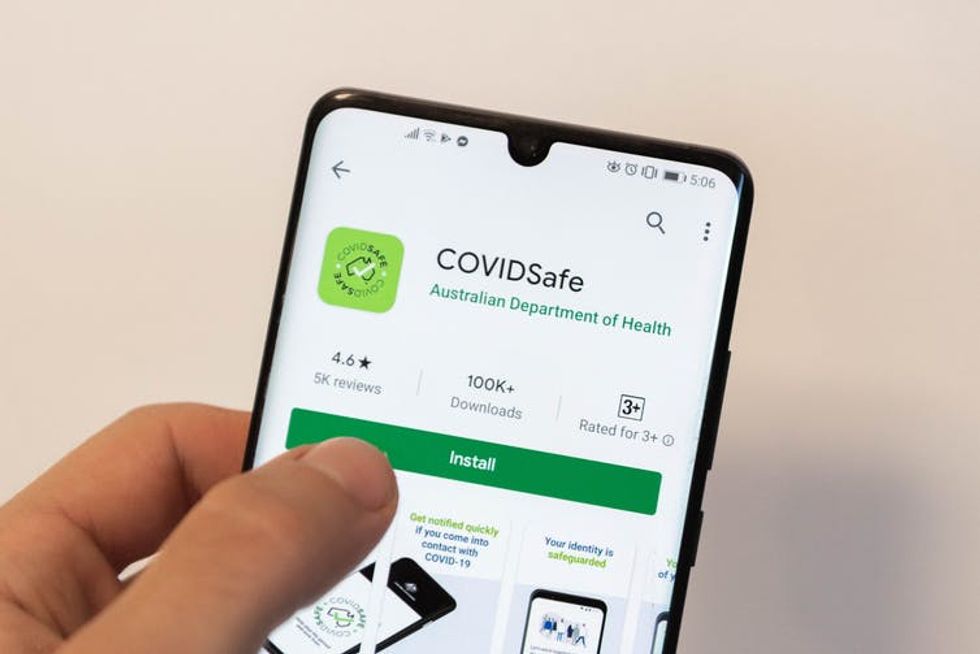
The Australian government’s COVIDSafe app warns about close encounters with people who are COVID-19-positive, but unlike the Apple-Google system, COVIDSafe reports the contacts to public health authorities.
Most of the competing proposals use a similar approach. The principal difference is that Apple’s and Google’s operating system updates reach far more phones automatically than a single app can. Additionally, by proposing a cross-platform standard, Apple and Google allow existing apps to piggyback and use a common, compatible communication approach that could work across many apps.
No plan is perfect
The Apple-Google exposure notification system is very secure, but it’s no guarantee of either accuracy or privacy. The system could produce a large number of false positives because being within Bluetooth range of an infected person doesn’t necessarily mean the virus has been transmitted. And even if an app records only very strong signals as a proxy for close contact, it cannot know whether there was a wall, a window or a floor between the phones.
However unlikely, there are ways governments or hackers could track or identify people using the system. Bluetooth LE devices use an advertising address when broadcasting on an advertising channel. Though these addresses can be randomized to protect the identity of the sender, we demonstrated last year that it is theoretically possible to track devices for extended periods of time if the advertising message and advertising address are not changed in sync. To Apple’s and Google’s credit, they call for these to be changed synchronously.
But even if the advertising address and a coronavirus app’s rolling identifier are changed in sync, it may still be possible to track someone’s phone. If there isn’t a sufficiently large number of other devices nearby that also change their advertising addresses and rolling identifiers in sync – a process known as mixing – someone could still track individual devices. For example, if there is a single phone in a room, someone could keep track of it because it’s the only phone that could be broadcasting the random identifiers.
Another potential attack involves logging additional information along with the rolling identifiers. Even though the protocol does not send personal information or location data, receiving apps could record when and where they received keys from other phones. If this was done on a large scale – such as an app that systematically collects this extra information – it could be used to identify and track individuals. For example, if a supermarket recorded the exact date and time of incoming rolling proximity identifiers at its checkout lanes and combined that data with credit card swipes, store staff would have a reasonable chance of identifying which customers were COVID-19 positive.
And because Bluetooth LE advertising beacons use plain-text messages, it’s possible to send faked messages. This could be used to troll others by repeating known COVID-19-positive rolling proximity identifiers to many people, resulting in deliberate false positives.
Nevertheless, the Apple-Google system could be the key to alerting thousands of people who have been exposed to the coronavirus while protecting their identities, unlike contact tracing apps that report identifying information to central government or corporate databases.
Karen Pence went on Fox News to explain why her husband failed to wear a required mask during a visit this week to the Mayo Clinic.
Vice President Mike Pence drew widespread condemnation when he declined to wear a protective mask during a tour of the medical clinic, and "Fox & Friends" co-host Ainsley Earhardt asked his wife to explain.
"That's a great question as our medical experts have told us wearing a masks prevents you from spreading the disease and knowing that he doesn't have COVID-19, he didn't wear one," Pence said.
That was the explanation offered by the vice president after facing criticism, but his wife offered a new excuse.
"It was actually after he left Mayo Clinic that he found out that they had a policy of asking everyone to wear a mask," she said. "Someone has worked on this whole task force for over two months is not someone who would have done anything to offend anyone or scare anyone. I'm glad that you gave me the opportunity to talk about that."
Blood tests that check for exposure to the coronavirus are starting to come online, and preliminary findings suggest that many people have been infected without knowing it. Even people who do eventually experience the common symptoms of COVID-19 don’t start coughing and spiking fevers the moment they’re infected.
How common is it for people to contract and fight off viruses without knowing it?
In general, having an infection without any symptoms is common. Perhaps the most infamous example was Typhoid Mary, who spread typhoid fever to other people without having any symptoms herself in the early 1900s.
My colleagues and I have found that many infections are fought off by the body without the person even knowing it. For example, when we carefully followed children for infection by the parasite Cryptosporidia, one of the major causes of diarrhea, almost half of those with infections showed no symptoms at all.
For the most part, symptoms are actually a side effect of fighting off an infection. It takes a little time for the immune system to rally that defense, so some cases are more aptly considered presymptomatic rather than asymptomatic.
How can someone spread coronavirus if they aren’t coughing and sneezing?
Everyone is on guard against the droplets that spray out from a coronavirus patient’s cough or sneeze. They’re a big reason public health officials have suggested everyone should wear masks.
But the virus also spreads through normal exhalations that can carry tiny droplets containing the virus. A regular breath may spread the virus several feet or more.
Spread could also come from fomites – surfaces, such as a doorknob or a grocery cart handle, that are contaminated with the coronavirus by an infected person’s touch.
What’s known about how contagious an asymptomatic person might be?
No matter what, if you’ve been exposed to someone with COVID-19, you should self-quarantine for the entire 14-day incubation period. Even if you feel fine, you’re still at risk of spreading the coronavirus to others.
Most recently it has been shown that high levels of the virus are present in respiratory secretions during the “presymptomatic” period that can last days to more than a week prior to the fever and cough characteristic of COVID-19. This ability of the virus to be transmitted by people without symptoms is a major reason for the pandemic.
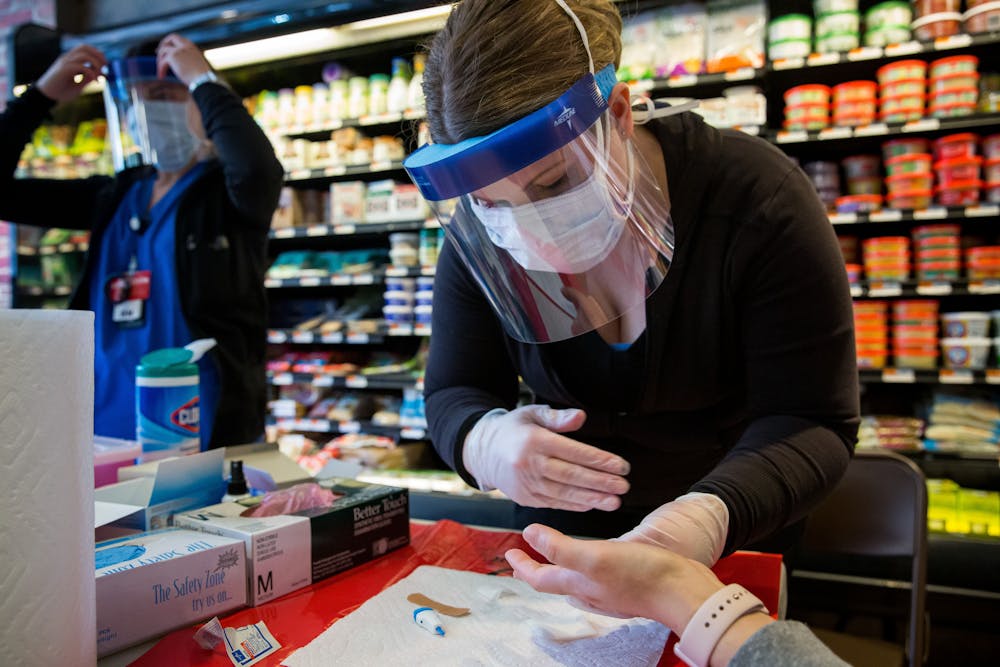
To find out what percentage of people have anti-coronavirus antibodies in their blood, health departments are starting to sample the public, as at this grocery store in New York.
After an asymptomatic infection, would someone still have antibodies against SARS-CoV-2 in their blood?
Most people are developing antibodies after recovery from COVID-19, likely even those without symptoms. It is a reasonable assumption, from what scientists know about other coronaviruses, that those antibodies will offer some measure of protection from reinfection. But nothing is known for sure yet.
Recent serosurveys in New York City that check people’s blood for antibodies against SARS-CoV-2 indicate that as many as one in five residents may have been previously infected with COVID-19. Their immune systems had fought off the coronavirus, whether they’d known they were infected or not – and many apparently didn’t.
How widespread is asymptomatic COVID-19 infection?
No one knows for sure, and for the moment lots of the evidence is anecdotal.
For a small example, consider the nursing home in Washington where many residents became infected. Twenty-three tested positive. Ten of them were already sick. Ten more eventually developed symptoms. But three people who tested positive never came down with the illness.
When doctors tested 397 people staying at a homeless shelter in Boston, 36% came up positive for COVID-19 – and none of them had complained of any symptoms.
The antibody serosurveys getting underway in differentparts ofthe country add further evidence that a good number – possibly anywhere from around 10% to 40% – of those infected might not experience symptoms.
Asymptomatic SARS-CoV-2 infection appears to be common – and will continue to complicate efforts to get the pandemic under control.
A federal judge blocked the Trump administration Monday from passing out coronavirus relief funds intended to help Native American communities to certain for-profit corporations owned by Natives.
The decision came after the Treasury Department made Alaska Native Corporations (ANCs) eligible for $8 billion in funding allocated by Congress to help Native American tribes. ANCs serve as holding companies for businesses that benefit from Native lands. There are about 237 ANCs in Alaska.
Treasury Secretary Steven Mnuchin argued that Congress “expressly chose to include ANCs” in its definition of “Indian tribe” in the CARES Act. But in a letter to Mnuchin, 12 House Democrats, including all four Native American members of Congress, argued that the “spirit and language” of the bill was to allocate the money to tribal governments — not ANCs.
Sen. Tom Udall, D-N.M., the vice chairman of the Senate Indian Affairs Committee, said in a separate letter to Mnuchin that Congress intended the funds solely for tribal governments so “they can continue essential government services.”
“Non-governmental tribal entities may well warrant relief under other CARES Act programs, but this funding in this title was intended for tribal governments and should not be diverted,” he said.
U.S. District Court Judge Amit Mehta agreed Monday that giving “dollars to for-profit corporations does not jibe” with the law’s “general purpose of funding the emergency needs of ‘governments.'”
The administration argued that ANCs could deliver services to communities like a tribal government, but Mehta said there was no evidence that ANCs were providing public services during the crisis. He also took issue with the government’s claim that the Treasury Inspector General could simply take back the money if it was improperly distributed.
“That seems unlikely,” Mehta said.
Mehta issued a preliminary injunction blocking the department from giving the funds to ANCs but stopped short of the tribes’ request to immediately send the $8 billion to tribal governments.
“Plaintiffs easily satisfy their burden to show that they will suffer irreparable injury in the absence of immediate injunctive relief,” Mehta ruled. “The $8 billion dollars allocated by Congress for ‘tribal governments’ is a fixed sum that plaintiffs and other tribal governments are entitled to receive to cover costs of combatting the COVID-19 pandemic in their communities . . . Any dollars improperly paid to ANCs will reduce the funds to plaintiffs. And, once disbursed, those funds will not be recoverable by judicial decree.”
Tribal leaders celebrated their win as they vowed to continue to fight for the money that was already allocated to them.
“Our voices were heard and our people prevailed today!” Navajo Nation President Jonathan Nez said. “I’m sure there will be other attempts to direct these funds away from tribes,” he added, vowing to continue to fight “for our fair share of the CARES Act funding.”
Congress clearly intended these governments — not Alaska corporate interests — to utilize the limited amount of CARES Act funds for recovery in Indian Country,” Cherokee Nation Principal Chief Chuck Hoskin Jr. said in a statement. “Tribes are leading the effort across the country to respond to COVID-19. Today’s win is a victory for these tribal governments, who will use this funding source as intended, to bravely lead and guide decisions best for our people in the midst of one of the greatest public health crisis in generations.”
"Fox & Friends" co-host Ainsley Earhardt appeared annoyed after co-host Brian Kilmeade snidely tried to downplay the risk her sick mother faced from COVID-19.
During a segment about California closing down its beaches to prevent further outbreaks, Earhardt said that she sympathized with Gov. Gavin Newsom, who had to make a tough public health decision aimed at saving lives.
"The beach was open and people could make their decisions -- the problem is, though, they started seeing more people go to the hospitals after that weekend," she said. "The governors have to make tough decisions because they don't want a relapse in all this, that wouldn't make them look good. Their residents would be dying!"
Earhardt then made her plea personal by mentioning that her own mother would be very vulnerable to the disease were she to contract it.
"My mom is very sick," she said. "And as much as I want to go out, I still want everyone to play by the rules, because when I finally do get to go home to visit her..."
"But is your mom going to the beach?" Kilmeade interrupted, in an attempt to play down her fears.
"No, but Brian... eventually she's going to be around family again," Earhardt tersely replied. "I understand both sides, I really do, I just don't want a resurgence of this!"
Dr. Anthony Fauci touted an experimental drug from Gilead Sciences that shows great promise for treating coronavirus, but it does not appear to be a desperately needed cure.
Remdesivir helped coronavirus patients leave the hospital sooner in an as-yet unpublished but rigorously designed trial by the National Institutes of Health, but experts cautioned against getting too hopeful, reported Axios.
"Remdesivir is a real drug for COVID," Umer Raffat, a pharmaceutical analyst at Evercore ISI, told investors, "but again, not a silver bullet."
Experts say the primary outcome was changed during the trial, and a separate randomized trial did not produce the same promising results.
The drug also produces the best results before infections get too serious, so its efficacy is limited.
"Its availability is not going to move the needle on social distancing relaxation," tweeted physician and drug researcher Peter Bach.
A person was arrested early Thursday after opening fire on the Cuban embassy in Washington, the US Secret Service said. No one was injured.
The unidentified person fired multiple rounds from what some reports said was a high-powered assault rifle.
"This morning at approximately 2:15 am, US Secret Service officers responded to the Embassy of Cuba following reports of shots fired," the Secret Service said in a statement.
"One individual was arrested for being in possession of an unregistered firearm as well as unregistered ammunition, assault with the intent to kill, and possession of a high capacity feed device.
"No injuries were reported at the scene."
The administration of President Donald Trump has chilled relations with Havana after they were opened up by his predecessor Barack Obama.
In October 2017, it expelled 15 Cuban diplomats after a rash of incidents in which US embassy staff in Cuba reported as yet unexplained head pains, dizziness and hearing loss.