A talk radio caller suggested vaping bleach as a possible treatment for coronavirus, and conservative host Jeff Kuhner assured him the recommendation wasn't crazy.
The caller, who identified himself as Zack from Stoughton, called into Boston's WRKO-AM on Friday morning to talk about President Donald Trump's dangerous suggestion to use disinfectants or powerful light internally to treat COVID-19.
"I've been thinking about this thing," Zack began. "I was a smoker for years, I smoked about three packs a day, and I never liked this new vape thing coming out with the nicotine in it, but I also have a bunch of friends with big cleaning companies."
After hearing an ad on Kuhner's program offering a disinfecting service during the pandemic, Zack said he started connecting the dots and wondered whether vape pens could deliver bleach and other disinfecting chemicals into infected lungs.
"Maybe they could make some sort of vape that could help people, you know, that would atomize chemicals into your lungs and you could blow it out your nose," Zack said. "Thinking outside the box is what we need to do now, and no one seems to want to do it. I don't know if I'm crazy."
The host assured the caller his idea was sound.
"No, you're not," Kuhner said. "Zack, you're not crazy, and bingo -- you said the word, you said the phrase. Thank you for that call. Thinking outside the box."
"That's literally what the president was doing yesterday," Kuhner added. "That's what a good chief executive does."
The Environmental Protection Agency issued a warning following Trump's remarks that disinfectant was intended for use only on surfaces, and not internally or topically.
“Never apply the product to yourself or others," the EPA warned. "Do not ingest disinfectant products."
Most disinfecting products, including chlorine and alcohol, are also hazardous when inhaled in large enough amounts.
Here’s an awful truth our government will tell you but not for some weeks to come: as of today more than 20% of American workers are unemployed.
That means more than 32 million Americans in the labor force are without work, the vast majority because of the coronavirus pandemic.
That’s a conservative estimate, for reasons explained below, based on my analysis of the official federal government reports.
The portion of American workers without work is now at its highest level since the Great Depression, though the Bureau of Labor Statistics announcements confirming this won’t show it until the first week of May or, more likely, in June or July. The bureau’s monthly announcements are based on data through the midpoint of the previous month.
In 1933, unemployment peaked at just short of 25%. It was 23.6% in 1932, the year voters chose Franklin D. Roosevelt for the White House.
Since then the highest jobless rate was 19% in 1937. The highest rate since World War II was 10.8% in 1982 when Ronald Reagan was president.
In this century the peak jobless rate was 9.9% in 2009 as the Great Recession that began under President George W, Bush consumed much of the wealth of the middle class and minorities, while Congress made financial investors richer than ever by bailing out Wall Street and turning its back on most homeowners.
Estimating Job Losses
How did I come up with these numbers, 20% jobless and 32 million Americans out of work?
In February 4.4% of the labor force was unemployed, the federal Bureau of Labor Statistics reported on March 9. That was 7.1 million people out of work using the government’s narrowest measure of joblessness, known as U-3. Using a much broader measure known as U-6 the jobless rate at the start of March was 8.7%.
Over the next seven weeks initial claims for unemployment benefits were filed by nearly 24.9 million American workers.
Add those two numbers: 32 million people are without work as of last week.
That’s 19.7% of the labor force.
More and More Claims Filed
If just a half million people filed jobless claims between April 20 and today the unemployment rate has exceeded 20%. Does anyone reasonably expect that the initial unemployment benefit claims report that we will get on April 30 will be that small?
I asked Jeff Faux, a founder of the Economic Policy Institute, about my numbers. ‘“At least 20 percent”’ is certainly reasonable, indisputable, I think,” Faux replied. “Given those who don’t qualify for UI [unemployment insurance] or otherwise don’t get picked up, it is a most probably an undercount.”
Elise Gould, another EPI economist, noted that “the latest UI claims data from today, these job losses translate into an unemployment rate of 18.3%. But that doesn’t tell the whole story” which you can read here.
Dean Baker, another liberal economist, said he wants to “focus on the prime age employment rates -- likely down by around 15 percentage points.” Prime age is age 25 to 54 so it excludes college students and people who retire early.
No matter whose figures you decide to rely on, the jobless numbers would be higher but for the state systems for claiming jobless benefits being overwhelmed. Many people have reported they cannot complete their claims and others say they are waiting until those systems are not so overwhelmed because they can file retroactively to when their employment ended.
California’s Employment Development Department is so overwhelmed that it has told of has told people on unemployment that they don’t need to report their efforts to find work. Normally people who don’t check in weekly to report their efforts to find work would be kicked off the unemployment benefit rolls.
We reported a month ago that before the pandemic seven of every eight jobless benefits claims in Florida was rejected. With the pandemic benefit seekers far outstrip the capacity of the state’s jobless benefit system to accept claims. That system, set up under Senator Rick Scott, then the Sunshine state’s Republican governor, was designed to reject applicants, critics charge.
$600 a week “too generous”
While there will be examples here and there of people who went off unemployment because they found jobs, overall the trend is to massive loss of jobs. In addition, many freelancers and gig workers could not even apply for benefits until last week and some are being turned away, further suppressing the official measures of joblessness.
Those $600 payments are also under attack as too generous. Senators Lindsay Graham of South Carolina and Ben Sasse of Nebraska are among those Republicans asserting that $600 a week is too generous, encouraging loafing instead of working.
Speaking with host John King, CNNWhite House correspondent John Harwood suggested there should be concerns about Donald Trump's mental stability after the president pitched using light and disinfectants as a possible cure for the coronavirus.
At Thursday's press conference the president proposed, "So supposing we hit the body with a tremendous — whether it’s ultraviolet or just a very powerful light. And then I said supposing you brought the light inside the body, which you can do either through the skin or some other way and I think you said you’re going to test that too."
He followed that with, "I see the disinfectant that knocks it out in a minute, one minute. And is there a way we can do something like that by injection inside or almost a cleaning? As you see it gets in the lungs, it does a tremendous number on the lungs, so it would be interesting to check that," which has caused more than a little consternation by health officials that the president might cause people to poison themselves if they listen to him.
Asked by host King what people are saying, Harwood stated the president''s comments created more questions about his grasp about what is going on.
"You could be generous to the president, John, and say was irresponsible when he was up there touting hydroxychloroquine before there was evidence it was going to be effective," Harwood began. "And now we see evidence suggesting maybe it was dangerous."
"This idea was so obviously nutty that the Lysol, the maker of one of the disinfectant products we were talking about, said the idea of ingesting disinfectant was something consumers absolutely should not do," the CNN correspondent continued. "The fact that the president should offer this idea, this nutty idea, seemingly unaware of how nutty it was puts into question an issue that we've danced around in the media for the last few years, which is: is the president all there? Is he connected with reality?"
"One of his former national security aides, Brett McGurk, tweeted this morning, 'you cannot get past the crazy in this white house.'" Harwood continued. " Think about that. It's hard to think about since President Trump is the leader regarding this coronavirus."
Move Comes During Height of First Wave of Pandemic
Roger Severino, a Christian right activist who heads the U.S. Dept. of Health and Human Services’s Office for Civil Rights is one step closer to his own personal goal of removing protections for LGBTQ patients, a move that would allow discrimination based on gender and sexual orientation.
Under Severino’s leadership the Trump administration has been moving quickly toward the final stages of dismantling critical protections for LGBTQ patients, Politico reports. The Dept. of Health and Human Services has sent a draft of its rewrite of an Obama-era policy to the Dept. of Justice for review, a sign it could soon announce the rollback of hard-fought regulations protecting some of the nation’s most vulnerable people.
HHS has been working on re-interpreting and re-writing the nondiscrimination provision of the Patient Protection and Affordable Care Act. The agency’s website currently says Section 1557 of the ACA “prohibits discrimination on the basis of race, color, national origin, sex, age, or disability in certain health programs or activities.”
“Advocates fear that it would allow hospitals and health workers to more easily discriminate against patients based on their gender or sexual orientation,” Politico reports, noting the provision “also offered specific protections for transgender patients for the first time and extended protections for women who had abortions.”
Severino has been called a “radical” anti-LGBTQ religious right activist. He previously served as CEO and counsel for the Becket Fund for Religious Liberty, a religious right non-profit that opposes separation of church and state. He also once served as the Director of the DeVos family’s Center for Religion and Civil Society in the Institute for Family, Community, and Opportunity.
Late last year a federal judge voided a rule Severino had implemented allowing medical providers to cite their personal religious or moral beliefs as a reason to refuse to provide care to certain individuals or to perform certain procedures. It would have allowed doctors and other health care professionals to refuse to perform or participate in abortions, prescribe or deliver contraception, or provide care to and LGBTQ person.
Severino is also tied to the Trump administration’s efforts to ban same-sex couples and LGBTQ people from adoption services.
Severino has long sought to gut ObamaCare’s LGBTQ protections. Before coming to the Trump administration Severino co-authored a Heritage Foundation report claiming new proposed ObamaCare nondiscrimination provisions “threaten the religious liberty, freedom of conscience, and independent medical judgment of health care professionals.”
Earlier in the week the president issued a threat against Iran on Twitter by writing, "I have instructed the United States Navy to shoot down and destroy any and all Iranian gunboats if they harass our ships at sea," which led Axios to report that the president has long been obsessed with Iran over the possibility the leaders of the country might do something to make him look weak.
As Swan writes, "President Trump's declaration about directing the Navy to 'shoot down and destroy' Iranian gunboats brings to a head his years of urging military leaders to get tougher on Iranian harassment at sea. Now — unlike in the days when James Mattis ran the Defense Department and often ignored what he viewed as intemperate orders from Trump — the president faces no meaningful resistance from his national security team."
Noting that "Trump often looks for shiny distractions during crises and has done so repeatedly in this case, " Swan claims that no one in the administration is surprised by the latest outburst by a president determined to look tough for his adoring fans.
"Trump lives in fear of Iran taking U.S. military personnel hostage. He wants, at all costs, to avoid scenes of American weakness and humiliation playing across the world's screens, current and former advisers say," Swan wrote. "He connects Iran — and its actions at sea in particular — to this image. Another factor: Trump views the subject of Iranian gunboats — as he does so many other things — through the prism of Barack Obama. He's told aides he'll never let U.S. sailors be filmed captured by Iran, on their knees."
The report points out that Trump has repeatedly requested that the Pentagon provide him with plans as to how they could go about blowing up what he calls Iran's "fast boats" in the Persian Gulf going back to former Defense Department head James Mattis who reportedly "refused to do so," with Swan adding, "He never provided the plans and simply ignored the requests of former national security adviser H.R. McMaster, according to three former officials involved in the deliberations."
Having written that, the Axios reporter noted that it would not be surprising if Pentagon officials took the president at his word and fired on the ships because "leadership of the Pentagon, State Department and National Security Council have largely aligned on this subject."
"Naval commanders have maximum flexibility with Trump as commander in chief. Trump has now made clear they won't be reprimanded if they decide to take him at his tweet," he concluded.
Speaking at the Q 2020 Virtual Summit this Wednesday, Christian author and former pastor Francis Chan raised a few eyebrows with comments he made regarding the coronavirus pandemic. According to Chan, God is using the virus to “prune the Church and cut off branches that aren't bearing fruit," The Christian Post reports.
“I hear a lot of talk of people being concerned about whether their church is going to survive,” Chan said, speaking via livestream. “The illustration I think of is, if I had a diamond right here, and I just smash it with a hammer, what would happen to that diamond? Nothing. If it's a real diamond, if it shatters, it wasn't real.”
“This is going to be a group that the gates of Hell can't stand against,” he continued. “No virus, no government, no economic this or that, life, death, nothing. And so we as believers are supposed to trust the words of Jesus and go, ‘The Church is going to be fine. If anything, this is the time where God is going to prune the Church and cut off branches that aren't bearing fruit, but it's only going to become more fruitful.’”
As The Christian Post points out, a recent survey found that six to nine percent of pastors are worried their church will not survive the lockdowns implemented to combat coronavirus. Forty-two percent of pastors said donations to their respective churches was "significantly" down and 28 percent said it was "slightly" down.
RNC Chairwoman Ronna McDaniel on Friday drew swift blowback after she said that President Donald Trump was the right man to fix the economy that collapsed on his watch.
In a tweet that was promoted by the president himself, McDaniel promoted Trump's past purported achievements on the economy as the top reason to reelect him later this year, despite the fact that the economy is currently in free fall.
"We have a decision as to who will restore our economy after this pandemic," she wrote. "Donald Trump has already done it once, and he is definitely the right person to do it again."
In reality, Trump's economy even before the pandemic hit wasn't all that different from the economy he inherited from former President Barack Obama.
While the unemployment rate continued to go down during the first three years of Trump's presidency, the monthly average job growth figures from 2017 through 2019 showed a slowdown in hiring compared to the last three years of Obama's presidency.
As CNN reported earlier this year, the economy added 7.9 million jobs over the last 35 months of Obama's presidency, compared to 6.7 million over the first 35 months of Trump's presidency.
McDaniel's promotion of Trump's economic prowess in the midst of an economic catastrophe earned her ridicule from her Twitter followers -- check out some reactions below.
Republican pollsters have identified a narrow slice of the electorate who may be persuaded to vote for President Donald Trump, but they're worried he's not trying hard enough to reach them.
Most Americans have already formed entrenched views about the president, but GOP pollsters have found that 36 percent of voters who disapproved of Trump's performance still say they liked some of his policies, reported The Atlantic.
“There are some that may not like his style, but support his policies, and in particular, his economic-nationalist argument,” said Trump pollster John McLaughlin, a veteran of dozens of GOP campaigns. “That’s the persuadable middle. That’s where the votes are.”
Another veteran Republican pollster, Neil Newhouse, echoed those recommendations.
“An issue like this — nationalism — could come into play," Newhouse said. "They may not like everything he’s doing, but they like the way he’s standing up to China.”
However, that nationalist message may not break through to voters who have lost their jobs or fear coronavirus infection, and some potentially persuadable voters just can't overlook their personal distaste for the president.
“You’re the best thing since sliced bread if you agree with him,” said Donald Scoggins, a 74-year-old moderate Republican from Virginia who voted for Trump in 2016. “The minute you don’t agree with him, he tends to denigrate you. That’s not an example we want for our youth.”
Trump may be forced to scapegoat China to deflect blame from himself if the death toll continues to rise and the economy remains moribund, and recent polls have found Americans don't trust what he says about the pandemic and feel the federal government's response was inadequate.
“I’d like him to not be focused on his own personal brand and vendettas,” said one Republican Senate aide. “There’s an opportunity for him to talk more about global economic policy, and it lines up well with what he said on the [2016] campaign. Most people look at China and they don’t like it, because it seems like jobs here are being taken away and everything has moved abroad. China is the poster child of that.”
Republicans are frustrated that Trump seems to be leaving the response up to Congress and the states, and some of them complained that GOP freshman Sen. Josh Hawley (R-MO) had come out with a more far-reaching plan than anything proposed by the president.
“On substantive plans, there’s been a hole from the White House,” said Doug Heye, a former RNC spokesperson. “Hawley is thinking big thoughts about these things — not just pushing back on China.”
It's difficult to predict what the political landscape will look like in November in the midst of an ongoing pandemic, but Republicans believe the president has two paths to re-election no matter what happens between now and then.
“If people are hopeful that things are going to improve — and people are pissed at China — the president is going to win by a lot,” said one Republican close to Trump’s campaign.
At his nightly coronavirus press briefing on Thursday, April 23, President Donald Trump suggested that household disinfectants such as Lysol could be ingested as a way to ward off coronavirus — an idea so dangerous that the manufacturers of Lysol, Reckitt Benckiser, had to warn users that their product should only be used as a disinfectant and should not be ingested under any circumstances. Trump is being lambasted on Twitter for making such a ridiculous suggestion — and some Twitter users are slamming the New York Times for going too far to achieve balance when reporting on it.
Twitter user @PaulWuster implied that what was real-life reporting from the New York Times on Trump’s press conference was the sort of parody that would be made up by “the staff of The Onion.” And @RemmieYeo, similarly, tweeted, “It’s like The Onion came to life to satirize 19th century America in the 21st.”
Trump repeatedly claims that the New York Times has a vendetta against him. But as some Twitter users see it, the Times went way overboard in its effort to be even-handed.
@BoiseJim7, quoting the Times, posted, “’Dangerously in the view of some experts’”- what the hell is wrong with your paper? It’s dangerous period! That’s an objective fact, not an opinion! Holy hell!” And @cluebcke described the Times’ reporting as “terminal both-sides-ism,” while @RationalWiki asked the Times, “Sirs, could you please detail for us the editorial process that leads to both-sidesing drinking bleach? Thank you.”
@DavMicRot wrote, “Cannot believe I need to write this, but: Despite what the @nytimes implies here in their pathetic attempt at False Equivalency, *ALL* experts agree that injecting yourself with bleach will kill you. So, do not listen to the President, it will kill you.
@Jmatonak sarcastically posted, “bleach keeps you young, so i’ve been told ’cause nobody who drinks it lives to get old!” And David Rothschild, @DavMicRot, tweeted, “Cannot believe I need to write this, but: Despite what the @nytimes implies here in their pathetic attempt at False Equivalency, *ALL* experts agree that injecting yourself with bleach will kill you. So, do not listen to the President, it will kill you.”
According to @gilmored85, “If you can’t state unequivocally that injecting yourself with disinfectants is bad, you have no business in journalism.”
UPDATE: The New York Times later rephrased their opening paragraph.
That paragraph now states, “On Thursday, he returned to that theme at the daily White House coronavirus briefing, bringing in a top administration scientist to back up his assertions and eagerly theorizing about treatments involving the use of household disinfectant that would be dangerous if put inside the body, as well as the power of sunlight and ultraviolet light.”
In a decidedly blunt column for the New York Times, Nobel Prize-winning economist Paul Krugman took Senate Majority Leader Mitch McConnell (R-KY) to the woodshed for suggesting that states should file for bankruptcy instead of asking the federal government for funds to deal with the COVID-19 health crisis.
In a word, he called the senior Republican's proposal: "stupid."
Under a headline that read, "McConnell to Every State: Drop Dead, " Krugman began, "Covid-19 has killed tens of thousands of Americans, and will clearly kill many more. The lockdown needed to contain the coronavirus is causing an economic slump several times as deep as the Great Recession. Yet this necessary slump doesn’t have to be accompanied by severe financial hardship. We have the resources to ensure that every American has enough to eat, that people don’t lose health insurance, that they don’t lose their homes because they can’t pay rent or mortgage fees. There’s also no reason we should see punishing cuts in essential public services."
Noting that McConnell "declared that he is opposed to any further federal aid to beleaguered state and local governments, and suggested that states declare bankruptcy instead," and adding that McConnell's office distributed two memos referring to proposals for state aid as “blue state bailouts,” Krugman highlighted some governors responding to the proposal "as stupid, which it is. But it’s also vile and hypocritical."
"When I say that we have the resources to avoid severe financial hardship, I’m referring to the federal government, which can borrow vast sums very cheaply. In fact, the interest rate on inflation-protected bonds, which measure real borrowing costs, is minus 0.43 percent: Investors are basically paying the feds to hold their money," the economist lectured. "So Washington can and should run big budget deficits in this time of need. State and local governments, however, can’t, because almost all of them are required by law to run balanced budgets."
"The obvious answer is federal aid. But McConnell wants states and cities to declare bankruptcy instead," Krugman wrote. "This is, as I said, stupid on multiple levels. For one thing, states don’t even have the legal right to declare bankruptcy; even if they somehow managed all the same to default on their relatively small debts, it would do little to alleviate their financial distress — although it could cause a national financial crisis."
The economist then focused on states like McConnell's that are being hard hit by more than the coronavirus.
"The idea that this is specifically a blue state problem is ludicrous. Fiscal crises are looming all across America, from Florida to Kansas to Texas — hit especially hard by crashing oil prices — to, yes, McConnell’s home state, Kentucky," he explained. "And if states and local governments are forced into sharp budget cuts, the effect will be to deepen the economic slump — which would be bad for Donald Trump and could cost Republicans the Senate. So yes, McConnell’s position is stupid. But it’s also vile."
"Last but not least, let’s talk about McConnell’s hypocrisy, which like his stupidity comes on multiple levels," the economist elaborated. "At one level, it’s really something to see a man who helped ram through a giant tax cut for corporations — which they mainly used to buy back their own stock — now pretend to be deeply concerned about borrowing money to help states facing a fiscal crisis that isn’t their fault. At another level, it’s also really something to see McConnell, whose state is heavily subsidized by the federal government, give lectures on self-reliance to states like New York that pay much more in federal taxes than they get back."
Summing up, the New York Times columnists said that there is more at play when McConnell made his pitch.
"Of course, McConnell has an agenda here: He’s hoping to use the pandemic to force afflicted states to shrink their governments. We can only hope both that this shameless exploitation of tragedy fails and that McConnell and his allies pay a heavy political price," he concluded.
The TrumpWhite House has corrected a transcript of Thursday's pandemic briefing that falsely made it look like Dr. Deborah Birx agreed that ultraviolet rays could be used to treat COVID-19.
NBC News reporter Shannon Pettypiece on Friday flagged a change in the official transcript that corrected an earlier error regarding Birx's reaction to Trump's rambling musings about using sunlight to treat coronavirus.
"Deborah, have you ever heard of that -- the heat and the light, relative to certain viruses, yes, but relative to this virus?" Trump asked Birx.
"That is a treatment," Birx replied in the original transcript, when in reality Birx said, "Not as a treatment."
Check out side-by-side comparisons of the two transcripts below.
There has been passionate – and honest – argument about how many people are likely to get sick and die under different circumstances and sets of official rules. It’s not clear how uncertain and evolving scientific findings should affect extraordinary government measures that restrict citizens’ basic freedoms.
CNBC’s Rick Santelli questions a part of the 2009 federal bailout plan.
Seeking authentic feelings
Dissent – and the freedom to do it – is a crucial element of democracy. Political leaders are rightly influenced by public opinion. But it’s important to know when protests are sparked by special-interest groups seeking to manipulate officials’ perception of public sentiment.
As a journalist who has covered politics for 20 years and now studies how people process uncertainty, I note that the questions about the current protests raise echoes of the Tea Party movement a decade ago.
In February 2009, the Obama administration was grappling with a severe economic crisis caused by a collapse in the mortgage market. A reporter on CNBC, Rick Santelli, began to complain that one part of the federal bailout plan, the Homeowner Affordability and Stability Plan, might let people out of their mortgage obligations even if they should have anticipated they wouldn’t be able to afford them and would face foreclosure.
Santelli made this point on TV while standing on the floor of the Chicago Mercantile Exchange, surrounded by very wealthy traders who egged him on. It was compelling entertainment, and the speech spread rapidly through conservative media. Radio host Rush Limbaugh replayed it on his show; conservative strategists admired it, and millions of conservatives heard it.
Santelli called for a modern-day “tea party” to object to unfair government rules.
Within months, a coalition of anti-immigration reform activists, fiscal hawks, regulation opponents and social conservatives pulled together behind a common set of grievances: Barack Obama’s alleged profligate spending, his willingness to let certain groups get ahead in the economy over other groups – policies that many of them viewed as putting racial minorities at a perceived advantage to white people.
Calling themselves the Tea Party movement, most members were Republicans – but the Republican Party wasn’t speaking for them, so the nation’s two-party structure itself became a common enemy, too. When the Tea Party held its first protests, thousands of people showed up. As the protests spread, motivated partisans who look for opportunities to change attitudes and behaviors, backed by a conservative political funding machine, developed a way to capture the protest energy and channel it effectively.
Authentic protest – like how the Tea Party movement began – is a longstanding American tradition.
Social scientists who study new movements in politics find that the underlying sentiments are as old as civilization itself: Who gets the stuff that the government gives out? What’s fair? Who’s jumped the line?
The movement needs a common enemy – in that case, Obama, his policies and a political structure that permitted them – and the potential for real change, not just politically but socially as well. For those joining the Tea Party, the goal became clear: They could take over the Republican Party.
Fairly quickly, the Tea Party was co-opted by wealthier interests hoping to channel its energy toward slightly different ends – although much of the movement resisted the corporate takeover of its message. Public opinion surveys backed up the intuition that the movement had force.
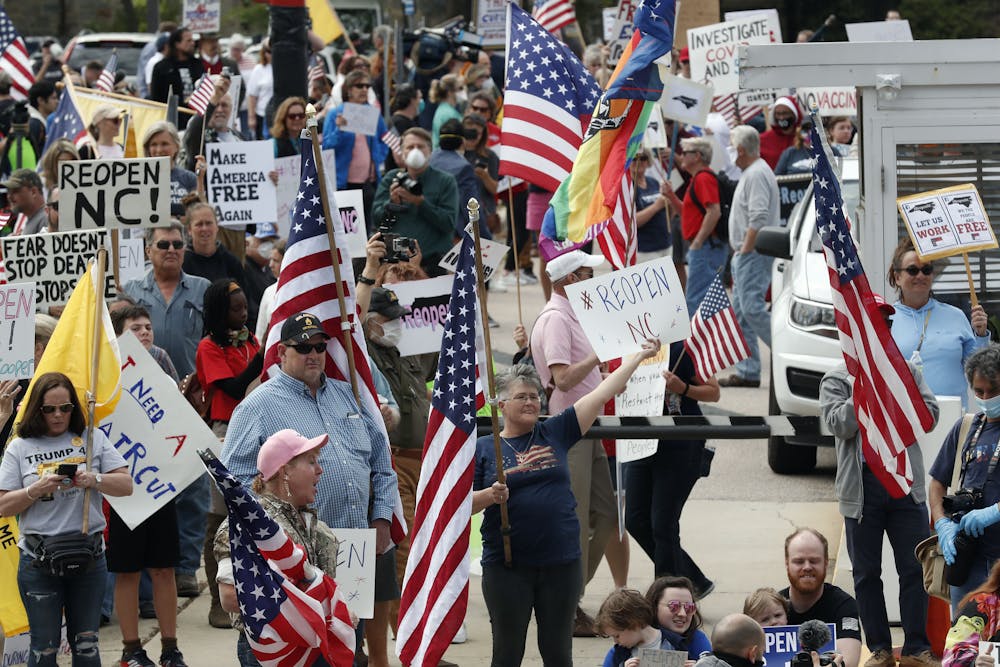
A North Carolina protest was ostensibly coordinated by ReopenNC, whose website was registered by a Florida resident and focuses on selling T-shirts and stickers.
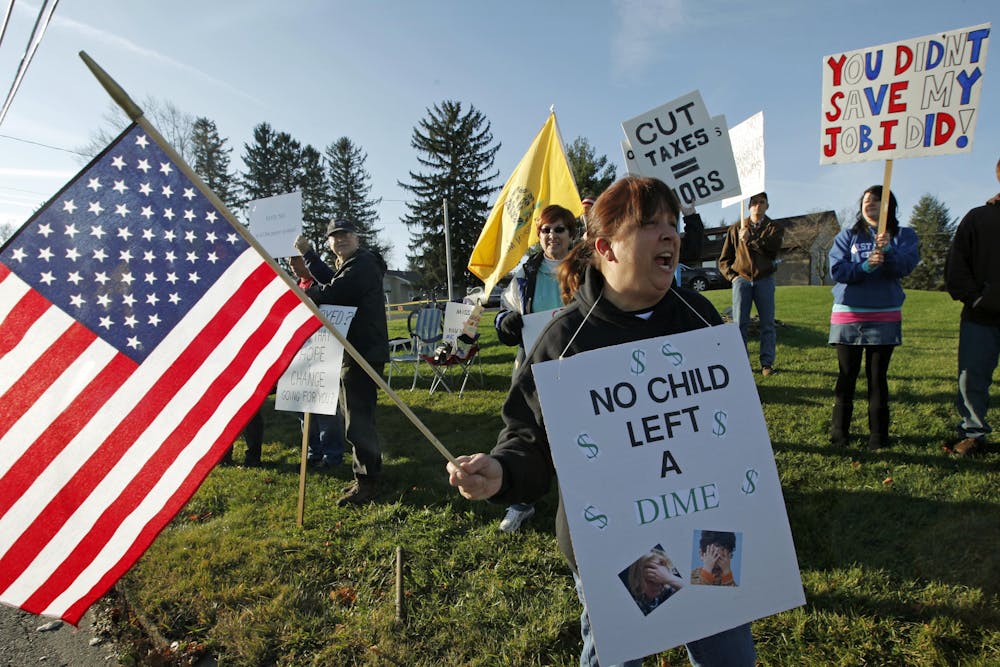
In mid-April 2020, it appeared, a new movement was rising to express frustration with the restrictions and uncertain endpoint to the pandemic, and the economic toll the lockdown has caused.
In the space of several days, there were protests in a dozen states, ranging from a crowd of more than 2,000 who gathered in Olympia, Washington, to several dozen in Annapolis, Maryland.
The available evidence suggests that the demonstrations were organized by paid political operatives using Facebook and new websites to encourage conservatives to protest in specific places against specific governors who had imposed strong public health restrictions on economic activity. This context indicates that one real intention of the protests was to create the illusion of an organic movement that had arisen to object to the restrictions. Evidence is to the contrary: Polling shows that just 12% of Americans think their local restrictions have gone too far – and 26% think they don’t go far enough.
He found that many of these websites, whose registration records you can see yourself at Whois.com, were owned by anti-gun-control groups that are run by the same family of brothers that organized the demonstrations through Facebook groups they run.
Several others of the “reopen” websites were registered with addresses or phone numbers used by longstanding conservative enterprises like Freedom Works. A surprising number belonged to an activist who told Mother Jones that he registered the domains to keep conservatives from using them to counter the recommendation of public health officials.
The ‘Reopen North Carolina’ website focuses on selling merchandise.
But that creates a sense that these protests grew quickly, spontaneously, and organically. The fact that protests happened in different places at different times doesn’t actually mean they’re spreading. When organized by the same small group of political operatives, sequential protests reflect the creators’ skill at mobilizing people – not a naturally rising level of frustration that ultimately pushes people to act.
Many political movements use these tactics. The problem comes from how the media presents the resulting events. On April 21, a labor union organized a protest by nurses at the White House – and media reports noted the event was created by a particular group with a specific purpose. That’s different from how the media treated the “reopen” gatherings.
During the 1970s when I was growing up in Southern California, the air was so polluted that I was regularly sent home from high school to “shelter in place.” There might not seem to be much in common between staying home due to air pollution and staying home to fight the coronavirus pandemic, but fundamentally, both have a lot to do with aerosols.
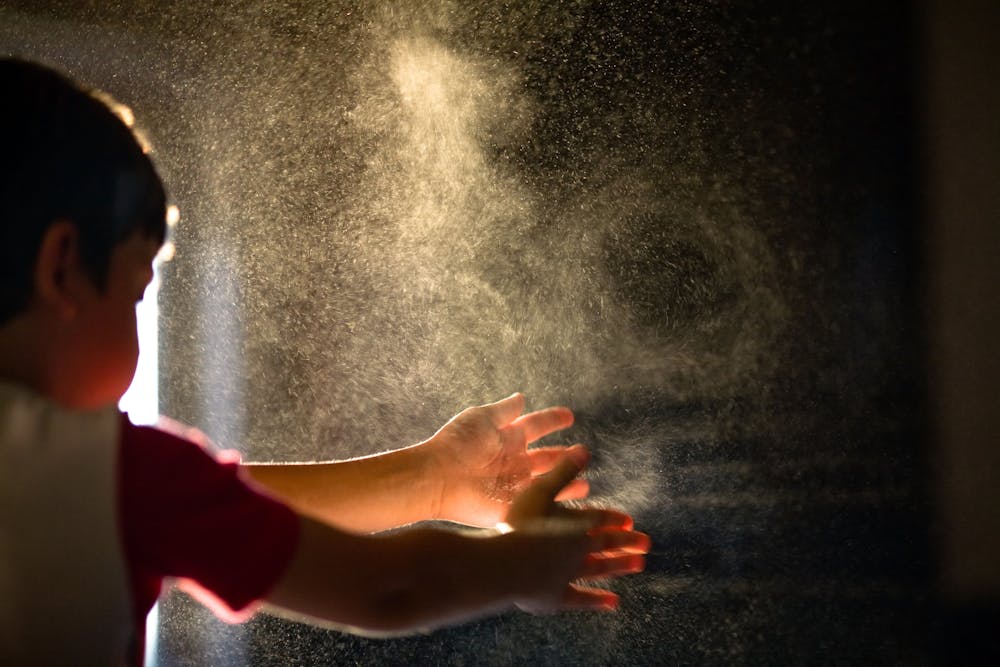
Aerosols are the tiny floating pieces of pollution that make up Los Angeles’ famous smog, the dust particles you see floating in a ray of sunshine and also the small droplets of liquid that escape your mouth when you talk, cough or breathe. These small pieces of floating liquids can contain pieces of the coronavirus and can be major contributor to its spread.
If you walk outside right now, chances are you will see people wearing masks and practicing social distancing. These actions are in large part meant to prevent people from spreading or inhaling aerosols.
I am a professor of mechanical engineering and study aerosols and air pollution. The more people understand how aerosols work, the better people can avoid getting or spreading the coronavirus.
An aerosol is a clump of small liquid or solid particles floating in the air. They are everywhere in the environment and can be made of anything small enough to float, like smoke, water or coronavirus-carrying saliva.
When a person coughs, talks or breathes, they throw anywhere between 900 to 300,000 liquid particles from their mouth. These particles range in size from microscopic – a thousandth the width of a hair – up to the size of a grain of fine beach sand. A cough can send them traveling at speeds up to 60 mph.
Size of the particle and air currents affect how long they will stay in the air. In a still room, tiny particles like smoke can stay airborne for up to eight hours. Larger particles fall out of the air more quickly and land on surfaces after a few minutes.
By simply being near other people, you are coming into constant contact with aerosols from their mouth. During a pandemic this a little more concerning than normal. But the important question is not do exhaled aerosols exist, rather, how infectious are they?
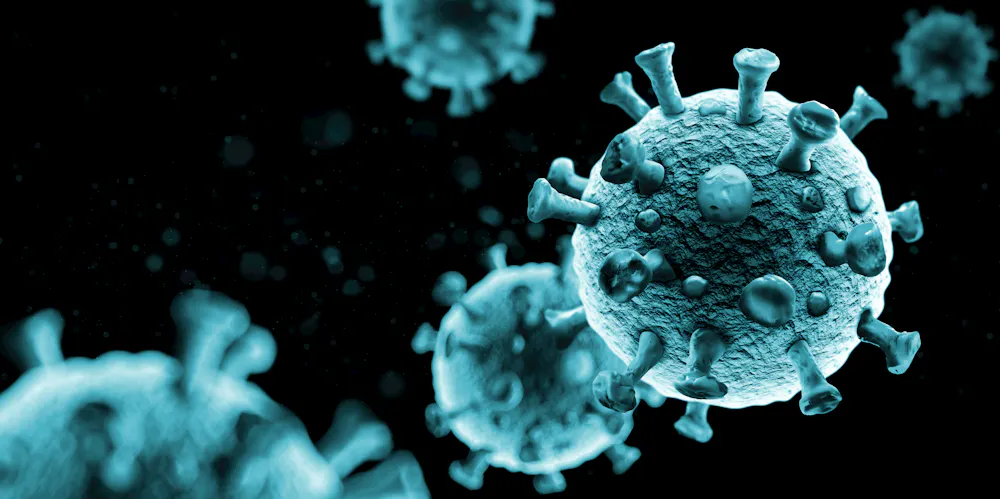
The coronavirus is small and easily transported by airborne particles of saliva.
The new coronavirus, SARS-CoV-2, is tiny, about 0.1 microns - roughly 4 millionths of an inch - in diameter. Aerosols produced by people when they breathe, talk and cough are generally between about 0.7 microns to around 10 microns – completely invisible to the naked eye and easily able to float in air. These particles are mostly biological fluids from people’s mouths and lungs and can contain bits of virus genetic material.
Researchers don’t yet know how many individual pieces of SARS-CoV-2 an aerosol produced by an infected person’s cough might hold. But in one preprint study, meaning it is currently under peer review, researchers used a model to estimate that a person standing and speaking in a room could release up to 114 infectious doses per hour. The researchers predict that these aerosolized bits of saliva would easily infect other people if this happened in public indoor spaces like a bank, restaurant or pharmacy.
Another thing to consider is how easy these particles are to inhale. In a recent computer model study, researchers found that people would most likely inhale aerosols from another person that is talking and coughing while sitting less than 6 feet away.
While this seems bad, the actual process from exposure to infection is a complicated numbers game. Often, viral particles found in aerosols are damaged. A study looking at the flu virus found that only 0.1% of viruses exhaled by a person are actually infectious. The coronavirus also starts to die off once it has left the body, remaining viable in the air for up to three hours. And of course, not every aerosol coming from an infected person will contain the coronavirus. There is a lot of chance involved.
Public health officials still don’t know whether direct contact, indirect contact through surfaces, or aerosols are the main pathway of transmission for the coronavirus. But everything experts like myself know about aerosols suggests that they could be a major pathway of transmission.
Aerosol driven outbreaks have been linked to restaurants, shops and many other public places.
It is almost impossible to study viral transmission in real time, so researchers have turned to environmental sampling and contact tracing to try to study the spread of the coronavirus in aerosols. This research is happening extremely fast and most of it is still under peer review, but these studies offer extremely interesting, if preliminary, information.
But environmental sampling alone cannot prove aerosol transmission. That requires contact tracing.
One restaurant in Guangzhou, China, was the site of a small outbreak on Jan. 23 and offers direct evidence of aerosol transmission. Researchers believe that there was one infected but asymptomatic person sitting at a table in the restaurant. Because of the air currents circulating in the room due to air conditioning, people sitting at two other tables became infected, likely because of aerosols.
Once outside, these potentially infectious aerosols disappear in the expanse of the atmosphere and are much less of a worry. It is of course possible to catch the virus outside if you are in close contact with a sick person, but this seems very rare. Researchers in China found that only one of 314 outbreaks they examined could be traced back to outdoor contact.
There has been recent concern over aerosol transmission during running and biking. While the science is still developing on this, it is probably wise to give other bikers or runners a little more room than normal.
Wearing masks and social distancing reduce the risk of spreading or inhaling aerosols.
With all of this knowledge of how aerosols are produced, how they move and the role they play in this pandemic, an obvious question arises: what about masks?
The Centers for Disease Control and Prevention recommends wearing a face mask in any public setting where social distancing is hard to do. This is because homemade masks probably do a reasonable job of blocking aerosols from leaving your mouth. The evidence generally supports their use and more research is coming to show that masks can be very effective at reducing SARS-CoV-2 in air. Masks aren’t perfect and more studies are currently underway to learn how effective they really are, but taking this small precaution could help slow the pandemic.
Other than wearing a mask, follow common sense and the guidance of public health officials. Avoid crowded indoor spaces as much as possible. Practice social distancing both inside and outdoors. Wash your hands frequently. All of these things work to prevent the spread of the coronavirus and can help keep you from getting it. There is a significant amount of evidence that COVID-19 is transmitted by the inhalation of airborne particles, but by carefully following the advice of experts, individuals can minimize the risk they pose.