Writing in the Washington Post this Thursday, Jennifer Rubin took Senate Majority Leader Mitch McConnell to task over his desire to allow states to declare bankruptcy instead of giving them unrestricted funds from the coronavirus relief bill. "He blithely declares, after spending trillions of dollars on everything from airline bailouts to small-business loans to enhanced employment that we shouldn’t borrow to fund state and local governments," she writes. "He might want to check back with the folks in Kentucky."
According to Rubin, McConnell's position is "politically dumb" and if he wants the economy to rebound, allowing states and cities to flounder is not the way to do it. As a political matter, the move is hugely damaging to Republicans as well.
With both Democrats and Republicans opposed, McConnell’s position makes no practical or political sense, Rubin writes.
"It’s the Herbert Hoover mentality all over again, as though fiscal tightening is the antidote to recession," Rubin continues. "It nevertheless is revealing of the ongoing contempt many Republicans (including many in the donor class) have for good governance and active, nimble government. The position is entirely out of step with popular opinion that wants government action now."
The coronavirus pandemic is both a health crisis and an economic crisis. According to researchers at John Hopkins University in Baltimore, COVID-19 had killed at least 184,372 people worldwide as of early Wednesday morning, April 23. And a variety of economic voices, from liberal New York Times columnist Paul Krugman to Desmond Lachman of the conservative but non-Trumpian American Enterprise Institute (AEI) are warning that the United States’ economic recovery will be long and difficult. But according to recent articles in The Bulwark and the New York Times, coronavirus has also become something else in the United States: a Culture War issue.
According to journalist Charlie Sykes (who co-founded The Bulwark with fellow Never Trump conservative Bill Kristol in late 2018 following the demise of the Weekly Standard), President Donald Trump and his allies in the Republican Party have managed to make coronavirus a referendum on identity politics.
“This weekend, we got a good look at where the arc of conservative activism is heading,” Sykes explains. “The death toll in the United States from the coronavirus has now topped 40,000, but — egged on by presidential tweets — packs of flag-waving, maskless protesters across the country defied stay-at-home orders to demand that the country reopen quickly.”
Sykes goes on to say, “It’s too early to know whether the protests will become vectors of disease. But it’s already abundantly clear they have become vectors of stupidity in an already exceptionally stupid time. And Trump World and the GOP are both all-in on them…. Many of the protests devolved into festivals of recklessness and crackpottery, complete with conspiracy theorists, Confederate flags, gun-wielding cosplay, and chants of ‘lock her up.’”
Other examples of Culture War “infantilism” that have asserted themselves during far-right anti-shutdown protests, Sykes observes, include protestors chanting “Fire Fauci”— a reference to Dr. Anthony Fauci, who is part of Trump’s coronavirus task force along with Dr. Deborah Birx — and describing Birx and Microsoft’s Bill Gates as “treasonous.” A protestor in Madison, Wisconsin, Sykes adds, was proudly displaying a sign that read, “No tests, no vaccine, no masks.”
Meanwhile, New York Times reporter Jeremy W. Peters cites other ways in which coronavirus has been turned into a Culture War issue — from white Christian fundamentalists claiming that social distancing is anti-religion to wingnuts claiming that anti-coronavirus measures are an attack on gun owners.
“For now,” Peters reports, “Mr. Trump is speaking to the minority of Americans who believe the government has gone too far in trying to contain the threat from the virus. And he is doing so by spreading misinformation and innuendo about how the restrictions affect issues like gun ownership and freedom of worship. He falsely claimed last week, for instance, that the Second Amendment was under threat in Virginia.”
"Fox & Friends" co-host Brian Kilmeade went on a rant Thursday morning, defending Attorney General Bill Barr while attacking the media, including MSNBC's Andrea Mitchell, and Michigan's Gov. Gretchen Whitmer, over coronavirus policies.
At issue for Kilmeade is anyone who dares to question President Donald Trump's Attorney General, who one federal judge just last month "excoriated" for lying about Robert Mueller's report while calling into question his “credibility."
Barr is threatening states who are not immediately re-opening with possible legal action, falsely suggesting governors do not have the power to shut down their states and claiming stay-at-home guidelines are "disturbingly close to house arrest," which is false.
U.S. Senator Richard Blumenthal (D-CT) accused Barr of "seemingly acting as a Trump political operative, not law enforcer."
But Kilmeade, who opposes stay-at-home orders and supports immediate opening of the states, isn't having this, and insists on defending the Attorney General.
Rattling off a list of states who will also soon re-open, Kilmeade declares, "Georgia, you're about to get some company."
Georgia's governor has told a large variety of businesses they should re-open on Friday, and more this coming Monday.
"It's going to be intriguing," Kilmeade said of what will happen when all these states re-open, and coronavirus cases spike as a result.
"Andrea Mitchell makes a comment: 'Is the Attorney General a doctor?' No," Kilmeade says. "But neither is she."
"Neither is Gov. Whitmer, who tells us not to buy seed or home improvement products," Kilmeade says, of Michigan's governor who is fighting for the health and safety of her state's residents. Both Mitchell and Whitmer cite medical experts or prevailing medical guidance. Kilmeade does not.
"It's the oppressive things they're doing within the state that the Attorney General has the audacity to say, 'I care about people, I want to make sure some people have somebody watching their back,' because no one seems to be, they just keep on saying stay inside, don't do anything, don't play ball, you better only go shopping and if not we got a drone over your head to tell on you, or Mayor de Blasio is gonna say, 'Pick up the phone and turn your neighbor in,'" Kilmeade ranted explosively.
Medical experts say until there is greater testing – between 500,000 and 3 million coronavirus tests per day, it will not be safe to go out.
"So the Attorney General, god forbid, says, 'I will – I'm gonna watch your back, American people' – Republicans and Democrats – and they're offended by that. I'm offended they're offended. Figure that out," Kilmeade taunted.
In a piece published at The Bulwark this Thursday, American Enterprise Institute economist Desmond Lachman contends that anyone expecting a fast economic recovery from coronavirus hasn't been paying attention to the "rapidly deteriorating global economic and financial market outlook."
"In particular, they are choosing to ignore the toxic combination of a record-high global debt-to-GDP ratio and the deepest worldwide economic recession in the post-war period," Lachman writes. "The resulting risks include a vicious return of the European sovereign debt crisis, the abrupt shift of the Chinese economy to a lower long-run growth path, and a wave of debt defaults in emerging markets."
Lachman warns that if any of these risks were to materialize, it would mean strong headwinds against any U.S. recovery from a coronavirus-induced recession.
As government leaders mull over the potential reopening of the U.S. economy to slow the damage, they should realize there's no miracle bounce-back in the works. "Even if the virus disappeared tomorrow, the world economy and global financial markets will still be stalked by structural risks," Lachman writes.
Now CNN's Jim Acosta is reporting that Trump only decided to turn on Kemp after members of the president's pandemic response task force told him that there was no way they could publicly support what the Trump-loving Georgia governor had done.
"At a meeting just prior to Wednesday’s briefing, task force members were discussing likelihood that some doctors on the panel would be asked by reporters about Kemp’s controversial move to open up many businesses in Georgia, like nail salons and bowling alleys," Acosta reports. "During the meeting, Doctor Anthony Fauci and others on the task force noted there would be a glaring inconsistency if the scientists were not in agreement with Trump on the Georgia issue during the press conference."
Acosta's sources also say that the task force members successfully convinced Trump to change his mind about Kemp's reopening plan, as the president had apparently earlier expressed private support for the measures.
The current crisis also hits landlords, small ones especially, who may now struggle to meet mortgage payments, property taxes and other essential expenses. Again, the measures offered by Congress provide only limited relief.
As scholars of housing policy, we know that for any measure to have real impact, it will need to address problems facing both tenants and landlords. Such a solution may already exist in the Housing Choice Voucher program, a 40-year-old program which enables low-income households to afford rental housing in the private market.
Renters are afforded some protection. The legislation forbids private and public owners of rental housing financed with government assistance – about 28% of all rentals – from evicting tenants for nonpayment of rent over a period of six months. In addition to the CARES Act, 15 states and 24 cities have temporarily suspended evictions for nearly all renters in their jurisdictions.
The CARES Act also provides relief in the shape of expanded unemployment benefits as well as a one-off payment of $1,200 to eligible adults and an extra $500 per child.
Moreover, when renters skip their rent, they still owe it – it will need to be repaid at a later date.
These emergency measures do little to help landlords cover their expenses. It does prohibit lenders from foreclosing on landlords with federally backed mortgages, should they fail to make payment. But it does nothing to help them pay employees, utility bills or their property taxes. And when landlords cannot pay property taxes, it becomes even more difficult for hard-pressed cities, towns and school districts to provide essential services.
A downside of this approach is the potential for providing assistance to landlords and tenants who do not need it. It would also require a new apparatus to administer the program, which could delay implementation.
Advocates and policymakers have suggested other ways government could address the looming rental housing crisis.
The approach partially adopted by the CARES Act is to compensate displaced workers for their loss of income. This could be expanded through repeated cash payments to households. Alternatively, unemployment benefits could be increased. But there is also no guarantee that recipients will use the funds for housing or that funds would be targeted at low-income households that require assistance.
The government could pay employers to keep workers on their payroll and hire back those they have let go. It has already adopted this approach to an extent, but not anywhere close to the scale that would be necessary. Scaling up these efforts would probably take months and may not be politically feasible.
Vouchers for success
We believe a more viable option would be expanding the government’s Housing Choice Voucher program. Established in 1974, it enables low-income households to rent housing in the private market, paying no more than 30% of their income on rent, with the government paying the rest.
It is available to all low-income households and currently serves 2.2 million households – although as many as 10 million were eligible for the program before the COVID crisis.
The program already has the administrative apparatus needed to handle an increase in participants: a nationwide network of over 3,300 housing authorities with decades of experience. Many have already demonstrated their capacity to dramatically expand operations to accommodate new households in the event of natural disasters, such as hurricanes and floods.
If expanded to meet the demands of the current crisis, the Housing Choice Voucher program could act as a shock absorber for the rental housing market. For tenants, it would provide some stability where there now is uncertainty and reduce the risk of displacement, eviction and homelessness. For landlords, it would provide a steady stream of income to help pay the mortgage, property taxes and other expenses.
“Meat shortages will be occurring two weeks from now in the retail outlets,” said Dennis Smith, a senior account executive at Archer Financial Services. “There is simply no spot pork available. The big box stores will get their needs met, many others will not.”
About 15 percent of the hog-slaughtering capacity is completely offline, and additional slowdowns are hobbling beef and poultry companies.
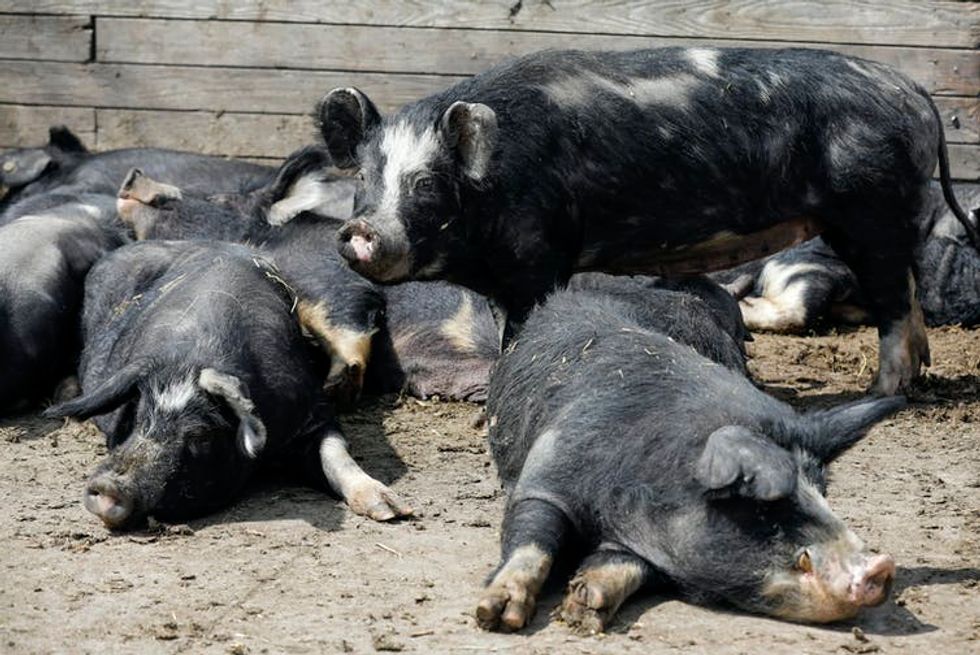
Meat prices are starting to surge as slaughterhouses close, but farmers don't have a market for their animals -- and the drop in hog futures could force farmers to euthanize their hogs and bury them as supplies back up.
That could, in turn, push grocery stores to ration pork chops, driving up retail costs.
Frozen pork inventories dropped 4.2 percent from February to March, the biggest drop for that month since 2014, but that decline came before slaughterhouse shutdowns began this month as workers got sick from the virus.
“For all the talk of cold-storage supplies, it’s just never a lot,” Bob Brown, an independent market consultant in Oklahoma. “It’s roughly a week’s worth of production in the freezer.”
The prices for pork belly -- which gets turned into bacon -- have more than doubled over four days this week, but the prices for hogs have plummeted because there's nowhere to process them.
That dislocation has driven up profit margins for meatpackers by about 340 percent since April 1, because the animals cost less but the finished product is far more valuable for plants that haven't been hit by the virus.
Some meatpackers have given raises and bonuses to workers to fight a high rate of absenteeism over illness concerns.
Sen. Josh Hawley, R-Mo., told Politico, “We probably cannot keep operating all in one location.”
For all of U.S. history so far, the House and Senate have had to take votes in person, in their respective chambers. Now, public health measures may prevent that.
As a former counsel for the House of Representatives from 1976 to 1983, I believe the Constitution permits Congress to use a method of voting other than gathering on the floor of their legislative chambers.
Democratic leadership in the House evidently agrees: They will soon bring a proposal to the House to allow proxy voting during the pandemic. That means a member who is present in the House could cast a vote on behalf of a member who has been forced to stay at home.
Framers’ language
The Framers who designed the constitutional structure for how things would work in Congress based it on parliamentary and colonial practices.
Members of Congress had and still have to vote in person on the floor of the House or Senate. But when the first Congress officially convened on March 4, 1789, due to bad weather and difficult travel, a quorum was not present. Without a quorum - a simple majority – there weren’t enough members there to actually conduct business. The ballots for president and vice president could not be counted and no legislation could be passed or revenue raised. A quorum finally assembled on April 1 in the House and April 5 in the Senate.
The Framers might not have anticipated the extraordinary steps that Congress would have to take in a crisis such as today, when public health measures could dictate that hundreds of members be prevented from meeting on the floor of the House or Senate.
Yet the language the Founders used 233 years ago may nevertheless permit technological innovations now to facilitate voting from places other than the actual physical House and Senate chambers.
One of the first electronic voting machines used by the House, after electronic voting was introduced in 1973.
While the dictionary definition of “assemble” includes “to meet” or “to gather,” there is no indication that virtual assembly would be prohibited under the Constitution.
What guidance the Constitution provides suggests wide leeway in deciding how to fulfill its requirements.
For years, until 1890, the view in the House was that satisfying the requirement for a quorum meant an absolute majority of members living and seated had to vote on any proposition. This resulted in members refusing to cast votes and thereby preventing a quorum and obstructing the House’s business.
The Constitution allows each house of Congress “to determine the Rules of its Proceedings.” The constitutionality of those rules has been challenged over the years, but the Supreme Court has said that Congress’ power to formulate and impose such rules is “absolute and beyond the challenge of any other body or tribunal.”
That means both the House and Senate have the power to amend their rules to allow a method of voting that does not require them to assemble on the floor of their chambers.
Securing the vote
This change could be constitutionally allowed and technically feasible. But it raises many other questions, from people’s faith in Congress’ trustworthiness to the vulnerability of such a system to outside attacks.
If Congress adopts remote voting, its major challenge is to create a system that can be protected against fraud, hacking or proxy voting.
While the Senate still requires voice or hand votes, the House implemented electronic voting systems in the early 1970s. By the 1980s, suspicions had arisen that House members, either for their convenience or to avoid an absence, lent their electronic voting cards to one another to enter their votes. Since no House rule specifically allowed such proxy voting on the floor, there was a question of whether such a practice was permissible under House Ethics rules.
Following a House Ethics Committee investigation into these anomalies, they adopted a rule preventing proxy voting on the House floor. Obviously the House would have to come up with a system for preventing such abuses from recurring.
Of course, such a system could be devised for limited use during emergencies, with a return to traditional voting in the chamber once the emergency has passed.
This is an updated version of an article originally published on March 24, 2020.
Many Americans may be surprised and confused to see farmers dumping milk down the drain or letting vegetables rot in their fields.
Why would they be destroying food at a time when grocery stores and food pantries struggle to keep pace with surging demand during the coronavirus pandemic?
As sociologists with a specialty in agriculture and food, we study how the structure of the food system affects people’s lives and the environment. Seeing food destroyed at a time when people are going hungry highlights both short- and long-term problems with this system.
Food and toilet paper have more in common than you think.
Rodney Stubina/EyeEm/Getty Images
A tale of two supply chains
Surprisingly, the supply chain for food bears a striking similarity to that of another product that has experienced shortages: toilet paper.
Like the toilet paper market, the food industry has two separate supply chains for consumer and commercial use. On the consumer side are grocery and convenience stores that focus on small purchases. The commercial side represents restaurants and institutions such as schools, prisons, hospitals and corporate cafeterias that purchase large quantities of foods in bulk. Ultimately, commercial institutions purchase in sizes that exceed the storage capacity of most households and food pantries.
While the commercial and the consumer supply chains are different, there are some commonalities: Both are complex, cover long distances and rely on just-in-time production. Both are also increasingly concentrated, meaning that there are only a few companies between farmers and consumers that process and distribute raw agricultural goods into edible food. For example, on the commercial side, Sysco and U.S. Foods control an estimated 75% of the market for food distribution.
These characteristics make the supply chains more vulnerable to disruptions.
Meat plant closures has created a bottleneck for processing.
AP Photo/Charlie Neibergall
Where the supply chains diverge
To understand why this food can’t readily be diverted to consumers, let’s take a closer look at the supply chains for meat, vegetables and milk. With each category, there are different reasons.
Vegetable farmers, for example, have a lot of crops growing in their fields intended for commercial buyers like schools, restaurants and cruise lines, which are no longer purchasing these products.
But a worseninglabor shortage makes it a lot harder to harvest or pick their crops and package them for consumers.
So a combination of plunging commercial demand, not enough low-wage yet skilled laborers, falling prices and a short window in which to pick vegetables means it has become cheaper to simply let them rot in the fields.
As for meat, restaurants typically order larger cuts and use more of the pricier parts like tenderloins. In contrast, much of the meat purchased on the consumer side is sold in “case-ready” packages, and ground beef is far more common.
So in general, commercial buyers tend to buy parts of the cow or pig that consumers simply don’t prepare at home. But what’s more, meat plant closures due to COVID-19 outbreaks are creating a bottleneck for slaughtering and processing animals, which also have a short window before they’re past their prime. As a result, producers, particularly pork farmers, are debating whether to feed and care for their animals past their prime or simply euthanize them.
Milk is even more complicated when it comes to how it flows along the food chain.
First, there’s no stopping cows giving milk; udders that are full must be emptied daily. The only question is where that milk will go.
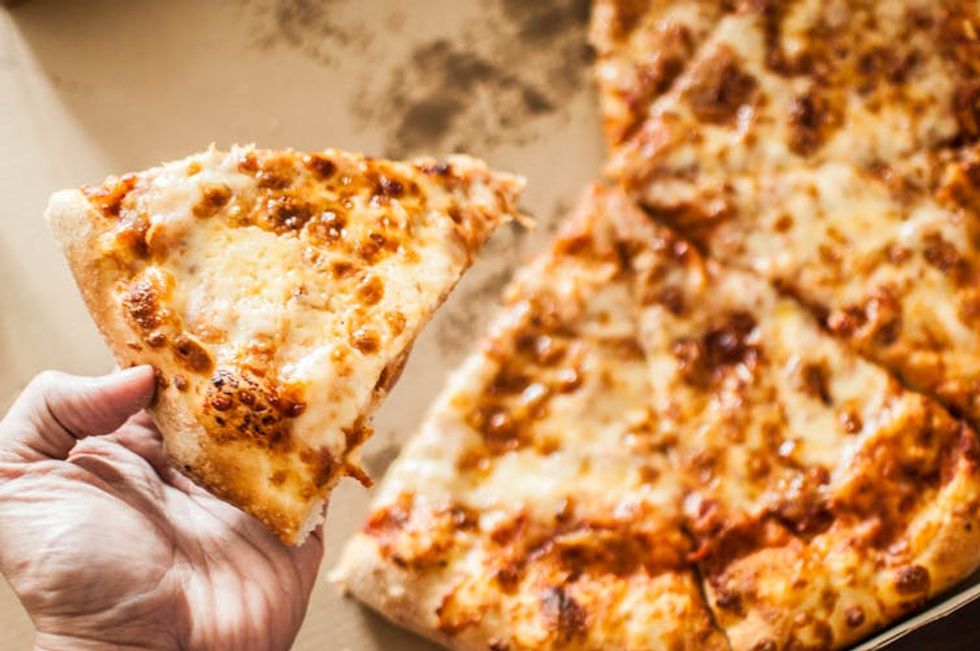
Restaurants and organizations like schools purchase nearly half of all milk, butter and other dairy products processed in the U.S. Pizzerias alone take nearly a quarter of all U.S. cheese production.
With many of these customers closed or cutting their purchases, there’s lots of excess milk. Unfortunately, processors do not have the equipment to package that milk into smaller containers for grocery stories and retail use.
As for converting more milk into dairy products with longer shelf lives like cheese, there was already a glut of mozzarella and other cheese plugging up cold storage space. And despite a rise in takeout pizza, overall demand for cheese has “dropped like a rock,” according to trade industry sources.
That has left dairy farmers with little choice but to dump excess milk into manure ponds and ditches.
A quarter of all cheese makes its way to a pizza.
Karl Tapales/Getty Images
A longer-term problem
Many states are working on short-term solutions to bridge the gap between the two supply chains.
Nebraska is temporarily allowing restaurants to sell unlabeled packaged foods to customers, Texas is pushing restaurants to prepare food care packages for at-risk families, and many other states have changed their health regulations to allow restaurants to repackage products into smaller quantities to sell to the public.
In addition, the U.S. Department of Agriculture plans to begin purchasing US$3 billion in fresh produce, dairy and meat to support farmers and eventually distribute it to food pantries and other organizations feeding Americans in need.
Although helpful in the short term, we believe a longer-term problem that needs to be addressed is how concentrated food supply chains have become, which has made them less nimble in adapting to disruptions like a health pandemic.
Georgia Gov. Brian Kemp got a nasty surprise on Wednesday when President Donald Trump came out against his plan to reopen tattoo parlors and bowling alleys -- despite the fact that Trump last week had called on governors to "liberate" their states from pandemic lockdown measures.
Conservative political strategist Rick Wilson is now pouring salt in Kemp's wounds by mocking him for showing slavish loyalty to a president who has proven he does not reciprocate in kind.
"He did what Fox and Trump told him to do and the second Trump decided for whatever random brainfart reason it was too soon, he turned on Kemp -- if you will -- like a dog," Wilson wrote on Twitter.
Wilson then excoriated elected Republicans who still believe that sucking up to the president is the best way to advance their political careers.
"After all this time, do you still not GET it?" he asked rhetorically. "Nothing you do will EVER be enough. You will NEVER get reciprocity for your risk and sacrifice. Everything he tells you is a lie. Your obedience and loyalty breed contempt and malice."
A pharmaceutical maker jacked up the cost of its only FDA-approved drug immediately after asking the federal government to expand its use as a coronavirus treatment.
Jaguar Health more than tripled the price of the antidiarrheal medication Mystesi shortly after asking the Food and Drug Administration to authorize emergency use for COVID-19 patients, reported Axios.
The list price of a 60-pill bottle of Mytesi was $668.52 going into this year, but on April 9 the company hiked the cost to $2,206.52.
Jaguar Health had asked the FDA on March 21 to approve the drug, which is typically prescribed to HIV/AIDS patients who are on antiretroviral drugs, for coronavirus patients suffering from diarrhea associated with certain antiviral treatments.
The FDA denied the request April 7 for unspecified reasons, but Jaguar Health remains in discussions with the National Institute of Allergy and Infectious Diseases about evaluating the drug's effectiveness against the coronavirus.
The company's CEO told Axios that Jaguar Health decided to raise the cost in December because it was losing too much money, and she insisted the cost increase would have been held off if the FDA had approved it for emergency use.
However, CEO Lisa Conte admitted the cost "likely" would have jumped after the emergency use period lapsed.
"How he's doing with this doesn't give me any confidence," said Corey Ingram, a 42-year-old inspector at a military equipment manufacturer. "The rejection of science, the constant disagreeing with his experts."
“After this,” the Spring Grove independent said, “anyone but Trump.”
Pennsylvania had the fifth-most confirmed cases of COVID-19 and fifth-most deaths in the U.S. as of Wednesday night, and the pandemic has wiped out 1.3 million jobs -- the second-highest number, after California.
“Trump won here in 2016 because he ran as a disruptor, but in a crisis like this, even if he were performing strongly, people are going to want a stabilizer in the White House,” said Phil English, a former Republican congressman from Erie.
“The stakes have changed,” he added. “Pennsylvania has been put into a much more challenging position, or at least demands a totally different strategy, for the president to keep it in his column.”
An April 1 poll showed 49 percent of Pennsylvania voters disapproved of Trump's handling of the pandemic, compared to 46 percent who approved, and latest RealClearPolitics polling average shows Joe Biden beating the president in the state by 47.8 percent to 43.2 percent.
Biden's path to victory isn't assured, of course, but his decades of government experience could be attractive to voters dissatisfied with Trump's handling of the COVID-19 pandemic.
“Four years ago, I was feeling good about having a nonpolitician come in to shake things up,” Ingram said. “But reality has set in, and this specific incident has made clear to me we need someone who really knows the ropes.”
Nobel Prize-winning economist Paul Romer told CNN's John Berman on Thursday that there is absolutely no reason that the United States cannot produce a sufficient number of COVID-19 testing kits needed to safely reopen the American economy.
While appearing on CNN, Romer explained the need to develop a mass testing program for the country as a key measure to control the disease.
"We need to test everybody because then everybody will have the information they need to be safe," he said. "Am I at risk of infecting my children or my colleagues? Are my colleagues at risk of infecting me? If we knew who was infected, then we take the protections to stop the spread of the virus."
Romer then challenged President Donald Trump's assertion that we can't manufacture enough tests to handle the crisis.
"I personally am advocating for 30 million tests a day, not a week," he said. "Let's think about whether that's feasible. This nation produces 350 million cans of soda every day. If we can produce 350 million cans worth of soda a day, we can produce 30 million tests a day."