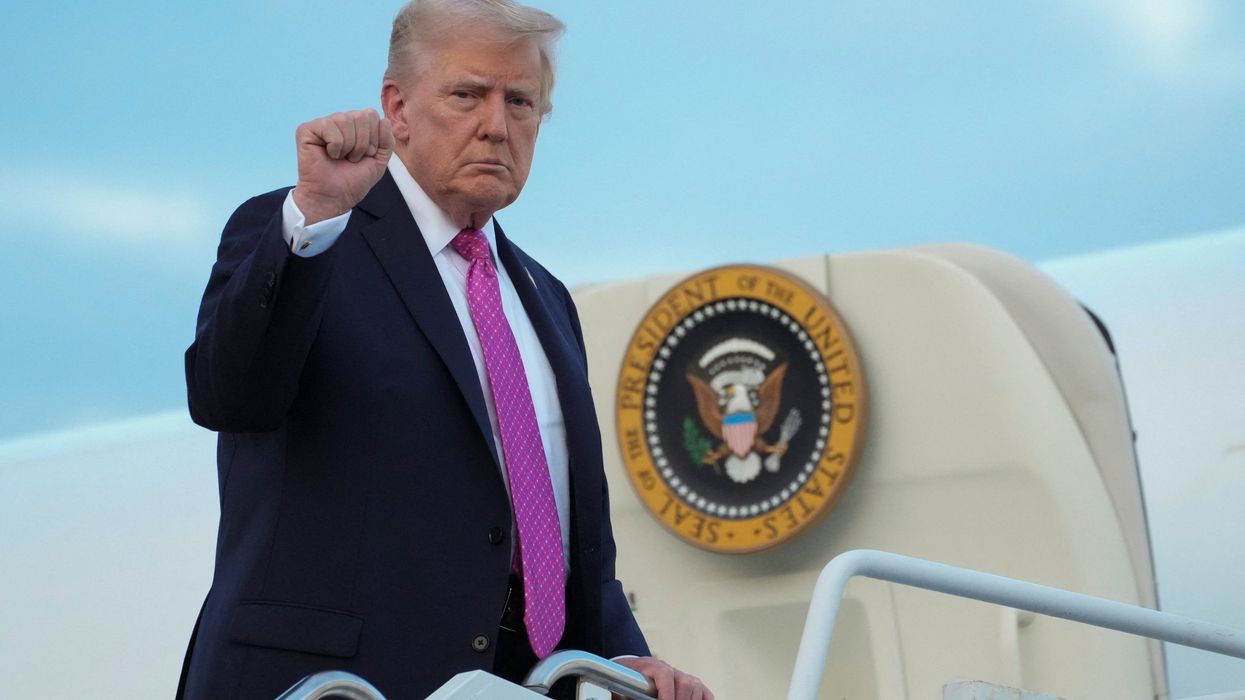
Donald Trump gestures as he boards Air Force One. REUTERS/Ken Cedeno

With Donald Trump becoming more erratic and lashing out at the traditional allies of the US, plans are afoot by members of the North Atlantic Treaty Organization (NATO) to create a separate version of the organization beyond the American president's reach.
According to the Wall Street Journal's Bojan Pancevski and Daniel Michaels, European officials are advancing informal plans for what some are calling "European NATO," a parallel structure that would give Europeans greater command-and-control authority and supplement U.S. military assets with their own capabilities.
The plans represent a massive shift in European strategic thinking now that Germany has ceased resisting French calls for greater European defense sovereignty, preferring American military guarantees. That calculus has fundamentally changed under German Chancellor Friedrich Merz, who is now actively participating in the initiative over concerns about U.S. dependability as an ally during the Trump presidency and beyond.
European officials are explicit about their purpose: preserve deterrence against Russia, operational continuity and nuclear credibility even if the Trump administration withdraws forces from Europe or refuses to come to its defense, as the president has repeatedly threatened.
Trump's recent rhetoric has only accelerated the timeline. He branded European allies as "cowards," called NATO "a paper tiger," and added menacingly, in reference to Putin: "Putin knows that too." He has also threatened to leave NATO entirely over Europe's refusal to support his Iran war, describing the move as already "beyond reconsideration," the Journal is reporting.
The momentum is undeniable. Finland's President Alexander Stubb, one of the leaders involved in the initiative, signaled the permanent nature of the shift: "A burden shifting from the U.S. toward Europe is ongoing and it will continue…as part of U.S. defense and national security strategy."
The report notes Europe is not waiting for Trump to make good on his threats. The plans, first conceived last year, have accelerated dramatically after Trump threatened to seize Greenland from NATO member Denmark and intensified amid the standoff over Europe's refusal to back the highly criticized Iran war.
Though congressional approval would be required for a formal NATO withdrawal, Trump retains broad authority as commander-in-chief to move troops or assets out of Europe or withhold support — a threat that has transformed European defense planning from theoretical to urgent.
Report typos and corrections to corrections@rawstory.com.
For customer support contact support@rawstory.com.