Fugitive US whistleblower Edward Snowden has been granted permanent residency in Russia, his lawyer said on Thursday.
Snowden, the former US intelligence contractor who revealed in 2013 that the US government was spying on its citizens, has been living in exile in Russia since the revelations.
The 37-year-old has said he would like to return to the United States.
His lawyer Anatoly Kucherena told AFP on Thursday that his residency permit was extended and is now indefinite, a situation made possible by recent changes to Russia's immigration law.
Kucherena said the application was filed in April but the process was delayed by the coronavirus pandemic.
Snowden is wanted in the United States on espionage charges after he leaked information showing that agents from the National Security Agency (NSA) were collecting telephone records of millions of US citizens.
When asked whether Snowden planned to apply for Russian citizenship, Kucherena said: "He will make the decision himself."
Kucherena said it was "natural" that Snowden wanted to return to the United States but will only do so when the case against him is closed.
Earlier this year, US President Donald Trump said he would "take a look" at pardoning Snowden but has not made further comment on the matter.
A 2015 petition calling on then president Barack Obama to pardon the whistleblower and privacy advocate was rejected by the White House.
Traditional American allies in Europe fear that the United States has been lost as a reliable partner on the world stage, even if President Donald Trump goes down in defeat.
In interviews with the New York Times, European officials said that they fear the shift of the Republican Party away from traditional American foreign policy may be permanent, which would mean that relations with the United States would depend entirely on which party controls the White House.
"Europeans are afraid that there is no longer a foreign-policy consensus in the United States," said Ivan Krastev, director of the Center for Liberal Strategies. "Every new administration can mean a totally new policy, and for them this is a nightmare."
Jeremy Shapiro of the European Council on Foreign Relations similarly said that "there is an incredible decay in Europe of the sense of the United States as a leader" in the world, as evidenced by its disastrous handling of the COVID-19 pandemic that has so far left more than 220,000 Americans dead.
“Biden doesn’t solve their America problem,” he said. “He’s not going to be president for ever, and Democrats won’t always be in power, and people have learned that the U.S. can’t be trusted on foreign policy, because the next administration will come in and wipe it away.”
Two women accused of stabbing two other women wearing Muslim headscarves near the Eiffel Tower in Paris and trying to rip off their veils have been charged with assault and racist slurs, legal sources told AFP on Thursday.
The case comes amid heightened racial tensions following the jihadist killing last week of a French teacher who had shown his pupils cartoons of the prophet Mohammed.
The women accused over the assault were drunk when they came across a group of Muslim women and children in the Champ de Mars park at the foot of the Eiffel Tower.
The Muslim family complained about the other women's dog, saying they felt threatened by it.
In the ensuing row one of the women with the dog pulled a knife and stabbed two of the veiled women, aged 19 and 40.
The 40-year-old woman sustained six stab wounds and is being treated in hospital for a perforated lung.
The younger victim was stabbed three times and was also treated in hospital but has since been discharged.
Both victims claimed their attackers called them "dirty Arabs" and told them: "This is not your home."
- 'Witch hunt' -
The incident caused a furore on social media with some people accusing the French media of remaining silent about an attack they saw as clearly anti-Muslim.
The main suspect has been placed in preventive custody while her friend has been released on bail, sources close to the investigation said.
The pair were charged late Wednesday with assault aggravated by the use of a weapon, drunkenness, racial insults and the fact that they acted together.
But the victims' lawyer Arie Alimi has called for the women to face stiffer charges, accusing them of attempted murder linked to the victims' race or religion.
He said one of the women specifically took issue with the headscarves worn by several women in the Muslim family, referring to it as "that thing you have on your head".
He also accused the suspects of trying to rip off their victims' veils and of aiming blows at the head.
The two suspects deny making racial insults.
Their lawyer Bernard Solitude warned against "blowing this story out of proportion" and said it was important to "stick to the facts: a row which degenerated after insults were made".
Alimi accused the French authorities -- which have closed a mosque on the outskirts of Paris and moved to shut down several Muslim groups in the aftermath of the beheading of teacher Samuel Paty by an 18-year-old Chechen radical -- of a "witch hunt".
He argued it had the effect of helping jihadists "reach their goal, which is the stigmatising of Muslims leading to more individuals becoming radicalised".
A secretive 2018 agreement between Beijing and the Vatican was renewed Thursday, despite strident US condemnation and warnings from underground Chinese priests loyal to Rome that they have only become more marginalised since it was signed.
The deal allows both Beijing and the Holy See a say in appointing bishops in an attempt to close a schism in China's 12-million-strong Catholic community.
Washington had put intense pressure on the Vatican to scrap the agreement, saying it has failed to shield Chinese Catholics from persecution.
"After friendly consultations," both sides agreed to the extension "for two years", foreign ministry spokesman Zhao Lijian told reporters on Thursday.
"The two sides will maintain close communication and consultation, and continue to push forward the process of improving relations."
Newly communist China severed ties with the Holy See in 1951, forcing Catholics to choose between membership of the state-run Chinese Catholic Patriotic Association or non-sanctioned churches loyal to the Pope.
The Communist Party is officially atheist and exercises strict control over all recognised religious institutions, including vetting sermons.
Those that operate without the Communist Party's blessing claim to have been targeted by authorities in recent years, pointing to the demolition of underground churches, persecution of members and pressure on their clergy to switch sides.
While some have hailed the Beijing-Vatican deal as a pragmatic compromise, others fear that China's underground churches will become even more marginalised.
"The situation has not improved at all," one underground priest in Jiangxi province told AFP recently.
The priest, who withheld his name over security concerns, said he had been banned by the government from carrying out church duties.
The renewal of the agreement, he said, would leave Catholics feeling "helpless and hopeless".
- Progress or setback? -
There was a potential sign of that pressure earlier this month when auxiliary bishop Vincenzo Guo Xijin of the Mindong Diocese in Fujian province abruptly resigned.
A person familiar with the matter told AFP Guo had resigned in protest after coming under pressure to join the state-run church, as the 2018 deal required bishops to do.
Other underground figures, including Bishop Augustine Cui Tai, remain detained or under house arrest.
The deal's supporters argue that it was never meant to address all outstanding issues, but was an important first step and largely beneficial to Chinese Catholics.
"We are content with the agreement," Cardinal Pietro Parolin, the Vatican's Secretary of State, told reporters Wednesday.
"But of course, problems remain that the agreement was not intended to resolve," he said.
The Vatican will be braced for an angry response from Washington less than two weeks before a US election in which America's large Christian population is being wooed by President Donald Trump.
Earlier this month Secretary of State Mike Pompeo called on the Vatican to be "serious" in addressing religious persecution in China - unusually forceful language directed at the pope.
- Defeat for the underground -
Priests and dioceses in the Chinese state church did not respond to AFP interview requests.
However, one of them, Paul Han Qingping of northern Hebei province, wrote a blog post in late September supporting a renewal of the agreement.
"As the barriers... have been removed, bishops in China are now able to come together more often in collaboration and consultation in solving Church issues," he wrote, but admitted that some unofficial clergy remain resistant.
In a key concession to the agreement, Pope Francis recognised eight bishops appointed by China without papal approval.
At least two more former underground bishops were appointed with approval from both sides, and a handful of underground bishops joined the official church this year.
"The Vatican realises the importance of working within the system to prevent further restrictions on China's religious believers," said Lawrence Reardon, professor of political science at the University of New Hampshire.
Critics -- including retired Cardinal Joseph Zen of Hong Kong -- have accused the Vatican of betraying its values to appease China.
That has led the underground community "practically disappeared," he said.
"That's not victory, that's a defeat -- complete defeat."
An American astronaut and two Russian cosmonauts touched down on the Kazakhstan steppe on Thursday, completing a 196-day mission that began with the first launch under lockdown conditions.
NASA astronaut Chris Cassidy and Russian cosmonauts Anatoly Ivanishin and Ivan Vagner landed around 150 kilometres (90 miles) southeast of the Kazakh city of Zhezkazgan at 0254 GMT, footage broadcast by the Russian space agency Roscosmos showed.
A NASA commentator citing communications from crews on the ground at the landing site said that the Soyuz descent module had landed in a vertical position and that the crew were working on getting the trio out of the craft.
The three-man crew had blasted off minus the unusual fanfare in April with around half the world's population living under national lockdowns imposed to contain the spread of the coronavirus.
The mission coincided with the arrival at the space station in May of the first astronauts to blast off from US soil for almost a decade.
The mission carried out by tycoon Elon Musk's SpaceX company as part of NASA's commercial Commercial Crew Program has helped fuel talk of a new "space race" between a number of countries.
Prior to returning from his third mission in space, former US Navy SEAL Cassidy, 50, tweeted a picture of blood samples that astronauts have to submit at various points in their mission, including just before undocking.
"What is the price of a return ride back to Earth?....8 tubes of blood!! The 7 shown in this picture were taken in the morning to be placed in our deep freezer, and the 8th will be drawn just prior to undock for ground processing soon after landing," Cassidy wrote.
First-time-flyer Vagner was a rare Roscosmos presence on the micro-blogging platform, where most NASA astronauts have a profile.
"Mama, I'm coming home," the 35-year-old tweeted on Wednesday.
Ivanishin is wrapping up his third mission, after NASA's Kathleen Rubins, with whom he launched to the ISS in 2016, arrived for a second stint aboard the station last week along with Sergey Ryzhikov and Sergey Kud-Sverchkov of Roscosmos.
The ISS, has been a rare example of cooperation between Moscow and Washington.
Next month will mark the 20th anniversary of the orbital lab being permanently occupied by humans, but the station is expected to be decommissioned in the next decade due to structural fatigue.
On Wednesday, Politico and The Washington Postreported that Secretary of State Mike Pompeo is proposing several major international human rights organizations, including Amnesty International, Human Rights Watch, and Oxfam, be classified as "anti-Semitic" groups — and that a formal declaration could come later this week at the earliest, with the intention of preventing other governments around the world from working with them.
"The proposal has prompted a sharp pushback from career officials in the department concerned that it would be a gift to authoritarian governments who have long sought to delegitimize human rights groups for their work exposing mass atrocities and crimes against humanity, according to the two people, who spoke on the condition of anonymity to discuss future policy decisions," reported John Hudson of the Post.
"Pro-Israel advocates have long complained of bias by groups such as Human Rights Watch and Amnesty International, saying they focus too heavily on the treatment of Palestinians by the Israeli government," said the report. "The groups, however, have a lengthy track record of spotlighting the mistreatment of individuals at the hands of governments elsewhere, including authoritarian regimes and Western democracies."
All three organizations deny the allegation of anti-Semitism, with Oxfam America's Noah Gottschalk saying, “Any insinuation that Oxfam supports anti-Semitism is false, baseless, and offensive. Oxfam and our Israeli and Palestinian partners have worked on the ground for decades to promote human rights and provide lifesaving support for Israeli and Palestinian communities. We stand by our long history of work protecting the lives, human rights, and futures of all Israelis and Palestinians.”
Director of National Intelligence John Ratcliffe announced Wednesday evening that the FBI has determined that Iran was behind the voter suppression emails sent to Democrats in Florida.
Speaking at an announcement from the headquarters, Ratcliffe blamed Iran and Russia for being involved in fraudulent election interactions. Unlike GOP accusations in the past, China and Ukraine were not named by Ratcliffe.
A Homeland Security official also claimed "they had detected holes in state and local election websites and instructed those participating to patch their online services," reported the Washington Post.
The messages targeting Democrats used data from the digital voter file which are available to companies for purchase. They were sent to the Democrats claiming that Proud Boys were “in possession of all your information” and told voters that they must change their party registration and vote for Trump.
President Donald Trump has claimed that foreign governments are rigging the election in Biden's favor. This refutes the claim.
Bloomberg News published a bombshell report on President Donald Trump's foreign policy on Wednesday.
"An influential Trump administration official secretly met with a representative of Nicolas Maduro’s regime in Mexico City in September to try to negotiate the Venezuelan leader’s peaceful exit from power," Bloomberg reported.
"Richard Grenell, the former Acting U.S. director of National Intelligence and ambassador to Germany, and Jorge Rodriguez, a Venezuelan politician who is close to Maduro, met in the Mexican capital, according to four people familiar with the matter. Secretary of State Michael Pompeo and the rest of the State Department weren’t told about the trip beforehand, according to two of the people," Bloomberg reported.
Grenell is one of Trump's most ardent supporters and has been blocked on Twitter by much of the White House press corps over his antics.
"Grenell sought to discuss Maduro’s departure, two of the people said, but it isn’t clear if Rodriguez and Maduro were open to the possibility," Bloomberg reported. "In any event, the talks weren’t successful, the people said."
Since Sept. 22, we’ve been using machine-learning algorithms to identify the predominant themes in foreign media coverage.
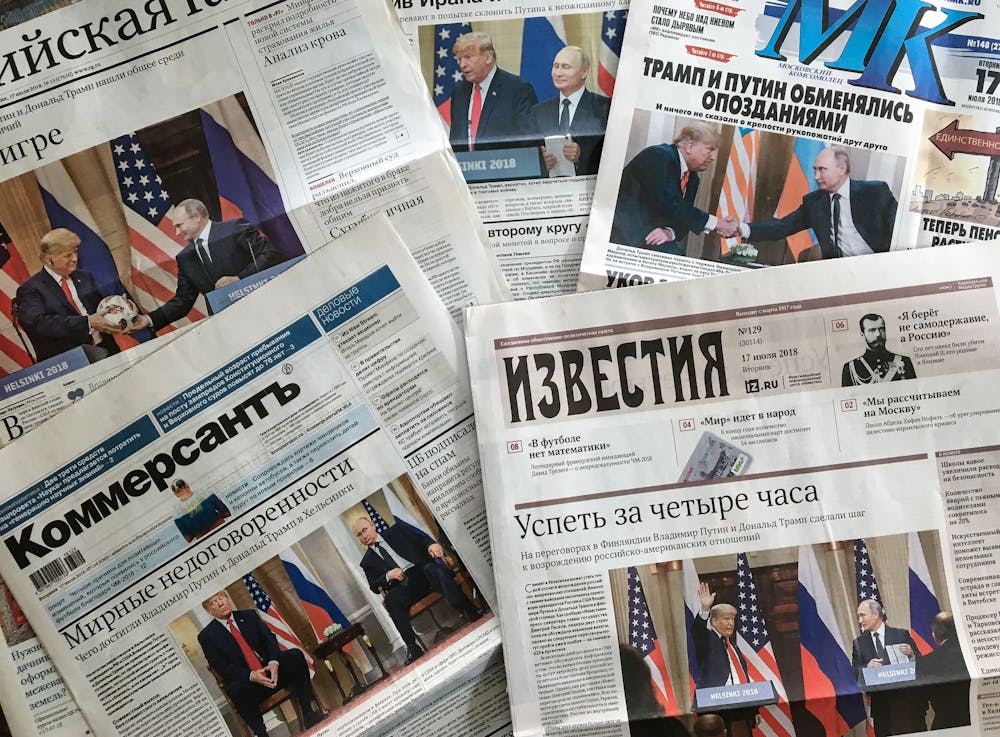
How different countries cover the race between Donald Trump and Joe Biden can shed some light on how foreign citizens discern the candidates and the American political process, especially in places that have strict state control of media like China, Russia and Iran.
Unlike in the U.S., where there is a cacophony of perspectives, by and large the media in these three countries follow very similar narratives.
In 2016, we did the same exercise. Back then, one of the main themes that emerged was the decline of U.S. democracy. With scandal and the disillusionment of voters dominating the headlines, America’s global competitors used the 2016 election to advance their own political narratives about U.S. decline.
Some of these themes have emerged in the coverage of the current race. But the biggest difference is their portrayal of Trump.
The last election cycle, candidate Trump was an unknown. Although foreign nations acknowledged his political inexperience, they were cautiously optimistic about Trump’s deal-making ability. Russian media outlets were particularly bullish on Trump’s potential.
Now, however, the feelings appear to have changed. China, Iran and even Russia seem to crave a return to normalcy – and, to some extent, American leadership in the world.
Dissecting the debate
To assess how America’s competitors make sense of the 2020 campaign, we tracked over 20 prominent news outlets from Chinese, Russian and Iranian native language media. We used automatic clustering algorithms to identify key narrative themes in the coverage and sentiment analysis to track how each country viewed the candidates. We then reviewed this AI-extracted information to validate our findings.
While our results are still preliminary, they shed light on how these countries’ media outlets are portraying the two candidates. Two key moments from the 2020 campaign – the first debate and Trump’s coronavirus diagnosis – are particularly illustrative.
After the first debate, the Chinese media questioned its usefulness to voters and generally portrayed Trump’s performance in a negative light. To them, the “chaotic” back-and-forth was a sobering reflection of America’s political turbulence.
They described Trump as purposely sabotaging the debate by interrupting his opponent and, in the days after the debate, noted that his performance failed to improve his lagging poll numbers. Biden was criticized for being unable to articulate concrete policies, but was nonetheless praised for being able to avoid any major gaffes and – as an article from the Xinhua News Agency put it – responding to Trump with “fierce words.”
Unlike in 2016, where Clinton was portrayed as anti-Russian, corrupt and elitist, Russian media appeared more willing to characterize the Democratic Party nominee in a positive light.
In fact, Russian coverage expressed surprise over Biden’s debate performance. He didn’t come across as feeble; instead, he was, as the daily newspaper Kommersant wrote, a lively opponent who appeared to be “criticizing, irritating and humiliating” Trump by calling him a “liar, racist and the worst president.” They did praise Trump’s especially aggressive rhetoric. However, our analysis found that Russian media also repeatedly claimed that, unlike 2016, voters today were tiring of his bombast.
While Trump’s post-debate posturing received some positive coverage, Russian media largely lamented his administration’s failure to deliver substantive progress toward normalizing relations between the two countries. They noted the debate neither clarified policies for voters nor for international observers.
Russian outlets have been largely supportive of President Trump, but have been critical of his handling of the coronavirus.
Iranian media took the strongest anti-Trump stance. Reports routinely pointed out that Trump has had no foreign policy successes, and has only exacerbated relations with the country’s major rivals. According to Iranian media outlets, Trump’s lack of accomplishments has left him with no choice but to rely on insults and personal attacks.
Biden, however, was said to have kept his calm. As Al Alam News wrote, he used “more credible responses and attacks than Trump.”
The former vice president, in their view, promised some semblance of normalized diplomatic relations.
‘Intransigence’ and ‘ignorance’
The final month of the U.S. presidential race is known for last-minute surprises that can upend the race. This year was no exception, with Trump’s Oct. 2 announcement of his COVID-19 diagnosis quickly shifting media coverage from the debate to Trump’s health.
He received little sympathy from foreign outlets. Across the board, they were quick to note how his personal disregard for public health safety measures symbolized his administration’s failed response to the pandemic.
For example, one Chinese media outlet, The Beijing News, characterized the diagnosis as “hitting” the president “in the face,” given his previous downplaying of the epidemic. Other reports claimed Trump lacked “care about the epidemic,” including disregard for “protective measures such as wearing a mask.”
Chinese outlets suggested Trump would use the diagnosis to win sympathy from voters, but also noted by being sidelined from holding campaign rallies, he could lose his “self-confessed” ability to attract voters.
Russian media, on the other hand, remained confident that Trump would recover and repeated the White House line of Trump’s good health.
At the same time, Russian outlets tended to chastise Trump’s unwillingness to avoid large gatherings, practice social distancing or wear a mask, all of which violated his administration’s basic health guidelines. Likewise, Russian reports criticized Trump’s post-diagnosis behavior – like tweeting video messages while at the hospital and violating quarantine with his public appearances – as “publicity stunts” that jeopardized the safety of his Secret Service detail and supporters.
Again, Iranian media most directly criticized Trump. Reports characterized Trump as “determined to continue the same approach,” despite his diagnosis, and remain “without a muzzle,” “irresponsibly” continuing to tweet misinformation falsely comparing COVID-19 to the flu.
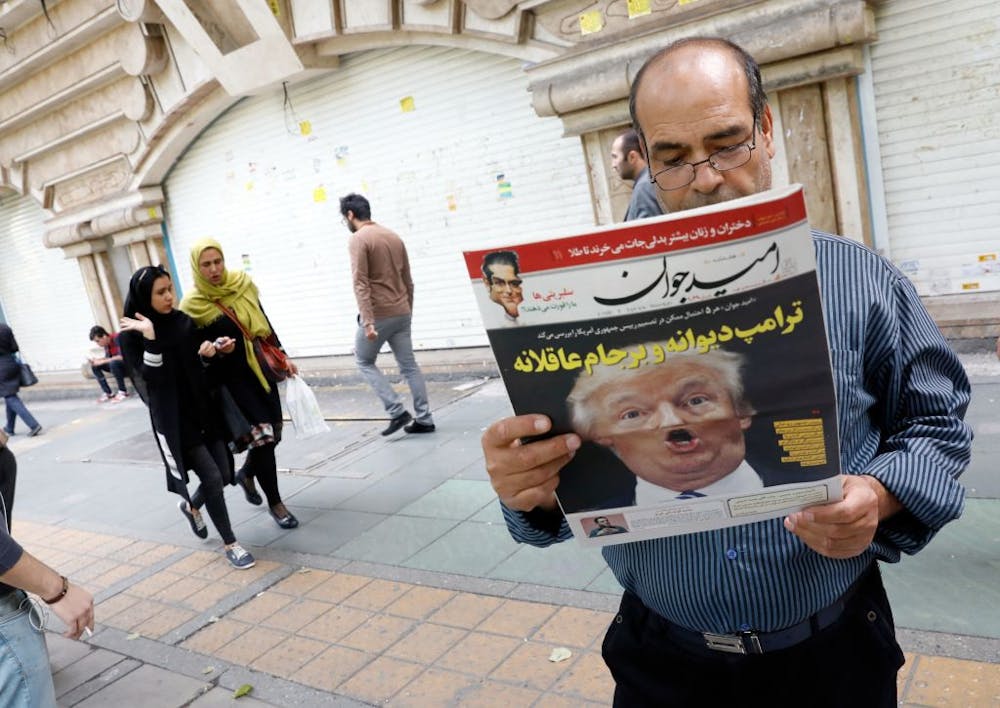
Iranian media outlets have been particularly harsh on the president, with this headline calling him ‘Crazy Trump.’
Coverage centered on Trump’s inability to, as Al Alam put it, show “any sympathy” for the over 200,000 dead Americans. This death toll, the same article noted, was attributed to Trump’s “mismanagement, intransigence, ignorance and stupidity,” highlighted by his cavalier disregard for safety guidelines such as wearing a mask.
In the bag for Biden?
Many of the criticisms of the U.S. found in foreign media outlets in our 2016 study appear in this year’s coverage. But since the 2016 election, geopolitics have changed quite a bit – and, for many of these countries, not necessarily for the better. That might best explain their collective ire toward Trump.
The Chinese entered into a trade war with the U.S., while the U.S. government leveled accusations of intellectual property theft, mass murder and blame for the spread of what Trump has called the “China Virus.”
Russians, meanwhile, have seen themselves – fairly or not – bound to Trump’s 2016 election victory and outed as an international provocateur. That Trump has not been able to deliver on normalizing U.S. Russian relations despite four years of posturing and political rhetoric has perhaps made Trump more of a political liability than worthwhile ally. Not only has the COVID-19 pandemic sparked unrest in Russia’s backyard, but mounting regional instability is also undermining Putin’s image as a master tactician.
As a result, these countries’ outlets appear to have shifted attention away from a broad critique of U.S. democracy toward exasperation with Trump’s leadership.
The two, of course, aren’t mutually exclusive. And these countries’ relatively positive characterizations of a potential Biden administration likely won’t last.
But even the country’s supposed adversaries seem to be craving a return to stability and predictability from the Oval Office.
An oil painting by British street artist Banksy parodying a Claude Monet masterpiece sold in London on Wednesday for £7.6 million, the second highest price at auction for the mysterious artist.
The oil on canvas work, "Show Me the Monet", a modern take on Monet's impressionist classic "The Water-Lily Pond", sold for £7,551,600 ($9.8 mn, 8.4 mn euros) at Sotheby's following a bidding battle.
"The hammer came down after five determined collectors battled for nearly nine minutes to drive the final price beyond its estimate of £3,000,000-5,000,000 to become the second highest price for the artist at auction," Sotheby's said.
The sale comes a year after a Banksy painting depicting the British parliament populated by chimpanzees smashed the record for the street artist by fetching nearly £9.9 million.
On that occasion the 2009 work entitled "Devolved Parliament" attracted a 13-minute battle between 10 different bidders.
"Show Me the Monet" was created in 2005, as part of a collection called "The Crude Oils" and had first been shown publicly in only Banksy's second gallery exhibition.
The painting transforms Monet's masterpiece depicting a Japanese-style bridge in his famous garden at Giverny into a modern-day fly-tipping spot.
Instead of an idyllic lily pond, the composition shows discarded shopping trollies and a fluorescent orange traffic cone floating in the water beneath the bridge.
"Ever prescient as a voice of protest and social dissent, here Banksy shines a light on society's disregard for the environment in favour of the wasteful excesses of consumerism," said Alex Branczik, Sotheby's European Head of Contemporary Art.
"Recent years have seen seminal Banksys come to auction, but this is one of his strongest, and most iconic, to appear yet," he added.
Banksy has become a household name since the turn of the century, after his iconic graffiti paintings began to appear overnight on buildings and at sites around the world.
The artist's identity remains shrouded in mystery even as his works have begun to attract increasingly high sums at auction.
Meanwhile he continues to use his art in stunts that generate huge publicity.
In 2018 his "Girl With The Balloon" partially shredded itself as the hammer came down at Sotheby's, becoming the retitled "Love Is In The Bin".
A volunteer participating in clinical trials of the Covid-19 vaccine developed by Oxford University has died in Brazil, officials said Wednesday, though it was unclear whether he received the vaccine or a placebo.
It is the first death reported in the various coronavirus vaccine trials taking place worldwide.
However, organizers of the study said an independent review had concluded there were no safety concerns and that testing of the vaccine, developed with pharmaceutical firm AstraZeneca, would continue.
Media reports said the volunteer was a 28-year-old doctor working on the front lines of the pandemic who died of complications from Covid-19.
"All significant medical incidents, whether participants are in the control group or the Covid-19 vaccine group, are independently reviewed," Oxford said in a statement.
"Following careful assessment of this case in Brazil, there have been no concerns about safety of the clinical trial, and the independent review in addition to the Brazilian regulator have recommended that the trial should continue."
National health regulator Anvisa confirmed it had been "formally notified of the case on October 19" and had received a report on the independent review from the security and evaluation committee overseeing the study.
The D'Or Teaching and Research Institute (IDOR), which is helping organize the tests in Brazil, said the independent review process had "raised no doubts about the safety of the study, and recommended it continue."
Oxford and AstraZeneca previously had to suspend testing of the vaccine in September when a volunteer in Britain developed an unexplained illness.
Trials resumed after British regulators and an independent review concluded the illness was not a side effect of the vaccine.
Half the volunteers in the final-stage clinical trial -- a double-blind, randomized, controlled study -- receive a placebo, IDOR said.
Around 8,000 volunteers have been vaccinated so far in Brazil, and more than 20,000 worldwide, it said.
Study participants must be doctors, nurses or other health sector workers who come into regular contact with the virus.
Brazilian newspaper Globo said the deceased volunteer was a young doctor who had been treating Covid-19 patients since March in the emergency rooms and intensive care units at two hospitals in Rio de Janeiro.
He graduated from medical school last year, and was in good health prior to contracting the disease, family and friends told the newspaper.
Spain has become the first European Union nation to surpass a million coronavirus infections, official data showed Wednesday, as the government mulls fresh restrictions on public life to curb the spread of the disease.
The country recorded 16,973 confirmed cases of Covid-19 over the past 24 hours, the health ministry announced Wednesday, taking the total to 1,005,295 since its first case was diagnosed on January 31 on the remote island of La Gomera in the Canary Islands.
Of this number, 34,366 people have died, after 156 more deaths were recorded in the previous 24 hours.
Spain, which is home to around 47 million people, is only the sixth country in the world to cross this grim milestone after the United States, India, Brazil, Russia and Argentina, according to an AFP tally based on official figures.
The new wave of contagion has been less deadly than in late March and April and the height of health crisis, when fatalities routinely exceeded 800 per day, as the median age of new infections has dropped.
But with healthcare workers warning the spike could once again overwhelm hospitals, health minister Salvador Illa said Tuesday the government is considering several new measures, including nighttime curfews such as those recently put in place in France and Belgium.
"We are facing very tough weeks ahead, winter is coming, the second wave is no longer a threat, it is a reality across Europe," he told a news conference, adding the government was "open to everything" to contain the virus.
- 'Political weapon' -
The health ministry is set to meet Thursday with representatives from Spain's powerful regional governments, who are in charge of healthcare, to update the country's plan to respond to the pandemic.
Spain was one of the worst-affected countries when the coronavirus struck Europe early this year before one of the world's most stringent lockdowns helped reduce the outbreak's spread.
But infections have surged since the lockdown measures were fully removed at the end of June, with the rise blamed on the rapid return of nightlife and a lack of an efficient system to track and trace infections.
Messy disagreements between the central and regional governments, and between political parties, over what measures to take have also hampered the response, experts say.
"The pandemic has been used as a political weapon to fight and argue with your adversaries instead of trying to find a middle ground and the best solution for everyone," Salvador Macip, an expert in health sciences at Catalonia's Open University who has written a book called "The Great Modern Plagues", told AFP.
- 'Tired and angry' -
As infections have picked up, Spanish regional authorities started imposing fresh restrictions.
Madrid and several satellite cities have since early October been under a partial lockdown, while the wealthy northeastern region of Catalonia has imposed a 15-day shutdown of all bars and restaurants.
Angela Hernandez Puente, a doctor and the deputy secretary of Madrid's Amtys medical association, said the situation was very worrying, but not comparable with the overwhelming pressure the health system came under in March when intensive care units were full and staff lacked personal protective equipment.
But she said the gains of Spain's tough lockdown were wasted due a lack of preparation for a second wave of infections, citing as an example the failure to hire more doctors for public primary care centres, the first line of defence against the virus as they handle testing and tracing potential cases as well as treating the sick.
"It's as if they thought that since infections lowered over the summer, 'that's it, it's over,' when in fact it was the moment to prepare," Hernandez Puente told AFP.
"Health care staff are tired and angry, many doctors feel that more should have been done in June, July and August to not let the public health system become overburdened as it is now," she added.
British pop legend Paul McCartney revealed Wednesday he will release the third in a trilogy of self-titled solo albums this year, after resurrecting unfinished music during the coronavirus lockdown.
The former Beatle's latest record "McCartney III", which will be unveiled on December 11, follows months of work at his home studio in Sussex in southern England on previously started and new songs.
It has all been written, produced and performed by McCartney, who said he hadn't been planning to release an album in 2020 until the pandemic forced him to stay at home for months.
"I had some stuff I'd worked on over the years but sometimes time would run out and it would be left half-finished so I started thinking about what I had," McCartney said, in comments published by Britain's Press Association news agency.
"Each day I'd start recording with the instrument I wrote the song on and then gradually layer it all up, it was a lot of fun," the 78-year-old McCartney added.
"It was about making music for yourself rather than making music that has to do a job. So, I just did stuff I fancied doing. I had no idea this would end up as an album."
Its release coincides with the 50th anniversary of his first self-titled solo endeavour, released as the "Fab Four" went their separate ways in 1970. A follow-up, "McCartney II", came a decade later.
The latest collection of tracks was mostly built from live takes of McCartney on vocals and guitar or piano, before overdubbing with his bass playing and drumming, according to PA.
It said McCartney had returned to an unreleased track from the early 1990s, "When Winter Comes", which was co-produced by The Beatles' late producer George Martin.
Pictures for the album were shot by McCartney's daughter, the photographer Mary McCartney, with additional images by his nephew Sonny McCartney and some that he took himself on his phone.
Keeping the photography in the family mirrors how the pop icon illustrated earlier solo albums, with his late wife Linda McCartney shooting the artwork for "McCartney II".
Linda also took many of the photos displayed on the gatefold cover of the original 1970 "McCartney" album.