On Saturday, The Daily Beast reported that Rodrigo Duterte, the autocratic strongman president of the Philippines, Rodrigo Duterte, plans to ban U.S. Sens. Patrick Leahy (D-VT) and Dick Durbin (D-IL) from entering his country — and is threatening to place further restrictions on American entry.
This comes as Leahy and Durbin added a provision into the 2020 budget bill that would ban entry of Philippine nationals involved in the imprisonment of Leila de Lima, a dissident of the Duterte government who was imprisoned.
Under current Philippine law, Americans are allowed to enter the country without a visa and may stay for up to 30 days.
"We will not sit idly if they continue to interfere with our processes as a sovereign state," said Salvador Panelo, a spokesman for Duterte.
The Mars 2020 rover, which sets off for the Red Planet next year, will not only search for traces of ancient life, but pave the way for future human missions, NASA scientists said Friday as they unveiled the vehicle.
The rover has been constructed in a large, sterile room at the Jet Propulsion Laboratory in Pasadena, near Los Angeles, where its driving equipment was given its first successful test last week.
Shown to invited journalists on Friday, it is scheduled to leave Earth in July 2020 from Florida's Cape Canaveral, becoming the fifth US rover to land on Mars seven months later in February.
"It's designed to seek the signs of life, so we're carrying a number of different instruments that will help us understand the geological and chemical context on the surface of Mars," deputy mission leader Matt Wallace told AFP.
AFP / Robyn Beck Approximately the size of a car, the Mars 2020 rover is equipped with six wheels like its predecessor Curiosity, allowing it to traverse rocky terrain
Among the devices on board the rover are 23 cameras, two "ears" that will allow it to listen to Martian winds, and lasers used for chemical analysis.
Approximately the size of a car, the rover is equipped with six wheels like its predecessor Curiosity, allowing it to traverse rocky terrain.
Speed is not a priority for the vehicle, which only has to cover around 200 yards per Martian day -- approximately the same as a day on Earth.
Fueled by a miniature nuclear reactor, Mars 2020 has seven-foot-long articulated arms and a drill to crack open rock samples in locations scientists identify as potentially suitable for life.
- Ancient life -
"What we're looking for is ancient microbial life -- we're talking about billions of years ago on Mars, when the planet was much more Earth-like," said Wallace.
Back then, the Red Planet had warm surface water, a thicker atmosphere and a magnetic force around it, he explained.
AFP / Robyn Beck NASA engineers and technicians reposition the Mars 2020 spacecraft descent stage equipment, which will be used to land the rover on the Red Planet
"And so it was much more conducive to the types of simple single cell life that evolved here on Earth at that time," Wallace said.
Once collected, the samples will be hermetically sealed in tubes by the rover.
The tubes will then be discarded on the planet's surface, where they will lie until a future mission can transport them back to Earth.
"We are hoping to move fairly quickly. We'd like to see the next mission launched in 2026, which will get to Mars and pick up the samples, put them into a rocket and propel that sample into orbit around Mars," said Wallace.
"The sample would then rendezvous with an orbiter and the orbiter would bring the sample back to the Earth."
Samples should reach Earth "in the course of a decade or so," he added.
- Human mission -
To maximize its chance of unearthing traces of ancient life, Mars 2020 will land in a long dried-up delta called Jezero.
The site, selected after years of scientific debate, is a crater that was once a 500-yard-deep lake.
AFP / Robyn Beck The Mars 2020 rover will remain active for at least one Martian year -- around two years on Earth
It was formerly connected to a network of rivers that flowed some 3.5 to 3.9 billion years ago.
The crater measures just under 30 miles across, and experts hope it may have preserved ancient organic molecules.
The Mars 2020 mission also carries hopes for an even more ambitious target -- a human mission to Mars.
"I think of it, really, as the first human precursor mission to Mars," said Wallace.
Equipment on board "will allow us to make oxygen" that could one day be used both for humans to breathe, and to fuel the departure from Mars "for the return trip."
The ambitions come as a new space race hots up, with Beijing increasingly vying to threaten US dominance.
China on Friday launched one of the world's most powerful rockets in a major step forward for its own planned mission to Mars next year.
NASA's Mars 2020 will remain active for at least one Martian year, which is around two years on Earth.
But Martian rovers have frequently exceeded their intended lifespans -- its predecessor Curiosity landed on Mars in 2012 and is still trundling around the planet's Mount Sharp region.
A Thai Navy SEAL who aided with the rescue of a youth football team trapped in a flooded cave last year has died from an infection he contracted during the dramatic recovery mission.
Petty Officer Beirut Pakbara fell ill with a blood infection while working to retrieve the 12 young boys and their coach, the Thai Navy said in a statement posted late Friday on their Facebook page.
After the 18-day ordeal came to an end last June -- with the entire team emerging safely from Tham Luang cave in northern Thailand -- he was under close supervision by doctors during his yearlong illness.
"But his condition worsened and he died from the blood infection," said the Navy, expressing "profound sadness" to his family.
An official in Beirut's home province of Satun told AFP the Navy SEAL was immediately buried on Friday after he died following Islamic funeral rituals.
Another rescuer, former Thai Navy SEAL diver Saman Gunan, also died during the rescue mission when he ran out of oxygen while attempting to establish an air line to the children and their coach.
A statue of the hero diver has been erected near the cave's entrance, attracting more than 1.3 million tourists since the 12 youngsters and the coach were extracted from their watery jail.
The rescue mission -- which included foreign expert divers and the Thai Navy -- drew extraordinary global interest to the mountainous district of Mae Sai.
The "Wild Boars" team became global celebrities and have since toured the world, meeting footballing giants at Manchester United and LA Galaxy and headlining Ellen Degeneres' US talk show.
The rescue has also attracted filmmakers eager to capture the dramatic operation onscreen -- with Netflix nabbing exclusive rights to tell the boys' story.
Another film, "The Cave" by Irish-Thai filmmaker Tom Waller, made it to silver screens in Thailand last month, though it focused more on the rescue efforts and even starred one of the foreign divers playing himself.
A massive car bomb exploded in a busy area of Mogadishu on Saturday, leaving at least 76 people dead, many of them university students, officials said.
The blast occurred at a busy intersection southwest of the Somali capital where traffic is heavy because of a security checkpoint and a tax office.
The wounded were carried on stretchers from the site, where the force of the explosion left charred and twisted remains of vehicles.
Mogadishu is regularly hit by car bombings and attacks waged by Al-Shabaab Islamist militants allied to Al-Qaeda, but Saturday's blast is the deadliest in about two years.
Many of those killed are believed to be university students whose bus was hit by the blast. Two Turkish nationals also died, police said.
AFP /Map of Somalia locating Mogadishu
"The number of casualties we have confirmed is 76 dead and 70 wounded, it could still be higher," the director of the private Aamin Ambulance service, Abdukadir Abdirahman Haji, told AFP.
Police officer Ibrahim Mohamed described the explosion as "devastating".
"We have confirmed that two Turkish nationals, presumably road construction engineers are among the dead, we don't have details about whether they were passing by the area or stayed in the area," he said.
- 'Dead bodies scattered' -
Mogadishu's mayor Omar Mohamud Mohamed told a press conference that the exact number of dead was not yet known, but that around 90 people were wounded.
"We will confirm the exact number of the number of the dead later but it is not going to be small, most of the dead were innocent university students and other civilians," he said.
AFP / Abdirazak Hussein FARAH Many people have been wounded in the explosion
"This was a devastating incident because there were many people including students in buses who were passing by the area when the blast occurred," said another witness, Muhibo Ahmed.
Sakariye Abdukadir, who was near the area when the car bomb detonated, said the blast "destroyed several of my car windows".
"All I could see was scattered dead bodies... amid the blast and some of them burned beyond recognition."
No group has yet claimed the attack.
Mogadishu is regularly hit by attacks by Al-Shabaab, which has fought for more than a decade to topple the Somali government.
The militant group emerged from the Islamic Courts Union that once controlled central and southern Somalia and is variously estimated to number between 5,000 and 9,000 men.
In 2010, the Shabaab declared their allegiance to Al-Qaeda.
AFP / Abdirazak Hussein FARAH The injured were being taken to Madina Hospital
In 2011, its fighters fled positions they once held in the capital Mogadishu, and have since lost many strongholds.
But they retain control of large rural swathes of the country and continue to wage a guerrilla war against the authorities
Two weeks ago, five people were killed when Shabaab militants attacked a Mogadishu hotel popular with politicians, army officers and diplomats in an hours-long siege.
Since 2015, there have been 13 attacks in Somalia with 20 or more killed, 11 of which have been in Mogadishu, according to a tally of AFP figures.
All of them involved car bombs.
The deadliest attack in the country's history was a truck bombing in October 2017 in Mogadishu which left 512 people dead and around 295 injured.
Olivia Newton-John, the UK-born Australian singer who found worldwide fame in the hit movie "Grease", was given a damehood in Britain's traditional New Year Honours unveiled on Friday.
The entertainer, whose career has spanned more than five decades, was joined on the prestigious annual achievement list by Oscar-winning Hollywood directors Sam Mendes and Steve McQueen.
English cricketing heroes Joe Root and Ben Stokes also received awards following the country's first Cricket World Cup victory last summer.
Queen Elizabeth II's New Year Honours List recognizes outstanding achievements in the worlds of showbiz, sport and politics, as well as the contributions of a larger number of everyday citizens.
Overall, 1,097 names were on the list for 2020, nearly two-thirds of whom have undertaken outstanding work in or for their local community.
Newton-John, who has devoted much of her time and celebrity to charities after battling three different cancer diagnoses since the early 1990s, said she was "extremely excited, honoured and grateful" to receive the award.
"As a girl born in Cambridge, I am very proud of my British ancestry and so appreciative to be recognised in this way by the United Kingdom," she told Britain's Press Association.
The 71-year-old moved to Australia with her family when she was five.
Mendes, best known for his acclaimed directorial debut "American Beauty", and McQueen, who made history in 2014 when he became the first black filmmaker to win a best picture Academy Award, both earned knighthoods.
Mendes, 54, the director of two Bond films, said he was "amazed, delighted and extremely proud".
"I have stood on the shoulders of so many collaborators and colleagues... to whom I owe a huge debt of gratitude," he said.
"I would not be receiving this honour without them."
McQueen's biggest success was the 2013 biographical drama "12 Years A Slave" -- a searing portrayal of slavery in the United States which proved a box office hit.
His most recent film is the crime heist drama, Widows, starring Viola Davis.
Elton John -- who was knighted in 1998 -- received an upgrade in this year's honours.
He was appointed to the Order of the Companions of Honour, awarded to people who have made a significant contribution in their field over a long period.
People who receive it carry the initials "CH" after their name.
Other notable honourees included Steven Knight, the creator of the hit BBC TV show "Peaky Blinders", who was made a CBE (Commander of the British Empire).
Roger Taylor, 70, a founding member of British rock band Queen, was awarded an OBE (Order of the British Empire).
2019 was a year of discontent. Street demonstrations rocked cities around the world – from Latin America to Asia, through Europe, Africa and the Middle East – leading to the downfall of leaders in some countries, and in others, forcing governments onto the defensive.
A variety of motives have fueled the rallies: protesters are demanding the removal of corrupt governments, better living standards, greater freedoms, or more rights.
FRANCE 24 offers a non-exhaustive recap of the movements that have led to the removal of national leaders, and others that have gained momentum over the past year.
Map showing countries that had widespread demonstrations in 2019.FRANCE 24 Infographics
Evo Morales forced out in Bolivia
A wave of protests swept through several Latin American countries in 2019. In Bolivia, Socialist President Evo Morales bowed to pressure from demonstrators and the military, and stepped down in November 10 after 14 years in power. Protesters had accused Morales of rigging the elections.
Mexico offered Morales, Bolivia’s first indigenous leader, asylum and he was replaced by Jeanine Anez, a member of the conservative opposition and the deputy head of Senate.
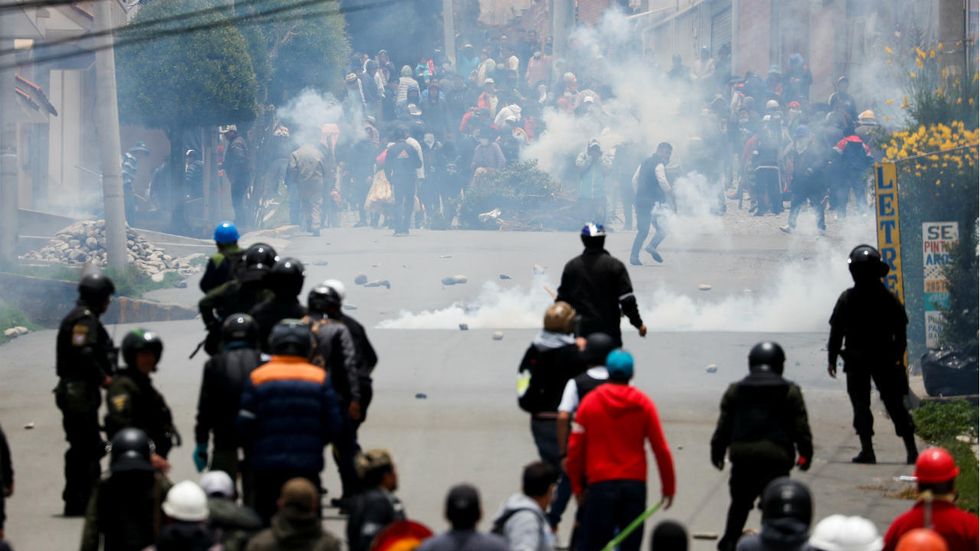
But Morales’s successful ouster did not bring peace to the streets of the capital, La Paz, and other Bolivian cities, which have since seen vast protests by supporters of the former president demanding that he be reinstated.
Supporters of Bolivian President Evo Morales and opposition supporters clash during a protest after Morales announced his resignation on Sunday, in La Paz Bolivia November 11, 2019.REUTERS/Carlos Garcia Rawlins
Hariri steps down in Lebanon
Lebanon’s Saad al-Hariri was pushed to resign in the face of sustained countrywide protests that erupted in mid-October against the ruling elite, which demonstrators blame for widespread corruption and mismanagement, amid the country’s worst economic and financial crisis in decades.
Hariri’s resignation brought down the coalition government, which included the powerful Shiite militant group Hezbollah, backed by Iran.
But although the newly appointed prime minister, Hassan Diab, promised that his government would consist only of independents and experts and not include politicians, protests have not let up. Since President Michel Aoun announced Diab’s nomination, thousands have taken to the streets in Beirut and elsewhere, saying Diab, too, was a member of the corrupt elite.
Diab, 60, a university professor and former education minister, was backed by Hezbollah and its allies, but does not have the support of the main Sunni Muslim groups, including Hariri’s party, although he is Sunni himself.
Mass protests have gripped Iraq since October 1, where citizens are demanding an overhaul of a system they see as corrupt and keeping most Iraqis in poverty. More than 450 people have been killed and 20,000 wounded since the rallies began, according to news agencies.
Prime Minister Adel Abdul Mahdi’s resignation in November has not calmed the movement, as he has remained in office in a caretaker capacity.
Like in Lebanon, protesters have demanded the complete ouster of the ruling class. Iraq is ranked the 12th most corrupt country in the world by watchdog group Transparency International.
On December 26 Iraqi President Barham Salih refused to designate the nominee of an Iran-backed parliamentary bloc for prime minister, saying he would rather resign than appoint someone to the position who would be rejected by protesters.
The protests have shaken the country out of two years of relative calm following the defeat of Islamic State Group insurgents.
“The president has found himself between the rock of the pro-Iran parties and the hard place of the people, but he chose to side with the protesters,” political analyst Ahmed Younis told AFP.
Algeria ends 20-year rule of President Abedelaziz Bouteflika
After 20 years in power, Algeria's ailing president, Abdelaziz Bouteflika, resigned on April 2, shortly after the country's powerful army chief of staff, Ahmed Gaid Salah, demanded that he be declared unfit and leave office "immediately".
Mass protests had erupted in mid-February after Bouteflika announced he would seek a fifth term in office. The 82-year-old president had rarely been seen in public since suffering a stroke in 2013.
Salah, who went on to serve as the North African country’s behind-the-scenes de facto leader, died of a heart attack on December 23.
But Bouteflika’s removal did not end the discontent in Algeria, where many citizens still view the government as inept, corrupt and unable to manage the flagging economy.
Over 60 percent of the population boycotted elections on December 12, won by Abdelmadjid Tebboune, who had served as prime minister under Bouteflika.
Demonstrators protest in Algiers, Algeria, on December 12, 2019, against the presidential election.REUTERS - Ramzi Boudina
After 30 years, Sudan ousts President Omar al-Bashir
Mass protests over economic difficulties erupted in Sudan in December 2018, leading to the ouster in April of President Omar al-Bashir after 30 years in power.
But there too, violent demonstrations and deadly clashes continued for several more months, well after Bashir was removed from power, until the military agreed in August to transition the country over to civilian rule.
Sudan’s first post-Bashir government was sworn in in September.
Several cases have been brought against Bashir since his ouster. On December 14, he was sentenced by a Khartoum court to two years in prison for corruption and is being investigated for his role in the 1989 coup that led to his rise to power.
As Bolivians demonstrated against Morales, protests swept through other Latin American countries. In Ecuador, weeks of demonstrations by indigenous protesters forced President Lenin Moreno to rescind a decree that would have raised fuel prices.
Riots in Chile led the government to announce a $5.5 million economic recovery plan, while Colombia’s President Ivan Duque continues to feel the heat with ongoing strikes and protests against his government’s economic policies and corruption.
Citizens have taken to the streets in parts of Asia as well. In India, the government of Prime Minister Narendra Modi has cracked down on protests in the face of mass rallies against a citizenship law that excludes Muslims.
Hong Kong has been battered by six months of increasingly violent demonstrations in the toughest challenge to Beijing since Britain handed the semi-autonomous territory over in 1997. Hundreds of thousands have taken to the streets amid growing fears that China is stamping out the city's liberties.
Protests erupted also in Iran in November after the government announced a sharp hike in fuel prices, leading to a three-day crackdown and violent clashes in which at least 304 people were killed, according Amnesty International.
European countries have also seen their share of mass demonstrations in 2019.
Marking a year since the beginning of the massive Yellow Vest movement, which was sparked by a plan to raise fuel prices, France has more recently been crippled by nationwide transport strikes and large demonstrations over the government’s planned pension reform.
In Spain, thousands marched this year for or against Catalan independence and in Czech Republic, hundreds of thousands have marched against their populist mogul prime minister, Andrej Babis, 30 years after that country’s Velvet Revolution.
The civil unrest continues, even in countries where demonstrations successfully led to the ouster of leaders. It remains to be seen whether new leadership and reforms will be enough to assuage protesters or whether emboldened populations will push even further for change.
The sister of the late British pop icon George Michael was found dead on Christmas Day, three years to the day after the singer-songwriter passed away, the family and police said Friday.
Melanie Panayiotou, 55, was found dead by her sister Yioda Panayiotou on Wednesday at her home in north London, according to reports.
"We can confirm that very tragically Melanie has passed away suddenly," the family's lawyer John Reid said in a statement.
"We would simply ask that the family's privacy be respected at this very sad time," he added, noting there would be "no further comment".
George Michael died from natural causes at his home in central England on Christmas Day in 2016.
The former Wham! star, who enjoyed a 35-year career punctuated by years of drug-taking, was 53.
Michael, whose real name was Georgios Kyriacos Panayiotou, sold more than 100 million albums throughout his career, producing hits including "Last Christmas" and "Wake Me Up Before You Go-Go".
He was reportedly close to both his sisters, leaving millions of pounds and parts of his sizeable estate to them in his will.
With the third anniversary of his death approaching, the family shared a statement on Michael's official website heralding the love still shown for him by fans.
Melanie Panayiotou was a hairdresser and makeup artist, who reportedly used to travel with her brother on tour to cut his hair.
London's Metropolitan Police Service said it had been called by an ambulance crew at around 7:35 pm (1935 GMT) on Wednesday to "reports of the sudden death of a woman, aged in her 50s".
It added: "The death is not being treated as suspicious by police. A report will be compiled for the Coroner into the circumstances."
Germans believe that President Donald Trump is a bigger threat to global peace than several world leaders accused of regularly violating the human rights of those within their own borders, according to the results of a new poll.
The survey, conducted by YouGov, reveals that Germans believe Trump poses a significantly bigger threat to world peace than North Korean leader Kim Jong Un, Russian President Vladimir Putin, Iranian Supreme Leader Ayatollah Ali Khamenei and Chinese President Xi Jinping.
Some 41 percent of Germans think Trump is the most dangerous, followed by Kim at 17 percent, Khamenei and Putin at 8 percent and Xi at 7 percent.
The latest results are similar to those reported in past polls. In a similar YouGov survey conducted last year, 48 percent of Germans surveyed said Trump presented the greatest hurdle to global peace, followed by Kim and Putin. That poll, notably, did not include Xi or Khamenei as options.
Earlier this year, YouGov posed a similar question to Americans of all ages: Who do you think is more dangerous — Trump, Kim, Putin, Xi or Venezuela’s Nicolás Maduro? Though voters ages 18 to 91, including Gen Z, millennials, Gen X, baby boomers and the Silent Generation, tend to vote differently, the poll found that voters across every generation considered Trump to be the biggest threat to world peace over Kim, Putin, Xi or Maduro.
The most recent poll surveyed 2,000 people between Dec. 16-18. It comes three weeks after Trump found himself as the laughing stock of his peers. A widely-circulated video showed several world leaders — including Canadian Prime Minister Justin Trudeau, French President Emmanuel Macron and British Prime Minister Boris Johnson — mocking him at the NATO summit in London.
"In the U.S., the richest 0.1% control a bigger share of the pie than at any time since 1929."
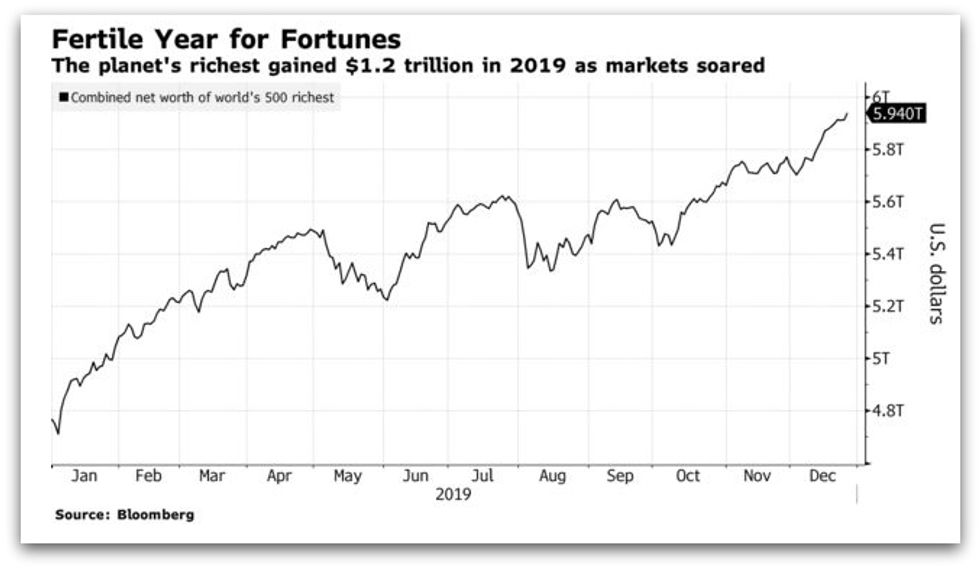
The 500 richest people in the world, all of whom are billionaires, gained a combined $1.2 trillion in wealth in 2019, further exacerbating inequities that have not been seen since the late 1920s.
That's according to a new Bloomberganalysis published Friday, which found that the planet's 500 richest people saw their collective net worth soar by 25 percent to $5.9 trillion over the last year.
"In the U.S., the richest 0.1 percent control a bigger share of the pie than at any time since 1929," Bloomberg noted. "The 172 American billionaires on the Bloomberg ranking added $500 billion, with Facebook Inc.'s Mark Zuckerberg up $27.3 billion and Microsoft Corp. co-founder Bill Gates [rising] $22.7 billion."
Amazon CEO Jeff Bezos lost nearly $9 billion in wealth in 2019, according to Bloomberg, but he will still likely end the year as the richest man in the world with a total net worth of $116 billion.
The analysis comes as 2020 Democratic presidential candidates, particularly Sens. Bernie Sanders (I-Vt.) and Elizabeth Warren (D-Mass.), have made tackling inequality a key component of their policy platforms.
Warren has proposed an annual two percent tax on assets over $50 million and a three percent tax on assets above $1 billion.
Sanders, who has said he does not believe billionaires should exist, is calling for a wealth tax that would slash the fortunes of U.S. billionaires in half over 15 years, according to his campaign.
"A small handful of billionaires should not be able to accumulate more money than they could spend in 10 lifetimes," Sanders said in September, "while millions of Americans are living in poverty and dying because they can't afford healthcare."
Rio de Janeiro police said on Thursday they are investigating a video by a far-right group that claimed to have carried out an attack on a group of actors who had depicted Jesus as gay.
On Wednesday, a video circulating on social media showed three masked men claiming to have carried out the attack in retaliation for "an attack against the Brazilian people's faith."
The two-minute video included images of several people lighting Molotov cocktails before throwing them at a building.
The attack, in which no one was hurt, took place Tuesday night at the studio of a group of actors called Porta dos Fundos, whose 46-minute film "Christ's First Temptation" began streaming on Netflix on December 3.
The satirical comedy depicts Jesus returning home with his boyfriend Orlando after 40 days in the desert, as Mary and Joseph plan a surprise party for Jesus's 30th birthday.
It has angered many evangelicals and Catholics, and hundreds of thousands of people signed a petition to have it taken down.
Far-right President Jair Bolsonaro's son Eduardo -- a lawmaker -- criticized the movie on Twitter.
"We believe in freedom of expression but is it really worth attacking the faith of 86 percent of the population?" he wrote.
The masked men in the video held up a flag of the 19th-century Empire of Brazil and another sporting a symbol linked to the 1930s far-right political party Brazilian Integralist Action.
"All hypotheses are being investigated," police commissioner Marco Aurelio Ribeiro told journalists.
Police have identified the registration numbers of a vehicle and motorcycle used by the attackers and said the masked group's video "matches" the crime committed.
Actor Joao Vicente de Castro, a member of Porta dos Fundos, told journalists the incident was "an attack on freedom of expression."
Porta dos Fundos, which was founded in 2012, won an International Emmy this year for their 2018 comedy Christmas special, "The Last Hangover," also available on Netflix.
An anti-racist association said Friday it has filed a complaint with French prosecutors over racist comments posted on social media after a black woman from Guadeloupe was chosen Miss France 2020.
Clemence Botino has been the target of racist comments, especially on Twitter, since she won the title on December 14, the Representative Council of Black Associations (CRAN) said in a statement.
"These comments must be sanctioned, they are totally unacceptable," CRAN president Ghyslain Vedeux told AFP.
He also criticised the platform Pharos, which the French government had put in place to fight against hate speech online.
"There was no reaction from the authorities, or the government," he added, especially complaining about the lack of action on the part of Marlene Schiappa, secretary of state in charge of fighting discrimination.
CRAN also pointed out that there had been racist tweets about Evelyne de Larichaudy, originally from Reunion, after she won the Miss Ile-de-France beauty contest,
At least 15 natural disasters linked to climate change this year caused damage of over $1 billion and seven of them cost at least $10 billion, British charity Christian Aid said Friday.
This year is set to be the second hottest year in history and each of the disasters in the report has a link with climate change, Christian Aid said.
"Extreme weather, fueled by climate change, struck every corner of the globe in 2019. From Southern Africa to North America and from Australia and Asia to Europe, floods, storms and fires brought chaos and destruction," it said.
Assembling its report from official figures, estimates by NGOs and aid bodies, scientific studies and media reports, the British charity said the disasters displaced millions and caused widespread deaths.
Seven of them caused damage of more than $10 billion (9 billion euros).
These included the floods that ravaged north India, typhoon Lekima in China, Hurricane Dorian in the United States, floods in China, floods in the Midwest and southern United States, typhoon Hagibis in Japan and the California wildfires, the costliest tragedy at $25 billion.
"These figures are likely to be underestimates as they often show only insured losses and do not always take into account other financial costs, such as lost productivity and uninsured losses," it said.
Christian Aid said the overwhelming majority of deaths were caused by just two events, in India and southern Africa, which called it "a reflection of how the world’s poorest people pay the heaviest price for the consequences of climate change.
"In contrast, the financial cost was greatest in richer countries: Japan and the United States suffered three of the four most costly events."
Greenhouse gas emissions are once again set to rise in 2019 after hitting a record in 2018, as extreme weather events -- made more likely as the planet warms -- struck seemingly everywhere this year.
These include Cyclone Idai in Mozambique, typhoon Hagibis in Japan, a deadly, record-breaking heatwave across much of Europe, wildfires in California and eastern Australia and floods in Venice.
The threat posed by climate change became so stark in 2019 that Indonesia, one of the fastest-growing economies on Earth, decided to move its capital to somewhere that wasn't sinking.
"Unless urgent action is taken to reduce emissions, global temperatures will rise at least another 0.5°C over the next 20 years, and another 2-3°C by the end of the century," Christian Aid said.
"The world’s weather will continue to become ever-more extreme and people around the world will continue to pay the price. The challenge ahead is to minimize the impacts through deep and rapid emissions cuts."
At least 14 people died Friday when a passenger plane carrying 100 people crashed into a house shortly after takeoff from Kazakhstan's largest city, authorities said.
The Bek Air plane "fell off the radar" minutes after it took off from Almaty airport at 7.05 am (01:05 GMT) on its way to the capital, Nur-Sultan, the airport authority said in a statement.
"There are 14 dead at the (crash) site," the city government said in a statement sent from its Telegram messenger app.
It added that a further 17 patients were being treated in hospital in a "serious condition", including at least eight children.
AFP /Graphic on the fatal Kazakhstan plane crash on Friday
A video, released by the Central Asian country's emergencies committee, showed the front of the plane crushed into a house that was partially collapsed, as rescue crews worked to pull people from the wreckage.
Rescue workers could be seen reaching into the windows of the shattered cock pit, as scores of emergency staff gathered at the site.
President Kassym-Jomart Tokayev pledged to provide families of the victims with compensation and tweeted that those responsible "will be severely punished in accordance with the law."
Tokayev also said that a government commission had been set up to investigate the circumstances surrounding the tragedy.
In March, a Bek Air Fokker-100 plane with 116 passengers made an emergency landing at the capital's international airport after its landing gear failed to deploy. None of the passengers or five-member crew were injured.
Kazakhstan's industry ministry said in a statement Friday that the Fokker-100 model would be grounded until the cause of the accident became clear.




 AFP / Robyn Beck
  AFP / Robyn Beck
  AFP / Robyn Beck
  AFP /
AFP / AFP / Abdirazak Hussein FARAH
  AFP / Abdirazak Hussein FARAH

 AFP /
AFP /