A French former NBA player has been reprimanded and fined $1,400 by sports officials in China for not looking at the Chinese flag during the national anthem before a game.
Players with the Chinese Basketball Association (CBA) are supposed to stare at the national symbol during the "March of the Volunteers", but television images showed Guerschon Yabusele, who plays for Nanjing Tongxi Monkey King, had his head down before Friday's game.
Yabusele was given a "serious warning" and a 10,000-yuan fine for not looking at the flag as required, the CBA said in a statement on Saturday.
Yabusele, who played forward for the Boston Celtics for two seasons before joining the CBA team this year, has not commented on the incident.
China's government has stepped up the promotion of patriotism under President Xi Jinping, with legislation approved in 2017 to punish anyone who disrespects the national anthem with up to three years in prison.
Opinions on Yabusele's punishment were divided on Chinese social media.
"He's happy to take money from China, but he doesn't respect it," one person wrote on the popular Weibo social media platform.
"This player must be expelled immediately and his club must be disqualified from the championship," another said.
But many found the sanction to be harsh.
"It's nonsense. First, he's not Chinese. Moreover, he stood up and didn't make any insulting gesture," one person wrote.
"He has his head down. So what? In what era does the CBA live? It's 50 years behind."
Yabusele is not the first foreign athlete to break patriotic rules in China.
Last year, Shandong Luneng's Brazilian midfielder Diego Tardelli was handed a one-game ban for rubbing his face during the anthem before a game.
The daughter of former Australian prime minister Bob Hawke said he ordered her to keep quiet about her alleged rape by one of his political allies for fear it would damage his career, Australian media has reported.
Rosslyn Dillon alleged she was raped three times by a late Labor member of parliament in the 1980s, The New Daily reported Saturday.
In a court affidavit, Dillon said her father -- one of Australia's most popular prime ministers -- told her not to go to the police to avoid controversy ahead of his challenge for the party leadership in 1982.
The allegations were reportedly made as part of her Aus$4 million ($2.73 million) claim to Hawke's estate, which she is disputing after receiving $750,000 in his will.
Hawke was unsuccessful in his 1982 attempt to become Labor leader. He took over the following year and was quickly elected prime minister, a position he held until 1991.
He died in May aged 89.
According to The New Daily, there are several inconsistencies in Dillon's claims, including the timing of certain documented historical events.
Dillon's sister, Sue Pieters-Hawke, said the family had been aware of the allegations at the time and Hawke found them distressing.
"She did tell people at the time. I believe there was a supportive response but it didn't involve using the legal system," she told The New Daily.
Dillon reportedly said she was "still haunted by the sexual assaults" and may have found closure if she had been able to go to the police.
Restaurants and cafes in Saudi Arabia are no longer required to have gender-segregated entrances, officials said, in a further easing of social restrictions in the ultra-conservative Islamic kingdom.
Eateries have long required one entrance for single men and another for women and families, in a country where the once-powerful religious police zealously enforced sex segregation in public places for decades.
The ministry of municipalities and rural affairs said on Twitter Sunday it was eliminating several requirements for restaurants, including the need for "an entrance for bachelors and a separate entrance for families".
It was unclear whether a restriction on seating inside restaurants will also be removed.
Restaurants are currently segregated into a "family" section for those accompanied by women and a "singles" area for men, though many have quietly taken down the barriers in recent years amid the kingdom's sweeping liberalisation drive.
The latest reform was hailed by young Saudis but dismissed by arch-conservatives on social media, with one Twitter user saying it went "against sharia", or Islamic law.
Saudi Arabia's de facto ruler, Crown Prince Mohammed bin Salman, has sought to project a moderate, business-friendly image of his austere kingdom as he seeks to boost investment.
Prince Mohammed has clipped the powers of hardline clerics as he pursues a modernisation drive that has allowed mixed-gender music concerts and ended decades-long bans on cinemas and women drivers.
Until three years ago, the religious police elicited widespread fear in the kingdom, chasing men and women out of malls to pray and berating anyone seen mingling with the opposite sex.
The hardline enforcers of public morality, whose powers began waning even before Prince Mohammed rose to power, are now largely out of sight.
But the reforms have been accompanied by a crackdown on activists, including women urging faster reform, some of whom have accused interrogators of sexual harassment and torture. Saudi prosecutors deny the accusations.
North Korea on Monday slammed US President Trump for "bluffing" and called him "an old man bereft of patience" as Pyongyang ramps up pressure on Washington over stalled nuclear talks.
Trump and North Korean leader Kim Jong Un engaged in mutual insults and threats of devastation in 2017, sending tensions soaring before a diplomatic rapprochement the following year.
Pyongyang has set Washington an end-of-year time limit to offer it new concessions in deadlocked nuclear negotiations, and has said it will adopt an unspecified "new way" if nothing acceptable is forthcoming.
Denuclearisation negotiations have been at a standstill since a summit in Hanoi broke up in February.
Trump has indicated that the option of military action was still on the table while downplaying Pyongyang's actions, saying the North's leader would not want to "interfere" with the upcoming US presidential elections.
"I'd be surprised if North Korea acted hostiley," Trump said Saturday.
But Kim Yong Chol, who served as the North's counterpart to US Secretary of State Mike Pompeo until the collapse of the Hanoi meeting, slammed Trump's "odd words and expression", referring to him as a "heedless and erratic old man".
"Our action is for his surprise. So, if he does not get astonished, we will be irritated," Kim, now the chairman of the Korea Asia-Pacific Peace Committee, said in a statement carried by the official KCNA news agency.
"This naturally indicates that Trump is an old man bereft of patience," he said, adding: "From those words and expressions we can read how irritated he is now."
The official noted that the North Korean leader had not used "any irritating expression towards the US president as yet", but warned his "understanding" of Trump could change.
"He must understand that his own style bluffing and hypocrisy sound rather abnormal and unrealistic to us," Kim said. "We have nothing more to lose."
The North has raised tensions in recent months with a series of assertive statements and multiple weapons tests -- including a "very important test" at its key satellite launch site at the weekend -- as its negotiating time limit approaches.
Kim's New Year speech, a key political set-piece in the isolated country, is also due on January 1.
On Thursday, the North's vice foreign minister Choe Son Hui warned of again referring to Trump as a "dotard" -- Pyongyang's favoured nickname for the US president at the height of tensions in 2017.
Another senior official said last week that what gift the US receives for Christmas will depend entirely on Washington's actions.
Five people were killed, 18 were injured and several more were left stranded after an island volcano popular with tourists erupted unexpectedly in New Zealand on Monday.
Police said some 50 people were visiting White Island when it exploded suddenly in the early afternoon -- hurling ash and rock high into the air.
Two dozen people made it off the island, five of whom have since died. The rest are being treated for injuries, including severe burns.
Nothing is yet known about a group -- now estimated to number in the double digits -- who are still trapped on the island.
"We're unsure of the exact numbers on there and we're unsure of their wellbeing," said deputy commissioner John Tims.
As night fell, he said volcanic activity made a rescue attempt too dangerous.
"The island is unstable, there's a danger of further eruptions, it is physically unsafe for us to return to the island"
Institute of Geological and Nuclear Sciences Ltd/AFP / Handout This combination of handout images from a webcam belonging to the Institute of Geological and Nuclear Sciences shows the volcano on New Zealand's White Island spewing steam and ash
"I've got to consider the safety of our people and emergency services staff."
The eruption occurred at 2:11pm (0111 GMT), thrusting a thick plume of white ash 3.6 kilometres (12,000 feet) into the sky.
Seconds before, live camera feeds showed a group of more than a half dozen people walking on the crater floor. Then the images went black.
A "considerable number" of those caught up in the disaster are believed to be Australian, according to officials in Canberra.
Michael Schade/AFP / Handout This handout photograph courtesy of Michael Schade shows wreckage of a helicopter amid ash minutes after the volcano erupted
As many as 30 people are also believed to be cruise passengers on a day trip from the vessel Ovation of the Seas, Kevin O'Sullivan, chief executive officer of industry body the New Zealand Cruise Association told AFP.
The ship's operator Royal Caribbean -- who had billed the trip to White Island as "an unforgettable guided tour of New Zealand's most active volcano" -- said "a number of our guests were touring the island" but did not confirm that number.
The ship has a capacity of around 4,000 people and set sail from Sydney last week on a 12 day voyage.
- Scene of terror -
Tourist Michael Schade, made it off the island just in time and was able to capture footage of the devastation.
His videos showed groups of startled tourists clustered by the shoreline, waiting to be evacuated as the ground around them smouldered, the sky filled with white debris. An ash-caked helicopter lies damaged nearby.
As his ship hurtled away, the caldera became virtually invisible, shrouded by a thick bank of ash.
AFP /New Zealand volcano
Volcanic Air said they had landed a helicopter on the island shortly before the eruption carrying four visitors and one pilot. All were now accounted for.
"It had landed on the island. What happened after that we don't know, but we know that all five made it back to Whakatane on one of the tourist boats," a company spokesman told AFP.
Guillaume Calmelet, the co-director of Skydive Tauranga, saw the eruption from above as he took a customer on a tandem skydive from a plane 12,000 feet above the Bay of Plenty.
"As soon as the parachute opened there was this huge cloud that was really different to whatever we've seen before," he told AFP. "I could see it coming out in freefall, so probably about 30 seconds for the whole cloud to form, if that. It was pretty quick."
The country's National Emergency Management Agency described the eruption as "moderate", although the plume of ash was clearly visible from the mainland and from satellites flying overhead.
"We have seen a steady decline in activity since the eruption. There remains significant uncertainty as to future changes but currently, there are no signs of escalation."
AFP/File / TORSTEN BLACKWOOD A file picture of New Zealand's most active volcano, Whakarri (White Island), in the Bay of Plenty
White Island -- - also known as Whakaari -- is about 50 kilometers (30 miles) offshore in the picturesque Bay of Plenty and is popular with adventurous tourists willing to don hard hats and gas masks.
It is New Zealand's most active volcano cone and about 70 percent of it is underwater, according to government-backed agency GeoNet.
Around 10,000 people visit the volcano every year. It has erupted frequently over the last half-century, most recently in 2016.
In August of that year the New Zealand Defense Force airlifted a 2.4-tonne shipping container onto the island to serve as an emergency shelter in case of an eruption.
"Sudden, unheralded eruptions from volcanoes such as White Island can be expected at any time," said University of Auckland volcanologist Shane Cronin.
"The hazards expected from such events are the violent ejection of hot blocks and ash, and formation of 'hurricane-like' currents of wet ash and coarse particles that radiate from the explosion vent."
"These can be deadly in terms of causing impact trauma, burns and respiratory problems. The eruptions are short-lived, but once one occurs, there are high chances for further, generally smaller ones as the system re-equilibrates."
New Zealand's White Island volcano erupted suddenly on Monday, prompting fears for a group of visitors seen walking on the crater floor moments before.
The country's National Emergency Management Agency said a "moderate volcanic eruption is occurring at White Island and is hazardous in the immediate vicinity of the volcano."
Cameras providing a live feed from the volcano showed more than half a dozen people walking inside the rim at 2:10 pm local time (0110 GMT), before images went dark when the eruption occurred minutes later.
The local mayor said she feared there had been "injuries" in the eruption.
"I've got limited understanding at present other than there's been an eruption, that there have been some people who were on the island at the time, who have had some injuries," Whakatane mayor Judy Turner told Radio NZ.
"I'm not sure of the extent or nature of those injuries... emergency services are all waiting for them to be returned from the island so they can attend to them."
Police said they were responding to the incident, but offered no further comment.
White Island is New Zealand's most active volcano cone and about 70 percent of it is undersea, according to government agency GeoNet.
Around 10,000 people visit the volcano every year. It has erupted frequently over the last half-century, most recently in 2016.
In August of that year the New Zealand Defence Force airlifted a 2.4-tonne shipping container onto the island to serve as an emergency shelter in case of an eruption.
The executive director of the Jewish Democratic Council of America told Salon on Sunday that President Donald Trump's recent comments about Jewish voters continue "what has been a very negative stereotype of Jews and money and power."
"He has said in the past that he wants Jews to be the ones counting his money," Halie Soifer told Salon. "He has repeatedly made references to what has been a very negative stereotype of Jews and money and power." After saying that "I think that he must believe it, and that is why he continues to repeat it," Soifer noted that Trump was repeating claims that he has made when "typically speaking extemporaneously, and clearly he's speaking from his heart. It's clear that there's quite a bit of hatred in it." Soifer also criticized Trump for having "views of Jews as driven largely by money, which is why he said at this events that Jews have no choice but to support him, referring to tax cuts."
She added that Trump said "those who don't support Israel, they should — and this is not a direct quote — but essentially, they should leave. And then we saw hateful figures like Ann Coulter retweet that video and suggest that Jews are unpatriotic, that they don't love America either. That is a good example of how the president's hatred is amplified by others in the media to continue to spread these anti-Semitic tropes. And this is exactly why anti-Semitism and white nationalism have grown during his presidency."
During the speech on Saturday to the Israeli American Council, Trump said that "we have to get the people of our country, of this country, to love Israel more, I have to tell you that. We have to do it. We have to get them to love Israel more. Because you have people that are Jewish people, that are great people — they don't love Israel enough. You know that. You know that." His remarks were later retweeted by Ann Coulter who asked, "Could we start slowly by getting them to like America?"
Trump is also reported to have said, according to the Times of Israel, that Jews would need to support him to stop a wealth tax. "Even if you don’t like me — and some of you don’t; some of you, I don’t like at all, actually — and you’re going to be my biggest supporters because you’ll be out of business in about 15 minutes," Trump remarked.
Trump's remarks were similar to past comments that he has made about Jewish voters. In August Trump said that he believed "any Jewish people that vote for a Democrat, I think it shows either a total lack of knowledge or great disloyalty." In 2015 Trump made controversial remarks to the Republican Jewish Coalition, saying that "stupidly, you want to give money. …You’re not going to support me because I don’t want your money." He later added, "Is there anyone in this room who doesn’t negotiate deals? Probably more than any room I’ve ever spoken.”
Soifer's comment about Trump saying he wanted Jews to be the ones counting his money is based on a 1991 book by John O’Donnell, the former president of Trump Plaza Hotel and Casino in Atlantic City, who quoted Trump as saying "Black guys counting my money! I hate it. The only kind of people I want counting my money are short guys that wear yarmulkes every day. … I think that the guy is lazy. And it’s probably not his fault, because laziness is a trait in blacks. It really is, I believe that. It’s not anything they can control." The president initially denied his remarks but later told Playboy in 1997 that "the stuff O’Donnell wrote about me is probably true.”
Sen. Ted Cruz (R-TX) appeared on "Meet the Press" Sunday to perpetuate the false narrative that Ukraine hacked the 2016 election, a fact that has been disproven by all of the U.S. intelligence agencies. When asked to explain what Cruz could possibly have been thinking, former Rep. Charlie Dent (R-PA) confessed he has no idea how to explain Cruz.
After a pause, Democratic panelist Hilary Rosen chuckled. "Yes, Charlie, explain Ted Cruz for us."
Dent was at a loss.
"Yeah, that would be great," he began. "I can't explain it. I mean, after all the things the president said about his wife and his father, I mean, why would he even attempt to defend the indefensible and start peddling these conspiracy theories? We all know what happened here. Everybody knows. Yes, there were people in Ukraine during 2016 that were unhappy that Paul Manafort was involved with Donald Trump's campaign because he was seen as a pro-Russian guy working for the government. That doesn't mean they interfered with the election."
He repeated, "again, Ted Cruz -- I can't explain it. You would think a man like that would have more self-respect."
Conservative Washington Post columnist Max Boot blasted President Donald Trump for essentially becoming a "press secretary" for the Saudi Arabian government in wake of the Pensacola, Florida mass shooting.
In his column Sunday, Boot noted that the typical mass shooting sentiments like "thoughts and prayers" were absent Friday when Trump discovered that the shooting was done by a Muslim.
"It turns out that Trump actually has a triple standard, because he treats attacks by Saudis differently than those from other Muslim nations," Boot observed. "On Friday, a Saudi air force officer studying at the Naval Air Station Pensacola shot dead three Americans and wounded eight others. Instead of expressing outrage or vowing vengeance, or even waiting for all the facts to come in, Trump sounded as if he were auditioning for the job of press secretary at the Saudi Embassy."
When speaking to the press, he delivered "sincere condolences" from King Salman. He also gave a "highly questionable" promise that the person didn't represent the "feelings of the Saudi people who love the American people."
As Boot noted, the U.S. has a complicated history with the Saudis, after 15 of the 19 hijackers who attacked the Twin Towers on Sept. 11 were Saudi citizens. Then there's the matter of the brutal torture, murder and dismemberment of Washington Post journalist Jamal Khashoggi.
"Sorry, but Americans don’t need blood money from the Saudis," wrote Boot. "What they need are honest answers to figure out what happened and why."
He noted that not only did the shooter screen videos of mass shootings with other Saudi students but the fact that he posted anti-Israel attacks about America's "invasion," he also had Saudi students film the attack. Boot explained that it would be enough for any right-wing Republican to proclaim "terrorism," yet Trump is staying away from saying the word.
It certainly isn't the first time Trump is taking the side of the Saudis. Boot recalled Trump's decision to back the Saudis against American ally Qatar during a Saudi blockade. He also recalled Trump's decision to back the Saudis during the disastrous humanitarian crisis after bombing Yemen.
"Why is Trump so sickeningly solicitous of a vicious dictatorship whose citizens have carried out numerous terrorist attacks against Americans, from Sept. 11, 2001, to Friday in Pensacola?" Boot asked. He speculated about the financial promise Trump's relationship with the Saudis could have for the president's own business prospects. Trump also seems to think that the U.S. needs the Saudi's oil, despite becoming energy-independent. Trump has also lied about the weapons the Saudis have agreed to purchase from the U.S., saying it was $110 billion when it's closer to $14.5 billion.
"If we’ve learned anything from Trump’s attempted extortion of Ukraine, it’s that all politics and policy is personal for him. His policy is 'Me First,' not 'America First,'" Boot closed. "Trump’s suspicious relationship with Saudi Arabia is merely another example of what happens when a president decides to run the U.S. government as if it were a family-owned business whose only objective is to benefit his bottom line."
According to a report from Politico, Chinese diplomats have been unleashed, as well as urged, to attack Donald Trump's administration and the U.S. in general via social media like Twitter -- turning the president's favorite social media platform back on him.
"The tactic comes as China’s Foreign Minister Wang Yi has reportedly urged his diplomats to adopt a 'fighting spirit,' which has led to Chinese diplomat Lijian Zhao to describe "America as 'unjust, 'inhumane' and 'hypocritical.' He’s gone so far as to slam neighborhood segregation in Washington, D.C., and assert that 'racial discrimination, gun violence, violent law enforcement are chronic diseases deeply rooted in U.S. society," Politico reports.
"Zhao is the most glaring example of a new trend in Chinese diplomacy: using social media, mainly Twitter, in an aggressive, decidedly undiplomatic manner. He and other Chinese officials are swinging in particular at the U.S., which under President Donald Trump — himself famous for mean tweets — has taken a combative stance toward the ruling Chinese Communist Party," Politico's Nahal Toosi wrote.
Writing, "Trump administration officials are tracking the shifting Chinese approach online. They stress, though, that the change is more about tone than substantive positioning on issues," Toosi explains, "U.S. officials are wary of getting into a Twitter war with Beijing. When it comes to the Chinese diplomatic attacks online."
“We’re going to answer by effectively explaining our position within a framework that’s very measured and reasonable, and we’ll see how they respond,” stated one Trump insider.
Not everyone in the Trump administration is taking the attacks lying down.
"In a speech at the Hudson Institute in late October, [Secretary of State Mike] Pompeo took a shot at China’s information strategy. He said that Chinese state-run media and government spokespeople are 'routinely maligning American intentions and policy objectives.' But Pompeo also indicated that the Chinese approach has worked overtime because the U.S. has been slow to wake up to the dangers the Communist Party poses to the world," the report notes. "
“They distorted how Americans view the People’s Republic and how they review General Secretary Xi.” Pompeo added. “Today, we’re finally realizing the degree to which the Chinese Communist Party is truly hostile to the United States and our values, and its worse deeds and words and how they impact us.”
As for Trump, he is holding his fire, desperately needing a trade deal with China as his trade war does significant damage to the U.S. economy.
The International Holocaust Remembrance Alliance defines anti-Semitism as “a certain perception of Jews, which may be expressed as hatred toward Jews.” It states that evidence of anti-Semitism “might include the targeting of the state of Israel, conceived as a Jewish collectivity.”This event raises questions of what are legitimate or illegitimate criticisms of the state of Israel. It also raises questions about when or whether such criticism is anti-Semitic.
However, it also states that “criticism of Israel similar to that leveled against any other country cannot be regarded as anti-Semitic.”
Using this definition, Canada’s vote for creation of a Palestinian state does not delegitimize Israel, any more than Canadian criticism of any other state delegitimizes it.
Illegitimate criticism
On the other hand, activists for Palestinian rights who call for the state of Israel to be destroyed, for example, by referring to a free Palestine “from the river to the sea,” engage in illegitimate criticism.
Regardless of the circumstances of its creation, Israel is a sovereign state that enjoys the right to exist. All sovereign states enjoy this right. Like any other state, Israel also has the right to defend itself against attack.
To suggest that Jews have no right to live in Israel is also to engage in illegitimate criticism. All states are permitted to determine who will live within their borders. And suggesting that Jews should not live in Israel means advocating the creation of a huge refugee population based on religio-ethnic criteria.
Some critics call Israel a colonial power. They assume that it is illegitimate for any Jewish “settler” to live in Israel proper. This assumption is based in part on the belief that Jews are not indigenous to the Middle East. But Jews have lived in the Middle East for thousands of years.
Israel was created in 1948. An estimated 600,000 to 760,000 Palestinians fled or were expelled in the subsequent Arab-Israeli war.
In later years, about 800,000 Jews left Arab countries. About two-thirds of them settled in Israel, and the other third elsewhere. Many of these Jews had been forcibly expelled.
Many Jews settled in Israel from Europe. It is important to remember the context of European pogroms and Nazi genocide that obliged many of them to flee.
This does not justify Israeli violations of the human rights of either Israeli Arabs or of Palestinians in the West Bank and Gaza. It merely provides some context as to why so many Jews have settled in Israel.
Sanctions against Israel are legitimate
Having said this, I agree with the opinion of the International Holocaust Remembrance Alliance that it’s legitimate to criticize Israel as one might criticize any other state. Thus the boycott, divestment and sanctions movement against Israel is legitimate, as long as it does not simultaneously question the right of Israel to exist as a state. Many Jewish people both within and outside Israel who are concerned about Palestinian rights support this movement.
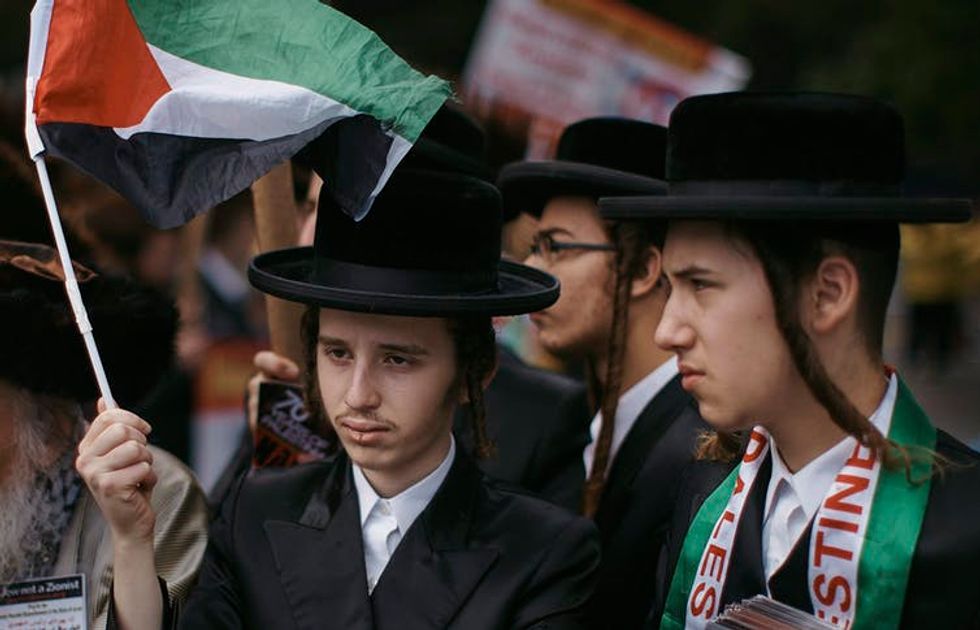
Hasidic Jews wave a flag of Palestine as they protest against Israel in front of the United Nations headquarters during the 73rd session of the United Nations General Assembly in September 2018 in New York.
(AP Photo/Andres Kudacki)
Similarly, although it is not strictly accurate to call Israel an apartheid state, it is within the realm of acceptable political rhetoric. Legally speaking, apartheid can only occur within a state. So calling Israel an apartheid state suggests that it has legal sovereignty over the West Bank and Gaza.
A better way to judge Israel’s actions in Gaza and the West Bank is through universal standards. One such standard is international humanitarian law, especially the fourth Geneva Convention of 1949. This convention prohibits transfers of population, either from or into conquered territories. That means Jewish settlements in the West Bank are illegal.
The International Court of Justice also adheres to universal standards. It ruled in 2004 that the wall separating Israel from the West Bank is illegal, because part of it is built outside Israel’s territory. This wall frequently separates Palestinians from their land, work opportunities and family members.
International human rights law is another universal standard that protects Palestinians. Israel definitely denies some human rights to people in the West Bank and Gaza. But so do Palestinians’ own political leaders, Hamas in Gaza and Fatah in the West Bank. Both these political groups deny their subjects civil liberties. They also use torture and arbitrary arrest, prohibited by international human rights law.
Other states punish Palestinians
Other states also undermine Palestinians’ human rights. Like Israel, Egypt periodically blockades Gaza . These blockades deny Palestinians freedom of movement across national boundaries. Both these states have the legal right to control their own borders. But these controls frequently mean that Palestinians cannot buy food, go to hospitals or work in Israel or Egypt.
Arab states also undermine Palestinians’ human rights. Some have given shelter to Palestinian refugees and their descendants for decades, but refuse to grant them citizenship.
These states are not legally obliged to grant citizenship to refugees and their descendants. But the reason that Jewish emigrants and refugees from Arab states do not constitute a political bloc, which Palestinians emigrants and refugees do, lies partly in citizenship laws.
Jewish emigrants and refugees obtained citizenship in Israel and other countries like the United States and Canada. Palestinians emigrants and refugees from Israel, and many of their descendants, remain stateless.
Universal rules and responsibilities
Serious concern for the human rights of Palestinians requires consideration of all the states that violate their rights under international human rights and humanitarian law.
These legal standards are universal. As long as they do not advocate eradication of the state of Israel and/or expulsion of Israeli Jews, states and activists that adhere to these standards are engaged in legitimate criticism.
Activists should respect Israel’s rights as a sovereign state. But Israel should respect Palestinians’ rights under universal human rights and humanitarian law. Israel is the most important of all the states in the Palestinian crisis.
Unfortunately, the government of Israel in 2019 was nationalist and expansionist. There’s little hope as we head into 2020 that Israel will negotiate in good faith with Palestinian leaders. Yet Israel will never be safe from attack until it negotiates a peaceful settlement that gives Palestinians their own state.
This week, Madonna made headlines for a very eccentric, Madonna-esque Instagram post. In her picture, she was laying on what looked like a hospital bed, receiving intravenous therapy (IV) as a woman played a Tibetan bowl above her body.“Felt amazing afterwards!!,” she wrote in the caption.
Madonna wasn’t in the hospital, however. While her exact whereabouts are unclear, she was getting a vitamin IV drip, an emerging wellness service not covered by insurance that has caught fire with celebrities. IV drips, though prohibitively expensive for most, have become in vogue among self-care enthusiasts who can afford the treatment.
In these procedures, consumers receive a saline or vitamin mixture administered intravenously. The mixture depends on the specific treatment, and IV drip marketers have formula that are designed to cure aging, low libido, as well as a general detox, to name a few. Yet the most popular IV drip is what is variously known as the “Myers' cocktail,” a vitamin and mineral mixture containing magnesium, calcium, various B vitamins and vitamin C. IV drips are often used as a hangover remedy, something that marketers have latched onto.
“It’s the fastest way to replace missing [nutrients],” Dr. Marina Yuabova of Integrative Wellness in Brooklyn, New York, told Salon. Yuabova is also a Family Nurse Practitioner and Assistant Professor at City University of New York.
IV drip clinics are popping up across the United States, selling infusions for those who want to escape the painful physical effects of having had one too many drinks the night before. These services range in price from $90 to several hundred dollars, depending on the service provider and where one is located — which is still more expensive than a night at the bar for most imbibers.
In San Francisco, where well-heeled techies are enamored of expensive and sometimes questionable wellness regimes, The I.V. Doc™ sells a range of hangover treatments that range in price from $150 to $269. At Yuabova’s clinic in Brooklyn, a comparable IV drip costs around $300. In Manhattan, some clinics charge up to $500. In contrast, a hangover "pill" — which are often sold at gas stations, and widely regarded as scams — can range from $1 to $20 in price.
Yuabova explained to Salon when it comes to treating a hangover, an IV drip helps to instantly replenish the fluids and nutrients that one's body loses while drinking alcohol.
“Within 15 minutes you’ll feel your headache clear up, nausea goes away, no more nausea or vomiting,” Yuabova said, adding that when someone drinks excessively, “it’s like somebody came in and rubbed all the nutrients out of the system."
I have previously written about how self-care has become a status symbol reserved for those who can afford to indulge in such luxuries. The wellness industry, which is estimated to be worth $4.2 trillion globally, is profiting off Americans’ anxiety, depression, and overall poor health, and while there is no shame in people trying to help themselves, it is worth examining the socioeconomic gap regarding the availability of these wellness trends. They seem to be increasingly popular among those who can afford them: the on-demand fitness app ClassPass now allows customers to reserve drips in various cities.
Separate from ClassPass, some clinics offer concierge services in which a nurse travels to the customer. A quick search on Instagram for the hashtag #IVdrip reveals tens of thousands of people taking photos from their homes while getting an intravenous infusion.
Meghan Connolly is a 28-year-old real estate agent living in Miami. She first tried IV drip therapy for a hangover in 2016.
“I tried it initially because I thought it was cool and I heard it was a hangover trend,” she told Salon. Connolly said she discovered on her first visit to the clinic they also offered drips for wellness. As a woman with endometriosis, she discovered that the drips helped with chronic illness as well. She estimates that she goes a minimum of twice a month, sometimes up to fives times a month, often a mix between treating a hangover and her illness. On average, she spends between $90 and $200 per visit — depending on the remedy.
“When I do it it helps me maintain overall wellness, my pain isn’t as bad and I don’t have as many flare-ups or episodes,” Connolly said, adding when it comes to treating a hangover, she is functional the next day. “As I get older, and when I go out and have like three drinks, the next day I can’t function; when I was in college I could have six drinks and go to class the next day.”
Alex Tran is 35-year-old digital marketing strategist in Seattle, Washington. While partying in Las Vegas with a friend, she turned to an IV drip to ensure she would be able to enjoy the next day.
“I was out until 7am in the morning,” Tran told Salon in an email. “We had lunch reservations at 1230pm and I almost didn’t make them.”
It cost $150 for a nurse to come to her hotel room. The process took around 40 minutes. For Tran, her IV bag was filled with vitamins and electrolytes that made her feel “refreshed” and like she was “never drunk at all.”
Tran said it was a bit of “splurge,” but something she would consider doing again on vacation.
“It is a bit expensive, so I’d splurge if I were on a time crunch or on a schedule with others,” she said.
Strangely, the cost of this service is cheaper than getting IV therapy in a hospital. Generally hospital IVs are life-saving necessities, not optional services. An IV bag of sterile saltwater is one of the most common components of emergency medicine, yet patients can experience price hikes of 100 to 200 times the manufacturer’s price thanks to the country’s complicated healthcare system, as reported by the New York Times in 2013. Some hospital IVs are billed to the patient at $500 to $800, though insurances will generally cover these — whereas at IV drip clinics, customers pay out of pocket.
In 2017, Hurricane Maria created a shortage of sterile intravenous medications in hospitals after Baxter International Inc., whose plants in Puerto Rico produces 44 percent of the IV bags used in U.S. hospitals, was damaged by the storm. Hospital weren’t the only ones impacted, but IV drip clinics were, too. Yuabova said she was impacted by the shortage, and now today, she overstocks in case another one happens.
Hong Kong democracy protesters are hoping for huge crowds later Sunday at a rally they have billed as a "last chance" for the city's pro-Beijing leaders in a major test for the six-month-old movement.
The march comes two weeks after pro-establishment parties got a drubbing in local elections, shattering government claims that a "silent majority" opposed the protests.
But activists say public anger is building once more after chief executive Carrie Lam and Beijing ruled out any further concessions despite the landslide election defeat.
"No matter how we express our views, through peacefully marching, through civilised elections, the government won't listen," said a 50-year-old protester, surnamed Wong, who was among hundreds arriving early for Sunday's rally.
"It only follows orders from the Chinese Communist Party," he added.
The semi-autonomous financial hub has been battered by increasingly violent demonstrations in the starkest challenge the city has presented to Beijing since its 1997 handover from Britain.
Millions have hit the streets in protests fuelled by years of growing fears that authoritarian China is stamping out the city's liberties.
The last fortnight has seen a marked drop in street battles and protester vandalism after the landslide win by pro-democracy candidates.
Police have taken the unusual step of allowing the Civil Human Rights Front to hold a march through the main island on Sunday -- the first time the group has been granted permission since mid-August.
Organisers have called on Lam to meet their demands which include an independent inquiry into the police's handling of the protests, an amnesty for those arrested, and fully free elections.
"This is the last chance given by the people to Carrie Lam," CHRF leader Jimmy Sham said on Friday.
Hong Kong's protests are largely leaderless and organised online. They were initially sparked by a now-abandoned attempt to allow extraditions to the mainland but have since morphed into a popular revolt against Beijing's rule.
The CHRF, which advocates non-violence, has been the main umbrella group behind record-breaking rallies earlier in the summer that saw huge crowds regularly march in searing heat.
Police seize weapons
Authorities have repeatedly banned major rallies in recent months citing the risk of violence from hardcore protesters.
Large crowds have simply ignored the bans, sparking near-weekly tear gas and petrol bomb clashes that have upended Hong Kong's reputation for stability and helped tip the city into recession.
Hours before the march was due to kick off, police displayed weapons, including a pistol and knives, they said had been found during overnight raids where eleven people were arrested.
Sunday afternoon's march will follow a well-worn route on the main island from Victoria Park to the heart of the commercial district.
It comes a day before the city marks the six-month anniversary of the protest movement in which some 6,000 people have been arrested and hundreds injured, including police.
Online forums used to organise the movement's more radical wing have vowed to target the morning commute on Monday if there is no response from Lam.
Years of huge, peaceful democracy marches have made little headway, leading to increased radicalisation among some Hong Kong protesters and a greater willingness to embrace violent tactics.
But there is little sign Lam is willing to budge, leading to fears the lull in street clashes will be temporary.
Since the local elections the city's chief executive has remained steadfast in her opposition to further concessions and Beijing has stuck by her even as she languishes with record low approval ratings.
The police force's reputation has also taken a hammering.
A new poll released on Friday by the Hong Kong Public Opinion Programme, which has tracked public sentiment for years, showed record disapproval for the force with 40 percent of respondents now giving it the lowest mark of zero.
Over the last two days the city's new police chief Chris Tang has been in Beijing where he met with senior party figures including public security chief Zhao Kezhi who gave his "strongest backing" according to official reports.
Tang, who has continued his predecessor's policy of rejecting calls for an independent inquiry, said his officers would clamp down on any violence at Sunday's march.
"If there is arson, petrol bombs or damage to shops, we will take action," he told reporters in Beijing.




 Institute of Geological and Nuclear Sciences Ltd/AFP / Handout
  Michael Schade/AFP / Handout
  AFP /
AFP / AFP/File / TORSTEN BLACKWOOD