The Pentagon released video and photos on Wednesday of the US special forces raid that resulted in the death of Islamic State group leader Abu Bakr al-Baghdadi.
Among the images released by the Defense Department was grainy black-and-white footage of US troops approaching on foot the high-walled compound in northwestern Syria where Baghdadi was holed up.
The Pentagon also released video of airstrikes on a group of unknown fighters on the ground who opened fire on the helicopters that ferried US forces in for the assault on Baghdadi's compound in Syria's Idlib province.
Before and after pictures of the isolated compound were also released.
The compound was razed by US munitions after the raid, leaving it looking like "a parking lot with large potholes," said Marine Corps General Kenneth McKenzie, commander of US Central Command.
McKenzie, speaking to reporters at the Pentagon, also provided several new details about Sunday's raid.
He said that two children were killed -- and not three as President Donald Trump previously said -- when Baghdadi blew himself up with a suicide vest in a tunnel as he tried to escape US troops.
He said the children appeared to be under 12 years old.
McKenzie was asked about Trump's claim that Baghdadi had fled into the tunnel "crying and whimpering."
US Department of Defense/AFP / HO This image released by the US Department of Defense shows before (L) and after (R) pictures of the compound in Syria where Islamic State group leader Abu Bakr al-Baghdadi died in a US raid
"About Baghdadi's last moments, I could tell you this," he said. "He crawled into a hole with two small children and blew himself up while his people stayed on the ground."
Baghdadi "may have fired from his hole in his last moments," he added.
McKenzie said that in addition to Baghdadi and the two children, four women and one man were killed at the compound.
He said the women had acted in a "threatening manner" and were wearing suicide vests.
- Buried at sea -
An unknown number of nearby fighters were also killed when they opened fire on US helicopters, McKenzie said.
US Department of Defense/AFP / Jose ROMERO This still image from a video released by the US Department of Defense shows smoke rising from the compound of Islamic State group leader Abu Bakr al-Baghdadi in Syria after it was destroyed by US forces
Video released by the Pentagon showed airstrikes on a group that appeared to consist of up to a dozen or so people on the ground.
McKenzie declined to provide any further details about the two men captured in the raid, but said that a "substantial" amount of electronics and documents had been recovered from the compound.
He said Baghdadi had been identified through comparison with his DNA, which had been on file since his 2004 detention in an Iraqi prison.
He said Baghdadi's remains had been flown back to the staging base for the raid for identification.
Baghdadi was then buried at sea within 24 hours of his death "in accordance with the laws of armed conflict," McKenzie said.
He also provided details about the dog that pursued Baghdadi into the tunnel.
He said it was a four-year veteran of 50 combat missions and had been injured by exposed live cables in the tunnel, but has returned to duty.
McKenzie said that despite Baghdadi's death, IS remains "dangerous."
"We're under no illusions that it will go away just because we killed Baghdadi," he said. "It will remain."
A young woman in Texas who remained awake for her brain surgery was able to speak to doctors during the procedure -- and viewers form around the world looked on, as part of the operation was livestreamed on Facebook.
By Wednesday, nearly 100,000 people had watched doctors removed a mass from Jenna Schardt's brain during a 40-minute video of the operation that was livestreamed Tuesday morning.
In the video, the 25-year-old patient can be seen speaking with physicians on one side of a blue operating curtain while doctors in surgical masks work on her brain on the other side.
Schardt had a stroke due to a mass of blood vessels in her left temporal lobe that was affecting her ability to talk, Methodist Dallas Medical Center head of neurology Nimesh Patel told AFP.
She remained awake as her skull was opened so that doctors could be sure they weren't damaging the parts of her brain that control speech as they worked -- they asked her to say words such as bird, dog or number in order to make a "map" of her brain, Patel said.
"In order for us to identify how to approach and remove the mass, we must determine areas that are safe," Patel said. They even asked Schardt about her dog to test her memory during the four-and-a-half hour surgery.
"Brain surgery performed awake, although it is in our repertoire, is not routine," he said. "It all depends on where the lesion is located and if the patient wants to be awake or asleep."
Schardt, from Illinois, is studying occupational therapy.
She wanted to use the experience to educate viewers through the livestream, Patel, said, which was broadcast on the hospital's account.
Schardt is expected to be discharged from the hospital on Thursday morning.
Doctors have performed awake brain surgery throughout the last couple of decades as a way to make sure patients retain essential brain activity -- like in controlling speech or motor functions -- during the operations.
And in 2016 a patient wore 3D virtual reality goggles during a brain surgery for the first time to make sure visual function remained intact while doctors removed a cancerous tumor.
A powerful earthquake struck the southern Philippines on Thursday, killing at least four people and sparking searches of seriously damaged buildings that had already been rattled by two previous deadly tremors in recent weeks.
The 6.5 magnitude quake hit the island of Mindanao, the US Geological Survey said, causing locals to run to safety in the same area where a strong tremor killed eight people on Tuesday.
The powerful shaking caused serious damage to a condominium building in the major southern city of Davao, which was about 45 kilometres (28 miles) from the epicentre.
At least nine people were hurt at the building, and rescuers had launched a search to determine if residents might be trapped inside, police told AFP.
Four people were killed in nearby Cotabato province by the quake, including a local official who was crushed to death, a police official said.
AFP / Jonathan WALTER Philippines earthquake
A hotel partially collapsed in another area, but a disaster official said the building had already been evacuated.
Locals have been left terrified by a string of powerful quakes, and hundreds of aftershocks since the first powerful tremor struck on October 16.
"I panicked and I rushed outside. I was afraid the building might collapse," said Beth Lancian, a restaurant cashier in Davao. "There's been an earthquake almost every week."
President Rodrigo Duterte was in his hometown of Davao when the shaking began, but his spokesman said he was unharmed.
Some 12,000 people were already in shelters on Mindanao island before Thursday's quake hit, the government said, either because their homes have been destroyed or they were too afraid to return to their residences.
- Landslides and debris -
The Philippines suffers regular tremors as part of the Pacific "Ring of Fire", an arc of intense seismic activity that stretches from Japan through Southeast Asia and across the Pacific basin.
AFP / Manman Dejeto A condominium complex was damaged in the quake
In the 6.6 magnitude quake on Tuesday, a teenage boy was crushed by a falling wall as he tried to escape his school in Magsaysay, the town spokesman told AFP.
Rock and landslides unleashed by the violent shaking killed four others, while a collapsed wall crushed a man, authorities said.
AFP / EDWIN BADILLES Locals have been left terrified by a string of powerful quakes
Nearly 400 people were hurt, including some seven pupils and teachers hurt escaping their collapsed elementary school.
The area was still suffering the effects of a 6.4-magnitude quake that hit less than two weeks ago, killing at least five people and damaging dozens of buildings.
Residents fled homes across the Mindanao region and a mall caught fire in the city of General Santos shortly after the quake struck on October 16.
Hundreds of people were still displaced two weeks after that quake when the second one struck earlier this week, forcing thousands more from their homes.
One of the deadliest quakes to hit the Philippines recently was in April, when 16 people were killed as a building near the capital Manila collapsed and the secondary Clark airport was shut down after damage to the passenger terminal.
High-rise structures in the capital swayed after the April quake, leaving some with large cracks in their walls.
A major fire devastated a historic Japanese castle on the southern island of Okinawa on Thursday morning, destroying large parts of the World Heritage site's complex, local authorities said.
The Shuri castle is a key part of a complex dating back to the Ryukyu Kingdom, and is believed to have been in use from around the 1400s. Most of the current structures are reconstructions based on original plans and photos of the old castle.
"All the (three) main buildings have burnt down, with nothing left behind," Daisuke Furugen, an official with the local Naha fire department, told AFP.
"Efforts to extinguish the fire are continuing, with 30 fire engines and some 100 firefighters involved."
"We have no reports of injuries," he added.
The blaze started before 3:00 am on Thursday morning, with the cause unknown as yet.
It started in the elaborate main building of the complex, a grand red structure with traditional tiling on the roof, and spread quickly to nearby buildings, officials said.
Television footage showed large orange flames engulfing the castle before sunrise, with daylight revealing the extensive damage done to the site. In some cases little more than charred and smoking wood was left behind.
"I am extremely saddened by this. I am utterly in shock," Naha Mayor Mikiko Shiroma told reporters.
"We have lost our symbol."
"Naha city will make our greatest possible efforts to do everything in our power" to deal with the fire and its aftermath, she pledged earlier, during an emergency meeting on the fire.
- 'Symbol of Okinawa' -
"It's sad. It's hard to put the feeling into words," a local resident told national broadcaster NHK.
"I feel hollowed out... It's been a symbol of Okinawa."
Officials said a festival that began on the 27th was being held at the site and preparatory work for some of the event had been ongoing up until 1am, hours before the blaze erupted.
However, it was not immediately clear whether there was a link to the fire.
The complex was largely destroyed during World War II, when the headquarters of the Japanese army was dug underneath the monument.
But it was extensively restored, with the work on the main hall based on scale drawings and photographs taken before the destruction, as well as extensive archaeological excavation.
The complex reopened as a national park in 1992.
Thanks to the faithful nature of the reconstruction, the site along with the remaining ruins was registered along with other Ryukyu sites in the region as a World Heritage Site in 2000.
"Five hundred years of Ryukyuan history (12th-17th century) are represented by this group of sites and monuments," the entry on the UNESCO website explains.
"The ruins of the castles, on imposing elevated sites, are evidence for the social structure over much of that period, while the sacred sites provide mute testimony to the rare survival of an ancient form of religion into the modern age."
The reconstructed main hall of the Shuri castle in particular is praised as "a great monument symbolising the pride of the Ryukyu people".
The facility's Shurei-mon Gate, with its striking red-tiled roof, was featured on a special banknote issued in 2000 when the G8 summit was hosted in Okinawa.
And the Olympic torch relay for next year's Tokyo Summer Games was due to pass by the site as it travels around the country in 2020.
Japan is dotted with historic castle complexes, most of which are careful reconstructions of original buildings.
Several have suffered damage from natural disasters in recent decades, including Kumamoto Castle in southern Japan, which was badly affected by a series of devastating earthquakes.
Mexico released a video Wednesday showing the moment jailed drug kingpin Joaquin "El Chapo" Guzman's son was arrested earlier this month, in what turned out to be a failed undertaking that ended with his release
Security officials gave a minute-by-minute summary of the October 17 operation during President Andres Manuel Lopez Obrador's morning press conference.
"Let everything that happened be known," he said of the mission that shocked the country and led to more than five hours of clashes between the Sinaloa drug cartel and security forces throughout the city of Culiacan, where 750,000 people live.
The recording -- which appears to have been taken by a camera mounted on one of the soldiers' helmets -- shows the moment that one of El Chapo's 10 children, 28-year-old Ovidio Guzman, a woman, and two other men come out of a house with their hands up, stepping into a garage.
Security forces dressed in tactical gear and wielding large guns gesture for Guzman and the others to come through the door of a white building.
"Come on! Calmly, calmly," they can be heard saying in Spanish, as alleged trafficker Guzman puts on a baseball cap.
Then, they guide him to his knees against a wall.
"Tell your people to stop everything, tell your people to stop everything," the soldiers demand, referencing the ongoing street battles.
The woman can be seen telling the soldiers there are children inside the house, which is located in the Tres Rios neighborhood.
In the next shot, Guzman is back on his feet and on the phone, appearing to give orders to stand down.
"Stop everything, stop everything, I have already surrendered," he says. "Tell them to stop... I don't want there to be chaos, please!"
Wednesday morning's press conference did not include footage of the moment Guzman went free, but officials did show video of National Guard members being attacked throughout the city.
"And when you see those things, what happened, is when you better understand why the operation was ordered to stop," Lopez Obrador said after the video ended.
New extensively drug-resistant variants of an ancient and deadly disease – typhoid fever – are spreading across international borders. Cases have been reported in Pakistan, India, Bangladesh, the Philippines, Iraq, Guatemala, UK, US, and Germany, as well as more recently in Australia and Canada. In recent years, drug resistant and travel-associated typhoid variants have also been spreading through the African continent. Under-reporting and international surveillance gaps mean that drug-resistant typhoid is probably even more extensive than we think.
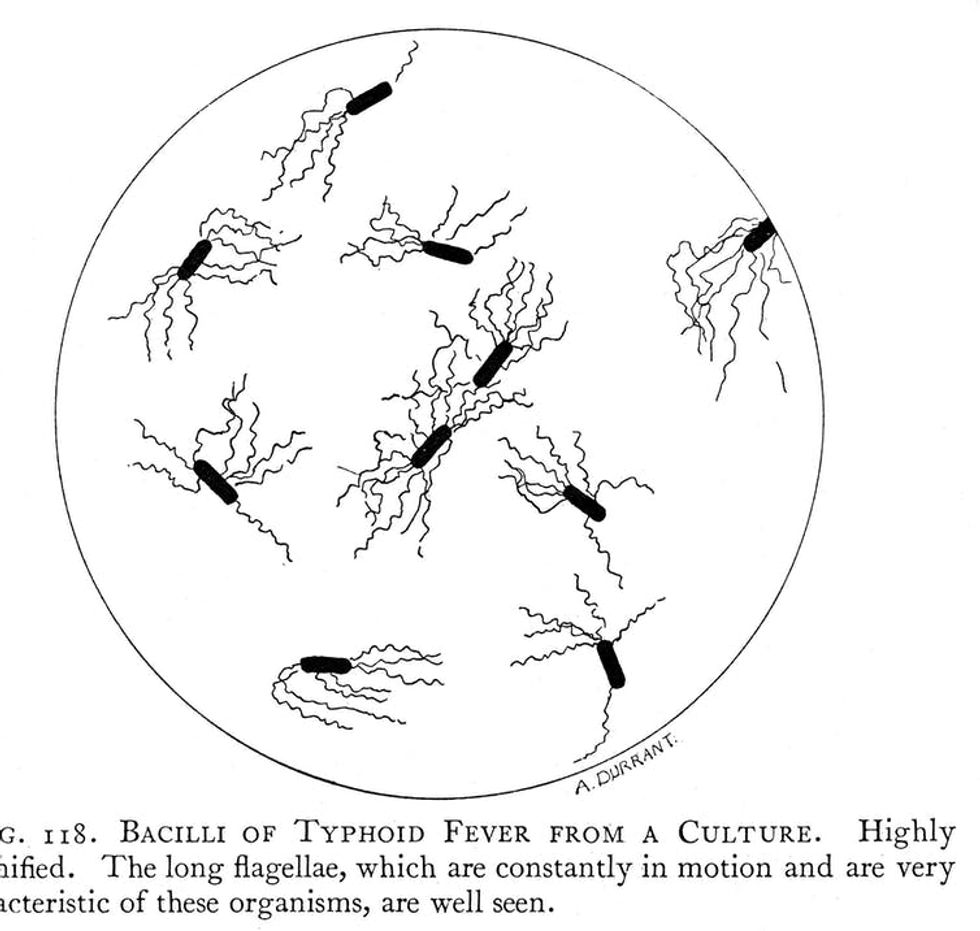
Causing fever, headache, abdominal pain and constipation or diarrhoea, typhoid is a bacterial disease. Salmonella enterica serovar Typhi – the organism behind typhoid – kills up to one in five patients if left untreated. S. Typhi spreads from person to person in water and food, which have been contaminated by faeces. As a consequence, typhoid is often associated with inadequate sanitation and water systems, as well as with poor hygiene practices.
The rapid rise of increasingly difficult to treat typhoid is a very worrying prospect. During an age of unparalleled international trade and travel, it is inevitable that any regional rise of antibiotic resistance will have global knock-on effects.
In Europe, Australia and North America isolated extensively drug-resistant variants (or XDR strains) were travel-related. Travellers had become infected while visiting Pakistan, where a large-scale outbreak of XDR typhoid is ongoing. Having caused at least 5,274 cases in the Sindh Province since 2016, the Pakistani XDR strain is proving resistant to all commonly available antibiotics except for one: azithromycin.
The coming years will likely see further travel-related resistant cases occur throughout the world. In Britain, strong demographic and historical ties to South-East Asia mean that about 500 typhoid cases (mostly travel-associated) are reported every year. In the US, at least 309 cases occurred in 2015 with almost 80% of confirmed cases reporting a history of travel to endemic areas. In Germany, 56 cases were reported in 2018 – 96% of which were travel associated.
The return of typhoid is something of a shock to health systems in richer countries. Between the late 19th century and the 1950s, sanitary improvements, effective vaccines and antibiotics eliminated endemic typhoid from most high-income countries. But after a lifetime of relative security, the prospect of typhoid again causing death in high-income hospitals is no longer an outlandish idea.
So how did this happen? The answer is uncomfortable and tied up in the inward-looking nature of Western disease eradication campaigns over the last century. Because, contrary to popular conceptions of typhoid as a disease of the past, typhoid never really left. As our new research shows, because typhoid control often stopped at high-income borders, it became a neglected disease in other, poorer countries. This global neglect is now proving costly.
Controlling typhoid depends in part on new technologies to prevent, diagnose and treat the disease. But it is also crucial that we keep a clear eye on the past so that we are able to rewrite the policies that enabled typhoid’s resurgence – in other words, old mistakes should not be repeated.
This article is part of Conversation Insights
The Insights team generates long-form journalism derived from interdisciplinary research. The team is working with academics from different backgrounds who have been engaged in projects aimed at tackling societal and scientific challenges.
Killer of paupers and kings
Genomic analysis and archaeological evidence makes it clear that the disease has been circulating in human populations for millennia.
While we cannot make accurate retrospective diagnoses using written sources alone, typhoid has been referenced as the mysterious killer of princes, presidents and paupers around the world. Typhoid was also a renowned scourge of armies and war. During the Second Boer War (1898-1902), the British Army reported more than 8,000 typhoid deaths.
Despite its prominence, typhoid’s cause and mode of transmission remained a mystery. Many experts initially believed that typhoid was caused by “bad air” originating from decaying matter and pungent-smelling filth. There was also no clear way to distinguish typhoid from other contemporary fevers. Modern notions of typhoid as a disease with a distinct clinical picture, a mostly water and food-borne mode of transmission, and with a bacterial cause, only gradually emerged during the 19th century after repeated pandemics of cholera kick-started investigations into waterborne modes of transmission.
The emerging concept of typhoid as a distinct bacterial disease that could be carried by contaminated water and food was accompanied by a parallel revolution of sanitary infrastructure in Europe, North America and parts of Asia, Africa, South America and Oceania. New waterborne ideas of typhoid transmission subsequently played an important role in justifying ongoing expenditure on improved sewage and drinking water systems.
Alice in Typhoidland
For example, in the British university city of Oxford, sanitarians like Henry Liddell, Dean of Christ Church College and father of Alice Liddell – the girl who inspired Alice in Wonderland, Lewis Carroll’s famous children’s book – used the spectre of typhoid to lobby for radical interventions into the city’s infrastructure and hydrology.
He did this with his close friend Henry Acland, professor of medicine, physician to the royal family (and alleged inspiration for the White Rabbit).
Liddell, whose wife had nearly died from typhoid in London, also oversaw improvements of his college’s grounds and sanitary infrastructure. This included redirecting the Trill Mill Stream – an open sewer – underground in 1863, the same year that Carroll began to write his first iconic book.
Although initial sanitary progress in Oxford was slow, growing public criticism, new government credits and scandals like the death of three undergraduates from typhoid encouraged city and university authorities to take decisive action during the 1870s. Within little over a decade, they constructed a new sewage system, closed down leaking cesspools, stopped pumping drinking water from below the main sewer outlet and created an affordable rate-financed and municipally-owned filtered drink water supply.
John Tenniel, Alice Rows the Sheep. This river was allegedly based on Trill Mill Stream.
The case of Oxford is far from unique. By the turn of the century, high-income cities across the world were investing substantial amounts of money in their water and sanitary infrastructures. While early interventions were often hit-and-miss and could vary significantly between cities, there is a clear correlation between rising expenditure on the provision of safe water services and declining mortality from waterborne diseases like typhoid.
From prevention to eradication
New technologies further aided attempts to curb what was increasingly described as a preventable disease. In 1897, Maidstone became the first British town to have its entire water supply treated with chlorine.
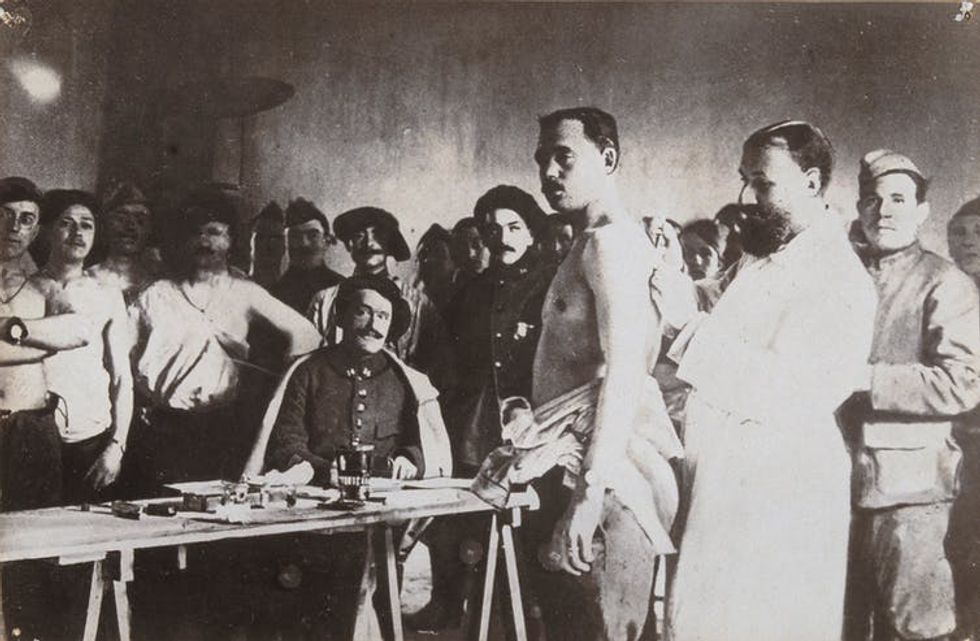
Vaccination emerged as another way to protect populations in areas without sanitary infrastructure. Devised by German and British researchers in 1896, early typhoid vaccines consisted of killed typhoid strains and were among the first bacterial vaccines. During the Second Boer War, British troops leaving the fold of “civilisation” could opt for inoculation against typhoid. This first roll-out of heat-killed vaccines was marred by quality problems and adverse side effects that made early vaccination extremely unpleasant. But by World War I, all major powers used improved bacterial typhoid vaccines to effectively protect troops and travellers.
Typhoid’s emerging status as a preventable disease was celebrated as a great success story of “rational Western science”. It also led to calls to move from prevention to eradication. Leading the hunt was the new profession of bacteriology.
This research soon showed that typhoid was far more complex than initially thought. Although its mode of transmission via water and contaminated food was becoming increasingly clear, it emerged that the bacterium could also be excreted by seemingly healthy people. So-called asymptomatic – or healthy – carriers have no symptoms but can still excrete S. Typhi through their faeces for years after the initial infection.
This concept of healthy carriers, advanced by the German bacteriologist Robert Koch in 1902, significantly complicated hopes for typhoid eradication. How was one supposed to deal with seemingly healthy members of the community, whose typhoid-contaminated faeces could put others at risk?
Answers reflected prevailing socio-cultural values. While most typhoid carriers were allowed to remain in their communities if they agreed to follow precautionary hygiene measures (abstaining from working in food preparation and waterworks), some were forcibly detained and isolated. Decisions about who could be trusted and who had to be isolated were far from neutral and reflected contemporary concerns about immigration, racism, chauvinist gender norms and rising militarism.
For example in Germany, bacteriologists tried to “cleanse” military deployment zones identified for an attack on France by testing communities, creating lists of carriers, and placing some in mandatory isolation from around 1904 onward. While communities in the centre of the Reich mostly escaped this practice, Prussian experts had few qualms about implementing mandatory isolation in the Franco-German periphery on the grounds of military need. During World War I, German soldiers were routinely screened for typhoid and strict controls were set up to stop potential carriers – like soldiers or displaced civilians – from infecting civilian populations in Germany. Once again not everybody was treated equally, with certain groups like Eastern Jews being disproportionately accused of carrying diseases of “filth” like typhoid.
In the United States, Irish immigrant Mary Mallon (who became known as “Typhoid Mary”) became the most prominent typhoid carrier to be detained after infecting the families she cooked for. Mallon was quarantined between 1907 and 1910 and again between 1915 and her death in 1936 after breaching the terms of her initial release and working as a cook under an assumed name.
An illustration that appeared in 1909 in The New York American.
British authorities, meanwhile, detained predominantly female carriers deemed mentally incapable of upholding sanitary standards in the Long Grove Asylum in Epsom between 1907 and 1992. Doubts about the women’s alleged insanity subsequently emerged.
But with typhoid continuing to decline in high-income countries, such treatment of carriers rarely made headlines. By the end of World War II, there was instead growing optimism about the prospect of eventual typhoid elimination. In Europe and North America, functioning sanitation systems, chlorination, fine-grained national surveillance for typhoid outbreaks and carriers by public health authorities, vaccines, and the advent of effective therapies for both typhoid victims (chloromycetin, 1948) and carriers (ampicillin, 1961) had turned the once feared disease into a negligible health threat.
Although individual outbreaks on ocean liners, in resorts, and occasionally towns, continued to attract public interest, typhoid was increasingly portrayed as a disease of the past, one which had been defeated with heroic sanitary and medical interventions. During an age of widespread confidence in the imminent scientific defeat of infectious disease, there seemed little reason to fear its return.
An infectious divide
This confidence was misplaced. While typhoid had almost vanished from high-income countries, it remained endemic in other parts of the world.
Over the next half century, the resulting infectious divide was reinforced by a relative neglect of international campaigns to tackle typhoid. Sustained large-scale investment in the supply of safe drinking water, safe sewage disposal, and basic healthcare services would have gone a long way to curb not only typhoid but many other diseases in the Global South.
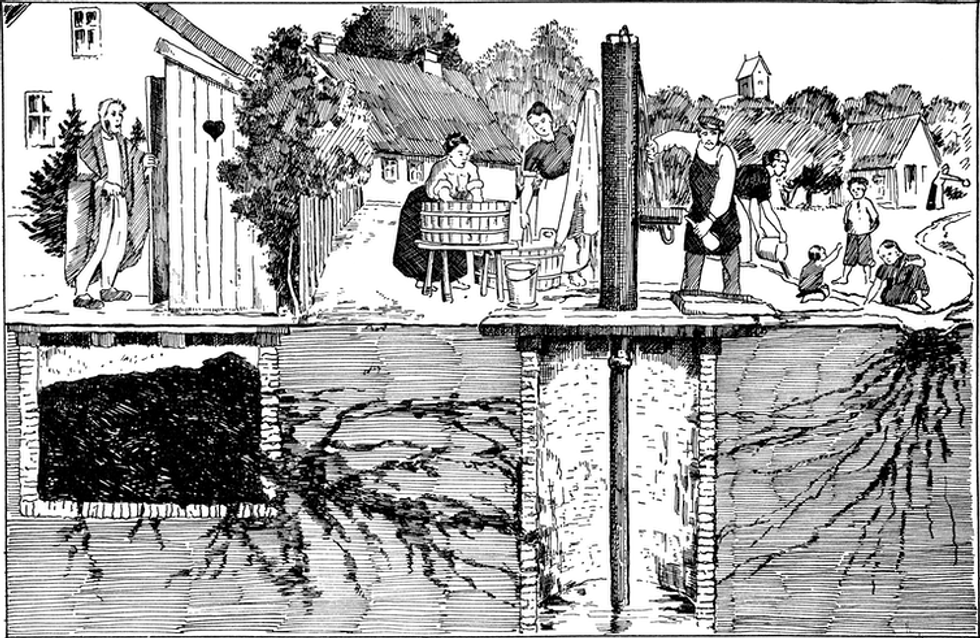
The various ways that a water well may become infected by typhoid fever bacteria, 1939.
But actual investment often remained ad hoc, uncoordinated, and insufficient. Instead, many rich countries focused on protecting their own populations. They prioritised vaccines, antibiotics and put surveillance-based biosecurity regimes in place, designed to stop typhoid from crossing back into high-income countries via travellers and migrants. This strategy was cheap in the short term but very costly in the long term.
Although governments and non-governmental organisations on both sides of the Iron Curtain provided infrastructural and medical aid to allies in the so-called “developing world” during the Cold War era, typhoid did not feature high on the international agenda and was frequently superseded by other, more prominent, or fast-burning diseases like malaria and smallpox. Meanwhile, a mix of population growth, resource constraints and inadequate access to water, sanitation and health infrastructures created perfect breeding grounds for typhoid in the Global South. This also led to an over-reliance on comparatively cheap antibiotics to keep the disease in check. The result was an evolutionary surge of increasingly antibiotic-resistant typhoid strains.
This surge had been predicted. Resistance against the first antibiotic treatment for typhoid, chloramphenicol, had been reported within two years of the antibiotic’s first use against typhoid in 1948. Individual strains had also proven resistant against ampicillin within years of its 1961 launch.
Typhoid outbreaks increase
In 1967, researchers in Israel and Greece reported the isolation of typhoid strains with transferable chloramphenicol resistance. In the same year, British experts analysing typhoid strains from Kuwait detected transferable resistance not only against chloramphenicol but also against ampicillin and the tetracyclines. Five years later, an explosive typhoid outbreak that infected more than 10,000 people in Mexico City was resistant to several antibiotics including chloramphenicol – but fortunately not ampicillin. India and Vietnam reported parallel outbreaks.
Western responses to the outbreaks were ad hoc, again focusing on biosecurity measures like traveller surveillance and vaccination rather than on concerted international campaigns to combat the factors driving the surge of resistant typhoid in low-income areas.
In response to the outbreaks in India and Mexico, Western media commentators accused local populations of relying on antibiotics too much and using drugs inappropriately. Rarely addressed were the underlying factors, such as insufficient access to affordable healthcare, clean drinking water and effective sewerage systems – or the fact that many of the drugs in use had been exported by Western producers.
The prioritisation of national biosecurity over collective responsibility was echoed in government policies. Western countries and non-governmental organisations provided limited laboratory, sanitation, and medical aid in response to natural disasters and acute outbreaks. But international support remained inadequate to compensate for existing financial, infrastructural, and organisational constraints or to keep up with population growth and rapid urbanisation in endemic areas.
Meanwhile, concerns about the import of resistant “foreign strains” encouraged governments to devote significant resources to monitoring borders, travellers, and migratory populations for typhoid. Resulting monitoring efforts remained influenced by culturally ingrained stereotypes of typhoid as a disease of uncivilised people. In response to the Mexican outbreak, US public health officials not only focused on monitoring non-American strains and intensifying the community surveillance of people with “Hispanic surnames” but also highlighted risk factors like alleged “Hispanic hygiene habits” even though no empirical research was conducted to test whether these culturally-biased associations were true.
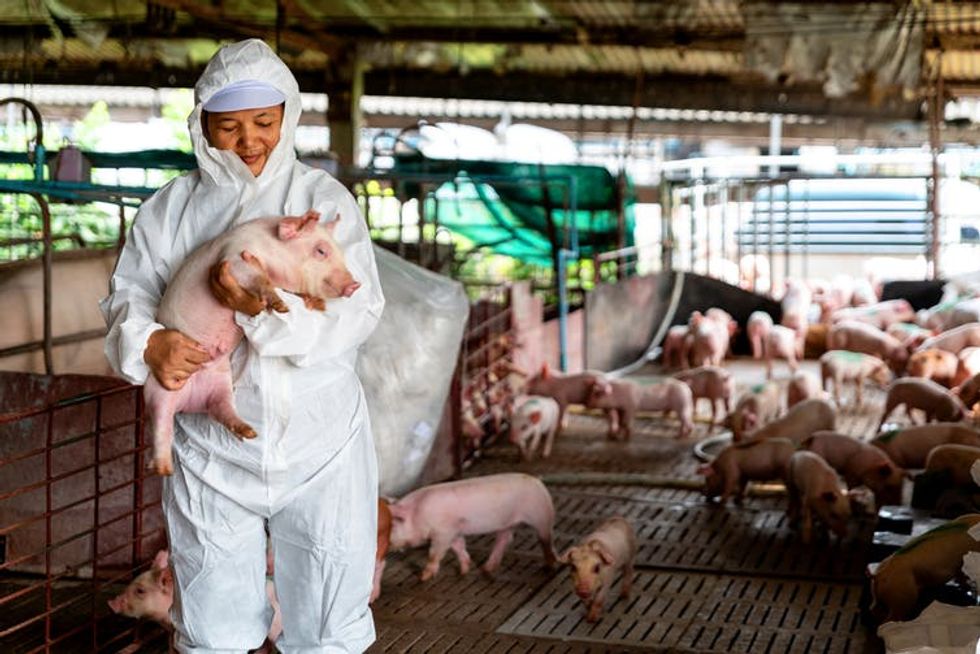
Antibiotics are in widespread use in agriculture.
Rat007/Shutterstock
Continued neglect
The neglect of international efforts to combat typhoid on a global level carried over into the 1980s. This neglect was facilitated by international disease surveillance networks with large coverage gaps in areas outside the Global North. It was also the result of overconfidence in newly available treatments.
Marked by political and economic instability, the following two decades experienced a rollback of healthcare provision. This happened in large parts of the Soviet sphere and also in Western-affiliated “developing countries” undergoing World Bank monitored programmes to implement free market policies. Without access to effective and affordable healthcare and sanitary services, local populations frequently turned to cheaper antibiotics to control disease.
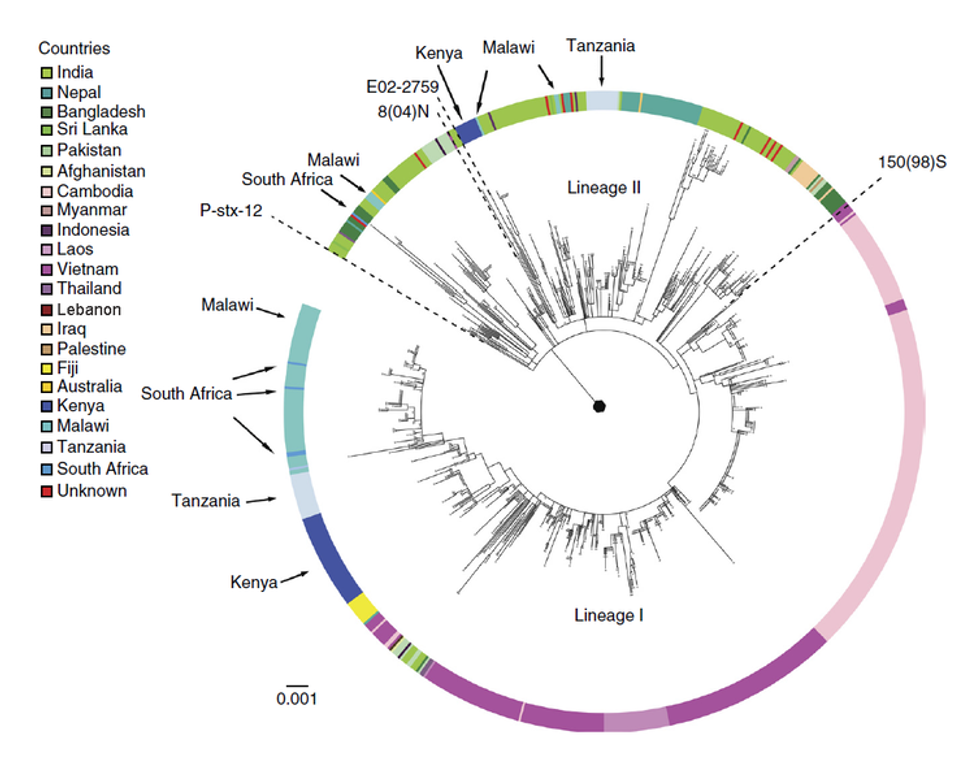
The result was a further global surge of antimicrobial resistance right at a time when an increasing number of international drug companies began to withdraw investment in new antibiotic development due to a lack of profitability. In 1988, a typhoid outbreak in Kashmir proved resistant to all three first-line antibiotics. Similar outbreaks were soon reported from Shanghai, Pakistan, and the Mekong Delta. New genetic sequencing revealed that a large part of rising antibiotic resistance was associated with the spread of a specific haplotype (a distinct group of genes clustered together on a single inherited chromosome).
Designated “H58”, organisms with this haplotype were undergoing a significant population expansion and conferred bacterial resistance not only against older first-line drugs but increasingly against new reserve antibiotics (like the fluoroquinolones and cephalosporins). By the late 1990s, the majority of strains isolated from a large-scale outbreak involving thousands of patients in formerly Soviet Tajikistan proved resistant to the fluoroquinolones. Sporadic cephalosporin resistance was reported from the early 2000s onwards.
Wellcome-Sanger Map: Population structure of the S. Typhi H58 lineage.
PATH
The current Pakistani outbreak of XDR typhoid, which began in 2016, is caused by a variant of H58 that is resistant to all antibiotics (except azithromycin) commonly used against typhoid. Total pan-resistance to locally available drugs may only be one mutation away.
A new generation of vaccines
This uneven history shows the limitations of making policy on a national or regional level when it comes to curbing border-crossing threats. Whether we choose to justify action out of ethical considerations of collective responsibility or out of enlightened self-interest, the global threat posed by XDR typhoid and the conditions producing multiple resistant pathogens like it will only be overcome by more – and not less – international involvement.
Fortunately, a new generation of vaccines could now provide a crucial cornerstone for new international efforts for typhoid control. New typhoid “Vi conjugate vaccines” (TCVs) have overcome many hurdles. One of these vaccines (Typbar-TCV®) only requires a single dose, is approved for children of six months and older (previous vaccines weren’t suitable for children under two) and was recently licensed in India, Nepal, Cambodia, and Nigeria. Other advanced TCV candidates are in manufacture and development.
These vaccines are no longer primarily designed to protect foreign travellers and limit acute outbreaks. They are also no longer being developed in areas of the world that need them the least; Typbar-TCV was developed and manufactured by the Indian company Bharat Biotec.
And in another twist of history that takes us back to Alice in Wonderland’s Oxford, Typbar-TCV was not tested on Indian but on British populations. In 2017, around 100 closely-observed participants drank live typhoid bacteria to test the vaccine for safety and efficacy. The carefully controlled Oxford “outbreak” is the largest recently recorded typhoid outbreak in the UK and provided critical data for the WHO’s decision to recommend the vaccine in 2018. This situation is a reversal of the current trend for vaccines created in high-income countries but tested in low and middle-income countries.
The long-term implications of this geographic shift of vaccine development are significant. As Samir Saha at the Child Health Research Foundation at Dhaka, Bangladesh, describes it:
We Bangladeshis, like any other low middle-income countries, usually receive a vaccine after 20-25 years of its introduction in the developed world – pneumococcal vaccines took 20 years and Hib vaccine took 25 years to travel here. This is the first time that a vaccine will be first introduced in a country where it is needed the most.
A bio-social problem
The arrival of the new vaccines is fantastic news during a time of failing antibiotics. But their roll-out will have to be accompanied by other measures if we are to move towards sustainable control of diseases that cause intestinal illnesses in low-income countries. As the long history of typhoid makes clear, effective health strategies have to integrate all available aspects of typhoid control.
Since around 1900, vaccines have played an important role in protecting travelling populations and military personnel from typhoid. But wider control has always also depended on the provision of robust drinking water and waste-water systems to prevent typhoid from spreading, an effective surveillance network to monitor typhoid incidence and the targeted provision of effective high-quality drugs to treat the disease. Over-reliance on any one intervention has repeatedly undermined wider control efforts.
At the same time, control efforts have to take place at multiple levels. Not only is there ample proof that ambitions for typhoid control cannot be limited to high-income countries alone, there is also strong evidence highlighting the importance of collaborations between local institutions for typhoid control. While 20th-century aid efforts primarily targeted nation states, a close look at the early “heroic age” of typhoid control reveals the importance of municipal and local actor coalitions in developing effective locally-tailored sanitary solutions. The provision of cheap affordable credit to facilitate initiatives with local buy-in was equally important.
Like any disease, typhoid is a complex phenomenon, driven by a bacteria but also the peculiarities of societal structures. Passing from one human to another over millennia, Salmonella Typhi has not only perfectly adapted to our living habits and environments but also bears the imprint of our antimicrobial interventions in its genetic code. Controlling it will require both biological and social interventions.
Tourism operators want aerial shark patrols to be introduced in Australia's Whitsunday Islands as they try to stem falling visitor numbers following a spate of attacks along the Great Barrier Reef.
An English tourist is recovering in hospital after his foot was ripped off by a shark on Tuesday while another had his leg mauled in the same attack at a popular snorkelling spot in the region.
In the past year there have been several shark attacks in waters around the Whitsundays, a chain of islands that attracts both Australian and foreign tourists.
In two separate incidents late last year, a 12-year-old girl lost a leg and a man died of his injuries.
Tourism Whitsundays CEO Tash Wheeler said tourist numbers had fallen in the past year, partly as a result of the shark attacks.
"Looking back over the last 12 months I can certainly say that there has been some impact to our industry in terms of visitation," she told reporters.
International visitors to the region dropped more than six percent to 226,000 in the year ending March 2019, the latest available figures.
Wheeler said tourism operators were seeking government funding for aerial patrols of the Whitsundays as an "interim measure" while research is undertaken into sharks in the area, which had been considered safe for swimming.
The latest attack comes just over a month after the Queensland state government removed dozens of unmanned shark traps, known as "drum lines", from popular swimming beaches after losing a court battle over its decades-old shark control program.
The Federal Court ruled that sharks found alive on baits in the Great Barrier Reef Marine Park had to be released -- which the government argued would be too dangerous for its workers to do.
After Tuesday's attack, the Queensland government announced it would install 32 additional drum lines just outside the protected area.
The Humane Society International, which launched the court action, denied the most recent attack was linked to the rolling back of "outdated" shark control practices.
"Installing more traditional drum lines to cull sharks is an ineffective knee jerk reaction. It doesn't work," marine campaigner Lawrence Chlebeck said in a statement.
Despite tens of millions of visits to the beach in Australia annually, shark attacks remain rare.
There were 27 attacks in the country's waters in 2018, according to data compiled by Sydney's Taronga Zoo.
A prequel series to global TV phenomenon "Game of Thrones" has been ordered, WarnerMedia announced Tuesday, as it set out launch details for its new HBO Max streaming service.
The new show in George RR Martin's fictional world of Westeros will take place 300 years prior to fantasy epic "Thrones" and will be called "House of the Dragon."
The series will be based on the book "Fire and Blood," which tells the story of the murderous, dragon-breeding Targaryen family.
"It's my pleasure to announce today that we are ordering 'House of the Dragon' straight to series for HBO," Casey Bloys, president of programming, told a Los Angeles launch event for HBO Max.
"It tells the story of House Targaryen and the early days of Westeros."
"Thrones," known for its graphic violence and sex as well as its unprecedented budget and production values, ended its eight-season run earlier this year with 59 Emmys -- a record for a drama or comedy at television's equivalent of the Oscars.
The new prequel has been co-created by Martin and Ryan Condal ("Colony"), who will write the 10-episode series and serve as showrunner alongside Miguel Sapochnik.
Sapochnik directed multiple "Game of Thrones" episodes including the Emmy-winning "Battle of the Bastards."
HBO Max, WarnerMedia's new Netflix rival, will launch in the United States in May, and will cost $14.99 per month, it was also revealed.
The platform will feature original shows including a Ridley Scott sci-fi and exclusive streaming rights to satirical cartoon "South Park."
It will offer around 10,000 hours of content at launch, including all 23 "South Park" seasons and three new seasons to follow.
- 'Part of the zeitgeist' -
Original shows will be largely released on a weekly basis, rather than dropped in one go for binge-watching, because "we like creating cultural impact," said HBO Max COO Kevin Reilly.
"Our creators also see the difference in rolling out shows gradually and letting them breathe," Reilly said.
"HBO hits like 'Succession' and 'Chernobyl' became part of the zeitgeist with a weekly release schedule, rather than fading quickly after a binge and burn."
Original content will see Scott produce and direct new sci-fi series "Raised by Wolves," about "two androids tasked with raising human children on a mysterious virgin planet."
Two new DC superhero series -- anthology show "Strange Adventures" and a series inspired by "Green Lantern" -- will be overseen by Greg Berlanti ("Arrow").
Another DC-themed show, comedy "DC Super Hero High," was announced from Elizabeth Banks ("Charlie's Angels"), while Mindy Kaling oversees a new college roommates-themed comedy.
The platform will feature from launch a library including "Friends" -- described by Reilly as "the pinnacle of streaming titles" thanks to both its original network audience and Generation Z newcomers -- and popular sitcom "The Big Bang Theory."
Existing HBO subscribers will have immediate access to HBO Max at no extra charge.
- 'Next great chapter' -
HBO Max users will be able to "follow" other users' profiles on the platform, to give them recommendations based on what "talent and influencers" enjoy.
In previously announced content, JJ Abrams appeared on stage to confirm his sci-fi "Demimonde" is in the works.
Jason Bateman will produce and star in Stephen King adaptation "The Outsider," while "Fleabag" creator Phoebe Waller-Bridge will produce and star in comedy "Run."
"Downton Abbey" creator Julian Fellowes will oversee "The Gilded Age" set in New York, while "The Wire" maker David Simon will adapt Philip Roth novel "The Plot Against America."
The presentation ended with Bloys' surprise announcement of "the next great chapter in George's saga."
No details of the "Thrones" prequel's launch date were announced.
The news comes hours after reports in the Hollywood press that another, separate "Game of Thrones" prequel starring Naomi Watts had been cancelled.
A pilot had been made but HBO decided not to take the show to a full series, it was reported. HBO did not confirm the news.
As many as five "Thrones" successor series have been put into early stages of development by HBO, but before Tuesday's announcement only the reportedly scrapped Watts pilot had entered production, and none had received a full series order.
The family of a motorcyclist killed in a crash involving the wife of an American diplomat have announced they are planning to sue US President Donald Trump's administration over an alleged cover-up.
Harry Dunn, 19, died on August 27 when his motorbike and a car driving on the wrong side of the road collided.
In a statement issued through her lawyers and reported in US media, Anne Sacoolas admitted she was driving. She left Britain claiming diplomatic immunity before she was interviewed by police.
Dunn's parents, Charlotte Charles and Tim Dunn, have urged US President Donald Trump's administration to extradite Sacoolas to Britain, to no avail.
"We are bringing claims against both Mrs. Sacoolas in the USA for civil damages as well as the Trump administration for their lawless misconduct and attempt to cover that up," family spokesman Radd Seiger said.
"The Trump administration is not only hellbent on breaking international laws, rules and conventions on diplomatic immunity," he added, "but they have no care or concern for the welfare of Harry’s family or any real intent on finding a solution."
The accident took place near a British airbase used by the US military as a communications hub and where 42-year-old Sacoolas's husband was stationed.
The case, which has generated huge public interest in Britain, has fueled tensions between London and Washington.
Trump called the crash a "terrible accident," saying it was common for Americans in Britain to have a hard time driving on the left side of the road.
Dunn's parents visited the White House October 15. They called Trump warm and welcoming but criticized the White House's attempts to engineer a snap meeting with Sacoolas, who was in a room next door with photographers.
Tim Dunn told Sky News the family were "disgusted" and "appalled" at the suspect's behavior.
"I'm angry that someone could do this and then get on a plane and go," he said.
The family has already filed a lawsuit against the British government for letting Sacoolas leave the country in the first place.
British police announced last week that investigators will travel to the US to interview Sacoolas.
Tuesday evening, The New York Times reported that National Security Council Ukraine expert Lieutenant Colonel Alexander Vindman had testified there were crucial omissions in rough transcript the White House released of a call with the president of Ukraine.
MSNBC's Brian Williams reported, "the breaking news we’re covering at the top of the broadcast here tonight is an indication that today’s testimony by an active-duty army officer might have been more damaging to the president than we first knew or thought."
"Lt. Col. Alexander S. Vindman, the top Ukraine expert on the National Security Council, told House impeachment investigators on Tuesday that the White House transcript of a July call between President Trump and Ukraine’s president omitted crucial words and phrases, and that his attempts to restore them failed," the newspaper reported, citing three sources.
"The omissions, Colonel Vindman said, included Mr. Trump’s assertion that there were recordings of former Vice President Joseph R. Biden Jr. discussing Ukraine corruption, and an explicit mention by Ukraine’s president, Volodymyr Zelensky, of Burisma Holdings, the energy company whose board employed Mr. Biden’s son Hunter," The Times reported.
"NBC News has also confirmed The Times' reporting tonight," Williams noted.
Swedish climate activist Greta Thunberg on Tuesday refused to accept an environmental award, saying the climate movement needed people in power to start to "listen" to "science" and not awards.
The young climate activist, who has rallied millions to her "Fridays for Future" movement, was honoured at a Stockholm ceremony held by the Nordic Council, a regional body for inter-parliamentary cooperation.
Thunberg had been nominated for her efforts by both Sweden and Norway and won the organisation's annual environment prize.
But after it was announced, a representative for her told the audience that she would not accept the award or the prize sum of 350,000 Danish kroner (about $52,000 or 46,800 euro), the TT news agency reported.
She addressed the decision in a post on Instagram from the United States.
"The climate movement does not need any more awards," she wrote.
"What we need is for our politicians and the people in power start to listen to the current, best available science."
While thanking the Nordic Council for the "huge honour," she also criticised Nordic countries for not living up to their "great reputation" on climate issues.
"There is no lack of bragging about this. There is no lack of beautiful words. But when it comes to our actual emissions and our ecological footprints per capita... then it’s a whole other story," Thunberg said.
Still only 16 years old, Thunberg rose to prominence after she started spending her Fridays outside Sweden's parliament in August 2018, holding a sign reading "School strike for climate".
British MPs on Tuesday agreed to hold an early election on December 12, backing Prime Minister Boris Johnson's call to try to break the crippling political deadlock that has seen Brexit delayed three times.
Hours after the EU formally agreed to postpone Britain's departure again, up to the end of January, lawmakers voted for the country's third election in four years.
It is a gamble for Johnson, who leads a minority Conservative government, but he had nowhere left to turn after MPs rejected the Brexit terms he struck with Brussels less than two weeks ago.
His Conservatives are currently well ahead of the opposition Labour party in opinion polls, and he hopes to win a majority in the lower House of Commons in order to push through his Brexit plan.
But his failure to keep to his "do or die" pledge to leave the EU on October 31 risks a backlash.
The election outcome could have huge implications for Britain's tortuous Brexit process, which began with the 2016 EU referendum.
Labour is committed to a new "people's vote", while two smaller opposition parties want to reverse Brexit and remain in the European Union.
Many Labour MPs are wary of an election, fearful of defeat under their leftist leader Jeremy Corbyn, but he swung his support behind the poll.
The other 27 EU member states earlier formally adopted Monday's decision by envoys to delay Brexit by up to three months until the end of January, with an option for Britain to leave early if it ratifies an exit deal.
"To my British friends, The EU27 has formally adopted the extension. It may be the last one. Please make the best use of this time," European Council President Donald Tusk said on Twitter.
The election bill will now go to the unelected upper House of Lords for debate on Wednesday, but peers are expected to back the plan, paving the way for parliament to be dissolved early next week .
- 'New mandate' -
Johnson took office in July promising to end the wrangling over Brexit which has bitterly divided the country, but a rebellion over his hardline strategy left him without a majority in parliament.
Unable to win MPs' support for his divorce terms, he was forced by law earlier this month to ask his fellow EU leaders for a delay.
After three failed attempts to pass a normal election motion, which requires the support of two-thirds of MPs, Johnson on Tuesday took an alternative path.
He introduced a bill to legislate for an election -- a method which required only a simple majority, and this passed by 438 votes to 20.
"We are left with no choice but to go to the country to break free from this impasse," he had told MPs.
A newly elected parliament would have a "new mandate to deliver on the will of people and get Brexit done", he said.
In a move to unite his Conservative party ahead of the poll -- the first to be held in December since 1923 -- Johnson readmitted 10 of the 21 MPs he expelled last month for defying his Brexit plan.
- Radical campaign -
Labour had sought to push for the general election to be held on December 9, but this was defeated by 315 votes to 295.
Veteran socialist Corbyn had been torn between rival camps over whether to support Johnson's election initiative.
But the smaller Scottish National Party and the Liberal Democrats -- who both oppose Brexit -- wanted an election, making it hard for Labour to stand in their way.
Corbyn had refused to back an election until Johnson's threat to leave the EU without a divorce deal was removed, but said this was resolved by the three-month Brexit delay.
"This election is a once-in-a-generation chance to transform our country and take on the vested interests holding people back," he said Tuesday.
"We will now launch the most ambitious and radical campaign for real change that our country has ever seen.
"This is our chance to build a country for the many not the few and fit for the next generation."
Experts warn that British politics remains deeply volatile more than three years after the referendum vote, and say the election result could be unpredictable.
There was significant voter switching between the 2015 and 2017 elections.
Election specialist John Curtice from the University of Strathclyde in Glasgow said Johnson is in a strong position to get a majority -- but an election remains a gamble.
"Boris has to win. A hung parliament and Boris is out," he said, warning that a Labour-led coalition would likely take over.
The armies of Syria and Turkey traded deadly fire Tuesday for the first time since Ankara launched an anti-Kurdish offensive in early October, as Russia announced Kurdish forces had withdrawn from the key border area.
Russian Defence Minister Sergei Shoigu said Kurdish forces had pulled back from the entire Turkish-Syrian border in accordance with a deal struck between Ankara and regime backer Moscow in Sochi earlier this month.
"The withdrawal of armed units from territory where a security corridor should be created has been completed ahead of time," Shoigu said, as quoted by Russian news agencies.
The Turkish military and its Syrian proxies launched an offensive against Kurdish forces in northeastern Syria on October 9 with the aim of creating a buffer zone roughly 30 kilometres (20 miles) deep.
Earlier this month, Kurdish forces agreed to withdraw from a 120-kilometre long, Arab-majority segment of the 440-kilometre border zone, but clashes have been reported since.
The Turkish presidency said joint Turkish-Russian patrols -- also planned under the Sochi deal -- would verify the Kurdish forces' withdrawal.
Shoigu said Syrian border guards and Russian military police had been deployed in the area.
But the situation was complicated by clashes between Syrian and Turkish forces on Tuesday.
The Britain-based Syrian Observatory for Human Rights reported that "heavy fighting erupted for the first time between the Syrian and Turkish armies", adding that six Syrian soldiers were killed near the key border town of Ras al-Ain.
"Turkish artillery fire killed five regime forces in battles on the edge of the village of Assadiya," Rami Abdel Rahman, the head of the Observatory, told AFP.
He added that Syrian fighters used by Turkey as the main ground force for the invasion had executed a government soldier they had captured.
Later Tuesday, the Observatory reported more clashes between regime forces and Turkey's Syrian proxies.
- Patrols -
Left in the lurch after US troops withdrew from the border area, Kurdish forces turned to the Syrian government for protection.
The regime's forces moved quickly north and are now expected to deploy along much of the border zone.
Turkish-Russian patrols in a 10-kilometre-deep strip on the border were to start after 1500 GMT Tuesday, but strikes near the border town of Derbasiyeh threatened that deadline, both the Observatory and Syrian state media reported.
The Observatory said Turkish and Russian military units had been due to meet at a border crossing to discuss the upcoming patrols.
Syrian state news agency SANA reported "Turkish mortar fire on the Derbasiyeh border crossing", some 60 kilometres east of Ras al-Ain, and said six Syrian civilians had been wounded.
It added that rounds were fired as Russian military police were driving by.
Turkey said the joint patrols with Russia would start "soon".
It said it would not hesitate to resume operations if it identified Kurdish fighters near the border, after its defence ministry said it had arrested 18 who claimed to be regime forces near Ras al-Ain.
The Syrian Democratic Forces, the de facto army of the moribund autonomous Kurdish administrated territory, has voiced reservations over the Sochi deal.
The agreement, to which the Kurds are not signatories, essentially hands much of their heartland to the regime.
- US presence -
Before Moscow launched a military intervention in Syria in 2015, President Bashar al-Assad barely controlled half of Syria's territory, with rebels, jihadists and Kurdish forces holding swathes of the country.
With Russian help, he clawed back much of the ground he had lost in the course of the grinding war, now in its ninth year.
The United States allied with the SDF in 2014 to fight the Syrian side of the war against the Islamic State's then sprawling "caliphate".
That phase of the conflict ended in March this year with the demise of the IS proto-state's last bastion in eastern Syria and US President Donald Trump's indications that he wanted to pull American troops out of the Syrian quagmire.
US forces present as part of an anti-IS coalition had been acting as a buffer between Turkey and the Kurds, both theoretically US allies, but that ended when they pulled back from the border at the beginning of October.
The White House then announced US forces were leaving the country altogether but they have since redeployed further east around oil wells in areas still under Kurdish control.
"We want to keep the oil, and we'll work something out with the Kurds," Trump said.
The Observatory said the US-led coalition Tuesday targeted regime positions in the eastern oil-rich province of Deir Ezzor with rocket fire.
The coalition did not immediately respond to a request for comment.




 US Department of Defense/AFP / HO This image released by the US Department of Defense shows before (L) and after (R) pictures of the compound in Syria where Islamic State group leader Abu Bakr al-Baghdadi died in a US raid
 US Department of Defense/AFP / Jose ROMERO This still image from a video released by the US Department of Defense shows smoke rising from the compound of Islamic State group leader Abu Bakr al-Baghdadi in Syria after it was destroyed by US forces
 AFP / Jonathan WALTER
  AFP / Manman Dejeto
  AFP / EDWIN BADILLES