President Donald Trump said he believes that Iran's leadership wants to talk, adding to expectations that he is trying to arrange a summit with his Iranian counterpart at the upcoming UN assembly.
"I can tell you that Iran wants to meet," he told reporters at the White House.
Trump has repeatedly indicated he is ready to meet with President Hassan Rouhani, who is expected to attend the UN General Assembly in New York this month. However, the Iranians have so far not given a positive response.
On Wednesday, Rouhani blasted the Trump administration, which has poured pressure on Iran, saying "the Americans must understand that bellicosity and warmongering don't work in their favor. Both... must be abandoned."
Arch-foes Tehran and Washington have been at loggerheads since May last year when Trump withdrew from a 2015 nuclear deal and began reimposing punitive measures.
Iran responded by scaling back its commitments to the accord, which gave it the promise of sanctions relief in return for curbs on its nuclear program.
However, some analysts see hope for more compromise following this week's exit of Trump's hardline national security adviser John Bolton, who in the past has called for the use of military force and regime change.
Bolton's departure came just days after Iran announced it had fired up centrifuges to boost its enriched uranium stockpiles in another step back from the deal.
Hesameddin Ashena, an adviser to Rouhani, hailed Bolton's dismissal as "a clear sign of the defeat of America's maximum pressure strategy."
Yet even with Bolton gone, top Trump officials have shown no signs of backing down from the strategy of sanctions against Iran.
"Now the president has made clear he is happy to take a meeting with no preconditions, but we are maintaining the maximum pressure campaign," Treasury Secretary Steven Mnuchin said after Bolton's departure.
The idea of a Trump-Rouhani meeting was floated last month by French President Emmanuel Macron, who has been spearheading European efforts to de-escalate tensions.
Rouhani said in response that Iran was ready to comply with the nuclear deal, known as the Joint Comprehensive Plan of Action, only if the Americans did so too.
Paris metro workers walked off the job Friday over plans for a major overhaul of the pension system, sparking huge traffic jams as commuters scrambled to find other ways of getting to work.
Ten of the city's 16 metro lines were shut down completely, while service on most others was "extremely disrupted," the city's RATP transit operator said.
Massive crowds waited on the platforms of the two automated driverless lines still operating and officials counted nearly 300 kilometres (185 miles) of traffic backups during the morning rush hour, more than double normal levels.
Two of the three main suburban lines that traverse the city were also severely disrupted, as were most bus and tram services.
But with many workers taking the day off, or managing to find alternative travel solutions, from bikes to electric scooters, skateboards and unicycles, the situation was not as chaotic as many had feared.
"We had expected a lot more people," an RATP agent at a station on Line 1, a fully automated metro that runs east-west through the heart of Paris, told AFP.
"Lots of my colleagues organised things so they could stay home. For example we had a meeting today that we pushed back to next week," said Gwenn, a 39-year-old financial controller, at the Bastille station.
To help ease the gridlock, the RATP offered free 30-minute rides on the Cityscoot network of electric mopeds.
US ride-hailing giant Uber is also hoping to seize the moment with two free 15-minute rides offered on its Parisian fleet of electric bikes and scooters.
- 'Shot across the bow' -
The strike is the first major protest against President Emmanuel Macron's plan to implement a universal pension system that would do away with the more advantageous plans enjoyed by workers in state transport and utility companies.
Other professions that have special schemes include sailors, solicitors and Paris Opera workers.
Metro workers say the reforms would force them to work longer by removing their long-held rights to early retirement, secured decades ago to compensate for spending long hours underground.
France's state auditor, the Cour des Comptes, said the average retirement age for RATP workers in 2017 was 55.7, compared with 63 years for most French workers.
The three main RATP labour unions have called the strike "a shot across the bow" against the overhaul, the latest element in Macron's push to bolster France's economy and cut spending.
"It's not a strike by the privileged few. It's a strike by employees saying 'We want to retire at a reasonable age with a reasonable pension'," Philippe Martinez, head of the CGT union, told France Info radio.
It is shaping up to be the biggest metro strike since 2007, when former president Nicolas Sarkozy also pushed through pension reforms.
During his 2017 presidential campaign, Macron pledged not to touch the current earliest legal retirement age of 62 for most workers.
The reforms unveiled in July, which would harmonise the 42 different pension schemes currently in place, would still allow people to retire at 62, but on a reduced pension.
A full pension would only be available from 64.
The government is in negotiations with unions over the reforms, which are likely to face further opposition in the coming weeks.
Lawyers, airline pilots, stewards and medical workers have already called a strike for Monday.
The mighty Aletsch -- the largest glacier in the Alps -- could completely disappear by the end of this century if nothing is done to rein in climate change, a study showed Thursday.
A team of researchers in Switzerland has used a cutting-edge simulation to show how the Aletsch Glacier will change as the planet continues to warm, the ETH technical university in Zurich said in a statement.
The glacier, which covers 86 square kilometers (33 square miles) in the Swiss Alps, and is estimated to hold around 11 billion tonnes of ice, has already seen its tongue recede by about one kilometer (0.6 miles) since the turn of the century.
Scientists are predicting that trend will continue even if the world is able to meet the 2015 Paris Agreement target of capping global warming at "well below" 2 degrees Celsius.
The ETH research team said that even in the best case scenario the glacier would lose 50 percent of its volume and length by year 2100, while in the worst-case scenario, "a couple patches of ice will be all that?s left."
Aletsch is one of more than 4,000 glaciers -- vast, ancient reserves of ice -- dotted throughout the Alps, providing seasonal water to millions and forming some of Europe's most stunning landscapes.
In a study earlier this year, ETH researchers determined that more than 90 percent of those glaciers will disappear by 2100 if greenhouse gas emissions are left unchecked.
Thursday's study meanwhile focused specifically on the impact on the biggest glacier of them all.
- 'Much more critical' -
Guillaume Jouvet and Matthias Huss at ETH's Laboratory of Hydraulics, Hydrology and Glaciology applied 3D glacier model simulations for the ice retreat using different established climate scenarios for Switzerland.
They show the glacier seen from the Eggishorn and Jungfraujoch peaks, which tower 2,927 and 3,466 meters above sea level, as it rapidly recedes over the coming eight decades.
They focused on three scenarios determined by different concentrations of CO2 in the atmosphere, and thus also different levels of global warming.
Even if warming is limited to below 2C, and the climate is stabilized by 2040, "we have to assume that the Aletsch Glacier will keep retreating until the end of the century," Jouvet said in the statement, pointing out that large glaciers are very slow to react to climate change.
This, he said, "means both ice volume and length will be reduced by more than half of what they are today".
If the global community is unable to pull together and effectively limit the planet-warming gases emitted through burning fossil fuels, construction, aviation and mega-farming, the situation for the glacier will be "much more critical", ETH said.
If Switzerland's climate warms by 4-8C by 2100 -- an "unfavorable but unfortunately fully realistic scenario" -- only "a couple of measly patches of ice" will remain.
And Konkordiaplatz, which is directly below Jungfraujoch and still covered in about 800 meters (half a mile) of ice, will be completely ice-free," Jouvet said.
Mexico said Thursday it disagrees with President Donald Trump's decision to restrict the right of Central Americans to seek asylum in the United States, a day after the Supreme Court allowed it to go ahead.
The US high court ruled Wednesday that the Trump administration can declare migrants ineligible for asylum if they enter the country from the southern border without first seeking asylum in one of the countries they crossed to get to there.
The decision, which stayed a lower court's temporary injunction, will be in effect while a broader case against the policy plays out in the courts.
Mexico could see asylum requests soar under the measure, which dramatically changes the rules for the thousands of Central Americans fleeing poverty and gang violence in their home countries in hopes of reaching the United States.
"Of course we disagree" with the restrictions, Mexican Foreign Minister Marcelo Ebrard told a news conference, speaking alongside President Andres Manuel Lopez Obrador.
"We have a very different policy in Mexico, and we are not going to change it. Mexico's refugee and asylum policy is a tradition here," Ebrard said.
"What we need to do is create alternatives so that people don't have to take these risks ... (because) of the lack of options" in their home countries.
Saying that US migration policy was already "very tough," he called the decision "unprecedented."
"It certainly draws one's attention. But it's their decision," he added.
He said Mexican officials would hold a series of meetings Thursday to evaluate the impact for Mexico.
Opponents argue the policy violates international law by forcing people fleeing for their lives to seek refuge in countries where they may also be in danger.
Despite his comments, Ebrard sought to send an upbeat message on US-Mexican relations, saying he had positive meetings in Washington Tuesday with Vice President Mike Pence and Secretary of State Mike Pompeo to review Mexico's progress in implementing a deal to reduce irregular migration.
Under the deal -- signed in June to avoid Trump's threat to impose tariffs on Mexican goods -- US migrant detentions on the southern border have fallen 58.7 percent.
Lopez Obrador, who spoke with Trump by phone Wednesday, said relations were "on very good terms."
An award for Indian Prime Minister Narendra Modi from the Bill and Melinda Gates Foundation is drawing increased criticism this week from rights advocates who are concerned because of Modi's human rights record in India and Kashmir and who called to rescind the honor.
"As Modi's India occupies Kashmir, the Gates Foundation has decided to give an award to the far-right Hindu nationalist," peace activist group CodePink said on Twitter. "Shame on them!"
The Indian prime minister is being given the award for his sanitation and toilet access initiative, the Clean India Mission, at the foundation's annual Goalkeepers event in New York City on September 24-25. The initiative, the foundation said in a statement to The Guardian, was evidence of "the progress India is making in improving sanitation, as part of its drive toward achievement of the U.N. sustainable development goals" and the reason for the award.
But the Indian leader's treatment of ethnic minorities in his country's northeastern state of Assam—including plans to put "non-citizens" in camps—and his government's August assault on Kashmir raise questions on the wisdom of honoring the right-wing leader.
Modi is "committing genocide of Muslims in India and Kashmir but is receiving an award in a few weeks here in the United States from the super liberal Gates Foundation," tweeted author Saira Rao.
"This isn't complicated," human rights lawyer and activist Arjun Sethi said on Twitter. "If you build a toilet in one room, and torture in another, you're undeserving of recognition."
A group, South Asian Americans and Allies in Philanthropy, wrote an open letter protesting the award on Medium. In the letter, the writers call for rescinding the honor because "under PM Modi's leadership, religious minorities all across India are facing heightened levels of violence, exclusion, and discrimination."
"For over a month now, PM Modi has placed eight million people in Jammu and Kashmir under house arrest, blocked communications and media coverage to the outside world, detained thousands of people including children, and denied basic benefits," the letter reads. "Reports of torture, including beatings and the murder of a young child by Indian security officers, are emerging as well. In addition, the Indian government has begun to disenfranchise millions of residents, mainly Muslims, in the state of Assam."
The effects of Modi's tenure as prime minister were further expounded upon in The Washington Post by Polis Project executive director Suchitra Vijayan and Georgetown law professor Arjun Singh Sethi:
When Modi was elected, many chose to overlook his murky past—but India's vulnerable could not. He has used both state power and the bully pulpit to further his ethnonationalist agenda. Under his leadership the country has witnessed a spike in hate crimes and mob violence, particularly against Muslims and Dalits. Rarely are the perpetrators held accountable. Last summer, a minister in Modi's cabinet even celebrated eight men who had been convicted of lynching a Muslim. Modi himself rarely publicly mentions the hate and violence surging across India.
The authoritarianism and brutality of the Modi government in Kashmir, Muslim Democratic Club of New York co-founder Faiza N. Ali said on Twitter, should disqualify the Indian prime minister from any such award.
"Modi is a fascist and Islamophobe, full stop," Ali tweeted. "The Gates Foundation should not proceed with this award after he's placed a communication blockade in Jammu and Kashmir, detained thousands including kids, and amid other serious human rights violations."
"Are Trump and Bolsonaro next?" wondered professor and writer Katrina Karkazis.
Bill Gates, who's also weathering bad press around his association with recently deceased convicted sex offender Jeffrey Epstein, "should be ashamed of himself," said Yale University researcher Gregg Gonsalves, who decried Modi as "not worthy of any award."
"He is a despot-in-the-making, a human rights abuser," said Gonsalves. "Everyone in public health should speak up."
"We will be doomed if we allow another nuclear accident to occur."
Japan's new environmental minister, Shinjiro Koizumi, called Wednesday for permanently shutting down the nation's nuclear reactors to prevent a repeat of the 2011 Fukushima disaster, comments that came just a day after Koizumi's predecessor recommended dumping more than one million tons of radioactive wastewater from the power plant into the Pacific Ocean.
"I would like to study how we will scrap them, not how to retain them."
—Shinjiro Koizumi, Japanese environmental minister
Koizumi was appointed to his position Wednesday as part of a broader shake-up of Japanese Prime Minister Shinzo Abe's cabinet. He is the 38-year-old son of former Japanese Prime Minister Junichiro Koizumi, a vocal critic of nuclear energy.
"I would like to study how we will scrap them, not how to retain them," the younger Koizumi, whose ministry oversees Japan's nuclear regulator, said during his first news conference late Wednesday. "We will be doomed if we allow another nuclear accident to occur. We never know when we'll have an earthquake."
In March of 2011, a powerful earthquake triggered a tsunami that caused the meltdown of three nuclear reactors at the Fukushima Daiichi power plant on Japan's northeastern coast, forcing tens of thousands of people to flee radiation around the plant. It was the world's second-worst nuclear disaster, after Chernobyl.
After the disaster, all 54 of Japan's nuclear reactors were shut down. Reutersreported Wednesday that "about 40 percent of the pre-Fukushima fleet is being decommissioned" and only six reactors are currently operating. Amid drawn out legal battles over the impacts of the meltdown, campaigners have ramped up opposition to nuclear power generation in the country.
However, some Japanese politicians, including the current prime minister, have argued that nuclear energy is necessary to meet national climate goals. Japan's new trade and industry minister, Isshu Sugawara, criticized Koizumi's call to shutter the country's reactors. "There are risks and fears about nuclear power," Sugawara said. "But 'zero-nukes' is, at the moment and in the future, not realistic."
Japan's government wants nuclear power to comprise 20 percent to 22 percent of the overall energy mix by 2030, drawing criticism from campaigners who say nuclear plants will always pose a danger given the country's vulnerability to large earthquakes and tsunamis.
Abe, however, has called for reactors to be restarted, arguing that nuclear energy will help Japan achieve its carbon dioxide emissions targets and reduce its dependence on imported gas and oil.
Despite Abe and Sugawara's stances, "the government is unlikely to meet its target of 30 reactor restarts by 2030," due to local opposition and legal challenges, noted The Guardian.
The Telegraphreported Thursday that Koizumi "was a surprise addition" to Abe's cabinet, considering that the new minister "has expressed sharp differences with senior members of the ruling Liberal Democratic Party since he was first elected in 2009 and supported a rival in the most recent election for party president."
Polls often indicate that Koizumi is considered a popular contender to serve as the next prime minister—and Abe's choice to appoint him to the cabinet, according to The Telegraph, is "seen as an effort to give a new generation of politicians an opportunity to learn the ropes of government."
Koizumi replaced Yoshiaki Harada, who made headlines around the world earlier this week. Responding to a projection from Tokyo Electric Power (TEPCO) that the utility will run out of storage space for contaminated groundwater around the Fukushima plant around the summer of 2022, Harada suggested during a news conference Tuesday that "the only option will be to drain it into the sea and dilute it."
As Common Dreamsreported Tuesday, Harada's comments were swiftly condemned by critics of nuclear energy both in Japan and around the world as well as the neighboring government of South Korea.
British Prime Minister Boris Johnson denied Thursday that he had lied to Queen Elizabeth II when requesting she suspend parliament this month in the run-up to Brexit.
Johnson asked the British head of state to shutter parliament for five weeks from last Tuesday, claiming it was necessary ahead of rolling out a new domestic agenda.
The unusually long suspension -- known as prorogation -- was widely seen as a bid to thwart opposition to a no-deal Brexit on October 31 and provoked uproar across the political spectrum as well as legal challenges.
The government was forced Wednesday to release its no-deal Brexit contingency plans after a parliamentary vote, but the opposition has accused it of withholding information.
A Scottish court this week sided with critics of the prorogation, ruling it was "unlawful" and intended to "stymie parliament".
Asked if he had misled Queen Elizabeth over his motives for the suspension, which will see the House of Commons closed until October 14, Johnson said: "Absolutely not".
"We need to get on and do all sorts of things at a national level," he added.
AFP/File / Daniel LEAL-OLIVASA government study warned of queues at British ports in the event of a no-deal Brexit
Johnson's government has appealed against Wednesday's decision by Scotland's highest civil court and the case is set to be heard in Britain's Supreme Court next Tuesday.
In the meantime, parliament remains suspended.
Northern Ireland's High Court on Thursday dismissed several lawsuits filed there arguing the prorogation was illegal and that a no-deal Brexit would breach the terms of the province's 1998 peace accord.
Tom Brake, Brexit spokesman for the pro-EU opposition Liberal Democrats, said the government was sitting on internal documents, messages and emails about the decision to prorogue parliament.
"I suspect that those documents... will confirm that the prime minister lied about the reason why," he told AFP.
"We all know that the reason he wanted to shut down parliament is because he didn't want parliament holding him to account."
- 'Worst-case scenario' -
Johnson also vowed Thursday that Britain will be ready for a no-deal departure from the EU on October 31 despite his own government's assessment that planning remained "at a low level".
The prime minister insisted the government had been "massively accelerating" its preparations since the August 2 internal report, which was disclosed on Wednesday after MPs voted for its release.
He called the "Operation Yellowhammer" forecast, drawn up with input from various departments and which warned of possible civil unrest and shortages of food and medicines following no deal, a "worst-case scenario".
AFP / John SAEKIRisk of a no-deal Brexit
"All the industries that matter will be ready for a no-deal Brexit," Johnson said.
"What you're looking at here is just the sensible preparations -- the worst-case scenario -- that you'd expect any government to do."
The documents painted a grim picture of possible "public disorder and community tensions" as well as logjams at Channel ports, threatening supplies, after a no-deal departure.
The Yellowhammer release has also fuelled fears among MPs that a disorderly divorce would be as calamitous as the documents warn.
"These documents are just the tip of the iceberg," said Brake.
- 'Landing space' -
Johnson took office in July promising finally to deliver on the referendum decision by leaving the EU on October 31 no matter what, but finds himself increasingly boxed in.
He lost his parliamentary majority last week after a series of defections and expulsions from his governing Conservative Party amid opposition to his hardline Brexit stance.
Ahead of the shutdown, lawmakers passed a law aimed at preventing a no-deal Brexit, but Johnson has insisted Britain will still depart the EU on October 31.
The British leader wants to renegotiate the divorce terms struck by his predecessor Theresa May, which MPs have repeatedly rejected.
In particular, he wants to change the so-called backstop provisions, which concern ways to keep the Northern Irish border with the Republic of Ireland open in all scenarios.
But European leaders accuse him of offering no viable alternatives.
British negotiators in Brussels this week ruled out accepting a more limited backstop, and emphasised they want the EU to accept alternative arrangements, according to a government spokesperson.
Johnson insisted he remained "very hopeful" of a deal.
"We can see the rough area of a landing space, of how you can do it," he said.
Zimbabwe ex-president Robert Mugabe's family and the government appeared to be deadlocked on Thursday over his final resting place after relatives snubbed a plan for him to be buried at a national monument.
Mugabe died in Singapore last week aged 95, leaving Zimbabweans divided over the legacy of a leader once lauded as a colonial-era liberation hero, but whose autocratic 37-year rule ended in a coup in 2017.
After Mugabe's death, his family and President Emmerson Mnangagwa appeared at odds over burying him at the National Heroes Acre in Harare or at a private ceremony likely in the family homestead of Kutama, northwest of the capital.
"His body will lie in state at Kutama on Sunday night... followed by a private burial -- either Monday or Tuesday -- no National Heroes Acre. That's the decision of the whole family," his nephew Leo Mugabe told AFP.
In a statement, the family accused Mnangagwa of trying to strongarm them into a public funeral against Mugabe's final wishes.
AFP / Zinyange Auntony Zimbabweans have been split over the death of the liberation hero whose tyrannical leadership and economic mismanagement devastated the country
Some family members are still bitter over Mugabe's ouster and the role played by Mnangagwa, a long-time ally from their days as guerrilla fighters who eventually turned against him.
Mugabe fired Mnangagwa as first vice president in 2017 -- a move many perceived as an attempt to position his wife Grace to succeed him after nearly four decades of iron-fisted rule.
Soon after, Mugabe was toppled by protesters and the army in what was seen as part of a power struggle within the ruling ZANU-PF party between pro-Mnangagwa factions and Mugabe loyalists siding with his wife Grace.
- 'Family will have final say' -
Mnangagwa, who praised Mugabe as a national hero, sought to downplay any dispute on Thursday, saying he was still in talks with the deceased leader's wife.
AFP / Jekesai NJIKIZANA Former Zimbabwean President Robert Mugabe ruled for 37 years until he was ousted in 2017
"We said we will bury him on Sunday, but how? It will be decided," Mnangagwa said, addressing mourners at Mugabe's Blue Roof residence. "The family will have the final say."
Leo Mugabe said later there was no feud, claiming only that the funeral would be private for family members only.
"The obvious situation we are having here is there's only one Robert Mugabe," he told reporters. "They (the family) don't want you to know where he is going to be buried."
The former leader had been traveling to Singapore regularly for medical treatment, but his health deteriorated rapidly after his ouster, which allies say left him a "broken soul".
Mugabe's body arrived from Singapore on Wednesday at Harare airport, where Mnangagwa and Grace stood together as the former leader's remains were given an honour guard.
AFP / ZINYANGE AUNTONY Mugabe's wife Grace arrived in Harare with the former leader's body
His body is expected be taken to Harare's Rufaro stadium on Thursday and Friday for a public ceremony.
Chinese President Xi Jinping, Cuban former leader Raul Castro and a dozen African presidents, including South Africa's Cyril Ramaphosa, are among those expected to attend Mugabe's state funeral on Saturday in Harare.
- Country divided over legacy -
Zimbabweans have been split over the death of a man once hailed for ending the former British colony Rhodesia of white-minority rule and bringing more access to health and education to the poor.
"The government should let him be buried at his rural home if that it is what he wanted," said taxi driver Desire Benhure, 28. "Otherwise he will become a ghost."
The 35,000-seat Rufaro stadium, where the public will be allowed to see the body, is where Mugabe took his oath of office when colonial Rhodesian Prime Minister Ian Smith handed over the reins of the country.
AFP /Profile of former Zimbabwe president Robert Mugabe.
Mugabe hoisted the new Zimbabwe flag and lit the independence flame on April 18, 1980 -- bringing hope for a new era after a long insurgency.
But many Zimbabweans will remember his tyrannical leadership and economic mismanagement that forced millions to escape a country crippled by hyper-inflation and shortages of food, drugs and fuel.
Mugabe's legacy is marked by the mass killing of the minority Ndebele people in a military campaign in the early 1980s known as Gukurahundi, which took the lives of an estimated 20,000 alleged "dissidents".
His violent seizure of white-owned farms helped ravage the economy, sent foreign investors fleeing and turned Mugabe into an international pariah -- even if his status as a liberation hero still resonates in Africa.
Zimbabweans still struggle to survive, with a once-vaunted public health system now in shambles and the economy still in crisis.
Mnangagwa himself is under pressure after promising to attract investment and create jobs in a post-Mugabe era, with little success.
A massive fuel price hike this year sparked nationwide protests which led to a government crackdown on opposition and clashes in which at least 17 people were killed after soldiers opened fire.
Israeli Prime Minister Benjamin Netanyahu's right-wing Likud party was found Thursday to have violated Facebook's hate-speech policy after a post from his account saying Arabs "want to destroy us all".
Israeli media reported that the post which said Israeli Arabs "want to destroy us all -- women, children and men" appeared on Netanyahu's official Facebook page and was subsequently removed by Likud.
"After careful review of the Likud campaign?s bot activities, we found a violation of our hate speech policy," a Facebook statement said, referring to an automated chat function.
"We also found that the bot was misusing the platform in the time period allowed to contact people. As a result, we temporarily suspended the bot for 24 hours. Should there be any additional violations, we will continue to take appropriate action."
A Likud spokesman told AFP that the freeze went into effect Thursday morning and would not affect the party's online election campaign.
Netanyahu, who is fighting an election battle for his political survival, said the message had nothing to do with him.
"It wasn't me. It was one of the workers at our election headquarters," he told Israeli public radio. "That mistake was fixed quickly."
"Think logically: Do you think I would really write such a thing?"
"I have friends in Arab countries and I have respect for human beings regardless of whether they are Jewish or Arab, Muslim or Christian."
Netanyahu has long faced accusations from critics that he has demonised Israel's 1.4 million Arab citizens with his political rhetoric.
With the September 17 vote looming, he and Likud drew outrage from opposition parties with a push for last-minute legislation that would allow party officials to bring cameras to polling stations.
His critics labelled it a naked attempt to depress turnout among Israel's Arab population, as it could intimidate many into staying away.
Netanyahu has used similar tactics in the past, including warning on election day in 2015 that Israeli Arabs were voting in "droves", a comment for which he later apologised.
As the effects of climate change become more widespread and alarming, U.N. Secretary-General António Guterres has called on nations to step up their plans for cutting greenhouse gas emissions. Every country has a part to play, but if the world’s largest emitters fail to meet their commitments, the goal of holding global warming to a manageable level will remain out of reach.
We study many aspects of China’s energy and climate policy, including industrial energy efficiency and reforestration. Our analysis indicates that if China fully executes existing policies and finishes reforming its electric power sector into a market-based system, its carbon dioxide emissions are likely to peak well before its 2030 target.
China’s climate portfolio
Over the last decade China has positioned itself as a global leader on climate action through aggressive investments and a bold mix of climate, renewable energy, energy efficiency and economic policies. As one of us (Kelly Sims Gallagher) documents in the recent book “Titans of the Climate,” China has implemented more than 100 policies related to lowering its energy use and greenhouse gas emissions.
Notable examples include a feed-in-tariff policy for renewable energy generators, which offers them a guaranteed price for their power; energy efficiency standards for power plants, motor vehicles, buildings and equipment; targets for energy production from non-fossil sources; and mandated caps on coal consumption.
China has added vast wind and solar installations to its grid and developed large domestic industries to manufacture solar panels, batteries and electric vehicles. In late 2017 it launched a national emissions trading system, which creates a market for buying and selling carbon dioxide emissions allowances. This was a profoundly symbolic step, given that the United States still has not adopted a national market-based climate policy.
Most of these policies will produce additional benefits, such as improving China’s energy security, promoting economic reform and reducing ground-level air pollution. The only major program explicitly aimed at reducing carbon dioxide is the emissions trading system.
China will need to carry out multiple policies to start reducing its carbon dioxide emissions by 2030 – most importantly, reforming its electric power sector.
Under the Paris Agreement, China committed to start reducing its carbon dioxide emissions and derive 20% of its energy from non-fossil fuels by around 2030. But when Chinese emissions rose in 2018, international observers feared that Beijing might fail to meet its targets. We analyzed China’s actions to assess that risk.
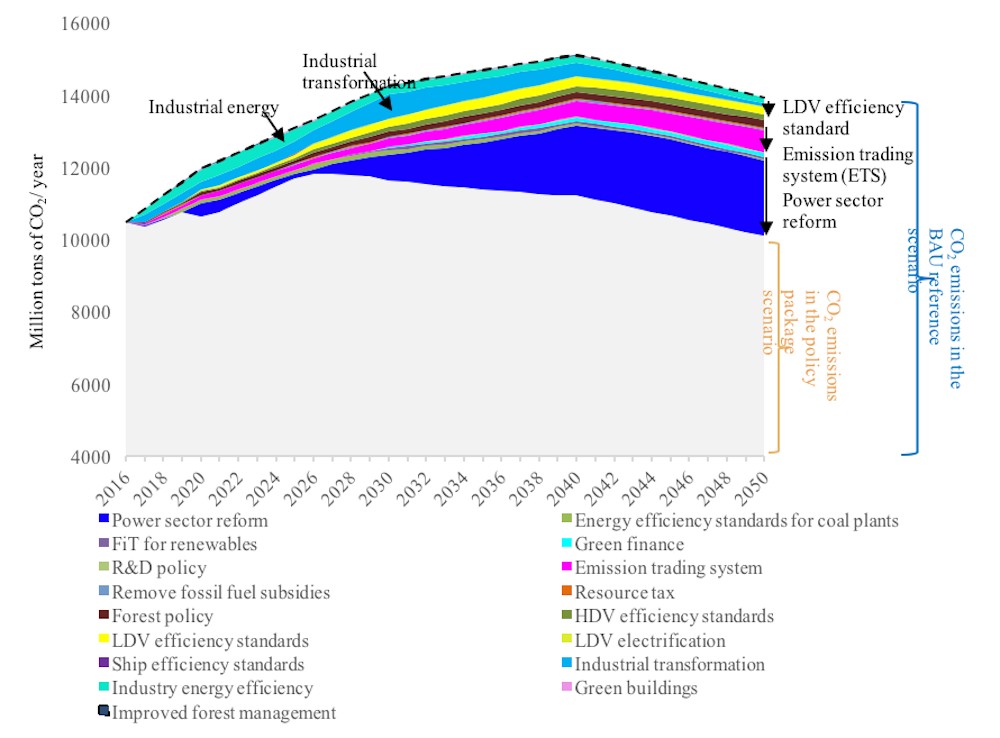
In our review, we found that the policies with the greatest influence over China’s projected emissions in 2030 were power sector reform, industrial transformation, industrial efficiency, emissions trading and light-duty vehicle efficiency.
Reforming the electric power sector is an essential step. Traditionally, electricity pricing schemes in China were determined by the National Development and Reform Commission, which leads the country’s macroeconomic planning. They favored existing power producers, particularly coal plants, not the cleanest or most efficient sources.
China committed to electric power reform, including emission reductions and greater use of renewables, in 2015. Converting to a process under which grid managers buy electricity from generators starting with the lowest-cost sources should facilitate installation and use of renewables, since renewable electricity has almost zero marginal costs. Meanwhile, renewable energy projects across China, especially solar, have become cheaper than grid electricity.
Even as China made big investments in wind and solar power in recent years, it also kept building coal plants. Power sector reform will help reduce the resulting overcapacity by stopping planned additions and encouraging market competition.
Reducing China’s reliance on coal energy is an enormous long-term shift.
But success is not guaranteed. The affected companies are giant state-owned enterprises. There is political resistance from owners of existing coal-fired power plants and from provinces that produce and use a lot of coal. The current U.S.-China trade war is slowing China’s economic growth and spurring rising concerns about employment, which could further complicate the reform process.
China’s emissions trading system has had a very modest impact so far because it set a low initial price on carbon dioxide emissions: US$7 per ton, increasing by 3% annually through 2030. But our analysis found that emissions trading, which allows low-carbon generators to make money by selling emissions allowances that they don’t need, could become influential over the longer term if it can sustain a much higher price. If China reduces its cap on total carbon dioxide emissions after 2025, which will increase the price of emissions allowances, this policy could become a major driver for emission reductions in the power sector.
Energy efficiency standards, particularly for coal-fired power plants, factories and motor vehicles, will also be very important over the coming decade. To continue driving progress, China will need to update these standards continuously.
Finally, there are some important gaps in China’s climate policies. Currently they only target carbon dioxide emissions, although China also generates significant quantities of other greenhouse gases, including methane and black carbon.
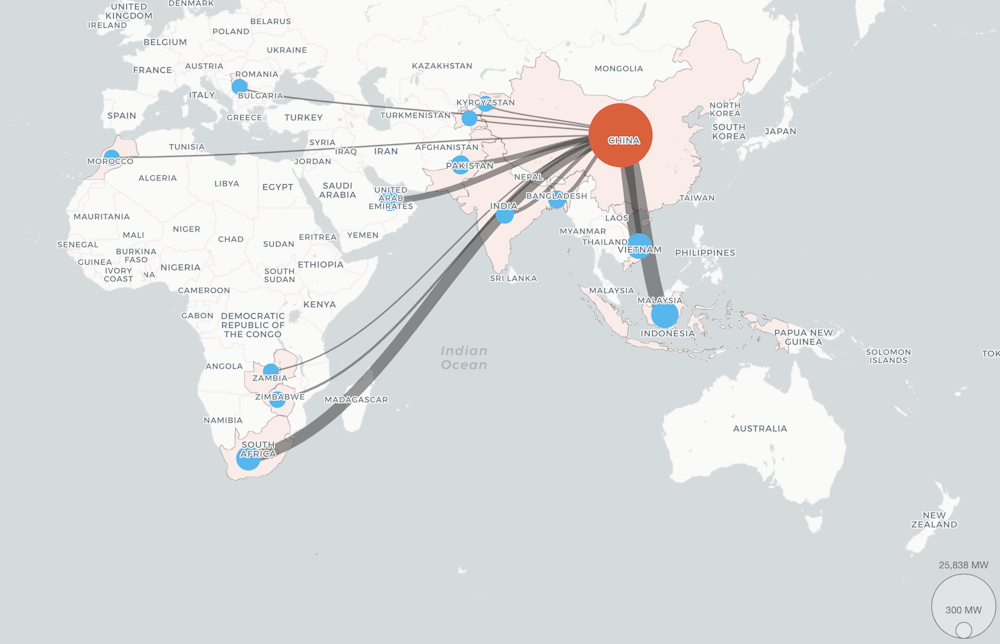
And China is contributing to emissions outside of its borders by exporting coal equipment and directly financing overseas coal plants through its Belt and Road Initiative. No nation, including China, currently reports emissions generated abroad in its national emissions inventory.
The biggest challenge China faces in achieving its Paris targets is making sure that business and local governments comply with policies and regulations that the government has already put in place. In the past, China has sometimes struggled with environmental enforcement at the local level when provincial and city governments prioritized economic development over the environment.
Assuming that China does carry out its existing and announced climate and energy policies, we think its carbon dioxide emissions could likely peak well before 2030. In our view, Chinese leaders should focus on completing power sector reform as soon as possible, implementing and strengthening emissions trading, making energy efficiency standards more stringent in the future and developing new carbon pricing policies for sectors such as iron, steel and transportation.
If they succeed, U.S. politicians will no longer have “But what about China?” as an excuse for opposing climate policies at home.
Kelly Sims Gallagher, Professor of Energy and Environmental Policy and Director, Center for International Environment and Resource Policy at The Fletcher School, Tufts University and Fang Zhang, China Research Coordinator and Postdoctoral Research Fellow, Tufts University
Russia's main opposition leader Alexei Navalny on Thursday blamed mass police raids on his regional offices on Kremlin "hysteria" sparked by the ruling party's losses in local elections.
"Why such hysteria? Two words: 'Smart voting,'" Navalny said on his blog.
Navalny said police searches were underway at more than 200 addresses in 41 cities across Russia.
He called it "the largest police operation in modern Russian history" and said it was the result of his call to supporters to vote tactically to push out ruling party candidates in local elections held Sunday in Moscow and other cities.
Allies of President Vladimir Putin suffered major losses in Moscow as a result.
"Putin got upset and is stomping his feet," the 43-year-old opposition leader said.
Navalny said authorities wanted to "demoralize" Russians and force them "to renounce collective action".
He said on Twitter that investigators' vans had arrived outside his Moscow headquarters as well.
Russian investigators in August launched a money laundering probe against Navalny's Anti-Corruption Fund (FBK), which has worked to expose officials' questionable wealth.
In the run-up to the elections Navalny and his supporters organized a wave of protests after popular opposition politicians were barred from standing in the Moscow parliament election, prompting a police crackdown.
The British government faced a backlash on Thursday after it was forced to publish documents warning that a no-deal Brexit could lead to civil unrest and shortages of food and medicines.
The "Operation Yellowhammer" papers, which the government released late on Wednesday, revealed that preparedness for leaving the EU without an agreement remained "at a low level".
The documents -- disclosed after MPs voted Monday for their release -- warned of "a rise in public disorder and community tensions" in such a scenario, as well as logjams at Channel ports threatening to impact supplies.
"It is extraordinary that these are things that could flow from the government's own policy," opposition Labour lawmaker Hilary Benn said.
"Normally when you're protecting against something like this it's a natural disaster, it's the action of others, (things) you don't control."
Prime Minister Boris Johnson's government said they were updating the scenarios, which were last compiled at the start of August, and that it envisaged "the worst case".
"We're spending the money on doing lots of things to mitigate those assumptions," Defence Secretary Ben Wallace told the BBC, noting there were daily meetings to prepare for no deal.
"We've planned for it and government does that well," he insisted.
Paul Carter, leader of the local authority in the southeast county of Kent, where there are fears of gridlock following a no-deal Brexit, said Johnson's administration had made "real progress" recently.
"I'm pretty confident that we can avoid disruption in Kent," he told the BBC.
But the release has fuelled fears among MPs that a disorderly divorce would be calamitous.
"It is unprecedented," said MP Dominic Grieve, who was expelled from the ruling Conservatives last week for voting against the government over the issue.
"Even if we are ready for a no-deal Brexit, this is highly disruptive and costly."
- 'Nothing is changing' -
Johnson took office in July promising to finally deliver on the referendum decision by leaving the EU on October 31 no matter what, but finds himself increasingly boxed in.
He has no majority in the Commons and suspended parliament on Monday until October 14 in an apparent bid to thwart opposition to a possible no-deal departure.
The controversial move provoked uproar across the political spectrum and several legal challenges.
A Scottish appeals court ruled Wednesday the suspension was "unlawful" but the government immediately appealed the decision, with the case set to be heard in the Supreme Court next Tuesday.
Parliament will for now stay shut, despite calls from opposition lawmakers for its immediate recall -- intensified by the release of the Yellowhammer documents.
"It is also now more important than ever that parliament is recalled and has the opportunity to scrutinise these documents and take all steps necessary to stop no deal," Labour's Brexit spokesman Keir Starmer said.
However, a government source told AFP on Wednesday that "nothing is changing" until the case was concluded.
Meanwhile another ruling on a legal challenge in Belfast that no deal would breach the terms of Northern Ireland's 1998 peace accord was expected Thursday.
- 'Great progress' -
Ahead of the shutdown lawmakers outlawed a no-deal Brexit, but Johnson has insisted Britain will still depart the EU on October 31.
The British leader wants to renegotiate the divorce terms struck by his predecessor Theresa May, which MPs have repeatedly rejected.
But European leaders accuse him of offering no viable alternatives.
Johnson, whose EU adviser David Frost is currently in Brussels, insisted Wednesday they were making "great progress" towards getting a deal.
"The ice floes are cracking, there is movement under the keel of these talks," he said.
President Donald Trump says the United States has agreed to a two-week delay in a planned increase in tariffs on some Chinese imports.
Trump said on Twitter on Wednesday that the delay is "a gesture of good will."
He says Chinese Vice Premier Liu He requested the delay "due to the fact that the People's Republic of China will be celebrating their 70th Anniversary ... on October 1st."
Trump has imposed or announced penalties on about $550 billion of Chinese products, or almost everything the United States buys from China.
Tariffs of 25% that were imposed previously on $250 billion worth of Chinese goods were due to rise to 30% on Oct. 1.
Instead, Trump says, that will be delayed until Oct. 15.
The two sides have agreed to resume negotiations in Washington early next month.
By delaying his tariff increase by two weeks, Trump has allowed for at least the theoretical possibility that the negotiators could make enough progress to avert his tariff increase indefinitely.




 AFP/File / Daniel LEAL-OLIVAS
 AFP / John SAEKI
 AFP / Zinyange Auntony
  AFP / Jekesai NJIKIZANA
  AFP / ZINYANGE AUNTONY
  AFP /
AFP /