US President Donald Trump on Friday said the costs of his protracted trade war are falling squarely on China, but a top adviser warned that the struggle between the economic superpowers could drag on for years.
Top-level negotiators are due to resume stalled talks in Washington early next month, with lower-level staff preparing the way in late September, according to officials on both sides.
And Trump says the pressure is on China to come to the table.
"China is eating the tariffs," Trump said on Twitter, repeating his claim that higher duties mean Washington is collecting billions of dollars from the Asian giant, without costs being passed on to US importers.
"China having worst year in decades. Talks happening, good for all!"
The face-off between the number one and two economies began about 18 months ago and now features steep tariffs on hundreds of billions of dollars' worth of trade. Trump says he wants to force China into radical change on protection for intellectual property and other key aspects of the current trading relationship.
But White House economic adviser Larry Kudlow cautioned that the trade war could be a drawn-out contest resembling the Cold War under president Ronald Reagan in the 1980s.
"The stakes are so high, we have to get it right. If that takes a decade, so be it," Kudlow told reporters.
"This is the kind of thing where you're looking at far-reaching consequences... so if it takes us more time to do it and to get it right, so be it," he said.
"I didn't go through the whole Cold War, but a lot of it. You know, it took decades, decades, to get where we wanted to be with the old Soviet Union."
- Economic fallout -
Trump has repeatedly insisted that US tariffs and China's slowing economy will pressure Beijing to cut a deal. There are signs that the trade war has also begun to weigh on the US economy, however.
Corporate earnings reports indicate US companies have been hit by the tit-for-tat measures and overall uncertainty. A report released this week said more than 10,000 job cuts announced last month stemmed from "trade difficulties."
Tariffs were hiked by both sides last month and US duties on Chinese goods are due to rise further in October and December.
However, Kudlow said the face-to-face talks will resume in a good atmosphere.
"I'm just saying it is good thing that they're coming here, and tempers are calmer," Kudlow said on CNBC television.
"We would love to go back to where we were in May, where we were getting kind of close to an agreement, maybe 90 percent of the way," he added.
"It's very positive that we negotiate and it may well be that something positive comes out of that."
Talks abruptly broke up in May, with Washington accusing Beijing of retracting core commitments just when an overall agreement was close to fruition.
Iran has begun injecting uranium gas into advanced centrifuges in violation of its 2015 nuclear deal with world powers, a spokesman said on Saturday.
Behrouz Kamalvandi of the Atomic Energy Organization of Iran made the remarks in a news conference broadcast on live television. He spoke from a podium with advanced centrifuges arranged next to him.
Iran already has breached the stockpile and enrichment level limits set by the deal, while stressing it could quickly revert back to the terms of the accord, if Europe delivers the sanctions relief promised in return for curbing Tehran’s nuclear program.
Kamalvandi warned that Europe had little time left to save the deal. President Donald Trump withdrew America from the accord over a year ago before imposing crippling trade sanctions on Iran.
“As far as the other side does not implement their commitments, they should not expect Iran to fulfill its commitments,” Kamalvandi said.
Kamalvandi said Iran had the ability to go beyond 20% enrichment of uranium. Analysts say 20% is just a short technical step away from 90% enrichment, which is weapons-grade level.
Kamalvandi warned several times in his comments that Iran was rapidly approaching a point that would mean a full withdrawal from the deal.
'Stockpile quickly increasing'
“Our stockpile is quickly increasing, we hope they will come to their senses,” he said.
However, he stressed that Iran would allow U.N. inspectors to continue to monitor sites in the country. A top official from the U.N.’s International Atomic Energy Agency was expected to meet with Iranian officials in Tehran on Sunday.
Tensions between Iran and the U.S. have risen in recent months that have seen mysterious attacks on oil tankers near the Strait of Hormuz, Iran shooting down a U.S. military surveillance drone and other incidents across the wider Middle East.
Also on Saturday, satellite images showed a once-detained Iranian oil tanker pursued by the U.S. appears to be off the coast of Syria, where Tehran reportedly promised the vessel would not go when authorities in Gibraltar agreed to release it several weeks ago.
The tanker Adrian Darya-1, formerly known as the Grace-1, turned off its Automatic Identification System late Monday, leading to speculation it would be heading to Syria. Other Iranian oil tankers have similarly turned off their tracking beacons in the area, with analysts saying they believe crude oil ends up in Syria in support of embattled President Bashar Assad’s government.
Images obtained by The Associated Press early Saturday from Maxar Technologies appeared to show the vessel off Syria’s coast, some 2 nautical miles (3.7 kilometers) off shore under intermittent cloud cover.
2.1 million barrels of crude oil
Iranian and Syrian officials have not acknowledged the vessel’s presence there. There was no immediate report in Iranian state media about the ship, though authorities earlier said the 2.1 million barrels of crude oil onboard had been sold to an unnamed buyer.
The oil on board would be worth about $130 million on the global market, but it remains unclear who would buy the oil as they’d face the threat of U.S. sanctions.
The new images matched a black-and-white image earlier tweeted by John Bolton, the U.S. national security adviser.
“Anyone who said the Adrian Darya-1 wasn’t headed to #Syria is in denial,” Bolton tweeted. “We can talk, but #Iran’s not getting any sanctions relief until it stops lying and spreading terror!”
U.S. prosecutors in federal court allege the Adrian Darya’s owner is Iran’s Revolutionary Guard, which answers only to Supreme Leader Ayatollah Ali Khamenei. On Wednesday, the U.S. imposed new sanctions on an oil shipping network it alleged had ties to the Guard and offered up to $15 million for anyone with information that disrupts its paramilitary operations.
Brian Hook, the U.S. special envoy for Iran, also has reportedly emailed or texted captains of Iranian oil tankers, trying to scare them into not delivering their cargo.
Meanwhile, the U.S. Transportation Department’s Maritime Administration issued on Saturday a new warning to shippers about a potential threat off the coast of Yemen in the southern Red Sea.
“A maritime threat has been reported in the Red Sea in the vicinity of Yemen,” the warning read. “The nature of the event is potential increased hostilities that threaten maritime security.”
Large areas of war-torn Yemen are held by the country’s Houthi rebels, which are allied to Iran. Shipping in the Red Sea has been targeted previously by rebel attacks. On Wednesday, a warning went out after two small boats followed one ship in the region, but there’s been no other information about a new threat there.
Cmdr. Joshua Frey, a spokesman for the U.S. Navy’s Bahrain-based 5th Fleet, said the Navy remained ready to maintain the safety of shippers in the region. He declined to specifically discuss the warning. The U.S. military’s Central Command did not respond to a request for comment.
Riot police fanned out across Hong Kong on Saturday and thwarted plans by pro-democracy protesters to target the airport, days after the city's leader made a surprise concession which was rejected by the movement as too little, too late.
Millions of pro-democracy supporters have taken to Hong Kong's streets for the past three months in the biggest challenge to China's rule since the city's handover from Britain in 1997.
On Wednesday, the city's pro-Beijing leader Carrie Lam surprised many by announcing she was scrapping a hugely unpopular extradition law that sparked the widespread and sometimes violent rallies.
The withdrawal was one of the protesters' key demands and both she and Beijing had previously refused to budge on the issue.
Lam, who was not directly elected but appointed by an overwhelmingly Beijing-friendly committee, portrayed the move as a bid to de-escalate tensions and start a dialogue.
But it has been widely dismissed by protesters as an empty gesture after 14 weeks of clashes with more than 1,100 arrests and many facing lengthy jail sentences.
AFP / Anthony WALLACE Security staff were carefully checking people's documents at the airport
Online messaging forums used by the largely leaderless movement had called for protesters to "stress test" the airport on Saturday afternoon, filling up with suggestions for how to disrupt the road and rail links leading to the terminals.
But a large deployment of police at key bus, ferry and rail terminals across the city appeared to deter protesters from arriving en masse.
Tao Tsz Fung, 26, managed to get through the security checks and made it to the airport, along with a few dozen more protesters hanging around outside the terminal.
"There are just too many police around," he told AFP. "But we'll be out again tomorrow."
Some train and bus services to the airport were running a more restricted service while police performed multiple stop and searches, largely against young people.
At the airport itself, the atmosphere was calm but passengers had to queue to have bags searched and boarding passes checked before being allowed to enter.
"On the way to the airport, our bus stopped for some sort of searching. The police came into the bus and checked everyone," James Reis, a passenger who arrived nine hours ahead of his flight home to Portugal, told AFP.
- Travel chaos -
In recent weeks, the airport -- the world's eighth busiest -- has become a repeated target of pro-democracy protesters as they try to ramp up pressure on Beijing and city leaders by denting Hong Kong's reputation as a stable business hub.
But the tactic is controversial because of the travel misery it causes -- and the fact that the target is not the state but ordinary people.
AFP / Anthony WALLACE The airport has repeatedly been targeted in the protests but the tactic is divisive because of the travel misery it causes
Last month hundreds of flights were cancelled over two days when huge crowds of protesters staged a sit-in at the airport, with ugly scenes playing out as two men suspected of being Chinese spies were beaten.
Previous protests at the airport had been non-disruptive and peaceful, aimed at enlightening travellers about the movement's goals.
Since the violent scenes, security has been ramped up around the sprawling hub -- which lies on reclaimed land west of the main city -- and access to the terminals has been restricted to those with boarding passes.
But last Sunday protesters returned to the airport and showed they could still wreak havoc.
Operators of the express train that links the airport and the city suspended services after the station was besieged and objects were thrown onto the rail line.
Roads we also blocked forcing stranded travellers to abandon their vehicles and drag their luggage for many kilometres.
Protesters have said their movement will only end when other key demands are met such as an amnesty for those arrested, an independent inquiry into the police and the granting of fully free elections, all of which Lam and Beijing have rejected.
- 'Sacrifice' -
At a peaceful rally on Friday night in the city's commercial district, many protesters said they planned to continue hitting the streets.
"It's too late now. In these three months, a lot of people have sacrificed themselves and been arrested," said a retiree who gave his surname as Cheng, bursting into tears as he spoke.
The same night, tear gas was fired at small groups of more hardline protesters who were shining laser pens at a police station in the district of Mongkok, an area that has seen repeated clashes.
They later built barricades and vandalised a nearby subway station. Protesters are planning a rally outside the US consulate on Sunday afternoon.
Zimbabweans entered a first full day of national mourning on Saturday, divided over the legacy of Robert Mugabe, the guerrilla hero turned despot who ruled the country for 37 years.
Flags flew half mast in the capital Harare as shops remained open and people bustled about their daily errands.
"We are not mourning, why should we mourn when we are suffering like this," said Ozias Mupeti, 55, standing on a dusty curb in downtown Harare on a cold and cloudy morning.
"Look at me selling pieces of ginger on the streets, at my age. I should have been an employer by now."
Mugabe, 95, passed away at 0240 GMT on Friday in Singapore, where he had been for medical treatment since April.
As Zimbabweans expressed sharply divided opinions about Mugabe, President Emmerson Mnangagwa said Friday that his predecessor had been declared a "national hero" and that Zimbabwe would mourn him until the burial.
The news of Mugabe's death was plastered across the front page of local papers.
"End of an era" said DailyNews. "95 and out", echoed NewsDay, while state-owned The Herald published a special edition entirely dedicated to the former president.
Yet residents in Harare appeared largely unconcerned by the headlines.
First heralded as a liberator who rid the former British colony Rhodesia of white minority rule, Mugabe used repression and fear to govern until he was finally ousted by his previously loyal generals in November 2017.
His increasingly tyrannical leadership and economic mismanagement prompted millions to leave the country.
Only a handful of Mugabe supporters came out the streets, sporting Mugabe-emblazoned T-shirts in honor of his passing.
One small group chanted and danced, another blasted music from a car.
"Mugabe provided education and scholarships to most Zimbabweans," Comrade Bhobhi told AFP. "Of course he failed somewhere but on the education side he did great."
"We will never get any other president like president Mugabe who during his time had the guts to call the British 'these stupid British' right in their face," said Vivian Jena, another supporter.
But while some Zimbabweans hailed Mugabe as a "revolutionary icon", for others his named evoked only "destruction" and "suffering".
"He destroyed this country. Now he’s gone and we have nothing left in the country because of him," said Mupeti, puffing at a cigarette.
"Why should I shed any tear for him when I'm suffering like this. I can’t even pay fees for my daughter who is doing Form 4."
AFP /Zimbabwe under Mugabe
Adam Molai, Mugabe's nephew, said the former president died of old age "surrounded by family".
He told reporters on Friday that the president was likely to announce when the body would move "sometime next week", adding that he could give no further details on the "state funeral".
Close relatives gathered for a vigil in Mugabe's rural homestead Zvimba on Friday.
The mood was sombre and another nephew, Leo Mugabe, said the family had "not yet deliberated on where he is going to be buried".
- 'Betrayed his people' -
South African President Cyril Ramaphosa remembered Mugabe as a "liberation fighter" and a "champion of Africa's cause against colonialism".
AFP/File / ALEXANDER JOE Mugabe's popularity faded as he cracked down on opponents
China lauded him as an "outstanding national liberation movement leader" while Russian President Vladimir Putin noted Mugabe's "great personal contribution" to Zimbabwe's independence.
But Britain said "Zimbabweans suffered for too long as a result of Mugabe's autocratic role".
And the United States blamed him for impoverishing Zimbabwe, saying he "betrayed his people's hopes".
The Mugabe years are widely remembered for his crushing of political dissent and policies that ruined the economy.
The former political prisoner and guerrilla leader swept to power in 1980 elections after a growing insurgency and economic sanctions forced the Rhodesian government to the negotiating table.
In office, he initially won international plaudits for his declared policy of racial reconciliation and for extending improved education and health services to the black majority.
- Human rights violations -
But that faded rapidly as Mugabe cracked down on his opponents. During the 1980s, he led an infamous campaign known as Gukurahundi during which an estimated 20,000 dissidents were killed.
The violent seizure of white-owned farms turned him into an international pariah -- although his status as a liberation hero still resonates strongly across Africa.
AFP / Roslan RAHMAN Mugabe died in Singapore where he was hospitalised in April
Aimed largely at angry war veterans who threatened to destabilize his rule, the land reform policy wrecked the crucial agricultural sector, caused foreign investors to flee and plunged the country into economic misery.
All along, the Mugabe regime was widely accused of human rights violations and of rigging elections.
The topic of his succession was virtually taboo until he reached his 90s and became visibly frail.
As his health weakened, the military finally intervened to quash his second wife Grace's presidential ambitions in favor of their preferred candidate, Mnangagwa, Mugabe's vice president at the time.
Mnangagwa took over in November 2017 and was elected in July last year.
HBO's "Real Time" with Bill Maher examined President Donald Trump's jealousy of Canadian Prime Minister Justin Trudeau on Friday.
"New Rule: Now that Melania has gazed into Justin Trudeau's eyes like this," Maher said, showing a photo of the first lady looking at the Canadian Prime Minister.
"Not long after Ivanka did it like this," he said, showing a photo of the first daughter looking at Trudeau.
" Trump has to tell us, 'Which one made you more jealous?'" Maher said.
"Mr. President, I'm kidding. We all know about the time Trudeau made you really jealous," he said, displaying a photo of Vladimir Putin looking at Trudeau.
FRANCE 24 brings you an exclusive report on the hunt for Edward Snowden, who became one of the world’s most wanted men after leaking explosive confidential documents on US mass surveillance. Back in 2013, while on the run in Hong Kong, and before heading to Russia, the whistleblower was sheltered by a group of refugees. Our reporters Valériane Gauthier, Mohamed Farhat and François Rihouay went to meet Snowden's "guardian angels", who today find themselves in danger.
After he revealed the National Security Agency's illegal mass surveillance programmes in 2013, Edward Snowden received help from some unlikely accomplices. Four refugees and their lawyer allowed the whistleblower to escape and stay under the radar, at a time when he was the world’s most wanted man.
For 13 days, they sheltered him in their tiny apartments located in the poorest area of Hong Kong, home to the marginalised community of asylum seekers. The mastermind behind the idea of hiding the American fugitive in plain sight was Robert Tibbo, a Canadian human rights lawyer, well known for defending asylum seekers in the region.
Snowden told FRANCE 24 he believes he owes his life to these unexpected allies, who could have turned him in at any time: “They could have written an email to the CIA and they could have gotten a big cheque or they could have finally gotten asylum in exchange. But they would have had to do it by selling someone into a grave. And for that, I’ll never be able to repay them.”
But since their identity was revealed, especially with the release of the Oliver Stone film "Snowden" in 2016, these refugees are being persecuted by Hong Kong authorities. Arrested on several occasions, they have been questioned about their ties with Snowden. The little welfare they received from the government has been cut. Today, they all live in constant fear in Hong Kong. If deported to their home country of Sri Lanka, they could face imprisonment, torture and even death. All of them have applied for asylum in Canada.
Snowden calls on Canada to act quickly
One of them, Vanessa Rodel, a Filipino national, has been granted refugee status. She arrived in Montreal in May with her daughter Keana. They are now permanent residents in the country. But Keana’s father Supun Kellapatha remains in limbo in Hong Kong with his two other children, seven-year-old Sethumdi and three-year-old Dinath; a father and his children who are suffering from this painful separation.
Vanessa and the refugees’ lawyers are calling on Ottawa to act quickly to welcome the remaining refugees to safety. But the Canadian immigration services seem to be delaying any action.
"Contrary to UN Guidelines and Canada’s legislative framework for reunifying refugee families, Canadian Prime Minister Justin Trudeau has fragmented a family by separating the seven-year-old Keana, now in Montreal, from her father, brother and sister," the Snowden refugees’ lawyer Robert Tibbo told FRANCE 24. "These actions by Trudeau and continued inaction to reunite this family in Canada appear to be taken from a page in US President Donald Trump’s playbook."
From Moscow, where he lives in exile, Edward Snowden is also trying to help his saviours. On FRANCE 24, he appealed directly to Canada: “Please protect these families, just bring them to Canada. These are the best kind of the people we have among us anywhere in the world and they need your help.”
As for Oliver Stone, he has written to Trudeau. He told FRANCE 24: "The remaining Snowden refugees in Hong Kong are experiencing two nightmares. The first fear of being sent back to Sri Lanka to face torture and death, and the second currently being played out by the Hong Kong government persecuting them. Mr Trudeau continues to delay bringing these families into Canada, including two stateless children, similar in age to Trudeau's own children, who should have been brought to safety and reunited with their sister Keana in Montreal."
From Hong Kong, where they still live in squalour, the remaining refugees dream of a new life in Canada: Supun and Nadeeka would like to "work for an NGO in order to help other refugees", while Ajith sees himself as a "wood craftsman in Quebec". Even if they now feel they paid a high price for helping the man who has become Washington's bête noire, Snowden’s “guardian angels” say they have no regrets.
Supun Kellapatha with his children, Keana, Sethumdi, and Dinath. A family now separated.
"Chick-fil-A has given millions of dollars to anti-LGBTQ2S organizations, including known hate groups and proponents of conversion therapy, and continues to do so every year," one Toronto group, The 519, says. The group lists itself as a "proud city agency and a registered charity," and is "committed to the health, happiness and full participation of the LGBTQ2S communities."
They posted these photos of Friday's protest:
CityNews Toronto Sr. Journalist Mark McAllister posted video and photos of the protest:
Canada's Daily Xtra last year spoke with Rich Matherne, vice president of Chick-fil-A International, who “could not make a commitment on behalf of the company” that it would cease funding anti-LGBTQ organizations and causes.
More video and photos from Friday's protest:
Chick-fil-A has been challenged to expand outside of the U.S. It opened a few stores in South Africa in the 1990's but closed them a few years later. It's first store in Canada also closed after a few years. Toronto appears to be Chick-fil-A's only current location in Canada.
Now aged 83, Woody Allen is one of America's most prolific directors. For over 60 years now, he has released nearly one film a year, including several masterpieces. His latest feature, "A Rainy Day in New York", is opening the Deauville American Film Festival in the French resort this Friday. He sat down to talk with FRANCE 24's Vincent Roux.
Woody Allen is back with "A Rainy Day in New York", which tells the story of a young couple visiting the Big Apple for a weekend. But the film may never be released in the United States because of allegations of child molestation by Allen's adopted daughter Dylan Farrow, which came back into the spotlight with the #MeToo movement.
"To me, it doesn’t matter ... The movie’s being released all over the world. If people enjoy the movie, I think it will eventually be released in the United States," Allen told FRANCE 24.
"Get organized, get active, and join forces in defense of the Amazon and in defense of our future."
Because "getting angry on social media is not enough" to put a stop to the fires and profit-driven policies ravaging the Amazon rainforest, thousands of people across six continents mobilized on Thursday to protest the destruction of the "lungs of the world" at the hands of far-right Brazilian President Jair Bolsonaro and large multinational corporations.
"From Rio de Janeiro and Brasilia to San Francisco and Hong Kong, people across generations, backgrounds, and borders are expressing their outrage over the destructive fires and their solidarity with the determined efforts of indigenous peoples to defend the forest and our collective wellbeing," said Christian Poirier, program director at Amazon Watch, which coordinated the global actions alongside the Association of Indigenous Peoples of Brazil (APIB) and Extinction Rebellion.
The demonstrations, which spanned more than 20 countries, came as thousands of fires continued to devastate the Amazon rainforest. Many of the blazes were deliberately and illegally set by farmers, loggers, and ranchers who, according to critics, have been emboldened by Bolsonaro's aggressive support for deforestation, which was accelerated rapidly during his time in office.
"Thousands of people around the world are mobilizing alongside Brazil's resistance to the Bolsonaro regime," said Poirier.
Demonstrators held a "die-in" outside the London offices of Blackrock, which a recent report described as the "world's largest investor in deforestation."
Outside the White House, protesters held signs that condemned U.S. President Donald Trump, Bolsonaro, and big business as "Amazon fire-starters."
Sônia Guajajara, executive coordinator at APIB, said to "address the scale of Amazon destruction we are witnessing," people "must get organized, get active, and join forces in defense of the Amazon and in defense of our future."
Clouds of dust rose behind the wheels of the pickup truck as we hurtled over the back road in Palo Verde, El Salvador. When we got to the stone-paved part of the road, the driver slowed as the truck heaved up and down with the uneven terrain. Riding in the back bed of the truck, Ruben (not his real name) and I talked while we held on tight, sitting on sacks of dried beans that he was taking to market.
“It doesn’t come out right,” he said, “it just doesn’t pay anymore to work the land. I take out a loan for seed, and then I can’t count on making it back to pay off my debt.”
Ruben told me then, for the first time, that he planned to save up his money to migrate out of El Salvador. His story is playing out across Central America among many migrants and would-be migrants.
When I spoke with Ruben, it was 2017, nearly 20 years after I had first spent time in his community, a coffee cooperative in El Salvador’s central highlands founded in the 1990s. Over those two decades, the cooperative’s hopes and dreams of a sustainable livelihood producing coffee for a global market have been dashed.
Rising global temperatures, the spread of crop disease and extreme weather events have made coffee harvests unreliable in places like El Salvador. On top of that, market prices are unpredictable.
In the back of the pickup truck that day, we talked about gangs too. There was increasing criminal activity in the town nearby, and some young people in the town were being harassed and recruited. But this was a relatively new issue for the community, layered on top of the persistent problem of the ecological crisis.
As a cultural anthropologist who studies factors of displacement in El Salvador, I see how Ruben’s situation is reflective of a much broader global phenomenon of people leaving their homes, directly or indirectly due to climate change and the degradation of their local ecosystem. And as environmental conditions are projected to get worse under current trends, this raises unresolved legal questions on the status and security of people like Ruben and his family.
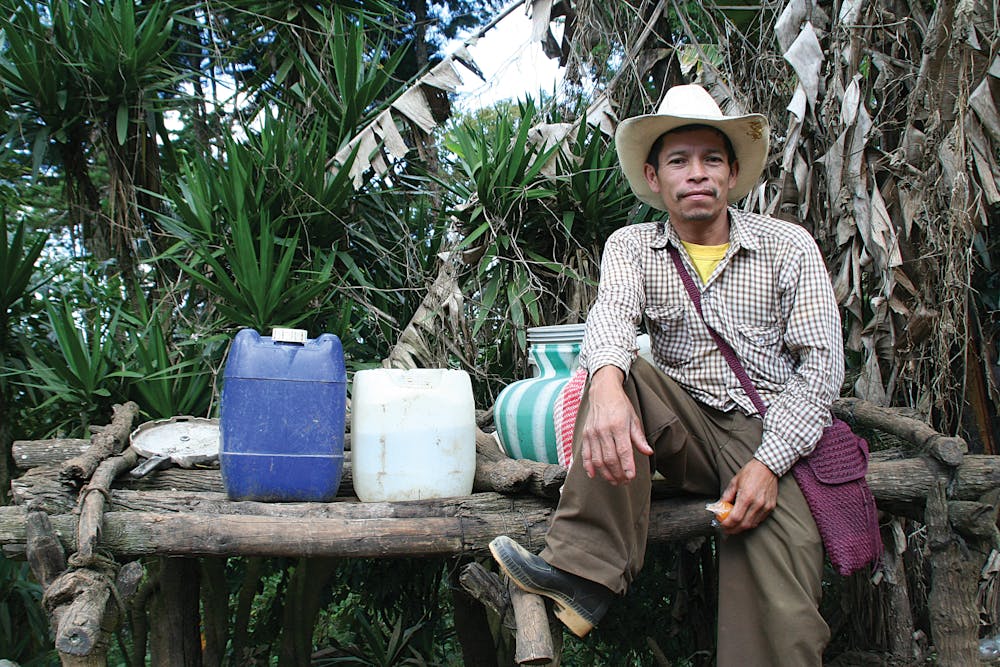
This man lives in the Dry Corridor on the Pacific Coast of Central America, an area that has suffered high rates of poverty and malnutrition.
Migration from Central America has gotten a lot of attention these days, including the famous migrant caravans. But much of it focuses on the way migrants from this region – especially El Salvador, Guatemala, Nicaragua and Honduras – are driven out by gang violence, corruption and political upheaval.
The migrant exodus from Central America includes many people impacted by climate change, although other factors play a part as well.
The link between environmental instability and emigration from the region became apparent in the late 1990s and early 2000s. Earthquakes and hurricanes, especially Hurricane Mitch in 1998 and its aftermath, were ravaging parts of Honduras, Nicaragua and El Salvador.
Many people from El Salvador and Honduras lived in the U.S. at the time, and the Bush administration granted them Temporary Protected Status. In this way, the government of the United States recognized the inhumanity of sending people back to places struggling with ecological disaster.
In the years since those events, both rapid-onset and long-term environmental crises continue to displace people from their homes worldwide. Studies show that displacement often happens indirectly through the impact of climate change on agricultural livelihoods, with some areas pressured more than others. But some are more dramatic: Both Honduras and Nicaragua are among the top 10 countries most impacted by extreme weather events between 1998 and 2017.
Since 2014, a serious drought has decimated crops in Central America’s so-called dry corridor along the Pacific Coast. By impacting smallholder farmers in El Salvador, Guatemala and Honduras, this drought helps to drive higher levels of migration from the region.
These trends have led experts at the World Bank to claim that around 2 million people are likely to be displaced from Central America by the year 2050 due to factors related to climate change. Of course, it’s hard to tease out the “push factor” of climate change from all of the other reasons that people need to leave. And unfortunately, these phenomena interact and tend to exacerbate each other.
Scholars are working hard to assess the scale of the problem and study ways people can adapt. But the problem is challenging. The number of displaced could be even higher – up to almost 4 million – if regional development does not shift to more climate-friendly and inclusive models of agriculture.
People who emigrate from Central America may not always fully realize the role climate change plays in their movement, or think of it as the final trigger given all the other reasons they have to flee. But they know that the crops fail too often, and it’s harder to get clean water than it used to be.
Environmental factors are playing more and more of a role in Central Americans’ decisions to leave home.
Seeking a protected status
Ruben recently contacted me to ask for a reference to a good immigration lawyer. He and his daughter are now in the United States and have an upcoming hearing to determine their status.
Just as he predicted a few years ago, Ruben couldn’t make a living in El Salvador. But he may find it hard to live in the U.S. too, given the mismatch between refugee law and current factors causing displacement.
For several years now, scholars and legal advocates have been asking how to respond to people displaced by environmental conditions. Do existing models of humanitarian response and resettlement work for this new population? Could such persons be recognized as in need of protection under international law, similar to political refugees?
Among the most complicated political questions is who should step up to deal with the harms of climate change, considering that wealthier countries pollute more but are often shielded from the worst effects. How can responsibility be assigned, and more importantly, what is to be done?
In the absence of coordinated action on the part of the global community to mitigate ecological instability and recognize the plight of displaced people, there’s a risk of what some have called “climate apartheid.” In this scenario – climate change combined with closed borders and few migration pathways – millions of people would be forced to choose between increasingly insecure livelihoods and the perils of unauthorized migration.
Reactions to Robert Mugabe’s death on Friday began pouring in shortly after Zimbabwean President Emmerson Mnangagwa announced the passing of the former anti-colonial resistance hero, who held power in post-colonial Zimbabwe for over three decades.
In a Twitter post announcing Mugabe’s death on Friday morning, Mnangagwa called his predecessor “an icon of liberation, a pan-Africanist who dedicated his life to the emancipation and empowerment of his people.”
But while most African leaders have hailed Mugabe’s contribution to Zimbabwe’s fight against colonialism, his post-colonial track record drew mixed reactions.
Here are some of the reactions from Zimbabwe and the rest of the world.
South African President Cyril Ramaphosa
"South Africans join the people and government of Zimbabwe in mourning the passing of a liberation fighter and champion of Africa's cause against colonialism.
"Under President Mugabe's leadership, Zimbabwe's sustained and valiant struggle against colonialism inspired our own struggle against apartheid and built in us the hope that one day South Africa too would be free.
"During the decades of our own struggle, Zimbabwe's liberation movement supported our own liberation movement to fight oppression on multiple fronts. After Zimbabwe achieved independence, the apartheid state brutalised and violated
Zimbabwe as punishment for supporting our own struggle.
"Many Zimbabweans paid with their lives so that we could be free. We will never forget or dishonour this sacrifice and solidarity."
"There will be mixed emotions in Zimbabwe at today's news. We of course express our condolences to those who mourn but know that for many he was a barrier to a better future. Under his rule the people of Zimbabwe suffered greatly as he impoverished their country and sanctioned the use of violence against them.
"His resignation in 2017 marked a turning point and we hope that today marks another which allows Zimbabwe to move on from the legacy of its past and become a democratic, prosperous nation that respects the human rights of its citizens."
Zimbabwean opposition Senator David Coltart
"He was a colossus on the Zimbabwean stage & his enduring positive legacy will be his role in ending white minority rule & expanding a quality education to all Zimbabweans."
Nelson Chamisa, head of Zimbabwe's main opposition MDC party
"My condolences to the Mugabe family and Africa for the passing on of Zimbabwe's founding President. This is a dark moment for the family because a giant among them has fallen. May the lord comfort them.
"Even though I and our party, the MDC, and the Zimbabwean people had great political differences with the late former President during his tenure in office, and disagreed for decades, we recognise his contribution made during his lifetime
as a nation's founding President."
Namibian President Hage Geingob
"As Namibians, we owe President Mugabe a deep sense of gratitude for his immense and selfless contributions to the liberation of our country ... The loss of the people of Zimbabwe is Africa's loss.
Chinese Foreign Ministry Spokesman Geng Shuang
Geng said Mugabe was an outstanding liberation movement leader and statesman for Zimbabwe who had defended his country's independence, opposed foreign interference and promoted good cooperation with China.
"We are deeply saddened by his passing and express sincere sympathies to the Zimbabwean people, government and to Mr. Mugabe's family."
Kenyan President Uhuru Kenyatta
"In this moment of sorrow, my thoughts and prayers go out to his family, his relatives and the people of Zimbabwe who, for many years, he served with commitment and dedication.
"Words cannot convey the magnitude of the loss as former President Mugabe was an elder statesman, a freedom fighter and a Pan-Africanist who played a major role in shaping the interests of the continent ... a man of courage who was never afraid to fight for what he believed in even when it was not popular."
Nigerian President Muhammadu Buhari
"The President commiserates with family members, friends and political associates of the political activist who fought for the independence of the country from colonial rule, and lived most of his life in public service.
"President Buhari believes Mugabe's sacrifices, especially in struggling for the political and economic emancipation of his people, will always be remembered by posterity."
Nasir Ahmad El-Rufai, Governor of Nigeria's Kaduna state
"He started very well, stayed too long and ended tragically. An African hero all the same..."
Prime Minister Boris Johnson sought to regain political momentum on Friday after a painful week left his do-or-die Brexit strategy in tatters.
Johnson wants an early general election that could give him a mandate to take Britain out of the European Union with or without a divorce deal on October 31.
He spent Friday morning campaigning in Scotland among fishermen who strongly backed the Brexit referendum in 2016.
Johnson received a boost when the High Court in London rejected a legal challenge against his decision to suspend parliament from next week.
But it granted permission for the case to go to the Supreme Court for an appeal scheduled for September 17.
"My legal team and I will not give up the fight for democracy," pro-EU campaigner Gina Miller told reporters.
And the upper House of Lords was set Friday to pass legislation that would force Johnson to seek a Brexit delay from Brussels unless he can strike a deal at an EU summit next month.
Johnson has branded the bill a "surrender" that would allow the other 27 EU leaders to dictate the terms on which Britain leaves its closest neighbours after 46 years.
POOL/AFP / Andrew Milligan Prime Minister Boris Johnson is struggling with his 'do or die' effort to pull Britain out of the European Union
He sacked 21 Conservative rebels who voted for the legislation in the House of Commons on Tuesday.
The decision left him without a working majority in parliament.
Opposition parties and the rebel Conservatives are now set to approve the delay bill when it returns to the Commons on Monday.
They are also widely expected to block for the second time Monday his attempt to schedule snap polls for October 15.
"Never in history has there been an opposition party that has been given a chance to have an election and has turned it down," Johnson said in Scotland.
"I think that they are making an extraordinary political mistake."
- Deal 'not possible' -
Johnson has been adamant that he will not seek a third Brexit delay this year.
The main opposition Labour Party is plotting a strategy with smaller groups that could leave Johnson with no other alternative but to resign.
They are reportedly trying to make sure that an election is held only after Johnson is forced to go back on his word and seek a divorce delay.
POOL/AFP / Duncan McGlynn Britain's Boris Johnson spent the morning campaigning in Scotland among fishermen who strongly backed the Brexit referendum in 2016
This would happen if no new agreement is reached when Johnson attends an October 17-18 EU leaders' summit in Brussels.
None is expected and EU officials say they have heard no new proposals from Johnson's team.
Finnish Prime Minister Antti Rinne -- whose Nordic country holds the rotating EU presidency -- said a chaotic "no-deal Brexit" seemed unavoidable.
"I hope that we can reach a situation where this can be solved so that there is no mess, but it seems not possible now," Rinne said in Helsinki.
"We don't know what's happening there. It seems very obvious that we are not getting Brexit with an agreement."
Johnson disagreed.
"I don't think we'll get a no-deal Brexit," he said in Scotland.
"I am very confident I will get an agreement at the summit on October 17."
- 'Cunning wheeze' -
Labour was negotiating on Friday with the pro-EU Scottish National Party (SNP) and smaller groups about an election date closer to the Brexit deadline.
POOL/AFP / Duncan McGlynn Boris Johnson says he remains confident Britain will get a new Brexit agreement from the EU
Johnson was also set to meet his team over the weekend to prepare for what promises to be another momentous week in the Brexit saga.
Labour foreign affairs spokeswoman Emily Thornberry said lawmakers did not trust "this prime minister, who is as slippery as can be".
She accused Johnson of trying to use an election "as a distraction whilst they, by some cunning wheeze, bounce us out of the EU."
SNP's parliamentary leader Ian Blackford also signalled his party's refusal to back an October 15 poll.
"The idea that he is coming with a motion to try and force an election having lost one this week is insane," he said.
"He is not going to compel parliamentarians to give him a mandate to determine the timing -- we don't trust him."
Pope Francis on Friday told tens of thousands of faithful at a packed stadium not to resort to "vengeance" as he wound up a visit to Mozambique, ravaged by a 16-year civil war and now the target of jihadist attacks.
His maiden visit to the poor former Portuguese colony came a month after the government and the former rebel group Renamo, now the main opposition party, signed a historic peace treaty.
Brutal jihadist attacks in northern Mozambique have claimed more than 300 lives over two years and forced thousands from their homes.
"We cannot think of the future and build a nation" with violence, the pope said in a homily to a crowd of about 60,000 at the Zimpeto stadium in the Mozambican capital Maputo.
Speaking in Portuguese, he asked them not to follow the old law of retaliation "an eye for eye, a tooth for a tooth.
AFP / GIANLUIGI GUERCIA The stadium was jampacked and many had travelled hundreds of miles to see the pontiff
"No family, no group of neighbors or ethnic group and even less no country has a future if the motor that unites them... is composed of vengeance and hatred," he said.
Denouncing reprisals cloaked under the guise of legality, the pope warned that violence was "an endless spiral without end with a very high cost.
"You have the right to peace!" he said.
Mozambique is a mainly Christian country and 28 percent of the population is Catholic.
Earlier Friday, the pope visited an AIDS care centre on the outskirts of Maputo, hailing the carers for responding to their "silent cry" for help in a country ravaged by the disease.
AFP / Tiziana FABI The Argentinian pope addressed the crowd in Portuguese
According to UNAIDS, 2.2 million Mozambicans -- 60 percent of them women -- were HIV positive in 2018 in the southern African nation of 27 million people.
There were 150,000 new infections last year and 54,000 AIDS-related deaths.
- 'Restoring dignity' -
Francis hailed the "compassion" of the health workers for responding to "this silent cry, almost inaudible, of innumerable women and all the people living in shame, marginalized and judged by everybody.
Francis thanked workers at the AIDS centre for "restoring the dignity" of women and children suffering from HIV and AIDS and for "hearing their cries and intervening personally."
AFP / Tiziana FABI He also visited a hospital which hosts a program for HIV-positive people and AIDS patients
He did not however touch on the delicate subject of prevention -- an issue riddled with minefields given the Catholic Church's stand on contraception -- especially in a largely conservative and traditional continent.
Francis is the first pope to visit Mozambique since John Paul II in 1988 and is on a three-nation tour that includes Madagascar and Mauritius.
On Thursday, the pontiff visited a brand new hospital in Zimpeto, a poor outlying district of the capital, where 23 percent of adult residents have been hit by HIV.
- 'Dream' -
The complex, inaugurated last year, comprises a state-of-the-art laboratory and hosts a program for HIV-positive and AIDS patients, especially pregnant women.
This program, named "Dream", was launched in 2002 by the Italian lay Catholic association Sant'Egidio which is very close to the Vatican and is dedicated to social service.
It runs 13 health centers in the country. The "Dream" project is spread across 11 African countries.
Mozambique and Madagascar are among the world's poorest countries and Francis' decision to visit is seen by commentators as an act of solidarity from a cleric who was a frequent presence in the shantytowns of Argentina and is now called the "pope of the poor".




 AFP / Anthony WALLACE
  AFP / Anthony WALLACE
  AFP /
AFP / AFP/File / ALEXANDER JOE
  AFP / Roslan RAHMAN

 POOL/AFP / Andrew Milligan
  POOL/AFP / Duncan McGlynn
  POOL/AFP / Duncan McGlynn
  AFP / GIANLUIGI GUERCIA
  AFP / Tiziana FABI
  AFP / Tiziana FABI