Former George W. Bush speechwriter turned Atlantic magazine senior editor David Frum tweeted over the weekend that Serena Williams might be taking steroids. Moments later, he deleted the tweets and claimed they were part of a private conversation and not intended for public consumption.
Then, after Williams took home the title, he posted the following series of Tweets on Sunday:
When other Twitter users responded with outrage that Frum would make such accusations without any proof beyond his own speculations, he deleted the tweets and claimed they were private.
Twitter users responded:
Seeing an opening, Frum scrambled to parlay this flap into a round of TV appearances:
The provenance of To Kill a Mockingbird (1960) is perhaps less well known than the novel itself, which has come to be even less remarked upon than the legal travails and self-imposed isolation of the author who penned the work.
Even those who haven’t read To Kill A Mockingbird know Harper Lee, now 89, has been labelled a recluse, dogged by legal troubles, and has the distinction of having written what is regarded an American masterpiece without peer.
The Pulitzer Prize-winning To Kill A Mockingbird outsold the Bible in its early days, and has been regularly voted the greatest novel of the century.
Lee herself has refused major interviews since 1964, and though active in her local community – Monroeville, Alabama – she still preserves a steadfast and tightly held grip on her privacy.
Then the publication of Go Set a Watchman (to be released in full on July 14), heralded as Lee’s “lost novel” and a sequel to To Kill A Mockingbird, was announced on February 3, this year.
The author – who had been almost as well known for publishing just the one book as it being that book – and who’d maintained she’d never publish another book, was releasing another, and the publishing world and fans reacted accordingly.
In the history of publishing it’s hard to think of a longer lead-in time to a second novel, or a more highly-anticipated publication. The book’s first chapter has appeared, in a coordinated, global publicity campaign, today. Think Salinger goes on The View, or ABBA reforming, in terms of Least Likely Events to Happen. That Lee would release a second novel is an incredible, stunning second act.
Go Set a Watchman, whose title derives from Isaiah 21:6, may be the most anticipated novel in the last 55 years of publishing, for that is how many years have passed between the publication of what will be Lee’s two books.
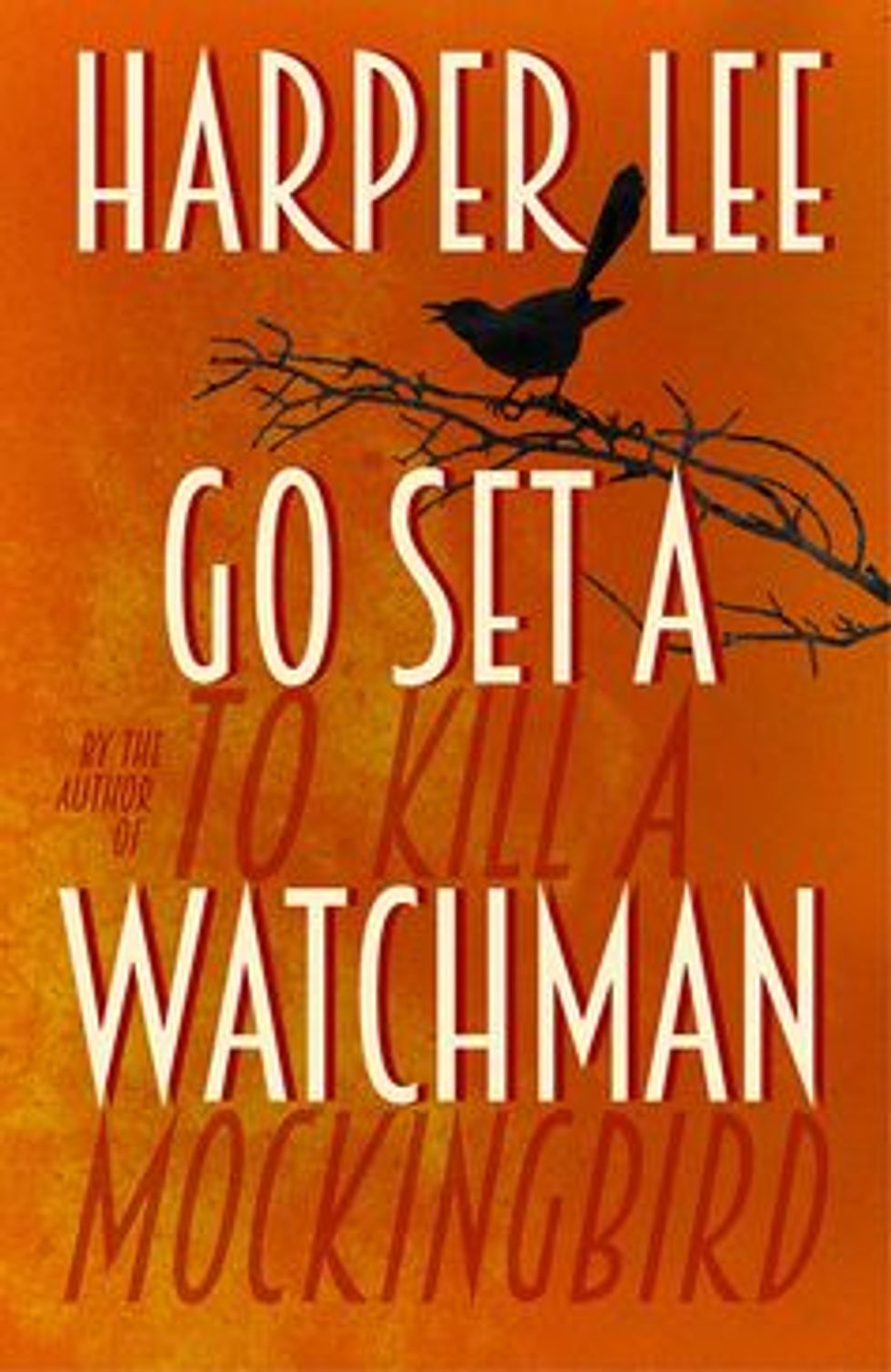
Go Set A Watchman (2015) cover, Random House, Australia.
Image courtesy of Random House
The novel, though, is not a sequel, and in fact is the first iteration of the classic story of Scout, her brother Jem and their father Atticus. Back in 1957, Lee’s agent and friend Maurice Crain was impressed with the Southern Gothic-infused story of Maycomb County, but suggested revising Go Set a Watchman from the adult Scout’s voice reflecting on her childhood, and rewrite the novel with the adult Atticus as the focus.
The resulting novel, Atticus, was completed and submitted for appraisal. Crain and his wife Annie Laurie Williams, also an agent, encouraged the novice writer to re-tell the story again, this time from the child’s perspective. The result was To Kill a Mockingbird, where the six-year-old Scout – who grows up to be the adult Jean-Louise – is our guide in a coming of age story that tracks through summers with brother Jem and friend Dill, and the winters at school in the Deep South of the United States, sometime after the Crash.
The process of writing To Kill A Mockingbird took Lee the better part of seven years to complete, and the resulting novel has been an established part of the American canon ever since.
To say the expectation on Go Set a Watchman is enormous is an understatement, but the interest in Lee’s work has not wavered over the years. Harper Collins agreement to release Go Set a Watchman unedited is testament to this, but the quality of To Kill A Mockingbird speaks to an underlying faith in Lee’s abilities as a writer.
This faith is borne out immediately from the opening lines of Go Set a Watchman:
Since Atlanta, she had looked out the dining-car window with a delight almost physical. Over her breakfast coffee, she watched the last of Georgia’s hills recede and the red earth appear, and with it tin-roofed houses set in the middle of swept yards, and in the yards the inevitable verbena grew, surrounded by whitewashed tires. She grinned when she saw her first TV antenna atop an unpainted Negro house; as they multiplied, her joy rose.
They have a familiar and comforting cadence, like the voice of a loved aunt after a long absence. The lyrical qualities of To Kill A Mockingbird are evident in the opening description, and bring us back to familiar territory, albeit from the viewpoint of the adult we may have hoped Scout would become.
That Jean-Louise, the adult narrator, existed before Scout told us To Kill a Mockingbird seems immaterial, with distinct echoes of Scout’s fierce independence and unique perspective on life. There’s a recognisable sense of child-like wonder in Jean-Louise’s description of her train ride home to Maycomb; it’s the voice of the truly glad to be alive, looking upon the world with much the same inquisitiveness Scout possessed in To Kill A Mockingbird.
Yet the almost immediate reference to the name Jean-Louise reminds us that Scout – the child – isn’t telling this story.
This is the voice and attitude of a grown woman, reflecting on entirely adult concerns like marriage and adultery. Jean-Louise’s reflections demonstrate she has the wisdom of age, and they read like the thoughts of a deep and pragmatic thinker.
The grown-up Scout is, however, still rebellious and defying convention, self-possessed and assured, rejecting offers of help and marriage alike with a grim humour. Jean-Louise is a woman with a strong moral conscience, echoing the fierce sense of justice we were introduced to in To Kill A Mockingbird. The adult that Scout became seems at ease; settled within herself, and accepting of her eccentricities, even acknowledging their effect on others.
It’s like Lee needed to know and understand the adult before she could provide a realistic depiction of the child in To Kill A Mockingbird.
Jean-Louise’s voice is strong, direct and delivers pragmatic homilies, much in the vein of To Kill A Mockingbird, which begins with:
There was no hurry, for there was nowhere to go, nothing to buy and no money to buy it with, nothing to see outside the boundaries of Maycomb County.
Go Set A Watchman’s narrative voice brings us the maxim: “If you did not want much, there was plenty”. From this, one can deduce Go Set A Watchman may yet deliver the kind of deep parable that made To Kill A Mockingbird such a classic.
Lee’s ability with description is evident in the excerpt published today, with long sentences beautifully rendered and evoking a world long lost to history, but welcoming all the same. The evocative imagery pulls the reader back to the world of To Kill A Mockingbird, although in the first pages we are abruptly introduced to the death of a much-loved character.
A friend’s immediate reaction to reading the first chapter was to comment about her relief Atticus was still alive. Such is the connection with and enduring affection for these characters.
These moments of recognition feel like a long-lost friend reborn. Jean-Louise is a woman of her era; at once independent and confident. She provides a glimpse to a kind of feminism that Scout could not have known the word for. Jean-Louise is as flawed as any human, quite proud and strident in her opinion.
When she tells her prospective fiancée in the opening chapter “Go to hell then”, she provides a link between Scout and what we think we know of Lee, who was quoted as being “happy as hell” at the publication of Go Set A Watchman.
As well she should be. Where Lee faced much discussion and debate about the origins and authorship of To Kill A Mockingbird, Go Set A Watchman – we can expect – will provide us with an impressive glimpse into the development of a novel and a writer.
Comedian and actor Dennis Leary went on an epic tirade about accused serial rapist Bill Cosby in an interview with the Daily Beast.
Leary was promoting his new show Sex&Drugs&Rock&Roll when he veered into a rant about the once-beloved creator and star of The Cosby Show and the children's program Fat Albert and the Cosby Kids.
"(H)ow do you feel about all this Cosby insanity?" asked the Beast's Marlow Stern.
Leary replied that Richard Pryor is his favorite comedian, saying, "I think he was the most gifted comedian. He had all the tools: brilliant social satirist, brutally honest, and could become a deer in the woods physically onstage and be Muhammad Ali and John Wayne. He had all the tools."
Cosby, said Leary, was talented and trailblazing, but when it came to silencing his accusers, the comedy legend became a monster.
"Dude, at that point, you’re into Stalinesque territory there of wielding so much power and shutting people up. I think I can honestly say this: It’s going to be impossible for me to listen to a Bill Cosby bit again from any era. Fuck the show, the show’s dead. And fuck Jell-O. I’m never going to eat Jell-O again. No offense to the Jell-O people, but it just reminds me of him. Fuck, I don’t think I can listen to any of his classic routines because it would automatically bring me back to creepy page one," Leary said.
Watch the promotional trailer for Sex&Drugs&Rock&Roll, embedded below:
Jean Louise Finch – beloved heroine of one of the most beloved novels of the modern age – has, in just the first few pages of Harper Lee’s wildly anticipated second novel Go Set A Watchman, been kissed hard, batted away a marriage proposal and revealed that one of To Kill a Mockingbird’s major characters has “dropped dead” in their tracks.
Last seen as the tomboy nicknamed Scout in To Kill a Mockingbird, Jean Louise is now an adult. “She had turned from an overalled, fractious, gun-slinging creature into a reasonable facsimile of a human being … She still moved like a 13-year-old boy and abjured most feminine adornment … She was easy to look at and easy to be with most of the time, but she was in no sense of the word an easy person,” writes Lee as Go Set a Watchman opens. She is on her way back to her hometown of Maycomb from New York to see her father Atticus, the hero of Lee’s 1960 novel, now an ailing 72-year-old.
The contents of the novel, which was written in the 1950s and then laid aside when Lee was asked by her editor to focus instead on its flashbacks to childhood, have been both a fiercely guarded secret and a hotly contested mystery since its existence was first revealed in February: was it an early version of Mockingbird? Was it deemed unpublishable when it was written in the 1950s? How was it found and why did Lee decide to publish now, at the age of 89, after decades of shunning any form of attention or publicity?
The first chapter, published on Friday by the Guardian in advance of the novel’s release at midnight on 14 July in bookshops around the world, reveals a witty, dry voice immediately recognisable as that of the To Kill a Mockingbird author. Jean Louise is shown to be grappling with two things as she comes home. Atticus, an almost godlike figure to the Scout of Mockingbird, is now in constant pain. “She was too old to rail against the inequity of it, but too young to accept her father’s crippling disease without putting up some kind of fight … She wondered how she would behave when her time came to hurt day in and day out.”
She is also pondering whether or not she should marry a childhood friend of her brother’s, who muses ruefully that “most women, before they’ve got ’em, present to their men smiling, agreeing faces. They hide their thoughts. You now, when you’re feeling hateful, honey, you are hateful.”
Lee’s literary agent Andrew Nurnberg, who was contacted last autumn about the manuscript’s existence, said that when he first read it after flying to Lee’s hometown of Monroeville, “my heart almost leapt out of my throat”. It had been discovered by her lawyer Tonja Carter in what Lee’s publisher described as “a secure location where it had been affixed to an original typescript” of Mockingbird.
“You just pick it up, and you say, ‘oh my goodness, this is Nelle, here she is’. And of course it is so hilarious,” said Nurnberg. According to Lee’s publisher she was clear she wanted the novel published exactly as it was written, so it has only had a light copy edit. “What is so fine about this book is that it isn’t polished by any editor, but it absolutely comes from the heart,” said Nurnberg.
As to how its depiction of racial issues would appear half a century after it was written, Nurmberg said: “It is dealing with a much more complicated issue, namely adult views of segregation in those days. It’s too easy for a child to see something either as good or as bad, but they don’t have those conflicts we grownups have, where we can see the grey areas.”
There have been persistent questions around the discovery of the novel: the New York Times suggested last weekend that the manuscript could have been discovered in 2011, with Carter aware of its existence at the time; there has been an investigation by the state of Alabama into allegations ( since declared unfounded ) that 89-year-old Lee was a victim of “elder abuse” over the novel’s publication. Nurnberg addressed these questions, saying: “The wonderful thing is that once this book is published, I very much hope all these naysayers are just going to disappear into the woodwork.”
Watchman, he reiterated, was always intended to be published. He has seen correspondence, he said, which shows “the plan was, from early on, having submitted Watchman … to produce three books” – Mockingbird, then a short connecting novel, then Watchman.
He quoted a letter from Lee’s agent at the time, in which the latter writes of Watchman, “Well, honey, you done got yoself a publisher”, the New York agent turning to typical Alabamese to inform his client of the deal.
Nurnberg also defended Carter, who, he said, had been pilloried over her role. “She is a woman who is valiantly protecting her charge, whom she has been with for 25, 30 years,” he said. “She’s completely devoted, she goes [to Lee’s assisted-living home in Monroeville] twice a day and has been for years to see her … She’s not a sneaky schemer of any kind … When I got that call, she really was shocked that she’d found [the manuscript] … She had never seen it.”
Nurnberg saw Lee last week, spending time with her before she was presented with the first copies of Watchman by her publishers. “She’s very deaf and you have to repeat things sometimes thrice or four times. She was in a good mood. She knew she was going to see these copies and was getting keen to see this book out there, finally,” he said. “When I told her how many copies they were printing [2m for the first US print run] she was completely shocked, because this is a book she had been advised to put on the back burner … I think she remembers so well the editor saying, ‘hang on, let’s do something else’, and that will have had, I think, a major impression on her life and her view of this specific book.”
Filmmaker and author Mary McDonagh Murphy also saw Lee last week, filming her as she received copies of the book, as part of her updated documentary Hey Boo , released in the US on Friday.
“By her friends’ reckoning [including her old friend and benefactor Joy Brown, who has seen Lee “many times” since she decided to publish] she’s absolutely delighted [about publication]. And this is what her lawyer says, and this is what her agent says, and this is what her statements say,” said Murphy. “Last week she was grateful. They gave her the books, and she said thank you. It seems she’s ready for it to be published.”
Murphy added that “certainly questions have been raised [about Lee’s decision to publish], but without asking Harper Lee directly and without Lee answering directly, it’s not easy to get to the bottom of things. But the people around her, and her friends, and her written statements, all attest to her intention to publish and her happiness about it.”
Having read the novel, Murphy said “it’s amazing to be able to see Scout at 26, and Atticus at 72, and as a journalist who’s been chronicling this for a while, it’s also an incredible experience to see what came first, to read exactly what was in Harper Lee’s mind when she began to write To Kill a Mockingbird … It’s delightful to hear her voice again.”
Lee herself has described the novel in a statement as “a pretty decent effort”.
Readers in the UK can buy the Guardian newspaper on Saturday for a 16-page souvenir Harper Lee supplement, free inside Weekend magazine. Featuring the whole first chapter of Go Set a Watchman, plus Oprah Winfrey on lunch with Harper Lee, actress Mary Badham on playing Scout, and more
A Canadian woman at the center of sexual assault allegations against comedian Bill Cosby accused him on Wednesday of violating a confidentiality agreement in their 2005 lawsuit, and asked a court to make public his entire testimony.
Andrea Constand, a former Temple University employee, filed court papers in Pennsylvania district court, also accusing Cosby and his advisers of manipulating the media through interviews and statements about the slew of sex assault allegations against him.
The lawsuit was filed two days after a Pennsylvania judge unsealed testimony in Constand's 2005 civil lawsuit against Cosby, in which the actor said he had obtained Quaaludes with the intent of giving the sedatives to young women in order to have sex with them.
The case was settled in 2006 for an undisclosed sum and both Cosby and Constand signed confidentiality agreements. In the past year some 40 other women have come forward accusing the star of TV comedy series "The Cosby Show" of drugging and sexually assaulting them in incidents dating back decades.
Constand said in Wednesday's court filing that Cosby was questioned about other sexual allegations at the time and that the women involved had a right to hear what he said about them then and "a right to determine what if anything can be used as evidence in their respective cases."
Constand, a former basketball player from Toronto, asked the court to have Cosby's "entire deposition and settlement agreement released to the public."
She said that while she has remained silent, "Cosby himself has given a rather incoherent interview and used members of his family and others as surrogates to speak for him."
Cosby has never been criminally charged, and most of the allegations exceed the statute of limitations. His attorneys have consistently denied the accusations. They could not immediately be reached for comment on Wednesday.
A spokeswoman for the Creative Artists Agency said on Wednesday the firm had parted ways with Cosby months ago, but she declined to say why.
Cosby has said little directly about the accusations, but he told the audience at one of his shows in Florida last year that he would not reply to "innuendos."
(Reporting by Jill Serjeant; Additional reporting by Curtis Skinner in San Francisco; Editing by Eric Walsh)
Bill Cosby's 2005 testimony that he gave Quaaludes to at least one woman he had sex with hasn't swayed Whoopi Goldberg's opinion of him. "The View" host told her audience on Tuesday that Mr. Cosby, 77, "has not been proven a rapist," in a court of law. "Save your texts, save your nasty comments, I don't…
While Fox News has been rallying behind Donald Trump, Fox's The Simpsons was not as generous, releasing a short skit online getting inside the Republican presidential candidate's head -- or rather, his scalp.
"Trumptastic Adventure" opens with Homer being recruited as one of Trump's campaign extras with the promise of $50 for his services.
Unfortunately for him, he gets too close for comfort to Trump's famous hair, only for it to end up showing him more about the candidate than anyone has gotten to see.
"It's so wispy -- it's a gravity-defying combover," Homer muses. "I can't believe that this was once on his ass."
The short clip came amid more good news for the show's fans. As Entertainment Weekly reported, Harry Shearer -- the voice of Mr. Burns, Ned Flanders and many other characters -- has agreed to rejoin the show by signing a four-year contract.
Watch Homer get swept up in Trump's campaign, as posted online, below.
A few summers ago, my friend Saul and I formed a covers band with several of our friends that would sing Manson Family songs onstage a couple of times. The first time we did it, we unwittingly joined the cottage industry of people who imitate or portray the love and terror cult . Even though Manson has appeared as a character in everything from B-movie exploitation films – there’s a whole Manson-inspired subgenre – to the works of National Book Award winners, via an opera , a German musical and a novelization of Columbo , I’m often amazed at the running for best Manson Family impersonators – not only how insurmountable the Fat White Manson Family ’s lead appears to be, but how the competition can be so weak.
Enter NBC. New crime drama Aquarius joins the imitation game this week like a uniformed cop at a hip happening. David Duchovny plays a square-faced detective whose missing-persons investigation leads to Charles Manson (a straw ascot-wearing Gethin Anthony), who somehow manages to lure young women to join his communal ranch with peaches like, “I pulled her out of the womb of ignorance and into the light of now”. It isn’t glorifying Manson to observe that the Most Dangerous Man Alive must have had better lines than that. In episode one, when Anthony fluffs the song Look At Your Game, Girl (as covered by Guns N Roses and the Fat White Manson Family), it’s clear this show’s as good at portraying Manson as Manson is at presenting himself to a parole board.
If people know anything about the Manson case, it will most likely come from state prosecutor Vincent Bugliosi’s best-selling Helter Skelter . Despite taking a criminal justice perspective – Bugliosi’s no stoned slacker and has no time for them either – it’s the most complete account of what actually happened in the Tate/LaBianca houses when members of the Manson Family butchered seven people, supposedly on Manson’s orders, on two consecutive nights, including the pregnant actress Sharon Tate. The 1972 documentary Manson, based on the book, is worth watching for the original Super 8 footage of Spahn Ranch, the girls singing Look At Your Love outside the courthouse and Manson’s soaring oration. In these key documents, Bugliosi famously attested – and this was presented to the court as a motive – that Manson believed he had heard hidden messages in the Beatles’ White Album, telling him that there would be a global race war in which the blacks would win, and his Family would eventually rule the world. “I may have implied on several occasions to several different people that I may have been Jesus Christ, but I haven’t decided yet what I am or who I am,” says Manson in Bugliosi’s book.
Manson was in fact a 13-year-old runaway who was sold by his mother for a bottle of vodka , before being beaten, buggered and learning to rape in sadistic correctional facilities where he spent a lot of his youth. This makes the core of the other essential book in the canon, Manson In His Own Words, an “autobiography” co-authored in the 80s by Nuel Emmons during prison visits. Manson believed that after spending most of his life behind bars, he was so unfit for life outside jail that before his release in 1967, he asked to stay in prison but his request was refused. He got out and became a pimp on Hollywood Boulevard before moving to San Francisco, where he started to sleep with the mostly suburban young women from good homes who would become the Manson Family. When he describes what happened at Sharon Tate’s house, the reader should be aware that they’re probably being conned by a master of the art.
There is no attempt at psychological or even biographical realism in the 1976 TV dramatization Helter Skelter (also based on Bugliosi’s book), which offers nothing to people who’ve seen the documentary with original footage. It’s the same stuff hammed up, and with Manson speeches that no actor has ever delivered with as much menace as Manson himself. Surprisingly the 2004 remake, also called Helter Skelter, boasts the only passable depiction of Charles Manson by an actor, Jeremy Davies. He masters the eyes, the voice and the paranoid preacher’s charisma. In campfire light he could be mistaken for the real thing, but the CSI-style helicopter music defiles it.
These TV and film adaptations are all a bit “hippie wigs”, then, as Danny in the cult British film Withnail & I describes the summer of love’s death. They imitate the aesthetics but not the spirit. Although you start talking about the spirit in pubs around London and people look wary. You have to have your arguments ready about Phil Spector being a convicted murderer too , and a good folk band that looks the part and knows how to play Ra-Hide Away.
Thomas Pynchon lampoons the idea of Manson as shorthand for the failure of alternative culture in his 2011 novel Inherent Vice. While Paul Thomas Anderson’s film cuts all but the author’s best riffs on Manson hysteria – a policeman declaring that all groups of three or more are a suspected cult – the novel has a Manson Family gag in pretty much every chapter. It’s also very good at describing, more than anything else in the canon, how you notice that strange moment when a scene starts to go sour; when older, more serious-looking dudes with an “unwillingness to blur out” start appearing at gatherings of carefree youths: “If everything in this dream of pre-revolution was in fact doomed to end and the faithless money-driven world to assert control over all the lives it felt entitled to touch, fondle, and molest, it would be agents like these, dutiful and silent, out doing the shitwork, who’d make it happen.”
In The White Album, Joan Didion describes the scene starting to go bad and hints at how she wound up in a psychiatric hospital. “In this light all connections were equally meaningful, and equally senseless.” It makes you wonder if Didion hadn’t broken down a year early, would she have joined Manson on the ranch? She describes how later, she shopped for the right kind of dress for Linda Kasabian, the Manson Family informant turned state witness, under the instructions of the tale’s ever-present director Bugliosi, who has been a master – perhaps even surpassing Manson – at controlling the narrative.
Manson’s prosecutor admitted recently that Charlie has “more supporters and sympathizers now than he ever did”. It doesn’t flatter Bugliosi to hold him partly responsible, seeing as he’s still giving interviews and selling books, albeit one-sided and, like the adaptations they sprung, unwilling to consider that Manson’s history of abuse and imprisonment may be as important to the horrors as the song White Rabbit, new-age spiritualism or bell-bottom flares.
Unlike the prosecutor who seems sure of the meaning he has impressed on the case with the blunt instruments of the law, Didion admits that even though she shares a godchild with the murdered Tate, writing about it “has not yet helped me to see what it means”. For me, it’s still all about The Family Jams album, the songs Look At Your Game, Girl and Garbage Dump – where trash like Aquarius belongs.
Reddit Chief Executive Ellen Pao on Monday issued an apology to users of the popular social news platform over the way the company handled the dismissal of a well-liked employee last week, a move that drew widespread outrage from users.
The site's former Director of Talent, Victoria Taylor, was dismissed from the company on Thursday, prompting moderators to shut down in protest roughly 300 discussion sections, also known as subreddits.
Pao apologized for not communicating well enough with the site's users on big changes like the dismissal, as well as for a history of broken promises made to the community.
"We screwed up. Not just on July 2, but also over the past several years," Pao said in the posting on the website, adding that the privately owned company was working to improve tools used by moderators.
San Francisco-based Reddit launched in 2005 and has grown to become one of the most highly viewed sites on the Internet, drawing some 160 million unique users a month.
Among the more popular sections of the site was the "Ask Me Anything" subreddit, which Taylor managed. AMAs, as they are called, involve celebrities, politicians or other noteworthy people answering user-submitted questions real-time on the site.
Community manager Kristine Fasnacht would step into that role as well as the new position of Moderator Advocate, to serve as a liaison between volunteer discussion section moderators and Reddit employees, Reddit spokeswoman Heather Wilson said.
Wilson declined to discuss why Taylor was dismissed, saying the company does not comment on individual employee matters. She said virtually all of the closed subreddits were back online as of Monday.
On Thursday Taylor tweeted: "Thank you to everyone for their good wishes and support. Love you guys."
The New York Times reported that Pao has faced a series of challenges since taking over the company in 2014, including the recent introduction of an anti-harassment policy that some users criticized as stifling the site's environment of free speech.
An online petition calling for her resignation has so far received more than 190,000 signatures, the Times reported.
(Reporting by Curtis Skinner; Editing by Cynthia Johnston and Eric Walsh)
Orange is the New Black has returned for a third season. If you haven’t watched it yet, it’s time to sit up and take note: the Netflix programme looks set to become a classic of feminist television.
The show is based on the memoirs of Piper Kerman who, after serving 13 months for drug trafficking and money laundering, became an activist. She campaigns for the rights of the 200,000 female prisoners, mostly women of colour, currently incarcerated in the United States. Fusing Kerman’s activist politics with compulsive comedy-drama, the show attracted critical acclaim and a huge feminist following for the challenge it mounts to dominant media representations of women.
The reason the show is able to buck industry trends has to do with the circumstances of its production. Unlike most network series, Orange is the New Black was produced by Lionsgate Television and Netflix as a straight-to-internet release. All 13 episodes of its first series were released simultaneously. This means it is not dependent on the pilot system, whereby shows that take longer to “grow” on audiences risk being cancelled due to low viewing figures.
Taylor Schilling as a frustrated Piper.
Netflix
Box set binges
This taps into the culture of “binge watching”, where audiences consume entire box sets in a single, intense sitting. This intensive consumption makes it possible to experiment with different forms of storytelling. Stories that are driven by relationship development, rather than the suspense that characterises traditional narrative forms can be told, and keep audiences coming back for more. This means there is a potential for different kinds of stories, ones that can perhaps challenge the normative and ideological content of more traditional media.
That said, the term “binge watching” is problematic: Orange is the New Black creator Jenji Kohan has expressed distaste for the term and indeed for the practice itself. Instead, she suggests the metaphor of bathing as a way of thinking about straight-to-web release and changes our sense of time:
Audiences immerse themselves … they bathe in it, they live with these characters for hours and hours at a time — and they have a different experience.
Pennsatucky (Taryn Manning) and Big Boo (Lea DeLaria).
Netflix
I like this bathing metaphor much better, because to immerse oneself in Orange is the New Black is to bask in something very different from mainstream TV’s portrayal of women and LGBTQ people. From its rousing Regina Spektor theme tune onwards, it doesn’t look or sound much like anything else on US television. In a world saturated with banal, airbrushed images of women, this is a treat.
Better than Breaking Bad?
This is the show, after all, that made Laverne Cox a household name as much for her sophisticated intersectional politics as for her laugh-out-loud beauty. A trans woman of colour and the first trans actor to be nominated for an Emmy, Cox has consistently questioned the popular notion that visibility in itself is enough to bring about social change, instead using her position to publicise LGBTQ activism and to call attention to issues of inequality and injustice. Orange is the New Black makes its feminist points in a slyly subversive way: its radical themes combine with compelling storytelling as we are plunged, cellmate-like, into intimacy with the characters.
Sophia (Laverne Cox).
Netflix
There’s tragic, deluded Morello, happily planning her wedding to a fiancé who – for reasons we gradually learn, to heartbreaking effect – never visits her. She reveals romantic love to be the lonely, narcissistic fantasy feminists have always argued it can be.
Bingeing on the show shifts our perspective on characters. Initially encouraged to laugh at “Crazy Eyes”, who seems like the caricature of a predatory prison dyke in search of a “wife”, we quickly come to empathise with her in a way that forces us to reflect uncomfortably on our own collusion in reductive stereotypes. And although Pennsatucky, played with villainous relish by Taryn Manning, comes across as hateful, deluded and pitiful, she nevertheless tells us more about the effects of crack on poor populations than five seasons of Breaking Bad.
While the show does not flinch from the violence and deprivation of prison life, it also has life-affirming things to say about female friendship: the beautifully written and performed banter of Poussey and Taystee, for instance, is a bond deeper than any romance.
Poussey (Samira Wiley) confronting Crazy Eyes (Uzo Aduba) as Taystee (Danielle Brooks) looks on.
Netflix
Doing time
But if the show changes the audience’s relationship to time in the way we watch television, it is its representation of doing time that resonates with feminist media history. Historically, queer and feminist imaginings have excelled in using prison as a starting point for queer and feminists imaginings.
From the sleazy women-in-prison paperbacks published by Naiad Press in the 50s and 60s, to 80s and 90s dramas like Prisoner: Cell Block H, Women in Prison, and especially Maureen Chadwick and Ann McManus’ gritty British soap Bad Girls, prison has been a rich site of feminist pulp, fusing serious messages about the lives of marginalised women with pure melodrama.
Adi Kuntsman has written that prison is not just about loss of freedom but “a form of social death … exercised through the denial of time, and future”. We need popular culture to disrupt this and reclaim marginalised people’s experience from the erasure that prison imposes. Ultimately, Orange is the New Black is great feminist television because it brings these culturally invisible women to unignorable, vivid life.
Who knew that professional wrestlers could be so sensitive? And that their antics could have potentially grave First Amendment implications?
Hulk Hogan’s lawsuit against Gawker Media over the publication of the former professional wrestler’s sex tape is the latest case that pits a celebrity’s privacy rights against the Bill of Rights.
A ruling against Gawker could not only destroy the media empire built on trafficking in gossip but could mean the First Amendment will be less likely to protect journalists, even in situations in which the subject matter is more clearly a matter of legitimate public interest.
Before we get to the guts of the Hogan case, whose trial had been set to begin this week but has been postponed, let’s consider a similar one – also involving a colorful wrestler – that could hint at where the jury might be headed.
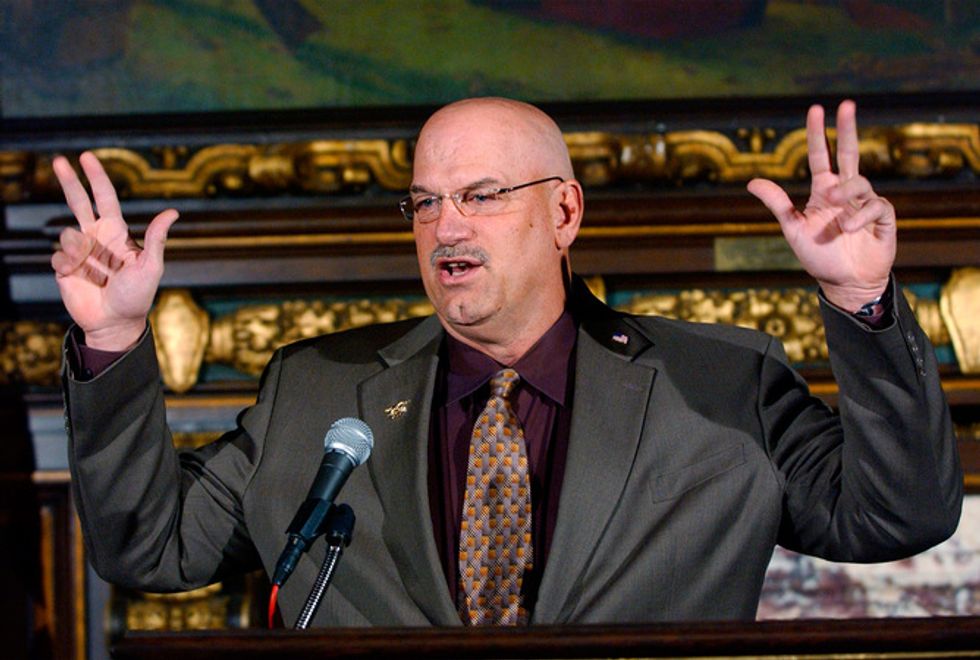
Jesse Ventura, during his brief stint as governor of Minnesota.
Reuters
Body v SEAL
In July 2014, Jesse “The Body” Ventura, wrestling Hall of Fame inductee, former governor of Minnesota and professional conspiracy theorist, spent three weeks convincing eight jurors in federal court in Minneapolis that his reputation was damaged by former Navy SEAL Chris Kyle’s account of a bar fight in his book, American Sniper.
Kyle described how he punched a man identified as “Scruff Face” after he said he “hated America,” that Navy SEALS “were killing men and women and children and murdering” and that they “deserved to lose a few” in the war in Iraq.
Ventura said the encounter never happened and that Kyle’s book had destroyed his reputation in the SEAL community and his career as a television personality. He told the Minneapolis Star Tribune that if he lost his libel case, he would be so distraught that he would move to Mexico.
Ventura sought millions of dollars in damages, not only for defamation, but also for Kyle’s use of his name and image to promote the book. Although Kyle never identified “Scruff Face” in the book itself, he did tell interviewers that he was referring to Ventura.
Because Kyle was killed in a shooting in Texas about a year after Ventura filed his suit in 2012, the evidence about what really happened in the bar came from contradictory testimony by Ventura himself and a parade of witnesses produced by the attorneys for both sides.
The jury deliberated for six days and appeared to be deadlocked. The lawyers agreed to accept an 8–2 verdict. And then the jury awarded Ventura US$500,000 in damages for the defamation claim and $1.3 million for the unjust enrichment claim. The case is currently on appeal before the US Court of Appeals for the Eighth Circuit. (Full disclosure: I am one of the signatories to a friend-of-the-court brief supporting the Kyle estate in its appeal.)
Hulk Hogan’s sex tape
Fast-forward to a year later and another wounded wrestler is poised to try to vindicate his honor in a court of law. But this time, the issue is privacy, not reputation.
Hulk Hogan, who once wrestled Ventura, is scheduled to go to trial on July 6 in St Petersburg, Florida, seeking damages of $100 million from Gawker, operator of the online blog and celebrity gossip network. Gawker posted a videotape of Hogan having sex with Heather Cole Clem, then-wife of a satellite radio personality who uses the moniker Bubba the Love Sponge.
Hogan says the tape was made without his knowledge or consent. He originally sued Gawker in federal court, but, after a variety of procedural maneuvers, the case against the media company ended up in state Circuit Court, where Hogan’s related suits against Heather Cole and Bubba Clem eventually settled.
Hogan claims that Gawker invaded his privacy by posting the videotape, revealing offensive private facts about him, causing him emotional distress and violating his right to control the use of his name and image. Earlier this year, a state appeals court rejected his attempt to force Gawker to remove the video from its website, finding that it would be an unconstitutional prior restraint.
However, the trial judge announced on July 1 that only the jurors – not the media or the public – will be able to watch the video when it is shown in the courtroom at trial. Gawker’s lawyers have argued that this action could prejudice the jury as it considers whether or not the public has a legitimate interest in seeing the tape.
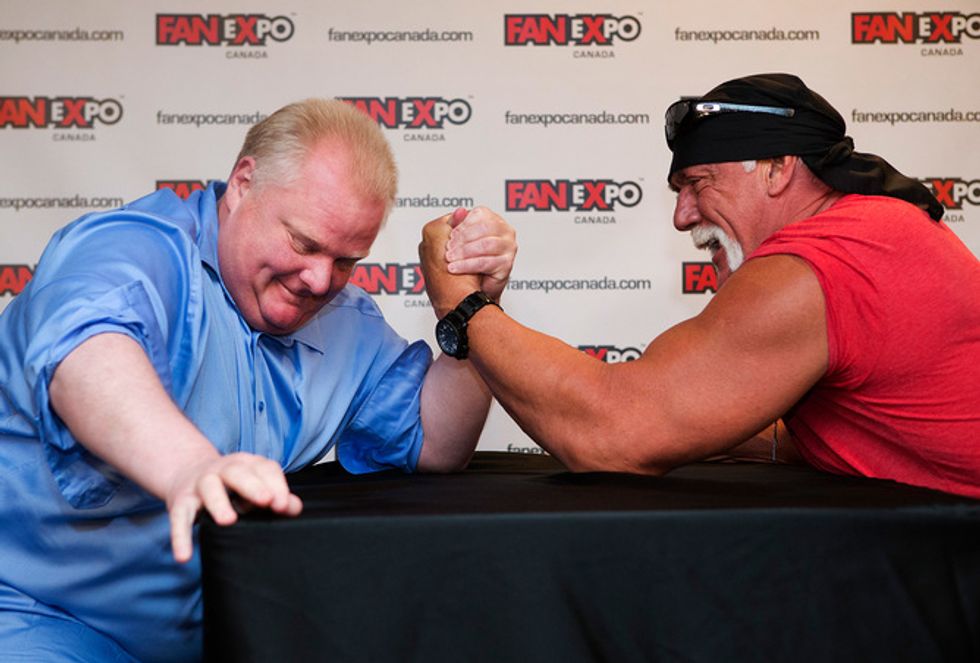
Toronto Mayor Rob Ford was another target in Gawker’s sights.
Reuters
Legitimate public interest?
Gawker generally revels in controversy and seems to especially relish acquiring contraband videotapes of celebrities misbehaving.
For example, Gawker reporters made several attempts in 2013 and 2014 to purchase recordings allegedly showing Toronto mayor Rob Ford smoking crack cocaine.
But in these instances, as with the Hogan tape, no one has accused Gawker of making or inducing someone else to make the illicit recordings. Under US Supreme Court precedent, if they did nothing illegal to obtain the tapes, publication would be protected by the First Amendment, provided the contents are a matter of public interest and concern.
But what does that mean? It seems that the Hogan tape certainly interests the public. The New York Times reported that it has generated more than five million clicks for Gawker’s site. But are the contents really a matter of legitimate public interest?
Hogan says they are not, even though, as the appeals court in Florida observed, he voluntarily chose to discuss the tape at length with TMZ and on The Howard Stern Show.
A celebrity’s right to privacy
Hogan’s case isn’t the first to involve publication of stolen or surreptitious recordings of celebrities, including Paris Hilton, Kim Kardashian and Jennifer Lopez, having sex with their spouses or significant others. But most of their privacy lawsuits were either settled, like Hogan’s suits against everyone but Gawker, or were dismissed by a judge.
In 1997, former Baywatch star Pamela Anderson and her husband lost their bid to sue Penthouse magazine for publishing sexually explicit photos. A federal court in California concluded that the couple had already voluntarily disclosed intimate information about themselves to the media, and that the photos were “newsworthy” and therefore protected by the First Amendment.
But courts have also recognized that celebrities do not necessarily give up all their rights to privacy simply because they have chosen to reveal some aspects of their lives to the public. As a federal judge court wrote in a case involving yet another sex tape of Pamela Anderson (this time with singer Bret Michaels), “even people who voluntarily enter the public sphere retain a privacy interest in the most intimate details of their lives.”
Will Hogan – who operates businesses in the nearby Tampa Bay area – be able to convince a St Petersburg jury that Gawker has exploited his sex life for crass financial gain? Or will the jurors conclude that Hogan couldn’t have any legitimate right to hide the amorous adventures he bragged about elsewhere and that are intensely interesting to at least some of the public?
Will they agree with Gawker founder and defendant Nick Denton, who told the Daily Beast, “In the Internet Age, you might once in a while have something come out if you’re going to be that indiscriminate in your pursuit of celebrity perks”?
It will be interesting to find out. And given the colorful personalities involved in this case, we can count on lots of media coverage, even though trial judge Pamela Campbell has declared that the trial “is not going to be a carnival.”
Perhaps, but I wouldn’t bet on it. Even though Judge Campbell has promised the parties “judicial serenity and calm” in the courtroom, she can’t really control how the media reports the case outside it.
Moreover, a flamboyant and charismatic celebrity can have a powerful effect on jurors. They may rally to protect a local hero from what they regard as the actions of an irresponsible press. They can do that by awarding him millions of dollars in damages.
What does it mean for Gawker?
Although in the Daily Beast interview, Denton seemed confident about Gawker’s prospects for victory, predicting that “there’s a one in 10 chance of disaster,” the reality is that juries in state courts are notorious for handing down big libel judgments. This could threaten the company’s very survival.
Gawker Media is reportedly worth about $200 million. Hogan is seeking an award for half that. Even though statistically, massive jury awards are often reduced or set aside by an appeals court, Florida law will require Gawker to post a bond for the full amount of damages, plus interest, pending appellate review, which could take years.
In the meantime, Gawker would have to find some financial resources to keep afloat.
What it means for the rest of news
This wouldn’t be the first time a news organization was driven to the brink of destruction by a huge damages award.
In 1982, the Alton (Illinois) Telegraph
declared bankruptcy after it lost its appeal of a $9.2 million judgment. That ruling had been based on a memorandum its reporters sent to prosecutors about a local contractor’s alleged ties with organized crime – a story that never even appeared in the newspaper.
In this case, of course, Hogan isn’t suing for libel. He couldn’t, because there is no dispute that the tape is genuine. Truthful speech, no matter how offensive, cannot be the basis for a defamation suit.
Here Hogan is arguing that intimate facts about his private life were made public in a way that would be highly offensive to a reasonable person.
Jurors are likely to identify with the plaintiff, on a very visceral level. They wouldn’t want a tape of themselves to be posted online, and they could agree that Hogan shouldn’t have to put up with it, either.
A ruling for Hogan could send a strong message that online sites should be very wary of posting videos of celebrities misbehaving, even if they think the content is newsworthy.
So, although he will appear in court using his real name (Terry Bollea), when the guy some call the greatest wrestler of all time strides into court wearing his signature bandanna, there is a chance he might take down Gawker – and maybe part of the First Amendment as well.
Stranger things have happened. Just ask Jesse Ventura.
A track on the singer’s new album has caused outrage – and been watched 12 million times
“Language. Nudity. Violence,” warns the first frame of the latest video from pop provocateur Rihanna. What follows certainly lives up to the billing.
Depending on which commentator or social media spat you choose, the video – viewed 12 million times since its release – is either an empowering challenge to music industry stereotypes or a racist and gory piece of misogyny.
Bitch Better Have My Money (BBHMM) is a slick seven-minute film, co-directed by one of the few black women in America who has managed to get right to the top of a male- dominated pop industry.
The plot is simple – an accountant has defrauded the singer out of money, so she kidnaps his wife, a spoiled, wealthy white woman complete with chi-chi dog and diamonds. With two friends, she bundles her into a trunk, strips her, swings her upside down from a rope, knocks her out with a bottle, then lets her almost drown in a swimming pool.
When that doesn’t get her the money, Rihanna finds the accountant, straps him to a chair, shows a collection of knives presumably used to finish him off, and then is shown blood-covered and naked in a trunk of money.
A show of sisterhood it isn’t, although the homage to Hollywood’s girl power blockbuster Thelma and Louise, with Rihanna and her co-conspirators riding off in a 1960s blue convertible, suggest the artist might think differently.
The song, the second single from the singer’s eighth album, is based on Rihanna’s grievance against an accountant, Peter Gounis, whom she filed a lawsuit against in 2012, claiming he gave her “unsound” financial advice that led to a loss of $9m in 2009 alone. She won a multimillion settlement.
Predictably, BBHMM ignited a furious debate. A headline on Refinery29 declared the video “Not Safe For Work or Feminists” while Twitter accused Rihanna of glorifying violence against women, and condemned the “kidnapped female” trope. Rolling Stone was attacked for praising the video and crediting the two minor male roles while not even giving a name to the actress who plays the main role.
Rachel Roberts, who has made several Vogue covers, said the offer of her part was “irresistible”. “The video was Rihanna’s concept,” Roberts said last week. “She co-directed it, so she personally cast me. Despite her out-there public image, she’s very professional and hands-on. The whole thing was an insane thrill ride. Helicopters, boats, gunfire, stunts, holding my breath underwater, a dozen locations, and a Pomeranian toy dog.” She praised Rihanna as “an undeniable talent”.
In the New Statesman, Helen Lewis was less gushing: “It was not very feminist – not even very hashtag feminist – of Rihanna to ‘torture that poor rich lady’. That is because it is not very feminist to torture women. Even if they are white. Even if they are rich. Even if you are a woman yourself. Sorry if this comes as a surprise.”
In an America seething over endemic racism, the presentation of a black woman exacting revenge on a white exploiter has been less controversial than the nudity. Vogue.com columnist Karley Sciortino said: “It’s good to normalise the female body. In so many music videos where you see nudity, it’s framed in these really specific ways: abstract female body parts just looking hot. When Rihanna’s naked she isn’t posing in a hyper-sexual way, she’s covered in blood and she’ll cut your dick off. She looks powerful, but it’s almost casual, normalised. It’s about showing a powerful representation of the female body, where women are in charge of the way that they’re being viewed.”
Rihanna’s co-directors, Leo Berne and Charles Brisgand, said her intention was clear. “From the beginning she was like, “I don’t care if it’s not aired on TV’,” Brisgand said. “She wanted something that people don’t expect from her.” The director said it was Rihanna’s idea to hang Roberts from her feet naked.
Rihanna, who has 22 million followers on Instagram, is one of the few whose appearance on a magazine cover will boost sales. Her past as a victim of domestic violence has brought her fans among young women who see a successful survivor. She certainly has the power to provoke – and she is using it.
Many are familiar with James McNeill Whistler’s portrait of his mother – officially titled Arrangement in Grey and Black, No. 1 – which is being exhibited this summer, starting July 4, at the Clark Art Institute in Williamstown, Massachusetts.
Given the picture’s iconic status as a symbol of motherhood, many also believe that they can guess the character, personality and life experiences of the quiet, seemingly frail, little woman sitting in that chair. You might opine that she led an isolated or sheltered life, or spent her days baking cookies.
But you’d be wrong. When researching my biography of her artist son, I became so fascinated by the part she played in his life and career – and so impressed by her resilience and intelligence – that I decided to write her biography, too. The more I’ve uncovered and read, the more I’ve discovered that Whistler’s mother led no ordinary life, and ended up shattering 19th-century established roles for American wives and mothers.
Womanhood
Anna Matilda (McNeill) Whistler (1804–1881) may have been a quiet, diminutive woman, but she was a mighty force in the lives of those around her.
She reared a renowned artist, an acclaimed physician, a prosperous businessman and a daughter who married into the English upper class.
A shrewd observer of the world, Anna encountered and interacted with an astonishing array of people from nearly every walk of life, whether it was American farmers and Russian peasants or Robert E Lee and Giuseppe Mazzini. She met with diplomats, businessmen, manufacturers, inventors, religious leaders, politicians, journalists, soldiers and, of course, artists.
Naturally, Anna was defined, to a large extent, by her times, and she did assume many of the societal roles prescribed for 19th-century, middle-class, American women.
She was pious and dutiful, with no higher ambition early in life than to marry the man she adored and maintain a well-ordered, economical Christian household, at once a refuge for her husband and a sanctuary for their children.
Anna certainly achieved those ends. As a steadfast wife and mother to eight children, three of them stepchildren, she initially met every expectation of the 19th century’s “cult of true womanhood,” the idea that women should strive for “piety, purity, domesticity and submissiveness.”
Born of two worlds
But there were complicated layers to her character and upbringing.
In a way, Anna was a daughter of the slave-holding South. She spent the first years of her life in North Carolina, where she was raised by a physician father and a beautiful, cultured mother. Both a plantation-owning uncle and Anna’s brother had children with black women. In the case of her uncle, this led to a widely publicized legal battle, in which family members, including Anna, challenged the terms of his will. He had bequeathed, it seems, the larger part of his enormous wealth to a black wife.
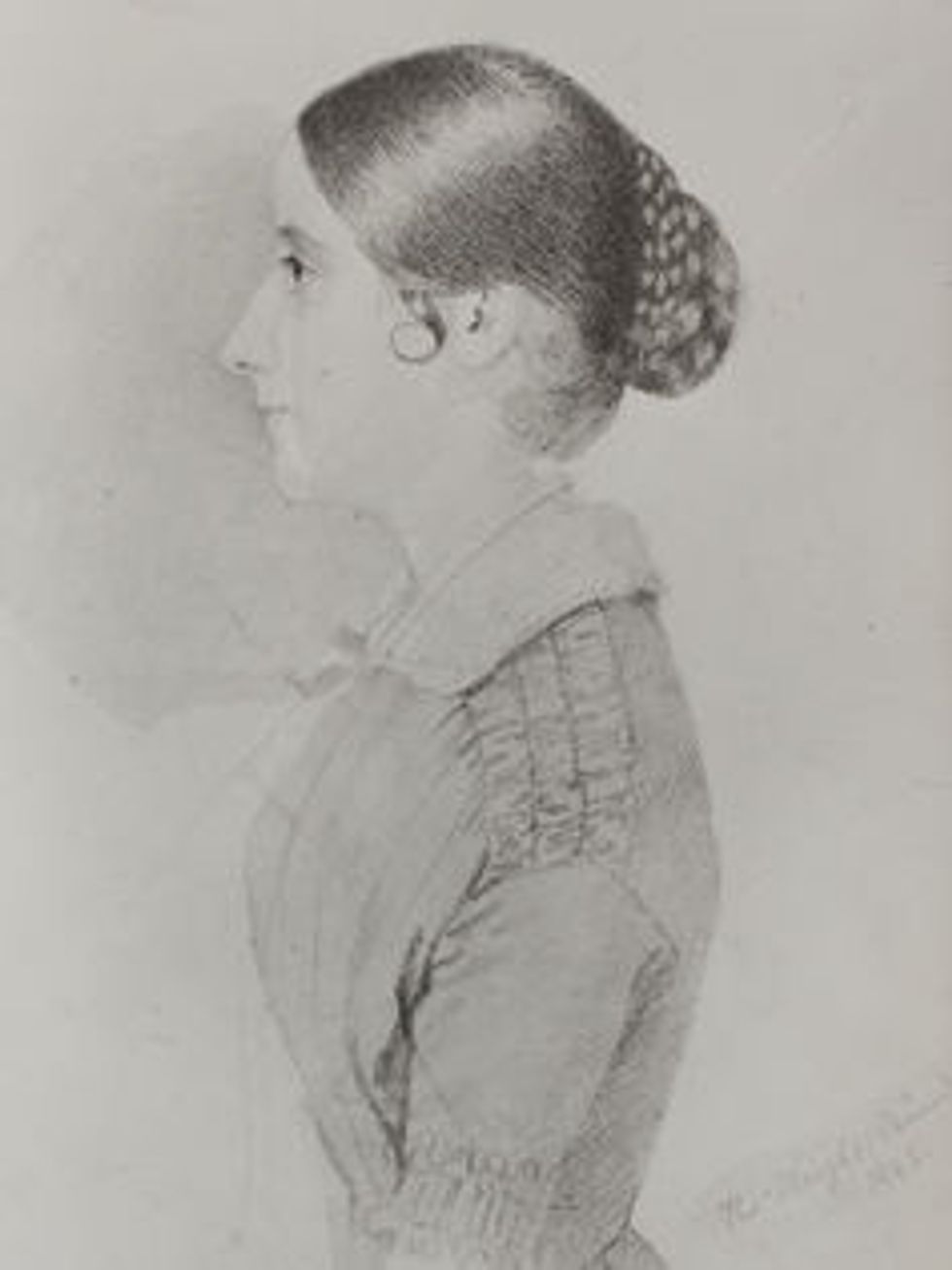
A portrait of Anna Whistler when she was roughly 20 years old.
The Whistler Collection, the University of Glasgow Special Collections.
However, Anna’s family moved to Brooklyn when she was 10, and it was in that prosperous northern village that she grew to maturity.
She completed the bulk of her formal education in Brooklyn and became more firmly grounded in the teaching of the Episcopal Church. Her city-hopping continued at 17 when, following the death of her father, Anna and her mother lived variously in New York, Baltimore and Georgetown. In her mid-20s, she spent more than a year in Great Britain, where she had two half-sisters. It was the first of 11 Atlantic crossings she made during her life.
By the time she married George Washington Whistler in 1831, her travels and several residences had not only exposed Anna to a variety of social and cultural environments, but they had also taught her perseverance, patience and independence – qualities she would come to depend on.
Naturally, she had her faults. She was keenly class-conscious, and she could be overly protective. Had her children not inherited her self-reliance, she might have smothered them. Even her strengths, especially her independence, could work against her.
As a sister-in-law complained, “Anna is so unshakable that sometimes I could shake her. And the way she will stand out even against people whose opinion mean the most to her. One can’t help admiring it but it seems so – well, so old!”
On the move
Thirteen years into her marriage, and after living in another four homes in three states, she packed up her family and moved to St Petersburg, Russia.
Her world-renowned engineer husband had been hired by Czar Nicholas I to build a railroad from St Petersburg to Moscow. Six years later, when her husband died of cholera, Anna returned to America to rear their two remaining adolescent children on her own.
From a position of relative wealth and status in Russia, she found herself almost impoverished; without her husband’s income, she was forced to depend on her modest savings. Other women might have retreated into a quiet, sedentary life, but that wasn’t in Anna’s nature.
By the 1850s, the lines between private and public lives, domestic and public spheres, were becoming blurred for middle-class women. The cult of true womanhood was giving way to a bolder, more visible, nascent modern woman.
Some women became public figures. Others, like Anna, exploited the same opportunities but chose to work behind the scenes. Being the widow of a famous and respected husband helped: it gave her an identity and credibility she would have otherwise lacked.
For instance, it allowed her to coax Robert E Lee, when he was superintendent at West Point, into giving her cadet son James a weekend pass. She later put her second son, William, through medical school and acted as unofficial business manager in America for James, who, upon being dismissed from West Point, had gone to Paris and London to become an artist. Anna promoted his work, sought commissions and acted as an adviser.
Then came the American Civil War, which presented Anna with a dilemma: on the one hand, she was a southern woman who still had relatives in the Confederate states. Further complicating matters, her youngest son William had married a southern cousin, and had enlisted as a surgeon in the Confederate army.
Yet Anna’s late husband had been a profoundly patriotic graduate of West Point who would have served the Union. So with failing eyesight and her children dispersed throughout the world, Anna slipped off to England, in a way absolving herself from having to pick a side.
In London, a masterpiece emerges
Quickly adapting to yet another upheaval, Anna directed her artist son’s London household, where she lived for most of the next 11 years. It was during this time that, in 1871, she sat for her famous portrait.
James Whistler’s sketch of the originally proposed pose for his Arrangement in Grey and Black, No. 2. Anna decided she wouldn’t be able to stand long enough in this pose.
The Whistler Collection, the University of Glasgow Special Collections.
Whistler had experienced one of his periodic bouts of self-doubt in the last half of the 1860s. Reconsidering the purpose of art, he experimented with new painting techniques, limiting his range of colors and spreading his paint more thinly and smoothly. He rejected the age-old assumption that a painting should tell a story or convey a moral lesson; beauty was all that mattered, he now said, art purely for art’s sake.
He shunned narrative titles for his paintings, describing them, instead, in musical terms or according to their dominant colors. The results were his unique series of nocturnes and his Arrangements in Grey and Black. The portrait of his mother was initially considered an unorthodox, even eccentric painting, but it went on to solidify James Whistler’s fame.
Anna Whistler passed away in 1881, although in one sense, Anna never really died.
Some would argue that Whistler’s Mother has become even better known than the artist himself. And it’s perhaps fitting that, like the painting’s globetrotting subject, the portrait continues to travel the world, hopping from state to state, from continent to continent.
Whistler’s Mother will be exhibited at the Clark Institute of Art in Williamstown, Massachusetts from July 4 to September 27.
NB A previous version of this article located the Clark Institute of Art in Worcester, MA: Clark University is in Worcester and the Clark Institute of Art in Williamstown.