Writing in The Guardian this Friday, Art Cullen says that President Trump's reelection chances are facing big hurdles in the Midwest, partly due to the fact that the "second quarter of 2020 was the worst in history."
" Trump started trade wars with China, Mexico and Canada that have flattened manufacturing up and down the Mississippi River," Cullen writes. "Corn prices are at their lowest level in a decade. Meatpacking workers across the midwest were ordered on to unsafe kill floors, shoulder to shoulder, sending fear shuddering through communities as the coronavirus rages. It is all deeply unsettling, and the polls reflect it. Here in Storm Lake, Iowa, the police chief took a knee with Black Lives Matter protesters in Chautauqua Park. This is for real. This is not 2016."
Where Trump once enjoyed endless support, things are looking testy. Trump's relationship with Mitch McConnell appears strained after the two couldn't finalize a coronavirus relief package before the Friday deadline -- all while the pandemic continues to rage out of control.
"Trump says the only way he can lose is through election fraud. In fact, it seems more likely that the only way he can win is through fraud," Cullen writes. "In April, Wisconsin Republicans tried to stop voters in a key Wisconsin election for a supreme court justice that was a proxy on Trump – and Trump lost, as stubborn cheeseheads stood in line for hours at great personal infection danger to vote. He desperately needs Wisconsin. But the paper mills are shutting down, dairy operators are drowning in a glut of corporate milk, and furious teachers are organizing like never before."
In contrast, according to Cullen, Biden has offered a steady rollout of plans designed to fix problems, along with a "heavy dose of decency and respect."
"That’s what people want to hear, not whining," writes Cullen.
Canadians are getting tired of seeing citizens from the disease-ridden United States illegally cross into their country.
In a dispatch for the New York Times, reporter Karen Schwartz, who has dual American and Canadian citizenship, describes how many Canadians are rushing to report "unwanted" American citizens they see sneaking into the Great White North to the Royal Canadian Mounted Police.
In fact, one of Schwartz's acquaintances warned her recently that "the Canadians are actually doing damage to vehicles with United States plates on them" -- and British Columbian Premier John Horgan recently had to chide his citizens to "be kind" to cars with American license plates after seeing multiple reports of harassment and intimidation against their drivers.
Trevor Long, the general manager at the Rimrock Resort Hotel in Banff, tells Schwartz that he's had problems recently dealing with one man from Alaska who keeps sneaking into the country and demanding that he be allowed to make an appointment at his spa.
"He was a little bit irritated that we said, ‘No, you’re not allowed to have your spa appointment,'" said Long, who added that the Alaskan man told him that "this whole pandemic was a farce."
As conservative pollster Frank Luntz put it: "America has changed."
In the past, hot button topics like the NRA and gun control would result in greater voter turnout for Republicans, but with the economy reeling and the Trump administration bungling the coronavirus pandemic which has led to over 160,000 deaths in the U.S., those issues have taken a backseat with voters.
As Politico's David Siders explained, 2020 has been a bad year for culture war talking points.
"The culture wars aren't working for Donald Trump," he wrote. "His law-and-order rhetoric isn’t registering with suburban voters. One of his leading evangelical supporters, Jerry Falwell Jr., was just photographed with his zipper down. Immigration isn't provoking the response it did in 2016, and NASCAR has spurned the president."
In any other year, a sitting Republican president could make the NRA lawsuit a key part of their campaign, however, pollster Luntz said it would have no bearing thisNovember.
“Every person who cares about the NRA is already voting for Trump. Suburban swing voters care about the right to own a gun, but they don't care about the NRA," he explained.
Noting that the embattled NRA is not in the financial position to help Trump the way it did in 2016, Siders wrote, "It's all about coronavirus and the economy, stupid. That's a problem for Republicans even the NRA has acknowledged."
Posing the question over whether the president can make the NRA lawsuit a key part of his appeal to be re-elected, Siders said he might but it would likely not make a dent in his numbers in the polls.
"Given Trump's inability to harness any other cultural issue so far in the campaign, it will likely take a Hail Mary for him to make it work," he wrote. "Trump has been running consistently behind Biden nationally and in most battleground states — unaided by issues surrounding civil unrest and the flag. Trump's best chance, most Republicans and Democrats agree, is for the coronavirus or economy to turn around or for his law-and-order rhetoric to gain traction."
These effects may be caused by direct viral infection of brain tissue. But growing evidence suggests additional indirect actions triggered via the virus’s infection of epithelial cells and the cardiovascular system, or through the immune system and inflammation, contribute to lasting neurological changes after COVID-19.
Many of the symptoms we attribute to an infection are really due to the protective responses of the immune system. A runny nose during a cold is not a direct effect of the virus, but a result of the immune system’s response to the cold virus. This is also true when it comes to feeling sick. The general malaise, tiredness, fever and social withdrawal are caused by activation of specialized immune cells in the brain, called neuroimmune cells, and signals in the brain.
These changes in brain and behavior, although annoying for our everyday lives, are highly adaptive and immensely beneficial. By resting, you allow the energy-demanding immune response to do its thing. A fever makes the body less hospitable to viruses and increases the efficiency of the immune system. Social withdrawal may help decrease spread of the virus.
Unfortunately, this also provides a way in which illnesses like COVID-19 can cause both acute neurological symptoms and long-lasting issues in the brain.
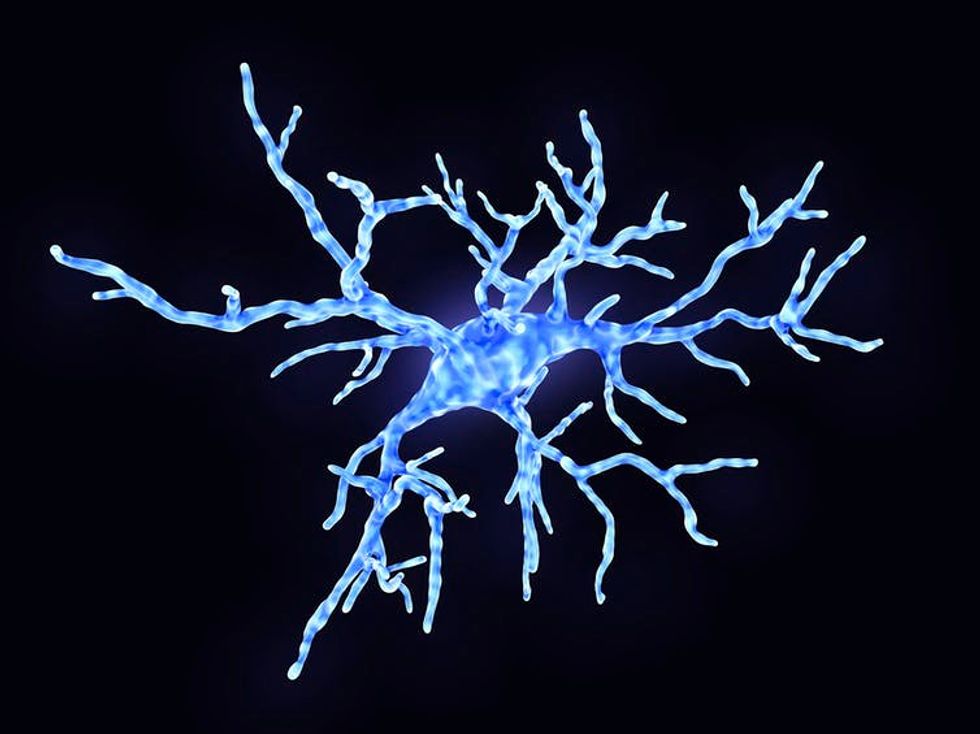
Microglia are specialized immune cells in the brain. In healthy states, they use their arms to test the environment. During an immune response, microglia change shape to engulf pathogens. But they can also damage neurons and their connections that store memory.
During illness and inflammation, the specialized immune cells in the brain become activated, spewing vast quantities of inflammatory signals, and modifying how they communicate with neurons. For one type of cell, microglia, this means changing shape, withdrawing the spindly arms and becoming blobby, mobile cells that envelop potential pathogens or cell debris in their path. But, in doing so, they also destroy and eat the neuronal connections that are so important for memory storage.
Another type of neuroimmune cell called an astrocyte, typically wraps around the connection between neurons during illness-evoked activation and dumps inflammatory signals on these junctions, effectively preventing the changes in connections between neurons that store memories.
Because COVID-19 involves a massive release of inflammatory signals, the impact of this disease on memory is particularly interesting to me. That is because there are both short-term effects on cognition (delirium), and the potential for long-lasting changes in memory, attention and cognition. There is also an increased risk for cognitive decline and dementia, including Alzheimer’s disease, during aging.
How does inflammation exert long-lasting effects on memory?
If activation of neuroimmune cells is limited to the duration of the illness, then how can inflammation cause long-lasting memory deficits or increase the risk of cognitive decline?
Both the brain and the immune system have specifically evolved to change as a consequence of experience, in order to neutralize danger and maximize survival. In the brain, changes in connections between neurons allows us to store memories and rapidly change behavior to escape threat, or seek food or social opportunities. The immune system has evolved to fine-tune the inflammatory response and antibody production against previously encountered pathogens.
Another major illness with a similar cognitive complications is sepsis – multi-organ dysfunction triggered by inflammation. In animal models of these diseases, we also see impairments of memory, and changes in neuroimmune and neuronal function that persist weeks and months after illness.
Does COVID-19 increase risk for cognitive decline?
It will be many years before we know whether the COVID-19 infection causes an increased risk for cognitive decline or Alzheimer’s disease. But this risk may be decreased or mitigated through prevention and treatment of COVID-19.
Prevention and treatment both rely on the ability to decrease the severity and duration of illness and inflammation. Intriguingly, very new research suggests that common vaccines, including the flu shot and pneumonia vaccines, may reduce risk for Alzheimer’s.
Additionally, several emerging treatments for COVID-19 are drugs that suppress excessive immune activationand inflammatory state. Potentially, these treatments will also reduce the impact of inflammation on the brain, and decrease the impact on long-term brain health.
COVID-19 will continue to impact health and well-being long after the pandemic is over. As such, it will be critical to continue to assess the effects of COVID-19 illness in vulnerability to later cognitive decline and dementias.
In doing so, researchers will likely gain critical new insight into the role of inflammation across the life-span in age-related cognitive decline. This will aid in the development of more effective strategies for prevention and treatment of these debilitating illnesses.
A woman who was permanently banned from entering a local hardware store for refusing to wear a face mask tells Vox that she's proud that her defiance of public health standards got her kicked out.
In an interview, a Wyoming resident named Jacqueline says that her local Menards home and garden store has told her that she is no longer allowed to shop there for refusing to wear a face mask on two separate occasions.
Although she was still allowed to shop at the store after the first time she came in without a face mask, she was permanently given the boot when she got into a physical altercation with an employee during her second trip to the store.
"Jacqueline says a worker pushed her, the store says she rammed someone with a cart -- and management called the police to file a report," reports Vox.
Despite this, however, Jacqueline says she has no regrets about her behavior.
"They don’t have to ban me because I’ll never go back again," said the woman, who also referred to the entire pandemic as "COVID scam garbage."
"They’re all saying this so that they can make the president look bad, so they can cause the problems they are causing," she told Vox.
An influential novel coronavirus pandemic model now projects that deaths from the disease in the United States could hit almost 300,000 by the start of December.
NPR reports that researchers at the University of Washington's Institute for Health Metrics and Evaluation say that the United States is headed toward a grim fall in which COVID-19 deaths will nearly double from their current level of 160,000 in the next four months.
To put this toll into perspective, NPR writes that it would be "more than four times the number of people who typically die from drug overdoses in the U.S. each year -- and more than five times the number killed by the flu in a very bad year."
Chris Murray, the head of the Institute for Health Metrics and Evaluation's team, says that he expects the toll to be so high because Americans have shown they quickly grow lax in terms of wearing masks and social distancing as soon as the number of cases in their area starts to go down.
"That creates this potential for [cases] going up, stabilizing, then coming down, [then] people becoming less vigilant, and then cases going up again," he tells NPR. "I think we will see more of that roller-coaster phenomenon through the fall."
Of more than 100 Texas prison units, the Roach Unit's apparent ability to avoid the virus has been attributed to a remote location and a warden who strictly enforces precautionary measures.
The only Texas prison that hasn’t had any staff or inmates test positive for the new coronavirus is the same one where inmates make soap and package hand sanitizer for the state’s lockups. Prisoners aren’t allowed to use the latter.
How this one unit seemingly remains untouched by a virus that has ravaged the state’s prison system, however, has been credited not to its soap factory, but to the prison’s location and the warden’s strict enforcement of the Texas Department of Criminal Justice’s coronavirus policy. Meanwhile, those inside prisons with hundreds of infected inmates have long reported dangerous practices. In lawsuits and letters, they have described officers without face masks, forced intermingling between infected and healthy prisoners, and limits to soap and cleaning supplies.
Texas leads the nation in prison deaths connected to the coronavirus, with a higher death toll than the federal lockups or any other state prison system. At least 112 Texas prisoners and 16 people who worked in prison units have died with the virus.
The Roach Unit is one of Texas’ more than 100 state-run prisons and jails, housing about 1,300 incarcerated men in the rural town of Childress in the Texas Panhandle. But none of the more than 17,700 state inmates who have tested positive for the virus were housed at Roach, according to a prison spokesperson. Nor have any of the nearly 3,700 infected prison employees worked at the unit.
“We’ve been lucky so far that here in the community of Childress there hasn’t been a big number of coronavirus cases,” said Ricardo Gutierrez, a 36-year-old inmate at the Roach Unit, in response to questions sent by The Texas Tribune. “I think that helps out a lot to not get the staff infected.”
After inmate visitation was canceled statewide, and most prison system transfers and all intake from county jails were temporarily halted in March and April, epidemiologists said most new prison infections were likely coming in through prison employees who contracted the virus in their communities. Childress County, with a population of about 7,000, has had only 37 people test positive for the coronavirus, according to data from the state health department.
TDCJ spokesperson Jeremy Desel said being geographically isolated helps protect the unit from the virus, but he added there is still “significant traffic there for distribution of materials they produce.”
In a March promotional video, TDCJ highlighted the Roach Unit’s soap and detergent factory as an essential tool to protect against the coronavirus, showing factory machines and some of the 84 inmates who work without pay to produce things like bar soap, laundry detergent, dish soap and bleach to distribute throughout the Texas prison system and sell. “Soap? We have plenty!” the video title boasted.
The next month, inmates in the factory also began repackaging hand sanitizer for prison employees to use, Desel said. TDCJ has steadfastly refused to allow inmates access to hand sanitizer, part of what prompted a federal lawsuit and four-week trial scrutinizing TDCJ’s handling of the pandemic. Prison attorneys have argued inmates could get drunk from the hand sanitizer or use it as an accelerant to set fires. Inmates’ attorneys have rejected those premises, saying such abuses are rare in lockups that allow it.
Aside from its location, though, Desel said “Roach is doing the same things that all units are doing to stop COVID.” But prisoners tell a different story.
Since March, inmates at numerous other prisons have told their loved ones and the Tribune that staff members have only partially enforced the policies put in place by prison officials to wear masks, regularly sanitize, and stay a safe distance apart in places like dorms, showers and hallways. Many inmates have reported that officers wore masks pulled down to their chins, prisoners were taken to the showers in large groups, and inmates who tested positive for the virus were sometimes housed with those who tested negative.
But at Roach, Gutierrez said the staff “are not messing around.” He said in a few instances where coronavirus was suspected, the sick inmate would be promptly removed and tested, and the men on the wing the inmate lived in would be quarantined for a few days until the tests came back negative, with nurses in protective gear regularly checking them for symptoms.
“They’re doing everything that the government has mandated: social distancing, the masks, sanitizing everything,” he said. “This warden has gone above and beyond to make sure that everything is being done right.”
Gutierrez said he gets the typical weekly amount of soap — five small bars stuffed into a toilet paper roll on Friday. But since the pandemic hit the state, he said Roach inmates also get more soap and a surface cleaner every Tuesday, and more is available at lunch in the dining hall. He said inmates also were still able to go to recreation and go to common rooms, but in much smaller groups.
Michele Deitch, a senior lecturer and prison conditions expert at the University of Texas' LBJ School of Public Affairs and law school, said Gutierrez’s description could make the Roach Unit a powerful example of the ways in which following TDCJ policies can help prevent an outbreak. On Thursday, 20 TDCJ lockups each had more than 300 inmates who had tested positive for the virus, with active infections often reported in large clusters of hundreds of people at once. Three units housed more than 700 inmates who had tested positive.
“The official protocols may be the same throughout the system, but ultimately there are huge differences in the degree to which particular facilities are following those protocols,” she said. “If they are taking the steps that they should be taking, they can reduce the spread of it within the facility if it does come in … it doesn’t have to become like a spread of wildfire.”
The University of Texas at Austin's LBJ School of Public Affairs has been a financial supporter of The Texas Tribune, a nonprofit, nonpartisan news organization that is funded in part by donations from members, foundations and corporate sponsors. Financial supporters play no role in the Tribune's journalism. Find a complete list of them here.
Australian police have arrested two men accused of planning an anti-lockdown protest in Melbourne, an unusual move to stop an event that authorities said would put "lives at risk".
Police said Friday that the two men in their 40s had been detained after mobile phones and a computer were seized and both would be formally charged with inciting a criminal offence.
The pair were arrested following an investigation into a protest of hundreds of people planned for Melbourne city centre on Sunday, police told AFP.
The gathering would breach Melbourne's wide-ranging lockdown -- which entered into force Thursday, banning large gatherings and preventing residents from going outside except to work, exercise or buy essentials.
The state of Victoria -- which includes Melbourne -- recorded 450 new virus cases on Friday and has seen record deaths this week, making it Australia's most serious outbreak.
Police in Victoria have vowed to crack down on anyone breaking lockdown restrictions, issuing 196 fines in the past 24 hours for everything from failing to wear a mask to breaching an overnight curfew or collecting a pizza.
But the decision to arrest the pair marks an escalation amid a series of legal battles over Black Lives Matter and other protests.
Since the pandemic began, Australian authorities have tried to proscribe a series of political gatherings on health grounds, with mixed legal success.
That has fuelled intense debate about whether the right to protest and freedom of speech are being unfairly curtailed, or whether public health concerns should take priority.
A Facebook page for the Sunday protest has been taken down, but it had voiced opposition to the forced closure of small business, mandatory mask wearing and "mandatory vaccines".
Many of the Australian government's measures to tackle the pandemic have sparked conspiracy theories and been opposed by anti-vaccination activists, self-styled "sovereign citizens" and a plethora of other anti-government movements.
The country of 25 million has so far recorded more than 20,000 virus cases and 255 deaths.
The number of COVID-19 cases in Africa has risen to over one million, with more than half registered in South Africa, according to an AFP count late Thursday.
The continent's worst-hit nation has registered 538,184 infections, including over 8,000 new cases on Thursday, and 9,604 deaths.
Egypt has recorded around 95,000 COVID-19 cases while the figure in Nigeria is 45,000.
Nevertheless the African continent remains one of the least affected, according to the official figures, with only Oceania registering fewer COVID-19 cases.
But the official numbers are likely to be a fraction of the real extent of the virus' spread throughout Africa where a number of countries have failing healthcare systems and limited screening capacities.
Worldwide there have been some 19 million recorded coronavirus cases resulting in over 709,000 deaths.
Thursday was also the 20th week in a row when the federal government has reported that more than one million Americans signed up for unemployment benefits.
The White House and Congress remain trillions of dollars apart on the next coronavirus stimulus bill.
Speaker Nancy Pelosi told reporters following a three-hour negotiation meeting that White House chief of staff Mark Meadows slammed the table and walked out of the meeting, to which Pelosi replied that the Trump administration was slamming the table on our children.
Here's some of what Capitol Hill correspondents tweeted following the end of the meeting:
The United States Senate adjourned on Thursday, allowing members a three-day weekend despite the fact enhanced unemployment has expired and there has been no deal reached on the next round of COVID-19 stimulus.
The decision to leave Washington, DC for the weekend comes the same day the federal government reported over 1 million Americans have filed new unemployment claims -- for the 20th week in a row.
According to BuzzFeed News, two students at a Georgia high school say they were suspended after they posted photos and videos of crowded hallways at their school to social media.
Speaking to BuzzFeed News, one student said the school suspended her for five days for violating school polices that state "that I used my phone in the hallway without permission, used my phone for social media, and posting pictures of minors without consent.”
“Day two at North Paulding High School. It is just as bad. We were stopped because it was jammed," she wrote in a tweet with one photo. "This is not ok. Not to mention the 10% mask rate."