During a segment on CNN this Wednesday, former Veterans Affairs secretary Dr. David Shulkin attempted to dispel notions that the anti-malaria drug hydroxychloroquine is an effective treatment against the coronavirus, as President Trump has suggested.
"I think so far we've had a lot of studies come out and none have shown evidence that says that this is an effective drug for the treatment or prevention of COVID-19," Shulkin said, adding that additional studies are being conducted and experts will have to see is that assessment changes.
"But at this point, to take a drug that has no effectiveness, or no known effectiveness, but potential harm, doesn't make a lot of sense," he continued.
Shulkin went on to say that it's up to a doctor whether to prescribe hydroxychloroquine, but he is surprised that a doctor would prescribe it to Trump after the FDA recommended "extreme caution" in allowing patients to take the drug.
"I'm concerned about the way this has publicly been discussed and that other Americans may believe that this is now safe to do."
A coalition of more than 30,000 small business owners across the U.S. is urging Congress not to grant corporations sweeping immunity from coronavirus-related workplace safety lawsuits, warning that the move would harm Main Street and "undo decades of worker and consumer protections."
"Corporate immunity is unnecessary to protect small business owners, as state law already protects responsible business owners who act reasonably," advocacy group Main Street Alliance wrote in a letter (pdf) to Democratic and Republican congressional leaders last week. "Creating this type of blanket immunity from lawsuits by injured workers or consumers would give bad actors a competitive edge at the cost of people's lives."
"Arguments for corporate immunity during this pandemic are premised on a false choice that illogically pits public health and safety against the economy and the viability of businesses," the letter continues. "In reality, we need to pursue a pragmatic, science-based approach to creating a pandemic-resilient economy that considers both the needs of small business owners and the public need for health and safety."
The letter came as big companies continued to ramp up their lobbying campaign in support of liability protections, which would shield corporations from legal responsibility for workers who contract Covid-19 on the job.
In a meeting at the State Dining Room of the White House on Monday, the CEOs of Panera Bread and Restaurant Brands International both pushed President Donald Trump to support liability protections in the next coronavirus stimulus package. Last month, Senate Majority Leader Mitch McConnell (R-Ky.) said liability protections are his top priority for future Covid-19 legislation.
"The Democrats don't want to give you the liability provisions," Trump said. "They just don't want to have that. And it's crazy that they don't... But we'll get it anyway."
Larry Kudlow, Trump's top economic adviser, assured the CEOs that the White House is "working very hard on the COVID-19 liability restrictions" as it pushes states to reopen their economies.
"That's going to be a key part of our next package," said Kudlow.
Main Street Alliance said that while its member businesses are "eager to resume operations as soon as possible," they are also "very concerned about safety."
"This is partially because they seek to be responsible community members and prevent the spread of this deadly virus," the group wrote. "But it is also because none of our members wants their business or brand associated with the spread of illness or death to employees or customers."
Instead of "promoting a race-to-the-bottom with life or death consequences" by approving liability protections for corporations, the coalition said Congress should provide:
Direct support for small businesses for the duration of the pandemic and that allows reopening at the pace and level businesses need to safeguard the health of owners, staff, and customers;
Adequate testing, tracing, supported isolation, and clear, industry-specific workplace safety standards and support;
Healthcare and economic protection for all workers and families—without immigration-based discrimination—to support both a healthy workforce and local spending;
Establish sufficient care infrastructure (child care, schools, paid leave) so parents and caregivers can return to work knowing their families are safe and protected;
Mechanisms to tackle systemic racial and economic inequities that are devastating businesses in communities of color and pushing people of color onto the frontlines of the disease.
"Main Street small businesses should not be forced into unfair competition with irresponsible businesses seeking immunity for their decisions to ignore health and safety standards for workers and consumers," the alliance wrote. "By rewarding noncompliance, corporate immunity would shift the costs of responsible behavior onto responsible Main Street businesses while putting people at grave risk."
"With this perverse cost-shift," the group warned, "corporate immunity could result in only the most irresponsible corporations surviving the pandemic."
According to a report from CNN, sources say the director for the US Centers for Disease Control and Prevention (CDC) is on shaky ground as President Trump reportedly has a target on Dr. Robert Redfield's back for removal.
"Informal conversations around 'what to do' about Redfield have taken place, as tensions between the CDC and the White House show no signs of abating, according to a senior administration official," CNN reports.
Coronavirus task force member Dr. Deborah Birx has become increasingly critical of the CDC, accusing it of having antiquated data-gathering practices. According to CNN, there have been heated conversations between Birx and Redfield during task force meetings. Additionally, White House economic adviser Peter Navarro recently publicly blamed the CDC for testing failures in the U.S. -- criticism that are apparently in line with Trump's thinking.
"Redfield has also been missing from key conversations about how to advance the CDC's data collecting methods," CNN reports. "The agency has been working around the clock, holding meetings and conference calls with federal officials and members of the private sector to implement a major data modernization initiative."
During a recent press conference, President Trump claimed that he's been taking the anti-malaria drug hydroxychloroquine as a means to avoid being infected by the coronavirus.
"Couple of weeks ago I started taking it," he said May 18. "Because I think it’s good. I’ve heard a lot of good stories. And if it’s not good, I’ll tell you right. I’m not going to get hurt by it."
The following day, Trump tried to downplay research that says the drug hasn't shown any benefit to coronavirus patients.
"If you look at the one survey, the only bad survey, they were giving it to people that were in very bad shape," Trump said on May 19. "They were very old. Almost dead. It was a Trump enemy statement."
Trump was apparently referring to a study that featured Veterans Administration patients. But according to a fact check from Politifact, three studies "all reached the same conclusion that outcomes with hydroxychloroquine were the same as without it."
According to Politifact, Trump ignored larger, newer studies in order to make his claim.
"In early May, two studies emerged based on patients treated in the nation’s biggest COVID-19 hotspot, New York City. Both investigations were much larger than the study of VA patients," Politifact reports. "The study that appeared May 7 in the New England Journal of Medicine looked at the medical records of 1,376 people who tested positive for COVID-19 and were admitted to the hospital. Their results echoed the first study on hydroxychloroquine."
MSNBC host Andrea Mitchell on Wednesday called President Donald Trump "effective" at "communication" about his controversial use of the drug hydroxychloroquine to prevent COVID-19.
Mitchell's remarks came after presumptive Democratic presidential nominee Joe Biden slammed Trump's promotion of hydroxychloroquine.
"Come on, man, what is he doing?" Biden exclaimed during an interview on Tuesday. "What in God's name is he doing?"
On Wednesday, Mitchell asked Biden campaign spokesperson Kate Bedingfield about Trump's hydroxychloroquine fascination.
"What about the decision by the president to take this drug?" Mitchell asked. "And the other advice that he's giving. A lot of people are going to listen to that."
"But he is being effective, isn't he," the MSNBC host added, "in terms of the way he's communicating his point of view?"
"I don't think so," Bedingfield replied. "If you have the president of the United States suggesting that people should take a dangerous, unproven, untested drug, that is not successful communication."
The Biden staffer said that Trump's tactics are "a political distraction" to divert attention away from "how we got in this crisis."
"People don't have to settle for this kind of leadership," she continued. "They don't have to settle for a president who has so badly mismanaged this crisis that we now have 36 million Americans applying for unemployment."
Although Tim Miller is a conservative who has been active in the Republican National Committee, he has been one of the most vehement critics of the “Obamagate” conspiracy theory that President Donald Trump is currently promoting: Miller is an expert when it comes to not only explaining what “Obamagate” is, but also, debunking it. Miller revisits the subject of “Obamagate” in a May 20 article for The Bulwark, and this time, he lays out the reasons why an e-mail by former Obama Administration official Susan Rice debunks “Obamagate” as idiotic nonsense.
Under Barack Obama’s presidency, Rice served as U.S. ambassador to the United Nations from 2009-2013 and as national security adviser from 2013 to early 2017. Michael Flynn became Trump’s first national security adviser after Obama left office, but Flynn was fired after lying to the FBI about his communications with former Russian Ambassador Sergey Kislyak.
Miller (who served as communications director for former Florida Gov. Jeb Bush) explains that Rice’s e-mail, which has been declassified, was “written by Rice to herself to memorialize a meeting with President Obama’s national security team about Gen. Michael Flynn’s contacts with Russian Ambassador Sergey Kislyak.”
“The full e-mail was declassified on Tuesday, and you will be shocked to learn that the previously redacted text completely debunks the nontroversy narrative that (Acting National Intelligence Director Richard) Grenell, the MAGA media and the Trump campaign were trying to drive with their initial leak,” Miller notes.
Part of the “Obamagate” conspiracy theory claims that Obama and his allies, in late 2016 and early 2017, were spying on Flynn and plotting against him in order to sabotage the incoming president. And Miller points to the “newly revealed” last three sentences of the e-mail as especially important: Rice wrote that former FBI Director James Comey “added that he has no indication thus far that Flynn has passed classified information to Kislyak, but he noted that ‘the level of communication is unusual.’ The president asked Comey to inform him if anything changes in the next few weeks that should affect how we share classified information with the incoming team. Comey said he would.”
Miller, analyzing Rice’s e-mail, writes, “So, the note that had been used to advance the idea that Obama was hiding info from — and even spying on! — Flynn has a line in it that indicates specifically that the president did not want to change how his administration shared classified information with the incoming administration unless something were to change, at which point he would want another briefing. And there is no evidence that another such briefing took place.”
Miller goes on to say that based on Rice’s e-mail, “In summary, here is what we know about Obama’s actions” — for one thing, “Obama says that the investigation should be done ‘by the book’ unless new information comes to light, at which point he should be briefed again.” Also: “President Obama privately warns President-Elect Trump about Flynn in one of their only conversations.”
When he was still president, Miller asserts, Obama was not only not conspiring against Trump — he was trying to work with the incoming president and make the transition to a new administration as smooth as possible. And according to Miller, Rice’s now-unredacted e-mail is hardly damning of Obama — no matter how much Trumpistas will claim it is.
“Only the producers of The Trump Show could come up with a fake conspiracy this morbidly thin,” Miller writes. “The Rice e-mail is such a massive nothing burger that it exists as a nothing burger continent on which all other nothing burgers rest.”
Farhad Manjoo has long considered himself to be an optimist, but thanks to President Trump's time in office, that quality has started to wane. Writing in The New York Times this Wednesday, Manjoo says that despite a period of hope that Democrats seemed to be making inroads against Trump's policies, that all is lost now thanks to the coronavirus.
"The coronavirus and our disastrous national response to it has smashed optimists like me in the head. If there is a silver lining, we’ll have to work hard to find it," he writes.
It's not just the fact that almost 100,000 Americans have died from the virus so far, that the federal government bungled its response, or that global cooperation during the pandemic.
"It is all these things and something more fundamental: a startling lack of leadership on identifying the worst consequences of this crisis and marshaling a united front against them," Manjoo writes. "Indeed, division and chaos might now be the permanent order of the day."
US President Donald Trump on Wednesday again lashed out at China over the coronavirus pandemic, blaming Beijing for "mass Worldwide killing."
His early morning tweet, which also referred to an unidentified "wacko in China," was the latest heated rhetoric from the White House, where Trump is making attacks on Beijing a centerpiece of his November reelection bid.
"It was the 'incompetence of China', and nothing else, that did this mass Worldwide killing," the president tweeted.
The virus first appeared in the Chinese city of Wuhan last December and spread rapidly around the world, killing more than 323,000 people at the latest count, and triggering huge economic damage.
Trump initially played down the seriousness of the threat and said repeatedly he believed China was addressing the outbreak.
He later pivoted to blaming China for allowing the international spread.
The White House has also suggested, without offering evidence so far, that the virus originated in a laboratory and was accidentally released.
Trump has made repeated but vague threats of retaliation against the chief US economic rival.
He has also threatened to break off US funding to the World Health Organization over what he says was its assistance to China in covering up the extent of the outbreak.
The diplomatic rift is rapidly opening just after Trump had been celebrating a truce in his trade war with China and comes after months of effusive praise for his Chinese counterpart Xi Jinping.
- US 'lies' -
Tempers are also fraying in China, where foreign ministry spokesman Zhao Lijian previously provoked Washington's ire by promoting a conspiracy theory that the virus was first brought to China by the US military.
Pushing back at Trump's WHO criticism, Zhao on Wednesday highlighted what he called the "many mistakes and loopholes on the US side, their lies and rumors."
"The US has seemingly forgotten that in the past, US leaders have repeatedly and publicly praised China's anti-epidemic work," Zhao said.
Zhao blamed US politicians "who want to shift the blame but can't shift it away."
During a phone call with Bangladeshi Prime Minister Sheikh Hasina, Xi also appeared to swipe at the United States.
"Xi emphasized that China opposes actions that interfere with international anti-epidemic cooperation and harm the world's –- and especially developing countries' -- efforts to fight the pandemic," state news agency Xinhua reported.
"China is willing to continue to work with the international community, including Bangladesh, to support the WHO's leadership role, promote international joint prevention and control cooperation, and safeguard global public health security," Xi said.
But US secretary of State Mike Pompeo told a news conference on Wednesday that the COVID-19 crisis had ended US illusions of close ties with China, saying "we greatly underestimated the degree to which Beijing is ideologically and politically hostile to free nations."
Pompeo, a close Trump ally, said China was led by a "brutal, authoritarian regime."
"The Chinese Communist Party's response to the COVID-19 outbreak in Wuhan has accelerated our more realistic understanding of Communist China," he said.
"Today, as we all sit here this morning, Beijing continues to deny investigators access to relevant facilities, to withhold live virus samples, to censor discussion on the pandemic within China and much, much more."
Senator Kamala Harris (D-CA) on Wednesday blasted Senator Ron Johnson (R-WI), the chair of the Senate Homeland Security and Governmental Affairs Committee, for holding a vote to subpoena documents related to Hunter Biden amid the coronavirus pandemic.
"Today's agenda reveals a lot about the Senate majority's priorities, sadly," Harris said during a committee hearing. "There are literally matters of life and death waiting for our committee's attention. But instead, this committee is doing the president's personal bidding."
The committee later voted along partisan lines to authorize Johnson to subpoena Blue Star Strategies, a public relations firm that represented Burisma Holdings, the Ukrainian natural gas company where Hunter Biden served on the board.
Organizers say scores of McDonalds workers have tested positive for Covid-19 in at least 16 states, but the company often doesn't notify employees when their coworkers are sick.
Demanding McDonald's prioritize public health and worker safety over profits, hundreds of employees at the fast food chain went on strike Wednesday, a day before the company was set to hold its annual shareholders' meeting.
Instead of distributing dividends to its shareholders, the striking employees are calling for the company to use its massive profits to pay for safety and financial protections for workers, scores of whom have contracted Covid-19 in at least 16 states so far.
Employees and strike organizers at the fair wage advocacy group Fight for $15 are demanding hazard pay during the pandemic of "$15X2," paid sick leave, sufficient protective gear for workers, and company-wide policy of closing a restaurant for two weeks when an employee becomes infected, with workers being fully paid.
The strike is taking place at stores in at least 20 cities. Fight for $15 and the SEIU, which is also supporting the action, say it's the first nationwide coordinated effort targeting the company since the coronavirus pandemic began in March.
On social media, Fight for $15 posted videos of workers explaining why they are walking off the job Wednesday.
Longtime McDonald's cook Bartolome Perez plans to join Wednesday's strike after having his hours reduced when he spoke up about working conditions during the pandemic.
"They only care for their profits," Perez toldUSA Today. "They don't care for our lives. They show it to us again and again."
"Workers being able to speak out is key for a healthy democracy and safe society," said Evan Greer, deputy director of Fight for the Future, which is leading the campaign. "Workers are our first line of defense against corruption, abuse, and an essential part of fighting COVID-19. They must feel safe in alerting the public about dangerous threats as they appear. Congress must act now."
The strike comes five weeks after the SEIU released a survey of about 800 McDonald's workers, 46% of whom reported coming to work sick out of fear that they would be penalized if they stayed home. More than 90% of workers said their stores did not supply sufficient face masks.
McDonald's claimed this week that the SEIU's survey is now outdated and that the company is "putting safety first" as it moves to fully reopen many of the indoor dining rooms at its 140,000 U.S. restaurants.
But on Tuesday, a day before the strike, McDonald's workers in Chicago filed a class-action lawsuit claiming the company is still not providing enough hand sanitizer, gloves, and masks for workers.
The suit demands that an Illinois judge issue an injunction to bar McDonald's from forcing workers to reuse masks and require the company to notify employees when a worker tests positive for Covid-19.
"I don't think there would be strikes happening on 20 cities all on the same day if this was not a widely experienced condition of all workers in fast-food restaurants," SEIU President Mary Kay Henry toldUSA Today in response to McDonalds' denials.
White House Press Secretary Kayleigh McEnany on Wednesday defended President Donald Trump's off-label use of hydroxychloroquine, insisting that people have a "right to try" the drug "in the waning days" of their lives.
"The doctor did prescribe it for him," McEnany told CBN's David Brody. "And he took it after having several discussions with Dr. Conley about its efficacy and he believed -- Dr. Conley -- that the benefits outweighed the risks for the president."
The press secretary noted that the drug has been used for decades for conditions other than COVID-19.
"It was issued an emergency use authorization to use this as essentially like a right to try," she added. "So, if you're someone who has this, who is looking for a therapeutic, who has COVID and is looking for a therapeutic, hydroxychloroquine is something some doctors professed optimism about."
"You do have a right to try it," McEnany said. "It gives people a right to try in the waning days of their life when they are facing a fatal illness."
On Tuesday, Trump said that people who had passed away while taking hydroxychloroquine in a Veterans Administration study were "ready to die."
From the 11th century until around the 19th century, Muslim cultures witnessed the use of magic bowls, healing necklaces and other objects in hopes of warding off drought, famine, floods and even epidemic diseases.
Many of these amulets and talismans are beautifully crafted objects, and so are of interest to art historians such as myself. And while they are now largely seen as relics of folk belief and superstition, in the premodern era these ritual objects emerged from elite spheres of Islamic knowledge, science and art.
Islamic personal protective gear
The phrase “personal protective equipment” – or “PPE,” in hospital lingo – has become part of our daily lives as we watch frontline health workers don gowns, face shields and gloves to protect themselves from COVID-19.
The Arabic language still reflects this historic understanding of disease as an invading enemy: The term for “plague” – ta‘un – derives from the verb “ta'ana,” to pierce or strike.
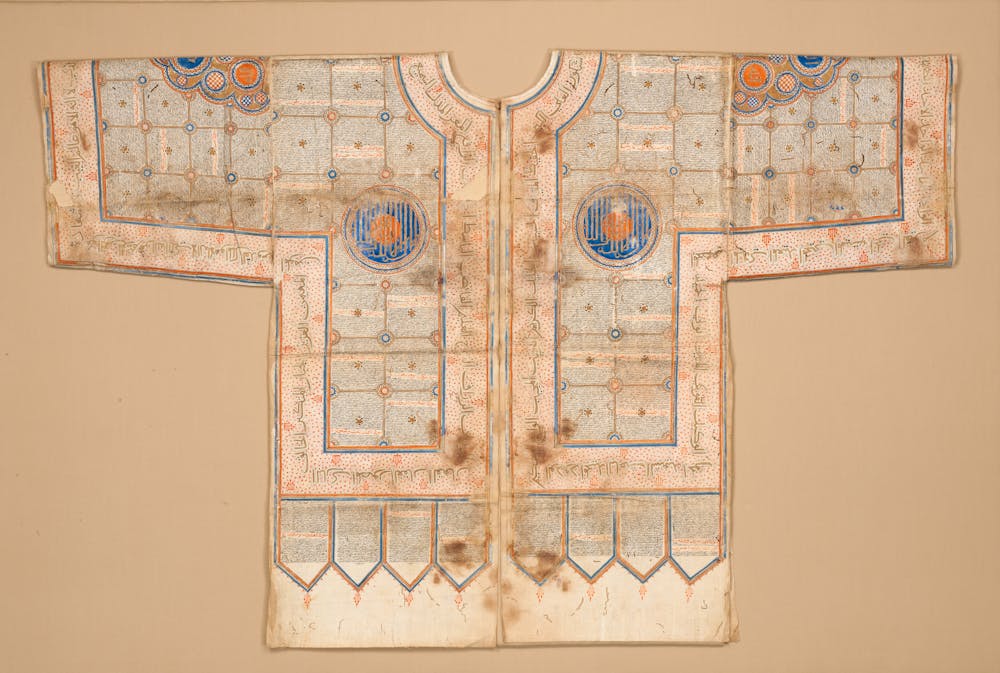
Protecting its wearer against a range of assaults, the quintessential premodern Islamic PPE was the talismanic shirt – a cloth garment inscribed with holy text and often worn in warfare. Featuring circular designs on the chest, shoulder pad roundels and a fringed lapel, the talismanic shirt may sound like something out of the disco era – but in practice it more closely recalls the body armor of war.
A Talismanic shirt made in India in the 15th or 16th century.
Covered in squares, numbers and designs, the shirts were “amuletically charged,” meaning they were thought capable of physically protecting the wearer against disease and death.
Other talismanic shirts, from India, included a protective panel on the back inscribed with a Quranic verse calling God “the Best Guardian and the Most Merciful of the Merciful Ones.”
Anti-plague design
Other common medieval Islamic PPEs included the miniature talismanic scroll – a tiny roll of Quranic verses on affordable block-printed paper – and amuletic designs like the six-pointed seal of Solomon.
Eleventh-century talismanic scroll from Egypt (left) and pendant with the ‘Garden of Names’ anti-plague amulet for sale online today (right).
Quranic scrolls and amulets were worn around the neck or otherwise attached to the body, suggesting that physical contact with the object was thought to unlock the enclosed blessings or life force, known as “baraka” in Arabic.
Perhaps most germane to today’s pandemic was the Islamic anti-plague talisman known as the “Garden of Names,” used across the Islamic world and especially popular in Ottoman lands.
The Garden of Names, or Jannat al-asma’ in Arabic, is a circular amuletic design that contains 19 letters and numbers, verses from the Quran and several names of God. Some painted images of this device show controlled smudges, suggesting that people kissed, rubbed or made potions out of the design to activate its baraka.
Healing water
Water has important healing properties in Islamic traditions, too, being associated with cleanliness and godliness. The Quran credits it as the source of “every living thing.”
Since the seventh century, Muslims visiting the holy city of Mecca, located in Saudi Arabia, have visited the Zamzam well, whose water is thought to have curative properties. There, religious pilgrims still fill flasks with the holy liquid, which is then drunk straight or mixed with other liquids into therapeutic potions.
Muslim pilgrims drinking Zamzam water upon arrival in the holy city of Mecca in 2019.
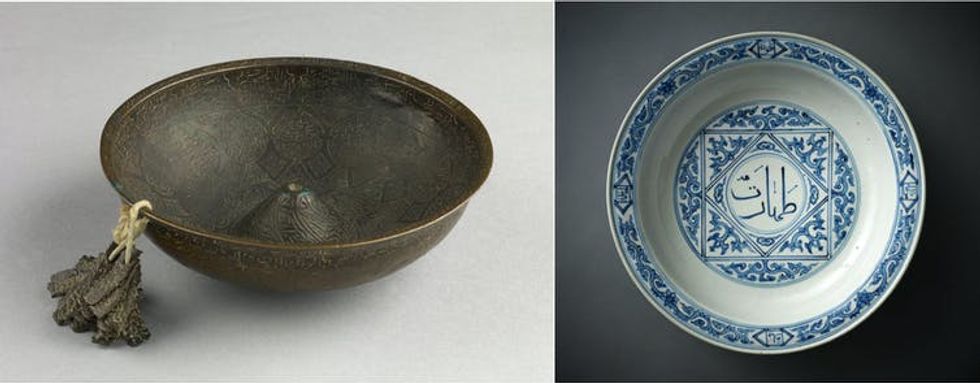
Alternatively, regular water could turn curative if a folk doctor poured it into special metal bowls decorated with talismanic words and images while praying. Some of these talismanic bowls specify the reason for their creation, so historians know they were used to heal everything from poison and dog bites to intestinal problems, “pain of the heart” – that is, heartbreak – and the plague. For centuries, Muslim women in labor were also cooled with water from these bowls.
A metal magico-medicinal bowl, left, and a ceramic ablutions basic inscribed with the word ‘taharat,’ meaning purity.
University of Michigan Hatcher Library/Aga Khan Museum
But amuletic objects and homeopathic practices still exist in the Islamic world, as they do in many faith cultures across the globe. Some Muslims still use magico-medicinal bowls at home; they’re sold on eBay.
Like prayer or meditation – which can have something of a placebo effect, bringing real benefits for both mind and body – Muslims facing sickness or other crises found strength and solace in religious objects for nearly a millennium.
As art objects, too, these artifacts speak to a human desire to seek comfort and cure in creativity and design. That is a feature of today’s pandemic, too.
In an report for Business Insider this Wednesday, Adam Bienkov writes that President Trump is "presiding over the deterioration of the United States' position on the world stage as European countries increasingly look towards China as a future global leader."
Citing recent opinion polls published in Germany, Britain, and France that show a decline in how Germans positively view the U.S., Bienkov points out that the shift came as a result of "global shock" over how President Trump was handling the response to the coronavirus outbreak.
Bienkov points to a recent column in the Irish Times that contends we're living in unprecedented times when other countries look at the U.S. with "pity."