Maine's former Republican governor attended an anti-lockdown protest in Augusta on Saturday -- but refused to get out of his car.
"Former governor Paul LePage briefly returned to Blaine House on Saturday for a protest of the business restrictions that its current occupant, Gov. Janet Mills, has put in place to prevent the spread of the coronavirus," the Bangor Daily Newsreports. "LePage did not even appear to leave the vehicle — with its Florida plates — that he drove to the rally."
"Instead, in what may have been a way to avoid violating Maine’s requirement that out-of-state visitors remain in quarantine for two weeks after arriving here, he parked the Lexus sedan in a small lot next to the Blaine House and used his cell phone to address a gathering of protesters about 40 feet away," the newspaper explained. "Then, he pulled out of the lot and appeared to drive off down Chamberlain Street."
Charles Eichacker, a reporter for the newspaper, posted a photo of the scene on Twitter, where LePage was thoroughly ridiculed.
On Saturday, Politico reported that President Donald Trump's officials at the Consumer Financial Protection Bureau (CFPB) are using the coronavirus pandemic as an excuse to suspend rules and oversight that require transparency from banks, credit card issuers, and credit bureaus.
"The Consumer Financial Protection Bureau is relaxing rules designed to shield Americans from abuse during the coronavirus crisis, saying the moves are necessary to give businesses flexibility during the pandemic," wrote Katy O'Donnell. "But with the agency facing an unprecedented wave of consumer complaints as millions of laid-off workers deal with their creditors, lawmakers and consumer advocates charge that the bureau is exploiting the crisis to further a pro-industry agenda. They’re demanding that it set aside all rulemaking unrelated to the crisis and take a more forceful stance toward businesses that could use the chaos to rip off consumers."
"A record number of consumer complaints have already been filed with the bureau — more than 42,000 in April alone, greater than in any other month since it opened in July 2011. The Justice Department recently brought its first fraud charges related to a small business lending program," wrote O'Donnell. But, "The bureau, for its part, has not brought a single enforcement case during the crisis, and its enforcement actions fell by 80 percent from 2015 to 2018, according to an analysis by the Consumer Federation of America."
"In March, the agency announced that it would relax or postpone various reporting requirements for mortgage lenders, credit card companies and other financial institutions," continued the report. "Last month, the bureau issued guidance signaling that it would not enforce a requirement that credit reporting companies review consumer disputes within 30 days and would instead consider the companies' 'good faith efforts to investigate disputes as quickly as possible.'"
The CFPB's director, Kathy Kraninger, has defended the CFPB actions, claiming that the rule changes free up resources for financial institutions to attend to the crisis, and insists that the CFPB is still taking action to protect consumers.
“The CFPB has a crucial role to play during this crisis to protect families,” said Sen. Elizabeth Warren (D-MA), one of the architects of the agency, in an email to Politico. “It must use its supervisory authority to monitor and detect consumer abuses and use its enforcement powers to punish companies that violate the law. Congress will be watching — and I will use every tool available to me to hold the agency accountable to its mission.”
On Saturday, writing for USA TODAY, Women's March official and manufacturing expert Bob Bland accused the Trump administration of diverting medical supplies her Masks for America organization had intended for medical workers.
"One month ago, as COVID-19 spread across the county and critical personal protective equipment (PPE) like masks, gloves, surgical gowns and face shields continued to be in short supply, I had hoped the government would do its job and act to meet this demand," wrote Bland. "But when news outlets reported that medical workers were being left vulnerable to infection without PPE, it was clear we couldn't wait for the Trump administration any longer. A small group of volunteers came together to found Masks for America and teamed up with leading health care activist Ady Barkan's Be A Hero Fund, Social Security Works and National Nurses United to get our front-line heroes the equipment they needed to stay safe as they saved lives."
"On April 11, during the peak of COVID-19 cases and deaths in New York City, the Federal Emergency Management Agency intervened and demanded orders of medical equipment allocated to our relief efforts be redirected to the federal government," she continued. "FEMA then seized 50,000 N95 respirators we had ordered without giving us an explanation or telling us where those respirators were going."
"In my 15 years of working in the manufacturing industry with international and domestic supply chains, I have never — never — had the federal government interfere like this," Bland wrote. "It wasn’t long before I realized it wasn’t only happening in New York and New Jersey ... Since those reports of FEMA quietly seizing materials, at least six states have lodged similar complaints against the federal government interfering with their supply chains."
"It is not illegal for the government to seize and distribute medical shipments through the Defense Production Act, yet our government has failed to be transparent with the public about how and why it is redistributing the resources of cities, states and private organizations like ours," wrote Bland. "The struggle to secure PPE and medical supplies isn’t just a failure of leadership in our government but also an unsustainable supply chain issue that has been bubbling just under the surface for years."
On Saturday, The New York Times editorial board excoriated the demand of Senate Majority Leader Mitch McConnell (R-KY) that any new coronavirus relief bill include liability protections for corporations that get their employees infected.
"The biggest obstacle, as [McConnell] sees it, is not a deadly disease but rapacious trial lawyers, capitalizing on the virus to chase ambulances and bankrupt American businesses," wrote the board. "As Congress gears up for the next installment of its stimulus package, Mr. McConnell has drawn a line: No more money for anyone until businesses get immunity from liability during the pandemic. The demands being debated include making it harder to claim that a business is at fault for a worker’s or customer’s infection, protecting businesses that are making personal protective equipment like masks for the first time, and protecting employers against privacy lawsuits if they disclose a worker’s infection."
"The problem is that immunity doesn’t just shield the worst actors; it also punishes the best, by giving a competitive advantage to the businesses that decide to cut corners at the expense of worker and customer health and safety," wrote the board.
"Consider what happened in Utah, which passed a bill immunizing businesses from pandemic-related litigation in most cases and issued only advisory guidelines," wrote the board. "The next day, the Utah Press Herald reported that two businesses had told their employees to disregard the guidelines, and even ordered those who had tested positive for the coronavirus to report to work. At one of the businesses, nearly half of all employees tested positive ... From nursing homes to Amazon warehouses to federal prisons, workers are getting sick because their bosses didn’t take necessary safety precautions."
McConnell's push doesn't even make sense, the board continued, because, "As a matter of law, it’s already extremely difficult for workers or consumers to succeed with tort claims. In most states, as long as a business shows that it followed regulations or guidelines, or even just took common-sense precautions, it will usually prevail ... So far, the predicted wave of lawsuits has not materialized. Instead we’re seeing suits like the one brought against Smithfield, which asks not for money damages but for the business to take the most basic safety precautions."
Additionally, the board wrote, "tort law is the province of the states, which can help incentivize good behavior by allowing people to sue when they are harmed by a business’s negligence or wrongdoing. Any immunity provision passed by Congress would pre-empt these state laws, making it virtually impossible for them to protect their own citizens. Such a provision might even violate the Constitution, said David Vladeck, a law professor at Georgetown who testified before the Senate last Tuesday."
"It’s no surprise that many businesses are confused about what they should do, and fearful of what might happen if they don’t do it," wrote the board. "The answer is to give them good, clear and mandatory guidelines, not immunity from liability. Until those guidelines are in place, it’s premature to talk about granting even more immunity to businesses."
On CNN Saturday, correspondent Kristen Holmes revealed that officials at the Centers for Disease Control in Atlanta are frustrated with coronavirus task force official Dr. Deborah Birx, because of her unwillingness to correct false claims made by President Donald Trump.
"Nick Valencia reporting with me, talking to CDC officials in Atlanta, who said they've been disappointed with Dr. Birx and her lack of really pushing back on some of the comments that President Trump has made that we know are untrue," said Holmes.
Unlike NIH official Dr. Anthony Fauci, who has more directly contradicted the president, Birx has more frequently tried to fit her medical recommendations into what Trump has already said. She has also consistently praised the president's leadership in forums about medical guidance, which has caused some commentators to question her credibility.
Schools from coast to coast are buying computers and scrambling to get low-income students the bandwidth they need for distance learning.
The relief package specified that the money would go to school districts based on the number of low-income students they serve. Those are children who are eligible for free and reduced-priced meals. Students whose families are below 185% of the official poverty line – which as of 2020 stands at $26,200 per year for a family of four – fall into this category.
School districts are also to reserve a portion of those funds to ensure equitable services for any low-income students who may attend private schools. That’s in keeping with a practice in place since Congress passed the Elementary and Secondary Education Act of 1965.
The department’s new guidance calls for a different method. Public school systems are being told to share these new federal funds based on the total number of students who attend private schools – rather than the much smaller number of low-income students in these schools. In other words, public school districts are being told to reserve funds for roughly 6 million total private school students, of which only an estimated 300,000 are low-income children.
By contrast, 52.3% of the nation’s 50 million public school students are low-income.
Moreover, private schools, unlike public schools, are already eligible for federal payroll protection funding under the CARES Act because they are considered small businesses.
Public schools were taking many precautions with meal distribution after a few weeks of widespread school closures.
Only about 10% of the nation’s students attend private schools. This is something Education Secretary Betsy DeVos has long aimed to change. She has consistently supported policies that would increase public funding for private school enrollment in the form of vouchers and tax credits. From this perspective, the current policy – while inconsistent with the law, equity and history – makes sense. But this time, DeVos’ private school policy would directly shortchange poor students.
The accounting method will require public schools – which are only receiving new federal money based on their poor students – to reserve multiple times more money for private schools than the CARES Act requires.
In Passaic, New Jersey, where the majority of public school students are poor, the district will need to reserve $1.4 million instead of $300,000 for private school students, according to an education advocacy group in that state. Montana estimates it will need to reserve $1.5 million for private schools rather than $206,469 it believes the law requires, The New York Times reports.
This will only increase the challenges that the highest poverty schools face. Before the pandemic even hit, public schools serving the highest-poverty communities had $1,000 less per student than those educating affluent students. These shortfalls are likely to expand based on current economic conditions.
During the Great Recession, states like North Carolina and Florida cut public school funding by 20% or more in three years. Poor communities there and elsewhere were the hardest hit.
The practical effects of these cuts were increased class sizes, unfilled teacher vacancies, higher percentages of uncertified teachers and schools where critical support staff like nurses and guidance counselors were too often missing. Some school districts were in such dire straits that they teetered on bankruptcy and considered closing some schools.
Fixing the problem
One solution to the current problem is for Congress to reiterate its original intent even more clearly. The new proposed $3 trillion relief bill pending in the House includes a provision that would do that.
The quicker option is for Congress to use its oversight powers to force the Education Department to concede that it made an error. That happened earlier this year when it reversed course on its plan to change the method for allocating funds to rural schools.
Those options, however, can be slow and uncertain. That’s one reason Indiana State Superintendent of Public Instruction Jennifer McCormick went ahead and told her school districts to ignore the guidance this week.
The law is on McCormick’s side. Her action offered a clear path forward for state and local officials across the nation who don’t believe that waiting for the political process to correct itself is fair to the country’s children who need help now.
The loss of 31 million jobs due to coronvirus has an added downside:
27 million have lost job-based health insurance. The worst may still lie ahead. One study estimated that 25 to 43 million people could lose coverage from their employer.
The situation for many Americans feels dramatic. Fortunately, the limited U.S. safety net will be able to cushion some of the fallout for almost 80% through programs like Medicaid, the Children’s Health Insurance Program and the Affordable Care Act marketplaces. And, of course, all preexisting conditions are still required to be covered by all insurers.
Yet millions will be left without coverage. As a professor of public policy, I believe there are four things you need to consider if you’ve been laid off, or if you didn’t have health insurance before the pandemic.
In Plantation, Florida, an aerial view of a deserted Westfield Broward Mall, taken by a drone on May 5.
What do I do if I’ve been laid off and lost coverage?
The good news: For many who have lost their employer-provided coverage, a number of alternatives may exist.
For some, they might now be able to join their spouse’s insurance. Others may be able to maintain their previous coverage through COBRA, albeit without the financial subsidy from their employer. This option can get expensive very quickly. Currently, average premiums in the U.S. for individuals amount to US$7,188. The number increases to $20,576 for a family of four. And COBRA adds an additional 2% of premiums for administration.
Due to the loss of income, people in states that expanded Medicaid under care of the ACA could become eligible for Medicaid coverage. In those states, individuals and their families qualify if their income falls below 138% of the federal poverty line. For a family of four, this currently amounts to roughly $36,000. In states that did not expand Medicaid, eligibility rules vary widely but are often quite restrictive.
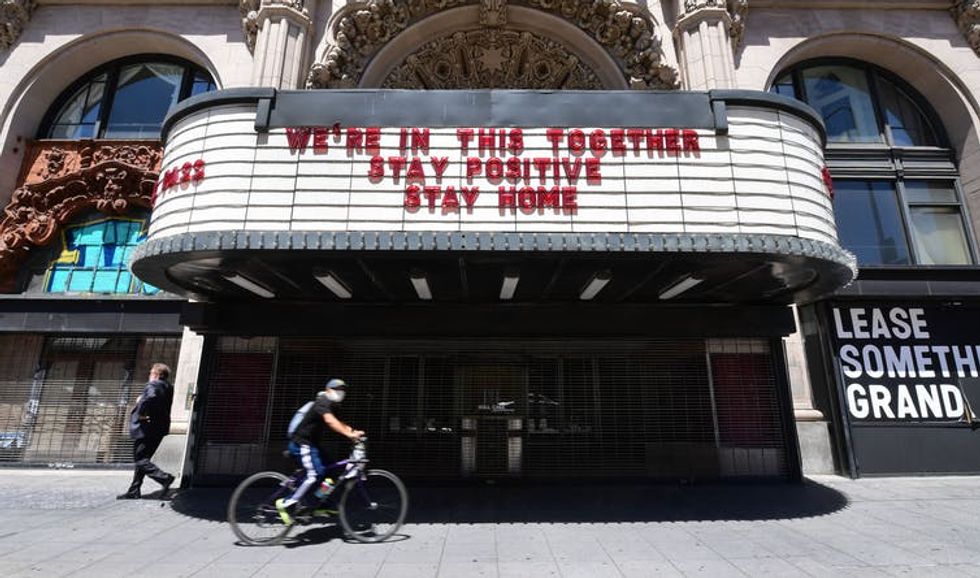
In Los Angeles, California, the Million Dollar Theater, closed due to the pandemic, offers some comforting words on its marquee.
Individuals who do not qualify for their state Medicaid program may find an alternative in coverage purchased on the ACA insurance marketplaces. Here individuals between 100% and 400% of the federal poverty line are eligible for premium support. Those on the low end of the guidelines are also eligible for out-of-pocket support.
Unfortunately, the decision of many states not to expand their Medicaid programs may leave millions of Americans ineligible for public coverage. They fall into the so-called coverage gap. They make less than the 100% of federal poverty line that makes them eligible for ACA marketplace subsidy. Yet they also make too much to qualify for the restrictive state Medicaid program. This situation applies to nonparent adults in 10 states, including Texas, Oklahoma and Mississippi.
Importantly, coverage may be available for the children of those who have lost their previous insurance through the Children’s Health Insurance Program. Eligibility limits, even in nonexpansion states, are significantly higher.
Finally, individuals can purchase short-term limited duration insurance. While premiums for this type of coverage are significantly cheaper than for ACA-compliant products, their coverage comes with significant gaps. That is, most preventive services, treatment for conditions like cancer or even prescription drugs likely will not be covered. They also require medical underwriting.
What if I didn’t have insurance in the first place?
A global pandemic seems like a particularly bad time to go without coverage. Yet we know that millions of Americans are eligible for public coverage but remain unenrolled. For many of them, many of the same options described above may apply, including Medicaid, CHIP, spousal coverage and short-term limited duration health plans.
The situation is more complex for those seeking to purchase insurance on their own. The ACA insurance marketplaces generally require that individuals purchase coverage during their open enrollment period. This occurs generally in November and December. The requirement is intended to keep insurance markets stable and not simply allow individuals to obtain coverage only when they fall sick.
In the wake of the coronavirus pandemic, at least nine states have made an exception and reopened their marketplaces temporarily. These include Colorado and Connecticut.
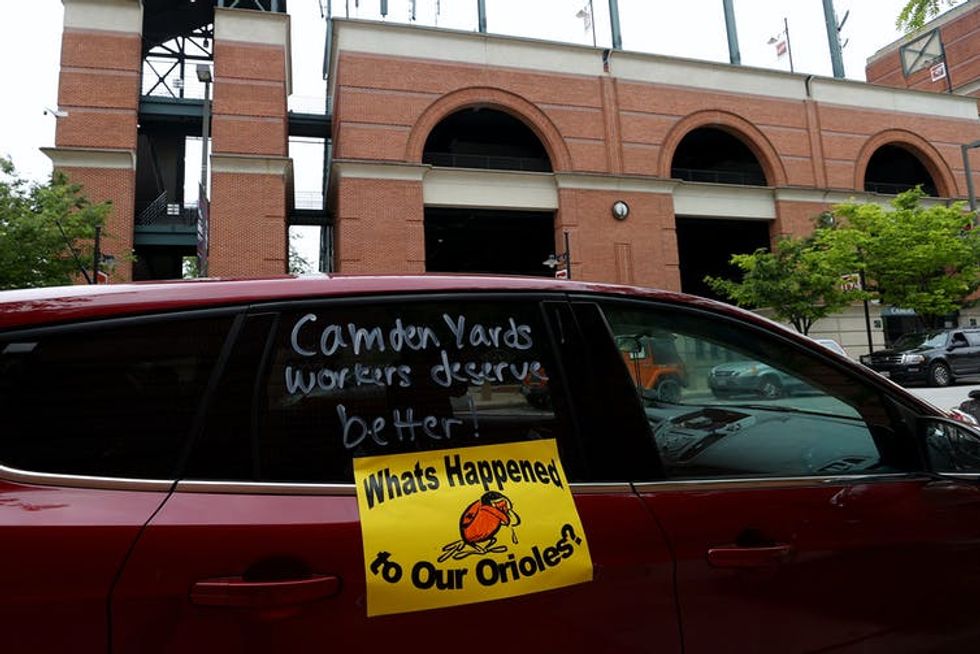
Outside Camden Yards in Baltimore, Maryland, concession workers call for the Baltimore Orioles baseball team to pay the workers unemployment insurance benefits. The start of the baseball season has been delayed due to the COVID-19 pandemic.
If you fall sick and need medical help but are currently uninsured, you should not hesitate to seek care.
Many providers, particularly hospitals and federally qualified health centers, will actively seek to enroll you into public coverage like Medicaid. Importantly, Medicaid coverage in most states can be applied retroactively for three months. However, a few states like Arizona and Iowa have obtained permission to exclude this benefit.
Even then, many states have longstanding protections for uninsured individuals that requires providers to use so-called sliding scales, the adjustment of fees based on income. Others have local programs that may help pay for your care. The CARES Act also provides reimbursement for some COVID-19-related care directly to providers.
Importantly, if you get a bill, try to negotiate with the provider. Legal aid societies across the country are there to help in this process.
How the ACA lawsuit may impact health insurance coverage
From a policy perspective, the coronavirus pandemic starkly highlights the need for a strong safety net. It is also offers a reminder of the benefits that the ACA provides to millions of Americans on a daily basis. Without it, millions more would lose their coverage.
It is important to remember that the ACA’s constitutionality is currently in litigation once more before the Supreme Court. The Trump administration has taken a virtually unprecedented step and refused to defend it. It has also argued that if any of the law is struck down, it should fall in its entirety. Of course, should this occur, the implications for the U.S. could be dramatic. On the other hand, should former Vice President Joe Biden come to office with a large Democratic majority in both chambers, it seems realistic to expect him to move forward with expanding the ACA and seeking the inclusion of the so-called public option.
On Saturday, Politico reported that President Donald Trump's re-election campaign is floundering in its efforts to craft a re-election strategy that can work in the coronavirus pandemic — particularly his planned efforts to woo communities of color.
"Almost a month ago, as the coronavirus exacted an outsized toll on vulnerable groups across America, President Donald Trump turned to an under-the-radar White House council to quickly determine how the federal government 'can best support minority and distressed communities," wrote Gabby Orr. "Little has come of it. The White House Opportunity and Revitalization Council, repurposed by Trump on April 22 to confront the pandemic’s disproportionate damage to communities of color, is still assembling proposals to reduce racial health disparities that have been magnified by the coronavirus outbreak, according to four people familiar with the planning."
"The delay in tackling the disproportionate mortality and infection rates and financial strain in minority communities — some of the most severe of the coronavirus crisis — underscores the challenge administration officials face as they grapple with a dire public health crisis," continued the report.
"The dearth of information about the federal government’s plans to correct failures that have exacerbated the pandemic’s impact on communities of color has not stopped the president — or his campaign — from using the topic to forge ahead in their pursuit of black and Latino supporters," said the report, noting that the president is continuing to trumpet his efforts on "underserved communities." "Nevertheless, minority voters have continued to give the president low marks for his handling of the coronavirus outbreak, which has claimed more than 80,000 American lives since February."
"One campaign official said that in order to survive the November contest, Trump needs to eat into the overwhelming support his likely challenger, former Vice President Joe Biden, enjoys among African Americans, while also strengthening his appeal among non-college educated whites," said the report. "The problem is, Trump’s singular strength with non-white voters — his handling of the U.S. economy — has disappeared as a reliable talking point in the coronavirus era. From campaign rallies in minority communities to speeches in front of conservative black audiences, the president’s most common refrain has been about low unemployment and steady wage growth, two relics of a pre-coronavirus economy."
The United States recorded 1,680 coronavirus deaths in the past 24 hours, bringing its grim total to 87,493, according to the latest real-time tally Friday reported by Johns Hopkins University.
The country -- hardest hit by the pandemic in terms of the number of fatalities -- has now confirmed a total of 1,442,924 cases, the Baltimore-based school reported.
You know someone's in a real panic when they start running in circles, and that's what Donald Trump has been doing for the past week. He started off last Sunday with an epic tweetstorm, 126 of them in all, the third-highest total for one day in his presidency, according to FactBa.se, which keeps track of Trump's statements. "Obamagate!" he tweeted, following that one with "Because it was Obamagate, and he and Sleepy Joe led the charge. The most corrupt administration in history!"
That presaged by 24 hours his now-famous exchange with Philip Rucker of the Washington Post in the Rose Garden, when Rucker asked him, "What crime, exactly, are you accusing President Obama of committing?"
"Obamagate," Trump replied, refusing to define the "crime" or provide any specific evidence. So Rucker followed up: "What is the crime, exactly, that you're accusing him of?" Trump shot him what passed for an angry look: "You know what the crime is," Trump answered. "The crime is very obvious to everybody."
What was Obamagate, pundits asked each other with puzzled looks on their faces, as the week wore on? They should have known that it would have something to do with Michael Flynn, Trump's former national security adviser, who lasted all of 24 days in the job before being fired for lying to Vice President Mike Pence about his phone call with Russian ambassador Sergey Kislyak in late December of 2016. Flynn was later charged with lying to the FBI, pled guilty twice, and has been awaiting sentencing for more than two years. Trump's Department of Justice, under the direction of Large Lickspittle Bill Barr, moved to drop the charges against Flynn last week, which generated a letter signed by 2,000 former Justice Department officials denouncing the motion filed by Little Lickspittle Timothy Shea, the U.S. attorney for the District of Columbia. The judge in the case will hold hearings on the matter and has not yet issued a ruling.
There is a perfect symmetry to the involvement of Michael Flynn in Trump's latest attempt to deflect attention from his inept handling of the coronavirus crisis, which has caused the infections of more than 1.4 million Americans and the deaths of more than 87,000 nationwide. Flynn enjoyed a singular distinction during the transition between the Obama and Trump administrations, besides his coziness with Russian bankers and ambassadors. Obama gave Trump only one piece of personal advice during their private meeting in the White House after Trump was elected: Whatever you do, don't hire Michael Flynn. For anything. Ever.
But Trump loved Flynn. It had been Flynn who led the delegates at the 2016 Republican National Convention in chanting "lock her up" after mentioning the alleged criminal behavior of Hillary Clinton as secretary of state. As with Trump's use of "Obamagate" as a shorthand for Obama's alleged corruption while in office, Flynn's allegations against Clinton were equally vague and shorn of specificity. Trump had already been encouraging his crowds to chant "lock her up" at his campaign rallies in 2016, and has continued the practice ever since. I don't know of a single rally Trump has held since he's been in office when the crowd didn't break into the "lock her up" chant, with Trump allowing the fascist bellowing to wash over him as he stands at the podium, smiling with approval at the crowd.
I use the words "fascist bellowing" on purpose, because that's what it is: Trump supporters at public events and rallies loudly endorsing official lawlessness. It's not a funny joke or clever verbiage. Trump and his followers have been routinely advocating the jailing of Trump's political opponents without an investigation, criminal charges, trial or conviction by a jury of their peers. This is the way fascist dictators dispose of their political opposition. Putin has jailed opponents of his regime. He has also arrested wealthy businessmen whose enterprises he wanted to seize, and of course he has ordered the murder of Russian citizens who he felt betrayed him.
Trump himself circled back around to calling for the jailing of his political enemies for unspecified crimes on Thursday morning in an interview with Maria Bartiromo on the Fox Business Network. Trump called the "unmasking" of Flynn "the greatest political crime in the history of our country."
He continued: "If I were a Democrat instead of a Republican, I think everybody would have been in jail a long time ago … it is a disgrace what's happened. This is the greatest political scam, hoax in the history of our country." To set the record straight, that's ludicrous and untrue. Flynn's "unmasking" was a routine national security procedure during which officials in the Obama administration were given Flynn's name as the person who was caught on NSA wiretaps talking to Kislyak during the Trump transition, when Flynn was serving as an adviser to Trump on national security and international relations. Included among the Obama officials were Trump's bete noire, former FBI director James Comey, and Vice President Joe Biden.
Another fascist dictator who made use of extrajudicial imprisonment of political enemies was Adolf Hitler. He didn't bother with leading "Lock her up" chants at his rallies. He just locked up his political opponents and racial and ethnic and religious enemies in concentration camps where they were executed or perished from disease and starvation. His followers rewarded him at political rallies by chanting "Heil Hitler." It was the all-purpose approbation of Hitler's leadership of Nazi Germany, a mass public endorsement of everything he did, including locking up his political opponents. That's what "Lock her up" has become for Trump.
Trump's campaign people are already talking about holding rallies as Trump blackmails the states by pushing his "open up" madness. "Lock her up" chant doubles down on hatred for Hillary Clinton, or these days for Nancy Pelosi and Joe Biden, for those in love with Trump, by loudly calling for his political opponents to be imprisoned without trial for unspecified crimes. If you don't believe me, listen to the chant the next time he holds a rally. Trump's followers are both swearing allegiance and saluting him. "Lock her up" is Trump's "Heil Hitler."
People living in the most deprived areas of Britain are more than four times likelier to test positive for COVID-19 than those living in the richest neighborhoods, new research showed Saturday.
A University of Oxford study looked at more than 3,600 COVID-19 test results from national programs and found that deprivation, age and chronic liver disease all increased the likelihood of testing positive.
Of that sample, the more than 660 people living in the most deprived areas, 29.5 percent tested positive, compared with just 7.7 percent of those in richer areas, the study showed.
Those aged 40-64 were at the highest risk, with 18.5 percent of that age group testing positive compared to just 4.6 percent of under 17s.
A greater percentage of men (18.4 percent) tested positive than women (13.3 percent).
And people of black ethnicity were more than four times likelier to test positive than those of white ethnicity -- 62.1 percent vs 15.5 percent.
The authors, however, cautioned that the cohort of black people tested in the study was small -- only 58 people.
"With each day that passes our knowledge of COVID-19 improves," said Gayatri Amirthalingam, from Public Health England and co-author of the study printed in The Lancet.
"This analysis of primary care outcomes of individuals testing positive for virus is an important contribution to our wider understanding of how COVID-19 is affecting people of different demographic groups."
The study has a number of limitations as it relies only on test results from routine testing programs, which may skew the demographics of people included in the research.
Nevertheless, lower income appeared to be a significant COVID-19 risk factor.
"We found an association between increasing deprivation and increased odds of a positive test, independent of household size, urban location, and smoking," the authors said.
'Existing inequalities'
The results showed current smokers were in fact less likely to test positive than non-smokers (11.4 percent vs 17.9 percent).
But that does not mean smoking protects an individual from COVID-19.
For one thing, smokers are more likely to cough -- a key symptom of the novel coronavirus -- and therefore may be more likely to get tested even when not sick.
It is also possible that smoking affects the efficacy of current COVID-19 swab tests.
"As well as the well-documented harms to overall health from smoking, there is potential for smoking to increase the severity of COVID-19 disease," said Simon de Lusignan, director of the Royal College of GPs Surveillance Centre.
Writing in a linked comment article, Rachel Jordan, a researcher from the University of Birmingham, said the study could help shape testing programs by prioritizing at-risk communities.
"What is fundamentally clear is that whatever the specific risk factors, the COVID-19 pandemic exacerbates existing socioeconomic inequalities," said Jordan, who was not involved in the research.
Appearing on MSNBC with guest host Joy Reid, former GOP campaign consultant Steve Schmidt tore into Donald Trump for his handling of the coronavirus pandemic that has led to over 85,000 dead, 35 million unemployed and the economy reeling.
Noting how other presidents have handled major disruptions, Schmidt said the damaged economy above all can be laid at Trump's feet.
Praising America's response to tragedies Schmidt explained, "We have fed more people, clothed more people, liberated more people and cured more people."
He then turned to Donald Trump.
"Donald Trump has been the worst president this country has ever had," he stated. "I don't say that hyperbolically -- he is. But he is a consequential president. He has brought this country, in three short years, to a place of weakness that is simply unimaginable if you are pondering where we are today from the day where Barack Obama left office."
"This is a moment of unparalleled national humiliation, of weakness when you listen to the president," he continued. "There are the musing of an imbecile, an idiot. And I don't use those words to name-call, I use them because they are the precise words in the English language to describe his behavior, his comportment, his actions. We've never seen a level of incompetence, a level of ineptitude so staggering on a daily basis from anybody on the history of the country."
The state Supreme Court's order comes one day after a state appeals court had allowed the expansion to stand while a legal case was appealed.
The Texas Supreme Court on Friday temporarily put on hold an expansion of voting by mail during the coronavirus pandemic.
Siding with Attorney General Ken Paxton, the Supreme Court blocked a state appeals court decision that allowed voters who lack immunity to the virus to qualify for absentee ballots by citing a disability. That appellate decision upheld a lower court's order that would have allowed more people to qualify to vote by mail. The state's Supreme Court has not weighed the merits of the case.
It’s the latest in an ongoing legal squabble that in the last three days has resulted in daily changes to who can qualify for a ballot they can fill out at home and mail in.
Federal and state courts are considering legal challenges to the state’s rules for voting by mail as Democrats and voting rights groups ask courts to clarify whether lack of immunity to the coronavirus is a valid reason for people to request absentee ballots. A resolution to that question is gaining more urgency every day as the state approaches the July primary runoff elections.
Paxton asked the Supreme Court to intervene the day after a state appeals court let stand a ruling from state District Judge Tim Sulak that susceptibility to the coronavirus counts as a disability under the state election code and is therefore a legally valid reason for voters to request absentee ballots.
The appeals court rebuffed Paxton's efforts to block voters from requesting absentee ballots under those conditions while the case was making its way through the courts.
But the Supreme Court’s Friday decision means that order will remain blocked while the appeal of the case moves forward.
"The Legislature has carefully limited who may and may not vote by mail," Paxton said in a statement after the ruling. "The Travis County trial court’s decision to allow everyone to vote by mail is contrary to state law and will be reversed on appeal."
In a statement, Texas Democratic Party Chair Gilberto Hinojosa said the party would continue the legal battle.
“This is a dark day for our democracy," he said. "The Republican Texas Supreme Court is wrong to force the people of Texas to choose between their health and their right to vote. They would have Texans die, just so they can hold on to power."
The attorney general has said local officials must follow his reading of existing eligibility requirements. Paxton argues that a fear of contracting the virus while voting in person doesn’t meet the state’s definition of a disability.
The Texas election code defines disability as a “sickness or physical condition” that prevents a voter from appearing in person without the risk of “injuring the voter’s health.”
But Sulak’s ruling is not based on voters’ fear of contracting the virus; instead, he agreed with the individual Texas voters, state Democrats and civic organizations that argued that a lack of immunity to the virus makes voters eligible under the existing disability definition.
The court also set oral arguments for Wednesday on Paxton's request for it to weigh in on whether the appeals court erred and abused its discretion when it allowed Sulak's order to go into effect.