Ousted U.S. vaccine chief Dr. Rick Bright testified on Thursday that "lives were lost" because the Trump administration failed to ramp up the production of personal protective equipment like N95 respirators.
During testimony before a House committee, the former director of the Biomedical Advanced Research and Development Authority said that he sounded the alarm about the need for protective equipment at the outset of the novel coronavirus pandemic.
"There were dozens of these alerts," Bright explained. "I pushed those forward to our leadership... I pushed those warnings to our critical infrastructure protection team. I pushed those warnings to our strategic national stockpile team who has the responsibility of procuring those medical supplies for our stockpile."
Bright said that he was repeatedly "met with indifference, saying they were either too busy or they didn't have a plan, they didn't know who was responsible for procuring those."
The ousted vaccine chief went on to claim that people had died because of the Trump administration's failure.
"Lives were endangered and I believe lives were lost," he lamented. "And not only that. We were forced to procure these supplies from other countries without the right quality standards. So even our doctors and nurses in the hospitals today are wearing N95 marked masks from other countries that are not providing the sufficient protection that a U.S. standard N95 mask would provide them."
"It just shows how very little regard Amazon has for its overworked employees."
Online retail giant Amazon has repeatedly referred to its workers as "heroes" as they carry out their jobs during the coronavirus pandemic, but the company announced this week that it is planning to end both $2-an-hour pay increases and double overtime for warehouse workers at the end of May even as CEO Jeff Bezos sees his wealth continue to soar.
Whole Foods, the Amazon-owned supermarket chain, also informed employees Tuesday that their $2 hourly raises will end on June 1.
"Staff put themselves at risk every day. Also with the harsh regime and difficult targets the workers more than deserve the pay rise permanently."
—Amazon employee
"When Amazon announced the first wage hike on March 16, it was set to run through the end of April," Recodereported Wednesday. "Amazon later extended the policy through May 16. Now the increases will end on May 31."
Asked by Recode why the hazard pay won't continue beyond the end of this month, an Amazon spokesperson dodged the question.
"This appreciation and pay incentive enabled us to deliver essential items to communities during these unprecedented times," the spokesperson said. "We are grateful to associates supporting customers during a time of increased demand, and are returning to our regular pay and overtime wages at the end of the month."
One Amazon employee called the company's decision to end hazard pay "disgraceful" in an interview with Business Insider.
"Staff put themselves at risk every day," the employee said. "Also with the harsh regime and difficult targets the workers more than deserve the pay rise permanently. It just shows how very little regard Amazon has for its overworked employees."
Another Amazon worker told Business Insider that the decision is a "slap in the face."
As Amazon moves to end small hazard pay increases for its workers, an analysis released Thursday by the Institute for Policy Studies found that Bezos—the richest man in the world—saw his wealth increase by $30 billion between March 18 and May 14.
Hundreds of Amazon warehouse workers and Whole Foods employees have called in sick and walked off the job in recent weeks to demand better pay and adequate safety equipment. One employee toldCBS News that at least 600 Amazon workers have tested positive for Covid-19.
"Amazon treats the humans in the warehouses as fungible units of pick-and-pack potential," said former Amazon vice president Tim Bray, who resigned in disgust earlier this month over the company's treatment of whistleblowers. "Only that's not just Amazon, it's how 21st-century capitalism is done."
White House press secretary Kayleigh McEnany says Americans "should be celebrating" that President Donald Trump and Vice President Mike Pence are healthy in the face of a pandemic that has now killed over 85,000 Americans.
McEnany was asked if the President and Vice President "have a procedure should the president and vice president become incapacitated due to coronavirus and Speaker Pelosi needs to step in?"
McEnany signaled they do not, nor do they plan to.
“That's not even something that we're addressing," McEnany told reporters. "We're keeping the president healthy. We're keeping the vice president healthy and you know they're healthy at this moment and they'll continue to be.”
When pressed, McEnany shot back: “The President's healthy. The Vice President's healthy and I think that's something all reporters should be celebrating and the American people as well.”
A key government agency has found that a whistleblower complaint filed by Dr. Richard Bright has uncovered a "substantial likelihood of wrongdoing."
The United States Office of Special Counsel, an independent federal agency whose mission is to protect government whistleblowers, released a statement on Tuesday affirming that Bright's complaint seems to have merit, and that the Department of Health and Human Services should initiate a full investigation of his claims.
"We emphasize that, while OSC has found a substantial likelihood of wrongdoing based on the information you submitted in support of your allegations your referral to the Secretary for investigation is not a final determination that the allegations are substantiated," the letter states, according to CNBC.
Bright, who was ousted last month from his position as the head of the Biomedical Advanced Research and Development Authority, testified on Thursday that America will face its “darkest winter in modern history” without further measures to improve the government’s ability to test and trace people infected with COVID-19.
Bright's whistleblower complaint alleges that he was removed from his position because he was resisting pushing anti-malarial drug hydroxychloroquine, which has been heavily promoted by President Donald Trump, as a treatment for COVID-19.
White House Press Secretary Kayleigh McEnany lashed out at Dr. Rick Bright on Thursday as he testified that the Trump administration ignored warnings about the novel coronavirus pandemic.
Bright, who was ousted as director of Biomedical Advanced Research and Development Authority, appeared before Congress Thursday morning to sound the alarm about what he predicted could be "the darkest winter in modern history" if the administration does not properly prepare.
Following his opening statement, McEnany appeared on Fox News where she cherry picked his remarks to claim the doctor had not been "paying attention."
"It sounds like Mr. Bright hasn't really been paying much attention," McEnany opined. "In fact, when he talks about the pandemic playbook, we actually put into place a pandemic preparedness document with recommendations long before the pandemic ever came."
"It sounds like he hasn't been paying attention when he suggests Americans should social distance and wash their hands," she continued. "These are all things we said millions of times probably at this point when you count everyone at the White House who has been saying it."
McEnany said that Bright also "wasn't paying attention when he talked about building up a stockpile of equipment."
"Perhaps he's unaware of the 25 million N95 respirators the president's delivered," she opined, ignoring the initial shortages of supplies.
"It sounds like this is someone who's reacting and making suggestions that have long been put into play," McEnany remarked.
The government controls the weather, they caused 9/11, there was no Holocaust, mass shootings are false flag attacks from the government -- these are all conspiracy theories peddled by conspiracy theorists cited in a new examination in The Atlantic's "Shadowland" project.
"My assumption about people like [Alex] Jones was that they were nihilistic grifters, exploiting innocent people seeking to satiate the deep human need for coherence," wrote Jeffrey Goldberg. "Jones told me he was busy; I could have 30 minutes. Four hours later he was still talking—we were having dinner at a Mexican restaurant by then—and I was looking for an exit."
“We’re living under tyranny," Jones told Goldberg. "The bankers, the New World Order, they’re using the War Powers Act to grab our guns. This isn’t a republic. Come on, if you say the bankers are forcing fluoride on us, if you call 9/11 an inside job, they’ll destroy your life, that’s how evil they are.”
Unlike the conspiracies Goldberg had heard over the years in the Middle East or the Russian conspiracy-mongering, he noted people like Jones were generally a source of amused mockery than serious consideration. Then came President Donald Trump.
“Your reputation is amazing,” Trump told Jones as he launched his campaign in 2015. “I will not let you down.”
Goldberg noted that Trump has stayed true to his promise.
"Trump does not defend our democracy from the ruinous consequences of conspiracy thinking," he wrote. "Instead, he embraces such thinking. A conspiracy theory—birtherism—was his pathway to power, and, in office, he warns of the threat of the 'deep state' with the ferocity of a QAnon disciple."
He's not just proposing injecting disinfectant, he's prescribing drugs he knows nothing about, and promoting sending people back to work whether it's safe or not.
"This improbable question—how did a person with a weakness for conspiratorial thinking achieve the presidency?—might be among the most consequential of the coming election, which is not merely a political contest, but a referendum on enlightenment values and on reality itself," wrote Goldberg. "Nonsense is nonsense, except when it kills. And conspiracy thinking, especially when advanced by the president of the United States, is an existential threat."
"Diplomatic platitudes are not enough—we need legal guarantees, and we need them now."
Over 140 global leaders and experts on Thursday issued an open letter urging world powers to guarantee that both a coronavirus vaccine and any treatment for Covid-19, when available, be free for everyone in order to put the "the interests of all humanity" ahead of those of the wealthiest corporations and governments.
The new letter, "Uniting Behind a People's Vaccine Against Covid-19," is signed by current and former heads of state including Pakistan's Prime Minister Imran Khan and former Irish President Mary Robinson as well as other notable figures including former United Nations special rapporteur Philip Alston and economist and Nobel laureate Joseph Stiglitz.
"Faced with this crisis, we cannot carry on business as usual," Helen Clark, former prime minister of New Zealand, said in a statement. "Diplomatic platitudes are not enough—we need legal guarantees, and we need them now."
The global call comes days ahead of the World Health Organization's World Health Assembly. At that virtual meeting, scheduled for Monday, the letter signatories say health ministers must remember the WHO's founding principle to help achieve "the enjoyment of the highest attainable standard of health as a fundamental right of every human being."
The letter calls on the World Health Assembly to "forge a global agreement that ensures rapid universal access to quality-assured vaccines and treatments with need prioritized above the ability to pay."
"Now is not the time to allow the interests of the wealthiest corporations and governments to be placed before the universal need to save lives, or to leave this massive and moral task to market forces," says the letter. "Access to vaccines and treatments as global public goods are in the interests of all humanity. We cannot afford for monopolies, crude competition, and near-sighted nationalism to stand in the way."
The letter says that health ministers should learn from the successes and failures in global efforts to tackle HIV, Ebola, and AIDS and hammer out an agreement with three key pillars: mandate worldwide sharing of Covid-19 information and technologies; roll out a rich nation-funded vaccine and technologies distribution plan; and guarantee free vaccine, treatment, and diagnostics with priority going towards front-line workers and the most vulnerable communities.
"Only a people's vaccine—with equality and solidarity at its core—can protect all of humanity and get our societies safely running again," the letter says. "A bold international agreement cannot wait."
President Donald Trump is in an awkward position. If he doesn't reopen the country -- the economy will likely stay where it is. If he reopens the country prematurely, people will die. In an election year, he's betting on the economy being the more important option than the lives of Americans.
It isn't merely that Trump has decided that the country needs to reopen all businesses, it's that he doesn't seem to have another plan for reviving the economy other than reopening. Any future stimulus package Democrats are working on is "dead on arrival," Trump proclaimed in a Fox News interview Wednesday.
"The White House has now essentially bet everything that states loosening restrictions will spur growth in time for November's election," the column explained.
Fauci's information flies in the face of Trump's plans. If a scientific expert says reopening will cause more suffering and death, Americans stand up and take notice. They're likely more apt to trust a long-time virus expert over a president who told the world to inject disinfectant into their bodies to kill the virus.
"By casting him as an unelected bureaucrat who is attempting to undermine Trump, they're harkening back to the 'deep state' conspiracies that have fueled Trump countless times before, most recently during impeachment and even concurrently with the events surrounding the Michael Flynn case," the report continued.
At the same time, Trump is likely miffed that more people trust Fauci than himself. Approval ratings show that Fauci is far more trusted by the public than the president.
"Officials say Trump has long held out some resentment that Fauci is respected and liked by people he has struggled to convert," said CNN.
Fauci testified this week that his relationship with Trump isn't a combative one, but Trump is being undermined publicly and he isn't happy about it.
The good doctor likely isn't headed for the political guillotine, but CNN anticipated the White House will begin to limit Fauci's public appearances and find other scientists who can undermine his warnings and match the president's strive to reopen at all costs.
PHILADELPHIA — Arguing that Pennsylvania should move quickly to reopen its economy even as coronavirus cases surge in some areas, the state House’s Republican leader said this weekend that reopening schools in the fall should be a top priority.Not only do students deserve a chance to perform experiments in science labs and play instruments in recitals, House Speaker Mike Turzai said — children are largely protected from the ravages of the virus because of their youth, and would be safe if they go back to school.“Guess what, they’re not at risk unless they have an underlying medical issue,” sai...
While much of America is holding out hope for a vaccination that will stop the spread of COVID-19, anti-vaccination activists are already preparing a massive informational warfare campaign aimed at convincing millions of Americans to forgo the eventual vaccine.
New York Times reporter Kevin Roose, who for years has been following the anti-vaxxer movement, writes that the campaign against the COVID-19 vaccine is already well under way -- and it stands a good chance of succeeding.
"They are much more organized and strategic than many of their critics believe," he writes. "They are savvy media manipulators, effective communicators and experienced at exploiting the weaknesses of social media platforms."
Roose predicts that anti-vaxxers will raise alarms about the quick development time of the COVID-19 vaccine by claiming that it was not put through a rigorous process to ensure its safety, and will also exploit fears of "mandatory vaccination" to convince people that the vaccine will put Americans' personal freedoms at risk.
"Organizations like the Centers for Disease Control and Prevention and the W.H.O. need to understand the dynamics of online anti-vaccination communities and start waging a hearts-and-minds campaign to restore faith in the medical establishment while a vaccine is being developed," he writes. "Social media companies need to take the threat of vaccine-related misinformation seriously and devote tremendous resources to stopping its spread."
Medical experts at the Centers for Disease Control and Prevention and the TrumpWhite House have expressed different views on how the U.S. can safely reopen during the coronavirus pandemic — and the recommendations offered by the CDC last month were stricter than the Trump Administration’s recommendations. The Associated Press is reporting that Nancy Beck, who Trump has nominated to permanently head the U.S. Consumer Product Safety Commission, played a key role in the “decision to shelve” the CDC’s guidelines on April 30. And Democratic Sen. Maria Cantwell of Washington State is demanding answers.
“I am deeply concerned by the nominee’s involvement in advocating for the deregulation of toxic chemicals known as PFAS, and I also have questions about her potential involvement with the CDC coronavirus guidance,” Cantwell asserted in an official statement.
Beck is a former chemical industry executive, and she has a doctorate in environmental health. However, Beck isn’t a medical doctor and has no experience in virology — unlike Dr. Anthony Fauci or Dr. Deborah Birx, both of whom are part of President Donald Trump’s coronavirus task force.
E-mails obtained by AP, the news agency reports, “show that Beck was the U.S. Centers for Disease Control and Prevention’s main point of contact in the White House about the proposed recommendations. At issue was a 63-page guide created by the CDC that would give community leaders step-by-step instructions for reopening schools, day care centers, restaurants and other facilities."
According to AP, “Beck’s role in the coronavirus guidance document was revealed in a series of e-mails from late April obtained by AP. On April 10, CDC Director Robert Redfield e-mailed the guidance to a group that included some of the president’s closest White House advisers, including Trump son-in-law Jared Kushner, and counselor Kellyanne Conway, and Dr. Anthony Fauci, the government’s top infectious disease expert. Redfield wrote that he wanted White House review and clearance to post the documents on the CDC website.”
In order for Beck to be appointed to head the U.S. Consumer Product Safety Commission permanently, she will have to be confirmed by the U.S. Senate — and Beck is scheduled to appear before the Senate later this month.
A church in Catoosa County, Georgia, is canceling in-house services after three coronavirus cases connected to the church have surfaced.
According to WDEF, this isn't the first time the virus has popped up at a church in the state, and the Georgia Baptist Mission Board is doing what they can to help churches during this time, such as webinars offered online.
“Just practical suggestions, I mean, how do you get people from the parking lot to the church. How do you set up the seating. What should you do and not do and how quick should the service be,” Georgia Baptist Mission Board Public Affairs Representative Mike Griffin said.
When it comes to reopening, Griffin says churches should resort to prayer and determine it's something the congregation wants.
In the search for treatments for COVID-19, many researchers are focusing their attention on a specific protein that allows the virus to infect human cells. Called the angiotensin-converting enzyme 2, or ACE2 “receptor,” the protein provides the entry point for the coronavirus to hook into and infect a wide range of human cells. Might this be central in how to treat this disease?
We are scientists with expertise in pharmacology, molecular biology and biochemistry, with a strong commitment to applying these skills to the discovery of novel therapies for human disease. In particular, all three authors have experience studying angiotensin signaling in various disease settings, a biochemical pathway that appears to be central in COVID-19. Here are some of the key issues to understand about why there’s so much focus on this protein.
What is the ACE2 receptor?
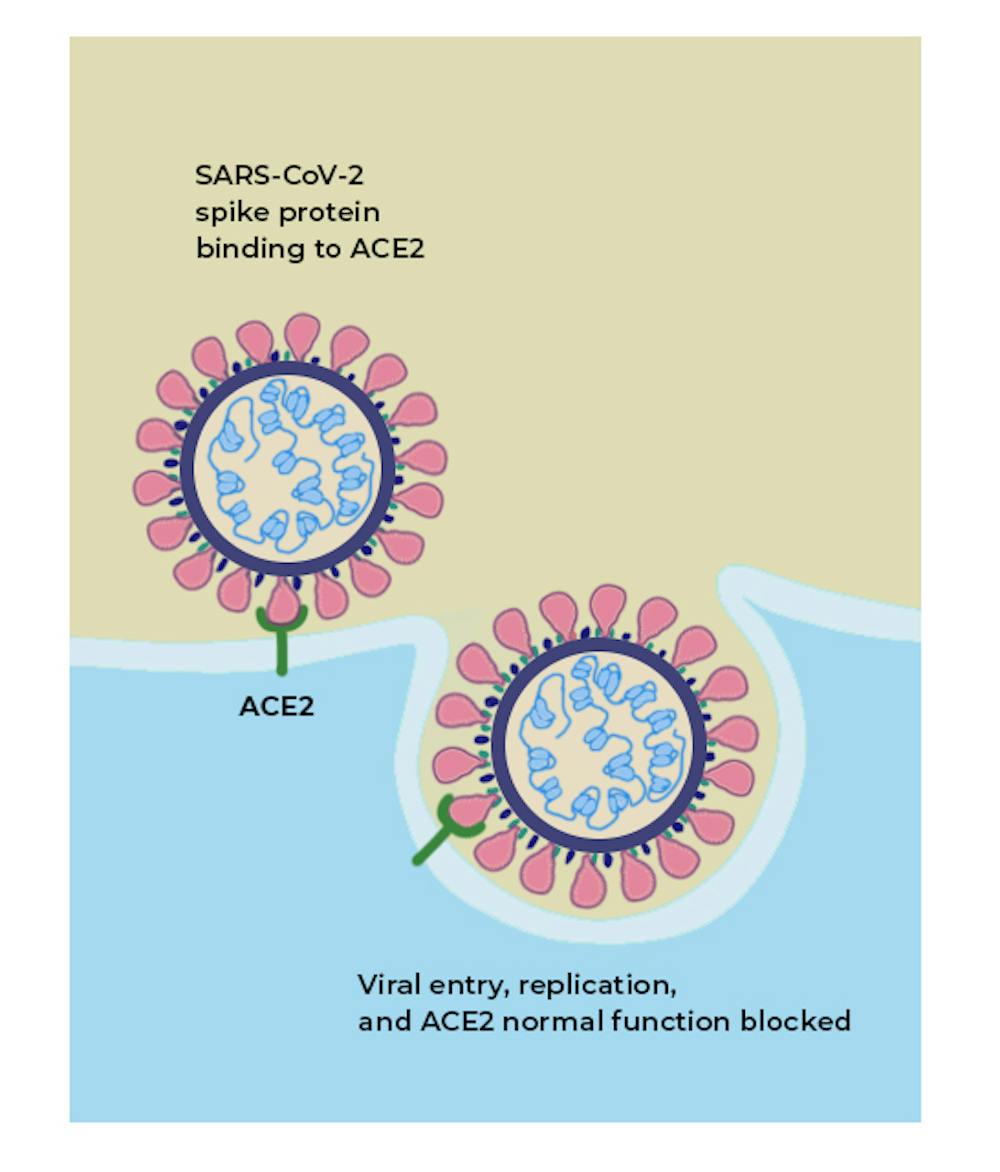
ACE2 acts as the receptor for the SARS-CoV-2 virus and allows it to infect the cell.
ACE2 is a protein on the surface of many cell types. It is an enzyme that generates small proteins – by cutting up the larger protein angiotensinogen – that then go on to regulate functions in the cell.
Using the spike-like protein on its surface, the SARS-CoV-2 virus binds to ACE2 – like a key being inserted into a lock – prior to entry and infection of cells. Hence, ACE2 acts as a cellular doorway – a receptor – for the virus that causes COVID-19.
Where in the body is it found?
ACE2 is present in many cell types and tissues including the lungs, heart, blood vessels, kidneys, liver and gastrointestinal tract. It is present in epithelial cells, which line certain tissues and create protective barriers.
The exchange of oxygen and carbon dioxide between the lungs and blood vessels occurs across this epithelial lining in the lung. ACE2 is present in epithelium in the nose, mouth and lungs. In the lungs, ACE2 is highly abundant on type 2 pneumocytes, an important cell type present in chambers within the lung called alveoli, where oxygen is absorbed and waste carbon dioxide is released.
What is the normal role ACE2 plays in the body?
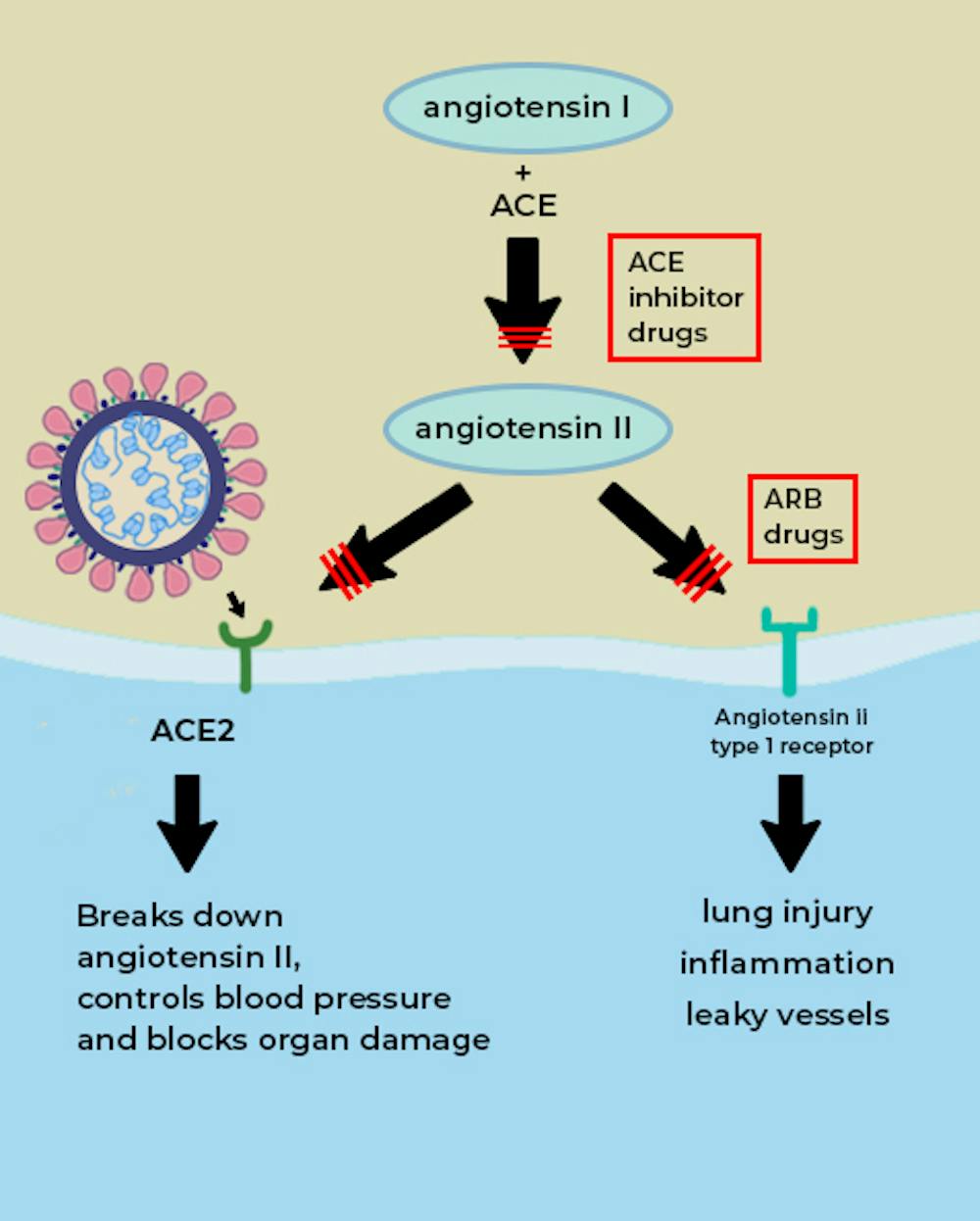
The ACE enzyme converts angiotensin I into angiotensin II. The main role of ACE2 is to break down angiotensin II into molecules that counteract angiotensin II’s harmful effects; but if the virus occupies the ACE2 ‘receptor’ on the surface of cells, then its role is blunted (red lines). Drugs called ACE inhibitors inhibit the formation of angiotensin II, which would otherwise interact with the angiotensin type 1 receptor to produce tissue damage and inflammation. Drugs called ARBs block angiotensin II from interacting with its receptor. Figure adapted from NEJM
ACE2 is a vital element in a biochemical pathway that is critical to regulating processes such as blood pressure, wound healing and inflammation, called the renin-angiotensin-aldosterone system (RAAS) pathway.
ACE2 helps modulate the many activities of a protein called angiotensin II (ANG II) that increases blood pressure and inflammation, increasing damage to blood vessel linings and various types of tissue injury. ACE2 converts ANG II to other molecules that counteract the effects of ANG II.
Of greatest relevance to COVID-19, ANG II can increase inflammation and the death of cells in the alveoli which are critical for bringing oxygen into the body; these harmful effects of ANG II are reduced by ACE2.
When the SARS-CoV-2 virus binds to ACE2, it prevents ACE2 from performing its normal function to regulate ANG II signaling. Thus, ACE2 action is “inhibited,” removing the brakes from ANG II signaling and making more ANG II available to injure tissues. This “decreased braking” likely contributes to injury, especially to the lungs and heart, in COVID-19 patients.
Does everyone have the same number of ACE2 on their cells?
No. ACE2 is present in all people but the quantity can vary among individuals and in different tissues and cells. Some evidence suggests that ACE2 may be higher in patients with hypertension, diabetes and coronary heart disease. Studies have found that a lack of ACE2 (in mice) is associated with severe tissue injury in the heart, lungs and other tissue types.
Does the quantity of receptors determine whether someone gets more or less sick?
This is unclear. The SARS-CoV-2 virus requires ACE2 to infect cells but the precise relationship between ACE2 levels, viral infectivity and severity of infection are not well understood.
Even so, aside from its ability to bind the SARS-CoV-2 virus, ACE2 has protective effects against tissue injury, by mitigating the pathological effects of ANG II.
When the amount of ACE2 is reduced because the virus is occupying the receptor, individuals may be more susceptible to severe illness from COVID-19. That is because enough ACE2 is available to facilitate viral entry but the decrease in available ACE2 contributes to more ANG II-mediated injury. In particular, reducing ACE2 will increase susceptibility to inflammation, cell death and organ failure, especially in the heart and the lung.
Which organs are most severely damaged by SARS-CoV-2?
The lungs are the primary site of injury by SARS-CoV-2 infection, which causes COVID-19. The virus reaches the lungs after entry in the nose or mouth.
ANG II drives lung injury. If there is a decrease in ACE2 activity (because the virus is binding to it), then ACE2 can’t break down the ANG II protein, which means there is more of it to cause inflammation and damage in the body.
The virus also impacts other tissues that express ACE2, including the heart, where damage and inflammation (myocarditis) can occur. The kidneys, liver and digestive tract can also be injured. Blood vessels may also be a site for damage.
In a recent research paper, we argued that a key factor that determines severity of damage in patients with COVID-19 is abnormally high ANG II activity.
What are ACE inhibitors? Are they a possible treatment or prophylactic for SARS-CoV-2?
Angiotensin converting enzyme (ACE, aka ACE1) is another protein, also found in tissues such as the lung and heart, where ACE2 is present. Drugs that inhibit the actions of ACE1 are called ACE inhibitors. Examples of these drugs are ramipril, lisinopril, and enalapril. These drugs block the actions of ACE1 but not ACE2. ACE1 drives the production of ANG II. In effect, ACE1 and ACE2 have a “yin-yang” relationship; ACE1 increases the amount of ANG II, whereas ACE2 reduces ANG II.
By inhibiting ACE1, ACE inhibitors reduce the levels of ANG II and its ability to increase blood pressure and tissue injury. ACE inhibitors are commonly prescribed for patients with hypertension, heart failure and kidney disease.
Another commonly prescribed class of drugs, angiotensin receptor blockers (ARBs, e.g., losartan, valsartan, etc.) have similar effects to ACE inhibitors and may also be useful in treating COVID-19.
No evidence exists to suggest prophylactic use of these drugs; we do not advise readers to take these drugs in the hopes that they will prevent COVID-19. We wish to emphasize that patients should only take these drugs as instructed by their health care provider.
New clinical trial tests ACE inhibitor against SARS-CoV-2
In collaboration with a multidisciplinary group of investigators, Dr. Loomba has initiated a multicenter (randomized, double-blinded, placebo-controlled) clinical trial to examine the efficacy of ramipril - an ACE inhibitor - compared to a placebo in reducing mortality, ICU admission or need for mechanical ventilation in patients with COVID-19.