The lucrative annual trek to harvest a caterpillar fungus nicknamed "Himalayan Viagra" that can fetch three times the price of gold in China will be banned amid Nepal's coronavirus lockdown, officials said Thursday.
Yarchagumba, which means "summer plant, winter insect" in Tibetan, is found for a few weeks above 3,500 meters (11,550 feet) and forms when the parasitic fungus lodges itself in a caterpillar, slowly killing it.
Harvesting the cone-shaped Ophiocordyceps sinensis is highly profitable and every spring, houses and schools empty as thousands of villagers make the sometimes perilous journey up into the mountains to collect it.
But officials said the restrictions imposed by Nepal's nationwide lockdown meant harvesting the fungus would be banned this year. Many districts have already prohibited collectors.
"All local units have been asked not to issue permits for collection of yarchagumba this year," Umesh Pandey, chief of Bajhang district in far west Nepal, told AFP.
Many Himalayan communities are financially dependent on collecting and selling the fungus, with some earning most of their yearly income from a few weeks of harvesting that usually begins in early to mid-April.
But with the snowline yet to retreat, the harvest period this year has been delayed.
In Nepal alone, about three metric tonnes of yarchagumba is collected every year, the country's central bank said in a 2016 report.
"I hope they will open and we can still pick. This is my only job, only option to make an earning," said Harak Singh Dhami, 29, from Darchula district, who made 200,000 rupees (US$1,600) last year after collecting 300 pieces.
People in China and Nepal have in the past been killed in clashes over the elusive fungus.
No definitive research has been published proving its beneficial qualities, but Chinese herbalists believe it boosts sexual performance.
Boiled in water to make tea, or added to soups and stews, it is said to cure a variety of ailments from fatigue to cancer.
Researchers say the purported wonder drug can fetch up to three times the price of gold in Beijing.
To grow, it needs a specific climate with winter temperatures below freezing but where the soil is not permanently frozen.
Experts say that over-harvesting and climate change has made it harder to find over the years.
A gay couple claims that they were kicked out of a U.K. grocery store because they were shopping together, LGBTQ Nation reports.
Jake Holliday and his boyfriend, Rhys, were shopping when a security guard asked them to leave because the store's social distancing guidelines disallowed couples to shop together. But according to Holliday, other heterosexual couples were shopping in the store. He says that heterosexual couples were also standing together in the queue outside.
That's when Holliday took out his phone and began broadcasting the incident on Facebook Live.
“So I said to the [security guard] politely, ‘We are actually a couple,'” Holliday told the store manager. “He got very angry, very irate for no reason. I’ve not been rude at all to him.”
“It’s nothing at all to do with your sexuality,” the manager replied.
“Well, it feels that way,” Holliday said. “Very much so.”
The manager then reiterated that the store only allows people to shop individually.
“That’s fine if we were told at the entrance, but we wasn’t,” Holliday said. “So you’ve not done your job properly anyway because you let numerous couples into this shop.”
The manager told Holliday that he could continue shopping as long as it's done individually, but Holliday decided to leave, telling the manager that he'd never shop at the store again.
Some Republican governors have continued to emphasize the need for social distancing during the coronavirus pandemic, including Maryland’s Larry Hogan and Massachusetts’ Charlie Baker. But others are much more Trumpian in their outlook: Florida’s Ron DeSantis, Texas’ Greg Abbott and Arizona’s Doug Ducey are pushing for their states to reopen their economies sooner rather than later — and in a scathing May 6 op-ed for the Arizona Republic, journalist Laurie Roberts slams Ducey for ignoring scientists who are warning him against reopening Arizona prematurely.
“For seven weeks,” Roberts explains, “Gov. Doug Ducey has assured us that his decisions to reopen the state would be based not on politics or wishful thinking or even a wing and a prayer. Data, he has said over and over again, would be in the drivers’ seat when it comes to steering Arizona through the coronavirus. Now, Ducey has tossed a significant piece of that data — public health models that predict we could be headed toward disaster — out the window.”
Roberts goes on to explain that on Monday, May 4 — after Ducey announced his plans to accelerate the reopening of Arizona’s economy — “state health officials told a team of university experts to stop working on models that project what will happen next. The universities’ models had shown that the only way to avoid a dramatic spike in cases was to delay reopening the state until the end of May. Instead, Ducey will rely on a federal model — one we aren’t allowed to even see.”
Roberts notes that Ducey recently extended his stay-at-home order for Arizona to May 15, but when Trump and other Republicans pushed for ending shutdowns in the U.S. sooner rather than later, he “began to undo this.”
“Ducey, on Monday, decreed that barber shops and hair salons could reopen on Friday, (May 8) and restaurants on May 11,” Roberts observes. “The stay-at-home order is expected to end next week.”
One of the scientists Ducey is ignoring is Tim Lant, a mathematical epidemiologist at Arizona State University. On April 22, Lant told the Arizona Republic, “I can say, scientifically, no, it’s not safe to reopen unless you’re planning on, you know, shutting down again after a couple of weeks.”
“Shortly after Ducey’s Monday announcement that he’s reopening parts of the economy,” Roberts writes, Lant and his team were notified that “their services are no longer needed — and not only that, but they’ll be cut off from access to state data they need to continue their modeling.”
Not all Arizona politicians are on board with Ducey’s desire to reopening the state prematurely. Arizona Sen. Kyrsten Sinema, a centrist Democrat, reaffirmed her commitment to social distancing this week and has been critical of Ducey. Sinema, on May 6, tweeted, “To reopen strong, we must be safe and smart. For now, that means continuing to social distance and stay home — as well as increasing testing and infection-tracking.”
Roberts concludes her op-ed on a biting note, stressing that Ducey’s actions are based on what is politically expedient — not on the best interests or health of Arizona residents.
“He’s got a president up for re-election who desperately wants to reopen the country, a party that is leaning on him to reopen the state and a team of university scientists who are cautioning him to go slow,” Roberts says of Arizona’s Republican governor. “Guess which one landed in the ditch this week?”
NFL commissioner Roger Goodell has unveiled protocols that would allow clubs to reopen team facilities to non-players and told all 32 clubs to have them in place by May 15.
In a memo outlining the route to safely reopen workout areas, Goodell asked each club to have an infection response team in the wake of the coronavirus pandemic that has shut down US sports leagues.
NFL facilities have been closed since March 25 due to the deadly virus outbreak.
The NFL, planning to start its next season on schedule in September, says state government officials must approve reopening facilities while social distancing and other safety measures must be followed.
No more than 50% of team staff would be allowed back into facilities, although players who were recovering from injuries would be allowed back as well in the first phase of the gradual reopening plan.
"The protocols are intended to allow for a safe and phased reopening," Goodell's memo said. "The first phase would involve a number of non-player personnel.
"No players would be permitted in the facility except to continue a course of therapy and rehabilitation that was underway when facilities were initially closed.
"Clubs should take steps to have these protocols in place by Friday, May 15 in anticipation of being advised when club facilities will formally reopen."
Protocols include wearing a cloth face covering or medical safety mask, temperatures taken daily and health questions for team employees and visitors to the facility.
It was uncertain whether the NFL would allow some clubs to reopen if others were not allowed by local government stay-at-home regulations.
The deadline to have all measures in place for a reopening is four days before the NFL's virtual league meeting of team owners.
Goodell discouraged speculation by team officials about possible options for the 2020 campaign, saying, "it is impossible to project what the next few months will bring".
The league continues to talk with the NFL Players Association about protocols for allowing players back into facilities, with details expected "fairly soon" according to Goodell.
The Research Brief is a short take about interesting academic work.
The big idea
The most common type of test for the new coronavirus takes several hours and is uncomfortable; samples are obtained by sliding a swab into the nose or throat.
Shining a laser onto virus samples trapped in mesh of carbon nanotubes will produce a signature ‘reflection.’
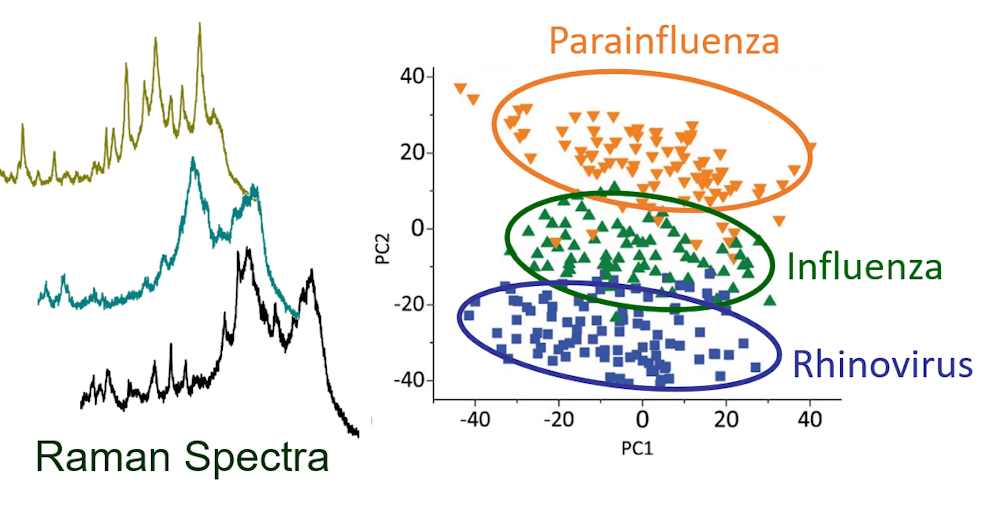
Our approach uses a technique called Raman spectroscopy to identify viruses by shining a light on a disposable cartridge that collects samples from oral cotton swabs or a person blowing through the device. Once a sample is collected, a spectrometer measures the interatomic vibrations that result from shining the light on the collected viruses. Each virus has its own signature vibrations, which act as a sort of optical fingerprint that can distinguish the coronavirus from, for example, the virus that causes influenza.
We could capture viruses from patients’ saliva taken with a swab or by a person blowing through a device, called a microfluidic cartridge. The air and liquid pass an array of carbon nanotubes, cylinder-shape molecules used in different materials.
The diameters of the nanotubes are microscopic, between 10-60 nanometers. Because they are smaller than microbes – flu viruses range from 90-120 nanometers in diameter and coronaviruses range from 125-150nm in diameter – the pathogens collect on the carbon nanotubes. Once trapped by passing through the carbon nanotubes, the viruses can be optically identified by shining a laser on the sample. Shining the light on the carbon nanotubes and pathogens creates a distinctive optical fingerprint, or “Raman peaks.”
After being beamed with lasers, different microbes will give off radiation in different wavelengths that can be measured to identify the pathogen.
After the laser shines on the trapped sample, machine learning algorithms identify the signature spectrum of the virus that results from the light that bounces off the virus particles. With the assistance of machine learning, the identification takes less than two minutes with an accuracy rate of up to 70% to 90%, comparable to state-of-the-art microbiology techniques.
Why it matters
Right now, the rapid and accurate detection of the novel coronavirus is of paramount importance. While Raman spectroscopy has the potential to be enormously helpful in identifying this virus, doctors can also use this technique to test for other illnesses, such as influenza. By identifying the virus easily, quickly and at the point of contact, Raman spectroscopy could significantly halt disease spread.
Compare that to our current methods of analyzing samples; a process that is relatively slow, tedious, labor intensive and requires extensive scrutiny at laboratories. Early and rapid detection with this new device has the potential to save hundreds of thousands of lives every year.
What other work is being done
For the identification of viruses, existing technologies do provide relatively sensitive detection. However, they take several hours and sometime days depending on the quality of the sample collected because low virus concentrations are very difficult to process and results in false negatives.
Unfortunately, both immune- and molecular-based methods, including enzyme-linked immunosorbent assay (ELISA) and polymerase chain reaction (PCR), require prior knowledge of the strains. Another technique known as deep sequencing is another promising new approach, but obtaining sufficient viral reads for it to work well depends on the quality of the sample and its preparation. Processing steps involve incorporating different benchtop equipment, reagents and technical expertise.
We are applying for federal funds to demonstrate that this technology works for SARS-CoV-2, the virus that cause COVID-19, and then build reliable prototypes that can be scaled up for mass production and field deployment. We are also talking with several manufacturers and exploring ways to move the technology forward to help in the current crisis.
We have been successful in capturing human respiratory viruses from clinical samples using this technique. Eventually, we foresee this technology becoming available to anyone visiting their family doctor. Within two minutes, a person would know whether you have a respiratory virus by comparing the result of the spectroscopy test with other results in a database. In the future, this technology could be at hospitals, airports and inside commercial aircraft to avoid outbreaks. And the captured viruses, still viable, can be replicated to develop a vaccine.
Scientists have been tracking changes to the genetic makeup of the new coronavirus to better understand how best to slow its spread. My research on the link between high blood sugar in patients and severity of illness from the virus could provide insight into the nature of different possible types of virus. Specifically, the presence of sugar on the virus’s spike protein could help differentiate them.
Many physicians noticed that people with high blood sugar, not only those with a history of diabetes but also unexplained new diabetes, were showing up in the hospital with the novel coronavirus. This indicated to me that something could be going on with the addition of sugar molecules to the virus, or the receptor it latches onto to infect cells, that influenced the severity of the disease.
I am a medical oncologist at the University of Pittsburgh who treats women with breast cancer. Colleagues of mine at the University of Pennsylvania have trials where we use the drug hydroxychloroqine to try to keep breast cancer from growing in the bone marrow, only to regrow years later. We call this tumor dormancy.
I was therefore very interested in finding out whether there were mutations in the virus that possibly added or subtracted sugar molecules from the virus proteins, and therefore possibly either increased or decreased the severity of disease.
Sequencing novel coronavirus and scanning for mutation
Unlike prior pandemics, we have a new and very powerful tool in 2020. We are able to obtain the RNA sequence of the virus almost in real time, and track the changes in the virus as it moves from place to place.
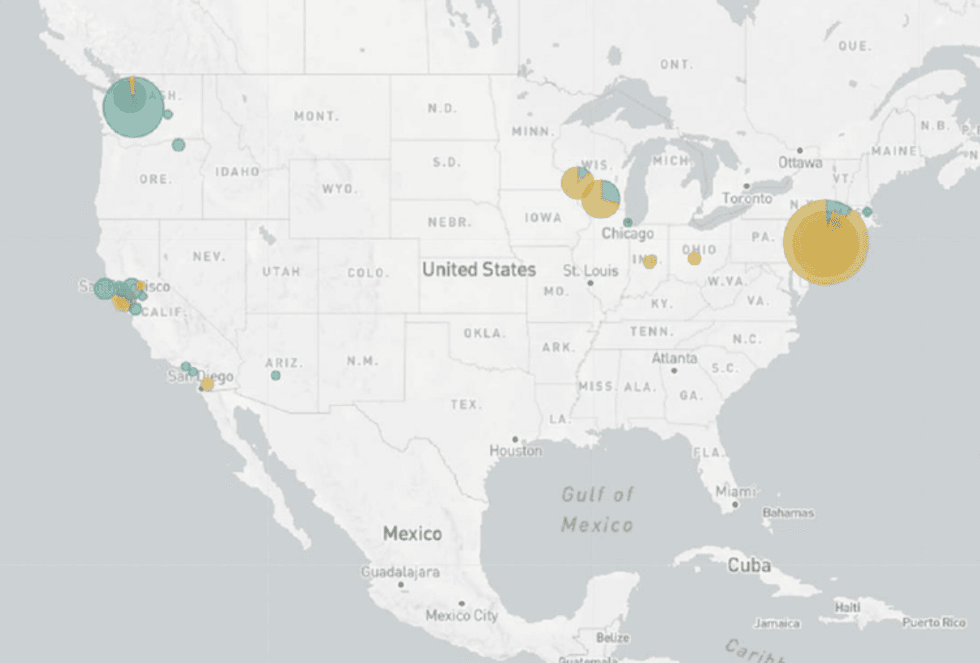
These coronaviruses do mutate quite a bit. A group of dedicated scientists who are members of a research organization called GISAID have been doing this, and another group called Nextstrain has created a website to allow the public to see the mutations in real time. It is open source, meaning anyone can use it.
While a causal link between this mutation and more severe disease remains to be proven, this may explain at least part of the difference between the severity of infections on the East and West coasts. A group in China recently found that changes in the spike protein among other mutations of the novel coronavirus taken from various people infected in Wuhan can alter the aggressiveness of the virus in cells grown in the lab. For example, strains of the novel coronavirus in Wuhan that were more similar to those in Washington and California were less aggressive in cell culture than those that were more similar to Europe.
While only a theory, this could mean that the novel coronavirus is trying out various strategies to try to live with us. If a virus is too aggressive, it may burn out too quickly by putting too many people in the hospital so it cannot spread. The milder form of the virus could spread more, and provide more immunity. Therefore, the novel coronavirus could be losing aggressiveness at it continues to move among us. This clearly is crucial to know, and needs to be tested.
Many scientists around the world are trying to figure this out. It’s interesting what a clinical observation can lead to.
President Donald Trump admitted his administration was not aggressively pursuing the widespread testing that health experts say is necessary to end the coronavirus pandemic.
Experts say the U.S. economy cannot safely be reopened until widespread testing and contact tracing is available, but Trump's administration has been slow to do that since the pandemic first arrived -- and he admitted again that he didn't want to know the true number of cases, reported the New York Times.
“In a way, by doing all this testing we make ourselves look bad,” Trump said Wednesday.
The president made a similar admission in early March, as the severity of the crisis was beginning to come into focus, and Trump did not want infected cruise ship passengers to disembark because it would raise the number of cases in the U.S.
“I would rather because I like the numbers being where they are,” Trump said at the time. “I don't need to have the numbers double because of one ship that wasn't our fault. And it wasn't the fault of the people on the ship either, okay? It wasn't their fault either and they're mostly Americans. So, I can live either way with it. I'd rather have them stay on, personally.”
There were fewer than 200 cases in the U.S. at that point, but there have since been 1.26 million cases reported and more than 74,000 deaths.
A man who believes that the COVID-19 pandemic is a "hoax" was caught on video having an unhinged meltdown at a Miami grocery store.
The Miami Herald reports that the footage was taken outside a Publix in South Beach, and it shows a man who is furious that the store asked him to wear a face mask before entering.
"This is a false flag fake pandemic!" he yelled. "You are in violation of my constitutional rights... I'm filing a class-action lawsuit! You can take your fake f*cking global terroristic false flag attack and shove it up your motherf*cking ass!"
The man wasn't done after that.
"You're terrorists!" he screamed. "You're in violation of my constitutional and civil rights! F*ck you motherf*ckers there's no pandemic!"
At this point, an employee at the store informed him that he would need to wear a face mask to shop there -- and he only got more hostile.
"You motherf*ckers are going to be getting mass arrested and f*cking executed for f*cking terrorism!" he screamed. "F*ck you!"
Blood tests have begun in the region around Rome to allow authorities to gauge how many people have been exposed to the coronavirus since the epidemic struck Italy.
More data will help to map out how the virus has travelled through the population, as the country begins to emerge from the health crisis that has killed nearly 30,000 of its citizens.
Over the following few days, the region of Lazio -- of which Rome is the capital -- will perform some 150,000 blood tests on health workers and police, those assumed to be most exposed to the virus.
Such tests have already begun in other regions, especially Lombardy in Italy's north which has been hardest hit by the coronavirus.
Sergio Bernardini, a professor in biochemistry and director of the lab at Rome's Tor Vergata hospital, said the large-scale screening efforts will produce a closer estimate of the number of people who have been infected with the virus.
"In reality, they're probably much more numerous, eight to ten times more than the figures we have today," Bernardini told AFP.
The tests, which require just a finger prick of blood, look for the presence of antibodies indicating that the person has been exposed to the virus at some point. The hope is that the person has developed immunity to the virus, although that is not guaranteed.
A positive result "does not mean that you are protected, it is not a license to return to normal daily life," Bernardini cautioned.
"It's absolutely necessary to continue using ... masks, which are still the most important thing, even more important than knowing if you have antibodies," he said.
The blood tests differ from the more common swab tests, which check molecules from nasal secretions to know whether a person currently has the virus.
Although the blood tests can help determine how many people may be immune, and how many have never been exposed to the virus, there are pitfalls, experts warn.
A person who has developed antibodies can still carry traces of the virus and be contagious. Moreover, it is not understood how long immunity to coronavirus lasts, meaning there is a risk those deemed "immune" could be re-infected and pass along the virus to others.
New claims for unemployment benefits filed by US workers declined slightly last week, but were still a staggering 3.2 million, government data said Thursday.
The data from the Labor Department bring the total claims filed since mid-March, when the coronavirus pandemic forced businesses to close their doors to stop the virus's spread, to 33.5 million.
The number of claims filed last week were slightly more than analysts expected and underscore the continuing damage done by the pandemic the United States, where 73,095 people have died from the disease and 1,227,430 cases have been reported as of Wednesday.
However Thursday's figure for the week ending May 2 was a decrease from the previous week, when 3.8 million workers filed new unemployment claims.
That may indicate the initial wave of layoffs is starting to ebb, but the number remains incredibly high -- well above even the worst four weeks of the global financial crisis and more comparable to unemployment levels seen during the Great Depression 90 years ago.
Ian Shepherdson of Pantheon Macroeconomics predicted new weekly filings dipping below one million by the second or third week of June, while hiring may begin picking back up if states reopen their economies.
"Claims continue to decay by about 15 to 18 percent per-week, and are now at less than half the 6.9 million peak in the week of March 28," he said in an analysis.
On MSNBC’s “Morning Joe,” host Joe Scarborough often attacks President Donald Trump for being a political “day trader” — meaning that he has a painfully short attention span and bases his actions on the current news cycle rather than being able to look at the big picture. And when Jonathan Lemire, a White House correspondent for the Associated Press (AP), appeared on “Morning Joe” on Thursday, May 7, he asserted that the news cycle and media coverage are driving Trump’s handling of the coronavirus task force.
Mika Brzezinski, who hosts “Morning Joe” with Scarborough, asked Lemire why Trump had suddenly changed his mind about possibly winding down that task force. Brzezinski asked, “Does (Trump) know that when you talk about shutting down a task force one day, and 24 hours later, you say people called him, that he is thinking and flying off the seat of his pants? Does he know he is exposing himself by the day, as to not being fully connected with the gravity of this problem? Is anyone helping him?”
Lemire responded, “The president reacts to media coverage and to outside forces when it comes to decisions. And that’s what we saw here. He had — there was no coordinated effort, per se, but the White House had had discussions in the last few weeks about beginning to wind down the task force, as it was going to pivot more toward the economy, looking towards reopening parts of the nation, and wanting to de-emphasize, certainly publicly, some of the health crisis response.”
As part of his reopening of the economy, Trump was talking about possibly winding down the task force — which is headed by Vice President Mike Pence and includes medical experts Dr. Anthony Fauci and Dr. Deborah Birx. But this week, Trump has been walking that back.
Lemire, discussing Trump’s White House coronavirus briefings, told Scarborough and Brzezinski, “We’ve seen the briefings go away, although a lot of that, of course, was because the president’s advisors realized it was damaging him politically. It was an effort not to make Dr. Birx and Dr. Fauci the public faces anymore. Instead, it was an attempt to change the conversation, to be more about the nation reopening and its economy. When the vice president said the other day, in a meeting, that the task force was going to be starting to wind down by the end of May or early June — and the president himself reiterated that on his trip to Arizona — there was some real blowback from business leaders, congressional Republicans.”
Lemire noted that the White House press conference on May 6 didn’t feature Birx or Fauci, but rather, Trump’s new White House press secretary, Kayleigh McEnany.
“We have the White House press secretary yesterday — we haven’t seen Dr. Fauci or Dr. Birx from the podium at the White House for some time,” Lemire explained. “They are still going to be part of this, but the president and his team want them to be less visible for the public. They want the focus — even as cases are going up across the country, even as cases outside New York continue to rise — they want the focus to be the nation trying to get back to work, reopening, thinking it is more politically advantageous for the president.”
President Donald Trump's determination to reopen the American economy during the COVID-19 pandemic comes even as the United States is still averaging around 2,000 new deaths per day.
Damning charts posted by Harvard epidemiologist Eric Feigl-Ding show that multiple countries around the world have managed to get new cases of the disease way down from their peaks, including Australia, Croatia, South Korea, Norway, and Lebanon.
The United States, along with countries such as Sweden and the United Kingdom, meanwhile, have only seen their cases plateau without any significant progress made in getting cases lower.
In fact, Axios reports that even countries such as Italy and Spain, which took brutal hits in the early weeks of the pandemic, have managed to get the virus's spread under control.
"New cases climbed over about a month from under 100 per day to terrifying peaks of roughly 8,000 per day in Spain and 6,000 per day in Italy," the publication notes. "The fall was nearly as sharp. Within two weeks of the peak, the rates of daily recorded cases had been halved. They’ve continued to fall since."
These countries are now taking steps to gradually reopen their economies, while America is pushing to reopen at a time when the country is seeing tens of thousands of new cases every day.
Russell Moore, the president of the Southern Baptist Convention's Ethics and Religious Liberty Commission, is calling out white evangelical Christians who are looking the other way from the brutal killing of Ahmaud Arbery.
In an essay published on his website, Moore said that the video showing two white men chasing down and shooting Arbery deserves Christians' attention as a matter of basic justice.
"There is no, under any Christian vision of justice, situation in which the mob murder of a person can be morally right," he writes. "Those who claim to have a high view of Romans 13 responsibilities of the state to 'wield the sword' against evildoers ought to be the first to see that vigilante justice is the repudiation not just of constitutional due process but of the Bible itself."
Moore then said that many white Christians seem tempted to write off Arbery's killing because they don't want to confront issues of racism in the United States.
"Sadly, though, many black and brown Christians have seen much of this, not just in history but in flashes of threats of violence in their own lives," he writes. "And some white Christians avert their eyes—even in cases of clear injustice—for fear of being labeled “Marxists” or “social justice warriors” by the same sort of forces of intimidation that wielded the same arguments against those who questioned the state-sponsored authoritarianism and terror of Jim Crow. And so, they turn their eyes."