The Miami Herald reported this Tuesday that when Florida governor Ron DeSantis found out that someone had recommended to his Surgeon General that the state should issue a blanket stay-at-home order mandating the closure of non-essential businesses and social distance to slow the spread of the coronavirus, he was shocked.
“Who recommended that?” he asked the reporter who told him the news. After being told the recommendation was given by Ali Mokdad, a professor at the University of Washington’s Institute for Health and Metrics Evaluation, DeSantis said it didn't hold much weight with him since the professor wasn't on the White House coronavirus task force.
“I’m in contact with [the White House task force] and I’ve said, ‘Are you recommending this?’ ” DeSantis said. “The task force has not recommended that to me. If they do, obviously that would be something that carries a lot of weight with me. If any of those task force folks tell me that we should do X, Y or Z, of course we’re going to consider it. But nobody has said that to me thus far.”
That excuse didn't go over so well with DeSantis' critics on Twitter:
The coronaviruspandemic is no laughing matter. According to Johns Hopkins University, almost 900,000 cases of COVID-19 have been diagnosed around the world. The U.S. leads the way with almost 200,000 people infected by the coronavirus.Despite dire predictions from Dr. Anthony Fauci,thedirector of the National Institute of Allergy and Infectious Diseases who predicted as many as 200,000 Americans could die from the coronavirus, people all across the country are not seriously embracing the call for self quarantines and social distancing.LATEST CORONAVIRUS UPDATES FROM NJ.COMThat prompted Califor...
President Donald Trump's allies are begging him to stop feuding with the Democratic governor of Michigan -- a state he needs to win re-election.
Trump won the state by just 11,000 votes in 2016, but he's risking his chances in November by picking a fight with Gov. Gretchen Whitmer over his response to the coronavirus pandemic, and his allies know it, reported the Associated Press.
“Everyone should be shedding the partisanship and coming together,” said Republican National Committee Chairwoman Ronna McDaniel, who lives in Michigan. “I think she’s done good things. ... I just didn't like her trying to lay every problem at the president’s feet.”
The governor has criticized the federal response to the outbreak, and Trump has attacked Whitmer -- who has become a leading vice presidential prospect for whoever wins the Democratic nomination.
Trump slurred the governor as “Gretchen ‘Half’ Whitmer" and insulted her leadership, and even said he had directed Vice President Mike Pence to freeze her out as the virus raged in Michigan, but he has since deleted the offending tweets and said he'd spoken with her by phone.
Whitmer has also backed down from the feud, saying her priority was protecting Michigan families from the outbreak.
“I don’t care about partisan fights or getting nicknames from the president," she said.
Michigan Republicans said they had advised Trump his attacks weren't helpful.
“I did relay to the administration that I didn’t think it was helpful and why play that game,” said Rep. Paul Mitchell (R-MI). “These are times when the American people look for leaders. Leaders don’t whine. Leaders don’t blame."
"This is not the time where we need more drama in this country," Mitchell added.
President Donald Trump on Wednesday said that he would not reopen so-called Obamacare exchanges to allow uninsured Americans to purchase insurance during the ongoing pandemic.
Last week, Trump seemed open to the idea, noting: “It’s something we're talking to a lot of people about.”
But NBC News reported on Wednesday that the president had decided against the move. It was not immediately clear if the Trump administration will take action specifically to help uninsured Americans as they face the COVID-19 pandemic.
"Open enrollment typically runs from Nov. 1 to Dec. 15 in the 38 states that use the federal exchange, healthcare.gov," CNN reported.
Trump Surgeon General Jerome Adams on Wednesday said that it's time for Florida Gov. Ron DeSantis to heed the advice being given by the federal government and issue a stay-at-home order for his state.
During an interview on NBC's "Today," host Savannah Guthrie repeatedly pressed Adams about DeSantis's claim that he would issue a stay-at-home order for his state if he were advised to do so by the federal government.
When asked what advice he would now give to DeSantis, Adams said that the government's guidelines on social distancing should be adopted throughout the United States.
"My advice to America would be that these guidelines are a national stay-at-home order," he said.
In a column for Politico, founding editor John F. Harris claims Donald Trump's presidency is on the verge of "breakdown" because of the speed with which the COVID-19 pandemic has paralyzed the country which has, in turn, put his inability to manage a crisis on full display for the country to see.
Pointing out Trump is now finding the "currents of history shifting violently" against him, Harris suggests that the president's primary weapons to use against his opponents will fail when it comes to dealing with a national health crisis.
"Trump emphatically has faced real opposition, and reveled in it, on his path to power. But he has met earlier chapters of adversity, in politics and business, with reliance on traits—bluster, defiance, implacable self-promotion—that, however unorthodox, served him quite well in the old context," the columnist wrote before adding, "Now the context has changed but—so far—Trump has not, or to the extent he has tried it has not lasted more than a few hours at a time. Admirers and foes alike have become so casually accustomed to this president’s shattering of norms in a contemporary political setting that people easily miss how bizarre these circumstances are in historical terms."
As Harris sees it, Trump's attempts to calm the waters and deal with the pandemic have exposed his biggest shortcoming just months before he faces re-election.
"In just the past few days (who keeps track of time in self-quarantine?) Trump has gone from shocking his own health experts with a prediction that church pews would be filled and the country 'raring to go' by Easter to extending the national shutdown through April. He has questioned whether governors are exaggerating their need for medical equipment and then indignantly denied saying that the next day. He has boasted of the television ratings for his coronavirus briefings," he explained.
"There is a difference between the current moment and the pre-corona past. Previously his most flamboyant behavior was, for many of his admirers, an essential part of his appeal, he wrote before warning, "It is unlikely that many Trump supporters are genuinely enthusiastic about his parade of errant statements on coronavirus, from the claim in late February that the number of U.S. cases 'within a couple of days is going to be down close to zero,' to his insistence earlier this month that, 'Anybody that needs a test, gets a test,' even as the person shepherding the administration’s response, Vice President Mike Pence, was saying,'“we don’t have enough tests today to meet what we anticipate will be the demand going forward.'"
"The coronavirus drama, with 180,000 cases, rather than the 15 at the time Trump made his 'close to zero' prediction, is still closer to the beginning than the end," he explained. "With some lucky breaks, combined with the policy shifts he and his health team have made, he could yet retain his title as the Houdini of his era."
However, he explained, short of getting some "lucky breaks" the president could see his brief political career comes to a quick close.
"Without those breaks, however, he could easily end up keeping company historically with Hoover (who promised that 'prosperity is around the corner') and Lyndon B. Johnson (whose Vietnam generals fantasized about 'light at the end of the tunnel') as presidents who arrived in office with outsized personalities that shriveled as they failed to meet the political, practical, ultimately psychic needs of a nation in crisis," he wrote.
TrumpWhite House counselor Kellyanne Conway on Wednesday sneered at former Vice President Joe Biden's advice about President Donald Trump calling up his predecessor to ask about advice for dealing with the coronavirus pandemic.
During a "Fox & Friends" interview, Conway was asked if Trump had considered talking with former President Barack Obama to get some pointers on handling the current crisis.
Conway, however, immediately pivoted to attacking Biden.
"I think it's really disappointing to have President Obama's No. 2, who apparently doesn't talk much to him, out there criticizing instead of saying, 'Here's what we did that we thought was effective,'" she complained. "Why doesn't Vice President Biden today call the White House and offer support?"
Conway then turned her attention to Trump critics more generally and scolded them for not praising the president.
"I think the critics and the naysayers seem so much more small, so much more shrill and unhelpful and petty than they ever have," she snarled.
America's national parks are still open during the coronavirus pandemic, and it's causing revolts among staff members who say they and their communities are being put at risk.
The Daily Beast reports that staffers at the Grand Canyon National Park are begging their bosses to temporarily shut down the park until the worst of the disease has passed.
"We feel our boss is not meeting up with our pleas," one Grand Canyon ranger tells the publication. "It’s political, to keep up the image... I feel people’s idea of the Grand Canyon is that you can isolate, but there’s two entrances. They are all going to the same view stations and same trails. It funnels people to the same spots."
Dustin Stone, a former human resources employee at Alaska’s Klondike Goldrush Historic National Park, tells The Daily Beast that he resigned his job because his boss was not taking the threat of the virus seriously.
“Being told over and over again that, ‘The system is working, trust the system, it’s taking its time,’ was like being given the middle finger over and over again,” Stone explained in an interview. "There is no time for bureaucracy right now when hours are so important."
The National Parks Service says that it has so far found at least seven of its employees have been infected with the virus, although the agency in recent days has grown more secretive when it comes to confirming cases.
"Smoky Mountain National Park Spokesperson Dana Soehn on Saturday said she could no longer confirm the coronavirus case she had previously confirmed... citing the new policy," The Daily Beast writes.
A Russian military plane carrying medical equipment has departed for the United States, the Defense Ministry in Moscow said Wednesday, as the Kremlin flexes its soft power amid the coronavirus pandemic.The Antonov-124, "with medical masks and medical equipment on board," left for the U.S. overnight, a statement said, without providing further details.Video released by the ministry showed the cargo plane loaded with boxes preparing to take off from a military airbase near Moscow early Wednesday morning.Contacted by AFP, the Defense Ministry refused to provide any further information on the deli...
Republican Senate Majority Leader Mitch McConnell on Tuesday offered a new—and, according to critics, "ridiculous" and baseless—excuse for the failure of the White House and the federal government more broadly to take early action against the coronavirus outbreak: The impeachment trial of President Donald Trump got in the way.
"While Trump's impeachment and trial were ongoing, Trump found time for his priorities—holding campaign rallies and playing golf."
—Judd Legum
In an appearance on NBC News contributor Hugh Hewitt's talk show, McConnell said the coronavirus outbreak "came up while we were, you know, tied down in the impeachment trial."
"And I think it diverted the attention of the government, because everything, every day, was all about impeachment," McConnell claimed.
But as Inae Oh and Dan Friedman of Mother Joneswrote Tuesday, the Kentucky Republican's argument "ignores reality on multiple counts."
First, there's the fact that senior administration officials, according to the Washington Post, spent weeks in January warning Trump about the virus' potential for disaster in the United States. "Donald Trump may not have been expecting this, but a lot of other people in the government were—they just couldn't get him to do anything about it," one official told the Post. "The system was blinking red."
While Trump ignored those national security warnings, he played a lot of golf, hitting the links at least five times from mid-January through early March. Did impeachment cause that?
McConnell's attempt to blame the Trump impeachment trial—which ended in acquittal on Feb. 5—for Senate inaction also doesn't fit the facts, Oh and Friedman noted.
"The trial didn't stop the Senate's health committee from receiving a briefing about the virus from U.S. public health officials on January 24," they wrote. "If impeachment really had prevented McConnell from taking action on coronavirus, one would have expected him to deal with the issue immediately after the trial concluded on February 5. He did not. The first thing senators did after acquitting Trump was take a five-day weekend. Upon their return, the Senate did not turn to pandemic preparation measures."
Asked about McConnell's claim during a press briefing Tuesday evening, Trump said the impeachment trial "probably did" hinder his response to the coronavirus outbreak, which has been widely condemned as slow and inadequate.
But Trump went on to say that he doesn't think he "would have acted any faster" had he not been impeached by the House of Representatives.
Watch:
Addressing McConnell's comments, Senate Minority Leader Chuck Schumer (D-N.Y.) tweeted Tuesday night that the Kentucky Republican "may have been distracted by impeachment from acting to fight coronavirus, but not everyone was."
"I called for President Trump to declare a public health emergency to fight coronavirus on January 26!" Schumer said.
In his "Popular Information" newsletter Wednesday morning, Judd Legum wrote that "if the federal government failed to respond to an imminent pandemic because it was too concerned about the political fate of Trump, it would be an outrage. But the reality is even worse."
"Years before Trump was impeached, he decimated the government's capacity to respond to a pandemic," Legum noted. "Moreover, while Trump's impeachment and trial were ongoing, Trump found time for his priorities—holding campaign rallies and playing golf. And after Trump was acquitted by the Senate on February 5, Trump continued to downplay the threat of the coronavirus and for many weeks."
Our work is licensed under a Creative Commons Attribution-Share Alike 3.0 License. Feel free to republish and share widely.
Russian leader Vladimir Putin has decided to handle his duties remotely, the Kremlin said Wednesday, after the head of the country's main coronavirus hospital tested positive following a meeting with the president.
Denis Protsenko, who met with Putin last week as the Russian leader visited the Kommunarka hospital in Moscow, said Tuesday he had been infected with the coronavirus but was feeling well.
"The president prefers these days to work remotely," Kremlin spokesman Dmitry Peskov told journalists, shortly before Putin was due to hold a cabinet meeting by videoconference.
"We are taking all precautionary measures," he said, adding that Putin was at the presidential residence in Novo-Ogaryovo outside Moscow.
Putin donned a bright yellow hazmat suit for the visit last Tuesday to the hospital. He was also seen talking to Protsenko without any protective gear but the Kremlin said there is no reason for concern about the president's health.
"All of those who were with the president at Kommunarka are being tested daily for the coronavirus," Peskov added, after saying on Tuesday that "everything is fine" with Putin.
Asked if Putin continued to shake hands with those he is meeting, Peskov said: "Of course everyone is now social distancing."
Almost 70 percent of Russia's 147 million population has been ordered into strict confinement over the pandemic, following a first announcement by the mayor of Moscow on Sunday.
Russia has so far registered 2,777 cases of the coronavirus and 24 deaths, mostly in Moscow.
Former senator Claire McCaskill called out Republican lawmakers for caring more about four deaths at Benghazi than thousands of deaths already from the coronavirus.
The MSNBC contributor told "Morning Joe" that President Donald Trump's inaction in the early stages of the outbreak had cost potentially hundreds of thousands of lives, and was currently endangering hundreds of sailors' lives on the USS Theodore Roosevelt.
"Delay is deadly," she said, "and this president was in charge and was part of a government that delayed a response, particularly as it related to testing, and as a result, we are going to see thousands and thousands of more people die."
"Look at preventable death, and you look at the crisis this has caused," McCaskill continued. "Think of all the energy that was expended on Benghazi, and all the accusations that were made that, well, it was preventable and there should have been people in the State Department should have known there was a security breach. We have got a ship full of our active military calling and saying, 'Please help us, we have over 200 people infected on this ship with active military in uniform serving our country in theater over across the ocean and this commander in chief knows it, and if we do not take steps to immediately help those people on that ship, what does that say about his ability to lead this country?"
"It is frightening to me that we have this kind of crisis and that there appears to -- nobody is rising to the occasion saying, okay, here's what we're going to do with the Teddy Roosevelt, we're going to take it to Guam," she added. "We've got doctors ready, we're going to take care of our sailors. It is unbelievable."
McCaskill said the president loves to show power, but seems afraid to actually use it.
"Let me just say [this] about Florida and these governors," she said. "You know, this president loves power. You know what he can do today? These governors are afraid of him and they're afraid to lead. All he has to do in his weekly, his daily show, is to say, I'm pleading with all the governors to enter statewide orders to stop schools, to shut down nonessential businesses. That's all the president has to do."
When Donald Trump was running for president, he cultivated a tough-guy persona: tough on immigration, tough on crime and tough on America’s adversaries.
As COVID-19 cases multiply daily in the U.S., Trump’s approach has remained largely unchanged.
He demanded that state governors show him personal appreciation before requesting masks and ventilators. When a reporter asked what he would say to Americans who were scared by the virus, Trump retorted that the question was “nasty” and that the journalist was “terrible.” And when asked if there would be enough ventilators for patients who needed them, he simply sneered, “Don’t be a cutie pie.”
Many Americans may have become accustomed to – or have even reveled in – Trump’s penchant for cruel digs, bellicose rhetoric and self-absorption. His supporters see him as someone who’s in their corner, excoriating political opponents and fighting on their behalf.
But a virus is a different sort of enemy. It doesn’t discriminate between who’s tough and who isn’t. You can’t threaten it, humiliate it or dispatch it with a drone strike.
And if history is any guide, Americans will want more than one-note tough guys to lead them through the pandemic. We saw this play out during the Great Depression, when a certain sort of cultural archetype fell out of favor – and a different one emerged.
Detached from reality
During his 1928 campaign, Herbert Hoover described America as “challenged with a peacetime choice between the American system of rugged individualism and a European philosophy of diametrically opposed doctrines – doctrines of paternalism and state socialism.”
Like Warren Harding and Calvin Coolidge before him, Hoover didn’t believe that it was the job of the federal government to support the needy. Depending on yourself – not the government – was cast as patriotic and courageous.
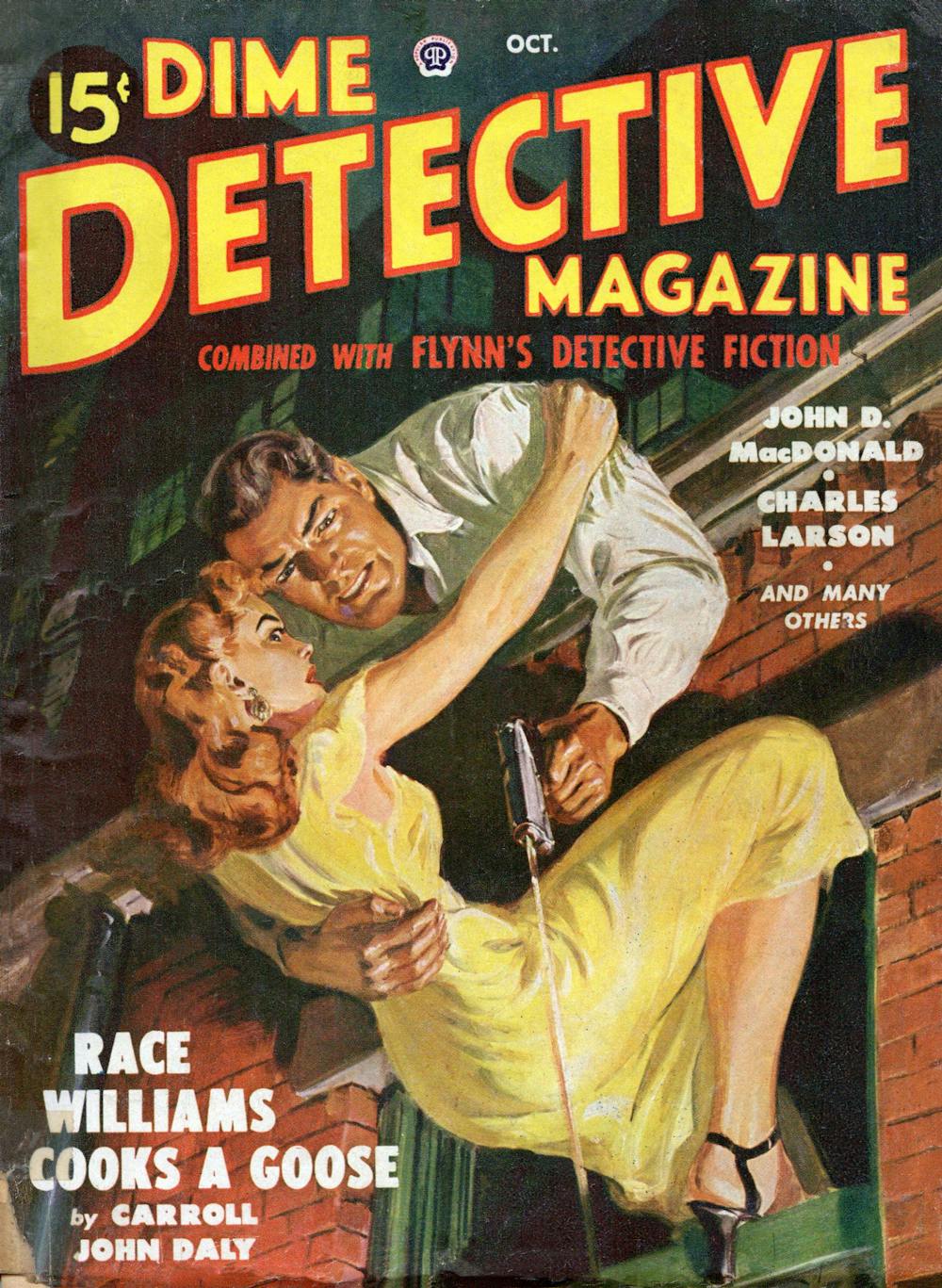
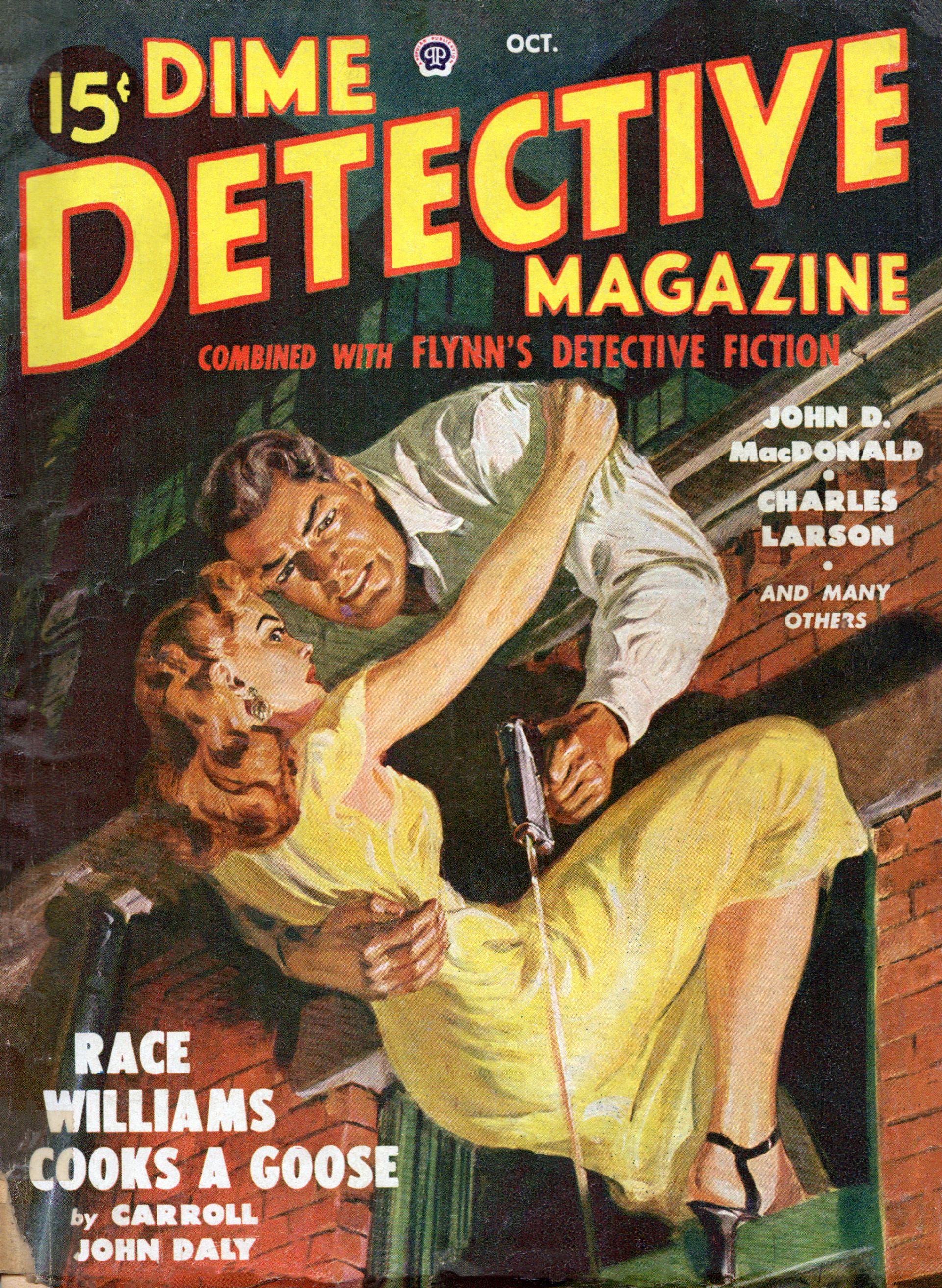
In keeping with the times, popular literature of the 1920s showcased bold individualists. Through much of the decade, the most popular pulp-fiction hero was Carroll John Daly’s Race Williams.
Williams, a gun-toting, tough-talking private eye, was the spiritual descendant of 19th-century frontier protagonists like James Fenimore Cooper’s Natty Bumppo and John Kennedy’s Horse-Shoe Robinson, and of real-life Western sheriffs like Pat Garrett and Wyatt Earp.
Embodying these rugged, cowboy archetypes, Williams frequented the back alleys and tenements of New York City, never hesitating and never missing a shot. He was a good guy, but bombastic and relatively one-dimensional – no weaknesses, no fears, no personal problems.
In the wake of the 1929 stock market crash, economic desperation and disillusion became a broadly American experience. What shell shock was to the soldiers returning from World War I, unemployment and economic insecurity were to the middle and working classes. And as I explain in my book “Detectives in the Shadows: A Hard-Boiled History,” the American public no longer yearned for fearless and invulnerable characters who glided above the worries of the world.
They already had that in Herbert Hoover and in an oblivious top 1%, whose share of national income went from 12% in 1919 to 34% in 1929. Two years into the crisis, Americans who hoped a callous president might turn compassionate were disappointed: Hoover doubled down on his opposition to government aid, stating that “No governmental action, no economic doctrine, no economic plan or project can replace that God-imposed responsibility of the individual man and woman to their neighbors.”
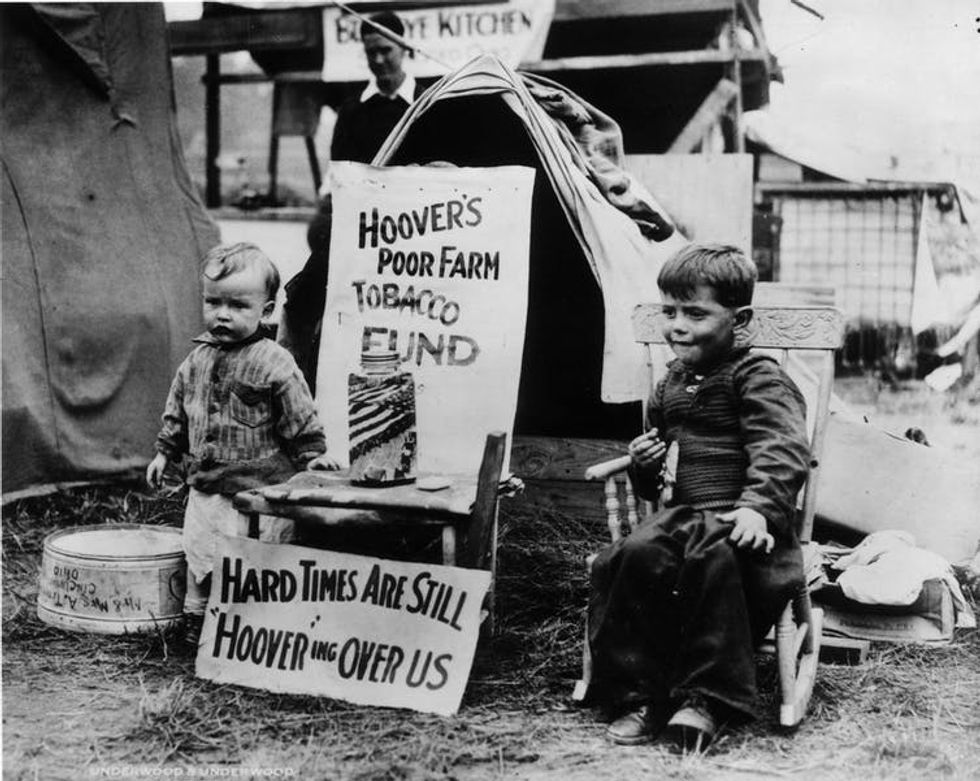
Two boys living in a ‘Hooverville’ shantytown in Washington, D.C.
As Hoover’s popularity started to decline, so did Race Williams’.
Replacing him as the most popular pulp fiction detective was Dashiell Hammett’s Continental Op, a hardworking detective who appeared in the novels “Red Harvest” and “The Dain Curse” and in dozens of short stories.
Rather than being blithely indestructible, the Op was nameless, unpretentious and empathetic. Unlike Race Williams, who praised himself and reminded readers that his shots never missed, the Op was much less facile and camera-ready. Overweight, overworked and middle-aged, he paused to think and to talk with others. When surrounded by death and corruption, he worried that it was “getting to him.” He showed that just making it through the day – with some combination of resilience and denial – was the way of the world, the way of all people.
That sentiment was particularly sustaining during the Depression, when alarming circumstances remained beyond individual control. At that time in American history, the Op’s no-nonsense understanding of desperation gained a new and enhanced currency.
A middle-aged hero who did society’s dirty work on very little sleep, who showed up whether he wanted to or not, seemingly indifferent to solitude and the absence of support, and yet willing to pursue the rich and hold their feet to the fire – this wasn’t a person whose life Americans envied, but someone they wanted on their side.
As it turned out, in the throes of the Depression, it was the sort of person more and more Americans were forced to be. Finally, it was the sort of person American wanted as president. In 1932, Americans elected – with 472 electoral votes – Franklin Delano Roosevelt, who promised to shoulder the task of improving the country’s economic fortunes. Like the Op, he was prepared to “speak the truth, the whole truth, frankly and boldly.” And he understood that the government could help people navigate pain and turmoil.
Even before the days of social distancing and empty supermarket shelves, Trump’s harsh indifference to others cast a heavy shadow. As the nation faces a worsening pandemic and what promises to be the gravest economic downturn since the Great Depression, aggression and egotism cannot carry a nation. Indeed, it is negligence, and many Americans are starved for a leader who sees them.
It’s not enough to have a made-for-TV tough guy. As literature and history have shown, a fully rounded human and worker among workers – able to tolerate discomfort and put others first – is the leader we need.