Brian Levin, Director of the Center for the Study of Hate and Extremism at California State University, told MSNBC on Friday that “ticking time bombs” like the New Zealand mosque shooter were ‘in the United States’ — and that anti-immigrant white nationalists were now a greater threat than Islamic jihadists.
“There's an international network of Islamophobes, and sometimes they visit different places, but most of it's on the Internet,” Levin said. “What we're seeing here just generally is these kind of ticking time bombs are in the United States.”
Levin said that although anti-Muslim hate crimes had gone down in 2018, for the previous three years, they had increased by 99%.
“When I testified before Congress in 2015, violent Salafist jihadists were ascendant and greatest threat. That is no longer the case by a long shot,” Levin said. “They have been replaced by white nationalists. It’s part of an international trend. These people sometimes hopscotch the ocean, but the Internet is becoming a tool of these folks.” He pointed to the Tree of Life synagogue shooter as an example.
“Bottom line, what we've seen with regard to these white nationalists is they dine from a buffet of hate that is on the Internet,” he said. “The most virulent among this is religious hate, and among that is Islamophobia.”
“Sometimes we see a shuffling of the deck chairs. One year it’ll be Jews, then Muslims,” Levin added. “But we've seen in the United States over the last few years anti-religion hate crimes top 20% for only the first time since '92, we’ve had three consecutive years.”
Several people were reported dead when a gunman opened fire at a crowded mosque in the New Zealand city of Christchurch, during afternoon prayers Friday.
Local media reported up six people were dead and the South Island city was placed in lockdown as police hunted for an "active shooter."
"A serious and evolving situation is occurring in Christchurch with an active shooter," police said in a statement.
"Police are responding with its full capability to manage the situation, but the risk environment remains extremely high."
The Masjid al Noor was filled with worshippers, including members of the Bangladesh cricket team.
One witness told stuff.co.nz he was praying in the Deans Ave mosque when he heard shooting and saw his wife lying dead on the footpath outside when he fled.
Another man said he saw children being shot.
"There were bodies all over me," he said.
An eyewitness told Radio New Zealand he heard shots fired and four people were lying on the ground, with "blood everywhere".
Unconfirmed reports said the shooter was wearing military-style clothing.
Police commissioner Mike Bush said all schools in the city had been placed in lockdown in response to "a serious ongoing firearms incident".
"Police urge anyone in central Christchurch to stay off the streets and report any suspicious behaviour," he said in a statement.
Central city buildings, including the Civic Offices and Central Library, were also locked down.
The city council offered a helpline for parents looking for kids attending a mass climate change rally nearby.
"Please do not try and come and collect your children until police say it is safe for people to come into the central city," they said.
There was no official information on casualties but a Bangladesh cricket team spokesman said none of the players were hurt.
"They are safe. But they are mentally shocked. We have asked the team to stay confined in the hotel," he told AFP.
He said the attack happened as some of Bangladesh players disembarked from a team bus and was about to enter the mosque.
He said most of the players went to the mosque.
He said Bangladesh cricket board is in contact with New Zealand cricket authorities and would take further decision after consultation
A gunman opened fire in a mosque in New Zealand on Friday and there were several casualties, media reported, after police deployed armed officers in response to shots fired in the center of Christchurch city.
The Bangladesh cricket team was in the vicinity of the shooting but all members were safe, a team coach told media.
Police did not immediately comment on whether the incident took place in the mosque or nearby. There is no official confirmation on casualties.
Media said shots had been fired near a mosque and a witness told broadcaster One News that he had seen three people lying on the ground, bleeding outside the building.
Radio New Zealand quoted a witness inside the mosque saying he heard shots fired and at least four people were lying on the ground and “there was blood everywhere”.
“Horrified to hear of Christchurch mosque shootings. There is never a justification for that sort of hatred,” said Amy Adams, a member of parliament from Christchurch.
The Bangladesh cricket team is in Christchurch to play New Zealand in a third cricket test starting on Saturday.
Mario Villavarayen, strength and conditioning coach of the Bangladesh cricket team was quoted by the New Zealand Herald as saying that the team was close to where the shooting occurred, but was safe.
“The players are shaken up but fine,” Villavarayen was quoted as saying.
The Connecticut Supreme Court on Thursday allowed a lawsuit against Remington Outdoor Co Inc to go ahead, giving families who lost loved ones in the 2012 Sandy Hook shooting the chance to pursue their claims in an effort to hold the gunmaker liable.
The families of nine of the victims and one survivor have said the manufacturer, along with a gun wholesaler and local retailer, are partially responsible for the carnage at the Newtown, Connecticut, school because they marketed the weapon based on its militaristic appeal.
Adam Lanza, 20, used a Remington AR-15 Bushmaster rifle, a semi-automatic civilian version of the U.S. military’s M-16, to kill 20 children between the ages of 6 and 7, as well as six adult staff members, at Sandy Hook Elementary School on Dec. 14, 2012. He then killed himself.
Remington on Thursday did not immediately respond to a request for comment.
The National Shooting Sports Foundation, the firearm industry’s trade association, said it was reviewing the decision and did not have immediate comment.
Josh Koskoff, one of the lawyers for the victims’ families, said in a statement the families were grateful for the court’s rejection of the gun industry’s bid for complete immunity.
“The families’ goal has always been to shed light on Remington’s calculated and profit-driven strategy to expand the AR-15 market and court high-risk users, all at the expense of Americans’ safety. Today’s decision is a critical step toward achieving that goal,” Koskoff said.
Legal experts have said any appeal of the ruling by the gunmaker would likely be taken up by the U.S. Supreme Court, where it could face steep legal hurdles.
The tragedy led then-President Barack Obama to urge federal gun control legislation, but proposals died on Capitol Hill.
The 2005 Protection of Lawful Commerce in Arms Act, or PLCAA, has provided the U.S. firearms industry an almost impenetrable defense against lawsuits by victims of mass shootings and gun violence, broadly shielding Remington and others such as American Outdoor Brands Corp, Sturm Ruger & Co and Vista Outdoor Inc from liability stemming from such incidents.
Since Sandy Hook and subsequent school shootings, most federal efforts at gun control or gun rights expansion have faded and the bulk of firearms legislation has been in state legislatures across the country.
The NRA is taking serious heat online for publishing an article in their magazine entitled "Target Practice" accompanied by a picture of House Speaker Nancy Pelosi (D-CA) and former lawmaker Gabby Giffords who is a victim of gun violence.
Gun control advocates and Pelosi's colleagues were quick to pounce on the gun group over the article published in their American Rifleman magazine (a screenshot can be seen below).
You can see some tweets calling out the NRA below:
Mass shootings seem to have become a sad new normal in the American life. They happen too often, and in very unexpected places. Concerts, movie theaters, places of worship, workplaces, schools, bars and restaurants are no longer secure from gun violence.
Often, and especially when a person who is not a minority or Muslim perpetrates a mass shooting, mental health is raised as a real concern – or, critics say, a diversion from the real issue of easy access to firearms.
Less is discussed, however, about the stress of such events on the rest of society. That includes those who survived the shooting; those who were in the vicinity, including the first responders; those who lost someone in the shooting; and those who hear about it via the media.
I am a trauma and anxiety researcher and clinician psychiatrist, and I know that the effects of such violence are far-reaching. While the immediate survivors are most affected, the rest of society suffers, too.
First, the immediate survivors
Like other animals, we humans get stressed or terrified via direct exposure to a dangerous event. The extent of that stress or fear can vary. For example, survivors may want to avoid the neighborhood where a shooting occurred or the context related to shooting, such as outdoor concerts if the shooting happened there. In the worst case, a person may develop post-traumatic stress disorder, or PTSD.
When the trauma is man-made, the impact can be profound: The rate of PTSD in mass shootings may be as high as 36 percent among survivors. Depression, another debilitating psychiatric condition, occurs in as many as 80 percent of people with PTSD.
Survivors of shootings may also experience survivor’s guilt, the feeling that they failed others who died, did not do enough to help them survive or just because they survived. PTSD can improve by itself, but many need treatment. We have effective treatments available in the form of psychotherapy and medications. The more chronic it gets, the more negative the impact on the brain, and the harder to treat.
The effect on those close by, or who arrive later
PTSD can develop not only through personal exposure to trauma, but also via exposure to others’ severe trauma. Humans are evolved to be very sensitive to social cues and have survived as a species particularly because of the ability to fear as a group. We therefore learn fear and experience terror via exposure to trauma and fear of others. Even seeing a black-and-white scared face on a computer will make our amygdala, the fear area of our brain, light up in brain imaging studies.
People in the vicinity of a mass shooting may see exposed, disfigured or burned dead bodies, injured people in agony, terror of others, extremely loud noises, chaos and terror of post-shooting, and the unknown. The unknown – a sense of lack of control over the situation – has a very important role in making people feel insecure, terrified and traumatized.
I, sadly, see this form of trauma often in asylum seekers exposed to torture of their loved ones, refugees exposed to casualties of war, combat veterans who lost their comrades and people who lost a loved one in car accidents, natural disasters or shootings.
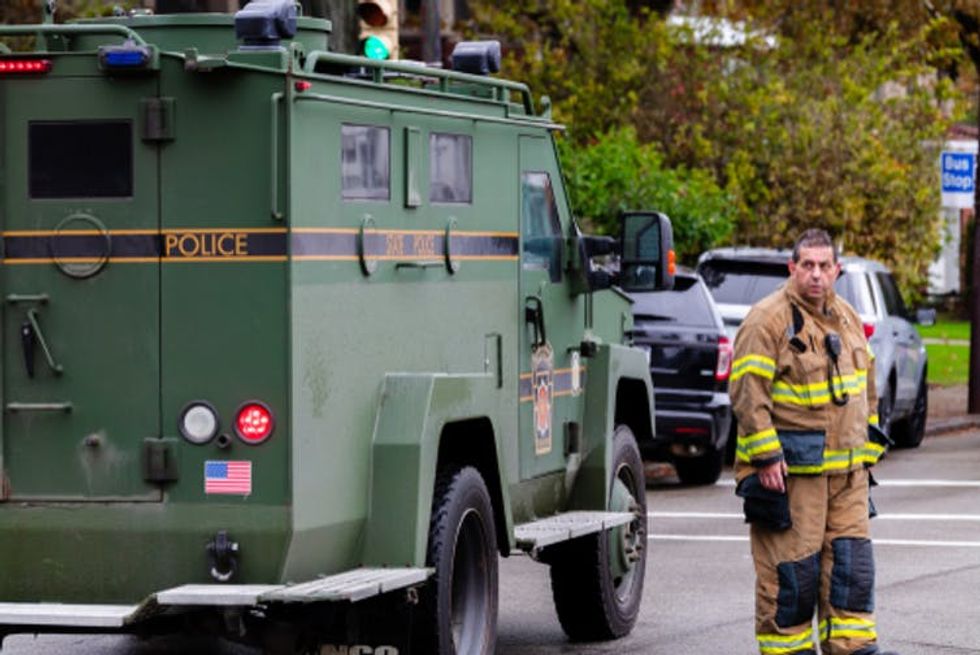
A first responder after the shooting at Tree of Life synagogue in Pittsburgh, Pennsylvania, Oct. 27, 2018.
Another group whose trauma is usually overlooked is the first responders. When we all run away, the police, the firefighters and the paramedics rush into the danger zone, and frequently face uncertainty, threats to themselves, their colleagues and others, as well as terrible bloody scenes of post-shooting. This exposure happens to them too frequently. PTSD has been reported in up to 20 percent of first responders to man-made mass violence.
How does it affect those who were not even near the shooting?
There is evidence of distress, anxiety or even PTSD symptoms among people who were not directly exposed to a disaster, but were exposed to the news, including post-9/11. Fear, the coming unknown (is there another shooting, are other co-conspirators involved?) and reduced faith in our perceived safety may all play a role in this.
Every time there is a mass shooting in a new place, we learn that kind of place is now on the not-very-safe list. When at the temple or church, the club or in the class, someone may walk in and open fire. People worry not only about themselves but also about the safety of their children and other loved ones.
Media: The good, the bad and the sometimes ugly
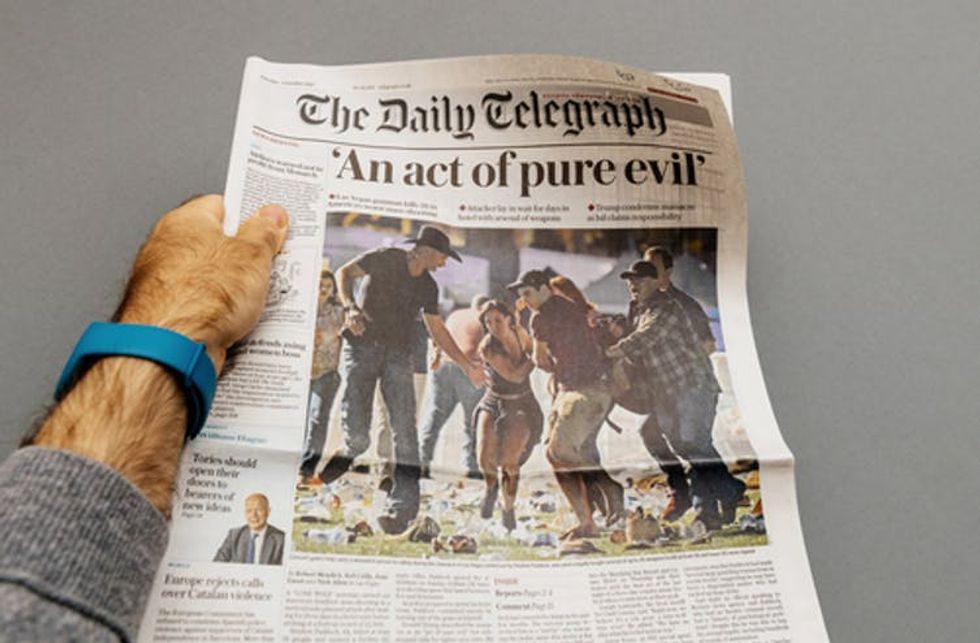
The Daily Telegraph front page of the shootings in Las Vegas on Oct 1, 2017.
I always say American cable news are “disaster pornographers.” When there is a mass shooting or a terrorist attack, they make sure to add enough dramatic tone to it to get all the attention for the duration of the time they desire. If there is one shooting in a corner of a city of millions, the cable news will make sure that you feel like the whole city is under siege.
Besides informing the public and logically analyzing the events, one job of the media is to attract viewers and readers, and viewers are better glued to the TV when their positive or negative emotions are stirred, with fear being one. Thus, the media, along with the politicians, can also play a role in stirring fear, anger or paranoia about one or another group of people.
When we are scared, we are vulnerable to regress to more tribal and stereotyping attitudes. We can get trapped in fear of perceiving all members of another tribe a threat, if a member of that group acted violently. In general, people may become less open and more cautious around others when they perceive a high risk of exposure to danger.
Is there a good side to it?
As we are used to happy endings, I will try to also address potentially positive outcomes: We may consider making our gun laws safer and open constructive discussions, including informing the public about the risks. As a group species, we are able to consolidate group dynamics and integrity when pressured and stressed, so we may raise a more positive sense of community. One beautiful outcome of the recent tragic shooting in the Tree of Life was the solidarity of the Muslim community with the Jewish. This is especially productive in the current political environment, where fear and division are common.
The bottom line is that we get angry, we get scared and we get confused. When united, we can do much better. And, do not spend too much time watching cable TV; turn it off when it stresses you too much.
The gunman who killed five fellow workers at an Illinois factory had just been fired, and the plant manager and a human resources official were among his victims, authorities said on Saturday.
Gary Martin, 45, armed himself with a .40 caliber handgun, which he owned illegally, before reporting for a meeting where he was told he was fired, Aurora Police Chief Kristen Ziman told a news conference.
Most of the workers killed in the shooting on Friday at the Henry Pratt Company plant, 40 miles (65 km) west of Chicago, were in the room where Martin was terminated, Ziman said. Five police officers were wounded by gunfire before Martin was killed in a shootout with police.
Martin had bought the weapon, a Smith & Wesson handgun with a laser sight, in 2014 before authorities realized he had a prior felony conviction, Ziman said.
“The fact remains that some disgruntled person walked in and had access to a firearm that he shouldn’t have had access to,” Ziman said at the news conference.
Investigators were seeking to determine why Martin was not forced to relinquish his gun before the shooting, Ziman said. He should have been barred from owning a handgun because he had a 1995 conviction for aggravated assault in Mississippi, she said, and he also had at least seven prior arrests in Illinois.
The bloodshed marked the latest spasm of gun violence in a nation where mass shootings have become almost commonplace, and came a day after the one-year anniversary of the massacre of 17 people by a gunman at Marjory Stoneman Douglas High School in Parkland, Florida.
Among those killed in the Aurora workplace shooting were Josh Pinkard, the plant manager, and Clayton Parks, the human resources manager, Aurora police said.
The other victims were identified as Trevor Wehner, a human resources intern, Russell Beyer, a mold operator, and Vicente Juarez, a stock room attendant and fork lift operator. Police did not give the ages of the victims.
Another employee at the plant, whose name was not released, was wounded in the shooting and treated at a hospital for non-life threatening injuries, police said.
At least two of the wounded police officers remained hospitalized on Saturday in stable condition, Ziman said.
A sixth officer was injured in the incident, but not by gunfire, police said.
The factory-warehouse plant employs about 200 workers and occupies 29,000 square feet in a working-class district of Aurora, the second-largest city in Illinois.
A gunman opened fire in a warehouse in Aurora, Illinois, on Friday, killing five people and wounding five police officers before he was slain, law enforcement officials said.
Aurora Police Chief Kristen Ziman said the shooter, identified as 45-year-old Gary Martin, was an employee at the sprawling industrial complex in Aurora, a Far West Chicago suburb, but did not say what may have motivated the attack.
The Chicago Sun-Times newspaper reported that a woman who identified herself to police as Martin’s mother told authorities her son had been laid off two weeks ago and was “stressed out” before Friday’s shooting
“Today is a sad day in the city of Aurora,” Mayor Richard Irvin told reporters. Aurora is about 40 miles (65 km) west of Chicago.
Ziman said police received multiple emergency calls from the manufacturing warehouse at 1:24 p.m. reporting an active shooter. The first officers arrived on the scene four minutes later and two of them were struck by gunfire, she said.
All told, five officers were shot and wounded, Ziman said, before the gunman was killed by police returning fire. A sixth officer suffered a knee injury.
Inside the building, five civilians were found deceased. None of them were identified.
The wounded police officers were in stable condition at a local hospital, Clayton Muhammad, spokesman for the City of Aurora, told the local ABC affiliate.
Witness John Probst told CNN that he saw the gunman, a co-worker, running down an aisle of the manufacturing facility with a pistol equipped with a laser sight. Probst told the network that he saw people bleeding.
Video on local media showed numerous police cars surrounding a large commercial building in Aurora, the ground covered in snow.
The bloodshed, marking the latest spasm of gun violence in a nation where mass shootings have become almost commonplace, came a day after the one-year anniversary of the massacre of 17 people by a gunman at Marjory Stoneman Douglas High School in Florida.
A spokeswoman for U.S. President Donald Trump said that he was aware of the incident.
“The President has been briefed and is monitoring the ongoing situation in Aurora, IL,” Sarah Sanders said in a statement.
House Speaker Nancy Pelosi delivered a warning to President Donald Trump and the Republican Party: declaring a national emergency over the border would only empower a Democratic president to do the same to accomplish their own pet goals.
"It's important to note that when the president declares this emergency, first of all, it's not an emergency, what's happening at the border. It's a humanitarian challenge to us," she said. "The president has tried to sell a bill of goods to America."
Pelosi said that Trump was "doing an end run" around Congress's duly appointed power of the purse, as well as their oversight responsibility, and warned the Republicans that the president's gambit may get him closer to his short term goals, but would have lasting consequences for their party when it inevitably blew up in their faces.
"I know the Republicans have some unease about it, no matter what they say," Pelosi said. "If the president can declare an emergency on something that he has created as an emergency, an illusion that he wants to convey, just think of what a president with different values can present to the American people."
By way of example, the Speaker brought up perhaps the one issue that terrifies Republicans the most: that some day, the U.S. government would designate "the epidemic of gun violence in America" an emergency and come for their guns.
"A Democratic president can declare emergencies, as well," she said with a stiff grin. "So the precedent that the president is setting here is something that should be met with great unease and dismay by the Republicans."
Florida Governor Ron DeSantis on Wednesday called for a state grand jury to investigate the 2018 school massacre in Parkland in which 17 people died, pledging accountability for any local failures that led to the deadliest U.S. high school shooting.
DeSantis, a Republican elected last fall after campaigning on the issue, petitioned the Florida Supreme Court for the investigation the day before the first anniversary of the Valentine’s Day massacre at Marjory Stoneman Douglas High School. He said the panel would review school safety statewide.
“They are going to have the power - subpoena and otherwise - to be able to get to the facts and get the truth,” DeSantis said at a news conference, flanked by the parents of slain students.
DeSantis said a grand jury would have broader authority than a state-appointed commission that also reviewed the shooting. Earlier this year, that panel issued a report finding cascading errors, from law enforcement officers holding back as shots were fired to lax school security enabling a former student with an AR-style semi-automatic rifle access to the campus.
Families in the Parkland community have raised concerns about how Broward County Public Schools prepared for student safety, as well as the district’s response to the shooting.
“When your child is murdered in school, you expect to get some answers,” said Andrew Pollack, whose daughter Meadow was killed at the school, speaking at the press conference.
DeSantis said he lacked the authority to remove Broward’s appointed schools superintendent. He noted that he did not find it appropriate to remove school board members who were recently re-elected after safety issues were raised during the campaigns.
Broward school superintendent Robert Runcie said he welcomed any review that could lead to improved school safety across the state.
“I agree with Governor DeSantis for wanting to know how all school districts in Florida manage money and security issues that impact school safety,” he said in a statement.
Last month, DeSantis suspended the Broward County sheriff who was also criticized for the law enforcement response to the shooting.
Reporting by Letitia Stein; Editing by Frank McGurty and James Dalgleish
On Valentine's Day of last year, a 19-year-old armed with a military-style assault rifle walked into his old high school in Parkland, Florida and slaughtered 17 people.
That spasm in America's epidemic of gun violence gave new impetus to the debate on controlling firearms, prompting marches across the country and a fresh round of hand-wringing in cable news studios.
Many of the Marjory Stoneman Douglas High School survivors such as David Hogg and Emma Gonzalez remain national figures a year on -- a testament to their tenacity in keeping the atrocity in the headlines -- yet concrete reform has remained limited and local.
Meanwhile America risks becoming inured to the carnage: four months before Parkland a gunman killed 58 people at a festival in Las Vegas while, 16 months earlier, a massacre at a gay night club in Orlando left 49 dead.
Nearly 1,200 children lost their lives to gun violence in the year since Parkland, according to a report from McClatchy newspapers and The Trace, a non-profit that chronicles firearms issues. More than 200 teen journalists banded together to profile the young victims for the report.
And with 37 mass shootings -- those with at least four victims, not including the assailant -- recorded already in the US this year, it is tempting to conclude that almost nothing has changed.
GETTY IMAGES NORTH AMERICA/AFP/File / Jemal Countess The Parkland students, pictured at the 2018 Time 100 Gala in New York on April 24, 2018, remain national figures a year on from the shooting
The inertia on gun control endures despite the best efforts of the Parkland students, who rejected the usual outpourings of sympathy offered by politicians and launched a nationwide movement seeking tougher regulation on sales.
"So many shootings have happened and you get 'thoughts and prayers' and then nothing happens," said Ryan Servaites, who survived the shooting.
"It's an absolute shame that our government has done absolutely nothing about it. So you know, we're fed up," Servaites, 16, told AFP.
- 'Our childhood ended' -
A month after the shooting, the student activists brought together hundreds of thousands of demonstrators in Washington, under the "March for Our Lives" banner.
GETTY IMAGES NORTH AMERICA/AFP/File / JOE RAEDLE The Parkland survivors have launched a petition to trigger a referendum on banning assault rifles in Florida
The teenagers toured 26 states, visiting schools and talking with lawmakers. They published a book, took part in an HBO documentary and, most importantly, caused state laws to be changed.
"In just 11 minutes, our childhood ended," Hogg and Gonzalez wrote in November in The Washington Post.
Florida is governed by Republicans and posed a major challenge for the student activists. But they successfully pushed for passage of state laws opposed by the powerful US gun lobby, the National Rifle Association.
Among other changes, a "red flag" law was passed allowing judges to order the seizure of guns from people deemed to be mentally unstable and the minimum age for purchasing a gun was raised to 21.
GETTY IMAGES NORTH AMERICA/AFP / JOE RAEDLE Student survivors of the Parkland massacre light candles around a cross at a candlelight memorial for the victims
The sale and possession of devices known as bump stocks, which allow semi-automatic weapons to fire as fast as illegal machineguns, and which were used to such deadly effect in Las Vegas, were also banned.
In December, President Donald Trump barred them at the national level.
After Parkland, 26 states and US capital Washington approved 67 laws related to gun control, according to the Giffords Law Center to Prevent Gun Violence.
In a report last December, the center said the movement for gun safety in America "experienced a tectonic shift in 2018."
- Big plans for 2019 -
GETTY IMAGES NORTH AMERICA/AFP / SPENCER PLATT Sir Paul McCartney joined thousands of people, many of them students, in the march against gun violence in Manhattan during the March for Our Lives rally on March 24, 2018
Yet significant nationwide reform to slash gun deaths has largely eluded the activists, who have vowed to entrench their campaign in 2019.
On Friday last week lawmakers from both parties presented Congress with a bill that would require universal background checks prior to gun purchases.
Under current laws, licensed dealers must carry out background checks on would-be buyers, but loopholes allow people to avoid such checks if they buy from a private seller, at gun shows or over the internet.
Defenders of the Second Amendment to the US Constitution, which establishes the right to bear arms, will fight the bill.
The NRA said such a law would not dissuade criminals, who will always find some way to acquire a firearm.
"These bills attack law-abiding gun owners by placing further burdens on gun ownership and use," its website states.
Tom Palmer, a gun rights supporting political scientist and vice president of free-market think tank Atlas Network, told the Miami Herald the two sides in the gun debate could not be more polarized.
"The gun control people see their opponents as people who don't care about human life, and the gun rights people see their opponents as people who don't care about human freedom," Palmer said.
Also worth noting: in a closely contested race for Florida's governorship in last November's mid-term elections, NRA-endorsed Republican Rick DeSantis beat Democrat Andrew Gillum, who backed stricter gun controls.
Undeterred, a group of Parkland survivors launched a petition on Monday which, if it garners the almost 800,000 signatures needed, will trigger a referendum on banning military-style assault rifles in Florida.
Meanwhile Nikolas Cruz, the defendant in the Parkland shooting, awaits his day in court. Prosecutors have said they will seek the death penalty on 17 counts of pre-meditated murder and 17 counts of attempted murder.
CNN's Brooke Baldwin broke down in tears on the air Tuesday, reading a Valentine's Day letter from the mother of a slain Parkland student a year after the massacre.
"I just want to take a minute to read a special letter, not just because Valentine's Day is Thursday, it's the same day as the Parkland shooting from a year ago," said Baldwin. "These words that I'm about to read are from Lori Alhadeff to her daughter Alyssa who was just 14 when her daughter was killed just one year ago." She added, with a deep sigh, that she would "try to get through this" but it was already obvious the host was deeply affected. Alhadeff wrote the letter for Dear World, a project of One World Strong, which seeks to provide support to "survivors of terrorism, hate crimes, or traumatic events."
"'Last Valentine's Day was the last time I saw you,'" Baldwin, getting about two sentences into the letter before she had to stop and compose herself. "'Valentine's Day is now about memories. Today like all days, I remember you." She stopped again and took a breath as her voice broke. "'I remember you weren't looking forward to going to school that day and like many 14-year-old girls you wanted a Valentine and were disappointed that you didn't have one.'"
Baldwin continued reading the letter in fits and starts, her voice breaking over and over, as she struggled to hold back tears.
"'High school love is magic. I was 14 once and those butterflies had whirled inside of me too. I wanted that for you,'" Baldwin went on. She stopped to tell viewers, "I want to get through this because these words matter."
"'A year has been a long time without you. So much has happened I want to tell you about,'" she continued. "'I talk to other moms who have lost children. We talk about you. We talk about our kids but when we look into each other's eyes we see it, a fire. I ran for the school board. I won. I screamed on national TV words of rage directed at the president. Dad fights for you every day. He is your voice.'"
"She goes on but I just want to include her closing," said Baldwin, who by that time was an emotional wreck. "'It's Valentine's Day. As I remember you, grief washes over me, but that grief emboldens me to fight for change. I wish I could take all the bullets for you.'"
Five people were found shot and killed in a home in an unincorporated town in eastern Texas on Monday, police said.
Police and rescue workers responded to a call at 10:30 a.m. CST about multiple victims of an assault at a residence in Blanchard, Texas, the Polk County Sheriff’s Office said on Facebook.
At the scene, they found several victims of gunshot wounds, the sheriff said.
The sheriff did not release details about the shooting or the identities of the victims.
“The scene is extremely fluid making it difficult to release information,” the sheriff said.
Blanchard, Texas is an unincorporated town located 80 miles (129 km) north of Houston.
Reporting by Brendan O'Brien in Milwaukee; editing by Bill Tarrant and Sandra Maler





 GETTY IMAGES NORTH AMERICA/AFP/File / Jemal Countess
  GETTY IMAGES NORTH AMERICA/AFP/File / JOE RAEDLE
  GETTY IMAGES NORTH AMERICA/AFP / JOE RAEDLE
  GETTY IMAGES NORTH AMERICA/AFP / SPENCER PLATT