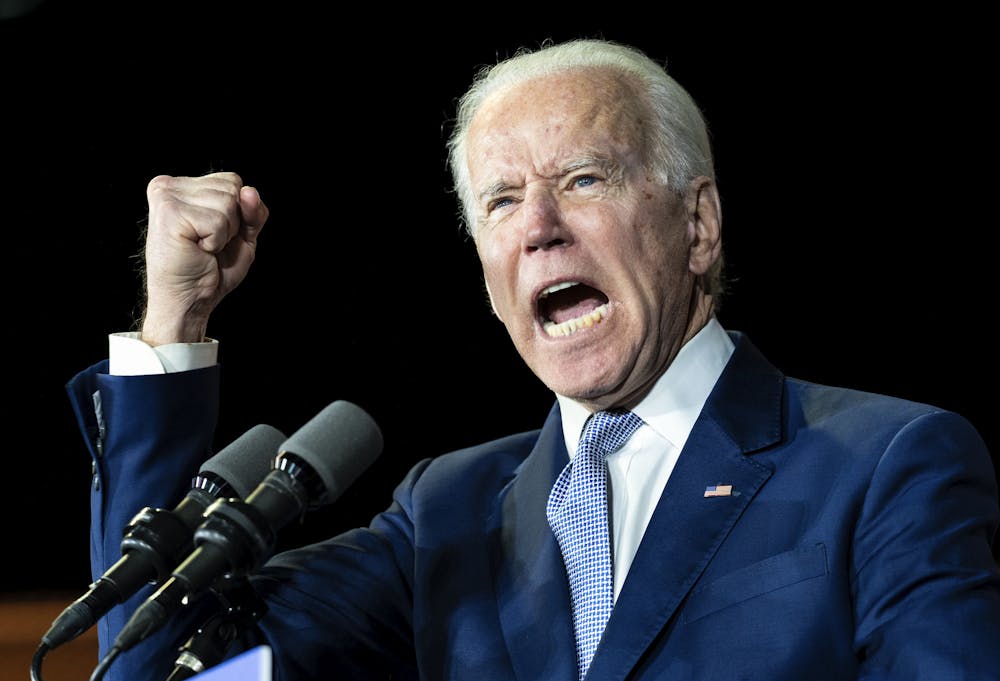
Sen. Mitt Romney (R-UT), the lone Republican senator to convict President Donald Trump on abuse of power charges, does not sound enthusiastic about his colleagues' decision to launch a probe of former Vice President Joe Biden.
In an interview with CNN's Manu Raju, Romney said he did not like the optics surrounding Sen. Ron Johnson's (R-WI) investigation into Biden's role in the firing of a Ukrainian prosecutor at a time when his son, Hunter Biden, was on the board of Ukrainian energy company Burisma.
"There's no question but the appearance of looking at Burisma appears political," he said. "And I think people are tired of these kind of political investigations."
Romney also suggested that the Senate's time would best be spent elsewhere.
"We also have a lot of work to do on matters that are not related to Burisma," he said. "We probably ought to focus on those things."
While Biden's role in firing former prosecutor Viktor Shokin has raised questions about conflicts of interest given his son's employment at the time, it has also been established that the push to fire Shokin was part of a broader anti-corruption initiative that was supported not just by the United States, but also the European Union and the International Monetary Fund.
Additionally, it has been confirmed that Shokin was not actively investigating Burisma at the time of his firing, and that many Western governments wanted him out because he was not taking up enough investigations into companies like Burisma.
Massachusetts Senator Elizabeth Warren is dropping out of the Democratic presidential race after failing to win a single state on Super Tuesday, including her own, US media reported.
The 70-year-old progressive lawmaker will hold a call with her campaign staff Thursday to announce that she is suspending her bid for the party's presidential nomination, The New York Times, CNN and other US media outlets said.
Warren led some national polls last summer but she never managed to build a broad coalition to carry her through to success in the primaries, finishing behind fellow progressive Bernie Sanders and moderate Joe Biden in 14 states on Super Tuesday.
Warren's withdrawal makes the Democratic race effectively a two-man contest between Biden, the 77-year-old former vice president, and Sanders, the 78-year-old Vermont senator.
Warren finished third in her home state of Massachusetts behind Biden and Sanders on Tuesday.
Warren's decision to drop out comes one day after that of billionaire former New York mayor Michael Bloomberg, who quit on Wednesday after a disappointing Super Tuesday performance and endorsed Biden.
According to the Times, Warren does not plan to make an endorsement when she announces that she is quitting the race.
Sanders told reporters that he had spoken to Warren on Wednesday.
Political commentator Zerlina Maxwell lamented the impact of sexism in politics on Thursday after Sen. Elizabeth Warren (D-MA) signaled that she was suspending her campaign for president.
After the news broke that Warren would end her quest for the White House, MSNBC's Crag Melvin spoke to Maxwell and former Sen. Claire McCaskill (D-MO) about why there is a lack of diversity at the top of the Democratic Party.
"Considering the diversity of the base of the party, how can it be that the two men left standing are white guys in their 70s?" Melvin asked.
" Joe Biden got the support of black voters in America," McCaskill pointed out. "That had a lot to do with Barack Obama. It had a lot to do with him being perceived as the guy that Barack Obama trusted the most."
Maxwell argued that Warren "would have done much better if she were a man."
"I think this is a moment where we really have to take a deep look into the cultural reasons why this is happening," Maxwell opined. "This doesn't necessarily have anything to do with any of the mistakes that Warren made because Joe Biden and Bernie Sanders make plenty of those and they're still in the race."
"We have never had a woman president," she continued. "And for some reason, it seem like only women are concerned about this fact and I would like more men to be vocal about the fact that they want to see women in positions of leadership."
Maxwell slammed men who think that it is sufficient to have a woman vice president.
"Why does a woman have to settle for the number two job?" she asked. "That's all I have to say about that."
"For the record, I want to see women in positions of power," Melvin replied.
"Well, it's important that you say that," Maxwell pointed out. "You vocalize it. You don't have to support Elizabeth Warren. I didn't support any candidate in this race. I didn't endorse. I don't have a favorite."
Maxwell admitted that she had worked for the last two Democratic presidential nominees -- Barack Obama and Hillary Clinton -- and neither are white men.
"I wasn't a Hillary person or an Obama person, I'm a Democrat," she explained. "I want more men to do what you just did, which is say, 'I would like to see women in positions of leadership.'"
"And not just when they get daughters and discover that women are people," Maxwell concluded.
In the Trumpified GOP of 2020, the battle among Republicans over who is or isn’t sufficiently supportive of President Donald Trump be downright silly. Many Republicans fear that being accused of being insufficiently pro-Trump could be the political kiss of death. And Politico’s Matt Dixon reports that in the important swing state of Florida, some of Gov. Ron DeSantis’ fellow Republicans are accusing him of not doing enough to help Trump win reelection.
In 2018’s gubernatorial race, the far-right DeSantis narrowly defeated the Democratic nominee: former Tallahassee Mayor Andrew Gillum. DeSantis, more than anyone, knows how much of a battleground state Florida can be: Gillum, who was endorsed by Sen. Bernie Sanders, ran to the left and just barely lost — while DeSantis ran as a Trump loyalist and just barely won.
“DeSantis was a Trump loyalist when the president helped propel the two-term Republican congressman into the governor’s mansion in 2018,” Dixon explains. “But Trump’s Republican allies in Florida now are spreading the word — behind the governor’s back — that DeSantis isn’t doing enough to repay the political debt.”
It remains to be seen whether 2020’s Democratic presidential nominee will be Sanders or former Vice President Joe Biden; following Super Tuesday, the primary is essentially a two-person competition between Biden and Sanders. And Biden’s supporters are arguing that he would have an easier time winning Florida’s 29 electoral votes than Sanders. Florida, a state that went to President Barack Obama in 2008 and 2012 and to Trump in 2016, could turn out to be a real nail-biter on Election Night.
Some of the Florida Republicans quoted in Dixon’s article insist that there is no tension between Trump and DeSantis, including Rep. Matt Gaetz and Alia Faraj-Johnson (a spokesperson for the Florida GOP). But others Dixon quotes don’t see it that way. An anonymously quoted source described by Dixon as a “Trump campaign staffer” told Politico, “It might not be a DeSantis problem, but there is definitely a fucking problem.”
That source also told Politico, “Florida doesn’t have a political leader at the moment who is working to reelect the president. The state party doesn’t seem to be building a significant ground game because they lack resources and direction.”
Another GOP source in Florida, described by Dixon as “a person familiar with party finances,” told Politico that a “growing point of friction” between DeSantis and “Trump’s reelection” is “the money raised from” a Republican dinner in Florida in December. According to that source, “The lack of money being available to the general party is making people around the president suspicious of what the governor is trying to accomplish.”
Sen. Elizabeth Warren (D-MA) has dropped out of the 2020 presidential race, leaving Sen. Bernie Sanders (I-VT) and former Vice President Joe Biden as the only two major candidates left in the race.
NBC News reports that Warren will announce that she's exiting the race during a call with staff within the next hour.
Warren's decision to quit comes after she suffered brutal losses on Super Tuesday, including a third-place finish in her home state of Massachusetts.
At this moment, there is no word on whether Warren plans to endorse any of the remaining Democratic candidates.
In July 2019, Democratic Rep. Tulsi Gabbard of Hawaii filed a lawsuit against Google, alleging that the tech giant violated her 1st Amendment rights when it briefly suspended her presidential campaign’s ad account. But on Wednesday, March 4, a California judge dismissed the congresswoman’s case and rejected her arguments.
Gabbard, in her lawsuit, asked for $50 million in damages because of “serious and continuing violations of Tulsi’s right to free speech” and alleged that Google “helps to run elections” with its search engine and advertising platform. But Judge Stephen Wilson of California’s Central District Court vehemently disagreed, asserting that what Gabbard’s case “fails to establish is how Google’s regulation of its own platform is in any way equivalent to a governmental regulation of an election.”
Wilson ruled that because Google is an “undisputedly private company” — not an agency of the government — Gabbard’s claims of censorship did not hold up.
On July 25, 2019, Gabbard tweeted, “In the hours following the 1st debate, while millions of Americans searched for info about Tulsi, Google suspended her search ad account w/o explanation. It is vital to our democracy that big tech companies can’t affect the outcome of elections.” And her lawsuit argued, “Since at least June 2019, Google has used its control over online political speech to silence Tulsi Gabbard, a candidate millions of Americans want to hear from.”
It was also in July 2019 that Google representative Riva Sciuto, in response to Gabbard’s complaints, said that her account was flagged by its automated system for what looked like unusual activity but that the mistake was quickly corrected — and the account was restored.
Despite low poll numbers, Gabbard remains in the 2020 Democratic presidential primary as of Thursday morning, March 5. The congresswoman hasn’t qualified for the last five Democratic presidential debates; the last one she appeared in was in November 2019. But Gabbard has yet to drop out of the race and is among the four candidates who remains after Super Tuesday. With Sen. Amy Klobuchar of Minnesota, former New York City Mayor Mike Bloomberg, billionaire Tom Steyer and former South Bend Indiana Mayor Pete Buttigieg all having dropped out, the Democratic field is down to four candidates: former Vice President Joe Biden, Sen. Bernie Sanders, Sen. Elizabeth Warren and Gabbard.
The last voters at Texas Southern University, a historically black university, ultimately spent nearly an entire workday waiting in line to cast their ballots, nearly five hours after polls closed.
From the sunlit atrium of the science building on campus, former Vice President Joe Biden asked Texas Southern University for an assist.
It was election day eve, and Biden was visiting the university just days after black voters in South Carolina had forcefully revived his presidential bid. That Biden had chosen to spend precious hours at Texas Southern ahead of Super Tuesday seemed to signal he hoped to make the historically black college and the community it represented a nexus between his last pivotal win and the next crucial test of his campaign.
“Tomorrow, Texas is going to speak,” Biden said to a raucous throng of supporters surrounding him. “I think we’re going to do well here in Texas with the help of all of you. I’m asking you for your vote. I’m asking you for your support because I’ve got to earn it.
Not even 24 hours later, a university forged during segregation would instead become the epicenter of the challenges and complications often faced by communities of color when they attempt to make themselves heard in Texas. Too few voting machines — and technical failures of aging equipment. Insufficient training of election workers. A shoddy system reporting incorrect wait times that routed voters to crowded locations. Long lines that only grew — initially wrapping through a campus library and eventually out into a courtyard — as voters rushed to jump in line before polls closed.
Wait times for voters in the queue, students and other residents of Houston’s Third Ward extended past the four-hour, then five-hour, then six-hour marks. The last voters at the polling place on campus would ultimately spend nearly an entire workday waiting in line to cast their ballots, almost five hours after polls closed.
The excessive wait times were not limited to college campuses or even to the Houston area. But Texas Southern University easily saw the worst of it as a result of a sort of perfect electoral storm in which state voting policy ran into local political disputes that were then met by an unexpected surge in Democratic voters — all at the expense of voters in a predominantly black community.
“People fought and died for me to have this right”
The signs that trouble was brewing at Texas Southern University came even before polls closed.
On his way out of Midtown, where he works for a financial corporation, Steven Currie pulled up the Harris County website to find the nearest polling location with the shortest wait time. The website steered him toward the college campus, which was conveniently just 10 minutes away from home.
But as soon as he arrived, he realized something was amiss. Currie stepped into the line around 5:15 p.m., when the stream of voters already stretched out the front door of the library. It would take him an hour just to get inside the building; he had another three hours to go before he made it to the front of the line.
“I got there and I immediately wanted to turn around, but they were handing out snacks,” Currie said jokingly.
Currie wasn’t the only voter that put too much faith in the county’s wait time system, which election workers were supposed to be updating every 25 minutes. Students from the University of Houston looking to avoid the crowded polling site near their campus made the short trek to Texas Southern.
“People were told, especially looking online, they said there would be a two-hour wait line, max,” said Francesa Ervin, a University of Houston graduate student who waited nearly five hours to vote at Texas Southern. “But all of those times were incorrect, so people come after work, and at that point they’re stuck because they can’t make it to another poll.”
The line at Texas Southern moved frustratingly slow. Just 10 polling machines had been allocated for voters looking to participate in the Democratic primary. It hadn’t been much of a problem during the early voting period, when an average of just 50 people came through the polling place a day, county officials said.
But the election day line was several hundred deep even before polls closed. County officials hustled to get 14 additional machines to the university. Other backup machines were allocated to other busy polling sites. Voters waiting in line at Texas Southern clapped and cheered when they saw the extra equipment go by, only to face a standstill soon after. Voting had to be temporarily suspended to get all of the machines synced up.
As the night dragged on — and the presidential race tightened — the Biden campaign ordered pizza and passed out water in hopes of keeping as many voters as it could in line. A saxophone player seemingly hoping to keep up voters’ morale offered a jazzy soundtrack to the affair.
Currie didn’t need any of that to stick it out over four and a half hours, but the university proved to be a poignant backdrop.
“People like my grandparents weren’t able to do this. People fought and died for me to have this right,” said Currie, who is black. “I would feel bad knowing the history of black people and voting and me having the opportunity to do it and then not voting.”
A broader political divide
All the while, 10 voting machines sat idle on the Republican side of the polling place.
Months before, the Democratic and Republican county parties had been unable to agree to hold a joint primary, which would have allowed voters to share machines preloaded with ballots for both parties.
The Harris County Democratic Party had agreed to the setup, but the Harris County GOP refused, citing in part the long lines Republican voters would have to wait through amid increased turnout for the pitched Democratic presidential primary.
"We wanted them to do a joint primary where you would just have one line and voters could use all the machines, but they couldn't agree on that,” said Harris County Clerk Diane Trautman, who was elected to her post in 2018.
Without a resolution, Trautman chose to allocate an equal number of machines for both primaries at each polling site “because we didn’t want to slight anyone,” particularly as Harris moved to countywide voting to free voters from precinct-specific voting. But the move essentially halved the number of voting machines available to Democratic voters on a busy election day. That meant Republican voting quickly wrapped up across the county while Democratic lines made for extra hours of voting at multiple polling places.
In a Wednesday press conference, Paul Simpson, the chair of the Harris County GOP, reiterated that the party was adamantly opposed to joint primaries and sought to preempt any blame for long Democratic lines. To Simpson, Trautman misfired by pursuing a 50/50 split of voting machines across the board instead of using past turnout data to adjust allocations, and he pointed to the party’s recommendation to give Republicans only four machines at Texas Southern University.
“The county clerk refused and failed to follow our suggestion to avoid the lines that we predicted last summer were going to happen,” Simpson said.
(Previous voting patterns weren’t available for Texas Southern University, which was only added as polling place under Trautman.)
But Lillie Schechter, the chairwoman of the Harris County Democratic Party, said the excessive wait times Democrats faced Tuesday were part of a broader electoral divide in a county that has turned reliably blue in recent years. That change in power has come with voting initiatives that local Republicans have not warmed up to, including a move to countywide voting that allows voters to cast ballots at any polling place in the county on election day.
To keep countywide voting for the primary election, the political parties needed to agree on the distribution of shared polling places. But the map the GOP pushed for on Super Tuesday established more voting centers in the two county commissioner precincts represented by Republicans, Schechter said.
“If you look at the story to say let's blame the county clerk's office, you’re missing the big picture here,” Schechter said.
Long-awaited urgency
In the aftermath of the wait time debacle, Trautman acknowledged that Democratic voting on Super Tuesday was bogged down by both technical and training issues. The county’s voting machines — the oldest in use among the state’s biggest counties — went down at different points in the night. Election workers weren’t always able to make the adjustments to bring them back into order. Both machines and election workers were “stretched to the max” during the late-night voting slog, she said.
At midnight — seven hours after polls closed — voting was again interrupted at the two polling places that were still running, including the Texas Southern University site, when the tablets used to check in voters automatically timed out and had to be rebooted.
Later on Wednesday, Trautman signaled she was assessing what the county needed to fix moving forward — a better method for rerouting voters to nearby voting sites with shorter lines, a wait time reporting system that’s not dependent on busy election workers, pushing for more early voting and, perhaps most notably, purchasing additional equipment for the November election.
“We will work to improve to make things better,” Trautman said.
It’s a sense of urgency that Mimi Marziani, president of the Texas Civil Rights Project, said is long overdue.
The organization, which helps run an election protection hotline, received calls into the early morning Wednesday about inexplicably long lines in polling locations serving mostly black and brown communities and on college campuses. In Harris County, the Democratic voting sites that required additional voting machines late into the evening were in neighborhoods with predominantly Hispanic and black residents.
The last votes at Texas Southern came well past 1 a.m. Wednesday.
“This was not a race-neutral collapse of the democratic process,” Marziani said. “This was one that absolutely discriminated against people of color, and we need to be clear-eyed about that.”
Photo: Long Lines waiting to vote Tuesday at Texas Southern University in Houston.
Jon Shapley/Courtesy The Houston Chronicle
Disclosure: Texas Southern University and the University of Houston have been financial supporters of The Texas Tribune, a nonprofit, nonpartisan news organization that is funded in part by donations from members, foundations and corporate sponsors. Financial supporters play no role in the Tribune's journalism. Find a complete list of them here.
Joe Biden joked that wife Jill was his Secret Service protection after she fought off vegan protestors who stormed the stage as the former vice president was giving a victory speech to supporters.
"I'm probably the only candidate running for president whose wife is my Secret Service," the Democratic frontrunner said at a California fundraiser in Bel Air Wednesday night, a day after the incident in Los Angeles.
"Whoa, you don't screw around with a Philly girl, I'll tell you what," he said.
"I thought I heard on the news on the way over that that the committee in charge of Secret Service decided they have to start providing Secret Service for us.
"I think that"s because they're afraid Jill's going to hurt someone. I tell you what man, I married way above my station," Biden joked.
As Biden was giving a speech in Los Angeles following his Super Tuesday wins, a female vegan protestor shouting "Let dairy die" rushed the stage and Jill grabbed her husband's hand and put herself between him and the woman.
Seconds later another vegan protestor rushed the stage and the former second lady grabbed her with both hands and pushed her back.
The protestor was escorted from the stage to boos from Biden supporters.
"We're OK," said Jill.
Democrats in the House have urged the acting Homeland Security secretary and congressional leaders to provide protection for Biden and his rival, Bernie Sanders.
Warren, after her poor showing and her humiliating loss in Massachusetts, is “reassessing.” Her only rationale for continuing – that she can bring the Sanders and the non-Sanders coalitions together – hardly seems plausible. It would mean the Democratic Party nominating someone who consistently finishes third or worse in most primaries.
To win outright, a candidate needs 1,991 delegates. The Bloomberg, Buttigieg and Klobuchar delegates seem mostly destined to move to Biden. Hundreds of superdelegates are also available to vote for the former vice president on a second ballot if the convention needs it. All that makes Biden now the prohibitive favorite to be the nominee. His resurrection was swift, almost unbelievable and simply unprecedented in the modern history of Democratic presidential primaries.
Editor’s note: From tiny Vermont villages to the tornado-damaged city of Nashville to California’s sprawling suburbs, Democrats on Super Tuesday rewarded candidates Joe Biden and Bernie Sanders with large delegate hauls. The Conversation asked three scholars to analyze the results, which drove Michael Bloomberg from the race and turned the competition effectively into a two-person contest between Joe Biden and Bernie Sanders.
Andrea Kent, Assistant Professor of Political Science, West Virginia University
Super Tuesday 2020 showed the resiliency of the Democratic Party’s center against the liberal left.
Of the 14, Sanders won six in 2016 and roughly 44% of the available delegates.
This year, Sanders looks likely to take only four states. Biden was particularly strong across the South, taking first in all the region’s contests. Biden’s wins in 2020 exceed those of Hillary Clinton in 2016; she lost Oklahoma to Sanders. Biden also recaptured Minnesota, which had gone to Sanders in 2016.
But Sanders’ capture of California, with its massive number of delegates, may help mitigate his smaller-state losses in the delegate-count column.
Based on the ideologically similar candidate pairs’ performances (centrists Biden and Bloomberg and leftists Sanders and Warren), the results suggest the appeal of leftist politics has not grown among many Democratic primary states’ voters. The centrist duo improved on Clinton’s vote-share numbers in Colorado, Maine, Minnesota, Oklahoma and Vermont.
While few states saw a significant increase in support for the left-wing candidates, the two that did – California and Texas – have a substantial number of delegates.
Looking ahead, the next two weeks will greatly clarify the Democratic primary race. On March 10, six states vote, including Washington – which went strongly for Sanders in 2016 – and Michigan, which went marginally for Sanders. The following week, four large states – including the presidential swing states of Ohio and Florida as well as Illinois and Arizona – vote, and all of these states went for the more moderate Clinton in 2016.
Sen. Bernie Sanders, I-Vt., U.S. 2020 Democratic presidential candidate and family on the stage during a Super Tuesday rally in Essex Junction, Vermont.
While few analysts think that the state is in play for 2020, what insights can the 2020 Super Tuesday results provide about the preferences of those living deep in Trump country?
In the 2020 Tennessee Republican primary, Trump received 384,034 votes – 50,000 more votes than he received in the crowded and competitive 2016 primary field.
As a comparison, in 2004, the last primary featuring a sitting Republican president running for reelection, there were only 99,061 total votes cast in the Republican primary. This suggests that Trump’s loyal and active voting base in the state has remained stable and even potentially grown since the last election.
The state has long been known for its moderate politics. But, despite the public critiques of the president and his administration from some of Tennessee’s leading Republicans – including former Gov. Bill Haslam, former Sen. Bob Corker and retiring Sen. Lamar Alexander – it appears that the current administration remains widely popular among most of the state’s conservative voters.
Joe Biden led Democrats in the state with nearly 42% of Super Tuesday votes. At the same time, he received about 30,000 fewer votes in 2020 than Hillary Clinton picked up in 2016. Meanwhile, Bernie Sanders picked up more than 7,000 additional votes in the state since 2016.
Still, of the state’s 95 counties, Biden won 91, with Sanders only taking the lead in four counties. From this breakdown, it appears that Democratic voters deep in Trump country think that the center-left approach of Biden is the best bet for the 2020 general election contest.
Former Vice President and Democratic presidential candidate Joe Biden speaks during a campaign rally in Los Angeles on Super Tuesday.
Rey Junco, Director of Research at the Center for Information and Research on Civic Learning and Engagement, Jonathan M. Tisch College of Civic Life, Tufts University
Texas was the second-biggest prize on Super Tuesday, and Joe Biden won the state’s primary with 33.7% of the vote. However, the state’s Latino vote went to Bernie Sanders: 45% for Sanders and 24% for Biden. While 44% of all Texas Democrat primary voters are white, 31% are Latino.
The split between Biden and Sanders was even greater among Latinos aged 18 to 29, who preferred Sanders over Biden, 66% versus 10%, and who made up a larger share of voters than young white Texans: 8% versus 5%. Since Biden appears to have won the state by fewer than 4 percentage points, higher participation from Latino youth could have changed the results.
However, as with all young voters, engaging Latino youth in Texas and around the country depends on sustained outreach. That has been a challenge: Our pre-primary poll of young voters in Texas found that Texas Latinos under age 40 were less likely than non-Latinos to have been contacted by a campaign or organization. Seventy-five percent of Latinos had not been contacted, compared to 60% of non-Latinos.
Perhaps as a result, Latinos were less likely to know key voting information. Though Texas’s primary allows any registered voter to vote as either a Republican or a Democrat, two-thirds of Latinos thought they had to be registered with a party to participate or said they didn’t know.
The cable news is littered with warnings about coronavirus and punditry about former Vice President Joe Biden and Sen. Bernie Sanders (I-VT). But Americans flipped to something more entertaining: mocking the president.
In a trending Twitter hashtag Wednesday night, users came up with ideas for what might be making President Donald Trump nervous. The president has spent the majority of the last few weeks clamoring to appear in early Democratic Primary states, even though he doesn't have a viable Republican opponent. His supporters desperately tried to get Republicans to support Sanders in the South Carolina race because he thought Sanders would be easier to beat. But Trump has also looked to Biden as a serious challenger, as evidenced by his work to take Biden down for the last several years with the aid of Ukraine.
That, along with mockery of other Republican Trump allies, is how many found the funny after a long election night.
President Donald Trump has not made it a secret that he does not want to face former Vice President Joe Biden in the 2020 presidential election. He has frequently gone out of his way to praise Sen. Bernie Sanders (I-VT), who is seen by some of his allies as an easier candidate to beat in November, and employed a complicated scheme against Biden involving Ukrainian military aid, that led to his impeachment for abuse of power.
But as columnist Karen Tumulty wrote in the Washington Post, on Super Tuesday, Democratic voters ignored the chaos and made a statement about the direction they want their party to go.
"One of the many things we learned on Super Tuesday is this: The perception that the Democratic Party has lurched to the left is greatly exaggerated," wrote Tumulty. "The results of what amounted to a nationwide primary were an endorsement of gradualism over revolution, and pragmatism above both of them."
"This, more than anything else we’ve seen lately, should scare President Trump’s campaign," continued Tumulty. "And it obviously does, as evidenced by the increasingly desperate and pathetic efforts by Trump and his team to shill for Sen. Bernie Sanders (I-Vt.), a democratic socialist. The president has been filling his Twitter feed with laments that Sanders is being mistreated, and faux concerns that the race is being rigged against him ... But then, what would you expect? Trump is apparently so terrified of former vice president Joe Biden that he felt compelled to commit an abuse of power that led to his impeachment."
"Democrats should not fear what lies ahead, even if it is a long and robust battle between the only two people who still have a shot," concluded Tumulty. "At the end of it, the country will have a far clearer idea of what the party stands for — and so will the Democrats themselves."
Money in politics is a huge problem, but one thing Super Tuesday proved is that there's a line to buying elections.
MSNBC's Ari Melber calculated that New York City Mayor Michael Bloomberg spent $240 per vote when former Vice President Joe Biden spent $10 per vote.
The money for Bloomberg wasn't just over the course of the last year, it was in just 100 days, releasing a kind of Bloomberg explosion that got him on the debate stage and earned him at least a few delegates.
A panel discussion, however, pundits noted that it wasn't exactly the money that was the problem. If Bloomberg has the charisma of Sen. Kamala Harris (D-CA), the brains of Sen. Elizabeth Warren (D-MA) and the money, it could have been a different night.
There is a silver-lining to Bloomberg's spending, for 2020, however, and that's the overwhelming amount of data and information he was able to gather that Trump has been using for years and Democrats have ignored.