On Wednesday, Politico reported that House Democrats released yet another batch of material turned over by indicted Rudy Giuliani associate Lev Parnas — including voicemails between Parnas and Victoria Toensing, a right-wing attorney in President Donald Trump's orbit.
"Hey Lev. VT here," said one message Toensing sent on April 23, 2019. "We've got a request to talk to the big one. So I just wanted to get the latest from you, if I could. I know it's late there. I’m sorry."
Toensing and Parnas have both been implicated in Giuliani's scheme to pressure Ukrainian President Volodymyr Zelensky into announcing an "investigation," of former Vice President Joe Biden's family.
US President Donald Trump faces trial in the Senate on two charges, abuse of power and obstruction of Congress.
Both charges stem from allegations that Trump held up military aid to Ukraine to force the government to announce an investigation into his possible 2020 reelection rival, Democrat Joe Biden, and to provide other dirt on the Democrats.
- The Ukraine affair -
The saga began in early 2019 when Trump's personal lawyer Rudy Giuliani began pressuring Ukraine to investigate Burisma Holdings, a Kiev-based energy company on whose board Biden's son Hunter served for five years.
Giuliani also sought an investigation into a debunked conspiracy theory that Ukraine helped the Democrats against Trump in the 2016 election.
According to the allegations, Trump sought both investigations to boost his electoral prospects against Biden.
To boost pressure, Trump canceled Vice President Mike Pence's plan to attend the May 14 inauguration of newly-elected Ukraine President Volodymyr Zelensky.
In a White House meeting on July 10, Gordon Sondland, the US ambassador to the European Union, told senior Ukrainian officials that a high profile summit Zelensky sought with Trump was contingent on the investigations.
Ukraine, a US ally at war in its east following the first Russian invasion of a European nation since the end of the Cold War, relies enormously on Washington's public support.
Nine days later Trump's chief of staff Mick Mulvaney froze a Ukraine military aid package worth $391 million, telling aides it was a Trump directive.
According to the charges, Trump made clear to Zelensky in a July 25 phone call that he wanted the investigations, hinting that they were linked to security assistance and a summit.
Trump mentioned the Bidens and Burisma specifically, and referred to the story that Ukraine helped the Democrats in the 2016 election.
In the ensuing weeks, Sondland pressed Kiev further, saying in text messages that Trump wanted the investigations as a quid pro quo for the military aid.
After Zelensky failed to deliver a statement that US diplomats prepared for him announcing the investigations, on September 1 Sondland told a Zelensky advisor that military aid would not be released until Kiev acted.
By that time an analyst from the US intelligence community had filed a whistleblower report alleging Trump was illegally soliciting foreign interference in a US election.
As that complaint became known, most of the aid was released without Zelensky committing to the investigations.
- Articles of impeachment -
Trump will be tried on two articles of impeachment, or charges, passed by the House of Representatives.
Article I charges Trump with abusing the powers of his office to illicitly solicit Ukraine's interference in the 2020 presidential election.
"President Trump engaged in this scheme or course of conduct for corrupt purposes in pursuit of personal political benefit," the charge says.
"In so doing, President Trump used the powers of the Presidency in a manner that compromised the national security of the United States and undermined the integrity of the United States democratic process."
Article II says that, to protect himself, Trump blocked government agencies and top aides from complying with subpoenas from the House investigation into the Ukraine affair.
"In the history of the Republic, no president has ever ordered the complete defiance of an impeachment inquiry or sought to obstruct and impede so comprehensively the ability of the House of Representatives to investigate 'high crimes and misdemeanors,'" it says.
"This abuse of office served to cover up the president's own repeated misconduct."
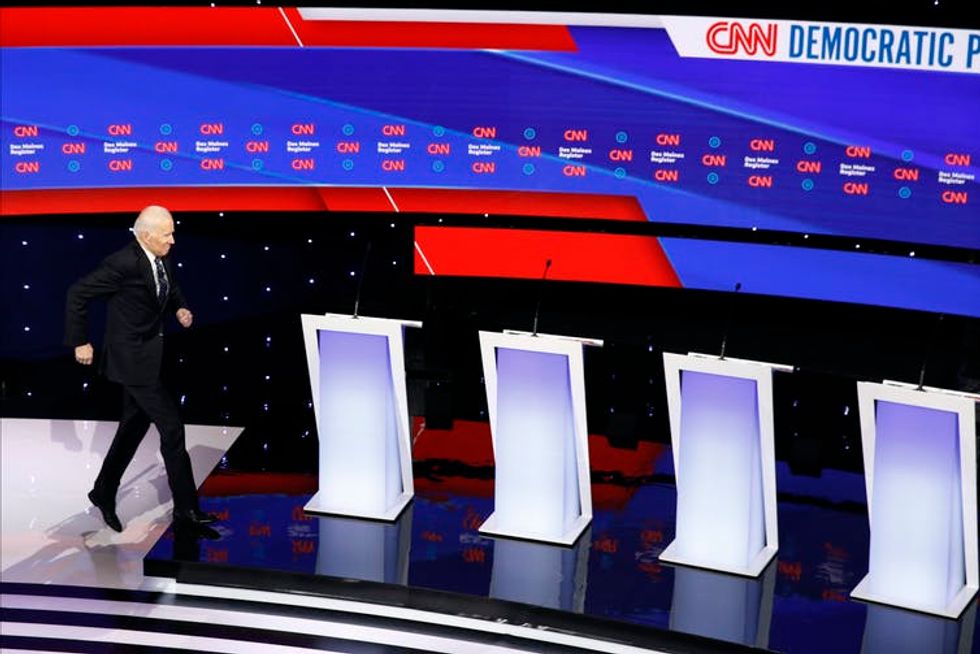
Editor’s note: Six Democrats qualified for the final debate before the Iowa caucus on Feb. 3. We asked three scholars to watch the Jan. 14 debate, held at Drake University in Des Moines, Iowa, and pick a quote from one of the candidates to highlight and analyze.
“I was part of that deal to get the nuclear agreement with Iran, bringing together the rest of the world, including some of the folks who aren’t friendly to us. And it was working.” - Joe Biden
That move convinced American allies that U.S. leadership had become as erratic as it was unreliable. It also removed the incentive for Iran to limit its ability to develop nuclear weapons and relied on sanctions to force Iran to capitulate.
Since the U.S. withdrew, Iran has responded by continuing to develop its nuclear capability, making the time it would need to construct a bomb increasingly shorter. The recent killing of senior Iranian military commander Qassem Soleimani by U.S. drone strike will only encourage Iran to reconsider the steps it must take to defend itself. That may prompt Israel to again contemplate a preemptive strike.
In his speech on Jan. 8, Trump explained his rationale for killing Soleimani – a speech that included several dubious claims. I predict that his effort to force Iran to its knees will have no more success than his attempt to negotiate with North Korea to get them to give up their weapons.
If Trump then resorts to military action against Iran, he will likely find it impossible to convince anyone that his justification for acting is either credible or legitimate.
And if Biden – or any of the others on the stage tonight – become president a year from now, putting the deal back together again will be difficult if not impossible.
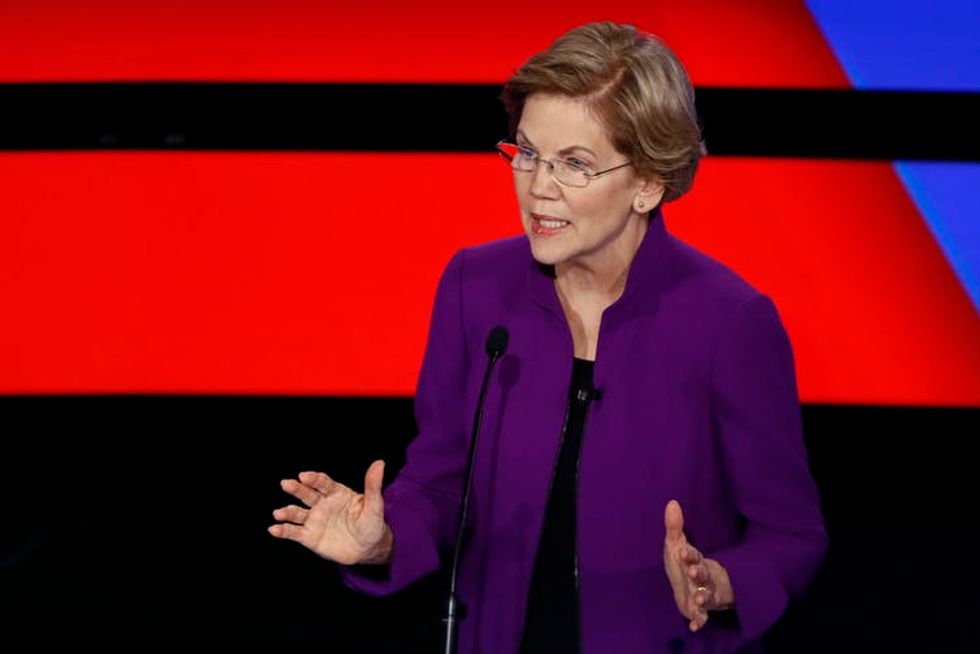
Elizabeth Warren spoke about the American military presence in the Middle East.
“We should stop asking our military to solve problems that cannot be solved militarily.” - Elizabeth Warren
The final debate before the Iowa caucus is a challenging one for candidates. The strategic question at hand is: Do they fight with other primary candidates – or deescalate the differences that exist between them, even if small?
This debate shined a light on the candidates’ foreign policy experience, in contrast with the policies of the sitting president. Most recently, Biden has been seen by Democratic primary voters as the candidate most trustworthy on foreign policy.
The focus on foreign policy in the early minutes of the debate opened a door for candidates to remind voters that their positions reinforce the Obama administration’s commitment to only send troops into harm’s way when it was necessary and with a strategy and defined goals, while at the same time openly questioning the military decisions of the Trump administration, especially in recent days.
Warren’s comments sent a clear message that diplomacy and other means, such as international alliances and negotiation, are to be considered.
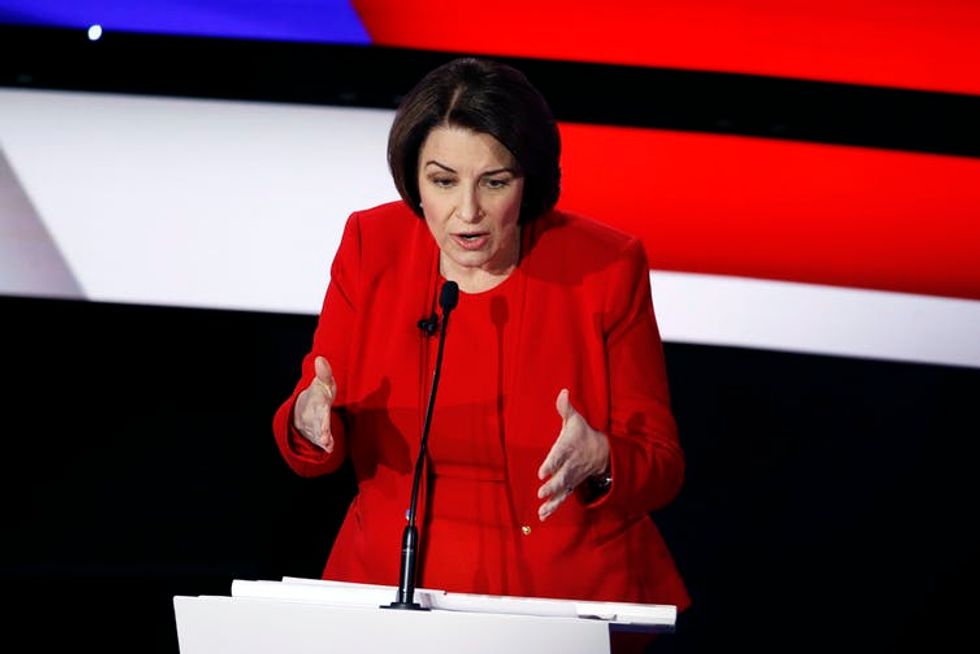
Amy Klobuchar spoke at the Jan. 14 Democratic presidential primary debate.
“We are not going to have a shortage of MBAs, we are going to have a shortage of plumbers.” - Amy Klobuchar
During the debate, moderators raised the question about Pete Buttigieg’s opposition to free public college access for the wealthiest 20% in the country.
Klobuchar attempted to pivot the conversation to the economic value of education, saying that there should be an emphasis on filling blue collar jobs that are currently vacant.
This statement echoes a question in today’s society about the value of higher education and who should be able to access it. This public debate has resulted from rising tuition costs, increased student loan debt and stagnation of wages.
Bureau of Labor Statistics data confirms that, in every state, those with college degrees earn more than those without degrees. College graduate average a weekly income of US$1,173, compared to $712 for those with only a high school diploma. A high school diploma no longer offers a career path that can lead to a middle-class life.
Key members of the Democratic voting block – women and people of color – face significant barriers to closing the income and wealth gap with white men.
In my view as someone who studies African American political behavior, Klobuchar was correct that the conversation about jobs should be broader. But careers with limited mobility and low wages do not offer an effective avenue to economic prosperity. Her comments did not fully acknowledge why people are willing to go into debt in order to receive education beyond high school.
African Americans often view education not only as an avenue to a career that allows for the potential of upward mobility, but also to a greater sense of freedom for oneself and one’s family. Klobuchar’s comment dismisses this long history of deep commitment to earning a freer life.
Leftist Bernie Sanders attacked frontrunner Joe Biden on foreign policy Tuesday but found himself fighting accusations of sexism in the final presidential debate before Democrats begin choosing who challenges incumbent Donald Trump in November's election.
With no candidate yet to carve out a clear lead less than three weeks to go before the first votes in the nominations battle, the stakes were high for the six presidential hopefuls on stage in Iowa.
The largely civilized showdown defied earlier expectations of fireworks, with tensions largely held in check during the two-hour debate.
But a rift between Sanders and fellow Senator Elizabeth Warren appeared to widen afterwards when Warren declined to shake hands with her long-time friend and fellow progressive.
The candidates tangled over everything from troop deployments and foreign policy to health care, international trade, climate change and a woman's chance of winning the White House.
Sanders, 78, assailed former vice president Biden, 77, over his vote in support of the 2003 Iraq war as the modern-day tensions in the Middle East dominated the opening exchanges.
With Washington's conflict with Iran as the backdrop, non-interventionist Sanders drew a sharp contrast, saying that while he opposed an Iraq war that was "based on lies," former vice president Biden trumpeted the effort.
"I thought they were lying," Sanders said of the Bush administration's justifications for war in 2002. "I didn't believe them for a moment. Joe saw it differently."
Biden said he had long acknowledged the war was "a mistake" but refrained from sparring with Sanders over Iraq.
Instead, Biden appealed for unity in preventing Trump from winning a second term.
"The American character is on the ballot," Biden said. "Not what Donald Trump is spewing out -- the hate, the xenophobia, the racism. That's not what we are as a nation."
Each candidate is desperate for a breakout moment that could give them the vital momentum heading into the Iowa caucases on February 3 which begins the presidential primary season.
The four candidates in the top tier -- Biden, Sanders, Warren and former South Bend, Indiana mayor Pete Buttigieg -- are bunched together in polling. Senator Amy Klobuchar and billionaire activist Tom Steyer rounded out the debate participants in Iowa's capital Des Moines.
For months, Sanders and Warren have battled peacefully for the right to wave the campaign's progressive flag. But their non-aggression pact unravelled in recent days, with Warren endorsing a report that Sanders privately told her he believed a woman could not defeat Trump.
"I didn't say it," Sanders insisted at the debate, stressing it was absurd for anyone to think a woman could not win the White House.
Warren said he did, before insisting that she was "not here to try to fight with Bernie."
AFP / Robyn Beck White House Senator Elizabeth Warren declined to shake hands with rival candidate Senator Bernie Sanders (R) after the Democratic Party's final presidential primary debate before Iowa launches the nomination voting on February 3, 2020
She then proceeded to highlight the electability of women, noting that the men on stage collectively lost 10 elections, prompting laughter from the audience.
But when the debate concluded, signs of lingering animosity remained: viral video shows Warren refusing to shake Sanders's outstretched hand and instead speaking briefly to the senator.
- Progressive feud -
AFP / Robyn Beck Former South Bend, Indiana mayor Pete Buttigieg is seeking to remain in the top tier of US Democratic presidential candidates, while Senator Amy Klobucher is struggling to climb into it
While lacking the effervescence of earlier debates, the candidates dutifully debated trade (Sanders said he opposes the new US MexicoCanada trade pact), climate change (Steyer if elected would declare a climate "state of emergency") and taxing the rich (Warren pushed her wealth tax).
Sanders, who suffered a heart attack in November but has enjoyed a mini surge in the polls in recent weeks, made Biden his number one target.
AFP / Kerem Yucel Supporters of US President Donald Trump make a show of political force in Des Moines, Iowa hours before the Democratic Party's seventh presidential debate on January 14, 2020
"I just don't think that Biden's record is going to bring forth the energy that we need to defeat Trump," Sanders tweeted as he released a damning three-minute anti-Biden video just before the debate.
The president meanwhile sought to thrust himself into the spotlight, accusing Sanders of being "nasty" and mocking Biden for occasional memory issues as he addressed supporters in Wisconsin.
"They haven't been doing great on the debates, I have to tell you," Trump said.
The debate risks being overshadowed by a historic political drama: Trump's looming impeachment trial in the Senate next week which is likely to force four presidential candidates to stay in Washington serving as jurors in the proceedings instead of winning over undecided Iowa voters.
AFP / Gal ROMA US 2020 vote: Democratic presidential nomination
There was no disagreements among Democrats that a Senate impeachment trial ought to proceed, with Warren saying "it is my responsibility" to sit as a juror.
Polling is tight in Iowa, with Biden at 20.7 percent support and Sanders, Buttigieg and Warren all less than five percentage points back, according to a RealClearPolitics average of polls.
Klobuchar, credited with a crisp performance in the previous debate, was well behind, at seven percent. Steyer is at 2.7 percent.
But the race remains fluid, with a recent Des Moines Register poll saying six in 10 voters could still be persuaded.
On Tuesday night, six of the leading Democratic candidates for president took the stage in a CNN primary debate — the last debate before the Iowa caucuses.
The stakes were particularly high as the top four candidates — Sen. Elizabeth Warren (D-MA), Sen. Bernie Sanders (I-VT), former Vice President Joe Biden, and Mayor Pete Buttigieg — remain in a tight race for first place in Iowa. The Iowa results may have a significant role in shaping the course of the entire primary process.
Debates are meant to discuss issues important to political parties and their voters broadly, but elections themselves are fundamentally about winners and losers. So here’s my — necessarily subjective — assessment of who came out of the debate looking stronger and who came out looking weaker:
Winners
Bernie Sanders — Some recent polling in Iowa has given Sanders’ supporters hope that he will come in first in the primary. And on Tuesday night, Sanders put his best foot forward. He continued his strong push against Biden and effectively parried away criticisms. CNN had clearly hoped for some fireworks between him and Warren over a recent dispute between their campaigns about her allegation that he once told her a woman couldn’t win in 2020. He denied the story, and he made a passionate argument that we should believe the opposite. But more importantly, he didn’t get bogged down in the fight and spent much of the night speaking clearly about the issues that matter to him.
Elizabeth Warren — Warren struggled at first in the debate to hit her stride, but once she got it, she gave a strong performance. She stuck by her story about Sanders, but she didn’t dwell on it. Instead, she made a powerful case that a woman, and she, in particular, would be a strong opponent of the president in 2020. It was the standout moment in the debate, and if convincing, it turned a potential weakness of hers into a strength. And at the end of the debate, she wrapped up by listing off several issues that were neglected during the night — including mental health, violence against trans people, gun safety, disability rights, and climate change’s impact on communities of color — showing her breadth of interests and passions.
Pete Buttigieg — Buttigieg’s best chance for making waves in the primary — a chance which overall remains small — rests on an impressive showing in Iowa. And with that on the line Tuesday night, he delivered what he needed: cogent, passionate responses to answers that showed off his skills as a politician and communicator. He still has many weaknesses his opponents or his could have exploited, most notably a recent devastating report in The Root about his failure to address racism in the South Bend Police Department. But largely, his opponents left him untouched. At one point, CNN’s Abby Phillip pressed him on his lack of support from black voters. While he didn’t answer the question directly, he successfully deflected it and was never really caught flat-footed.
Losers
The moderators — The moderation of the debate was a disaster. Many of the questions that were asked were framed merely for the purpose of being confrontational, rather than generating clarity on the issues or inspiring informed debate. The moderators obsessed over the costs of proposed programs like Medicare for All and free college, rather than discussing the benefits they might bring. And they continually interrupted the candidates in the middle of their answers instead of waiting for a natural pause.
Joe Biden — Biden remains the frontrunner in the polls, and his previously lackluster debate performances don’t appear to have hurt him much. Nevertheless, it was hard to watch Biden’s performance and conclude he’s anything other than a loser of the night. His answers were slow, stilted, and frankly, he often looked bored and just waiting for the debate to be over. His best moment was his closing statement, which he delivered with gusto. But it just left me wondering: Where was that energy and passion the rest of the debate?
Tom Steyer — What is there to say about Tom Steyer? The fact that he has bought his way on to the debate stage with his massive wealth and a disingenuous campaign to impeach Trump hangs over his whole candidacy. His passion about climate change is always welcome, but the case that he — a billionaire with no experience in government — is best positioned to address the issue is highly dubious. He also insists on talking directly to the camera during the debates, which is off-putting. And he continues to claim that his success in business makes him best positioned to run against Trump on the economy, though there’s little reason to believe this is true.
Amy Klobuchar — The Minnesota senator has a decent case to make for her own electability as a popular elected official from the Midwest. But unfortunately, she keeps sliding into the same habit in each debate of casting herself as the person who throws cold water on the bold ideas of others. There may be a role for that in debates, but her relentless use of the tactic is hardly inspiring. While she can dish out criticism, it’s much harder for her to paint a vision of why someone should want to vote for her above and beyond her supposed ability to win.
On Tuesday night, six of the leading Democratic candidates for president took the stage in a CNN primary debate — the last debate before the Iowa caucuses.
The stakes were particularly high as the top four candidates — Sen. Elizabeth Warren (D-MA), Sen. Bernie Sanders (I-VT), former Vice President Joe Biden, and Mayor Pete Buttigieg — remain in a tight race for first place in Iowa. The Iowa results may have a significant role in shaping the course of the entire primary process.
Debates are meant to discuss issues important to political parties and their voters broadly, but elections themselves are fundamentally about winners and losers. So here’s my — necessarily subjective — assessment of who came out of the debate looking stronger and who came out looking weaker:
Winners
Bernie Sanders — Some recent polling in Iowa has given Sanders’ supporters hope that he will come in first in the primary. And on Tuesday night, Sanders put his best foot forward. He continued his strong push against Biden and effectively parried away criticisms. CNN had clearly hoped for some fireworks between him and Warren over a recent dispute between their campaigns about her allegation that he once told her a woman couldn’t win in 2020. He denied the story, and he made a passionate argument that we should believe the opposite. But more importantly, he didn’t get bogged down in the fight and spent much of the night speaking clearly about the issues that matter to him.
Elizabeth Warren — Warren struggled at first in the debate to hit her stride, but once she got it, she gave a strong performance. She stuck by her story about Sanders, but she didn’t dwell on it. Instead, she made a powerful case that a woman, and she, in particular, would be a strong opponent of the president in 2020. It was the standout moment in the debate, and if convincing, it turned a potential weakness of hers into a strength. And at the end of the debate, she wrapped up by listing off several issues that were neglected during the night — including mental health, violence against trans people, gun safety, disability rights, and climate change’s impact on communities of color — showing her breadth of interests and passions.
Pete Buttigieg — Buttigieg’s best chance for making waves in the primary — a chance which overall remains small — rests on an impressive showing in Iowa. And with that on the line Tuesday night, he delivered what he needed: cogent, passionate responses to answers that showed off his skills as a politician and communicator. He still has many weaknesses his opponents or his could have exploited, most notably a recent devastating report in The Root about his failure to address racism in the South Bend Police Department. But largely, his opponents left him untouched. At one point, CNN’s Abby Phillip pressed him on his lack of support from black voters. While he didn’t answer the question directly, he successfully deflected it and was never really caught flat-footed.
Losers
The moderators — The moderation of the debate was a disaster. Many of the questions that were asked were framed merely for the purpose of being confrontational, rather than generating clarity on the issues or inspiring informed debate. The moderators obsessed over the costs of proposed programs like Medicare for All and free college, rather than discussing the benefits they might bring. And they continually interrupted the candidates in the middle of their answers instead of waiting for a natural pause.
Joe Biden — Biden remains the frontrunner in the polls, and his previously lackluster debate performances don’t appear to have hurt him much. Nevertheless, it was hard to watch Biden’s performance and conclude he’s anything other than a loser of the night. His answers were slow, stilted, and frankly, he often looked bored and just waiting for the debate to be over. His best moment was his closing statement, which he delivered with gusto. But it just left me wondering: Where was that energy and passion the rest of the debate?
Tom Steyer — What is there to say about Tom Steyer? The fact that he has bought his way on to the debate stage with his massive wealth and a disingenuous campaign to impeach Trump hangs over his whole candidacy. His passion about climate change is always welcome, but the case that he — a billionaire with no experience in government — is best positioned to address the issue is highly dubious. He also insists on talking directly to the camera during the debates, which is off-putting. And he continues to claim that his success in business makes him best positioned to run against Trump on the economy, though there’s little reason to believe this is true.
Amy Klobuchar — The Minnesota senator has a decent case to make for her own electability as a popular elected official from the Midwest. But unfortunately, she keeps sliding into the same habit in each debate of casting herself as the person who throws cold water on the bold ideas of others. There may be a role for that in debates, but her relentless use of the tactic is hardly inspiring. While she can dish out criticism, it’s much harder for her to paint a vision of why someone should want to vote for her above and beyond her supposed ability to win.
House Intelligence Committee Chair Adam Schiff, a California Democrat, dropped a new slate of deeply revealing evidence Tuesday night in the impeachment case against President Donald Trump.
Though the evidence doesn’t change the basic narrative of the case against Trump — that he and a group of his cronies used the administration in various ways to put pressure on Ukraine to announce investigations into his political rivals as the 2020 campaign heated up — it adds more color and detail to the story and should make the president’s culpability in a disturbing plot even harder for his Republican allies to deny.
Here are seven stunning new facts the new evidence revealed:
1. Rudy Giuliani told Ukrainian President Volodymyr Zelensky he’s working with Trump’s “knowledge and consent.”
Writing to Zelensky on May 10, when Giuliani was trying to plan a trip to Ukraine to pressure the country into investigating former Vice President Joe Biden, the president’s lawyer wrote that he is acting with Trump’s “knowledge and consent.” This claim fundamentally undercuts the argument some defenders of the president have been inclined to make that Giuliani was operating as a rogue agent.
2. In the same letter, Giuliani says he is acting in his “capacity as personal counsel to President Trump.”
“I am private counsel to President Donald J. Trump,” Giuliani wrote. “Just to be precise, I represent him as a private citizen, not as President of the United States.”
This confirms, as many have argued repeatedly, that Giuliani’s efforts in Ukraine were clearly for Trump’s personal benefit, not the country’s. That’s part of the reason why it was so grossly wrong, and indeed impeachable, for him to use the powers of his office to induce Ukraine to announce an investigation into Biden and other political opponents.
3. Trump lawyer Jay Sekulow gave John Dowd, another attorney, permission from the president to defend Igor Furman and Lev Parnas, two of Giuliani’s associates who have been indicted on campaign finance charges, in part, for their Ukraine-related work.
Trump has claimed he doesn’t know who Furman and Parnas are, even though he has appeared in pictures with them. This evidence makes it harder to believe this is true and raises more questions about why he was trying to conceal his dealings with them.
4. Parnas wrote notes on Ritz-Carlton stationery suggesting he was directly involved with the Ukraine scheme.
“get Zalensky [sic] to Annonce [sic] that the Biden case will Be Investigated,” he wrote.
In a letter to House Judiciary Chair Jerry Nadler, Schiff said Parnas’ lawyer confirmed that he wrote the note.
5. Parnas texted with a man named Robert F. Hyde, believed to be the same person who is running for a House seat in Connecticut, about removing former Ukraine Ambassador Marie Yovanovitch.
Schiff explained:
In response to some articles, tweets, and videos accusing the Ambassador of being disloyal to President Trump, Mr. Hyde wrote “Wow. Can’t believe Trumo [sic] hasn’t fired this bitch. I’ll get right in that. Mr. Hyde then sent a series of text messages suggesting that he had Ambassador Yovanovitch under physical surveillance in Kyiv and that “They are willing to help if we/you would like a price.”
6. Parnas was also communicating with Ukrainian officials which, Schiff argued, demonstrated “that Mr. Parnas served as a direct channel between President Trump’s agent, Mr. Giuliani, and individuals close to President Volodymyr Zelensky.”
Parnas tried to set up a meeting for Giuliani and Zelenksy in May 2019 via senior aides to the Ukrainian president, the texts show.
7. Giuliani tried to get a visa approved for a disgraced former Ukrainian prosecutor.
Parnas told Giuliani that former Prosecutor General Viktor Shokin, who has been feeding the unsupported allegations against Biden, was denied a visa to the U.S. Giuliani said in response: “I can revive it,” despite having no formal role at the State Department.
In October, when asked about indicted Rudy Giuliani business associates Lev Parnas and Igor Fruman, President Donald Trump played dumb, saying "I don't know those gentlemen."
But that is decidedly at odds with an email released as part of a trove of documents given by Parnas to the House Intelligence Committee, which suggests that Trump approved legal counsel for Parnas and Fruman just days before denying he knew them to reporters:
Parnas and Fruman were indicted on campaign finance charges relating to their roles in the scheme to withhold military aid from Ukrainian President Volodymyr Zelensky to force him to announce an "investigation" of former Vice President Joe Biden's family. Giuliani, currently serving as Trump's attorney, is reportedly also under investigation for the affair.
On Tuesday, the House Intelligence Committee released some of the documents turned over by indicted Rudy Giuliani associate Lev Parnas, who allegedly aided in the scheme to use military aid to extort Ukrainian President Volodymyr Zelensky into announcing an investigation into former Vice President Joe Biden.
One of the most eye-catching documents to be released is a hastily-scrawled note, written on stationery from the Ritz-Carlton hotel in Vienna, Austria, which read "get Zalensky [sic] to Annonce [sic] that the Biden case will be Investigated."
Parnas turned over a vast trove of information to the House as part of his attempt to cooperate with the impeachment proceedings.
Senate Majority Leader Mitch McConnell (R-KY) on Tuesday admitted that there is "little to no sentiment in the Republican caucus" supporting a motion to dismiss articles of impeachment against President Donald Trump.
At a press conference, McConnell told reporters that the Senate impeachment trial will likely begin next Tuesday.
“There is little to no sentiment in the Republican caucus for the motion to dismiss," McConnell said.
The Majority Leader went on to suggest that Republicans would call their own witnesses if Democrats insist on having new testimony.
"I can’t imagine that only the witnesses that Democrats want to call would be called," he said.
Some Republicans have said that Joe Biden, Hunter Biden and Rudy Giuliani should speak to Senators.
In an MSNBC panel discussion Tuesday, former FBI assistant director for counterintelligence, Frank Figliuzzi, warned that American law has not kept up with technology. As a result, the laws and regulations on international hacking are ambiguous. The recent act by Russia to hack the Ukrainian oil and gas company Burisma to search for dirt on former Vice President Joe Biden is exactly what former special counsel Robert Mueller cautioned would happen in 2020.
"We have been told, including by Bob Mueller, that Russians were doing this in an ongoing fashion," said Figliuzzi. "This is the new battlefield. This is the new normal. We're going to see this go on and on and on. And it may be Joe Biden that this is about right now, but every candidate should hunker down and get ready for foreign influence, hacking and propaganda."
Former FBI special agent Clint Watts explained that the way the American government protects against cyber-espionage is really only isolated to .gov and .mil sites and accounts. They don't have the bandwidth to protect every .com in the United States. So, companies like CrowdStrike, which President Donald Trump has accused of some type of conspiracy, is a private company that helps corporations, banks or law firms protect their networks.
Figliuzzi went on to say that it's clear the Russians don't care about intruding in the American election because no one will stop them.
"The similarity that you're describing is what's so brazen about this," he said. "Russians made no effort to try something different. This is a message to us that, look, we don't fear any reprisal. No one's going to push back on us, so why should we bother masking our identity? We could pretend to be Iranians; they've done that before. We could pretend to be North Korean. We could pretend to be the 400-pound guy in his bed but no, we're going to leave a trail of bread crumbs that you've seen before. It leads right to us. Now do something about it. That's the challenge we're facing with Russia."
Host Katy Tur went on to ask Watts what the security apparatus can do when the president of the United States goes so far as to put out misinformation and propaganda to help his campaign.
Watts explained that's why Trump was asked what he would do if compromising material was given to him by a foreign government again. Reporters asked Trump if he would hand it over to the FBI, and he said "no," and he would willingly collude with the foreign power again. Watts said that when foreign governments see Trump's comments, then they are more willing to intrude on the election more openly now.
Since Sen. Kamala Harris dropped out last month, "Sanders appears to have gained almost all of [her] former supporters in California."
With a ten-point jump since November, Sen. Bernie Sanders has surged to the lead in a California tracking poll less than two months before the state's Democratic primary on Super Tuesday—March 3.
The tracking poll Public Policy Institute of California, which was last conducted in November, shows Sanders leading with support of 27 percent of likely Democratic primary voters, followed by former Vice President Joe Biden with 24 percent and Sen. Elizabeth Warren at 23 percent.
With a margin of error of 6.5 percent, the poll revealed a statistically tight race among the top three candidates—though fourth place was occupied by former South Bend, Indiana mayor Pete Buttigieg who garnered just 6 percent. The most striking feature in the trends was that while support for Warren and Biden has plateaued since Sen. Kamala Harrris, who represents California, dropped out in early December, Sanders experienced a significant surge.
"Sanders appears to have gained almost all of Kamala's former supporters in California," tweetedThe Hill's Krystal Ball in response.
"Among younger voters (age 18–44), Sanders (45%) has much more support than Warren (25%) and Biden (12%)," the PPIC noted, "while voters age 45 and older favor Biden (32%) over Warren (22%) and Sanders (15%)."
Appearing on "The Late Show with Stephen Colbert," MSNBC host Joe Scarborough ripped into the Republican Party lawmakers for casting aside their constitutional duties and selling out to Donald Trump.
Sitting next to Mika Brzezinski, the former GOP lawmaker was asked about the possibility that multiple GOP lawmakers might not fall in line with Senate Majority Leader Mitch McConnell's plan to undercut the president's impeachment trial.
"There have been some Republicans who will kind of go halfway there and then pull back,” Brzezinski told the late-night TV host, with Scarborough jumping in.
“That’s what I don’t understand, what job is worth selling your political soul for?” Scarborough suggested. “You can look at the people who are running in Republican primaries, and you can predict what they’re going to do. It’s very disappointing.”
Scarbrough also stated he supported former Vice President Joe Biden as the best bet to unseat Trump.
“Here’s the amazing thing about Joe Biden,” Scarborough explained. “He’s like Trump. He’s Teflon. It doesn’t matter how he does in debates, it doesn’t matter what clips you bring up about the guy, he just keeps on keepin’ on.”





 AFP / Robyn Beck
  AFP / Robyn Beck
  AFP / Kerem Yucel
  AFP / Gal ROMA

