On Thursday, the panel on "Morning Joe" couldn't contain their disbelief at the path that Donald Trump seems to be taking as he makes a third run for the presidency, with co-host Joe Scarborough laughing and noting the former president wants to "terminate the Constitution" if he is re-elected.
After touching on Trump's bizarre comments that implied he is at odds with his own children, the MSNBC host expressed amazement that the former president is still the leading GOP contender for the top spot on the 2024 ticket.
"You want to turn things around? You've got to change the dynamic," he exclaimed. "What is the dynamic you have to change so the game changes? So your business changes? Change the dynamic. They're not doing it as long as you don't change the dynamic."
"If you lost in '17, '18, '19, '20, '21, '22, you're going to lose in '24, but they're not," he continued. "If it is Ron DeSantis versus Joe Biden -- we all have our problems with Ron DeSantis -- you've just changed the dynamic and the Biden team has a reason to be very worried."
"If it's Trump and Biden, go to France for a month; he's lost his mind," he laughed. "Now, he is fighting his own children. He said he wanted to terminate the constitution."
It is still almost 300 days until the first ballot is cast but the fog is already lifting in the battle for the 2024 Republican presidential nomination -- leaving two men standing.
Florida Governor Ron DeSantis has emerged as the only genuine threat so far to frontrunner Donald Trump, with the primary contest narrowing to a bitter head-to-head over character and the ability to win elections.
A number of lower-profile hopefuls have been bystanders as the 76-year-old political brawler with a peerless aptitude for sniffing out weakness among his enemies has concentrated his fire on the young pretender, 32 years his junior.
Trump is making his third run for the White House after losing his re-election bid to Democrat Joe Biden in 2020, while DeSantis, who is yet to officially announce his candidacy, is untested on the national stage.
The similarities are unmistakable -- from the populist style honed in their respective fiefdoms at opposite ends of Florida to their love of showmanship, culture wars and a good old-fashioned dust-up with the media.
But their success in persuading Republicans to give them a shot at the White House in 2024 may well turn on their ability to play to their differences.
The pair weren't always foes. Trump endorsed DeSantis in his first run for governor in 2018, before distancing himself from his protege after the 44-year-old's landslide re-election victory last year.
The combative governor's crusade against the "woke" left-wing ideology he sees as infecting schools and other public institutions has made him a major player in American conservatism and, in many respects, a Trump "mini-me."
- 'No daily drama' -
Meanwhile, the de facto Republican leader has been rolling out his rhetorical artillery, labeling DeSantis a "mediocre governor," scoffing at his claims to have kept Florida open during the pandemic and painting him as a threat to the welfare safety net.
The Florida governor responded with his most direct shots yet at his adversary, drawing a distinction between his own "no daily drama" leadership style and the stubborn whiff of scandal and constant chaos around Trump.
As with the stragglers among the Republican White House hopefuls, DeSantis has not diverged meaningfully from Trump's stated positions or governing record, reducing the contest to a question of style over substance.
"On a policy front, they're probably very similar. They share some of the same basic America First kind of policies," says Saul Anuzis, a political consultant and former chairman of the Michigan Republican Party.
"But their style, their way of governance, that's where the big difference comes in."
DeSantis, the progeny of working-class parents, a war veteran and a Harvard and Yale graduate, is from different stock than the former president, heir to a real estate empire built up by his father.
"DeSantis seems to be less bombastic, more deliberate, while at the same time willing to take on the media," Anuzis notes.
"He is not afraid of a fight but he does it in a softer, kinder way."
Trump, on the other hand, is a "larger-than-life populist," according to Matthew Continetti, a researcher at the American Enterprise Institute think tank and author of a history of the US conservative movement.
"He is someone whose personality overwhelms everything else," he said.
- 'Remarkably unpopular' -
For this expert, DeSantis has better odds than Trump for defeating the 2024 Democratic candidate, which will almost certainly be Biden.
"(Trump) is very popular among his base supporters, but two-thirds of the country don't want to see him (as) president again," Continetti says.
Another reason to think DeSantis might play better in the general election: he isn't facing criminal investigation in multiple jurisdictions and isn't seen as a one-man crime wave by much of Middle America -- the 30 percent of voters that decide elections.
Trump's controversies have not dampened his enthusiasm for swatting away rivals with puerile smears and DeSantis will be expected to hit back with alacrity.
But he will also need to contend with Trump's secret sauce -- the enormous leeway his supporters give him compared with the much higher standards to which other politicians are held.
The DeSantis campaign, for example, took a big hit from both parties when he downplayed Russia's brutal invasion of Ukraine as a "territorial dispute" -- while Trump's nakedly pro-Putin rhetoric barely raises an eyebrow.
"I don't think there's any benefit for DeSantis or anybody to really attack Trump at this stage of the game," Azunis told AFP.
"DeSantis has set his own timetable," he added. "He has been very disciplined so far, and I think that discipline has served him well."
A Florida congressman on Wednesday assailed Republicans who oppose gun safety laws in the aftermath of a school shooting in Nashville earlier this week that killed six people including three children.
Rep. Jared Moskowitz (D-FL) noted that the Nashville shooting suspect used an AR-15, the assault rifle of choice for most mass shooters that was banned from 1994 to 2004.
Moskowitz made his comments during a Committee on Oversight and Accountability meeting on crime in Washington D.C.
“There are six people that are dead in that school including three children because you guys got rid of the assault weapons ban,” Moskowitz said during an exchange with Rep. Marjorie Taylor Greene (R-GA).
“Because you guys made it easy for people who don't deserve to have weapons, who are mentally incapable of having weapons of war, being able to buy those weapons and go into schools.”
Before the exchange with Greene, Moskowitz said it was absurd to focus on relatively minor crimes such as public urination and car theft amid an ongoing mass shooting epidemic that the nation is now experiencing.
“You guys want to talk about DC public schools and crime? I don't I don't want to burst your bubble over there, but mass murder in schools is crime,” Moskowitz said.
“You want to talk about 1,300 cars being stolen, 550 people have been murdered in school. Who cares about the cars? What about the kids?”
"No hearing for them. 330,000 kids have experienced gun violence in this country. The number one killer of school aged children in this country. Gun violence. How do you think for the parents who have had to bury their kids who have had to decide what to put their kids clothes, but their kids when they buried them? Or kind of box they have to pick out for their child or for when they come home?"
The exchange with Greene began after Moskowitz asked rhetorically whether anyone in the committee disagreed with his assertion that “murder in schools is murder.”
“I'll yield to anyone on this committee who disagrees that murder in schools is not murder,” he said.
“Is there any question?”
The far-right congresswoman from Georgia did not dispute Moskowitz’s characterization of school shootings being murderous, but instead cited her own lived experience and blamed the horrific incidents on gun laws.
“I was an 11th grade and Joe Biden made our school gun free school zones,” Greene said. “One of the students in my school brought three guns to school and our entire school went on lockdown, because he was the only person with a gun."
“There was no good guy with a gun to protect us kids at school.”
Greene cited police who fatally shot the suspect in Monday’s shooting as an example of a “good guy with a gun” saving lives.
“So, if you want to have a good talk about schools, and protecting children, we need to talk about protecting our children the same way we protect our president, the way we protect our celebrities,” Greene said.
Moskowitz disputed the notion that an armed presence offers much deterrence, noting that in the aftermath of the 2018 Parkland, Florida shooting, he supported School Resource Officers at every school.
“Did the good guys with the guns stop six people from getting murdered? No. But you know what? AR 15’s, have you ever seen what those bullets do to children? You know why you don't hunt with an AR 15 with a deer, because there's nothing left. And there's nothing left as these kids when people go into school and murder them while they're trying to read."
“You guys are worried about banning books – dead kids can't read.”
The About Face Beauty Spa in Royal Oak, Michigan, a quiet suburb north of Detroit, offers a variety of skin and body services, from $10 lip waxing to a $150 “bridal make-up” session.
But while owner Robin Manoogian generally caters to a local clientele, you’ve likely seen her work.
That’s because the Republican National Committee has paid the beauty spa more than $17,000 in recent years to do Chairwoman Ronna McDaniel’s hair and make-up ahead of the powerful Michigander’s many appearances on national television.
The payments to Manoogian’s spa are just a fraction of the nearly $100,000 the RNC has paid various beauty professionals since 2017, when McDaniel became chairwoman, according to a Raw Story analysis of federal campaign finance data. They include several in the Washington, D.C., area, where McDaniel also spends significant amounts of time.
Describing McDaniel as “a delight to work with” and possessing "the most beautiful bone structure and sparkling eyes,” Manoogian told Raw Story she routinely meets the RNC chairwoman on-location at Detroit television studios.
“When she's got a live interview, we just keep working. Rain, sleet, snow,” said Manoogian, adding she totes a beauty kit with her for her appointments with McDaniel. “You know, the hit is scheduled for a certain time frame and she's got to be in the chair mic'ed ready with not a hair out of place. In and out. Done and done.”
The RNC’s hair-and-make-up spending comes at a time when the Republican Party is courting blue-collar voters and lambasting President Joe Biden for what conservative leaders assert is an elitist and ineffectual economic policy that’s causing “nothing but pain and misery for American families.”
A recent payment from the Republican National Committee to the About Face Beauty Spa, per Federal Election Commission records.
And it’s the latest example in a storied string of prominent political figures — both Democrats and Republicans — who’ve enjoyed top-shelf pampering while simultaneously wooing the proletariat.
‘Incredibly sexist’
An RNC spokeswoman defended the committee’s hair-and-makeup spending, which it characterized in federal campaign finance filings as “media preparation.”
“These payments were for hair and make-up for TV appearances for GOP voices, and as chairwoman of the RNC, part of the job is to spread our great Republican message on the airwaves,” RNC spokesperson Emma Vaughn told Raw Story. “It is incredibly sexist of Raw Story to attempt to smear women in politics for getting their hair and make-up done for TV appearances, something that has been done by men on both sides of the aisle for decades without criticism.”
But there has been criticism, often from Republicans.
In 2015, prominent Republicans panned then-Democratic presidential candidate Hillary Clinton — perennially on television — for a $600 hair appointment at the posh John Barrett Salon in New York City, which put part of the Bergdorf Goodman department store on lockdown.
Then-GOP presidential frontrunner and Wisconsin Gov. Scott Walker tweeted a list entitled “The Economics of Hillary’s $600 Haircut.” The money spent on Clinton’s coiffure could buy a family “138 pounds of beef” or “buy four years’ supply of eggs,” Walker asserted. Hashtag: “#OutOfTouch.”
The College Republicans tweeted two photos of Clinton, her hair shorter and sleeker in the second image. “Before and After @HillaryClinton's $600 haircut #WeCanDoBetter,” it read.
In another tweet, the College Republicans scoffed: “.@HillaryClinton's $600 haircut: meanwhile college students struggling to pay for books this semester #WeCanDoBetter”
For example, Trump has called actress Rosie O’Donnell a “fat pig” and “slob” and media executive Arianna Huffington a “dog” and “ugly both inside and out.”
“I tell you what it really was shocking to see it because you’re right it must be, it was massive. Her hair became massive,” he told conservative radio host Mark Levin in 2017.
Levin warned Trump, whose own hair is the subject of endless fascination and mockery, that his comments might get him in trouble.
“I don’t care. I’m a person that tells the truth,” Trump said. “You know it was interesting to see but I’ve never seen Hillary with that hairdo so I think that’s an OK thing to say, but it was very different.”
More recently, Trump slammed the Super Bowl halftime performance of Rihanna, a longtime critic of the former president.
"Without her 'Stylist' she'd be NOTHING. Bad everything, and NO TALENT!" Trump wrote on his Truth Social site.
As the news spread about the possibility of a Trump indictment for the hush money payments to adult film star Stormy Daniels, the former president lashed out, calling her “horseface” and misspelling her name.
Political expense? Or personal?
There's a fine line between what the public will consider a legitimate political expense and a personal extravagance.
"If political donors knew their contributions would be funding $16,000+ spa retreats, $1,000+ haircuts, and thousands of dollars for suits, dresses, and makeup, many of these contributors likely wouldn't donate," said Aaron Scherb, senior director of legislative affairs at Common Cause, a government accountability group. "While these expenses likely aren't illegal, these examples show how big money continues to dominate politics and funds lavish lifestyles for certain political figures. We need reforms like those contained in the Freedom to Vote Act to get big money out of politics to help elevate the voices of everyday Americans in politics."
The COVID-19 era proved that TV talking heads, stuck in their living rooms and home offices with studios off-limits, could still do national media hits without the help of professional artists.
One prominent politician — Sen. Jon Tester (D-MT) — boasted in a fundraising message to donors about his cut-rate approach to grooming.
“Just like my $12 flattop haircut from my local barbershop back home and my collection of dirt-stained t-shirts, my background is a big part of the reason I remain grounded and focused amid the partisan politics and nonsense happening in our government,” Tester said.
Nevertheless, politicians of all stripes will sometimes use donors’ campaign cash — often a little, occasionally a lot — to put on their best face.
Rep. Pete Aguilar (D-CA) paid a makeup artist $300 in August 2022. When Secretary of the Interior Deb Haaland represented New Mexico in the U.S. House, she once spent $275 on a makeup artist.
And when Carla Sands, who served as an ambassador to Denmark during the Trump administration, ran for U.S. Senate in Pennsylvania in 2022, she labeled her $845 makeup artist as "media prep.”
There are others: Rep. Emilia Sykes (D-OH) spent less than $300 on "media prep" at Macy's and Dillards. During her 2014 and 2016 campaigns, Rep. Tulsi Gabbard, a Democrat-turned-independent who now works as a Fox News contributor, spent just under $7,000 in campaign cash for makeup and hair expenses.
Raw Story also examined Rep. Nancy Pelosi's expenses, finding that among her campaign accounts and political PAC, the former Democratic House speaker used campaign money to fund $2,900 worth of makeup and hair expenses between 2014 and 2024.
But according to campaign finance reports, the former speaker didn’t regularly use political or campaign cash to have her makeup and hair done for public appearances. Rather, she paid for it out of her own pocket and not at the donors’ expense.
Pelosi’s appointments continued to make news during the past decade. Fox News, for example, reported on Pelosi having her hair done in San Francisco on Aug. 31, 2020 — during the early months of the COVID-19 pandemic, when trips to the beauty salon or barber shop came with perceived risk.
Campaign finance reports show that during the same month, the RNC paid District Bridal Company of Washington, D.C., $2,496 for hair and makeup services.
In the midst of these hair and makeup expenditures, the Republican National Committee stands apart for the frequency and amount of money it spends for such services, Raw Story’s analysis of federal campaign finance data indicates.
Among the charges the RNC had for hair and makeup includes $750 for a Michigan salon and a “celebrity” makeup artist that appears to work with Fox, who charged $2,546.97.
In the case of one makeup artist, who was paid $1,560 in 2018 and $778 in 2017, the same person was listed on OpenSecrets for "travel expenses," totaling $3,473 in 2017.
The RNC told Raw Story that, by its count, the DNC spent over $47,000 in hair and makeup expenses during the 2021-2022 election cycle.
The DNC refused to comment for this story. But a person familiar with the DNC expenditures told Raw Story the costs are not just for hair and makeup but for a variety of people and purposes.
FEC data indicated the DNC lists hair and makeup expenses using the catch-all term “event production,” which also includes site rentals, stage set-ups, lighting, filming, and event consultants for conventions. It’s all mixed together, making it difficult to suss out the exact amount out of the $167,817 of “event production” for the past decade.
The names of hair and makeup vendors that appear in the DNC’s financial disclosures also for the past year match the names of makeup artists that have posted photos touting their work with first lady Jill Biden during the 2020 campaign for her photoshoot with Vanity Fair.
Another DNC expense during the 2021-2022 years comes from the hair and makeup company Conceptual Beauty.
While they haven’t posted any photos of their work with political leaders in the past two years, they did share pics of Pelosi, tagging the location of the photos as the Capitol Visitor’s Center following Donald Trump’s 2019 State of the Union address.
Many of the DNC's hired hair and makeup artists are proud to publicly promote their clients, whether political or media. But DNC Chairman Jaime Harrison never turned up in the social media images for these hair and makeup artists.
It doesn’t mean he hasn’t utilized any services — but there’s no federal record indicating such expenditures have occurred. The DNC declined to comment on Harrison, as well.
The artist was hired via the communications department during Anthony Scaramucci’s short tenure. Then-White House press secretary Sarah Huckabee Sanders’ makeup changed enough during her time in front of the cameras that comedian Michelle Wolf joked about her “perfect smoky eye” during a White House Correspondents Association dinner.
‘Personal image to maintain’
According to Manoogian, McDaniel has never physically visited her spa in Michigan.
And while McDaniel may rank among Manoogian's most notable clients — the late Queen of Soul Aretha Franklin is another — Manoogian told Raw Story that she has worked for decades doing hair and makeup for television programs and more recently did the makeup for an episode of NBC show “Dateline.”
Manoogian’s spa website explained that she has worked for numerous clients and network television during her nearly 40 years in the business.
Manoogian emphasized that the money she’s made from the RNC came over a six-year period and that she does McDaniel's makeup and hair every time she's appearing on television from Michigan. Most cable news networks have their own hair and makeup staff in New York and Washington, but that might not be the case at the affiliates where the guest, such as McDaniel, appears via satellite.
RNC Chairwoman Ronna McDaniel appears on Fox News in November 2018.
RNC Chairwoman Ronna McDaniel appears on CNN in February 2023.
"I absolutely just go to the studio facility prior to the interview to handle getting her ready, and that's my craft," Manoogian explained. "I mean, with six years together, do the math. When she's in D.C., I know she's got her normal crew but, I know she travels all the time, so she's either coming or going."
Manoogian clarified that she has a "kit" and drives directly to the studio to meet McDaniel each time.
"It's not much per year for how many visits there are," Manoogian said. "And essentially, you have to go where the satellite is to reach the national, live. It's standard."
Manoogian also explained that one of the biggest problems with television is that it takes a three-dimensional world and renders it in two dimensions, which is why people always look like they've gained weight on camera. Light reflecting off the oils on the face also contributes. So, the most important thing a person can do when appearing on camera is to ensure there's no shine, she said.
“As a professional, you have a personal image to maintain, just like movie stars," Manoogian told Raw Story.
Politicians, tangled
Former President Bill Clinton and former U.S. Sen. John Edwards (D-NC)Photos by Gage Skidmore/Wikipedia and Peter Smith/Flickr
In a political era where the image is often everything, one can trace modern grooming and beauty brouhahas to President Bill Clinton, who once shut down part of Los Angeles International Airport with Air Force One’s engines running so his mononymous Beverly Hills hairstylist, Cristophe, could board the presidential jet and tend to the commander-in-chief’s salt-and-pepper locks.
Democrat John Edwards, a U.S. senator and 2004 and 2008 presidential candidate, drew gasps and pearl-clutching when this “son of a mill worker,” who championed impoverished Americans, used $1,250 worth of donor dollars to bankroll a traveling hairstylist who tended to his Kennedy-like coiffe.
During the 2008 campaign, the RNC spent $150,000 not on hair and makeup but on a wardrobe for vice presidential nominee Sarah Palin and her family, Politico reported at the time. Ahead of the Republican Convention in Minneapolis that year, the committee spent $75,062.63 at Neiman Marcus.
Trump’s White House didn’t use political donors’ money to handle hair and makeup, however.
Taxpayers funded Trump’s White House hiring a full-time artist to work at 1600 Pennsylvania Ave. and handle anyone there who appeared on television.
The RNC’s first financial report for 2023, covering spending in January, indicated more spending with Manoogian’s business, as well as other vendors that provide various hair, makeup and eyelash services — although it’s unclear exactly what services they provided the RNC.
Since the conclusion of the 2022 midterms, the RNC dropped another $3,867 on hair and makeup costs in January 2023. In February 2023, they had another $1,725 payment to the Michigan spa. It’s a total of $5,592 for 2023. The Democratic Party has spent $4,333.25 on "event production" during the same time period.
That put the Republican Party over $90,000 in donor-funded hair and makeup expenditures since McDaniel took over.
The RNC told Raw Story that they don’t intend to change their process of spending donor funds on the chair’s hair and makeup.
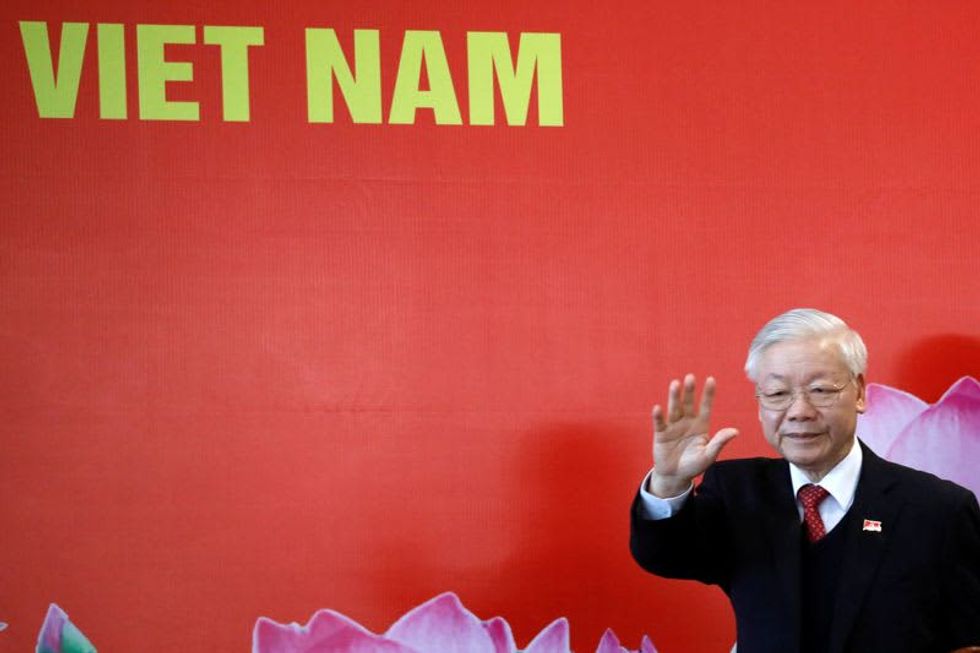
HANOI (Reuters) -The chief of Vietnam's ruling Communist Party Nguyen Phu Trong and U.S. President Joe Biden agreed in a telephone call on Wednesday to "promote, develop and deepen" ties, Vietnam's state media reported.
The call, a rare engagement for Biden with a foreign leader who is not a head of state or government, came as the U.S. president is hosting a second Summit for Democracy
In a statement, the White House said Biden reinforced in the call a U.S. commitment to a strong, prosperous, resilient, and independent Vietnam, adding they would work together to address regional challenges and ensure a free and open Indo-Pacific.
The United States is now Vietnam's largest export market and the two former foes are celebrating the 10th anniversary of a "comprehensive partnership" this year.
But Hanoi has been careful to ensure its ties do not alienate its giant neighbour China, while Vietnam's human rights record has been a sticking point in the relationship, with Washington critical of the government's intolerance of dissent and frequent jailing and harassment of those who speak out.
Biden also emphasized a U.S. commitment to the centrality of the Association of Southeast Asian Nations (ASEAN), respect for human rights and cooperation on climate goals, according to the White House statement.
Experts say a push by the United States to upgrade ties with Vietnam this year is facing resistance in Hanoi over concerns that China could see the move as hostile at a time of tension between the two superpowers.
"The two leaders will assign relevant authorities of the two sides to discuss details for further promoting ties," the party's official newspaper, Nhan Dan, reported.
The report said Trong, who is Vietnam's most powerful figure, and Biden repeated invitations to visit each others country. Trong had spoken with former U.S. Presidents Barack Obama and Donald Trump when they were in power.
"Vietnam consistently pursues its foreign policy of independence, self-reliance, peace, friendship, cooperation, diversification and multilateralisation of relations, active and proactive global integration," Trong said during the call, according to Nhan Dan.
In October, Trong was the first foreign leader to meet Presdent Xi Jinping in Beijing after he secured a precedent-breaking third term as General Secretary at the Chinese Communist Party.
(Reporting by Khanh Vu in Hanoi and David Brunnstrom in WashingtonEditing by Ed Davies and Michael Perry)
CNN's Oliver Darcy reacted with astonishment on Wednesday evening to the newly released emails in Dominion Voting Systems' $1.6 billion lawsuit against Fox News, which provided even more evidence the network higher-ups, including CEO Suzanne Scott, knew they were pushing false conspiracy theories about the election — something Fox still denies.
"Stunning that the CEO of Fox said in an email or a text, said that fact-checking the former president, which some Fox employees were trying to do, was bad for business," said anchor Anderson Cooper. "Not something you would expect from a leader of a purported news network."
"Right," said Darcy. "Now we're having new emails that really shed light on the pressure that Fox News is under as a business, after they called the election accurately for Joe Biden. I want to read to you an email that Suzanne Scott, the CEO, sent another executive after a correspondent, Eric Shawn, fact-checked Trump's lies and a guest who went on Sean Hannity's program and spread some election lies, and she said, 'This has to stop,' and goes on to say 'This is bad business and there clearly is a lack of understanding of what is happening in these shows. The audience is furious and we are just feeding the material. Bad for business.'"
"Now, Fox News will say that this was because they fact-checked a guest that was spreading, again, these election conspiracy theories on Sean Hannity's show," Darcy added. "But still, regardless, like, if a guest went on cnn and spread election conspiracy theories, it would be pretty normal, it would be expected, that other anchors would then call it out. In fact, check that for the audience."
"There was also emails about concern about viewers dropping out of their streaming service, is that right?" Cooper continued.
"Viewers left in pretty large numbers after the election," said Darcy. "When they were rebelling against fox news, they switched over to Newsmax, which Donald Trump was telling them to do. But now we're also learning in this new email that 25,000 subscribers to Fox Nation, Fox News' streaming service, had also dropped. They had just unsubscribed, apparently because there were so angry that Fox News had the nerve to actually accurately call the election for Joe Biden. And in other another email that we also see, we see Dobbs producers talking about how putting on election liars like Rudy Giuliani, like Sidney Powell, was actually good for the ratings. In one email they write, 'I mean to keep this alive we really need Rudy or Sidney.' I mean, extremely stunning emails, again. There's just a mountain of evidence now showing the behind the scenes at Fox News."
Former President Donald Trump is asking his advisers for a plan to launch a military invasion of Mexico to attack drug cartels if re-elected in 2024, Rolling Stone reported on Wednesday.
"Trump lieutenants have briefed him on several options that include unilateral military strikes and troop deployments on a sovereign U.S. partner and neighbor, the sources say. One such proposal that Trump has been briefed on this year is an October white paper from the Center for Renewing America, an increasingly influential think tank staffed largely by Trumpist wonks, MAGA loyalists, and veterans of his administration," reported Asawin Suebsaeng and Adam Rawnsley. "The policy paper — titled 'It’s Time to Wage War on Transnational Drug Cartels' — outlines possible justifications and procedures for the next Republican commander-in-chief to 'formally' declare 'war against the cartels,' in response to 'the mounting bodies of dead Americans from fentanyl poisonings.'"
The magazine acknowledges that this would be an invasion of a sovereign country, writing that the U.S. should “conduct specific military operations to destroy the cartels and enlist the Mexican government in joint operations to target cartel-networked infrastructure, including affiliated factions and enablers with direct action.” However, it brushed off the legal concerns, saying that “It is vital that Mexico not be led to believe that they have veto power to prevent the US from taking the actions necessary to secure its borders and people.”
This idea is not new. In 2019, Trump considered designating the drug cartels as terrorist organizations, a move that could have opened the door to military action against them, but administration officials decided against it. More recently, some Republicans like Rep. Marjorie Taylor Greene (R-GA) have called for the cartels to be bombed.
Mexican President Andrés Manuel López Obrador has made clear that he does not support American military operations inside his country's borders. And there are a number of ways such an operation can go wrong; this comes after the U.S. spent 20 years trying to stabilize Afghanistan and clear the Taliban out of the country, only for the government to collapse and the Taliban to re-emerge.
This comes as President Joe Biden has stepped up efforts against the cartels, which in addition to flooding the U.S. with dangerous drugs fueling a nationwide epidemic of overdose deaths, are committing widespread organized violence in Mexico on a level seen in some civil wars. The U.S. and Mexican governments are working toward a deal where the former cracks down on guns going south to arm the cartels, while the latter tries to stop fentanyl from going north.
Democratic Sen. Tom Carper of Delaware violated a transparency and conflicts-of-interest law by disclosing one of his wife's stock trades more than a year after a federal deadline, according to a Raw Story review of congressional financial disclosure records.
Carper on Tuesday disclosed that Martha Ann Stacy sold $2,991.98 worth of stock in Taiwan Semiconductor Manufacturing Ltd., although the trade took place on Jan. 19, 2022.
His wife's sale of Taiwan Semiconductor Manufacturing Ltd. came shortly before Carper, as chairman of the Senate Finance Subcommittee on International Trade, advocated for Taiwan's inclusion in the Indo-Pacific Economic Framework. Taiwan Semiconductor Manufacturing Ltd., for its part, spent more than $2.8 million lobbying the federal government in 2022, according to federal records compiled by nonpartisan research group OpenSecrets.
Federal lawmakers and their spouses are legally permitted to trade individual stocks. But Carper is one among dozens of lawmakers who have violated the Stop Trading on Congressional Knowledge Act of 2012's transparency requirement that any stock trade must be publicly disclosed within 45 days of the trade being made.
Widespread violations of this provision, coupled with lawmakers' potential conflicts between their public responsibilities and personal stock trades, have prompted some in Congress to call for an outright ban on elected officials and their families buying and selling equities.
Carper's office characterized the late disclosure as a "simple clerical error".
"Senator Carper and his wife, Martha, have always been careful to ensure that their financial investments are handled separately by a financial adviser who makes decisions and transactions independently," Carper spokesperson Katie Grasso told Raw Story. "Senator Carper supported the STOCK Act, and he fully supports ongoing conversations in Congress on how to strengthen the legislation and improve transparency and accountability for our elected officials."
Grasso added that "immediately upon being made aware of this error, Senator Carper reported the transaction to rectify the situation."
The senator is working with the U.S. Senate Select Committee on Ethics, a bipartisan body of three Republicans and three Democrats, "so he can fully resolve this matter," she said.
The typical fine for a late stock trade disclosure of this sort is $200, per federal law. Generally, neither the House nor the Senate ethics committees release details about their findings regarding lawmakers who violate the STOCK Act, nor do they maintain a public accounting of which lawmakers have been assessed fines, and how much those fines total.
During the 117th Congress from 2021 to 2022, at least 78 members of Congress — dozens of Democrats and Republicans alike — were found to have violated the STOCK Act's disclosure provisions, according to a tally maintained by Insider.
Some, like Carper, were late disclosing a few thousand dollars worth of stock trades. Others were late disclosing trades that soared into the hundreds of thousands and even millions of dollars.
This year, Raw Story has identified two additional lawmakers — Reps. Seth Moulton (D-MA) and Gerry Connolly (D-VA) — who were late disclosing personal stock trades.
Carper, a close ally of President Joe Biden, who represents Biden's home state, is one of Congress' most active stock traders, as he and is wife have logged hundreds of individual trades during the past several years.
News organizations including the New York Times, Insider, NPR and Sludge have documented rampant financial conflicts of interests among dozens of members of Congress, such as those who bought and sold defense contractor stock while occupying positions on congressional armed services committees or otherwise voting on measures to send such companies billions of federal dollars. The executive and judicial branches are riddled with similar financial conflict issues, too, as the Wall Street Journal hasreported.
A plan to enact a congressional stock-trade ban failed during the 2021-2022 congressional session after Democratic House leaders declined to bring any of several existing bills — including one floated by House leaders themselves — up for a vote.
But this year, a bipartisan group members of Congress, including Rep. Abigail Spanberger (D-VA), Rep. Chip Roy (R-TX) and Sen. Josh Hawley (R-MO), are renewing efforts to ban federal lawmakers and their spouses from trading stocks altogether. Cryptocurrency trades are also a target.
WASHINGTON (Reuters) -The U.S. Senate easily passed legislation on Wednesday to repeal two decades-old authorizations for past wars in Iraq, as Congress pushes to reassert its role in deciding whether to send troops into combat 20 years after the last invasion.
The Democratic-led Senate voted 66-30 in favor of legislation to repeal the 1991 and 2002 Authorizations for the Use of Military Force, or AUMFs, a bipartisan majority well above the 51 votes needed to pass the measure that would formally end the Gulf and Iraq wars.
To become law, the repeal of the two Iraq AUMFs must still pass the Republican-led House of Representatives, where Speaker Kevin McCarthy signaled support but told a news conference last week the matter should first be reviewed by a House committee, not go straight to a floor vote.
President Joe Biden has said he will sign the measure if it passes both the Senate and House and reaches his desk.
Twenty years after the March 2003 U.S. invasion that toppled Iraq's Saddam Hussein, the vote was a historic, if symbolic, step away from a war that killed hundreds of thousands of Iraqis and thousands of Americans, complicated policy in the Middle East and bitterly divided U.S. politics.
Supporters of repeal also said it recognized that Iraq is no longer an adversary but has become a U.S. security partner.
The resolution also would repeal the Gulf War AUMF approved in 1991 after Saddam's Iraq invaded Kuwait.
The Iraq AUMFs have been labeled "zombie" authorizations because they never expire but their original purpose no longer applies.
'CONSTITUTIONAL ROLE'
It was also the latest effort by U.S. lawmakers to reclaim congressional authority over whether troops should be sent into combat, which backers of the repeal said had been improperly ceded to the White House as the Senate and the House passed and then failed to repeal open-ended war authorizations.
"This vote shows that Congress is prepared to call back our constitutional role in deciding how and when a nation goes to war, and also when it should end wars," said Senator Bob Menendez, Democratic chairman of the Foreign Relations Committee, before the vote.
"It also protects against future administrations abusing authorizations that outlive their mandate but still remain on the books," Menendez said.
Under the U.S. constitution, Congress, not the president, has the right to declare war.
Lawmakers have been divided over whether to let the AUMFs stand, leaving it to military commanders to decide how best to fight U.S. enemies. As a result, no AUMF repeals have passed since 1971, although some have passed committees or one chamber of Congress.
In 1971, Congress voted to repeal the Gulf of Tonkin Resolution, which had provided authority for the Vietnam War.
Secretary of Defense Lloyd Austin told a House hearing that it was up to Congress to decide whether to repeal the Iraq AUMFs, but that the military could still "do what we need to do" based on a separate AUMF passed in after the Sept. 11, 2001, attacks authorizing military action against extremists.
McConnell, who is out of Washington recovering from a fall, issued a statement opposing the repeal.
"Our terrorist enemies aren’t sunsetting their war against us. And when we deploy our servicemembers in harm’s way, we need to supply them with all the support and legal authorities that we can," he said, citing recent attacks such as one last week in Syria that killed one American and wounded six others.
(Reporting by Patricia Zengerle with additional reporting by Richard Cowan; editing by Mark Heinrich and Cynthia Osterman)
Former President Donald Trump recently conducted a television interview where he appeared to not know the difference between the North Atlantic Treaty Organization (NATO) and the North American Free Trade Agreement (NAFTA).
During a recent appearance on Fox News, Trump spoke with conservative host Sean Hannity where he claimed he "got rid of NATO."
The former president began his rant by insisting that other countries feared him and knew “not to mess around” in regard to trade alliances saying, “Did they fear me? I suspect they did."
He went on to share details about a previous discussion he'd had with Russian President Vladimir Putin as he weighed in on the Nord Stream pipeline.
According to Trump: "Putin said, 'Man, you are killing me, especially about Nord Stream.' And I stopped it. It was stopped cold. And I told other countries, 'If you go into the Nord Stream, you are not going to do any business with the United States of America,' meaning rip us off on trade because a lot of them have ripped us off. I made a lot of great deals on trade, though. I changed a lot of those deals where it was a bad deal for us and now it’s good, like USMCA with NATO. I got rid of NATO and built USMCA. I made a great trade deal with China. Our farmers, to this day they made tremendous money because of the deal."
It's unclear whether or not Hannity caught the former president's blunder but he did not challenge his remarks.
At one point during the discussion, Trump shifted his attention to President Joe Biden and took jabs at the president's cognitive functions. Hannity asked Trump if he would consider another round of cognitive testing.
“I would like to see it for anybody running for president, taking a cognitive test,” Trump said. “You know they do it in China, but it’s done in a different way. They have a caste system. And the smartest person gets to the top.”
At 92, Rupert Murdoch is far from retired. Much of the coverage at Fox News and Fox Business reportedly reflects his enthusiasm for Florida Gov. Ron DeSantis as a possible 2024 GOP presidential candidate. And the Melbourne, Australia native (who has homes in London as well as different parts of the United States) continues to be a highly influential figure in right-wing media.
During a late March pre-trial hearing in Delaware, Judge Eric M. Davis pushed back against what he said were efforts by Fox News attorneys to prevent him from traveling to testify in Dominion Voting Systems' $1.6 billion defamation case against the right-wing cable news outlet. Davis, according to National Public Radio (NPR), believes that Murdoch is still perfectly capable of traveling.
Davis, the judge in that civil defamation case, noted that he had received a letter saying that Murdoch "couldn't travel" to Delaware because of COVID-19. But the judge cited recent examples of the right-wing media mogul planning to travel between his various homes. Davis, according to NPR, warned Fox News' attorneys to "be careful" and not make him "look like an idiot."
"I also have people telling me that he's done some things recently that (show) he's hardly infirm," Davis told the courtroom.
"On Tuesday, (March 28)," NPR's Karl Baker reports, "Fox attorney Matthew Carter pointed to Murdoch's deposition when responding to Davis' incredulity about the media magnate's ability to travel. Carter said there had been a miscommunication. He said his side hadn't argued that Murdoch was infirm, but that there was no reason for his trial testimony given that the Murdoch had already submitted to seven hours of questioning in the deposition."
Baker adds, "In his deposition, Murdoch asserted that he knew Trump had lost the 2020 election, but certain Fox hosts, including Maria Bartiromo and Lou Dobbs, had ‘endorsed’ the narrative of a stolen election."
It remains to be seen what jurors will think about Dominion's arguments and Fox News' counterarguments in the defamation case. Dominion alleges that Fox News defamed the company when, after the 2020 presidential election, it promoted the false claim that Dominion's voting equipment had been used to help now-President Joe Biden steal votes from then-President Donald Trump.
Fox News, in the Dominion case, has maintained that it wasn't trying to convince viewers that the company did anything illegal in 2020 — it was simply asking questions. But Dominion, in response, alleges that Fox News knew that the allegations against the company were false but promoted them anyway. As evidence, Dominion is presenting examples of e-mails and text messages in which Fox News hosts — including Tucker Carlson and Sean Hannity — acknowledged that claims of a stolen election were nonsense. Moreover, according to Dominion, Carlson attacked Fox News' reporters for debunking claims of a stolen election, as he believed doing so would alienate the cable channel's audience and hurt its brand.
Nonetheless, defamation is very difficult to prove under the U.S. Supreme Court's 1964 standard in New York Times versus Sullivan. According to the Sullivan standard, a plaintiff in a civil defamation case must show that the defendant acted with "actual malice" — and things like sloppy reporting and inflammatory comments do not meet that tough standard.
Dominion has also filed separate defamation lawsuits against Newsmax TV, One America News (OAN) and attorneys Sidney Powell and Rudy Giuliani, all of whom it says promoted false claims about the company after the 2020 election.
Among other things, the deck features an email from Fox News CEO Suzanne Scott in which she berated host Eric Shawn for fact checking former President Donald Trump's false claims about Democrats using "massive dumps of votes" to cheat in the 2020 presidential election.
Shortly after Shawn shot down this claim on air, Scott sent out an angry email to Fox News executive Meade Cooper complaining that hosts such as Shawn were infuriating their viewers by providing context to Trump's false claims about election fraud.
"This has to stop now," she demanded. "This is bad business and there clearly is a lack of understanding what is happening in these shows. The audience is furious and we are just feeding them material. Bad for business."
In its lawsuit, Dominion has repeatedly shown that Fox News aired claims about Dominion's machines purportedly rigging the election for President Joe Biden that it knew to be false.
In a statement, Fox News stated: “These documents once again demonstrate Dominion’s continued reliance on cherry-picked quotes without context to generate headlines in order to distract from the facts of this case. The foundational right to a free press is at stake and we will continue to fiercely advocate for the First Amendment in protecting the role of news organizations to cover the news.”
The United State Congress enacted the 2002 Authorization for Use of Military Force which empowered then-president George W. Bush to send US forces to Iraq in 2003
Washington (AFP) - US senators advanced cross-party legislation on Wednesday to repeal authorizations for the wars in Iraq -- 20 years after American forces invaded the country to remove Saddam Hussein from power.
Both parties supported canceling the 2002 Authorization for Use of Military Force (AUMF) that empowered George W Bush to launch the invasion, as well as the 1991 version that allowed his father, George HW Bush, to attack Iraq after Saddam's forces invaded Kuwait.
"The United States, Iraq -- the entire world -- have changed dramatically since 2002, and it's time the laws on the books catch up with those changes," said Chuck Schumer, the leader of the Senate's Democratic majority.
"These AUMFs have outlived their use. These repeals will not harm our service members abroad, nor will it hinder our ability to keep Americans safe."
The repeals passed by 66 votes to 30, with 18 Republicans crossing the aisle to back the Democratic-led initiative.
President Joe Biden has pledged to sign the legislation if it comes to his desk, but its prospects in the Republican-controlled House of Representatives look less certain.
Kevin McCarthy, the top Republican in the House, was recently asked by NBC News if he would bring the repeals to the floor in the lower chamber but he would not commit, saying: "I'd have to look at what their bill does first."
The 2002 AUMF repeal is more controversial than its earlier counterpart, as the later one was used to justify several military operations in Iraq after the end of the war, such as retaliation against Iran-allied militias.
Crucially, it was cited in the January 2020 US assassination in Baghdad of Iranian general Qasem Soleimani, ordered by Donald Trump.
The legislation does not cancel the 2001 authorization of war in Afghanistan that gave presidents broad powers to order military force against Al-Qaeda and its offshoots in Syria, Yemen, Somalia and other parts of Africa.
Almost 4,500 US service members had died in Iraq by the time the last combat troops departed in 2011, while the war had claimed the lives of more than 100,000 Iraqi civilians, according to the Iraq Body Count group.
More than 32,000 Americans were wounded and tens of thousands struggle to this day from the effects of toxic burn pit exposure, post-traumatic stress disorder and other chronic conditions.






 Former President Bill Clinton and former U.S. Sen. John Edwards (D-NC)Photos by Gage Skidmore/Wikipedia and Peter Smith/Flickr