With the Republican National Convention now underway, the GOP has opted not to publish a party platform for 2020. But according to conservative Never Trump journalist David Frum, the Republican Party does have a 2020 platform — although it’s so extreme that Republicans are afraid to publish it. Frum, in a scathing listicle published in The Atlantic on August 25, lays out what he describes as “13 ideas that command almost universal assent within the Trump Administration, within the Republican caucuses of the U.S. House and U.S. Senate, among governors and state legislators, on Fox News, and among rank-and-file Republicans.”
Frum, one of Trump’s vehement critics on the right, disagrees with pundits who “conclude that the GOP lacks ideas, that it stands for nothing, that it has shriveled to little more than a Trump cult.” The GOP of 2020, Frum argues, does have a “coherent platform” of ideas that are “broadly shared” within the party, but they are so terrible and so unpopular outside Trump’s hardcore base that Republicans won’t come right out and publish the platform.
Those ideas, according to Frum, range from “coronavirus is a much-overhyped problem” and “climate change is a much-overhyped problem” to “the most important mechanism of economic policy…. is adjusting the burden of taxation on society’s richest citizens.” Others include “voting is a privilege” and “the trade and alliance structures built after World War II are outdated.”
Another unpublished part of the GOP’s 2020 platform, according to Frum, is that “health care is a purchase like any other.” Party leaders, Frum writes, believe that “individuals should make their own best deals in the insurance market with minimal government supervision. Those who pay more should get more. Those who cannot pay must either rely on Medicaid, accept charity, or go without.”
Other unpublished planks in the GOP’s 2020 platform, Frum writes, include “China has become an economic and geopolitical adversary of the United States,” “the post-Watergate ethics reforms overreached” and “anti-black racism has ceased to be an important problem in American life” as well as “Trump’s border wall is the right policy to slow illegal immigration” and “the courts should move gradually and carefully toward eliminating the mistake made in 1965 when women’s sexual privacy was elevated into a constitutional right.”
Frum wraps up his list with #12 — “The country is currently gripped by a surge of crime and lawlessness as a result of the Black Lives Matter movement and its criticism of police” — and #13: “Civility and respect are cherished ideals, but in the face of the overwhelming and unfair onslaught against President Trump by the media and the Deep State, his occasional excesses on Twitter and at his rallies should be understood as pardonable reactions to much more severe misconduct by others.”
Since those 13 planks really do comprise the GOP platform of 2020, Frum argues, why not publish them? And Frum answers his own question, explaining, “The platform I’ve just described, like so much of the Trump/Republican program, commands support only among a minority of the American people. The platform works — to the extent it does work — by exciting enthusiastic support among Trump supporters. But stated too explicitly, it invites a backlash among the American majority. This is a platform for a party that talks to itself, not to the rest of the country.”
Writing in the Washington Post this Tuesday, Greg Sargent says President Trump has "hallowed out" the Republican Party and turned it into a personality cult. "But no level of appreciation of this state of affairs could possibly have prepared us for what we’re witnessing at the GOP convention."
Aside from the "white grievance," Sargent contends that the convention's "sheer unbridled messianism" was front and center.
"In short, the depiction of Trump has been absolute and comprehensive in its idolatry, infusing the convention with quasi-totalitarian levels of disinformation and hagiography alike," Sargent writes.
The "worshipful tone" of the convention tried to paint an image of Trump having an awe-inspiring ability to rise above his opponents. But Trump has spent literally years attacking critics in the most "childish, petty and idiotic ways imaginable, spraying around epithets (often directed at Black women) such as 'nasty' and 'loser' and 'dumb' and 'dummy' and 'Low IQ' with great relish," Sargent writes.
Another farce promoted by convention speakers is the notion that Trump is the most "empathetic person in America."
"In the real world, Trump has struggled to demonstrate a shred of basic humanity about the mounting deaths, bereavement and economic misery that have been unleashed, largely by his own towering failures on the coronavirus," writes Sargent. "And he has refused to accept responsibility for any of this, treating people’s perceptions as if they can be simply erased by his magical lying. Both of these constitute forms of very deep contempt for the lived experiences of other human beings."
In interviews with MSNBC, Michigan steelworkers called out Donald Trump for his failure to come through with jobs after making big promises during campaign swings over three years ago.
In clips shared by MSNBC host Stephanie Ruhle, who explained that the rise in the stock market is having little impact on the average Americans' life, NBC correspondent Heidi Przybyla was seen interviewing workers -- all currently laid-off -- about job availability particularly in light of the president's tariff war with China.
"I sat down yesterday with a few of the recently laid-off steelworkers who told me that, you know, all of those pledges from 2016 about how Trump was going to bring back their lifestyle, bring back these good-paying jobs by cracking down on trade and tariffs -- all of that didn't work out. It did nothing to save their communities," the correspondent explained.
"It didn't seem like any of this was coming, it just was a total surprise," lamented steelworker John Gies. "My son is still working there, and he can't believe that it's gone this direction."
"If you get in a car accident, that cage, we make that steel," explained Mike Miller. "We make that family safe in there and that's the pride these guys and women have when they're making this steel. And then all of a sudden, you know that rug has been pulled out from underneath you."
Unemployed worker Steve Bernard was more pointed in his criticism of the president.
'"He came to this area and said if you elect me you'll see two and a half times, you'll see the steel industry, you guys will be fighting off orders," Bernard recalled. " That's what he said. Check it out: three years later, where are we now? These guys are out of work."
Hecklers drowned out speakers defending a Confederate monument during a news conference in Alabama.
John Scales struggled to be heard as protesters raised their voices even louder while he offered a defense of keeping a Confederate monument in place outside the Madison County Courthouse in Huntsville, reported AL.com.
“Would you allow me to speak or are you going to try to take over?” he said in exasperation.
Jane Adams, who seemed to be the loudest heckler, told Scales she had a constitutional right to be heard.
“Some have said it is a moral imperative to move this (monument),” Scales told reporters at the press conference. “But the problem is morality must be based on truth and the story that (soldiers) fought for slavery is absolutely, unequivocally false.”
“That is not true!” Adams screamed.
“I don’t know if you guys want to put up with this or not," Scales said, turning to his fellow members of the Historical Protection of North Alabama organization.
The next speaker didn't fare any better, and complained the three hecklers in attendance were "haters.
The county commission, which has jurisdiction over the monument, has tried to remove the statue that has been damaged by vandals and protested by business leaders.
“It’s obviously going to take some professional reconditioning of that monument, the damage that’s been done to it,” said commission chair Dale Strong. “What we’re trying to do is proceed with the preservation, the relocation, that’s where we’re going right now. I do hope at a later date, it will be repaired.”
The state legislature prohibited the removal of Confederate monuments in 2017 except for temporary relocation for emergency repairs, and requires their return within one year, but Historical Protection of North Alabama wants it to remain no matter what.
“We don’t deny the South was fighting for slavery,” said group member Ed Kennedy. “That’s a political issue, but the soldiers on the battlefield were not fighting for that reason.”
Adams disagreed, and read excerpts from the so-called "cornerstone speech" Alexander Stephens, vice president of the Confederacy, in March 1861, a month before the Civil War began.
“Upon the great truth that the Negro is not equal to the White man," Stephens said at that time, "that slavery is subordination to the superior race is his natural and normal condition.”
Adams said that was reason enough to take down monuments honoring the Confederacy and its soldiers.
“They lost, and not only did their lose, their ideas and their principles lost out,” Adams said. “Slavery lost out. It should go.”
Rep. Carolyn Maloney (D-NY) told MSNBC on Tuesday that the pressure that Republicans are getting from their constituents over the U.S. Postal Service has been considerable and it's working.
Speaking to Hallie Jackson, Maloney explained that while the Republicans were trying to dismiss the USPS slowdown as a conspiracy theory, some Republicans agreed it is real and a serious concern. During the House Reform and Oversight Committee hearing with Postmaster General Louis DeJoy, Republicans railed against allegations that there was anything wrong with the USPS.
Behind the scenes, however, Republicans know the issue is so serious they're pressuring GOP members against supporting any funding or something that could be perceived as support for the USPS.
"I think that this issue is a bipartisan issue," said Maloney. "It should not be partisan at all. It is always bipartisan, and we had 26 Republicans vote with us, many of them told me they were under tremendous pressure from their leadership, not to. Members are very concerned both Republican and Democratic across the country because of the reports that we're getting from our constituents. People, particularly in rural areas, who are not getting their medicines, are not getting their checks, not getting the support and the connection that they get with mail. So, it is a serious issue. So, we solved it. We passed a bill, passed my bill, Delivering for America, that adequately funds the Post Office through 2021, and it also reverses the harmful actions that he has taken to slow down the mail."
She noted that Rep. Eleanor Holmes Norton (D-DC) got DeJoy to commit to lifting restrictions on overtime, so at the very least, workers can be compensated for extra work they've had to do as staff recovers from the coronavirus.
A gun-toting man who attended a boat rally for President Donald Trump in Rhode Island over the weekend allegedly accosted another person at the event because he wore a face mask.
The Public's Radio reports that the pro-Trump rally took place at the Colt State Park on Sunday, and park rangers who were working during the event say they were caught off guard by the hostility of some of the rally attendees.
"One attendee -- who carried a handgun on his waist, in violation of state park rules -- allegedly accosted another guest for wearing a mask," reports The Public's Radio. "Another park-goer, who had a rainbow pride pin on their bag, was called a homophobic slur. Some attendees also threatened to tip over a park ranger’s truck."
One park ranger, who asked not to be named, said they had no idea there would be a large boater rally for the president until it happened on Sunday.
“I did not realize that this event was happening until basically the park was full of people flying Trump flags,” the ranger said. “There was no preparation for it, and then we basically got left out to fend for ourselves."
Mike Healey, a spokesman for the Department of Environmental Management, tells The Public's Radio that they received "maybe one or two 911 calls during the event, but they were mostly about verbal incidents."
Stephanie Grisham, press secretary for Melania Trump, on Tuesday defended the first lady's Republican National Convention speech, which will be delivered from the Rose Garden despite prohibitions against political events at the White House.
During an interview on MSNBC, host Hallie Jackson asked Grisham about what her team is doing to prepare the first lady's speech so that it will not be hit with charges of plagiarism like her previous convention address.
"I can tell you that every word in this speech is from her," Grisham insisted. "It's very authentic and it's going to come from the heart."
Jackson pressed Grisham on Melania Trump's "Be Best" campaign against "online bullying."
"These online conspiracy theorists are a natural extension or an extreme extension that can be violent and dangerous of the online bullying that Mrs. Trump talks about," Jackson said, pointing to the fringe right wing group QAnon.
"Does she disavow -- given her Be Best campaign -- does she disavow QAnon?" the MSNBC host wondered.
Grisham objected to the question.
"I think there's constantly this misperception that it's about online bullying, which of course gets tied to the president," Grisham said. "It's about online safety and it's about teaching children that there are predators out there online and they need to really watch out who they're talking to online and what they're doing."
"It's really not about bullying per se," she added. "It can be mean, it can be manipulative. She's said that over and over. But it's about online safety as a whole."
When it came to Melania Trump's convention speech, Grisham argued that an overhaul of the White House Rose Garden had nothing to do with the event -- even though the first lady plans to deliver her speech from the location.
"It has nothing to do with tonight's speech," she said, observing that the first lady is "exempt" from the Hatch Act.
Before ending the interview, Jackson asked about President Donald Trump's "false claims, online bullying, things that he said that are racist and sexist and so on."
"Perceived as racist by the media," Grisham corrected the host.
"I think people would just call them -- some of the the things he's said -- racist," Jackson observed. "That is not actually my question. My question is how she navigates that when it comes to the the themes you say she wants to talk about tonight."
"Then it's good thing his wife is up there talking," the first lady's spokesperson said. "Look, they are married. And it's astonishing to me that it has to be constantly about both of them. She is doing her speech tonight. She is talking about children and what she's been doing for children and what she wants to continue doing for children."
"And she believes this president should continue to be the president for the next four years," she added. "So she's going to continue to make that case."
Unfortunately for us all, the pain only begins there. Other important health policy news that would ordinarily make headlines is buried under the crushing weight of the coronavirus. Many have not had time to notice or understand the Trump administration’s efforts to wreck health care coverage.
We are both professors at Boston University School of Public Health who study health insurance, one using economics and statistics and the other focusing on law and policy. We have researched the big picture of COVID-19’s impact on the safety net and the details of how our federalist system, with states having considerable control over policy, has made a coordinated response to the pandemic more difficult.
Here, we highlight two major actions by the Trump administration that should be receiving more attention – attempting to cap federal Medicaid funding, and arguing to the Supreme Court that the entire Affordable Care Act should be struck down.
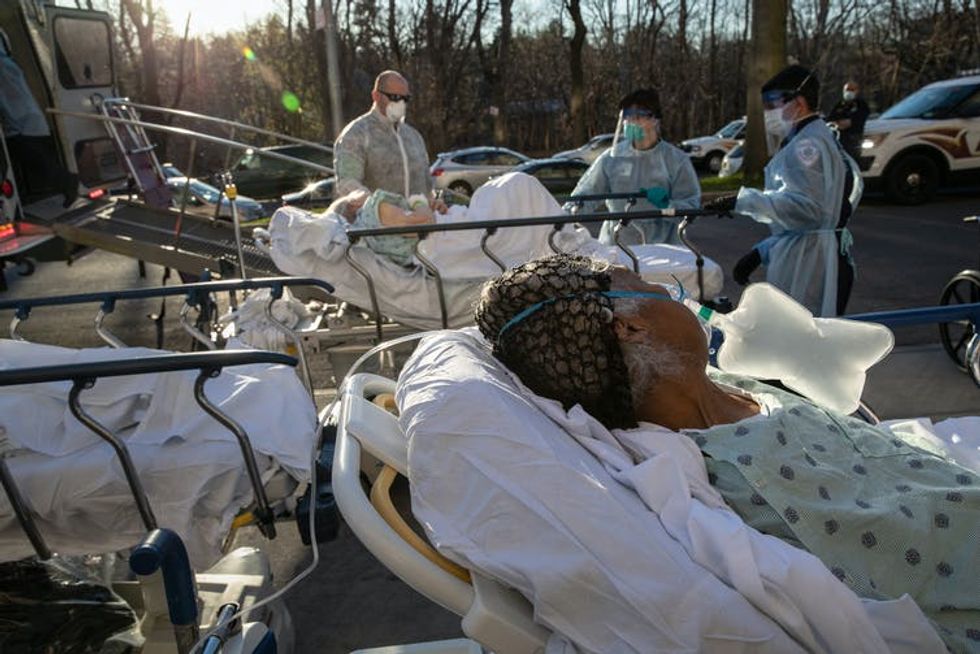
COVID-19 patients arrive to the Wakefield Campus of the Montefiore Medical Center on April 06, 2020 in the Bronx borough of New York City.
Complicated language and political posturing make it hard to understand health care in the best of times. This is particularly true for proposals to change the funding for Medicaid, the health insurance program for low-income Americans that also covers many disabled and elderly people.
Medicaid has historically been funded like this: States pay a percentage of Medicaid costs, and the federal government covers the rest. The federal match ranges from 50% to as much as 83% of every dollar. It doesn’t matter whether a state has one thousand or one million Medicaid enrollees, that same cost sharing applies. Uncapped federal funding gives Medicaid flexibility to meet that need.
Block grants are pre-set amounts of money that the federal government offers to states, which then have control over the money within broad guidelines. While that may sound harmless and even appealing to some, block granting reduces the amount of federal money available and shifts the risk of economic, health, and other emergencies to states. Medicaid block grants would set limits on how much money the federal government spends, either in total or per person.
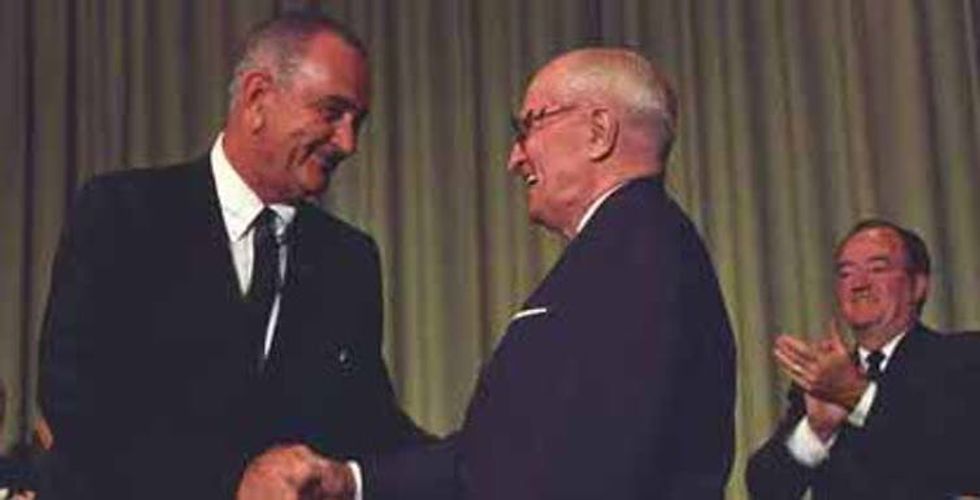
President Lyndon Johnson, left, shakes hands with former President Harry Truman when Medicare and Medicaid became law in 1965. Truman had tried to pass Medicare-like bill but failed. Vice president Hubert Humphrey is in the background.
Medicaid has never been capped this way in its 55-year history, but block granting for Medicaid has long been an unfulfilled dream for conservatives, with Ronald Reagan, Newt Gingrich, and Paul Ryan trying but failing to make block grants a reality.
The Trump administration decided to try a different road. In January 2020, the Centers for Medicare and Medicaid Services issued a letter to state Medicaid directors describing a new Healthy Adult Opportunity policy that would fundamentally change the way Medicaid has always worked by implementing block grants.
Instead of the current partnership, in which the pie (Medicaid spending) can expand but the pieces (federal and state share of costs) stay the same size relatively, this new block grant policy would provide states either a set dollar amount for each enrollee (a per capita cap) or for their entire program (a fixed annual grant). Either way, the state would be responsible for any extra costs. To be clear, we and others believe this policy is illegal without a change in federal law.
So why would states pursue this? Political ideology and less federal oversight are big factors.
Giving states greater control over health policy could encourage states to find savings in their Medicaid programs. But unexpected spending on Medicaid, such as spikes in enrollment from natural disasters, could lead states to cut benefits, payments to providers, or other necessary services. This could make good quality care harder to get. It could also lead states to shift funding away from other essential services, like education, to meet medical needs.
We believe this is an especially bad time to pick this fight, while the nation tries to prevent spikes in COVID-19 and state budgets are in decline. Limiting the amount of money states have for Medicaid could not only limit health care access for the 65 million Americans already enrolled in Medicaid, but also potentially millions more who may need it as a result of the pandemic.
Killing the ACA
The ACA has faced near constant legal and political challenges since it became law a decade ago. Even enthusiastic supporters admit that it is far from perfect. But, some 20 million people gained insurance through the law.
The first challenge came when some states claimed that the law’s individual mandate, a requirement to have health insurance or pay a penalty, was unconstitutional. The Supreme Court ruled in 2012 that the mandate is constitutional, and the law was implemented.
In 2017, the Republicans controlling Congress tried but failed to repeal the ACA. Congress was only able to reduce the tax penalty to zero for the individual mandate, meaning the law still requires having health insurance coverage but the penalty is now $0.
Now, states argue once again that the mandate is unconstitutional because the penalty fails to “produce at least some revenue.” This new case is scheduled to be heard by the Supreme Court on Nov. 10. Texas v. California is the third major legal challenge to the ACA, but the first time that the federal government will not defend the law in court.
Texas leads 17 other states, with full support from the Trump administration, in arguing that the ACA cannot exist without the individual mandate penalty because the law is not “severable” – meaning that if one part of a law fails, then the entire law falls.
Of course, Congress did exactly that, severing the penalty from the rest of the ACA when it enacted the Tax Cuts and Jobs Act of 2017.
And, the Supreme Court already decided that the ACA is severable when it made Medicaid expansion optional in 2012. This case has been called “balderdash” by legal scholars, yet the court could issue a decision in a few months that eliminates the ACA.
If the ACA is struck down, that means the loss of coverage for preexisting conditions, the return of annual or lifetime caps, or policies being revoked for cancer patients. Those who don’t earn much money still deserve good health care. Nearly everyone will feel it if the Trump administration and Texas are successful, regardless of whether your health insurance is through your work, HealthCare.gov, Medicaid or Medicare.
Staying healthy is first priority during this pandemic, but understanding that health insurance could be on the brink of evaporating for millions is a close second.
On Tuesday, writing for The Washington Post, conservative columnist Jennifer Rubin laid into the first night of the Republican National Convention, saying that it was devoid of optimism and instead a parade of racially-charged anger.
"In the spin before the Republican National Convention began, President Trump’s team insisted we would get optimism, hope and uplift," wrote Rubin. "Instead, the first night has brought a parade of angry and aggrieved — and mostly White — speakers who sound as paranoid as Trump ... In contrast to the upbeat videos and testimonies of the Democratic nominee’s good character, Republicans have largely relied on a parade of angry individuals standing on a podium. The setting had the feel of a local tea party confab, with many people speaking VERY LOUDLY to people already fully in their club."
One of the key moments of the evening was Trump adviser Kimberly Guilfoyle's animated speech condemning Democrats as a threat to the American way of life — which found itself on the receiving end of social media mockery. But there were many other moments that exemplified the GOP's grievance politics, wrote Rubin.
"The white supremacy was barely disguised as 26-year-old Charlie Kirk of Turning Point USA and Students for Trump said Trump is 'the bodyguard of Western civilization.' Let me translate: Anyone who is not a White American is foreign, alien and 'the other,'" wrote Rubin. "The climax of White victimhood might have been the St. Louis couple, wealthy trial lawyers Mark and Patricia McCloskey, charged with unlawful use of a weapon after they brandished guns at Black Lives Matter protesters outside their home. Their appearance was a bullhorn message to aggrieved Whites: We will protect you! The couple’s complaint that 'they' want to destroy the suburbs was classic Trump language — an undisguised effort to play to Whites’ fears."
"There will be three more nights of hollering and race-mongering," concluded Rubin. "Parental supervision advised."
U.S. Congresswoman Alexandria Ocasio-Cortez is criticizing Trump campaign national finance committee chairwoman Kimberly Guilfoyle for claiming to be a "first generation American," and saying her mother is an "immigrant." Guilfoyle was born in San Francisco to a mother who was born in Puerto Rico. Puerto Rico is a U.S. territory and its citizens are U.S. citizens.
"The woman the GOP picked as their 'proud' Latina to tout 'immigrant experience' didn’t seem to know that Puerto Rico is already part of the United States," Rep. Ocasio-Cortez, a Democrat of New York whose mother was also born in Puerto Rico, said. "It’s quite on message, bc it reflects their belief that Latinos aren’t real citizens, even when we are Native descendants."
"As a first generation American I know how dangerous their socialist agenda is," Guilfoyle, speaking about Democrats in a fiery speech, told viewers of Monday night's Republican National Convention. She is not a first generation American.
"My mother Mercedes was a special education teacher from Aguadilla, Puerto Rico," she continued. "My father, also an immigrant, came to this nation in pursuit of the American dream."
Now that presidential adviser Ivanka Trump has helped headline an anti-human trafficking initiative announced earlier this month by the White House, more than a dozen prominent evangelicals have written to her requesting she protect detained and deported migrant children from human trafficking. In an open letter, more than a dozen evangelical leaders called upon the first daughter to ensure that her father’s administration adheres to federal anti-trafficking law in its treatment of unaccompanied migrant children. After reminding her of her recent declaration that trafficking is “the gravest of h...
It took up 30 seconds Saturday night on the nightly news in Scranton, Pennsylvania — footage of maybe 20-30 white women (the kind our president likes to call “suburban housewives”) and their kids marching through a park in the Wayne County, Pennsylvania, seat of Honesdale, carrying signs such as “Keep Our Children Safe from Pedos!” The WNEP-TV anchorwoman — speaking to a region of northeast Pennsylvania that was so critical for President Donal Trump’s 2016 victory — reported in her tone of TV authority on their march “to bring awareness around human trafficking.”There were more than 200 of the...
New York Times polling analyst Nate Cohn took stock of the first night of the Republican National Convention and came away confused about whether the GOP accomplished its goals -- or even if accomplishing its goals was possible.
Writing on Twitter, Cohn said that the RNC has "a lot of work to do" to rebuild support ahead of the November election, but he warned that "it's also not always clear what they can do" to accomplish that.
"I'm reminded of the scene in 'Apollo 13,' when the flight director asks after the explosion: 'Let's look at this from the standpoint of status. What do we got on the spacecraft that's good?'" he writes. "At least on the numbers, they don't have many good answers to that question."
Cohn argues that, in order to pull off a successful convention, Trump's GOP would need to have good opposition material to use against Democrats, a "clear vision of your preferred most important issue," and presidential approval ratings in the 47 percent range.
"Heading into this convention, I don't think the Trump campaign had laid the groundwork for this style of reelection campaign," he writes. "They haven't resolved on a clear attack on Biden. They haven't chosen a clear contrast on the most important issue. Their approval isn't at 47."
Cohn then speculates that "the reason they haven't done these things may be because they can't or don't know how."