Former NBA player Royce White overcame his anxiety to lead protests over the weekend in Minneapolis.
Speaking to CNN Tuesday, White noted that if only people listened to football star Colin Kaepernick, who peacefully protested by taking a knee during the "National Anthem" sung at games, this would not have happened. He was trying to raise awareness about police brutality and the disproportionate attacks on people of color at the hands of police. At the time, conservatives, including President Donald Trump, blasted him for the protest, ignoring the reason for doing it and focusing instead on how he refused to stand for the song.
He explained that the way forward is to "rebuild from the ground up. Communities have to take back their sovereignty. And it's going to be ugly. Our president, Donald Trump, being the liar that he is, ran on the idea of sovereignty. But for some reason, it doesn't apply to Black communities and brown communities. For some reason, he believes we're beneath philosophical ideas like sovereignty. But we are not. We do believe we deserve sovereignty and we will stand up for it."
White has been an advocate of mental health issues as he is plagued with crippling anxiety.
"Look, I deal with anxiety, but I told people this would happen," he told CNN. "These corporate oligarchs that these corporations were incompetent. That these corporations lacked the necessary humanity to protect us. America is the world's biggest corporation."
He referenced a tweet he sent that predicted that things will get worse if Trump refuses to allow people of color equal rights.
"We are tired of the tyranny of police. We are tired of corporations. We are tired of his tyranny," said White about Trump.
A man who has been accused of travelling from central Illinois to Minneapolis to start riots had at one time expressed "enthusiasm" for President Donald Trump.
The St. Paul Pioneer Press reports that 28-year-old Matthew Lee Rupert was accused this week of going to Minneapolis and handing out explosives that he encouraged others to throw at the police.
"They got SWAT trucks up there... I’ve got some bombs if some of you all want to throw them back," Rupert said in a video posted on his own Facebook page late last week.
A Pioneer Press review of Rupert's social media postings revealed that the alleged perpetrator "expresses enthusiasm for President Donald Trump in several posts from 2017 and 2016," although some of his views appear to be left wing and he isn't a dedicated Trump supporter.
Rupert expressed sympathy for George Floyd in the wake of his death last week, as well as an antipathy toward police officers.
"Cops kill everyday and everyone wants to just now stand," he wrote in one recent post. "I been a freedom fighter my whole life and I’ll live behind my constitutional rights!!! I love this country but the people u pay to harass us I hate to the death of me."
According to a report from Bloomberg, Black civil rights leaders who participated in a conference call with Facebook founder Mark Zuckerberg walked away afterward "disappointed and stunned" at the tech billionaire's seeming inability to understand issues that impact African-Americans.
The report notes that part of the discussion involved Zuckerberg's decision to ignore and dismiss comments made by Donald Trump about police brutality protesters -- with one Black leader calling the exec's explanation "incomprehensible."
According to Bloomberg's Jeff Green, "Mark Zuckerberg hosted a nearly hour-long video call with U.S. civil rights leaders to discuss ongoing issues around his company’s policies as they relate to race, elections and other topics," before adding it didn't go well based on comments from Color of Change President Rashad Robinson.
In an interview, Robinson lamented, "... the problem with my ongoing conversations with Mark, is that I feel like I spent a lot of time, and my colleagues spent a lot of time, explaining to him why these things are a problem, and I think he just very much lacks the ability to understand it.”
Pointing out that Zuckerberg's hands-off approach when it comes to Trump is baffling in light of the president's threat that “when the looting starts, the shooting starts” with regard to George Floyd protesters, Robinson noted that the Facebook executive is bucking his own employees who are furious with him.
“His employees are outraged,” explained Robinson. “I’ve got outreach from some of them. Saying Black Lives Matter, saying I’m going to give money, but having your policies actually hurt black people, people will know the difference.”
While a spokesperson for Facebook praised the get-together by issuing a statement saying the tech giant is "... grateful that leaders in the civil rights community took the time to share candid, honest feedback,” Robinson differed with their appraisal of how it went with the company's founder.
“He continues to do things and make decisions that hurt communities and put people in harm’s way and is not accountable for it,” explained Robinson.
A Las Vegas police officer remains on life support and a heavily armed suspect was killed in a pair of separate shootings during protests over police brutality.
A suspect walked up and shot the officer in the back of the head as the officer was engaged in a struggle with a protester outside the Circus Circus Hotel and Casino, reported KLAS-TV.
That suspect was taken into custody about 2 a.m., police said, but no additional information was provided.
“Last night as officers were attempting to disperse a large crowd of protesters in front of the Circus Circus, our officers were taking rocks and bottles from the crowd,” said Clark County Sheriff Joe Lombardo. “Officers were attempting to get some of the protesters in custody when a shot rang out, our officer went down.”
Las Vegas police and federal officers were guarding the city's federal building around 11:22 p.m. when a man carrying multiple guns and who appeared to be wearing body armor approached.
Lombardo said the man reached for one of those guns and officers opened fire, fatally wounding him.
The sheriff wasn't sure whether the man had been involved in the protest, but said he assumed so.
“He was obviously an open carry individual,” Lombardo said.
Open carry of firearms is permitted in Nevada without a permit for anyone over 18 years old.
Writing in the Boston Globe this Tuesday, James Pindell points to President Trump's inauguration speech from over three years ago, where he promised to put an end to "American carnage."
"Three years later, amid a global pandemic, record unemployment, and violent uprisings against racist police violence, 'American carnage' sounds a lot more reality-based. And Trump, often, has only made things worse," Pindell writes.
While Trump didn't create systemic racism or the coronavirus, he has done nothing to help, according to Pindell, who said that Trump has a history of giving white supremacists comfort time and again.
"Last week, he tweeted a warning to protesters: 'when the looting starts, the shooting starts,' prompting Twitter to flag his tweet as violating its rules for glorifying violence," Pindell writes. "Over the weekend, he called for a 'MAGA night' of a counterprotest outside the White House, which could set up clashes with the president’s critics. He also retweeted this incendiary message: 'This isn’t going to stop until the good guys are willing to use overwhelming force against the bad guys.'"
With Trump as president, inequality has only worsened. Pindell suggests that Joe Biden should consider reviving Ronald Reagan’s 1980 campaign slogan: "Are you better off than you were four years ago?"
Brendan Buck, a former aide to two Republican House Speakers, slammed President Donald Trump for doing a staged photo op that required launching teargas at nearby peaceful demonstrators.
In an interview with the Washington Post, the former aide to both Paul Ryan and John Boehner said that it was shocking to see police deploy teargas and rubber bullets against peaceful protesters solely because they were standing in the way of Trump's photo op at the St. John's Church in Washington, D.C.
"We long ago lost sight of normal, but this was a singularly immoral act," Buck said. "The president used force against American citizens, not to protect property, but to soothe his own insecurities. We will all move on to the next outrage, but this was a true abuse of power and should not be forgotten."
On Monday, June 1, police from Arlington, Virginia (a Washington, D.C. suburb) helped police in the nation’s capital control large protests demanding justice for George Floyd. But Arlington officers, according to Washington television station WUSA 9 (a CBS-affiliation station) are now “reevaluating” their “agreement with” Washington law enforcement because of their actions on behalf of President Donald Trump.
Washington police have been widely criticized for using violent force against peaceful protestors in order to clear the way for Trump to speak at St. John’s Episcopal Church and rally his base with a photo op. And Arlington police, according to WUSA, see that as a misuse of law enforcement.
In an official statement, Arlington officials explained, “At the direction of the County Board, County Manager and Police Chief, all ACPD officers left the District of Columbia at 8:30 tonight. The County is re-evaluating the agreements that allowed our officers to be put in a compromising position that endangered their health and safety, and that of the people around them, for a purpose not worthy of our mutual aid obligations.”
Libby Garvey, an Arlington County board member, tweeted, “We ordered @ArlingtonVaPD to immediately leave DC. Appalled mutual aid agreement abused to endanger their and others safety for a photo op.”
The protests in Washington, D.C., like many others across the United States as well as in parts of Europe, were held in response to the killing of George Floyd in Minneapolis on May 25. Floyd’s death has been followed by numerous nonviolent protests, but many U.S. cities have also been rocked by the worst civil unrest the country has suffered since the L.A. Riots of 1992.
In a column for the Daily Beast, a veteran of the Iraq war harshly criticized police officers who -- whether due to lack or training or lack of self-control -- have been attacking protestors who have flooded the streets in the U.S. to express their outrage over the murder of George Floyd at the hands of four now-fired police officers in Minneapolis.
With assistance from the Beast's Spencer Ackerman, Rafael Noboa y Rivera began by detailing his military background.
"I joined the military in 1999. I was deployed to Balad, north of Baghdad, as the occupation of Iraq started to unravel in 2003 and 2004, the end of my Army tenure. I was scared every time I did a cordon-and search. But I received training—from basic training up through field exercises," he explained. "To the small degree we did cordon-and-search in training, we were trained to exercise fire discipline, response discipline, and to observe the rules of engagement. There’s an Army value system that rewards restraint, that says, 'This is the way we behave and we’ll punish transgressions.'"
With that in mind, the military veteran called out American cops over their treatment of citizens -- in particular, how they treat African-Americans.
"Seeing police across America escalate violence against protesters made me think of my service in Iraq. In retrospect, I both did and didn’t expect that we’d be treating Americans, and especially black Americans, like they were under occupation. The difference is that in the military, we had rules of engagement and training, even if they didn’t always succeed, to stop us from making an awful situation worse," he wrote before noting, "The cops don’t seem to have that."
"It’s a multifaceted problem, but cops are walking around like storm troopers, with an assumption that getting more weaponry will allow them to take on gang violence. Meanwhile, you’re looking at white civilians walking around with AR-15s, cosplaying as Call of Duty characters, and cops don’t stop them when they try to occupy statehouses," he explained. "When I saw the video of Minnesota police and National Guard shooting paint canisters into quiet houses on a residential street, it showed me a throughline in all these police reactions. No matter the department or the locality, there’s a total lack of discipline."
"There’s a rot at the heart of policing. We’ve forgotten what it means to protect, to de-escalate a situation, to preserve the peace as opposed to inflicting violence," he ciontinued. "I saw the absolutely incredible statement by the NYPD commissioner. It was laser-focused on the safety of his officers as opposed to the safety of the public. But when you choose to be a police officer, you accept risk. I don’t mean to minimize the dangers police face, but it reminded me of when generals would focus on force protection—keeping us safe, as opposed to keeping the Iraqis safe. If it’s overriding your mission to serve and protect—the key word is 'serve' —you need to find another line of business."
The military veteran then had a word of warning for law enforcement officials.
"It’s extremely dangerous for American citizens to feel that they’re under occupation," he cautioned. "Then you’re talking about a crisis of democratic legitimacy. That is profoundly corrosive. I think that’s really at the heart of much of what’s happening here. We’ve got way more than 103,000 dead in this pandemic and probably way more than 40 million unemployed. The American people don’t feel like their government institutions are at all responsive to their most basic needs and desires—bottom of the Maslow Pyramid stuff like feeling safe and protected. And the summer hasn’t even started yet."
San Francisco and New York City both reported their first COVID-19 cases during the first week of March. On March 16, San Francisco announced it was ordering residents to stay home to avoid spreading the coronavirus, and New York did the same less than a week later. But by the end of May, while San Francisco had attributed 43 deaths to COVID-19, New York City’s death count was over 20,000.
What explains the stark difference in COVID-19-related deaths between these two cities? Is the delay in the stay-at-home order responsible? What about city-specific measures taken to mitigate COVID-19 before the order? Is something else going on?
The divergent trajectories of San Francisco and New York City, while especially striking, are not unique. Worldwide, COVID-19 is having highly variable effects. Within the U.S., infections, hospitalizations and deaths have skyrocketed in nearly all major cities in the Northeast while remaining fairly low in some other metropolitan centers, such as Houston, Phoenix and San Diego.
How cities and states implemented public health interventions, such as school closures and stay-at-home orders, has varied widely. Comparing these interventions, whether they worked and for whom, can provide insights about the disease and help improve future policy decisions. But accurate comparisons aren’t simple.
The range of COVID-19 interventions implemented across the U.S. and worldwide was not random, making them difficult to compare. Among other things, population density, household sizes, public transportation use and hospital capacity may have contributed to the differences in COVID-19 deaths in San Francisco and New York City. These sorts of differences complicate analyses of the effectiveness of responses to the COVID-19 pandemic.
As a biostatistician and an epidemiologist, we use statistical methods to sort out causes and effects by controlling for the differences between communities. With COVID-19, we’ve often seen comparisons that don’t adjust for these differences. The following experiment shows why that can be a problem.
City simulations reveal a paradox
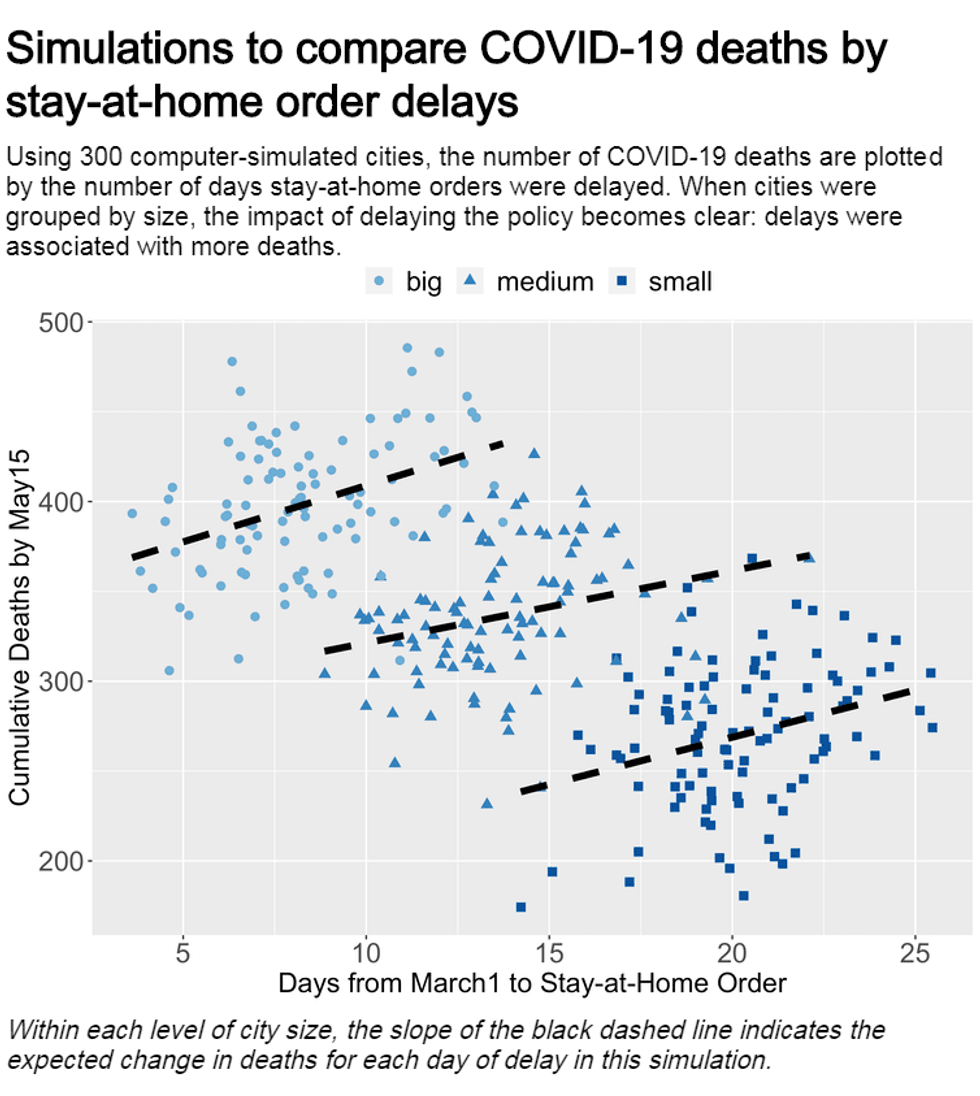
To illustrate the dangers of comparisons that fail to adjust for differences, we set up a simple computer simulation with only three hypothetical variables: city size, timing of stay-at-home orders and cumulative COVID-19 deaths by May 15.
For 300 simulated cities, we plotted COVID-19 deaths by the delay time, defined as the number of days between March 1 and the order being issued. Among cities of comparable size, delays in implementing stay-at-home orders are associated with more COVID-19 deaths – specifically, 40-63 more deaths are expected for each 10-day delay. The hypothetical policy recommendation from this analysis would be for immediate implementation of stay-at-home orders.
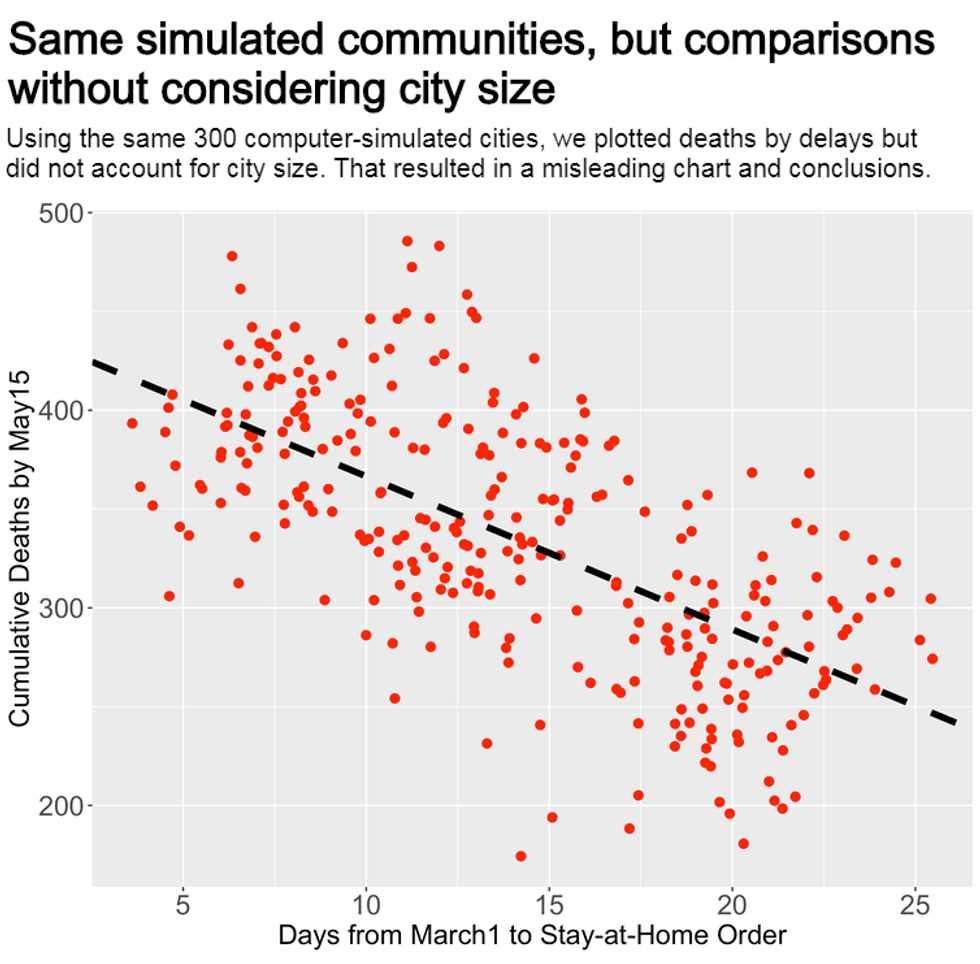
Now consider a plot of the same 300 simulated cities that doesn’t take city size into consideration. The relationship between delays and deaths is reversed: Earlier implementation in this simulation is strongly associated with more deaths, and later implementation with fewer deaths. This apparent paradox occurs because of the causal relationships between city size, delays and COVID-19 deaths. Strong connections or associations between two variables don’t guarantee that one variable causes another. Correlation does not imply causation.
Failing to properly address these relationships can create misperceptions with dramatic implications for policymakers. In these simulations, the analysis that fails to consider city size would lead to an erroneous policy recommendation to delay or never implement stay-at-home orders.
Of course, causal inference in real life is more complicated than in a computer simulation with only three variables.
In addition to confounding factors like community size, substantial evidence suggests that public health interventions do not protect all people equally.
In San Francisco, stark disparities have emerged. For example, comprehensive testing of the Mission District revealed 95% of people testing positive were Hispanic. Factors like socioeconomic status, race and ethnicity, and many others, vary widely among communities and can impact COVID-19 infection and death rates. Differences among community residents makes appropriate interpretation of comparisons, such as between San Francisco and New York, even more difficult.
So how do we effectively learn in the current environment?
While especially pressing now, the analytic challenges posed by COVID-19 are not new. Public health experts have long used data from nonrandomized studies – even in the midst of epidemics. During the Cholera outbreak in London in 1849, John Snow, famed in epidemiologic circles, used available data, simple tools and careful consideration to identify a water pump as a source of disease spread. Evidence-based decisions require both data and appropriate methods to analyze data.
Cities and communities worldwide vary in important ways that can complicate public health research. The rigorous application of causal inference methods that can take into account differences between populations is necessary to guide policy and to avoid misinformed conclusions.
MSNBC's Mika Brzezinski turned away in disgust from President Donald Trump's photo opportunity at St. John's Episcopal Church.
The president walked across Lafayette Park after U.S. Park Police and National Guard troops dispersed peaceful protesters with tear gas, and then posed for a photo with a Bible that some observers believe was held upside-down.
"So the president holding the Bible up like it's a Trump steak," Brzezinski said. "It's so staggeringly kind of empty given other moments in history where presidents have gone to churches and have used prayer to restore calm and fill the hearts of the brokenhearted. I can think of many moments in recent history and I can't explain it."
Preventing deaths from COVID-19 depends on people who get it seeking treatment – which also allows authorities to track down whom they came in contact with to reduce spread.
But, as the economic pain and joblessness caused by the statewide lockdowns continue to grow, more Americans are experiencing severe strains on their personal finances. This threatens our ability to contain the pandemic because those feeling the most financial stress are much less likely to seek medical care if they experience coronavirus symptoms, according to my analysis of a recent Federal Reserve survey.
The Fed conducts a survey of the economic health of U.S. households every quarter, most recently near the end of 2019. In April, it conducted a supplementary but similar survey to quickly gauge how people were handling the coronavirus crisis. Results of both surveys were released on May 14.
The Fed tries to measure financial stress in three key ways. Its surveys ask respondents if they are unable to pay all their monthly bills, couldn’t cover a US$400 emergency expense, or are “just getting by” or worse.
Even before the pandemic hit, the picture wasn’t pretty. In October, when the fourth-quarter survey was conducted, 42% of employed respondents reported fitting at least one of these descriptions, while over 8% said they fit all three. Those figures jumped to 72% and 20% for low-income workers.
But by April, tens of millions of people who had jobs in October lost them as most nonessential businesses across the U.S. either closed or reduced their services. The unemployment rate shot up to 14.7% that month – the highest since the Great Depression – and is expected to climb further when the May data are released on June 5.
The Fed’s April survey, however, paints an even broader picture of the economic impact of the pandemic. In that survey, about 28% of the previously employed respondents said they either lost their job, were being furloughed, had their hours cut or were taking unpaid leave. This has been financially devastating to many, with 68% of this group reporting one of the stresses listed above and 28% saying they were experiencing all three, regardless of income level.
Forgoing medical care
Separate questions in the surveys demonstrate just how strong the link is between financial and physical health.
The October survey also asks those respondents if they had skipped a doctor’s visit during the previous 12 months because of the cost. More than 20% of those who reported one of these financial stresses said they had, while almost 46% of those with all three said so.
In April, the Fed asked a more timely question: “If you got sick with symptoms of the coronavirus, would you try to contact a doctor?”
A third of those respondents who also said they’re experiencing all three financial stresses said “no.” This is especially significant because, unlike the October question, it describes a current, known threat, rather than referring to a previous medical issue of unknown severity. And the widely reported urgency and seriousness of the coronavirus suggests someone wouldn’t treat the decision to seek a doctor’s care or advice lightly.
Relieving the stress
That was back in April, less than a month into the coronavirus lockdowns. If the same questions were asked today, I believe the numbers would look a lot worse.
In the middle of a serious pandemic, we don’t want sick people avoiding treatment because they’re worried they won’t be able to put food on the table. This would likely worsen the spread of the coronavirus and make it a whole lot harder to contain.
As Congress debates additional measures to mitigate the economic and financial effects of the pandemic, it would be wise to keep in mind the connection between financial stress and individual decisions to seek medical care.
Tribalism has become a signature of America within and without since the election of President Trump. The nation has parted ways with international allies, left the rest of the world in their effort to fight the climate change, and most recently the pandemic, by leaving the World Health Organization. Even the pandemic was not a serious issue of importance to our leaders. We did not care much about what was happening in the rest of the world, as opposed to the time of previous pandemics when we were on the ground in those countries helping block the progress so long as it was China’s or the European Union’s problem. This marks drastic change from previous U.S. altruistic attitude, including during the World War II.
Whether Trump is the cause or effect of the changes in America’s collective attitude, an attribute of our current president is his eagerness and ability to use fear for intimidation of those who disagree with him, and subordination and shepherding of those who support him.
Fear is arguably as old as life. It is deeply ingrained in the living organisms that have survived extinction through billions of years of evolution. Its roots are deep in our core psychological and biological being, and it is one of our most intimate feelings. Danger and war are as old as human history, and so are politics and religion.
I am a psychiatrist and neuroscientist specializing in fear and trauma, and I have some thoughts on how politics, fear and tribalism are intertwined in the current events.
We learn fear from tribe mates
Like other animals, humans can learn fear from experience, such as being attacked by a predator, or witnessing a predator attacking another human. Furthermore, we learn fear by instructions, such as being told there is a predator nearby.
Learning from our tribe mates is an evolutionary advantage that has prevented us from repeating dangerous experiences of other humans. We have a tendency to trust our tribe mates and authorities, especially when it comes to danger. It is adaptive: Parents and wise old men told us not to eat a special plant, or not to go to an area in the woods, or we would be hurt. By trusting them, we would not die like a great-grandfather who died eating that plant. This way, we accumulated knowledge.
Tribalism has been an inherent part of human history, and is closely linked with fear. There has always been competition between groups of humans in different ways and with different faces, from brutal wartime nationalism to a strong loyalty to a football team. Evidence from cultural neuroscience shows that our brains even respond differently at an unconscious level simply to the view of faces from other races or cultures.
At a tribal level, people are more emotional and consequently less logical: Fans of both teams pray for their team to win, hoping God will take sides in a game. On the other hand, we regress to tribalism when afraid. This is an evolutionary advantage that would lead to the group cohesion and help us fight the other tribes to survive.
Tribalism is the biological loophole that many politicians have banked on for a long time: tapping into our fears and tribal instincts. Abuse of fear has killed in many faces: extreme nationalism, Nazism, the Ku Klux Klan and religious tribalism have all led to heartless killing of millions.
The typical pattern is to give the other humans a different label than us, perceive them as less than us, who are going to harm us or our resources, and to turn the other group into a concept. It does not have to necessarily be race or nationality. It can be any real or imaginary difference: liberals, conservatives, Middle Easterners, white men, the right, the left, Muslims, Jews, Christians, Sikhs. The list goes on and on.
This attitude is a hallmark of the current president. You could be a Chinese, a Mexican, a Muslim, a Democrat, a liberal, a reporter or a woman. So long as you do not belong to his immediate or larger perceived tribe, he portrays you as subhuman, less worthy, and an enemy.
When building tribal boundaries between “us” and “them,” politicians have managed very well to create virtual groups of people that do not communicate and hate without even knowing each other: This is the human animal in action!
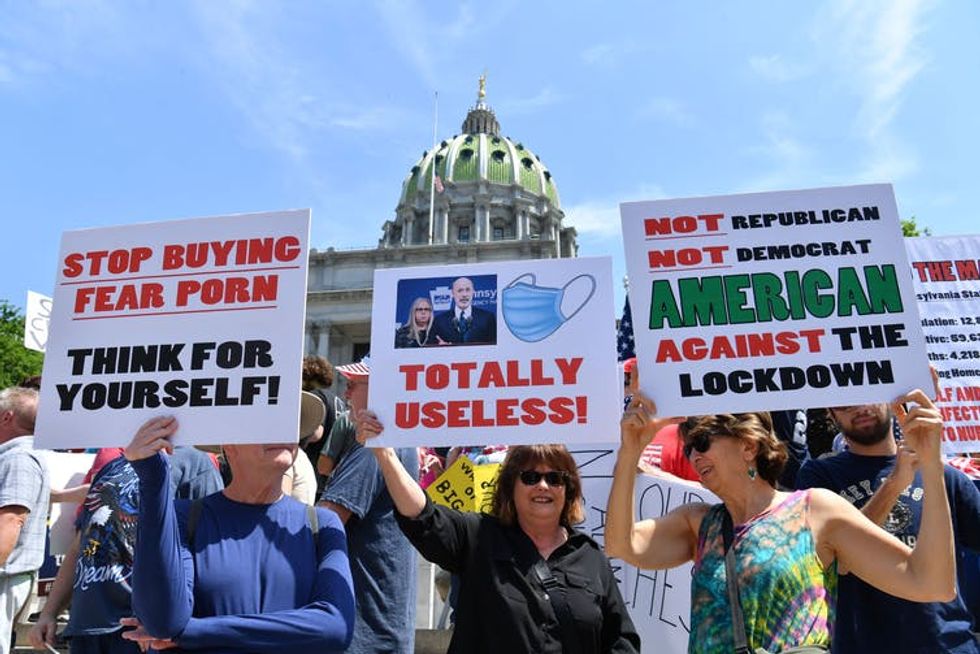
The coronavirus pandemic has contributed to divisions rather than mitigated them, as shown here in a protest in Harrisburg, Pennsylvania, on May 15, 2020 in favor of reopening the state.
Very often my patients with phobias start with: “I know it is stupid, but I am afraid of spiders.” Or it may be dogs or cats, or something else. And I always reply: “It is not stupid, it is illogical.” We humans have different functions in the brain, and fear oftentimes bypasses logic. In situations of danger, we ought to be fast: First run or kill, then think.
This human tendency is meat to the politicians who want to exploit fear: If you grew up only around people who look like you, only listened to one media outlet and heard from the old uncle that those who look or think differently hate you and are dangerous, the inherent fear and hatred toward those unseen people is an understandable (but flawed) result.
To win us, politicians, sometimes with the media’s help, do their best to keep us separated, to keep the real or imaginary “others” just a “concept.” Because if we spend time with others, talk to them and eat with them, we will learn that they are like us: humans with all the strengths and weaknesses that we possess. Some are strong, some are weak, some are funny, some are dumb, some are nice and some not too nice.
Fear can easily turn violent
There is a reason that the response to fear is called the “fight or flight” response. That response has helped us survive the predators and other tribes that have wanted to kill us. But again, it is another loophole in our biology to be abused. By scaring us, the demagogues turn on our aggression toward “the others,” whether in the form of vandalizing their temples, harassing them on the social media, of killing them in cold blood.
When demagogues manage to get hold of our fear circuitry, we often regress to illogical, tribal and aggressive human animals, becoming weapons ourselves – weapons that politicians use for their own agenda.
The irony of evolution is that while those attached to tribal ideologies of racism and nationalism perceive themselves as superior to others, in reality they are acting on a more primitive, less evolved and more animal level.
Editor’s note: This article is an updated version of an article that originally was published Jan. 11, 2019.
A police officer in Savannah, Georgia says that the violent clashes that have erupted between police and demonstrators are a direct result of a "militarized" police force that thinks of American citizens the same way an army thinks of citizens in an occupied foreign country.
In an interview with Vox.com, police officer Patrick Skinner, who previously served as a CIA officer overseas, said that the counterinsurgency strategies that the United States has deployed in countries such as Iraq and Afghanistan have been brought home and are being used on demonstrators.
"I’m a big believer that the police shouldn’t act like the military," he said. "We shouldn’t dress like the military. We shouldn’t have military weapons. When you can’t tell the difference between the police and the National Guard, that’s a big problem. But police have been militarized. This is the result of that."
Skinner said that police have no choice but to take action when a protest transforms into a riot, but he also says that police throughout the country have missed many opportunities to deescalate situations that have turned violent.
"We’re taught that it’s a war," he said, explaining how police are not sufficiently trained to deescalate conflict. "It’s not. But it’s becoming a war. We are the action arm for a fucked-up national mindset. This doesn’t exist in isolation. America has the police force that it votes for, that it funds. This system is what we set up. We spent a lot of money and a lot of time over hundreds of years to have this police force."