MSNBC's Joe Scarborough warned Senate Majority Leader Mitch McConnell was committing "political suicide" by continuing to cover for President Donald Trump during the coronavirus pandemic.
The president's approval is sliding again as U.S. coronavirus deaths approach 60,000, threatening his chances at re-election and putting McConnell in danger of losing his leadership position -- and possibly even his Senate seat.
"If Pennsylvania and Michigan and Florida flip, it's all over anyway," Scarborough said. "Whether you're looking at 1974, 1980, 1994, 2006, 2008, I mean, whatever you look at, these waves usually sweep all in one direction. Right now, the momentum is going away from the Republicans because they continue to embrace Donald Trump. They are not speaking out in a way that even some of their governors are. That is political suicide."
The "Morning Joe" host said the Kentucky Republican was as vulnerable as he's ever been.
"Mitch McConnell is not just concerned about not being majority leader, Mitch McConnell may not win re-election," Scarborough said. "Everybody loves to say, 'Oh, Mitch McConnell always figures out a way to win.' He was carrying an 18 percent approval rating for some time in his own state. He is being out-fundraised now in Kentucky, which is a state that a Democratic governor won [last year]. Mitch McConnell, maybe he did win in the past, all of these close elections, like Harry Reid always figured a way to squeak it out."
"Mitch McConnell is carrying water for a president who was telling people to inject disinfectants into their body," he added. "Mitch McConnell is carrying water for a president who said that this pandemic, which is going to have killed far more people than died in the Vietnam War, American troops fighting. I mean, Mitch McConnell is going to be taking that in the fall, defending that president who said, 'It was just one person from China,' and it was magically going to go away. He is going to be seen as the guy doing more to defend this president than anybody else. That's going to be tough to defend, even in Kentucky."
Online conspiracy theorists are blaming a U.S. Army reservist for the coronavirus pandemic, and their claims are being amplified by Chinese state media.
Maatje Benassi and her husband have never tested positive for the virus or experienced symptoms, but YouTube videos identifying her as Patient Zero in the outbreak have garnered hundreds of thousands of views and have rocketed across Chinese social media, reported CNN.
"It's like waking up from a bad dream going into a nightmare day after day," Benassi said.
She and her husband, who is a retired Air Force officer who still works for the military service as a civilian contractor, have hired an attorney, but they've found there's little they can do to stop the spread of the conspiracy theory about them.
Benassi became a target due to her participation in the Military World Games hosted in October in Wuhan, where she competed in a cycling competition that left her with a fractured rib and concussion as the result of a crash.
Conspiracy theorist George Webb, who has nearly 100,000 followers on his YouTube channel, claimed Benassi and Italian DJ Benny Benassi are somehow involved in a plot to spread the deadly virus.
The Italian musician, whose 2002 song "Satisfaction" was a worldwide hit, says he's never met the American reservist or her husband, and they're not even related as far as they know.
Webb offered no substantive evidence to back his claims during an interview with CNN, and instead complained that YouTube had stopped running ads on his videos.
Matt Benassi, the civilian Pentagon employee, told CNN he feared the conspiracy theories would make them targets for violence, and he expressed frustration with YouTube for allowing Webb's videos to remain online.
"It's really hard to hold [Webb] accountable," Matt Benassi said. "Law enforcement will tell you that there's nothing that we can do about it because we have free speech in this country. Then they say, 'Go talk to a civil attorney,' so we did. We talked to an attorney. You quickly realize that for folks like us, it's just too expensive to litigate something like this. We get no recourse from law enforcement. We get no recourse from the courts."
However, Trump administration sources are telling The Daily Beast that Kushner has been notably absent in recent weeks, and they are unsure of what work he's actually doing.
“[Jared] could be in his office just googling ‘coronavirus,’ show the results to the president, and still get a gold sticker from his dad-in-law,” one senior Trump administration official who works with the coronavirus task force tells the publication. “He is solving the coronavirus like he’s bringing peace to the [Middle East].”
Officials say that much of Kushner's time has been spent trying to engage allies in the private sector to help with the administration's response, although the results have "provoked mockery and some internal face-palming."
Additionally, The Daily Beast reports that "several of the projects that Kushner’s team has helmed to help do that are running behind schedule or are causing massive disruptions in the way states are handling their own coronavirus responses."
In particular, state officials are saying that Kushner's efforts at buying up supplies for the national stockpile has actually harmed their ability to secure needed equipment for medical professionals.
Earlier this month, the U.S. Supreme Court interfered in an election in Wisconsin in yet another 5-4 decision meant to secure an electoral advantage for the Republican Party. Amidst the coronavirus pandemic, a federal district court had granted a one-week extension to Wisconsin's mail-in ballot deadline. The election included not only Wisconsin's presidential primary, but also a crucial judicial general election that threatened the GOP's hold on the state's highest court. But the Supreme Court overruled the lower court, tossing out thousands of absentee ballots and forcing Wisconsin voters and poll workers to risk exposure to coronavirus. The irony: the justices made their votes in the case remotely.
The Court reasoned that lower federal courts "should not ordinarily alter the election rules on the eve of an election." This ignored, of course, that a pandemic made the election in question anything but ordinary. Milwaukee, a city of 600,000 people, ordinarily has 180 polling places, but there were just five open on Election Day. Madison, a city of 255,000 people, ordinarily does not experience half of its poll workers missing, as it did that Tuesday. (It was surely not lost on the Court's conservative majority that these cities ordinarily vote overwhelmingly for Democrats.) And, of course, Wisconsinites do not ordinarily have to choose between risking viral infection or staying home and forgoing their sacred right to vote.
Unfortunately, the Supreme Court's hostility towards democracy has become ordinary.
Our democracy has been under assault for the past two decades, and the Supreme Court has dealt many of the sharpest blows. Since 2000, the court has ordered the state of Florida to stop counting ballots and handed the presidential election to a Republican who lost the popular vote, gutted the Voting Rights Act, upheld racist voter ID laws in Indiana, allowed a torrent of dark money to flow into our electoral process, and authorized racially biased voter purges in Ohio.
It is time we do something about the Roberts court's assault on democracy. Expanding the Supreme Court is our only option.
Despite substantial evidence that the Roberts Court and democracy cannot coexist, some are hesitant to embrace "court expansion" — increasing the number of seats on the Supreme Court the next time Democrats control the Presidency, House, and Senate — as a solution. They fear it would cause a "death spiral" in which Republicans would simply expand the court again should they retake unified control. (This, of course, ignores that the Republicans have already altered the size of the court before — in 2016, when the Senate reduced the size of the court to eight for an entire year rather than seat Merrick Garland, Barack Obama's nominee to replace the late Antonin Scalia. Republicans paid the steep political price of winning the presidency, House, and Senate that fall.)
But court expansion would not cause a death spiral of democracy. That death spiral is already here. And it will only get worse if we do nothing.
The Roberts court — with a majority of five conservative justices, four of whom were appointed by Republican presidents who took office after losing the popular vote — has made it unnecessarily difficult for all voters, especially Democratic voters, to cast their ballot. Justice Roberts famously declared that "things have changed in the South" in his decision striking down key provisions of the Voting Rights Act. Five years later, Georgia's then-Secretary of State, Brian Kemp, stole an election from Stacey Abrams, a Democrat, by engaging in the exact form of black voter suppression the Voting Rights Act was meant to check. Thanks to the Roberts court, the affront to democracy we saw in Georgia — more than over 1.5 million mostly black voters purged, dozens of majority-black precincts closed, defective voting machines, and four-hour lines to vote in majority-black neighborhoods — was legal for the first time since the era of Jim Crow.
The Supreme Court's antidemocratic streak reverberates far beyond voting. Thanks to the Roberts Court, our campaign finance system operates so that, overwhelmingly, the candidates who make it onto the ballot and win elections are captured by corporate interests and wealthy donors. This is true of both Democrats and Republicans. These candidates hold views that are out of step with those of the average American, many of whom choose to stay home rather than vote for candidates who are more responsive to their donors than their constituents.
Even if Democrats overcome these hurdles to get more votes, they will be met with structural barriers that will keep them out of power. Thanks to the GOP's aggressive partisan gerrymandering, Democrats have to routinely produce historic turnout to win House majorities. In 2018, the Democrats' seven-point win resulted in a 36-seat majority; in contrast, the GOP's seven-point win in 2010 produced a 49-seat majority. The Senate is even more undemocratic, and only getting worse: Democrats won the Senate popular vote by 9 million in 2018 and lostseats. By 2040, 30% of Americans, people from disproportionately white and rural states, will be represented by 70% of U.S. senators.
Do not expect the Roberts court to level this horribly uneven playing field. It has refused to address even the most blatant examples of partisan gerrymandering: in 2018, the conservative majority declined to intervene against Wisconsin's state-level gerrymander, which enabled Republicans to win 63 of the 99 state assembly seats with only 44.8% of the vote. Worse yet, it held that partisan gerrymandering was a political question that no federal court is allowed to touch in the future. The court is also likely to rule against measures that would make the Senate less undemocratic, such as granting statehood to Washington, D.C.
Democrats have a bold plan to restore democracy, but it may not pass muster with a hostile Supreme Court. In 2019, House Democrats passed the For the People Act (H.R. 1) to counteract a decades-long conservative assault on democracy. It includes measures like automatic voter registration to add nearly 50 million voters to the rolls, campaign finance reform to reduce the outsize influence of big money, independent redistricting to end partisan gerrymandering, and prohibitions on voter suppression. But the Roberts court cannot be trusted to faithfully interpret that law. In Husted v. Randolph Institute (2018), the court manipulated the National Voter Registration Act of 1993, a statute meant to expand voter registration, to allow Ohio to purge one million voters, a disproportionate number of whom are black. Given that recent precedent, and the Court's general antipathy toward democracy, there is every reason to believe that the Roberts court will come up with pretextual reasons to strike down crucial provisions of the For the People Act, which would both bolster our democracy and threaten unified Republican control.
Make no mistake, Democrats want to compete for the support of the American people. Unfortunately, Republicans have shown that their strategy for winning is to cheat. Very recently, President Trump admitted that when more people vote, Republicans lose.
We cannot restore democracy without fixing the Supreme Court. That is precisely why court expansion is so urgently necessary.
Practically speaking, a plan that pairs court expansion with legislation to restore our democracy will naturally provide a bulwark against Republican retaliation. With 50 million voters added to the rolls and fair congressional maps, it would be exceptionally difficult for Republicans to recapture unified control of the political branches and pass their own court expansion bill.
We live in a time of crisis. Aside from the coronavirus pandemic, we have 10 years left to prevent irreversible climate catastrophe. Income inequality is the highest it has been in a century. More than 30 million Americans do not have health insurance, a number that is growing. A woman's right to choose is constantly being undermined; the Supreme Court could overturn Roe v. Wade tomorrow. More than 2.3 million Americans are incarcerated, while 12 million undocumented people in this country live without legal protection. Millions of LGBTQ people live without protection from employment discrimination under federal law. At least 33,000 people in the United States die each year from gun violence.
Our ability to respond to these crises depends on enfranchising the 53 million eligible voters who cannot or will not participate in our democracy — exactly the sort of measure the Roberts court will not allow.
We face a choice: allow these crises to worsen, or expand the court.
MSNBC's Joe Scarborough and Mika Brzezinski unloaded on President Donald Trump for trying to bluff his way through a public health crisis.
Trump asked last week whether household disinfectants might be used to treat coronavirus patients, but then claimed he was only joking when he was universally mocked -- and the "Morning Joe" co-hosts excoriated the president.
"These people that were once, quote, movement conservatives, are nothing more than a Trump cult, personality cult," Scarborough said. "That's why they can't even admit that this president is unfit for his office and that people are going to die in the future because of this, unless somebody figures out a way to get him to focus, be serious, and put seniors first, put people with pre-existing health conditions first, put this nation's health and safety and well-being first."
Brzezinski pushed back against critics who say she and Scarborough have been overly wrought in their response.
"A lot of the president's pawns, whether they're in the media or whatever, will say, 'Oh, Joe and Mika, so upset,'" she said. "I want to point out something you said on your Instagram live this weekend. You would love to see the president be competent in this crisis. Unfortunately, that's not what we're getting, and people are dying. If you see a lot of emotion coming from this show, it's because we are frightened for the American people at this point, given the fact that the White House has shown zero competence in this crisis."
Trump insisted over the weekend that he was only joking when he suggested shooting sunlight inside of a person's body to treat coronavirus, and bizarrely claimed he wasn't even speaking to Dr. Deborah Birx -- when video shows he was.
"He is putting her in a terrible position with a quack idea, and forcing her to talk about heat and light," Brzezinski said. "She has to grasp for an answer and explain to him that maybe a fever, but no. No, you're an idiot. You're a moron is what she's thinking, okay? You can see it on her face. I'm sorry, Mr. President, you put her in that position. This really reputable, credible, prepared woman, who spent her entire life getting ready for a crisis like this. You're a joke. You try to make a joke of the entire situation."
New York, which has ground to a halt to stop the coronavirus pandemic, may start reopening manufacturing and construction after May 15, Governor Andrew Cuomo said Sunday.
Cuomo, however, said that any easing of measures would take place first in the north of the state and not in the New York City metropolitan region, by far the hardest-hit area in the United States.
"The regions that would be more likely able to open sooner would be the upstate regions," Cuomo told reporters. "Downstate New York is going to be more complicated."
He said that any potential reopening of New York City, the country's most populous city, could need to be coordinated with authorities in the adjacent states of New Jersey and Connecticut.
A lockdown of New York ordered by Cuomo is set to expire on May 15. Under a plan for reopening, the first sectors would be construction and manufacturing.
Cuomo said the state was operating with a caveat -- "don't do anything that's going to bring people in from all across the board."
Cuomo has called for a two-week delay before the next stage of reopenings, which would include most offices, to ensure that the first phase does not trigger a resurgence of the virus.
The governor stressed that any final decision would be conditioned on a downturn in COVID-19 hospitalizations between now and May 15.
The state on Sunday reported 367 fatalities in the previous 24 hours, the lowest number since March 30 when 332 people died.
COVID-19 has now killed 16,966 people in New York state, accounting for around a third of the deaths in the United States.
To reopen, businesses will need to present New York authorities with plans that show they are ensuring sanitation to reduce the risk of virus transmission.
Cuomo said that no full-scale return to normal could come until the reopening of schools, which would allow parents to work outside of home.
New York state has not made a decision on reopening the education system, although Mayor Bill de Blasio has said that he considers the rest of the school year cancelled in the city.
Cuomo said that some school districts were studying whether to hold summer sessions to make up for lost time.
A national security expert told CNN on Monday that President Donald Trump has given Americans no choice but to disregard everything he says about the COVID-19 pandemic.
Juliette Kayyem, the former U.S. Assistant Secretary of Homeland Security for Intergovernmental Affairs for President Barack Obama, told CNN's Alisyn Camerota that Trump's musings about the benefits of injecting people with disinfectant to treat COVID-19 appear to have been the last straw for even many Republicans who are now pushing to have him stop giving regular briefings about the pandemic.
"I've often said from the beginning, if the president can't be useful, make him irrelevant," she said. "It sounds like he's going to get out of the lane that matters the most, which is the protection of lives and the protection of our first responders, and maybe turn into a lane which also matters, which is economics."
While Kayyem didn't exactly endorse whatever solutions Trump would propose to revive the economy, she said that having him focus on economics is "not going to kill people directly right now."
"If people, like governors, begin to isolate the president and his bad information, we will be in a better place," she concluded.
There has been passionate – and honest – argument about how many people are likely to get sick and die under different circumstances and sets of official rules. It’s not clear how uncertain and evolving scientific findings should affect extraordinary government measures that restrict citizens’ basic freedoms.
CNBC’s Rick Santelli questions a part of the 2009 federal bailout plan.
Seeking authentic feelings
Dissent – and the freedom to do it – is a crucial element of democracy. Political leaders are rightly influenced by public opinion. But it’s important to know when protests are sparked by special-interest groups seeking to manipulate officials’ perception of public sentiment.
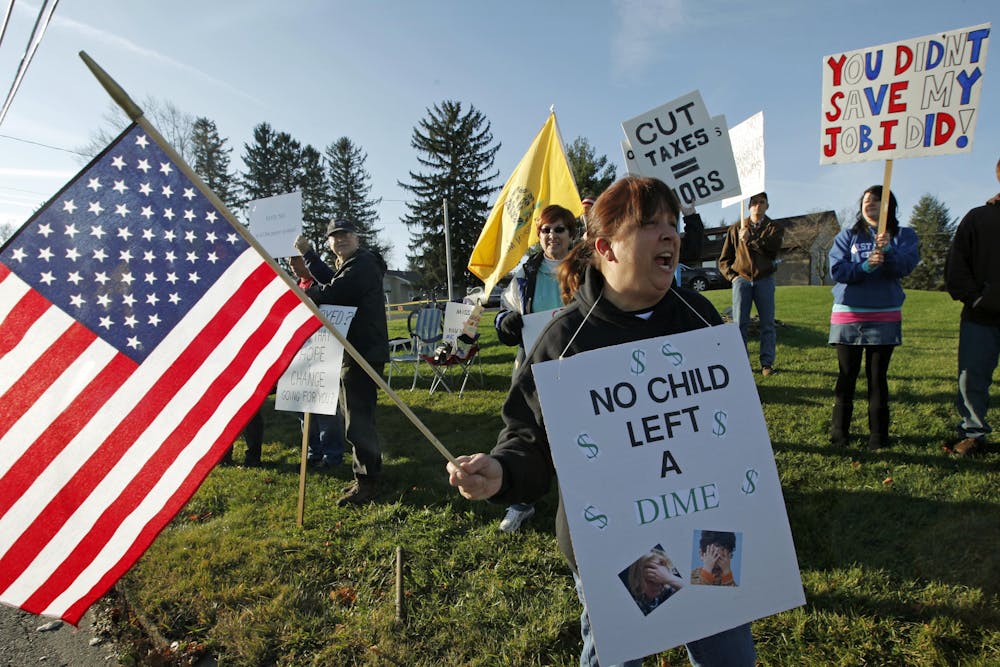
As a journalist who has covered politics for 20 years and now studies how people process uncertainty, I note that the questions about the current protests raise echoes of the Tea Party movement a decade ago.
In February 2009, the Obama administration was grappling with a severe economic crisis caused by a collapse in the mortgage market. A reporter on CNBC, Rick Santelli, began to complain that one part of the federal bailout plan, the Homeowner Affordability and Stability Plan, might let people out of their mortgage obligations even if they should have anticipated they wouldn’t be able to afford them and would face foreclosure.
Santelli made this point on TV while standing on the floor of the Chicago Mercantile Exchange, surrounded by very wealthy traders who egged him on. It was compelling entertainment, and the speech spread rapidly through conservative media. Radio host Rush Limbaugh replayed it on his show; conservative strategists admired it, and millions of conservatives heard it.
Santelli called for a modern-day “tea party” to object to unfair government rules.
Within months, a coalition of anti-immigration reform activists, fiscal hawks, regulation opponents and social conservatives pulled together behind a common set of grievances: Barack Obama’s alleged profligate spending, his willingness to let certain groups get ahead in the economy over other groups – policies that many of them viewed as putting racial minorities at a perceived advantage to white people.
Calling themselves the Tea Party movement, most members were Republicans – but the Republican Party wasn’t speaking for them, so the nation’s two-party structure itself became a common enemy, too. When the Tea Party held its first protests, thousands of people showed up. As the protests spread, motivated partisans who look for opportunities to change attitudes and behaviors, backed by a conservative political funding machine, developed a way to capture the protest energy and channel it effectively.
Authentic protest – like how the Tea Party movement began – is a longstanding American tradition.
Social scientists who study new movements in politics find that the underlying sentiments are as old as civilization itself: Who gets the stuff that the government gives out? What’s fair? Who’s jumped the line?
The movement needs a common enemy – in that case, Obama, his policies and a political structure that permitted them – and the potential for real change, not just politically but socially as well. For those joining the Tea Party, the goal became clear: They could take over the Republican Party.
Fairly quickly, the Tea Party was co-opted by wealthier interests hoping to channel its energy toward slightly different ends – although much of the movement resisted the corporate takeover of its message. Public opinion surveys backed up the intuition that the movement had force.
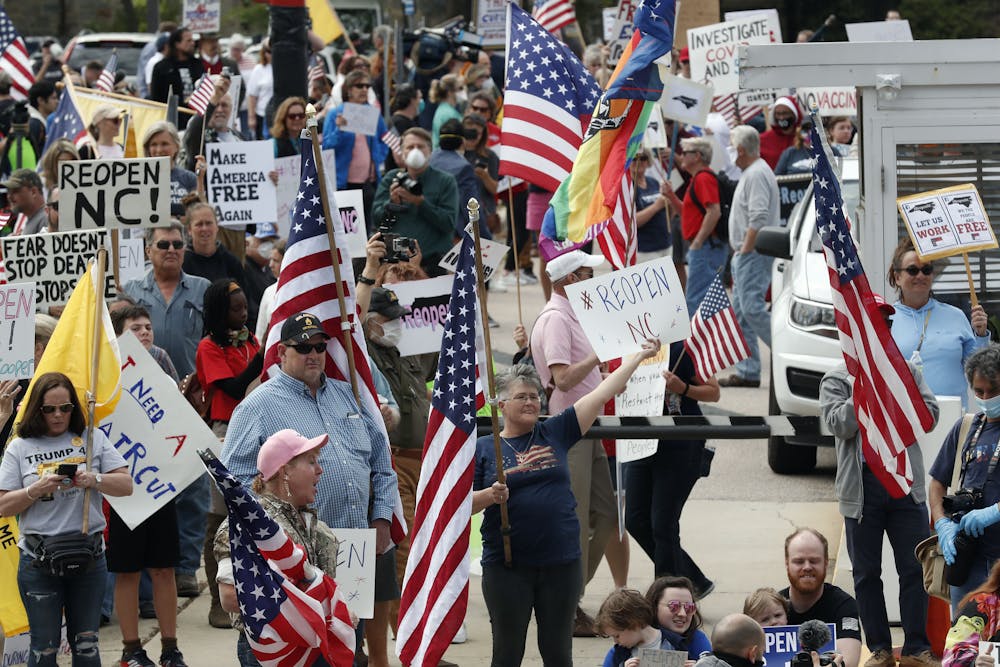
A North Carolina protest was ostensibly coordinated by ReopenNC, whose website was registered by a Florida resident and focuses on selling T-shirts and stickers.
In mid-April 2020, it appeared, a new movement was rising to express frustration with the restrictions and uncertain endpoint to the pandemic, and the economic toll the lockdown has caused.
In the space of several days, there were protests in a dozen states, ranging from a crowd of more than 2,000 who gathered in Olympia, Washington, to several dozen in Annapolis, Maryland.
The available evidence suggests that the demonstrations were organized by paid political operatives using Facebook and new websites to encourage conservatives to protest in specific places against specific governors who had imposed strong public health restrictions on economic activity. This context indicates that one real intention of the protests was to create the illusion of an organic movement that had arisen to object to the restrictions. Evidence is to the contrary: Polling shows that just 12% of Americans think their local restrictions have gone too far – and 26% think they don’t go far enough.
He found that many of these websites, whose registration records you can see yourself at Whois.com, were owned by anti-gun-control groups that are run by the same family of brothers that organized the demonstrations through Facebook groups they run.
Several others of the “reopen” websites were registered with addresses or phone numbers used by longstanding conservative enterprises like Freedom Works. A surprising number belonged to an activist who told Mother Jones that he registered the domains to keep conservatives from using them to counter the recommendation of public health officials.
The ‘Reopen North Carolina’ website focuses on selling merchandise.
But that creates a sense that these protests grew quickly, spontaneously, and organically. The fact that protests happened in different places at different times doesn’t actually mean they’re spreading. When organized by the same small group of political operatives, sequential protests reflect the creators’ skill at mobilizing people – not a naturally rising level of frustration that ultimately pushes people to act.
Many political movements use these tactics. The problem comes from how the media presents the resulting events. On April 21, a labor union organized a protest by nurses at the White House – and media reports noted the event was created by a particular group with a specific purpose. That’s different from how the media treated the “reopen” gatherings.
"It's no use going on to what might have been," said Democratic Speaker of the House on Sunday morning when asked about her legislative strategy against Republicans.
Amid growing criticism from progressives and increased anxiety among the nation's working families, small business owners, and local and state governments that economic relief from the coronavirus pandemic will come too late and be too little, House Speaker Nancy Pelosi on Sunday told television viewers to "just calm down" when asked if she had erred in her legislative strategy with the TrumpWhite House and Senate Majority Leader Mitch McConnell.
Asked by CNN's Jake Tapper on "State of the Union" if she had made a "tactical mistake" by allowing an "interim" piece of coronavirus relief package—known as COVID 3.5—to pass last week without much stronger support for state and local governments, Pelosi deflected on the premise.
"Just calm down," Pelosi said. "We will have state and local and we will have it in a significant way. It's no use going on to what might have been."
Pelosi argued that Democrats "made the most of" the interim package—moving McConnell to a large expansion of the Paycheck Protection Program (PPP) for small businesses—but promised once again that a larger package was on its way.
Pelosi said local and state lawmakers, including New York Gov. Andrew Cuomo, are right to be frustrated in terms of lack of emergency funding for local governments. "They should be impatient," Pelosi said, "and their impatience with help us" get a bigger package and more funding in the Democrats' CARES 2 package, now being drawn up in the House.
On the interim package, widely criticized as a capitulation to McConnell and a forfeiture of key political leverage, Pelosi told the American people, "Judge it for what it does, don't criticize it for what it doesn't—because we have a plan for that."
While McConnell was pilloried last week for suggesting that states should be sent to bankruptcy as opposed to receiving funds, Democrats have said a large aid package to state and local governments will be a key part of their CARES 2 legislation.
As Common Dreamsreported Friday in the wake of the Trump's signing the COVID 3.5. bill into law, progressive advocates said the Democrats' repeated kicking of the can down the road is no longer acceptable.
"'Just wait until the next bill' is not good enough anymore," Morris Pearl, chair of the Patriotic Millionaires, said in a statement. "If these are truly legislative priorities for members of Congress, as they should be, they need to start fighting for them."
In a letter (pdf) to Pelosi and Senate Minority Chuck Schumer at the end of last week, nearly 50 progressive advocacy groups said that as Republicans attempt to exploit the coronavirus crisis to "further enrich their already-wealthy donors, and undermine democracy," Democrats "must put forth and fight for a relief package that puts people first."
"We need Democrats to be bold and fearless in fighting for our families and our communities, advancing solutions that are commensurate with the scale of the crisis we face and helping us build toward a better future for our people, our economy and our democracy," the groups wrote.
New White House Press Secretary Kayleigh McEnany spent time during her Sunday to attack the Washington Post for not putting her quote up high enough in an article.
In a Tweet Sunday, McEnany revealed that she took time out of her busy schedule to count the 21 paragraphs that come before her quote in a piece.
She cited the right-wing organization News Busters, claiming that Post headlines about the White House's response to the coronavirus crisis have been "false."
The headlines have read things like "White House's chaotic response evokes Trump's early days." When the headline is googled, it isn't found online anywhere. They also cite the headline: "How the Trump administration squandered its response time," which appeared to be slightly different from the original headline as well. The story details the lost time during February when Trump was attending rallies and saying the coronavirus was nothing more than the flu.
None of the headlines within the News Busters blog post appear to have links or screen captures attached to them, so it's unclear how they're gathering the information or the headlines. It is entirely possible that the headlines came from just the hard copies of the paper, but some of the headlines don't appear to have been used online.
Trump's approval of the coronavirus crisis stands at just 45.7 percent, according to FiveThirtyEight, with 50.1 percent disapproving.
Trump retweeted her, calling the Post "slime balls."
"Our analysts tallied 53 obviously negative headlines during this 100 day period, compared with just two that were clearly positive, a greater than 25-to-1 disparity," wrote News Busters. The deaths of thousands of Americans is generally not seen as a positive.
So far, John's Hopkins reports there are nearly 55,000 deaths in the United States from COVID-19 in just the past few months. The Trump administration frequently compared the COVID crisis to former President Barack Obama's H1N1 crisis, which killed 12,469 people from April 2009 to April 2010. The U.S. is closing in on one million COVID cases, but only 1 percent of the population has been able to be tested.
It is unknown why the Trump White House is focusing on attacking the media instead of focusing on the need for testing and the deaths of so many Americans.
President Donald Trump on Sunday dismissed reports he was considering sacking health secretary Alex Azar as criticism mounts over the US response to the coronavirus pandemic.
Trump, who risks losing public support ahead of the November election due to the climbing death toll, lashed out over stories on CNN and other media outlets.
"Reports that H.H.S. Secretary Alex Azar is going to be 'fired' by me are Fake News," Trump wrote on Twitter.
"They are desperate to create the perception of chaos & havoc in the minds of the public."
Trump renewed his attacks on Fox News, which he targets when its generally supportive broadcasting veers into criticism.
"No respect for the people running @FoxNews. But Fox keeps on plugging to try and become politically correct," he said.
"The people who are watching @FoxNews... are angry. They want an alternative now. So do I!"
He separately threatened lawsuits over his media coverage, and asked the "Noble Committee" to rescind awards -- presumed to be a reference to the Nobel Prize, which has no journalism category.
Trump appears to have halted his daily televised briefings on the virus after suggesting that patients might be injected with disinfectant to kill an infection.
He later claimed he had been speaking "sarcastically."
More than 54,000 Americans have died from the novel coronavirus.
President Donald Trump tweeted Sunday that he was asked by West Point to attend their graduation, which has been postponed due to the coronavirus crisis.
The New York Times reported that the cadets are being forced to come back for an event with Trump, but former senior Trump campaign adviser David Urban attacked it as "fake news."
All of the claims were ones that were disputed by West Point graduate and government relations chief for VoteVets, Will Goodwin.
"I'm a West Point graduate. Mr. President, they did NOT ask you to be there," he tweeted Sunday. "You put your ego ahead of the safety of our future Army Officers. It's just the latest example of you putting your own political interest ahead of our military readiness. You're undeserving of the office."
Many of the graduated cadets have already scattered across the country in an effort to help with the coronavirus crisis, reported the Times.
President Donald Trump's campaign seems to have edited out 6 states from the American flag in a recent puzzle the store is selling on the campaign site.
Trump is known for selling a manner of strange items on his website, along with typical t-shirts and hats, Trump is selling over-priced plastic straws with his name on them and an official Sharpie for editing your own government documents. But the latest item seems a little anti-American.
According to the email, Trump supporters voted in favor of the puzzle image with only 44 stars.
"We asked you to vote on which puzzle you’d like us to carry in the Official Trump Campaign Store," the email said. "Well, we’re happy to report that the votes are in and for the FIRST TIME EVER, we're releasing a limited-edition Official Trump Puzzle. President Trump knows that you are one of his strongest supporters, so he’s asked us to give you EXCLUSIVE EARLY ACCESS to get your puzzle FIRST before we release them to the public."
Deputy Press Secretary Sarah Matthews confirmed that the campaign cropped the photo on the left side and that's why the six stars are missing. They did not clarify why it was cropped in that manner.
The last six states to join the United States were Utah, Oklahoma, New Mexico, Arizona, Alaska and Hawaii. No other states have been officially added since 1959, though many territories have protested for statehood, including Puerto Rico and Washington, D.C.