Using U.S. Census Bureau data, we looked at the Gini coefficient, a common measure of income inequality.
This measurement ranges from 0, where everyone earns exactly the same amount and there is complete equality, to 1, or complete inequality, where all resources are held by one individual or household. Values above 0.4 are often considered high, and values near or below 0.3 very low.
For most of the past five decades, income inequality has been higher in rural counties than in urban areas.
The most rural counties – those with the smallest, least dense populations – suffer the highest levels of income inequality. Meanwhile, the most urban areas tend to have the lowest levels of inequality.
Narrowing the gap
However, rural-urban differences at the county level have narrowed over the past decade or so.
On average, in 1970, the Gini coefficient within rural counties was 10.2% higher than within urban counties. In 2016, it was just 0.5% higher. This convergence is happening because inequality is worsening in urban areas – not because things are getting better in rural communities.
We found a similar pattern when comparing inequality between the most rural and most urban counties.
There is one exception: suburban counties. While suburban counties are getting more unequal, they are doing so at a much slower rate than the core cities in the nation’s metropolitan areas.
What’s more, more Americans now live in highly unequal counties. In 1970, 1% of the urban population lived in counties where the Gini coeffecient was over 0.48, an especially high score. In 2016, it was 8.2%.
Rural counties have seen a more modest increase in the proportion of their population living in highly unequal counties – from 5.7% to 7.6%.
Strikingly, the population living in low-inequality counties has all but disappeared. While 8.3% of the rural population and 30.0% of the urban population lived in low-inequality places in 1970, by 2016 virtually no Americans – less than 1% – lived in low-inequality places, where the Gini coefficient was less than 0.36.
In 2016, just 31 out of the 3,076 counties in the contiguous United States were considered low inequality, according to our analysis.
What this means
Rural poverty has received considerable attention from scholars and the media.
But persistently high levels of inequality in rural communities also suggest the need to study the substantial number of people at the high end of the economic spectrum. Little is known about who, exactly, falls at the top of the income distribution in rural communities.
If researchers knew more about the role of elites in the rural United States, they could develop more comprehensive explanations of why inequality and other economic development challenges persist.
In addition, our work shows that urban inequality is an increasingly important issue. Since the average level of income inequality within rural counties has changed little over the decades, it seems that the growing inequality within urban counties has driven income disparities nationwide.
A key group of allies is missing in the U.S. effort to face the coronavirus pandemic: the American people.
In the wake of World War II and during the Cold War, the U.S. was the world’s best at planning and preparing for mobilizing the citizenry to take action in an emergency. In those days, the anticipated emergency was a nuclear attack on the U.S., likely resulting in a loss of national leadership that required local governments and members of the public to step up.
Every American was asked to help prepare for that possibility, storing extra supplies, planning to communicate with family members and developing survival skills.
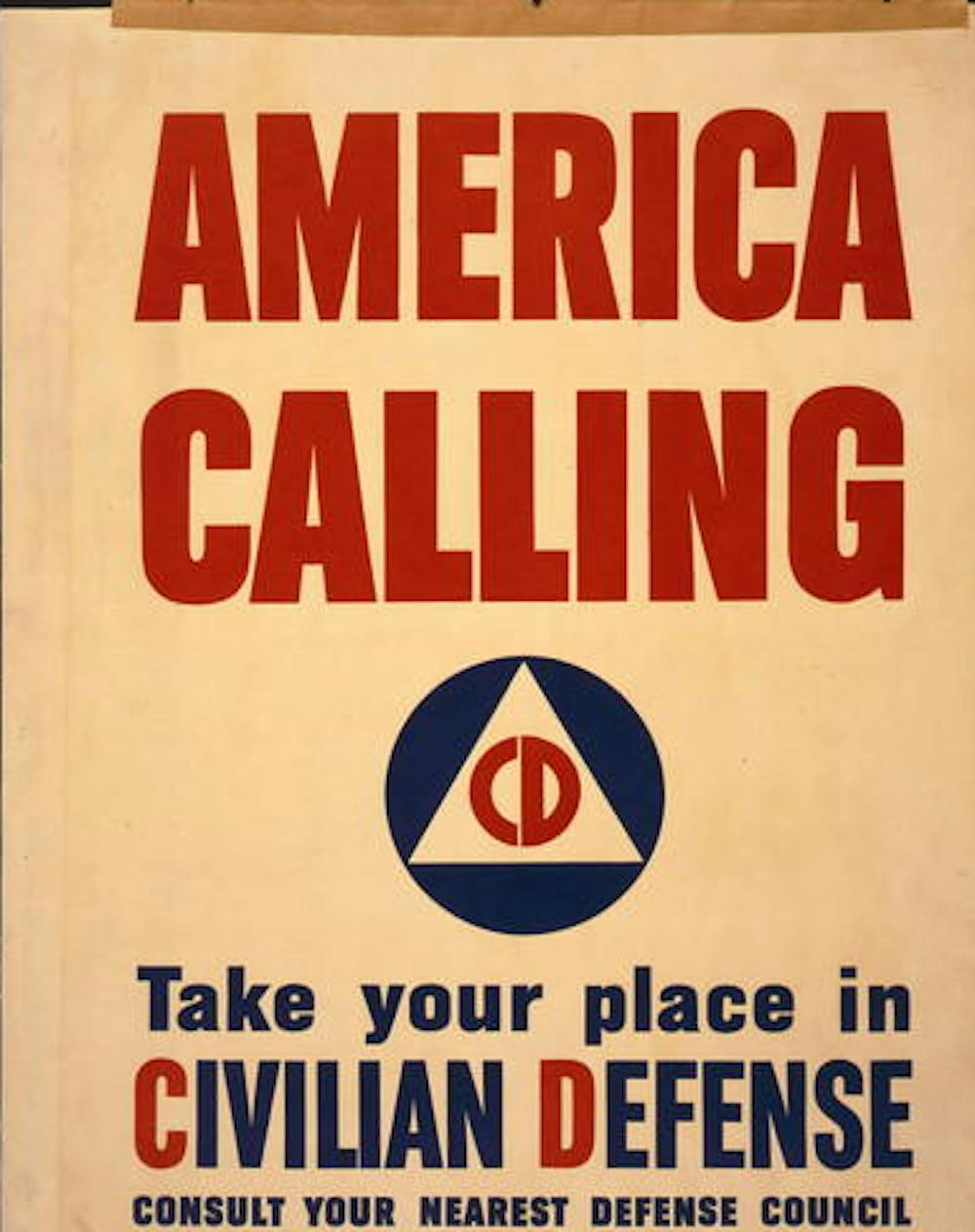
A poster from 1941 urged all Americans to contribute to community preparedness for emergencies.
Over the latter half of the 20th century, the U.S. civil defense effort encouraged all Americans to be prepared to respond actively to a national emergency.
In recent years, however, Americans’ expectations have shifted from being ready to respond to passively waiting for help from a centralized, bureaucratic federal effort – usually led by the Federal Emergency Management Agency.
Bert the Turtle taught Americans to ‘duck and cover’ in the face of danger.
Civilian-led response after World War II
As professors of architecture and urban planning who study extreme events and historical forces shaping communities, we have firsthand experience in disaster response following Hurricanes Katrina and Maria. We have observed that federal emergency responses can often be poorly orchestrated and mismanaged, lacking the nimble effectiveness of local, citizen-organized efforts. That slows aid, and recovery.
But this was not always the case. Civil defense efforts once relied on the active efforts of citizens.
Created in 1947, the National Security Resources Board was charged with overseeing the nation’s civil defense preparations. The agency oversaw a coordinated communications effort that included reserving dedicated radio frequencies for broadcasting emergency information, issuing instructional posters and pamphlets. Its efforts also included producing short films for school-age children such as “Bert the Turtle” and “Duck and Cover,” which taught kids ways they could help keep themselves safe.
The board was also the origin of the once-ubiquitous Emergency Broadcast System, meant to give the public accurate information and instruction in an urgent situation. Its tests, including a script declaring that “this is a test … this is only a test,” would precede an ear-splitting tone interrupting radio and TV broadcasts.
Other civil defense efforts encouraged citizens to practice air raid drills, including training students to shelter under their classroom desks. Volunteers were mobilized to stock and maintain provisions and medical supplies in a decentralized network of fallout shelters in the basements of public buildings. This was common practice until the late 1970s.
As the Cold War subsided, emergency management began to encompass other types of extreme events, which often required specialized equipment and expert training. That required a move to a more professional disaster response.
The lack of civic coordination shifts responsibility away from citizens working collectively – and in fact has left people seemingly less prepared to respond to a crisis.
Schools have closed, and with no real backup plan, most teachers have been forced to learn on the fly about how to provide distance learning and online education.
Without guidance, people are waiting for help to arrive. In the meantime, the uncertainty has fueled panic-buying that has emptied stores, leaving critical care workers – and those too poor to buy in bulk or in advance – without reliable access to key foods and supplies.
These examples demonstrate that small-scale approaches can be effective in producing big results. In contrast, larger organizations are more bureaucratic and slower to respond. These inverse economies of scale mirror civil defense efforts: Many working collectively but independently are sometimes more effective than a larger centralized effort.
When facing an unexpected crisis, some amount of disorganization is probably inevitable. But other countries, such as Estonia, Sweden, Finland, Nigeria and Australia, actively work to engage all citizens in disaster preparedness, first aid training and other efforts that give people clear and productive tasks to accomplish.
Following their example – and indeed the United States’ own history – could help create a system of federal oversight and coordination complemented by prepared and trained local responders. That could better prepare the public to pull together as a collective civic community when disaster next strikes.
MSNBC's "Morning Joe" on Tuesday played back-to-back clips of President Donald Trump and former British Prime Minister Winston Churchill -- and the contrast between the two men in dealing with national crises was stark.
The first clip showed Churchill addressing the United Kingdom during the country's fight with the Nazis in 1941.
"We cannot tell what the course of this fell war will be," Churchill began. "It spreads remorse to ever-wider regions. We know it will be hard, we expect it will be long, we cannot predict or measure its episodes or its tribulation. But one thing is certain, one thing is sure, one thing stands out, stark and undeniable, massive and unassailable for all the world to see: It will not be by German hands that the structure of Europe will be rebuilt or the union of the European family achieved!"
The show then cut immediately to Trump talking about the COVID-19 pandemic last month.
"We're prepared and had we're doing a great job with it," Trump said of the virus. "It will go away. Just stay calm. It will go away. Everybody has to be vigilant and has to be careful. Be calm. It's really working out. A lot of good things are going to happen."
The BBC's Katty Kay then remarked that it was "almost cruel to put the clips of Trump and Churchill back-to-back like that."
Appearing on CNN's "New Day" with host Alisyn Camerota, the former head of the Occupational Safety and Health Administration (OSHA) handed the President an "F" for his handling of the coronavirus pandemic when it comes to worker safety and bluntly called the president a failure.
Less than 24 hours after the president held a confrontational press conference that was long on invective and short on information on efforts made by the government to halt the spread of the COVID-19 virus, David Michaels was asked to grade how things are going for frontline workers since the pandemic gripped the country.
Introduced as the "longest-serving head" of the safety agency, host Camerota asked, "OSHA, as we understand it, is tasked with protecting these workers and making sure they're not in hazardous situations -- what grade do you give to how OSHA has handled this coronavirus pandemic?"
"It's disheartening, he began. "But I would give them an F. They're simply missing in action in handling this epidemic. 12 weeks ago safety and health experts said OSHA should be preparing, should be issuing emergency standards to make sure workers are protected first in health care and then all these other essential workers and OSHA still hasn't done it. OSHA has been invisible in this whole response."
"Well, what should OSHA be doing?" Camerota pressed. "Because you were there for so long, what can they be doing to protect the workers?"
"Well, first it's got to come down from the top," he replied. "It's not just OSHA. President Trump has failed. He's not made the order to employers to protect workers and to tell OSHA to get out there and very prominently say that every employer here are rules that you must follow. and those rules should be in the CDC guidelines. But OSHA is not saying that employers have to follow those rules. OSHA is saying nothing and the CDC is saying employers should follow those rules. and that makes a big difference."
The editors begin by documenting in painstaking detail how DeSantis lagged behind Ohio Republican Gov. Mike DeWine in shutting down key parts of his state's economy, even as the number of infections grew at an exponential pace.
They then accuse him of seeming more interested in buttering up President Donald Trump than in protecting vulnerable Florida residents.
"DeSantis last week played the role of Mini-Me to President Trump, making a pitch for the unproven drug hydroxychloroquine as a potential treatment for COVID-19," the editors write. "DeSantis also gave Florida a meme-worthy moment by wearing a blue glove on one hand while touching his face with other, ungloved hand."
The editors also nail DeSantis for pushing disinformation about the disease that could put people's lives in jeopardy.
"Continuing his dismal week, Florida’s governor also declared that no one in the nation under 25 years old had died from COVID-19," they write. "Fact check: Wrong. His error was in the context of musing about whether to reopen public schools in May given the resistance young people seem to have to coronavirus. News flash for the governor: Many of our public school teachers are not in their 20s and would be at much higher risk for falling ill."
JPMorgan Chase reported a staggering decline in first-quarter earnings Tuesday after setting aside nearly $8.3 billion for loans vulnerable to the economic devastation from coronavirus shutdowns.
The biggest US bank by assets reported profits of $2.9 billion for the quarter ending March 31, down 69 percent from the year-ago period. Revenue dipped three percent to $28.3 billion.
Chief Executive Jamie Dimon described the bank's underlying results as "extremely good" during the first quarter, but said the addition of large credit reserves was needed because of the "likelihood of a fairly severe recession."
The bank said in a press release that the reserve build reflects "deterioration in the macro-environment as a result of the impact of COVID-19 and continued pressure on oil prices."
The provisions included $4.4 billion, primarily in its credit card business, and $2.4 billion across businesses, with the biggest amounts in oil and gas, real estate and retail.
The sums reflect the bank's assessment of clients' ability to pay back loans after suffering a big drop in business due to the shutdown of large parts of the United States to counter the spread of the coronavirus.
Wells Fargo reports results later Tuesday and other large banks will follow on Wednesday.
According to a report from Politico, Texas Republicans are beginning to panic about the upcoming November election as the state reels from a double hit that includes a massive economic downturn due to the reeling oil industry and a bumbling response to the coronavirus pandemic by GOP lawmakers, ranging from President Donald Trump to Gov. Greg Abbott.
According to the report, "The twin economic shock of the coronavirus pandemic and a collapsing oil market has upended the political landscape in Texas — driving Republicans into an unfamiliar defensive crouch and giving restive Democrats an unexpected election-year lift," adding, "Republicans who'd been running on a familiar platform of gangbusters job growth and small government suddenly find themselves without a clear message as unemployment skyrockets and plummeting oil prices ravage the state budget. Their fealty to limited government is under threat with Congress’ massive stimulus spending — and they likely will have to defend even more government spending or slash state spending on core services like education and health care."
One GOP consultant wrapped it the party's problems by admitting, "This pandemic has put Republicans in a tough position."
Noting that the "pandemic is exceedingly unlikely to swing the biggest contests in 2020," Politico reports that multiple Texas lawmakers and strategists claimed "fallout from the virus could hasten the state’s drift away from Republicans spurred by demographic shifts in burgeoning areas repelled by President Donald Trump."
"The economic impact threatens to hurt down-ticket Republicans, who for decades have hitched their fortunes to a robust economy. Democrats are targeting seven U.S. House seats and defending two, mostly in the suburbs of the largest cities: Houston, Dallas, San Antonio, Austin, El Paso and Fort Worth. Winning the state House is not out of the question for Democrats. They need to flip nine seats and are targeting districts that [Beto] O'Rourke carried two years ago to get there," the report states.
Asked what is happening in the state, O'Rourke claimed, "We have yet to feel the full brunt of this pandemic in Texas," before adding, "That’s really going to affect a lot of what you see in November up the ballot — we’ve got 38 Electoral College votes on the line for [Joe] Biden or Trump and down the ballot for these statehouse races. ... People are horrified at Republican leadership right now.”
According to Texas lobbyist Chad Cantella, "We were leaning blue after O’Rourke ran. But people felt like that was the high-water mark,” before admitting that the pandemic crisis has become a major game-changer, stating, "It could really charge up the Democratic base to get over the hump.”
"Democrats are hopeful that many of their social programs now resonate with voters who are used to championing limited government. Nathan Johnson, a Democratic state senator, has called on Abbott to expand Medicaid — Texas is one of 14 states that has opposed doing so and the governor is suing to overturn Obamacare. Advocates, meantime, are also calling on conservatives to drop a lawsuit against Austin and San Antonio’s paid sick leave ordinances," the report notes before adding, "Democrats have also looked to expand vote-by-mail rules to more people to help shape the November vote. Right now, to qualify for a mail-in ballot, Texas voters must either be 65 or older, have a disability or be traveling outside the country during voting."
Battered by grim headlines, horrifying statistics and deep uncertainty over the coronavirus pandemic, many people worldwide are trying to lift their spirits by seeking out "good news."
Sites specializing in upbeat news have seen a surge in growth in recent weeks. And Google searches for "good news" have jumped fivefold since the start of the year.
The Good News Network, created in the late 1990s, has seen traffic triple in the past month with more than 10 million visitors, according to founder and editor Geri Weis-Corbley.
"People are sending us links of positive, inspiring things happening in their neighborhoods, in their cities, in their states, so we have so much good news to pass along," said Weis-Corbley, who also observed spikes in interest after the September 11 attacks and the global financial crisis of a decade ago.
"We think that people now are experiencing a yearning for good news that will continue."
Other websites including The Guardian, Fox News, HuffPost, MSN and Yahoo have their own pages dedicated to uplifting stories.
A CNN newsletter, "The Good Stuff," created last year, has seen a 50 percent jump in subscriptions over the past month, a network spokesperson said.
"Our editorial team saw growing interest in the stories that made our audience smile, with fascinating discoveries, everyday heroes, inspiring movements and great things happening all over the world," the spokesperson said.
Actor John Krasinski joined the effort with his own weekly YouTube video show, "Some Good News," from March 29, which mimics a traditional news broadcast, but focusing on uplifting stories.
Krasinski's videos offer a mix of tributes to pandemic "health heroes" and celebrity appearances including from his actress wife Emily Blunt, and got 15 million views for its first episode.
- Coping with crisis -
Stuart Soroka, a professor at the University of Michigan's Institute for Social Research, said humans are conditioned to pay closer attention to negative news because it could force them to change their behavior.
But in a crisis, Soroka, said people also look for news which is "most outlying, at odds with our expectations," which may account for the public turning to positive stories.
Ashley Muddiman, a professor at the Center for Media Engagement at the University of Kansas, said the positive news is a way of helping people cope.
"There's a good amount of research that suggests that when people are too scared or things are too negative, that they might try to shut down instead of trying to do things or go about their life," Muddiman said.
"I do think that people want to see solutions and want to see people working towards solutions rather than bickering with each other. When news can cover that, I think that that is something to be attractive to audiences."
Some people are showing signs of fatigue with the onslaught of depressing news about the health crisis.
"I think that a lot of us can fall victim to being drawn into constant negative news," said Clarence Edwards, a resident of the US capital city Washington.
"I think the media pay attention to what sells, and mainly that's scary and bad news. "
MSNBC's Joe Scarborough started cracking up on Tuesday while discussing the Wisconsin Republican Party's humiliating loss in an election for the state's Supreme Court.
After hearing that Wisconsin Republicans are now accusing Democrats of trying to "rig" an election that the GOP insisted had to happen amid the pandemic, Scarborough burst out laughing.
"In the immortal words of Forrest Gump, 'Stupid is as stupid does,'" Scarborough said. "In this case, stupid would be the Wisconsin Republican Party, [which] forced people to go out and vote in the middle of a pandemic, believing that it would lower turnout and would elect a Republican so they could purge voter rolls."
Guest John Heilemann similarly mocked President Donald Trump for personally endorsing Kelly and claiming that his endorsement would put the conservative judge over the top.
"Stupider is as stupider does," Heilemann quipped. "In this case, stupider was Donald Trump."
Is Lady Gaga the new Bob Geldof?Or, to pose the question differently for those unfamiliar with the Boomtown Rats singer known for organizing enormous charity concerts on multiple continents: Is Gaga’s One World: Together at Home the new Live Aid?That question will be answered April 18 when the star-studded One World concert, instigated by Gaga and presented with the World Health Organization and the antipoverty organization Global Citizen, will aim to raise coronavirus awareness while celebrating health-care workers who have been putting their lives at risk.The One World bill is loaded with bi...
COLUMBIA, S.C. — “We have a new disaster on our hands now,” Gov. Henry McMaster said Monday.The governor was speaking Monday at one of his regular news conferences to update the state on the coronavirus outbreak. But South Carolina suffered another blow early Monday when heavy storm winds and tornadoes struck the state from the Upstate to the Lowcountry.McMaster said the state is assessing the financial impact of the storm damage so the state could pursue a disaster declaration and receive federal support to help with the recovery.Property damage was reported across South Carolina on Monday. A...
The next several months could bring hurricanes, floods and fire, on top of the pandemic currently raging through the country. How do you shelter in place during an evacuation?
Two and a half years ago Hurricane Maria ripped open homes across the southern Puerto Rican city of Ponce, destroying the rickety electrical grid and sending thousands of people into shelters or onto the streets. People were still rebuilding when, in January, a devastating earthquake jolted the island’s southern coast. Afraid of collapsing walls and showering concrete, people moved back outdoors, where they still spend cool, wet nights under blue tarps strung to poles and tied to cars packed with coolers and lawn chairs.
Now thousands brace for a wave of illness as the COVID-19 pandemic spreads insidiously across the island, threatening people without homes, without water, some struggling even to maintain basic hygiene. It’s the latest blow in a diabolical cascade of crises, striking Puerto Ricans at their most vulnerable. When the sickness comes, doctors and nurses will be scarce; the hurricane forced almost half of them to leave the island in search of jobs.
“Everyone is in hell,” said Abel Vale, a retired environmental consultant who lives north of Ponce, “or left forgotten.”
This is how cascading catastrophes can compound in effect, kicked off or made worse by climate change, which promises to amplify the harm and make even unrelated crises more painful.
And it may well portend what comes next for the rest of the United States.
The Roberto Clemente Coliseum in San Juan was crowded with evacuees on Sept. 19, 2017, as Hurricane Maria bore down on Puerto Rico. (Hector Retamal/AFP via Getty Images)
The flooding, hurricanes and wildfires that now regularly arrive in the U.S. each spring and summer, after all, are not on hold because we also face a health crisis. Changes in the climate have made the chance of a natural disaster striking during this pandemic significantly more likely, and its likely impact more severe. Today, hurricanes are larger, and more intense than ever. Fires are spreading faster and further amid drought, their total size having doubled in recent years. Meanwhile, precipitation across the Midwest — which suffered devastating floods last spring — has increased by more than 45% since the 1950s.
“Climate change is loading the weather dice against us,” said Katherine Hayhoe, a professor of public policy and law at Texas Tech University and one of the world’s foremost climate scientists. “We always have the chance of rolling a double six.”
When we do, disasters that might have otherwise proved manageable will compound and amplify COVID’s effects until the hurt — measured in lives, livelihoods and property damage — winds up worse than it might have been from any one disaster alone. Storms, floods and fires will greet a crippled nation, its people sequestered inside homes, its workforce locked down, unable to procure even basic emergency and building supplies. The authorities tasked with responding to it will already be consumed by other emergencies, their capacity to provide even the most fundamental aid limited, their budgets gutted.
Now, as a pandemic rifles through the lives of Americans, killing thousands each week, we’re looking down the barrel of hurricane season, which begins in less than two months. Gulf of Mexico waters are running unusually warm, setting up conditions for strong storms, and the researchers at Colorado State University predict there is a 69% chance that a major hurricane will make landfall in the U.S. this summer or fall.
The public health responses required to manage the pandemic run directly against what will need to be done to respond to such a hurricane. Large numbers of people may need to flee on short notice and be housed in shelters that are overcrowded, understaffed and undersupplied. In 2017 in Florida Hurricane Irma still forced some 191,000 people into crowded arenas and other shelters.
If that happens again, how will people maintain physical distancing? Will states still send evacuees into shelters? Will National Guard troops permit them to cross state boundaries? It’s easy to see how flight from the threat of nature could lead to a resurgence of contagion, starting a whole new wave of infections spreading across the country. “To say that we are not prepared for these concurrent disasters is putting it mildly,” said Irwin Redlener, a clinical professor of health policy at Columbia University’s Earth Institute and a leading expert in public health ramifications of catastrophic events. “I’m extremely worried.”
Flames from the Holy Fire outside Glen Ivy Hot Springs in Corona, California, loomed over a highway southeast of Los Angeles on Aug. 10, 2018. (Robyn Beck/AFP via Getty Images)
Those are the social costs. But the economic toll would also be compounded. Risk Management Solutions is one of the world’s largest risk modeling companies, focused on calculating the odds and costs of climate-related risk and other disasters for the insurance and finance industries and for governments around the world. For the first time, it has come up with a measure of what the compounded effect of cascading disasters might mean — at least economically. If a major hurricane makes landfall in Florida this summer, while COVID-19 social distancing measures remain in place and the pandemic rages on, RMS models forecast that the damages and recovery might cost as much as 20% more to clean up than usual. That could translate to tens of billions of dollars. The scale of impact would likely be similar for other types of disasters RMS has yet to analyze.
The models don’t predict how many more lives may be lost, but the issues of cost and health risk are intertwined. Insurers depend on speed of response to mitigate the cost of repairing homes after a big storm. The winds blow a roof off and contractors race to replace it before rain can rot out the walls and seep into the foundation. But what happens when plywood and other materials are unavailable? What happens when contractors are in COVID isolation and can’t work? The rains come, the houses rot, the costs rise, the people who are displaced remain grouped with family or in shelters and other vulnerable settings, exposed to the risk of the virus for longer. They miss work, or can’t get new jobs, spiraling into deeper financial hardship.
“It’s one plus one equals three,” saids Robert Muir-Wood, the chief research officer for science and technology at RMS.
Planning and proactive funding could avert the worst overlaps. Redlener suggests that states in climate-disaster-prone regions immediately excuse their disaster officials from day-to-day pandemic response and have them revisit their preparedness plans for concurrent hurricanes and wildfires in the context of what’s now unfolding across the country. Another RMS researcher suggested that states could revise their disaster plans to use thousands of vacant hotel rooms instead of large group shelters. But it’s not clear that states have either the forethought or the bandwidth to make such adjustments.
Florida’s State Emergency Operations Center wrote in response to emailed questions that the state is guided by its 240-page Comprehensive Emergency Management Plan, which is “designed to be flexible, adaptable and scalable.” Officials pointed to clauses in that plan that direct the state to consider and protect public health during the response to a disaster, to “maintain situational awareness,” and to, for example, “support sheltering of people with medical” needs. It contemplates the importance of paying close attention to “surge” needs, by ensuring that adequate medical staff and supplies are available. It even acknowledges that in some cases evacuation increases health risks to patients, stating that evacuation will only take place when the risk of staying in place is greater than the risk involved in evacuating.
But the document offers no specific plan for how to do those things, and does not appear to consider when the health-affected population includes all people, rather than a subset of patients. Much of what the plan suggests we already know from the past few weeks to be impractical in the face of the current pandemic. Was Florida suggesting, for example, that considering health risks, it would forego evacuations entirely in the face of a major hurricane this year, and if so, what would that mean for people’s physical safety?
The state wouldn’t say. It declined to answer those and other specific questions.
The first tests for the country could begin even sooner than hurricane season. After last spring proved to be the wettest on record in the Missouri River basin, more than a million acres of farmland were flooded and 14 million people were affected in what amounted to some of the worst flooding in the history of the middle part of the country, stretching from South Dakota and Iowa down to Nebraska and Oklahoma.
This spring could be nearly as bad. According to the National Oceanic and Atmospheric Administration’s spring flood outlook, two-thirds of the continental United States faces elevated flood risk next month, with 25 states poised for “major or moderate” flooding. Along the Missouri, this winter set a new record for water saturation and soil moisture — a predictor of how much water the ground can absorb before it floods — signals that last year’s disaster could well repeat.
Floodwaters surrounded a farm on March 22, 2019, near Craig, Missouri. (Scott Olson/Getty Images)
The Plains states have until now been spared the worst of the COVID-19 outbreak, yet there are signs that the virus is spreading quickly into the heartland, and that peak infection, coupled with hospitalizations and death rates, could come weeks later than for the rest of the country, coinciding with the flooding and the forcing of people from their homes in late April and early May.
Next, of course, is fire season, which promises to return to the American West this August after a dry winter. California has received just 64% of its normal rainfall, meaning bone-dry hillsides and dehydrated vegetation will likely be waiting for the intense offshore, fire-driving winds that arrive like clockwork each fall.
A difficult fire season will demand thousands of firefighters, but current infection rates among firefighters and other first responders suggest that as many as 10% of some departments won’t be available to respond. In California, firefighting training, brush reduction efforts and the prescribed burns critical to reducing fire risk have all been delayed this spring. Exchanges of firefighting teams between states, and between countries, will be hampered, and many of the agencies tasked with coordinating fire response — the U.S. Department of Agriculture and the Federal Emergency Management Agency among them — are also consumed with the COVID-19 response. The crews that travel to fight fires often crowd into vehicles and sleep in makeshift camps — ideal conditions for the transmission of disease, unless officials decide to drastically cut down on efforts to put out the flames.
Even in regions that don’t burn, air quality will decline, putting sensitive people at greater respiratory health risk. And if last year’s blackouts are repeated, the power may be shut off in some areas to avoid sparking wires, killing internet access in the process. How can the sixth largest economy in the world recover from economic depression spurred by the pandemic when millions of people working from home lose power, grinding their work, as well as online schooling, to a standstill?
Once again, ProPublica found little evidence that such scenarios were being planned for. A spokesperson for the California State Department of Public Health, which manages disaster response, replied to questions with an email stating simply that “we’re not speculating on the overlap of coronavirus and wildfires.” And a spokesperson for the Governor’s Office of Emergency Services did not respond to a detailed list of questions about how the state’s plans could address cascading crises.
Trafficking in worst-case scenarios can seem like alarmist business, but people like Columbia’s Redlener say it would be irresponsible not to consider it. The price tag for economic relief is already more than $2.2 trillion. How much money is the federal government going to be able to expend to help large populations meet even their basic living expenses if they are unemployed in large numbers because of the pandemic and then lose everything they have left to a natural disaster?
People accepted relief items including water, food, clothing and animal food on Sept. 17, 2017, after Hurricane Irma passed through Marathon, Florida. (Joe Raedle/Getty Images)
“It sets us up for a level of misery that no living American has experienced — even during the Great Depression,” Redlener said. “There is no real equivalent to what I am worried about in terms of multiple large scale disasters in a country that is ill prepared.”
The last bulwark against this level of failure — the nation’s first responder — is supposed to be FEMA, which offers top-level management for major crises and approves emergency response if it’s going to be paid for with federal aid. Yet FEMA is already stretched thin by its lead position on the unprecedented pandemic response, and it has been notoriously ineffective in the past when called on to fight on multiple fronts. In 2017, for example, FEMA struggled to manage Hurricane Harvey in Houston, followed a few weeks later by Hurricanes Irma and Maria, and then five of the most destructive wildfires in California’s history. Today, many places in Puerto Rico are still waiting for paperwork to be approved and aid promised by the agency more than 24 months ago to arrive.
ProPublica sent FEMA a list of questions, including a request for its plan to deal with a multi-front disaster. We asked whether the agency or its leadership had ever been briefed on the potential ways a pandemic could multiply its other tasks, including climate-related disasters.
The agency declined to answer specific questions but stated, in its email response, “Even as FEMA is focused on responding to COVID-19, we are also preparing and maintaining the Agency’s readiness for other disasters to include spring flooding, severe weather, and the upcoming hurricane season.” In the email, a spokesperson said the agency was “evaluating” how its staffing needs might change, and preparing for a “surge capacity” in Homeland Security personnel that it relied on after Superstorm Sandy.
Those who know the agency best are skeptical, though, that it can handle what may be asked of it over the course of the next 12 months.
“Emergency response is a disaster, and we don’t learn from every experience,” said Judith Enck, who was the EPA’s regional administrator handling its response to Sandy in 2012, and whose region also included Puerto Rico. By design, FEMA is a reactive agency, unable to anticipate and fend off a crisis. Add to that, Enck said, that FEMA lacks the funding and the expertise. It parachutes into regions with little local knowledge and relies on its ability to quickly hire platoons of temporary employees — staff who during a pandemic are unlikely to be available. “I don’t think that model makes any sense any more.”
Puerto Ricans, of course, already know this. They’ve lost faith in their territorial government and in the current federal administration. They have come to accept living with frail health and civic infrastructure, and to rely on a culture of resilience, and nonprofit aid, over the uncoordinated and corrupt gestures of government. And while Puerto Rican politics may be unique within the country, they have a message other Americans must absorb: There is no cavalry.
“The lesson is, help isn’t coming” said Frances Colon, a former deputy science and technology advisor to the U.S. secretary of state, who now runs an environmental policy consultancy in Miami and works in part with Puerto Rican development. “We learned we cannot put our faith in the federal government.”
Here’s the dismal equation for food banks: Panic shopping and hoarding have led to supply shortages. Volunteers frightened of the virus have stopped showing up. And a newly jobless population has sent demand soaring.
For Carlos Rodriguez, CEO of the Community FoodBank of New Jersey, the spike in demand has been as dramatic as the arrival of the coronavirus. In a normal year, Rodriguez’s organization provides food for some 50 million meals through a network of 1,000 pantries, food kitchens and other affiliates. But the pandemic meant that some of his bigger food pantries saw 50% more traffic almost overnight. And people who had previously donated food were now, for the first time in their lives, asking for help feeding their families.
The disaster-like level of need is only one problem. Panic shopping by consumers has left grocery stores with little left over to donate, Rodriguez said, leaving the Community FoodBank without its most reliable supply of provisions. To keep feeding its clients, he said, his organization has been forced to vie with national grocery chains to buy basic items, paying 15% more than only a month or so ago.
Rodriguez estimates the Community FoodBank has clear access to about two and a half weeks of food. “I have to tell you, we are week by week,” he said. “The need keeps compounding.”
Around the country, as more than 16 million people have filed for unemployment in just three weeks, the nation’s emergency assistance food supply chain has come under rapid strain. Food banks are besieged by unprecedented traffic, even as the pandemic reduces the number of volunteers who help staff the operations. Supplies are harder to come by as consumers stock up more and donate less.
The result, in some cases, has been dramatic: hourslong waits for donated food. Images of multimile lines of idling cars are becoming the modern equivalent of the Depression-era photos of men in overcoats waiting for bread.
Calls into some food assistance hotlines have increased tenfold, said Katie Fitzgerald, executive vice president and chief operating officer for Feeding America, the nation’s largest food bank organization. Between 30% and 50% of the visitors to food banks in Feeding America’s network since the coronavirus are seeking food assistance for the first time, she said. “There’s a lot of desperation and fear out there.”
Data from state 211 help lines, which help connect Americans with social services, tell a similar story. Researchers at Washington University in St. Louis compared requests for food pantry information on 211 calls between March 12 and 25 to the same period last year. Those requests at least doubled in all 23 states the researchers examined. In New Jersey, 211 food pantry requests jumped 2,200%; in Alabama, 967%; and in Maryland, 963%.
Local food banks are under duress. The United Food Bank in Mesa, Arizona, served roughly four times as many families in the last full week of March compared with the first week, all while battling a 40% reduction in grocery store food donations, said Tyson Nansel, the organization’s spokesperson.
The consequences have been immediate. A fifth of local meal assistance programs in Feeding America’s network have already shuttered at least temporarily, according to a survey of the organization’s food banks.
The overall U.S. food supply, experts say, is plentiful. But a burst in demand because of pandemic fears has led to temporarily empty shelves, said Ananth Iyer, department head of management at Purdue University and an expert on supply-chain management.
That has reduced food bank supplies since unsold food with expired “sell by” or “best by” dates in grocery stores, which can still be safe to eat, is often donated to food banks. Cash donations help food banks, but Fitzgerald said it’s still tough to purchase shelf-stable supplies right now.
In the survey of her 200-bank network, Fitzgerald said, 20% worry they’ll run out of the necessary supplies in the next two to four weeks. “We estimate that there is a $1.4 billion gap in what the emergency food assistance system needs to meet this elevated need,” she said. Without that, Fitzgerald said, the organization may have trouble sustaining operations. “It’s a very big problem.”
Meanwhile applications for the federal government’s largest food-support program, Supplemental Nutrition Assistance Program, or SNAP — colloquially referred to as food stamps — are rising in most states, said Stacy Dean, vice president for food assistance policy at the Center on Budget and Policy Priorities. The Families First Coronavirus Response Act, signed into law March 18, lets states increase benefits (with approval by the U.S. Department of Agriculture, which oversees the SNAP program and gives guidance to state agencies and local offices administering it) for households not already receiving maximum SNAP benefits.
As prescriptions surge, Walgreens and CVS employees say they need more protective gear, cleaning supplies and sick pay. “Someone will come into work sick and there’s nothing anyone can do about it,” a pharmacist says.
This gives no boost to the poorest families, who already receive maximum benefits, according to Dean. “I’m very disappointed that they locked out the poorest families from emergency allotments,” she said. Dean and other advocates say the USDA could do more.
Under the Families First act, SNAP households are receiving a total of $1.7 billion each month above the previous total, the USDA said in an emailed response. The agency added that it is “leveraging all of our programs’ services, built-in flexibilities, and new flexibilities to ensure people have access to food.”
The USDA estimates that some 37 million Americans were food insecure in 2018. An additional 17 million people are now at risk of going hungry, according to projections by Feeding America.
SNAP applications are rising in states such as Georgia, Utah, Louisiana and Connecticut. In Alabama, online applications for food stamps spiked 155% from February to March. California’s applications more than doubled between the first and fourth weeks of March.
In many states, there are fewer staff processing more applications, because of social distancing and coronavirus-related telework, Dean said. In California, Los Angeles County’s Department of Public and Social Services closed its offices and expanded teleworking, according to spokesperson James Bolden. He said that the department hasn’t heard about issues with its online portal, but that some customers have had longer-than-usual wait times for its telephone Customer Service Center.
The Families First act was intended to be an immediate relief response, the Center on Budget and Policy Priorities wrote in a recent post. The package includes other benefits, like one piece that lets states (with the USDA’s signoff) give meal-replacement benefits to households with children who’d otherwise receive free or reduced-price meals at school. States, including Michigan and Florida, are starting to get approved for this.
On April 6, 140 representatives — all but one a Democrat — signed a letter to House and Senate leaders urging them to increase the maximum SNAP benefit by 15%, bump up the monthly minimum benefit from $16 to $30 and put a hold on Trump administration rules that would weaken benefits and eligibility for food stamps. (The 2009 Recovery Act increased the maximum monthly SNAP benefit by 13.6%.) Charitable groups like Feeding America have called for a boost to SNAP to aid the millions of newly unemployed Americans, calling it the best short- and long-term solution to help food access.
In most states, SNAP benefits can’t be used to make online food purchases, though a pilot program has opened up this option in a handful of states. It hasn’t yet made it to Virginia, where the roadblock has frustrated recipients of food stamps like Erika Schneider, a 42-year-old in Charlottesville who is unemployed because of a respiratory and neurological condition. Schneider, who doesn’t drive, started a Change.org petition to broaden online grocery delivery and pickup options for SNAP users.
She relied on daily Meals on Wheels food delivery, which stopped daily deliveries a few weeks ago and instead has been dropping off shelf-stable items every two weeks. Schneider is on a special diet and said she couldn’t eat everything that was dropped off recently. She resorted to eating cans of plain tomato sauce and rice. “All of a sudden, I was like, ‘Oh my god, I’m almost out of food,’” Schneider said. “And then I ran out of food and completely panicked.”
She was finally able to restock her cupboards with the help of community donations and organizations, she said, and a few days ago, Meals on Wheels dropped off a box of food.
“I guess I just got lucky this time,” Schneider said. “But we shouldn’t have to get lucky in a crisis. We should have the infrastructure for equal access to food at any time.”