On Saturday, The New York Timesreported that Republicans are struggling to find delegates to attend the GOP convention.
"Adding to the uncertainty surrounding the convention is the trepidation delegates are feeling about attending a crowded gathering," reported Annie Karni and Maggie Haberman. "Already, states like Indiana are having difficulty filling both their delegate and alternate spots. Many convention delegates are over 60 and therefore more vulnerable to the virus."
"Indiana, Vice President Mike Pence’s home state, has struggled to fill its slots with the party donors and activists who typically compete for the highly coveted positions to represent the state on the convention floor," the report continued.
This struggle comes as Republicans seek to move most aspects of the convention out of Charlotte, North Carolina.
"On a phone call with NC Governor Roy Cooper on May 29, Mr. Trump said he would not deliver a speech in front of a half-empty arena and that he wanted a quick answer on whether the state would accommodate him, according to two people familiar with the call," said the report. "Mr. Trump asked Mr. Cooper what he should do; the governor said they should work to find a way to scale the convention back, one of the people said."
It is currently not set in stone where the convention will take place instead, although Gov. Ron DeSantis (R-FL) has been encouraging the GOP to hold the convention in his state, and some officials are looking at the city of Jacksonville in particular.
Scholars estimate that across the United States voter turnout among felons would average around 35%. If correct, this figure could have swayed several 2016 elections with small victory margins, including Florida, where President Donald Trump beat Hillary Clinton in 2016 by 1.2 percentage points.
Florida Republicans seized on Amendment 4’s provision stating that felons have to “complete all the terms of their sentence.” In May 2019, Gov. Ron DeSantis signed a bill requiring felons to pay all “court fees, fines and restitution” and to complete any community service before regaining voting rights. One expert estimated that 87% of Florida felons would not meet these conditions.
Republican resistance to felon voting rights does not end with Florida. Republicans in Virginia and Georgia have opposed Democratic reform efforts. And in Iowa they have called for more stringent limits on voting rights.
Myresearch on mass incarceration and the U.S. penal system suggests that felony disenfranchisement is inextricably linked – as it has been for 150 years – to the political power struggle over African American civil rights.
Given that African Americans, a crucial Democratic constituency, are disproportionately represented in the U.S. prison population, the outcome of the Florida litigation, and reform efforts in other states, have important implications for the 2020 presidential election.
The Roman Republic, from the middle of the second century A.D. onward, used “infamia” to penalize criminals by taking away additional public rights like testifying before tribunals. It served as an alternative to the death penalty.
In medieval Europe, and in the English common law, such penalties were called “civil death.” But, unlike Rome’s decision to make “infamia” an alternative to the death penalty, civil death in Europe did not necessarily save the lives of offenders. Labeled “outlaws,” they could be killed by anyone with impunity.
Felony disenfranchisement continued to spread before the Civil War, as 18 states included it in their constitutions. The most common justification stated that people who violate society’s rules should not be able to participate in formulating them.
In the war’s aftermath, the ratification of the 15th Amendment extended voting rights to people regardless of their “race, color, or previous condition of servitude.”
Fearing the growth of African American political power, Southern states did two things. They enacted laws aimed at regulating the lives of freed slaves and black citizens, criminalizing things from vagrancy to assaulting a white woman. They also passed measures revoking voting rights for persons convicted of committing such crimes.
The felony voting restrictions we see today trace their origins to these post-Civil War laws.
In 1871 a Virginia court decision noted that the “Bill of Rights is a declaration of general principles for the government of a society of freemen, and not of convicted felons,” who should be treated as “slaves of the state.”
That phrase, “slaves of the state,” codified a connection between the disenfranchisement of felons and the history of slavery in the U.S. The idea of prisoners as slaves spread to other states. And it was reflected in prison practices like convict leasing and the use of chain gangs.
20th-century consolidation
During the 20th century, felony disenfranchisement became an unquestionable component of America’s legal landscape. All but two states – Maine and Vermont – employed it. Some states seemed to temper the harshness of disenfranchisement by allowing ex-convicts to petition for a restoration of their voting rights. But few former felons have been able to do so.
Periodically, people released from prison sued to secure their voting rights. They claimed that disenfranchisement disproportionately damages racial minorities and limits their political influence. As a report from the Sentencing Project notes, “One in 13 African Americans of voting age is disenfranchised, a rate more than four times greater than that of non-African Americans.”
Despite last week’s Florida ruling, felons have also had little success restoring their voting rights through litigation.
In a series of rulings, the Supreme Court has generally refused to hear those legal challenges. The high court also has said that because disenfranchisement laws have a reasonable basis and a long history in the U.S., they do not violate the 14th Amendment’s guarantee of equal protection.
Letting felons vote
In 2019 six states joined Florida in reforming, or ending, felony disenfranchisement. They were motivated by concerns about racial justice and doubts about mass incarceration.
Nationally, these measures tend to be more popular among Democrats than Republicans. There may be multiple reasons for that difference, including the parties’ varied approaches to crime and punishment.
But there are political reasons, too. Alabama Republican Party Chairman Marty Connors captured this premise when he explained: “We’re opposed to restoring voting rights because felons don’t tend to vote Republican.” Research on voting patterns by ex-felons suggests that Connors’ view is not off the mark.
That view underscores the stakes in Florida’s Amendment 4 debate. As the research suggests, the measure could alter America’s political landscape.
Given President Trump’s narrow victory in the Sunshine State in the last presidential election, if the courts strike down efforts to restrict Amendment 4 and allow 1.4 million Floridians to cast ballots in 2020, Florida may help elect a Democratic president.
The highest court in the land has given states some leeway in determining when and how to safely reopen places of worship during the COVID-19 pandemic. The move lends support to state officials making science-informed decisions that may inhibit church congregants from fully engaging in their faith.
The decision is the latest turn in the debate over what places of worship may do during the lockdown and as the U.S. comes out of it. During the pandemic there have been frequent clashes as federal, state and local officials try to balance protecting the public’s health with the rights of individuals and groups to gather and practice their faith.
The debate over church attendance began as soon the current crisis took hold and communities began to lockdown.
One of the earliest high-profile clashes involved the arrest and jailing of a Tampa Bay, Florida-area pastor. Pastor Rodney Howard-Browne, a controversial figure who has dismissed coroanvirus as a “phantom plague” held two large services in defiance of the county’s stay-at-home order and at a time when local COVID-19 cases were soaring. He was detained on May 30. But just two days after the arrest, Florida Gov. Ron DeSantisissued an executive order declaring that “attending religious services conducted in churches, synagogues and houses of worship” were to be protected as “essential activities.” He added that the state order would override any contradictory local restrictions.
But this characterization of live, in-person church services as “essential” blurs the distinct way that term was originally applied to businesses, services and employees in the crisis. “Essential” in this context referred to critical contributors to our nation’s infrastructure and workforce. They are the people involved with keeping our hospitals, food supplies, transport and utilities running, as well as law enforcement and our national defense.
This is especially true when examining the mix of states’ approaches to in-person church gatherings.
States and SCOTUS
By late May, even the states hit hardest by the virus had begun to loosen their restrictions on gatherings. But when the first “stay-at-home” orders were issued, California was just one of nine states to ban live religious gatherings altogether. Meanwhile, around 20 other states initially limited live gatherings to 10 people or less. Doing so placed restrictions on church services akin to those on concerts, movie theaters or sporting events.
But other states followed a similar approach to Florida, labeling religious gatherings as “essential,” or at least declaring that they should be exempt from restrictions in place for other types of gatherings.
Indiana and Kansas both initially tried a political and scientific middle ground: characterizing church gatherings as “essential,” but still requiring that religious organizations follow the rules set out by the Centers for Disease Control and Prevention for in-person social gatherings, minimizing and discouraging live meetings until the public health threat was reduced.
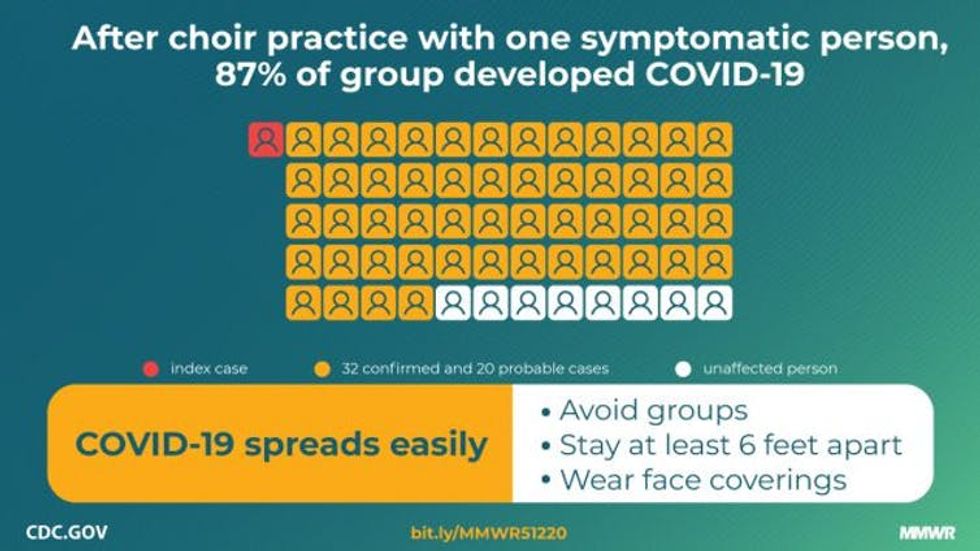
From a public health perspective, restricting in-person religious gatherings makes sense. COVID-19 is most easily spread as an aerosol, such as when people are talking or singing. The risk of spread is also higher in closed spaces when in close proximity to someone infected and increases the longer you are near them.
Defiant churches tried different tactics to remain open. Some simply ignored the restrictions and continued to hold services. And California isn’t the only state to see state rules challenged in court. Kansas, Kentucky, Mississippi, New Mexico, Texas and Virginia have all seen similar legal action.
In many cases, the organizations fighting restrictions have cited the First Amendment and argued that it is unconstitutional to restrict church gatherings, especially when other secular so-called “essential” or “life-sustaining” entities – such as grocery stores, liquor stores and laundromats – are allowed to stay open. This line of argument was echoed in the Supreme Court decision’s dissenting opinion written by Justice Brent Kavanaugh in the Supreme Court case.
The Supreme Court, looking at the latest version of California’s restrictions – which limits churches to 25% capacity, or a maximum of 100 attendees – declined to second guess the state’s elected officials in their assessment of the best way to protect the public’s health. In his concurring opinion, Chief Justice John Roberts, the pivotal vote in the church case, seemed swayed by how officials endeavored to follow the science during a time “fraught with medical and scientific uncertainties.” He noted that religious services were more like social gatherings than “grocery stores, banks, and laundromats, in which people neither congregate in large groups nor remain in close proximity for extended periods.”
But should infection numbers spike in the near future, state officials have the knowledge that a majority on the Supreme Court – for now at least – appear willing to follow the science and support their good-faith efforts to manage public health emergencies.
[The Conversation’s newsletter explains what’s going on with the coronavirus pandemic. Subscribe now.]
According to a report from the Daily Beast, officials at the Centers for Disease Control (CDC) believe that a "statistically significant" increase in pneumonia-related deaths in Florida may be related to the COVID-19 virus.
With Florida being one of the first states to re-open after most of the country went into an almost complete shutdown due to the coronavirus pandemic, reports of deaths in the state have been under more scrutiny than usual as health experts attempt to get their arms around the health crisis.
The report from the Beast's Erin Banco states, "According to the data from the CDC’s National Center for Health Statistics, since the beginning of the year there has been a total of 1,519 deaths in Florida where pneumonia and influenza were listed as the underlying cause. By comparison, in the same time period last year, Florida recorded 1,207 such deaths. The CDC has historically counted pneumonia and influenza deaths together. CDC officials told The Daily Beast that most of the deaths included in that category are pneumonia. "
According to Bob Anderson, the chief of the Mortality Statistics Branch in CDC’s National Center for Health Statistics, that increase is "statistically significant" and the death total was likely tied to COVID-19.
"The increase has sparked a conspiracy theory on the left, that Florida is deliberately trying to undercount coronavirus fatalities by labeling them as something else. There’s no evidence to suggest any such underhand efforts, or that the state is unique across the country," Banco wrote but cautioned, "But officials, including Anderson, do believe that a portion of the pneumonia and influenza deaths in Florida involved patients who were infected with, but never tested for, COVID-19. In such scenarios, though the virus likely contributed to the death, it may not have been recorded as the cause of death by the physician, coroner or medical examiner."
According to Anderson, "We’re definitely experiencing an underreporting issue nationwide. [In Florida] most likely what we’re seeing are folks dying without having been tested and the best evidence that the doctors or whoever is filling out the death certificate had pointed to the person dying of pneumonia.”
Anderson went on to note that reported "pneumonia and influenza deaths for 2020 are lower than reality because the death certificate reporting system lags by several weeks, especially in states that do not have digitized systems to process the papers."
On Tuesday, writing for Slate, legal reporter Mark Joseph Stern walked through the legal mess the Florida GOP created when they tried to roll back the voter-approved abolition of felony disenfranchisement with a law requiring rehabilitated convicts pay back all fines and fees before voting — and how it led to a rebuke from a federal judge.
"The first thing you need to understand about Florida’s poll tax — which U.S. District Judge Robert Hinkle sharply limited on Sunday — is that the state has no idea how to implement it," wrote Stern. "Setting aside the racial and democratic implications, the law sounds straightforward: It obligates former felons to pay all fines and fees associated with their sentence before they can cast a ballot. The scheme might function properly if Florida could identify residents with unpaid court charges and calculate how much they owe. But the state cannot do any of that, because it does not know who owes courts money or how much they owe. And even if ex-felons try to unearth their court-imposed fines and fees, they will probably fail. In most cases, reliable records do not exist."
"This chaos gives people with felony convictions two choices," wrote Stern. "They can register to vote and hope that state prosecutors do not later dig up court debts and bring criminal charges against them. Or, to avoid risking jail time, they can surrender their constitutional right to vote. On Sunday, in a 125-page decision, Hinkle ruled this predicament unconstitutional. In doing so, he meticulously detailed the extraordinary negligence and incompetence exhibited by Florida lawmakers as they rushed to stop ex-felons from voting."
"Remember that Florida is a pioneer in cash register justice: It literally funds its criminal justice system through a mind-boggling array of fines and fees imposed on everyone unfortunate enough to get arrested in the state," wrote Stern. "The nickel-and-diming spirals as you move through the system. You must pay to get a public defender. You must pay for medical care behind bars. You must pay to reinstate a suspended driver’s license. You must pay for drug abuse treatment, for electronic monitoring, for your own urinalysis. There is no exception for indigent defendants. And none of it is cheap: As Hinkle noted, one Florida county charges a minimum of $668 for a public defender and $548 if you forgo public defense. Even if you represent yourself, you must pay for the pleasure of appearing in court. And those costs go up when defendants are charged with multiple counts."
"Curiously, although Florida devised this scheme, it never created a uniform method of tracking payments," wrote Stern. "The Legislature left that job to the counties, whose own records are often out of date or incomplete. Some counties hire private debt collectors who add a 40 percent surcharge on unpaid court debt. Most debts still go unpaid. In 2018, the Florida Court Clerks and Comptrollers, an association that attempts to track court assessments, labeled 83 percent of court fines levied between 2014 and 2018 as having “minimal collections expectations.” That means they’ll probably never be paid. The same association reported that counties collect just 20.55 percent of fines and fees levied in circuit criminal courts, where most felony cases take place."
"A state budget analysis found that the division would require at least 21 extra employees" to check whether each voter is eligible, wrote Stern, but "the Legislature provided it with zero. As a result, there is currently a backlog of about 85,000 pending voter registrations from newly eligible Floridians ... [officials have] found no reliable method of determining how much they owe. Virtually every attempt to calculate this figure—by both state officials and expert accountants hired by the defendants—produces inconsistencies and discrepancies. The information does not exist."
Hinkle's order, Stern wrote, requires Florida officials to give any voter who requests it an "advisory opinion" on their eligibility within 21 days, or they are automatically re-enfranchised. A higher court could strike it down if Trump-appointed judges hear the case, but Stern suggests this is unlikely.
"In the process of defending SB 7066, Florida humiliated itself, revealing the extreme incompetence of myriad legislators, election administrators, and county officials," Stern wrote. "It is now painfully clear that would-be voters have no dependable way to figure out what they owe. The state plainly hoped this system would dissuade people from even attempting to vote for fear of criminal prosecution. In passing a poll tax, it also transformed its registration procedures into a Kafkaesque bureaucratic nightmare for 1.4 million Floridians. To reverse Hinkle’s order, a court would have to rationalize that nightmare, to claim that the state has not, in fact, infringed on residents’ constitutional right to vote. That cannot be done in good faith."
"Conservative judges may be eager to rubber-stamp run-of-the-mill voter suppression, but they sometimes shy away from especially egregious disenfranchisement," concluded Stern. "It is hard to see why courts would stick their necks out to defend Florida’s clown show."
Gov. Ron DeSantis (R-FL) said he made a pitch to the White House this week for the Republican National Convention to be moved from North Carolina to Florida.
DeSantis revealed on Tuesday that he had spoken to White House officials about moving the convention after President Donald Trumpthreatened to pull the event from Charlotte unless Democratic Gov. Roy Cooper agreed to allow people to "fully occupy" the arena.
While speaking to reporters, the Florida governor insisted that Trump would follow public health guidelines if the event was moved to his state.
"Florida would love to have the RNC," DeSantis said. "Heck, I'm a Republican. It would be good for us to have the RNC in terms of the economic impact when you talk about major events like that."
"We should try to get it done as best we can in accordance with whatever safety requirements," he added. "You know, [Trump's] government will be talking about the safety restrictions of the president's government."
DeSantis continued: "Obviously he's going to want to abide by whatever they're saying. So we can get that done. We can do it in a way that's safe. That would be a huge economic impact."
The governor, however, did not commit to allowing Republicans to "fully occupy" the convention space as Trump has called for.
Writing in the Washington Post this Tuesday, Phillip Bump tackles President Trump's comments disparaging mail-in voting, saying that recent developments in Florida expose the reasoning for attacking the system.
"You may recall that, in the days following the 2018 midterm elections, there was some uncertainty in the results in Florida's gubernatorial and Senate races," Bump writes. "While Democrats nationally won clear victories in a number of closely contested House races, Florida looked different, with then-Gov. Rick Scott (R) appearing to win a close Senate race and then-Rep. Ron DeSantis (R) narrowly winning the race to replace Scott. As more votes came in, though, both Scott's and DeSantis's leads narrowed."
Scott made accusations of voter fraud without evidence, and Trump immediately joined in. Scott won, but no evidence of fraud was ever uncovered.
Trump has made similar evidence-free claims elsewhere, and they are often "vague, if not laughable."
"He has repeatedly claimed that people will go vote, leave, change clothes and then go vote again — something for which there is simply no evidence," Bump writes.
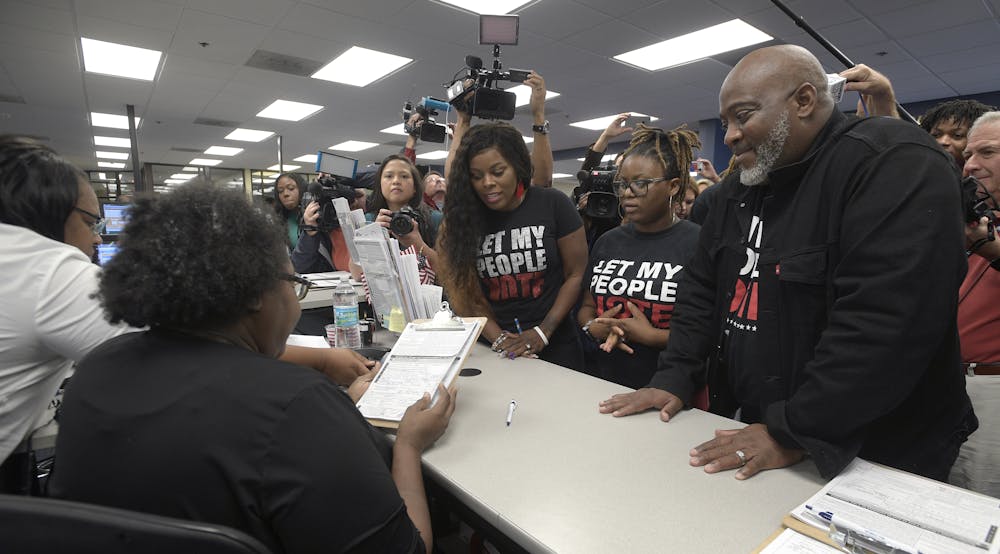
Advocates for restoring the voting rights of people with past convictions welcomed the ruling as "a powerful reminder that no one can trump the U.S. Constitution."
Civil liberties advocates celebrated after a federal court on Sunday struck down as unconstitutional a Florida law that would have denied the right to vote to nearly a million recently enfranchised state residents with past felony convictions until they paid all outstanding legal fees, fines, and restitution.
After Florida voters in November 2018 overwhelming backed Amendment 4—a ballot initiative that restored the voting rights of Floridians who have fully completed their sentences for felony convictions other than murder or sex crimes—state lawmakers passed legislation that critics condemned as a "modern day poll tax."
U.S. District Court Judge Robert L. Hinkle of Tallahassee concluded (pdf) Sunday that making voting rights contingent on payment for criminal justice services that a state must or chooses to provide represented "a tax by any other name" and violated the U.S. Constitution's 24th Amendment and the National Voter Registration Act.
Leah C. Aden of the NAACP Legal Defense and Educational Fund called the ruling "a monumental win for our democracy" while Julie Ebenstein, senior staff attorney with ACLU's Voting Rights Project, said it was "a tremendous victory for voting rights" that could enable hundreds of thousands of Floridians to participate upcoming elections.
Sean Morales-Doyle, senior counsel at the Brennan Center for Justice at New York University Law, said in a statement that this "historic win" in court "opens the way for hundreds of thousands of Floridians to exercise their fundamental right to vote this November—and our democracy will be stronger for their participation."
Although the state is expected to appeal Hinkle's decision—meaning participation in the upcoming November elections remains uncertain for many—the New York Timesnoted that "much of Sunday's ruling is built on a previous ruling by the United States Court of Appeals for the 11th Circuit in Atlanta, which would hear any appeal."
Critics of SB7066 vowed to keep up the legal battle as long as is necessary. The case was brought by the national ACLU, the ACLU of Florida, the Brennan Center, the NAACP Legal Defense and Educational Fund, the Campaign Legal Center, the Southern Poverty Law Center, and the legal firm Paul, Weiss, Rifkind, Wharton & Garrison LLP.
ACLU of Florida legal director Daniel Tilley said that "our democracy requires that every eligible voter have equitable access to the ballot box. Instead of embracing this founding principle, the Florida Legislature and Gov. DeSantis enacted a modern-day poll tax to keep people from accessing this fundamental right."
"It should alarm Floridians that there are people occupying the highest echelons of political power in our state who fought to keep Florida tied to its racist past and bar people from voting," Tilley added. "While the state is likely to appeal this decision, we're ready to take this fight all the way to the U.S. Supreme Court."
Tilley and Aden acknowledged the bravery of their clients who participated in the case and spoke out against the law, which they denounced as discriminatory.
"While we're disappointed that the court did not recognize that the legislature's decision to adopt SB7066 was partially motivated by a desire to minimize the political power of black returning citizens, we nonetheless celebrate this important win alongside our brave clients like Raquel Wright, Curtis Bryant, Jr., LaToya Moreland, and the Florida State and Orange County NAACP," said Aden. "Through their compelling testimony and dedicated engagement, they fearlessly stood up against Florida's attempt to put a price tag on voting."
The Florida Rights Restoration Coalition (FRRC), a grassroots group run by formerly convicted persons that helped lead the ultimately successful effort to pass Amendment 4, also welcomed Hinkle's decision in a statement (pdf) Sunday and promised to continue fighting for enfranchising Floridians.
"This court decision adds another remarkable chapter in our fight as returning citizens to participate in our democracy," said FRRC executive director Desmond Meade. "We will remain vigilant in our commitment to place people over politics, and ensure that all returning citizens, no matter how they may vote, have an opportunity to possess what we believe to be the most endearing sign of citizenship, the right to vote."
"As the leaders of Amendment 4," Meade added, "we are looking forward to utilizing this court ruling to expand on our registration efforts to create a more inclusive democracy, make voting exciting again, and to coalesce the voices of returning citizens to create a more just and equitable justice system."
MIAMI — By the time Gov. Ron DeSantis issued a stay-at-home order warning Floridians of the danger posed by the rapidly spreading coronavirus, 188 people already had died — considerably more than the 85 fatalities the state acknowledged at the time.Most of those who died from a coronavirus infection in March were elders, though the fatalities also included a 28-year-old woman who died at Sarasota Memorial Hospital, and a 34-year-old Broward County man whose “flu-like symptoms” developed into pneumonia. A 39-year-old traveling disc jockey who had recently visited Miami died of the disease on Ma...
ORLANDO, Fla. — Florida tourism leaders called for a quicker reopening and more government help in a roundtable with Vice President Mike Pence and Gov. Ron DeSantis in Orlando on Wednesday, with SeaWorld’s CEO saying the park might reopen as soon as June.At the same time, DeSantis urged theme park companies to open up their water parks.The meeting came as Universal Orlando said it would be the first major theme park to present reopening plans Thursday to Orange County Mayor Jerry Demings’ Economic Recovery Task Force, paving the way for that resort to reopen.Marc Swanson, interim CEO of SeaWor...
On Wednesday, The Daily Beast reported that new data under analysis by the White House coronavirus task force show several Southern counties that are no longer under stay-at-home orders are at risk for an explosion of new COVID-19 cases.
"The study, which was put together by PolicyLab at Children’s Hospital of Philadelphia, is part of a data set being reviewed by top coronavirus task force officials and people working with the team, The Daily Beast reported earlier this month," wrote national security reporter Erin Blanco. "A previous model by the PolicyLab predicted that if officials moved too quickly and too aggressively to reopen in mid-May, individual counties could witness hundreds, if not a thousand-plus, more coronavirus cases reported each day by August 1."
"The new model shows that in southern counties, particularly in Texas, Florida, Alabama, and Virginia, the risk for resurgence is high over the next four weeks," continued the report. "These states have moved to reopen, at least partially, since the team published its last model in April."
"The data set now takes into consideration current levels of social distancing rather than projections about what would happen when local communities reopened," said the report. "It also includes data for more than 200 additional counties across the country. The findings indicate that the risk for large second waves of outbreaks remains low if communities continue to implement cautious, incremental plans to reopening that limit crowding and travel to non-essential businesses. Doctors working on the study said that without vigilance in masking, hygiene, and disinfection, certain southern counties will remain high risk."
Two large counties particularly at risk include Miami-Dade county in Florida, where Gov. Ron DeSantis has reopened gyms, salons, and theme parks and is moving to open retail stores, and Dallas County in Texas, where stay-at-home orders have been similarly relaxed by Gov. Greg Abbott.
MIAMI — Three months ago, Floridians were celebrating Valentine’s Day unaware that the novel coronavirus posed any real threat to their lives, or that it was likely already spreading through the state. No one had told them to be worried.While the public was kept in the dark, top Florida health officials were scrambling to come up with a plan for a crisis they knew was upon them, according to internal Florida Department of Health data and communications obtained by the Miami Herald.The records show that on Feb. 13 DOH assembled an emergency response team. The team’s mission: “Contain the spread...
On Tuesday, Gov. Ron DeSantis (R-FL) refused to address his comments blaming the unemployed for their inability to navigate Florida’s broken social services, leaving the question to one of his officials.
As DeSantis was leaving a press conference, a reporter asked him if he still thought the applicants were to blame.
“The governor is a Yale lawyer, I thought he could answer his own questions,” said Politico journalist Gary Fineout after the governor refused to answer and walked off.
Critics say that Florida has one of the most dysfunctional unemployment benefits systems in the United States, and it is causing major problems as the coronavirus pandemic puts hundreds of thousands out of work. There is evidence that some Republican lawmakers, as well as DeSantis’ predecessor Rick Scott, deliberately made the system prohibitively difficult to navigate to ensure unemployment rolls stayed low.
DeSantis has pledged to fix the problem. However, he recently caused outrage by blaming the problems on the people applying, saying they are just making too many errors while signing up.