Rudy Giuliani has invented a new excuse for why he shouldn't be forced to testify under oath before Congress -- and it is not holding up under scrutiny from legal experts.
In an interview with Politico, Giuliani claimed that testifying about his work in trying to get the Ukrainian government to dig up dirt on former Vice President Joe Biden would violate the attorney-client privilege he shares with President Donald Trump.
But former federal prosecutor Renato Mariotti argues that congressional investigators wouldn't have to ask him about conversations he'd had with the president in order to get more information about Giuliani's activities.
"There is no attorney-client privilege between Giuliani and Ukrainians, or between Giuliani and State Department officials," Mariotti writes. "On its face, this comment is absurd."
Ken White, who like Mariotti is also a former federal prosecutor, had a similar take and jokingly asked, "But what if Rudy is voluntary pro bono counsel to all Ukrainians."
Giuliani is a central figure in the investigation of President Donald Trump's efforts to push the Ukrainian government to launch an investigation into potential 2020 rival Joe Biden. Giuliani's words and actions so far have not only implicated the president in this scheme, but also State Department officials who apparently helped him set up meetings with Ukrainian officials.
ProPublica is a Pulitzer Prize-winning investigative newsroom. Sign up for The Big Story newsletter to receive stories like this one in your inbox.
Rudy Giuliani received a subpoena this week from House Democrats as part of their impeachment inquiry. He wasn’t happy about it. In a tweet on Monday, Giuliani, the president’s personal lawyer, accused the Democratic committee chairs of having “prejudged this case.” He asserted that the subpoena, which seeks “all documents and communications” about Giuliani’s repeated forays into the world of Ukrainian law enforcement and politics, raises “constitutional and legal issues” including “attorney client and other privileges.”
At first blush, it’s a reasonable position. The attorney-client privilege shields confidential communications between a lawyer and his client so long as they pertain to seeking or providing legal advice. Giuliani is an attorney; the president is his client. With a number of exceptions, lawyers do not have to reveal anything about conversations with their clients.
Yet legal experts say Giuliani’s apparent hopes of invoking the privilege to avoid providing documents or testifying may be undercut by his own words — specifically, his habit of announcing in public that he is operating in a nonlegal capacity in his international trips. Those trips are of significant interest to congressional investigators. Communications between President Donald Trump and his lawyer aren’t privileged if their substance falls outside the attorney-client relationship.
Take a recent conversation Giuliani had with a reporter for The Atlantic about his attempts to enlist officials in Kyiv, the Ukrainian capital, to investigate matters that could benefit the president politically. “I’m not acting as a lawyer,” he told the reporter. “I’m acting as someone who has devoted most of his life to straightening out government.”
Giuliani also took pains to say he wasn’t acting as the president’s lawyer when he attended a Kremlin-backed conference in Armenia last October. As ProPublica and WNYC reported, he spoke about cybersecurity and was slated to appear on a panel alongside two advisers to Russian President Vladimir Putin, one of whom was on a U.S. sanctions list. When local reporters caught up with Giuliani, he told them: “I’m not here in my capacity as a private lawyer for President Trump. I’m here as a private citizen.”
At other moments, Giuliani has described himself as Trump’s attorney. For example, he told The New York Times earlier this year that his work in Ukraine was for the benefit of his client, Trump. In that article, Giuliani said he hoped an investigation in Ukraine would turn up information that “will be very, very helpful to my client, and may turn out to be helpful to my government.” (That interview also included a memorable Giuliani comment: “We’re not meddling in an election, we’re meddling in an investigation, which we have a right to do.”)
An assertion of attorney-client privilege generally requires evidence that the lawyer in question was representing the client on the relevant matter. “That is a threshold and essential criterion to even be able to invoke the privilege,” said Stephen Gillers, a legal ethics expert at New York University School of Law. “Is Giuliani acting as a lawyer for the president, giving legal advice and counsel? If that’s not true, then nothing is privileged.”
Neither Giuliani nor his newly retained lawyer, Jon Sale, immediately returned a request for comment.
Over the past year, Giuliani has gone to great lengths to persuade Ukrainian officials to examine two matters on which the president has fixated. The first is a perplexing conspiracy theory that blames Ukraine, rather than Russia, for the hacking of Democratic Party campaign emails during the 2016 election. The other involves questions — but little in the way of facts — about whether Trump’s potential rival in next year’s election, Joe Biden, used his office as vice president to stymie an investigation into a Ukrainian energy company on whose board of directors his son Hunter served. Neither the conspiracy theory nor the Biden-related postulating has been supported by any independent, credible investigations.
A whistleblower complaint filed in August with the inspector general for the intelligence community has raised concerns that Trump abused his office by pushing Ukraine’s president, Volodymyr Zelensky, on a July 25 call, to speak with Giuliani and to pursue the investigations he’s been hawking. White House officials, the whistleblower alleges, then took steps to limit access to records of the call, which Democrats say is evidence of a cover-up. The complaint sparked the ongoing House impeachment inquiry.
Trump and his allies have insisted there was nothing improper about the July 25 call, and Zelensky recently told reporters he did not feel he was being pressured.
Should Giuliani invoke attorney-client privilege and refuse to comply with the subpoena he tweeted about Monday — or to testify before House committees, if subpoenaed to do so — he will almost certainly put his fate in the hands of the courts. The next move for House Democrats, assuming they disagree with Giuliani’s position, would likely be to vote to hold Giuliani in contempt of Congress and then file a lawsuit asking a federal judge to order him to comply with the subpoena. Penalties for failing to comply with a court order include fines and even, in extreme cases, jail time.
Giuliani’s assertion that he wasn’t acting as a lawyer when he lobbied Ukraine will make it harder for him and his client to invoke the attorney-client privilege successfully. It would serve as evidence that conversations or written communications about the lobbying campaign fall outside the attorney-client relationship.
“It doesn’t make things easier” for Giuliani and Trump, said Ronald Minkoff, a partner at the law firm Frankfurt Kurnit Klein & Selz and an expert on attorney ethics. “The client has to establish that the privilege applies. It’s not assumed that the privilege applies.”
A different threat to an attempt to invoke attorney-client privilege could also arise. Congress has taken the position that the separation of powers does not require it to honor the privilege, which is a doctrine created by the judiciary. That stance is as yet untested in court, and in practice, Congress has tended to honor lawyer-client protections.
The attorney-client privilege, moreover, is likely to pertain to only a small number of communications congressional investigators are interested in. Conversations or written communications with people other than Trump or that were disclosed to other people — even discussions with the president that were held in the presence of other U.S. officials — will likely not be privileged. Trump may, however, try to resort to other privileges to keep information from House Democrats, like the executive privilege. In response to recent congressional investigations, White House lawyers have taken an uncommonly broad — and legally uncertain — view of that privilege.
But Giuliani has more on the line than many Trump administration officials who have flouted congressional subpoenas in recent months.
“Giuliani, as a lawyer, may find it hard to ignore a subpoena, on the grounds that he’s a lawyer,” Gillers, the NYU law professor, said. As a member of the New York bar, he is subject to its rules, and “he wouldn’t want to get into trouble with the disciplinary committee.”
Appearing on MSNBC's "Morning Joe," Evelyn Farkas, a friend of former Ukraine envoy Kurt Volker, said that Rudy Giuliani is being suckered by pro-Kremlin Ukrainians with "garbage" information which he is then passing on to President Donald Trump.
Speaking with fill-in host Willie Geist, the former Deputy Assistant Secretary of Defense for Russia/Ukraine/Eurasia under President Barack Obama was asked about Volker's upcoming testimony before three Democratic-controlled House committees on Thursday and what lawmakers can expect to hear.
According to Farkas, Volker stepped down from his position in the Trump administration so he could speak freely without interference from the White House and could be counted on to not hold back.
While discussing his links to Rudy Giuliani -- who included Volker in some of his texts -- Farkas took a shot at the former New York mayor for pushing fake information because he is being played by some of his Ukraine contacts who may be Kremlin agents.
"We should be very concerned," Farkas explained. "That's the bigger picture here. The Russian government is still trying to weaken our democracy and they are loving this. They are benefiting first and foremost from the smear on Ukraine, which in part probably came from them."
"I mean, someone's feeding Rudy Giuliani a lot of this garbage information. and I believe those people are close to the Kremlin even if they're Ukrainian," she added. "So the Kremlin is benefitting from that, and then, of course, they're also benefiting even from this impeachment because it's creating a mess in our democracy. We can expect them to continue to use whatever disinformation they can to try to spy on us and take the information out of campaigns and put it out in the public -- all the dirty tricks have not stopped."
A "Fox & Friends" host paused awkwardly before shooting down his colleague's prediction about a former envoy's upcoming congressional testimony.
Kurt Volker, a former special envoy to Ukraine during the period when President Donald Trump pressed the country's president to help his campaign against Joe Biden, will testify before lawmakers Thursday in closed-door hearings.
"Today Kurt Volker goes up, he's the [former] envoy to the Ukraine," co-host Brian Kilmeade told viewers.
Co-host Steve Doocy quickly predicted what Volker would say.
"He's going to say he was pressured out," Doocy said, smiling cheerfully. "Out of the administration."
Kilmeade stammered and paused for three seconds before slapping down Doocy's guess.
"Uh," he said. "I'm not sure. He left immediately, right away, after his text messages came out with Rudy Giuliani."
On Thursday, The Daily Beast reported that President Donald Trump's lawyer Rudy Giuliani has repeatedly turned to a questionable source to try to get dirt on Ukraine: Trump's imprisoned former campaign chairman, Paul Manafort.
Giuliani has reportedly communicated with Manafort several times over the last few months, in an attempt to gather evidence that Ukraine was trying to tip the scales for Hillary Clinton and the Democratic National Committee in the 2016 presidential election — much the same way that the Kremlin was working to assist Trump. This theory has been banging around the GOP for a while, although there is zero evidence Democratic officials did anything improper.
Manafort has had financial ties to Ukrainian oligarchs for years, which ultimately led to his conviction and imprisonment for bank fraud and tax evasion.
The communications with Manafort appear to be yet another aspect of Giuliani's efforts to weaponize Ukraine against the 2020 election — efforts which ultimately led to Trump pressuring Ukrainian President Volodymyr Zelensky to help him find dirt on former Vice President Joe Biden.
Politico's Jake Sherman senses a shift in how President Donald Trump is covered by the media and defended by Republicans.
The website's senior writer and co-author of its Playbook newsletter appeared Thursday on MSNBC's "Morning Joe," where he said Trump's well-worn strategies for weathering scandals aren't working now that he's facing impeachment.
"The president's strategy here is a little bit worn out, according to all the Republicans we talk to," Sherman said. "He's trying to employ the same tool he's used for the last two years, and it's not been successful because he's dealing with a entirely new set of facts. An impeachment inquiry that is obviously extremely legitimate -- Congress has the right do this."
"We've heard him talk about the media like this before," Sherman added. "We've heard him call people crooked, we know he doesn't like Democrats. We know all of these things and, frankly, it's not having much effect because we've heard it now for two years."
Sherman pointed to a remarkable exchange between an angry Trump and a calmly persistent Jeff Mason, a reporter for Reuters who repeatedly pressed the president to explain what he wanted the Ukrainian president to do for him regarding Joe Biden.
"Reporters are standing up to the president and not cowering down when he bullies them, not that any reporter has before," Sherman said. "But it's important to keep that in mind. So these tricks that he's employed for two years are not terribly successful.
Sherman said the White House's chaotic response to the impeachment inquiry, and the swift pace of bombshell revelations that blow up the news cycle on a sometimes hourly basis have spooked congressional Republicans.
"You hear all around Washington the last couple weeks Republicans are very concerned that this White House has no strategy," he said. "Why does it have no strategy? Two important things to keep in mind. No. 1, he has no surrogates that are willing to go on television to defend him. Why is that? Because they don't know where the bottom is, they don't know the entirety of the story, because the president has not been forthright."
"People like Rudy Giuliani when they go on TV are roundly dismissed as a laughingstock because their behavior is so bizarre," Sherman added. "Lawmakers won't go on TV because they don't want to stand up for the president at this moment when they don't know everything."
The White House isn't set up to handle impeachment, he said, and it shows.
"He (has) a White House press operation that is not only not standard, it's not operational," Sherman said. "We don't have a White House press secretary that's operational in the sense that they're not briefing and doing anything proactive to change the narrative of this story or combat it."
"It's just incredibly bizarre to see all this lineup of circumstances that the White House is unwilling or unable to change," he added, "and that, in the face of an impeachment inquiry that's getting more and more serious, Democrats are saying that stonewalling is going to have consequences in that it could be evidence for obstruction, and the president has no strategy to handle this that we see in the public view."
Whatever Donald Trump does, Richard Nixon usually did it first and better.
Nixon got a foreign government’s help to win a presidential election over 50 years ago. Trump’s imitation of the master has proven far from perfect, and that may cost him the presidency.
Trump’s first mistake was soliciting foreign interference personally. As a result, he cannot deny that he urged Ukraine’s president to investigate Joe Biden. The proof is in his own White House’s record of their telephone call.
When Nixon solicited foreign interference on behalf of his presidential campaign, he was careful to use a cutout, a go-between whose clandestine activities could, if exposed, be plausibly denied. Anna Chennault, a conservative activist and Republican fundraiser, acted as Nixon’s secret back channel to the government of South Vietnam.
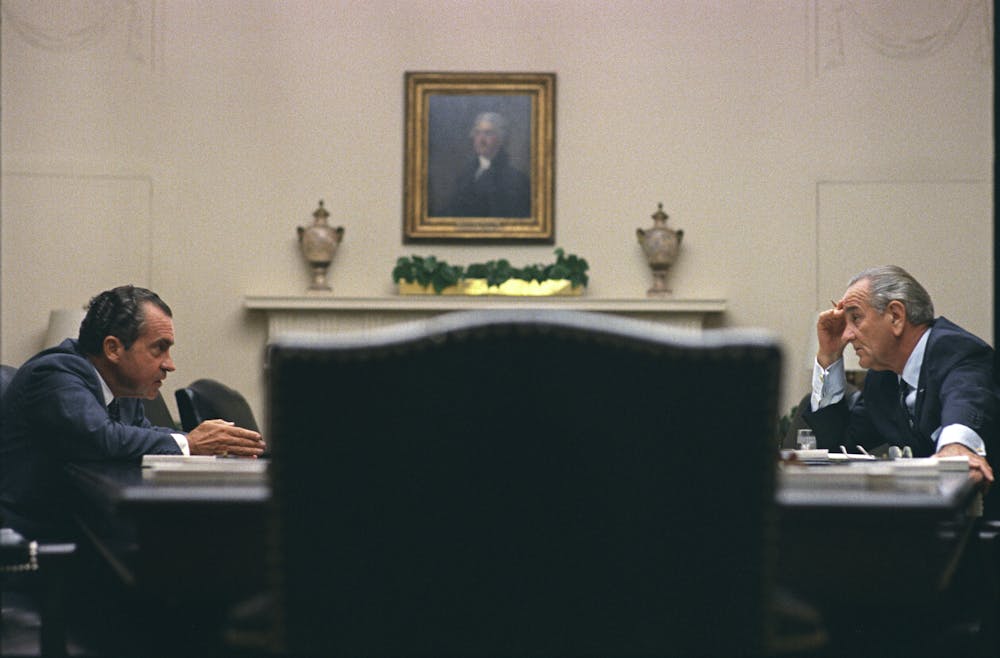
Nixon’s illegal interference with Vietnam peace talks helped win him the election. Here, he meets with President Lyndon Johnson in July 1968.
Nixon’s great hope was to hang Vietnam like an albatross on Democratic presidential nominee Hubert Humphrey, the sitting vice president. Nixon’s great fear was that President Lyndon Johnson would start peace talks before Election Day, boosting Humphrey’s campaign along with hopes for an end to the war.
On the eve of the 1968 presidential election, President Johnson asked his three top advisers on the Vietnam War – Secretary of State Dean Rusk, National Security Adviser Walt Rostow and Secretary of Defense Clark Clifford – if he should expose Republican interference with his efforts to start begin peace talks.
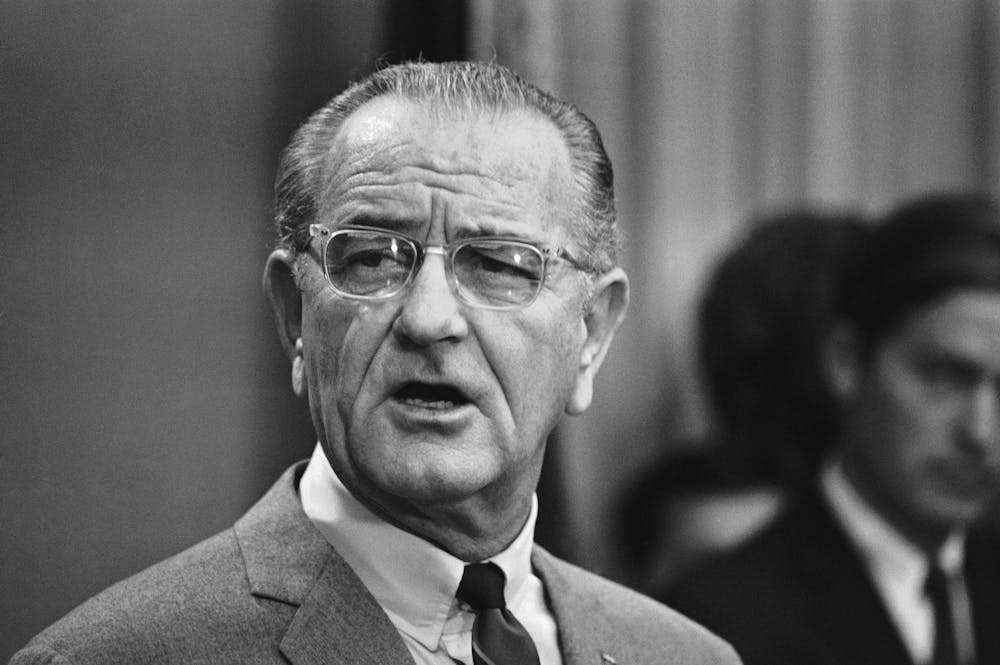
President Johnson discusses with three top advisers whether to expose Republican interference in the Vietnam peace process. They all advised the president not to do so.
False counter-accusations
It’s too late for Trump to use a cutout with Ukraine, but in other ways his actions mirror Nixon’s.
One recurring Nixonian tactic was to falsely claim the Democrats did things that were just as bad as the things he actually did. For example, Republicans charged that Johnson played politics with the war by announcing peace talks right before Election Day.
The diplomatic record proves otherwise. Johnson set three conditions for the peace talks months earlier. He offered to halt the bombing of North Vietnam if Hanoi: (1) respected the demilitarized zone dividing North and South Vietnam, (2) accepted South Vietnamese participation in peace talks, and (3) stopped shelling Southern cities.
Hanoi, however, insisted on an unconditional bombing halt. Johnson refused to budge. So did the North Vietnamese – until October 1968, when they accepted all three of Johnson’s conditions. The timing of the peace talks was their choice, not his. The partisan accusation was false.
Likewise, Republicans’ often-repeated, never-substantiated conspiracy theory that one or more Bidens did something corrupt involving Ukraine is the oppositeoftrue. But it does shift the spotlight off Republicans and onto Democrats. And it fosters the false sense that “both sides do it” when only one side did.
Another of Nixon’s favorite tactics was to suggest there was something shady about detecting his crimes. Just as Trump baselessly claims that the Ukraine whistleblower got information about him “illegally,” Republicans like William Safire baselessly claimed that LBJ “abused the power of our intelligence agencies” to get dirt on Nixon.
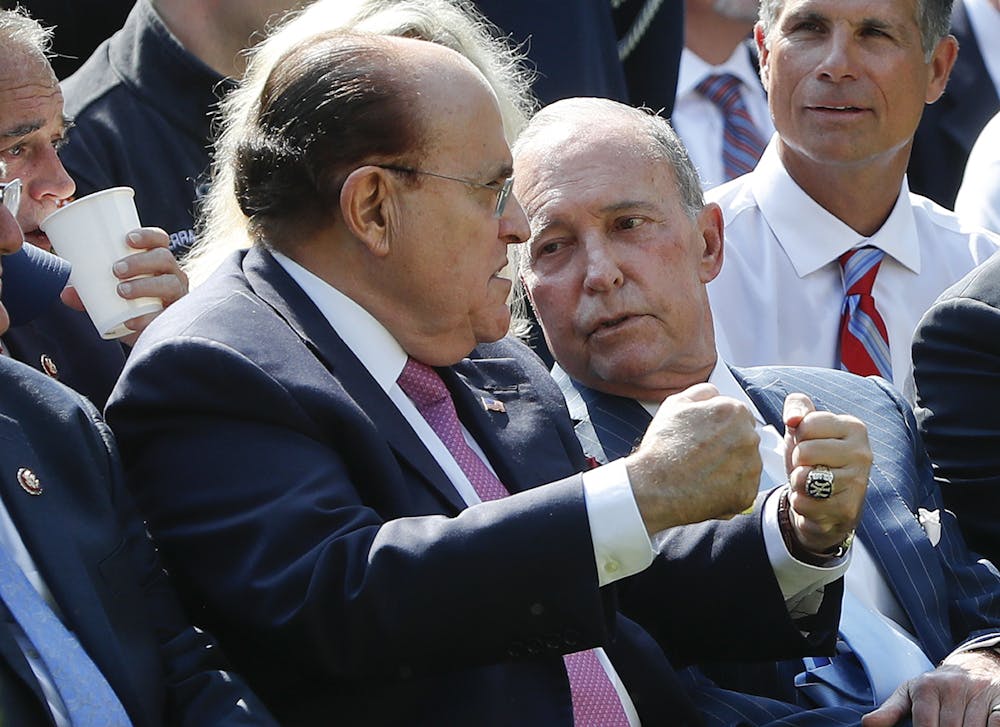
Rudy Giuliani, left, was President Trump’s unofficial emissary to Ukrainian leaders, whom he wanted to dig up dirt on the Biden family.
The records of the CIA, NSA and FBI prove otherwise. Like presidents before and since, Johnson used the CIA and NSA to collect diplomatic intelligence. To provide him with Saigon’s true, private position on the peace talks, the CIA bugged the office of South Vietnamese president Nguyen Van Thieu and the NSA intercepted cables to Thieu from the South Vietnamese embassy in Washington, D.C.
Johnson did learn something about Chennault’s activities from this surveillance, but only because diplomatic intelligence is supposed to uncover attempts to thwart presidential diplomacy.
Based on what he learned, Johnson ordered the FBI to tail Chennault and tap the South Vietnamese embassy’s phone. Mere days later, the FBI wiretap overheard Chennault telling the South Vietnamese on behalf of “her boss (not further identified)” to “hold on, we are gonna win.”
Here was evidence that the Nixon campaign was violating the Logan Act – which forbids private U.S. citizens from conducting “any correspondence or intercourse with any foreign government” – by undermining the president’s diplomatic efforts to end a war that was killing hundreds of Americans every week.
In other words, Johnson used the FBI to uncover a crime that was also a threat to national security.
Clearly, there’s one thing that can overcome Nixonian tactics: evidence. For this reason, House impeachment investigators will likely subpoena as much as they can, and President Trump will likely withhold as much as he can.
Withholding evidence is yet another Nixonian tactic, one called “stonewalling.” It was the basis of the final article of impeachment against him.
Ukraine's former president categorically denied that Joe Biden had ever asked him to open or close any criminal cases, effectively knocking down President Donald Trump's conspiracy theory about the former vice president.
Petro Poroshenko, who served as the nation's president from 2014 until earlier this year, joined a growing list of Ukrainian officials who said they never saw Biden take any improper actions involving his son's business work there, reported Bloomberg.
“The former vice president, at least in personal conversations, didn’t raise any requests to open or close any concrete cases,” Poroshenko told Bloomberg in a statement.
Poroshenko made similar comments in recent days to CNN and the Los Angeles Times.
Trump and his personal lawyer Rudy Giuliani have claimed, without any evidence, that Biden abused his government position in 2016 to push out Ukraine's prosecutor general to stop an investigation of a natural gas company where his son Hunter Biden sat on the board.
Poroshenko and other Ukrainian officials have said that simply isn't true.
The former Ukrainian president said Viktor Shokin resigned as prosecutor general three years ago after "massive campaigns" by activists, more than two-thirds of parliament and Ukrainian media seeking his ouster.
Poroshenko said he accepted the resignation to "restore public confidence and trust" in the country's law enforcement.
He also denied that Ukraine had interfered in the 2016 U.S. election, as Trump has claimed, and said the country had always sought support from both American political parties in its territorial dispute with Russia.
“It’s very important to secure such support at this moment,” Poroshenko told Bloomberg. “It should not be harmed as the result of internal processes in the U.S. and should not depend on the outcome of the U.S. presidential election.”
According to reports from both CNN and the Washington Examiner, former Ukraine envoy Kurt Volker is expected to be very forthcoming when he sits down behind closed doors with three congressional committees on Thursday, with the Examiner reporting he is "not willing to take the fall" for any malfeasance committed by the president or his attorney, Rudy Giuliani.
As CNN reports, Volker is a "longtime Republican foreign policy expert who was seen in the White House as not fully 'on the Trump train,'" adding, "Volker is now at the center of the impeachment inquiry examining allegations Trump deployed the machinery of state in a vendetta to target political rivals. Volker's testimony, analysts say, could be damaging to the President and his allies."
What should be worrying the White House are reports that Volker will not run interference for Trump or Giuliani.
The Examiner reports that Evelyn Farkas, a friend of Volker, who worked as deputy assistant secretary of defense for three years under Barack Obama said “He's not going to take a fall needlessly for people if it's not warranted.”
"He likely got involved in something sort of inadvertently, meaning he was asked to do one thing and it may have become bigger. But, he certainly would never have condoned anything that would subvert American democracy, or Ukrainian democracy, for that matter," Farkas added.
According to another associate, Frances Fragos Townsend, a trustee at the McCain Institute, where Volker works as executive director, "It's fair to say [Volker] resigned his position as envoy so he could assure that he could defend himself and cooperate with the committee."
Volker is now set to testify before the Intelligence, Oversight and Reform and Foreign Affairs committees behind closed doors.
MSNBC contributor Jonathan Lemire revealed that President Donald Trump had revealed his private rage during a public meeting with the Finnish president.
Lemire, the White House correspondent for the Associated Press, told MSNBC's "Morning Joe" that the public saw a side of the president that Trump aides had seen ever since House Democrats launched a formal impeachment inquiry last week.
"What you saw yesterday was a president alone," Lemire said. "This is someone who has no formal war room, he has very few Republicans willing to go on television and defend him. He has an invisible press secretary, and there's an extraordinary amount of pressure building on him day and day as a recognition of what a lethal threat this story is, and impeachment is."
"Basically, what we saw yesterday was how he's acted in private for the last week," Lemire continued. "Angry at his staff, angry at aides and angry at anyone he can talk to, and that rage burst into the public yesterday."
"Some of that steam, of course, he's been letting off on Twitter all along," he added, "but what we saw in those two events, first in the Oval Office and then in that surreal press conference next to the poor president of Finland, was his pure rage at the predicament he's in, because at the moment he doesn't see any way out."
Trump's thinning staff feels like this scandal is different from others the White House has weathered, and they're increasingly frustrated with the president and worried about their own legal exposure, Lemire said.
"That's true," he said. "When this story first broke there was an element of, okay, here's another bad news story, we've had a bunch of these before and we got through those, including the Mueller probe, and it's an anticipation they will again."
"But what they've seen is, this is an administration that is flailing," Lemire continued. "There are very few powerful voices left in the room, very few guardrails, including the acting Chief of Staff Mick Mulvaney who seems not interested at all in trying to rein in the president, has basically given him free reign to do whatever he wants, and there is an anger that the president and Rudy Giuliani and a few other enablers continue to make the situation worse."
"There doesn't seem to be a way out," he added, "and there seems to be growing legal exposure for anyone in the building."
The top Democrat on the Senate Foreign Relations Committee sent letters to Energy Secretary Rick Perry and Vice President Mike Pence questioning their roles in President Trump’s pressure campaign on the Ukrainian government, apparently in search of dirt on Joe Biden.
Sen. Bob Menendez, D-N.J., the committee’s ranking member, sent the letters after the whistleblower whose complaint triggered the House impeachment inquiry cited Pence and Perry’s actions as part of the broader effort to “pressure the Ukrainian leadership.”
The whistleblower wrote that Trump “instructed” Pence to cancel a planned trip to Ukraine to attend new president Volodymyr Zelensky’s inauguration in May. Perry “led the delegation instead” and “made clear” to Ukrainian officials that Trump “did not want to meet” with Zelensky until he “saw how Zelensky ‘chose to act’ in office.”
Menendez cited the whistleblower report and Perry’s meetings with Zelensky, Ukraine's prime minister, and the head of parliament in his letter to Perry.
"President Trump's phone call and the allegations in the whistleblower complaint raise serious questions about the messages that were communicated on behalf of President Trump to the government of Ukraine," Menendez wrote.
Menendez included a list of questions seeking information on who requested Perry to lead the Ukrainian delegation, as well as whether Trump or White House aides asked him to convey Trump’s “desire for assistance in investigating one of his political opponents.”
Perry’s role figures into the House impeachment inquiry as well. House Democrats on Monday issued a subpoena seeking any communications the Energy Department may have had regarding Trump’s discussions with Zelensky, Politico reported.
Rep. Jamie Raskin, D-Md., who sits on both the House Oversight and Judiciary committees, told the outlet that Perry will likely have to testify to Congress about his role.
“His Ukraine-related activities have drawn the interest of members and he almost certainly has relevant testimony to offer,” Raskin said. “He seems to have appeared and reappeared multiple times in the Ukrainian context, so he’s likely to have evidence that Congress would consider material.”
Perry, one of the few Trump cabinet member who has avoided serious scandals so far, has visited Ukraine multiple times as energy secretary and helped craft a deal that increased U.S. coal exports to the country. He tweeted a photo of his most recent meeting with Zelensky last month.
Austin Rivers, head of the watchdog group American Oversight, told Politico that Democrats should bring Perry in for questioning.
“It’s possible there’s nothing here but it’s also possible that Rick Perry participated in, knowingly or unknowingly, a pressure campaign to have Ukraine investigate the president’s domestic political opponents,” he said. “If I were Rick Perry or anyone else in the administration, I’d be very careful about being honest right now.”
Menendez also sent a similar letter to Pence. Pence defended Trump’s move to block military aid to Ukraine days before the call to Zelensky, claiming it was held for review due to “issues of corruption,” The New York Times reported. After meeting with Zelensky in Poland on a trip Trump skipped, Pence told reporters that to invest more U.S. money in Ukraine, “the president wants to be assured that those resources are truly making their way to the kind of investments that will contribute to security and stability in Ukraine.”
Menendez questioned whether Pence was actually in Poland in order to pressure Zelensky to investigate Biden.
"You met with President Zelensky in Warsaw, Poland. When asked by a reporter on that trip whether you could ‘assure Ukraine that the hold-up of that money has absolutely nothing to do with efforts, including by Rudy Giuliani, to try to dig up dirt on the Biden family,’ you did not answer the question,” Menendez wrote. “As the summary of the call with President Zelensky demonstrates, President Trump requested a foreign government help investigate his domestic political opponent. While I hope that he was alone in making such an inappropriate request, your statements regarding your discussions with Ukraine officials raise questions whether you may have helped carry that message.”
If Politico's gossip pages are to be believed, Republican politicians are miffed with Donald Trump right now. Not because of all the crimes he has apparently committed — they've always been fine with that, since Trump was on that tip long before he ran for president — but because they feel the cover-up is lacking the finesse one finds in your finer criminal conspiracies.
"GOP lawmakers and operatives are concerned at what appears to be a lack of urgency from the Trump administration in forming an organized, unified response engine to the Democratic impeachment threat," Tuesday morning's Politico Playbook informs us.
Instead, Republicans are quietly complaining about the lack of "a centralized war room" to coordinate their talking points, and instead leaving GOP members of Congress flailing to come up with their own defenses of Trump, or, if one wants to dispense with the euphemisms, to make up their own lies.
"Nobody wants to look like [Kevin] McCarthy did on ‘60 Minutes'," Politico reports, referencing the humiliating performance by the House minority leader, whose efforts to lie were so ham-fisted that he was, at one point, caught trying to deny direct quotes from Trump's call with Ukrainian President Volodymyr Zelensky.
It's true, of course, that Trump's handling of this impeachment inquiry looks like amateur hour. The entire White House strategy, gently described in the Washington Post as an "ad hoc counter-impeachment effort," seems to be centered around the president unleashing unhinged rants on Twitter while his lawyer, Rudy Giuliani, downs a couple shots and goes on TV for some more unhinged ranting.
But it's also true that none of that much matters, at least when it comes to bringing Trump's base of loyal Republican voters in line. That's because, as Trump understands full well, he doesn't need an in-house communications strategy. Instead, he has Fox News, a multi-billion-dollar propaganda apparatus with reach and resources far behind whatever piddly little team the White House could throw together.And Fox News is just the tip of the iceberg. Trump is also relying on Christian right media, AM talk radio, and a battalion of right-wing websites that will not hesitate to lie on his behalf, often in ways targeted to the specific delusions of their specific audiences. (Breitbart, for instance, can put a race-baiting spin on it, while Christian right pastors will frame the issue as if Democrats were impeaching Jesus himself.)
According to Politico, Republican politicians are worried this won't be enough: "[T]here is deep skepticism that the late-night Fox lineup will have any credibility with rank-and-file Republicans that are necessary to prosecute this argument against House Democrats."
The inability to spin this is likely because Trump has been so blatant with the crime-doing, and not because there's any lack of resources available to Republicans who wish to deceive their voters. But as much as it may feel impossible for so-called Republican leaders like McCarthy, to handle questions from real reporters working for real news organizations, the sad fact of the matter that when it comes to Trump's strategy of bamboozling his base, Fox News is already getting the job done.
A Monmouth University Poll released Tuesday shows that only 40% of Republican voters believe that Trump mentioned Joe Biden's name in his call to Zelensky. That number only rises to 50% among Republicans who reportedly have been paying attention to this story.
That's an astounding level of ignorance and/or delusion, needless to say. Whether or not Trump mentioned Biden isn't a matter of "belief" or "opinion." It's a demonstrable fact, evident in the recreated transcript of the call released, under great external pressure, by the White House. Denying that Trump mentioned Biden is on the level of denying that Trump told Billy Bush he likes to "grab them by the pussy."
This is just the latest in a growing trend of polls that I like to dub "let's see how ignorant Republicans are" polling. Traditionally, polls ask respondents about their opinions: who they intend to vote for, what they think about politicians, where they think the country is headed, that sort of thing. Increasingly, however, pollsters are running polls like pop quizzes to see whether respondents can pass a basic knowledge test regarding the relevant facts, which is a useful measure of how effective right-wing propaganda is.
A lot of this is simply ego, of course. Trump voters are unwilling to admit they are wrong and, like their beloved president, double down on the lies rather than admitting inconvenient truths. But that's why right wing propaganda is so powerful. The good-looking people backed up with expensive graphics and studio lighting are there to make Republican voters feel socially affirmed in their lies and delusions, and to feel that it's OK to let go of any remaining attachment to unpleasant realities, such as the fact their president is a criminal.
So it's a little silly for Republican politicians to be griping to Politico about how Trump isn't doing more to massage their disinformation campaign for them. If their goal is to keep the base in the fold, then it doesn't really matter how many times McCarthy or any other Republicans face-plant on national TV. Their audience is people who can literally see a transcript of Trump talking about Biden with a foreign leader and claim that they never saw the word "Biden" in it. They'll gobble down any lies Fox News feeds them, no matter how incoherent.
That said, despite Trump's confidence to the contrary, he's going to need more than the terminal Fox News heads. That's doubly true if the goal is winning the 2020 election instead of merely intimidating Republican politicians, who are protected by gerrymandering and voter suppression, into backing him during the impeachment process. No amount of White House organizing will trick everyone else into believing that Donald Trump is anything but a flagrant criminal.
Rudy Giuliani, Donald Trump Jr. and Eric Trump were all on Fox News Wednesday after a disastrous day of public relations at the hands of the president of the United States.
While President Donald Trump has been bragging about his "stock market" and the gains he's been able to make since being in office, if the market tanks, it's the fault of someone else.
The younger Trump made the same argument to Laura Ingraham on Fox News after perpetuating the conspiracy theory about Joe Biden's son.
"But if the market starts cratering, who gets the blame on this?" asked Ingraham.
"They shouldn’t be pushing an impeachment narrative. They really shouldn’t. They should be going out and helping our country and they have the power to do that," said Eric Trump.