The Jewish Agency said Monday that more than 5,000 Ukrainians have inquired about moving to Israel after Russia launched an invasion of their country.
The agency, created in 1929 before Israel was established, processes Israeli immigration for Jews in the diaspora.
A spokeswoman told AFP that the agency has set up a hotline following Russia's invasion of Ukraine last week to assist Jews wanting to immigrate.
So far there have been more than 5,000 requests, she said.
The agency has also set up six processing stations at Ukranian border crossings with Poland, Moldova, Romania and Hungary.
The stations "are meant to immediately assist the expected waves of immigration due to the war in Ukraine", a statement said, and more will be staffed as needed.
Israeli government officials are responsible for evaluating the eligibility of immigration claims.
According to Israeli law, Jews, their children, grandchildren, and spouses are eligible for citizenship.
The Israeli foreign ministry said at least 2,000 Israelis have left Ukraine since Thursday, and estimated that at least another 6,000 Israelis remain in the country.
Meanwhile, the Palestinian foreign ministry in the Israeli-occupied West Bank said it was working to help some 2,600 Palestinians in Ukraine, including hundreds of students.
Palestinian embassy workers had assisted dozens of students who evacuated to Romania and Poland, foreign ministry spokesman Ahmed Al-Deek said.
A Russian climate delegate apologized to his Ukrainian counterparts and other government officials on Sunday for the ongoing and deadly invasion, which he decried as wholly unwarranted.
"First of all, let me thank Ukraine and present an apology on behalf of all Russians who were not able to prevent this conflict," Oleg Anisimov, the head of Russia's delegation to the Intergovernmental Panel on Climate Change (IPCC), said during a private virtual meeting.
"Let me thank Ukraine and present an apology on behalf of all Russians who were not able to prevent this conflict."
"All of those who know what is happening fail to find any justification for this attack against Ukraine," added Anisimov, a scientist at the state hydrological institute in St. Petersburg. "Since we are dealing with scientific issues, we have huge admiration for the Ukrainian delegation that was able to still do its work."
Anisimov's remarks, which attendees hailed as courageous and moving, came after Ukraine's delegation to the IPCC was forced to briefly depart a meeting Thursday due to Russia's attack, which has thus far killed an estimated 350 civilians and heightened the risk of a catastrophic nuclear war.
According to one human rights organization, thousands of Russian anti-war demonstrators have been arrested in recent days during demonstrations against the invasion.
The Daily Beastcharacterized Anisimov's comments as "possibly the first instance of a Moscow official speaking out against the invasion."
Government delegates to the IPCC gathered Sunday to put the finishing touches on the body's latest scientific report, which is expected to show that the human-caused climate crisis is accelerating, sparking devastating extreme weather across the globe.
The report is set to be published early Monday.
Svitlana Krakovska, the leader of Ukraine's delegation to the IPCC, reportedly used her remarks at Sunday's IPCC meeting to link war and the climate emergency.
"Human-induced climate change and the war on Ukraine have the same roots—fossil fuels and our dependence on them," Krakovska said, according to another government delegate in attendance.
Krakovska also reportedly voiced dismay that the IPCC's vitally important findings will have to "compete for media space with war."
MOSCOW (Reuters) - The Kremlin on Monday accused the European Union of hostile behaviour towards Russia, saying weapons supplies to Ukraine were dangerous and destabilising and proved that Russia was right in its efforts to demilitarise its neighbour.
The West has stepped up arms supplies to Ukraine in order to help it defend against a Russian invasion that Moscow calls a "special military operation" aimed at protecting civilians.
Kremlin spokesperson Dmitry Peskov declined to comment on the number of casualties Russian forces have suffered, or to elaborate on President Vladimir Putin's instructions at the weekend for Russia's nuclear deterrence forces to be placed on a "special regime".
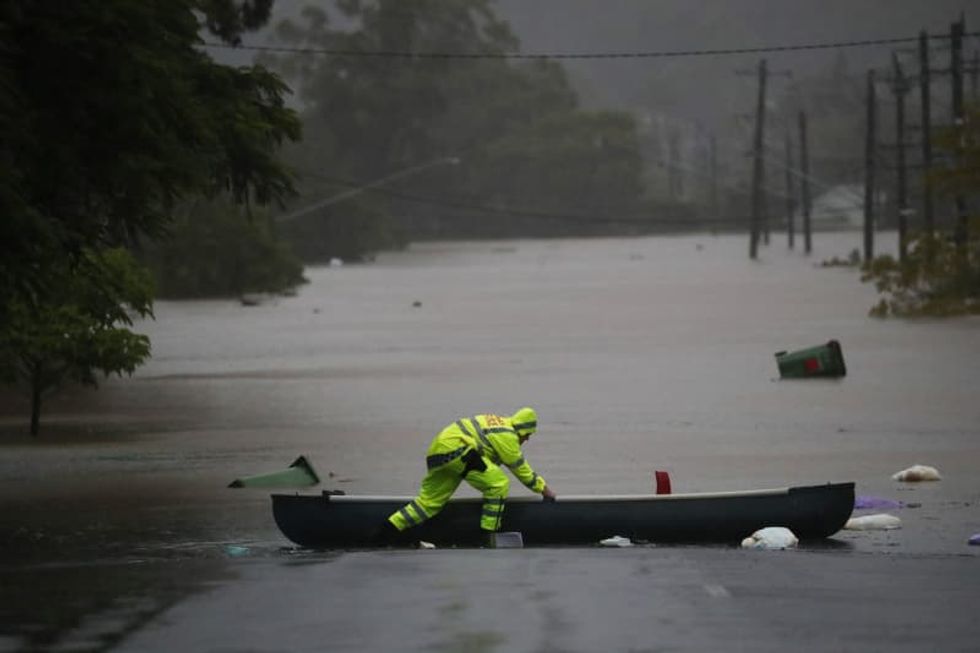
A man takes his boat from a street covered with flood waters in the town of Lismore. Queensland's southeast is set to endure more wild weather as the state grapples with a days-long flood crisis. Jason O’brien/AAP/dpa
Parts of eastern Australia are battling with severe flooding following torrential rains as officials warned on Monday of a life-threatening situation.
Many people, especially around the city of Lismore in the state of New South Wales, had taken refuge on the roofs of their homes to escape rapidly rising waters, Australian Prime Minister Scott Morrison said on Monday.
He spoke of a crisis situation and planned to consult later in the day with the country's emergency authorities on how to proceed.
Lismore Mayor Steve Krieg described the situation as unprecedented and life-threatening.
Writing on Lismore's website, he said the community was facing "one of the most difficult periods in its history." More than 15,000 people in the region have already been moved to safety from the flooding.
Australia's largest city, Sydney, also recently experienced flooding. Meteorologists said it was Sydney's wettest summer for 30 years.
Meanwhile, in the neighbouring state of Queensland, the death toll rose to eight. Three people are still missing, according to police reports.
The metropolis of Brisbane and the cities of Gympie and Maryborough were particularly badly affected, as well as areas along the Sunshine Coast. The region has seen as much rain in a few days as it normally does in an entire year.
More than 50,000 homes are without power. Hundreds of schools remain closed, and public transportation such as buses, trains and ferries have been suspended.
The extreme weather was triggered by a slow-moving low-pressure system.
Australia is being particularly badly affected by climate change. In mid-January, large parts of the country were still sweltering under a merciless heatwave, with temperatures of more than 50 degrees recorded in the west of the country.
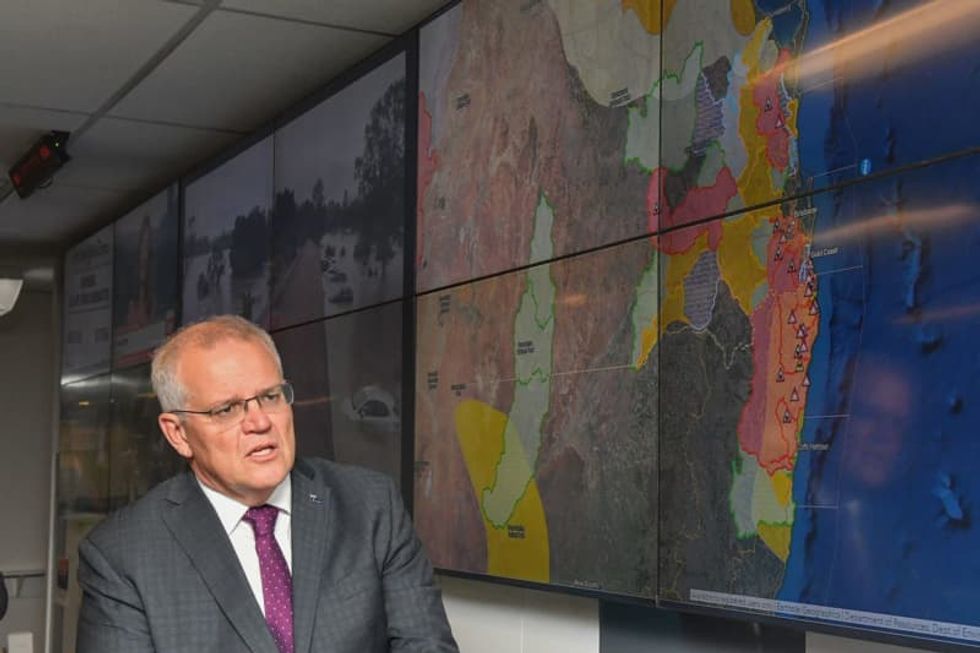
Australian Prime Minister Scott Morrison listens to a briefing on the flooding disaster at the National Situation Room at Emergency management Australia. Mick Tsikas/AAP/dpa
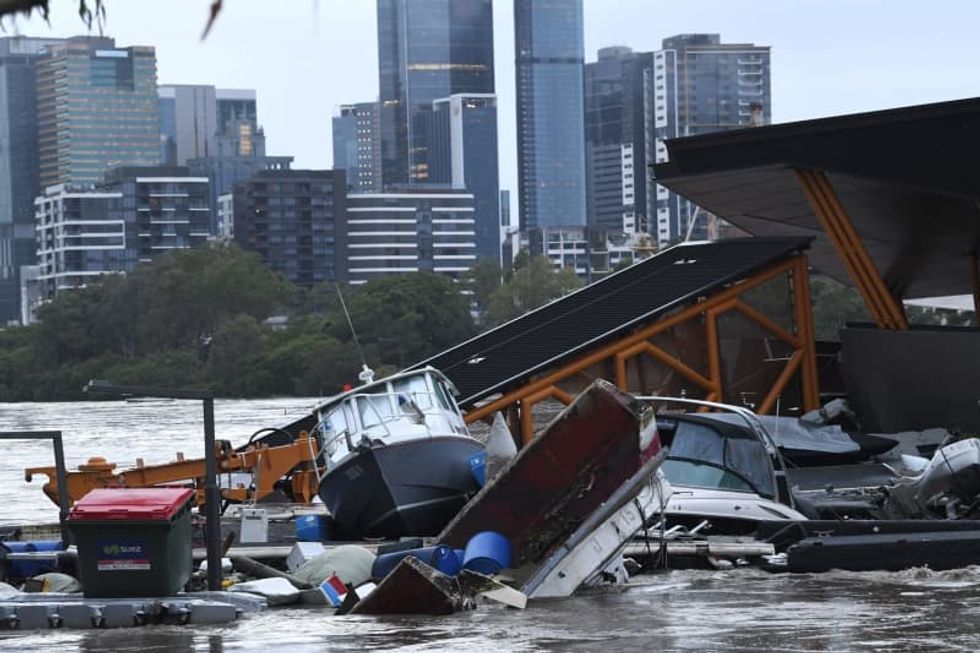
Boats and other debris wash into the Milton ferry terminal on the Brisbane River. Queensland's southeast is set to endure more wild weather as the state grapples with a days-long flood crisis. Darren England/AAP/dpa
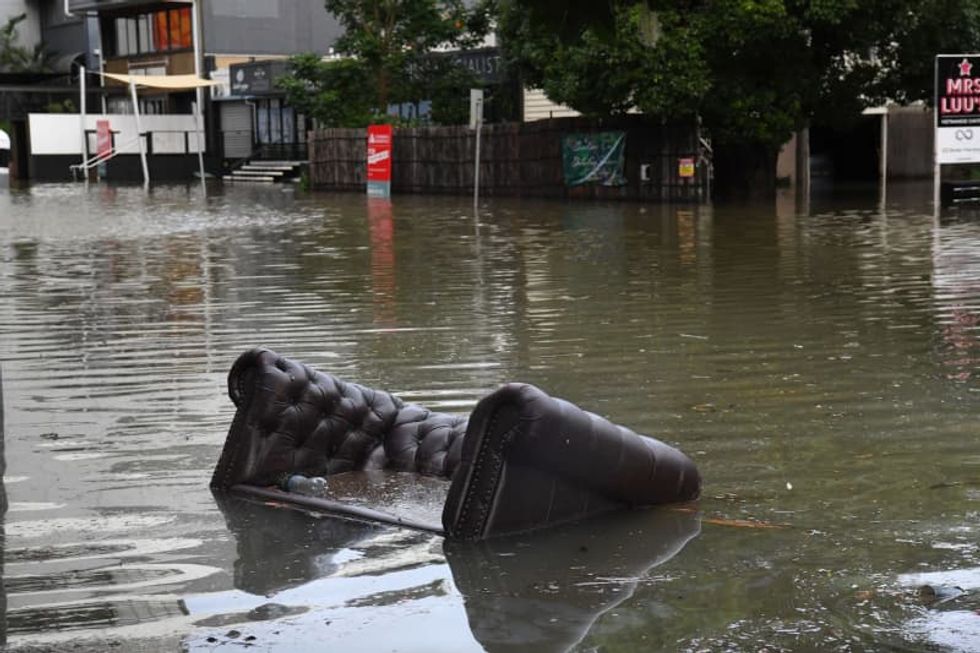
An armchair floats in floodwaters in the Brisbane suburb of Milton. Queensland's southeast is set to endure more wild weather as the state grapples with a days-long flood crisis. Darren England/AAP/dpa
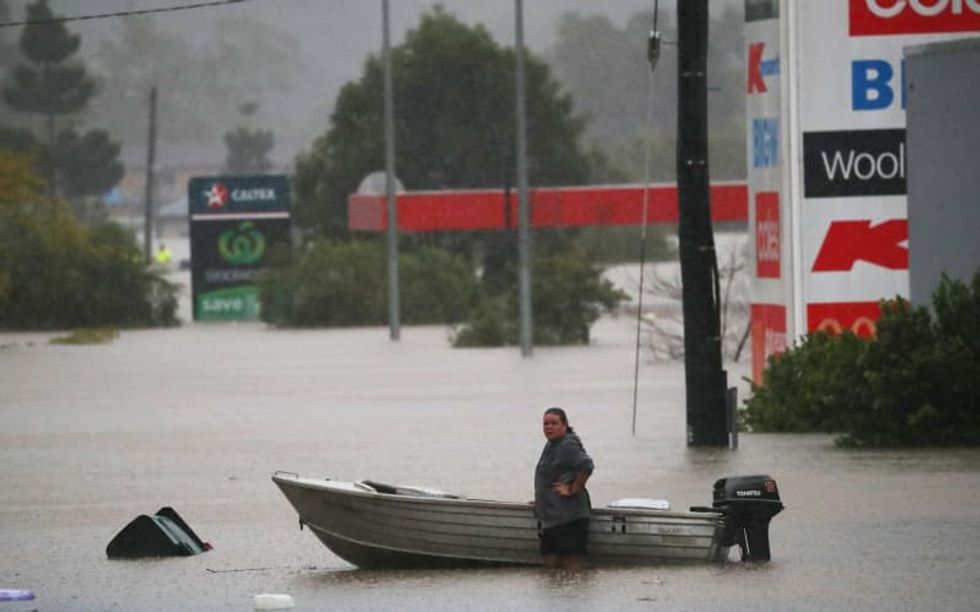
A woman stands next to a boat in a flooded street. Queensland's southeast is set to endure more wild weather as the state grapples with a days-long flood crisis. Jason O’brien/AAP/dpa
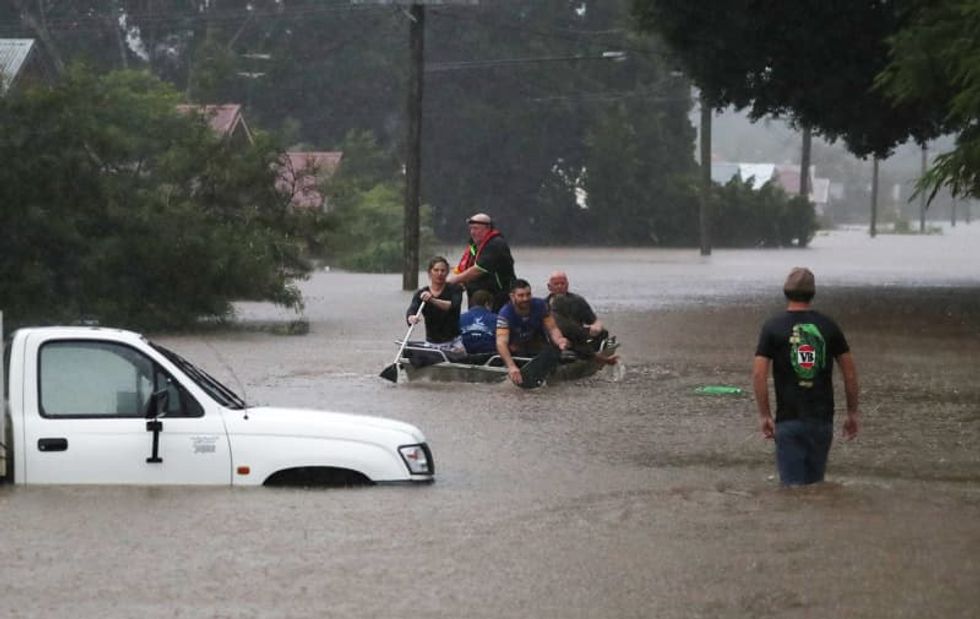
A family steer their boat through a flooded street in the town of Lismore. Queensland's southeast is set to endure more wild weather as the state grapples with a days-long flood crisis. Jason O’brien/AAP/dpa
A general view of a Russian Rouble coin on display board. Russia's Central Bank says it is barring traders from selling Russian securities held by foreigners as the domestic financial system faces tightened sanctions. picture alliance / dpa
The Bank of Russia has decided to increase its key interest rate by 10.5 percentage points to 20% starting Monday, as the central bank responded to Western sanctions amid the Ukraine conflict.
A statement said that the move was designed to shield financial stability and protect the savings of citizens from depreciation.
In the morning, the rouble lost about 8% of its value against the dollar. As a result, one dollar cost more than ever at around 90 roubles.
The national currency plunged in foreign markets even further.
By Elizabeth Culliford (Reuters) - Meta Platforms said a hacking group used Facebook to target a handful of public figures in Ukraine, including prominent military officials, politicians and a journalist, amid Russia's ongoing invasion of the country. Meta said in the last 48 hours it had also separately removed a network of about 40 fake accounts, groups and pages across Facebook and Instagram that operated from Russia and Ukraine targeting people in Ukraine, for violating its rules against coordinated inauthentic behavior. A Twitter spokesperson said it had also suspended more than a dozen a...
BEIJING (Reuters) -China is willing to work with the United States on a G7-led global infrastructure plan and welcomes Washington to join its Belt and Road Initiative, Chinese Foreign Minister Wang Yi said on Monday.
The Group of Seven (G7) richest democracies, consisting of United States and its allies, proposed the Build Back Better World (B3W) initiative in June to help developing countries meet infrastructure needs, as they sought to counter China's growing influence.
"We are also willing to consider coordinating with the U.S. 'Build Back Better World' initiative to provide the world with more high-quality public goods," Wang said in a video message at an event for the 50th anniversary of the Shanghai Communique, which marked the normalising of relations between United States and China.
He said China is also open to the United States participating in the Belt and Road Initiative (BRI) and the Global Development Initiative, a call by Chinese President Xi Jinping in September for all countries to work towards sustainable development.
G7's B3W initiative is seen as an alternative to rival China's BRI, which was launched by Xi in 2013. More than 100 countries have signed agreements with China to cooperate in BRI projects like railways, ports, highways and other infrastructure.
Wang urged Washington to work with China in Asia-Pacific to build a "family of openness, inclusiveness, innovation, growth, connectivity and win-win cooperation", rather than turn the region into one of conflict and confrontation.
The Shanghai Communique, a document which marked the end of isolation between both countries and issued during then U.S. President Richard Nixon's historic visit to China, meant that two major powers with different social systems were willing to coexist peacefully, he said.
Wang reiterated a call for the United States to stop supporting independence for Taiwan, a self-ruled island China claims as its own.
(Reporting by Yew Lun Tian; Editing by Christian Schmollinger and Muralikumar Anantharaman)
The European Union on Sunday closed its airspace to Russian aircraft and banned Russian state media outlets RT and Sputnik, which European Commission President Ursula von der Leyen referred to as "the Kremlin's media machine."
"They won't be able to land in, take off or overfly the territory of the EU. Including the private jets of oligarchs," von der Leyen said of the airspace measures that came four days after the start of Russia's military campaign against Ukraine.
Individual EU countries have been announcing bans on Russian planes in its airspace in recent days.
Britain has also banned Russian airlines from landing at its airports or crossing its airspace, meaning Moscow is facing a massive blockade of the continent's skies.
Passengers could still transfer to countries that have not imposed flight bans. Istanbul, for example, is a hub that connects Western Europe and Russia.
Later, the Russian airline Aeroflot said it would suspend all flights to European destinations from Monday, according to the Interfax news agency.
Von der Leyen meanwhile praised Ukrainian President Volodymyr Zelensky's leadership in the face of Russia's attack, saying "his bravery and the resilience of the Ukrainian people are an inspiration to us all."
The European Commission president also spoke in favour of Ukraine joining the European Union in an interview with Euronews.
"Indeed over time they belong to us. They are one of us and we want them in," von der Leyen said, also emphasizing that there are already several areas of cooperation between the bloc and the country.
"Had a phone conversation with [von der Leyen]. Talked about concrete decisions on strengthening Ukraine's defense capabilities, macro-financial assistance and Ukraine's membership in the #EU," Zelensky said in the early hours of Monday.
The Ukrainian leader said that he also spoke to British Prime Minister Boris Johnson and Polish President Andrzej Duda over the phone and "agreed on further joint steps to counter the aggressor."
The EU also went after the Russian state media outlets RT and Sputnik.
Von der Leyen referred to them as "the Kremlin's media machine" and said they were being used to spread Russian President Vladimir Putin's lies to justify his war against Ukraine.
Several of the 27 EU countries have already taken measures against Russian state media.
Latvia and Estonia blocked a number of Russian-language channels in response to Russia's invasion of Ukraine, while RT - formerly known as Russia Today - was taken off Austrian airways on Sunday. RT's German-language channel was also recently blocked by a Berlin regulator.
Johnson critized RT for "peddling" content that is "doing a lot of damage to the truth," but said it wasn't within his power to ban the channel.
"We have a principle in this country that we don't allow politicians to ban this or that media organisation," he said in comments reported by the Press Association. "And that's the way we do it. And I think we're better for that."
In announcing the EU measures, neither von der Leyen nor EU Foreign Policy Chief Josep Borrell gave details about the timing of the ban or how it would be imposed.
Borrell only said that there were technical ways to ban the broadcast of RT and Sputnik in the EU.
RT is repeatedly criticized in the West as a Kremlin propaganda tool.
The central accusation is that the channel spreads conspiracy theories and disinformation on behalf of the Russian state. RT rejects this premise. The channel has several foreign-language programmes in its portfolio.
Additionally, in a significant break with previous policy, von der Leyen said that for the first time the EU will finance the purchase and delivery of weapons and equipment to a country under attack.
The EU will provide half a billion euros (556 million dollars) for the delivery of weapons and equipment to the Ukrainian armed forces.
Borrell said the material is to be brought to Ukraine via a logistics base in Poland. Details are to be clarified on Monday at consultations of the defence ministers of the 27 member states.
Also on Sunday, the European Commission said it would soon propose new rules in response to a "mass influx" of Ukrainian refugees. The proposal is expected to be considered by EU interior ministers on Thursday.
The mechanism would allow displaced persons to be granted immediate temporary protection without a lengthy asylum procedure.
EU Home Affairs Commissioner Ylva Johansson said she does not know how many people will come but that the 27-member bloc should "prepare for millions."
Russia launched a long-feared invasion of Ukraine in the early hours of Thursday, prompting international outrage and sending hundreds of thousands of people fleeing into neighbouring countries, many of which are EU member states.
German Interior Minister Nancy Faeser advocated for fast, straightforward help for all people fleeing the war on the EU's doorstep.
"For us, the most important thing now is to find unbureaucratic solutions to get people to safety as quickly as possible," Faeser said ahead of the meeting with her colleagues.
European Commission President Ursula von der Leyen holds a press statement on further measures to respond to the Russian invasion of Ukraine, at the European Commission in Brussels. Xavier Lejeune/European Commission/dpa
World football's governing body FIFA decided on Sunday that no international matches should be played in Russia and that its flag and anthem were not welcome, but stopped short of kicking them out of the World Cup for now.
French Football Federation president Noël Le Graët earlier became the first significant figure in the sport to suggest Russia should be thrown out of the men's World Cup following the invasion of Ukraine.
Poland, Sweden and the Czech Republic have refused to play Russia next month in the play-offs for the tournament in Qatar in November. Poland and Sweden said FIFA's punishment did not go far enough.
FIFA, in what it said were "initial measures" against the 2018 World Cup hosts, said in a statement that no international game shall be played in Russia with home matches being played on neutral territory and without spectators.
Russia will also have to compete in international football under the banner “Football Union of Russia”, similar to an Olympic ban on the country name due to anti-doping violations, while no flag or anthem of Russia will be used in matches where teams from the Football Union of Russia participate, FIFA added.
"FIFA will continue its ongoing dialogue with the IOC, UEFA and other sport organisations to determine any additional measures or sanctions, including a potential exclusion from competitions, that shall be applied in the near future should the situation not be improving rapidly," the statement continued.
"That is my first impulse," Le Graët told Le Parisien newspaper when asked if Russia should be banned from the World Cup. "The world of sport, and football in particular, cannot remain neutral. I will certainly not object to Russia's exclusion."
The Czechs joined Poland and Sweden from Saturday in refusing to face Russia in the play-offs for Qatar regardless of the match venue.
A statement Sunday said the executive committee of the Czech football federation and players agreed it was "not possible to play against the Russian national team in the current situation".
Poland were first to say they would not play Russia in their March 24 play-off semi-final even if the tie was moved from Moscow. The winner of Sweden v Czech Republic in the other path B semi-final were then scheduled to go to Russia, if they won, for the March 29 final.
The English FA has also said it will not play Russia for "the foreseeable future".
Russia is becoming increasingly isolated in the sporting world and European football's ruling body UEFA had already said matches cannot be played in Russia or Ukraine, with RB Leipzig's Europa League tie with Spartak Moscow next month up in the air.
UEFA is also set to consider the sponsorship deal it has with Russian state energy firm Gazprom.
Hans-Joachim Watzke, interim president of the German football federation (DFB), said it was "dirty money" that "we cannot take any more" while DFB presidential candidate Peter Peters said it was "a clear yes" to ending the cooperation.
Gazpom sponsors the Champions League and Euro 2024 in Germany but Schalke, a German second division side, have already removed their name from their shirts.
A network of Ukrainian athletes have written to the heads of the International Olympic Committee (IOC) and International Paralympic Committee asking them to ban Russia and Belarus from international sport with the Beijing Paralympics beginning on Friday.
The junior swimming world championships in Russia's Kazan in August have been cancelled.
Volleyball is one of the few sports still considering a major event in Russia with the men's world championships scheduled for August. This is under review though with some nations saying they will not travel to Russia to take part. Many airlines will not fly there.
World judo's governing body meanwhile has taken personal action against Russian President Vladimir Putin, while Russian Sergey Soloveychik has stepped down as the head of European judo.
"In light of the ongoing war conflict in Ukraine, the International Judo Federation announces the suspension of Mr. Vladimir Putin’s status as Honorary President and Ambassador of the International Judo Federation," it said in a statement.
Putin has reached the level of black belt in the sport.
Noel Le Graet, President of the French Football Federation, speaks at a press conference during the 2019 FIFA women's World Cup. French Football Federation president Noel Le Grae has become the first significant figure in the sport to suggest Russia should be thrown out of the men's World Cup following the invasion of Ukraine. Sebastian Gollnow/dpa
Russian President Vladimir Putin speaks during a press conference at the Kremlin. The world judo governing body (IJU) has taken personal action against Russian President Vladimir Putin following the invasion of Ukraine. -/Kremlin/dpa
Vladimir Putin's yacht, Graceful, appears to have a different call sign on a few yacht tracking websites.
As Russian oligarch yachts are being tracked around the world, Putin's luxury boat typically has the call sign UBGV8, according to FleetMon.
But on another website, MarineTraffic, Bloomberg reporter Ryan Gallagher and Good Pillow CEO William LeGate noticed that someone changed the call sign to FCKPTN and its current maritime position is "Hell."
Gallagher tweeted that it was an offshoot group from the hackers Anonymous known as The Anon Leaks,
They "told me they did it by manipulating the maritime 'Automatic Identification System,' which is used to track ship locations," he tweeted. "They said they wanted to put the yacht in the scope of sanction packages as well as 'put a little smile on some faces for a short period in these dark times.'"
Rep. Lauren Boebert (R-CO) spoke to Fox while at CPAC on Sunday and claimed that the United States has no business being involved in the invasion of Ukraine. Instead, she believes that the U.S. should move into Canada and "liberate" them.
"But we also have neighbors to the north who need freedom and who need to be liberated and we need that right here at home," she added.
It prompted Canadians to lash out with disapproval, including Canadian officials. MP Anthony Housefather invited Boebert to call him so he could talk to her about what Canada is and believe. Boebert's information about Canada appears to be focused on the so-called "freedom convoy," of anti-vaccine truck drivers.
Former US Ambassador to Canada Bruce Heyman similarly spoke out against Boebert, calling her "reckless" and "dangerous." He explained that she "crosses every line of diplomacy and decency."
The Balearic Island newspaper Ultima Hora reported Sunday that a $7.8 million yacht "partially sank" at the docks on the Spanish island of Mallorca after a Ukrainian sailor opened the valves.
The sailor was arrested after the incident with the massive boat named the Lady Anastasia. The ship boasts nearly a 156-foot length and five cabins and employs the sailor along with a few other staffers. It's owned by Russian citizen Alexander Mijeev, who once headed the Russian Helicopter Corporation, which builds aircraft for the Russian military. In 2016, however, Mijeev took over Rostec, a weapons supplier.
In court, the sailor explained that the owner of the ship is in charge of the production of weapons that are currently hitting his country. When he saw the footage of the Russian cruise missiles hitting civilian targets like apartment buildings and a Kindergarten, the sailor said he was moved to act. He said that he knew the missile was produced by the company. That's why he took revenge on the owner. It caused only material damage, he explained, never physical.
He opened the valve in the engine room and a second where the crew lives. He told three crew members, also Ukrainians to abandon ship.
"The owner of this ship is a criminal who makes his living selling weapons and now they kill Ukrainians," he told the police when they came to arrest him.
The judge released him, but the sailor was charged.
Green Day became the latest artist or organization to cancel events in Russia following the country’s invasion of Ukraine. The punk rock band said Sunday that it won’t perform in Moscow on May 29 as previously scheduled. “With heavy hearts, in light of current events we feel it is necessary to cancel our upcoming show in Moscow at Spartak Stadium,” Green Day said in a statement shared on the group’s Instagram story. “We are aware that this moment is not about stadium rock shows, it’s much bigger than that. But we also know that rock and roll is forever and we feel confident there will be a tim...