China on Friday urged the United States to meet it halfway and strengthen cooperation in the fight against the coronavirus pandemic after President Donald Trump threatened to sever bilateral ties.
Relations between the world's two largest economies have deteriorated in recent weeks, with both sides trading barbs over the origins of the virus that has killed more than 300,000 people.
"To maintain the steady development of China-US relations is in the fundamental interests of the people in both countries, and is conducive to world peace and stability," said foreign ministry spokesman Zhao Lijian at a press briefing.
"At present, China and the US should continue to strengthen cooperation against the epidemic, defeat the epidemic as soon as possible, treat patients, and restore economy and production. But it requires the US to meet halfway with China."
The comments came after Trump further hardened his rhetoric towards China, threatening to cut ties with the rival superpower completely as relations have steadily deteriorated over the pandemic.
"There are many things we could do ... We could cut off the whole relationship," Trump said Thursday in an interview with Fox Business News.
"You'd save $500 billion if you cut off the whole relationship."
Trump said that his relationship with Chinese President Xi Jinping is "very good" but added: "right now I just don't want to speak to him".
The threat came a week after a trade call between US and Chinese trade negotiators in which both sides stressed their commitment to the Phase One trade deal reached in January.
However, fulfillment of the deal looks increasingly tenuous in the face of the pandemic and a looming global economic downturn.
In the pact signed in January, China agreed to buy $200 billion more in US goods over two years than it did in 2017 -- before the trade war erupted and triggered tariffs on billions of dollars of two-way trade.
Tensions have ratcheted up between Washington and Beijing as they traded barbs over the origin of the pandemic that first appeared in late 2019 in the Chinese city of Wuhan, which Trump has dubbed the "Plague from China."
Treating COVID-19 patients with the malaria drug hydroxychloroquine (HCQ) had no positive effect and caused other health complications, two new studies showed Friday.
The anti-inflammatory has been touted by US President Donald Trump among others as a potential "game changer", after initial studies in lab settings showed it may be able to prevent the virus replicating.
But several subsequent studies -- including one funded by the US government -- appear to have doused hopes that HCQ can help patients hospitalized with COVID-19.
In the first study released Friday, researchers in France monitored 181 patients hospitalized with pneumonia due to COVID-19 and who needed oxygen.
Eighty-four were treated with HCQ and 97 were not.
They found no meaningful difference between the groups for either transfer to intensive care, death within seven days or developing acute respiratory distress syndrome within 10 days.
"Hydroxychloroquine has received worldwide attention as a potential treatment for COVID-19 because of positive results from small studies," said the authors of the research, published in the BMJ journal.
"However, the results of this study do not support its use in patients admitted to hospital with COVID-19 who require oxygen."
A second study saw researchers in China split 150 COVID-19 patients in to two groups, one of which received HCQ.
After four weeks tests revealed similar rates of sustained infection among both groups, though adverse reactions to treatment were more common in the HCQ group.
Nor did the severity or duration of symptoms differ between each group.
Hydroxychloroquine and a related compound chloroquine have been used for decades to treat malaria, as well as the autoimmune disorders lupus and rheumatoid arthritis.
Last month the European Medicines Agency warned that there was no indication HCQ could treat COVID-19 and said some studies had seen serious and sometimes fatal heart problems in patients.
Belgium is only cautiously beginning to emerge from its coronavirus lockdown and its bars and restaurants won't open until next month at least.
But the prayers of a lucky few drinkers have nevertheless been answered, with the release of a new batch of perhaps the world's best and most exclusive beer.
The monks of the Trappist Abbey of Saint Sixtus only sell their holy brew by appointment, to individual consumers, and until Thursday their outlet was closed.
Belgium has had one of the highest per capita death tolls from the global coronavirus pandemic in the world, and rules for social distancing have been strict.
AFP / Kenzo Tribouillard Aficionados who reserved a slot online -- and were willing to observe safety rules -- were able to pull up to the monastery and pick up their quota
St Benedict's rules, however, say the monks must work to support themselves, and the Trappist Westvleteren beer is regularly voted among the world's best by fans.
On Thursday, aficionados who reserved a slot online -- and were willing to observe safety rules -- were able to pull up to the monastery and pick up their quota.
Brother Godfried, of the order, explained the rules.
"At the red light they have to stop, so that there are only two or three people active here where the transaction takes place," he told AFP.
"We also work without cash and there's plexiglass."
AFP / Kenzo Tribouillard The brewery has survived through several incarnations and the modern brewing hall now produces small batches of three distinct Trappist tipples -- Blond, 8 and 12
Rules come naturally to the faithful members of the Cistercian Order, but do their customers understand self-control? They seem ready to comply, for their share of the beer.
For Flor Holvoet, the trip to the monastery was at last a proper excuse to escape the lockdown at home, and come out to pick up his crate.
"It was the first opportunity to get out of my house and do a trip like this, to drive all the way here to get some world-famous beer," he said.
Lawyer Thomas Vuylsteke normally wouldn't have time on a workday to make a beer run, but his kids are off school and he was babysitting at home.
AFP / Kenzo Tribouillard Plexiglass has been put in as part of new safety measures to curb the spread of coronavirus
"I was out of beers, and last Friday I saw we can order some new, so I ordered them for me and my brother-in-law, and I decided to come and pick them today," he said.
Some might frown on the return to business at the abbey, so early into Belgium's tentative "deconfinement" process.
But, as Brother Godfried explained, the rules the monastery has already put in place to restrict sales to non-commercial buyers were good preparation to operate safely.
- Royal licence -
"The reservation system allows us to regulate very well how many people come here," he said, referring to the online sign-up system to deter re-sellers and speculators.
AFP / Kenzo Tribouillard As Belgium's borders are closed, beer fans from the rest of Europe and beyond have not been able to swarm in on the new batch
And Belgium's borders are closed, so beer fans from the rest of Europe and beyond have not been able to swarm in on the new batch.
"You have to know, we live by the rule of Benedict, the Benedictine tradition, and that provides that monks... live by the work of their hands," Godfried said.
"In very concrete terms, this means that we have to live from our brewery. So for us, it is very important that we can start selling again. Because that's what we live from."
AFP / Kenzo Tribouillard The recent explosion of interest in craft beers and rare brews -- along with the scarcity -- has contributed to the beer's legendary status among hobbyists
The abbey was founded in 1831, when french monks arrived in Flanders to join a hermit, Jan-Baptist Victoor, living in a Flemish forest.
They made cheese and beer for their own need and in 1839, Belgium's King Leopold I licensed them as brewers.
The brewery has survived through several incarnations and the modern brewing hall now produces small batches of three distinct Trappist tipples -- Blond, 8 and 12.
The recent explosion of interest in craft beers and rare brews -- along with the scarcity -- has contributed to the beer's legendary status among hobbyists.
In recent years, profiteers have tried to cash in by selling the beers at inflated prices, forcing the humble monks to adopt their online order and pick-up system.
Face masks are rare and social distances vary but the human chain spreads out, braving the risk of infection, as activists in Oslo make a last-ditch bid to save a building adorned with artwork designed by Spanish master painter Pablo Picasso.
Damaged in rightwing extremist Anders Behring Breivik's July 2011 attacks, the "Y Block", a government building complex named for its shape and completed in 1969, is due to be demolished any day now.
On its grey cement walls are two Picasso drawings, sandblasted by Norwegian artist Carl Nesjar, who collaborated with the Spaniard.
On the facade facing the street, "The Fishermen" depicts three men hauling their oversized catch on board their boat. In the lobby, "The Seagull" shows the bird, its wings spread wide, devouring a fish.
Etched in the Spanish painter's childlike strokes, the two works will be cut out and relocated to new government buildings due to be built in the central Oslo neighbourhood.
But not everyone is okay with that plan.
AFP / Pierre-Henry DESHAYES Activists form a human chain during a demonstration in a last-ditch effort to try to save Y block
"We're going to be kicking ourselves for years," blasts Erik Lie, one of the 200 or so Norwegians who have come to protest against the demolition on this freezing May morning, one link in the human chain in front of the building.
"I hope it's not too late," he says, his orange woolly hat reading "Let Y Stand", before adding fatalistically: "But this will probably be a pile of rubble soon."
- Symbol of democracy -
Because of the new coronavirus, protesters are linked by metre-long ribbons in a bid to keep them at a safe distance from one another.
Energised by their despair, they still harbour dreams of ripping the building from the bulldozers' claws.
But behind them, beyond the high fences, the sound of metal saws suggests the preparations are well underway.
According to Statsbygg, the public agency in charge of overseeing the demolition, the murals are to be dismantled before the end of spring.
SCANPIX NORWAY/AFP/File / STORLØKKEN, AAGE Norwegian artist Carl Nesjar sandblasted the Pablo Picasso works into the concrete during the construction of the government building in Oslo, Norway in June 1958
The nearby "H Block" building, built in the late 1950s and which has three other Picasso murals, was home to the prime minister's offices until Breivik blew up a van loaded with 950 kilos (2,100 pounds) of explosives at its base.
"H Block" will be renovated and will continue to tower over the new ministry buildings.
For some, the symbolism is inevitable: these buildings remain standing, despite Breivik's attempts to bring them -- and democracy -- down.
"Y Block is an iconic building in Oslo that has survived a terrorist attack and now the government wants to tear it down. And nobody can actually give a good argument for why they should," says Tone Dalen, one of the figurehead of the protests.
The government meanwhile insists that the demolition of "Y Block" to make space for new buildings was a difficult but necessary decision.
"It will improve security and accessibility for cyclists and pedestrians, and will provide a more open and greener space, as well as offices suited to the future ministries," said Modernisation Minister Nikolai Astrup.
- Too late -
"The Fishermen" and "The Seagull" -- whose existence many Norwegians were unaware of until the question of their relocation arose -- are supposed to be made more visible to the public in their future location.
"A lot of people think that it's Picasso that deserves to be preserved but it's also the architecture and the interaction between 'Y Block' and 'H Block', the history that it represents," insists Erik Lie.
"These are monuments that illustrate the rebuilding of Norway after the war, and everything that I associate with the development of modern society," he says.
AFP/File / Odd ANDERSEN Y Block was damaged in rightwing extremist Anders Behring Breivik's July 2011 attacks and is now set for demolition
With their drab appearance, the buildings' aesthetic qualities may be debated but supporters insist that you cannot destroy everything you don't like.
"Maybe we don't find it beautiful today, but perhaps in 30 years we'll think the opposite," notes Cecilie Geelmuyden, a 50-year-old civil servant and protest supporter.
Despite a growing number of protests in recent weeks, the demolition process now appear irreversible.
At the end of August, the Oslo district court is to consider a request to have the demolition declared illegal.
But that will be too late, in all likelihood.
As Lie predicts, by then, "Y Block" will probably be nothing more than a pile of rubble.
The coronavirus could infect a quarter of a billion Africans and put intolerable pressure on the continent's fragile health system, a new report said Friday, as the pandemic's global death toll topped 300,000.
Despite fears of a second wave of infections, borders began opening up in Europe and lockdowns continued to ease as governments try to get stalled economies moving again, with experts warning world output could shrink by 10 percent.
AFP / STR Medical workers conduct mass COVID-19 tests in Wuhan in China's central Hubei province
And Donald Trump ramped up his war of words with Beijing over responsibility for what he has dubbed the "Plague from China", threatening to cut ties between the two countries.
But it was the very human cost of the disease that was thrown into sharp relief with the discovery of infections in the world's biggest refugee camp, where upwards of a million Rohingya live in squalor.
AFP / Johannes EISELE Medical workers transport a patient outside a special COVID-19 area at Maimonides Medical Center in New York City
"We are looking at the very real prospect that thousands of people may die from COVID-19" in these camps, Save The Children's Bangladesh health director Shamim Jahan said.
"There are no intensive care beds at this moment" in the camps at Cox's Bazaar, Jahan said.
Track and trace teams were fanning out Friday to follow up on two positive tests.
- Vaccine -
Epidemiologists have long warned that the virus could race through the cramped, sewage-soaked alleys of the camps, where the persecuted Muslim minority have lived since fleeing a military offensive in neighboring Myanmar nearly three years ago.
The nexus of poverty and risk was also laid bare by a World Health Organization report that warned Africa is a hotspot waiting to happen, despite so far having escaped the worst of the disease.
Researchers say frangible health systems on the world's poorest continent could quickly be overwhelmed, with modeling suggesting 231 million people could become infected.
Up to 190,000 of them could die, the study published in the journal BMJ Global Health suggested.
AFP / ALFREDO ESTRELLA A sacristan wearing a face mask disinfects the religious statues inside the Sagrada Familia Church in Mexico City
With large populations living in slums, social distancing is all but impossible for many on the continent, and health experts say only a vaccine will prevent widespread infection.
Despite scientists working flat out towards that aim, experts say it could still be many months -- or even years -- away.
And without a robust roll-out plan, even highly developed countries could struggle to take advantage of any breakthrough.
AFP / Martin BUREAU A teacher shows pupils how to clean their hands in a classroom at Saint-Exupery school in the Paris' suburb of La Courneuve
In the US, the man formerly charged with developing a vaccine told lawmakers the government in Washington has no "master plan" to fight the pandemic and is unprepared to distribute enough vaccines to immunize millions of Americans.
"We don't have a single point of leadership right now for this response," said Rick Bright, who was removed from his job last month.
- 'Disappointed in China' -
The United States has registered almost 86,000 deaths linked to COVID-19 -- the highest toll of any nation, with a third of all known global infections.
AFP / MICHAEL DANTAS An indigenous girl from Parque das Tribos community leaves a headdress on the coffin of Chief Messias, 53, of the Kokama tribe who died of COVID-19, in Manaus, Brazil
In an interview aired Thursday, Trump again accused Beijing of concealing the true scale of the problem after the virus emerged in Wuhan late last year.
"I'm very disappointed in China. I will tell you that right now," he said.
Asked how the United States might choose to retaliate against what he has dubbed the "Plague from China", Trump said: "We could cut off the whole relationship".
AFP / Brendan Smialowski US President Donald Trump walks from Marine One to the White House as a secret service agent wearing a face mask looks in Washington, DC
Beijing played down the spat, saying: "To maintain the steady development of China-US relations is in the fundamental interests of the people in both countries."
The US and China are the world's two largest economies, doing hundreds of billions of dollars of mutually beneficial trade every year.
Nevertheless, the US president is keen to make Beijing the bogeyman in an election year when gloomy news has become par for the course.
New figures showed a further three million job losses, taking the newly unemployed to 36.5 million -- more than 10 percent of the US population.
AFP / FAJRIN RAHARJO Airport health officials check passengers for required travel documents, such as a COVID-19 test certificate, at Soekarno-Hatta Jakarta International airport in Tangerang
Over a third of them will have trouble paying their bills, a survey has revealed.
States are slashing their budgets because of tax shortfalls caused by the job losses, with California announcing it would have a $54 billion deficit this year.
AFP / MOHAMMED HUWAIS A fighter loyal to the Huthi rebels keeps guard as volunteers take measures to prevent the spread of COVID-19 in Yemen's capital Sanaa
Germany's treasury is also expecting a big hole in its budget, with around 100 billion euros wiped off the tax take in 2020.
Europe's biggest economy has already slipped into a recession, with GDP expected to shrink by 6.3 percent this year -- the biggest contraction since 1949.
The Asian Development Bank on Friday doubled its previous estimate of the cost of the pandemic, saying the world economy would shrink by $8.8 trillion -- almost a tenth of global output.
Up to 242 million jobs will vanish due to the virus, the Manila-based bank said.
- 'We may need more graves' -
AFP / Phill Magakoe People sitting in separate perspex cubicles bid for flowers during an action inside the Multiflora warehouse in Johannesburg
Much of Europe was back on the road to recovery, with more parts of the continent opening up.
Slovenia opened its borders on Friday after declaring an end to its coronavirus epidemic, despite new infections still being reported.
Austria and Germany were expected to open their shared border, while Latvia, Lithuania and Estonia were set to create their own "mini-Shengen on the Baltic", allowing free movement among the three countries.
But in Latin America, the news was looking increasingly dire.
Thousands of fresh graves are being dug in the Chilean capital's main cemetery, as the infection rate soars and as Santiago enters lockdown from Friday.
"We may need more graves, because we see what's happened in other countries," cemetery director Rashid Saud told AFP.
Tens of thousands of people were forced into cramped shelters by the powerful storm pounding the Philippines on Friday, making social distancing nearly impossible as the nation battles the coronavirus pandemic.
Typhoon Vongfong flattened flimsy coastal homes when it roared ashore on central Samar island on Thursday, but then weakened into a severe tropical storm on its path north to the capital Manila.
The storm hit as tens of millions of Filipinos are hunkered down at home against the coronavirus, but at least 141,700 had to flee in central Bicol province because of the powerful storm, disaster officials said.
"We have to wear masks and apply distancing at all times," local police official Carlito Abriz told AFP. "It's difficult to enforce because they (the evacuees) are stressed. But we are doing our best."
Bicol saw less damage than hard-hit Samar, so some of those in shelters had begun to return home after the storm passed on Friday, disaster officials reported.
AFP / John SAEKI Philippines Typhoon
Authorities have said they will run shelters at half of capacity, provide masks to people who don't have them and try to keep families grouped together.
However, many spaces normally used as storm shelters have been converted into quarantine sites for people suspected of being infected with coronavirus.
"The challenge really lies in the physical distancing," said disaster official Junie Castillo, who added they were housing people in classrooms emptied by the pandemic.
Fortunately the central region where the storm struck first is not one of the hotspots of the Philippines' outbreak, which has seen 11,876 reported infections and 790 dead.
- Overlapping disasters -
Tens of millions more people live along Vongfong's path, which is forecast to take it near the densely populated capital Manila later Friday or early Saturday.
Disaster officials in Manila, which is the centre of the nation's virus outbreak, said they have not ordered pre-emptive evacuations for the capital but have issued storm warnings.
Authorities have not reported any deaths so far, but disaster crews had not yet completed their assessment of hard-hit areas cut off by the storm.
AFP / Alren BERONIO Tens of millions more people live along Vongfong's path, which is forecast to take it near the densely populated capital Manila
It is not unheard of for disasters to overlap in the Philippines, and some 22,000 people were evacuated from the slopes of the active Mayon volcano ahead of the typhoon's arrival.
Heavy rains in the past have sent landslides of debris cascading down the volcano, burying and killing the communities in their paths.
Typhoons are a dangerous and disruptive part of life in the Philippine archipelago, which gets hit by an average of 20 storms and typhoons each year.
The storms put millions of people in disaster-prone areas in a state of constant poverty and rebuilding.
A July 2019 study by the Manila-based Asian Development Bank said the most frequent storms lop one percent off the Philippine economy, with the stronger ones cutting economic output by nearly three percent.
Many of the areas in Vongfong's path have already gone through much of their emergency disaster money while responding to the pandemic, and have asked the national government for help.
The country's deadliest cyclone on record was Super Typhoon Haiyan, which left more than 7,300 people dead or missing in 2013.
When the epidemic hit, they were just three musicians stuck at home who started larking around on their terrace with a guitar and a bin in the hope of livening up lockdown.
But two months and 27 songs later, the Barcelona trio has become a rooftop sensation, their catchy tunes in a mix of Spanish, Catalan and English winning them an impressive following online -- and a contract with Sony.
Known as the "Stay Homas", Klaus, Rai and Guillem now have 400,000 followers on Instagram, Michael Buble has covered one of their songs and they have collaborated with Manu Chao and Pablo Alborán.
And their first album will be out this autumn.
"Not in a hundred lifetimes would I have ever believed this was going to happen to us. That Sony would come knocking because they like the songs we make on our rooftop with a guitar and a metal rubbish bin," Guillem Bolto, 25, told AFP at their flat.
"It's completely incredible."
Since the start of the year, the three have shared an attic flat in Barcelona whose hallway is now full of beers and freebies sent in by brands whose products appear in their videos.
They play in two local bands: Bolto sings and plays trombone in one, while Klaus Stroink, 25, plays trumpet in another with 28-year-old bass player Rai Benet.
But they never wrote anything together until the March 14 lockdown when they found themselves at a loose end while having a beer in the sun on the roof in Barcelona's Ensanche neighbourhood.
"Rai started playing bossanova-style and mucking around and we started to put together a song which we recorded and put online," explains Bolto sitting on the terrace next to pots of cacti.
It was a hit, so the next day they recorded another called "Stay Homa" which they took as their name. Another followed and then another.
- 'Please stay homa, don't want corona' -
At first, they were recording every day in what they named their "Confination Songs".
"It was out of our hands pretty quickly because people were more and more enthusiastic which really motivated us. Suddenly it just exploded," Bolto said.
And over the past two months, they've touched on everything from reggae to folk, flamenco to trap, always in a lighthearted manner and with a sense of humour.
"Please stay homa (please stay home), don't want the corona (please stay home), Oh God please stay homa (please stay home) It's ok to be alona," they lyricise in the track from which they took their name.
The idea was to "give a sort of positive message which says OK, this is a shitty situation but let's try and find some good in it," says Stroink
With all the restrictions, it has been a barebones project, they say, making music "on the cheap" with whatever was lying around the house -- a cardboard box, an empty gin bottle, a metal wastepaper bin, a spatula.
"Very little has been planned in this project," admits Stroink.
"We're using a bin because we don't have drums, if we had drums we'd play them. For the first three weeks we only had one drumstick."
- 100,000 followers in a week -
Their tunes have drawn many collaborators who record themselves at home -- then send their video which is shown on a mobile phone as the trio performs their latest song.
Even so, it took them a while to set up a website and a social media profile -- because they worried they wouldn't have any followers.
"Within a week, we had more than 100,000 followers -- 100,000!" chuckles Benet.
But it's a bitter-sweet feeling, coming at a bad moment for the music industry with so many people out of work.
And the sudden fame is "a bit overwhelming", Stroink says.
"I'm doing just fine with my friends, with my people and I don't want that to change.
The United States on Thursday renewed calls on China to free the Tibetan identified 25 years earlier as the Panchen Lama and warned Beijing not to see the episode as a model for handling the Dalai Lama's succession.
On May 14, 1995, the exiled Dalai Lama, a Nobel laureate with a wide global following, recognized six-year-old Gedhun Choekyi Nyima as the reincarnation of the Panchen Lama, the second most senior figure in Tibetan Buddhism's largest school.
The boy was taken into custody three days later and has not been seen since, with human rights groups calling him the world's youngest political prisoner.
"We continue to press the Chinese authorities to release the Panchen Lama, to let him free, but (also) to let the world know where he is," said Sam Brownback, the State Department's ambassador-at-large for international religious freedom.
"This takes on, I think, an increased interest and focus and importance as the Chinese Communist Party continues to assert their right to appoint the next Dalai Lama," he told reporters.
"They don't have the right to appoint the next Dalai Lama any more than they (have) the right to appoint the next pope."
China's officially atheist government has made clear it could seek to name a successor to the 84-year-old Dalai Lama, evidently hoping that the global movement for Tibetan autonomy will wither away without the charismatic monk.
The 14th Dalai Lama, who has cut back on a hectic travel schedule but is not known to have serious health issues, has mused about breaking tradition to scuttle Beijing's plans.
He has spoken of appointing his own successor -- perhaps a girl -- while he is still alive or declaring the institution finished with him.
China appointed its own Panchen Lama, who has made a number of tightly scripted public appearances, even though many Tibetans do not recognize him.
In a rare statement on the Dalai Lama-appointed Panchen Lama, a pro-Beijing official in Tibet said in 2015 that the young man was healthy, enjoying an education and "does not want to be disturbed."
On Venice's famous St Mark's Square, even the pigeons have disappeared. There are no tourists to feed them, so why bother hanging around?
Chased away by the coronavirus, the city's foreign visitors have abandoned one of Italy's most beloved cities, and many locals want them back.
"Without tourists, Venice is a dead city," Mauro Sambo, a 66-year-old gondolier who has been working on the Serenissima canals since 1975, told AFP.
"Even if post-lockdown has begun, who goes on a gondola ride? Foreigners, not locals," lamented the bearded gondolier cleaning his boat moored in front of the Doge's Palace.
On the Grand Canal, the deafening silence is only rarely broken by the few vaporetti still circulating. The ornate palaces along both banks dotted with luxury hotels and cultural institutions are not operating, their shutters closed.
In Italy, tourism accounts for 13 percent of GDP and 15 percent of jobs, but the economy of the so-called City of Canals is even more dependent on this key sector.
Paola Mar, in charge of tourism at Venice's city hall, told AFP that 65 percent of the city's population works in tourism.
"The impact of the coronavirus on the arrival of foreigners, who account for 85 percent of tourists coming to Venice, is very heavy compared to other destinations with more domestic than foreign tourists," said Mar.
On Wednesday, the European Union called on its members to reopen their internal borders to prevent a collapse of the tourism sector.
"We have already received requests to find out when we can come back, how we can come back," said Mar.
- 'We will survive' -
"We have survived wars, and this is a war," said Francesco Pecin, a 47-year-old building contractor walking near the Bridge of Sighs.
"We will manage to get through it, thanks to our entrepreneurial spirit," Pecin vowed.
Despite the "fewer and fewer Venetians who are pure Venetians" and the increasing number of hotels and AirBnBs, Pecin admitted the reality of his native city: "We need tourism."
Enrico Facchetti, a 61-year-old former goldsmith walking his dog in front of St Mark's Basilica, agreed.
"The city has an economy based on tourism," he said. "Maybe it's a mistake, but we have no choice. Without tourists, we won't get by!"
Venice has looked outward throughout its storied history.
Its maritime economy welcomed traders of all stripes, an openness that brought prosperity and prestige to the city.
"Historically, Venice is open to the world, cosmopolitan," said Facchetti.
"Look at this basilica! It's Byzantine in style, the bronze horses on the pediment were taken from Constantinople.
Despite the current yearning for tourists to come back, tensions remain, as evidenced by a large banner on one building's facade: "Fed up with Bed and Breakfast!"
For years, Venice has been shedding its locals.
Today only about 52,000 people live full-time in the historic centre of the city out of greater Venice's total population of 260,000.
The drain to the mainland continues, where prices are lower and living is more convenient.
Locals are more often seen in districts a bit further afield, such as the Cannareggio neighborhood, where masked and gloved locals lined up quietly in front of bars, grocery stores and bakeries this week.
Even on the island of Murano, famous for its glass factories, one production house has been turned into a hotel-restaurant, said businessman Dimitri Tiozzo.
"There is no longer any artisanal production," he said.
Still, despite the complaints, in the face of the major economic crisis hitting this tourist hotspot, Venice's priority is the return of visitors, said Mar.
Even before the coronavirus emergency, she recalled, the city was hit by record flooding in November, causing millions of euros in damage to shopkeepers and homeowners.
While most Romans found Italy's coronavirus quarantine a real buzz kill, the city's bees had a field day.
Even as Rome endured a recently ended two-month lockdown, some lucky bees residing in hives atop the headquarters of Italy's forestry unit were thriving.
For three years, members of the carabinieri -- the military police force, charged with protecting forests and the environment -- have been tracking the approximately 150,000 bees living in three hives on the roof.
The coronavirus epidemic offered a unique opportunity for research, as traffic, pollution and noise in the sprawling city virtually stopped overnight in early March after a nationwide quarantine was ordered.
How would the bees react?
"They've been happy," said Raffaele Cirone, president of the Italian Apiculture Federation.
"We see they've been more numerous and healthy, and those are indications of the nutrition they've been getting," he added.
The quality of the bees' honey has visibly improved, Cirone said.
Tests show that the bees have been sampling 150 different flowers in the area, compared with the 100 varieties seen before the lockdown.
Lack of air pollution means the bees have been able to smell the flowers that attract them from 2 kilometers (1.2 miles) away, double the normal distance, he said.
There are an estimated 1,000 to 2,000 hives in Rome, and the city's bees were already happier than their comrades in the countryside, said Cirone, where bees must contend with toxic chemical products used in agricultural production.
On Thursday, two carabinieri beekeepers wearing gloves, hats, veils and bright yellow protective jackets over their uniforms -- with their distinctive red-striped trousers -- showed off their bees with hive smokers in hand.
One of them, Corporal Gianluca Filoni, said the bees had grown on him after their time together.
"I'm not crazy about insects but now I like them," Filoni said, as he showed off a honey and wax-encrusted frame covered by hundreds of bees.
The queen, who had been out of sight, suddenly came into view.
"There she is!" exclaimed Filoni, before the queen bee buried her way into a new hiding place. "She doesn't like to be exposed."
Cirone of the beekeeping federation said his initiation into apiculture began at age six, when his uncle brought him along to watch him take care of his hives, instructing him to stay very still and quiet.
It's a memory that still brings shivers, Cirone said.
"It was like going into the lion's den and coming out unharmed," said this bee lover, who even sports bees on his tie.
The bee-studying project, managed by Lieutenant Colonel Nicola Giordano of the forestry and environment unit command, includes about 30 other groups in Italy's capital sharing information about their bees.
The data from the two-month quarantine period is expected to be ready by summer.
Giordano said it was not incongruent for the carabinieri to be paying attention to the tiny, honey-making insects.
"It might seem strange but seeing as our institutional mission is the environment, to not take into account the bees, the pollinators, would mean we're not paying attention to biological complexity which is fundamental to our planet," Giordano said.
The bee-tracking project, he added, was called "Sentinels of nature."
Making honey is not really the point, he said, but still the hives produce about 30 kilograms (65 pounds) of honey.
US President Donald Trump further hardened his rhetoric towards China on Thursday, saying he no longer wishes to speak with Xi Jinping and warning darkly he might cut ties over the rival superpower's handling of the coronavirus pandemic.
Tensions have ratcheted up between Washington and Beijing as they trade barbs over the origin of the pandemic -- which first appeared in late 2019 in the Chinese city of Wuhan, and which Trump has dubbed the "Plague from China."
"I have a very good relationship (with Xi), but I just -- right now I don't want to speak to him," Trump told Fox Business. "I'm very disappointed in China. I will tell you that right now," he said.
Asked how the United States might choose to retaliate, Trump gave no specifics but struck a threatening tone, saying: "There are many things we could do. We could do things. We could cut off the whole relationship."
"If you did, what would happen?" Trump asked. "You'd save $500 billion if you cut off the whole relationship."
Trump has for weeks accused China of concealing the true scale of the outbreak, allowing it to spread unchecked across the globe and claim the lives of 300,000 people to date.
Beijing strongly denies the charge, insisting it transmitted all available data as soon as possible to the World Health Organization.
But Trump doubled down on Fox Business, insisting: "They could have stopped it. They could have stopped it in China where it came from. But it didn't happen that way."
"It's very sad what's happened to the world and to our country, with all of the deaths," he said.
- Hacking accusation -
The US-Chinese standoff over the pandemic has raised questions over the fate of a partial trade deal inked in January that had marked a truce in their bruising economic war.
Trump earlier this week ruled out renegotiating that deal, when asked about reports that China was looking to reopen talks.
Last Friday Vice Premier Liu He, who led China's negotiations, spoke by phone with Washington's top negotiators and confirmed that both sides agreed to implementing the first phase of the deal.
But the war of words has simmered on, with US authorities adding fuel to the fire Wednesday by saying Chinese hackers were trying to obtain coronavirus data on treatments and vaccines, and warning the effort involved Chinese government-affiliated groups and others.
The FBI and the Cybersecurity and Infrastructure Security Agency said China's efforts posed a "significant threat" to the US response to COVID-19 -- coming as dozens of companies, institutes and governments around the world are racing to develop a vaccine.
Beijing strongly rejected the accusation, calling it a smear attempt -- just as it has forcefully rejected the US accusation that the virus originated in a Wuhan laboratory.
When asked on Fox Business what evidence there was to support that claim, Trump was less categorical than on past occasions, even appearing to dial back his assertion.
"We have a lot of information, and it's not good. But you know, the worst of all, whether it came from the lab or came from the bats -- it all came from China and they should have stopped it," he said.
Nevertheless, US officials are pressing ahead in search of ways to punish China and seek compensation for the costs of the pandemic -- and Republican senators on Tuesday proposed legislation that would empower Trump to slap sanctions on China if it does not give a "full accounting" for the outbreak.
"Diplomatic platitudes are not enough—we need legal guarantees, and we need them now."
Over 140 global leaders and experts on Thursday issued an open letter urging world powers to guarantee that both a coronavirus vaccine and any treatment for Covid-19, when available, be free for everyone in order to put the "the interests of all humanity" ahead of those of the wealthiest corporations and governments.
The new letter, "Uniting Behind a People's Vaccine Against Covid-19," is signed by current and former heads of state including Pakistan's Prime Minister Imran Khan and former Irish President Mary Robinson as well as other notable figures including former United Nations special rapporteur Philip Alston and economist and Nobel laureate Joseph Stiglitz.
"Faced with this crisis, we cannot carry on business as usual," Helen Clark, former prime minister of New Zealand, said in a statement. "Diplomatic platitudes are not enough—we need legal guarantees, and we need them now."
The global call comes days ahead of the World Health Organization's World Health Assembly. At that virtual meeting, scheduled for Monday, the letter signatories say health ministers must remember the WHO's founding principle to help achieve "the enjoyment of the highest attainable standard of health as a fundamental right of every human being."
The letter calls on the World Health Assembly to "forge a global agreement that ensures rapid universal access to quality-assured vaccines and treatments with need prioritized above the ability to pay."
"Now is not the time to allow the interests of the wealthiest corporations and governments to be placed before the universal need to save lives, or to leave this massive and moral task to market forces," says the letter. "Access to vaccines and treatments as global public goods are in the interests of all humanity. We cannot afford for monopolies, crude competition, and near-sighted nationalism to stand in the way."
The letter says that health ministers should learn from the successes and failures in global efforts to tackle HIV, Ebola, and AIDS and hammer out an agreement with three key pillars: mandate worldwide sharing of Covid-19 information and technologies; roll out a rich nation-funded vaccine and technologies distribution plan; and guarantee free vaccine, treatment, and diagnostics with priority going towards front-line workers and the most vulnerable communities.
"Only a people's vaccine—with equality and solidarity at its core—can protect all of humanity and get our societies safely running again," the letter says. "A bold international agreement cannot wait."
In the search for treatments for COVID-19, many researchers are focusing their attention on a specific protein that allows the virus to infect human cells. Called the angiotensin-converting enzyme 2, or ACE2 “receptor,” the protein provides the entry point for the coronavirus to hook into and infect a wide range of human cells. Might this be central in how to treat this disease?
We are scientists with expertise in pharmacology, molecular biology and biochemistry, with a strong commitment to applying these skills to the discovery of novel therapies for human disease. In particular, all three authors have experience studying angiotensin signaling in various disease settings, a biochemical pathway that appears to be central in COVID-19. Here are some of the key issues to understand about why there’s so much focus on this protein.
What is the ACE2 receptor?
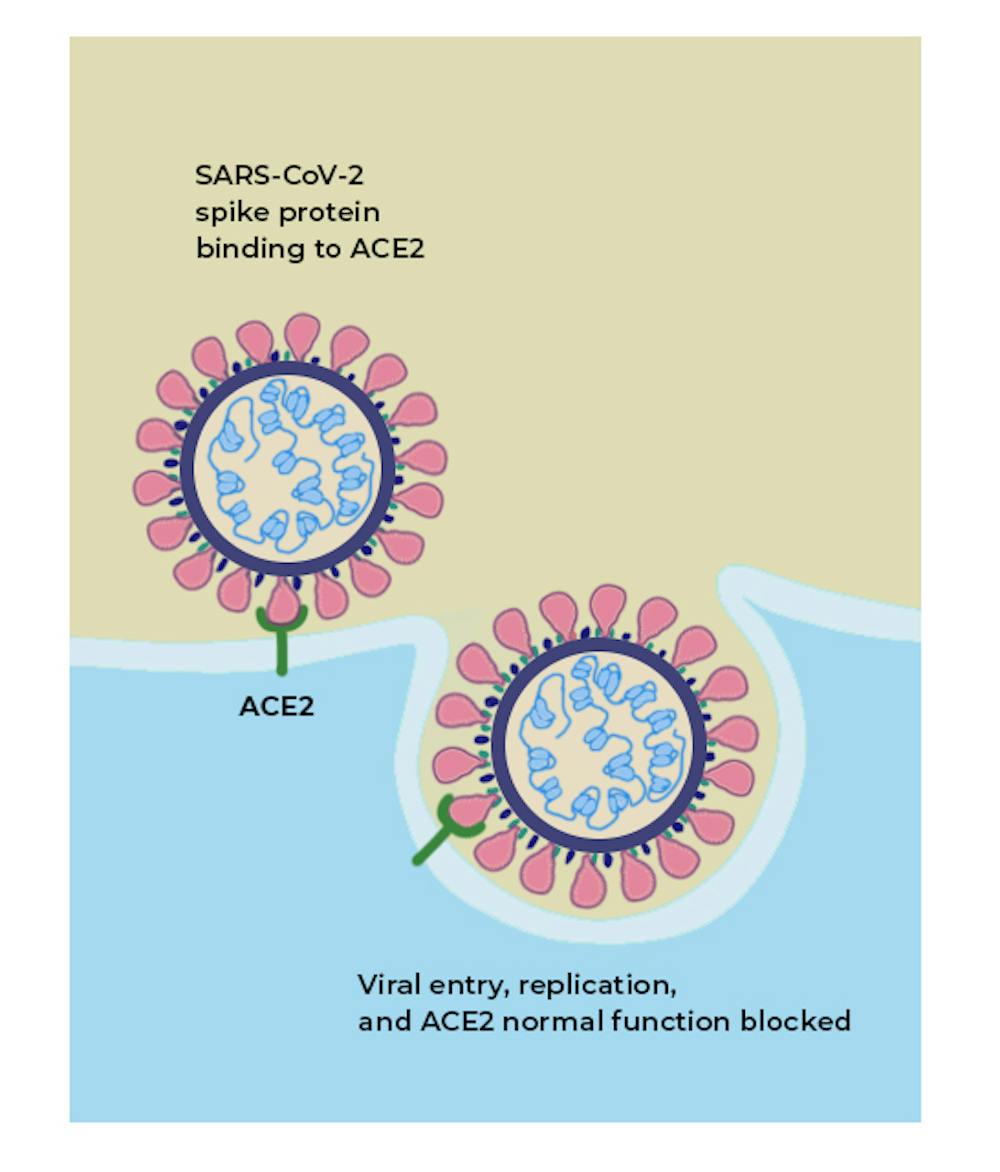
ACE2 acts as the receptor for the SARS-CoV-2 virus and allows it to infect the cell.
ACE2 is a protein on the surface of many cell types. It is an enzyme that generates small proteins – by cutting up the larger protein angiotensinogen – that then go on to regulate functions in the cell.
Using the spike-like protein on its surface, the SARS-CoV-2 virus binds to ACE2 – like a key being inserted into a lock – prior to entry and infection of cells. Hence, ACE2 acts as a cellular doorway – a receptor – for the virus that causes COVID-19.
Where in the body is it found?
ACE2 is present in many cell types and tissues including the lungs, heart, blood vessels, kidneys, liver and gastrointestinal tract. It is present in epithelial cells, which line certain tissues and create protective barriers.
The exchange of oxygen and carbon dioxide between the lungs and blood vessels occurs across this epithelial lining in the lung. ACE2 is present in epithelium in the nose, mouth and lungs. In the lungs, ACE2 is highly abundant on type 2 pneumocytes, an important cell type present in chambers within the lung called alveoli, where oxygen is absorbed and waste carbon dioxide is released.
What is the normal role ACE2 plays in the body?
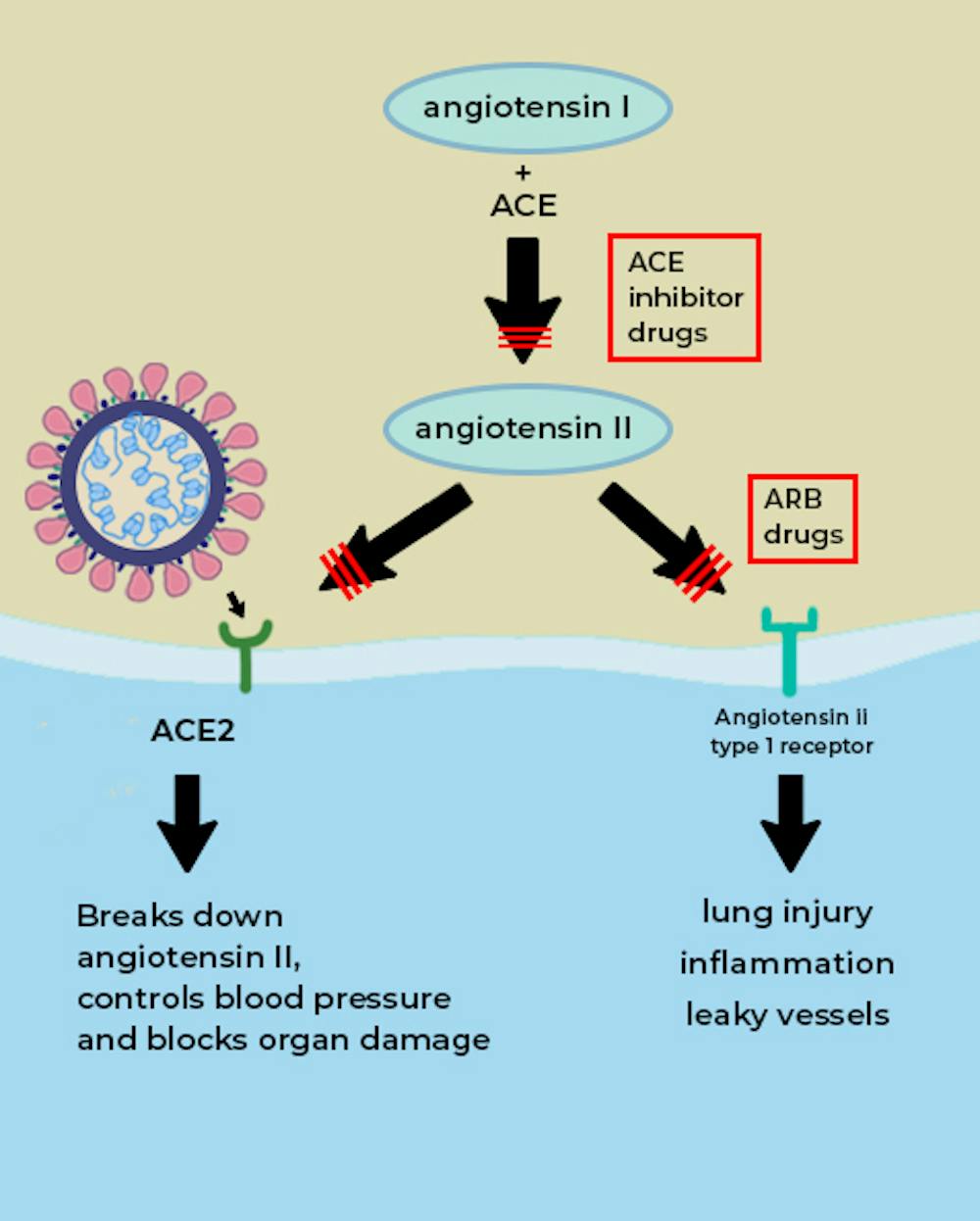
The ACE enzyme converts angiotensin I into angiotensin II. The main role of ACE2 is to break down angiotensin II into molecules that counteract angiotensin II’s harmful effects; but if the virus occupies the ACE2 ‘receptor’ on the surface of cells, then its role is blunted (red lines). Drugs called ACE inhibitors inhibit the formation of angiotensin II, which would otherwise interact with the angiotensin type 1 receptor to produce tissue damage and inflammation. Drugs called ARBs block angiotensin II from interacting with its receptor. Figure adapted from NEJM
ACE2 is a vital element in a biochemical pathway that is critical to regulating processes such as blood pressure, wound healing and inflammation, called the renin-angiotensin-aldosterone system (RAAS) pathway.
ACE2 helps modulate the many activities of a protein called angiotensin II (ANG II) that increases blood pressure and inflammation, increasing damage to blood vessel linings and various types of tissue injury. ACE2 converts ANG II to other molecules that counteract the effects of ANG II.
Of greatest relevance to COVID-19, ANG II can increase inflammation and the death of cells in the alveoli which are critical for bringing oxygen into the body; these harmful effects of ANG II are reduced by ACE2.
When the SARS-CoV-2 virus binds to ACE2, it prevents ACE2 from performing its normal function to regulate ANG II signaling. Thus, ACE2 action is “inhibited,” removing the brakes from ANG II signaling and making more ANG II available to injure tissues. This “decreased braking” likely contributes to injury, especially to the lungs and heart, in COVID-19 patients.
Does everyone have the same number of ACE2 on their cells?
No. ACE2 is present in all people but the quantity can vary among individuals and in different tissues and cells. Some evidence suggests that ACE2 may be higher in patients with hypertension, diabetes and coronary heart disease. Studies have found that a lack of ACE2 (in mice) is associated with severe tissue injury in the heart, lungs and other tissue types.
Does the quantity of receptors determine whether someone gets more or less sick?
This is unclear. The SARS-CoV-2 virus requires ACE2 to infect cells but the precise relationship between ACE2 levels, viral infectivity and severity of infection are not well understood.
Even so, aside from its ability to bind the SARS-CoV-2 virus, ACE2 has protective effects against tissue injury, by mitigating the pathological effects of ANG II.
When the amount of ACE2 is reduced because the virus is occupying the receptor, individuals may be more susceptible to severe illness from COVID-19. That is because enough ACE2 is available to facilitate viral entry but the decrease in available ACE2 contributes to more ANG II-mediated injury. In particular, reducing ACE2 will increase susceptibility to inflammation, cell death and organ failure, especially in the heart and the lung.
Which organs are most severely damaged by SARS-CoV-2?
The lungs are the primary site of injury by SARS-CoV-2 infection, which causes COVID-19. The virus reaches the lungs after entry in the nose or mouth.
ANG II drives lung injury. If there is a decrease in ACE2 activity (because the virus is binding to it), then ACE2 can’t break down the ANG II protein, which means there is more of it to cause inflammation and damage in the body.
The virus also impacts other tissues that express ACE2, including the heart, where damage and inflammation (myocarditis) can occur. The kidneys, liver and digestive tract can also be injured. Blood vessels may also be a site for damage.
In a recent research paper, we argued that a key factor that determines severity of damage in patients with COVID-19 is abnormally high ANG II activity.
What are ACE inhibitors? Are they a possible treatment or prophylactic for SARS-CoV-2?
Angiotensin converting enzyme (ACE, aka ACE1) is another protein, also found in tissues such as the lung and heart, where ACE2 is present. Drugs that inhibit the actions of ACE1 are called ACE inhibitors. Examples of these drugs are ramipril, lisinopril, and enalapril. These drugs block the actions of ACE1 but not ACE2. ACE1 drives the production of ANG II. In effect, ACE1 and ACE2 have a “yin-yang” relationship; ACE1 increases the amount of ANG II, whereas ACE2 reduces ANG II.
By inhibiting ACE1, ACE inhibitors reduce the levels of ANG II and its ability to increase blood pressure and tissue injury. ACE inhibitors are commonly prescribed for patients with hypertension, heart failure and kidney disease.
Another commonly prescribed class of drugs, angiotensin receptor blockers (ARBs, e.g., losartan, valsartan, etc.) have similar effects to ACE inhibitors and may also be useful in treating COVID-19.
No evidence exists to suggest prophylactic use of these drugs; we do not advise readers to take these drugs in the hopes that they will prevent COVID-19. We wish to emphasize that patients should only take these drugs as instructed by their health care provider.
New clinical trial tests ACE inhibitor against SARS-CoV-2
In collaboration with a multidisciplinary group of investigators, Dr. Loomba has initiated a multicenter (randomized, double-blinded, placebo-controlled) clinical trial to examine the efficacy of ramipril - an ACE inhibitor - compared to a placebo in reducing mortality, ICU admission or need for mechanical ventilation in patients with COVID-19.




 AFP / Kenzo Tribouillard
  AFP / Kenzo Tribouillard
  AFP / Kenzo Tribouillard
  AFP / Kenzo Tribouillard
  AFP / Kenzo Tribouillard
  AFP / Pierre-Henry DESHAYES
  SCANPIX NORWAY/AFP/File / STORLØKKEN, AAGE
  AFP/File / Odd ANDERSEN
  AFP / STR
  AFP / Johannes EISELE
  AFP / ALFREDO ESTRELLA
  AFP / Martin BUREAU
  AFP / MICHAEL DANTAS
  AFP / Brendan Smialowski
  AFP / FAJRIN RAHARJO
  AFP / MOHAMMED HUWAIS
  AFP / Phill Magakoe
  AFP / John SAEKI
  AFP / Alren BERONIO