Swedish teen activist Greta Thunberg said Tuesday that US President Donald Trump's climate change denialism was "so extreme" that it had helped galvanize the movement to halt long term planetary warming.
She spoke in an interview with AFP on the eve of her departure from North America where she has spent almost three months.
"He's so extreme and he says so extreme things, so I think people wake up by that in a way," the 16-year-old said from on board a sailboat preparing to depart from the East Coast town of Hampton, Virginia for Europe early Wednesday.
"I thought when he got elected, now people will finally, now people must finally wake up," she continued.
"Because it feels like if we just continue like now, nothing's going to happen. So maybe he is helping."
A young Australian couple have volunteered to aid her in her return journey.
Elayna Carausu, 26, and Riley Whitelum 35, live on their catamaran with their 11-month-old boy and document their adventures on social media, and responded to Greta's appeal for help with an environmentally friendly return trip to Europe.
They had originally planned to spend the winter in the United States but will now carry Greta and her father Svante Thunberg on their 14-meter (45 feet) catamaran, "La Vagabonde."
After months of campaigning in the US and Canada, including an appearance at a key UN climate summit in September, which was the reason for her visit, she offered a lukewarm assessment on the impact.
"It depends," she said, in her usual matter-of-fact way of speaking.
"In one way, lots of things have changed, and lots of things have moved in the right direction, but also in a sense we have, we have gone a few more months without real action being taken and without people realizing the emergency we are in," said the high-schooler, who will return to her education next year.
The trip itself should last two to three weeks, depending on weather conditions. The young couple and their son Lenny (who has his own Instagram account) and the Thunbergs will be joined by professional British sailor Nikki Henderson who was called to lend a hand.
Their destination is Portugal, some 5,500 kilometers (3,400 miles) away, in order to participate in the COP 25 UN climate summit in Madrid, Spain from December 2 to December 13.
The venue was originally in Chile but was shifted because of political unrest, forcing Greta to change her travel plans.
"If I get to the COP 25 in time, then I will participate in that, because I have received an invitation to do so," she said, wearing a windbreaker emblazoned with the words "Unite for Science."
President Donald Trump withdrew from Syria abruptly and against the advice of those on the ground in the region. It left American Kurdish allies high-and-dry as Turkey began a bombing campaign against them.
Russian Minister of Foreign Affairs Sergey Lavrov mocked Trump for the move and then his bizarre decision to go back into Syria "for the oil."
Trump was ultimately schooled by his Pentagon officials who explained that any money from the oil would go to the Syrian Democratic Forces.
"They tried to negotiate and then said, 'Okay we cannot reach the deal so Kurds you are on our own. We are leaving,'" Lavrov said of Trump's negotiations. "Then after they left the Kurds and left Syria, they said, 'Okay, we don’t have any more obligations in front of the Kurds. But we are coming back for oil.' Not for the Kurds. It’s an interesting zigzagging, you know."
Trump once praised the program. Today he drew closer to being allowed to kill it.
The five conservative U.S. Supreme Court justices – including two installed by President Donald Trump – appear ready to allow the nation's chief executive to kill the DACA program that protects 700,000 to 800,000 Dreamers. The program, started by President Barack Obama, offers work authorizations and protections from deportation for those who were brought to America as children and have not known any other land as home for nearly their entire lives.
The New York Times reports that the Supreme Court's four liberal justices during oral arguments Tuesday appeared to focus on the president's motivation for ending DACA, officially the Deferred Action for Childhood Arrivals program.
The court's five conservatives appeared more inclined to not question the president's motivations, ignoring the fact that intent is central to many acts, including those that are or could be criminal.
Noting that DACA "has broad, bipartisan support," the Times reports that in earlier in his tenure Trump "praised the program’s goals and suggested he wanted to preserve it."
In contrast, President Trump earlier Tuesday posted a tweet that includes a lie:
In reality, one of the stipulations of the DACA program is that enrollees cannot have been convicted of crimes.
The court is expected to hand down a ruling next spring.
"Does the U.S. provide mental health services for separated families who ask to be deported in order to reunite?"
The U.S. held a record 69,550 migrant children in detention facilities in 2019, a Tuesday report from The Associated Press and PBS Frontline found, leading to major psychological and physiscal harm and lasting trauma.
"No other country held as many immigrant children in detention over the past year as the United States—69,550," said AP tech reporter Frank Bajak in a tweet promoting his colleagues' work. "The physical and emotional scars are profound."
The story lays out in excrutiating detail the emotional pain of victims of President Donald Trump's child separation policy, focusing on, among others, a Honduran father whose three-year-old daughter can no longer look at him or connect with him after being separated at the U.S. border and abused in foster care.
"I think about this trauma staying with her too, because the trauma has remained with me and still hasn't faded," the father told AP.
The 3-year-old Honduran girl was taken from her father when immigration officials caught them near the border in Texas in March 2019 and sent her to government-funded foster care. The father had no idea where his daughter was for three panicked weeks. It was another month before a caregiver put her on the phone but the girl, who turned four in government custody, refused to speak, screaming in anger.
"She said that I had left her alone and she was crying," said her father during an interview with the AP and Frontline at their home in Honduras. "'I don't love you Daddy, you left me alone,'" she told him. The father agreed to speak about their case on condition of anonymity for safety reasons.
The AP/Frontline report also includes testimony from a number of teenagers who told their own harrowing tales.
"We can't allow this cruelty to continue," Texas immigrant rights group RAICES said on Twitter.
The number of children held by the U.S. in 2019 exceeded that of any other country.
"Donald Trump is a record setting president," tweeted Rep. Judy Chu (D-Calif.), a frequent critic of the administration's immigration policies.
In a statement, Families Belong Together chair Jess Morales Rocketto decried the abusive policies.
"The U.S. threw 70,000 children into cages under Donald Trump's administration, detaining more children than any other country in the world," said Rocketto.
Taken altogether, the children in U.S. detention this year could fit into a football field.
The Department of Health and Human Services (HHS) Office of Refugee Resettlement is responsible for the welfare of the children.
In a statement, HHS spokesperson Mark Weber said that those concerned over the White House policies "must give credit to the Office of Refugee Resettlement and the shelter network staff for managing a program that was able to rapidly expand and unify the largest number of kids ever, all in an incredibly difficult environment."
But critics of the White House and HHS pointed out that the treatment of children by the administration as reported prompts questions on abuse and called for Congressional action to end the policy.
"Thousands have been traumatized, ripped away from their families, and at least six children have died preventable deaths in custody—all while the government lawyers argued they weren't worthy of soap or toothbrushes," said Families Together's Rocketto. "They cannot be trusted with the welfare of children and families—Congress must act to end these abuses immediately."
NBC News reporter Leigh Ann Caldwell wondered if the U.S. would take any responsibility for the grave harm it is doing to the victims of its border policies.
"My question," tweeted Caldwell. "Does the U.S. provide mental health services for separated families who ask to be deported in order to reunite?"
When Apollo 11 landed on the Moon, it was a giant leap for mankind and a huge success for American engineering, but there was one aspect of the mission that hadn’t really gone as planned. When Neil Armstrong manually guided the lunar module to a safe touchdown, he had to override the computer which had the craft landing in a field of boulders. It left the demonstration of precision automated guidance to Apollo 12.
Fifty years ago this month, Apollo 12 successfully landed within a few hundred meters of its target, 400,000 kilometers (248,500 miles) away from where it lifted off. A key figure responsible for that precision landing was an unassuming Englishman living in the Arizona desert, Ewen Whitaker. Without the aid of computers or GPS, but with patience and an exhaustive knowledge of the geography of the Moon, Whitaker pinpointed where a robotic spacecraft had landed two years earlier.
As a scientist interested in the chronology of events on the Moon, I ultimately found myself analyzing rocks that had been brought back from the Moon by Apollo 12, working in a laboratory that Whitaker had helped establish. And even though Whitaker retired within months of my arrival in Tucson, it was a delight to get to know him and learn the stories of his quiet heroics.
The genesis of a lunar expert
Whitaker had long been fascinated by the Moon, and when pioneering planetary scientist Gerard Kuiper put out a request for collaborators at an international astronomical gathering in Dublin in 1956, Whitaker was the only one who responded. He went to join Kuiper at Yerkes Observatory in Wisconsin, then accompanied the group when it relocated to the University of Arizona and founded the Lunar and Planetary Laboratory.
As the group produced progressively better images and maps of the Moon, Whitaker absorbed the details with a devotion that meant that he almost certainly knew more lunar geography than any human ever had.
When NASA’s Surveyor 1 became the first robotic spacecraft to perform a soft landing on the Moon, in 1966, Whitaker wasn’t officially part of the team. But when the team studied the images from Surveyor 1’s camera, and published the location where they thought they had landed, Whitaker disagreed. When he examined the images of the peaks and craters and compared them to the highest-resolution images of the Moon’s surface available, he concluded the spacecraft was actually a few kilometers away from the published location. The team agreed.
After Apollo 11’s hair-raising final seconds before touchdown, precision landing became a high priority for Apollo 12. But the challenge was to establish the exact location of anything on a body that humans were just beginning to explore. A subsequent Surveyor mission provided the images Whitaker needed.
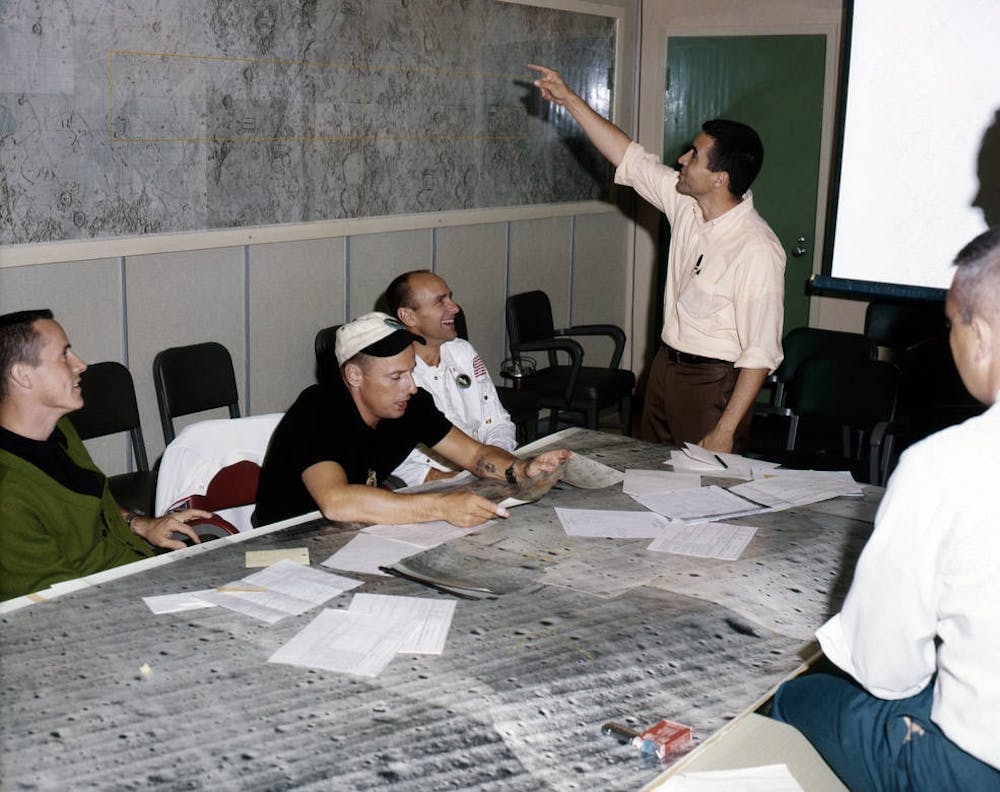
Left: Apollo 12 astronauts Pete Conrad (second from left, wearing white cap) and Alan Bean during final geology training. Astronauts Hoot Gibson (left) who served as capsule communicator during the Moon walks, and Harrison Schmitt (right), the only geologist astronaut.
NASA had landed the Surveyor 3 unmanned craft in 1967, and the location had several advantages for an Apollo 12 landing site. It was clearly an area where a spacecraft could safely land; it was near the equator, which made it easily accessible. And, if the landing was close enough to Surveyor 3, the astronauts could walk over and remove pieces of it to bring back to Earth. That way, scientists could study the wear and tear on the materials after spending two years on the lunar surface, exposed to vacuum, extreme temperatures, ionizing radiation and micrometeorite bombardment.
Given Whitaker’s success with locating Surveyor 1, he was asked to locate precisely Surveyor 3. It was a tougher task than finding Surveyor 1. Because Surveyor 3 had landed in a crater, the view was restricted, but Whitaker again poured over the best images he could find, and believed he had found the landing site.
Apollo 12 launched on November 14, 1969, and, other than being struck by lightning twice within the first minute after it lifted off, had an uneventful trip to the Moon. On November 19, the landing module, Intrepid, headed into a crater and safely touched down. When Mission Commander Pete Conrad stepped out onto the lunar surface, he saw Surveyor 3, about 200 meters away. Ewen Whitaker had gotten it right.
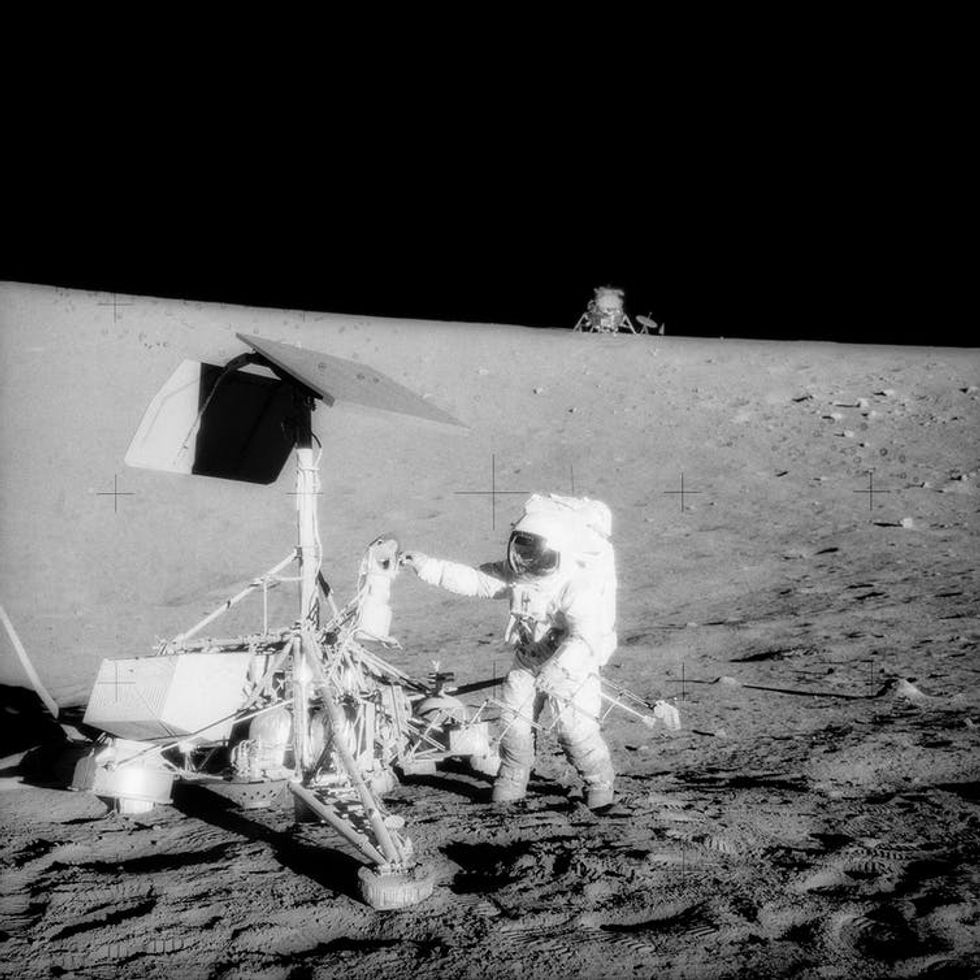
Conrad and fellow astronaut Alan Bean walked to the unmanned spacecraft, and some of the iconic images from the mission are of Conrad working on the Surveyor craft, including taking off its camera, which was returned to Earth for analysis.
Astronaut Pete Conrad examines the camera on Surveyor 3, with the Apollo 12 spacecraft in the background.
NASA
One of the ironies of that set of images is that the photographer, Bean, later became a very successful painter, with many of his paintings reflecting his lunar experiences, including the visit to Surveyor 3. Meanwhile, the astronauts sent a personal note to Whitaker, thanking him for his contributions, and that became one of Ewen’s prized possessions, framed and hanging on the wall of his house.
But the story of Whitaker and Bean wasn’t quite over. In the late 1990s, Bean was displaying artwork at a gallery in Tucson, and Whitaker went to see if he could meet him. Jim Scotti, an astronomer (in the Lunar and Planetary Lab) and space artist who knew both Whitaker and Bean, was at the meeting, and said that it seemed more like a reunion than a first meeting, with a happy mix of Whitaker’s English accent and Bean’s Texas twang.
And why not? For each of them, that day in November of 1969 had been the highlight of their professional careers, and neither could have done it without the other.
Dutch police have arrested a man who threatened in a social media post to blow himself up over plans to sideline "Black Pete", a Christmas-time character provoking accusations of racist stereotyping.
The arrest is the latest controversy over the country's traditional Saint Nicholas side kick, portrayed in winter parades and by many Dutch children with a black face, thick red lips, woolly hair and a golden earring.
"A 49-year-old man from The Hague was arrested Monday afternoon after he threatened to blow himself up in support of the Saint Nicholas tradition," police said in a statement.
"The suspect made a comment on Facebook over the weekend, which led to a lot of social unrest."
Prosecutors examined the comment and decided to arrest the man at his home on Monday but did not find any explosives. He will appear before a judge on Thursday.
"The man in a statement admitted he posted the comment and that he was sorry, after seeing the reaction it created," they added.
Police said several other supporters and opponents of the character -- known as Zwarte Piet in Dutch -- had recently "made strong statements back and forth" on social media but that "as long as no criminal limit is exceeded, everyone can give their opinion".
The arrest is the latest in an increasingly bitter dispute between those who see Black Pete as a harmless children's character and those who say it is a throwback to slavery and racist oppression.
Dutch police arrested five men on Friday after angry pro-Black Pete protesters threw rocks and fireworks at a meeting of a group called "Kick Out Zwarte Piet".
Police will also be on alert on Saturday when Saint Nicholas makes his traditional arrival in the central Dutch city of Apeldoorn.
The parade will for the first time feature no traditional Black Petes, only so-called "Sooty Petes" with dark marks on their faces said to be the result of crawling down the chimney.
In 2015 a UN committee said the character sometimes reflected "negative stereotypes" and was seen as "a vestige of slavery" by many people.
Many Dutch have grown up with the tradition and children often dress as Black Pete as they await December 6, when their shoes are filled with chocolate -- an act of generosity attributed to the saint.
Plato, one of the earliest thinkers and writers about democracy, predicted that letting people govern themselves would eventually lead the masses to support the rule of tyrants.
When I tell my college-level philosophy students that in about 380 B.C. he asked “does not tyranny spring from democracy,” they’re sometimes surprised, thinking it’s a shocking connection.
But looking at the modern political world, it seems much less far-fetched to me now. In democratic nations like Turkey, the U.K., Hungary, Brazil and the U.S., anti-elite demagogues are riding a wave of populism fueled by nationalist pride. It is a sign that liberal constraints on democracy are weakening.
To philosophers, the term “liberalism” means something different than it does in partisan U.S. politics. Liberalism as a philosophy prioritizes the protection of individual rights, including freedom of thought, religion and lifestyle, against mass opinion and abuses of government power.
What went wrong in Athens?
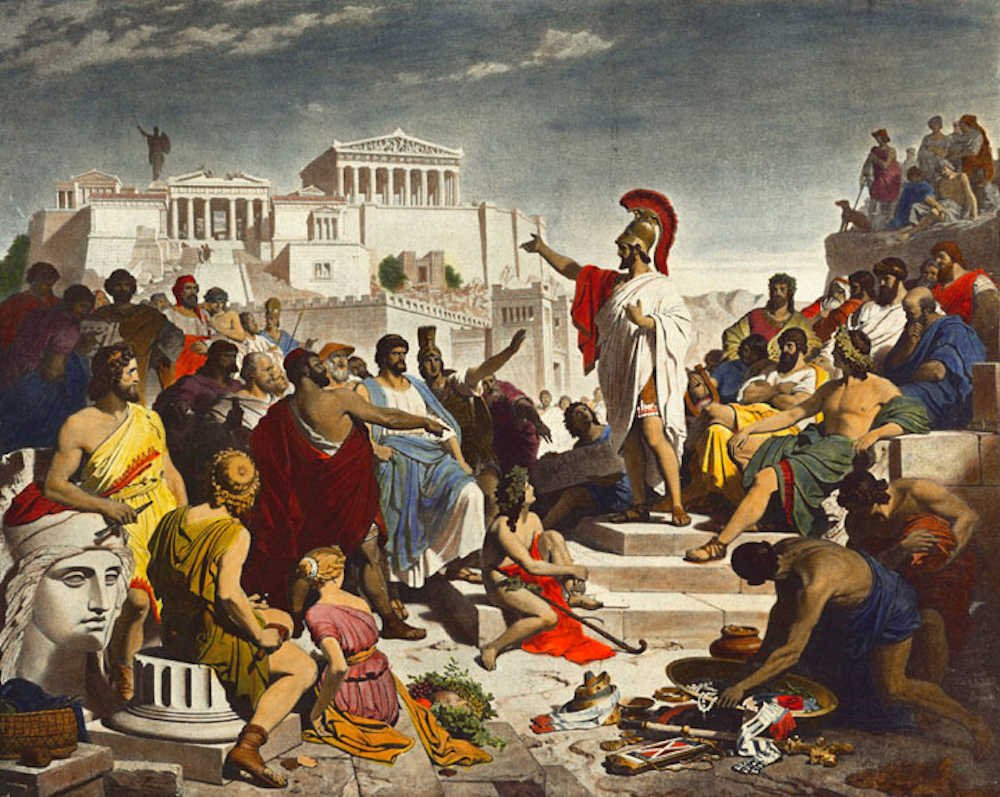
In classical Athens, the birthplace of democracy, the democratic assembly was an arena filled with rhetoric unconstrained by any commitment to facts or truth. So far, so familiar.
Aristotle and his students had not yet formalized the basic concepts and principles of logic, so those who sought influence learned from sophists, teachers of rhetoric who focused on controlling the audience’s emotions rather than influencing their logical thinking.
There lay the trap: Power belonged to anyone who could harness the collective will of the citizens directly by appealing to their emotions rather than using evidence and facts to change their minds.
In his “History of the Peloponnesian War,” the Greek historian Thucydides provides an example of how the Athenian statesman Pericles, who was elected democratically and not considered a tyrant, was nonetheless able to manipulate the Athenian citizenry:
“Whenever he sensed that arrogance was making them more confident than the situation merited, he would say something to strike fear into their hearts; and when on the other hand he saw them fearful without good reason, he restored their confidence again. So it came about that what was in name a democracy was in practice government by the foremost man.”
Misleading speech is the essential element of despots, because despots need the support of the people. Demagogues’ manipulation of the Athenian people left a legacy of instability, bloodshed and genocidal warfare, described in Thucydides’ history.
That record is why Socrates – before being sentenced to death by democratic vote – chastised the Athenian democracy for its elevation of popular opinion at the expense of truth. Greece’s bloody history is also why Plato associated democracy with tyranny in Book VIII of “The Republic.” It was a democracy without constraint against the worst impulses of the majority.
Chinese President Xi Jinping on Tuesday urged Britain to return the Parthenon Marbles to Greece, wading into a decades-old dispute between the countries over the ownership of the sculptures.
The ancient friezes, which include depictions of battles between mythical ancient Greeks and centaurs, were taken by British diplomat Lord Elgin in the early 19th century and are now on display at the British Museum in London.
Britain has always refused to return the carvings -- often still known as the Elgin Marbles -- arguing that they were taken with the permission of local Ottoman rulers at the time.
Xi toured the Acropolis Museum, built partly to house the Parthenon Marbles, during a three-day visit to Athens and told his hosts he agreed with them that the sculptures should be returned.
"I assure you of our support, because we also have many Chinese cultural works outside our country that we are trying to recover," Xi said on the last day of his official visit.
Greece has been campaigning for three decades for their return, arguing that the Ottoman empire was an occupying force and any permission granted during its time is not valid.
Athens had once considered suing Britain over the issue, an action reportedly championed by lawyer Amal Clooney.
But in recent years the Greek government has taken a more diplomatic route, asking the UN's cultural agency UNESCO to mediate, an offer rejected by the British Museum.
Prime Minister Kyriakos Mitsotakis, elected in July, made an official request for the loan of marbles for the 200th anniversary celebrations of Greek independence in 2021.
The British Museum has said it would examine any request from Greece to borrow exhibits.
Poland has complained to Netflix that a Holocaust documentary series on Nazi German death camps "rewrites history" by featuring an "incorrect" map.
Prime Minister Mateusz Morawiecki called on the popular US streaming and production website to correct the "terrible mistake" that he believed had been "committed unintentionally".
A Netflix consultant in Poland who only identified herself as Malgorzata told AFP on Tuesday the company was "treating the issue as a priority" and that its headquarters would soon issue an official statement.
"Netflix did not intend to offend anyone or compromise any values," she added.
The Auschwitz memorial museum also tweeted that historical and geographical information in the Netflix documentary about the locations of Nazi death camps was "simply wrong".
A map featured in "The Devil Next Door" documentary wrongly shows death camps built by Nazi Germany during World War II inside the borders of modern-day Poland that were established only after the end of the war.
In reality, Nazi Germany set up the camps inside territory it occupied following its September 1939 invasion and takeover of Poland.
"Not only is the map incorrect, but it deceives viewers into believing that Poland was responsible for establishing and maintaining the camps, and for committing crimes therein," Morawiecki said in the letter to Netflix boss Reed Hastings posted on his official Facebook page on Monday.
"As my country did not even exist at that time as an independent state, and millions of Poles were murdered at these sites, this element of 'The Devil Next Door' is nothing short of rewriting history," he said.
The map in question appears in a documentary focused on retired US autoworker John Demjanjuk, convicted in a landmark 2011 German court ruling for serving as a guard at the Nazi German Sobibor camp in occupied Poland.
Poland suffered some of the worst horrors of World War II: nearly six million Poles died in the conflict that killed more than 50 million people overall.
That figure includes the six million Jews who died in the Holocaust, half of them Polish.
Sexually-charged letters between James Bond creator Ian Fleming and his wife Ann were put up for auction on Tuesday, part of a collection of correspondence that also charts the success of his 007 books.
They couple first met in 1934, when Ann was married to her first husband, but they did not tie the knot until 1952 -- the year Fleming wrote "Casino Royale", his first novel about the fictional super spy.
The letters reveal the intensity of their relationship, particularly before they married.
In one, Ann wrote to ask Fleming to "put me in your bed with a raw cowhide whip in my hand so as I can keep you well behaved for forty years".
The collection contains more than 160 letters written by both of them, estimated at £200,000-£300,000 (233,000-350,000 euros, $260,000-$385,000) ahead of the December 3-10 sale.
Gabriel Heaton, books and manuscripts specialist at Sotheby's auction house, said the correspondence offered an "unmatched record" of Fleming's life and career.
- 'Outlet for libido and imagination' -
The letters begin when he was working in intelligence during World War II, cover his journalism and the creation of Bond, including time spent writing at his Goldeneye estate in Jamaica.
"James Bond was very much a product of Ian and Ann's relationship," Heaton said.
"It is no coincidence that Ian wrote his first Bond novel in the same year they married, both as an outlet for his libido and imagination, and also in an attempt to make money for a woman who was used to being unthinkingly rich."
The letters reveal the couple's heartache at the death of their daughter at just a few hours old, born while Ann was married to her second husband, newspaper magnate Viscount Rothermere.
"I have nothing to say to comfort you. After all this travail and pain it is bitter. I can only send you my arms and my love and all my prayers," Fleming wrote to her.
They later had a son, Caspar, an event Fleming celebrated by buying a golden typewriter.
Their correspondence describes a life of glamour and privilege but also, as the years progress, an increasing bitterness in their life together.
"You mention 'bad old bachelor days' -- the only person you stopped sleeping with when they ceased was me!" Ann complained in one letter.
Fleming also describes the extraordinary process of writing a Bond book a year.
"I have written a third of it in one week -- a chapter a day. I expect I shall get stuck soon but to date it does well & interests me," he wrote of what would become "From Russia, with Love".
"The first half is about Russia & that has always interested me. They have decided to murder Bond. A beautiful spy called Titania Romanova is about to appear. Coo er!"
"The Trump administration has cast aside the pretext of calling for new elections. Now it's praising Evo Morales' resignation at the barrel of a gun."
U.S. President Donald Trump made official his administration's support for the military coup in Bolivia with a celebratory statement late Monday that one observer said "reads like a chilling warning of more coups to come."
"The United States applauds the Bolivian people for demanding freedom and the Bolivian military for abiding by its oath to protect not just a single person, but Bolivia's constitution," Trump said in a statement posted to the White House website.
"These events send a strong signal to the illegitimate regimes in Venezuela and Nicaragua that democracy and the will of the people will always prevail," Trump added. "We are now one step closer to a completely democratic, prosperous, and free Western Hemisphere."
The governments of Nicaragua and Venezuela—both victims of past U.S.-backed military coups—have condemned the ouster of Morales in Bolivia.
The Trump administration has not been quiet about its desire for the removal of Bolivia's socialist President Evo Morales, who resigned Sunday under threat from the nation's military, police forces, and violent right-wing protesters.
Hours before Morales resigned in a televised address, U.S. Secretary of State Mike Pompeo tweeted his support for the findings of the U.S.-dominated Organization of American States (OAS), which alleged Morales' victory in the October presidential election was riddled with fraud. Pompeo also echoed OAS' call for new elections, a demand Morales accepted shortly before he was forced aside.
Guillaume Long, senior policy analyst Center for Economic and Policy Research (CEPR) and co-author of recent analysis of the October election, disputed the OAS findings in a statement last week, arguing "there is simply no statistical or evidentiary basis to dispute the vote count results showing that Evo Morales won in the first round."
Following Morales' resignation, "the Trump administration has cast aside the pretext of calling for new elections," tweeted journalist Dan Cohen. "Now it's praising Evo Morales' resignation at the barrel of a gun."
"In the parlance of American empire," Cohen said, "a military coup is considered an expression of democracy."
CEPR co-director Mark Weisbrot tweeted late Monday that Trump's statement in support of the coup in Bolivia is "no surprise."
"The Trump/[Sen. Marco] Rubio team has been helping the coup all along," Weisbrot said. "But his statement, like his 'I like oil, we're keeping the oil," in Syria, is embarrassingly blunt and also menacing."
Trump's applause for the coup in Bolivia came as the Mexican government granted asylum to Morales, who tweeted Monday night that he is leaving Bolivia amid concerns for his safety.
"I am leaving for Mexico, grateful for the openness of these brothers who offered us asylum," said Morales. "Soon I will return with more strength and energy."
Hillary Clinton said Tuesday it was "shameful" that the British government had not published a delayed parliamentary report into possible Russian interference in British politics ahead of December elections.
British Prime Minister Boris Johnson's government has previously rejected claims it was suppressing the report to avoid a scandal ahead of next month's snap poll.
"Every person who votes in this country deserves to see that report before your election happens," the defeated US presidential candidate told BBC Radio 4 during a book tour.
Clinton said there was "no doubt" that Russia is "determined to try to shape the politics of western democracies".
"Not to our benefit, but to theirs," said the Democrat, who lost the 2016 US election to President Donald Trump in a race that US intelligence chiefs have said was marred by Russian interference.
"I find it inexplicable that your government will not release a government report about Russian influence. Inexplicable and shameful," she told BBC Radio 5 Live.
Britain's parliament was previously told a report by the Intelligence and Security Committee was sent to the prime minister for approval on October 17.
The probe into suspected Russian covert actions in Britain's democratic process reportedly includes examining whether Moscow tried to interfere with the 2016 Brexit vote and the 2017 general election.
Moscow has been accused of spearheading sophisticated disinformation campaigns around the world to further its interests.
The Intelligence and Security Committee, which oversees the work of the country's intelligence agencies, submits its reports to the government before publication to avoid the inadvertent release of sensitive information.
A former head of domestic spy agency MI5 and the committee's chairman have suggested Johnson is stalling on the release of the 50-page report with the December 12 general election looming.
Jonathan Evans, head of MI5 from 2007 to 2013, called on the government to explain the delay.
Foreign Office minister Chris Pincher has previously said that the report is going through "an intensive security review".
Pincher has also played down concerns, saying there is "no evidence" to suggest there has been any successful Russian involvement in the British electoral system.
More than 50 people, mostly children, were injured by a man who broke into a kindergarten in southwest China and sprayed them with corrosive liquid, local authorities said Tuesday.
The suspect, a 23-year-old surnamed Kong, entered the kindergarten by climbing a wall before spraying victims with sodium hydroxide, said local authorities in Kaiyuan city, Yunnan province.
The attack took place on Monday at 3:35 pm (0735 GMT), authorities said on their Twitter-like Weibo account.
Some 51 children and three teachers were admitted to hospital for treatment, two with "severe symptoms".
Police arrested Kong less than an hour after the attack.
"Because his parents divorced during his childhood, the lack of family warmth resulted in psychological distortion," said local authorities, adding that Zhang's work and life were unsatisfactory as well.
All this created a "pessimistic mentality and thoughts about retaliating against society", they said.
Violent attacks targeting schoolchildren are not uncommon in China, which has seen a slew of deadly incidents over the past few years -- usually involving knives.
In April last year, a 28-year-old man killed nine middle-school students as they were returning home in one of the country's deadliest knife attacks in recent years.
The killer, who said he had been bullied when he attended the school in northern China's Shaanxi province, was executed in September last year.
Later in 2018, a knife-wielding woman injured 14 children at a kindergarten in Sichuan province.
The 39-year-old assailant slashed students while they were returning to the classroom after morning exercises.