The United Nations is running a deficit of $230 million, Secretary General Antonio Guterres said on Monday, and may run out of money by the end of October.
In a letter intended for the 37,000 employees at the UN secretariat and obtained by AFP, Guterres said unspecified "additional stop-gap measures" would have to be taken to ensure salaries and entitlements are paid.
"Member States have paid only 70 per cent of the total amount needed for our regular budget operations in 2019. This translates into a cash shortage of $230 million at the end of September. We run the risk of depleting our backup liquidity reserves by the end of the month," he wrote.
To cut costs, Guterres mentioned postponing conferences and meetings and reducing services, while also restricting official travel to only essential activities and taking measures to save energy.
Guterres had asked member states earlier this year to up contributions to the world body to head off cash flow problems, but they refused, a UN official said on condition of anonymity.
"The ultimate responsibility for our financial health lies with Member States," Guterres said.
Not including what it pays for peacekeeping operations, the UN's operating budget for 2018-2019 is close to $5.4 billion, with the United States contributing 22 percent.
The creators of "South Park" have issued a mock apology to China after censors scrubbed their popular animation from the Chinese web.
The tongue-in-cheek statement, skewering Beijing's demands that western brands conform to its world view, came with officials apparently annoyed about an episode that crossed several of the Communist Party's red lines.
The episode -- called "Band in China" -- depicted forced labour at a Chinese prison, and parodied companies that cave-in to censorship for commercial gain.
"I can't sell my soul like this," says one character, who was under pressure from Chinese censors to rewrite his music.
"It's not worth living in a world where China controls my country's art," he added.
The incident comes as the NBA and its Houston Rockets franchise are facing fierce criticism and financial punishment in China over a tweet supporting Hong Kong's democracy protesters.
Both the league and the team have scrambled to apologise over the tweet by Rockets' general manager Daryl Morey, as calls for a boycott gather steam in one of the NBA's most lucrative markets.
But the apologies have sparked derision in the United States, where critics said the league was sacrificing morals for money.
Writing on Twitter, "South Park" creators Trey Parker and Matt Stone offered spoof contrition over any offence they had caused in China with their satirical show.
"Like the NBA, we welcome the Chinese censors into our homes and into our hearts," they wrote.
"We too love money more than freedom and democracy. Xi doesn’t look just like Winnie the Pooh at all," the statement added, a reference to banned memes comparing Chinese President Xi Jinping with AA Milne's portly bear.
"Long live the Great Communist Party of China! May this autumn's sorghum harvest be bountiful! We good now China?" the statement read.
On Tuesday, searches for "South Park" on China's Twitter-like social media platform Weibo and popular film review site Douban did not return any results.
And while information on South Park was still available on a few video streaming sites, episodes could not be played.
Parker and Stone's response to China stands in stark contrast to that of major Western brands who have quickly beaten a retreat when faced with potential losses in China's huge -- and fiercely nationalistic -- consumer market.
Companies ranging from airlines to fashion houses have issued fulsome apologies, often after being charged with "hurting the feelings of the Chinese people".
As well as any indication of support for protests in Hong Kong, common crimes include labelling Taiwan as a separate country -- China believes it is a renegade province -- or discussing Xinjiang, where rights groups say a million mostly-Muslim minorities are being held in prison camps.
Three researchers from the United States and Britain on Monday shared the Nobel Medicine Prize for research into how human cells sense and adapt to changing oxygen levels, opening up new strategies to fight such diseases as cancer and anaemia.
Americans William Kaelin and Gregg Semenza, and Britain's Peter Ratcliffe, split the nine million Swedish kronor ($914,000, 833,000 euros) award.
While the fact that humans need oxygen to survive has been understood for centuries, how the body registers and responds to oxygen was little known prior to the trio's pioneering work.
AFP / Andrew CABALLERO-REYNOLDS Gregg Semenza speaks at the John Hopkins School of medicine after winning the 2019 Nobel Medicine Prize for Hypoxia discovery in Baltimore, Maryland
Semenza studied a gene known as EPO which causes the body to create more red blood cells and isolated the specific DNA segments that help it to adapt to low oxygen levels.
Ratcliffe and Semenza then applied this knowledge to show that the oxygen sensing mechanism was present in virtually all human tissues.
Kaelin identified another gene, present in patients with a genetic disorder that puts them at far greater risk of certain cancers. The gene rewires the body's ability to prevent the onset of cancer, and it plays a key role in how cancer cells respond to low oxygen levels.
Their work has shed new light on the specific, cell-level processes the body undergoes when low on oxygen -- from helping our muscles function during exercise to adapting to life at high altitude.
Cells' oxygen-sensing ability is also essential during foetal development and in creating new blood vessels.
- Drugs being developed -
A large number of diseases are linked to EPO, including renal failure and severe anaemia.
Cancerous tumours use the body's oxygen-regulating tools to hijack blood vessel formation and allow the cancer cells to spread. The Nobel committee said Monday that several trials were underway developing drugs to interrupt this process, potentially short-circuiting tumour growth.
Oxford University/AFP / HO British scientist Peter Ratcliffe said he was writing a grant proposal when he learned of the award
For treatment of anaemia -- where the body lacks sufficient red blood cells to carry enough oxygen to tissues -- medicines seek to stimulate EPO creation. One such drug has already been approved in China.
This essentially tricks the body into thinking it is at higher altitude, prompting the creation of new red blood cells.
Kaelin, 61, works at the Dana-Farber Cancer Institute in Boston and is a professor at Harvard Medical School in the United States.
Semenza, 63, is director of the Vascular Research Program at the Johns Hopkins Institute for Cell Engineering.
Ratcliffe, 65, is director of clinical research at the Francis Crick Institute in London, and director of the Target Discovery Institute in Oxford.
AFP / JOSEPH PREZIOSO When the phone rang at 4:50 am, William Kaelin wasn't sure if he was dreaming, but when he picked it up he saw a long string of digits indicating an international call
Kaelin told reporters it was a moment he had dreamt of for a long time. "I think any scientist who says he's never or she's never considered this moment is probably lying," he said.
When the phone rang at around 5:00 am, he wasn't sure if he was dreaming.
He then noticed the caller ID was from Europe, "And at that point my heart started racing," the 61-year-old told AFP.
"I sort of had this out-of-body feeling of just great appreciation," he said, adding he was accepting the prize partly on behalf of his late wife Carolyn, a cancer surgeon.
Semenza on the other hand missed the first call he got, and waited several anxious minutes by the phone, answering it second time around.
"I was in a daze," he said, adding he had not been expecting the honor but had since celebrated with champagne.
- Discovery science -
AFP / Kun TIAN The winners of the Nobel prize for medicine from 2013-2019
Kaelin said the win highlighted the value of basic research, rather than setting out to cure a specific disease.
"Here I am as a cancer biologist helping to contribute to a new drug for haematological condition, namely anaemia," he told AFP.
Semenza, whose first breakthrough came in 1995, told AFP that the Nobel prize created the false impression that great science was done by older people, when the opposite was in fact true.
"We made the discoveries when we were young, but we get recognised when we're old," he said, adding it was younger scientists at his lab driving cutting-edge work.
The Peace Prize will be awarded in Oslo on Friday, with speculation rife that Swedish teenage activist Greta Thunberg could win for her campaign to raise awareness about climate change.
Before that, the Physics Prize will be announced on Tuesday and the Chemistry Prize on Wednesday.
On Thursday, the Swedish Academy will announce one literature laureate for 2018 and one for 2019, after postponing last year's award due to a sexual harassment scandal that exposed deep rifts among its 18 members.
The announcement of the Economics Prize will wrap things up on Monday, October 14.
It is a song close to French hearts, the building power of its defiant march swelling chests and bringing a tear to the eye.
But the "Song of the Partisans" -- the hymn of the French Resistance which moves most French people more than their bellicose national anthem "La Marseillaise" -- was in fact written over a pot of tea in London by a group of Russians.
For years the authorities were content to quietly perpetuate the myth that the song had sprung from the brave hearts of fighters who had taken to the "maquis" and the mountains to resist the German occupiers during World War II.
Indeed the Free French forces of General Charles de Gaulle ordered that the names of its true authors be hushed up, a new exhibition on the song in Paris shows.
"If people realised that it had been written in London over tea and sandwiches it wouldn't quite have had the same ring nor credibility," said curator Lionel Dardenne.
In fact, the music was written by a young White Russian aristocrat named Anna Betoulinsky who worked in the Free French canteen in the British capital.
She later became Anna Marly after plucking her stage name from a telephone directory.
- BBC hit -
It was only after her "Guerrilla Song" had aired on the BBC that Marly -- who grew up on the French Riviera after fleeing Saint Petersburg when her father was murdered by the Bolsheviks -- was persuaded to adapt it for her adopted homeland.
In one of the many historical ironies that surround the stirring ballad, she actually wrote the original version in Russian to celebrate the sacrifice of Soviet partisans who had slowed Hitler's advance on Moscow.
But it was the French version that was later included in the repertoire of the Red Army Choir.
Indeed, its lyrics were mostly written by another Russian, Joseph Kessel, whose family moved to France when he was also a child.
A heroic pilot in both the world wars, the journalist went on to write "Belle de Jour" and the "Army of Shadows" -- a bleak, unromantic portrait of the Resistance -- both of which were made into classic films.
In a further irony, the song was taken up by Ho Chi Minh's Viet Minh in their struggle to free Vietnam from its French and later American overlords.
Supporters of French Algeria, whose armed wing tried to assassinate Marly and Kessel's hero De Gaulle on several occasions, also adopted it.
It also very nearly became the national anthem of South Korea.
Dardenne said a large part of the song's appeal rests on its "perceived authenticity... and on the belief which still persists that it was written anonymously and came up from the depths of the Resistance."
- Blurred origins -
Even though it is a central part of many official French commemoration ceremonies, "most people don't really know where it comes from", he added.
Such is its power and malleability that it exists simultaneously as an official anthem and a protest song, with the French "yellow vest" protest movement reclaiming it and changing the lyrics to urge President Emmanuel Macron to listen to the people.
Dardenne said it was the Resistance leader Emmanuel d'Astier de la Vigerie who, after rewriting parts of song himself, insisted on its real authorship being blurred.
Neither Marly nor Kessel -- who believed that "a people without songs is a people who cannot fight" -- objected given there was a war to be won, the curator added.
However, over time their roles became further eclipsed because "the 'Song of the Partisans' is deeply anchored in people's hearts because people think that it comes from the maquis."
Marly in particular suffered, Dardenne said, despite the fact that her companion song, "The Complaint of the Partisan" which she wrote with Astier de la Vigerie, was taken up and re-recorded by Leonard Cohen in 1969 as "The Partisan".
"She never quite had the fame that she would have wanted," Dardenne said. She died in a Russian Orthodox monastery in Alaska in 2006.
A Japanese exhibition of censored art works reopens Tuesday two months after it was forced to close following threats over a controversial South Korean statue of a wartime sex slave.
The Aichi Triennale 2019 show, featuring the statue of a girl in traditional Korean clothes sitting on a chair, was shut down in early August just three days after it opened.
It reopens later Tuesday -- with the controversial figure on display -- after new safety measures were put in place, with guides and educational programmes also offered to visitors, organisers said.
The exhibition was dedicated to showing works that were censored elsewhere and was originally scheduled to run for 75 days.
But it sparked controversy with the inclusion of the statue, at a time when relations between Japan and South Korea have plunged to new lows over wartime issues.
The central government has pulled subsidies for the exhibition, claiming Aichi prefecture failed to provide full information in advance.
The reopening comes with less than a week remaining of the art festival.
"It is very regrettable that displays of some artists' works are cancelled. I want to complete this Aichi Triennale, one of the biggest art festivals in Japan, in an amicable way," Aichi Governor Hideaki Omura said late Monday.
The girl's statue symbolises the sex slaves -- sometimes referred to as "comfort women" -- who were forced to work in wartime Japanese military brothels during World War II.
Omura, who heads the organisers, said in August they received a number of threatening emails, phone calls, and faxes about the exhibition.
Mainstream historians say up to 200,000 women -- mostly from Korea, but also other parts of Asia including China -- were forced to work in Japanese military brothels.
Activists have in recent years set up dozens of statues in public venues around the world, many of them in South Korea, in honour of the victims.
The statues have drawn Tokyo's ire, which has pressed for the removal of one outside its Seoul embassy.
In recent months, bilateral relations between Japan and South Korea have frayed over a long-running dispute on the use of forced labour during World War II.
The two sides have rescinded each other's favoured export partner statuses, and Seoul announced it would scrap an agreement to share sensitive military information.
U.S. House Committee on Foreign Affairs Chairman Eliot Engel called a withdrawal “reckless,” and noted, “American withdrawal would only benefit Russia.”
As President Donald Trump was being denounced from all political sides—both domestically and on the international stage—for his decision to rapidly withdraw troops from northeast Syria, reporting on Monday indicated Turkey has already launched bombing raids across the border in order to target the very Kurdish forces which long acted as key coalition allies and foot soldiers against the Islamic State (ISIS).
Turkish forces carried out attacks against Kurdish forces and the anti-Assad Syrian Democratic Forces militia in Syria and Iraq near the Turkish border on Monday evening.
Turkish forces attacked SDF positions in the city of al-Malikiyah in the Hasakah area in northern Syria, according to Syrian state news agency SANA.
The SDF includes Kurds and others in eastern Syria which the US has helped train, assist and advise during the war on ISIS.
Earlier in the day, Turkey President Recep Tayyip Erdoğan, who urged Trump to withdrawal American troops from the region, had warned that military action might come swiftly.
"We have made a decision," Erdoğan told reporters before leaving the country on his way to Serbia. "We said 'one night we could come suddenly.' We continue our determination."
While the Turkish government continues to treat Kurdish elements in Syria and Iraq—both the SDF and the Kurdistan Workers' Party (PKK)—as terrorists organizations, both have been instrumental in fighting ISIS in the region as they've also sought to exercise political autonomy despite the violence and instability that has beset the region since the 2003 invasion of Iraq and the later fracture in Syria that resulted in civil war.
"Turkey's unprovoked attack on our areas will have a negative impact on our fight against ISIS and the stability and peace we have created in the region in the recent years," said the SDF in a press statement. "As the Syrian Democratic Forces, we are determined to defend our land at all costs."
On the subject of Trump's decision and U.S. involvement, Amjed Osman, a spokesperson for the Syrian Democratic Council, said that "America's attitude will create a negative impact on the whole region, and what has been built up here, the peace and the stability in this region."
The decision to remove U.S. forces in this manner, Osman added, "will destroy all the advances, particularly with regards to security. We have always said that Erdoğan's threats are serious. There is no serious international will to bring an end to the Syrian crisis. The Turkish threats mean that the situation in this region will return to point zero. There will be chaos once again."
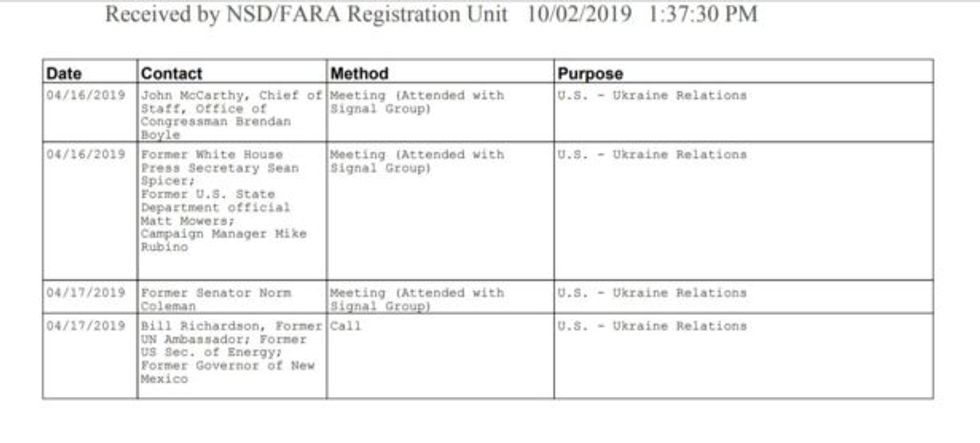
A U.S.-based attorney has been outed for spending over $100,000 to try and influence operations involving Ukrainian President Volodymyr Zelensky in an attempt to score a job in his administration.
According to the open-government site OpenSecrets, lawyer Marcus Cohen filed his report of his activities under the Foreign Agents Registration Act, revealing he reached out to Sean Spicer and another Trump campaign aides.
[caption id="attachment_1550815" align="aligncenter" width="615"] (Photo via screen capture of FARA disclosure)[/caption]
The new records show these previously unreported meetings along with the financial disclosure of over $100,000 lobbying to promote Zelensky’s interests in the United States ahead of his election and the now-famous July 25 phone call with President Donald Trump.
"Marcus Cohen, claims his advice focused on 'interactions with the U.S. government' in an 'effort to offer advice to a potential new administration in the Ukraine' on issues such as 'anti-corruption efforts,'" Open Secrets quoted. The language is remarkably similar to Trump's comments on the impeachment investigations into his deal with Zelensky to investigate former Vice President Joe Biden.
In the past, Cohen has said he was volunteering to help Zelensky "out of good will," but Zelensky has denied any links, saying he didn't even remember meeting Cohen.
The new filings show that isn't entirely accurate. Instead, his efforts were made “with the hope (but not expectation) that any eventual new Ukrainian administration might formally hire [Cohen] for a position within the Government,” Open Secrets quoted the filing.
"Despite his lack of notoriety, Cohen not only provided 'internal advice to the Zelensky campaign' but continued advising Zelensky’s representatives after his election, according to new FARA records," the site wrote.
Cohen said he's not getting money from Zelensky or his campaign, nor do they have a contract of any kind.
The Socialists won 36.6 percent of the vote with over 99 percent of stations reporting, followed by the center-right Social Democratic Party (PSD) on 27.9 percent, its worst result since 1983.
With the smaller conservative CDS-People's Party (CDS-PP) getting just 4.2 percent, the night was a serious reversal for Portugal's mainstream right.
On the left, the old-school Portuguese Communist Party (PCP) saw its support drop to a historic low of 6.5 percent and the Left Bloc, a media-savvy, urban-based party, confirmed its position as Portugal's third party, falling slightly to 9.7 percent.
The Iberian nation, noted Deutsche Welle, is "one of the few European countries where right-wing populists remain insignificant."
Voting information outlet Europe Elects broke down the figures:
The results mean that Costa now "needs to negotiate a new deal with one or both of his far-left allies in the previous legislature," as Reutersnoted.
Guardian columnist Owen Jones, in a tweet, suggested that voters were likely happy with the leftward shift the Social Party made in that previous legislature:
Ricardo Ferreira Reis, polling center director at Lisbon's Católica University, made a similar observation. "This result," he toldRTP television, "can be seen as a vote for a government led by the Socialist Party with parliamentary support or in coalition with other forces on the left."
European Council president Donald Tusk congratulated Costa on the win, saying his "electoral success comes at a challenging time for Europe and the world."
"European unity is more needed now than ever," Tusk continued, "and I trust that your government will continue playing a constructive role in the most relevant themes such as the climate emergency, trade conflicts, our multi-year budget, migration, the completion of the Economic and Monetary Union as well as Brexit."
As US forces pull back from parts of northern Syria and make way for a threatened Turkish military offensive, here is a recap of Washington's involvement in the Syrian conflict.
- Pressure on Assad -
On April 29, 2011, a month after the first protests in Syria that were met with brutal force by the regime, Washington imposes sanctions on several Syrian officials.
The measures extend to President Bashar al-Assad the following month.
On August 18, US president Barack Obama and Western allies for the first time explicitly call on Assad to stand down.
In October, the US ambassador leaves Syria for "security reasons". Damascus recalls its ambassador from Washington.
- Obama backs off 'red line' -
In August 2013, the Syrian regime is accused of carrying out a chemical attack near Damascus that killed more than 1,400 people, according to Washington.
Despite having vowed to act with force if Syria crossed the chemical weapons "red line", Obama at the last minute pulls back from punitive strikes on regime infrastructure.
Instead, on September 14, he agrees to a deal with Moscow -- Assad's main backer -- that is meant to dismantle Syria's chemical weapons arsenal.
- US targets IS -
On September 23, 2014, the US and Arab allies launch air strikes in Syria against the Islamic State (IS) group, expanding a campaign underway in neighbouring Iraq.
The biggest contributor to the coalition, Washington deploys 2,000 soldiers, mostly special forces.
In October 2015, the Syrian Democratic Forces (SDF), a Kurdish-Syrian Arab alliance of some 50,000 fighters, is created with US backing.
Dominated by the Kurdish People's Protection Units (YPG) militia, it receives US training and aid in the form of arms, air support and intelligence.
The SDF later overruns IS in northeastern Syria, driving out the jihadists from their last patch of territory in the village of Baghouz in March 2019.
On April 7, 2017, US forces fire a barrage of cruise missiles at Syria's Shayrat airbase, believed to be the launch site of a chemical attack that killed 88 people in Idlib province.
It is the first direct US action against Assad's government and President Donald Trump's most significant military decision since taking office in January 2017.
On April 14, 2018, the US -- with the support of France and Britain -- launches new retaliatory strikes after an alleged regime chemical attack on the then rebel-held town of Douma, in which some 40 people were killed.
- Withdrawal announced -
On December 19, 2018, Trump announces that all of the roughly 2,000 US troops in Syria will be withdrawn because IS had been "defeated".
The surprise decision prompts Defense Secretary James Mattis to resign and is met with concern by France, Britain and Germany, but praise from Russia and Turkey.
On January 16, 2019, a suicide attack claimed by IS kills four US servicemen and 15 others at a restaurant in Syria's northern city of Manbij.
It is the deadliest attack against US forces since they deployed.
On August 7, Turkish and US officials agree to jointly manage a buffer zone between the Turkish border and areas in Syria controlled by the YPG, which Istanbul considers a "terrorist" threat.
- US steps aside -
But on October 6, Washington announces that US forces would withdraw from the border areas to make way for a "long-planned operation" by Turkish forces.
The following day, President Recep Tayyip Erdogan confirms that Turkish action against Kurdish militants in Syria is imminent.
The United Nations says it is "preparing for the worst" and the European Union warns that civilians could be harmed.
Sen. Lindsey Graham (R-SC) on Monday vowed to take swift action in response to President Donald Trump's abrupt decision to abandon Kurdish allies by completely withdrawing American forces from Northern Syria.
In a tweet, Graham announced he was working with Sen. Chris Van Hollen (D-MD) on new legislation aimed at deterring Turkey from attacking Kurish forces in Syria after the American withdrawal.
"We will introduce bipartisan sanctions against Turkey if they invade Syria and will call for their suspension from NATO if they attack Kurdish forces who assisted the U.S. in the destruction of the ISIS Caliphate," Graham announced.
In a veiled shot at President Donald Trump, Graham also said that he hopes and expects "sanctions against Turkey -- if necessary -- would be veto-proof," meaning that Congress would have the votes to override the president's veto.
"This decision to abandon our Kurdish allies and turn Syria over to Russia, Iran, & Turkey will put every radical Islamist on steroids," Graham added. "Shot in the arm to the bad guys. Devastating for the good guys."
Graham has long been one of the president's most loyal defenders, but he has been unsparing in his criticism of Trump's decision to allow the Turkish government to invade Syria, where it has long wanted to conduct military operations against the Kurds.
Companies offer high payments and bring-a-friend bonuses to Mexicans who cross the border on temporary visas to donate blood plasma. The U.S. offers weaker health protections for donors than most countries.
Every week, thousands of Mexicans cross the border into the U.S. on temporary visas to sell their blood plasma to profit-making pharmaceutical companies that lure them with Facebook ads and colorful flyers promising hefty cash rewards.
The donors, including some who say the payments are their only income, may take home up to $400 a month if they donate twice a week and earn various incentives, including “buddy bonuses” for recruiting friends or family. Unlike other nations that limit or forbid paid plasma donations at a high frequency out of concern for donor health and quality control, the U.S. allows companies to pay donors and has comparatively loose standards for monitoring their health.
Donating plasma too frequently can hurt a donor’s immune system. A donor’s level of the antibody immunoglobulin G should be screened every four months under guidelines from the U.S. Food and Drug Administration. But in the U.S., donors are still allowed to give plasma up to 104 times a year, far more than in most other countries. Selling plasma has been banned in Mexico since 1987.
Genesis, a 21-year-old Mexican studying to be a paramedic, who asked that her last name not be used for her protection, said she gives plasma twice a week in El Paso, Texas. She said she often faints, gets migraines and has numbness in her limbs. The more she donates plasma, the weaker she feels. “I have trouble lifting stuff, problems with my muscles.”
The plasma companies contend their payments are not wages as defined under the law. They classify them as “compensation” for donor time, since the process often requires long waits and an hour or more hooked up to plasma extraction equipment.
“Plasma donors are compensated because of the time and commitment involved in being a regular plasma donor,” said the pharmaceutical company Grifols, which is based in Barcelona, Spain, and runs 17 plasma donation centers along the U.S.-Mexico border, more than any other company.
The companies also say they carefully monitor donors and follow all safety procedures. These flyers show that U.S.-based plasma centers accept Border Crossing Cards issued with temporary visas. The practice falls into a gray area of federal immigration law.
As the Trump administration clamps down on most traffic at the southern border, U.S. immigration agencies have done little to stop the stream of Mexicans using their B-1/B-2 visas to visit plasma centers. In interviews with ARD German TV, some former plasma center employees said they routinely recommended that clients lie to U.S. Customs and Border patrol about the purpose of their U.S. visits.
“If people are using a B-1/B-2 visa to cross the border to sell plasma, they could be putting that document at risk,” said Roger Maier, a spokesman for CBP, the agency that examines visas at the border. “We strongly encourage people to not use their documents for that capacity.”
Maier said agents “have a lot of discretion in our ability to allow people to enter the United States based on the documents they present.” Asked if the use of visitor visas to donate plasma violates the law, he said, “I’m sorry, it’s a gray area, but I can’t give you a yes or no.”
The U.S. State Department said later that the visa rules do not address “the legality of this specific purpose of travel.” The Department of Justice and the U.S. Attorney’s Office for the Western District of Texas, which includes El Paso, did not respond to requests for comment.
Blood plasma donors in the Talecris donation center in El Paso, Texas, a mile from the U.S.-Mexico border. (Thomas Bergmann/ARD)
The U.S. is the largest supplier of blood plasma in a $21 billion global market. FDA data shows that of the 805 plasma donation centers in the U.S., 43 are located along the southern border, up to 62 miles from Mexico.
The border clinics are the most productive, according to internal Grifols documents obtained by ARD. While most U.S. centers receive around 1,000 paid donations a week, centers at the border count more than 2,300. The documents show that border centers also rank highest in donor frequency; they top of list of centers with customers who donate 75 times or more per year.
Companies say they follow numerous safety precautions and seek new donors because they face a critical need as demand increases for lifesaving pharmaceutical products made from plasma, a yellowish fluid extracted from blood that contains antibodies that defend against disease.
The centers are mainly owned by Grifols, the Australia-based CSL and BPL, an emerging player headquartered in the U.K. U.S.-based GCAM Inc. has four centers along the southern border.
The FDA requires companies to monitor patient health before each donation. In some CSL centers, the payment amount depends on body weight, which determines how much blood plasma can be collected. Donors weighing between 110 and 149 pounds receive $20 per donation, while donors between 175 and 400 pounds earn up to $40. However, a person who doesn’t finish the donation for any reason doesn’t get paid.
Calculating the exact number of Mexican donors coming into the U.S. is difficult because the companies do not disclose this data to state or federal agencies. ARD German TV obtained two weeks of donation counts for all the Grifols facilities in the U.S. from earlier this year, including those along the Texas-Mexico border.
Grifols employees at five centers along the border, who requested anonymity to protect their jobs, estimated that Mexican citizens make up 60% to 90% of donors each day, depending on the facility.
Based on those estimates, nearly 10,000 Mexican citizens donated plasma at those five Grifols centers during each of the two weeks. Thirty-eight additional plasma donation centers operate in the border area.
Reporters from ARD German TV and Searchlight New Mexico, an investigative news organization, talked to more than 50 plasma donors from the Mexican cities of Ciudad Juárez, Nuevo Laredo, Reynosa, Nogales and Matamoros, and they found that most use their plasma payments to cover basic needs like food, electricity, diapers and clothes. A typical worker in Ciudad Juárez makes about $9 a day.
Genesis lives just across the border from El Paso. Selling blood plasma in the United States is her only income; she’s crossed the border twice a week for three years. Her father, Gamaliel, introduced her to making a living this way.
Genesis, like most Mexican plasma donors, relies on a B-1/B-2 temporary visa to gain entry. In July alone, the State Department issued or renewed 84,804 Border Crossing Cards for Mexican citizens.
Most donors interviewed by ARD and Searchlight said that they give CBP officials a reason for their trips that obscures the real purpose. Donors are anxious and uncertain, but willing to take the risk. “I understand it is not illegal,” Gamaliel said. “But, if you get to an officer in a bad mood, they could take your visa. So it’s better not to tell.” The 44-year-old fitness trainer runs his own gym in Ciudad Juárez, but he hardly makes $100 a month. For nine years, he’s donated twice a week to cover his and his youngest daughter’s basic needs.
Genesis said she tells CBP she’s visiting an aunt who lives in the U.S., but she rarely does so; instead, she goes directly to the lab. For the petite student, the moment right before crossing the border into El Paso is the most stressful. “I can never be sure. Who will be the officer on duty, what will they say or think. There’s always a chance they don’t believe you.”
The subterfuge is necessary because, at best, crossing into the U.S. to donate plasma for money falls into a questionable area of the law. While neither the State Department nor CBP calls plasma donation payments illegal, the law doesn’t define specifically if visa rules prohibit them. There haven’t yet been any investigations or prosecutions of plasma labs.
Potential liability for the pharmaceutical companies is even muddier. U.S. Citizenship and Immigration Services, which regulates legal immigration into the U.S., says that companies could be subject to charges if they engage in a “pattern or practice of knowingly hiring unauthorized aliens,” including people who are in the U.S. legally but not legally authorized to work.
The Plasma Protein Therapeutics Association, a trade organization representing for-profit plasma-producing pharmaceutical companies in North America and Europe, said in an email that donors are not employees of plasma centers and “only a person lawfully permitted to be in the United States can be accepted as a donor.”
A flyer in Spanish offers $300 for blood plasma. U.S.-based plasma centers accept Border Crossing Cards issued with temporary visas, a practice that falls into a gray area of federal immigration law. (Lauren Villagran/Searchlight New Mexico)
CSL and Grifols, the dominant companies at the U.S. border, declined interview requests but gave written statements. Grifols emphasized that “all donors, regardless of where they come from, must comply with all necessary health, regulatory and legal requirements to donate. There are no exceptions.” CSL said the company “complies with all laws in the countries in which we operate.”
BPL said in a statement it was “following all applicable guidelines that exist to promote the safety of both plasma donors and the patients who use plasma derived therapeutics.”
GCAM did not reply to a request for comment.
Grifols offers bonuses to lure donors. Only if donors give at the maximum frequency allowed by FDA they receive the full payment.
Blood and vaccines rank among the most valuable U.S. exports. In 2018, the U.S. collected 41 million liters of plasma intended for the production of medicine, and almost half of that was shipped abroad.
Around 78% of blood plasma exported from the U.S. ended up in Germany, Spain and Austria, where Grifols, CSL and others operate large high-tech plasma processing plants. A large portion of the drugs produced are then reimported and sold in the U.S.
There is little information about the long-term consequences of frequent plasma donations. Some scientists argue that a donor’s antibodies should be tested after every fifth donation, and some European countries like Germany require this. But the FDA in a statement defended its requirement that levels be checked every four months, saying, “We recognize that regulators in other countries may reach different regulatory conclusions even when considering the same data.”
Genesis keeps losing weight, leaving her perilously close to the 110-pound minimum required for donation. To avoid getting turned away at the clinics for being underweight, which has happened in the past, Genesis said she regularly fools the scales by putting water bottles in her pockets. Her trick has never been noticed.
When our reporters asked Genesis to get her blood levels examined, the lab results confirmed what Genesis felt. The test showed a dangerously low immunoglobulin G level. According to Paul Strengers of the International Plasma Fractionation Association, a trade group for not-for-profit collectors of blood plasma, the loss of antibodies can damage the immune system and lead to serious infections like pneumonia. The doctor who conducted the blood tests suggested that she stop donating plasma until her body is fully recovered. But, Genesis said, “stopping is a luxury I cannot afford.”
by Stefanie Dodt and Jan Lukas Strozyk, ARD German TV, and Dara Lind, ProPublica
Extinction Rebellion activists began gathering in cities across Australia and New Zealand on Monday to kick off a fortnight of global civil disobedience demanding governments take urgent action on climate change.
Protesters held a silent vigil on the steps of state parliament in Melbourne early Monday ahead of a march through the southern Australian city.
In Sydney, hundreds of protesters staged a sit-in on a busy inner-city road, while a small group of activists locked themselves to a bridge in Brisbane.
Meanwhile demonstrators shut down part of Wellington, New Zealand's capital, by chaining themselves to a bright pink car.
They were the start of planned disruptions in 60 cities around the world over the next two weeks by Extinction Rebellion, which is warning of a looming environmental "apocalypse".
Thousands are expected to join other events this week in Australia, including a bee die-off enactment, a nude parade and a funeral procession for the planet.
"We have tried petitions, lobbying and marches, and now time is running out," Australian activist Jane Morton said.
"We have no choice but to rebel until our government declares a climate and ecological emergency and takes the action that is required to save us."
Australia is ruled by a conservative government that has resisted taking comprehensive action to tackle climate change, while backing lucrative coal exports.
Prime Minister Scott Morrison last month snubbed a United Nations climate summit after he was not invited to speak because of his lack of new climate announcements.
"Our governments are lying to us about the state of the climate and ecological emergency," Melbourne-based climate activist Christine Canti told AFP.
"I have got four small young children and I want to be able to look them in the eye and tell them when I found out the extent and the severity of the crisis... I did absolutely everything within my power to be able to try and reverse that."
Extinction Rebellion's tactics in Australia have prompted senior conservative politicians to call for protesters' welfare payments to be cut and for public denunciations.
"People should take these names and the photos of these people and distribute them as far and wide as they can so that we shame these people," Australian Home Affairs Minister Peter Dutton said on radio last week, referring to the Extinction Rebellion protesters.
"Shame them because of the actions they have committed and because they're acting outside of the law and against community standards. Let their families know what you think of their behaviour."
In the northern Australian state of Queensland, home to huge coal mines and Dutton's electorate, harsher penalties are being considered in response to the regular disruption of peak-hour traffic.
- 'Burn capitalism, not petrol' -
Extinction Rebellion has scheduled non-violent protests chiefly in Europe, North America and Australia over the next fortnight.
Events will also be held in India, Buenos Aires and Cape Town.
An "opening ceremony" Sunday evening attracted hundreds of people to central London, where plans are in place to shut down key sites including Westminster and Lambeth bridges, in addition to protests outside key government departments.
Hundreds of activists barricaded themselves inside a Paris shopping centre for hours over the weekend, unfurling banners with slogans such as: "Burn capitalism, not petrol" above restaurants and fashion boutiques.
In Delhi, one of the world's most polluted cities, dozens of protesters staged another preliminary event on Sunday by holding a "die-in" on a road in the heart of India's capital.
Holding up hands covered in red paint and signs such as "There is no planet B", they called on the Indian government to act to tackle climate change.
"I don't know if I will have a future or not," Vansha Jain, 17, told AFP.
Extinction Rebellion was established last year in Britain by academics and has become one of the world's fastest-growing environmental movements.
Campaigners want governments to declare a climate and ecological emergency, reduce greenhouse gas emissions to zero by 2025, halt biodiversity loss and be led by new "citizens' assemblies" on climate and ecological justice.




 AFP / Andrew CABALLERO-REYNOLDS
  Oxford University/AFP / HO
  AFP / JOSEPH PREZIOSO
  AFP / Kun TIAN
  (Photo via screen capture of
