As the New York Stock Exchange closed at more than 800 points down on Wednesday, MSNBC host Nicolle Wallace remarked that the week has been catastrophic for President Donald Trump this week on every issue.
"The Dow closing over 800 points down today as Donald Trump's political weakness, foreign policy cluelessness and abdication of American leadership on the world stage is on full and stark display," Wallace opened.
She noted that the whole world is watching pro-democracy protesters in Hong Kong carrying American flags as they fight for what rights they have left. In any other administration, the world would be clear about where America stands. Instead, what's happened is ambiguity, confusion and general carelessness for Hong Kong.
Wallace called it the "kind of standoff America used to take as a clear stand on the side of pro-democracy forces. Today it's unclear where the American president comes down."
Lawmakers across Washington, including Trump's own advisers, are alarmed about the situation, but the president is golfing and on vacation. When he appeared in public Tuesday, Trump rambled on about loving trucks, being angry at former President Barack Obama for his book deal after leaving office and wind energy being somehow dangerous.
Wallace said that a former Republican Trump opponent became vulnerable the moment he revealed he didn't know what "the nuclear triad" was.
"[A]s violence escalates and old animosities are rekindled across Asia, Washington has chosen inaction, and governments are ignoring the Trump administration's mild admonitions and calls for calm," The New York Times wrote Wednesday. The inability or unwillingness of Washington to help defuse the flashpoints is one of the clearest signs yet of the erosion of American power and global influence under Mr. Trump, who has stuck to his 'America First' idea of disengagement, analysts say."
One administration official told Politico that the Hong Kong protests were "about as close to Tiananmen Square, potentially, that you're going to get in the modern age."
Trump, by contrast, called it a "very tricky situation," and said he hoped it ended with liberty. It's unclear if he knows what Tiananmen Square is.
"My, how far we've come from a 'Shining City on a hill,'" Wallace said, quoting former President Ronald Reagan.
Video and satellite images released this week show Chinese military troops massing near the border with Hong Kong. Is it just an exercise in intimidation or is there a real threat of a Chinese military intervention?
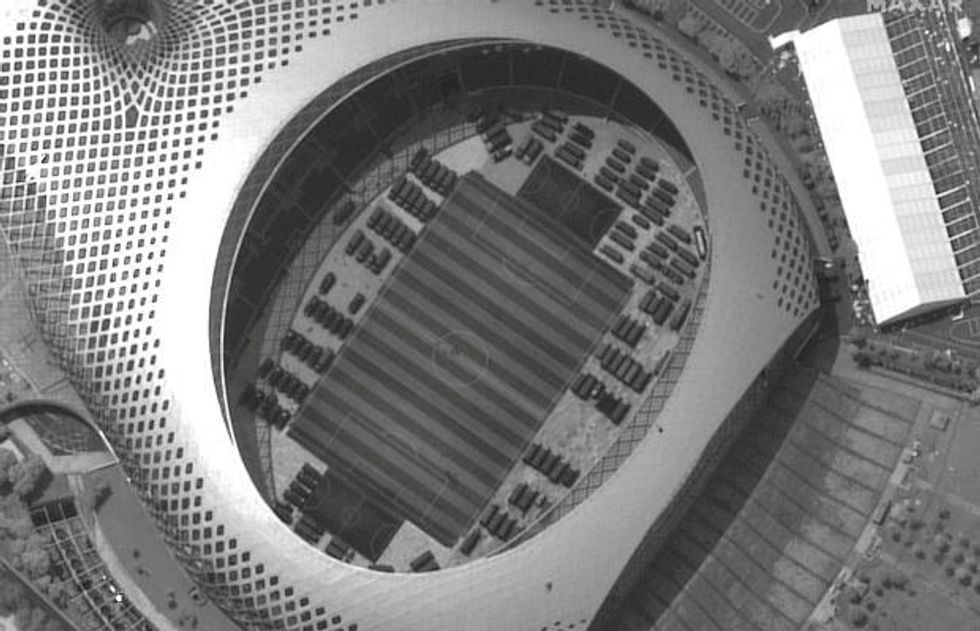
Armoured personnel carriers are seen, one after the other, rolling along a Chinese highway. Their apparent destination is a sports stadium in the city of Shenzhen, just across the bay from Hong Kong.
The video of what appears to be the deployment of Chinese military personnel to within miles of the Hong Kong border were published by Chinese state media earlier this week.
That was followed by satellite images, taken on Monday but released on Wednesday by US-based Maxar Technologies, showing what looked to be Chinese military vehicles parked inside the Shenzhen Bay Sports Centre, a 20,000-seat arena that once hosted a concert by English pop singer Jessie J, but may now be the staging post for a military operation by the People’s Liberation Army.
It is the latest sign that Beijing is prepared to take a more direct role in curtailing the ongoing pro-democracy protests in Hong Kong, or at least wants the main actors in those protests to believe it is willing to do so.
‘Psychological warfare’
State media claimed the troop movements were part of previously scheduled military drills, unrelated to events in Hong Kong.
Professor Steve Tsang, Director of the SOAS China Institute in London, says there is no doubt the release of the video was designed to deliver a message.
“It is clearly meant to intimidate people in Hong Kong and send a message that if the Hong Kong government can’t get things under control, they will intervene,” he told FRANCE 24.
Beijing has mostly watched from the sidelines as the protests in Hong Kong, triggered by a controversial extradition treaty with China amid a perceived general erosion of freedoms since the territory was handed back to China in 1997, have grown increasingly violent.
However, as the Hong Kong government led by Chief Executive Carrie Lam seems increasingly unable to quell the unrest, China has stepped up its rhetoric and issued what to some are veiled threats of more direct action.
On Wednesday, following violent clashes at Hong Kong's international airport, China's Hong Kong Liaison office compared the protesters to "terrorists”. Earlier this month, another slickly produced video was released by the PLA garrison in Hong Kong, showing armed troops undergoing “anti-riot” drills.
“Beijing probably thinks the images constitute the resolute backings Carrie Lam badly needs to restore order,” Dr Kenneth Chan, associate professor in political science at Hong Kong Baptist University, told FRANCE 24.
A satellite image appears to show a close up of Chinese military vehicles at Shenzhen Bay Sports Centre in China, close to the Hong Kong border.Maxar Technologies / Handout via Reuters
“Talks and images about the deployment of troops also serve as a typical communist-style psychological warfare to isolate and marginalise the more radical elements of the ongoing protest in Hong Kong,” added Chan, who is also a former Civic Party lawmaker in the Hong Kong legislature.
‘Not an empty threat’
Though Beijing’s goal may be primarily to intimidate, that does not mean it will not resort to military intervention if pushed to it, said Tsang.
“The Chinese would much prefer the protesters to simply go home. But if they think the authority of the Communist party is being challenged they will intervene,” he said.
“It is not an empty threat, it is a real threat.”
Escalating that threat is a potential flashpoint looming on the horizon.
October 1 will mark the 70th anniversary of the founding of the People’s Republic of China, a day set to be celebrated with much pomp and ceremony on the mainland. If demonstrators in Hong Kong mark the occasion by taking to the streets in full force, it could prove a provocation too far for Beijing.
If China does intervene, that could mean troops pouring across the border, and also the deployment of the PLA garrison in Hong Kong, estimated at between 8,000 to 10,000 troops, which until now has remained firmly in its barracks.
Under the “one country, two systems” principle in which Hong Kong is granted a certain amount of political autonomy by the mainland, the PLA garrison can only intervene if requested to do so by the Hong Kong government.
However, such is the influence now exerted by Beijing, this legal hurdle is a mere technicality, according to Tsang.
“If the Chinese government wants the Hong Kong executive to request an intervention, then they will request it,” he said. “If China does intervene they (the troops stationed in China and the Hong Kong garrison) will be deployed together.”
Resistance
For China, however, such a move is fraught with risk, and viewed by most experts as a last resort option for Beijing.
A military intervention would almost certainly be a death knell for the one country, two systems policy, marking a seismic shift in the geopolitical status quo in the region.
The international fallout, along with the risk to Hong Kong’s status as a business and finance hub, of such a move means Beijing is likely to explore other options first.
“The total subjugation of the city by brute force will be fatal to both the city’s global financial status and China’s international standing,” believes Chan.
There is also the question of the resistance Chinese troops could face among a Hong Kong populace that has continued to take to the streetsdespite an often bloody security crackdown.
“It is all speculation but if they send in troops it could all be over in 24 hours, but it may not, there may be pockets of resistance that keep going,” said Tsang.
“A lot will depend on how much violence Chinese troops use in Hong Kong and that we don’t know.
Many dream of what they would do had they a time machine. Some would travel 100 million years back in time, when dinosaurs roamed the Earth. Not many, though, would think of taking a telescope with them, and if, having done so, observe Saturn and its rings.
Whether our time-traveling astronomer would be able to observe Saturn’s rings is debatable. Have the rings, in some shape or form, existed since the beginnings of the solar system, 4.6 billion years ago, or are they a more recent addition? Had the rings even formed when the Chicxulub asteroid wiped out the dinosaurs?
I am a space scientist with a passion for teaching physics and astronomy, and Saturn’s rings have always fascinated me as they tell the story of how the eyes of humanity were opened to the wonders of our solar system and the cosmos.
Our view of Saturn evolves
When Galileo first observed Saturn through his telescope in 1610, he was still basking in the fame of discovering the four moons of Jupiter. But Saturn perplexed him. Peering at the planet through his telescope, it first looked to him as a planet with two very large moons, then as a lone planet, and then again through his newer telescope, in 1616, as a planet with arms or handles.
Four decades later, Christiaan Huygens first suggested that Saturn was a ringed planet, and what Galileo had seen were different views of Saturn’s rings. Because of the 27 degrees in the tilt of Saturn’s rotation axis relative to the plane of its orbit, the rings appear to tilt toward and away from Earth with the 29-year cycle of Saturn’s revolution about the Sun, giving humanity an ever-changing view of the rings.
But what were the rings made of? Were they solid disks as some suggested? Or were they made up of smaller particles? As more structure became apparent in the rings, as more gaps were found, and as the motion of the rings about Saturn was observed, astronomers realized that the rings were not solid, and were perhaps made up of a large number of moonlets, or small moons. At the same time, estimates for the thickness of the rings went from Sir William Herschel’s 300 miles in 1789, to Audouin Dollfus’ much more precise estimate of less than two miles in 1966.
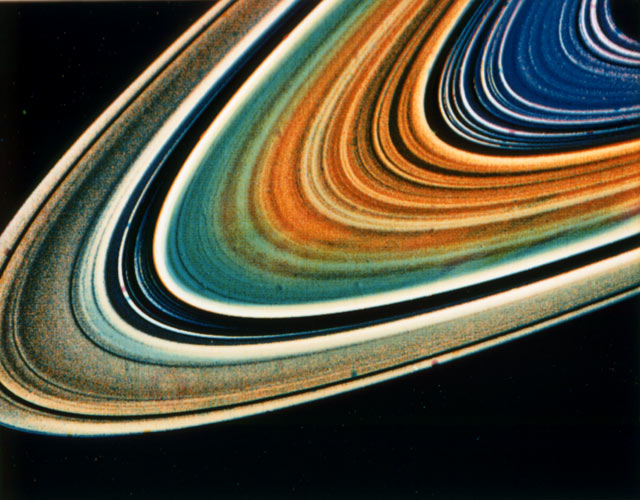
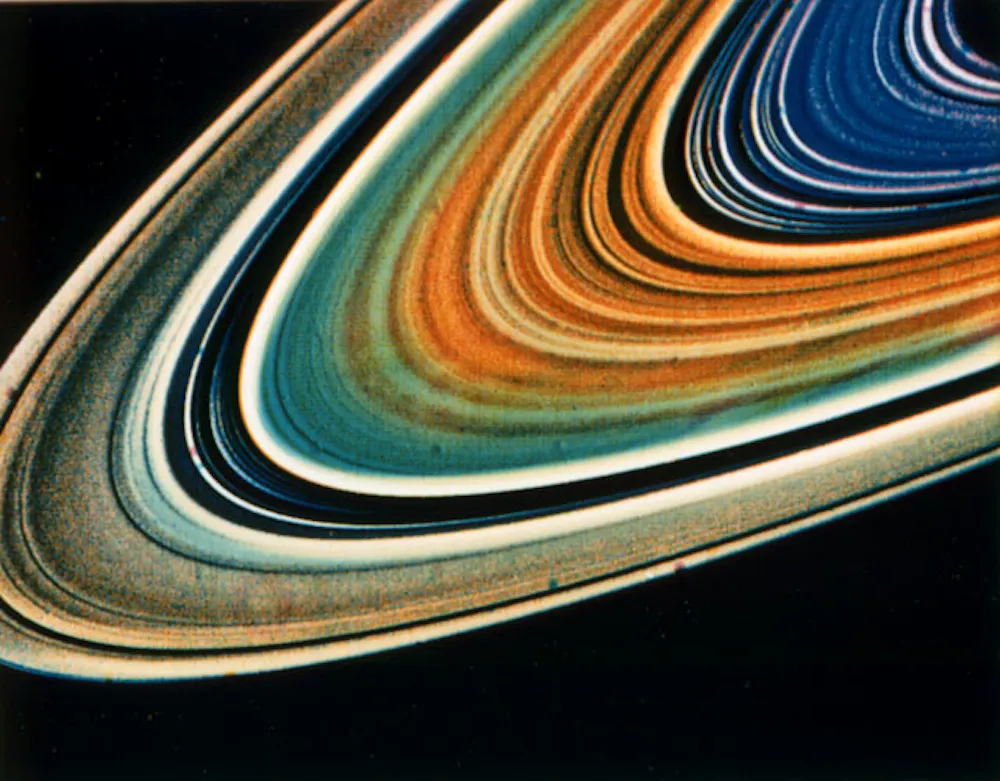
Astronomers understanding of the rings changed dramatically with the Pioneer 11 and twin Voyager missions to Saturn. Voyager’s now famous photograph of the rings, backlit by the Sun, showed for the first time that what appeared as the vast A, B and C rings in fact comprised millions of smaller ringlets.
Voyager 2 false color image of Saturn’s B and C rings showing many ringlets.
The Cassini mission to Saturn, having spent over a decade orbiting the ringed giant, gave planetary scientists even more spectacular and surprising views. The magnificent ring system of Saturn is between 10 meters and one kilometer thick. The combined mass of its particles, which are 99.8% ice and most of which are less than one meter in size, is about 16 quadrillion tons, less than 0.02% the mass of Earth’s Moon, and less than half the mass of Saturn’s moon Mimas. This has led some scientists to speculate whether the rings are a result of the breakup of one of Saturn’s moons or the capture and breakup of a stray comet.
The dynamic rings
In the four centuries since the invention of the telescope, rings have also been discovered around Jupiter, Uranus and Neptune, the giant planets of our solar system. The reason why the giant planets are adorned with rings and Earth and the other rocky planets are not was first proposed by Eduard Roche, a French astronomer in 1849.
A moon and its planet are always in a gravitational dance. Earth’s moon, by pulling on opposite sides of the Earth, causes the ocean tides. Tidal forces also affect planetary moons. If a moon ventures too close to a planet, these forces can overcome the gravitational “glue” holding the moon together and tear it apart.
This causes the moon to break up and spread along its original orbit, forming a ring.
The Roche limit, the minimum safe distance for a moon’s orbit, is approximately 2.5 times the planet’s radius from the planet’s center. For enormous Saturn, this is a distance of 87,000 kilometers above its cloud tops and matches the location of Saturn’s outer F ring. For Earth, this distance is less than 10,000 kilometers above its surface. An asteroid or comet would have to venture very close to the Earth to be torn apart by tidal forces and form a ring around the Earth. Our own Moon is a very safe 380,000 kilometers away.
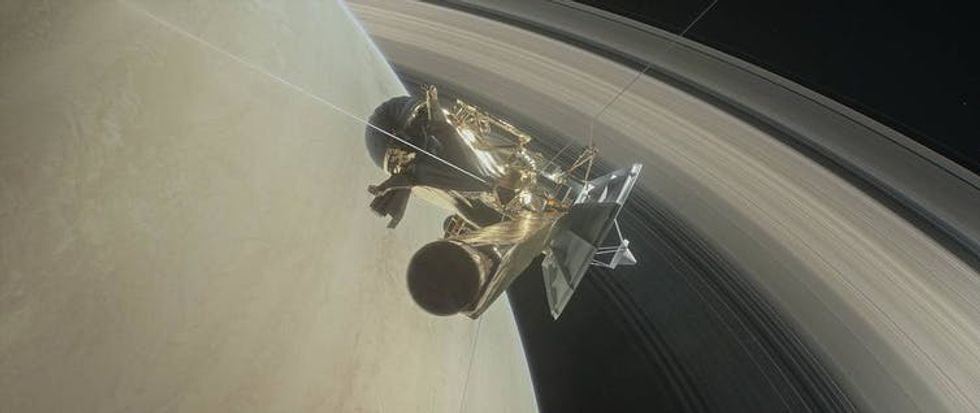
NASA’s Cassini spacecraft about to make one of its dives between Saturn and its innermost rings as part of the mission’s grand finale.
The thinness of planetary rings is caused by their ever-changing nature. A ring particle whose orbit is tilted with respect to the rest of the ring will eventually collide with other ring particles. In doing so, it will lose energy and settle into the plane of the ring. Over millions of years, all such errant particles either fall away or get in line, leaving only the very thin ring system people observe today.
During the last year of its mission, the Cassini spacecraft dived repeatedly through the 7,000 kilometer gap between the clouds of Saturn and its inner rings. These unprecedented observations made one fact very clear: The rings are constantly changing. Individual particles in the rings are continually jostled by each other. Ring particles are steadily raining down onto Saturn.
The shepherd moons Pan, Daphnis, Atlas, Pandora and Prometheus, measuring between eight and 130 kilometers across, quite literally shepherd the ring particles, keeping them in their present orbits. Density waves, caused by the motion of shepherd moons within the rings, jostle and reshape the rings. Small moonlets are forming from ring particles that coalesce together. All this indicates that the rings are ephemeral. Every second up to 40 tons of ice from the rings rain down on Saturn’s atmosphere. That means the rings may last only several tens to hundreds of millions of years.
Could a time-traveling astronomer have seen the rings 100 million years ago? One indicator for the age of the rings is their dustiness. Objects exposed to the dust permeating our solar system for long periods of time grow dustier and darker.
Saturn’s rings are extremely bright and dust-free, seeming to indicate that they formed anywhere from 10 to 100 million years ago, if astronomers’ understanding of how icy particles gather dust is correct. One thing is for certain. The rings our time-traveling astronaut would have seen would have looked very different from the way they do today.
This story has been corrected to reflect that it was Christiaan Huygens, not Giovanni Cassini, who first suggested that Saturn had rings.
An American trade pact with Britain is doomed if the latter's withdrawal from the EU undermines the Northern Ireland peace accord, US House Speaker Nancy Pelosi warned Wednesday.
"Whatever form it takes, Brexit cannot be allowed to imperil the Good Friday Agreement, including the seamless border between the Irish Republic and Northern Ireland," Pelosi, the top Democrat in Congress, said in a statement.
"If Brexit undermines the Good Friday accord, there will be no chance of a US-UK trade agreement passing the Congress."
The 1998 Good Friday Agreement brought the decades-old Northern Ireland conflict to an end. But how to handle Northern Ireland has emerged as a core issue for Brexit negotiators.
Because Northern Ireland, which is a part of the United Kingdom, shares a border with Ireland, a part of the EU, critics have warned that Brexit might require reimposing a hard border on the island -- essentially upending the agreement that has kept peace in Northern Ireland for the past two decades.
Goods and people freely cross the border, as both countries are currently members of the EU.
The withdrawal agreement negotiated last year between London and Brussels contains a "backstop" plan to maintain this situation whatever happens with Brexit.
However, British MPs have rejected it three times and new Prime Minister Boris Johnson warns the backstop must go or Britain will leave the EU on October 31 without any deal.
Pelosi, a master legislator, strongly signalled that Republicans would join her Democrats in opposing a trade pact if Brexit undermines the peace deal.
"The peace of the Good Friday Agreement is treasured by the American people and will be fiercely defended on a bicameral and bipartisan basis in the United States Congress," she said.
The Republican co-chair of the Friends of Ireland group in the US Congress, Pete King, reportedly said jeopardizing the open border was a "needless provocation" over which his party would have no hesitation defying Trump.
Those in Congress with a strong belief in Northern Ireland and the Good Friday agreement "would certainly be willing to go against the president," King told The Guardian.
On Monday US National Security Advisor John Bolton, a hawkish Trump aide, said Washington wanted to "move very quickly" on the trade pact after Britain exits the EU.
Notre-Dame cathedral in Paris is still at risk of collapse after being gutted by a fire in April, with more stonework falling during the recent heatwave in the French capital, the government said on Wednesday.
France's culture ministry insisted that the urgent need to make the cathedral safe had dictated the pace of the works, following criticism that it had ignored the risks of lead poisoning.
Work to secure the cathedral was suspended on July 25 to allow for decontamination of the lead that had spread during the fire. The work should resume next week.
The culture ministry said that in the aftermath of the fire all work on the cathedral had been aimed at avoiding its collapse, and had not yet involved any kind of restoration.
"There were recently new falls of stones from the nave vaults due to the heatwave," it said.
"It is only the urgency linked to the persistent risk of a collapse that justifies the rhythm of work undertaken" since the fire.
French investigative news site Mediapart published a report this week accusing the ministry of repeatedly ignoring warnings by labour inspectors about the dangers posed by the lead until the works were finally suspended on July 25.
But the ministry rejected Mediapart's allegations that it had failed to pay attention to the risks encountered by workers on the site.
"All the state services involved at the site have made the health of the workers the absolute priority, above all other consideration," it said.
President Emmanuel Macron has set an ambitious target of five years for the restoration to be finished. But the ministry said restoration work would not even begin until next year.
"The first restoration works will not take place -- at the very earliest -- before the first half of 2020," it said.
Hundreds of tonnes of lead in the roof and steeple melted during the April 15 blaze that nearly destroyed the gothic masterpiece, with winds spreading the particles well beyond the church's grounds.
Paris prosecutors said in June that a poorly stubbed-out cigarette or an electrical fault could have started the fire and opened an investigation into criminal negligence, without targeting any individual.
A deadly explosion at a Russian testing site has focused attention on President Vladimir Putin's bid to build a nuclear-powered missile that the Kremlin hopes would give Moscow the edge in a new arms race.
Western experts have linked the blast at the Nyonoksa test site on August 8, which caused a sharp spike in local radiation levels, to the 9M730 Burevestnik nuclear-powered cruise missile first revealed by Putin in 2018.
The Kremlin has, however, not confirmed that the accident was linked to the Burevestnik project and the identity of the missile that exploded remains uncertain.
But while a nuclear-powered missile with the theoretical ability to strike any target on planet earth may seem attractive, analysts warn the technical difficulties and risks could outweigh any strategic gain.
Russia's nuclear agency Rosatom said that its staff, five of whom were killed in the blast, were providing engineering and technical support for the "isotope power source" of a missile.
- Why seek a nuclear-powered missile?
Fears of a new arms race between Russia and the US have intensified after the collapse this year of the Cold War era Intermediate-Range Nuclear Forces (INF) treaty.
The aim of developing a nuclear-powered missile is to give it a range that is, in theory, unlimited, said Corentin Brustlein, head of security studies at the the French Institute of International Relations (IFRI).
"This also, in theory, frees you up from the constraint of the amount of fuel that you can carry," he told AFP.
"With unlimited range, you can make major detours to strike the enemy in exposed zones, use trajectories that are not under surveillance and thwart and surprise American radar and their anti-missile defenses," he added.
He said that Russia still has an "obsession" over American missile defense dating back to the Cold War and the presidency of Ronald Reagan who championed the Strategic Defense Initiative program known as "Star Wars".
"They fear that the Americans one day will have a capacity to neutralize their arsenal using offensive and defensive means."
"Russia is multiplying its options to be certain to be able to penetrate American missile defense systems," he added.
- Are the risks too great?
The technical demands of manufacturing such a missile are huge, requiring the miniaturization of a nuclear reactor to a scale where it can be put on the missile.
And the risks for the scientists and operators -- especially in the early phase of development -- are clear.
A former chief of a French intelligence service, who asked not to be named, told AFP that such safety considerations would normally act as a brake on the development of the weapons.
But "Russia does not respect the same security guidelines because they consider them to be too heavy," he said, noting that France only used nuclear reactors in submarines and its Charles de Gaulle aircraft carrier.
"Overall, is it worth it? We thought not and we are not the only ones."
Experts have rubbished any comparison with the 1986 Chernobyl nuclear disaster -- which the Soviet authorities kept under wraps for days -- but there have been local radiation concerns.
Russia's weather service has said radiation levels were up to 16 times the norm in the nearby town of Severodvinsk after the explosion. It prompted residents to buy iodine, which can help prevent the thyroid gland from absorbing radiation.
Brustlein said that developing a nuclear-powered missile was "extremely complicated" for the sake of a "very dubious operational interest".
"The number of technical challenges that are needed to scale down a nuclear reactor to such a size and the constraints on tests are enormous."
"If you put together the technical challenges, the political, environmental consequences and the operational interest you end up with a very negative equation."
- Does Russia have other motives?
Prominent Russian military expert Alexander Golts described the missile as "completely useless and superfluous".
But the Kremlin's aims may go well beyond simple military strategy at a time when Putin's popularity is on the wane with Moscow rocked by regular opposition protests.
Touting military superiority remains a strong card for the Kremlin with Putin threatening to deploy "invincible" weapons against "decision-making centres" in the West.
"There is the aspect of nationalistic posturing which is extremely important. Putin wants to show that Russia is developing systems that the US does not have and that it is sustaining a technological competition," said Brustlein.
The former French intelligence chief added: "There is an important political dimension for Vladimir Putin -- he wants to show that Russia is still a great military power."
A skeletal 70-year-old elephant has been withdrawn from a high-profile annual Buddhist pageant in Sri Lanka following a social media firestorm against parading the feeble animal.
The chief custodian of the Temple of the Tooth -- which organizes the event -- Pradeep Nilanga Dela said Tikiri would not be part of Wednesday's grand finale, involving dozens of jumbos.
Dela said the elephant's "medical condition" meant her owners told him she would not be part of Kandy city's parade and told AFP by telephone, "Tikiri is being treated."
Animal-lovers lambasted the authorities for forcing the aged animal to parade several kilometers (miles) wearing elaborate clothing at the hugely popular night festival.
Asian elephant expert Jayantha Jayewardene described the animal's treatment as inhumane.
"Obviously the animal is severely under-nourished, it is close to death", Jayewardene told AFP.
"Owners parade their elephants to gain merit for themselves and not for the animal. This should never have been allowed," he said, adding he was relieved she would not be paraded.
Lek Chailert, the founder of the Save Elephant Foundation, said on social media that spectators do not realize how weak Tikiri was because she was covered in an elaborate costume.
"No one sees her bony body or her weakened condition, because of her costume," Chailert said. "No one sees the tears in her eyes, injured by the bright lights that decorate her mask, no one sees her difficulty to step as her legs are short shackled while she walks."
The Temple of the Tooth, Buddhism's holiest shrine on the island, holds the annual festival with traditional drummers and dancers as well as nearly 100 tamed elephants.
Many rich Sri Lankans keep elephants as pets, but there have been numerous complaints of ill treatment and cruelty.
US President Donald Trump was assailed Tuesday for his hands-off approach to pro-democracy protests in Hong Kong, avoiding criticizing Beijing even as Chinese troops massed on the border to the territory.
Critics on both sides of the political spectrum accused Trump of abandoning longstanding US policy to support democratic movements and giving Beijing a green light to intervene in one of the world's most important financial and trade centers, a semi-autonomous Chinese region.
As protestors battled police in Hong Kong's airport Tuesday, partially shutting down air traffic, Trump appeared ambivalent, telling journalists the situation was "very tricky."
"I hope it works out for everybody including China. I hope it works out peacefully, nobody gets hurt, nobody gets killed," he said.
- Trump urges calm -
AFP / Manan VATSYAYANA Pro-democracy protestors block a terminal entrance after a scuffle with police at Hong Kong's international airport
Shortly afterward, Trump tweeted that US intelligence confirmed that Beijing had sent troops to the Hong Kong border.
"Everyone should be calm and safe!" Trump wrote, retweeting a video of People's Liberation Army trucks in the Chinese city of Shenzhen.
But the US leader had no words in support of the protestors as Hong Kong experiences its largest crisis since the British handover of its former colony to China in 1997.
After more than four months of protests, his administration has mainly called for both sides to avoid violence, while denying Beijing's accusations of US interference.
"Trump favors both sides in Hong Kong protests. Hardly a profile in courage," said Nicholas Burns, a former senior US diplomat now at the Harvard University Kennedy School.
"The only side the US should be on is democratic rights for the people of Hong Kong."
AFP/File / STR Chinese police officers take part in a drill in Shenzhen, across the border from Hong Kong
The protests, which began in March and have intensified since then, are against a move by the Hong Kong government to allow the extradition of criminal suspects to China, which opponents view as an incursion into Hong Kong's more transparent justice system.
But they have come as Chinese President Xi Jinping's and Trump's governments have plunged ever deeper into a wrenching battle over trade that is dragging down the economies of both, with no sign of a resolution.
In late July Trump praised Xi's approach to the protests, one day after organized triad gangsters attacked protestors, sending 45 to hospitals.
"China could stop them if they wanted," he said.
"I think President Xi of China has acted responsibly, very responsibly," he said.
Days later, he blasted China's trade policies but, regarding the Hong Kong protests, said Beijing "doesn't need advice."
"That's between Hong Kong and ... China, because Hong Kong is a part of China," he said.
Thomas Wright, a foreign policy expert at the Brookings Institution, accused Trump of essentially giving Xi "a green light" to intervene in the territory.
In a tweet Wright called it the "Worst foreign policy decision of his presidency."
- 'Defining moment' -
His stance on Tuesday contrasted with those of top legislators in Congress.
Senior Republican Senator Lindsey Graham called the Hong Kong situation "a defining moment for US-China relations."
"30 years after Tiananmen Square all Americans stand with the peaceful protesters in Hong Kong. These protests highlight the moral authority of their demands for Freedom and Democracy," he wrote.
AFP / Manan VATSYAYANA A police officer is pictured after a scuffle with pro-democracy protestors at Hong Kong's International Airport on August 13
Another Republican, Marco Rubio, rejected the view that the protests were an "internal matter" of China's.
"Given their history of repression, Chinese troops massed on border is cause for grave concern," Rubio wrote.
Democrats meanwhile more directly attacked Trump for what one, Representative Jim McGovern, called "dangerous" language that "invites miscalculation."
"Warn Beijing of serious consequences if it cracks down on peaceful protesters," he told Trump.
Senator Chris Murphy said US support for democracy activists in other countries has long been extremely important.
"It's also hard to overstate how devastating it is when they risk it all to speak up for these 'American' values, and America is silent," he wrote on Twitter.
The vast majority of Hong Kong's pro-democracy protesters are university-educated, almost half are in their twenties and nearly everyone loathes the police, according to an academic survey that sheds new light on the movement.
Ten weeks of demonstrations in the financial hub have seen millions of people take to the streets, increasingly violent clashes breakout between hardcore protesters and police and, more recently, flights grounded at the airport.
The rallies that began in opposition to a bill allowing extraditions to mainland China have morphed into a broader bid to reverse a slide in democratic freedoms.
Researchers from four of the city's universities surveyed participants across 12 protests -- including mass rallies and "fluid" and "static" demonstrations -- between June 9 and August 4 and found 54 percent were male and 46 percent were female.
Overall, 77 percent of the 6,688 respondents said they had a tertiary (higher) education, with 21 percent saying they had a secondary (high school) education.
The 20-29 age bracket was the most represented with 49 percent, compared to 11 percent under 20 and 19 percent aged between 30 and 39. Sixteen percent were 40 and above.
Exactly half (50 percent) considered themselves to be middle class, while 41 percent said they were "grassroots".
When asked why they were demonstrating, 87 percent said they wanted the extradition bill to be withdrawn, 95 percent expressed dissatisfaction with police's handling of the protests and 92 percent called for the establishment of an independent commission of inquiry.
The survey, called 'Onsite Survey Findings in Hong Kong's Anti-Extradition Bill Protests' was published on August 12 and led by researchers from the Chinese University of Hong Kong, Lingnan University, the Hang Seng University of Hong Kong and Hong Kong Baptist University.
Firefighters on the Greek island of Evia were still battling Wednesday to contain a fire that has caused massive damage to a pristine mountain wildlife habitat after threatening four communities.
"It's a huge ecological disaster in a unique, untouched pine forest," said acting regional governor Costas Bakoyannis.
The fire that broke out in the early hours of Tuesday on Greece's second-largest island prompted the evacuation of the villages of Kontodespoti, Makrymalli, Stavros and Platana, and threatened the town of Psachna during the night, officials said.
"From Psachna to Kontodespoti and Makrymalli everything has been burned down. It's fortunate that we do not have human victims," Thanassis Karakatzas, a deputy regional civil protection officer, told state agency ANA.
Over 200 firefighters were in action backed by 75 fire trucks, nine water-bombing helicopters and seven planes along a 12-kilometer (seven-mile) front, managing to avert damage to inhabited areas.
"We succeeded in protecting human lives and saving properties," said citizen's protection minister Michalis Chrisohoidis.
"We should be able to tackle the fire by the end of the day," Yiannis Razos, a local official, told Athens municipal radio.
The area faced power outages and water cuts on Wednesday, residents said.
An Italian water bomber was expected to join the fray later in the day after Greece requested EU assistance. A second Italian plane and two more from Spain were due to arrive by the evening.
EU Humanitarian Commissioner Christos Stylianides, who held talks with senior officials in Athens, called the mobilisation of Greek forces "exemplary".
"I think we will be able to limit the ecological losses...European solidarity is tangible," Stylianides told reporters.
However, the fire has caused major damage to the 550-hectare wildlife habitat of Agrilitsa.
No injuries or respiratory problems that required hospitalization were reported at the height of the emergency on Tuesday, Health Minister Vassilis Kikilias said in a tweet.
But three ambulances were stationed close to the area as a precaution.
Greece has been hit by a spate of wildfires since the weekend, fanned by gale-force winds and temperatures of 40 degrees Celsius (104 Fahrenheit).
Prime Minister Kyriakos Mitsotakis, who cancelled his summer vacation and returned to Athens on Tuesday, acknowledged that the fire crews had had a grueling battle, with the fire department handling about 50 blazes daily.
"I am aware that our firefighters, particularly over the last five days, have given their all, they are without sleep and often without food," Mitsotakis said.
Other fires on Tuesday were contained on the island of Thassos, the central region of Viotia, and in the Peloponnese region.
On Monday, a major forest fire threatening homes in Peania, an eastern suburb of Athens, was brought under control. At least two houses were burned but there were no reports of injuries.
On Sunday, a fire on the small island of Elafonissos, in the Peloponnese, was brought under control after a two-day battle.
The fossilised remains of a huge penguin almost the size of an adult human have been found in New Zealand's South Island, scientists announced Wednesday.
The giant waddling sea bird stood 1.6 metres (63 inches) high and weighed 80 kilograms, about four times heavier and 40cm taller than the modern Emperor penguin, researchers said.
Named "crossvallia waiparensis", it hunted off New Zealand's coast in the Paleocene era, 66-56 million years ago.
An amateur fossil hunter found leg bones belonging to the bird last year and it was confirmed as a new species in research published this week in "Alcheringa: An Australasian Journal of Palaeontology".
Canterbury Museum researcher Vanesa De Pietri said it was the second giant penguin from the Paleocene era found in the area.
"It further reinforces our theory that penguins attained great size early in their evolution," she said.
Scientists have previously speculated that the mega-penguins eventually died out due to the emergence of other large marine predators such as seals and toothed whales.
New Zealand is well known for its extinct giant birds, including the flightless moa, which was up to 3.6-metres tall, and Haast's eagle, which had a wingspan of three metres.
Just last week, Canterbury Museum announced the discovery of a prodigious parrot that was one metre tall and lived about 19 million years ago.
China reacted furiously Wednesday to "terrorist-like" attacks on its citizens by pro-democracy protesters during a second day of mass disruptions at Hong Kong's airport that turned violent.
The rallies, which had paralysed one of the world's busiest travel hubs, ended with ugly clashes on Tuesday night that included protesters beating two men.
The Chinese government immediately seized on the attacks to louden its drumbeat of anger and intimidation against the protesters, who have staged 10 weeks of relentless rallies to demand greater freedoms.
"We express the strongest condemnation of these terrorist-like actions," said Xu Luying, spokeswoman at the Hong Kong and Macao Affairs of the State Council, who called the two men who were beaten "mainland China compatriots."
It was the second time this week that China had sought to frame the protests as "terrorism", part of a pattern of increasingly ominous warnings that have raised fears it may deploy force to quell the unrest.
- Chinese warnings -
China on Monday said there were signs of "terrorism emerging", as state media published a video of armoured personnel carriers driving towards the border with Hong Kong.
AFP / Philip FONG Protesters hold placards as they rest on the floor of Hong Kong's international airport
US President Donald Trump added to fears Beijing may stage a military intervention to end the unrest, saying on Tuesday his intelligence had confirmed Chinese troop movements toward the Hong Kong border.
"I hope it works out for everybody including China. I hope it works out peacefully, nobody gets hurt, nobody gets killed," Trump said.
The people power movement, which has seen millions take to Hong Kong's streets, was sparked by opposition to a planned law that would have allowed extraditions to mainland China.
It quickly evolved into a much broader campaign for democratic freedoms.
Under a 1997 deal that saw Hong Kong return to China from British colonial rule, the city is meant to have far greater liberties than those allowed on the mainland.
AFP / Manan VATSYAYANA After initially just voicing their demands with peaceful demonstrations, the protesters adopted more aggressive tactics
The protesters, who are demanding that China's rulers stop interfering in the city, have enjoyed widespread support throughout most sectors of Hong Kong's society.
But the beating of the two men at the airport on Tuesday, as well as the blocking of passengers from boarding flights, could backfire in terms of maintaining support.
The movement has no public leaders, with protests organized anonymously over social media and chat apps.
- Angry, exhausted -
One group, which has organized anonymous press conferences featuring protesters, sought Tuesday to address the concerns that the rallies at the airport had gone too far.
"After months of prolonged resistance, we are frightened, angry and exhausted. Some of us have become easily agitated and over-reacted last night," the group said in a statement.
AFP / Anthony WALLACE Demonstrators also turned on two men, fueled by suspicions within their ranks about undercover police or spies
"For this we feel pained and dispirited and would like to express our most sincere apologies."
Demonstrators turned on the two men, fueled by suspicions within their ranks about undercover police or spies.
The first man was held for about two hours and assaulted before eventually being led away in an ambulance.
Riot police briefly deployed pepper spray and batons to beat back protesters while they escorted the vehicle away from the departures hall.
Another man, wearing a yellow journalist vest, was surrounded, zip-tied and then beaten by a small group who accused him of being a spy.
In a tweet, Hu Xijun, the editor of China's state-controlled Global Times tabloid -- which has vociferously condemned the protests -- said the man was a journalist for the paper.
In another ugly scene, a group of protesters ganged up on a policeman and beat him. They stopped their attack when the policeman pulled his gun and pointed it at them, but did not fire.
On Wednesday there were only a handful of protesters at the airport and many flights were operating as scheduled.
- Abyss -
On Tuesday morning, the city's leader, Carrie Lam, gave an at-times emotional press conference in which she warned of dangerous consequences if escalating violence was not curbed and said the hub was being "pushed into an abyss."
But she once again refused to make any concessions to the protesters.
The United Nations' human rights chief on Tuesday voiced concern over force used against protesters and called for an impartial probe.
However, Trump has said little to support Hong Kong's pro-democracy movement, drawing criticism from both sides of the American political spectrum.
"Trump favors both sides in Hong Kong protests. Hardly a profile in courage," said Nicholas Burns, a former senior US diplomat now at the Harvard University Kennedy School.
A Chinese student is suing American giant Disney alleging double standards because the company bans visitors to its Asian theme parks from taking their own food.
The lawsuit against Shanghai Disneyland takes the entertainment company to task because the same strictures do not apply in its US or European parks.
The legal action, which has sparked widespread support on social media, comes as China and the US spar over trade, and as tensions rise between the world's two largest economies.
The student, surnamed Wang, says she had her "rights violated" after being barred from bringing in her own meal, forcing her to buy "overpriced" food inside the park.
The David-and-Goliath legal challenge has lit up China's Twitter-like Weibo platform, with the Chinese-language hashtag "Disney sued for prohibiting bringing own food and beverage" attracting more than 600 million views and tens of thousands of comments.
"Many people may also feel that their rights have been violated, but (they) did not sue due to the time involved. As law students, (it) is our duty," Wang told online media The Paper.
Disney told state broadcaster CCTV the regulations are "consistent with most of China's theme parks and Disney's other destinations in Asia."
Disney parks in the US and Paris allow guests to bring in outside food items. Those in Tokyo, Hong Kong and Shanghai do not.
"Disney's (rules) are an example of double standards (and) discrimination against Asia," one Weibo user wrote.
Communist Party mouthpiece The People's Daily wrote Wednesday said there was a need to "protect consumers' rights and interests."
"Why have the double standards?" between the West and Asia, the newspaper asked.
Shanghai Disneyland did not reply to an AFP request for comment.
The entertainment conglomerate opened its $5.5 billion theme park in Shanghai in June 2016, Disney's sixth theme park and third in Asia.
The US company's website says that since November 2017 food and alcoholic beverages have not been allowed to be brought into the theme park, while "a reasonable amount of baby food, dry snacks or fruit is allowed".
A local court in Shanghai told AFP it has submitted the case to the city's main People's Court.





 AFP / Manan VATSYAYANA
  AFP/File / STR
  AFP / Manan VATSYAYANA
  AFP / Philip FONG
  AFP / Anthony WALLACE