Carl Reiner, a revered and versatile comedy entertainer who won nine Emmies and stayed active into the 1990s with roles in movies such as the "Ocean's Eleven" franchise, has died at the age of 98.
Showbiz friends of the writer, actor, director and producer confirmed his death, which news reports said came Monday night of natural causes at his home in Beverly Hills.
For many Americans, the Bronx-born Reiner was perhaps best known for the 1960s TV sitcom "The Dick Van Dyke Show," which he created and performed in as an irascible comedian. It won five Emmies.
In his early years Reiner worked with comedy legends such as Syd Caesar and Mel Brooks, a close friend. In one hugely popular skit with the latter, Reiner played a straight man interviewer to Brooks's "2001 Year Old Man."
In later years his film credits as director include "Oh God,” starring George Burns, in 1977; “The Jerk,” with Steve Martin in 1979; and “All of Me,” with Martin and Lily Tomlin, in 1984.
The father of director and activist Rob Reiner, Reiner Sr. did other movies with Martin, including "Dead Men Don't Wear Plaid" and "Man with Two Brains."
In 1995, Reiner received the Writers Guild’s lifetime achievement award for a career in TV writing. In 2000, he won the Mark Twain Prize for Humor, presented by the Kennedy Center.
Just three days before his death, Reiner tweeted a message of gratitude for the full life he had.
"Nothing pleases me more than knowing that I have lived the best life possible by having met & marrying the gifted Estelle (Stella) Lebost---who partnered with me in bringing Rob, Annie & Lucas Reiner into to this needy & evolving world."
Condolences for Reiner poured in, including a tweet from New York governor Andrew Cuomo.
"Carl Reiner, Bronx born and bred, made TV comedy that endures to this day. He made America laugh — a true gift," Cuomo wrote.
Another US TV comedy legend, Alan Alda, also paid tribute.
"My friend Carl Reiner died last night. His talent will live on for a long time, but the loss of his kindness and decency leaves a hole in our hearts. We love you, Carl," Alda tweeted.
Donald Trump kicked off his Tuesday morning by crowing about arresting "anarchists" who threw paint on a statue in Manhattan at the same time that he has yet to condemn Russia for reportedly paying a bounty for the killing U.S. military personnel overseas.
According to the president, who has been waging a Twitter war on protesters, "We are tracking down the two Anarchists who threw paint on the magnificent George Washington Statue in Manhattan. We have them on tape. They will be prosecuted and face 10 years in Prison based on the Monuments and Statues Act. Turn yourselves in now!"
Commenters on Twitter were quick to note that he seems more concerned about memorials to those who have passed and less so with living and breathing Americans serving their country, with one former staffer from his 2016 presidential campaign writing, "You’re spending more time on this than on the bounties rewarding killing good American boys."
Here’s an easy prediction: Over the next six-to-eight weeks, dozens of columns will be published that follow the same template. They’ll begin by reviewing the polls and discussing how “daunting” Trump’s prospects look at present, usually with a focus on how poorly he’s faring in Wisconsin, Michigan and Pennsylvania–and maybe Florida–and among college-educated whites in the burbs, women and/or Obama-to-Trump voters.
They will then note that Hillary Clinton also led Trump by a similar margin in the nationwide polling in 2016, but won’t say that it was only for a few days that March. They might add that Mike Dukakis and George H.W. Bush had healthy leads at this point in their races before going on to lose badly.
These columns will all include some variation of, “with four months to go (or, a month from now, with three months to go), there’s still plenty of time to turn this around.”
The pundit will then argue that despite the grim outlook, there is one thing that Trump could do to “reset” or “right the ship” of his campaign, and this will be something that he’s proven totally incapable of doing. Perhaps it will be showing human empathy, competently managing the pandemic or winning over people of color. (An equally implausible alternative would be arguing that he can still rebound if we manage to put the pandemic behind us and the economy starts roaring back by November.)
As soon as it’s no longer possible to write that there’s still plenty of time left, the punditry will shift to relentless attempts to make the race seem more competitive than the polls would suggest. Expect constant speculation that every flub or gaffe Joe Biden makes–and every window that gets broken or statue that’s pulled down by protesters–may be just the thing that finally drives those college-educated white women back into Trump’s embrace.
I will ridicule these columns and you should too. But to be fair, 2020 is an inherently terrible cycle for pundits. They have to file a couple of columns per week to pay the rent. And there are three factors that will make it harder than ever for them to submit a decent one.
First, all election analyses, whether by political scientists, data-journalists or pundits, are based on past experience. But an incumbent who was a wildly polarizing reality-TV star and is incapable of shifting strategy or moderating his rhetoric is a first. More importantly, unless you’re 100 years old, you’ve never experienced an election year in which unemployment topped 11 percent, and unless you’re 120, you’ve never lived through a pandemic of this scale. There’s no precedent for 2020, and any analysis that rests on comparisons to past elections, as many do, will be largely worthless.
Second, and related to the first, Trump’s popularity, or lack thereof, has been unprecedented in its stability. Every other incumbent during the modern polling era had experienced periods when they enjoyed a degree of popular support and others when they did not. Trump’s net approval (approval rate minus disapproval rate) in FiveThirtyEight’s average went underwater on his 15th day in office and has stayed there ever since. Many of his supporters love him and most of his opponents despise him, and until the pandemic hit, those numbers had hardly budged. As Harry Enten wrote last month, Biden’s lead in the polls is also the most stable in modern history, and that was true before we had ever heard of Covid-19. Most of a pundit’s job consists of analyzing how a candidate might win over or alienate one group of voters or another (or voters in one region or another) and this year, it’s hard to imagine that any debate performance or policy proposal or gaffe could change the dynamic of the race. Trump can and probably will narrow the gap somewhat, but he isn’t going to become popular during a pandemic that will probably have killed 200,000-plus Americans by Election Day.
Finally, Trump can win a second term, but his paths to getting there are all impossible to predict and fall outside of the bounds of mainstream political analysis. He could eke out another Electoral College win through relentless voter suppression and intimidation, various forms of ratf*cking or some massive and unforeseeable glitches with millions of absentee ballots. If Biden’s victory rests on a couple of red states, their legislators could give their electoral votes to Trump when he declares that the election was tainted by widespread fraud. And, unlikely as it may be after 40 years in the public eye, something heinous in Biden’s past could emerge. These and other potential “October surprises” are all scenarios that we won’t see coming in advance.
So let’s spare a thought for America’s pundits. They have to try to write interesting things about a race featuring a historically unpopular, wildly polarizing incumbent who’s trailed his opponent consistently for 18 months during an unprecedented period of crisis. His only chance of winning is by becoming a completely different person or via some unpredictable sequence of events. If not for down ballot races, they’d really have almost no chance of offering any analysis that’s both interesting and accurate.
At least it will be a great year for media critics.
Black lives may matter more at MSNBC.The No. 2 cable news network is reportedly adding some much-needed color to its prime-time lineup.Weekend morning anchor Joy Ann Reid — sometimes referred to as Joy Reid — will reportedly succeed Chris Matthews in his “Hardball” time slot, which was vacated three months ago when he resigned over sexual harassment accusations.Citing unnamed individuals with knowledge of the matter, the Wall Street Journal reports that MSNBC is “close” to announcing Reid as the new host of the network’s 7 p.m. ET slot, establishing her as the lead-in to its block of primetime...
MSNBC anchor Chuck Todd trended nationwide on Twitter on Tuesday following an interview with former acting White House Chief of Staff Mick Mulvaney.
Mulvaney, the former South Carolina GOP congressman, who also served as director of the Office of Management and Budget (OMB), is currently serving as President Donald Trump's "special envoy" for Northern Ireland.
Frustrated viewers blasted the interview and called upon MSNBC to fire the "Meet the Press" host. Here's some of what people were saying.
Supporters waiting outside President Donald Trump's event in Arizona on Tuesday became angry with an MSNBC reporter after he asked them why they refused to wear face masks.
While reporting from Phoenix, where Trump is expected to speak inside a church, MSNBC's Vaughn Hillyard attempted to get some insight into why the president's fans were opposed to wearing masks.
"Do you mind if I ask you guys, why not wear a mask?" Hillyard asked the group of supporters.
"It's not about the mask," one woman replied. "It's about the hypocrisy. The hypocrisy that it's okay for tens of thousands of people to go and riot, to go and protest. But you can not have a group of a thousand, and this is not okay?"
"Are you concerned about your own health?" the MSNBC correspondent pressed.
"I am not," the woman replied before being interrupted by another Trump fan.
"Why don't you cover the protesters and ask why they aren't wearing a mask?" the man asked Hillyard.
"Yeah!" the woman agreed.
Hillyard noted that many of the protesters at Black Lives Matter events "are wearing masks."
"I'm asking you a question," the man ranted.
"I'm asking you," Hillyard said.
"I'm asking you a question," the Trump supporter said again. "Why isn't the liberal news media focusing on them not wearing any masks?"
"Can I ask you, sir?" Hillyard tried again. "Why not you yourself?"
"I'm asking you a question," the man insisted. "You didn't answer my question. Answer my question first."
After someone shouted an expletive at Hillyard, he ended the live shot.
The Stonewall riots were a six-night series of protests that began in the early morning of June 28, 1969, and centered around the Stonewall Inn, a gay bar in New York City.
Four days earlier, on June 24, 1969, the police, led by Deputy Inspector Seymour Pine, raided the Stonewall Inn and began arresting bar employees and confiscating liquor. But when Pine led a second raid on the 28th, patrons fought back. Approximately 150 people fled, regrouped on the street and stormed the bar, trapping the police inside. The protesters began throwing bricks, bottles and garbage, and attempted to set the bar on fire.
For six nights, protesters clashed off and on with police, while chanting and marching in and around Christopher Street.
Today, many credit the protests with sparking the LGBTQ rights movement. But at the time, if you were a New Yorker reading the local, mainstream papers, you wouldn’t know that a new civil rights movement was unfolding in the city.
In the days after the Stonewall riots, depending on which paper you read, you would have been exposed to a vastly different version of events. The major dailies gave a megaphone to the police, while alternative outlets embedded themselves among the protesters.
When the press inadvertently outed people
To understand the differences in media coverage, it’s important to recall the relationship between gay people, the press and the police prior to Stonewall.
If arrested, a person’s name, age, address and crime would be published as part of the police blotter in most local newspapers across the U.S. For example, if a man was arrested for committing a “homosexual” act in Dayton, Ohio, his information would be published in the Dayton Daily News. Such publication often had disastrous consequences for the person “outed” in print.
Gay men, therefore, were forced underground. Christopher Street in Manhattan’s Greenwich Village became a fairly safe locale with bars and coffee shops that surreptitiously catered to a LGBTQ clientele. These bars often were run by the Mafia, which owned the cigarette machines and jukeboxes, and sold watered-down liquor.
Unlike many clubs, the Stonewall Inn, which opened in March 1967, was on a main thoroughfare instead of a side street. The clientele was mostly men, though even marginalized segments of the LGBTQ community frequented the bar because of its two dance floors.
On average, police raided bars once a month, though they typically would warn the bar that a raid was coming and time the raid to minimize disrupting the bar’s business. Police raids usually were accepted by bar employees and clientele.
However, this time was different. Stonewall’s patrons already were upset about the June 24 raid, so when one person resisted arrest, others joined in. The situation quickly escalated.
The big dailies give the police a platform
The scene was tense and chaotic.
Inside Stonewall, Pine gave his officers the order not to shoot, fearing that any additional escalation could lead to a full-scale massacre. Outside, hundreds of protesters were throwing almost anything they could get their hands on, while others were trying to find a way to set Stonewall on fire with the cops inside.
Yet the mainstream media largely failed to adequately cover the protests.
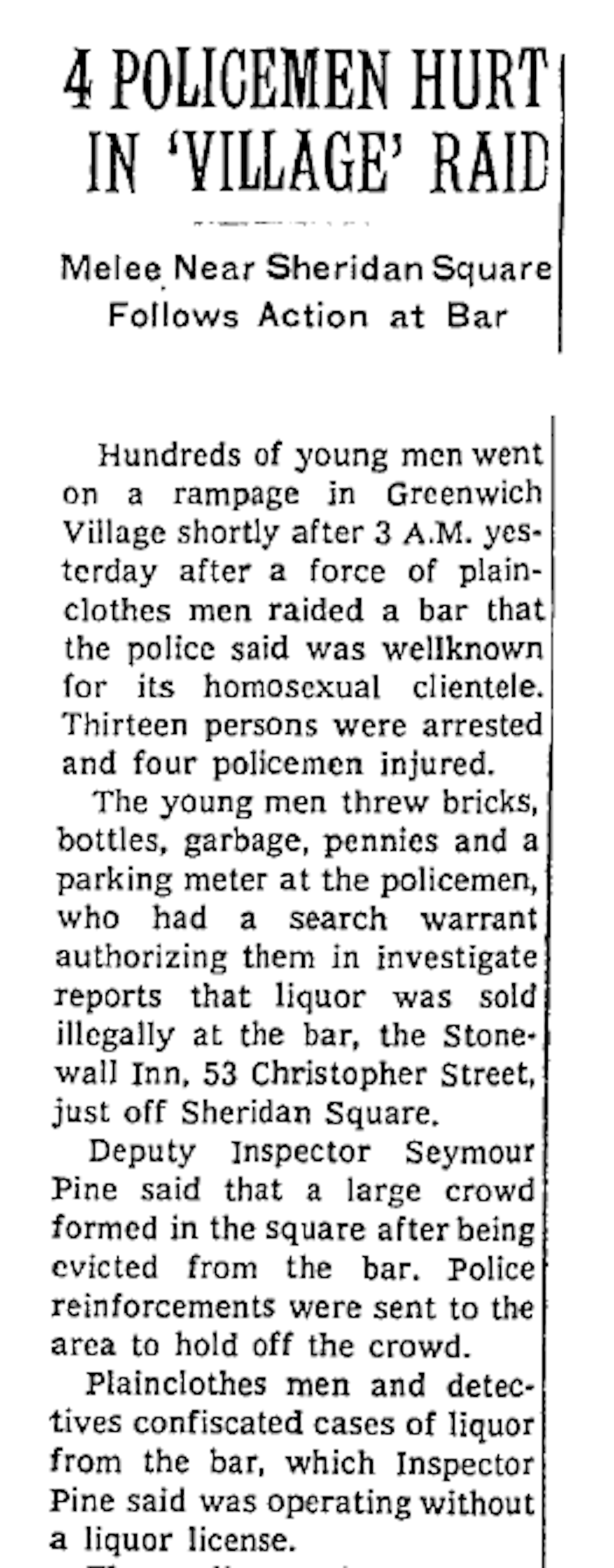
The first article on Stonewall to appear in The New York Times relied solely on interviews with the police.
The three city dailies – The New York Times, The New York Daily News and New York Post – wrote a smattering of stories in which they quoted exclusively police sources and offered little context. The story was framed as an instance of lawless youth run amok – an almost unprovoked riot.
For example, the Times’ first Stonewall article, “4 policemen hurt in ‘Village’ raid” began “Hundreds of young men went on a rampage in Greenwich Village shortly after 3 a.m. yesterday after a force of plainclothes men raided a bar that the police said was wellknown for its homosexual clientele.”
The mainstream papers at least covered Stonewall. Local TV stations failed to even report on the riots happening in the heart of Manhattan.
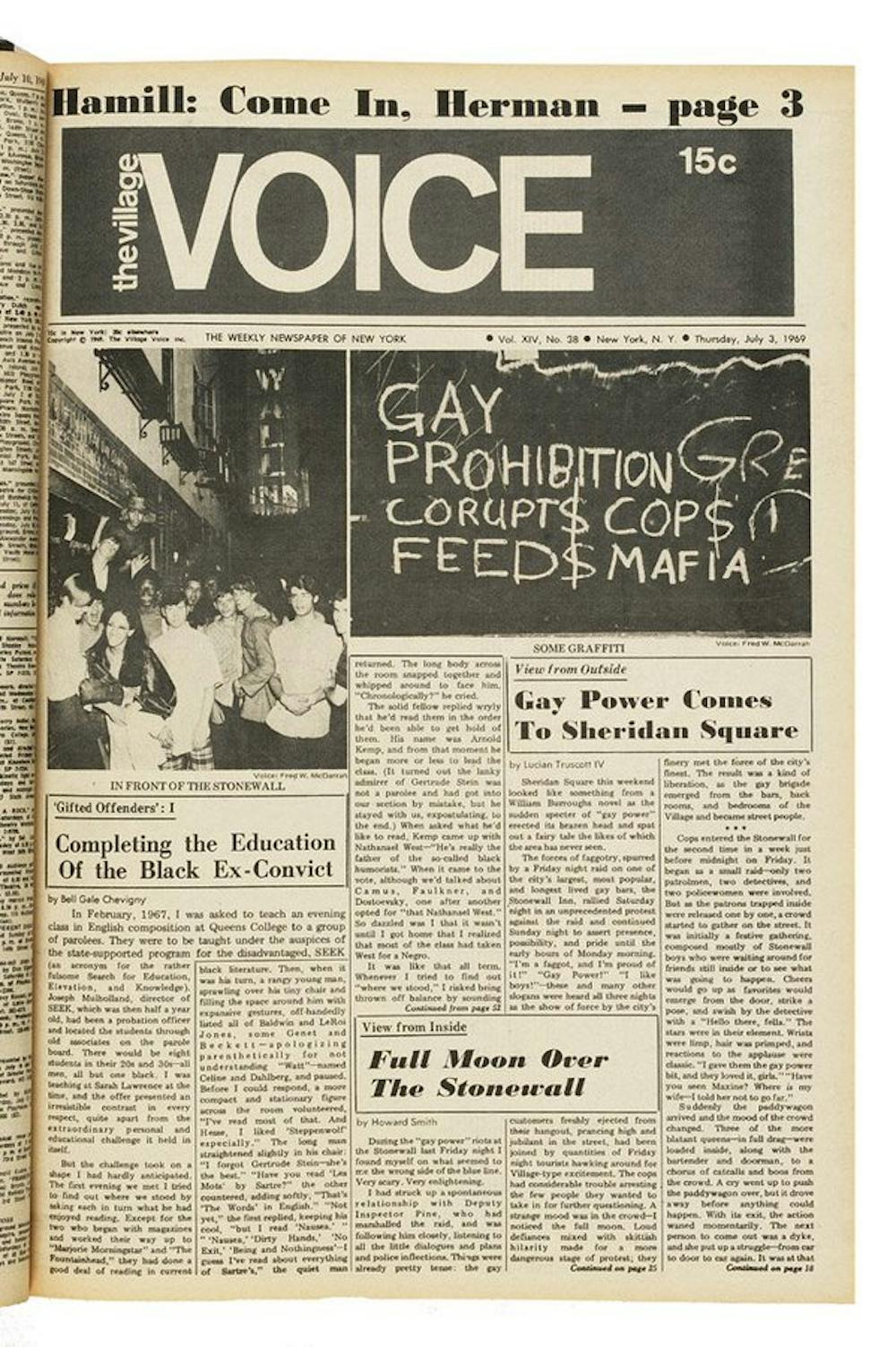
In contrast, the most popular local alternative paper, The Village Voice, gave the riots front-page coverage. It included interviews and quotes from the protesters, as well as two first-person accounts by Voice reporters Howard Smith, who was trapped inside the bar with police officers, and Lucian Truscott IV, who was outside with protesters.
Both reporters initially witnessed the riot from the Voice offices, which were a few doors down Christopher Street from Stonewall.
The alternative press rises to the occasion
The Voice’s coverage featured many hallmarks of alternative publications.
By incorporating the views of both protesters and police, they created a more complex, nuanced story. And the paper framed the Stonewall riots as an expression of liberation instead of rebellion, with Smith writing that the protesters were simply “objecting to how they were being treated.”
‘Gay Power Comes to Sheridan Square’ – The Village Voice gave the riots front-page treatment.
However, the Voice coverage was far from perfect. The anti-gay tone in Truscott’s piece angered protesters, as did some of the paper’s long-held editorial policies against same-sex personal ads.
While the Voice often was left-of-center politically, it wasn’t as radical as some of its more underground counterparts – the Rat, the East Village Other and the Berkeley Barb, all of which also covered the Stonewall riots.
Still, the Voice served as an important platform for the otherwise voiceless left out of the mainstream discussion during both Stonewall and the paper’s 60-year run. The Voice closed in 2018, following the shuttering of similar publications in Boston, Baltimore, Philadelphia and San Francisco.
An alternative press has existed alongside the mainstream since the earliest days of the nation. These papers play an important role in the U.S. media landscape by covering stories and topics that go unreported by their mainstream counterparts. They often forego the pretense of objectivity for activism; rather than quote government officials and business leaders, they’ll quote people on the ground.
Fifty years after Stonewall, it’s important to reflect on the gains of the LGBTQ movement. But it’s equally important to think about what’s lost when alternative newspapers stop publishing – and thus stop covering unreported, underreported or misreported stories.
Joel Schumacher, the director of two flamboyant "Batman" films and cult teen classic "The Lost Boys," has died of cancer aged 80.
The maverick who began as a costume designer before rising to the top ranks of Hollywood directors passed away in New York City, publicists ID-PR said in a statement to AFP.
Schumacher "passed away quietly from cancer this morning after a year-long battle. He will be fondly remembered by his friends and collaborators," it said.
The director is best known to wider audiences for the divisive "Batman Forever" (1995) and "Batman & Robin" (1997).
Schumacher had taken over helming the highly lucrative comic book franchise from Tim Burton, and his first effort starring Val Kilmer performed well at the box office.
But both movies, notable for their camp and colorful style, were assailed by many critics and fans, who took particular exception to the nipples Schumacher added to Batman's suit.
In a 2017 interview, Schumacher told Vice he wanted to "apologize to every fan that was disappointed" by "Batman & Robin," adding that he felt "like I had murdered a baby."
The caped crusader's big-screen franchise was later reinvigorated by Christopher Nolan's 2005 "Batman Begins."
Schumacher started as a Hollywood costume designer in the 1970s, working on movies including Woody Allen's "Sleeper" (1973) and "Interiors" (1978).
Brat Pack-starring coming-of-age drama "St Elmo's Fire" (1985) was Schumacher's first bona fide hit as a director.
He followed up with teen vampire movie "The Lost Boys" (1987) and sci-fi "Flatliners" (1990) before helming the "Batman" titles for Warner Bros.
Schumacher is credited with helping to launch several young A-list careers, including Matthew McConaughey in 1996's "A Time to Kill" and Colin Farrell in "Tigerland" (2000) and "Phone Booth" (2003).
Prior to his Hollywood career, he attended art school and worked as a window designer for a New York women's accessories store.
President Donald Trump's daughter and her husband are reportedly angry at Trump 2020 campaign manager Brad Parscale after a Tulsa rally failed to meet expectations.
According to CNN's Jim Acosta, Ivanka Trump and Jared Kushner were said to be "pissed" at the campaign manager because thousands of the arena's seats were empty.
Parscale sought to blame the media in a statement released on Sunday.
"Leftists and online trolls are doing a victory lap, thinking they somehow impacted rally attendance," Parscale wrote, "don't know what they're talking about or how our rallies work. Reporters who wrote gleefully about TikTok and K-pop fans -- without contacting the campaign for comment -- behaved unprofessionally and were willing dupes to the charade."
"For the media to now celebrate the fear that they helped create is disgusting, but typical," he added. "And it makes us wonder why we bother credentialing media for events when they don't do their full jobs as professionals."
Fox News host Chris Wallace challenged Trump 2020 campaign spokesperson Mercedes Schlapp for making "campaign speeches" during an interview on Sunday.
On his Fox News Sunday program, Wallace noted that President Donald Trump's Tulsa rally on Saturday had been sparsely attended despite the fact that the president claimed nearly a million people had requested tickets.
"We all saw the pictures last night," Wallace explained. "The arena was no more than two-thirds full. And the outdoor rally was cancelled because there was no overflow crowd. What happened?"
"The key here is to understand," Schlapp replied, "there were factors involved, they were concerned about the protesters who were coming in."
"He talks about how he can fill an arena," Wallace said, referring to the president. "And he didn't fill an arena last night. You guys were so far off that you had planned an outdoor rally and there wasn't an overflow crowd."
"Protesters did not stop people from coming to that rally," he added. "The fact is, people did not show up."
Schlapp disagreed before attacking presumptive Democratic presidential nominee Joe Biden for holding virtual events during the ongoing pandemic.
"Mercedes, please don't filibuster," Wallace interrupted. "Frankly, it makes you guys look silly when you deny the reality of what happened."
"I don't know why you are saying that," Schlapp complained.
"There are empty seats there," Wallace replied. "At least a third, if not half of the rally was empty. You can't deny it."
"Joe Biden has been a failed politician that has done nothing but support failed institutions," Schlapp opined. "This is in contrast with President Trump who has a strong record and is rebuilding this economy."
"Mercedes, you're shifting to a campaign speech, which has nothing to do with the attendance of the rally," Wallace observed.
According to a report from HuffPost, controversial former Donald Trump aide Sebastian Gorka may be headed to a new job within the president's administration, taking a high-ranking spot overseeing Voice of America.
With Michael Pack, a friend of former White House chief strategist Steve Bannon, taking over as the head of the U.S. Agency for Global Media -- which has led to two resignations at the taxpayer-funded agency that supervises the Voice of America -- rumors began flying Monday night that Gorka may be offered a position
According to a report from CNN, the conservative radio show host "may take on a leadership role within VOA, and there has been talk of appointing him as a board member of the U.S. Agency for Global Media."
"A well-placed VOA employee said there are internal discussions about a sizable shakeup coming to the agency that may include former White House official and conservative radio host Sebastian Gorka taking on a leadership position. Given Gorka's partisan background, such an appointment would send a major message about VOA shifting to become a mouthpiece for the administration," the CNN report states.
The HuffPost reports that, "Gorka, who worked with Bannon at Breitbart before Trump’s election, left the Trump administration after an eight-month stint as a White House deputy assistant. His departure followed a furious backlash over his anti-Islam comments and reported ties to a far-right Hungarian political group with historical links to the Nazi party. "
At a press conference on Monday, the family of Rayshard Brooks expressed their devastation following his killing by an Atlanta police officer.
"I didn't come here to talk to the media, I came to love on my people," Brooks' cousin told reporters. "But if you ask how this young black man was, look at your children when you see them laugh -- that innocence, that joy, that pureness of soul -- and you had a glimpse of what we lost, you'll have a glimpse of what it feels like."
"Because tomorrow we're going to have to deal with it again," he continued. "We're going to have to bury him, we're going to have to say, 'We'll miss you,' and if we didn't say we love you enough, we've got to apologize to him for not telling him that we loved him that much."
The words appeared to be too much for family members who walked out of the press conference crying.
"I'm not sure what else America needs to see," attorney L. Chris Stewart lamented after the family left the room. "Sadly, I'm probably going to be back here in a few months with another case."
White House economic adviser Larry Kudlow admitted on Sunday that attendees at President Donald Trump's rallies should "probably" wear masks to prevent spread of COVID-19.
While appearing on CNN, State of the Union host Jake Tapper noted that "up to 200,000 Americans" have been projected to die due to the novel coronavirus.
"Yes, it is a concern," Kudlow said. "People must observe the safety guidelines. The social distancing must be observed. Face coverings in key places must be observed."
"I'm glad to see you calling for people to wear masks," Tapper observed. "And I assume that also means at the Trump rally in Tulsa? People should be wearing masks at the Trump rally in Tulsa this Saturday."
"Well, okay," Kudlow stuttered in response. "Probably so."