White House adviser Kellyanne Conway on Wednesday lowered expectations for President Donald Trump's rally attendance by excusing supporters who do not want to "put themselves at risk."
During an appearance on Fox & Friends, Conway faced questions about how the Trump 2020 campaign would continue holding events despite a surge in COVID-19 cases in many states.
"I would point everybody's attention to many of the great outdoor rallies that we've done," Conway said. "But I think we have to also understand, many people who support Donald Trump, who would walk across broken glass for him are not going to go to the rallies."
"And that's okay," she continued. "They are going to support him in different ways. They don't want to put themselves at risk. But they already support him. They're hardly swing voters."
Florida hospitals are seeing more younger coronavirus patients, but then quickly releasing them back into the population where they could infect others.
Younger patients are accounting for an increasing share of COVID-19 patients, but their symptoms are more likely to be mild, and health experts are concerned they'll spread the potentially deadly virus if they choose not to quarantine, reported The Daily Beast.
“We know from the data that the cases are trending younger and we have a pretty good idea that it is related to the behavior of young folks going out to bars and house parties,” said Cindy Prins, a University of Florida epidemiology professor. “We tend to take more risks and live in the moment when we are younger. They may believe they are not at risk of being hospitalized, but they do pose a risk to others.”
One nurse from Cleveland Clinic reported a dramatic difference in coronavirus patients since the state officially reopened, saying they saw few COVID-19 patients during Florida's scattershot lockdown but nearly a dozen per day.
“Now, it’s about 10 a day,” said the nurse, who asked to remain anonymous. “I had seven the last night I worked. All the ones I’ve treated are in their mid-20s to early-50s.”
The hospital, however, said its Weston location saw about three COVID-19 patients a day and only 20 percent of those admitted were under 40, but even Gov. Ron DeSantis is blaming the state's rising case numbers on younger patients.
“They’re younger people," DeSantis said. "They’re going to do what they’re going to do."
Intensive care units in Miami-Dade area hospitals are 70 percent capacity, and patients were coming in Monday faster than they were being discharged, according to the county, and some hospitals are nearing maximum capacity.
“We are still at capacity with people waiting for beds,” said a Homestead Hospital nurse who asked to remain anonymous. “Most of the people receiving a COVID-positive diagnosis are completely asymptomatic.”
The hospital declined to comment on the nurse's claims, but those observations were matched by claims made by a paramedic who works at nearby Aventura Hospital.
“A few of them needed ventilators, but most of them are stable,” said the paramedic. “We’re seeing a lot of 18-35 year olds getting it. Two of my co-workers are actually out sick now cause they got it … nothing severe, but they have to stay home until they’re negative.”
The Daily Beast spoke to two patients under 40 who have experienced symptoms but felt well enough to venture out in public.
“I was getting absurdly tired at work,” said Karlie McCutcheson, a 23-year-old from Jacksonville. “Even my bosses noticed it. But it wasn’t until Friday night that I really believed I had caught COVID.”
Her employer shut down the office afterward and other employees must get tested, and McCutcheson believes she spread the virus to her father and brother after catching it from her boyfriend a few weeks ago.
“In Jacksonville, it was like COVID was no longer a big deal,” she said. “Everyone had gone back to living their normal lives.”
A 38-year-old from Pembroke Pines said he felt safe enough to go out for food and drinks with friends last week, after the state reopened last month.
“I wouldn’t say I felt safer, but I had started venturing out again a little bit,” Jordan Rodriguez said. “I still wear a face mask whenever I go out and I have always been a germaphobe, so I’m regularly washing my hands with soap.”
But he still tested positive for the virus after running a fever the day after his restaurant outing.
“Since that day, I’ve felt no symptoms," he said. "I check my temperature regularly and it hasn’t gone up. But I’ve been quarantined in my bedroom.”
“It sucks,” Rodriguez added. “I’ve just been sitting here reading books, watching YouTube videos and binging on all kinds of TV shows. But I don’t want to be responsible for giving it to anybody.”
On CNN Wednesday, New York Times reporter Maggie Haberman said that President Donald Trump has not discussed the COVID-19 pandemic in recent weeks because his officials fear he'd suggest injecting bleach again.
"My understanding is that he, according to a number of people, would have been fine with some kind of briefing being held about a month ago by Mike Pence, the vice president, which eventually came last week," said Haberman. "But there were a couple of people around the president, namely Hope Hicks, Jared Kushner, and Mark Meadows, who prefer that he not do it, for different reasons."
"Hope Hicks and Jared Kushner are concerned that the president is going to re-do one of those famous performances from the briefing room, whether it was about injecting breach or screaming at reporters," said Haberman. "And I think Mark Meadows wants to be focused solely on the economy. And to your point, you can talk about it all you want, but that doesn't mean people are not dealing with the coronavirus. That's where the country is, it's going to become more noticeable the longer the president goes without discussing it."
John Berman on Wednesday delivered a blistering opening statement on CNN's "New Day," in which he hammered President Donald Trump's misplaced priorities during the COVID-19 pandemic.
"What's the plan?" Berman asked at the start of the show. "Seriously, what's the plan? The U.S. is hovering near an all-time high in coronavirus cases, more than 44,000 new cases just yesterday. Dr. Anthony Fauci is warning that number could reach 100,000 if we don't take action. So, where is that federal action?"
In particular, Berman scalded the president for tweeting more about the removal of Confederate monuments than about plans to combat the spread of the novel coronavirus.
"The president has said next to nothing about this," Berman said. "He's not even acknowledged this huge jump in cases. Overnight, he vowed to protect the legacy of Robert E. Lee, who was at no risk of catching coronavirus. So he has a plan for Robert E. Lee, but what about the pandemic?"
Co-host Erica Hill then pointed out that even some Republican lawmakers have been calling on Trump to at least start promote wearing face masks during the pandemic -- but said that "Mr. Trump continues to ignore those calls, and he also continues to ignore the science."
Germany takes over the European Union's six-month presidency Wednesday, with outgoing Chancellor Angela Merkel staking her legacy on a massive economic recovery plan to help the bloc cope with the coronavirus fallout.
Merkel's last major role on the international stage comes as the 27-member club faces its deepest recession since World War II, triggered by a pandemic that has killed more than 500,000 people globally.
The crisis has galvanised Europe's most powerful leader who, with just over a year left in her final term, has ditched her usual wait-and-see approach to call for "extraordinary measures" to weather the storm.
Analysis: German EU presidency brings 'sigh of relief' to coronavirus-ravaged Europe
The proposed fund would controversially be financed through shared EU borrowing and marks a stunning U-turn for Germany after years of opposition to debt pooling.
The EU's rotating presidency is Merkel's "last chance" to make her mark as one of Europe's great leaders, Der Spiegel weekly wrote, adding that it was time for Germany to shoulder more responsibility as the bloc's biggest nation and top economy.
"For years the chancellor put off dealing with the chronic problems of the EU and the euro. Now, towards the end of her political career, she has the opportunity to make up for past mistakes," Spiegel wrote.
There will be no shortage of challenges to tackle in the months ahead.
Post-Brexit negotiations, a more assertive China, rocky transatlantic ties, climate change and the conflicts in Libya and Syria will all be jostling for attention, even if the pandemic promises to dominate the agenda.
'Extraordinary solidarity'
Germany kicked off its EU custodianship by projecting the words "Together for Europe's recovery" onto Berlin's iconic Brandenburg Gate late Tuesday.
After 15 years in office, Merkel is the bloc's longest-serving leader and held the EU presidency once before, in 2007.
But the stakes are higher this time.
A first major test will come at a July 17-18 EU summit, where Merkel hopes leaders will reach an agreement on the 750-billion-euro rescue fund put forward by European Commission president Ursula von der Leyen -- Merkel's former defence minister.
The money is expected to come mainly in the form of grants for countries hardest hit by the pandemic, such as debt-laden Italy and Spain.
But so-called frugal nations including Austria and the Netherlands want to reign in the spending and are insisting on loans rather than grants.
Merkel has urged holdout nations to "engage in an extraordinary act of solidarity", warning that an uneven recovery could undermine the EU single market and end up harming stronger economies too.
"We hope we can find a solution, even if the road is still long," Merkel said at the press conference alongside Macron.
Brexit warning
The fund is based on an idea unveiled by the French-German duo in May, in which the European Commission would raise money on the financial markets to help pay for the post-pandemic recovery in poorer member states.
If accepted, the rescue fund would be a milestone for EU unity.
Daily newsletterReceive essential international news every morning
It would also be a big win for Berlin, and could ease some of the lingering resentment from the eurozone debt crisis a decade ago when Merkel's government insisted on harsh austerity for struggling nations like Greece.
Another contentious issue that could define Germany's EU presidency is Brexit.
After weeks of standstill, Britain and the EU have resumed negotiations about the country's divorce deal with the bloc -- which could still result in a hard Brexit at the end of the year.
In an interview with several newspapers last week, Merkel warned that Britain would "have to live with the consequences" of having weaker economic ties with the EU.
Beijing lifted several lockdowns imposed to control a fresh coronavirus outbreak and reported just three new cases in the city on Wednesday, raising hopes that the cluster had been brought under control.
The Chinese capital had closed off dozens of residential compounds and carried out mass testing last month after hundreds of infections raised fears of a virus resurgence.
But five residential communities that have had no new virus cases during a control period were released from lockdown on Tuesday, state media reported, as the city relaxed curbs.
Seven other Beijing communities saw their lockdowns lifted last Friday.
The vast majority of cases have been linked to the sprawling Xinfadi market that supplies about 80 percent of Beijing's fresh produce and meat, sparking concern about food safety.
State media outlet China News reported that the lockdown of five communities in the hard-hit Fengtai district was lifted, and disease control experts would propose a plan for removing restrictions on another seven in the area surrounding the market.
But the report said even the communities freed from lockdown would have to "strictly implement closed management", with non-residents unable to enter the compounds.
Communities will also issue entry passes for residents.
China had largely brought the deadly outbreak under control before the new Beijing cluster was detected.
The government has since imposed a strict lockdown on nearly half a million people in neighbouring Hebei province to contain a fresh cluster there, adopting the same strict measures imposed at the height of the pandemic in the epicentre of Wuhan city earlier this year.
However, Wu Zunyou, chief epidemiology expert at the Chinese Center for Disease Control and Prevention, told reporters in June that the new outbreak had been "brought under control".
When coronavirus claimed its first victim in India's largest slum in April, many feared the disease would turn its narrow, congested streets into a graveyard, with social distancing or contact tracing all but impossible.
But three months on, Mumbai's Dharavi offers a rare glimmer of hope with new infections shrinking, thanks to an aggressive strategy that focused on "chasing the virus, instead of waiting for disaster", according to city official Kiran Dighavkar.
The sprawling slum has long been a byword for the financial capital's bitter income disparities -- with Dharavi's estimated one million people scraping a living as factory workers or maids and chauffeurs to Mumbai's well-heeled residents.
With a dozen people typically sleeping in a single room, and hundreds using the same public toilet, authorities realised early that standard practices would be of little use.
"Social distancing was never a possibility, home isolation was never an option, and contact tracing was a huge problem with so many people using the same toilet," Dighavkar told AFP.
An initial plan to conduct door-to-door screenings was abandoned after Mumbai's searing heat and humidity left medical workers feeling suffocated under layers of protective equipment as they combed the area's cramped alleys for cases.
But, with infections rising fast and fewer than 50,000 people checked for symptoms, officials needed to move quickly and get creative.
What they came up with was coined "Mission Dharavi".
Each day, medical workers set up a "fever camp" in a different part of the slum, so residents could be screened for symptoms and tested for coronavirus if needed.
Schools, wedding halls and sports complexes were repurposed as quarantine facilities that offered free meals, vitamins and "laughter yoga" sessions.
Strict containment measures were deployed in virus hotspots that were home to 125,000 people, including the use of drones to monitor their movements and alert police, while a huge army of volunteers swung into action, distributing rations so they didn't go hungry.
Bollywood stars and business tycoons paid for medical equipment as construction workers built a 200-bed field hospital at breakneck speed in a park inside Dharavi.
By late June, more than half the slum's population had been screened for symptoms and around 12,000 tested for coronavirus.
So far Dharavi has reported just 82 deaths -- a fraction of Mumbai's more than 4,500 fatalities.
- 'Brink of victory' -
"We are on the brink of victory, I feel very proud," said Abhay Taware, a doctor who saw around 100 patients daily in his tiny clinic at the height of the crisis.
The 44-year-old father-of-two also had to fight his own battle against coronavirus when he contracted the disease in April, but told AFP he had "no doubts" about returning to work.
"I thought I could show my patients that a positive diagnosis does not mean the end," he said.
Although doctors like Taware worked to reassure worried residents, the stigma persists.
After an isolating 25-day spell in hospital and a fortnight in quarantine, Sushil -- not his real name -- said he now feared discrimination if people found out about his diagnosis.
The 24-year-old also struck a note of caution, warning of a potential resurgence in infections.
"People need to take as many precautions as possible. The numbers might have come down but they can swiftly rise again", he told AFP.
- 'No escape next time' -
With Mumbai and Delhi struggling to accommodate coronavirus patients as India's cases surge past half a million officials are also wary of celebrating too soon.
"It's a war. Everything is dynamic," said Dighavkar.
"Right now, we feel like we are on top of the situation," he said.
"The challenge will be when factories reopen," he added, referring to the billion-dollar leather and recycling industries run out of Dharavi's cramped tenements.
And some in the slum fear their community might not be as lucky next time.
On a blazing morning, as car salesman Vinod Kamble lined up to have his temperature taken, he recalled his terror when the virus landed in Mumbai.
"I felt like Dharavi would be destroyed, and nothing would be left," he told AFP, describing the near impossibility of avoiding infection in the slum.
"We need better infrastructure," the 32-year-old said.
"Otherwise the next time a disease like this emerges, I don't think Dharavi will be able to escape."
As the vast majority of companies rush to reopen and people rush back to public life, they’re falling into the trap of “getting back to normal.” They’re not realizing we’re heading into a period of waves of restrictions once again, due to many states reopening too soon.
Indeed, some of the states to open early onward have already reimposed some restrictions. This shows that as I predicted in a newspaper editorial way back at the start of the pandemic on March 10, 2020, we will greatly underestimate the pandemic and need to prepare to face rolling waves of restrictions and shutdowns until a vaccine. To avoid the trap of normalcy, we need to understand the parallels between what’s going on now, and what happened at the start of the pandemic.
Very many prominent business and political leaders downplayed the pandemic in its early stages. As a result, most business owners and plenty of ordinary citizens initially perceived the pandemic as little worse than the common cold.
This initial impression anchored their opinions toward minimizing the threat posed by COVID-19. In neuroscience and behavioral economics research, we call such initial impressions an “anchor.” Our minds tend to fall into a dangerous judgment error called the anchoring bias or focalism, where we give too much credit to the initial piece of information we received on a topic and perceive the rest of the information through the filter of that initial impression.
Yes, first impressions really matter, too much for our own good! That means as new information became available about the danger of COVID-19, people stuck to their initial impressions. They feel very reluctant to change their minds based on new evidence. Nowhere is this more evidence than in guidance on wearing masks.
Initially, the CDC indicated that there’s no need to wear masks to protect yourself or others from COVID-19. Over time, as research evidence accumulated on the benefits of wearing masks, the CDC changed its guidelines, highlighting the importance of masking in public.
That’s how science works: changing evidence results in changing guidelines. But that’s not how our brains work, at least for those without training in critical evaluation of evidence.
The result? Many disregarded the new guidance, especially if those they consider authority figures did not reinforce it. Due to a mental blindspot called emotional contagion, we tend to adopt the perspectives of those we see as authority figures. With their guidance, we can overcome initial anchoring; without it, we will stick to our initial perspective.
Just as dangerous is another dangerous judgment error that cognitive neuroscientists call the normalcy bias. This mental blindspot refers to the fact that our gut reactions drive us to feel that the future, at least in the short and medium term of the next couple of years, will function in roughly the same way as the past: normally. As a result, we tend to vastly underestimate both the possibility and impact of a disaster striking us. Moreover, we will rush to get back to normal even when we should be preparing for the aftershocks or continuation of the disaster.
The normalcy bias, anchoring bias, and emotional contagion are three of over one hundred mental blindspots that cognitive neuroscientists and behavioral economists like myself call cognitive biases. Fortunately, recent research by myself and other scholars has shown us how we can effectively defeat such dangerous judgment errors.
First you need to understand and evaluate where you yourself and your organization have fallen into each of these biases, and evaluate the damage caused by doing so. Then, you need to consider realistically the long-term outcomes and plan for a realistic scenario that addresses the likelihood of major disruptions.
Prepare to deal with waves of restrictions and loosenings for the long haul, especially as it’s likely that the coronavirus will get worse in the Fall, as weather gets colder. Remember, even if you made some bad decisions in the past, you always have the opportunity to make better decisions going forward to survive and thrive through the pandemic.
Voters in Western Colorado have sent Republican Rep. Scott Tipton to Congress in five straight elections. But his winning streak ended on Tuesday when he lost his GOP primary to Lauren Boebert.
Diane Mitsch Bush won the Democratic Primary, the Associated Press reports.
"She doesn’t have the support of the party and her fundraising has trailed Tipton’s," Colorado Public Radio reported last week. "Yet, as her campaign ad points out, she is pro-Trump and pro-gun. In fact, she owns Shooters Grill in Rifle, Colorado, a restaurant known for servers who are armed and open carry."
"The upstart candidate claims the true Trump mantle. And just as the president has been known to promote conspiracy theories, Boebert isn’t dismissive of QAnon, a conspiracy theory alleging a 'deep state' attack on Trump, and other allegations against Democratic politicians," Colorado Public Radio explained. "On a Q-friendly web show, Boebert, based on what she heard about Q, said: 'I hope that this is real.'”
While the race received little attention outside of Colorado, Boebert's stances were the focus of what attention the race did receive.
"Down the ballot, in the 3rd Congressional District, Republican Rep. Scott R. Tipton is facing a primary challenge from gun rights activist Lauren Boebert, the owner of Shooter's Grill in Rifle, Colo., where customers can order a 'Guac 9' burger or a 'Turkey Ham Uzi Melt.' She became the focus of local media attention when she defied coronavirus restrictions and tangled with city officials," The Washington Postreported, in a preview of the race.
Here's some of what people were saying about the state of the race following Tipton's surprise defeat:
On Tuesday, writing for The Washington Post, conservative columnist Max Boot slammed President Donald Trump for turning America into the "United States of Idiocracy" amid a deadly global pandemic.
"The only thing 'Idiocracy' really got wrong was its timeline," said Boot, referring to the Mike Judge film depicting a future in which everyone in America is stupid. "It has taken just 15 years, not 500, for America to become an idiocracy. Don’t believe it? Look at our response to the coronavirus pandemic."
"In other wealthy democracies, coronavirus cases have been plummeting," wrote Boot. "In the United States, they have risen 80 percent over the past 14 days. On Monday, the United States reported more than 40,000 new cases, while the European Union, which is more populous, had fewer than 6,000. The number of confirmed coronavirus deaths in the United States is approaching 130,000, more than twice as many as in any other country."
"The presidency’s idiocy is matched by that of Republican governors in states such as Florida (where coronavirus cases increased by 277 percent in the past two weeks), Texas (+184 percent) and Arizona (+145 percent)," wrote Boot. "They were slow to declare lockdowns and quick to end them. They also refused to impose statewide mask mandates — and, in the case of Texas and Arizona, tried to prevent municipalities from imposing their own rules — even though studies show that wearing masks can reduce transmission by as much as 85 percent."
This stupidity, Boot wrote, has filtered down.
"An Ohio state legislator said, 'I don’t want to cover people’s faces' because 'we’re created in the image and likeness of God,'" wrote Boot. "A Palm Beach, Fla., woman complained that masks 'throw God’s wonderful breathing system out the door,' while a fellow Palm Beach resident denounced mask advocates for 'practicing the Devil’s law.' A North Carolina woman burned a mask, complaining that it represented 'nanny state overreach.' Wait till these freedom-lovers find out about speeding laws, seat-belt laws and drunken-driving laws, which restrict their 'right' to get wasted and careen down the highway at 95 mph without a seat belt."
"We can and should hold our leaders responsible, but ultimately, we have no one but ourselves to blame," concluded Boot. "Nobody forced so many Americans to act so recklessly — first by placing their faith in a president who doesn’t deserve it, and now in ignoring widely publicized scientific findings. We are living — and now dying — in an idiocracy of our own creation."
Top advisor to President Donald Trump have argued against the Coronavirus Task Force holding regular Coronavirus Task Force briefings as multiple states are experiencing a surge in COVID-19 cases, Politico reported Tuesday.
"President Donald Trump’s top aides are divided over the merits of resuming national press briefings to keep the public informed about the latest coronavirus statistics as infection rates spike in large states including California, Texas, Florida, Arizona and Georgia," Politico reported. "Trump chief of staff Mark Meadows, senior adviser Jared Kushner, press secretary Kayleigh McEnany and counselor to the president Hope Hicks are among the aides arguing against these regular sessions because they want to keep the White House focused on the path forward and the nascent economic recovery — without scaring too much of the country about a virus resurgence when infections are rising at different paces in different regions."
"More than 126,000 people have perished in the U.S. due to the coronavirus, according to the Centers for Disease Control and Prevention, and the government’s own experts are warning of serious trouble ahead," Politico noted. "The brewing internal fight shows the extent to which the White House has lost control of its messaging on Covid-19 as the majority of voters disapprove of Trump’s handling of the virus, according to interviews with a half dozen current and former senior administration officials and Republicans close to the White House."
Trump has been harming himself with his own supporters with his approach.
"The coronavirus void at the White House — after a historic stretch of briefings by the president himself — is highlighting the holes in Trump’s latest approach as he focuses on other matters while blaming the media for focusing on the coronavirus," Politico reported. "Trump’s current handling of the virus risks damaging Trump’s standing even further, making him look out of touch with even his own supporters in red states now struggling with the virus resurgence."
Former Obama strategist David Axelrod offered his thoughts on Trump's situation.
“You can’t spin a pandemic,” Axelrod noted. “I mean, everyone is living with it. The reality of it is too obvious.”
President Donald Trump lashed out at China on Tuesday as coronavirus spikes in states across America, while other countries have successfully slowed the spread of the pandemic.
"As I watch the Pandemic spread its ugly face all across the world, including the tremendous damage it has done to the USA, I become more and more angry at China," Trump revealed.
"People can see it, and I can feel it!" he claimed.
Despite the fact other countries have responded to COVID-19 far more successfully than America, Trump has repeatedly tried to blame China to deflect criticism of his administration's response.
In the days before Arizona Gov. Doug Ducey changed course by urging people to stay home, Scottsdale city councilman Guy Phillips donned a face covering and shouted “I can’t breathe” into a microphone at an anti-mask rally. His mocking of the last words of George Floyd is only one more example of the racism that seems to shadow the outbreaks of contagious viruses.
That’s precisely what happened 40 years ago with HIV/AIDS; that’s what happened a century ago with the xenophobically named Spanish flu. Today, it’s happening on sovereign tribal lands throughout the American Southwest, where the loathsome relationship between racism and the novel coronavirus is on full display.
Our ethnographic studies include a focus on health care and health policy for the Indigenous people of the U.S. We now know COVID-19 cases and deaths within the Indigenous nations have soared, and are among the worst hot spots in the country. Currently there are well over 7,000 positive cases on the Navajo Nation – which covers portions of Arizona, Utah and New Mexico – where per capita infections quickly surpassed New York and New Jersey in May.
One of the reasons: When Gov. Ducey first let expire his statewide stay-at-home-order, droves of Arizonans returned to life as usual. They congregated in long lines and dined in crowded restaurants. Many were not wearing masks. Fourteen days later, COVID-19 cases began to rise. With that, Arizona lost control of the virus.
Indigenous people already live with existing challenges to health and life.About 18% of COVID-19 deaths in Arizona have been Indigenous people, where they account for 4.5% of the population. And still Arizonans in border regions actively resist changing their behaviors to curb the spread of disease.
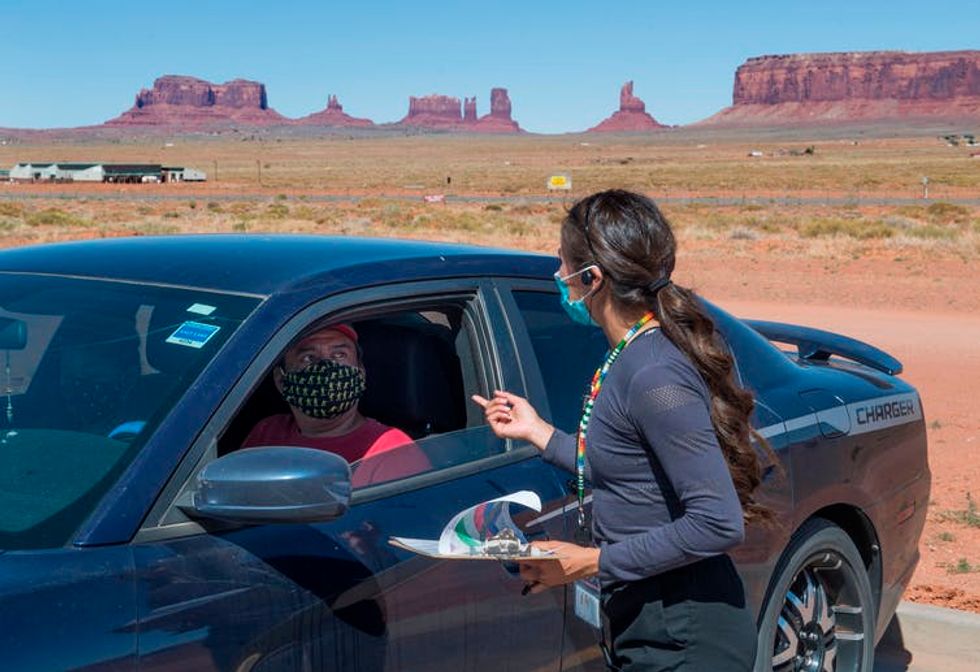
Medics consult with a drive-in patient at a COVID-19 testing center in the Navajo Nation town of Monument Valley, Arizona. Navajo Nation President Jonathan Nez said weeks of delays in delivering coronavirus aid to Native American tribes exacerbated the outbreak.
Hispanic, Black and Indigenous people are more likely to be hospitalized or die from COVID-19 than whites. And although white Arizonans are aware of that, their response, all too often is indifference and sometimes hate. Cities on or near ancestral Indigenous lands and tribal nations may be geographically close, but politically, economically and culturally, they are worlds apart. This racism is common in regions that border tribal lands.
A recent example: In a Facebook post, Daniel Franzen, a 34-year-old white man from Page, Arizona, urged readers to use “lethal force” against Indigenous people because “they are 100% infected.” Local police arrested him.
And from April 2016, an even more deadly example of violent policing: Austin Shipley, a Winslow, Arizona, police officer shot and killed Loreal Tsingine, a 100-pound Navajo woman. The officer claimed to fear for his life because the woman was holding a pair of scissors. After Tsingine was shot, eyewitnesses were not allowed to administer lifesaving techniques that might have saved her. Her body was left in the street until 6 a.m. the next day.
This was not the first time Shipley was the aggressor during his career and, as the current uprising of Black Lives Matter reminds us, Indigeous, Black and people of color often die by the hands of police. Leaders of Indigenous social movements sued the federal government and continue to fight for justice.
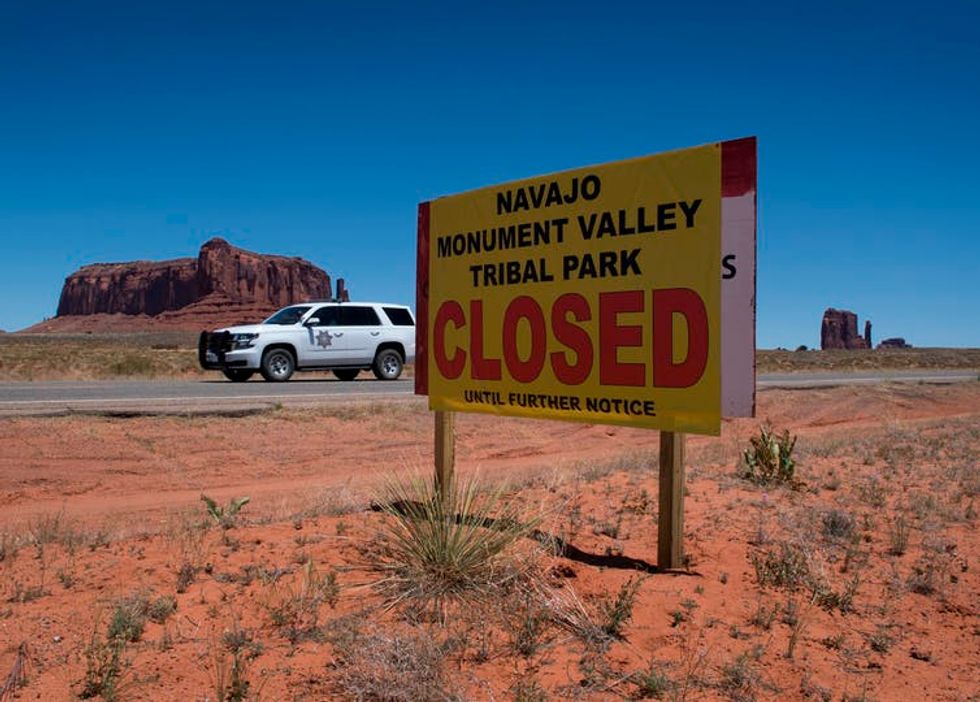
Monument Valley Tribal Park in Arizona, closed due to the pandemic. Normally, the park would be teeming with tourists this time of year.
In March 2020, our research team interviewed 30 non-Indigenous people across the political spectrum about the pandemic. One of our questions: Is anyone to blame for the virus? Responses range from finger-pointing at all of China (the “Wuhan Coronavirus”), to President Trump and “out of control capitalism.” As for “who would suffer the most,” our respondents were consistent. Indigent people of color, they said, are most at risk.
They also discussed a need to physically distance from “outsiders.” Such a response suggests a pervasive idea – that associating with certain groups increases the dangers of virus transmission. One white woman, an outlier, told us that Indigenous people had been “a little slower to adopt the precaution measures … it is easier for them to forget to protect themselves.” The woman now avoids stores where Indigeous people go. Others said much the same thing though usually with concern and awareness. Exposure to friends and family was OK. Interaction with outsiders was more dangerous.
The notion that Indigenous people are “slower” to respond to COVID-19 is false. Tribes quickly and proactively promoted science-based resources and issued emergency executive orders that are updated regularly. The White Mountain Apache Tribe closed down borders early and then again in June, after one-eighth of tribal members tested positive for COVID-19. Donations of hand sanitizing stations and personal protection equipment for Navajo, Hopi, Tewa and other tribes in the region continue to provide relief.
Challenges to lifesaving procedures came from outside of tribal nations. The mayor of Page, Arizona, for example, posted a social media query to the president of the Navajo Nation in hopes that tourist attractions would open for business. Others responded that Nez, the president, was “busy fighting hard for our people.”
Rather than acknowledging the actions of tribal leadership to save lives, the mayor instead chose to perpetuate the racist trope of “drunk indians” by writing, “I wish he would battle alcoholism as hard as COVID-19.”
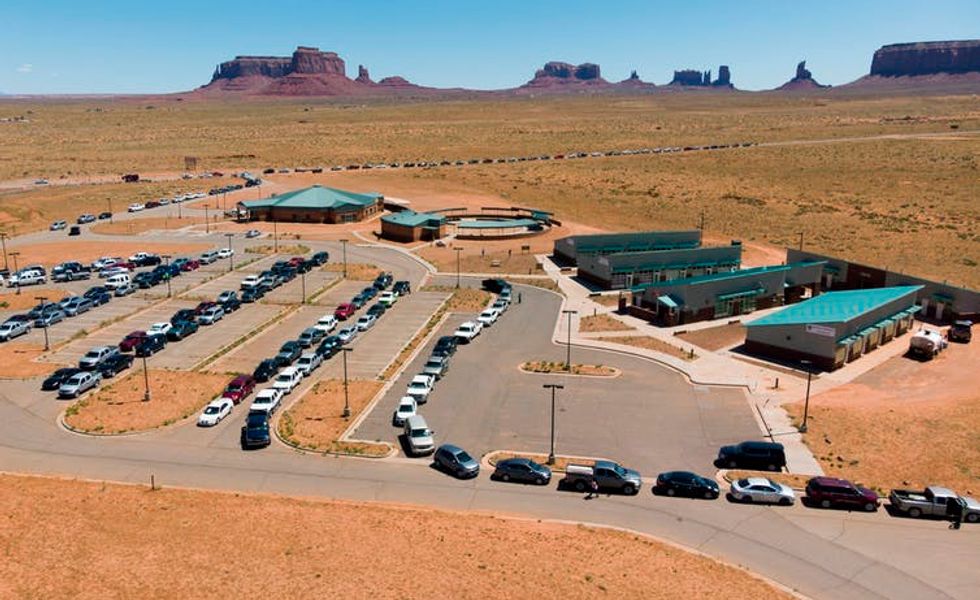
Residents of the Navajo Nation in Monument Valley, Arizona, line up to collect water and supplies as COVID-19 spreads through the area. Approximately one-third of this sovereign territory’s 178,000 residents don’t have access to running water or sanitation.
Before COVID-19, many Indigenous people already feared the inability to breathe. In the Southwest, children on tribal lands have a 60% higher asthma risk than non-Hispanic whites. For heat, many families in the Southwest use coal and wood-burning stoves; the particulate matter from them is unsafe for inhalation, and long-term exposure increases the likelihood of death from COVID-19.
Clean water, too, is often inaccessible. More than 500 abandoned uranium mines have elevated radiation levels on tribal lands in the southwest. That means Indigenous people and their livestock depend on contaminated water. Radiation spills, including the Church Rock spill, the country’s largest, continues to contain high levels of toxins. Indigenous miners and their families are also at elevated risk for respiratory problems, including lung cancer, and increased vulnerability to COVID-19.
Tribes partnering with environmental justice organizations and federal agencies are aware of these disparities and they fight to improve science and policy for healthier air and water on tribal lands, but these efforts are an uphill battle. The racism of border town leaders demonstrates why.
Fighting back
In the last few weeks, Black Lives Matter brought national attention to this failure. Finally, all of us see what Native, Hispanic and Black Americans long knew: We live in a political, governmental and judicial system that treats Black and brown bodies as disposable. We are governed by a collective mindset that rigidly enforces economic disparity, political disenfranchisement, environmental injustice and extreme policing. The difficult but doable task facing all of us now is to create a future more equitable and just for Indigenous people.