Vice President Mike Pence has kept the nation's top health officials from appearing on CNN since the network stopped carrying the daily coronavirus briefings in their entirety.
The vice president's office, which is responsible for booking those officials to deliver pandemic information, told CNN that Dr. Deborah Birx or Dr. Anthony Fauci would not be permitted to appear on the network until it carries the briefings, including Pence's remarks, in full.
"When you guys cover the briefings with the health officials then you can expect them back on your air," a Pence spokesperson told CNN.
CNN has been broadcasting only President Donald Trump's question-and-answer portion of the briefings and then cutting away for an immediate fact check, and a network executive explained the decision by saying the events often run longer than two hours.
Fauci, Birx, FDA commissioner Stephen Hahn and Surgeon General Jerome Adams have each appeared on other networks in the past week, although broadcast networks have not generally carried the briefings in full.
The vice president's office blocked all CNN appearances since last week, but the White House has made two non-health care officials -- Defense Secretary Mark Esper and trade adviser Peter Navarro -- available to the network.
During an interview with Fox News host Laura Ingraham Wednesday night, Attorney General Bill Barr praised President Trump's "statesman-like" effort at the "beginning" of the coronavirus epidemic where he "tried to bring people together" while "working with all the governors" -- a characterization that did not go over well with many of the President's critics on Twitter.
On Wednesday a committee of Republican lawmakers in Kansas decided to overthrow Gov. Laura Kelly (D) over her decision to limit church services to 10 or fewer people during the coronavirus outbreak. While the Bible says "where two or three gather in my name, there am I with them," for the Kansas GOP, it simply wasn't enough.
Already three Kansans have contracted coronavirus from being at church, and in a scathing editorial, the Kansas City Star shredded the Republicans for putting lives in danger.
"More Kansans will get sick because of the committee’s vote. More lives will be at risk,' the editorial began.
Most decisions like this take a two-thirds vote of the Senate, but lawmakers have already left Topeka. They left The Legislative Coordinating Council in power to "review" the governor's orders around the virus.
"All the Republicans on the committee voted to overturn the order. The Democrats voted to keep it," said the Star.
While decisions to protect Kansans shouldn't be a partisan choice, in Kansas, it's taken a nasty turn toward ideological zealots putting politics above lives.
"To be clear: Kelly did not prohibit anyone from praying or worshiping," the Star reiterated. "She simply limited mass church attendance in an effort to slow the spread of the deadly coronavirus, just as other governors across the country have done."
The state has 12 "clusters" of coronavirus outbreaks, three of which came from church activities. In a normal world, it should be enough to make a conclusion to limit activities.
"As we approach the peak of this pandemic, there is no longer any question that putting a stop to large gatherings is an absolute imperative," said the Star. "Most Kansans understand that the only safe decision is to stay home. That Kansas lawmakers were even debating this question should deeply trouble their constituents. The governor’s order was inarguably necessary and appropriately limited. Forty-four states, including Missouri, limit church attendance to 10 persons or fewer, or no one at all."
While many Americans are coming together to try and protect each other, in Kansas, "Republicans spent Wednesday blistering the governor’s efforts, putting the people of Kansas at risk of greater spread of the virus," the editorial said. "Kansas Senate President Susan Wagle led the parade, further undercutting her own credibility and raising serious questions about her judgment. She called Kelly’s order 'out of line, extreme,' pronouncing it unconstitutional and a 'blatant violation' of religious rights."
"Incredibly, she tried to turn the coronavirus dispute into another unnecessary, tiresome jeremiad against abortion," the Star explained. "Yet what is pro-life about endangering the health of thousands of Kansans by overturning Kelly’s order?"
Another Republican demanded Kelly withdraw the order entirely. Kansas Attorney General Derek Schmidt, a Republican, "in a breathtaking straddle, said Kelly’s order was 'sound public health advice that Kansans should follow,' yet also said law enforcement officials should not enforce it."
The Star agreed it was an extraordinary measure but done in a time of extreme emergency and only after alternatives were attempted. Kansas, like the rest of the nation, face dangerous times.
"The prohibition on large church gatherings certainly would have been lifted when the coronavirus danger had subsided," explained the Star. "That moment is not now. Now is the time for quiet prayer and reflection, and an effort by all Kansans to limit the spread of COVID-19. The Legislative Coordinating Committee endangered Kansans Wednesday. It prolonged the public health risk in our state. Its members should be ashamed, and its actions should be remembered."
Republican LCC members Susan Wagle, Ron Ryckman, Jim Denning, Blaine Finch and Daniel Hawkins have not indicated that they're willing to stake their reputation on their decision.
President Donald Trump’s army of knee-jerk defenders in the right-wing media have been jumping through hoops to explain why, back in January and February, he failed to take the coronavirus threat seriously. One Trumpian talking point is that no one could have seen the pandemic coming — which is nonsense, as everyone from intel officials to Peter Navarro (one of Trump’s main economic advisers) to former Vice President Joe Biden was sounding the alarm. And another bogus argument is that Trump, thanks to House Speaker Nancy Pelosi and other partisan Democrats, was distracted by impeachment. But the Lincoln Project, an anti-Trump conservative group that includes attorney George Conway, tears that argument to shreds in a blistering new video.
The video, titled “Distraction,” opens with some grim statistics — noting that “coronavirus has now killed three times more Americans than 9/11. So what’s Donald Trump been up to? Blaming the impeachment hearings for distracting him from preparing for the pandemic.”
The Lincoln Project goes on to cite examples of Trump being warned that a giant storm was brewing — for example, the January 29 memo in which Navarro stressed to the National Security Council (NSC) that “coronavirus presented a grave threat to the United States.” And “days later,” the video adds, the World Health Organization (WHO) “declared it a global health emergency. Where was Trump? He wasn’t distracted. He had plenty to do — like campaign rallies and golfing.”
The Lincoln’s Project video also notes that “in February, the virus spread to Europe. While Italy was shutting down and quarantines were being announced all over the world, Trump played more golf and packed thousands of people together. Sounds safe. The day before the first American died, where was Trump? Where do you think he was? At another rally. By March, the world was calling coronavirus a pandemic. Where was Trump? On Twitter, as usual, blaming everyone else.”
The video asserts that when Trump “finally bothered to take it seriously,” it was “too late for 10,000 Americans — and who knows how many more. Trump just didn’t care. He still doesn’t. He was never distracted.”
World powers scrambled on Thursday to build a global response to the human tragedy and once-in-a-century economic catastrophe caused by the coronavirus epidemic, as death tolls in the US and Europe soared higher.
In a locked-down New York, the UN Security Council was to meet on the pandemic for the first time. And, by video conference, EU finance ministers were wrangling over how to bail out their worst hit members Italy and Spain.
"We anticipate the worst economic fallout since the Great Depression," said International Monetary Fund chief Kristalina Georgieva, warning that all but a handful of countries will see incomes fall and urging governments to provide "lifelines" to businesses and households alike.
On the spiritual front, Pope Francis was preparing to celebrate Maundy Thursday with The Mass of the Lord's Supper, but he was to be unable to perform the tradition of washing the feet of the faithful in case of infection.
AFP / Philip FONG Japan's Prime Minister Shinzo Abe has declared a month-long state of emergency in Tokyo, but there and elsewhere the economic slowdown is starting to bite
And Iran's supreme leader Ayatollah Ali Khamenei warned Muslim worshippers to pray at home rather than in crowded mosques, even when the holy month of Ramadan begins later this month.
Meanwhile, the number of worldwide cases of the novel coronavirus since it spread from China earlier this year topped 1.5 million, according to an AFP tally. More than 88,981 people have died.
Alongside the personal tragedies and the pressure on overburdened hospitals, there has been a stark economic toll, with the World Trade Organization warning of the "worst recession of our lifetimes."
The worst-hit countries in Europe -- the worst hit continent -- are Italy and Spain, where daily death tolls are now down from their peaks but still running high, despite strict lockdowns.
AFP / Bryan R. Smith Rows of beds separated by black fabric are set up as a temporary field hospital for COVID-19 patients at the USTA Billie Jean King tennis center in New York
Spain's daily fatalities fell to 683 on Thursday, down from 757 the day before, while its total passed 15,000.
In Italy, the country's youngest COVID-19 patient, a two-month-old baby girl, was reportedly released from hospital, a bright moment of hope in a country with 17,669 dead.
- European project at stake -
Madrid and Rome are seeking assistance from EU partners to rebuild their economies in the wake of the disaster, but Germany has rejected the idea of joint borrowing and the Netherlands is blocking a compromise solution.
EU finance ministers were to meet later Thursday by videoconference for the second late-night crisis talks of the week to try to agree terms to allow hard-hit members to access funds.
"If we do not seize the opportunity to put new life into the European project, the risk of failure is real," Italian prime minister Giuseppe Conte told the BBC, suggesting the very future of the EU was at stake.
AFP / Gal ROMA A chart showing the additional number of people living below $5.50 a day due to a drop in income
Christine Lagarde, the head of the European Central Bank, said it was "vital" that ministers hatch a plan big enough to meet the challenge, warning: "If not all countries are cured, the others will suffer."
European companies are also suffering under a public lockdown, which health experts say is vital to slow the virus' spread but has effectively frozen economic life.
In one example, German airline Lufthansa warned it was losing one million euros ($1.08 million) an hour and would need state aid.
The coronavirus slump has also exacerbated the instability in world energy markets, and on Thursday top oil producers from OPEC like Saudi Arabia and its OPEC+ partners, including Russia, met to discuss cutting production to boost prices.
The virus has travelled around the whole world, and confined more than a third of humanity to their homes, but there has been a marked lack of international solidarity.
Thursday's videoconference meeting of the UN Security Council will be the first on the crisis since it began.
AFP / CRISTINA QUICLER A woman walks past a church in Seville, adorned with flowers and candles left by the faithful after Easter processions were cancelled
Led by Germany, nine of the council's 10 non-permanent members requested the closed-door meeting last week, fed up with the body's inaction over the unprecedented global crisis.
Talks are moving in the right direction, diplomats said, and Washington is no longer insisting UN language refer to the virus as coming from China, which had infuriated Beijing.
Despite the pandemic's origins, the United States is now the country hardest hit and UN host city New York is now America's most infected. On Wednesday, for the second straight day, the US recorded nearly 2,000 deaths.
There has also been a week of record tolls in Britain, where Prime Minister Boris Johnson spent a fourth night in intensive care, his condition said to be improving.
"The prime minister had a good night and continues to improve in intensive care at St Thomas' Hospital. He's in good spirits," a Downing Street spokesman said.
- 'Playing with fire' -
AFP / Simon MALFATTO The official number of deaths linked to the coronavirus around the world, as of April 9 at 1100 GMT
And the pandemic is marching into areas previously only lightly affected: in Africa, Ethiopia declared a state of emergency and Liberia said it was locking down its capital Monrovia.
The continent also faces vast economic damage, with the World Bank warning that sub-Saharan Africa could slip into its first recession in a quarter of a century.
At the global level, the World Health Organization and US President Donald Trump are embroiled in an ugly war of words, with Trump accusing the UN body of "blowing it" and of being too close to China.
WHO chief Tedros Adhanom Ghebreyesus urged unity at a time of global crisis, saying: "If you don't want many more body bags, then you refrain from politicising it."
At Perry’s Funeral Home in Newark, maximum storage capacity is 35 bodies. As of Sunday, the home had 40 — the extras needed to be moved to an offsite facility.“The phones are ringing off the hook,” manager Sam Arnold said. “The staff is overwhelmed."Like many funeral homes in North Jersey, Arnold’s business is now in crisis amid the coronavirus pandemic, as the industry scrambles to keep pace with a spiking Garden State death toll. COVID-19-related fatalities have surpassed 1,000 in barely a month, hospitals are overloaded with bodies awaiting pick-up and crematoriums are backlogged, business ...
A sailor from the USS Theodore Roosevelt who had previously tested positive for coronavirus was found unresponsive and admitted to intensive care, according to a report from CNN.
The Theodore Roosevelt recently made headlines thanks to a controversy that led to the resignation of Acting Navy Secretary Thomas Modly this Tuesday. The aircraft carrier's captain, Brett Crozier, was dismissed after the leak of a memo in which he begged Navy officials to evacuate the ship to protect the health of its sailors.
As CNN points out, Modly then flew to Guam and slamming Crozier during a speech to sailors, calling him "stupid" for not expecting the memo to leak to the media and even suggesting the captain had leaked the memo himself.
According to a statement from the Navy on Thursday, the sailor was found unconscious on March 30 and has been admitted to the intensive care unit of the US Navy Hospital on Guam. CNN reports that 97% of the Theodore Roosevelt's crew have been tested for coronavirus and 416 sailors have tested positive.
Right-wing economist Art Laffer, the creator of the infamous "Laffer curve" that incorrectly claims that tax cuts inevitably lead to increases in revenue for the government, says he's in contact with officials in President Donald Trump's White House and is pitching them on ideas for ways to "restart" the economy later this year.
In an interview with Reuters, Laffer gave a preview of potential coming attractions from the Trump administration as it seeks to reopen the American economy in the midst of the COVID-19 pandemic.
"Tax non-profits. Cut the pay of public officials and professors. Give businesses and workers who manage to hold on to their jobs a payroll tax holiday to the end of the year," Reuters writes in summarizing Laffer's proposals.
In addition to this, Laffer tells Reuters that he would like to slash unemployment benefits so that the millions of people who lost their jobs over the past three weeks don't lose the incentive to find work.
“If you tax people who work and you pay people who don’t work, you will get less people working,” Laffer said. “If you make it more unattractive to be unemployed, then there’s an incentive to go look for another job faster.”
A handful of hospitals have started clinical trials to test a new treatment for the coronavirus.
Hospitals in Boston, Alabama, Louisiana, Sweden and Austria are testing nitric oxide, a gas that relaxes blood vessels and could improve breathing, on patients with mild to moderate symptoms of COVID-19.
“It’s a gas that typically is used in babies with high lung pressure,” said Dr. Pankaj Arora, who is helping to administer the trial at the University of Alabama at Birmingham. “It’s FDA-approved for use in babies with high lung pressure, and we use it in some of our adult patients. In cardiology, we use it in our adult patients when the pulmonary pressures, pressures in the lungs, are very high.”
The molecule, which is not the same as nitrous oxide or laughing gas, is already used to treat heart disease, erectile dysfunction and respiratory illness.
“We have tremendous confidence this therapy will alter the devastating effects of COVID-19 but we must test it," Dr. Keith Scott, principal investigator at Louisiana State University Health in Shreveport. "If results show promise, and since this gas is already FDA approved, widespread use could begin immediately.”
The treatment has shown promise on COVID-19 patients in Italy, and a second trial at Massachusetts General Hospital examines whether the gas can mitigate the onset of the virus for health care workers constantly exposed to coronavirus patients.
UAB's trial builds on research conducted during the SARS epidemic in 2002-2003, when doctors found the gas improved lung function and also showed some anti-virus properties.
“The current [coronavirus] is quite similar to the one which was there in 2002-2003, and back then they tested this gas in patients of SARS and found that they were doing exceptionally well,” Dr. Vibhu Parcha, who is also administering UAB's trial, “and they further tested it and they found that this gas was also causing prevention of the growth of the virus.”
As the COVID-19 epidemic continues to ravage the American public, an unsurprising story emerges: Poor communities are hot spots for COVID transmission. The death rate from COVID-19 appears to be staggeringly high among African Americans compared to whites. The Washington Post reports, for example, that while 14% of the Michigan population is black, 40% of COVID-19 deaths are among blacks.
This is a familiar pattern to a social and infectious disease epidemiologist like myself. It is evidence of centuries of segregation and discrimination that have disproportionately placed people of color in communities without access to health care, with degraded and crowded living conditions and a lack of basic opportunities for health and wellness.
Blacks are more likely to work in low-paying jobs, such as custodial work and food service, that cannot be done remotely. Here, a server adds stuffed cabbage to an order at The Boys Farmers Market in Delray Beach, Fla.
TB, in particular, has long been tied to socioeconomic status. Even in the face of a widespread TB epidemic in the U.S. in the early 1900s, there was a noticeable pattern in which people of color, immigrants and those living in poor environments were more likely to be infected with TB and less likely to receive care.
The case of TB offers a unique vantage point to understand how these inequities emerge. Processes that operate at a societal level, such as residential segregation, have been at work since the early 20th century. Such processes have systematically placed racial and ethnic minority populations in low-income communities with fewer resources and more exposure to environmental hazards.
Urban renewal and development efforts of the 1900s systematically benefited whites, further displacing communities of color. This resulted in minority communities with greater proportions of dilapidated low-quality housing and poverty with direct implications for the subsequent risk of infectious diseases. Thus, non-white populations are unduly placed in settings that both increase exposure to infectious pathogens, such as Mycobacterium tuberculosis(the pathogen causing TB), and limit individuals’ ability to access health care to mitigate the effects of the subsequent disease.
The lack of resources also means that low-income communities have a higher prevalence of chronic conditions. For example, low-income neighborhoods with reduced access to healthy food and fewer opportunities for physical activity have higher rates of high blood pressure, obesity and diabetes. Such chronic conditions often result in compromised immunity, making individuals more vulnerable to infectious diseases.
One of the most insidious effects of living in a low-income community is the chronic toll of stress on the body, particularly the immune system. Socioeconomic disadvantage, via discrimination, job and housing instability, and food insecurity result in increased stress. This stress exposure is biological costly to the body.
Infectious diseases, like TB or COVID-19, can then thrive among populations that are living in low-income communities both because of increased exposure to infectious pathogens and a reduced ability of individuals to fight infections.
Blacks are dying of COVID-19 at higher rates than Caucasians in many cities across the country.
Now is the time for action
COVID-19 seems to be following a similar, albeit amplified, trajectory as TB. If we take no action, the inequities we see will only increase in the coming months and years.
People of color continue to face discrimination in housing and labor markets. For example, redlining practices still exist, though in subtler ways, as evidenced by increased predatory lending practices and diminished access to goods and services in minority neighborhoods. Disinvestment in these communities has created spaces and places where everyone’s life does not count equally, where it is allowable for some people to not have access to the resources to live healthy lives.
While infectious disease epidemics like TB, or now COVID-19, can undoubtedly create health disparities, they will almost certainly exacerbate existing ones, pulling back the curtain on the consequences of the inequality to which we have all become accustomed.
COVID-19 offers us a moment in time to pay attention to these inequities. Pockets of COVID-19 transmission in any community keep the risk of an enduring epidemic alive for every community.
I believe it should be a high priority for policymakers to partner with local health care practitioners and community organizations to provide low-income communities with resources to deal with this epidemic. These interventions should reduce or eliminate the cost of testing and treatment, and offer social and economic support for families that may need time from work for medical treatment, or have lost jobs because of COVID-19. Finally, as the possibility of treatments and vaccines develop, plans need be put in place that deliver the interventions to low-income communities first, not last.
The new coronavirus’s ability to wreak havoc in the lungs is raising a lot of concerns and questions from my asthma patients. They already know how it feels to have trouble breathing. Now, they are wondering what risks they face amid this new pandemic.
Some worry that their asthma inhalers could increase their risk of COVID-19 infection. Others are asking if nebulizers are safe, and if they can use expired inhalers.
Here are answers to some of the common questions I’m hearing as an allergist.
Do people with asthma face a higher risk of severe illness if they get COVID-19?
There’s a lot we still don’t know about COVID-19 and how it affects asthma patients.
Based on the data we have so far, asthma does not appear to increase the risk of acquiring COVID-19. However, the Centers for Disease Control and Prevention does list “chronic lung disease or moderate to severe asthma” under groups at higher risk for severe illness if they get COVID-19.
It’s important to understand what “severe illness” means.
One complication from COVID-19 is acute respiratory distress syndrome, a severe lung disease that results from damage to the alveoli, the air sacs of the lungs. When COVID-19 patients require ventilators, it’s often for acute respiratory distress syndrome. We don’t know very much about the risk factors for developing acute respiratory distress syndrome or how to treat the specific type of inflammation that drives this condition, but there is no evidence that asthma is a risk factor for developing acute respiratory distress syndrome if infected with COVID-19.
In contrast to acute respiratory distress syndrome, asthma is a chronic condition that we know a lot about. It is characterized by airway inflammation, mucous production and airway spasm. Respiratory viruses, including strains of coronavirus that cause the common cold, can trigger asthma symptoms, and it’s likely that COVID-19 could do the same. Even though asthma is also an inflammatory condition, in contrast to acute respiratory distress syndrome, we have very effective treatments for asthma.
At the first onset of respiratory symptoms, asthma patients should follow their individualized asthma action plan and contact their health care provider to see if additional treatments are necessary to prevent symptoms from worsening.
Can I keep using steroid medications?
A few patients have told me they stopped their inhaled corticosteroid medication because they were concerned that the steroids would suppress their immune systems. That’s exactly what asthma doctors don’t want to hear.
Asthma controller therapies reduce the frequency and severity of everyday asthma symptoms as well as asthma attacks. Stopping asthma controllers can increase the likelihood of a severe asthma attack when exposed to a trigger, such as a virus or allergen. An asthma attack, even if unrelated to COVID-19, may result in an emergency room visit, which can then increase risk of exposure to COVID-19.
For patients with COVID-19, the messages about corticosteroids can be confusing. In SARS and MERS, as well as emerging studies on COVID-19, corticosteroids have not been shown to have a survival benefit. The World Health Organization and the CDC recommend that corticosteroids not be used routinely to treat viral pneumonia or ARDS due to COVID-19.
However, if a patient has an asthma attack, regardless of whether the trigger is COVID-19, corticosteroids are usually effective and should be used.
Are nebulizers OK to use at home?
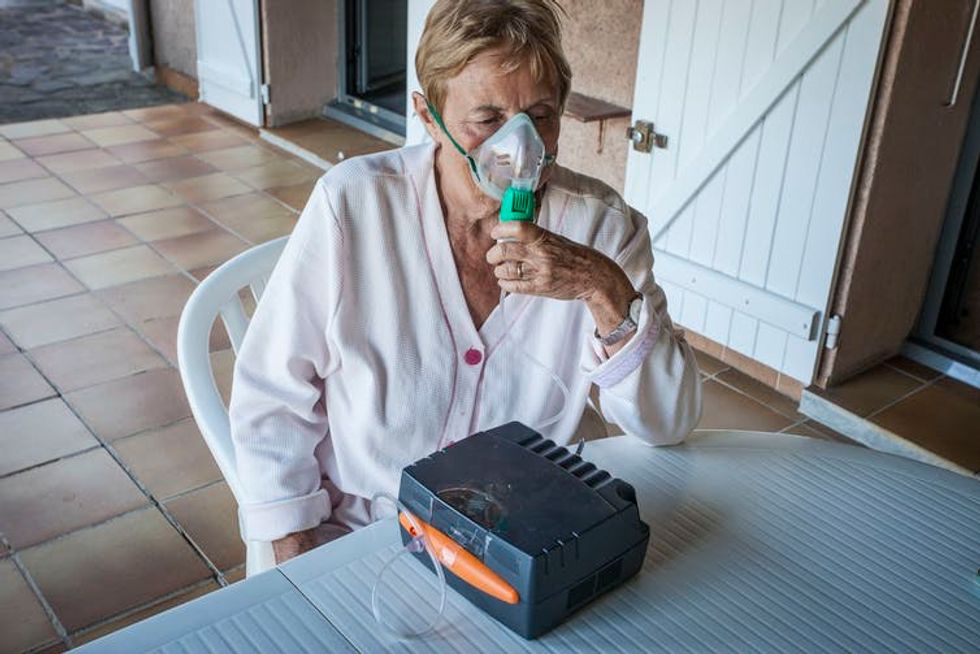
Sometimes patients have difficulty using handheld inhalers and instead use nebulizers, which turn liquid medicine into a mist. Particularly when the patient is experiencing severe asthma symptoms, nebulizers can be more effective at delivering medication slowly into the airways.
The current concern about nebulizers is that if they are used by a patient with a respiratory infection, the nebulizer could aerosolize droplets containing virus, allowing the virus to stay in the air longer. Hospitals and other facilities are being advised to reduce their use of nebulizers to reduce spread of the new coronavirus.
Nebulizers turn liquid medication into a mist that the asthma patient inhales. The way they work has raised concerns that nebulizers could spread coronavirus.
If an asthma patient finds that nebulized therapy is more effective than inhalers, the nebulizer should be used in a room that is isolated from other household members.
What can I do if my pharmacy runs out of albuterol rescue inhalers?
Some parts of the country are experiencing shortages of albuterol inhalers, in part because hospitals are using them more for COVID-19 patients. If the pharmacy is out of stock, patients have some options:
Albuterol handheld inhalers are marketed under various names, and not all are in short supply. It’s worth asking the pharmacist if another formulation is available.
Nebulized albuterol is widely available and may be an alternative if the user takes the recommended precautions.
Check with mail order or other local pharmacies.
Ask your physician whether other rescue inhalers, such as levalbuterol or ipratropium, would be appropriate. Your physician may also suggest other alternatives.
If necessary, patients can use albuterol that has expired. In general, medications are thought to be safe one year after their expiration date, but they are not guaranteed to have the same potency.
What else should I do to stay healthy?
Asthma care is individualized, and I recommend that asthma patients check in with their health care providers to make sure they are using daily controller medications correctly have a plan in place in case asthma symptoms worsen. Keep a 30-day supply of your usual medications, but don’t stockpile medications, which can lead to shortages.
At this point, most people are aware of the CDC’s recommendations on how to protect yourself, including social isolation, hand hygiene and disinfecting surfaces. I would add one more – pay attention to your mental health, too.
When I asked one patient whether she had experienced asthma symptoms recently, her response was that she was hyperventilating at times just sitting and watching the news. She knew it was time to turn off the TV.
It’s a stressful time. Getting good sleep and being kind to yourself and others is more important than ever.
The conservative Wall Street Journal urged readers to tune out President Donald Trump's daily coronavirus briefings.
The newspaper's editorial board published a column Wednesday evening lamenting that Trump had turned those news conferences into an airing of grievances instead of useful updates on the public health crisis.
"The briefings began as a good idea to educate the public about the dangers of the virus, how Americans should change their behavior, and what the government is doing to combat it," the column began. "They showed seriousness of purpose, action to mobilize public and private resources, and a sense of optimism. Mr. Trump benefitted in the polls not because he was the center of attention but because he showed he had put together a team of experts working to overcome a national health crisis."
Eventually the president concluded the briefings put the spotlight on him, and he began using them as a substitute for the freewheeling campaign rallies he can't hold during the COVID-19 outbreak.
"Perhaps he resented the media adulation that New York Gov. Andrew Cuomo has been receiving for his daily show," the column says. "Whatever the reason, the briefings are now all about the President."
The Journal stopped short of calling out the president for spreading misinformation about the virus or his administration's handling of the outbreak, as many media outlets have done, but the newspaper complained that Trump was unable to resist petty attacks on his critics.
"On Tuesday Mr. Trump was asked, in a typically tendentious question, why he had compared the coronavirus to the flu," the column says. "Instead of saying he had been hoping for the best but was wrong when he'd said that, he got into a fight over the severity of the flu. This sort of exchange usually devolves into a useless squabble that helps Mr. Trump’s critics and contributes little to public understanding."
"The President’s outbursts against his political critics are also notably off key at this moment," the column adds. "This isn’t impeachment, and COVID-19 isn’t shifty Schiff. It’s a once-a-century threat to American life and livelihood."
In the age of coronavirus, Americans are being told to stay home and wear masks outside. The federal government has made way for hospitals to treat patients in repurposed hotels and dormitories. Private companies are working to push out new diagnostic tests.But the national effort has been disorganized, relying heavily on state action, said health systems experts and public health researchers. That approach has fallen short, they assert.“We’re in a lot more trouble than we need to be,” said Dr. Donald Berwick, who ran the federal Centers for Medicare & Medicaid Services during the Obama admini...




 AFP / Philip FONG
  AFP / Bryan R. Smith
  AFP / Gal ROMA
  AFP / CRISTINA QUICLER
  AFP / Simon MALFATTO