The creationist museum, Ark Encounter in Williamstown, Kentucky, denies the age of the Earth, thinks Jesus Christ existed with the dinosaurs and a slew of other false scientific narratives. But after announcing that they would stay open because they prize cleanliness, as cited in The Bible, there was a considerable response, Patheos' "The Friendly Atheist" wrote.
"Answers in Genesis and its biblical attractions, the Creation Museum and the Ark Encounter, have always placed a very high standard on cleanliness and sanitation at all its facilities and offices, which assists in illness prevention," a statement from Ark Encounters said before ultimately changing their position. "In fact, in guest surveys, the cleanliness of our attractions is consistently rated as "excellent" by an overwhelming percentage of our guests."
"Due to the extensive publicity concerning the COVID-19 (coronavirus) and its effects, we have been taking additional steps and preventive measures, in line with guidance from the Centers for Disease Control and Prevention (CDC) and other health agencies," the statement continued. "We use known disinfectants approved by the EPA to deal with this virus and others and routinely sanitize and clean throughout our facilities, including restrooms, kitchens, and transport vehicles such as our public shuttle buses. The sanitization and cleaning occur throughout the day during normal business operations as well as a very thorough cleaning in the evening by trained housekeeping professionals."
It's unclear what the magic disinfectants are, but no amount of disinfecting can stop a virus if someone sneezes or coughs near another person. The Ark Encounter didn't intend to test people for fever upon entering, but that wasn't a recommendation from Genesis.
"This is why so many people criticize Answers in Genesis," wrote The Friendly Atheist. "It's not just their rejection of evolution. That's philosophically and scientifically wrong, but that's not new. What's dangerous is developing the mindset that says scientists shouldn't be trusted."
See some of the responses to the Ark Encounter below:
A health official in North Carolina is asking for help from the community after confirming that an individual who tested positive for the COVID-19 virus attended a Lego convention in Raleigh.
"Because the crowd was so large and so mobile, we have no way to identify who came in close contact with this person during the Lego convention," Wake Country Emergency Operations Center director Jose Cabanas told the station. "We need the community's help to determine who was potentially at risk of exposure to the virus."
Anyone who attended the BrickUniverse Lego Fan Convention at the Raleigh Convention Center on March 8 from 2-4 pm is encouraged to call the Wake County Public Health Division's COVID-19 hotline at 919-856-7044.
A Norwegian university has reportedly backtracked after calling health services in the United States poorly developed.
In a post on Facebook, the Norwegian University of Science and Technology advised some international students students to return home.
"This applies especially if you are staying in a country with poorly developed health services and infrastructure, for example the USA," the post said, according to reports.
By Sunday afternoon, the reference to the United States had been removed from the Facebook posting. The language, however, was not removed from the NTNU website.
"This applies especially if you are staying in a country with poorly developed health services and infrastructure and/or collective infrastructure," the updated post said.
But Commenters had already responded to the initial post.
"Can’t wait to when the Americans wake up," one person wrote.
"As an American I can't wait for Americans to wake up either," another replied.
"I laughed so loud with 'for example, USA', that I think I woke my neighbours up 😂😂😂," a commenter noted.
"Oh my god this is great 😂😂😂," another Facebook user laughed.
The Internet lashed out at Rep. Devin Nunes (R-CA) on Sunday after he told Americans to go to restaurants during the novel coronavirus pandemic.
"There's a lot of concerns with the economy here because people are scared to go out," Nunes told Fox News host Maria Bartiromo. "But I will just say, one of the things you can do if you're healthy, you and your family, it's a great time to just go out, go to a local restaurant."
"Just don't run to the grocery store and buy $4,000 of food!" he added. "Go to your local pub."
The advice did not go over well on Twitter, where people repeatedly referred to Nunes as an "idiot."
Rep. Devin Nunes (R-CA) asserted on Sunday that the coronavirus pandemic is a perfect time to frequent gathering places like restaurants and pubs.
Nunes made the remarks during an appearance on the Fox News program Sunday Morning Futures with host Maria Bartiromo.
"What the American people need to understand is we need to stop panicking," Nunes advised. "There's no shortage of food in this country. People don't need to go to the store and fight over a bottle of water or toilet paper."
"We want you to buy food!" he continued. "There's a lot of concerns with the economy here because people are scared to go out. But I will just say, one of the things you can do if you're healthy, you and your family, it's a great time to just go out, go to a local restaurant."
Nunes observed that patrons could likely "get in easily" at their favorite restaurant.
"Just don't run to the grocery store and buy $4,000 of food!" he exclaimed. "Go to your local pub."
In an appearance on CBS, the top infectious disease expert in the U.S. said that he would not dine in public.
"Right now, myself personally, I wouldn't go to a restaurant," Dr. Anthony Fauci told Face the Nation on Sunday.
The National Geographic revealed in a story on Friday that what the Museum of the Bible has claimed are fragments of the Dead Sea Scrolls are a complete fraud.
The museum, founded by Hobby Lobby CEO Steve Green, already faced problems when they were "forced to forfeit thousands of cuneiform texts from Iraq, and pay a $3 million fine for illicit importation," reported Politico.
Now the museum is back in the news as independent researchers funded by the museum announced that all of the 16 fragments are forgeries. The museum says that they were duped by the collector and Green, as well as biblical scholars.
"The Museum of the Bible is trying to be as transparent as possible," says CEO Harry Hargrave. "We're victims—we're victims of misrepresentation, we're victims of fraud."
The museum researchers released a report of over 200 pages detailing how "these fragments were manipulated with the intent to deceive," said fraud investigator Colette Loll.
"The new findings don't cast doubt on the 100,000 real Dead Sea Scroll fragments, most of which lie in the Shrine of the Book, part of the Israel Museum, Jerusalem," said National Geographic. "However, the report's findings raise grave questions about the 'post-2002' Dead Sea Scroll fragments, a group of some 70 snippets of biblical text that entered the antiquities market in the 2000s. Even before the new report, some scholars believed that most to all of the post-2002 fragments were modern fakes."
"Once one or two of the fragments were fake, you know all of them probably are, because they come from the same sources, and they look basically the same," said Norway's University researcher Årstein Justnes, who has tracked the post-2002 pieces.
"It really was—and still is—an interesting kind of detective story," says Jeffrey Kloha, the Museum of the Bible's chief curatorial officer. "We really hope this is helpful to other institutions and researchers because we think this provides a good foundation for looking at other pieces, even if it raises other questions."
If you saw the 2011 movie “Contagion,” about a worldwide pandemic of a new virus, then you’ve heard the term “R0.”
Pronounced “R naught,” this isn’t just jargon made up in Hollywood. It represents an important concept in epidemiology and is a crucial part of public health planning during an outbreak, like the current coronavirus pandemic that’s spread globally since it was first identified in China.
Scientists use R0 – the reproduction number – to describe the intensity of an infectious disease outbreak. R0 estimates have been an important part of characterizing pandemics or large publicized outbreaks, including the 2003 SARS pandemic, the 2009 H1N1 influenza pandemic and the 2014 Ebola epidemic in West Africa. It’s something epidemiologists are racing to nail down about SARS-CoV-2, the virus that causes COVID-19.
How much will a disease spread?
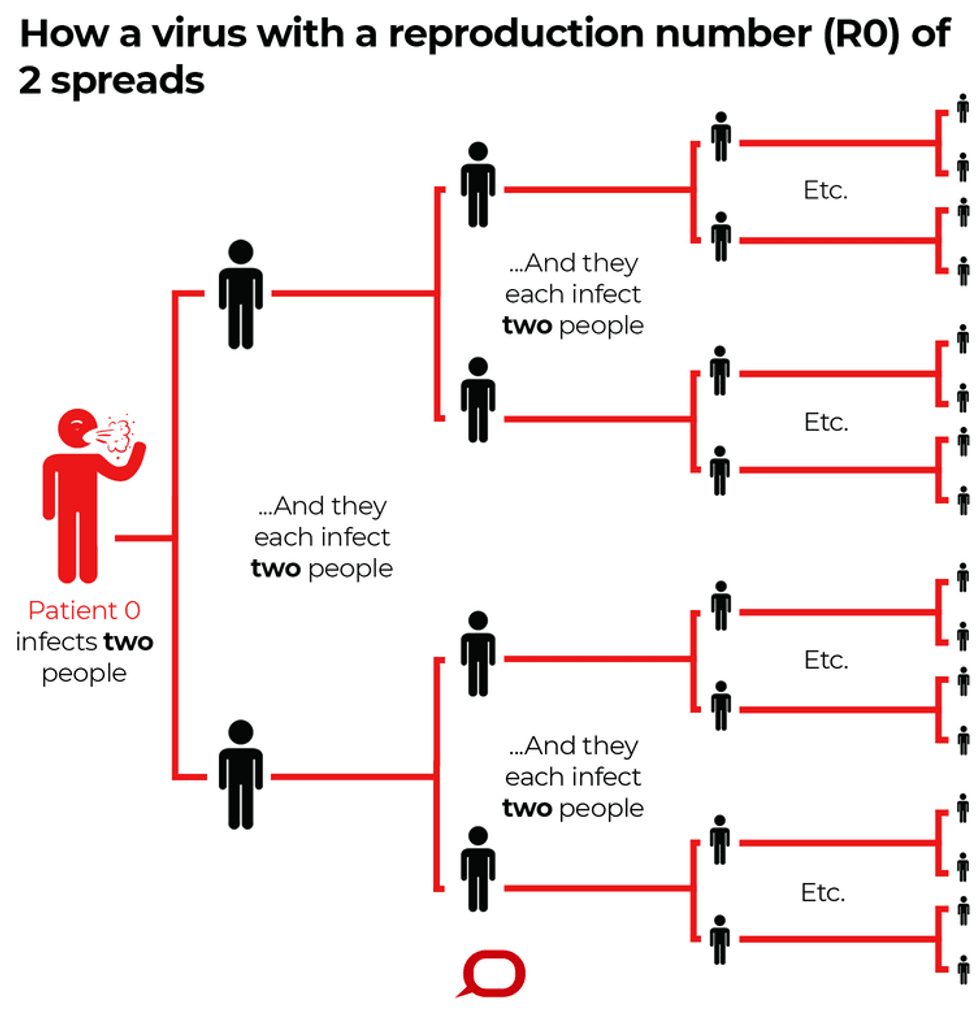
The formal definition of a disease’s R0 is the number of cases, on average, an infected person will cause during their infectious period.
R0 describes how many cases of a disease an infected person will go on to cause – in this imagined scenario R0=2.
The basic reproduction number represents the maximum epidemic potential of a pathogen. It describes what would happen if an infectious person were to enter a fully susceptible community, and therefore is an estimate based on an idealized scenario.
The effective reproduction number depends on the population’s current susceptibility. This measure of transmission potential is likely lower than the basic reproduction number, based on factors like whether some of the people are vaccinated against the disease, or whether some people have immunity due to prior exposure with the pathogen. Therefore, the effective R0 changes over time and is an estimate based on a more realistic situation within the population.
It’s important to realize that both the basic and effective R0 are situation-dependent. It’s affected by the properties of the pathogen, such as how infectious it is. It’s affected by the host population – for instance, how susceptible people are due to nutritional status or other illnesses that may compromise one’s immune system. And it’s affected by the environment, including things like demographics, socioeconomic and climatic factors.
For example, R0 for measles ranges from 12 to 18, depending on factors like population density and life expectancy. This is a large R0, mainly because the measles virus is highly infectious.
On the other hand, the influenza virus is less infectious, with its R0 rangingfrom 0.9 to 2.1. Influenza, therefore, does not cause the same explosive outbreaks as measles, but it persists due to its ability to mutate and evade the human immune system.
What makes R0 useful in public health?
Demographer Alfred Lotka proposed the reproduction number in the 1920s, as a measure of the rate of reproduction in a given population.
In the 1950s, epidemiologist George MacDonald suggested using it to describe the transmission potential of malaria. He proposed that, if R0 is less than 1, the disease will die out in a population, because on average an infectious person will transmit to fewer than one other susceptible person. On the other hand, if R0 is greater than 1, the disease will spread.
When public health agencies are figuring out how to deal with an outbreak, they are trying to bring R0 down to less than 1. This is tough for diseases like measles that have a high R0. It is especially challenging for measles in densely populated regions like India and China, where R0 is higher, compared to places where people are more spread out.
For the SARS pandemic in 2003, scientists estimated the original R0 to be around 2.75. A month or two later, the effective R0 dropped below 1, thanks to the tremendous effort that went into intervention strategies, including isolation and quarantine activities.
However, the pandemic continued. While on average, an infectious person transmitted to fewer than one susceptible individual, occasionally one person transmitted to tens or even hundreds of other cases. This phenomenon is called super spreading. Officials documented super spreader events a number of times during the SARS epidemic in Singapore, Hong Kong and Beijing.
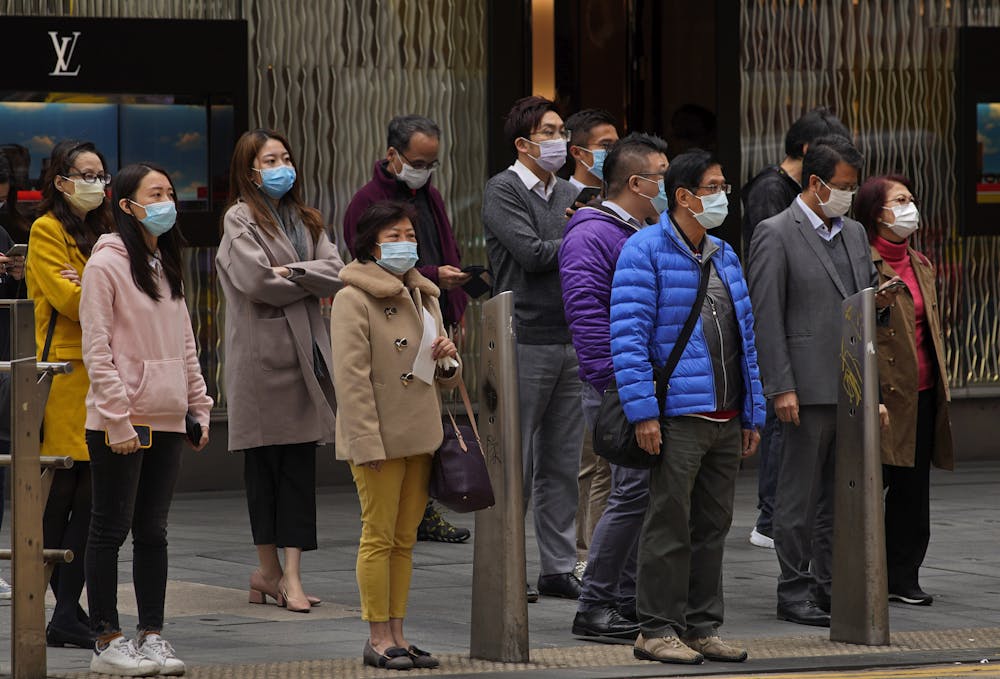
People in Hong Kong, concerned about coronavirus spreading from mainland China, wear face masks in February 2020.
A number of groups have estimated R0 for this new coronavirus. The Imperial College group has estimated R0 to be somewhere between 1.5 and 3.5. Most modeling simulations that project future cases are using R0s in that range.
These differences are not surprising; there’s uncertainty about many of the factors that go into estimating R0, such as in estimating the number of cases, especially early on in an outbreak.
Based on these current estimates, projections of the future number of cases of coronavirus are fraught with high levels of uncertainty and will likely be somewhat inaccurate.
The difficulties arise for a number of reasons.
First, the basic properties of this viral pathogen – like the infectious period – are as yet unknown.
Second, researchers don’t know how many mild cases or infections that don’t result in symptoms have been missed by surveillance but nevertheless are spreading the disease.
Third, the majority of people who come down with this new coronavirus do recover, and are likely then immune to coming down with it again. It’s unclear how the changing susceptibility of the population will affect the future spread of infection. As the virus moves into new regions and communities, it encounters people with varying health conditions that affect their susceptibility to disease, as well as different social structures, both of which affect its transmissibility.
Finally, and likely the most important reason, no one knows the future impacts of current disease control measures. Epidemiologists’ current estimates of R0 say nothing about how measures such as travel restrictions, social distancing and self-quarantine efforts will influence the virus’s continued spread.
This is an updated version of an article originally published on Feb. 5, 2020. The reproduction number for seasonal flu was corrected on March 27, 2020.
One of President Donald Trump's favorite pastors, Robert Jeffress, intends to keep a 13,000-member Dallas church open because he has a book signing on Sunday.
He explained that his book signing is far more important than anything else.
“What we are doing is more important that what the NBA is doing," he explained.
He's open to other options if the virus spreads more in Texas, he said. However, due to inadequate testing, it's unclear who has the virus and who merely has a cold. There are also carriers of the virus who don't yet know that they are sick.
Jeffress' book signing is scheduled for March 15 for his instruction manual: COURAGEOUS: 10 Strategies for Thriving in a Hostile World. "Self-quarantine" is not among the 10 strategies.
NBA player Rudy Gobert mocked the coronavirus and how highly infectious it was by touching all of the microphones of every reporter at a press event.
He then came to Oklahoma City to play against the OKC Thunder but the game was called off when it turned out he had a fever. It turned out Gobert tested positive for coronavirus.
Gobert put not only his teammates in danger, but also brought the coronavirus to Oklahoma, which had relatively low infection rates in the centrally located state.
After also traveling to Oklahoma and using the same limo service as Gobert, music icon Cher was forced into quarantine and had to cancel her Oklahoma City show. It was hours later that she announced she was canceling her entire "Here We Go Again" tour. She's currently awaiting test results.
"The first and most important thing is I would like to publicly apologize to the people that I may have endangered," Gobert said. "At the time, I had no idea I was even infected. I was careless and make no excuse. I hope my story serves as a warning and causes everyone to take this seriously."
"I will do whatever I can to support using my experience as a way to educate others and prevent the spread of this virus," he also said.
He thanked well-wishers and then lamented how embarrassed he was.
"I have gone through so many emotions since learning of my diagnosis…mostly fear, anxiety, and embarrassment," he said. "I am under great care and will fully recover. Thank you again for all your support. I encourage everyone to take all of the steps to stay safe and healthy. Love."
The physician for the United States Congress expects between 70 to 150 million people in the country to eventually get infected with the novel coronavirus, a lawmaker said Thursday.
Congresswoman Rashida Tlaib made the remarks during a hearing of the House of Representatives with members of the president's coronavirus task force, confirming what was reported earlier by US media outlets including Axios and NBC News.
"Congress's attending physician told the Senate that he expects between 70 to 150 million people to eventually contract the coronavirus in the United States," Tlaib said.
Citing two sources, Axios had reported that doctor Brian Monahan conveyed the projection to Senate senior staff on Tuesday, telling them they should prepare for the worst and offering advice on how to remain healthy.
The upper end of the projection is about 46 percent of the US population of 327 million people. By comparison German Chancellor Angela Merkel warned this week that up to 70 percent of her country's population could get the virus.
Asked by Tlaib whether he believed the projection was accurate, Anthony Fauci, head of the National Institute of Allergy and Infectious Diseases (NIAID), told the hearing: "We really need to be careful with those kinds of predictions because that's based on a model."
He added that "all models are as good as the assumptions that you put into the model" and that with containment and mitigation the upper end of the projection could be avoided.
About 80 percent of coronavirus cases are mild, and according to the latest US modeling, the overall mortality rate is somewhere between 0.1 and one percent.
Risk starts to increase for people who are over 60 and is heightened more for those over 80, as well as for people who have other conditions like diabetes, heart disease or lung disease, or whose immune systems are compromised.
Fauci noted that a 2014 model by the Centers for Disease Control and Prevention (CDC) projected the African Ebola outbreak could affect more than a million people. But this was eventually not the case and the final number was under 30,000.
The U.S. government is fighting to contain and slow down the spread of the coronavirus. Testing is central to these efforts. Molecular biologist and viral researcher Maureen Ferran answers some basic questions about how these diagnostic tests work – and if there are enough to go around.
Who gets tested for the virus?
Currently there are two main reasons someone would be tested for the coronavirus: having symptoms or exposure to an infected person.
The main symptoms of COVID-19, the disease caused by the coronavirus SARS-CoV-2, are fever, dry cough and shortness of breath. These look a lot like the flu and the common cold, so it takes a physician to determine if testing for the virus is necessary.
Initially, the Centers for Disease Control and Prevention recommended testing only people with symptoms and who had potentially been exposed to the virus. But to the surprise of public health officials, several of the first people in the U.S. who tested positive for the virus had no obvious exposure. This development suggested that the virus was being transmitted locally, meaning it was spreading from person to person easily and/or that people may have been transmitting the virus without experiencing serious symptoms.
As of writing this, there are no specific treatments available for COVID-19, but that does not mean testing is pointless. Perhaps most importantly, testing is done so that infected patients can be quarantined and the spread of the virus slowed. Another benefit of testing is that it lets public health workers build a more accurate picture of the number of cases and how the virus is spreading in the population.
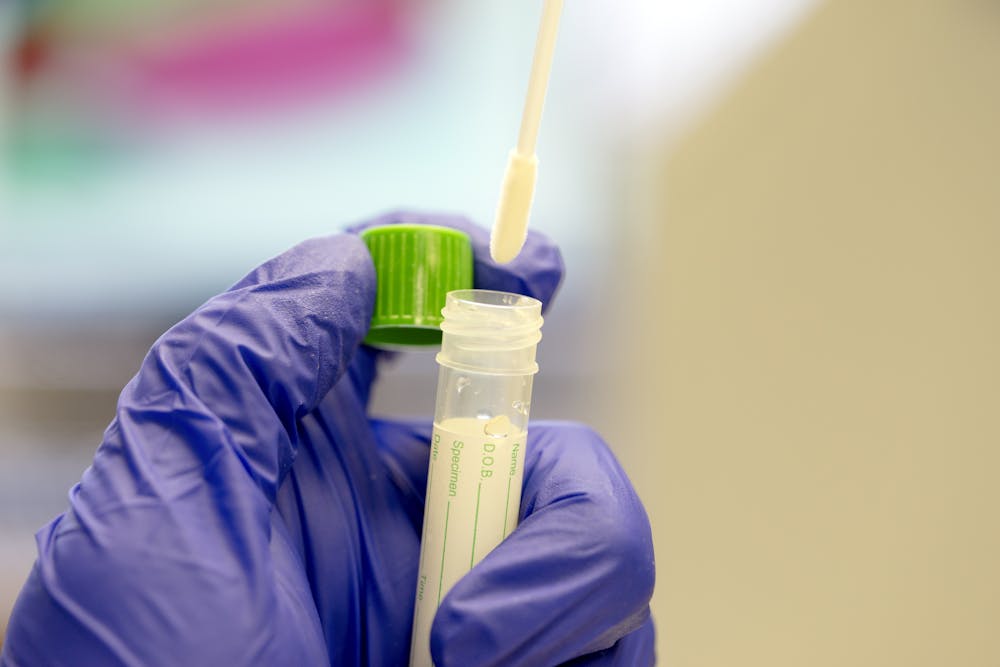
Taking a sample is quick, easy and can be done anywhere. Finding out if a person is infected is more complicated.
While collecting a sample is easy, actually determining whether a person is infected with the coronavirus is much more complicated. The current method looks for the virus’s genetic material (RNA) in a patient’s cells.
In order to detect the presence of RNA in the patient’s sample, labs perform a test called reverse-transcription polymerase chain reaction. This method first converts any viral RNA to DNA. Then the DNA is replicated millions of times until there are enough copies to detect using a specialized piece of equipment called a quantitative PCR instrument.
If genetic material from the virus is found in the sample, then the patient is infected with the virus.
The availability of tests has been a big issue. Prior to Feb. 29, the CDC was the only place approved by the FDA to develop, produce and process tests. However, as the number of suspected cases climbed and doctors approved more people for testing, demand to be tested soared.
As pressure on the federal government to make tests available increased, the FDA announced a new policy on Feb. 29 that made it easier for commercial and academic laboratories to develop their own tests and allowed other certified labs to test patient samples.
Integrated DNA Technologies, a CDC contractor, shipped 700,000 tests to commercial, academic and health care laboratories on March 6. Quest Diagnostics and LabCorp, two large commercial test manufacturers, started making their own test kits, which became available on March 9. Many companies, hospitals and other institutions are now racing to develop more tests to diagnose COVID-19.
Realistically, it isn’t feasible to test everyone who is sick in the U.S. Therefore, most health officials believe it is important to prioritize the testing of people who need it the most: those at high risk such as health care workers who have been in contact with COVID-19 patients; symptomatic people in areas with high infection rates; and people 65 years of age and older with chronic health issues, such as heart disease, lung disease or diabetes. As more tests become available, it will be possible to test more people.
There’s also a need to develop faster tests that do not require special equipment and personnel. Testing allows experts to better understand how the outbreak is progressing and try to predict the impact the virus will have on society.
As with all outbreaks, this pandemic will end. In the meantime, however, people need to wash their hands and try to minimize their risk of exposure. There is much to be learned about this novel coronavirus. Only time will tell if it disappears from the human population, as SARS did in 2004, or becomes a seasonal disease like flu.
Greenland and Antarctica are shedding six times more ice than during the 1990s, driving sea level rise that could see annual flooding by 2100 in regions home today to some 400 million people, scientists have warned.
The kilometres-thick ice sheets atop land masses at the planet's extremities sloughed off 6.4 trillion tonnes of mass from 1992 through 2017, adding nearly two centimetres (an inch) to the global watermark, according to an assessment by 89 researchers, the most comprehensive to date.
Last summer's Arctic heatwave will likely top the 2011 record for polar ice sheet loss of 552 billion tonnes, they reported in a pair of studies, published Wednesday in Nature.
That is roughly the equivalent of eight Olympic pools draining into the ocean every second.
While less visible than climate-enhanced hurricanes, sea level rise may ultimately prove the most devastating of global warming impacts.
Indeed, it is the added centimetres -- perhaps added metres by the 22nd century -- that make storm surges from climate-enhanced tropical cyclones so much more deadly and destructive, experts say.
"Every centimetre of sea level rise leads to coastal flooding and coastal erosion, disrupting lives around the planet," said University of Leeds professor Andrew Shepherd, who led the analysis along with Erik Ivins from NASA's Jet Propulsion Laboratory.
"If Antarctica and Greenland continue to track worst-case climate warming scenarios, they will cause an extra 17 centimetres of sea level rise by the end of the century," he said in a statement.
- 'Irrefutable evidence' -
That's about a third of the rise forecast for 2100 by the UN's climate science advisory panel (IPCC) under a scenario midway between a rapid drawdown of global greenhouse gases -- seen by many as overly optimistic -- and the unbridled expansion of fossil fuel use, also seen as unlikely.
Melting glaciers and the expansion of ocean water as it warms accounted for most sea level rise through the 20th century, but ice sheet melt-off has become a major driver over the last decade.
Almost all of the ice lost from Antarctica, and half of that from Greenland, has been triggered by warming ocean water speeding the movement of glaciers toward the sea.
Oceans help humanity by absorbing more than 90 percent of the excess heat from global warming.
The remainder of Greenland's ice losses is due to rising air temperature, which creates roaring rivers of ocean-bound melt-water in summer.
The combined rate of mass loss from both ice sheets rose six-fold from 81 to 475 billion tonnes per year over less than three decades, the studies reported.
The findings are grounded in decades of satellite data, in situ measurements, and computer modelling.
"Satellite measurements provide prima facie, irrefutable evidence," said Ivins.
- Point of no return -
The IPCC forecasts about half-a-metre of sea level rise by 2100 under the middle-of-the-road emissions scenario known as RCP4.5.
If humanity defies the odds and achieves "carbon neutrality" by mid-century -- which means any remaining emissions are somehow offset -- sea level will likely be capped at 43 cm.
The "worst case" pathway -- which assumes carbon emissions continue unabated, or that Earth itself will begin to boost greenhouse gas concentrations -- would see an 84 cm increase, according to an IPCC special report on oceans released in September.
Over the last decade, sea level has risen about four millimetres per year. But moving into the 22nd century, the waterline is likely to go up ten times faster, even under an optimistic emissions scenario.
Earth's average surface temperature has warmed one degree Celsius over preindustrial levels, but polar regions have heated up twice as much.
Greenland and West Antarctica -- which many scientists say has already passed a point-of-no-return and will shed all its ice eventually -- together support enough frozen water to lift oceans about 13 metres.
The rest of Antarctica, which is more stable, sits underneath more than 50 metres-worth of sea level rise.
President Donald Trump began his address to the nation by saying that the "foreign virus" is being handled by the "best" people.
"This is the most aggressive and comprehensive effort to confront a foreign virus in modern history," he said.
He announced that the country was saved by blocking Chinese travel into the United States. The only reason the virus spread more in the United States, he said, is because European travels.
However, Trump said that it would not apply to the United Kingdom, but didn't explain why.
Trump said that he would prevent "surprise billing" from insurance and that his people are helping create the anti-viral medication needed to save lives.
"The risk is very very low," he said, promising people that were young would be fine.
He said that he would consider action to help fund people who can't work due to the virus.
“The virus will not have a chance against us,” he promised.
"We're having to fix a problem that four weeks ago nobody ever thought would be a problem," he also said. The first case was reported in the United States 7 weeks ago.