The novel coronavirus proved deadly in 1.4 percent of all people infected in the Chinese outbreak city of Wuhan, far lower than global estimates of the killer pandemic, researchers said Thursday.
COVID-19 cases are soaring, with more than 200,000 confirmed since cases emerged in Wuhan late last year.
The World Health Organization said this month that COVID-19 proves deadly in 3.4 percent of confirmed cases.
But with limited testing capacity and confirmed cases likely to be towards the severe end of the spectrum, several experts have suggested the true mortality rate may be significantly lower.
A team of researchers in China has now reviewed eight separate public and private data sources on COVID-19 in Wuhan, and believe they have come up with a more accurate mortality estimate.
These include: data on confirmed cases with no contact with the market where the outbreak originated; confirmed air passenger cases; age distribution of confirmed cases and deaths; and time between onset and death.
They found that the probability of dying after developing COVID-19 symptoms was 1.4 percent.
"Estimation of true case numbers -- necessary to determine the severity per case -- is challenging in the setting of an overwhelmed healthcare system that cannot ascertain cases effectively," said the study, published in Nature Medicine.
As of February 29, mainland China had 79,394 confirmed COVID-19 cases and 2,838 deaths -- meaning 3.54 percent of patients diagnosed with the disease later died.
But the authors said that milder cases presenting few or no symptoms are missing from data sets, and suggested their estimates were a better way to view the virus and the problem it poses.
"The number of severe outcomes or deaths in the population is most strongly dependent on how ill an infected person is likely to become, and this question should be the focus of attention," they wrote.
- Age matters -
The analysis, led by Joseph Wu, a renowned epidemiologist at the University of Hong Kong, also examined the likelihood of death across age ranges.
Compared with those aged 30-59 years, those above 59 were roughly 5.1 times more likely to die after infection.
Those under 30 were 60 percent less likely to die than the median age group.
The authors concluded that the risk of contracting a moderate to severe infection increased roughly four percent per year among adults aged 30-60 years.
Chinese authorities undertook a near-total lockdown of Wuhan and the surrounding province of Hubei, confining more than 11 million people to their homes for weeks.
They also constructed a new hospital in the city to deal with COVID-19 case loads.
On Wednesday China reported just one new domestic case, compared to over 1,000 per day at the epidemic's peak.
Wu said his estimates should help inform policymakers at a time when several European countries are undergoing lock downs.
"Estimates of both the observed and unobserved infections are essential for informing the development and evaluation of public health strategies, which need to be traded off against economic, social and personal freedom costs," he wrote.
COVID-19, which first emerged in Wuhan, China in December 2019, is relentlessly sweeping across the world. The scale of the epidemic has caused chaos and led to the World Health Organisation declaring it a pandemic in early February 2020.
Understanding the virus is the preoccupation of scientists who are trying to unravel its mysteries as a first step to finding ways to stop the disease spreading, and to finding a vaccine. On a daily basis scientists are finding out new things about SARS-CoV-2, the virus behind the rapidly spreading disease COVID-19.
An area of inquiry is its relationship to other coronaviruses. For example, it’s been identified as being part of the same family of coronaviruses which caused Severe Acute Respiratory Syndrome (SARS) and Middle East Respiratory Syndrome (MERS). SARS was first identified in 2002. It caused severe respiratory disease which was fatal in approximately 10% of cases. MERS, on the other hand, originated in the Middle East and although less infectious, caused death in around 37% of cases.
Scientists investigating SARS-CoV-2 have found that the structure is very similar to the SARS-CoV. But there are also a number of marked differences. For example, one of the most startling differences of COVID-19 is its rapid spread across the world.
Closing the gap in understanding these differences and similarities is what stands between scientists and a solution to the rapidly spreading disease. One vital line of inquiry into how the body is able to fight and overcome the infection is how blood types – and their associated antibodies – might influence the immune response.
Similarities and differences
SARS-Cov-2 is round in shape and has a number of proteins called spikes on the surface. These spikes attach to the same human cell receptor (angiotensin-converting enzyme 2) as the SARS-CoV. This information is important as it suggests that the virus uses the same mechanism of ensuring that the viral genes enter the host cell, replicate and infect other cells. Scientists can use this to develop drugs which inhibit the spike protein from binding and so slow the ability of the virus to replicate
Another similarity is the structure of the spike protein which is called NSP15. Scientists from a number of universities in the US have studied the structure of this protein and found it to be 89% similar to the NSP15 protein in SARS-CoV.
Like COVID-19, SARS was highly infectious. But there was one quirk: not everyone who was exposed to individuals who were already infected developed the disease.
One area of research was whether blood types and naturally occurring antibodies could influence the spread or severity of infection.
The distribution of the four main blood groups (A, B, AB and O) varies across population groups and geographical regions due to natural selection, the environment and disease. Up until recently, blood groups were commonly known for their role in blood transfusion. If patients received incompatible blood, powerful naturally occurring anti-A or anti-B antibodies could cause a blood transfusion reaction.
But research has shown that blood types could also play a role in infection and how the body’s immune system responds. One theory is that blood group antigens can act as binding receptors which will allow viruses or bacteria to attach and enter the body’s cells.
An example of this is the norovirus which causes severe vomiting and diarrhoea. This virus is able to bind to ABO antigens on mucosal surfaces of the gut, and once this happens, it is able to gain entry into the host cell and then replicate. On the other hand, anti-A and anti-B antibodies may be part of the body’s natural defence and could limit or even prevent infection.
What about coronaviruses?
Doctors at a Hong Kong hospital studied this phenomenon and reported that individuals who were blood group O appeared to be less susceptible to SARS-CoV than those who were group A, B or AB. Researchers showed that the virus could express antigens on its surface similar to those found in the ABH blood group. They also reported that naturally occurring anti-A antibodies were able to inhibit or even block the binding of the virus to the host cell.
This led to the theory that group O individuals, which have both anti-A and anti-B antibodies, may have some protection against infection.
The fact that blood types and their associated antibodies influence the immune response is one of the lines of inquiry into how the body is able to fight and overcome the infection.
Another discovery is that the SARS-CoV-2 spike protein is unique and is 10-20 times more likely to attach to human cells. This could explain the increased and more rapid spread across populations.
The structure of these unique spike proteins matter enormously because they will form the basis for the development of a vaccine.
The ABO blood group has evolved in response to disease over thousands of years. The antigens and antibodies which form part of this system interact with cells of the immune system and are able to influence the way they react. As we get to know more about SARS-CoV-2 the role of blood types, if any, may become clearer.
Elon Musk's SpaceX will send astronauts to the International Space Station for the first time in May, NASA said, announcing the first crewed launch from the United States to the platform since 2011.
The tech entrepreneur's company will launch a Falcon 9 rocket to transport NASA astronauts Bob Behnken and Doug Hurley in a first for the space agency as it looks to cut costs.
"NASA and SpaceX are currently targeting no earlier than mid-to-late May for launch," the US space agency said in a statement Wednesday.
In March, Musk's Crew Dragon capsule made a round trip to the ISS, which is in orbit more than 250 miles (400 kilometers) above Earth, with a mannequin on board, before returning to the Atlantic after six days in space.
Since the last US space shuttle mission in 2011, after 30 years of service, only the Russians have been going back and forth to the ISS.
SpaceX has made the trip 15 times since 2012, but only to refuel the station.
It is not the only private company servicing NASA: Boeing has also won a contract and is developing its own Starliner capsule.
A 6-year-old in Florida is suffering from coronavirus, busting the myth that children and young people aren't getting the disease, WPLG explained.
President Donald Trump perpetuated a misleading claim that children are getting the disease less, in fact children can get it, and it can be hard on them.
Dr. Julie Kantor explained that everyone regardless of age is susceptible to the virus. Not all patients who are positive need to be in the hospital or on a ventilator. She noted it's only when they begin to have trouble breathing that it becomes an emergency situation.
Young people can also be carriers of the virus, which is why they're warning against people visiting the elderly or anyone with a compromised immune system.
The World Health Organization recommended Tuesday that people suffering COVID-19 symptoms avoid taking ibuprofen, after French officials warned that anti-inflammatory drugs could worsen effects of the virus.
The warning by French Health Minister Olivier Veran followed a recent study in The Lancet medical journal that hypothesised that an enzyme boosted by anti-inflammatory drugs such as ibuprofen could facilitate and worsen COVID-19 infections.
Asked about the study, WHO spokesman Christian Lindmeier told reporters in Geneva the UN health agency's experts were "looking into this to give further guidance."
"In the meantime, we recommend using rather paracetamol, and do not use ibuprofen as a self-medication. That's important," he said.
He added that if ibuprofen had been "prescribed by the healthcare professionals, then, of course, that's up to them."
His comments came after Veran sent a tweet cautioning that the use of ibuprofen and similar anti-inflammatory drugs could be "an aggravating factor" in COVID-19 infections.
"In the case of fever, take paracetamol," he wrote.
The French minister stressed that patients already being treated with anti-inflammatory drugs should ask advice from their doctor.
Paracetamol must be taken strictly according to the recommended dose, because too much of it can damage the liver.
The COVID-19 pandemic, which has infected around 190,000 people worldwide and killed more than 7,800, causes mild symptoms in most people, but can result in pneumonia and in some cases severe illness that can lead to multiple organ failure.
Even before the pandemic, French authorities sounded the alarm over serious "infectious complications" linked to the use of ibuprofen, which is sold under various brands like Nurofen and Advil, and other anti-inflammatory drugs.
A spokesperson for British pharmaceutical company Reckitt Benckiser, which makes Nurofen, said in an email statement that the company was aware of concerns raised about "the use of steroids and non-steroidal anti-inflammatory (NSAIDs) products, including ibuprofen, for the alleviation of COVID-19 symptoms."
“Consumer safety is our number one priority," the spokesperson said, stressing that "Ibuprofen is a well-established medicine that has been used safely as a self-care fever and pain reducer, including in viral illnesses, for more than 30 years."
"We do not currently believe there is any proven scientific evidence linking over-the-counter use of ibuprofen to the aggravation of COVID-19," the statement said.
The spokesperson said Reckitt Benckiser was "engaging with the WHO, EMA (the European Medicines Agency) and other local health authorities" on the issue and would provide "any additional information or guidance necessary for the safe use of our products following any such evaluation."
Emory University epidemiologist and health services researcher Dr. Rachel Patzer, PhD revealed that she moved her husband, a medical doctor, out of the house to help keep their family safe.
In a tragic thread on Twitter, Patzer said that her husband is actively coming in contact with coronavirus patients. While he's practicing safety, to protect their family, he'll be crashing above their garage.
"We have a 3 week-old newborn and 2 young kids and just can’t risk it," said Patzer. "It pains me to wonder how many weeks will go by that he won’t get to hold our new baby or see our older kids. This is one example of the sacrifice that healthcare workers are making for our communities."
She's sharing in the fear and anxiety many Americans face. She's worried about the health and wellness of her spouse, while being forced to care for children alone.
Patzer went on to shame the fools making things worse by partying in bars and clubs.
"It is difficult to see pictures of all the people at bars and restaurants, socializing, making play dates, and ignoring social distancing recommendations when I know my husband and many other healthcare workers are risking their lives to treat more sick patients," she wrote. "Please, take this pandemic seriously. I hope the projections of infections and serious cases are incorrect. If not, our healthcare system will be overloaded. And already we are seeing the strain. Please thank a healthcare worker for what they are doing and sacrificing."
President Donald Trump on Tuesday asserted that he had not changed his "tone" with regard to the seriousness of the novel coronavirus pandemic.
At a press briefing, MSNBC's Kristen Welker noted that the president had struck a more "somber" tone in the last 24 hours after initially insisting that the virus would quickly "go away."
"I have seen that where people actually liked it," Trump said of his Monday briefing. "But I didn't feel different. I've always known this is a real -- this is a pandemic."
"I thought it was a pandemic long before it was called a pandemic," he added.
As part of his duties overseeing the task force in charges of dealing with the coronavirus pandemic, Vice President Mike Pence has been holding secret meetings with prominent right-wing "influencers" on how to spin Donald Trump's administration's efforts to contain the growing health crisis.
According to a report from the Daily Beast, the outreach began at the annual CPAC conference long before the administration had any idea what they were dealing with, the report notes.
"The direct outreach occurred on Thursday, Feb. 27—the day after Trump tapped Pence to lead the task force. There, the vice president hosted an informal briefing on COVID-19 and the administration’s latest efforts, with several right-leaning personalities with large followings on Twitter and other social media platforms, according to a source with direct knowledge of the gathering," the Beast reports, adding, "The following Wednesday, Pence hosted another closed-door meeting with conservative 'influencers,' with this one lasting for roughly an hour in the vice president’s office on White House grounds."
Among those Vice President Pence has been reaching out to are "Fox New fixture and prolific MAGA tweeter Dan Bongino; former Trump adviser and current “War Room: 2020” podcast host Jason Miller; Newsmax TV host and Trump’s former press secretary Sean Spicer; former White House official and Sinclair 'must-run' commentator Boris Epshteyn; Sinclair anchor and ex-Fox News host Eric Bolling; and former Rep. Jack Kingston (R-GA), a Trump surrogate."
The report notes that the outreach illustrates that White House knows it has a public relations problem of epic proportions on its hands and needs all Trump-supporting hands on deck, who are being used to praise the president while at the same time lashing out the media for their coverage of the administration's failures.
"For weeks the Trump administration’s coronavirus task force has struggled to maintain continuity in messaging, with different departments seemingly operating off of different scripts and with different ideas about how to disseminate information to the public. Part of that tension is internal, with a White House and a president having been desperate to calm the markets at a time when state governments are calling for help amid rising death tolls," the report continued. "Through it all, the vice president’s office, and communications teams on the task force, have tried to minimize the noise, calm Americans, and relentlessly lauded the president’s response to the outbreak in the U.S. The efforts to loop in conservative influencers has been seen as a way to maneuver beyond the regular briefings to the White House press corps and reach a different and more sympathetic media cohort. "
Defending the meetings, Pence chief of staff Marc Short described their efforts by stating, "The vice president has said that he wants to get as much information out to the American people as possible… There are a lot of different channels of communication. It's not just press briefings every day, it's not just TV interviews… There’s a whole lot of different streams of information. And one of those is surrogates.”
Pennsylvania's governor has just instituted a "shutdown" over the coronavirus. New York, New Jersey, Connecticut, Maryland and other states are banning all bars and restaurants. Some are ushering in the shutdown starting at 8:00 p.m. But Kid Rock in Nashville, TN thinks he should stay open.
According to TMZ, Kid Rock's Big Ass Honky Tonk Rock N' Roll Steakhouse will remain open until police demand he closes. The mayor of Nashville has ordered such bar and restaurants to close, but the musician thinks he knows better.
"We appreciate the efforts of Mayor Cooper to combat the COVID-19 virus, but unless there's a statewide mandate that directs all bars and restaurants to be closed, the request made by Mayor Cooper is unconstitutional as he is targeting a select group of businesses.
"We are compassionate with those who have contracted the COVID-19 coronavirus and all who are helping manage the crisis as the entire world addresses the outbreak. However, a Tootsie's patron as immediate as last night, mentioned having lived through the polio epidemic and didn't recall such extreme measures being handed down in history," Kid Rock said in a statement according to FoxNashville.
"Despite the use of quarantines, polio could and did spread. During the first half of the 20th century, America experienced several epidemics," said the site. "In the acute phase of the disease, some patients suffered paralysis of the muscle groups in their chests, which resulted in breathing difficulty or—in the most severe cases—death."
The president even suffered from it.
In the case of Washington, D.C., when the mayor asked for bars and restaurants to lockdown. When the Hawk n' Dove ignored the mayor, she sent in police to empty the place out. It's unclear if Mayor Cooper will do the same in Nashville.
This was the scene in Nashville at Kid Rock's honky-tonk early Sunday morning.
It's clear that President Donald Trump is panicking over the turn the country is taking, according to one columnist.Washington Post political writer Greg Sargent explained in his Monday column that since the first hint of a coronavirus/COVID-19, Trump has claimed that everything is fine and it's not a big deal.
Sargent explained that the denial hampered the federal response to the virus and could have saved lives. The president revealed Friday that he doesn't even know what the National Security Council's pandemic unit was and who killed it. He turned to Dr. Anthony Fauci on Friday trying to blame him, but Fauci works for the National Institute Allergy and Infectious Diseases. Not the National Security Council. When he was asked about it, he called it a "nasty question" from the PBS reporter who asked it.
"Determined not to be outdone by his own malice and depravity, Trump is taking new steps that threaten to make all of it worse," wrote Sargent. "He’s telling millions of Americans to entirely shut out any and all correctives to his falsehoods. He’s insisting they must plug their ears to any criticism designed to hold his government accountable for the failures we’re seeing, even though such criticism could nudge the response in a more constructive direction."
During Sunday's briefing, Trump even raged at the media for reporting about his false claims about a Google website that would help coordinate the coronavirus response. When he spoke about it on Friday, Trump told the world it would be ready Sunday. He even mocked the Obamacare website saying the Google coronavirus site would take a lot less time. In fact, the website is only for Bay Area coronavirus cases. It's only a test-run. It will be many months before it can be scaled up to be used nationally. Trump waved a page of Google tweets clarifying the facts, and told reporters they needed to correct their stories.
The Washington Post columnist says it's clear the president doesn't understand the facts about the website he's touting.
"But also note Trump’s declaration that, in a larger sense, the media is not being truthful at a time of crisis," wrote Sargent. "Trump is using his megaphone to tell the American people not to trust an institution they must rely on for information amid an ongoing public health emergency, all because that institution held him accountable for his own failures on this front."
It isn't the first time Trump has fought with the media over the truth, the difference is that now Trump is losing the battle and his supporters who trust him over facts run the risk of losing their lives.
"The relentless effort to discredit the very same news media that’s informing the public where he will not, and imposing a form of accountability on Trump that he would never dream of imposing on himself, is of a piece with all that," Sargent closed. "And we can only guess at how many people will be deceived and misled, at exactly the moment when they need good information the most."
A panel of doctors on Fox News encouraged Americans not to listen to Rep. Devin Nunes' (R-CA) plea for people to go to restaurants and pubs during the novel coronavirus pandemic.
"There's a lot of concerns with the economy here because people are scared to go out," Nunes said during a Sunday appearance on Fox News. "But I will just say, one of the things you can do if you're healthy, you and your family, it's a great time to just go out, go to a local restaurant."
"Just don't run to the grocery store and buy $4,000 of food!" he added. "Go to your local pub."
On Monday, Dr. Nicole Saphier -- a Fox News contributor -- shot down Nunes' advice.
"You have Devin Nunes telling people, 'Go out to restaurants, go ahead and do that,'" the doctor lamented. "And here's the thing between panicking and just smart behaviors, and the truth is we don't want people going out to busy restaurants right now. We want people to just kind of stay in their homes for the betterment of themselves and their families, but also the community."
Saphier warned that following Nunes' recommendation could leave the United States "in the same situation as Italy."
At that point, Fox News host Ed Henry played a clip of U.S. infectious disease expert Dr. Anthony Fauci explaining why he would not go out to restaurants at this time.
"We have to have a consistency in that regard," Fox News contributor Dr. Marc Siegel agreed. "That's what Dr. Fauci's talking about. [We must] get people to understand how serious this is."
“That escalated quickly!” is a common trope used in popular culture to describe when a situation gets out of hand before you’ve even had a chance to think about it. We don’t often use this trope in medicine, but I can think of nothing better to describe what has been going on in the U.S. with the coronavirus outbreak.
I am a physician scientist who practices infectious disease medicine and runs a research laboratory that specializes in viruses. I spend much of my time directing a clinical microbiology laboratory for a large academic medical center. If you’ve ever had a doctor tell you that they are going to test you for a virus, it’s teams like mine that develop and run that test.
When I first heard about the coronavirus outbreak in China, I had no idea I would soon be on the front lines of dealing with this outbreak.
Why testing is at the heart of the problem
Let me start by describing exactly what this virus is. It’s a novel virus from the coronavirus family and is spread by respiratory droplets (like when you sneeze) and contact with contaminated surfaces. The “common cold” is usually caused by rhinoviruses, but there are four coronaviruses that also cause colds.
The SARS outbreak of 2003 resulted in 774 deaths and the MERS outbreak of 2012 resulted in 858 deaths; both were caused by novel coronaviruses. The ease of spread of this new virus – called SARS-CoV-2 – has led to its rapid emergence across the globe, with more than 5,000 deaths and counting. Although there are drugs in development and testing phases, there are no drugs currently available that are proven effective against severe coronavirus illnesses.
For the most part, public health officials don’t know who in the U.S. has it because there isn’t a method to test most of the population for it. If you don’t know who has a disease, it’s impossible to predict its spread, how many people will get it, or how many people may die from it. Testing in the U.S. must be expanded, which a number of companies are working on, to reveal the scope of the problem.
How the US lagged behind
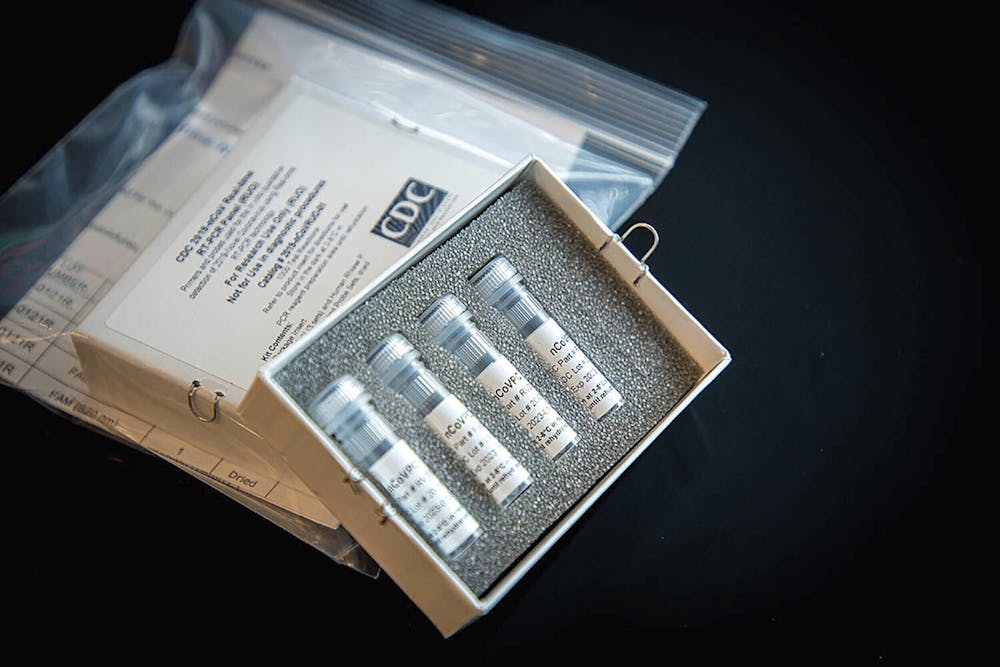
Earlier this year, the Centers for Disease Control and Prevention developed a rapid test for SARS-CoV-2. This test is designed to amplify and detect the genetic material in the virus – its RNA (ribonucleic acid) – from your body. It targets certain conserved RNA sequences in the virus that are different from those found in other coronaviruses. The problem is that for a population of 331 million, a single testing center wasn’t nearly enough. The CDC enabled state public health labs to use their test, but this still hasn’t been enough to meet population needs.
The Centers for Disease Control and Prevention decided to make its own coronavirus testing kit but the first release was flawed, one of a number of reasons for inadequate availability of testing in the early stages of the pandemic.
The testing deficiency leaves much of the U.S. population out in the cold. It’s now up to companies, hospitals and academic centers to pick up the slack. Part of the delay was due to what happened during the Zika virus outbreak of 2015, when laboratories that developed their own tests were halted by the FDA because they did not have approval.
Testing development really picked up Feb. 29 after the FDA relented and released guidance for developing tests in individual laboratories, and a free-for-all ensued. We laboratory directors were on the spot to develop tests, and most were unprepared to say the least. Test development typically takes months.
Labs use what is called a reverse-transcription polymerase chain reaction, or RT-PCR, to test a sample taken with a swab from the back of someone’s throat and/or nose. The tests work by converting the virus’ RNA to DNA and then replicating it millions of times in order to amplify its presence and then detect its genetic sequence. If it is detected, a patient is infected.
Even with the FDA guidance, we had to decide what RNA sequences in the virus to target and how quickly we could get reliable testing materials. We could only obtain materials for RNA amplification and detection from the CDC or private industry, who were all being bombarded with our requests simultaneously. We laboratory directors were suddenly competing with one another for limited resources to develop these tests.
What went wrong?
If you compare our ability to ramp up testing to that observed in Chinaand South Korea, the U.S. response was not up to par. Both countries allowed companies to develop and distribute tests from an early stage, permitting large portions of their populations to be tested.
Part of the problem in the U.S. is the lack of centralized facilities across the country that all have the same equipment to run complex tests. Just in the state of California alone where I live, there are hundreds of hospitals, most with significant differences in their equipment and testing capabilities. When the CDC made their test available, my first thought was, “We don’t even have the equipment to run this test.” Most hospitals in my state and across the country faced this exact same dilemma: a lack of proper equipment and difficulty obtaining adequate testing materials.
Also, problems with CDC-manufactured testing kits arose immediately and caused testing failures when they first released them in February. These failure stories motivated many of us to either develop tests based on our own analysis of COVID-19, or to partner with industry in the development of their tests. At my institution, we’ve been working with industry partners and accelerating the development of their tests for our patient populations.
Why it’s not the end of the world
There’s a lot of negatives to find in the response to the coronavirus outbreak, but the flaws in the response represent learning opportunities. Highly infectious viruses in a connected world won’t stay contained for long. Our assumption should have been that it would make it to the U.S. from the onset.
The next time there’s an outbreak, we laboratory directors won’t be waiting for the government to give us the green light to develop diagnostic tests. We’ll do it on our own and press the FDA to allow us to use it. The hard work to ramp up testing in the U.S. is the most significant effort in which I have ever taken part. If you could see the efforts of companies, academic centers, and hospitals right now in the U.S., you’d walk away with optimism that we’re up to the task.
As the SARS-CoV-2 virus continues its global spread and the number of diagnosed COVID-19 cases continues to increase, anxiety related to the outbreak is on the rise too.As a psychologist, I am seeing this in my practice already. Although feeling anxiety in response to a threat is a normal human reaction, sustained high anxiety can undermine constructive responses to the crisis. People who already suffer from anxiety and related disorders are especially likely to have a hard time during the coronavirus crisis.The following suggestions, based on psychological science, can help you deal with coro...