The notion of disinformation often brings to mind easy-to-spot propaganda peddled by totalitarian states, but the reality is much more complex. Though disinformation does serve an agenda, it is often camouflaged in facts and advanced by innocent and often well-meaning individuals.
As a researcher who studies how communications technologies are used during crises, I’ve found that this mix of information types makes it difficult for people, including those who build and run online platforms, to distinguish an organic rumor from an organized disinformation campaign. And this challenge is not getting any easier as efforts to understand and respond to COVID-19 get caught up in the political machinations of this year’s presidential election.
Rumors, misinformation and disinformation
Rumors are, and have always been, common during crisis events. Crises are often accompanied by uncertainty about the event and anxiety about its impacts and how people should respond. People naturally want to resolve that uncertainty and anxiety, and often attempt to do so through collective sensemaking. It’s a process of coming together to gather information and theorize about the unfolding event. Rumors are a natural byproduct.
Rumors aren’t necessarily bad. But the same conditions that produce rumors also make people vulnerable to disinformation, which is more insidious. Unlike rumors and misinformation, which may or may not be intentional, disinformation is false or misleading information spread for a particular objective, often a political or financial aim.
Disinformation has its roots in the practice of dezinformatsiya used by the Soviet Union’s intelligence agencies to attempt to change how people understood and interpreted events in the world. It’s useful to think of disinformation not as a single piece of information or even a single narrative, but as a campaign, a set of actions and narratives produced and spread to deceive for political purpose.
Lawrence Martin-Bittman, a former Soviet intelligence officer who defected from what was then Czechoslovakia and later became a professor of disinformation, described how effective disinformation campaigns are often built around a true or plausible core. They exploit existing biases, divisions and inconsistencies in a targeted group or society. And they often employ “unwitting agents” to spread their content and advance their objectives.
Black Lake in the Czech Republic was the site of a Soviet-era disinformation campaign against West Germany involving real Nazi documents and a duped Czech television crew.
Regardless of the perpetrator, disinformation functions on multiple levels and scales. While a single disinformation campaign may have a specific objective – for instance, changing public opinion about a political candidate or policy – pervasive disinformation works at a more profound level to undermine democratic societies.
Distinguishing between unintentional misinformation and intentional disinformation is a critical challenge. Intent is often hard to infer, especially in online spaces where the original source of information can be obscured. In addition, disinformation can be spread by people who believe it to be true. And unintentional misinformation can be strategically amplified as part of a disinformation campaign. Definitions and distinctions get messy, fast.
Consider the case of the “Plandemic” video that blazed across social media platforms in May 2020. The video contained a range of false claims and conspiracy theories about COVID-19. Problematically, it advocated against wearing masks, claiming they would “activate” the virus, and laid the foundations for eventual refusal of a COVID-19 vaccine.
Though many of these false narratives had emerged elsewhere online, the “Plandemic” video brought them together in a single, slickly produced 26-minute video. Before being removed by the platforms for containing harmful medical misinformation, the video propagated widely on Facebook and received millions of YouTube views.
As it spread, it was actively promoted and amplified by public groups on Facebook and networked communities on Twitter associated with the anti-vaccine movement, the QAnon conspiracy theory community and pro-Trump political activism.
But was this a case of misinformation or disinformation? The answer lies in understanding how – and inferring a little about why – the video went viral.
The video’s protagonist was Dr. Judy Mikovits, a discredited scientist who had previously advocated for several false theories in the medical domain – for example, claiming that vaccines cause autism. In the lead-up to the video’s release, she was promoting a new book, which featured many of the narratives that appeared in the Plandemic video.
One of those narratives was an accusation against Dr. Anthony Fauci, director of the National Institute for Allergy and Infectious Diseases. At the time, Fauci was a focus of criticism for promoting social distancing measures that some conservatives viewed as harmful to the economy. Public comments from Mikovits and her associates suggest that damaging Fauci’s reputation was a specific goal of their campaign.
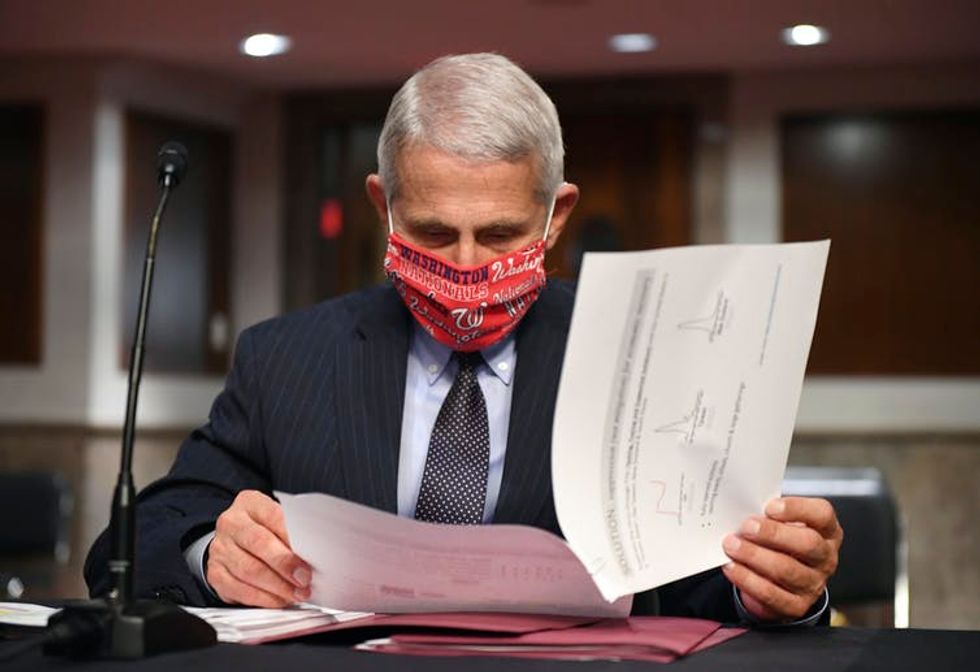
Dr. Anthony Fauci, director of the National Institute for Allergy and Infectious Diseases, preparing to testify before a Senate hearing. Fauci was a target of the Plandemic conspiracy theory video.
This background suggests that Mikovits and her collaborators had several objectives beyond simply sharing her misinformed theories about COVID-19. These include financial, political and reputational motives. However, it is also possible that Mikovits is a sincere believer of the information that she was sharing, as were millions of people who shared and retweeted her content online.
What’s ahead
In the United States, as COVID-19 blurs into the presidential election, we’re likely to continue to see disinformation campaigns employed for political, financial and reputational gain. Domestic activist groups will use these techniques to produce and spread false and misleading narratives about the disease – and about the election. Foreign agents will attempt to join the conversation, often by infiltrating existing groups and attempting to steer them towards their goals.
For example, there will likely be attempts to use the threat of COVID-19 to frighten people away from the polls. Along with those direct attacks on election integrity, there are likely to also be indirect effects – on people’s perceptions of election integrity – from both sincere activists and agents of disinformation campaigns.
Efforts to shape attitudes and policies around voting are already in motion. These include work to draw attention to voter suppression and attempts to frame mail-in voting as vulnerable to fraud. Some of this rhetoric stems from sincere criticism meant to inspire action to make the electoral systems stronger. Other narratives, for example unsupported claims of “voter fraud,” seem to serve the primary aim of undermining trust in those systems.
History teaches that this blending of activism and active measures, of foreign and domestic actors, and of witting and unwitting agents, is nothing new. And certainly the difficulty of distinguishing between these is not made any easier in the connected era. But better understanding these intersections can help researchers, journalists, communications platform designers, policymakers and society at large develop strategies for mitigating the impacts of disinformation during this challenging moment.
The Research Brief is a short take about interesting academic work.
The big idea
A paper came out in Nature on July 22 that further underscores earlier studies that show that neither the malaria drug hydroxychloroquine nor chloroquine prevents SARS-CoV-2 – the virus that causes COVID-19 – from replicating in lung cells.
Most Americans probably remember that hydroxychloroquine became the focus of numerous clinical trials following the president’s statement that it could be a “game changer.” At the time, he appeared to base this statement on anecdotal stories, as well as a few early and very limited studies that hydroxychloroquine seemed to help patients with COVID-19 recover.
The new study was carried out by scientists in Germany who tested HCQ on a collection of different cell types to figure out why this drug doesn’t prevent the virus from infecting humans.
Their findings clearly show that that HQC can block the coronavirus from infecting kidney cells from the African green monkey. But it does not inhibit the virus in human lung cells – the primary site of infection for the SARS-CoV-2 virus.
In order for the virus to enter a cell, it can do so by two mechanisms - one, when the SARS-CoV-2 spike protein attaches to the ACE2 receptor and inserts its genetic material into the cell. In the second mechanism, the virus is absorbed into some special compartments in cells called endosomes.
Depending on the cell type, some, like kidney cells, need an enzyme called cathepsin L for the virus to successfully infect them. In lung cells, however, an enzyme called TMPRSS2 (on the cell surface) is necessary. Cathepsin L requires an acidic environment to function and allow the virus to infect the cell, while TMPRSS2 does not.
In the green monkey kidney cells, both hydroxychloroquine and chloroquine decrease the acidity, which then disables the cathepsin L enzyme, blocking the virus from infecting the monkey cells. In human lung cells, which have very low levels of cathepsin L enzyme, the virus uses the enzyme TMPRSS2 to enter the cell. But because that enzyme is not controlled by acidity, neither HCQ and CQ can block the SARS-CoV-2 from infecting the lungs or stop the virus from replicating.
Why it matters
This matters for several reasons. One, much time and money has been spent studying a drug that many scientists said from the very beginning was not going to be effective in killing the virus.
The second reason is that the studies that have reported antiviral activity for hydroxychloroquine were not in epithelial lung cells. Thus, their results are not relevant to properly studying SARS-CoV-2 infections in humans.
What’s next?
As scientists proceed with investigating new drugs as well as trying to repurpose old ones, like hydroxychloroquine, it is critical that researchers take the time to think about their study design.
In short, those of us involved in antiviral drug development should all take a lesson from this study. It is important not only to focus our efforts on pursuing drugs that will directly shut down viral replication, but also to study the virus in the primary site of infection.
Democrats have not held control of the United States Senate since losing in the 2014 election, but are on pace to regain the majority in November according to a new analysis by the Cook Political Report.
"With just over 100 days until Election Day, the political climate appears dire for Republicans across the board. President Trump is the decided underdog against former Vice President Joe Biden in our Electoral College ratings and Democrats could end up expanding their House majority," Jessica Taylor wrote.
"That leaves the Senate as Republicans' firewall—the final barrier to unified control for Democrats in 2021. While GOP incumbents are trying to run races independent of the president, if Trump’s polling numbers remain this dismal come November, that’s an unenviable and likely unsuccessful strategy, according to several top party strategists. As of now, Democrats are a slight favorite to win the Senate majority," the report explained.
"We wrote four months ago that the worsening pandemic, along with Biden emerging as the Democratic nominee instead of Bernie Sanders, was the “perfect storm” Republicans feared. Now, with the death toll nearing 150,000, the environment has gotten even worse for the GOP, prodded along by Trump’s missteps. Racial injustice protests after the deaths of George Floyd, Breonna Taylor and Ahmaud Arbery in early June further galvanized the nation, leading to rapid cultural shifts against Confederate monuments and even the long pushed for change of the Mississippi state flag, which still bore the Confederate battle flag emblem.
Taken together, that’s not just a perfect storm for Democrats, but perhaps a perfect tsunami."
The group changed its ratings in five key races.
In Arizona, interim Republican Sen. Martha McSally's reelection campaign went from toss-up to leaning Democrat. McSally is being challenged by former astronaut Mark Kelly.
In Iowa, Republican Sen. Joni Ernst's campaign had been rating as leaning Republican, but is now considered a toss-up. Ernst is being challenged by Theresa Greenfield.
In Georgia, Republican Sen. David Perdue's chances had been rated as leaning Republican, but is now considered a toss-up.
President Donald Trump announced on Thursday that he was canceling his Republican National Convention acceptance speech in Jacksonville due to the spread of coronavirus in the state.
While Trump has sought to get back on the campaign trail, he has not held one of his signature campaign rallies since the debacle in Tulsa, when he failed to fill the arena his campaign had rented.
A rally planned for New Hampshire was also canceled.
At Thursday's White House press briefing on the coronavirus pandemic, President Donald Trump repeated his insistence that schools should open immediately regardless of whether they have a plan to keep students and teachers safe — despite vast majorities of the public opposed to this demand, and despite the fact that Trump himself is now canceling the Jacksonville portion of the GOP convention out of COVID-19 danger.
Trump then took it a step further, suggesting that public schools that do not reopen should be defunded and their budgets handed out to parents to send their children to private or parochial institutions.
At Thursday's White House coronavirus briefing, President Donald Trump announced that he would be canceling the component of the Republican National Convention that was scheduled to take place in Jacksonville, Florida.
"To have a big convention is not the right time," said Trump. "I told my team to cancel the Jacksonville, Florida portion of the convention." He added that the functions in North Carolina will continue and there will be some teleconferencing functions.
The convention, which was moved to Jacksonville from Charlotte over a dispute with the North Carolina governor about COVID-19 safety measures, has been in doubt for days, as coronavirus cases have flared in Florida and local law enforcement have said they can't guarantee safety of attendees.
As Joe Biden continues to outraise President Trump when it comes to campaign funds, Republicans are growing increasingly concerned about Kimberly Guilfoyle's ability to oversee the effort as Team Trump heads into an uphill battle for reelection, POLITICO reports.
Guilfoyle, who oversees a fundraising unit within the campaign, is seeing growing upheaval from her staff who have described a "feeling of confusion and said it felt like they were caught between the competing demands of longtime fundraiser Caroline Wren and Guilfoyle confidante Sergio Gor, who oversee the unit’s day-to-day operations," according to POLITICO.
"Finance staffers privately complain about a pressure-cooker environment in which employees are berated when they’re perceived to not be measuring up," the report continues. "They compare working under Wren and Gor to living with two warring parents; some Republicans argue that staff discontent is less about Guilfoyle than about the pair working directly under her."
Guilfoyle's team has seen staff departures due to people finding the situation on the team untenable, leading to replacements who don't have much experience working with political fundraisers.
"There are growing Republican worries that the internal turmoil will hurt the campaign’s fundraising," the reports states. "The task of shepherding mid-level donors demands a high level of organization and staff coordination, with outreach to thousands of people who are neither mega-donors with bottomless bank accounts nor smaller contributors being hit up for a few hundred dollars at most."
A man, who wanted air put in his tires reportedly became "extremely irate" when the owner of an auto shop asked him to put on a mask, was later shot dead after he attempted to run over the owner's son with his car. Another man was wounded.
"The owner said he told the man that he could help him but that he needed to have a mask on and the man became 'extremely irate,'" incident reports filed by Bernalillo County Sheriff’s Office deputies say, according to the Albuquerque Journal. "The owner told deputies the man crashed into his son’s vehicle and tried to run him over before driving off."
As police were searching for the alleged assailant, "they received a call from the auto shop owner saying the vehicle had returned and his son had shot someone."
Progressives are accusing Senate Majority Leader Mitch McConnell and President Donald Trump of pulling out all the stops to suppress the vote in November after new details of the Republican coronavirus stimulus plan revealed it does not propose a single dollar in election assistance funding.
"It seems Mitch McConnell is doing everything he can to suppress the vote by putting voters in danger."
—Sean Eldridge, Stand Up America
A summary (pdf) of the Republican plan obtained by the New York Times Thursday doesn't mention election funding directly, but it does note that the GOP relief package will propose "no additional money for state/local governments."
The draft adds in a parenthetical, "Certainly expect to get some [funding] added in negotiations with the Dems."
"It is outrageous that this proposal contains not one penny to help states conduct safe elections during a global pandemic," Sean Eldridge, founder and president of Stand Up America, said in a statement. "Policymakers should be doing everything they can to ensure voters are not forced to risk their health to cast their ballot."
"Instead," Eldridge said, "it seems Mitch McConnell is doing everything he can to suppress the vote by putting voters in danger."
The Republican plan, which is being crafted in McConnell's office in partnership with the Trump White House, has not yet been finalized and the details could still change.
Voting rights advocates say the election assistance money is necessary to help states expand vote-by-mail and ensure that in-person polling places are adequately equipped and prepared to safely hold a general election amid a pandemic.
Failing to approve election funding, progressives warn, could drive down turnout in November by limiting voters' ballot options in an environment where it is potentially dangerous to vote in person.
Trump's repeated and baseless attacks on mail-in voting as well as his refusal to commit to accepting the results of the 2020 election have added urgency to progressive efforts to ensure a safe and fair contest. On Thursday, Stand Up America and Indivisible announced that 30 new advocacy groups have joined the grassroots campaign preparing to mobilize should Trump refuse to leave office.
"Together, we will ensure that every vote is counted and that we protect our democracy," said Cristina Jimenez, executive director and co-founder of United We Dream Action, an immigrant rights group.
In May, House Democrats passed legislation that would provide more than $1 trillion in funding for state and local governments—including billions in election assistance money—as they face pandemic-induced budgetary crises.
Eldridge said Democratic lawmakers must do everything in their power to ensure that adequate election assistance funding is included in the stimulus package that eventually makes its way through Congress.
"Democrats in both chambers cannot allow Republicans to threaten the foundation of our democracy—and they must use every piece of available leverage to ensure election funding is included in a final brokered deal," said Eldridge. "Nothing less than our democracy is at stake."
MSNBC host Nicolle Wallace noticed that President Donald Trump seems to have become a bitter, delusional, angry man as he's realized that he'll probably lose in November.
"The bottom is calling, and it wants to know if we're there yet," Wallace joked, noting she's stopped assuming we've reached rock-bottom in the Trump era. Speaking to her panel Thursday, Wallace equated Trump's cruelty mocking a disabled reporter to being similar to his cruelty, not caring about people fighting and dying from COVID-19 and sticking children in cages on the border after ripping them away from their parents.
"There's cruelty and a feeling of sticking your finger in an electric socket if you know anyone or love anyone that's been screened for dementia or Alzheimer's," Wallace said.
Former Rep. Donna Edwards (D-MD) said that every week shows Americans that there is no bottom to Trump's administration. She explained that Trump has no real empathy for people with the coronavirus just as he doesn't "appreciate the circumstance, the sad circumstance of millions of Americans who suffer from dementia and Alzheimer's in their years. He has no ability really to put himself into someone else's shoes."
"There is no example of a president at a high watermark that didn't succeed in holding this country as it grieves, as it struggles, as it suffers," said Wallace. "Donald Trump either can't do it or won't do it. Joe Biden is surging ahead of him in poll after poll after poll."
New York Times reporter Nick Confessore agreed, saying that Trump seems to be struggling to understand the American voter. He's putting out ads attacking Biden's mental health and deceptively editing videos that show outright lies. It isn't working, Confessore said.
"He thinks he can win this campaign on a mano-a-mano fight over who has a higher test score," he continued. "It feels divorced from the moment when people are worried and scared, if not for their life, for their loved ones and jobs and kids going to school. You don't get the sense when the president is trying to adapt by returning to the press conferences that he understands this is a moment of crisis, and it's going to be a crisis long past Election Day. We, as voters, are used to seeing a certain set of ticks from a president. A certain set of acts, even feigned from a president to get through these times. He doesn't display those things."
Wallace asked Phil Rucker if there's any indication that someone is telling Trump behind the scenes that he needs to care about the dead Americans.
"No, nothing that I can report," said Rucker. "That's not to say he's not making that kind of contact. Perhaps he is, but he's probably not. If he were making those outreach calls, his spokespeople would be the first to alert the news media about it. And we have not heard about him doing that. When he makes public appearances, we rarely even hear him voice thoughts and empathy for people who are suffering. We've seen it a bit in these briefings he's been doing the last few days, but there was any number of public appearances earlier this summer where the president would come out and say next to nothing about the coronavirus. In fact, pretend like it wasn't happening."
Wallace read a New York Times report saying that Trump believes Democrats are using COVID-19 for political reasons, saying "watch on Nov. 4 everything will open up."
"I mean, this is a bitter, delusional, angry guy who I suppose he's saying on Nov. 4, everything will open up because he knows he's going to lose," Wallace said.
Yale School of Medicine forensic psychiatrist Bandy Lee offered her expertise on Thursday to break down what President Donald Trump revealed about his mental fitness to hold office during a recent Fox News interview.
Lee says that Trump's attacks on Joe Biden's mental fitness are actually him admitting his own mental decline.
Lee also says that Ronny Jackson, the former White House doctor now running for Congress, may not even be a medical doctor anymore.
According to a Marine Corps spokesperson speaking to POLITICO, a Marine assigned to the military helicopter squadron that transports President Trump has tested positive for coronavirus.
"The Marine, assigned to Marine Helicopter Squadron 1, was tested on Tuesday and received the positive result on Thursday, said spokesperson Capt. Joseph Butterfield, adding that the squadron administers 80 to 100 tests per week," the report states.
The squadron was informed of the positive test on Thursday, just ahead of Trump's planned trip to Bedminster, N.J this weekend.
"Out of an abundance of caution, Marines who may have had contact with the infected Marine have been removed from the detachment," Capt. Joseph Butterfield, adding that the Marine was never in direct contact with the Trump helicopters. "No impact is expected to the President during his trip to Bedminster, N.J."