In addition to the rumblings about whom he’ll name as his vice presidential candidate, presumptive Democratic presidential nominee Joe Biden recently surprised many political observers by suggesting that he might also announce the selection of some Cabinet members before November’s election. This would be an unusual move that poses some risks – as well as rewards.
Typically, presidential candidates wait until after winning the election to name their Cabinet members – the heads of the government departments like State, Treasury and Commerce – and other key White House staff. Though sometimes they offer hints, campaigns worry an early announcement might make it seem the candidate is assuming a win, taking the voters’ support for granted.
In addition, some legal experts have wondered whether announcing Cabinet picks might violate campaign finance laws because a presidential candidate could be viewed as offering someone a prominent position within the White House in exchange for their political support – effectively, a bribe.
Biden has assured voters that he will have an experienced White House team – one that’s ready to help him lead on day one and to steer the ship of state if Biden, age 77, were to experience health problems or retire after one term in office.
Given these factors, would announcing his Cabinet early help Biden to win the election? Bluntly put, no one knows for sure, especially in the extraordinary circumstances of an election-year pandemic. There’s just no modern precedent.
But from our research, we have a good idea of what to expect. That’s because in our forthcoming book “Do Running Mates Matter?” we look at the effects of the one team member that every presidential candidate names before the election: the vice presidential candidate.
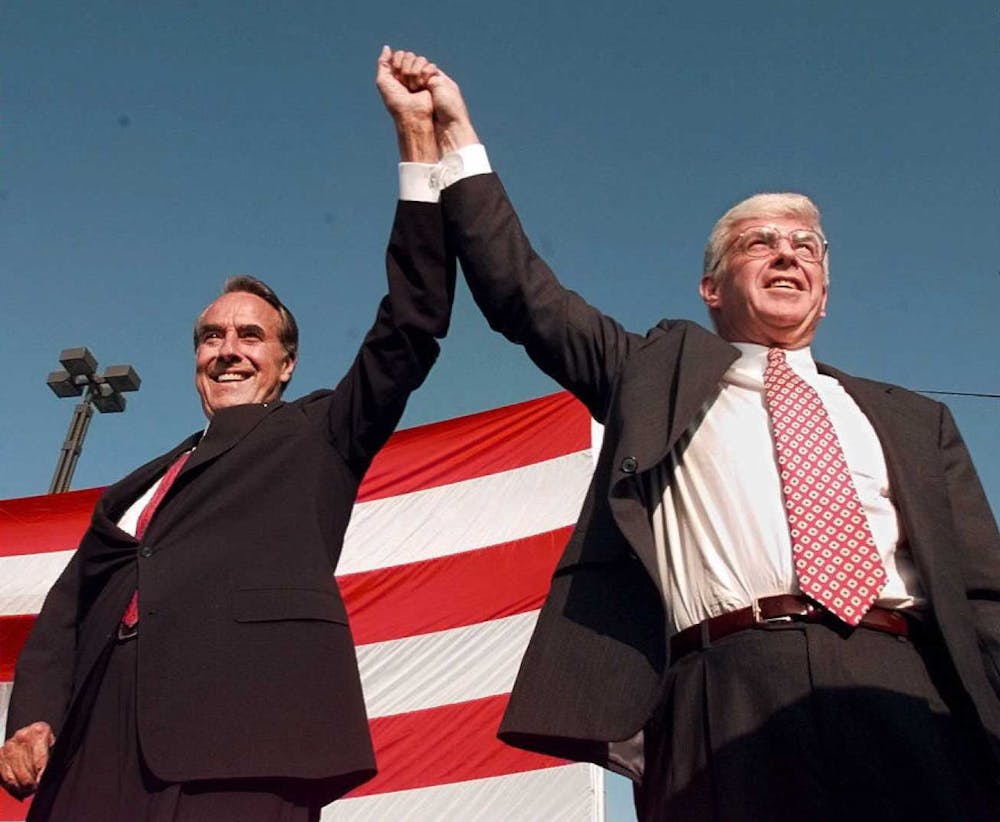
Picking Jack Kemp, right, as his running mate didn’t help 1996 Republican nominee Bob Dole win the election.
For our book, we analyzed a half-century of political science survey data to examine what effect a running mate has on the success of presidential candidates.
In short, we found that running mates have very little direct effect on voters. When people go to the polls, they are primarily expressing a preference for the presidential candidate, not the second person on the ticket.
On rare occasions, voters can be swayed by running mates who are much more – or less – popular than their party’s main candidate. For instance, John Kerry’s vice presidential candidate in 2004, former North Carolina Sen. John Edwards, was relatively popular with voters early in the campaign. And, as our research shows, Edwards’ popularity made voters more likely to vote for Kerry, at least in the short term.
In general, a candidate’s choice for second-in-command does very little to directly swing voters, so we think it’s unlikely that lower-ranking picks, like for Cabinet posts, would make much difference at all.
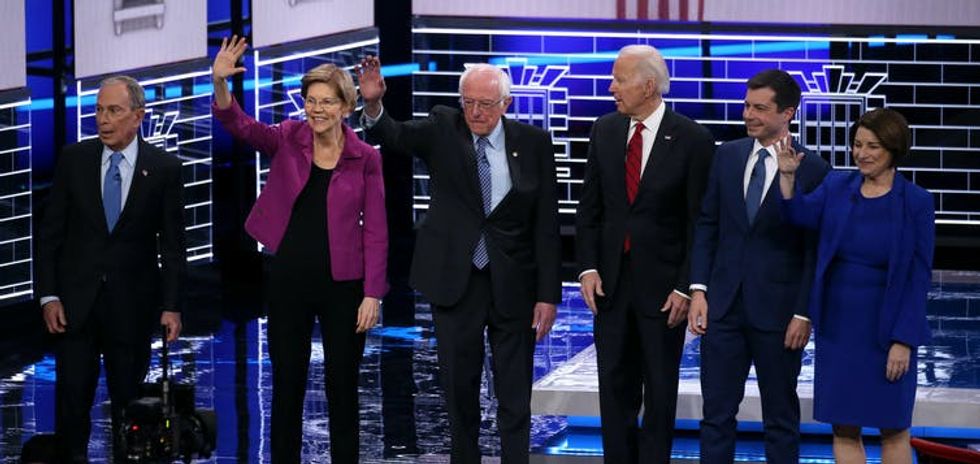
When John McCain, right, picked Sarah Palin, second from left, as his running mate in 2008.
However, we found that voters view vice presidential choices as new information about the main candidate – and that information can shift voters’ views and change votes. The candidate’s choice gives voters insight into who the candidate really is, what he or she stands for, and how the person might operate once in office.
Take the 2008 presidential election, for example, when Democrat Barack Obama ran against Republican John McCain with Joe Biden and Sarah Palin as their respective vice presidential nominees.
In our book, we explain that voters who doubted Palin’s qualifications also were more likely to doubt McCain’s judgment and think he was too old to be president. As a result, they were less likely to vote for McCain.
However, our analysis also showed that voters who believed Biden was well-qualified for office were more likely to approve of Obama’s judgment – and less likely to think he was too young to be president. As a result, they were more likely to vote for Obama.
Naming Cabinet members prior to the election might have a similar indirect effect. Depending on Biden’s choices, an early Cabinet announcement could indicate that the presumptive Democratic nominee would be ready with an experienced team to govern right from the start – or that he will give a job to anyone who can help him win the election, even if that person is not the right fit.
Those signals might gain – or lose – him some votes.
Many of Biden’s primary election opponents have been suggested as possible Cabinet nominees.
Naming Cabinet members comes with other risks, too. It would give the incumbent, President Donald Trump, more targets to attack. And journalists would scrutinize Biden’s picks, as they do vice presidential selections.
If a prospective Cabinet nominee were linked to a scandal or a campaign trail embarrassment, that could hurt Biden’s campaign by bringing negative attention or distracting the media and voters from his primary message. At worst, a nominee’s struggles could call into question Biden’s judgment and ability to govern, potentially costing him votes.
Even if Biden wins, those campaign trail problems could make it less likely the Senate would later confirm the nominee to serve in the Cabinet.
In the short term, Biden’s surprise announcement that he might name Cabinet selections before November’s election has won him some welcome media coverage amid the coronavirus pandemic.
But the risks of going through with this unprecedented move may outweigh the potential rewards: Cabinet picks are unlikely to help him win, and there is a reasonable chance that at least one would backfire.
President Donald Trump admitted his administration was not aggressively pursuing the widespread testing that health experts say is necessary to end the coronavirus pandemic.
Experts say the U.S. economy cannot safely be reopened until widespread testing and contact tracing is available, but Trump's administration has been slow to do that since the pandemic first arrived -- and he admitted again that he didn't want to know the true number of cases, reported the New York Times.
“In a way, by doing all this testing we make ourselves look bad,” Trump said Wednesday.
The president made a similar admission in early March, as the severity of the crisis was beginning to come into focus, and Trump did not want infected cruise ship passengers to disembark because it would raise the number of cases in the U.S.
“I would rather because I like the numbers being where they are,” Trump said at the time. “I don't need to have the numbers double because of one ship that wasn't our fault. And it wasn't the fault of the people on the ship either, okay? It wasn't their fault either and they're mostly Americans. So, I can live either way with it. I'd rather have them stay on, personally.”
There were fewer than 200 cases in the U.S. at that point, but there have since been 1.26 million cases reported and more than 74,000 deaths.
A man who believes that the COVID-19 pandemic is a "hoax" was caught on video having an unhinged meltdown at a Miami grocery store.
The Miami Herald reports that the footage was taken outside a Publix in South Beach, and it shows a man who is furious that the store asked him to wear a face mask before entering.
"This is a false flag fake pandemic!" he yelled. "You are in violation of my constitutional rights... I'm filing a class-action lawsuit! You can take your fake f*cking global terroristic false flag attack and shove it up your motherf*cking ass!"
The man wasn't done after that.
"You're terrorists!" he screamed. "You're in violation of my constitutional and civil rights! F*ck you motherf*ckers there's no pandemic!"
At this point, an employee at the store informed him that he would need to wear a face mask to shop there -- and he only got more hostile.
"You motherf*ckers are going to be getting mass arrested and f*cking executed for f*cking terrorism!" he screamed. "F*ck you!"
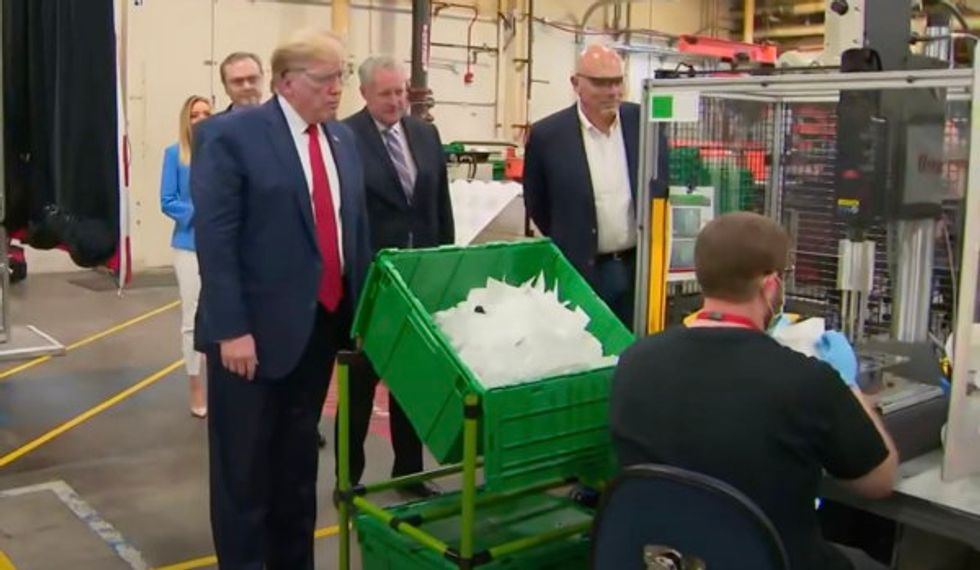
The irony of President Donald Trump’s refusal to wear a mask this week at a mask-manufacturing plant did not go unnoticed, even though he claimed the head of Honeywell told him he did not need to – despite signs to the contrary.
But The Associated Press reports the real reason President Trump refuses to wear a mask is he thinks it will hurt his re-election chances.
Trump has told White House and campaign aides in private he believes if he wears a mask it will “send the wrong message.” Mask-wearing is to protect other people, not the wearer.
“The president said doing so would make it seem like he is preoccupied with health instead of focused on reopening the nation’s economy — which his aides believe is the key to his reelection chances in November,” the AP adds.
Trump has always followed the “do as I say and not as I do” doctrine.
On Wednesday a reporter in the Oval Office mentioned to the President that he did not wear a mask when touring the mask-making facility.
Trump claimed he was told he didn’t have to, and added, “as you know we were far away from people.”
The reporter then mentioned that Trump was holding an event honoring nurses and yet he was not practicing social distancing or wearing a mask.
“Mr. President, what kind of message does it send if you’re surrounded by nurses who are not social distancing and not wearing masks?”
“Well I can’t help that,” Trump snarled. “I mean look I’m trying to be nice I’m signing a bill, and you criticize us. Look, here’s the story: there’s nothing I can do to satisfy the media, the Democrats, or the fake news, and I understand that.”
Trump was the one who made the public announcement last month that the CDC was urging all Americans to wear masks to protect those around them and slow the spread of the coronavirus.
As he made the announcement he interjected, “I don’t think that I’m going to be doing it.” On national television.
Trump also mocked the idea months ago that people should stop shaking hands.
At a Fox News town hall in March Trump said, “you can’t be a politician and not shake hands. And I’ll be shaking hands with people—and they want to say hello and hug you and kiss you—I don’t care.”
New claims for unemployment benefits filed by US workers declined slightly last week, but were still a staggering 3.2 million, government data said Thursday.
The data from the Labor Department bring the total claims filed since mid-March, when the coronavirus pandemic forced businesses to close their doors to stop the virus's spread, to 33.5 million.
The number of claims filed last week were slightly more than analysts expected and underscore the continuing damage done by the pandemic the United States, where 73,095 people have died from the disease and 1,227,430 cases have been reported as of Wednesday.
However Thursday's figure for the week ending May 2 was a decrease from the previous week, when 3.8 million workers filed new unemployment claims.
That may indicate the initial wave of layoffs is starting to ebb, but the number remains incredibly high -- well above even the worst four weeks of the global financial crisis and more comparable to unemployment levels seen during the Great Depression 90 years ago.
Ian Shepherdson of Pantheon Macroeconomics predicted new weekly filings dipping below one million by the second or third week of June, while hiring may begin picking back up if states reopen their economies.
"Claims continue to decay by about 15 to 18 percent per-week, and are now at less than half the 6.9 million peak in the week of March 28," he said in an analysis.
On MSNBC’s “Morning Joe,” host Joe Scarborough often attacks President Donald Trump for being a political “day trader” — meaning that he has a painfully short attention span and bases his actions on the current news cycle rather than being able to look at the big picture. And when Jonathan Lemire, a White House correspondent for the Associated Press (AP), appeared on “Morning Joe” on Thursday, May 7, he asserted that the news cycle and media coverage are driving Trump’s handling of the coronavirus task force.
Mika Brzezinski, who hosts “Morning Joe” with Scarborough, asked Lemire why Trump had suddenly changed his mind about possibly winding down that task force. Brzezinski asked, “Does (Trump) know that when you talk about shutting down a task force one day, and 24 hours later, you say people called him, that he is thinking and flying off the seat of his pants? Does he know he is exposing himself by the day, as to not being fully connected with the gravity of this problem? Is anyone helping him?”
Lemire responded, “The president reacts to media coverage and to outside forces when it comes to decisions. And that’s what we saw here. He had — there was no coordinated effort, per se, but the White House had had discussions in the last few weeks about beginning to wind down the task force, as it was going to pivot more toward the economy, looking towards reopening parts of the nation, and wanting to de-emphasize, certainly publicly, some of the health crisis response.”
As part of his reopening of the economy, Trump was talking about possibly winding down the task force — which is headed by Vice President Mike Pence and includes medical experts Dr. Anthony Fauci and Dr. Deborah Birx. But this week, Trump has been walking that back.
Lemire, discussing Trump’s White House coronavirus briefings, told Scarborough and Brzezinski, “We’ve seen the briefings go away, although a lot of that, of course, was because the president’s advisors realized it was damaging him politically. It was an effort not to make Dr. Birx and Dr. Fauci the public faces anymore. Instead, it was an attempt to change the conversation, to be more about the nation reopening and its economy. When the vice president said the other day, in a meeting, that the task force was going to be starting to wind down by the end of May or early June — and the president himself reiterated that on his trip to Arizona — there was some real blowback from business leaders, congressional Republicans.”
Lemire noted that the White House press conference on May 6 didn’t feature Birx or Fauci, but rather, Trump’s new White House press secretary, Kayleigh McEnany.
“We have the White House press secretary yesterday — we haven’t seen Dr. Fauci or Dr. Birx from the podium at the White House for some time,” Lemire explained. “They are still going to be part of this, but the president and his team want them to be less visible for the public. They want the focus — even as cases are going up across the country, even as cases outside New York continue to rise — they want the focus to be the nation trying to get back to work, reopening, thinking it is more politically advantageous for the president.”
President Donald Trump's determination to reopen the American economy during the COVID-19 pandemic comes even as the United States is still averaging around 2,000 new deaths per day.
Damning charts posted by Harvard epidemiologist Eric Feigl-Ding show that multiple countries around the world have managed to get new cases of the disease way down from their peaks, including Australia, Croatia, South Korea, Norway, and Lebanon.
The United States, along with countries such as Sweden and the United Kingdom, meanwhile, have only seen their cases plateau without any significant progress made in getting cases lower.
In fact, Axios reports that even countries such as Italy and Spain, which took brutal hits in the early weeks of the pandemic, have managed to get the virus's spread under control.
"New cases climbed over about a month from under 100 per day to terrifying peaks of roughly 8,000 per day in Spain and 6,000 per day in Italy," the publication notes. "The fall was nearly as sharp. Within two weeks of the peak, the rates of daily recorded cases had been halved. They’ve continued to fall since."
These countries are now taking steps to gradually reopen their economies, while America is pushing to reopen at a time when the country is seeing tens of thousands of new cases every day.
Alex Azar, secretary of the Department of Health and Human Services, blamed a coronavirus outbreak in meat processing facilities on the "home and social" conditions of their predominantly racial minority workforce.
At least 6,500 meatpacking plant workers have contracted COVID-19, which has shut down facilities and disrupted the food supply chain, and President Donald Trump's top health official suggested during a phone call with lawmakers the workers themselves were to blame, reported Politico.
"He was essentially turning it around, blaming the victim and implying that their lifestyle was the problem," said Rep. Ann Kuster (D-NH), who took part in the call. "Their theory of the case is that they are not becoming infected in the meat processing plant, they're becoming infected because of the way they live in their home."
About 44 percent of meatpackers are Latino and 25 percent are African American, according to the Center for Economic and Policy Research, and an estimated 80 percent of meat processing plant employees are undocumented or refugees.
Azar told a bipartisan group that he believed infections were being brought into the plants by employees, saying many of them lived in communal housing -- and he proposed sending law enforcement into their communities to enforce social distancing rules.
"Law enforcement is not going to solve the problem," Kuster said. "It was so far off base."
There hasn't been enough testing to show where the workers were infected, but epidemiologists believe meat processing plants themselves are the epicenter for the disease in many rural areas due to crowded conditions on the job.
"The risk factor appears to be the packing plants and not the homes, because that's the gathering place," said Christine Petersen, an epidemiologist at the University of Iowa. "I don't think we can say it was because certain groups were socializing more."
Former Republican strategist Steve Schmidt blamed President Donald Trump for the staggering number of lives already lost to the coronavirus pandemic.
Schmidt appeared Thursday on MSNBC's "Morning Joe," where he explained why he and other "never-Trump" conservatives made the "Mourning In America" ad that has driven the president crazy.
"He started rage tweeting at about 1:00 in the morning, when he saw it after it ran," Schmidt said. "It had been viewed more than 16 million times, it's raised over $1 million. What the ad points out is that the president, who ran saying, 'I alone can fix it,' and, 'I'll make America great again,' has presided over an era unlike any other in American history. He's brought tragedy to the country. This is a moment of profound American weakness."
Schmidt said the president had mishandled every opportunity in the fight against the deadly virus, and has abdicated his leadership role.
"He has handled this with a level of ineptitude and incompetence that is simply staggering," Schmidt said. "The cost is immense human suffering in the country. We have 70,000 dead Americans, that number will cruise through 100,000. We have a shattered economy. We'll see unemployment rates of 30 percent."
All this suffering was avoidable, he said, if the president had managed the crisis with any competence.
"None of this had to happen," Schmidt said. "He was not on his game, he left the country unprotected. He's been lying to the country, he has been talking about his television ratings. His eye is not on the ball. The reality is, we have the worst president in American history at the moment of one of the greatest crises in the country's history."
Schmidt said Joe Biden should hammer away at Trump's glaring weaknesses.
"He has an incapacity for empathy," Schmidt said. "He has no instinct for leadership. He is a mess."
"He is an unsteady hand at a moment in crisis," he added. "All over this country, there is death that did not have to be. He told the American people that he had been assured by the Chinese, no problem -- 15 Americans have this, soon it will be gone. This is a disaster for the ages."
Russell Moore, the president of the Southern Baptist Convention's Ethics and Religious Liberty Commission, is calling out white evangelical Christians who are looking the other way from the brutal killing of Ahmaud Arbery.
In an essay published on his website, Moore said that the video showing two white men chasing down and shooting Arbery deserves Christians' attention as a matter of basic justice.
"There is no, under any Christian vision of justice, situation in which the mob murder of a person can be morally right," he writes. "Those who claim to have a high view of Romans 13 responsibilities of the state to 'wield the sword' against evildoers ought to be the first to see that vigilante justice is the repudiation not just of constitutional due process but of the Bible itself."
Moore then said that many white Christians seem tempted to write off Arbery's killing because they don't want to confront issues of racism in the United States.
"Sadly, though, many black and brown Christians have seen much of this, not just in history but in flashes of threats of violence in their own lives," he writes. "And some white Christians avert their eyes—even in cases of clear injustice—for fear of being labeled “Marxists” or “social justice warriors” by the same sort of forces of intimidation that wielded the same arguments against those who questioned the state-sponsored authoritarianism and terror of Jim Crow. And so, they turn their eyes."
The governor is allowing more businesses to reopen, and Texans are weighing the risks of returning to normalcy. In this weekly series, Texans from across the state share stories about how they're navigating life during the COVID-19 pandemic.
Each week, The Texas Tribune is featuring the stories of a group of Texans from different parts of the state and different walks of life who are confronting the challenges of the COVID-19 pandemic. New installments will be published every Thursday. You can read the entire collection here.
Restaurants, retailers, malls and movie theaters opened in Texas on Friday. But in Midland, the Normans are staying away.
“I got little kids, a pregnant wife — there’s no sense in risking it,” Joseph Norman said. “For what?”
Norman has already lost his oilfield company, Forty Acre A&M — a casualty of the coronavirus-induced oil price crash — and he doesn't want to leave anything else to chance. The family has wandered out of its home sparingly, like a recent stop at an ice cream truck. And a trip to see Paw-Paw — Norman’s father, Jerry — who pressed his mask-covered face against the car’s back window as 3-year-old Joseph Lee reached toward him from his car seat.
But other than outings like those, the Normans don’t plan to venture out much, despite Gov. Greg Abbott’s decision to relax restrictions on some businesses. Norman said he doesn’t trust that it’s safe to go out yet.
Norman said he might drive by a few restaurants in Midland to see if they’re busy, but he says he won’t set foot inside a restaurant any time soon. He doesn’t understand why government officials are allowing it.
“Most of everything that’s coming from the government and leadership — it’s coming out both sides of their mouth, it’s a bunch of confusion,” Norman said. “I don’t even think they know what they're doing, man.”
He added, “They’re making financial decisions, and that doesn’t make it the right decision.”
Many of Norman’s friends plan to stay home, too, he said, though he has seen chatter on his Facebook feed about some people ready to hit lakes and beaches.
“Y’all test it out,” Norman said with a laugh. “Let me know how that goes.”
Norman said he misses the movies — specifically “the dadgum popcorn” — and spending time out of the house. But he can’t ignore the fact that the coronavirus has killed more than 900 Texans and infected more than 34,000 as of Wednesday, and those numbers continue to rise.
“The true nature of people is being revealed,” Norman said. “Because there’s no other reason to say it’s OK to reopen things when the only benefit is money.”
"Mom, we're too close": Distancing becomes normal for the Shah kids
Rupal Shah, 45, is an education technology executive in San Antonio.
When the Shahs moved to San Antonio from Austin about three years ago, they bought the lot across the street from Lea’s parents, north of the city almost in the Hill Country. Their kids, 5-year-old Nikhil and 6-year-old Nina, are “very, very close” to their grandparents, whom they call Nana and Papa, Lea Shah said. They are used to crossing the street and spending the night, and their grandparents coming over to babysit when Rupal and Lea have a date night.
Lately there have been a lot of reasons to crave a grandparent’s hug. The world is upended, school’s canceled and home is the only destination as the country battles the novel coronavirus. And Nik is partway through chemotherapy treatments for Wilms tumor, a kidney cancer that has made his family’s efforts to isolate all the more high stakes.
Nikhil and Nina Shah celebrate a socially distant Easter with their grandparents at their San Antonio home. Photo credit: Courtesy of Rupal Shah
So Nina and Nik and Nana and Papa are staying 6 feet apart, and the comfort comes remotely. They take walks together, separated by the full width of their street. When the kids bake, they drop off zucchini bread across the street. When their grandfather picks up groceries, he remembers their favorite fruits.
Lea has begun pulling up chairs for her parents. Her mother sat nearby in the shade on a recent Friday as the kids played in a pile of dirt. On Easter, her parents perched far up the driveway as Nik and Nina hunted for eggs and dug through their baskets, bunny ears on their heads. It feels better than nothing, but still bittersweet.
At first, the parents worried they would have to keep reminding Nik and Nina to keep a safe distance — how counterintuitive, telling children not to hug their grandparents. They expected they’d have to remind them over and over, to chide them for doing what felt natural and normal. But the children, who have learned from hospital personnel and from educational videos about the new coronavirus and Nik’s cancer, are beginning to internalize the restrictions.
Now, the limitations feel so familiar that they self-impose them.
Nik is “a strong advocate for himself,” Lea said. “If he thinks we’re too close to Papa, he’s like, ‘Mom, we’re too close, we’re too close.’”
The restaurant can reopen. But the staff isn't ready to risk it.
Debbie Chen, 49, is a restaurant owner in Houston.
Debbie Chen says the conversation with her staff was a short one.
After Gov. Greg Abbott announced last week that restaurants, retail establishments and movie theaters could reopen at 25% capacity, Shabu House’s chef simply said, “I’m not working.”
Chen agreed. Then the conversation drifted elsewhere.
“He was like, ‘If one person sneezes, it’s going to spray all over,’” she said. “It’s not worth the risk.”
Although the restaurant in Houston’s Chinatown has taken a financial shellacking since Abbott and officials in Harris County ordered restaurants closed for dine-in business, Chen said the risk of coming back right now was too big.
While the restaurant will continue to offer takeout, Chen said that because Shabu House’s team is so small — there are three employees, including Chen — “if any one of us were to come down with [the coronavirus] for a couple of weeks or if several of us came down with it, we really wouldn’t be reopening dine-in for a while.”
She understands the governor’s motivation for wanting to reopen parts of the economy. “People are unemployed, especially a lot of people who didn’t get the Paycheck Protection Program loans,” she said.
Abbott is getting pushback from his party’s right flank to reopen the state more quickly, and his decision means tough choices for restaurant owners, who must decide whether opening their doors is the right call for their employees and clientele.
“For now we’ve decided we’re going to wait and see until the end of the month to reopen dine-in,” she said. “If things look better, maybe we’ll do May 18, but my team isn’t comfortable opening yet. We’re kind of nervous about this peak we’re supposed to hit.”
According to an internal document obtained by The New York Times, President Donald Trump’s administration is predicting a steady rise in the number of deaths from the coronavirus until June 1, when the country might see upwards of 3,000 daily deaths.
The good news for Chen is that she thinks she can afford to remain afloat doing take-out only for at least another few weeks. Shabu House was recently approved for a PPP loan that she thinks will help the restaurant for the time being — and keep her from dipping into her retirement savings to pay next month’s rent.
“It definitely makes me feel a little more comfortable with being able to stay shut through this month,” she said.
Chen said the loan can go toward the restaurant’s rent, utilities and payroll but, under federal guidelines, has to be used within eight weeks.
“So it’s a breather for a couple of months,” Chen said. “Then we’ll see what happens after that.”
In rural county, some businesses are reopening while others wait
Nathan McDonald, 64, is the county judge in Matagorda County.
The Matagorda County Commissioners Court had its regular Monday meeting in person for the first time this week — a welcome sign that things are slowly returning to some version of normal since the coronavirus pandemic hit the rural community.
“Zoom is a great thing if you don’t have anything else,” County Judge Nate McDonald said. “But at this point, we do have something else, so we’ll use it and meet in person.”
Although things are beginning to return to regular programming, McDonald said residents still have questions about Gov. Greg Abbott’s most recent executive order, which allowed certain businesses in the state to begin reopening with certain restrictions. Retail stores, restaurants, movie theaters and malls, for example, can open their doors again — but only if they operate at 25% capacity.
For rural communities like Matagorda County, asking businesses with an already small occupancy to reopen under such guidelines can be a challenge. As McDonald put it, a number of restaurants felt like it would not make a “measurable difference” to operate at such a limited capacity. So they’re staying closed for now.
“We have some folks who are going to open, but many more who aren’t,” McDonald said. “So they’re just continuing to prepare takeout meals and operate [via] drive-thru. … A number of restaurants are just going to wait until the occupancy gets up to 50% or better.”
Another challenge? Getting employees to return to work, McDonald said.
“What a lot [of businesses] are finding is that their employees don’t want to come back to work,” he said. “The federal government has made it too profitable for them to stay off of work, since they can make more not working than they can working.”
Matagorda County Judge Nathan McDonald holds a bottle of isopropyl alcohol that was donated. Photo credit: Courtesy of Judge Nathan McDonald
Beyond that, McDonald said residents have asked him repeatedly why Abbott didn't give entities like hair salons and barbershops the green light to reopen. Since then, the governor announced that those businesses could reopen Friday under certain guidelines, but other types of businesses must continue to wait.
“We would like to have some conversations about opening some of these businesses that are hurting badly from this loss of revenue,” McDonald said. “These typically aren’t wealthy folks who own and work at these businesses. … [And right now] they have no income.”
McDonald pointed to his own hairstylist, who he said has cut his hair every month for the past 20 years.
“She hasn’t [cut it] now for the past two months,” he said before adding with a chuckle, “I’m starting to look like I did in the ’70s, with nice, long blonde hair again. … I need to get that cleaned up, but I’m not going to do it until the ban is lifted.”
At "family hospital," retiring administrator relishes her last, chaotic weeks
Donna Boatright, 66, is a hospital administrator in Sweetwater.
Donna Boatright is an obsessive planner, constantly strategizing how to handle every worst-case scenario her brain can come up with.
But caring for patients sickened by a previously unknown coronavirus that’s caused a global pandemic? With five weeks left before she’s scheduled to retire? As fate would have it, the final chapter of Boatright’s 45-year career is more chaotic than even she could envision.
“I’ve laughed a lot about how I thought my last couple of months would be, and this is going to sound horrible, but I really thought I would kind of cruise through it,” she said.
Donna Boatright, right, joins her cousin Kaleb Hoover, left, and other pairs of relatives who work at the Rolling Plains Memorial Hospital. Photo credit: Courtesy of Donna Boatright
She’d planned to have long sit-downs with the physicians and write nostalgic notes of appreciation to the 300-person staff that has “certainly been a family to me.” Instead, she’s had to steal what little time she can for brief moments of reflection.
The slogan of the Rolling Plains Memorial Hospital is “Our family, caring for yours,” and a series of photos compiled by the hospital’s administration is a reminder that in many cases it’s literally true.
One features a brother-sister pair who work in the surgical suite, another a father-son duo in the pharmacy, and many others are dedicated to the married couples who are also co-workers. In a town like Sweetwater, with some 11,000 residents, even the hospital, where Boatright has been the administrator for 11 years, is a kind of family business.
Boatright knows she’s not the only one missing out on various symbolic milestones as the pandemic continues to upend daily life in her community. The son of the hospital’s cardiac rehab director, for example, is graduating this year as valedictorian of Sweetwater High School, but it seems he won’t get to deliver a speech.
“In times of crisis, those things get put to the side, but I feel so sorry for those kids,” Boatright said.
In the meantime, she’s cherishing the inspiring moments of the pandemic, like when a local businessman left pizzas for the whole staff in the conference room or when dozens of people gathered in the hospital parking lot to honk and wave and show support for their front-line health care workers.
Despite the chaos, “I’m eternally grateful that I was here during this time,” Boatright said. “I would’ve been a basket case being at home and not knowing what’s happening.”
And the grandkids are back at the ranch this week. Social distancing measures mean Boatright can only give them air hugs, but a highlight was seeing her 7-year-old granddaughter squeal with delight upon learning that Mr. Squiggles, their pet caterpillar, had finally spun a cocoon.
Her sister's graduation ceremony is canceled. So they'll do it at home.
Liz Salas, 23, is a food pantry employee in Dallas.
Samantha Salas, Liz Salas’ 18-year-old sister, recently learned that her high school graduation ceremony is going fully digital. Liz knew a traditional ceremony was out of the question, but she expected Dallas ISD to commemorate its students with more than just a video ceremony.
High schools in Denton ISD are hosting a “hands-free” graduation at the Texas Motor Speedway. Allen High School seniors will graduate at its football stadium with social distancing practices in place, Liz pointed out.
“How is it that Dallas ISD can’t do some sort of physical graduation as well?” Liz said.
Last week, the school district announced it would take graduation ceremonies online due to COVID-19 safety threats. Seniors will get custom banners and a districtwide ovation from 7 to 7:10 p.m. May 21, according to a written statement from the district.
But the Salas family won’t let its soon-to-be high school graduate go uncelebrated.
Samantha Salas (left) and her sister Liz at a Texas Rangers baseball game. Photo credit: Courtesy Liz Salas
Samantha will don her green and gold cap and gown and walk the stage — even if the stage is the living room floor. And her family will make a special dinner to commemorate the day.
And she’ll be sporting that green for a few more years.
Liz said Samantha called her Friday, and all Liz could hear for a solid minute was her sister in tears. Liz didn’t know what was wrong, and then her sister managed to blurt out, “I got into UNT Denton!”
Finally some good news in the middle of the pandemic, Liz thought.
Samantha will start at the University of North Texas — whose colors are green, white and black — in the fall. She didn’t have a first-choice school and was just happy to get into any of the universities she applied to.
Liz was hoping her sister would apply to her alma mater, Queens University of Charlotte, North Carolina, and they’d both rep royal blue. Samantha started the application but got scared that she wouldn’t get in and didn’t complete it.
“If that means I have to switch out my royal blue for Mean Green, then I guess so be it,” Liz said.
Tale of two cities: El Paso eases restrictions, Juárez remains locked down
Taylor Levy, 33, is an immigration lawyer in El Paso.
EL PASO — It’s often said that cities on the Texas-Mexico border are not separate entities, but instead large communities that span two countries and share a river.
But as Texas slowly allows businesses to reopen, Taylor Levy sees a noticeable difference in how El Paso and Ciudad Juárez are responding to the COVID-19 pandemic.
“I feel very weird every time I drive over the bridge because on the Juárez side, at least in downtown Juárez, all the shops are still shuttered,” she said. “And then I drive across the bridge, and all the shops are opened up. It’s really weird to see people closely walking down the street.”
Levy, an immigration lawyer who splits her time between the two cities and provides free advice to migrants stuck in Mexico, said that El Paso retail stores and restaurants are likely trying to do their best to limit the number of people inside, but she’s not ready to venture out yet.
“I think the numbers [of COVID-19 cases] are pretty concerning in El Paso,” she said. “I am going to continue doing my work that I see as essential, but no, I am not doing anything social or shopping beyond grocery store necessities.”
On Monday, El Paso reported that it has surpassed 1,000 cases, making the county the seventh-highest in infections in the state. That total includes 65 hospitalizations.
But Levy said efforts to require face coverings in Ciudad Juárez are also falling short in some areas of the city, which is home to more than 1 million people.
“In the nicer parts of Juárez you see a lot of compliance, but in the poorer parts of Juárez it’s more business as usual,” she said. “I think there are a lot of people who are risking tickets [from police] because they need to work in an informal economy.”
Until things become safer in both cities, Levy said she’s content in keeping with her daily routine and social distancing.
“I just feel the numbers are going to continue to keep going up, we keep hearing about more and more COVID cases in El Paso,” she said.
Disclosure: The Texas Tribune, as a nonprofit local newsroom and a small business, applied for and received a loan through the Paycheck Protection Program in the amount of $800,000.
A public health expert warned that schools could not safely reopen in the fall until the White House delivers on its promise made as states began shutting down two months ago.
Nadia Abuelezam, an epidemiologist and professor at Boston College's School of Nursing, told MSNBC's "Morning Joe" that President Donald Trump's administration had squandered up to eight weeks of lockdowns in some states.
"The reason why we've been in lockdown -- there are a number of reasons," Abuelezam said. "One is to let the health care system keep up with the demand. Another reason is, hopefully, to buy a little bit of time, to start improving our testing capacity, start improving our capacity to contact trace and isolate people who are positive. Certainly, an improvement in our testing, whether that's sort of quick diagnostic testing, or whether that's sort of quick diagnostic testing, or whether that's providing a landscape of test, trace and isolate."
"I think these are all things that we should be thinking about improving during this time of lockdown," she added. "As you've mentioned, some states decided to move out of lockdown without that supply chain and also without a system in place, to try to prevent new infections and spread in these areas."
As a result, Abuelezam said, individuals should continue to practice social distancing for the foreseeable future.
"I think a lot of this, again, depends on the system that we can have in place, to be able to test people, to be able to contact trace and make sure we're protecting all of the potential contacts, to be able to isolate people, and then also to be able to treat and support people," she said. "Really, the timeline is going to depend on our ability to get the system in place."
"I do think that this is going to be a bit of a longer lasting epidemic than people might be expecting," Abuelezam added. "I think people should really plan to maintain social distancing for a bit longer, especially to protect their families and the vulnerable in the population. In my perspective, I don't see this epidemic ending anytime soon. I do think that a vaccine will really be needed in order to make this sort of an official stop, have an official stop to the epidemic. Again, this system needs to be in place. We need to be able to test, we need to be able to trace, we need to be able to isolate. Until that happens, I'm not sure that it would be really safe to go back to all of our normal activities."
Former Trump FDA Commissioner Scott Gottlieb on Thursday that Americans should prepare for dire health consequences after the United States has failed to stop the coronavirus.
While appearing on CNBC's "Squawk Box," Gottlieb explained that America's efforts to battle the pandemic have so far come up short of what he'd hoped to achieve.
"We felt that, by the end of April, we were not only going to bend the curve, flatten the curve, we were also going to see sustained declines in new cases and be in a much better position nationally," he said. "We haven't seen, nationally, sustained declines that we expected. And we might not see it -- we might see just this slow burn of infection across the country."
Gottlieb then said it appeared that many states have decided they're willing to take the risk, although he warned of dire health consequences for doing so, and not just from the people who die from COVID-19.
"Vaccine prescriptions are down almost 90 percent," he said. "We're going to have measles outbreaks because kids are skipping routine vaccinations and routine physicals."






/https://static.texastribune.org/media/files/e505f066c7aec6835d1a34e6adcca23b/JNorman.png)
/https://static.texastribune.org/media/files/fe3c10e5e87856a306eacc9dde01a486/RShah.png)
/https://static.texastribune.org/media/files/63e092452d766a23bce52b8d52614c91/Shah%20Week%205%20TT%2001.jpeg)
/https://static.texastribune.org/media/files/b26228c1a3c82bb5a35e6004cb833a8b/DChen.png)
/https://static.texastribune.org/media/files/565b2a5a945d8bb6d4657f3c3bb9ef0f/Debbie%20Chen%20WK%205%20TT%2001.jpg)
/https://static.texastribune.org/media/files/de3124bebd746b7150f32525e241a7c3/TT-diaries_NMcDonald.png)
/https://static.texastribune.org/media/files/09d4dd77417ea7e6f45ed16f43acb8ee/Nate%20McDonald%20WK%205%20TT%2001.JPG)
/https://static.texastribune.org/media/files/5a38170d8b1d775a64481987ee58cfa1/DBoatright.png)
/https://static.texastribune.org/media/files/d8f5ae1311db2644481e794f142c0582/Donna%20Boatright%20TT.jpg)
/https://static.texastribune.org/media/files/3c735ebaefa14b9446f0c5c30bbefb3c/LSalas.png)
/https://static.texastribune.org/media/files/41099b2c87cee0553b59c7674bdc11e6/Liz%20Salas%20TT%2001.jpg)
/https://static.texastribune.org/media/files/754f4ac3c6b2faf012cbd9b8bde19423/TLevy.png)
