Four-time heavyweight boxing champion Evander Holyfield says he is making a ring comeback for charity at age 57, hoping to help first responders and children combat the coronavirus pandemic.
And it could set the stage for a third fight against Mike Tyson more than 20 years after the originals.
Holyfield said he would fight in exhibition matches to raise support for Unite4OurFight, which helps learning and emotional development projects aimed at children whose schooling was disrupted by the deadly virus outbreak.
"Are you ready? The moment you've all been waiting for... The Champ is back!" Holyfield posted on Twitter. "I'd like to announce that I will be making a comeback to the ring. I will be fighting in exhibition matches for a great cause."
Holyfield's move comes after Tyson, 53, was shown training and saying he wanted to make a charity comeback in exhibition bouts.
Holyfield has not fought since stopping Danish fighter Brian Nielsen in the 10th round at Copenhagen in 2011, improving his record to 44-10 with two drawn.
He last owned one of the three major heavyweight crowns in early 2001 after beating John Ruiz for the World Boxing Association title in August 2000.
Holyfield stopped Mike Tyson in the 11th round in 1996 to win the WBA title and then won a 1997 rematch when Tyson was disqualified for biting.
Two of Holyfield's other biggest fights came in 1999 when he fought a controversial draw with Lennox Lewis in New York for the undisputed heavyweight crown, then lost to the British star by unanimous decision eight months later in Las Vegas.
"My name was made on fighting," Holyfield said on the charity's website. "It's time I bring that fighter out with the man I have always been. It's time to step up as citizens need help like never before."
Fox News judicial analyst Andrew Napolitano said on Thursday that a Republican plan to shield businesses from coronavirus-related lawsuits is "dangerous."
Earlier this week, Senate Majority Leader Mitch McConnell (R-KY) suggested that he would not support additional relief funds to households and businesses unless the package also includes a measure shielding businesses from liability for coronavirus infections.
But Napolitano argued that the provision would be anti-conservative and violate states rights.
"Can the Congress tell state courts that they cannot hear claims of liability when someone goes into a public accommodation and contracts coronavirus?" the Fox News analyst explained. "Congress has been very reticent to do that. Conservatives who believe in states rights have been very reluctant to interfere with the operation of state courts."
Napolitano pointed out that the only other instance where Congress has restricted state courts is a law that prohibits gun manufacturers from being sued over gun violence.
"I think that this liability shield business is very dangerous," he added. "The decision of whose fault someone was harmed by should be decided by juries and not by politicians."
A member of the U.S. Navy who also serves as a personal valet to President Trump has tested positive for coronavirus, CNN reports .
As CNN points out, the valets are an elite military unit who work in the White House and are sometimes very close to the president and first family. Trump was reportedly upset when he learned the valet tested positive. He was tested a second time by a White House physician.
"We were recently notified by the White House Medical Unit that a member of the United States Military, who works on the White House campus, has tested positive for Coronavirus," deputy White House press secretary Hogan Gidley said in a statement. "The President and the Vice President have since tested negative for the virus and they remain in great health."
The U.S. Postal Service's Board of Governors—which is controlled by appointees of President Donald Trump—announced late Wednesday that it has unanimously selected a top Trump and GOP donor to serve as postmaster general, installing an ally of the White House to lead a popular agency that has long been a target of right-wing reforms and is currently under severe threat of collapse due to the Covid-19 crisis.
In a statement, the Board of Governors touted Louis DeJoy's experience as "an accomplished business executive" in North Carolina. As the Washington Postreported, DeJoy—the head of fundraising for the Republican National Convention in Charlotte—is set to become the "first postmaster general in two decades who did not rise through the agency's ranks."
DeJoy is expected to take over as postmaster general on June 15, following the retirement of current USPS chief Megan Brennan.
Rep. Gerry Connolly (D-Va.), a vocal critic of the president's recent attacks on the USPS and refusal to provide the agency with desperately needed aid, slammed the selection of an executive and GOP donor with no experience working at the Postal Service, particularly at such a perilous moment for the nation's most popular government institution.
"President Trump rewards a partisan donor by installing him at the United States Postal Service," Connolly said in a statement. "The Postal Service is in crisis and needs real leadership and someone with knowledge of the issues. This crony doesn't cut it."
DeJoy's appointment comes as the Postal Service is struggling to weather the sharp decline in mail volume brought on by the Covid-19 pandemic. The agency's recent financial troubles have been compounded by a 2006 congressional mandate requiring it to fund its retirees' health benefits through 2056.
Last month, Postmaster General Brennan told members of Congress that USPS—which has not received federal funding for decades, running entirely on revenue from products and services—needs an infusion of $75 billion to avert financial ruin within the next several months. House Democratic leaders are reportedly pushing for $25 billion in emergency funding for the Postal Service in the next Covid-19 stimulus package.
But Trump continues to stand in the way of aid for USPS—dismissing the agency as a "joke"—and threaten to block legislation that includes any direct funding. The CARES Act, which Trump signed into law in March, contained a $10 billion loan for the Postal Service—funding that the Trump administration is reportedly holding hostage in an effort to impose long-sought changes to the agency.
"At a time when the country needs us now more than ever, [Treasury Secretary Steve] Mnuchin and his Wall Street cronies are attempting to exploit the crisis to raise prices, demonize heroic postal workers, and cut service, all so private delivery companies can profit," Mark Dimondstein, president of the 200,000-member American Postal Workers Union, said in a statement last month.
The collapse or privatization of the Postal Service could have disastrous and far-reaching implications, including for the prospect of nationwide vote-by-mail, which advocates say will be necessary to safely hold the November elections amid the Covid-19 pandemic.
Vanita Gupta, president and CEO of the Leadership Conference on Civil and Human Rights, tweeted late Wednesday that it is "hard not to be cynical about the motivations" behind DeJoy's appointment.
"It's an ominous sign," said Gupta. "The USPS is a public good. So many jobs especially for people of color and delivery of essential items depend on it. And our democracy (vote-by-mail, the census) amid COVID-19 depends on it."
In a letter to members of Congress on Wednesday, more than 100 advocacy groups urged lawmakers to "act now to save the USPS, the hundreds of thousands of jobs included in its diverse workforce, and the communities that depend upon this critical federal agency."
"A vote against adequate, timely funding for the USPS is an anti-civil rights vote," the groups wrote. "At a time where people in America need the Postal Service more than ever, we must prioritize funding to ensure that this agency has the resources it needs."
A white woman was caught on video this week going on an unhinged rant against a police officer who tried to get her to stop blocking traffic.
In the video, the woman can be seen repeatedly yelling "F*ck you!" at the top of her lungs while the officer calmly tries to explain that she needs to move her car.
"I want everyone to stop f*cking yelling at me right now 'cause I'm not f*cking moving!" she screams.
She then got back in her car and continued hurling abuse at the officer by calling him a "short f*cking piece of sh*t."
She then got upset when the officer appeared to say something about her to another person.
"You can talk about me all the f*ck you want, you f*cking Hawaiians," she ranted. "'The white lady's crazy' -- you can talk all the f*ck you want, you f*cking motherf*ckers!"
The Trump administration has blocked the Centers for Disease Control and Prevention from releasing a 17-page manual designed to help a wide variety of public spaces, from restaurants to schools to day-care centers to churches, re-open safely.
The Associated Press reports "agency scientists were told the guidance 'would never see the light of day,' according to a CDC official."
The guidelines, which also included guidance for employers with vulnerable workers, were set to be released Friday.
One person "close to the White House’s coronavirus task force," according to the AP, "said the CDC documents were never cleared by CDC leadership for public release," and "said that White House officials don’t want to offer detailed guidance for how specific sectors can reopen, calling it a 'slippery slope."
CNN adds that coronavirus task force co-ordinator Dr. Deborah Birx had ordered the guidelines to be created.
"We are used to dealing with a White House that asks for things and then chaos ensues. A team of people at the CDC spent innumerable hours in response to an ask from Debbie Birx," a source told CNN.
But President Trump has made clear there will not be a "new normal," and is demanding a return to the America that existed before the coronavirus.
"I see the new normal being what it was three months ago. I think we want to go back to where it was," Trump said. "I want to go back to where it was, that's where we're going to be."
President Donald Trump has made clear he will take no responsibility for anything that goes wrong, while demanding credit for anything that goes right.
“No, I don’t take responsibility at all,” Trump infamously said in mid-March when asked about coronavirus testing failures.
Rep. Steve King (R-IA) who has been caught in multiple racist, sexist, homophobic and xenophobic comments over the years, was removed from all of his committees in Congress by his leadership and now one GOP Jewish group is supporting his opponent.
According to NBC News, the Republican Jewish Coalition is endorsing Randy Feenstra, in what they call a "rare rebuke" of one of their own party members.
"Rep. Steve King's record includes inflammatory rhetoric condoning white supremacists and anti-Semites. He has also met with and endorsed extremist foreign leaders," said director Matt Brooks. He went on to call King’s record “egregious” enough to warrant another endorsement.
The group's political action committee sent a $5,000 check to Feenstra and intends to raise money for him, Brooks said.
Over half a million dollars were raised to help Republicans from their group in 2018, records show.
King swears he's being treated unfairly by his own party, saying he's the victim of a "political lynch mob." He swears he rejects white nationalism and white supremacy as well as anyone who carries the ideology.
"White nationalist, white supremacist, Western civilization — how did that language become offensive?" King asked last January. "Why did I sit in classes teaching me about the merits of our history and our civilization?"
King was on the Judiciary, Agriculture, and Small Business Committees until he was removed January 14, 2019, and condemned for his statements.
There are other GOP groups who have come out in support of Feenstra too. The candidate said that King's actions has diminished his ability to be an effective official for the Iowa district.
A gay couple claims that they were kicked out of a U.K. grocery store because they were shopping together, LGBTQ Nation reports.
Jake Holliday and his boyfriend, Rhys, were shopping when a security guard asked them to leave because the store's social distancing guidelines disallowed couples to shop together. But according to Holliday, other heterosexual couples were shopping in the store. He says that heterosexual couples were also standing together in the queue outside.
That's when Holliday took out his phone and began broadcasting the incident on Facebook Live.
“So I said to the [security guard] politely, ‘We are actually a couple,'” Holliday told the store manager. “He got very angry, very irate for no reason. I’ve not been rude at all to him.”
“It’s nothing at all to do with your sexuality,” the manager replied.
“Well, it feels that way,” Holliday said. “Very much so.”
The manager then reiterated that the store only allows people to shop individually.
“That’s fine if we were told at the entrance, but we wasn’t,” Holliday said. “So you’ve not done your job properly anyway because you let numerous couples into this shop.”
The manager told Holliday that he could continue shopping as long as it's done individually, but Holliday decided to leave, telling the manager that he'd never shop at the store again.
Some Republican governors have continued to emphasize the need for social distancing during the coronavirus pandemic, including Maryland’s Larry Hogan and Massachusetts’ Charlie Baker. But others are much more Trumpian in their outlook: Florida’s Ron DeSantis, Texas’ Greg Abbott and Arizona’s Doug Ducey are pushing for their states to reopen their economies sooner rather than later — and in a scathing May 6 op-ed for the Arizona Republic, journalist Laurie Roberts slams Ducey for ignoring scientists who are warning him against reopening Arizona prematurely.
“For seven weeks,” Roberts explains, “Gov. Doug Ducey has assured us that his decisions to reopen the state would be based not on politics or wishful thinking or even a wing and a prayer. Data, he has said over and over again, would be in the drivers’ seat when it comes to steering Arizona through the coronavirus. Now, Ducey has tossed a significant piece of that data — public health models that predict we could be headed toward disaster — out the window.”
Roberts goes on to explain that on Monday, May 4 — after Ducey announced his plans to accelerate the reopening of Arizona’s economy — “state health officials told a team of university experts to stop working on models that project what will happen next. The universities’ models had shown that the only way to avoid a dramatic spike in cases was to delay reopening the state until the end of May. Instead, Ducey will rely on a federal model — one we aren’t allowed to even see.”
Roberts notes that Ducey recently extended his stay-at-home order for Arizona to May 15, but when Trump and other Republicans pushed for ending shutdowns in the U.S. sooner rather than later, he “began to undo this.”
“Ducey, on Monday, decreed that barber shops and hair salons could reopen on Friday, (May 8) and restaurants on May 11,” Roberts observes. “The stay-at-home order is expected to end next week.”
One of the scientists Ducey is ignoring is Tim Lant, a mathematical epidemiologist at Arizona State University. On April 22, Lant told the Arizona Republic, “I can say, scientifically, no, it’s not safe to reopen unless you’re planning on, you know, shutting down again after a couple of weeks.”
“Shortly after Ducey’s Monday announcement that he’s reopening parts of the economy,” Roberts writes, Lant and his team were notified that “their services are no longer needed — and not only that, but they’ll be cut off from access to state data they need to continue their modeling.”
Not all Arizona politicians are on board with Ducey’s desire to reopening the state prematurely. Arizona Sen. Kyrsten Sinema, a centrist Democrat, reaffirmed her commitment to social distancing this week and has been critical of Ducey. Sinema, on May 6, tweeted, “To reopen strong, we must be safe and smart. For now, that means continuing to social distance and stay home — as well as increasing testing and infection-tracking.”
Roberts concludes her op-ed on a biting note, stressing that Ducey’s actions are based on what is politically expedient — not on the best interests or health of Arizona residents.
“He’s got a president up for re-election who desperately wants to reopen the country, a party that is leaning on him to reopen the state and a team of university scientists who are cautioning him to go slow,” Roberts says of Arizona’s Republican governor. “Guess which one landed in the ditch this week?”
US Treasury Secretary Steve Mnuchin is tussling with economic meltdown, China tensions, an irascible boss and now... an attack by the swearing, raging frontman of Guns N' Roses.
Axl Rose, lead singer of the heavy rock band famous for albums like "Appetite for Destruction," laid into Mnuchin on Twitter.
"It's official!" Rose wrote late Wednesday. "Whatever anyone may have previously thought of Steve Mnuchin he’s officially an asshole."
Mnuchin, who has an aura as square and wonkish as his black-rimmed glasses, surprisingly found time to tweet back.
"What have you done for the country lately?" he asked the rockstar, seeking to reinforce his patriotic stance by adding a flag emoji.
Unfortunately, the Yale and Goldman Sachs alum put not the US flag but that of Liberia.
That version looks somewhat similar to the American banner but with fewer stripes and, most obviously different, just one star instead of 50.
Rose jumped back at Mnuchin.
"Didn’t get we’re hoping 2 emulate Liberia’s economic model,” he wrote before going on to lash Mnuchin's encouragement of Americans to take domestic vacations despite the coronavirus crisis.
While there's no love between Guns N' Roses and the White House, one of their songs, "Live and let die" blasted from speakers earlier this week as President Donald Trump toured a mask-making factory in Arizona.
NFL commissioner Roger Goodell has unveiled protocols that would allow clubs to reopen team facilities to non-players and told all 32 clubs to have them in place by May 15.
In a memo outlining the route to safely reopen workout areas, Goodell asked each club to have an infection response team in the wake of the coronavirus pandemic that has shut down US sports leagues.
NFL facilities have been closed since March 25 due to the deadly virus outbreak.
The NFL, planning to start its next season on schedule in September, says state government officials must approve reopening facilities while social distancing and other safety measures must be followed.
No more than 50% of team staff would be allowed back into facilities, although players who were recovering from injuries would be allowed back as well in the first phase of the gradual reopening plan.
"The protocols are intended to allow for a safe and phased reopening," Goodell's memo said. "The first phase would involve a number of non-player personnel.
"No players would be permitted in the facility except to continue a course of therapy and rehabilitation that was underway when facilities were initially closed.
"Clubs should take steps to have these protocols in place by Friday, May 15 in anticipation of being advised when club facilities will formally reopen."
Protocols include wearing a cloth face covering or medical safety mask, temperatures taken daily and health questions for team employees and visitors to the facility.
It was uncertain whether the NFL would allow some clubs to reopen if others were not allowed by local government stay-at-home regulations.
The deadline to have all measures in place for a reopening is four days before the NFL's virtual league meeting of team owners.
Goodell discouraged speculation by team officials about possible options for the 2020 campaign, saying, "it is impossible to project what the next few months will bring".
The league continues to talk with the NFL Players Association about protocols for allowing players back into facilities, with details expected "fairly soon" according to Goodell.
The Research Brief is a short take about interesting academic work.
The big idea
The most common type of test for the new coronavirus takes several hours and is uncomfortable; samples are obtained by sliding a swab into the nose or throat.
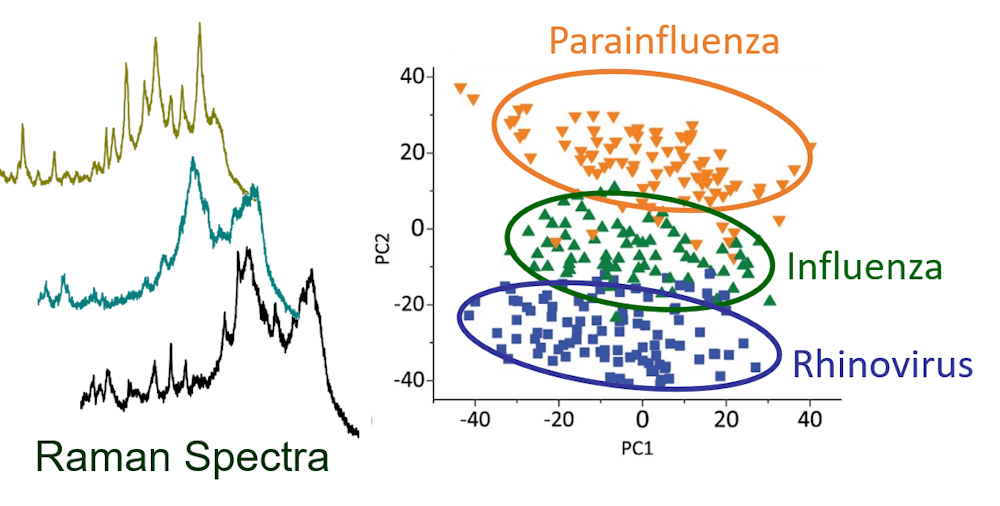
Shining a laser onto virus samples trapped in mesh of carbon nanotubes will produce a signature ‘reflection.’
Our approach uses a technique called Raman spectroscopy to identify viruses by shining a light on a disposable cartridge that collects samples from oral cotton swabs or a person blowing through the device. Once a sample is collected, a spectrometer measures the interatomic vibrations that result from shining the light on the collected viruses. Each virus has its own signature vibrations, which act as a sort of optical fingerprint that can distinguish the coronavirus from, for example, the virus that causes influenza.
We could capture viruses from patients’ saliva taken with a swab or by a person blowing through a device, called a microfluidic cartridge. The air and liquid pass an array of carbon nanotubes, cylinder-shape molecules used in different materials.
The diameters of the nanotubes are microscopic, between 10-60 nanometers. Because they are smaller than microbes – flu viruses range from 90-120 nanometers in diameter and coronaviruses range from 125-150nm in diameter – the pathogens collect on the carbon nanotubes. Once trapped by passing through the carbon nanotubes, the viruses can be optically identified by shining a laser on the sample. Shining the light on the carbon nanotubes and pathogens creates a distinctive optical fingerprint, or “Raman peaks.”
After being beamed with lasers, different microbes will give off radiation in different wavelengths that can be measured to identify the pathogen.
After the laser shines on the trapped sample, machine learning algorithms identify the signature spectrum of the virus that results from the light that bounces off the virus particles. With the assistance of machine learning, the identification takes less than two minutes with an accuracy rate of up to 70% to 90%, comparable to state-of-the-art microbiology techniques.
Why it matters
Right now, the rapid and accurate detection of the novel coronavirus is of paramount importance. While Raman spectroscopy has the potential to be enormously helpful in identifying this virus, doctors can also use this technique to test for other illnesses, such as influenza. By identifying the virus easily, quickly and at the point of contact, Raman spectroscopy could significantly halt disease spread.
Compare that to our current methods of analyzing samples; a process that is relatively slow, tedious, labor intensive and requires extensive scrutiny at laboratories. Early and rapid detection with this new device has the potential to save hundreds of thousands of lives every year.
What other work is being done
For the identification of viruses, existing technologies do provide relatively sensitive detection. However, they take several hours and sometime days depending on the quality of the sample collected because low virus concentrations are very difficult to process and results in false negatives.
Unfortunately, both immune- and molecular-based methods, including enzyme-linked immunosorbent assay (ELISA) and polymerase chain reaction (PCR), require prior knowledge of the strains. Another technique known as deep sequencing is another promising new approach, but obtaining sufficient viral reads for it to work well depends on the quality of the sample and its preparation. Processing steps involve incorporating different benchtop equipment, reagents and technical expertise.
We are applying for federal funds to demonstrate that this technology works for SARS-CoV-2, the virus that cause COVID-19, and then build reliable prototypes that can be scaled up for mass production and field deployment. We are also talking with several manufacturers and exploring ways to move the technology forward to help in the current crisis.
We have been successful in capturing human respiratory viruses from clinical samples using this technique. Eventually, we foresee this technology becoming available to anyone visiting their family doctor. Within two minutes, a person would know whether you have a respiratory virus by comparing the result of the spectroscopy test with other results in a database. In the future, this technology could be at hospitals, airports and inside commercial aircraft to avoid outbreaks. And the captured viruses, still viable, can be replicated to develop a vaccine.
Editor’s note: Education Secretary Betsy DeVos released new regulations on May 6 that govern how sexual assault investigations are handled on college campuses. We asked Marissa Pollick, a University of Michigan lecturer and attorney who specializes in compliance with Title IX – the federal law that governs gender discrimination on campus – to explain what the new regulations mean for accusers and the accused.
1. Has the definition of sexual harassment become more narrow?
Yes. Under the prior guidance, a single incident, if severe enough, might meet the definition of sexual harassment. The new rules state that sexual harassment must be unwelcome conduct that is so “severe, pervasive and objectively offensive” that it effectively denies a person access to the school’s education programs or activities. An isolated incident of unwelcome remarks of a sexual nature, for example, would not meet the revised definition. The new rules also clarify the sexual harassment definition to specifically include sexual assault, dating violence and stalking, which need not satisfy the severe and pervasive standard.
2. How do the new regulations affect victims?
Victim advocates are concerned that the new rules will discourage victims from coming forward. As before, educational institutions, public and private, that receive federal funds must have a Title IX policy that addresses sexual misconduct. Under the new rules, colleges and universities must now conduct live hearings with cross-examination in connection with sexual misconduct complaints. Critics believe this will intimidate and cause further emotional harm to sexual assault survivors.
In addition, schools may use a new evidentiary standard that will make it harder for complainants to prove that a violation of sexual misconduct policy took place.
Before, schools could use a standard of “preponderance of the evidence” – which means more likely than not – to prove a Title IX policy violation. Now, schools may use a “clear and convincing” evidence standard. Clear and convincing proof means that the evidence presented must be highly and substantially more probable to be true than not. This higher standard is used in certain civil cases that involve high risk of loss or fundamental concerns such as free speech under the First Amendment. Under the new rules, schools will be permitted to choose between these two evidentiary standards for use at all stages of their investigation and proceedings. Victim advocates are concerned that schools will utilize the higher standard of proof to reduce the number of lawsuits from accused perpetrators who are disciplined under the policy.
3. What are the most significant changes for the accused?
The rule changes arguably provide more due process protections for alleged perpetrators that many observers and some courts found were lacking in the past. For instance, there have been successful lawsuits against universities that expelled or otherwise disciplined students for policy violations without conducting a full and fair hearing. Accused students must now be given written assurance that they are presumed innocent, which was not previously required. They also may use lawyers or legal advisers to cross-examine their accuser. This was not included in the prior guidance. Further, the accused will receive greater protections under the clear and convincing evidentiary standard because it will be more difficult to prove that the alleged conduct was a policy violation.
4. What do schools have to do now that they didn’t before?
Schools must now carefully review and revise their policies to ensure that they are compliant with the new regulations. The final rules take effect Aug. 14, 2020, which is particularly challenging given the major demands on schools during the COVID-19 pandemic. If a college or university has not utilized live hearings, they must now coordinate and train staff and personnel to develop and implement the new investigation and hearing requirements, including virtual hearings if necessary.