President Donald Trump filed another appeal for his Pennsylvania suit to stop the votes from being counted in the state. This suit goes to the Third Circuit Court, and the filing was due at 4 p.m. In true Trump-legal team style, however, the filing didn't drop until 4:19 p.m.
"This latest filing - where Trump is now seeking to prevent certification in Pennsylvania - has now ascended the Mount Rushmore of banana-pants," tweeted appellate lawyer Raffi Melkonian. "Among other insanities - 1) you needed to file this days ago; 2) why are you asking for an extra 1,000 words on the motion when YOU ARE FILING A 14,000 WORD APPELLATE BRIEF ALSO TODAY; 3) It is not called a TRO."
Former acting Solicitor General Neal Katyal found it odd that the Trump legal team would try to file a restraining order in a U.S. district court of appeals when it wasn't in the first case.
Making his way through the legal filing, Reuters crime and justice reporter Brad Heath cited the point that Trump's team isn't trying to disenfranchise 6.8 million voters. They're trying to disenfranchise a subset of 1.5 million voters. Later on in the filing, however, the campaign says that irregularities mean the whole election should be thrown out and handed to the Republican-led legislature to decide. That would essentially nullify the 6.8 million votes they say they're not trying to disenfranchise.
"Trump's lawyers say the only issues they want the Third Circuit to resolve are whether they should have been able to amend their complaint to reinstate claims they dropped by mistake, and whether they can revive a related injunction motion," tweeted Heath. "Trump's lawyers want to be able to go back to the district court so they can argue that a bunch of election procedures they didn't like - curing of mail-in ballots, canvassing observation, etc - were part of a deliberate scheme to help Joe Biden become president."
Trump's lawyers went on to say that telling counties to count absentee ballots without secrecy envelopes was a scheme to help Biden win. "Nevermind that the state Supreme Court said they shouldn't be counted and it appears they, therefore, weren't," tweeted Heath.
The filing doesn't include much about why Judge Matthew Brann's ruling should be reversed, other than lawyers saying they didn't want to wait too long to amend their complaint because it would prejudice defendants.
Former Federal Prosecutor Joyce White Vance said that the courts may have to decide at what point to issue sanctions for such absurd lawsuits.
U.S. Senator Lamar Alexander (R-TN), who has served in politics for nearly four decades, on Monday issued likely the strongest call from the upper congressional chamber to President Donald Trump: it's over, wrap it up.
“When you are in public life, people remember the last thing you do,” the 80-year old Tennessee Republican told Trump in a statement he just released.
"The presidential election is rapidly coming to a formal end," Sen. Alexander wrote. "Recounts are being completed, Courts are resolving disputes. Most states will certify their results by December 8."
"Since it seems apparent that Joe Biden will be the President-elect, my hope is that President Trump will take pride in his considerable accomplishments, put the country first, and and have a prompt and orderly transition to help the new administration succeed."
Alexander, highly-respected in conservative America, is retiring in January.
On Friday Sen. Alexander called on Trump to allow the transition to begin, including releasing the millions of dollars Congress has approved.
He has served as Governor of Tennessee, Chair of the National Governors' Assoc., Secretary of Education, Chair of the Senate Republican Conference, Chair of the Senate Health, Education, Labor and Pensions Committee, and was first elected to the Senate in 2002.
US President-elect Joe Biden signalled a sharp reversal Monday from Donald Trump's anti-immigrant policies with the choice of Cuba-born Alejandro Mayorkas to lead the Department of Homeland Security.
The former federal prosecutor ran US immigration services and then was DHS deputy secretary in the Obama-Biden administration.
Most notably Mayorkas, who turns 61 on Tuesday, oversaw the implementation of DACA, the Deferred Action for Childhood Arrivals program, meant to offer a way to citizenship for millions of longtime US residents who entered the country illegally.
Under Trump that effort was halted and challenged in courts, as part of the White House's determined effort against undocumented immigrants.
Mayorkas will be the first immigrant himself to lead the sprawling DHS bureaucracy, whose mission is focused firstly on protecting the country from terror and cyber attacks and natural disasters.
In a tweet, Mayorkas pointed to his own history as a refugee as shaping his view of the job.
His mother was a Romanian Jew who fled to Cuba, and his father a Cuban Jew who brought the family to the United States in 1960 before Mayorkas' first birthday.
"When I was very young, the United States provided my family and me a place of refuge," he wrote.
"Now, I have been nominated to be the DHS secretary and oversee the protection of all Americans and those who flee persecution in search of a better life for themselves and their loved ones."
Trump politicized DHS
But Mayorkas, who goes by the nickname Ali, will have a much larger challenge.
DHS was created in the wake of the September 11, 2001 Al-Qaeda attacks to coordinate domestic security against potential terrorism.
But it also assumed controls of borders and immigration enforcement, disaster management, cyber security, and air and sea transportation security.
Now, with some 240,000 employees, it is a sprawling department whose core mission is poorly defined, and which was deeply politicized by Trump.
Trump churned the DHS leadership as he sought officials who would pursue an absolute halt to legal and illegal immigration and be willing to resort to extreme measures, like separating families and isolating children, to deter undocumented immigrants.
He also had DHS's Immigration and Customs Enforcement agency, known as ICE, step up raids on illegal immigrants, deporting thousands as Trump sweepingly branded all of them "gang members," "drug smugglers" and "rapists and murderers."
That has led to calls to eliminate ICE.
Meanwhile Trump took aim at DHS officials who dared to undermine his political agenda, including those who said the leading US domestic threat was from extreme-right white nationalist and neo-Nazi ideologues, and not from the left as Trump claimed.
And last week Trump summarily fired the DHS head of election security, Chris Krebs, who had rejected his assertions of "massive fraud" in the November 3 vote.
Democratic Representative Joaquin Castro, who leads the Congressional Hispanic Caucus, called Mayorkas "a fantastic choice."
"After the cruelty and devastation wrought by the Trump administration, Mayorkas has a mandate to overhaul DHS," Castro said.
"As the former Deputy Secretary of DHS and lead implementor of DACA, he has the necessary experience to bring about much needed reforms."
For nearly 30 years, the state of Georgia has voted reliably Republican in presidential elections. Not since 1992 has the state backed a Democrat for president. Now, the hand recount of 2020 election ballots has confirmed Joe Biden won the state.
The initial returns from Georgia on election night leaned Republican, but in the days that followed, the balance of the count shifted steadily, as ballots from in and around Atlanta were counted. These votes were largely from communities of color, mostly African American – and they represent much of the state’s rich history of civil rights advocacy.
I am a political scientist and race scholar, with specific emphasis on examining social justice movement strategy and the impact of collective action. To me, the story behind how those Biden-Harris voters were mobilized – with others across the state – is the latest chapter in the state’s history of community organizing for peaceful democratic political change.
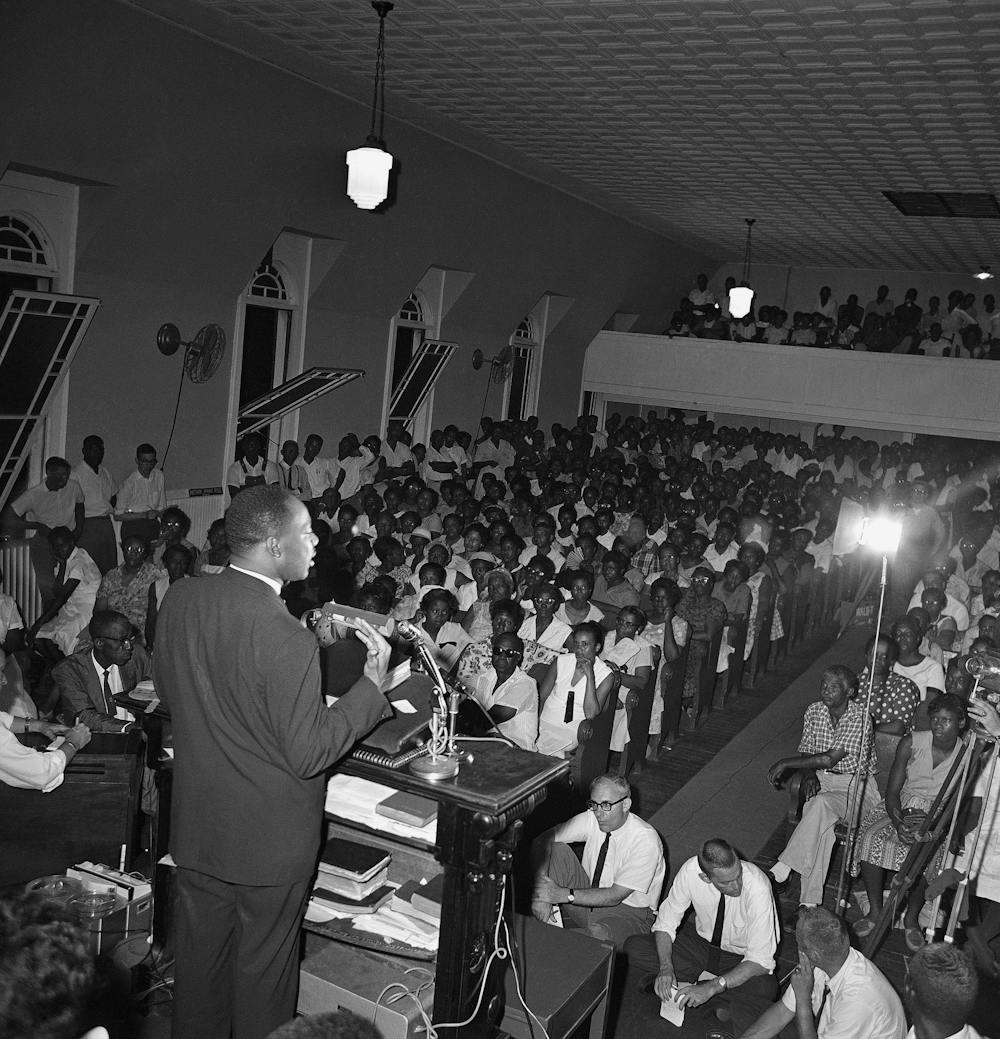
Martin Luther King Jr. speaks to a church gathering in Albany, Ga., about desegregation efforts and civil rights, in July 1962.
Social justice movements and civil rights activism have always been important in Georgia. Even during Reconstruction, in the wake of the Civil War, the organizers worked to teach Georgians about voting rights and the rules for qualifying to vote in a state that had long denied them that right.
One major effort was the 1961-1962 Albany Movement, based in the Georgia town of that name. The effort was led initially by the Student Nonviolent Coordinating Committee, with later help from the Southern Christian Leadership Conference, two of the nation’s leading civil rights organizations at the time. At the outset, Albany’s population was 40% Black, but many of them were not registered to vote.
The Albany Movement was the first attempt to completely desegregate a community, including through teaching nonviolence for people to engage in civil disobedience. The tactics and strategies pioneered there were successful in Albany and, as King and his movement shifted to Birmingham, Alabama, formed the basis for their work as well.
Between 1960 and 1964, half a million Black voters were registered in Georgia, as part of a larger Student Nonviolent Coordinating Committee voter registration drive across the South.
Those decades of activism built strong networks for grassroots organizing and taught many people how to effectively fight segregation and racism with boycotts, sit-ins and other nonviolent methods of direct action resistance. After King’s assassination in 1968, the movement slowed significantly, showing how important it was to decentralize future civil rights efforts, rather than focusing them on one specific person or place.
Decades later, the Movement for Black Lives arose in response to police brutality against Black Americans, and built on the lessons learned through the 1960s.
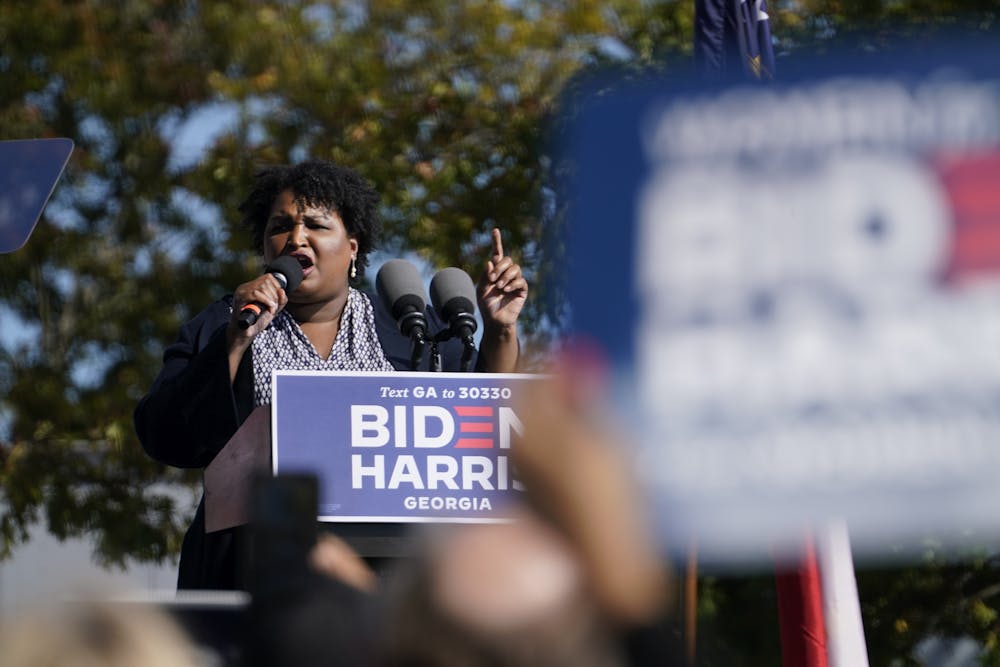
Georgia politician and activist Stacey Abrams speaks to a crowd in advance of the 2020 election.
The latest push for Black voters in Georgia came in 2018, after former State Representative Stacey Abrams, a Black Democratic woman, narrowly lost the race for governor to Brian Kemp, a white Republican man.
Her loss was largely attributed to the efforts of Kemp, who had been the state’s top elections official, to suppress Black votes. Those efforts included throwing more than half a million voters off the rolls – most of them Black – and tightening other voting rules.
In the wake of that election, Abrams committed herself to fight voter suppression in Georgia. She created an organization called Fair Fight to get the purged voters back on the rolls and to register others who were eligible to vote as well.
She began these efforts when Black Georgians’ attention had turned strongly to politics after the killing of Ahmaud Arbery. The 2020 death of civil rights icon and longtime Congressman John Lewis brought more attention to racial inequality. Many people realized they had been disenfranchised and were suffering from “intolerance fatigue,” the feeling of being “sick and tired of being sick and tired.”
Abrams and Fair Fight benefited from the state’s 2016 implementation of the 1993 National Voter Registration Act, sometimes called the “motor voter” law, which gives people the opportunity to register to vote at the same time that they apply for or renew a driver’s license.
Altogether, that collective effort registered 800,000 new voters in Georgia since Abrams’ 2018 loss. Some of those were likely among the many that Secretary of State Kemp had forced off the rolls, but many were also people who had never before been registered to vote in Georgia.
In addition to getting people’s names on the voting rolls, these groups pushed the importance of actually voting and taught people how to vote safely, including by mail or in-person before Election Day. Their efforts resulted in a 63% increase over the 2016 statistics for mail-in and early in-person voting ballots cast.
An additional factor in the Georgia election result may have been President Donald Trump’s own statements discouraging his supporters from voting, but the real key was the grassroots organization, the modern echo of the Albany Movement, the Student Nonviolent Coordinating Committee and other efforts, that brought new voters into the fold.
“Petitioners do not allege, and there is no evidence of, any fraud in connection with the challenged ballots; Petitioners do not allege, and there is no evidence of, any misconduct in connection with the challenged ballots; Petitioners do not allege, and there is no evidence of, any impropriety in connection with the challenged ballots; Petitioners do not allege, and there is no evidence of, any undue influence committed with respect to the challenged ballots.”
The attorney backpedaling is not surprising.
It’s one thing to speculate via tweet, but quite another for an attorney, who is an officer of the court, to make representations to a judge. Trump’s lawyers are constrained in what they can assert by three major restrictions that apply to lawyers: professional ethics, rules of civil procedure and rules of evidence.
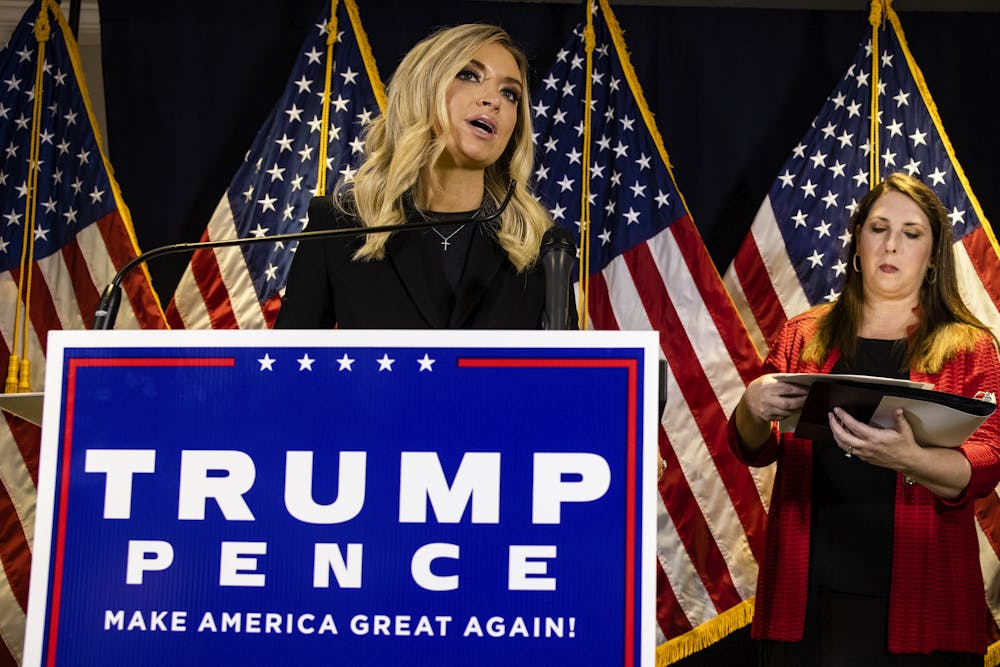
White House Press Secretary Kayleigh McEnany, left, at a press conference where Trump campaign and GOP officials pushed theories of voter intimidation, fraud and illegal votes but were unable to provide proof.
As members of the bar association – the state entity that grants attorneys their license to practice law – lawyers have a professional ethics obligation “not to abuse legal procedure” by filing “frivolous” claims. Rule 3.1 of the Model Rules of Professional Conduct, some version of which applies in all states, forbids a lawyer from bringing a claim or argument “unless there is a basis in law and fact for doing so that is not frivolous.”
The bar requires lawyers to “inform themselves about the facts of their clients’ cases and the applicable law” and “determine that they can make good faith arguments” supporting their clients’ positions.
At least outside the context of criminal defense, lawyers must be able to honestly represent to the court that they have a basis for believing they have a path to getting relief either based on existing law or “a good faith argument for an extension, modification or reversal of existing law.”
Violating this requirement could expose the lawyer to sanctions from the state bar, which could range from a reprimand to a fine to a license suspension. More practically, it can erode courts’ confidence in the lawyer’s reliability and damage the lawyer’s professional reputation.
In Trump’s case, this means his attorneys can only say the election was stolen if they know of actual, credible reports of systematic fraud.
President Trump leaves a Nov. 5, 2020, press conference at which he alleged the election had been rigged and stolen.
Formal disciplinary administrative proceedings against lawyers by the bar for this kind of misconduct are rare. But less rare are motions by opposing parties for sanctions under a different rule.
Federal Rule of Civil Procedure 11 allows an opposing party to move for sanctions against a lawyer who files a frivolous claim or makes a frivolous argument. Most states have an analogous rule for their courts.
Rule 11 provides that when making a claim before the court, the attorney certifies, “after an inquiry reasonable under the circumstances,” that:
it’s not being made for an improper purpose, such as to harass or delay;
the claims are warranted by existing law or a nonfrivolous argument for a change in the law; and
the factual assertions have evidence to support them, or will likely have such support after a reasonable opportunity for investigation and discovery.
For example, if a corporation’s lawyer files an antitrust complaint that she knows to be a stretch, just to block a rival’s merger deal and give her client time to complete its own merger deal first, that would be a violation of Rule 11.
The rule allows any opposing party to ask for sanctions, or for the court to order sanctions on its own initiative. Frequently, such sanctions include paying the other side’s attorney fees for having to do the work to oppose the frivolous claim or argument.
As an election law scholar and practitioner, I believe that perhaps the most compelling rule keeping lawyers cautious is the practical consideration that making unsubstantiated claims of fraud is not only unethical but also a waste of time.
Eventually — and, under the accelerated time frame of these cases, that means pretty quickly — the lawyers are going to have to present actual evidence to judges. Without such evidence, judges will dismiss the claim.
And a lawyer making fraud claims without evidence runs the risk that an impatient judge might dismiss an entire case, even if other, legitimate claims are being made.
When it comes to the election fraud claims, watch what the lawyers do, not what the politicians say.
Progressives continue to be alarmed that the Biden transition is considering former Chicago Mayor Rahm Emanuel for a position in the next administration.
Emanuel had been floated as a potential Transportation Secretary nominee, but progressives were outraged.
With reports that the transition was considering Emanuel for a less high-profile position, Rep. Alexandria Ocasio-Cortez (D-NY) said that he was disqualified from any position.
"What is so hard to understand about this?" the youngest woman in Congress, known as AOC, asked.
"Raul Emanuel helped cover up the murder of Laquan McDonald. Covering up a murder is disqualifying for public leadership. This is not about the 'visibility' of a post," she argued.
"It is shameful and concerning that he is even being considered," AOC added.
Courteous and refined and with a side passion for rock guitar, Antony Blinken, named Monday to be US secretary of state, embodies the role of a diplomat both in image and mission coupled with a deep-rooted passion for human rights.
A longtime aide to President-elect Joe Biden, Blinken is a fluent French speaker and devoted believer in international cooperation who has vowed to work to repair US alliances badly frayed by Donald Trump's in-your-face approach.
With an elegant mane of salt-and-pepper hair, the 58-year-old Blinken -- who goes by "Tony" -- could scarcely be more different than Trump's secretary of state, the rough-edged, hard-charging Mike Pompeo.
"He's about as mild-mannered, humble and unassuming as they come," said Robert Malley, a childhood friend of Blinken who is now president of the International Crisis Group.
"I've yet to meet anybody who recounts an episode of Tony exploding or having a fit of anger," Malley said.
But Blinken, a deputy secretary of state during Barack Obama's presidency, may show different instincts than Biden even while remaining loyal to him.
The stepson of a Holocaust survivor, Blinken has advocated interventions on humanitarian grounds while Biden as vice president was cautious on the use of force.
"Superpowers don't bluff," Blinken was reported to have warned repeatedly in deliberations on Syria's civil war, in which Obama issued warnings but ultimately decided for a limited role.
Speaking earlier this year about the "horrific" loss of life in Syria, Blinken said: "The last administration has to acknowledge that we failed -- not for want of trying, but we failed."
"It's something that I will take with me for the rest of my days. It's something that I feel very strongly," he told CBS News.
- Formative youth abroad -
Blinken's passion about preventing atrocities can be traced to his stepfather, Polish-born Samuel Pisar, one of the youngest survivors of the Holocaust, whose family was murdered.
A prominent lawyer who worked for detente between the West and Soviet Union, Pisar moved the family to Paris where Blinken studied at the prestigious Ecole Jeannine Manuel.
Malley, his classmate, said that Blinken learned to navigate the US role in the world as a young American in Paris in the wake of the Vietnam War.
"Tony believed strongly in his values and identity as an American but was living in a foreign country and therefore forced to see the world through the eyes of that foreign country at a time when the US was not the most popular," Malley said.
Blinken's biological father is a prominent investment banker and his mother, Judith Pisar, for years headed the American Center in Paris, which brought together artists.
His youth in Paris also launched Blinken's fledging musical career as he played jazz and discovered rock, quoting Pink Floyd's "Another Brick in the Wall" in his high school yearbook.
In Washington, Blinken has performed in a Beatles cover band and used free time in the pandemic to compose his own songs, his guitar sometimes visible during interviews taped from his home.
His musical alter ego, ABlinken, had a modest 57 monthly listeners as of Monday on Spotify where he has uploaded two songs, driven by slow-driving 1970s-inspired rock guitar and an uncharacteristically forceful tenor vocal delivery.
- Belief in US mission -
Blinken attended Harvard University where he wrote for The Harvard Crimson -- a review of an album from Bob Dylan's Christian phase concluded that the rock legend "is no man's lackey. He will always do and sing what he believes" -- before a career in law and Democratic Party politics, serving on the staff of the Senate Foreign Relations Committee when Biden served.
In a 2017 talk, Blinken said that his views remain shaped by his stepfather who survived concentration camps including Auschwitz and Dachau before making a dash for his life, defying German gunfire, during a death march.
After two days hiding in the woods, the teenage Pisar heard the rumblings of a tank and, to his relief, saw not a German but an African-American soldier.
"He got down on his knees and said the only three words he knew in English, that his mother had taught him, 'God bless America,'" Blinken recalled.
"The GI lifted him into the tank -- into, figuratively speaking, the United States and into freedom.
"That's the country I grew up with: The United States playing that extraordinary, unique, welcoming role."
Rep. Ted Lieu (D-CA) said that it's long past time for General Services Administration chief Emily Murphy to authorize President-elect Joe Biden's transition.
After announcing that Michigan would be certifying the election despite President Donald Trump's protests, Lieu told Murphy now that contested states like Michigan are done and she has no other justification to refuse to allow the transition to move forward.
"Dear @GSAEmily: With the certification by Michigan, there continues to be no excuse for you to obstruct the transition to President-elect @JoeBiden & Vice President-elect @KamalaHarris. Stop being a partisan hack who believes in dead Hugo Chavez conspiracy theories. Do your job."
Congress had called Murphy to testify this week, but she refused, saying that her deputy could testify instead, but they couldn't figure out the technology to join a meeting. So, Murphy said her deputy would come to speak to Congress next week. Congress called that unacceptable and offered to send someone over to help Murphy run her computer.
Writing in the Washington Post this Monday, Paul Waldman says that even though President Trump will no longer be president after January 20, the Republican Party will remain in the grasp of his influence for years to come.
"There have long been right-wing conspiracy theorists, but never before has conspiracy theorizing become so common in the GOP — and its politicians know it," Waldman writes. "The rank and file, having been fed a relentless diet of it for years, are convinced that dark cabals are controlling events, there are no coincidences and anything that doesn’t work out their way can only be the result of menacing forces conspiring against them."
According to Waldman, now that adherents of the QAnon cult have been elected to Congress, party leaders will be compelled to "wink and nod" to every conspiracy theory that comes along.
"We’ll continue to see a vicious cycle in which politicians and the conservative media feed conspiracy theories to the Republican masses, who become ever more convinced they’re true, and therefore the politicians and media continue pandering to them with still more," he writes.
It's official: President Donald Trump has lost Michigan and there's nothing he can do to stop it.
After a day filled with members of the Michigan Board of State Canvasser attempting to promote Trump's conspiracy theories, but in the end, they had no other options.
After a robust comment section from the public, GOP canvasser Aaron Van Langevelde announced that he would support certifying election results.
"We have a clear legal duty to certify the results of the election," he said.
It effectively ended the debate over whether Trump could take back the state after losing it with over 100,000 votes.
Michigan held its electors' meeting to certify the state's election on Monday, only to be flooded with conspiracy theories. At the same time, a Republican member of the Michigan Board of State Canvassers even pushed the false idea that he can refuse to certify the election.
At one point, former Michigan Republican Sen. Patrick Colbeck ranted that electronic voting "computers were connected to the internet." He alleged that because tabulators were connected they were "attempting to subvert the election and hide the fact that they were doing so."
Democratic member, Julie Matuzak, finally cut into his rant telling Colbeck "If you have evidence of fraud, have you submitted it to the Attorney General?"
Colbeck said he hasn't submitted anything to the attorney general.
The AG announced that she never received any complaint or any evidence of fraud and that had her office heard such a complaint they would certainly investigate.
President-elect Joe Biden has announced several of his top cabinet picks and by far the response has been overwhelmingly positive from experts in their fields.
The Transition Team has just put out a short video on the first set of nominees:
Lawfare Executive Editor, CNN National Security and Legal Analyst, Former Intel Community attorney:
Former acting United States Deputy Secretary of State and former Under Secretary of State for Political Affairs:
Former Senior Advisor and Foreign Language Spokesperson at the State Department and a Senior Director of Cabinet Affairs in the White House under Obama:
Busy airports and serpentine queues at testing sites: many Americans plan to celebrate Thanksgiving with extended family Thursday despite authorities warning they risk exacerbating the coronavirus pandemic engulfing the country.
Stopping short of issuing an outright ban, the US government's health protection agency has for the first time called on Americans not to travel for the annual holiday, which sees families get together over turkey, yams and cranberry sauce and for many is more important than Christmas.
With more than 150,000 new cases daily in the US, which has the world's highest coronavirus death toll of more than 256,000, most state governors have urged citizens not to turn their dining rooms into hotbeds of coronavirus.
The government's highly respected infectious disease expert Anthony Fauci sought to lead by example by announcing that his three adult daughters would not be visiting him for Thanksgiving this year.
He said he would celebrate the holiday alone with his wife, contenting himself with "a glass of wine" with his children over Zoom.
But after almost nine months of the pandemic the guidelines are too restrictive for some Americans who are finding ways to celebrate with loved ones while limiting the number of dinner guests.
- 'Busiest weekend' -
This weekend past, images on social media of crowded airports in Chicago and Phoenix fueled concerns about whether Americans were taking the warnings seriously enough.
It was the "busiest weekend" since the start of the pandemic with more than three million passengers passing through US airports, according to the Transportation Security Administration, which is responsible for security checks.
The number is less than half the seven million that traveled for Thanksgiving last year but health officials fear it is enough to fuel a catastrophic increase in cases in December.
"Our pleas for help have fallen on selfish deaf ears," tweeted Cleavon Gilman, an emergency doctor in Arizona, noting that the state's hospitals are "overwhelmed" with Covid patients.
New York and many other American cities have witnessed long queues outside testing centers in recent days as people seek negative tests to visit relatives with a clear conscience, even though health officials stress a test several days before a gathering doesn't eliminate the risk of transmission.
Twenty-four-year-old friends Amanda and Chris queued for two hours at a testing site in New York Sunday.
They are hesitant about visiting their families in Florida but felt pressured by their parents.
"Our family was the one who was like, 'Please just come this time'," said Amanda, who works in an auction house.
"When I told my mom we were going to wait in line, she was like, 'You dont need to do that.' They seem much less smart than we are," she told AFP.
Mary Perez, 54 and from Long Island, says she usually has 35 family members over for Thanksgiving but this year she will slightly exceed the New York governor's limit of 10 people. Eleven relatives will gather at her home: five adults and six children.
"I don't really feel I'm breaking the law (as) you can't really count the little ones. They have to come along with their parents," she told AFP.
- 'Pivotal moment' -
Even with minimal celebrations -- resulting in significantly smaller turkey orders this year, according to breeders -- officials fear an explosion of cases in the run-up to Christmas.
Since the start of the pandemic in March, holidays have triggered outbreaks of the virus, including after July 4, Labor Day in September and Halloween, according to health officials.
For Thanksgiving, the first holiday of the winter period, the risk is even greater because thousands of students will return home and often stay there until January.
"It's not too late to change your plans," Meghan McGinty, an expert in disaster prevention at Johns Hopkins University, pleaded on Monday.
"Thanksgiving will be a pivotal moment in the control of the pandemic. If we don't limit our celebration to just our households, we will undoubtably see cases and hospitalizations rise after Thanksgiving," she said.