


Don't blame Dems for Trump
As soon as it became clear that Donald Trump would win the 2024 election, I braced myself for an onslaught of bad-faith, blame-Democrats-first narratives — from Kamala Harris supporters.
Despite the sea change in power (courtesy of our winner-take-all electoral system), the election was close.
Trump won with a meager 31.7% of eligible voters. Unlike Barack Obama and Joe Biden, he failed to get a majority of those who did vote.
Holding the Senate was an impossible task because Democrats held contested seats in three deep-red states (West Virginia, Ohio, and Montana). But Democrats won four out of five swing-state Senate races (Arizona, Michigan, Nevada, and Wisconsin) and fought Republicans to a draw in the House.
In short, the 2024 election was not a mandate.
But that didn’t stop media charlatans from denouncing the Democrats.
Ruy Teixeira, a once-progressive opinion writer who has spent decades in elite Beltway think tanks, said, “The Democrats really are no longer the party of the common man and woman. The priorities and values that dominate the party today are instead those of educated, liberal America which only partially overlap — and sometimes not at all — with those of ordinary Americans.”
TV host Bill Maher, who’d said he was certain Harris would win, said Harris lost because of an article in Scientific American that purportedly trafficked in “wokeness.”
The implication is that the Democratic Party is out of touch with everyday people.
This is a nifty little self-defense mechanism for Democrats who aren’t willing to see the MAGA social pathology for what it is.
Shifting blame to “the politicians” or “the consultants” in the Democratic Party gives a get-out-of-jail-free card to relatives and neighbors and co-workers who are handmaidens to fascism (however unwittingly).
Alienation from people one interacts with, or is intertwined with, is avoided through denial. No messiness. No compartmentalization. Plaster on a fake smile and call it a day.
The purveyors of blame-Democrats-first narratives, most of whom have never so much as run for student council, suffer the conceit that they have more insight into winning strategies than Harris’s senior campaign advisor, David Plouffe, who managed Obama’s 2008 landslide win.
The assertion that Trump won because of Democratic failures rests on the notion that voters are rational actors.
The major impact of uncontrollable events (economic cycles, COVID, foreign interference, foreign crises, the frames the media chooses to hype) is minimized in favor of the theory that if Candidate A just uses the right messaging, they can appeal to voters’ innate goodness and high-minded desire to do the right thing by their fellow citizens. Easy peasy.
In addition to being a naïve view of human nature, this belief has little relevance to the 2024 election because Harris ran a pretty effective campaign.
Her rollout was smooth and surprised the Trump campaign.
She consolidated party support quickly.
The Democrats had an energetic and unified convention that aggressively targeted working voters.
Harris vivisected Trump in the debate he didn’t chicken out of.
She raised tons of money for ads and organizing, had a much bigger (in-house) field operation, blanketed swing states, and had her political surrogates do the same.
Harris downplayed her race and gender and picked a gun-toting, white male everyman veteran as her VP so as not to threaten moderate white voters.
She mitigated Trump’s false messaging on immigration by actively endorsing a bipartisan plan co-authored by Republican senator James Lankford.
She mitigated Trump’s false messaging on crime by casting the election as a choice between a felon and a prosecutor.
While Trump closed the campaign by fellating a microphone, ending a town hall meeting to dance for 39 minutes, and hosting a pre-election Madison Square Garden event rife with racial slurs and echoes of an infamous 1939 pro-Nazi rally, Harris went through the whole campaign without a substantial gaffe.
The most obvious explanation for Harris’ loss, the one the media ignores for fear of sacrificing eyeballs (and more importantly, dollars), is that tens of millions of American voters are bigoted and/or politically illiterate.
Divorced from objective reality
We no longer live in a Lincoln-Douglas debate nation, where civic-minded audiences patiently listen to nuanced three-hour arguments about substantive issues.
We live in a country with a long history of anti-intellectualism where the average IQ is 98 and 54% of our citizens ages 16 to 74 read below a sixth-grade level.
We live in a country of short attention spans, shrinking sound bites, stuporous consumerism, and cellphone-clutching zombies.
We live in a country where students at elite universities whine about reading requirements.
We live in a country with mass disinformation funnels that systematically weaponize ignorance by spoon-feeding lies and distortions 24-7 through Newsmax, Fox, One America News, Sinclair Broadcasting, right-wing radio, the Daily Caller, Breitbart, social media, the Manosphere, and a zillion other platforms.
We live in a country where a critical mass of our citizens is divorced from objective reality.
37% of Americans believe the earth was created in the last 10,000 years and one in five still believe in Biblical literalism.
One in four religious voters believe that a man found liable for sexual abuse, who cheated on his first wife with his second wife, his second wife with his third wife, and his third wife with a porn star, unprotected, was “chosen by God.” Never mind his 34 felony convictions and multi-million-dollar civil penalties for business fraud.
America has the highest per capita fossil fuel consumption in the world, but the very existence of climate change — which threatens human civilization — is denied by 28% of our citizens. 42% of Americans don’t even grasp the direct role human activity plays in rising CO2 levels, which has been public knowledge for four decades.
Our president is so hostile to the scientific method that 75% of scientists in a recent Nature magazine poll said they were open to leaving the U.S.
In such a country, where half of adults can’t name all three branches of government, the average voter has little understanding of how a bill becomes law or how their representative votes day in and day out. They don’t know what’s happening in D.C. beyond headlines, let alone how it’s happening, why it’s happening, obstacles legislation will face in the courts, or the full human impacts of a law once it is implemented.
In this environment of widespread political illiteracy, many voters shrink complicated issues down to oversimplistic, shorthand impressions — vibes or feelings — instead of using rational, evidence-based analysis.
This was clear in the way voters viewed the economy, the decisive issue in the 2024 election.
As happened across much of the world during the tumult of COVID, many voters wrongly assumed that correlation is causation, that incumbent governments were automatically to blame for the state of the economy.
While Biden was president, inflation rose 21.2%, the steepest increase since the oil shocks of the ’70s and early ’80s. Yet inflation barely outpaced wage growth, which was 19.4% during the same period.
Republicans claimed Biden’s stimulus spending was a major driver of inflation, but this was speculation, not hard fact. Mainstream economists feel that Biden’s deficit spending — which was roughly half of Trump’s — may have moved things around the margins, but not to a large degree.
U.S. President Joe Biden, flanked by U.S. Vice President Kamala Harris. REUTERS/Evelyn Hockstein
And even if Biden deserved some blame for inflation, it’s clear that he inherited a no-win situation. If he had failed to pump enough stimulus into the economy, he could have been blamed for a slow recovery, as Obama was. Republicans handed Biden a shit sandwich and then complained about the flavor.
What’s objectively undeniable is that inflation was a worldwide phenomenon caused by COVID-driven supply-chain disruptions (and potentially some degree of corporate greed).
And U.S. inflation rates were within the norms of our G20 allies.
And America had a quicker rebound and higher job growth than developed world peers, the lowest unemployment in over 50 years, and wage growth has been higher than inflation since February 2023.
And these conditions especially benefited Ruy Teixeira’s common man and woman, who had the biggest jumps in pay they’d experienced since the ’90s dot-com boom.
The rebound was so vigorous that just prior to the election, Rupert Murdoch’s Wall Street Journal said that the U.S. economy was “the envy of the world,” a huge turnaround from four years prior, when America experienced record job losses on Trump’s watch.
26 million interviews
Despite the above facts, and Democratic presidents significantly outperforming Republicans economically over several decades, a majority of Americans felt Trump would do a better job of managing the economy than Harris.
By this convoluted logic, Trump deserved credit for the record sustained growth he inherited from Obama and no blame for losing 22 million jobs, while Biden (and Harris, by extension) received no credit for presiding over an economy that was “the envy of the world” and shouldered the blame for pandemic-related inflation that was experienced worldwide.
The disconnect, as with so many in American politics, is rooted in ignorance.
Democratic data guru David Shor’s firm, Blue Rose, conducted 26 million interviews in 2024. Shor found that less-engaged voters were most likely to blame Harris for inflation and gas prices. Shor also discovered that low-information voters on Tik Tok swung 8% more Republican than in 2020 and “politically-disengaged” voters swung 14 points to Republicans. (They continue to support Trump in the highest numbers.)
In a podcast interview with New York Times columnist Ezra Klein, Shor pointed out that many self-described moderates without college degrees suffered from cognitive dissonance (holding contradictory views without realizing it).
Broad misunderstandings of the economy are of a piece with a feeling among many working-class stiffs — white ones especially — that Republicans better represent their interests.
Recent history definitively proves otherwise.
Other than one-term George Bush, Sr., every Republican president of the last 45 years has followed a trickle-down template: slash social services for our most vulnerable citizens, including disabled children; lavish lucrative subsidies on highly-profitable defense contractors; give the most privileged Americans huge tax cuts; and toss in a helping of union-busting.
The GOP has done very little to address steep increases in the costs of health care, education, childcare, or housing during this time, even when they’ve controlled the White House and both houses of Congress.
By contrast, Democratic presidents Bill Clinton, Barack Obama and Joe Biden focused heavily on cost-of-living issues. All three were endlessly filibustered by Senate Republicans, forcing Democrats to abandon economic reform or water it down enough to secure every Democratic Senate vote necessary for passage.
Unable to get broad-based change due to factors beyond their control, Democrats were painted as ineffective, which fed public misperceptions about the major parties’ stark differences in priorities.
In other words, Teixeira’s claim that “the Democrats really are no longer the party of the common man and woman” gets it backward.
The Democrats are in fact the only party representing the economic interests of the common man and woman.
The Biden presidency offers the most recent example of this long-term trend.
Biden stood up for everyday people by staffing federal agencies with consumer advocates, supporting net neutrality, taking on Big Tech and other monopolies, going after junk fees, reducing student loan debt, extending the COVID-era eviction moratorium, increasing the minimum wage for federal workers, and being arguably the most pro-union president in decades.
The first big bill Biden signed, the American Rescue Plan Act of 2021, helped struggling state and local governments push through the then-raging COVID pandemic, put $1,400 in the pocket of 85% of Americans, greatly expanded access to healthcare coverage (including mental health and substance abuse treatment), lowered healthcare and prescription drug costs, and cut child poverty by 30 percent.
The American Rescue Plan Act passed without a single Republican vote.
The second consequential measure Biden signed, the Infrastructure Investment and Jobs Act, pumps over a trillion dollars into roads, bridges, highways, the electric grid, public transit, and broadband access for rural areas that didn’t back Biden. The Economic Policy Institute estimated that the bill would support 772,000 jobs per year for its first decade, in both red and blue states.
The third big bill Biden signed, the CHIPS and Science Act, shores up our industrial base by investing $280 billion in domestic manufacturing of semiconductors, STEM workforce development, and research and development. The bill helps both rural and urban constituencies and provides a boost to non-degreed Americans with the requisite skills.
The fourth major bill Biden signed, the Inflation Reduction Act, lowered prescription drug prices, funded Affordable Care Act subsidies for three years to keep rates down, and provided a record investment in clean energy production — and with it, manufacturing jobs.
The Inflation Reduction Act received unanimous support from Democrats but not a single Republican vote, despite the fact that Republican districts received most of the benefits. (Eighteen House Republicans begged Speaker Mike Johnson not to repeal it.)
The Inflation Reduction Act was part of Biden’s much bigger Build Back Better Plan, which would have capped childcare costs, expanded the Earned Income Tax Credit for working Americans, created over a million public housing units, removed barriers to union organizing, expanded Medicaid eligibility, increased homecare for the elderly and guaranteed homecare workers a decent wage, and funded universal preschool, two free years of community college, and paid family and medical leave.
Biden’s achievements were of such a grand scale that he was ranked among the top 15 presidents in a poll of presidential scholars, 31 slots ahead of Trump (who was dead last). Because of this sensei-level governance, the longshot odds of beating Biden in a primary, and Biden’s general election polling relative to potential primary opponents, no viable Democrats stepped up to challenge him in 2024.
Meanwhile, helped along by a media obsessed with the president’s age, Ruy Teixeira’s common man and woman rewarded Biden for his tireless efforts on their behalf by running him out on a rail in favor of a right-wing billionaire guaranteed to make their lives tangibly worse.
'Values voters'
Republicans have been getting the votes of working stiffs while screwing them economically ever since the Civil Rights Act passed. The “modern” GOP continues to manipulate the amygdalae of blue-collar voters with hot-button issues that have exactly zero impact on their daily lives.
This was echoed in Shor’s finding that a sizable number of working-class voters in the States are “values voters,” not unlike working-class voters in other developed countries.
In plain English this means that when faced with rapid social and technological change, many human beings who haven’t been forced to open their minds through the college experience lurch toward prejudice.
Study after study after study after study after study showed that Trump owed his 2016 “victory” in large part to dehumanizing racist and sexist appeals. He used the same tactics in 2024.
Though he lost to a white man who barely campaigned in 2020, Trump beat two women who were vastly more qualified for the job — the second after he ended the right to choose and made women second-class citizens in most of red America.
Protesters outside the U.S. Supreme Court. REUTERS/Evelyn Hockstein
Much has been made of the Democrats’ supposed “wokeness.” Apparently some Americans — especially men — feel that they shouldn’t have to be thoughtful toward populations who’ve historically been discriminated against and continue to be discriminated against. This ties in with so-called “cancel culture,” where people who publicly state unpopular opinions are marginalized.
In the same vein, red state Republicans get their hackles up about Critical Race Theory (CRT), which acknowledges the role centuries of institutional racism play in current socioeconomic outcomes.
To the extent that “wokeness” and “cancel culture” exist, don’t hold your breath trying to find even one (1) example of a “woke” piece of legislation signed into law by Joe Biden that negatively impacts Americans without a degree, or a single instance of Democrats pushing CRT at the national level.
Another phantasm the Trump campaign got a lot of mileage out of with “values voters” was the specter of trans Americans.
Apparently, having to occasionally try to make other people comfortable in their own skin by addressing them with preferred pronouns is a major imposition on one’s “freedom,” or self-expression, or something.
And nothing is so threatening to the common man and woman as trans athletes. Of the 500,000 athletes in college sports, fewer than 10 identify as trans. Unless you are one of the teeny, tiny percentage of people competing against a trans athlete, or the parent of one of these people, you have zero skin in the game.
None.
Republican plays to bigotry also explain their fixation on illegal immigration.
Amplifying fears of brown hordes coming across the border into land we stole from Mexico in 1848 is the gift that keeps on giving for the GOP.
Yes, illegal immigration is a problem throughout parts of the Southwest U.S.
But it’s a complex problem and many Republican talking points are dubious if not patently false.
Evidence that immigrants “steal American jobs” is thin.
Immigrants don’t drain taxpayer benefits. Immigrants contribute more to the economy than they take in and tend not to apply for benefits due to a lack of awareness about available programs and a desire to stay out of the way.
Illegal immigrant voter fraud is “vanishingly rare.” Any reasonably intelligent person could deduce that people who are in the country illegally aren’t going to risk deportation to vote.
Just as the Trump campaign falsely claimed Democrats had wanted to “defund the police” and lied about the extent of crime at the national level (though the federal government has no purview over local law enforcement), he ramped up fury over a “migrant crime wave” that had little basis in reality.
The race-baiting, lies, and distortions were compounded by the fact that far-right Republicans are the reason border problems continue.
If Ruy Teixeira’s common man and woman paid attention to legislative battles, they would know that bipartisan immigration reform bills were sabotaged three times by nativist Republicans.
In 2007, right-wing Republicans killed a bipartisan bill which was supported by most Democrats and many conservative Republicans, including President George W. Bush.
In 2014, after Obama’s bipartisan immigration bill passed the Senate, it was deep-sixed by House Republicans.
Last year, when Biden and many Democrats swallowed their misgivings to support a punitive immigration reform bill co-authored by James Lankford, the far-right Republican senator from Oklahoma, Trump convinced congressional Republicans to kill the bill on false pretenses so immigration would be a potent issue in the presidential campaign.
As with their decades of obstruction on economic reform, the GOP reliably follows a simple formula with immigration reform: block, blame shift, weaponize. Keep positive change from happening, lie about why the problem continues, and capitalize on the public’s frustration (and ignorance) when it continues to fester.
Rinse and repeat.
'A big, burly, anarchic beast'
The endless thinking errors and logical fallacies exploited by the GOP’s massive disinformation ecosystem combine with a long list of built-in advantages Republicans bring to every election cycle: gerrymandering, the rural tilt of the Senate, intentionally-racist GOP voter suppression laws, an electorate that is 71% white and 25% evangelical white, bothsidesism among legacy media that normalizes the MAGA social pathology, the right- and white-wing bias of the electoral college, and lingering animosity toward the federal government in one (heavily-subsidized) region of the country that lost a war defending slavery.
Between all of this and homophobia, racism, misogyny, transphobia, and an American culture of individualism which often manifests in cruelty, it’s a wonder Democrats came as close as they did in 2024.
Frankly, it’s a wonder Democrats ever win.
For all the finger-pointing directed at Democrats for being “terrible at messaging” or out of touch with “real Americans,” the reality is that the number of truly persuadable voters is small and shrinking.
And for forward-thinking messaging to work: 1) major media would have to pivot to policy-based coverage; 2) low-information persuadables would have to have a desire to learn; 3) low-information persuadables would have to act on their desire to learn while knowing how to access valid information, having the capacity to understand what they’re taking in, having the capacity to contextualize the information, and actually getting off their butts to vote.
Good luck with that.
U.S. federal politics is a big, burly, anarchic beast. Stars like Bill Clinton and Barack Obama can’t be manufactured. They’re unusually charismatic figures (and men, which helps) who ran at very opportune moments: during recessions when the opposing party had the White House and candidates who didn’t inspire the base.
Savvy messaging, slick re-branding, and smart campaign tactics can move things around the margins, but so long as America has such a high concentration of bigoted, distracted, misinformed, and uninformed voters, expect one close election (and many gravely disappointing ones) after another.
We have met the enemy, and he is us.
Dan Benbow has been an online political features writer since 2003. His work has appeared at RawStory, the Miami Herald, the New York Daily News, Salon, Truthout, and the Progressive. He is currently seeking representation for his first novel and can be reached at benbowauthor@gmail.com and followed @danbenbow on BlueSky.
How Republican plans will make us sicker
The Republican Party has a knack for keeping America sick.
In 1994, when virtually every other developed country had universal healthcare, Republicans and their medical-industrial complex allies used a flood of disinformation to kill President Bill Clinton’s healthcare reform bill.
For 16 long years after, Republicans blocked structural reform, with predictably grim results. By 2010, 49 million Americans lacked coverage. Medical bills accounted for 62 percent of U.S. bankruptcies (up from 8 percent in 1981). Tens of thousands of Americans a year died from a lack of healthcare coverage.
ALSO READ: 16 worthless things Trump will give you for your money
Summarizing a 2010 Commonwealth Fund report, science writer Maggie Fox said that “Americans spend twice as much as residents of other developed countries on healthcare, but get lower quality, less efficiency and have the least equitable system.”
Just months earlier, Democrats had overcome a Republican filibuster to pass the Affordable Care Act (ACA), but the law hadn’t taken effect yet.
Several frivolous court challenges and then-Sen. John McCain’s act of political courage later, the ACA has achieved a number of big things. They’ve made us healthier. And they’re worth listing individually:
- The ACA, colloquially known as Obamacare, currently provides healthcare to 40 million Americans.
- The U.S. now has its lowest uninsured rates in modern history. If not for state-level GOP resistance to Medicaid expansion, the number would be even higher — an estimated 2.3 million additional Americans would have healthcare coverage.
- The number of Americans under the age of 26 who receive coverage through their parents’ policies has more than doubled, according to the Centers for Disease Control and Prevention.
- Americans with pre-existing conditions (including “up to 86 percent of people ages 55 to 64” who are not yet Medicare-eligible) are no longer at the mercy of healthcare industry greed.
- Americans aren’t necessarily bound to toxic employers for their healthcare coverage, since they can sign up for the ACA if they leave a job with benefits. This is especially beneficial to the self-employed.
- Americans who experience traumatic, life-changing events won’t be gouged due to caps on annual out-of-pocket costs and the end of insurance company limits on payouts for a given patient.
- The ACA uses rate review to make insurance companies spend at least 80 percent of their budget on direct care, rather than on expenses which have no value to patients—marketing, advertising, profit margins, lavish CEO compensation and the inflated administrative costs that come with privatization and multiple billers.
Closing the health gap
Despite these big steps forward, four decades of Republican obstruction has ensured that the United States still has a long way to go before it catches up to its peers.
Unique among developed countries, the United States still fails to cover tens of millions of its citizens, which contributed to hundreds of thousands of deaths during the COVID pandemic.
Millions with employer-based coverage self-ration their care to avoid exorbitant co-pays and deductibles.
Relative to other developed countries, America still has far more medical bankruptcies, far higher infant mortality rates, far higher maternal mortality rates, and higher avoidable mortality rates.
Our fragmented healthcare system contributes to by far the highest rates of childhood deaths of any industrialized country, and our life expectancy is lower than some developing countries.
Because of GOP hostility to government price regulation (a component of all universal health systems), Americans continue to pay by far the most for healthcare and prescription drugs among our advanced economy peers.
To the extent he has been able — despite senators Joe Manchin and Kyrsten Sinema and unified Republican opposition — President Joe Biden has ameliorated these problems.
His American Rescue Plan Act increased ACA subsidies for millions, decreased income requirements for ACA eligibility, and lured additional states into Medicaid expansion with increased subsidies. Thanks to Biden, new ACA enrollments hit a record high this year.
The Inflation Reduction Act keeps ACA subsidies in place through 2025. It caps costs for insulin and other drugs covered under Part D of Medicare and will limit out-of-pocket prescription drug expenses to $2,000/year for Medicare beneficiaries in 2025. It also forces prescription drug companies to negotiate the costs of the 10 most expensive drugs (a number that will rise to 20 drugs annually.)
When blocked by Congress, Biden has used executive actions. Biden expanded postpartum Medicaid eligibility and open enrollment periods for the ACA and increased funding for navigators that assist Americans signing up for ACA coverage. He reformed Title X to extend family planning access to women who’d had it stripped away by the Trump Administration. He also fixed the “family glitch,” which kept family members of people with overpriced employer-based coverage from getting coverage through the ACA.
Biden also took a number of steps to shore up the Children’s Health Insurance Program (CHIP) and increase funding for the Maternal, Infant, and Early Childhood Home Visiting Program, which provides health benefits for Alaska Native and American Indian families and pays for itself many times over.
Your health is on the ballot
If given another term, and a Democratic Congress, Biden would continue improving the nation’s healthcare system, as reflected in his most recent budget.
Biden would expand care to the uninsured, improve coverage and lower drug costs in the CHIP program, Medicare and Medicaid.
He would try to extend ACA subsidies beyond 2025 and increase ACA subsidies to lower premiums.
He would raise the number of drugs Medicare negotiates to 50 annually, expand the $2,000 annual prescription drug cap to private plans and limit co-pays for generic drugs.
He would try to make Big Pharma pay rebates if the cost of a specific drug goes up more than inflation. His agenda also includes expanded home care services, improved access to mental health care, and increased research in women’s health.
He would continue to work on lowering maternal mortality rates and improving neonatal care. He could revive policies blocked by Congress during his first two years — such as a Medicare buy-in for Americans 50 and older and a national public option, which has lowered patient costs at the state level.
ALSO READ: How Trump could run for president from jail
By contrast, Donald Trump, the former president and presumptive 2024 Republican nominee, shows little interest in healthcare reform. His website is conspicuously light on healthcare policy. He rarely talks of it on the campaign trail.
In a nod to his old-and-white constituency, he promises to take on Big Pharma, but Biden is already doing this and congressional Republicans have actually considered a repeal of the pricing curbs that Biden established.
Trump’s site makes a vague statement about appointing a panel to review childhood illnesses, Washington-speak for kicking the can down the road.
His public statements offer mixed messages on the big issues. Would he try to repeal the Affordable Care Act? Would he protect Medicare, privatize it or cut funding? Would he maintain protections for people with pre-existing conditions or allow them to go without coverage by leading an effort to repeal the ACA, as he has threatened to do?
Given Trump’s prior record — his lack of clarity about future plans, his habit of lying consistently, the 88 felony counts pending against him across four separate criminal court cases — healthcare advocates have no good reason to trust him.
In fact, if Trump serves a second term with Republican majorities in Congress, the GOP would almost certainly make our healthcare system more expensive and less responsive to the average citizen’s needs.
ALSO READ: Trump vs. history: Former presidents typically implode on their comeback tours
The recent House Republican Study Committee budget proposal slashes Medicaid, as did the House Republicans’ 2023 budget proposal. These cuts would be devastating to the poor, the disabled, special needs children, and millions of elderly Americans (Medicaid funds over half of America's long-term care.)
The United States, alone among its developed world peers, has 5 million children with no healthcare. GOP plans to gut Medicaid and the CHIP (Children’s Health Insurance Program) could cause millions more to lose coverage.
GOP repeal of the Affordable Care Act — which Republicans have attempted before and Trump and congressional Republicans remain open to — could have catastrophic consequences.
Up to 30 million Americans could lose their coverage, including many of our most vulnerable citizens. Up to 129 million Americans with pre-existing conditions could again be at the mercy of healthcare industry profiteers. Medical debt and bankruptcies could skyrocket. Millions of Americans could lose access to no-cost preventive services.
Women would bear the brunt of this, stuck with co-pays for (or simply foregoing) mammograms, cervical cancer screenings, pregnancy-related services, contraception, and Pap smears. Their children would lose vital pediatric immunizations.
Due to his unholy alliance with extreme-right, self-proclaimed Christians, Trump would likely exhume his policy to cut off funding for Planned Parenthood and other family planning organizations, thereby taking away birth control from millions of cash-strapped women and exacerbating America’s contraceptive desert crisis.
He would probably re-start his “final conscience rule,” which allows healthcare entities to deny reproductive healthcare to women for religious reasons.
His Justice Department would either support or (at best) present no legal challenges to red state abortion restrictions so ambiguously worded that they actually threaten certain forms of birth control.
He would pack the federal courts with anti-abortion judges such as Matthew Kacsmaryk, the Trump appointee who recently ruled to outlaw mifepristone, an FDA-approved medication used to end early-term pregnancies since 2000.
He would hamper fetal tissue research and undermine the National Institutes of Health and the Centers for Disease Control and Prevention. Again.
ALSO READ: Trump’s Manhattan trial could determine whether rule of law survives: criminologist
In effect, Republicans could inflict the worst of all worlds: big steps backward toward the highly dysfunctional healthcare system we had pre-ACA, with its higher costs, fewer benefits, and more uninsured Americans. They would handcuff groundbreaking health research for American women.
We could expect less healthcare security, more anxiety about keeping our coverage (and our family’s coverage), more rationing due to prohibitive for-profit mark-ups, children not getting basic needs met, low-income disabled and elderly Americans going without and more back-alley abortions.
American lifespans, which already trail other highly developed nations by several years and have significantly regressed since their 2014 peak, will get shorter yet.
The 2024 presidential election will determine if the U.S. continues to gravitate toward the humane and effective healthcare models that exist everywhere else in the developed world or wins a race to the bottom with itself.
Dan Benbow has been an online political features writer since 2003. His work has appeared at Raw Story, the Miami Herald, the New York Daily News, Salon, Truthout and the Progressive. He is currently seeking representation for his first novel and can be reached at benbowauthor@gmail.com or followed @danbenbow on X.
Meet the Republican deadbeat dads
Recently, the Alabama Supreme Court ruled that frozen embryos used in in-vitro fertilization (IVF) have the same legal rights as living, breathing, flesh-and-blood children.
Concerned about the impact of the ruling, Alabama Republicans scrambled to pass a law giving legal immunity to IVF providers in the state.
The immediate problem was resolved, but the theocratic thinking behind the court decision is widely shared in conservative areas of the United States.
One in four states have fetal personhood laws. Oklahoma, Mississippi, South Carolina and Alabama incarcerate women who are found to have used illegal substances while pregnant.
ALSO READ: ‘Don't have enough’: Wealthy Trump allies balk at helping Donald pay legal bills
Roughly two-thirds of American women between the ages of 14 and 49 use birth control, but six Republican states — Arkansas, Idaho, Kentucky, Missouri, Tennessee and Wyoming — have laws that limit contraception.
The 15 states with the most restrictions on reproductive freedom all voted for Trump by double-digit margins in 2020, except for Texas, which has a ban on abortion after six weeks.
The rationalization for these laws is the belief that life begins at conception.
But federal-level Republican officials — most of whom are men — consistently prioritize forced births over opportunities for children outside the womb.
This is the case despite clear evidence that investment in children pays for itself.
This turn to cruelty began when Republican Ronald Reagan assumed the presidency in 1981. Armed with the simplistic slogans of a former ad man (“government is the problem, not the solution”), Reagan proposed steep cuts to social services in his first budget — in the midst of high unemployment and a grinding recession. He even precipitated a government shutdown in 1982 when Democrats wouldn’t go along with the cuts.
While sticking it to the poor, Reagan increased defense spending to unprecedented levels and brought the top tax rate down from 70 percent to 28 percent.
This template — fiscal austerity for the poor (poor children especially) alongside lavish, taxpayer-funded subsidies for defense contractors and the wealthy — has been standard Republican fare ever since.
Upon taking control of Congress in 1995, Republicans pushed big cuts to Medicare, Medicaid and other programs designed to help the poor and vulnerable. When President Bill Clinton, a Democrat, refused to sign the budget, Republicans shut down the government.
Republican President George W. Bush signed tax cuts in 2001 and 2003, which gave $570,000 windfalls to the wealthiest 1 percent of Americans, while the Republican house in 2003 voted for steep cuts to Medicaid, food stamps and other programs that help disadvantaged children.
In his 2014 budget, 69 percent of Republican House Speaker Paul Ryan’s proposed budget cuts targeted low-income Americans. His 2018 budget — drawn up when Republicans controlled the White House and both houses of Congress — took the same tack.
Decades of Republican indifference shows. A 2021 UNICEF study, for example, placed the U.S. 40th in the world in childcare policies, based on measures of paid parental leave, quality, affordability and access.
So much for “America First.”
Failing our children
Prodded by Democratic Speaker of the House Nancy Pelosi, the U.S. addressed this shortcoming with COVID-era funding, which lowered the child poverty by 40 percent — only to lose that progress when Senate Republicans (and Democratic Sen. Joe Manchin) blocked increased childcare funding during the 2021-2022 American Families Plan negotiations. (This move also torpedoed universal preschool, paid leave for parents with infants, and funding for low-wage childcare workers.)
House Republicans recently signed on to a bipartisan bill that reduces the child tax credit, but it has far less effect than Pelosi’s measures. There’s also no guarantee it will overcome a potential Republican filibuster in the Senate.
Lack of childcare assistance is just one of many ways in which America fails its children.
ALSO READ: A neuroscientist reveals how Trump and Biden's cognitive impairments are different
Child poverty rates in the U.S. are twice those of Canada, higher than every Western European country except Spain, and two-to-six times higher than Scandinavian countries.
According to the Children’s Defense Fund, one in six American children under five years old lives in poverty, the highest ratio of any age bracket in the United States. Poverty rates for Black, Hispanic and Native American children are far higher.
Of the 11 million American children living in poverty, 5 percent have no healthcare coverage, with Texas leading the way at 11 percent.
Nine million American children struggle with hunger. The key federal programs serving this population are the Supplemental Nutrition Assistance Program (SNAP) and the Women, Infants, and Children Program (WIC) — frequent targets of congressional Republicans.
According to the World Bank, the U.S. was 43rd in infant mortality rates in 2021 and didn’t make the top 50 in under-five mortality rates.
America’s broadscale ratings are the shame of the developed world.
The UN development report from 2022, described as “a summary measure of average achievement in key dimensions of human development,” ranked the U.S. at No. 20, behind Canada, Singapore, the U.K/Ireland and most of Western Europe.
America finished 35th in a 2020 World Bank study of the Human Capital Index, described as the measure of “the amount of human capital that a child born today can expect to acquire by age 18, given the risks of poor health and poor education that prevail in the country where she lives.”
ALSO READ: Inside the neo-Nazi hate network grooming children for a race war
A 2020 UNICEF report card on well-being outcomes for children listed the U.S. as 32nd in mental health, 38th in physical health and 36th overall, placing us behind former Soviet satellite states such as Latvia, Lithuania, Slovakia, Estonia and Romania.
With some of the worst results for children among advanced economies, one might think that America would consider investing in future generations.
If Democrats hold the Senate, the White House, and win the House back, President Joe Biden is highly likely to do just that with increases in Medicaid funding and eligibility, increases in prenatal care, early childhood education, WIC, SNAP and childcare subsidies for struggling families.
By contrast, child poverty appears nowhere in the “Agenda47” tab or the “Issues” tab on Donald Trump’s campaign website.
There is a page about fighting chronic childhood illnesses, but Trump has lately veered into the realm of vaccine skepticism.
Biden, meanwhile, has already funded children’s healthcare at high levels and nothing concrete is being proposed by Trump other than a commission — which is a common D.C. tactic to pay lip service to an issue.
Given this absence, the GOP’s history, and the 2025 House Republican Study Committee budget, if Trump wins the presidency and Republicans take control of Congress, it’s likely that funding for most (or all) of these programs will be on the chopping block.
Multiple emails (soliciting information about any GOP proposals to address child poverty in 2025) to Trump campaign spokesman Stephen Cheung, Trump’s press office, the Republican Study Committee and the Republican Senate policy committee went unanswered.
This ghosting is representative of the GOP’s neglect of our most vulnerable citizens for the past four decades.
The 2024 presidential election will determine if America tries to fulfill its moral obligation to coming generations, or becomes a deadbeat dad rolling the dice with our future.
Dan Benbow has been an online political features writer since 2003. His work has appeared at Raw Story, the Miami Herald, the New York Daily News, Salon, Truthout and the Progressive. He is currently seeking representation for his first novel and can be reached at benbowauthor@gmail.comor followed @danbenbow on X.
Trump winning Wisconsin could hinge on an insidious voting practice
Democrats are understandably excited by the upcoming death of the Republican gerrymander in Wisconsin.
Since the heavily GOP-skewed maps were signed into law in 2011, the conservative legislature has been ballot-proof, free to ignore the views of most Wisconsinites.
As a result, a purple state which has voted Democratic in eight of the last nine presidential races maintains far-right, outlier positions on some major issues.
Wisconsin is one of only 10 states not to sign on to Medicaid expansion. It’s only one of only 12 with 1980s-era, zero-tolerance marijuana laws. And Wisconsin bans abortion after 20 weeks — Republicans are trying to lower that to 14 weeks.
Democrats will have a chance to retake the state Assembly in 2024 and the state Senate in 2026 — if the new maps aren’t overturned in federal court.
ALSO READ: Inside the neo-Nazi hate network grooming children for a race war
Nationally, the implications could be even greater: Republicans likely won’t be able to impose any new voter suppression measures on the 2024 presidential race in Wisconsin.
This is significant because no Democratic candidate has won a presidential race without Wisconsin since John F. Kennedy in 1960.
But Democrats shouldn’t get too excited.
Ninety-seven percent of Wisconsin’s land mass is considered rural. Other than a handful of scattered clusters, large portions of the state’s Democratic vote are concentrated in two high-density areas (minority-majority Milwaukee and cobalt-blue Madison).
By contrast, Republicans outnumber Democrats in larger, less-populated swaths of the state where whites make up 90-plus percent of the population.
Even before the 2011 gerrymander, Republicans tended to dominate the state Assembly because of geographic advantages, which continue under the new maps.
According to an analysis by Marquette University, even if the new maps had been in place for the 2022 midterm, Republicans would currently have majorities in both chambers of the state legislature.
In addition, Wisconsin is rife with voter suppression, which disproportionately harms Democratic constituencies.
ALSO READ: ‘Leave the drama to them:’ Mother of Lauren Boebert’s grandson speaks out
Urban Wisconsinites are more likely to face precinct closures or changes, which have been found to lower turnout from one to two percent.
Countrywide, Black and Latino voters wait 46 percent longer to vote on average, according to a Brennan Center for Justice study. Milwaukee residents experienced this in 2020, when Republicans rejected universal mail balloting then sued to force a primary election during a COVID breakout.
Passed into law by a Republican legislature and governor in 1998, Wisconsin’s “truth in sentencing” law forces citizens released from prison to remain on extended supervision, under strict rules, often for years at a time.
While on supervision, offenders can’t vote, which disenfranchises 63,000 Wisconsinites. Black Wisconsin residents, the Democratic Party’s most loyal constituency, are incarcerated at 12 times’ the rate of white residents, according to the Prison Policy Initiative.
In 2010, Republicans won control of the governor’s mansion and state legislature in a low-turnout, off-year election. The following year, they passed one of the strictest and most racially-discriminatory voter ID laws in the country on a party-line vote. The law also disenfranchises women and college students in inordinate numbers.
Gerrymandered Republicans limited early voting after record turnout in the 2018 midterm election (anchored by an ambitious early vote campaign) helped Democrats sweep statewide races. Previously, Wisconsinites had six weeks of early voting. They now have just two weeks.
After Joe Biden won Wisconsin with the help of a sizable mail ballot vote, a 4-3 Republican majority on Wisconsin’s Supreme Court banned absentee ballot drop boxes, a ruling which narrows voting options for hundreds of thousands of Wisconsinites.
In addition to creating an undue burden for disabled voters, the ban disproportionately harms city residents. Citizens without a personal vehicle – much more common in urban areas – have to travel greater distances to drop off ballots than voters in less-diverse small towns. Many voters in Madison and Milwaukee have to take multiple buses just to drop off their ballots at a designated elections office before election day.
ALSO READ: ‘Grab any cheerleaders?’ Fans decry Trump’s S.C. football appearance as a ‘terrible look’
The law is currently on appeal, but there’s no guarantee that it will be ruled on (let alone overturned and implemented) in time for the November presidential election.
Regardless of what happens with the drop box court case, 2024 is likely to be another nailbiter in the Badger State, a tipping-point state in both the 2016 and 2020 elections.
The last two quality polls show Biden and Donald Trump tied in Wisconsin.
Spoiler candidates Robert F. Kennedy, Jr. and Jill Stein (who was essential to Trump’s Wisconsin win in 2016) will likely siphon tens of thousands of votes from Biden.
Given these realities, it’s possible that systematic racial voter suppression could decide the 2024 presidential election.
Sixty years after passage of the Voting Rights Act, access to the ballot remains separate and unequal in Wisconsin.
Dan Benbow has been an online political features writer since 2003. His work has appeared at Raw Story, the Miami Herald, the New York Daily News, Salon, Truthout and the Progressive. He is currently seeking representation for his first novel and can be reached at benbowauthor@gmail.com or followed @danbenbow on X.
Donald Trump’s failed coup: the complete January 6 timeline
It was evident that Donald Trump was likely to lose the presidency 20 minutes after Election 2020 polls closed in California.
At 11:20 p.m. EST, the Fox News Decision Desk called Arizona for Joe Biden. The Copper State had gone Democratic just once since 1948, when Bill Clinton won by two points in his 1996 landslide.
Without Arizona, Trump would have to win three of the five undecided swing states (Georgia, Nevada, Wisconsin, Michigan, Pennsylvania) to stay in power. The Blue Wall states (Wisconsin, Michigan, Pennsylvania) had supported Democratic candidates in every presidential election but one since 1992. Nevada had gone Democratic for the last three presidential cycles.
Sensing that they might have been dealt a death blow, the Trump campaign had conniption fits when Arizona was called by their network of choice. A call was put in to Fox chairman Rupert Murdoch. Murdoch later “testified that he could hear Trump shouting in the background as the then-president's son-in-law, Jared Kushner, told him the situation was ‘terrible.’”
Murdoch reportedly said, “‘Well, the numbers are the numbers.’”
Two-and-a-half hours later, Biden won Nebraska’s 2nd District, a right-leaning swing district that had gone Democratic just one other time.
Arizona and the 2nd District gave Biden 238 electoral college votes. To get to the magic number of 270, he just needed to win Wisconsin (10 electoral votes), Michigan (16), and Nevada (6), Georgia (16), or Pennsylvania (20).
ALSO READ: Five unresolved questions surrounding the Jan. 6 attack
With so many routes to 270, Biden’s likelihood of winning shot up to 80% at electionbettingodds.com by the morning of November 4.
That afternoon-into-evening, pre-2016 patterns reappeared when Wisconsin and Michigan were called for Biden, the latter by over 150,000 votes.
Trump’s campaign team made noise about challenging Biden’s 20,000-ballot Wisconsin victory, but as former Wisconsin governor and Trump ally Scott Walker pointed out at the time, a recount was highly unlikely to change the result.
With Wisconsin and Michigan in Biden’s column, Democrats needed just six more electoral college votes to retake the White House, exactly the number in Nevada. Biden’s chances of losing Nevada were low, and Pennsylvania appeared to be a really good bet, based on Trump’s narrowing margin and the proportion of votes which remained to be counted in heavily-Democratic precincts.
Joe Biden was officially declared the winner of Pennsylvania and president-elect of the United States at 11:26 a.m. EST on Saturday, Nov. 7, 2020.
Biden went on to win Nevada and Georgia, giving him 306 electoral college votes — well above the necessary threshold of 270 — to go with a commanding seven million-ballot popular vote win.
If anything, it was surprising that the race was close, given that Biden came into election day with an 8.4% national lead, according to FiveThirtyEight.
Among the possible causes for the polling errors were aggressive GOP voter suppression in some swing states, the reluctance of some Trump supporters to talk to pollsters, and Trump’s momentum at the end of the race, which was helped along by an endless tour of crowded, virus-spreading rallies at the height of Covid-19 (something the Biden campaign didn’t risk).
Sifting through the election results, it was apparent that record levels of culture war polarization enflamed by Donald Trump turned right-leaning, non-degreed whites out in droves. Iowa and Ohio (which were forecast to be close) were Republican blowouts, and Biden’s Wisconsin win was narrower than pollsters thought it would be.
At the same time, racial divisiveness backfired among many young voters, suburbanites, and most people of color, driving Georgia and Arizona to Joe Biden.
Given voter turnout demographics, the results of the 2020 presidential election were relatively orderly and predictable. Biden’s victory was more conclusive than Trump’s 2016 victory and either of George W. Bush’s two wins, and his popular-vote margin exceeded that of Obama’s 2012 re-election.
In a functional democracy, the Pennsylvania call would have triggered a graceful concession and set the presidential transition in motion.
But America had the distinction of being governed by Donald J. Trump, a deeply-wounded narcissist with no regard for the rule of law.
***
Trump’s disinformation campaign began long before the election with constant repetition of the false claim that mail balloting was inherently corrupt and that the 2020 election would be “rigged” against him.
Mail balloting was targeted because Trump knew Democrats would use it in higher proportions than Republicans, since they were more concerned about getting Covid-19 at crowded polling stations.
This false narrative was also a way to pre-emptively delegitimize a potential loss at the polls. Trump repeated this lie so often that many Republican voters took it at face value, prepping his followers to believe the blizzard of lies to come.
There were hints that Trump might refuse to concede before November 2020.
In July, well behind Joe Biden in the polls, Trump was rebuffed by his own party when he used false pretenses to propose that the presidential election be delayed (which hadn’t even happened during the Civil War).
In August, it was reported that Facebook executives were gaming out post-election scenarios in which Trump refused to admit defeat.
In September, Trump publicly suggested that the election could be decided by unelected judges on the federal Supreme Court — rather than the voters — and ordered the extreme right Proud Boys to “stand back and stand by” in the first presidential debate.
As the election drew near, Trump failed to close the polling gap with Biden due to mass job losses and his poor handling of the worsening Covid-19 pandemic.
Outside of the right-wing echo chamber, it was common knowledge that Republican-leaning, in-person votes would be counted first in a lot of competitive states, creating a “red mirage” (the false impression that Trump was going to win), after which there would be a “blue shift” as more Democratic votes — mail votes in particular — were counted.
Three days before the 2020 election, Tom Fitton of the right-wing group Judicial Watch emailed Trump an election night speech to exploit his base’s programmed ignorance of the red mirage/blue shift:
“The voters have spoken. The ballots counted by the Election Day deadline show the American people have bestowed on me the great honor of reelection to President of the United States. Federal law establishes November 3 as Election Day — the deadline by which voters in states across the country must choose a president. Some partisans will try to overturn today’s lawful election results by shamelessly counting ballots that arrive after Election Day for days and weeks. This is lawless, invites massive voter fraud, undermines our democracy, and could dishonestly cancel the votes of tens of millions of Americans who ensured their votes would arrive to be counted on Election Day. I am prepared to go to court to make sure this election is not stolen and am directing the Justice Department to defend federal election law accordingly. We had an election today — and I won. Some believe Election Day deadlines don’t matter and would attack democracy through fraud and judicial activism. Counting ballots that arrive after Election Day is unfair and shows contempt for the will of the people. I will defend, to the full extent of the law, free and fair elections and our constitutional republic from any electoral coup. Thank you and God bless America.”
That same day, Trump strategist Steve Bannon told “a group of associates” about this plan to stage a big announcement not long after polls closed, while the red mirage was at its peak:
“What Trump’s gonna do is just declare victory. Right? He’s gonna declare victory. But that doesn’t mean he’s a winner ... He’s just gonna say he’s a winner.”
Jonathan Swan of Axios broke a story about this strategy on November 1, two days before the election. According to Swan, “President Trump has told confidants he'll declare victory on Tuesday night if it looks like he's ‘ahead,’ according to three sources familiar with his private comments. That's even if the Electoral College outcome still hinges on large numbers of uncounted votes in key states like Pennsylvania.”
Swan would later report that this plan had been in the works since “the second week of October.”
Trump ally Roger Stone was filmed saying much the same in conversation with other Trump supporters:
“I really do suspect it’ll still be up in the air. When that happens, the key thing to do is to claim victory. Possession is nine tenths of the law. ‘No, we won. F--- you, Sorry. Over. We won. You’re wrong. F--- you.’”
Right on script, Trump held a press conference at 2:20 a.m. EST on the morning after Election Day. He read off his election day numbers in swing states and claimed that his shrinking leads resulted from duplicity:
“This is a fraud on the American public. This is an embarrassment to our country. We were getting ready to win this election. Frankly, we did win this election.”
After the applause died down, he added, “So our goal now is to ensure the integrity for the good of this nation.”
***
The unveiling of the Big Lie was a trumpet call to right-wing extremists.
The theory was tailor-made for the big portion of Trump’s base motivated by white grievance narratives. Only too happy to exploit this sense of victimhood in the name of raw power were Trump’s allies in state legislatures, Congress, the Republican Attorneys General Association, right-wing television media and social media.
While gullible and crestfallen Republican voters were being conned with a bogus cover story in public, Trump allies worked behind the scenes to keep Biden out of the White House.
The day after the election, Nov. 4, 2020, the Trump campaign contracted with Simpatico Software Systems in hopes of finding evidence of voter fraud which could be used in courtrooms and in the court of public opinion.
The GOP also sent “protesters” to a vote-counting center in Detroit — which is 78% Black — to whip up Republican indignation and stir public doubt.
While America’s eyes were distracted by shiny objects, the shadow campaign to steal the White House kicked into high gear.
Central to this effort was Trump’s chief of staff Mark Meadows, who would be “directing traffic” among conspirators (including 34 members of Congress.) That day, Meadows received a text from Energy Secretary Rick Perry suggesting an “aggressive strategy” to keep Trump in office.
The plan was to convince at least three Republican-controlled legislatures (in swing states Trump had lost) to shatter long-standing legal precedent by overriding the will of their voters and declaring electors for Trump.
Shorting Biden of three of these six swing states — Michigan, Pennsylvania, Nevada, Wisconsin, Georgia, Arizona — would throw the election to the House of Representatives, where Republicans had a majority of delegations in more states than Democrats, thanks to gerrymandering.
As reported at CNN.com, Mark Meadows on November 5 received a text from Donald Trump Jr., which discussed “filing lawsuits and advocating recounts to prevent certain swing states from certifying their results, as well as having a handful of Republican state houses put forward slates of fake ‘Trump electors’.
Donald Trump Jr. (Photo by Chandan Khanna for AFP)
“If all that failed, according to the Trump, Jr. text, GOP lawmakers in Congress could simply vote to reinstall Trump as President on January 6.”
The will of the American people was irrelevant, according to Trump Jr.:
“It’s very simple ... We have multiple paths. We control them all.”
Trump ally Stone was in sync with Trump Jr.
Dictating to an aide on camera, Stone said, “Although state officials in all 50 states must ultimately certify the results of the voting in their state…the final decision as to who the state legislatures authorize be sent to the Electoral College is a decision made solely by the legislature….Any legislative body may decide on the basis of overwhelming evidence of fraud, to send electors to the Electoral College who accurately reflect the president’s legitimate victory in their state, which was illegally denied him through fraud.”
Meanwhile, Trump sent a series of tweets encouraging supporters to disrupt vote counts in the minority-majority swing state cities of Detroit, Philadelphia and Atlanta.
Meadows received another fake electors proposal on November 6 from Andy Biggs, a House representative from Arizona, to which he texted back, “I love it!”
Also on the 6th, Rep. Paul Gosar of Arizona (who would later be tied to the January 6 “Save America” rally in Washington, D.C.) sent out widely-shared tweets implying that his states’ tally was fraudulent because of vote-flipping on Dominion voting machines.
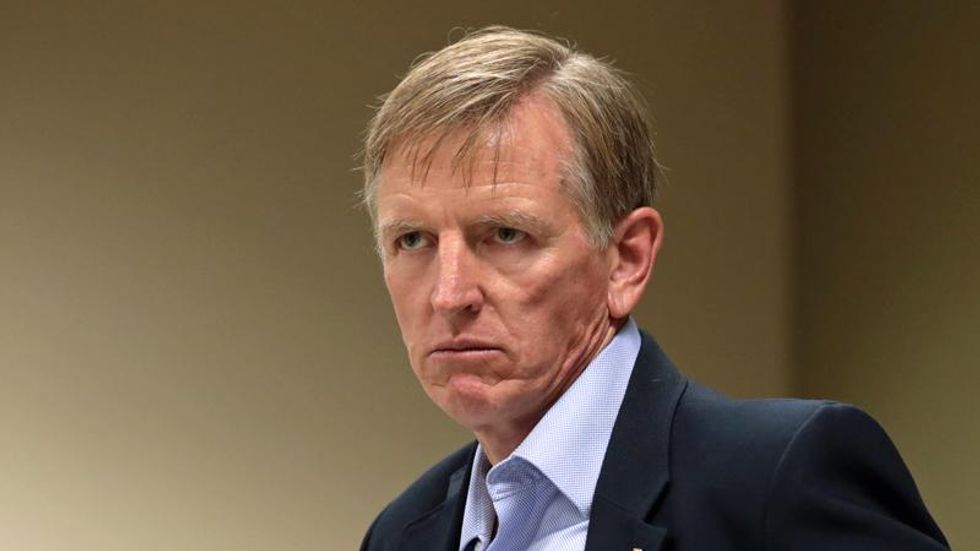
Rep. Paul Gosar. Photo: Gage Skidmore.
This would be Trump supporters’ main voting fraud talking point up through January 6.
While Republicans publicly implied that fraud had taken place in America’s black and brown Democratic cities, Trump spokesman Jason Miller texted Mark Meadows and a host of other top officials that the narrative was demonstrably false in Pennsylvania, which was about to be declared for Biden:
“One other key data point: In 2016, POTUS received 15.5% of the vote in Philadelphia County. Today he is currently at 18.3%. So he increased from his performance in 2016. In 2016, Philadelphia County made up 11.3% of the total vote in the state. As it currently stands, Philadelphia County only makes up 10.2% of the statewide vote tally. So POTUS performed better in a smaller share. Sen. (Rick) Santorum was just making this point on CNN - cuts hard against the urban vote stealing narrative.” (Philadelphia’s Republican city commissioner Al Schmidt would say much the same thing to CNN a few days later.)
On the day Biden was declared president-elect, November 7, Trump met with conservative activist David Bossie and top campaign staffers Bill Stepien, Jason Miller and Justin Clark in the White House.
Deputy campaign manager Clark said Trump’s only hope of reversing his loss lay in squeaking out victories in Georgia and Arizona, which were still counting votes, and getting thousands of Wisconsin votes disqualified over technicalities. Clark said this had a “5 to 10 percent chance” of succeeding.
With the chances of legal victory so slim, Trump started looking for outside-the-box thinking.
That day, Sen. Mike Lee (R-UT) hinted at what was to come when he texted Mark Meadows with a suggestion that Trump meet with Republican lawyer Sidney Powell, who “[had] a strategy to keep things alive and put several states back in play.”
Key to Powell’s strategy would be a sustained PR attack on Dominion Voting Systems, which were used in multiple swing states. By claiming that Dominion had rigged those states for Biden, Trump’s people would imply that state legislatures should be allowed to override “fraudulent” official vote counts.
Fox executives considered the theories so outlandish that they cancelled that night’s Jeanine Pirro show on Fox News (in which she planned to target Dominion).
But the caution would be short-lived.
The following day, November 8, Fox chairman Rupert Murdoch texted Fox CEO Suzanne Scott that his network was “Getting creamed by CNN!” Apparently, many of his partisan viewers didn’t have the heart to watch infotainment about a one-term president who had lost his re-election battle.
That day, Fox attempted to juice their ratings by having Sidney Powell on the Maria Bartiromo show, the first of several appearances Powell, Giuliani and other conspiracy-peddling Trump allies would make on the network.
On November 9, Trump’s exceptionally loyal (up to then) attorney general, William Barr, sent a directive to federal prosecutors to ramp up voter fraud charges before state elections were certified, a change in Justice Department policy which prompted the resignation of Richard Pilger, who headed the department’s election crimes division.
In addition, Trump fired Defense Secretary Mark Esper for not being “sufficiently loyal.” Esper had fallen out of favor for refusing to deploy troops to American cities during the summer protests, supporting diversity, barring Confederate flags on military bases and keeping an eye on Russia. He was replaced with the underqualified Christopher Miller, who brought three Trump loyalists with him, including Kash Patel, a lawyer with no military experience.
Kash Patel
Kash Patel. (Shutterstock.com)
This was an oddly consequential move for an outgoing administration to make. Suspicions were further aroused when two administration officials told reporters from the New York Timesthat Trump was considering firing FBI chief Christopher Wray and CIA head Gina Haspel. Haspel reportedly told General Mark Milley (chairman of the Joint Chiefs of Staff), “We are on the way to a right-wing coup.”
Haspel was on to something. On November 10, two Texas businessmen linked to Energy Secretary Rick Perry met with Donald Trump in the Oval Office, where they discussed the plan to have Republican-controlled swing state legislatures ignore the will of their voters and unilaterally pick the electors for their states.
According to I Alone Can Fix It by Washington Post reporters Carol Leonnig and Philip Rucker, when hearing of the fake elector plans circulating, Mark Milley responded that, “They may try, but they’re not going to f------ succeed” because “You can’t do this without the military. You can’t do this without the CIA and the FBI. We’re the guys with the guns.”
Speaking at a military installation in Virginia on November 11 (Veteran’s Day), Milley told the assembled crowd, “We do not take an oath to a king or queen, or tyrant or dictator, we do not take an oath to an individual … We take an oath to the Constitution, and every soldier that is represented in this museum — every sailor, airman, marine, coastguard — each of us protects and defends that document, regardless of personal price.”
Over at Fox, panic continued about ratings. Senior VP Raj Shah, who on other occasions had referred to Sidney Powell’s election claims as “MIND NUMBINGLY NUTS” and “totally insane,” said the network was “under heavy fire from our customer base.” Shah suggested they get feedback from viewers to see “if they have been somehow betrayed by the network” and concluded that “bold, clear and decisive action is needed for us to begin to regain the trust that we’re losing with our core audience.”
Attempts to regain the core audience’s trust were undermined by Fox reporter Jacqui Heinrich, who fact-checked a Trump tweet referencing Dominion lies told on Lou Dobbs’ and Sean Hannity’s shows.
A November 12 group text among Fox stars Sean Hannity, Laura Ingraham, and Tucker Carlson revealed that Hannity had complained about Heinrich’s fact-check to CEO Suzanne Scott, who had kicked the complaint up to Jay Wallace and Irena Briganti, Fox’s head of PR.
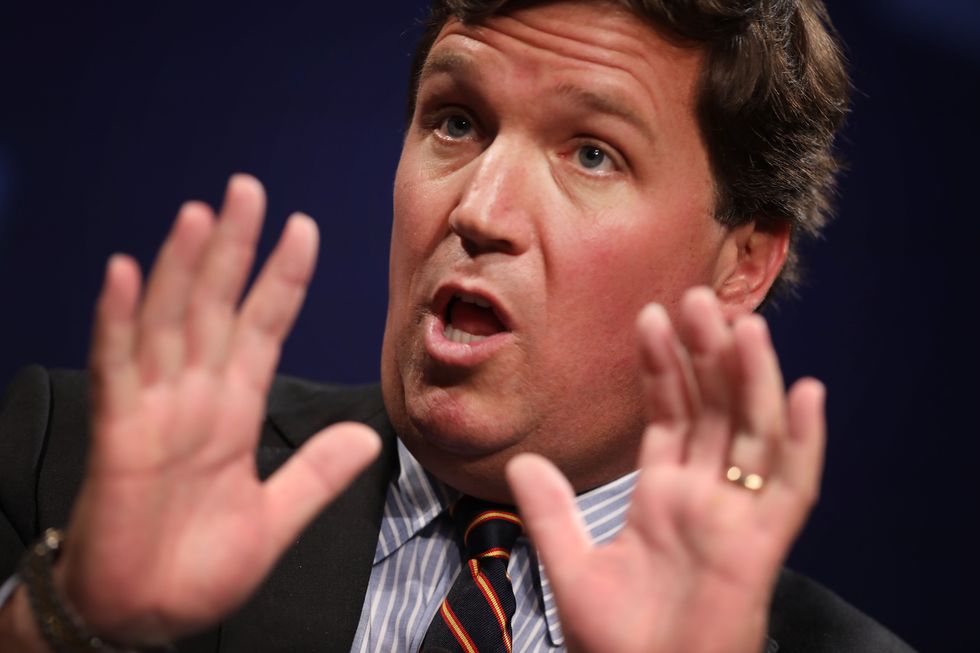
Tucker Carlson. Chip Somodevilla/Getty Images
In the text, Carlson wrote, “Please get her fired. Seriously … what the f---? I'm actually shocked ... It needs to stop immediately, like tonight. It's measurably hurting the company. The stock price is down. Not a joke.”
In a separate text that day, Hannity told Fox producers “we need to own the dominion story.”
While anchors worried about ratings, Tommy Firth — one of the producers of Laura Ingraham’s show — bemoaned the network’s embrace of the Dominion narrative.
In a text to Ron Mitchell (a Fox executive involved in the show), Firth said, “This dominion s--- is going to give me a f------ aneurysm — as many times as I’ve told Laura it’s bs, she sees s--- posters and Trump tweeting about it …”
Mitchell replied that “This is the Bill Gates/microchip angle to voter fraud.”
Experts agreed.
A statement from the Cybersecurity and Infrastructure Security Agency (an arm of the Department of Homeland Security created under Trump which closely monitors elections) said that “The November 3rd election was the most secure in American history.” The statement went on to say that “there is no evidence that any voting system deleted or lost votes, changed votes, or was in any way compromised.”
Trump ally Sen. Lindsey Graham (R-SC) actively sought to delete votes on November 13.
While Georgia was engaged in a recount that Donald Trump was almost certain to lose, Graham called Republican Secretary of State Brad Raffensperger. According to Raffensperger, Graham asked pointed questions about signature matching for votes cast.
Raffensberger told CNN “Well, it’s just an implication that look hard and see how many ballots you could throw out.”
Later, when appearing before the bipartisan House Select Committee to Investigate the January 6th Attack on the United States Capitol (hereafter referred to as the "January 6 House Select Committee"), Raffensperger said, “My concern was, would you be disenfranchising voters when the ballots have already been accepted by the county process.”
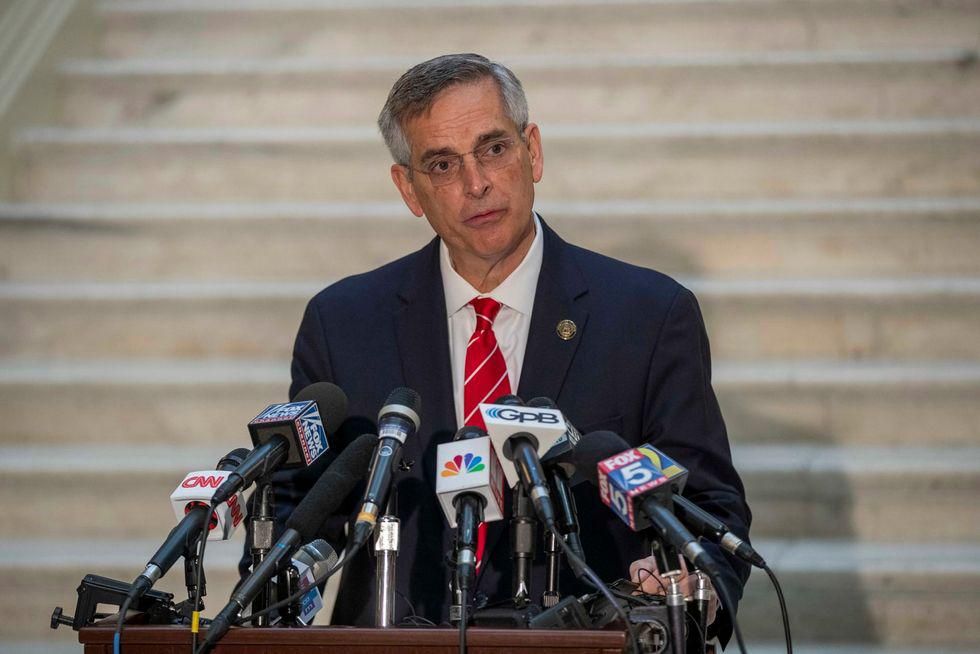
Georgia cancels 101,000 people in voter registration removal
Georgia Secretary of State Brad Raffensperger makes remarks during a news conference at the Georgia State Capitol building in Atlanta on Dec. 2, 2020. Alyssa Pointer/Atlanta Journal-Constitution/TNS
The ballots had been accepted because they were valid.
As Fox Information Specialist Leonard Balducci emailed producers that day, “There’s no evidence of widespread fraud in the 2020 election, or of major problems with Dominion’s systems. Election officials from both political parties have stated publicly that the election went well and international observers confirmed there were no serious irregularities.”
Nonetheless, eager to appease the outgoing president, White House deputy director of communications Zach Parkinson asked Trump staff to look into conspiracy theories about Dominion voting machines.
Staff gave Parkinson a memo on November 14 which showed that many of the claims were false, including the claim — made that night by Sidney Powell on Jeannine Pirro’s Fox show — that “It is one huge, huge criminal conspiracy that should be investigated by military intelligence.”
Fox maintained a focus on ratings. On November 16, Rupert Murdoch told CEO Suzanne Scott via email that they needed to keep an eye on Newsmax, who was getting a surge of far-right viewers due to its willingness to hype phantasmal voter fraud. (Fox president Jay Fox had called Newsmax’ coverage “an alternative universe”).
Murdoch’s email said, “These people should be watched, if skeptically … We don’t want to antagonize Trump further, but Giuliani taken with a large grain of salt. Everything at stake here.”
A November 17 text (which Fox would later try to have redacted from a defamation trial) revealed Tucker Carlson’s true feelings about the Dominion story.
Of Sidney Powell, he said, “She’s a psychopath. She’s getting Trump all spun up and has zero evidence.” He added, “Same with Rudy [Giuliani]. [National Security Council] Cyber did a through [sic] analysis. There’s nothing to see.”
Though Carlson considered Powell a psychopath, Arizona GOP chair Kelli Ward recommended her services to Clint Hickman, forwarding Powell’s number and asking that he “call her.” Hickman, a Republican who had supported Trump, was chairman of the Maricopa County Board, which was still counting votes.
Around the same time, Trump called two Republicans on the Wayne County Board of Canvassers (covering Detroit, which is 78% Black) and pressured them not to certify the results because “We've got to fight for our country … We can't let these people take our country away from us.” On the call with Trump was GOP national chairwoman Ronna McDaniel. McDaniel told the canvassers, “If you can go home tonight, do not sign [the certification] … We will get you attorneys.”
The two election officials’ efforts to placate Trump came too late to be legally binding and only delayed the obvious, given Biden’s 154,000-vote margin of victory in Michigan.
Though Joe Biden had been officially declared president-elect and was presumably going to take office, the Trump administration made another significant personnel move on November 18.
Republican Chris Krebs, the Trump-appointed head of the Cybersecurity and Infrastructure Security Agency, was fired by tweet because he had publicly fact-checked election fraud claims and gotten off-message with the statement that 2020 was “the most secure election in American history.”
Rupert Murdoch’s Wall Street Journal echoed Krebs’ findings, saying there was no substance to the Dominion claims, as did Fox host Laura Ingraham — in private. In a text to Tucker Carlson, Ingraham wrote that “Sidney [Powell] is a complete nut. No one will work with her. Ditto with Rudy.”
But The Big Lie was all Trump had left, so the deception continued.
That day, Republicans Jim Jordan and James Comer made a Twitter announcement that they would “investigate” the 2020 election to keep the Republican base on boil while GOP lawyers got to work.
Enter Kenneth Chesebro.
Chesebro, a former Democrat and future felon, sent Jim Troupis (a Republican lawyer in Wisconsin) a memo detailing a plan to get Wisconsin’s legitimate pro-Biden electors replaced with fake (pro-Trump) electors.
This would be “among the earliest known efforts to put on paper proposals for preparing alternate electors” and one of several such memos Chesebro would send to GOP operatives in swing states Trump had lost.
According to reporters for the New York Times, “The memos show how just over two weeks after Election Day, Mr. Trump’s campaign was seeking to buy itself more time to undo the results. At the heart of the strategy was the idea that their real deadline was not Dec. 14, when official electors would be chosen to reflect the outcome in each state, but Jan. 6, when Congress would meet to certify the results.”
On November 19, Trump’s outside attorneys Rudy Giuliani, Sydney Powell and Jenna Ellis had a surreal hair dye-dripping press conference in which they served up several false claims to try to pressure the Justice Department to open “a full-scale criminal investigation” of the election.
These lawyers were part of “Team Kraken,” second-string attorneys who stepped up to push claims Trump’s official White House lawyers wouldn’t touch. One GOP operative told a reporter for New York magazine, “Any time Rudy Giuliani, Sidney Powell, and Jenna Ellis are leading your legal battle, you are not in a good place … I wouldn’t let those lawyers represent me for a parking ticket.”
Two members of Congress in regular text contact with Mark Meadows — Lee of Utah and representative Chip Roy of Texas — were critical of the press conference. Roy told Meadows, “Hey brother — we need substance or people are going to break.” Lee said, “The potential defamation liability for the president is significant here …Unless Powell can back up everything she said, which I kind of doubt she can.” Meadows wrote Lee back that he agreed and was “very concerned” about the press conference.
Privately, Fox chairman Rupert Murdoch referred to the press conference as "Really crazy stuff. And damaging."
But Fox CEO Suzanne Scott threw a fit when Fox News White House correspondent Kristin Fisher fact-checked claims made at the presser. In an email to Fox president Jay Wallace, Scott said that “I can’t keep defending these reporters who don’t understand our viewers and how to handle stories … We need to manage this […] The audience feels like we crapped on [them] and we have damaged their trust and belief in us.”
On November 20, Trump continued the campaign to flip states he’d lost when he invited Republican representatives from Michigan’s state legislature to the White House.
At one point, Trump “raised his false claim, among others, of an illegitimate vote dump in Detroit. In response, the Michigan Senate Majority Leader [Mike Shirkey] told [Trump] that he had lost Michigan not because of fraud, but because the Defendant had underperformed with certain voter populations in the state.”
After the meeting, the Michigan representatives made a joint statement to the press in which they said, “We have not yet been made aware of any information that would change the outcome of the election in Michigan and as legislative leaders, we will follow the law and follow the normal process regarding Michigan's electors, just as we have said throughout this election.”
Trump was at it again on November 21, tweeting “Why is Joe Biden so quickly forming a Cabinet when my investigators have found hundreds of thousands of fraudulent votes, enough to ‘flip’ at least four States, which in turn is more than enough to win the Election? Hopefully the Courts and/or Legislatures will have....the COURAGE to do what has to be done to maintain the integrity of our Elections, and the United States of America itself. THE WORLD IS WATCHING!!!”
While publicly showing sympathy for Trump’s outrage, Tucker Carlson texted Trump Kraken attorney Jenna Ellis that “circumstantial [evidence] won’t work with this story. If there’s any Dominion documents or copies of the software show them to me. And as you know there isn’t.”
On November 22, Trump and Rudy Giuliani called Rusty Bowers, the conservative Republican speaker of the Arizona house who had endorsed Trump. Bowers was asked to have show trials positing that fraudulent votes among the deceased and undocumented immigrants may have been the difference in Biden’s Arizona win. He refused.
Rudy Giuliani, Donald Trump. Photo via AFP.
On November 23, Trump appointee Emily Murphy of the General Services Administration finally released money for the Biden Administration’s transition. This unprecedented delay jeopardized national security (since Biden was not yet receiving intelligence briefings) and the containment of Covid-19, which was at peak numbers in part because of Trump’s failure to aggressively address the pandemic.
The president had more pressing matters than working with public health officials to counteract a virus that was killing 1,500 of his constituents per day.
On November 25, Trump conferenced in from the White House to a hearing/publicity stunt in Gettysburg, where Giuliani issued — and Trump backed — false claims about voter fraud in that state.
Trump later invited Pennsylvania legislators to the White House. Joining Trump was Phil Waldron, a retired Army colonel who would circulate a PowerPoint presentation chockfull of outlandish conspiracy theories to Republican members of Congress and Mark Meadows.
False claims continued on November 29, when Trump spewed election lies and whined about the FBI and the Justice Department in an interview with Fox News’ Maria Bartiromo, who would later be sued for promulgating disinformation about the presidential election.
On November 30, Arizona was certified for Biden. While publicly signing the paperwork, Republican governor/Trump supporter Doug Ducey silenced a phone call from the White House.
Ducey later called Trump back and was subjected to conspiracies about dead and undocumented voters. According to reporters for the Washington Post, following this call, “Trump directed Pence, a former governor who had known Ducey for years, to frequently check in with the governor for any progress on uncovering claims of voting improprieties, according to two people with knowledge of the effort.
“In each of the calls, Ducey reiterated that officials in the state had searched for alleged widespread illegal activity and followed up on every lead but had not discovered anything that would have changed the outcome of the election results, according to Ducey’s recounting to the donor.”
Lack of evidence to the contrary, Fox continued to nurse their viewership’s grievances. That day, Sean Hannity hosted Sidney Powell, whom he had previously referred to as an “f’ing lunatic.”
Up-’til-then Trump toady William Barr felt the same way about Powell’s claims. Shockingly, he said so publicly.
On December 1, Barr told the AP, “we have not seen fraud on a scale that could have effected a different outcome of the election.”
Bill Barr (Brendan Smialowski:AFP)
According to reporter Jonathan Karl, Barr felt that Trump’s fraud allegations were “all b-------,” but he’d agreed to the investigations to “appease his boss.”
In a fit of rage at the breaking AP story, Trump allegedly heaved a porcelain plate of food through the air, leaving servants (and Mark Meadows aide Cassidy Hutchinson) to wipe up the ketchup which dripped down a wall of the White House dining room.
Another Republican who refused to parrot Trump’s Big Lie was Gabriel Sterling. Sterling, who worked for Georgia’s conservative Republican secretary of state Brad Raffensperger, held a press conference to denounce the violent threats Georgia elections officials were receiving as a result of Trump’s endless disinformation about voting machines in the state:
“Mr. President, it looks like you likely lost the state of Georgia … Stop inspiring people to commit potential acts of violence. Someone is going to get hurt, someone is going to get shot, someone is going to get killed. And it’s not right.”
On December 2, Fox CEO Suzanne Scott emailed Meade Cooper (executive VP of primetime programming) that fact checks of Trump’s false claims “[Have] to Stop Now. The Audience is Furious.”
Trump continued to pour gasoline on the fire. In a speech that day, he said that “in one Michigan county, as an example, that used Dominion systems, they found that nearly 6,000 votes had been wrongly switched from Trump to Biden, and this is just the tip of the iceberg.”
The claim was false, and even if true wouldn’t have mattered, since Trump had lost Michigan by 154,000 votes.
Trump sent Rudy Giuliani on the road December 3. In Georgia, Giuliani made “fantastical claims” for seven hours before the Republican-controlled Senate Judiciary Subcommittee. Giuliani also took the carnival to Michigan, where he refused to be sworn in.
That same day, Trump’s communication director Alyssa Farah Griffin went to see Mark Meadows. According to Griffin, “I'd gone into his office to say that I was going to resign. I didn't agree with what we were saying about the election result of the election being stolen. And he said, ‘Wait, what if I can tell you that we're not leaving office?’”
Key to Trump staying in office was Republican lawyer John Eastman.
John Eastman
John Eastman during Trump's "Save America" rally on January 6, 2021. (BRENDAN SMIALOWSKI/AFP)
Eastman, working in concert with Kenneth Chesebro, was one of the central architects of Trump’s extralegal efforts to overcome democracy.
On December 4, he emailed Russ Diamond, a far-right member of Pennsylvania’s House of Representatives. Eastman proposed that Pennsylvania Republicans challenge and disqualify enough absentee ballots in the state to “provide some cover” for the GOP-controlled legislature to declare the election invalid and appoint fake electors for Trump.
Pennsylvania Republicans didn’t go this far, but they did sign a public letter asking Congress to block their state’s electoral votes on January 6 — “just hours after” PA Majority Leader Kerry Benninghoff and House Speaker Bryan Cutler “had unequivocally stated — in a memo cosigned by Senate Majority Leader Kim Ward (R., Westmoreland) and President Pro Tempore Jake Corman (R., Centre) — that state legislators had no authority to ignore certified election results and appoint Pennsylvania’s delegates to the Electoral College themselves, despite repeated calls from the president and some within their own party to do so.”
The fake elector strategy continued on December 5, as Trump tried to muscle Republican governor Brian Kemp into throwing out Georgia’s electors. Kemp, a self-proclaimed “politically-incorrect conservative” (who had endorsed Trump) refused.
Convincing Republicans in at least three swing states to reject Biden’s legitimate electors was still Trump’s only chance at holding onto the White House, barring a Supreme Court decision to toss out Biden’s wins in several swing states.
To this end, on December 6, Kenneth Chesebro sent a memo suggesting a “bold, controversial strategy” to have fake electors vote on December 14 — the day the electoral college would meet — in the six key swing states. This move would give Mike Pence an “alternative” (fake/pro-Trump) set of electors to choose from on January 6, the day electoral college votes would officially be counted in Congress.
Jim Troupis (see November 18) explained the logistics in a December 7 communication to Trump advisor Boris Epshteyn:
“The second slate [of fake electors] just shows up at noon on Monday [December 14] and votes and then transmits the results … It is up to Pence on Jan 6 to open them. Our strategy, which we believe is replicable in all 6 contested states, is for the electors to meet and vote so that an interim decision by a Court to certify Trump the winner can be executed on by the Court ordering the Governor to issue whatever is required to name the electors. The key nationally would be for all six states to do it so the election remains in doubt until January.”
One of those six states was Pennsylvania. Trump’s maneuvering to overcome an 81,000-vote loss in that state was set back on December 8, when the U.S. Supreme Court rejected a lawsuit claiming a measure to expand mail voting (passed by Pennsylvania’s Republican legislature) had been unconstitutional.
In an email that day, Trump adviser Jason Miller explained why they kept losing in court: “When our research and campaign legal team can’t back up any of the claims made by our Elite Strike Force Legal Team, you can see why we’re 0-32 on our case. I’ll obviously hustle to help on all fronts, but it’s tough to own any of this when it’s all just conspiracy s--- beamed down from the mothership.”
Legal setbacks notwithstanding, the plot continued. Arizona lawyer Jack Wilenchik emailed Trump advisor Boris Epshteyn about the means by which fraudulent electors could be used on January 6: “We would just be sending in ‘fake’ electoral votes to [Mike] Pence so that ‘someone’ in Congress can make an objection when they start counting votes, and start arguing that the ‘fake’ votes should be counted.”
Wilenchik further wrote that the plan should be “[kept] under wraps until Congress counts the vote Jan. 6th (so we can try to ‘surprise’ the Dems and media with it).” (Wilenchik, who admitted in the same email that “the votes aren’t legal under federal law,” later corrected himself, typing in the same thread that “‘alternative’ votes is probably a better term than ‘fake’ votes,” to which he attached a smiley face emoji.)
These efforts were coordinated through outside lawyer Rudy Giuliani, the head of “Team Kraken”; Trump’s official White House lawyers saw the moves as illegal.
By the end of December 9, the District of Columbia and all 50 states had certified their vote totals, and Joe Biden’s win.
Republican representative (and future House speaker) Mike Johnson of Louisiana sent a solicitation email to fellow Republicans asking them to join a legal brief filed by the attorney general of Texas. The aim of the lawsuit was to invalidate votes in states won by Biden.
While Republicans tried to invalidate legitimate electors, Kenneth Chesebro emailed Jim Troupis about how to “operationalize” the casting of fake electors in the six swing states, based on state-by-state election regulations.
Two days later, the outgoing Trump Administration considered another major 11th-hour personnel change.
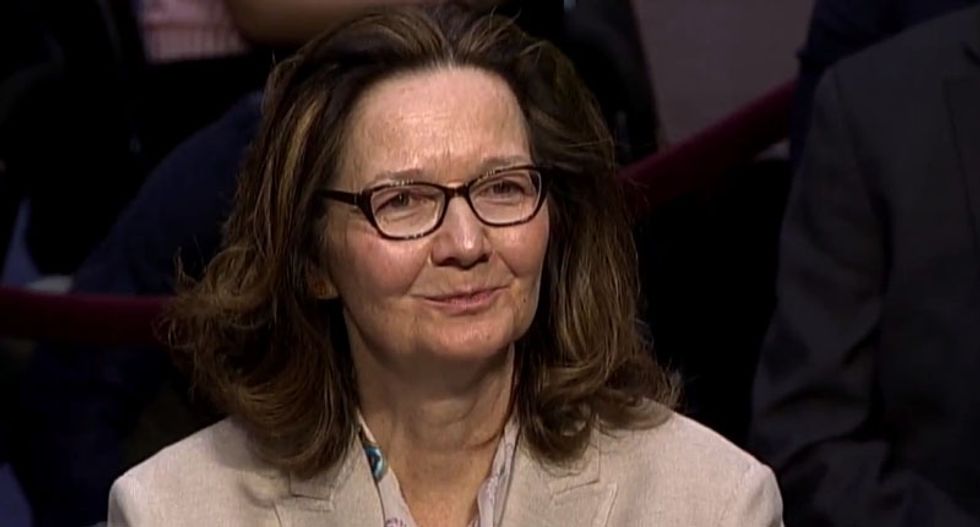
Gina Haspel. (Screenshot)
On December 11, Trump planned to fire CIA director Gina Haspel’s deputy director and replace him with the woefully-underqualified Kash Patel (see November 9) in order to install a loyalist near the top of the CIA. As with the post-election firing of Defense Secretary Mike Esper and (Cybersecurity and Infrastructure Security Agency leader) Christopher Krebs, this would be a consequential move for a lame duck administration to make.
In response, Haspel told Trump she would resign if her deputy was let go.
Afterward, Trump met with Mike Pence and other senior aides, who recommended keeping Haspel happy. Trump left Haspel’s deputy in place.
***
With the December 14 deadline approaching, fake elector and Nevada State Republican National Committee member Jim DeGraffenreid emailed Kenneth Chesebro with the subject “URGENT-Trump-Pence campaign asked me to contact you to coordinate Dec. 14 voting by Nevada electors.”
Planning to use an alternate slate of electors in Nevada had begun as early as four days before the 2020 election, when DeGraffenreid told other state party officials in a text that Nevada’s Republican Secretary of State Barbara Cegavske “might do a lot of things, but sending a slate of Republican electors without them being clearly the winners of the popular vote is not one of them.”
The fake elector scheme took a hit that day when the U.S. Supreme Court tossed a lawsuit by the state of Texas challenging results in four other states, saying Texas did not have “a judicially cognizable interest in the manner in which another state conducts its elections.”
Outraged by the decision, Trump supporters held protests across the country on December 12.
The D.C. rally, which featured future January 6 paramilitary operators the Proud Boys, the Oath Keepers, and the 1st Amendment Praetorian, turned violent when counter-protesters showed up, leading to four stabbings and 33 arrests.
One protester told a reporter for the New York Times, “They don’t want to deal with this…It’s going to have to go nuclear, using the Insurrection Act and bringing out the military.” This comment referenced the possibility that Donald Trump would use the chaos of street violence (even street violence provoked by his own supporters) as a false pretext to declare a national emergency, deploy troops domestically, and extend his stay in the White House.
Concerns about the legality of the fake elector strategy lingered. Christina Bobb (an anchor for the far-right One America News) that day sent an email about Douglas Mastriano, Trump’s point person for Pennsylvania’s fake electors:
“Mastriano needs a call from [Rudy Giuliani]. This needs to be done. Talk to him about legalities of what they are doing,….Electors want to be reassured that the process is * legal * essential for greater strategy.” [emphasis mine]
On the call, Giuliani claimed that Pennsylvania Republicans, who would be meeting in two days to pledge their fraudulent electoral votes for Trump, were meeting on a contingency basis only. Their fake elector certificates included verbiage to the effect that the certificates would be valid only if lawsuits went Trump’s way; the certificates were not intended as absolute substitutes for the legitimate PA electors.
The conditional language to limit legal liability was used in only one of the six main swing states; all other fake certificates were posed as genuine. Kenneth Chesebro suggested to Trump campaign staffer Michael Roman that the conditional language be used for all of the certificates, but Roman texted back “F--- these guys.”
On December 13, Kenneth Chesebro emailed Giuliani about the campaign’s “President of the Senate” strategy.
The idea was to have Republican allies in Congress hold hearings questioning the Electoral Count Act precedent, under which the vice president’s role was purely ceremonial. The hope was that the hearings could convince Mike Pence to “firmly take the position that he, and he alone, is charged with the constitutional responsibility not just to open the votes, but to count them — including making judgments about what to do if there are conflicting votes.”
Alternately, the hearings could jog Pence’s doubt about his involvement in counting the electoral college votes. If Pence recused himself, Trump ally Charles Grassley, the octogenarian Republican senator from Iowa, would preside over the process, giving him the option to reject legitimate electoral certificates and accept fraudulent ones.
Sen. Chuck Grassley (Photo by Andrew Harnick for AFP)
One leg of this strategy involved flipping Georgia, where Trump operative Robert Sinners instructed state Republicans to appoint alternate electors in “complete secrecy” so that the media wouldn’t know what they were doing:
“I must ask for your complete discretion in this process … Your duties are imperative to ensure the end result — a win in Georgia for President Trump — but will be hampered unless we have complete secrecy and discretion.”
Emails from Christina Bobb to Trump lawyers and swing state operatives revealed that state Republicans also had false electors ready in Arizona, Michigan, Nevada, Wisconsin and Pennsylvania.
On the final day before certification, the Trump team added fake electors in New Mexico, which Biden had won by double digits. To give this tactic a patina of legitimacy, they filed a lawsuit challenging Biden’s win six minutes before the filing deadline was up.
In a group chat that day, Trump campaign officials — who wouldn’t back the plan in a signed statement — referred to it as “a crazy play” that would be “certifying illegal votes.”
On December 14, the Electoral College met and certified Joe Biden’s victory.
According to Biden, seven Republican senators called to congratulate him. Trump allies Mitch McConnell, Israeli Prime Miniter Benjamin Netanyahu and Russian Vladimir Putin publicly congratulated the president-elect, too.
In Michigan, Republican state Senate leader Mike Shirkey and House Speaker Lee Chatfield announced that they would not get in the way of their voters.
Shirkey said, “[W]e have not received evidence of fraud on a scale that would change the outcome of the election in Michigan.”
Chatfield said, “We’ve diligently examined these reports of fraud to the best of our ability. I fought hard for President Trump. Nobody wanted him to win more than me. I think he’s done an incredible job … But I love our republic, too. I can’t fathom risking our norms, traditions and institutions to pass a resolution retroactively changing the electors for Trump, simply because some think there may have been enough widespread fraud to give him the win. That’s unprecedented for good reason.
“And that’s why there is not enough support in the House to cast a new slate of electors. I fear we’d lose our country forever. This truly would bring mutually assured destruction for every future election in regards to the Electoral College. And I can’t stand for that. I won’t.”
While Shirkey, Chatfield and the civilized world recognized Biden’s victory, 84 state-level Republican officials in seven states (including Michigan) signed fake elector certificates in hopes that Vice President Mike Pence would reject the legitimate electors on January 6.
With the fake electors secured, Trump’s focus returned to pursuing thus-far elusive evidence of voter fraud.
As reported by CNN, “Trump's assistant sent [deputy attorney general Jeff] Rosen and [Justice Department official] Richard Donoghue a document claiming to show voter fraud in Antrim County, Michigan. An aide to Donoghue forwarded the document to the US Attorneys for the Eastern and Western Districts in Michigan. Less than an hour later, Trump tweeted that [Attorney General William] Barr would be leaving the Justice Department just before Christmas, elevating both Rosen and Donoghue to the top spots at [the Justice Department].”***
The day after the electoral college certified Joe Biden’s win, December 15, Republican Senate Majority Leader Mitch McConnell spoke publicly on the Senate floor, congratulating Biden and referring to him as the “president-elect.”
This was significant because McConnell — who had voted with Trump 91% of the time and shepherded his judges through the Senate — was publicly signaling that he thought Trump’s election challenges no longer had merit.
Rebecca Green of William and Mary Law School told USA Today, “The legal avenues for pursuing a change in the outcome of the 2020 election have closed …It's not for lack of trying. There's just a lack of evidence of irregularities in this election.”
McConnell had moved on. But Donald Trump hadn’t.
After McConnell’s speech, Trump tweeted, “This Fake Election can no longer stand” and invited Jeff Rosen to the White House. At the Oval Office, Trump pressured his next attorney general to put Justice Department backing behind election lawsuits, 61 of 62 of which would be rejected by Democratic and Republican judges—including Trump appointees — often with uncharacteristically scathing judicial rulings.
On December 16, Senator Mike Lee told Mark Meadows, via text, that weeks of failures to turn up concrete evidence of fraud was weakening party resolve. Referring to senators objecting to the electoral vote certification, Lee said, “I think we’re now passed [sic] the point where we can expect anyone will do it without some direction and a strong evidentiary argument.”
Trump’s former chief of staff Reince Priebus agreed. In a meeting with Trump at the Oval Office that day, Priebus planned to let Trump down easy, to make it clear that he’d fought the good fight but it was time to prepare to leave the White House. In attendance were Priebus, Jim Troupis, Kenneth Chesebro, Mark Meadows and lawyers who had worked on the Wisconsin state Supreme Court case Trump had recently lost.
To Priebus’ dismay, Chesebro went off script, mentioning that Trump could still win with fake electors. The key date was no longer December 14, when the electoral college had elected Joe Biden, but January 6, when Congress would certify the electoral college certificates.
Mark Meadows (Photo by Olivier Douliery for AFP)
Bulling ahead, someone in the Trump orbit drew up a draft executive order to have the military seize voting machines in Georgia. According to Betsy Woodruff Swan of Politico, “The order empowers the defense secretary to ‘seize, collect, retain and analyze all machines, equipment, electronically stored information, and material records required for retention under’ a U.S. law that relates to preservation of election records.” The order also “would have given the defense secretary 60 days to write an assessment of the 2020 election. That suggests it could have been a gambit to keep Trump in power until at least mid-February of 2021.”
Variations on this plan included Rudy Giuliani asking the Department of Homeland Security to seize machines, Trump asking his attorney general, and Trump asking Republican legislators in Pennsylvania and Michigan to summon local law enforcement. Memos were drawn up for both the Department of Homeland Security and the Pentagon to seize voting machines. The requests were not acted on.
A document covering similar ground (dated December 17) was referenced in a privilege log provided to the January 6 House Select Committee by the attorney for Bernard Kerik (see January 4). The withheld document was titled, “DRAFT LETTER FROM POTUS TO SEIZE EVIDENCE IN THE INTEREST OF NATIONAL SECURITY FOR THE 2020 ELECTIONS.”
On December 18, a memo emerged which advocated for the Department of Defense (DOD) to appoint a team who would review data (collected by the National Security Agency) in search of foreign interference in the 2020 election. The memo concluded that the Trump Administration could take the law into their own hands, depending on the findings:
“If evidence of foreign interference is found, the team would generate a classified DOD legal finding to support next steps to defend the Constitution in a manner superior to current civilian-only judicial remedies (which should still be pursued in parallel).”
The content of the December 16-18 documents happened to dovetail with a contentious six-hour meeting at the White House that evening.
The meeting began when Trump received “Team Kraken” (Rudy Giuliani, Sidney Powell, Michael Flynn, and Overstock.com CEO Patrick Byrne), outsiders unaffiliated with Trump’s official White House legal team who were happy to entertain—and act on—the president’s conspiracy theories.
Upon finding out who was with the president, Trump’s lawyer Pat Cipollone “rushed” to the White House, purportedly out of fear that Trump might receive advice which could put him at risk of breaking the law.
According to witness testimony before the January 6 House Select Committee, a screaming match ensued between those who supported the rule of law and those who did not.
In the latter category were Rudy Giuliani and Trump’s former national security adviser, convicted felon Michael Flynn, who had recently said that Trump should declare martial law, seize voting machines, and force a new election.
Donald Trump and Michael Flynn (cnn.com)
On the side of historical precedent and the rule of law were White House staff secretary Derek Lyons and White House lawyers Pat Cipollone and Eric Herschmann.
Among the ideas Cipollone and Herschmann heard were Flynn’s claim that foreign countries had rigged America’s election with Nest-brand thermostats and suggestions that Trump declare a national emergency (which could be used as a justification for martial law), sign an executive order to have the National Guard seize voting machines and/or oversee re-votes in the six states Trump was contesting, and name Sidney Powell special counsel to investigate voting machines.
When Cipollone and Herschmann asked for evidence to support the fraud claims, nothing substantial was offered. Unhappy with this line of questioning, Trump griped about the White House lawyers not offering “solutions.” Giuliani accused them of being “pussies.”
In an interview with MSNBC’s Rachel Maddow, Politico reporter Nicholas Wu said of the overlap between the potential “smoking gun” December 17 document (referenced in a privilege log provided by Bernie Kerik’s lawyer) and the controversial topics discussed on December 18, “It’s unclear exactly if these two things are linked, but … that’s quite a coincidence.”
With lawyerly options to overthrow the election narrowing, Trump escalated his tactics.
At 1:42 a.m. on December 19, just a few hours after the White House showdown, Trump tweeted, “Statistically impossible to have lost the 2020 Election. Big protest in D.C. on January 6th. Be there, will be wild!”
Trump’s announcement set far-right militants into motion.
According to New York Times reporters Alan Feuer, Michael S. Schmidt and Luke Broadwater, extremists “began to set up encrypted communications channels, acquire protective gear and, in one case, prepare heavily armed ‘quick reaction forces’ to be staged outside Washington.
“They also began to whip up their members with a drumbeat of bellicose language, with their private messaging channels increasingly characterized by what one called an ‘apocalyptic tone.’ Directly after Mr. Trump’s tweet was posted, the Capitol Police began to see a spike in right-wing threats against members of Congress.”
A Twitter employee who monitored traffic on the site told the January 6 House Select Committee:
“It felt as if a mob was being organized and they were gathering together their weaponry and their logic and their reasoning behind why they were prepared to fight prior to December 19 … Very clear that individuals were ready willing and able to take up arms. After this Tweet on December 19, again it became clear not only were these individuals ready and willing, but the leader of their cause was asking them to join him.”
CNN reported that “a Justice Department court filing revealed that the Oath Keepers had extensive plans for violence in the days surrounding January 6. Prosecutors say that at least three chapters of the gang held military training camps focusing on ‘military-style basic’ training, ‘unconventional warfare,’ and ‘hasty ambushes.’ At least one of the Oath Keepers brought explosives, including grenades, to the quick reaction force (QRF) site outside Washington, D.C.”
The forces of insurrection — the Proud Boys, the Oath Keepers, the Three Percenters, Bikers for Trump, Vets for Trump, members of QAnon, and others — were banding together. The head of homeland security for the District of Columbia, Donell Harvin, told the January 6 House Select Committee:
“We got derogatory information from [open-source intelligence] suggesting that some very, very violent individuals were organizing to come to D.C. But not only were they organizing to come to D.C. — these non-aligned groups were aligning ... When you have armed militia collaborating with white supremacy groups collaborating with conspiracy theory groups online all towards a common goal, you start seeing what we call in terrorism a blended ideology and that’s a very, very bad sign.”
Terrorist groups shared a might-makes-right psychology with Donald Trump. According to Trump campaign consultant Jenna Ellis, while at a White House Christmas party that day, Trump aide Dan Scavino told her “The boss is not going to leave under any circumstances. We are just going to stay in power.”
When Ellis said, “Well, it doesn’t quite work that way,” Scavino replied “We don’t care.”
On December 21, Donald Trump, Rudy Giuliani and Mark Meadows met with congressional allies at the White House. According to Meadows’ aide Cassidy Hutchinson — one of the central witnesses before the January 6 House Select Committee — this group included Republicans Paul Gosar, Jody Hice, Scott Perry, Andy Harris, Brian Babin, Louie Gohmert, Marjorie Taylor Greene, Matt Gaetz, Andy Biggs, Mo Brooks and Jim Jordan. The House members had come in response to an email invite from Mo Brooks (who would speak at the January 6 rally) with a subject line of “White House meeting December 21 regarding January 6.”
The topic, once again, was how to get illegitimate electors accepted or get legitimate electors tossed, which would allow House Republicans — rather than America’s voters — to pick the president.
To sustain the cover story for these illegal actions, Trump continued to bray about fraud. That day’s PR offensive included the tweet that he’d “won in a landslide” and “[needed] backing from the Justice Department.”
Loyal Vice President Mike Pence disagreed, but only in private. As reported by ABC News, in an Oval Office meeting with just the two of them that day, Trump asked Pence what they could do now that the campaign’s lawsuits were uniformly being rejected. According to Pence, he said that if the remaining legal challenges didn’t go in their favor, Trump “should simply accept the results,’ ‘you should take a bow,’ travel the country to thank supporters, ‘and then run again if you want.’”
Trump’s most fervent supporters weren’t ready to say farewell. A Capitol police intelligence report received that day revealed a pro-Trump group’s plans for January 6, as revealed on Reddit. Among the lines cited in the report were:
- “Get into Capitol Building, stand outside congress. Be in the room next to them. They won’t have time [to] run if they play dumb.”
- “Deploy Capitol Police to restrict movement. Anyone going armed needs to be mentally prepared to draw down on LEOs. Let them shoot first, but make sure they know what happens if they do.”
- “If they don’t show up, we enter the Capitol as the Third Continental Congress and certify the Trump Electors.”
- “Surround every building with a tunnel entrance/exit. They better dig a tunnel all the way to China if they want to escape.”
- “If a million patriots who [show] up bristling with AR’s, just how brave do you think they’ll be when it comes to enforcing their unconstitutional laws? Don’t cuck out. This is do or die. Bring your guns.”
The mass brainwashing of aggrieved Republicans continued on December 22, when Trump tweeted a video with the claim that “the rigging of the 2020 election was only the final step in the Democrats’ and the media’s yearslong effort to overthrow the will of the American people.”
In hopes of overthrowing the will of the American people, House Republican Scott Perry, one of the main collaborators, “arranged for [Jeffrey] Clark to meet Trump behind the back of senior Department of Justice officials — and contrary to long-standing department regulations — in the Oval Office.”
While Jeffrey Clark was on the way to becoming one of the main players in Donald Trump’s attempted coup, Mark Meadows flew to Georgia, where he hoped to crash signature-matching done by elections officials.
Per established protocols, Meadows was not allowed to observe the process. As a consolation prize, he wangled the phone number of Frances Watson, an elections investigator at the site.
Donald Trump called Watson the following day, December 23. He flattered her, trotted out grievances about voter fraud, and said, “When the right answer comes out, you'll be praised … People will say ‘great,’ because that's what it's about, the ability to check and to make it right, because everyone knows it's wrong.”
Also that day, John Eastman emailed a strategy memo to Trump aide Boris Epshteyn, cc’ing Chesebro. He said that they should forego the congressional hearings suggested by Chesebro on December 13 because hearings might “invite counter views that we do not believe should constrain Pence (or Grassley).”
That day, a Grassley aide James Rice emailed Pence staff, “Is there any reason to believe that your boss will not preside over the electoral college vote count … leaving my boss in the spot as [president pro tem]?”
Paul Teller, an aide to Pence, replied “it’s not a zero percent chance of that happening.”
The big news that Wednesday was the resignation of Attorney General William Barr.
With Barr out of the way, Trump called new attorney general Jeffrey Rosen on December 24 to see if he could convince him to issue fake findings of vote fraud.
During the conversation, Trump asked Rosen if he knew Jeffrey Clark. Clark was a largely unknown lawyer for the Environment and Natural Resources Division (and head of the United States Department of Justice Civil Division) with no legal purview over White House affairs.
Rosen later told the January 6 House Select Committee, “When I hung up I was quizzical as to how does the president even knew Mr. Clark … I was not aware that they had ever met or that the president had been involved in any of the issues in the civil division.”
While Trump worked on Rosen, outside attorney John Eastman commented (in an email to Kenneth Chesebro and “Trump campaign officials”) that there was a “heated fight” on the Supreme Court about Trump’s lawsuit to overturn the election.
Chesebro responded that the “odds of action before Jan. 6 will become more favorable if the justices start to fear that there will be ‘wild’ chaos on Jan. 6 unless they rule by then, either way.”
The email hinted that Supreme Court justice Clarence Thomas’ wife Ginni — a board member of the far-right Council for National Policy —may have given insider information to Eastman about the status of Trump’s case before the Supreme Court. Ginni Thomas sent multiple texts to Eastman, who had previously clerked for her husband. Swaying Justice Thomas was seen as the linchpin to blocking electors in Georgia, as Thomas oversaw the courts in that district.
When Vice President Pence called Trump on December 25 to wish him a merry Christmas, Trump shifted the discussion to his desire to have Pence reject valid electors — and 231 years of democracy — on January 6.
Pence replied that, “You know I don’t think I have the authority to change the outcome.”
Trump also spoke on the phone with William J. Olson, a Republican lawyer who would go on to represent Trump ally/vote fraud conspiracy theorist Mike Lindell, CEO of MyPillow.
Olson advocated declaring martial law and replacing Jeffrey Rosen with an attorney general willing to revive the Texas attorney general’s lawsuit to nullify electoral college votes in otherstates (which had been rejected by the U.S. Supreme Court on December 11).
To this end, Republican Rep. Scott Perry of Pennsylvania texted Mark Meadows to see if he had gotten in touch with Jeffrey Clark.
On December 26, Trump tweeted more lies about the election (calling it “the biggest SCAM in our nation’s history”), attacked the FBI, the Justice Department, and the courts for following the rule of law, and referenced his January 6 “Save America” rally.
The rally and its aftermath were top of mind for Trump’s militant supporters. That day, the Secret Service received intelligence that the Proud Boys “think they will have a large enough group to march into DC armed and will outnumber the police so they can’t be stopped … Their plan is to literally kill people.”
That same day, Trump ally Scott Perry texted Mark Meadows, suggesting that the administration elevate Jeffrey Clark to attorney general if they hoped to stay in power. This was one of at least 62 texts with Meadows after the election (in addition to dozens of contacts with Trump’s outside lawyers).
Clark was mentioned because Trump’s attorney general of less than a week, Jeffrey Rosen, insisted on following the rule of law. On December 27, Trump pressured Rosen to review “election fraud” in Pennsylvania and Arizona that former attorney general William Barr had found to be inconsequential.
Rosen reportedly told Trump that the Department of Justice “can’t, and won’t, just flip a switch and change the election.”
In response, Trump told Rosen to “just say that the election was corrupt” and “leave the rest to me and the [Republican] congressmen.”
Trump’s allies were in on a “Strategic Communications Plan,” a document detailing an aggressive disinformation campaign filled with talking points about fraud in swing states, messaging channels, and target audiences — even though Trump was told that the fraud talking points were false by “at least 11 aides and close confidants.”
Trump also tried to get Rosen to sign on to a lawsuit (which had already been rejected by the Department of Justice’s Office of Legal Counsel) asking the Supreme Court to toss out electoral college votes in six states Biden had won and order a “special election.”
Trump wasn’t the only one badgering Rosen. Jeffrey Clark made five cracks at the new attorney general, trying to get him to challenge election results in key states lost by Trump.
Rosen’s second-in-command also felt the heat.
Coaxed by Trump, Pennsylvania representative Scott Perry called Richard Donoghue, the deputy attorney general, to try to get the Justice Department to review debunked voter fraud claims in Pennsylvania. Perry also tried to convince Donoghue to grant more power to Trump loyalist Jeffrey Clark, who wanted to scour election results for any data which could be exploited for GOP messaging.
On December 28, Clark peddled conspiracy theories around the Justice Department and sent a message to Jeff Rosen and Richard Donoghue requesting their sign-off on a letter (conveniently typed on official Department of Justice letterhead) which asked Georgia’s Republican legislature to call a special session to investigate election “irregularities” and choose a slate of illegitimate electors for Trump.
In the words of historian Heather Cox Richardson, “Clearly, there was no time to actually conduct another investigation into the election before January 6; the letter was designed simply to justify counting out Biden’s ballots or, failing that, to create popular fury that might delay the January 6 count.”
Donoghue responded via email that signing such a letter was “not even in the realm of possibility.”
Without the backing of Justice Department leadership, Clark worked with aide Ken Klukowski (who had started at the DOJ on December 15) to gather witnesses to provide “testimony” of voter fraud. The January 6 House Select Committee revealed that voter suppression expert Ken Blackwell emailed Mike Pence’s office to ask him to meet with Klukowski and John Eastman. According to Jeremy Stahl of Slate, “this email was the first piece of public evidence linking Eastman directly to the efforts to use the [Department of Justice] to change the outcome of the election.”
Another effort to change the outcome of the election came from William Olson, the lawyer Trump had spoken to on Christmas. Warning that “time is about to run out” for their plans, Olson sent a letter to Trump saying that the Office of White House Counsel and Attorney General Rosen were failing the president.
Olson suggested the White House replace Rosen within 24 hours and re-file a case along the lines of Texas v. Pennsylvania, which would nullify the electoral college votes of Georgia, Michigan, Pennsylvania and Wisconsin. If the Supreme Court didn’t rule in Trump’s favor, the president could act unilaterally, since “that body was never intended to be the final authority on matters of this sort.”
Rupert Murdoch’s New York Post disagreed. The day prior, the right-wing newspaper ran an editorial telling Trump “Give it up, Mr. President — for your sake and the nation’s.” The editorial opened with “Mr. President, it’s time to end this dark charade,” mentioned that the electoral college vote count on January 6 was merely pro forma, and called Trump to account for “cheering for an undemocratic coup.”
Even as Fox continued to placate viewers by feeding doubt about 2020, Post owner Murdoch congratulated the editor-in-chief (Col Allen) on a “great” editorial and added that it might convince Trump to throw in the towel: “If he doesn’t tweet it’ll mean he’s read it and stopped to think.”
If Trump did pause to collect his thoughts, it was brief. In a December 29 conversation with Mike Pence, Trump claimed the Department of Justice had found “major infractions” of election law.
This wasn’t true.
Mark Meadows did his part for the Big Lie that day when he urged Attorney General Rosen and Deputy Attorney General Richard Donoghue to consider the right-wing myth that the number of votes cast in Pennsylvania was larger than the number of registered voters in the state and to take a look at “Italygate” (a theory that Biden supporters in Italy had used satellites to change a decisive number of votes in swing states from Trump to Biden).
Rosen also heard from Trump’s personal assistant Molly Michael. Michael emailed Rosen, Donoghue, and Solicitor General Jeffrey Wall a legal complaint claiming that the six swing states Trump had lost by the narrowest margins (Nevada, Wisconsin, Pennsylvania, Michigan, Georgia, Arizona) had violated the Electors Clause of the Constitution, along with a request to file a case before the U.S. Supreme Court.
The pressure on Rosen continued on December 30. Outside attorney Kurt Olsen called Jeff Rosen and said that Trump expected him to file Michael’s Supreme Court lawsuit by noon that day.
Rosen didn’t budge.
Meanwhile, Trump strategist Steve Bannon called the president and suggested he lure Mike Pence back to Washington (from a skiing vacation) in order to pressure him into refusing to accept Biden electors during the January 6 certification. The goal was to convince Pence to “kill the Biden presidency in the crib.”
As Trump worked on Pence, presidential aspirant Sen. Josh Hawley, a Missouri Republican, became the first senator to announce his intent to object to electors for Joe Biden on January 6.
While Hawley made a savvy play for future Republican primary voters, Trump’s minions continued to pressure the Justice Department (DOJ). In two of five known emails Mark Meadows sent asking the DOJ to review tinfoil-hat conspiracy theories, Trump’s chief of staff that day sent Justice officials disinformation about alleged voter fraud in Fulton County, Georgia. (Meadows also forwarded debunked conspiracy theories to “the FBI, Pentagon, National Security Council, and Office of the Director of National Intelligence.”)
Late that night, Republican Scott Perry of Pennsylvania texted Jeffrey Clark. Among the key lines in the exchange were:
Perry: “[Trump] seems very happy with your response. I read it just as you dictated.”
Clark: “I’m praying. This makes me quite nervous. And wonder if I’m worthy or ready.”
Perry: “You are the man. I have confirmed it. God does what he does for a reason.”
If so, God decreed that Ken Chesebro email John Eastman and other coup legal staff on December 31. Chesebro asked Eastman’s opinion about getting Clarence Thomas (who oversees the circuit courts in Georgia) to issue a stay of the Georgia results, thereby gaining legal (and PR) legitimacy for the idea that other swing state results were potentially fraudulent, and thus ripe to be overturned by state legislatures.
Among those states was Arizona. The White House left a message that day for Clint Hickman, the Republican head of the Maricopa County Board of Supervisors, asking for a call back. This was one of numerous Republican attempts to get Hickman to issue arbitrary rulings in Trump’s favor in order to flip a state Trump had lost by more than 10,000 votes.
Mindful of election laws and legal liability, Hickman didn’t return this call (or the one the White House placed three days later).
The main event on the final day of 2020 involved the Department of Justice. Frustrated that he couldn’t get the new attorney general to break the law, Trump invited Rosen and Donoghue to the White House.
At the meeting, Trump reportedly said that he was considering replacing Rosen with Jeffrey Clark because Rosen hadn’t been aggressive enough in investigating voter fraud. Trump wanted voting machines seized by the Justice Department, but was told by Rosen that the DOJ had “no legal authority” to do so. If any such authority existed, it was held by the Department of Homeland Security (DHS).
After the meeting, “Trump then called Ken Cuccinelli, the DHS acting deputy secretary, and falsely told him that the acting attorney general had just said that it was Cuccinelli’s job to seize voting machines ‘and you’re not doing your job.’”
As Trump tried to cling to power, Chip Roy, a supporter of Trump’s election challenges a few weeks earlier, texted Mark Meadows that it was time to give up:
“The president should call everyone off. It’s the only path. If we substitute the will of states through electors with a vote by congress every 4 years…we have destroyed the electoral college.”
Proud Boy leader Enrique Tarrio had no such concern about constitutional niceties.
In an end-of-year text to fellow right-wing activists, he wrote, “Let’s bring this new year in with one word in mind: revolt.”
***
On Jan. 1, 2021, Jeff Rosen received a 13-minute YouTube video about “Italygate” from Mark Meadows (which Meadows had gotten the day prior from Scott Perry). Meadows also asked Rosen to send Jeffrey Clark to Georgia, presumably so that Clark could find something, anything which could be construed as “voter fraud.”
Pressure on Pence continued. Trump loyalist and director of presidential personnel Johnny McEntee texted a memo to Greg Jacob (Pence’s chief of staff), headlined with the words “Jefferson Used His Position as VP to Win,” a fanciful interpretation of the 1800 presidential election.
McEntee’s memo took a hit when three Republican judges (including a Trump-appointed judge) in Texas rejected Rep. Louie Gohmert’s lawsuit claiming Mike Pence could unilaterally pick and choose which electors to accept on January 6.
Following the ruling, Trump called Pence. The president was upset that Pence had sided with the Department of Justice, who had opposed the lawsuit of Gohmert, a Texas Republican. Pence told Trump that he was bound by the Constitution to follow the will of the voters.
Trump reportedly told him, “You’re too honest.”
Kenneth Chesebro was more to Trump’s liking. In a message to John Eastman and Boris Epshteyn, Chesebro listed 14 talking points for congressional Republicans to ignore the spirit of the Electoral Count Act on January 6.Key among these ideas was the suggestion that Josh Hawley, the senator from Missouri, break 133 years of precedent and oppose the rule that each member of Congress who objected to certifying a state’s electoral votes had no more than five minutes to state their case.
Breaking the precedent would allow endless objections, buying Trump more time for a miracle court decision, for Pence to give in and pick the electors himself, or for Pence to step down and let Sen. Chuck Grassley take over and do Trump’s bidding.
Jan. 2, 2021, was a busy day in the annals of failed election theft.
Eleven Republican senators, including former and likely future presidential candidate Ted Cruz, made a joint statement in which they referred to ill-defined fraud and advocated “an emergency 10-day audit of the election returns in the disputed states.”
The senators’ public pretense was that the audit was necessary in order to assuage millions of Americans who had doubts about the legitimacy of the 2020 election. Polls cited showed that one-third of independents, two-thirds of Republicans, and 39% of all voters held the baseless belief that the election had been “rigged.”
Sen. Ted Cruz. (Right Cheer/Flickr)
In plain English, the senators were contending that since four out of every 10 Americans were gullible enough to believe ludicrous and self-serving Republican lies about an election they clearly lost, a 10-day “audit” giving Republicans more time to peddle ludicrous and self-serving lies about an election they clearly lost was necessary to “restore faith in American Democracy.”
While his congressional sycophants performed Kabuki theater, Trump made another attempt to flip Georgia. After 18 requests from Mark Meadows, Georgia Secretary of State Brad Raffensperger consented to a call with Trump.
During an infamous 67-minute conference call, Raffensperger debunked Trump’s conspiracy theories and pointed out that multiple recounts hadn’t come close to reversing Trump’s Georgia loss. Unbowed by the facts, Trump tried to bully the Republican Secretary of State into “[finding] 11,780 votes” for him—just enough to give Trump Georgia’s 16 electoral college votes.
The Justice Department wouldn’t bend to Trump’s will either. Jeff Rosen wrote Jeffrey Clark back and said (as his second-in-command Richard Donoghue had already done on December 28) that he was “not prepared to sign” a letter asking Georgia’s Republican legislature to “investigate” trumped-up allegations of fraud.
Evidence or no evidence, plans continued for January 6.
Trump called 300 Republican state legislators, telling them they could overrule the will of the voters in their states and put forward fake electors.
Republican Rep. Jim Jordan of Ohio took part in a conference call with Rudy Giuliani and other Trump allies to discuss “strategies for delaying the January 6th joint session” and ways to coax Trump supporters to D.C. through social media.
According to Mark Meadows aide Cassidy Hutchinson, “the terms ‘Proud Boys’ and ‘Oath Keepers’” came up “when [Rudy] Giuliani was around.” After a January 2 meeting between Rudy Giuliani, Mark Meadows, and other White House officials, Giuliani told Hutchinson, “We’re going to the Capitol! It’s going to be great!”
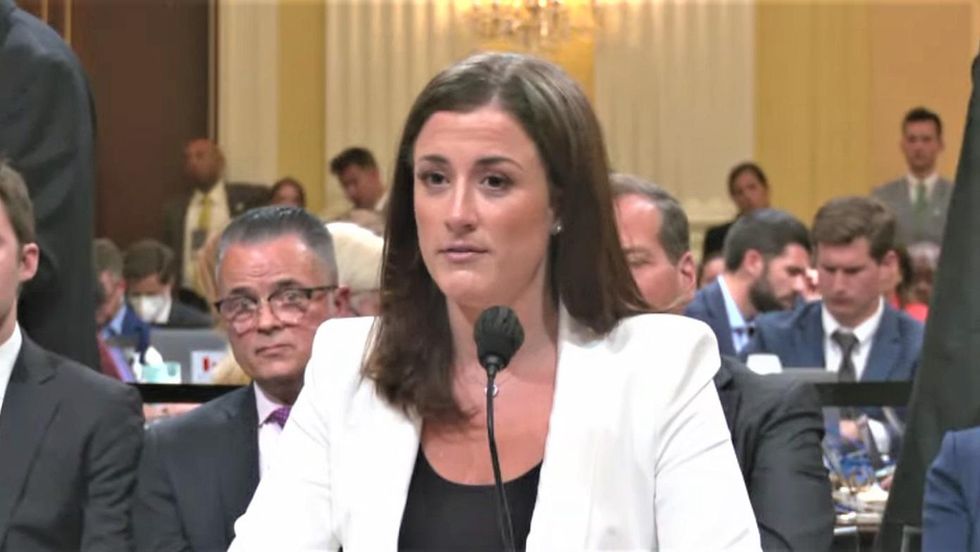
Cassidy Hutchinson (Screen cap / House Select Committee video)
Hutchinson asked Meadows for clarification.
Meadows told her “There’s a lot going on … things might get real, real bad on January 6.”
Department of Homeland Security employees felt the same way, “[noting] that people were sharing a map of the Capitol building online. Those employees messaged each other, saying they ‘feel like people are actually going to try and hurt politicians. Jan 6th is gonna be crazy.’”
One politician who may have been targeted was current senator and former Republican presidential candidate Mitt Romney, who received a call that day from independent Sen. Angus King of Maine. King warned Romney about violence at the Capitol — and potentially violence directed toward him.
Romney texted Mitch McConnell: “In case you have not heard this, I just got a call from Angus King, who said that he had spoken with a senior official at the Pentagon who reports that they are seeing very disturbing social media traffic regarding the protests planned on the 6th. There are calls to burn down your home, Mitch; to smuggle guns into DC, and to storm the Capitol. I hope that sufficient security plans are in place, but I am concerned that the instigator — the President — is the one who commands the reinforcements the DC and Capitol police might require.”
Romney said that McConnell did not reply.
On Jan. 3, 2021, Mark Meadows received a text which said, “I heard Jeff Clark is [going toreplace Jeff Rosen] on Monday [January 4]. That's amazing. It will make a lot of patriots happy, and I'm personally so proud that you are at the tip of the spear, and I could call you a friend.”
As reported at Talking Points Memo, “Clark planned to send letters to state legislatures saying that the DOJ had found evidence suggesting that the election results were in doubt, while advising state lawmakers to consider tossing out Biden’s electors and replacing them with the fake electors slates that the Trump campaign had created.”
That afternoon, deputy White House counsel Patrick Philbin, who believed Trump should follow the rule of law, told Clark that the fraud allegations were baseless and that a fake elector coup would cause “riots in every major city in the United States.”
Reportedly, Clark replied, “Well … that’s why there’s an Insurrection Act.”
Call logs revealed by the January 6 House Select Committee showed that Clark called the White House four times that day. By the fourth call — at 4:19 p.m. — Clark was officially referred to in the logs as the “acting Attorney General.”
In testimony before the committee, Jeff Rosen said that Clark “told me that the timeline had moved up and that the president had offered him the job and that he was accepting it.” Rosen “wasn’t going to accept being fired by [a] subordinate,” so he arranged a meeting at the White House.
Rosen told congressional investigators that Trump began the meeting by saying, “One thing we know is you, Rosen, aren't going to do anything to overturn the election,” and implied that he could keep his job if he agreed to send Jeffrey Clark’s letter (written by Ken Klukowski, see December 28) to Georgia legislators.
For two-and-a-half hours, Clark tried to convince Trump that he should become attorney general while Richard Donoghue, Pat Cipollone, Jeff Rosen and Assistant Attorney General for the Office of Legal Counsel Steven Engel argued against the elevation of Clark.
Engel told the January 6 House Select Committee:
“I said, ‘Mr. President you’re talking about putting a man in that seat who has never tried a criminal case, who has never conducted a criminal investigation, and he’s telling you that he’s going to take charge of the department’s 115,000 employees, including the entire FBI, and turn the place on a dime and conduct nationwide criminal investigations that will produce results in a matter of days. It’s impossible, it’s absurd, it is not going to happen, and it is going to fail.’
“He has never been in front of a trial jury, a grand jury, he’s never even been to [FBI Director] Chris Wray’s office. I said at one point, ‘If you walked into Chris Wray’s office, one, would you know how to get there, and two, if you got there, would he even know who you are? And do you really think that the FBI is going to suddenly start following your orders?’ It’s not going to happen. He’s not competent.”
Trump backed off of his threat to replace Rosen after “Donoghue and Assistant Attorney General for the Office of Legal Counsel Steve Engel made clear that there would be mass resignations at [the Department of Justice] if Trump moved forward with replacing Rosen with Clark.”
Though he left Rosen in place, Trump fired the U.S. attorney who covered the Atlanta area, BJay Pak. Trump said Pak hadn’t done enough to uncover fraud in his district. Pak’s replacement, Trump loyalist Bobby Christine, later concluded that “There’s just nothing to” Trump’s claims of voter fraud in Fulton County, where Biden amassed a huge share of his Georgia votes.
While manipulating the electoral college certification was Trump’s main focus, many political insiders had concerns that the president might fall back on the Insurrection Act — especially if pro-Trump protesters clashed with left-leaning forces on January 6. Earlier that day, all 10 living defense secretaries penned an op-ed in the Washington Post aimed at top decision makers on the Trump administration’s national security team.
The signatories said that acting Defense Secretary Christopher Miller and those working under him “are each bound by oath, law and precedent to facilitate the entry into office of the incoming administration, and to do so wholeheartedly. They must also refrain from any political actions that undermine the results of the election or hinder the success of the new team.”
Trump and his collaborators weren’t yet accepting that there would be a “new team” on January 20.
On Jan. 4, 2021, Republican senators were given a Team Kraken pitch to seize voting machines and delay the official January 6 certification.
Kevin Cramer, a conservative Republican senator who had voted with Trump 94% of the time, said that the presenters wheeled out “some of the most fantastical claims” about interference from Venezuela or China as a justification for this extraordinary step. Attending via Zoom was Republican Sen. Ron Johnson of Wisconsin, who would try to pass off fake electors for Wisconsin and Michigan on January 6.
Another Wisconsin Republican who was in on the plot was Mark Jefferson, executive director of the state party. With the fake Wisconsin electoral certificates hung up in the mail, Trump’s lawyers were becoming desperate. In a text to a colleague, Jefferson said, “Freaking Trump idiots want someone to fly original elector papers to the senate President … They’re going to call one of us to tell us just what the hell is going on.”
While Republicans played chicken with democracy, security concerns grew. As revealed duringthe January 6 House Select Committee hearings, here summarized by historian Heather Cox Richardson:
“On January 4, National Security Advisor Robert O’Brien called [Mark] Meadows to warn of violence on January 6. The Secret Service and White House Deputy Chief of Staff Anthony Ornato, who was in charge of security protocol to protect anyone covered by presidential protection, also warned of coming violence.”
Despite these warnings, Gen. Mark Milley was turned down when he suggested to Trump cabinet members that permits for a January 6 protest at the Capitol building be revoked due to the possibility of violence.
Army Gen. Mark A. Milley, chairman of the Joint Chiefs of Staff, testifies before the House Armed Services Committee / photo by Navy Petty Officer 1st Class Carlos M. Vazquez II.
Still hoping to avoid a messy, violent coup in favor of a bloodless, lawyerly coup, Trump’s outside attorney John Eastman presented Mike Pence with a six-step plan to toss the electoral college votes from seven states Trump lost.
If Pence carried out the plan, neither candidate would have 270 electoral college votes, which would throw the election to the House of Representatives, allowing Republicans to override the will of American voters.
Eastman’s plan was in clear violation of the Electoral Count Act passed in the late 19th century; Pence’s counsel Mark Jacob would later say that Eastman’s reading of 133 years of election precedent was “essentially entirely made up.”
A second option was to have Pence adjourn the counting, allowing time for states Trump had lost to submit fake electors. Eastman had advocated for this scheme on a Steve Bannon podcast two days earlier and sketched out its details in a two-page memo to Republican senators Lindsey Graham and Mike Lee, both of whom would later conclude that Trump’s fraud claims were baseless.
Speaking to Jim Acosta on CNN, famous Watergate reporter Carl Bernstein said of the Eastman memo, “I think what we are seeing in these memos particularly are blueprints for a coup …The actual blueprints in document form in which the president of the United States, through his chief of staff, is sending to Mike Pence’s, the vice president’s, staff a blueprint to overturn an election, a blueprint for a conspiracy led by a president of the United States to result in an authoritarian coup in which the election is stolen.”
The nerve center of the authoritarian coup attempt was a war room at the Willard Hotel, one block from the White House.
In the weeks before January 6, Trump’s lawyer Rudy Giuliani led a team of conspirators who attempted to overturn Biden’s election victory. Interlocking strategies included injecting disinformation about voter fraud into the right-wing media bloodstream, encouraging swing state Trump supporters to pressure their state legislators to block certification of Biden’s win, pushing state legislators directly to block certification of Biden’s victory, and trying to convince Mike Pence that he had the power to deny state-certified electoral college votes.
At various times Giuliani was joined by Steve Bannon, John Eastman, Bernard Kerik, Phil Waldron, and Roger Stone, who had Oath Keepers as bodyguards along with connections to both Stewart Rhodes (leader of the Oath Keepers) and Enrique Tarrio (leader of the Proud Boys).
Details of the Willard team’s agenda were revealed in a document given to the January 6 House Select Committee by Bernard Kerik’s attorney. (See December 17.)
While Trump and his war room cabal brainstormed ways to manipulate Mike Pence, other Republicans gave the vice president sound interpretations of constitutional law. Conservative Judge J. Michael Luttig told Pence’s staff that there was no legal basis for him to reject electoral college votes, advice also passed on by conservatives John Yoo and former Vice President Dan Quayle.
The day before the official counting of electoral ballots, Jan. 5, 2021, Mike Pence’s attorney, Greg Jacob, released a three-page memo which pointed out that the rejection of Joe Biden’s electors would be a flagrant violation of the 1887 Electoral College Act.
Pence’s chief of staff, Marc Short, called a meeting with Timothy Giebels, the head of the vice president’s security detail. Giebels was told that due to Pence’s reluctance to meddle with the electoral count, Donald Trump “was going to turn publicly against the vice president, and there could be a security risk to Mr. Pence because of it.”
Meanwhile, even some of Trump’s most loyal staff were getting skittish about Trump’s proposed power grab. Trump aide Jason Miller, tasked with putting out an official White House statement about the fake electors, asked other communications staff via text “How best [to] proceed tomorrow so we don’t look like a donkey show, particularly on the comms/media front?”
Justin Clark, deputy campaign manager, responded that “Here’s the thing the way this has morphed it’s a crazy play so I don’t know who wants to put their name on it.”
Pennsylvania’s fake electors were having the same reluctance. As reported in the Washington Post, general counsel for the Pennsylvania GOP, Thomas W. King III, emailed a Trump campaign official “saying he understood that the Trump electors in Pennsylvania had been told they would receive ‘indemnification by the campaign if someone gets sued or worse.’
“They were also to receive ‘a legal opinion by a national firm and certified to be accurate by a Pa. lawyer,’ King wrote. Instead, he wrote, they got a memo from Kenneth Chesebro … [who] described the plan in Pennsylvania as ‘dicey’ because state law calls for the governor, who at the time was a Democrat, to approve any elector substitutions.
“King made changes to the electors’ paperwork to make clear that the Republican electoral votes were valid only with the finding of a court order that could not be appealed.” (King would later tell the Post, “No one ever offered indemnification ... Any document that any lawyer looks at needs to be accurate.”)
Oddly enough, while fake electors tried to cover their backsides, an article appeared that day about Republican senator/Trump ally Chuck Grassley overseeing the electoral college vote if Pence somehow failed to show up.
Grassley’s exact words were, “If the vice president isn’t there, and we don’t expect him to be there, I will be presiding over the Senate and obviously listening to the debate without saying anything.” (Grassley’s office later said the statement was misinterpreted by the media).
The Capitol was supposed to be closed to the public that Tuesday due to Covid-19, but Republican House member Barry Loudermilk of Georgia gave a tour. The January 6 House Select Committee would later tweet that “Individuals on the tour photographed/recorded areas not typically of interest to tourists: hallways, staircases and security checkpoints.” One of the people on the tour marched to the Capitol the following day while threatening violence against Democratic members of Congress.
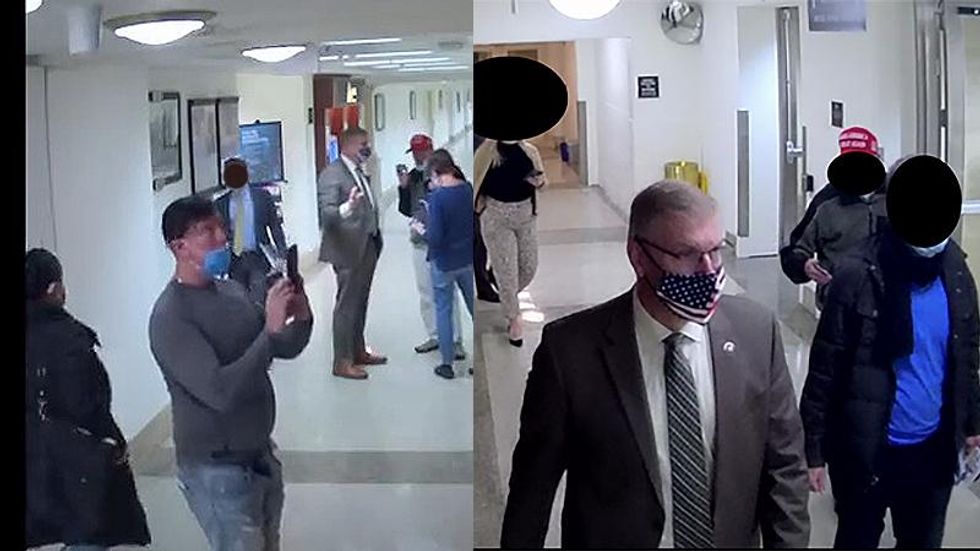
Rep. Barry Loudermilk (R-GA) giving tours in the Capitol to MAGA fans on Jan. 5, 2021. Photos via screen capture of released video from Jan. 6 investigatory committee
Democrats weren’t the only ones under threat. Republican Rep. Debbie Lesko was caught on tape asking congressional leadership to “come up with a safety plan for members” because “I’m actually very concerned about this, because we have who knows how many hundreds of thousands of people coming here. We have Antifa. We also have, quite honestly, Trump supporters, who actually believe that we are going to overturn the election. And when that doesn’t happen — most likely will not happen — they are going to go nuts.”
Aware of the potential for violence, Washington, D.C., Mayor Muriel Bowser requested National Guard backup, but Donald Trump’s Defense Department handcuffed the Guard’s mission. According to Paul Sonne, Peter Hermann and Missy Ryan of the Washington Post, “the Pentagon prohibited the District’s guardsmen from receiving ammunition or riot gear, interacting with protesters unless necessary for self-defense, sharing equipment with local law enforcement, or using Guard surveillance and air assets without the defense secretary’s explicit sign-off.”
In addition, “The D.C. Guard was also told it would be allowed to deploy a quick-reaction force only as a measure of last resort,” which forced local D.C. officials to get approval from Trump’s Defense Department for rapid deployment, a bureaucratic hurdle which hadn’t existed previously.
While the Secret Service “warned the U.S. Capitol Police that their officers could face violence at the hands of supporters of former President Donald Trump,” Mark Meadows sent out an email demanding that the National Guard “protect pro-Trump people.” A statement from the White House Office of the Press Secretary hyped the threat of left-leaning protesters, saying “President Trump will not allow Antifa, or any terrorist organization, to destroy our great country.”
Trump mirrored this with a tweet threatening members of antifa who showed up in D.C. on January 6. There was speculation later on that this messaging could have been put in place to give Trump cover to declare a national emergency on January 6, if anti-Trump protesters showed up to fight pro-Trump protesters. A national emergency could have allowed Trump to seize voting machines according to Phil Waldron’s 38-page PowerPoint titled “Election Fraud, Foreign Interference & Options for January 6” (see November 25, January 4).
As D.C. girded for trouble, Trump riled his supporters up with a 5 p.m. tweet which read, “Washington is being inundated with people who don’t want to see an election victory stolen by emboldened Radical Left Democrats … Our Country has had enough, they won’t take it anymore!”
This call out to the troops coincided with a pro-Trump event at Freedom Plaza that night. Speaking at the rally were Trump allies who were considered too extreme to speak at the main event on January 6 — Alex Jones, Ali Alexander, Michael Flynn and Roger Stone.
Infowars host Alex Jones. (Screenshot)
Stone told those in attendance they were in an “epic struggle for the future of this country between dark and light, between the godly and the godless, between good and evil. And we will win this fight or America will step off into a thousand years of darkness.”
According to deputy press secretary Sarah Matthews, during an Oval Office meeting which took place while music was booming at Freedom Plaza (just half a mile from the White House), “[Trump] was in a very good mood. And I say that because he had not been in a good mood for weeks leading up to that, and then it seemed like he was in a fantastic mood that evening.”
Deputy press secretary Judd Deere concurred, saying Trump was “animated” and “excited about the next day. He was excited to do a rally with his supporters.”
At the meeting, Trump discussed the march to the Capitol which would follow his speech at the Ellipse on January 6. Though it was known to pro-Trump activists and administration figures, the march to the Capitol wasn’t public knowledge. As January 6 committee member Stephanie Murphy would later say, “the evidence confirms that this was not a spontaneous call to action, but rather was a deliberate strategy decided upon in advance by the president.”
Late that evening, Trump called his allies at the Willard Hotel and strategized about how they could delay the vote count long enough to get three swing states to reject Biden’s electoral votes and send false electoral votes to the Capitol.
One of the key strategists at the Willard was Steve Bannon. Rep. Liz Cheney, future vice chair of the January 6 House Select Committee, would later say, “Based on the committee’s investigation, it appears that Mr. Bannon had substantial advance knowledge of the plans for January 6th and likely had an important role in formulating those plans.”
On his podcast the night of January 5, Steve Bannon concluded ominously:
“It’s not going to happen like you think it’s going to happen. OK, it’s going to be quite extraordinarily different. All I can say is, strap in … You made this happen and tomorrow it’s game day. So strap in. Let’s get ready.”
***
Prior to Jan. 6, 2021, the electoral college vote count and certification had been purely ceremonial.
But since none of Trump’s tactics to overthrow the election had worked, the president’s fundraiser Caroline Wren, campaign operative Katrina Pierson, chief of staff Mark Meadows, Republican members of Congress, and right-wing activists planned one final, grand charade: a “Save America” rally followed by a stealth march to the Capitol.
Activists involved in the planning bought burner phones with cash to secretly communicate with members of the White House, including chief of staff Mark Meadows. It would later come out that “Trump’s political operation reported paying more than $4.3 million to people and firms that organized the Jan. 6 rally since the start of the 2020 election.”
According to Hunter Walker of Rolling Stone, event planners also collaborated with fringe-right members of Congress such as Marjorie Taylor Greene, Louie Gohmert, Paul Gosar (later to become one of the biggest defenders of the insurrectionists), Madison Cawthorn (who spoke at the January 6 rally), Andy Biggs and Lauren Boebert.
Two of Walker’s sources (both event planners) said that Gosar — who allegedly made phone calls to the sources on January 6 — promised that Trump would grant them pardons if they incurred any legal trouble as a result of the rally. Right-wing activist Ali Alexander, one of the organizers of the “Wild Protest,” had also mentioned collaborating with Gosar and Biggs in a video which was later deleted.
The rally and the march were a prelude to the formal challenge by 13 Republican senators and 140 House members to Joe Biden’s electoral college victory. The challenge would consist of regurgitated fraud claims which had been rejected for lack of merit in more than 60 judicial cases, by judges of all ideological stripes.
Trump trade adviser Peter Navarro would later brag about his role in recruiting members of Congress. He and Steve Bannon came up with a plan called “the Green Bay sweep.” The aim was to get challengers to delay the electoral vote certification as long as possible in hopes that several hours of televised hearings (full of Republican claims about a “rigged election”) would pressure Mike Pence to reject electors from Biden states and end 231 years of American democracy.
While the suits conspired, Trump’s ground troops stood by. Alongside the Oath Keepers, who “were expecting Trump to invoke the Insurrection Act” so that he would have a false pretense to call up the U.S. military and maintain control of the government by force, 250-300 Proud Boys had plans to pre-empt the certification by seizing government offices and making demands on behalf of the losing presidential candidate. The leaders of the two groups had met in a D.C. underground parking lot the day prior.
According to Mark Meadows’ aide Cassidy Hutchinson, as of 8:00 a.m., “intelligence reports were already coming in that some of the people near the Ellipse, where Trump was to speak, were dressed in body armor and armed with Glock-style pistols, shotguns, and AR-15s, along with other weapons.”
When deputy chief of staff Anthony Ornato told Meadows about weapons confiscated by law enforcement, “Meadows appeared uninterested and didn't look up from his phone … saying: ‘All right, anything else?’”
At 8:24 a.m., Eric Waldow, a deputy chief in the Capitol Police force who was “responsible for directing officers’ movements,” sent a message over Capitol Police radio for his fellow officers to “watch out for anti-Trump protesters in the massive pro-Trump crowd.”
There was concern of violence between Trump’s white supremacist followers and left-wing activists, but this would turn out to be an empty threat. Prodded to stay home with hashtags #Jan6TrumpTrap and #DontTakeTheBait, the left’s presence at the rally was minimal to nonexistent.
With just over four hours to go before the certification was to start, Trump allies continued their attempts to overturn the will of the American people.
The speaker of the Arizona House, Rusty Bowers, received a call from House of Representatives member Andy Biggs asking him to reject Biden’s legitimate electors for the state of Arizona. This was one of many requests from conspirators to Bowers (including a call from Rudy Giuliani, who had earlier admitted to Bowers that “we have lots of theories, we just don’t have the evidence”).
Bowers refused to buckle, even as his family had been doxxed, with Trump supporters shouting epithets outside of his home while his daughter was inside dying of cancer.
One of the main conspirators was Rep. Jim Jordan. Jordan and Trump spoke for 10 minutes that morning. Jordan would later gum up the works during the certification, after the Capitol was cleared.
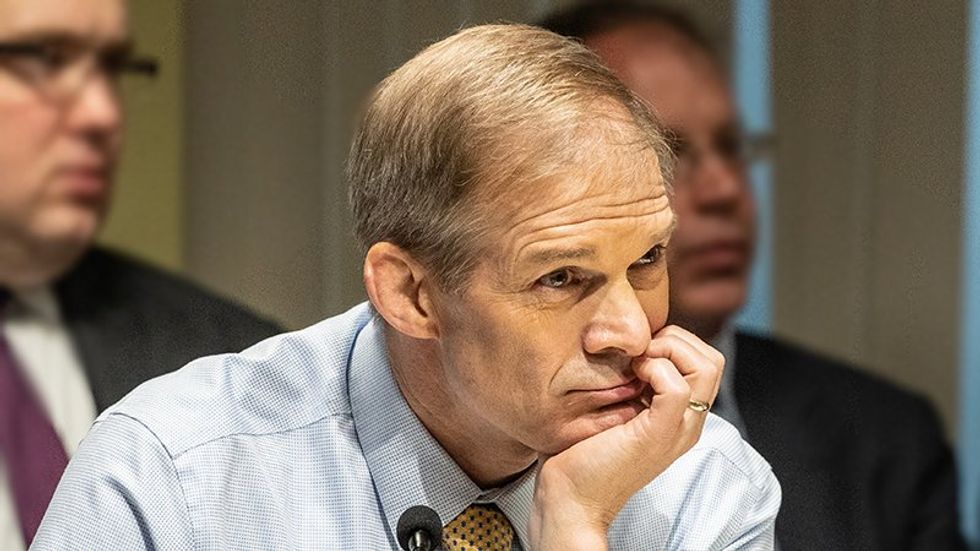
Rep. Jim Jordan (R-OH). Photo: lev radin/Shutterstock
Trump also received a call around 11:04 a.m. from Republican senator David Perdue.
It was the last call recorded in the official White House logs until 6:54 p.m. that evening.
The most consequential conversation Trump had was with Vice President Mike Pence, whom Trump had already pressured twice that day, with tweets at 1:00 a.m. and 8:17 a.m.
Around 11:20 a.m., Trump called Pence from the Oval Office. Several witnesses were present. Marc Short, Pence’s chief of staff, estimated that the call lasted 15-to-20 minutes.
According to reporters Kyle Cheney and Betsy Woodruff Swan, “Multiple people familiar with the testimony given to the [January 6] committee about the call offered a consistent account. One of those people — granted anonymity to speak candidly — said witnesses described the conversation as beginning relatively pleasantly, with Trump embracing the legal advice he was given about Pence’s ability to send the election back to the states.
“Although people in the Oval Office couldn’t hear him, Pence had clearly rejected Trump’s entreaties, the person indicated. Witnesses have said listeners in the room were surprised because it was the first time they recalled Pence saying no to Trump. The call deteriorated and Trump grew frustrated.”
Trump told Pence, “You can either go down in history as a patriot … or you can go down in history as a pussy.”
Pence chose to go down in history as a patriot.
Just before the count began, he released a public letter confirming that he lacked the constitutional authority to unilaterally decide which electoral college votes to accept.
Trump responded to this pushback from his previously subservient #2 by “reinserting language [into his rally speech] that he had personally drafted earlier that morning — falsely claiming that the Vice President had authority to send electoral votes to the states — but that advisors had previously successfully advocated be removed.”
This change in emphasis increased the threat risk for Vice President Pence. As reported by historian Heather Cox Richardson, the “Save America” rally that day was simmering with latent violence:
“Text messages between [Cassidy] Hutchinson and [Deputy Chief of Staff Anthony] Ornato show that Trump was ‘furious’ before the Ellipse rally because he wanted photos to show the space full of people and it was not full because law enforcement was screening people for weapons before they could go in. Trump wanted the screening machines, called magnetometers, to be taken down.”
According to Hutchinson’s testimony before the January 6 House Select Committee, “I overheard the president say something to the effect of, you know, ‘I don’t even care that they have weapons. They’re not here to hurt me. Take the f-ing mags away. Let my people in. They can march to the Capitol from here. Let the people in. Take the f-ing mags away.’”
The speeches included several incitements to violence.
Lead-off speaker Mo Brooks, clad in body armor, said, “Today is the day American patriots start taking down names and kicking ass!”
Addressing congressional Republicans who intended to honor the will of American voters, Donald Trump, Jr. said, “We’re coming for you, and we’re going to have a good time doing it.” If they didn’t change their minds and oppose Biden’s certification, “I’m gonna be in your backyard in a couple of months.”
Rudy Giuliani said, “Let’s have trial by combat,” which was “an eerie reference to battles to the death in the series ‘Game of Thrones.’”
Donald Trump headlined at noon. Talking tough from behind bulletproof glass, he unleashed a torrent of self-serving lies about the election, “used the words ‘fight’ or ‘fighting’ at least 20 times,” and said, “You’ll never take back our country with weakness. You have to show strength. You have to be strong.”
Over at the Capitol, with the clock running down, Republicans were still scheming to get illegitimate electors to Mike Pence. At 12:37 p.m., an aide to Republican Sen. Ron Johnson texted a Pence aide about “alternate” electors for Wisconsin and Michigan that Johnson wanted to pass off. In response, the Pence aide said, “Do not give that to [Pence].”
By 12:54 p.m. — six minutes before House Speaker Nancy Pelosi was scheduled to bring Congress to order — Trump supporters had busted through barrier fences around the U.S. Capitol.
Less than 10 minutes after the formal count had begun, Trump finished his speech with a call to action:
“We will never give up; we will never concede … We will stop the steal. We’re going to walk down Pennsylvania Avenue, and we’re going to the Capitol … We’re going to try and give our Republicans, the weak ones … the kind of pride and boldness that they need to take back our country.”
The march had been hidden — by design — from the general public. In a January 4 communication, conservative organizer Kylie Jane Kramer had texted MyPillow CEO Mike Lindell that “It can also not get out about the march because I will be in trouble with the national park service and all the agencies but POTUS is going to just call for it ‘unexpectedly.’”
Trump’s advisors had composed a tweet which mentioned the march. Trump read the tweet, but didn’t send it, leaving Capitol security in the dark about what they were about to face.
In the presidential limousine, the Secret Service refused to take Trump to the Capitol. Cassidy Hutchinson told the January 6 House Select Committee that the outgoing president threw a fit as he “attempted to grab the steering wheel and then lunged at the agent driving” the vehicle. Trump’s demand (“I am the f---ing president, take me up to the Capitol now”) went unheeded.
At 1:14 p.m., Vice President-elect Kamala Harris was evacuated from Democratic National Committee headquarters, where a pipe bomb was found. Another pipe bomb, placed by the same suspect the night prior, would be found at the Republican National Committee headquarters. The motive remains unknown, but it could have been to draw law enforcement attention away from the Capitol.
Donald Trump was in the White House dining room by 1:25 p.m., where he was soon notified about the “violence at the Capitol.”
Doing nothing to stop the insurrection, President Trump got cozy in front of Fox News. He “asked aides for a list of senators to call as he continued to pursue paths to overturn his defeat,” according to White House press secretary Kayleigh McEnany.
Around the same time, Trump’s ally, Paul Gosar (who had collaborated with the “Save America” organizers), began the GOP stalling tactics, objecting to electors from Arizona. The two houses of Congress separated to “debate” Gosar’s objection.
At 1:30 p.m., insurrectionists overtook police at the back of the Capitol, forcing them inside the building.
Unaware of the threat, Congress continued the proceedings. Senate Majority leader Mitch McConnell said, “Voters, the courts, and the states have all spoken — they've all spoken … If we overrule them, it would damage our republic forever.”
As McConnell spoke, a crowd of 8,000 equipped with “riot helmets, gas masks, shields, pepper spray, fireworks, climbing gear ... explosives, metal pipes, [and] baseball bats” surrounded the front of the Capitol.
At 1:39 p.m., Trump had a four-minute call with Rudy Giuliani, who would call several senators that day to try to derail the certification. They spoke again a half hour later.
Because local officials’ authority to order backup had been taken away by the Trump administration one day before the certification, Capitol Police Chief Steven Sund had to beg Trump allies in the Department of Defense for National Guard reinforcements.
Trump’s military officials stonewalled Sund, who first called for help at 1:49 p.m.
According to testimony before the January 6 House Select Committee, here referenced by Professor Heather Cox Richardson, “[Cassidy] Hutchinson went into [Mark] Meadows’s [White House] office between 2:00 and 2:05 to ask if he was watching the scene unfold on his television. Scrolling through his phone, he answered that he was. She asked if he had talked to Trump. He said, ‘Yeah. He wants to be alone right now.’ [White House Counsel Pat] Cipollone burst into the office and said to go get the president. Meadows repeated that Trump didn't want to do anything. Cipollone very clearly said this to Mark — something to the effect of, ‘Mark, something needs to be done or people are going to die and the blood’s going to be on your f-ing hands. This is getting out of control.”’
Back at the Capitol, as officer Caroline Edwards later described it to the January 6 committee, “What I saw was just a war scene … There were officers on the ground. They were bleeding. They were throwing up. I saw friends with blood all over their faces. I was slipping in people’s blood. I was catching people as they fell. It was carnage. It was chaos.”
At 2:11 p.m., Trump supporters — heavily represented by right-wing hate groups, including many former members of law enforcement and the military — burst through a police line to storm the Capitol, the first hostile takeover of America’s seat of government since 1814.
By 2:13 p.m., they were inside the building.
Once inside, insurrectionists assaulted Capitol police officers, attacked journalists, and traumatized members of Congress and congressional aides.
Under the surface appearance of random chaos were a number of determined seditionists with concrete goals. Some targeted the offices of specific members of Congress in hopes of kidnapping them, or worse. Others ransacked the Senate parliamentarian’s office in an apparent attempt to intercept electoral college ballots. There were allegations that plotters may have had help from members of the Capitol police force and/or Republican representatives (including Barry Loudermilk, who had conducted a tour of the Capitol on January 5, and Ronny Jackson).
At 2:15 p.m., Pat Cipollone texted Mark Meadows that “we need to do something more. They’re literally calling for the vice president to be f’ing hung.”
Meadows responded that “You heard [President Trump], Pat. He thinks Mike deserves that. He doesn’t think they’re doing anything wrong.”
Four minutes later, Hogan Gidley (the national press secretary for Trump’s 2020 campaign) texted Hope Hicks (counselor to the president) with a suggestion that Trump put out a request to his followers to be non-violent.
Hicks replied that she had suggested as much “several times” on Monday and Tuesday — this was Wednesday — but “I’m not there.”
The Senate was called into recess at 2:20 p.m.
The House soon followed.
At 2:24 p.m., while “America Firsters and other invaders fanned out in search of lawmakers, breaking into offices and reveling in their own astounding impunity,” Trump sent out what would become a notorious tweet:
“Mike Pence didn’t have the courage to do what should have been done to protect our Country and our Constitution, giving States a chance to certify a corrected set of facts, not the fraudulent or inaccurate ones which they were asked to previously certify … USA demands the truth!”
As Trump’s deputy press secretary Sarah Matthews would tell the January 6 House Select Committee, this was exactly what wasn’t needed in that moment, as Trump was “giving the green light to [the insurrectionists]” who “truly latch on to every word and every tweet.”
While lawmakers hid from rioters, Trump called Sen. Tommy Tuberville of Alabama to ask him to stall the electoral college vote certification whenever (or if) it could safely resume. Trump reached Tuberville around 2:26 p.m. and was notified that Mike Pence, his wife, his brother and his daughter had just been whisked away from the Senate floor. Later reports showed that seditionists missed Pence and his family by one minute (or “five to 10 feet” by another account).
An excerpt from I Alone Can Fix It by reporters Carol Leonnig and Philip Rucker described the scene:
“At that moment, Pence was still in his ceremonial office — protected by Secret Service agents, but vulnerable because the second-floor office had windows that could be breached and the intruding thugs had gained control of the building. Tim Giebels, the lead special agent in charge of the vice president’s protective detail, twice asked Pence to evacuate the Capitol, but Pence refused. ‘I’m not leaving the Capitol,’ he told Giebels. The last thing the vice president wanted was the people attacking the Capitol to see his 20-car motorcade fleeing. That would only vindicate their insurrection.
“At 2:26, after a team of agents scouted a safe path to ensure the Pences would not encounter trouble, Giebels and the rest of Pence’s detail guided them down a staircase to a secure subterranean area that rioters couldn’t reach, where the vice president’s armored limousine awaited. Giebels asked Pence to get in one of the vehicles. ‘We can hold here,’ he said.”
At 2:28 p.m., Mark Meadows received a text from Republican Rep.-elect Marjorie Taylor Greene (“Please tell the president to calm people … This isn’t the way to solve anything”). Meadows would continue to field desperate pleas from Trump allies to stop the violence over the next half hour.
Around 2:30 p.m., Capitol Police Chief Steven Sund asked lieutenant generals Walter Piatt and Charles Flynn (the brother of martial law advocate Michael Flynn) for permission to deploy the National Guard.
Accompanying Sund were Maj. Gen. William Walker (the commander of the D.C. National Guard), Walker’s counsel (Col. Earl Matthews), and D.C. Chief of Police Robert Contee.
Walker had buses of troops ready to go.
According to Matthews, Piatt told Sund he didn’t like “the optics” of “having armed military personnel on the grounds of the Capitol,” though the Defense Department had had no concern for “optics” the previous June, when they had deployed armed military personnel at peaceful Black Lives Matter protests.
After police chief Contee threatened to ask D.C. Mayor Muriel Bowser to have a press conference exposing Piatt and Flynn’s suspicious delay, Piatt’s fallback suggestion was to have “Guardsmen take over D.C. police officers’ traffic duties so those officers could head to the Capitol.”
This, too, was baffling, as a hand-off would take more time than sending the Guard directly to the Capitol. As reported by Politico, Matthews’ 36-page memo about January 6 said that “Every D.C. Guard leader was desperate to get to the Capitol to help … then stunned by the delay in deployment. Responding to civil unrest in Washington is ‘a foundational mission, a statutory mission of the D.C. National Guard.’”
Army Secretary Ryan McCarthy had been invited to the call but was “incommunicado or unreachable for most of the afternoon,” according to Matthews.
As Trump’s Defense Department officials let seditionists ravage the Capitol, Trump allies — including former New Jersey Gov. Chris Christie, Sen. Lindsey Graham, House Minority Leader Kevin McCarthy and former advisor Kellyanne Conway — called the White House to try to get Trump to act.
But the commander-in-chief wasn’t taking calls.
He was wrapped up in the West Wing dining room watching on Fox News the attempted coup he’d fomented. As one aide told a reporter, “‘He was hard to reach, and you know why? Because it was live TV … If it’s TiVo, he just hits pause and takes the calls. If it’s live TV, he watches it, and he was just watching it all unfold.’”
According to White House counsel Pat Cipollone, Trump was also pressured (in person) to ask the rioters to go home by “fellow lawyers Pat Philbin and Eric Herschmann, Ivanka Trump, Jared Kushner … Press Secretary Kayleigh McEnany, [Deputy Chief of Staff for Communications] Dan Scavino, [Pence National Security Adviser] Gen. Keith Kellogg and White House Chief of Staff Mark Meadows.”
Ivanka Trump. Photo: AFP
Fulfilling the request would have required minimal effort. Trump’s deputy press secretary Sarah Matthews told the January 6 House Select Committee, “It would take probably less than 60 seconds to get from the Oval Office dining room to the press briefing room. There’s a camera that is on in there at all times. If the president wanted to address people, he could have done so.”
But Trump was unmoved, even when his daughter, Ivanka, initially asked him to stop the violence, perhaps because he felt the rioters kept his hopes alive by obstructing the certification.
Eventually, Trump took a call from Republican House Minority Leader Kevin McCarthy, who was inside the Capitol. Republican Rep. Jaime Herrera Beutler, who was with McCarthy, tweeted, “When McCarthy finally reached the president on January 6 and asked him to publicly and forcefully call off the riot, the president initially repeated the falsehood that it was anti-fascists that had breached the Capitol … McCarthy refuted that and told the president that these were Trump supporters. That's when, according to McCarthy, the president said, ‘Well, Kevin, I guess these people are more upset about the election than you are.’”
Republican Sen. Ben Sasse of Nebraska would later that week say that Trump was “confused about why other people on his team weren’t as excited as he was as you had rioters pushing against Capitol Police trying to get into the building.” Sasse also mentioned that Trump was talking to the other people in the room about “a path by which he was going to stay in office after January 20.”
Key to this path was a delay in the certification. As they hid in an underground Senate loading dock, Trump’s deputy chief of staff (in charge of the Secret Service) Tim Giebels asked Mike Pence to get into one of the Secret Service-protected vehicles. According to reporting in I Alone Can Fix It, Pence replied, “I’m not getting in the car, Tim ... I trust you, Tim, but you’re not driving the car. If I get in that vehicle, you guys are taking off. I’m not getting in the car.”
Another excerpt from I Alone Can Fix It indicates that Pence had good reason to stay put.
In the scene described, Mike Pence’s national security adviser Keith Kellogg interacts with White House Deputy Chief of Staff/liaison to the Secret Service Anthony Ornato. The exchange takes place shortly after Pence’s refusal to get into the Secret Service car. Ornato’s loyalties — to Donald Trump or democracy — are in question, as Trump had brought Ornato to the White House from the Secret Service, a major break with the non-partisan code of the Secret Service:
“Kellogg ran into Tony Ornato in the West Wing. Ornato, who oversaw Secret Service movements, told him that Pence’s detail was planning to move the vice president to Joint Base Andrews. ‘You can’t do that, Tony,’ Kellogg said. ‘Leave him where he’s at. He’s got a job to do. I know you guys too well. You’ll fly him to Alaska if you have a chance. Don’t do it.’”
While Pence held firm, Ivanka Trump convinced her father to make a half-hearted attempt to defuse the violence with a tweet at 2:38 p.m.: “Please support our Capitol Police and Law Enforcement. They are truly on the side of our Country. Stay peaceful!”
Donald Trump Jr. texted Mark Meadows in response: “He’s got to condemn this s--- ASAP. The capitol police tweet is not enough.”
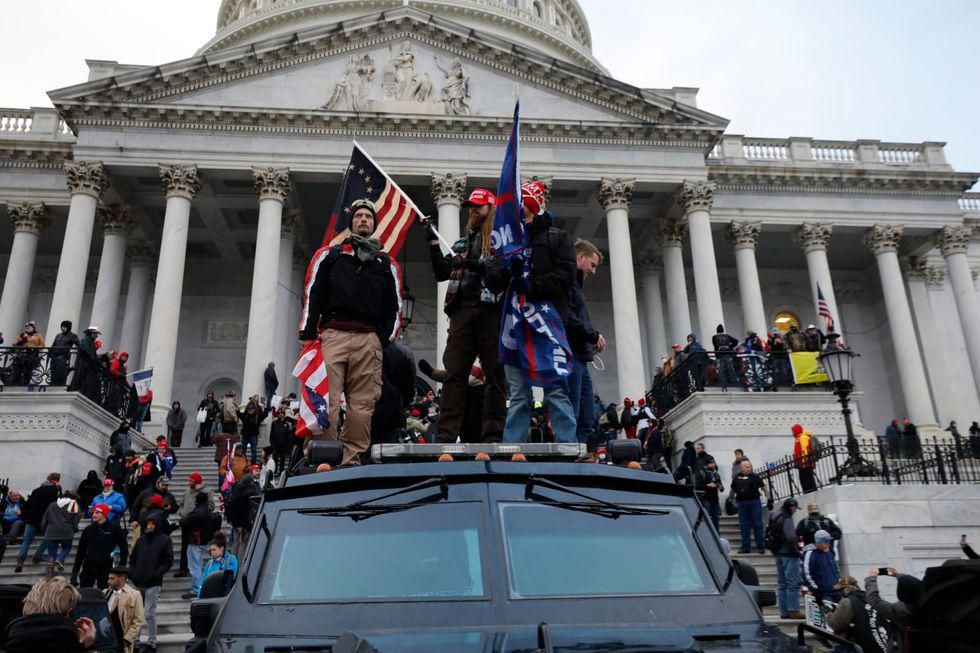
'Sociopathic': New reports suggest Trump sided with violent mob during Capitol attack
Supporters of President Donald Trump protest on the steps of the U.S. Capitol building on Capitol Hill in Washington, D.C., on Wednesday, Jan. 6, 2021. - Yuri Gripas/Yuri Gripas/TNS
At 3:13 p.m., Trump sent another tweet:
“I am asking for everyone at the U.S. Capitol to remain peaceful. No violence! Remember, WE are the Party of Law & Order – respect the Law and our great men and women in Blue. Thank you!”
But President Trump wouldn’t ask the insurrectionists to leave the Capitol, which forced Mike Pence and Democratic leaders Nancy Pelosi and Chuck Schumer to call the governors of Virginia and Maryland, the secretary of defense, the attorney general — anyone who could help.
By 3:45 p.m., Trump aide Jason Miller had come up with messaging which could end the insurrection and appease the president (by shifting the blame). Miller texted Mark Meadows and (Trump aide) Dan Scavino two tweet suggestions:
1) “Bad apples, likely ANTIFA or other crazed leftists, infiltrated today’s peaceful protest over the fraudulent vote count. Violence is never acceptable! MAGA supporters embrace our police and the rule of law and should leave the Capitol now!”
2) “The fake news media who encouraged this summer’s violent and radical riots are now trying to blame peaceful and innocent MAGA supporters for violent actions. This isn't who we are! Our people should head home and let the criminals suffer the consequences!”
At 4:06 p.m., president-elect Joe Biden tweeted a speech:
“I call on President Trump to go on national television now, to fulfill his oath and defend the Constitution and demand an end to this siege. This is not a protest. It is an insurrection.”
Since Trump’s tweets had had little discernible impact on the insurrectionists, his advisers came up with a neutral, yet unequivocal video statement:
“I urge all of my supporters to do exactly what 99% of them have already been doing — express their passions and opinions PEACEFULLY.
“My supporters have a right to make their voices heard, but make no mistake — NO ONE should be using violence or threats of violence to express themselves. Especially at the U.S. Capitol. Let’s respect our institutions. Let’s all do better.
“I am asking you to leave the Capitol Hill region NOW and go home in a peaceful way.”
Trump agreed to ask his followers to go home, but ad-libbed disinformation which fed the misplaced rage at the heart of the insurrection.
His video plea was posted at 4:17 p.m., more than two hours into the breach and more than three hours after he became aware of the violence outside the Capitol:
“It was a landslide election. And everyone knows it. Especially the other side. But you have to go home … There’s never been a time like this when such a thing happened when they could take it away from all of us. From me, from you, from our country. This was a fraudulent election … Go home. We love you. You're very special.”
As reported by Ryan Goodman and Justin Hendrix, “According to the Department of Defense’s and U.S. Army’s own timelines, it is only after President Trump publicly released [his video statement] that [Defense Secretary Christopher] Miller approved [Army Secretary Ryan] McCarthy’s plan for deploying the D.C. National Guard to the Capitol and even later when McCarthy authorized [D.C. National Guard commander William] Walker to deploy his forces to the Capitol.”
The National Guard finally arrived at 5:20 p.m.
The Capitol was cleared at 5:34 p.m.
At 6:01 p.m., Trump tweeted: “These are the things and events that happen when a sacred landslide election victory is so unceremoniously & viciously stripped away from great patriots who have been badly & unfairly treated for so long … Go home with love & in peace. Remember this day forever!”
Around 7 p.m., with an hour to go before the vote count would resume, Rudy Giuliani called what he thought was Sen. Tommy Tuberville’s cellphone and left a voicemail. But Giuliani mistakenly dialed the wrong senator, who gave the recording to The Dispatch.
In the message, Giuliani asked the senator to organize objections to 10 states won by Biden in order to drag the certification out as long as possible, preferably until the end of the following day.
Giuliani said that the delay would give Republicans more time to present “evidence” of fraud in key swing states. Another goal could have been to impede the certification in order to allow more time for the resolution of a longshot election lawsuit that was before the Supreme Court (who would refuse to expedite the claim on January 11). This was one of eight members of Congress Giuliani reached out to throughout January 6.
After Mike Pence re-started the official vote count, Trump lawyer John Eastman emailed Pence’s lawyer, Greg Jacob, claiming that Pence was breaking the Electoral Count Act because debate was going “past the allotted time.”
Pence officially certified Joe Biden’s victory at 3:42 a.m. on January 7, 2021.
Mike Pence speaking with attendees at the 2020 Student Action Summit hosted by Turning Point USA.
Mike Pence. (Gage Skidmore)
Biden’s win was certified despite the objections of two-thirds of House Republicans and eight Republican senators who came out of hiding to spout election fraud lies which had jeopardized their safety just hours earlier.
Remarkably, dead-enders continued to push Trump’s cause after the sun came up.
According to White House counsel Eric Herschmann, he received a call from John Eastman the day after the insurrection “asking for legal work ‘preserving something potentially for appeal’ in the contested state of Georgia,” where Trump lawyer Sidney Powell flew — that same day — to gather confidential voter data.
Herschmann reportedly told Eastman, “You’re out of your effin’ mind,” and, “Now I’m going to give you the best free legal advice you’re getting in your life: Get a great effing criminal defense lawyer. You’re going to need it.”
Not long after this conversation, Eastman emailed Rudy Giuliani to ask if he could be added to the growing list of pardon requests.
While some administration officials resigned and others pondered using the 25th Amendment to force Donald Trump from office, Ivanka Trump patiently fought off temper tantrums as she tried to coax her father to make a statement condemning the violence he had caused.
Trump couldn’t admit he had lost.
He cut out language in a prepared speech about the importance of law and order, one of his favorite themes during the campaign, removing his advisors’ verbiage that “I am directing the Department of Justice to ensure all lawbreakers are prosecuted to the fullest extent of the law. We must send a clear message — not with mercy but with JUSTICE. Legal consequences must be swift and firm.”
Trump removed a line that could have insulted his fanbase: “I want to be very clear you do not represent me. You do not represent our movement.”
Trump’s most feral supporters had done substantial damage. They had inflicted severe trauma on Capitol law enforcement and members of Congress. They had injured more than 150 law enforcement officers and contributed to the deaths of five (an Iraq War vet who was bashed in the head with a fire extinguisher and four who later committed suicide). Their rampage cost America’s taxpayers $480 million to secure the Capitol (with 25,000 National Guard members) before Joe Biden’s inauguration. Taxpayers spent another $1.5 million dollars to repair the citadel of American democracy. The damage done to America’s long-standing tradition of peaceful transfers of power was (and still is) incalculable.
To date, Donald Trump has expressed no contrition for inciting the January 6 insurrection.
In a TV appearance in September of 2021, ABC reporter Jonathan Karl, who interviewed Trump for his book Betrayal: the Final Act of the Trump Show, said, “I was absolutely dumbfounded at how fondly he looks back on January 6th. He thinks it was a great day. He thinks it was one of the greatest days of his time in politics.”
***
Four years after Donald Trump’s failed coup attempt, big gaps remain in the public’s understanding of January 6, 2021.
The January 6 House Select Committee was hobbled in their mission by a long list of Trump allies who refused to appear before the committee or pleaded the 5th Amendment when they did.
Encrypted communications among Republican conspirators, insurrectionist organizers, and between organizers and Republican conspirators have slipped into the ether.
Phone communications on January 6 among members of key government agencies — the Secret Service, the Department of Homeland Security, and the Defense Department— have disappeared.
During the January 6 House Select Committee hearings, Representative Jamie Raskin called Mike Pence’s refusal to get into the Secret Service vehicle (“I’m not getting into that car”) “the six most chilling words of this entire thing I’ve seen so far” and asserted that the efforts to get Pence out of the Capitol were motivated by a desire to delay the vote certification: “[Pence] knew exactly what this inside coup they had planned for was to do.”
The role of Secret Service members in Trump’s plot could be a critical piece of the puzzle, but Secret Service texts from January 5 and January 6 mysteriously disappeared.
The texts vanished after multiple House committees requested all such records be preserved on January 16, 2021. The Trump-appointed Department of Homeland Security inspector general Joseph Cuffari discovered that these texts had been deleted in May of 2021 but didn’t notify Congress until July 14, 2022. Officials in the inspector general’s office wrote a memo notifying Congress of the missing texts in April of 2022, but Cuffari didn’t forward the information.
Not surprisingly, Joe Biden hired a new Secret Service team on entering office.
An investigation is ongoing.
The biggest mystery is why backup deployment to the Capitol took so long.
This delay happened despite the fact that chief of staff Mark Meadows, who was with Trump, was in “non-stop” communication all day with Kash Patel, the chief of staff for Defense Secretary Christopher Miller — whom Trump had installed after losing the 2020 election.
One line of thought is that Trump’s appointees handcuffed D.C. police and conspired to delay National Guard deployment to give the insurrectionists time to stop the vote certification. Miller was perfectly aware of how dire the situation was from early on and yet reportedly didn’t sign on to the emergency deployment until 4:32 p.m., two hours and 43 minutes after Capitol police chief Steven Sund first asked for backup.
And it’s hard to imagine Deputy Chief of Staff for Operations General Charles Flynn (whose brother Michael Flynn was in Trump’s inner circle of coup planners) being disappointed if the certification didn’t happen. This could explain his odd concern about “optics” when Capitol police chief Steven Sund asked for permission to deploy backup around 2:30 p.m. Col. Earl Matthews, a lawyer for the commanding general of the D.C. National Guard, said that Flynn and his cohort Lt. Gen. Walter Piatt were “absolute and unmitigated liars” when they spoke to the January 6 House Select Committee.
A second theory, based on the testimony of General Mark Milley (chairman of the Joint Chiefs of Staff) and Christopher Miller before the January 6 committee, is that deployment was held off out of fear that the introduction of troops could create the chaos Trump needed to invoke the Insurrection Act, just as the Oath Keepers hoped he would. The timing of deployment — after Trump had asked his supporters to go home in the 4:17 p.m. video — may support this theory.
Or maybe Miller and/or Milley were covering their butts before the House Select Committee. Maybe the deployment happened when it did because Mike Pence and congressional leadership were pushing the Department of Defense to act and Miller/Milley felt that Trump’s 4:17 p.m. video statement indicated that he no longer expected their acquiescence.
Hopefully more will come out about key players’ actions and motivations in the Jack Smithand Fani Willis investigations of Trump’s election interference.
What we know with absolute certainty is that The Big Lie which fueled Donald Trump’s coupattempt looks even more preposterous now than it did in the aftermath of the 2020 presidential election.
When “Kraken” attorney Sidney Powell was sued by Dominion, her lawyers defended their client by claiming that “no reasonable person” would have believed Powell’s attacks on Dominion.
Big Lie perpetrators, from Rudy Giuliani to Mike Lindell to One America News to Sidney Powell to Jenna Ellis to Kenneth Chesebro have flipped or lost/settled court cases.
Mike Lindell. Real America's Voice/screen grab
For News settled a $787 million defamation lawsuit with Dominion. The presiding judge said, “The evidence developed in this civil proceeding demonstrates that [it] is crystal clear that none of the Statements relating to Dominion about the 2020 election are true.”
The conspiracy peddlers have lost court cases because the real-world data collected about the 2020 has been remarkably consistent and in line with previous studies showing voter fraud to be very rare.
In fact, two studies the Trump campaign paid for in November and December of 2020 contradicted their public messaging.
Berkeley Research Group tested “at least a dozen hypotheses that Trump’s team wanted tested,” according to Josh Dawsey of the Washington Post. Dawsey’s source said, “None of these were significant enough [to impact the election result]….Just like any election, there are always errors, omissions and irregularities. It was nowhere close enough to what they wanted to prove, and it actually went in both directions.”
Simpatico Software Systems was hired by the Trump campaign on the day after the election. Simpatico’s founder, Ken Block, told the Post, “No substantive voter fraud was uncovered in my investigations looking for it, nor was I able to confirm any of the outside claims of voter fraud that I was asked to look at … Every fraud claim I was asked to investigate was false.”
Thomas Windom, a senior assistant special counsel in Jack Smith’s insurrection investigation, told Politico “that prosecutors asked Trump’s ‘former DNI, former acting secretary of DHS, former acting deputy secretary of DHS, former CISA director, former acting CISA director, former CISA senior cyber counsel, former national security adviser, former deputy NSA, former chief of staff to the National Security Council, former chairman of the Election Assistance Commission, presidential intelligence briefer, former secretary of Defense and former DOJ leadership’ for any evidence of that foreign or domestic actors flipped a single vote from a voting machine in 2020.
“They offered none,” he says.
Recounts from the six states at the heart of the 2020 presidential election further disproved Trump’s fraud claims. And the consistency of swing state results from 2020 to 2022 suggest that the former was no fluke.
Georgia did three recounts, one by hand. All three verified a Biden margin of over 11,000 ballots. Biden’s win was within 0.6% of the pre-election projections at Nate Silver’s FiveThirtyEight. In 2022, Democratic U.S. Sen. Raphael Warnock beat Republican Herschel Walker by almost 100,000 votes in the Peach State, despite aggressive voter suppression legislation passed by Republicans in 2021.
The final 2020 tally in Arizona was within .6% of the RealClearPolitics polling projection. A thorough study conducted by Republican Attorney General Mark Brnovich (which involved 60 staff and 10,000 person hours) found “no evidence of election fraud, manipulation of the election process, or any instances of organized/coordinated fraud was provided by any of the complaining parties.”
An independent audit of Arizona’s largest county, Maricopa, found no change in Biden’s margin of victory. Arizona’s Republican legislature didn’t like this finding, so they hired Cyber Ninjas, a Trump-supporting (and Trump-supported) security company, on the taxpayer dime. The Cyber Ninjas’ audit increased Biden’s Maricopa margin by 360 votes.
In 2022, Democrats won the two most hotly-contested races in Arizona — for governor and U.S. Senate — despite party-line Republican voter suppression legislation passed after the 2020 election. Incumbent Democratic Sen. Mark Kelly won by almost six points.
A recount of Wisconsin’s two biggest Democratic counties requested by Republicans padded Biden’s 20,000-plus-vote margin by another 87 ballots. A 2021 nonpartisan audit showed that 2020 was “largely safe and secure” in the words of the Republican co-chair of the committee that commissioned the report. A 14-month partisan audit done by Republicans to placate Donald Trump found “absolutely no evidence” of fraud before it was disbanded.
In 2022, African American Democrat Mandela Barnes narrowly lost to incumbent U.S. Sen. Ron Johnson (after being swamped by outside money and racist appeals), but Democrats won four out of the other five statewide offices. Democratic Gov. Tony Evers, the bulwark against a complete Republican takeover of the state’s election system, won by a comfortable 90,000 votes despite race-based GOP voter suppression measures on the books.
One month ago, as part of a settlement, Wisconsin’s fake electors put out the following statement:
“We hereby reaffirm that Joseph R. Biden, Jr. won the 2020 presidential election and that we were not the duly elected presidential electors for the State of Wisconsin for the 2020 presidential election … We oppose any attempt to undermine the public’s faith in the ultimate results of the 2020 presidential election.”
Michigan’s recount validated Biden’s 154,000-vote margin. An audit conducted by a bipartisan panel of Michigan state senators in 2021 found “no widespread or systemic fraud.” A report released in lieu of the investigation said, “The committee strongly recommends citizens use a critical eye and ear toward those who have pushed demonstrably false theories for their own personal gain.”
Biden’s win was small next to Democrats’ Michigan victories in 2022, in which Democratic Gov. Gretchen Whitmer won by 11 points and Democrats regained control of the state legislature.
Like Barack Obama and Hillary Clinton, Biden won Nevada by a big enough margin — 2.4 points in Biden’s case — to negate the need for a recount. This margin was within 0.3% of the RealClearPolitics’ pre-election projection. Nevada’s Republican Secretary of State put out a point-by-point refutation of right-wing conspiracies.
A sample audit of 63 counties in Pennsylvania after the 2020 election found results which were within “a fraction of a percentage point” of the official tabulation. Biden’s margin of victory — 1.2% — was the exact same margin predicted by RealClearPolitics.com. Democrats easily won the two big races in 2022: John Fetterman clinched the U.S. Senate seat by five points; Josh Shapiro won the governor’s mansion by almost 15 points. Democrats also won control of the state House of Representatives for the first time in 12 years.
A thorough AP study of the six closest swing states in 2020 found a total of less than 475 potentially fraudulent votes. Not all of the ballots were necessarily fraudulent (thus the word “potentially”), not all of the ballots were necessarily counted, and the ballots came from Democrats, Republicans, and independents. Joe Biden won each of these states by more than 10,000 votes.
A peer-reviewed study published by the National Academy of Sciences concluded the following:
“After the 2020 US presidential election Donald Trump refused to concede, alleging widespread and unparalleled voter fraud. Trump’s supporters deployed several statistical arguments in an attempt to cast doubt on the result. Reviewing the most prominent of these statistical claims, we conclude that none of them is even remotely convincing. The common logic behind these claims is that, if the election were fairly conducted, some feature of the observed 2020 election result would be unlikely or impossible. In each case, we find that the purportedly anomalous fact is either not a fact or not anomalous.”
“Lost, Not Stolen,” a paper published by “a group of prominent conservative legal and political figures,” concluded that “there is absolutely no evidence of fraud in the 2020 Presidential Election on the magnitude necessary to shift the result in any state, let alone the nation as a whole. In fact, there was no fraud that changed the outcome in even a single precinct.”
The most important takeaway from all of the evidence to emerge over the past three years is that Donald Trump did nothing to clear the Capitol for over three hours.
In the words of the January 6 House Select Committee co-chair Bennie Thompson, “For 187 minutes on January 6th, this man of unbridled destructive energy could not be moved — not by his aides, not by his allies.…or the desperate pleas of those facing down the rioters … He ignored and disregarded the desperate pleas of his own family, including Ivanka and Don Jr., even though he was the only person in the world who could call off the mob. He could not be moved to rise from the dining room table … and carry his message to the violent mob.”
Thompson’s counterpart on the committee, Liz Cheney, was a conservative Republican who endorsed Trump in 2016 and 2020, donated to and raised money for his 2020 campaign as a co-captain of the Trump Victory Finance Committee, and voted with Trump 93% of the time during his single term in office. In closing remarks made in a January 6 committee hearing in July of 2022, she said, “In our hearing tonight, you saw an American president faced with a stark and unmistakable choice between right and wrong. There was no ambiguity, no nuance. Donald Trump made a purposeful choice to violate his oath of office.”
Former Rep. Liz Cheney (R-WY). MSNBC
Looking to this year’s presidential race, Cheney posed the question every American with a conscience should ask themselves:
“Can a president who is willing to make the choices Donald Trump made during the violence of Jan. 6 ever be trusted with any position of authority in our great nation again?”
***
Despite overwhelming evidence that Joe Biden won fairly and that Donald Trump incited an insurrection and refused to stop it, Trump’s support around the country has remained relatively steady.
In large part, this is because tens of millions of Americans are gullible enough to still buy the Big Lie and the concomitant belief that the Capitol protest was justifiable.
Credulousness is particularly pronounced among the GOP base, whose authoritarian leanings and sense of victimhood have been expertly manipulated by a steady diet of hate radio, far-right social media, Fox, and three years of well-funded disinformation about The Big Lie.
A recent Washington Post poll showed that only 31% of Republicans grasp/accept that Biden’s 2020 win was legitimate. By a 72-24% margin Republicans believe “too much is being made of the storming of the United States Capitol” as opposed to “January 6, 2021 was an attack on democracy that should never be forgotten.” Only 14% of Republicans believe Trump bears “a great deal” or “a good amount” of responsibility for the siege of the Capitol.
Capitalizing on this vast gulf between perception and reality, Trump is currently ahead in general election polls and betting markets. The leads are narrow, and Trump faces numerous legal problems, but there is no guarantee that any of the cases will be resolved before the election. And even if they were, to date Trump hasn’t gotten a scratch (polling-wise) from the indictments; how much would a conviction change this?
The upshot is that mass, programmed ignorance threatens 235 years of American democracy.
Donald Trump’s America is a cauldron of fear beset with bomb threats at state capitols, election workers in exodus, and rampant gun violence rubber-stamped by a political party whose members play along for personal safety and personal gain.
If Trump isn’t held accountable for January 6, it will only get worse.
Trump’s lawyers recently argued that he had not taken an oath to support the Constitution prior to January 6, and the former president has made no secret of his plans should he re-take the White House.
A cabinet of loyal — if not necessarily qualified — extremists.
Mass roundups, detentions, deportations and an end to automatic citizenship for people born in the U.S.A.
An expansion of Muslim bans.
An end to the longstanding prohibition on using the military domestically (in order to harass Democratic-majority cities).
Weaponization of the historically non-partisan Department of Justice and unilateral executive branch control over government agencies.
A phalanx of far-right lawyers in the White House and government agencies bound to Trump’s whims, rather than the rule of law.
Replacement of 50,000 non-partisan civil service employees with partisan Republican stooges.
An end to the Affordable Care Act (and with it, coverage for tens of millions and protections for Americans with pre-existing conditions).
An assault on LGBTQ rights.
Empowerment of extreme-right white nationalist groups and pardons for the January 6 seditionists.
If this seems like cartoonishly dystopian doom-mongering, consider how much more destructive George W. Bush was than the mild-mannered “compassionate conservative” who ran in 2000.
Or that hundreds of thousands of Americans died needlessly because of Trump’s mishandling of Covid-19.
Or how close America came to becoming a banana republic on Jan. 6, 2021.
If the recent past is prologue, a second Trump term would probably be much grimmer for our future than we can now imagine.
On Tuesday, November 5, America faces a stark choice: We can continue to grow into a dynamic, multicultural democracy or we can devolve into a stunted Handmaid’s Tale plutocracy, forever playing catch up with the 21st century.
Dan Benbow has been an online political features writer since 2003. His work has appeared at Raw Story, the Miami Herald, the New York Daily News, Salon, Truthout and the Progressive. He is currently seeking representation for his first novel and can be reached at benbowauthor@gmail.com or followed @danbenbow on X.

The road to the mountaintop
“On January 30, 1968, 21 [Black] workers were sent home without pay because of the rain. When the rain let up an hour later, white employees were still on the clock and worked all day for pay. This caused a furor among the men and T. O. Jones [a former sanitation worker and president of the AFSCME Local] took up the issue with the new Directory of Public Works, Charles Blackburn.”
“…Two days later, the first day of February, two sanitation employees - Echol Cole, 35, and Robert Walker, 29 - were crushed to death by a malfunctioning garbage truck. They were inside the truck trying to escape a driving rain long enough to eat their lunch. Work rules in the Sanitation Department called for workers to clock out when it rained. Meanwhile the predominantly white supervisory and administrative staff were allowed to continue working for pay. Both of the dead men were relatively new to the job. Neither man had a life insurance policy."
A few days after this incident, on February 4, Martin Luther King, Jr. gave his famous “Drum Major Instinct” sermon at the Ebenezer Baptist Church in Atlanta, Georgia. In that speech, he said*:
Every now and then I guess we all think realistically (Yes, sir) about that day when we will be victimized with what is life's final common denominator—that something that we call death. We all think about it. And every now and then I think about my own death and I think about my own funeral. And I don't think of it in a morbid sense. And every now and then I ask myself, “What is it that I would want said?”…
(*audience responses in parentheses)
I'd like somebody to mention that day that Martin Luther King, Jr. tried to give his life serving others. (Yes)
I'd like for somebody to say that day that Martin Luther King, Jr. tried to love somebody.
I want you to say that day that I tried to be right on the war question. (Amen)
I want you to be able to say that day that I did try to feed the hungry. (Yes)
And I want you to be able to say that day that I did try in my life to clothe those who were naked. (Yes)
I want you to say on that day that I did try in my life to visit those who were in prison. (Lord)
I want you to say that I tried to love and serve humanity. (Yes)
Before long, King would go on his last mission.
***
Back in Memphis, the deaths of Cole and Walker galvanized the city’s 1,300 sanitation workers, most of whom were Black, “received virtually no health care benefits, pensions, or vacations, worked in filthy conditions, and lacked such simple amenities as a place to eat and shower.”
The workers went on strike February 12, demanding better wages (many of them lived at the poverty level despite working full-time), more humane working conditions, and recognition of their union by the city of Memphis, a cause they’d been fighting for since 1963.
On February 23, the city council refused to accept the workers’ terms. The next day, demonstrators marched to City Hall. Along the way, they were beset by police with Mace and teargas. In response, Black ministers banded together to organize daily demonstrations and boycotts of local businesses which had discriminatory practices.
After weeks of escalating protests and racial tension fueled by the recalcitrance of the city council and white Republican Mayor Henry Loeb, Martin Luther King, Jr. was beckoned to Memphis. On March 18, he spoke to a crowd of 15,000, urging them to commit acts of civil disobedience, to effectively cripple the city into doing the right thing.
A major march was scheduled for March 22, but was pushed back to March 28 due to a snowstorm. King led the march on the 28th through downtown Memphis. According to the Martin Luther King, Jr. Research and Education Institute at Stanford:
“Memphis city officials estimated that 22,000 students skipped school that day to participate in the demonstration. King arrived late and found a massive crowd on the brink of chaos. Lawson and King led the march together but quickly called off the demonstration as violence began to erupt. King was whisked away to a nearby hotel, and Lawson told the mass of people to turn around and go back to the church. In the chaos that followed, downtown shops were looted, and a 16-year-old was shot and killed by a policeman. Police followed demonstrators back to the Clayborn Temple, entered the church, released tear gas inside the sanctuary, and clubbed people as they lay on the floor to get fresh air.
“[Mayor] Loeb called for martial law and brought in 4,000 National Guard troops. The following day, over 200 striking workers continued their daily march, carrying signs that read, ‘I Am A Man.’”
King was blamed for the violence and mayhem by local mainstream media, who were white-owned and in cahoots with the police and the FBI (which had hounded King for years and were swarming Memphis).
Unbowed, King scheduled a second march for Monday, April 8.
The city of Memphis filed an injunction, claiming concern about civil disorder—and King’s safety. City Attorney Frank Gianotti said, “We are fearful that in the turmoil of the moment someone may even harm Dr. King’s life…we don’t want that to happen.”
King’s response?
“We are not going to be stopped by Mace or injunctions.”
King was scheduled to speak at the Mason Temple church on the evening of April 3, but he felt under the weather. While he recuperated at the Lorraine Motel across town, his good friend Ralph Abernathy was called in as a substitute.
But the packed, energized crowd at the Mason Temple clearly wanted the originally-scheduled headliner. King was summoned.
Martin Luther King, Jr. began the “Mountaintop” speech by posing a question:
If I were standing at the beginning of time with the possibility of taking a kind of general and panoramic view of the whole of human history up to now, and the Almighty said to me, “Martin Luther King, which age would you like to live in?”
Following a tour of Moses leading the Children of Israel out of Egypt through the great philosophers of ancient Greece, the Roman empire, the Renaissance, Abraham Lincoln, and Franklin Delano Roosevelt, King said “I would turn to the Almighty and say, ‘If you allow me to live just a few years in the second half of the twentieth century, I will be happy,’” and tied the theme of human liberation into the boiling social movements of 1968:
Something is happening in our world. (Yeah) The masses of people are rising up. And wherever they are assembled today, whether they are in Johannesburg, South Africa; Nairobi, Kenya; Accra, Ghana; New York City; Atlanta, Georgia; Jackson, Mississippi; or Memphis, Tennessee, the cry is always the same: “We want to be free.” (Applause)
Once the broader frame was set, King brought things around to Memphis, 1968, and asserted his bedrock belief in non-violence:
We don't have to argue with anybody. We don't have to curse and go around acting bad with our words. We don't need any bricks and bottles; we don't need any Molotov cocktails.
The moral imperative of unity and self-sacrifice on behalf of the sanitation workers was connected with the road to Jericho parable, and our duty to one another:
And so, the first question that the priest asked, the first question that the Levite asked was, “If I stop to help this man, what will happen to me?” (All right)
But then the Good Samaritan came by, and he reversed the question: “If I do not stop to help this man, what will happen to him?” That's the question before you tonight. (Yes) Not, “If I stop to help the sanitation workers, what will happen to my job?” Not “If I stop to help the sanitation workers, what will happen to all of the hours that I usually spend in my office every day and every week as a pastor?” (Yes) The question is not “If I stop to help this man in need, what will happen to me?” The question is “If I do not stop to help the sanitation workers, what will happen to them?” That's the question. (Applause)
The speech’s closing was eerily prophetic:
It really doesn't matter what happens now. I left Atlanta this morning, and as we got started on the plane–there were six of us–the pilot said over the public address system: “We are sorry for the delay, but we have Dr. Martin Luther King on the plane.” And to be sure that all of the bags were checked, and to be sure that nothing would be wrong on the plane, we had to check out everything carefully. And we've had the plane protected and guarded all night.
And then I got into Memphis. And some began to say the threats, or talk about the threats that were out (Yeah), or what would happen to me from some of our sick white brothers.
Well, I don't know what will happen now; we've got some difficult days ahead. (Amen) But it really doesn't matter to me now, because I've been to the mountaintop. (Yeah) (Applause) And I don't mind. (Applause continues) Like anybody, I would like to live a long life–longevity has its place. But I'm not concerned about that now. I just want to do God's will. (Yeah) And He's allowed me to go up to the mountain. (Go ahead) And I've looked over (Yes sir), and I've seen the Promised Land. (Go ahead) I may not get there with you. (Go ahead) But I want you to know tonight (Yes), that we, as a people, will get to the Promised Land. (Applause) (Go ahead, Go ahead) And so I'm happy tonight; I'm not worried about anything; I'm not fearing any man. Mine eyes have seen the glory of the coming of the Lord. (Applause)
During a speech ten years later, civil rights activist Benjamin Hooks said, “I remember that night when he [King] finished, he stopped by quoting the words of that song that he loved so well, ‘Mine eyes have seen the glory of the coming of the Lord.’ He never finished. He wheeled around and took his seat and to my surprise, when I got a little closer, I saw tears streaming down his face. Grown men were sitting there weeping openly because of the power of this man who spoke on that night.”
The next day, April 4, 1968, King’s lawyers appeared before a judge to challenge the city of Memphis' injunction. According to Andrew Young, who later became the mayor of Atlanta, King was “surrounded by his brother, his staff and close friends of the movement...he laughed and joked all day until it was time to go to dinner at 6 p.m.”
Just before leaving, King went outside to check the weather for proper attire. There, out on the balcony, he was assassinated. King was 39 years old.
Following riots and pressure from state and local officials, a deal accepting most of the sanitation workers’ requests was reached on April 16, one week after Martin Luther King, Jr.’s funeral.
Dan Benbow has been an online political features writer since 2003.
His work has appeared at RawStory, the Miami Herald, the New York Daily News, Salon, Truthout, the Progressive, AlterNet, MSN.com, GetUnderground/KotoriMag, BuzzFlash, BeyondChron, AddictingInfo, and his boutique blog, Truth and Beauty.
He can be reached at benbowauthor@gmail.com and followed @danbenbow on Twitter.
The day democracy was tested: A deep dive into Trump's attempted coup on January 6
The Copper State had gone Democratic just once since 1948, when Bill Clinton won by two points in his 1996 landslide. Without Arizona, Trump would have to win three of the five states left (Georgia, Nevada, and the Blue Wall states—Wisconsin, Michigan, Pennsylvania).
The Blue Wall states had supported Democratic candidates in every presidential election since 1992 except for the outlier 2016 race in which Trump scraped by with the help of voter suppression, Jill Stein, Cambridge Analytica, Julian Assange, James Comey, and Russia’s 50,000+ fake Twitter accounts.
Sensing that they’d been dealt a death blow, the Trump campaign had conniption fits when Arizona was called by their network of choice. Efforts to pressure Fox to take the projection back failed. By the end of the night, the AP followed suit.
Biden also won Nebraska’s 2nd district on election day, giving him 238 electoral college votes. To get to the magic number of 270, he just needed to win Wisconsin (10), Michigan (16), and Nevada, Georgia, or Pennsylvania.
With so many routes to 270, Biden’s likelihood of winning shot up to 80% at electionbettingodds.com by the morning of November 4. That afternoon-into-evening, pre-2016 patterns re-asserted themselves when Wisconsin and Michigan were called for Biden, the latter by over 150,000 votes. Trump’s campaign team made noise about challenging Biden’s 20,000-ballot Wisconsin win, but as former Wisconsin governor and Trump ally Scott Walker pointed out at the time, a recount was highly unlikely to change the result.
With Wisconsin and Michigan in Biden’s column, Democrats needed just six more electoral college votes to retake the White House, exactly the number in Nevada. Biden’s chances of losing Nevada (a state Democrats had won in the previous three election cycles) were remote, and Pennsylvania appeared to be a really good bet for Biden, based on Trump’s narrowing margin and the proportion of votes which remained to be counted in heavily-Democratic precincts.
Joe Biden was officially declared the winner of Pennsylvania and president-elect of the United States on Saturday, November 7, 2020.
Biden would go on to win Nevada and Georgia, giving him 306 electoral college votes—well above the necessary threshold of 270—to go with a commanding seven million-ballot popular vote win.
If anything, it was surprising that the race was even close, given that Biden came into election day with an 8.4% national lead.
Among the possible causes for the polling errors were GOP voter suppression, the reluctance of some Trump supporters to talk to pollsters, and Trump’s momentum at the end of the race.
Sifting through the election results, it was evident that record levels of culture war polarization stirred up by Donald Trump turned right-leaning whites out in droves, making Iowa and Ohio (which were predicted to be close) Republican blowouts, and Biden’s Wisconsin win much narrower than pollsters thought it would be.
At the same time, racial divisiveness backfired among young voters, suburbanites, and people of color, driving Georgia and Arizona to Joe Biden.
Given voter turnout demographics, the results of the 2020 presidential election were relatively orderly and predictable. Biden’s victory was more conclusive than either of W. Bush’s wins and Trump’s 2016 victory, and his popular-vote margin exceeded Obama’s 2012 re-election.
In any functional democracy, the Pennsylvania call would have ended the election drama, triggered a graceful concession, and set the presidential transition in motion.
But America had the unique distinction of being governed by Donald J. Trump, a deeply wounded narcissist with an iron grip on the levers of power.
***
Trump’s disinformation campaign had begun long before the election with constant repetition of the false claim that mail balloting was inherently corrupt and that the 2020 election would be “rigged” against him, a way to pre-emptively delegitimize a potential loss at the polls. Trump repeated this flagrant lie so often that many Republican voters took it at face value, prepping his followers to believe the many lies to come.
Outside of the right-wing echo chamber, it was common knowledge that Republican-leaning, in-person votes would be counted first in a lot of competitive states, creating a “red mirage” (the false impression that Trump was going to win), after which there would be a “blue shift” as more Democratic votes—mail votes in particular—were counted. Three days before the 2020 election, on October 31, 2020 Trump strategist Steve Bannon told “a group of associates” that Trump was going to exploit his base’s programmed ignorance by staging a big announcement not long after polls closed, while the red mirage was at its peak:
“What Trump’s gonna do is just declare victory. Right? He’s gonna declare victory. But that doesn’t mean he’s a winner….He’s just gonna say he’s a winner.”
Jonathan Swan of Axios broke a story about this strategy on November 1, two days before the election. According to Swan, “President Trump has told confidants he'll declare victory on Tuesday night if it looks like he's ‘ahead,’ according to three sources familiar with his private comments. That's even if the Electoral College outcome still hinges on large numbers of uncounted votes in key states like Pennsylvania.”
Sure enough, egged on by a drunken Rudy Giuliani while ignoring more cautious advisors, Trump held a press conference early on the morning after election day. He claimed that his shrinking leads in competitive states were fraudulent and said, “Frankly, we did win this election.”
This would be the opening of an aggressive campaign to steal the presidency through disinformation, frivolous lawsuits, abrupt personnel changes, and pressure on state and local officials (and Mike Pence).
The core of the campaign was Trump’s Big Lie, a baseless theory which slotted neatly into the white grievance narrative believed by big portions of the Republican base. This sense of victimhood was inflamed by Trump’s allies in state legislatures, Congress, the Republican Attorneys General Association, right-wing media, and social media.
While gullible and crestfallen Republican voters were being conned, Trump’s chief of staff Mark Meadows operated in the shadows to keep Joe Biden out of the White House. Meadows played a double game, assuring some administration members that Trump would step down when the time came even as he was “directing traffic” among conspirators to keep Trump in office. In the two months between Trump’s loss and the insurrection, Meadows was conspired with at least 34 far-right Republican members of Congress.
The day after the election (November 4), as it became obvious Trump would lose, Meadows received a text from Energy Secretary Rick Perry suggesting an “aggressive strategy” to hold the White House. The plan was to convince at least three Republican-controlled legislatures in states Trump had lost to shatter long-standing legal precedent by ignoring the will of their voters and declaring electors for Trump. Shorting Biden of three states would throw the election to the House of Representatives, where Republicans had a majority of delegations in more states than Democrats.
As reported at CNN.com, on November 5 Meadows received a text from Donald Trump, Jr. which discussed “filing lawsuits and advocating recounts to prevent certain swing states from certifying their results, as well as having a handful of Republican state houses put forward slates of fake ‘Trump electors.’
“If all that failed, according to the Trump, Jr. text, GOP lawmakers in Congress could simply vote to reinstall Trump as President on January 6.”
The will of the American people was irrelevant, according to Trump, Jr.: “It’s very simple….We have multiple paths. We control them all.”
Meadows received another fake electors proposal on November 6 from Andy Biggs, a House representative of Arizona, to which he texted back, “I love it!”
Also on the 6th, Representative Paul Gosar of Arizona (who would later be tied to the January 6 “Save America” rally) sent out widely-shared tweets implying that his states’ tally was fraudulent due to vote-flipping on Dominion voting machines, a talking point Republicans would milk to death over the next two months—even though Trump’s lawyers knew the claim was false. (Right-wing networks Newsmax, Fox, and One America News would later be sued for presenting disinformation about Dominion’s machines).
While various Republicans publicly implied that fraud was happening in America’s black and brown Democratic cities, Trump spokesman Jason Miller texted Mark Meadows and a host of other top officials that the narrative was false in Pennsylvania, which was about to be declared for Biden:
“One other key data point: In 2016, POTUS received 15.5% of the vote in Philadelphia County. Today he is currently at 18.3%. So he increased from his performance in 2016. In 2016, Philadelphia County made up 11.3% of the total vote in the state. As it currently stands, Philadelphia County only makes up 10.2% of the statewide vote tally. So POTUS performed better in a smaller share. Sen. (Rick) Santorum was just making this point on CNN - cuts hard against the urban vote stealing narrative.” Philadelphia’s Republican city commissioner Al Schmidt would say much the same thing to CNN a few days later.
Even as the deceitfulness behind the fraud claims was becoming more apparent, Republican conspirators were hard at work to overturn legitimate election results. On November 7, 2020, the day Biden was officially declared president-elect, Utah senator Mike Lee texted Mark Meadows with a suggestion that Trump meet with lawyer Sidney Powell, who “[had] a strategy to keep things alive and put several states back in play.”
On November 9, Trump’s exceptionally loyal attorney general, William Barr, sent a directive to federal prosecutors to ramp up voter fraud charges before state elections were certified, a change in Justice Department policy which prompted the resignation of Richard Pilger, who headed the department’s election crimes division.
On the same day, Trump fired Defense Secretary Mark Esper for not being “sufficiently loyal.” Esper had fallen out of favor for refusing to deploy troops to American cities during the summer protests, supporting diversity, barring Confederate flags on military bases, and keeping an eye on Russia. Esper was replaced with the underqualified Christopher Miller, who brought three Trump loyalists with him, including Kash Patel, a lawyer with no military experience.
This was an oddly consequential move for an outgoing administration to make. Suspicions were further aroused when two administration officials told reporters from the New York Times that Trump was considering firing FBI chief Christopher Wray and CIA head Gina Haspel. Haspel reportedly told General Mark Milley (chairman of the Joint Chiefs of Staff), “We are on the way to a right-wing coup.”
Haspel was on to something. On November 10, two Texas businessmen linked to Energy Secretary Rick Perry met with Donald Trump in the Oval Office, where they discussed the plan to have Republican-controlled state legislatures ignore the will of their voters and unilaterally pick the electors for their states.
According to I Alone Can Fix It by Washington Post reporters Carol Leonnig and Phillip Rucker, when hearing of the fake elector plans circulating, Mark Milley responded that, “They may try, but they’re not going to fucking succeed” because “You can’t do this without the military. You can’t do this without the CIA and the FBI. We’re the guys with the guns.”
Speaking at a military installation in Virginia on November 11 (Veteran’s Day), Milley told the assembled crowd, “We do not take an oath to a king or queen, or tyrant or dictator, we do not take an oath to an individual….We take an oath to the Constitution, and every soldier that is represented in this museum—every sailor, airman, marine, coastguard—each of us protects and defends that document, regardless of personal price.”
On November 13, Zach Parkinson (deputy director of communications for the Trump campaign) asked campaign staff to look into conspiracy theories about Dominion voting machines which were making the rounds on right-wing media. Staff gave Parkinson a memo on November 14 which showed that most of the claims were false.
Though Joe Biden had been officially declared president-elect and was presumably going to take office, the Trump administration made another significant personnel move on November 18. Republican Chris Krebs, the Trump-appointed head of the Cybersecurity and Infrastructure Security Agency, was fired by tweet because he had publicly fact-checked false claims of election fraud and gotten off-message by sharing his observation that 2020 was “the most secure election in American history.”
That same day, Trump lawyer Kenneth Chesebro sent Jim Troupis (a Republican lawyer in Wisconsin) a memo detailing a plan to get Wisconsin’s legitimate electors replaced with fake (pro-Trump) electors. This would be “among the earliest known efforts to put on paper proposals for preparing alternate electors” and one of several such memos Chesebro would send to GOP operatives in swing states Trump had lost.
According to reporters for the New York Times, “The memos show how just over two weeks after Election Day, Mr. Trump’s campaign was seeking to buy itself more time to undo the results. At the heart of the strategy was the idea that their real deadline was not Dec. 14, when official electors would be chosen to reflect the outcome in each state, but Jan. 6, when Congress would meet to certify the results.”
Next door to Wisconsin, after pressure from Trump, two Republican members of the Wayne County Board of Canvassers (covering Detroit, which is 78% Black) tried to rescind their certifications of the county’s vote totals. The 11th-hour reversal to placate Trump came too late and only delayed the obvious, given Biden’s 154,000-vote margin of victory in Michigan.
Refusing to let the will of the voters get in the way of raw power, on November 19 Trump’s outside attorneys Rudy Giuliani, Sydney Powell, and Jenna Ellis had a surreal hair dye-dripping press conference in which they served up several false claims to try to pressure the Justice Department to open “a full-scale criminal investigation” of the election.
These lawyers were part of “Team Kraken,” second-string attorneys who stepped up to push ludicrous legal claims as Trump’s official lawyers stepped back to honor the rule of law. One GOP operative told a reporter for New York magazine, “Any time Rudy Giuliani, Sidney Powell, and Jenna Ellis are leading your legal battle, you are not in a good place….I wouldn’t let those lawyers represent me for a parking ticket.”
Two members of Congress who were in regular text contact with Mark Meadows—SSenator Mike Lee of Utah and representative Chip Roy of Texas—were critical of the press conference. Roy told Meadows, “Hey brother—we need substance or people are going to break.” Lee said, “The potential defamation liability for the president is significant here….Unless Powell can back up everything she said, which I kind of doubt she can.” Meadows wrote Lee back that he agreed and was “very concerned” about the press conference. (Four months later, when Powell was sued by Dominion, her lawyers defended their client by claiming that “no reasonable person” would have believed Powell’s attacks on Dominion.)
On November 20, Trump continued the campaign to flip states he’d lost when he invited Republican representatives from Michigan’s state legislature to the White House. Trump was unable to cow them into submission because there was no legal way for Republicans to overturn Biden’s victory in the state.
After the meeting, the Michigan representatives made a joint statement to the press in which they said, “We have not yet been made aware of any information that would change the outcome of the election in Michigan and as legislative leaders, we will follow the law and follow the normal process regarding Michigan's electors, just as we have said throughout this election.”
Trump was at it again on November 21, tweeting “Why is Joe Biden so quickly forming a Cabinet when my investigators have found hundreds of thousands of fraudulent votes, enough to ‘flip’ at least four States, which in turn is more than enough to win the Election? Hopefully the Courts and/or Legislatures will have....the COURAGE to do what has to be done to maintain the integrity of our Elections, and the United States of America itself. THE WORLD IS WATCHING!!!”
On November 23, Trump appointee Emily Murphy of the General Services Administration finally released money for the Biden Administration’s transition. This unprecedented delay jeopardized national security (since Biden was not yet receiving intelligence briefings) and containment of Covid-19, which was at peak numbers due to Trump’s abject failure to address the pandemic.
With Michigan secured for Joe Biden, Trump turned his attention to Pennsylvania. On November 25, Trump conferenced in from the White House to a hearing/publicity stunt in Gettysburg, where Trump’s lawyer Rudy Giuliani issued—and Trump backed—false claims about voter fraud in that state.
Trump later invited Pennsylvania legislators to the White House. Joining Trump was Phil Waldron, a retired Army colonel who would circulate a PowerPoint presentation chockfull of outlandish conspiracy theories to Mark Meadows and Republican members of Congress. (Waldron would later say that he spoke with Mark Meadows “maybe eight to ten times” between election day and the insurrection; they also exchanged texts.)
False claims continued on November 29, when Trump spewed election lies and whined about the FBI and the Justice Department in an interview with Fox News’ Maria Bartiromo, who would go on to be sued for promulgating disinformation about the presidential election.
Trump’s favored narrative took a major hit on December 1, when Attorney General William Barr told an AP reporter, “we have not seen fraud on a scale that could have effected a different outcome of the election.” According to reporter Jonathan Karl, Barr felt that Trump’s fraud allegations were “all bullshit,” but he’d agreed to the investigations to “appease his boss.”
In a fit of rage at the breaking AP story, Trump allegedly heaved a porcelain plate of food through the air, leaving servants to wipe up the ketchup which dripped down a wall of the White House dining room.
Another Republican who refused to parrot Trump’s Big Lie was Gabriel Sterling. Sterling, who worked for Georgia’s conservative Republican secretary of state Brad Raffensperger, held a press conference to denounce the violent threats Georgia elections officials were receiving as a result of Trump’s endless disinformation about voting machines in the state:
“Mr. President, it looks like you likely lost the state of Georgia….Stop inspiring people to commit potential acts of violence. Someone is going to get hurt, someone is going to get shot, someone is going to get killed. And it’s not right.”
(The United States House Select Committee on the January 6 Attack—hereafter referred to as “the January 6 committee”—would feature testimony about the domestic terror campaign endured by Georgia elections workers Shaye Moss and her mother Ruby Freeman after Rudy Giuliani publicly accused them of rigging the vote in Joe Biden’s favor. As part of a settlement, the extreme-right One America News network would later admit that there was “no widespread voter fraud by election workers” in Georgia.)
On December 2, White House Communications Director Alyssa Farrah Griffin told Mark Meadows she would be putting in her resignation. According to Griffin, Meadows replied, “What if I could tell you we’re actually going to be staying?”
Lawyer John Eastman was one of the central legal architects—along with Kenneth Chesebro— of Trump’s extralegal efforts to stay in the White House. On December 4, Eastman emailed Russ Diamond, a far-right member of Pennsylvania’s House of Representatives. Eastman proposed that Pennsylvania Republicans challenge and disqualify enough absentee ballots in the state to “provide some cover” for the GOP-controlled legislature to declare the election invalid and appoint fake electors for Trump.
The fake elector strategy continued on December 5, as Trump tried to muscle conservative Republican governor Brian Kemp into throwing out Georgia’s electors and pressured the Republican head of the Pennsylvania House of Representatives, Bryan Cutler, to do the same in his state.
Convincing Republicans in at least three swing states to reject Biden’s legitimate electors was still Trump’s only chance at holding onto the White House, barring a Supreme Court decision to toss out Biden’s wins in several swing states.
In a December 7 communication to Trump advisor Boris Epshteyn, Jim Troupis (see November 18) said that this strategy revolved around getting false electors on the books on December 14—the day the electoral college met—with the long-term goal of getting these electors—as opposed to the legitimate ones—accepted in the six most competitive states lost by Trump on January 6. In Troupis’ words:
“The second slate [of fake electors] just shows up at noon on Monday [December 14] and votes and then transmits the results….It is up to Pence on Jan 6 to open them. Our strategy, which we believe is replicable in all 6 contested states, is for the electors to meet and vote so that an interim decision by a Court to certify Trump the winner can be executed on by the Court ordering the Governor to issue whatever is required to name the electors. The key nationally would be for all six states to do it so the election remains in doubt until January.”
Twenty of Joe Biden’s electoral college votes were in Pennsylvania. Trump’s maneuvering to overcome an 80,000-vote loss in that state was set back on December 8, when the U.S. Supreme Court rejected a lawsuit claiming a measure to expand mail voting passed by Pennsylvania’s Republican legislature had been unconstitutional.
Legal setbacks notwithstanding, the plot continued. Arizona lawyer Jack Wilenchik emailed Trump advisor Boris Epshteyn: “We would just be sending in ‘fake’ electoral votes to [Mike] Pence so that ‘someone’ in Congress can make an objection when they start counting votes, and start arguing that the ‘fake’ votes should be counted.”
This was part of a multi-state effort among Mark Meadows, Rudy Giuliani, and Epshteyn, who was “a regular point of contact” for lawyer John Eastman. Wilenchik further wrote that the plan should be “[kept] under wraps until Congress counts the vote Jan. 6th (so we can try to ‘surprise’ the Dems and media with it).” (Wilenchik later corrected himself, typing in the same thread that “‘alternative’ votes is probably a better term than ‘fake’ votes,” to which he attached a smiley face emoji.)
Referring to a suggestion proposed by Eastman ally Kenneth Chesebro (see November 18), Wilenchik said, “His idea is basically that all of us (GA, WI, AZ, PA, etc.) have our electors send in their votes (even though the votes aren’t legal under federal law — because they’re not signed by the Governor); so that members of Congress can fight about whether they should be counted on January 6th.”
These efforts were coordinated through outside lawyer Rudy Giuliani; Trump’s official White House lawyers saw the moves as illegal.
By the end of December 9, the District of Columbia and all 50 states had certified their vote totals, and Joe Biden’s win.
Though Attorney General William Barr had already issued his finding that Biden was the legitimate winner of the 2020 election, Trump poked him again on December 10 with a retweet asking for a special prosecutor to investigate baseless allegations of fraud.
A major personnel change was considered then averted on December 11. Trump planned to fire CIA director Gina Haspel’s deputy director and replace him with the woefully-underqualified Kash Patel (see November 9) in order to install a loyalist near the top of the CIA. As with the post-election firing of Defense Secretary Mike Esper and (Cybersecurity and Infrastructure Security Agency leader) Christopher Krebs, this would be a consequential move for a lame duck administration to make.
In response, Haspel told Trump she would resign if her deputy was let go. Afterward, Trump met with Mike Pence and other senior aides, who recommended keeping Haspel happy. Trump left Haspel’s deputy in place.
Another one of Trump’s machinations was thwarted when the U.S. Supreme Court tossed a lawsuit by the state of Texas challenging results in four other states, saying Texas did not have “a judicially cognizable interest in the manner in which another state conducts its elections.”
Outraged by the decision, conspiracy-addled Trump supporters held protests across the country on December 12. The D.C. rally, which featured future January 6 paramilitary operators the Proud Boys, the Oath Keepers, and the 1st Amendment Praetorian, turned violent when counter-protesters showed up, leading to four stabbings and 33 arrests.
One protester told a reporter for the New York Times, “They don’t want to deal with this…It’s going to have to go nuclear, using the Insurrection Act and bringing out the military.” This comment referenced the wild card possibility that Donald Trump would use the chaos of street violence (even street violence provoked by his own supporters) to assert control over the presidency by deploying troops domestically.
That same day, Christina Bobb (an anchor for the far-right One America News) sent an email about Douglas Mastriano, Trump’s point person for Pennsylvania’s fake electors: “Mastriano needs a call from [Rudy Giuliani]. This needs to be done. Talk to him about legalities of what they are doing,….Electors want to be reassured that the process is * legal * essential for greater strategy.”
One person who wasn’t convinced of the legality of this strategy was Andrew Hitt, chairman of the GOP in Wisconsin. After being contacted by Rudy Giuliani for a call, Hitt texted a friend that “These guys are up to no good and its [sic] gonna fail miserably.” (Despite his stated reservations, Hitt would later become a fake elector for Trump).
On December 13, Kenneth Chesebro emailed Giuliani about the campaign’s “President of the Senate” strategy. The idea was to get false Trump electors accepted on January 6 by convincing Mike Pence to “firmly take the position that he, and he alone, is charged with the constitutional responsibility not just to open the votes, but to count them — including making judgments about what to do if there are conflicting votes.”
One leg of this strategy involved flipping Georgia, where Trump operative Robert Sinners instructed state Republicans to appoint alternate electors in “complete secrecy” so that the media wouldn’t know what they were doing:
“I must ask for your complete discretion in this process….Your duties are imperative to ensure the end result – a win in Georgia for President Trump – but will be hampered unless we have complete secrecy and discretion.”
Emails from Christina Bobb to Trump lawyers and swing state operatives revealed that state Republicans had false electors ready in Arizona, Michigan, Nevada, Wisconsin, New Mexico, and Pennsylvania.
(Not coincidentally, Special Counsel Jack Smith would later subpoena these states as part of his investigation into Donald Trump’s potential criminal liability for the January 6 insurrection).
On December 14, the Electoral College met and certified Joe Biden’s victory. According to Biden, seven Republican senators called to congratulate him. Trump allies Mitch McConnell, Benjamin Netanyahu, and Vladimir Putin publicly congratulated the president-elect.
While the rest of the civilized world recognized Biden’s victory, 59 state-level Republican officials in seven swing states signed fake electors in hopes that Vice President Mike Pence would reject the legitimate electors on January 6.
Meanwhile, Donald Trump’s obsessive attempts to find elusive “voter fraud” took on new life.
As reported by CNN, “Trump's assistant sent [deputy attorney general Jeff] Rosen and [Justice Department official] Richard Donoghue a document claiming to show voter fraud in Antrim County, Michigan. An aide to Donoghue forwarded the document to the US Attorneys for the Eastern and Western Districts in Michigan. Less than an hour later, Trump tweeted that [Attorney General William] Barr would be leaving the Justice Department just before Christmas, elevating both Rosen and Donoghue to the top spots at [the Justice Department].”
The day after the electoral college validated Biden’s win, December 15, Trump tweeted, “This Fake Election can no longer stand” and invited Jeff Rosen to the White House. At the Oval Office, Trump pressured his next attorney general to put Justice Department backing behind election lawsuits, 61 of 62 of which would be rejected by Democratic and Republican judges—including Trump appointees—often with uncharacteristically scathing judicial rulings.
On December 16, Senator Mike Lee told Mark Meadows, via text, that weeks of failures to turn up concrete evidence of fraud were weakening party resolve. Referring to senators objecting to the electoral vote certification, Lee said, “I think we’re now passed [sic] the point where we can expect anyone will do it without some direction and a strong evidentiary argument.”
Lacking an evidentiary argument, someone in the Trump orbit drew up a draft executive order to have the military seize voting machines in Georgia. According to Betsy Woodruff Swan of Politico, “The order empowers the defense secretary to ‘seize, collect, retain and analyze all machines, equipment, electronically stored information, and material records required for retention under’ a U.S. law that relates to preservation of election records.” The order also “would have given the defense secretary 60 days to write an assessment of the 2020 election. That suggests it could have been a gambit to keep Trump in power until at least mid-February of 2021.”
Variations on this plan included Rudy Giuliani asking the Department of Homeland Security to seize machines, Trump asking Bill Barr, and Trump asking Republican legislators in Pennsylvania and Michigan to summon local law enforcement. Memos were drawn up for both the Department of Homeland Security and the Pentagon to seize voting machines. The requests were not acted on.
A document covering similar ground (dated December 17) was referenced in a privilege log provided to the January 6 committee by the attorney for Bernard Kerik (see January 4 entry). The withheld document was titled, “DRAFT LETTER FROM POTUS TO SEIZE EVIDENCE IN THE INTEREST OF NATIONAL SECURITY FOR THE 2020 ELECTIONS.”
On December 18, a memo was drawn up advocating for the Department of Defense (DOD) to appoint a team who would review data (collected by the National Security Agency) in search of foreign interference in the 2020 election. The memo concluded that the Trump Administration could take the law into their own hands, depending on the findings:
“If evidence of foreign interference is found, the team would generate a classified DOD legal finding to support next steps to defend the Constitution in a manner superior to current civilian-only judicial remedies (which should still be pursued in parallel).”
The content of the documents drawn up December 16-18 dovetailed with a contentious six-hour meeting at the White House that evening.
The meeting began when Trump received “Team Kraken” (Rudy Giuliani, Sidney Powell, Michael Flynn, and former Overstock.com CEO Patrick Byrne), outsiders unaffiliated with Trump’s official White House legal team who were happy to entertain—and act on—the president’s ridiculous conspiracy theories.
Upon finding out who was with the outgoing president, Trump’s lawyer Pat Cipollone “rushed” to the White House, purportedly out of fear that Trump could receive advice which could put him at risk of breaking the law.
According to witness testimony before the January 6 committee, a screaming match ensued between those who supported the rule of law and those who did not.
Firmly in the latter category were Rudy Giuliani and Trump’s former national security advisor, convicted felon Michael Flynn, who had recently said that Trump should declare martial law, seize voting machines, and force a new election.
On the side of law and historical precedent were White House lawyers Pat Cipollone and Eric Herschmann, and White House staff secretary Derek Lyons.
Among the ideas Cipollone and Herschmann were subjected to were Flynn’s claim that foreign countries had rigged America’s election with Nest-brand thermostats and suggestions that Trump declare a national emergency (which could be used as a justification for martial law), sign an executive order to have the National Guard seize voting machines and/or oversee re-votes in the six states Trump was contesting, and name Sidney Powell Special Counsel to investigate voting machines.
When Cipollone and Herschmann asked for evidence to support the fraud claims, nothing substantial was offered. Unhappy with this line of questioning, Trump griped about the White House lawyers not giving him “solutions.” Giuliani accused them of being “pussies.”
In an interview with Rachel Maddow, Politico reporter Nicholas Wu said of the overlap between the potential “smoking gun” December 17 document (referenced in a privilege log provided by Bernie Kerik’s lawyer) and the controversial topics discussed on December 18, “It’s unclear exactly if these two things are linked, but…that’s quite a coincidence.”
With lawyerly options to overthrow the election narrowing, Trump escalated his tactics. At 1:42 a.m. on December 19, just a few hours after the White House showdown, Trump tweeted “Statistically impossible to have lost the 2020 Election. Big protest in D.C. on January 6th. Be there, will be wild!”
Trump’s announcement set far-right militants into motion.
According to New York Times reporters Alan Feuer, Michael S. Schmidt and Luke Broadwater, extremists “began to set up encrypted communications channels, acquire protective gear and, in one case, prepare heavily armed ‘quick reaction forces’ to be staged outside Washington.
“They also began to whip up their members with a drumbeat of bellicose language, with their private messaging channels increasingly characterized by what one called an ‘apocalyptic tone.’ Directly after Mr. Trump’s tweet was posted, the Capitol Police began to see a spike in right-wing threats against members of Congress.”
A Twitter employee who monitored traffic on the site told the January 6 committee:
“It felt as if a mob was being organized and they were gathering together their weaponry and their logic and their reasoning behind why they were prepared to fight prior to December 19….Very clear that individuals were ready willing and able to take up arms. After this Tweet on December 19, again it became clear not only were these individuals ready and willing, but the leader of their cause was asking them to join him.”
According to reporters from CNN, “a Justice Department court filing revealed that the Oath Keepers had extensive plans for violence in the days surrounding January 6. Prosecutors say that at least three chapters of the gang held military training camps focusing on ‘military-style basic’ training, ‘unconventional warfare,’ and ‘hasty ambushes.’ At least one of the Oath Keepers brought explosives, including grenades, to the quick reaction force (QRF) site outside Washington, D.C.” (Oath Keeper leader Elmer Stewart Rhodes would later be found guilty of seditious conspiracy against the U.S. government).
The forces of insurrection—the Proud Boys, the Oath Keepers, the Three Percenters, Bikers for Trump, Vets for Trump, members of QAnon, and others—were banding together. The head of homeland security for the District of Columbia, Donell Harvin, told the January 6 committee:
“We got derogatory information from [open source intelligence] suggesting that some very, very violent individuals were organizing to come to D.C. But not only were they organizing to come to D.C.—these non-aligned groups were aligning….When you have armed militia collaborating with white supremacy groups collaborating with conspiracy theory groups online all towards a common goal, you start seeing what we call in terrorism a blended ideology and that’s a very, very bad sign.”
On December 21, Donald Trump, Rudy Giuliani, and Mark Meadows met with congressional allies at the White House. According to Mark Meadows’ aide Cassidy Hutchinson—one of the central witnesses before the January 6 committee—this group included Republicans Paul Gosar, Jody Hice, Scott Perry, Andy Harris, Brian Babin, Louie Gohmert, Marjorie Taylor Greene, Matt Gaetz, Andy Biggs, Mo Brooks, and Jim Jordan.
The House members had come in response to an email invite from Mo Brooks (who would speak at the January 6 rally) with a subject line of “White House meeting December 21 regarding January 6.” The topic, once again, was how to get illegitimate electors from swing states Trump had lost accepted. (Brooks would later ask for a pardon for himself and other members of this group. Biggs, who exchanged at least 63 text messages with Mark Meadows, would refuse to appear before the January 6 committee.)
Trump’s public communications that day included the tweet that he’d “won in a landslide” and “[needed] backing from the Justice Department.”
The propaganda continued on December 22, when Trump tweeted a video with the claim that “The rigging of the 2020 election was only the final step in the Democrats’ and the media’s yearslong effort to overthrow the will of the American people.”
In order to overthrow the will of the American people, Scott Perry, one of the main collaborators, “arranged for [Jeffrey] Clark to meet Trump behind the back of senior Department of Justice officials—and contrary to long-standing department regulations—in the Oval Office.” Clark was a largely unknown lawyer for the Environment and Natural Resources Division (and head of the United States Department of Justice Civil Division) with no legal purview over White House affairs.
While Jeffrey Clark was on the way to becoming a key figure in Donald Trump’s coup attempt, Mark Meadows flew to Georgia, where he hoped to crash signature-matching done by elections officials. Per established protocols, Meadows was not allowed to observe the process. As a consolation prize, Meadows wangled the phone number of Frances Watson, an elections investigator at the site.
Donald Trump called Watson the following day, December 23. He flattered her, trotted out grievances about imaginary voter fraud, and said, “When the right answer comes out, you'll be praised….People will say ‘great,’ because that's what it's about, the ability to check and to make it right, because everyone knows it's wrong.”
The big news that Wednesday was the resignation of Attorney General William Barr.
With Barr out of the way, Trump called new attorney general Jeffrey Rosen on December 24 to see if he could convince him to issue fake findings of vote fraud. During the conversation, Trump asked Rosen if he knew Jeffrey Clark. Rosen told the January 6 committee, “When I hung up I was quizzical as to how does the president even knew Mr. Clark….I was not aware that they had ever met or that the president had been involved in any of the issues in the civil division.”
While Trump worked on Rosen, outside attorney John Eastman commented (in an email to Kenneth Chesebro and “Trump campaign officials”) that there was a “heated fight” on the Supreme Court about Trump’s lawsuit to overturn the election. Chesebro responded that the “odds of action before Jan. 6 will become more favorable if the justices start to fear that there will be ‘wild’ chaos on Jan. 6 unless they rule by then, either way.”
The email hinted that Clarence Thomas’ wife Ginni—a board member of the far-right Council for National Policy—may have given insider information to Eastman about the status of Trump’s case before the Supreme Court. Ginni Thomas sent multiple texts to Eastman, who had previously clerked for her husband. Swaying Justice Thomas was seen as the linchpin to blocking electors in Georgia, which Thomas oversaw.
(The texts to Eastman were just a small part of Ginni Thomas’ efforts to help steal the election, which included conspiratorial texts to Mark Meadows and pleas to Republican members of the Arizona legislature to ignore the will of Arizona voters. Justice Thomas would be the one member of the Supreme Court to support Donald Trump’s effort to block White House communications documents from the January 6 committee.)
While much of the world celebrated Christmas, Donald Trump was on the phone with William J. Olson, a Republican lawyer who would go on to represent MyPillow CEO Mike Lindell. Among the ideas Olson advocated were declaring martial law and replacing Jeffrey Rosen with an attorney general willing to revive the Texas Attorney General’s lawsuit to nullify electoral college votes in other states (which had been rejected by the Supreme Court on December 11).
On December 26, Trump tweeted more lies about the election (calling it “the biggest SCAM in our nation’s history”), attacked the FBI, the Justice Department, and the courts for following the rule of law, and referenced his January 6 “Save America” rally.
The rally was top of mind for Trump’s militant supporters. That day, the Secret Service received intelligence that the Proud Boys “think they will have a large enough group to march into DC armed and will outnumber the police so they can’t be stopped.” Moreover, “Their plan is to literally kill people.”
Meanwhile, Trump ally Scott Perry texted Mark Meadows, suggesting that the administration elevate Jeffrey Clark to attorney general if they hoped to overturn the election. This was one of at least 62 texts with Meadows after the election (in addition, Perry had dozens of contacts with Trump’s outside lawyers).
Clark was being mentioned because Trump’s attorney general of less than a week, Jeffrey Rosen, insisted on following the rule of law. On December 27, Trump pressured Rosen to review “election fraud” in Pennsylvania and Arizona that William Barr had already found to be inconsequential. Rosen reportedly told Trump that the Department of Justice “can’t, and won’t, just flip a switch and change the election.” In response, Trump told Rosen to “just say that the election was corrupt” and “leave the rest to me and the [Republican] congressmen.”
Trump’s allies were in on a “Strategic Communications Plan,” a document detailing an aggressive disinformation campaign filled with talking points about fraud in swing states, messaging channels, and target audiences—even though Trump was told that the fraud talking points were false by “at least 11 aides and close confidants.”
Trump also tried to get Rosen to sign on to a lawsuit (which had already been rejected by the Department of Justice’s Office of Legal Counsel) asking the Supreme Court to toss out electoral college votes in six states Biden had won and order a “special election.”
Trump wasn’t the only one badgering Rosen. Jeffrey Clark made five cracks at the new attorney general, trying to get him to challenge election results in key states lost by Trump.
Rosen’s second-in-command also felt the heat. Coaxed by Trump, Pennsylvania representative Scott Perry called Richard Donoghue, the Deputy Attorney General, to try to get the Justice Department to review debunked voter fraud claims in Pennsylvania. Perry also tried to convince Donoghue to grant more power to Trump loyalist Jeffrey Clark, who wanted to scour election results for any data which could be exploited.
(Perry would later duck the January 6 committee while citing his devotion to “the rule of law,” then play the victim and file a lawsuit when the FBI confiscated his phone at part of a Justice Department investigation of January 6).
On December 28, Clark peddled conspiracy theories around the Justice Department and sent a message to Jeff Rosen and Richard Donoghue requesting their sign-off on a letter (conveniently typed on official Department of Justice letterhead) which asked Georgia’s Republican legislature to call a special session to investigate election “irregularities” and choose a slate of illegitimate electors for Trump.
In the words of historian Heather Cox Richardson, “Clearly, there was no time to actually conduct another investigation into the election before January 6; the letter was designed simply to justify counting out Biden’s ballots or, failing that, to create popular fury that might delay the January 6 count.”
Donoghue responded via email that signing such a letter was “not even in the realm of possibility.”
Without the backing of Justice Department leadership, Clark worked with aide Ken Klukowski (who had started at the Justice Department on December 15) to gather witnesses to provide “testimony” of voter fraud. The January 6 committee revealed that voter suppression expert Ken Blackwell emailed Mike Pence’s office to ask him to meet with Klukowski and John Eastman. According to Jeremy Stahl of Slate, “this email was the first piece of public evidence linking Eastman directly to the efforts to use the [Department of Justice] to change the outcome of the election.”
Another effort to change the outcome of the election came from William Olson, the lawyer Trump had spoken to on Christmas. Warning that “time is about to run out” for their plans, Olson sent a letter to Trump saying that the Office of White House Counsel and Attorney General Rosen were failing the president. Olson suggested the White House replace Rosen within 24 hours and re-file a case along the lines of Texas v. Pennsylvania, which would have nullified the electoral college votes of Georgia, Michigan, Pennsylvania, and Wisconsin. If the Supreme Court didn’t rule in Trump’s favor, the president could act unilaterally, since “that body was never intended to be the final authority on matters of this sort.”
Mark Meadows continued the full-court press on December 29 when he urged Rosen and Deputy Attorney General Richard Donoghue to consider the right-wing myth that the number of votes cast in Pennsylvania was larger than the number of registered voters in the state and to take a look at “Italygate” (a theory that Biden supporters in Italy had used satellites to change a decisive number of votes in swing states from Trump to Biden).
Meanwhile, Trump’s personal assistant Molly Michael emailed Rosen, Donoghue, and Solicitor General Jeffrey Wall a legal complaint baselessly claiming that the six swing states Trump had lost by the narrowest margins (Nevada, Wisconsin, Pennsylvania, Michigan, Georgia, Arizona) had violated the Electors Clause of the Constitution, along with a request to file a case before the U.S. Supreme Court.
Trump’s outside attorney, Kurt Olsen, called Jeff Rosen on December 30 and said that Trump expected him to file Michael’s Supreme Court lawsuit by noon that day. Rosen refused.
Trump’s strategist Steve Bannon called the president and suggested he lure Mike Pence back to Washington (from a skiing vacation) in order to pressure him into refusing to accept Biden electors during the January 6 certification. The goal was to convince Pence to “kill the Biden presidency in the crib.”
As Trump worked on Pence, presidential aspirant Josh Hawley, a Republican senator from Missouri, became the first senator to announce his intent to object to electors for Joe Biden on January 6.
While Hawley made a savvy play for future Republican primary voters, Trump’s minions continued to pressure the Justice Department (DOJ). In two of five known emails Mark Meadows sent asking the DOJ to review tinfoil-hat conspiracy theories, Trump’s chief of staff that day sent Justice officials disinformation about alleged voter fraud in Fulton County, Georgia. (Meadows also forwarded debunked conspiracy theories to “the FBI, Pentagon, National Security Council, and Office of the Director of National Intelligence.”)
Unable to get the new attorney general to do his bidding, Trump invited Rosen and Donoghue to the White House on December 31. At the meeting, Trump reportedly said that he was considering replacing Rosen with Jeffrey Clark because Rosen hadn’t been aggressive enough in investigating voter fraud. Trump wanted voting machines seized by the Justice Department, but was told by Rosen that the DOJ had “no legal authority” to do so. If any such authority existed, it was held by the Department of Homeland Security (DHS).
Once the meeting had ended, “Trump then called Ken Cuccinelli, the DHS acting deputy secretary, and falsely told him that the acting attorney general had just said that it was Cuccinelli’s job to seize voting machines ‘and you’re not doing your job.’”
As Trump tried to cling to power, Chip Roy, a supporter of Trump’s election challenges a few weeks earlier, texted Mark Meadows that it was time to give up:
“The president should call everyone off. It’s the only path. If we substitute the will of states through electors with a vote by congress every 4 years…we have destroyed the electoral college.”
On January 1, 2021, Jeff Rosen received a 13-minute YouTube video about Italygate from Mark Meadows (which Meadows had gotten the day prior from Scott Perry). Meadows also asked Rosen to send Jeffrey Clark to Georgia, presumably so that Clark could find something, anything which could be construed as “voter fraud.”
Trump loyalist and director of presidential personnel Johnny McEntee texted a memo to Greg Jacob, Mike Pence’s chief of staff, headlined with the words “Jefferson Used His Position as VP to Win,” a fanciful interpretation of the 1800 presidential election.
McEntee’s memo took a hit when a Trump-appointed judge in Texas rejected Arizona representative Louie Gohmert’s lawsuit claiming Mike Pence could pick and choose which electors to accept on January 6.
Chip Roy texted Mark Meadows that Trump’s plans to overrule the will of the people could “[drive] a stake in the heart of the federal republic.”
January 2, 2021 was a big day in the annals of failed election theft.
Eleven Republican senators, including former and likely future presidential candidate Ted Cruz, made a joint statement in which they referred to ill-defined fraud and advocated “an emergency 10-day audit of the election returns in the disputed states.”
The senators’ public pretense was that the audit was necessary in order to assuage millions of Americans who had doubts about the legitimacy of the 2020 election. Polls cited showed that one-third of independents, two-thirds of Republicans, and 39% of all voters held the baseless belief that the election had been “rigged.”
In plain English, the senators were contending that since four out of every 10 Americans were gullible enough to believe ludicrous and self-serving Republican lies about an election they clearly lost, a 10-day “audit” giving Republicans more time to peddle ludicrous and self-serving lies about the election to gullible Americans was necessary in order to “restore faith in American Democracy.”
While his congressional sycophants performed Kabuki theater, Trump made another attempt to flip Georgia. After 18 requests from Mark Meadows, Georgia Secretary of State Brad Raffensperger consented to a call with Trump. During an infamous 67-minute conference call, Raffensperger debunked Trump’s conspiracy theories and pointed out that multiple recounts hadn’t come close to reversing Trump’s Georgia loss. Unbowed by the facts, Trump tried to bully the Republican Secretary of State into “[finding] 11,780 votes” for him—just enough to give Trump Georgia’s 16 electoral college votes.
Trump also called 300 Republican state legislators, telling them they could overrule the will of the voters in their states and put forward fake electors.
The Justice Department continued to refuse to bend to Trump’s will. Jeff Rosen wrote Jeffrey Clark back and asserted, as his second-in-command Richard Donoghue had already done on December 28, that he was “not prepared to sign” a letter asking Georgia’s Republican legislature to “investigate” trumped-up fraud.
Nonetheless, plans continued for January 6.
According to Mark Meadows aide Cassidy Hutchinson, “the terms ‘Proud Boys’ and ‘Oath Keepers’” came up “when [Rudy] Giuliani was around.” After a January 2 meeting between Rudy Giuliani, Mark Meadows, and other White House officials, Giuliani told Hutchinson, “We’re going to the Capitol! It’s going to be great!” Hutchinson asked Meadows for clarification. Meadows told her “There’s a lot going on…things might get real, real bad on January 6.”
On January 3, 2021, Meadows received a text which said, “I heard Jeff Clark is [going to replace Jeff Rosen] on Monday [January 4]. That's amazing. It will make a lot of patriots happy, and I'm personally so proud that you are at the tip of the spear, and I could call you a friend.”
Call logs revealed by the January 6 committee showed that Clark called the White House four times that day. By the fourth call—at 4:19 p.m.—Clark was officially referred to in the logs as the “acting Attorney General.”
In testimony before the committee, Jeff Rosen said that Clark “told me that the timeline had moved up and that the president had offered him the job and that he was accepting it.” Rosen “wasn’t going to accept being fired by [a] subordinate,” so he arranged a meeting at the White House.
Rosen told congressional investigators that Trump began the meeting by saying, “One thing we know is you, Rosen, aren't going to do anything to overturn the election,” and implied that he could keep his job if he agreed to send Jeffrey Clark’s letter (written by Ken Klukowski, see December 28) to Georgia legislators.
For two-and-a-half hours, Clark tried to convince Trump that he should become attorney general while Richard Donoghue, Pat Cipollone, Jeff Rosen, and Assistant Attorney General for the Office of Legal Counsel Steven Engel argued against the elevation of Clark. Engel told the January 6 committee:
“I said, ‘Mr. President you’re talking about putting a man in that seat who has never tried a criminal case, who has never conducted a criminal investigation, and he’s telling you that he’s going to take charge of the department’s 115,000 employees, including the entire FBI, and turn the place on a dime and conduct nationwide criminal investigations that will produce results in a matter of days. It’s impossible, it’s absurd, it is not going to happen, and it is going to fail.’
“He has never been in front of a trial jury, a grand jury, he’s never even been to [FBI Director] Chris Wray’s office. I said at one point, ‘If you walked into Chris Wray’s office, one, would you know how to get there, and two, if you got there, would he even know who you are? And do you really think that the FBI is going to suddenly start following your orders?’ It’s not going to happen. He’s not competent.”
Trump backed off of his threat to replace Rosen after “Donoghue and Assistant Attorney General for the Office of Legal Counsel Steve Engel made clear that there would be mass resignations at [the Department of Justice] if Trump moved forward with replacing Rosen with Clark.”
Though he left Rosen in place, Trump fired the U.S. attorney who covered the Atlanta area, Bjay Pak. Trump said Pak hadn’t done enough to uncover fraud in his district. Pak’s replacement, Trump loyalist Bobby Christine, later concluded that “There’s just nothing to” Trump’s claims of voter fraud in Fulton County, where Biden amassed a huge share of his Georgia votes.
While manipulating the electoral college certification was Trump’s main focus, many political insiders had concerns that the president might fall back on the Insurrection Act—especially if pro-Trump protesters clashed with left-leaning forces on January 6. Earlier that day, all ten living defense secretaries, including the recently deposed Mark Esper, penned an op-ed in the Washington Post aimed at key players in the Trump administration’s national security apparatus.
The signatories said that acting Defense Secretary Christopher Miller and those working under him “are each bound by oath, law and precedent to facilitate the entry into office of the incoming administration, and to do so wholeheartedly. They must also refrain from any political actions that undermine the results of the election or hinder the success of the new team.”
Trump and his collaborators weren’t yet accepting that there would be a “new team” on January 20.
On January 4, 2021, Republican senators were given a Team Kraken pitch to seize voting machines and delay the official January 6 certification. Kevin Cramer, a conservative Republican senator who had voted with Trump 94% of the time, disclosed that the presenters wheeled out “some of the most fantastical claims” about interference from Venezuela or China as a justification for the extraordinary step. Attending via Zoom was Wisconsin senator Ron Johnson, who would try to pass off fake electors for his state on January 6.
Another Wisconsin Republican who was in on the plot was Mark Jefferson, executive director of the state party. In a text to a colleague, he said, “Freaking Trump idiots want someone to fly original elector papers to the senate President….They’re going to call one of us to tell us just what the hell is going on.”
As revealed during the January 6 committee hearings, here summarized by historian Heather Cox Richardson: “on January 4, National Security Advisor Robert O’Brien called [Mark] Meadows to warn of violence on January 6. The Secret Service and White House Deputy Chief of Staff Anthony Ornato, who was in charge of security protocol to protect anyone covered by presidential protection, also warned of coming violence.”
Despite these warnings, General Mark Milley was turned down when he suggested to Trump cabinet members that permits for a January 6 protest at the Capitol building be revoked due to the possibility of violence.
Still hoping to avoid a messy, violent coup in favor of a bloodless, lawyerly coup, Trump’s outside attorney John Eastman presented Mike Pence with a six-step plan to toss the electoral college votes from seven states Trump lost. If Pence carried out the plan, neither candidate would have 270 electoral college votes, which would throw the election to the House of Representatives, allowing Republicans to override the will of American voters.
Eastman’s plan was in clear violation of the Electoral Count Act passed after the 1876 election; Pence’s counsel Mark Jacob would later say that Eastman’s misreading of 130 years of election precedent was “essentially entirely made up.”
A second option was to have Pence adjourn the counting, allowing time for states Trump had lost to send fake electors. Eastman had advocated for this scheme on a Steve Bannon podcast two days earlier and sketched out its details in a two-page memo to Republican senators Lyndsey Graham and Mike Lee, both of whom would later conclude that Trump’s fraud claims were baseless.
Speaking to Jim Acosta on CNN, famous Watergate reporter Carl Bernstein said of the Eastman memo, “I think what we are seeing in these memos particularly are blueprints for a coup….The actual blueprints in document form in which the president of the United States, through his chief of staff, is sending to Mike Pence’s, the vice president’s, staff a blueprint to overturn an election, a blueprint for a conspiracy led by a president of the United States to result in an authoritarian coup in which the election is stolen.”
The nerve center of the authoritarian coup attempt was a war room at the Willard Hotel, one block from the White House. In the weeks before January 6, Trump’s lawyer Rudy Giuliani led a team of conspirators who attempted to overturn Biden’s election victory. Strategies included injecting disinformation about voter fraud into the right-wing media bloodstream, encouraging Trump supporters in swing states to pressure their state legislators to block certification of Biden’s win, pushing state legislators directly to block certification of Biden’s victory, and trying to convince Mike Pence that he had the power to deny state-certified electoral college votes.
At various times Giuliani was joined by Steve Bannon, John Eastman, Bernard Kerik, Phil Waldron (author of a 38-page PowerPoint detailing ways to overturn the election), and Roger Stone, who had Oath Keepers as bodyguards along with connections to both Stewart Rhodes (leader of the Oath Keepers) and Enrique Tarrio (leader of the Proud Boys),
Details of the Willard team’s agenda were revealed in a document given to the January 6 committee by Bernard Kerik’s attorney. (See December 17)
While Trump and his war room cabal brainstormed ways to manipulate Mike Pence, other Republicans gave the vice president sound interpretations of constitutional law. Conservative judge J. Michael Luttig told Pence’s staff that there was no legal basis for him to reject electoral college votes, advice also passed on by conservatives John Yoo and former vice president Dan Quayle.
That night, appearing at a rally for two Republican senators facing runoffs in Georgia, Trump told the audience Joe Biden wasn’t “taking this White House. We’re going to fight like hell.”
The imminent threat to democracy was far greater than was known to the U.S. public on January 5, 2021, the day before the official counting of electoral ballots.
Mike Pence’s attorney, Greg Jacob, released a three-page memo which pointed out that Pence’s rejection of Joe Biden electors would be a flagrant violation of the 1887 Electoral College Act. Mike Pence’s chief of staff, Marc Short, called a meeting with Timothy Giebels, the head of the vice president’s security detail. Giebels was told that due to Pence’s reluctance to meddle with the electoral count, Donald Trump “was going to turn publicly against the vice president, and there could be a security risk to Mr. Pence because of it.”
Oddly enough, an article appeared that day about Trump ally and Republican senator Chuck Grassley overseeing the electoral college vote if Pence somehow failed to show up.
The Capitol was supposed to be closed to the public due to Covid-19, but Republican House member Barry Loudermilk of Georgia gave a tour of the Capitol that day. One of the people on the tour marched to the Capitol the following day while threatening violence against Democratic members of Congress. The January 6 committee would later tweet that “Individuals on the tour photographed/recorded areas not typically of interest to tourists: hallways, staircases and security checkpoints.” (Loudermilk would be among the 147 House Republicans who would refuse to certify Biden’s win.)
Though the Secret Service “warned the U.S. Capitol Police that their officers could face violence at the hands of supporters of former President Donald Trump,” Mark Meadows sent out an email demanding that the National Guard “protect pro-Trump people. A statement from the White House Office of the Press Secretary hyped the threat of left-leaning protesters, saying “President Trump will not allow Antifa, or any terrorist organization, to destroy our great country.”
Trump mirrored this with a tweet threatening members of antifa who showed up in D.C. on January 6. There was speculation later that this messaging could have been put in place to give Trump cover to declare a national emergency on January 6, if anti-Trump protesters showed up to fight pro-Trump protesters. A national emergency would have allowed Trump to seize voting machines according to Phil Waldron’s 38-page PowerPoint titled “Election Fraud, Foreign Interference & Options for January 6” (see November 25, January 4).
Mark Meadows continued to “direct traffic.” Among other things, he arranged secret White House meetings between Trump and his conspirators (behind the backs of White House counsel) and contacted Michael Flynn and Roger Stone—convicted felons whom Trump had recently pardoned that would be connected to the coup attempt. Flynn and Stone would appear that night at a Freedom Plaza event.
Republican representative Debbie Lesko was caught on tape asking congressional leadership to “come up with a safety plan for members” because “I’m actually very concerned about this, because we have who knows how many hundreds of thousands of people coming here. We have Antifa. We also have, quite honestly, Trump supporters, who actually believe that we are going to overturn the election. And when that doesn’t happen – most likely will not happen – they are going to go nuts.”
Washington D.C. mayor Muriel Bowser requested National Guard backup, but Donald Trump’s Defense Department handcuffed the Guard’s mission. According to Paul Sonne, Peter Hermann, and Missy Ryan of the Washington Post, “the Pentagon prohibited the District’s guardsmen from receiving ammunition or riot gear, interacting with protesters unless necessary for self-defense, sharing equipment with local law enforcement, or using Guard surveillance and air assets without the defense secretary’s explicit sign-off.”
In addition, “The D.C. Guard was also told it would be allowed to deploy a quick-reaction force only as a measure of last resort,” which forced local D.C. officials to get approval from Trump’s Defense Department for rapid deployment, a bureaucratic hurdle which hadn’t existed previously.
As D.C. girded for trouble, Trump riled his supporters up with a 5 p.m. tweet which read, “Washington is being inundated with people who don’t want to see an election victory stolen by emboldened Radical Left Democrats….Our Country has had enough, they won’t take it anymore!”
This call out to the troops coincided with a pro-Trump event at Freedom Plaza that night. Speaking at the rally were Trump allies who were too extreme to speak at the main event on January 6—Alex Jones, Ali Alexander, Michael Flynn, and Roger Stone. Stone told those in attendance they were in an “epic struggle for the future of this country between dark and light, between the godly and the godless, between good and evil. And we will win this fight or America will step off into a thousand years of darkness.”
According to deputy press secretary Sarah Matthews, during an Oval Office meeting which took place while music was booming at Freedom Plaza (just half a mile from the White House), “[Trump] was in a very good mood. And I say that because he had not been in a good mood for weeks leading up to that, and then it seemed like he was in a fantastic mood that evening.”
Deputy Press Secretary Judd Deere concurred, saying Trump was “animated” and “excited about the next day. He was excited to do a rally with his supporters.”
At the meeting, Trump discussed the march to the capitol which would follow his speech at the Ellipse. Though it was known to pro-Trump activists and administration figures, the march to the Capitol wasn’t public knowledge. As January 6 committee member Stephanie Murphy would later say, “the evidence confirms that this was not a spontaneous call to action, but rather was a deliberate strategy decided upon in advance by the president.”
Late that evening, Trump called his apparatchiks at the Willard Hotel and strategized about how they could delay the vote count long enough to get three swing states to reject Biden’s electoral votes and send false electoral votes to the Capitol.
One of the key strategists at the Willard was Steve Bannon. Liz Cheney, future vice chair of the January 6 committee, would later say, “Based on the committee’s investigation, it appears that Mr. Bannon had substantial advance knowledge of the plans for January 6th and likely had an important role in formulating those plans.”
On his podcast the night of January 5, Steve Bannon concluded ominously: “It’s not going to happen like you think it’s going to happen. OK, it’s going to be quite extraordinarily different. All I can say is, strap in….You made this happen and tomorrow it’s game day. So strap in. Let’s get ready.”
***
Prior to January 6, 2021, the electoral college vote count and certification had been purely ceremonial.
But since none of Trump’s banana republic tactics to overthrow the election had worked, the president’s fundraiser Caroline Wren, campaign operative Katrina Pierson, chief of staff Mark Meadows, Republican members of Congress, and right-wing activists planned one final, grand charade: a “Save America” rally followed by a march to the Capitol which wasn’t yet public knowledge.
Activists involved in the planning bought burner phones with cash to secretly communicate with members of the White House, including chief of staff Mark Meadows. It would later come out that “Trump’s political operation reported paying more than $4.3 million to people and firms that organized the Jan. 6 rally since the start of the 2020 election.”
According to Hunter Walker of Rolling Stone, event planners also collaborated with fringe-right members of Congress such as Marjorie Taylor Greene, Louie Gohmert, Paul Gosar (later to become one of the biggest defenders of the insurrectionists), Madison Cawthorn (who spoke at the January 6 rally), Andy Biggs, and Lauren Boebert.
Two of Walker’s sources (both event planners) said that Gosar—who allegedly made phone calls to the sources on January 6—promised that Trump would grant them pardons if they incurred any legal trouble as a result of the rally. Right-wing activist Ali Alexander, one of the organizers of the “Wild Protest,” had also mentioned collaborating with Biggs, Gosar, and Mo Brooks (who spoke at the rally) in a video which was later deleted. Walker’s sources further contended that Mark Meadows was warned in advance about potential violence; there’s no evidence he did anything to stop it.
The rally and the march were a prelude to the formal challenge by 13 Republican senators and 140 House members to Joe Biden’s electoral college victory. The challenge would consist of regurgitated fraud claims which had been rejected for lack of merit in more than 60 judicial cases, by judges of all ideological stripes. Trump trade adviser Peter Navarro would later brag about his role in recruiting members of Congress for this cynical stunt. He and Steve Bannon came up with a plan called “the Green Bay sweep.” The aim was to get challengers to delay the electoral vote certification as long as possible in hopes that several hours of televised hearings (full of Republican propaganda about a “rigged election”) would pressure Mike Pence to reject electors from Biden states and end 232 years of American democracy.
While the suits conspired, Trump’s ground troops stood by. Alongside the Oath Keepers, who “were expecting Trump to invoke the Insurrection Act” so that he could have a false pretense to call up the U.S. military and maintain control of the government by force, 250-300 Proud Boys had plans to pre-empt the certification by seizing government offices and making demands on behalf of the losing presidential candidate. The leaders of the two groups had met in a D.C. underground parking lot the day prior.
According to Mark Meadows’ aide Cassidy Hutchinson, as of 8:00 a.m., “intelligence reports were already coming in that some of the people near the Ellipse, where Trump was to speak, were dressed in body armor and armed with Glock-style pistols, shotguns, and AR-15s, along with other weapons.”
When deputy chief of staff Anthony Ornato told Meadows about weapons confiscated by law enforcement, “Meadows appeared uninterested and didn't look up from his phone…saying: ‘All right, anything else?’”
At 8:24 a.m., Eric Waldow, a deputy chief in the Capitol Police Force who was “responsible for directing officers’ movements,” sent a message over Capitol Police Radio for his fellow officers to “watch out for anti-Trump protesters in the massive pro-Trump crowd.” There was concern of violence between Trump’s white supremacist followers and left-wing activists, but this would turn out to be an empty threat. Prodded to stay home with hashtags #Jan6TrumpTrap and #DontTakeTheBait, the left’s presence at the rally was minimal to nonexistent.
With just over four hours to go before the certification was to start, Trump allies continued their attempts to overturn the will of the American people.
The speaker of the Arizona House, Rusty Bowers, received a call from House of Representatives member Andy Biggs asking Bowers to reject Biden’s legitimate electors for the state of Arizona. This was one of many requests from conspirators to Bowers (including a call from Rudy Giuliani in which Giuliani admitted that “we have lots of theories, we just don’t have the evidence”).
Bowers refused, even as Trump supporters shouted epithets outside of his home while his daughter was inside dying of cancer. (Bowers would later kill a Republican bill empowering the Arizona legislature to override the will of the voters in choosing electoral college votes. In retaliation, the GOP organized and defeated Bowers in a 2022 state Senate primary).
One of the main conspirators was Representative Jim Jordan. Jordan and Trump spoke for ten minutes that morning. Jordan would later gum up the works during the certification—after the Capitol was cleared (then dodge the January 6 committee and be coy about when he spoke with Trump that day.)
The most momentous call Trump had was with Vice President Mike Pence.
Around 11:20 a.m., Trump called Pence from the Oval Office while several witnesses were present. Pence took the call. Marc Short, Pence’s chief of staff, estimated that the call lasted 15-20 minutes. According to reporters Kyle Cheney and Betsy Woodruff Swan, “Multiple people familiar with the testimony given to the [January 6] committee about the call offered a consistent account. One of those people — granted anonymity to speak candidly — said witnesses described the conversation as beginning relatively pleasantly, with Trump embracing the legal advice he was given about Pence’s ability to send the election back to the states.
“Although people in the Oval Office couldn’t hear him, Pence had clearly rejected Trump’s entreaties, the person indicated. Witnesses have said listeners in the room were surprised because it was the first time they recalled Pence saying no to Trump. The call deteriorated and Trump grew frustrated.”
Trump told Pence “You can either go down in history as a patriot…or you can go down in history as a pussy.”
Pence chose to go down in history as a patriot.
Just before the count began, he released a public letter confirming that he lacked the constitutional authority to unilaterally decide which electoral college votes to accept.
Preserving long-held democratic precedents were not a priority at the “Save America” rally, which was simmering with latent violence. As reported by historian Heather Cox Richardson, “Text messages between [Cassidy] Hutchinson and [Deputy Chief of Staff Anthony] Ornato show that Trump was ‘furious’ before the Ellipse rally because he wanted photos to show the space full of people and it was not full because law enforcement was screening people for weapons before they could go in. Trump wanted the screening machines, called magnetometers, to be taken down.”
According to Hutchinson’s testimony before the January 6 committee, “I overheard the president say something to the effect of, you know, ‘I don’t even care that they have weapons. They’re not here to hurt me. Take the f-ing mags away. Let my people in. They can march to the Capitol from here. Let the people in. Take the f-ing mags away.’”
The speeches included several incitements to violence.
Lead-off speaker Mo Brooks, clad in body armor, said, “Today is the day American patriots start taking down names and kicking ass!”
Addressing congressional Republicans who intended to honor the will of American voters, Donald Trump, Jr. said, “We’re coming for you, and we’re going to have a good time doing it.” If they didn’t change their minds and oppose Biden’s certification “I’m gonna be in your backyard in a couple of months.”
Trump’s lawyer, Rudy Giuliani, said, “Let’s have trial by combat,” which was “an eerie reference to battles to the death in the series ‘Game of Thrones.’”
Donald Trump headlined at noon. Talking tough from behind bulletproof glass, he unleashed a torrent of self-serving lies about the election, “used the words ‘fight’ or ‘fighting’ at least 20 times,” and said “You’ll never take back our country with weakness. You have to show strength. You have to be strong.”
Over at the Capitol, with the clock running down, Republicans were still scheming to get illegitimate electors to Mike Pence. At 12:37, an aide to Republican senator Ron Johnson texted a Pence aide about “alternate” electors Johnson wanted to pass off. In response, the Pence aide said, “Do not give that to [Pence].”
By 12:54 p.m.—six minutes before Nancy Pelosi was scheduled to bring Congress to order—Trump supporters had busted through barrier fences around the U.S. Capitol.
Five-ten minutes after the formal count had begun, Trump finished his speech with a call to action:
“We will never give up; we will never concede….We will stop the steal. We’re going to walk down Pennsylvania Avenue, and we’re going to the Capitol…We’re going to try and give our Republicans, the weak ones…the kind of pride and boldness that they need to take back our country.”
The march had been hidden—by design—from the general public. In a January 4 communication, conservative organizer Kylie Jane Kramer had texted MyPillow CEO Mike Lindell that “It can also not get out about the march because I will be in trouble with the national park service and all the agencies but POTUS is going to just call for it ‘unexpectedly.’” Trump’s advisors composed a tweet which mentioned the march; Trump read the tweet, but didn’t send it.
In the getaway car, the Secret Service refused to take Trump to the Capitol. Cassidy Hutchinson told the January 6 committee that the outgoing president threw a fit as he “attempted to grab the steering wheel and then lunged at the agent driving” the vehicle. Trump’s demand (“I am the fucking president, take me up to the Capitol now”) went unheeded.
At 1:14 p.m., Vice President-elect Kamala Harris was evacuated from Democratic National Committee headquarters, where a pipe bomb was found. Another pipe bomb, placed by the same suspect the night prior, would be found at the Republican National Committee headquarters. The motive remains unknown, but it could have been to draw law enforcement attention away from the Capitol.
Donald Trump was in the White House dining room by 1:25, where he “was informed of violence at the Capitol within 15 minutes of leaving the stage after his speech at the Ellipse.”
While doing nothing to stop the insurrection, Trump got cozy in front of Fox News. He “asked aides for a list of senators to call as he continued to pursue paths to overturn his defeat,” according to White House press secretary Kayleigh McEnany.
Around the same time, Trump’s ally, Paul Gosar (who had collaborated with the “Save America” organizers), began the GOP stalling tactics, objecting to electors from Arizona. The two houses of Congress separated to “debate” Gosar’s objection.
At 1:30 p.m., insurrectionists overtook police at the back of the Capitol, forcing them inside the building. Unaware of the threat, Congress continued the proceedings. Senate Majority leader Mitch McConnell, who had voted with Trump 91% of the time, said “Voters, the courts, and the states have all spoken — they've all spoken….If we overrule them, it would damage our republic forever.”
As McConnell spoke, a crowd of 8,000 equipped with “riot helmets, gas masks, shields, pepper spray, fireworks, climbing gear...explosives, metal pipes, [and] baseball bats” surrounded the front of the Capitol.
At 1:39 p.m., the president had a four-minute call with Rudy Giuliani, who would call several senators that day to try to slow the certification down. They spoke again a half hour later.
Because local officials’ authority to call for backup had been taken away by the Trump administration one day before the certification, it was left to Capitol police chief Steven Sund to beg Trump allies in the Department of Defense for backup. Trump’s military officials stonewalled Sund, who started calling at 1:49 p.m. for help.
According to testimony before the January 6 committee, here referenced by Professor Heather Cox Richardson, “[Cassidy] Hutchinson went into [Mark] Meadows’s [White House] office between 2:00 and 2:05 to ask if he was watching the scene unfold on his television. Scrolling through his phone, he answered that he was. She asked if he had talked to Trump. He said, ‘Yeah. He wants to be alone right now.’ [White House Counsel Pat] Cipollone burst into the office and said to go get the president. Meadows repeated that Trump didn't want to do anything. Cipollone very clearly said this to Mark—something to the effect of, ‘Mark, something needs to be done or people are going to die and the blood’s going to be on your f-ing hands. This is getting out of control.”’
Back at the Capitol, as officer Caroline Edwards later described it to the January 6 committee, “What I saw was just a war scene….There were officers on the ground. They were bleeding. They were throwing up. I saw friends with blood all over their faces. I was slipping in people’s blood. I was catching people as they fell. It was carnage. It was chaos.”
At 2:11 p.m., Trump supporters—heavily represented by right-wing hate groups, including many former members of law enforcement and the military—busted through a police line to storm the Capitol, the first hostile takeover of America’s seat of government since 1814. By 2:13, they were inside the building.
Once inside, insurrectionists assaulted Capitol police officers, attacked journalists, traumatized members of Congress and congressional aides, and contributed to multiple members of Congress getting Covid-19.
Under the surface appearance of random chaos were a number of determined seditionists with concrete goals. Some targeted the offices of specific members of Congress in hopes of kidnapping them, or worse. Others ransacked the Senate parliamentarian’s office in an apparent attempt to intercept electoral college ballots. There were allegations that plotters may have had help from members of the Capitol police force and/or Republican representatives (including Barry Loudermilk, who had conducted a tour of the Capitol on January 5).
At 2:15 p.m., Pat Cipollone texted Mark Meadows that “we need to do something more. They’re literally calling for the vice president to be f’ing hung.”
Meadows responded that “You heard [Trump], Pat. He thinks Mike deserves that. He doesn’t think they’re doing anything wrong.”
Cipollone’s reply: “This is f’ing crazy, we need to do something more.”
Four minutes later, Hogan Gidley (the national press secretary for Trump’s 2020 campaign) texted Hope Hicks (counselor to the president) with a suggestion that Trump put out a request to his followers to be non-violent. Hicks replied that she had suggested as much “several times” on Monday and Tuesday—this was Wednesday—but “I’m not there.”
The Senate was called into recess at 2:20 p.m., right after Mike Pence was escorted out of the chamber by Secret Service.
The House soon followed.
At 2:24 p.m., while “America Firsters and other invaders fanned out in search of lawmakers, breaking into offices and reveling in their own astounding impunity,” Trump sent out what would become a notorious tweet:
“Mike Pence didn’t have the courage to do what should have been done to protect our Country and our Constitution, giving States a chance to certify a corrected set of facts, not the fraudulent or inaccurate ones which they were asked to previously certify….USA demands the truth!”
As Trump’s deputy press secretary Sarah Matthews would tell the January 6 committee, this was exactly what wasn’t needed in that moment, as Trump was “giving the green light to [the insurrectionists]” who “truly latch on to every word and every tweet.”
While lawmakers hid from rioters, Trump called Alabama senator Tommy Tuberville to ask him to stall the electoral college vote certification whenever (or if) it could safely resume. Trump reached Tuberville around 2:26 p.m. and was notified that Mike Pence, his wife, his brother, and his daughter had been whisked away from the Senate floor. Later reports showed that the seditionists missed Pence and his family by one minute (or “five to 10 feet” by another account).
An excerpt from I Alone Can Fix It by reporters Carol Leonnig and Philip Rucker described the scene:
“At that moment, Pence was still in his ceremonial office — protected by Secret Service agents, but vulnerable because the second-floor office had windows that could be breached and the intruding thugs had gained control of the building. Tim Giebels, the lead special agent in charge of the vice president’s protective detail, twice asked Pence to evacuate the Capitol, but Pence refused. ‘I’m not leaving the Capitol,’ he told Giebels. The last thing the vice president wanted was the people attacking the Capitol to see his 20-car motorcade fleeing. That would only vindicate their insurrection.
“At 2:26, after a team of agents scouted a safe path to ensure the Pences would not encounter trouble, Giebels and the rest of Pence’s detail guided them down a staircase to a secure subterranean area that rioters couldn’t reach, where the vice president’s armored limousine awaited. Giebels asked Pence to get in one of the vehicles. ‘We can hold here,’ he said.”
At 2:28, Mark Meadows received a text from Republican representative-elect Marjorie Taylor Greene (“Please tell the president to calm people…This isn’t the way to solve anything”). Meadows would continue to field desperate pleas to stop the violence from Trump allies (including Laura Ingraham and Mick Mulvaney) over the next half hour.
Around 2:30, Capitol police chief Steven Sund asked Lieutenant Generals Walter Piatt and Charles Flynn (the brother of Martial Law advocate Michael Flynn) for permission to deploy the National Guard. Accompanying Sund were Major General William Walker (the commander of the D.C. National Guard), Walker’s counsel (Colonel Earl Matthews), and D.C. chief of police Robert Contee.
According to Colonel Matthews, Piatt told Sund he didn’t like “the optics” of “having armed military personnel on the grounds of the Capitol,” though the Defense Department had had no concern for “optics” in June 2020, when they had deployed armed military personnel at peaceful Black Lives Matter protests.
After police chief Contee said he would ask D.C. Mayor Muriel Bowser to have a press conference exposing Piatt and Flynn’s suspicious delay, Piatt’s fallback suggestion was to have “Guardsmen take over D.C. police officers’ traffic duties so those officers could head to the Capitol.”
This too was baffling, as a hand-off would take more time than sending the Guard directly to the Capitol. As reported by Politico, Colonel Matthews’ 36-page memo about January 6 said that “Every D.C. Guard leader was desperate to get to the Capitol to help…then stunned by the delay in deployment. Responding to civil unrest in Washington is ‘a foundational mission, a statutory mission of the D.C. National Guard.’”
Army Secretary Ryan McCarthy had been invited to the call but was “incommunicado or unreachable for most of the afternoon,” according to Matthews.
As Trump’s Defense Department officials let seditionists ravage the Capitol, Trump allies—including former New Jersey governor Chris Christie, senator Lindsey Graham, Kevin McCarthy, and former advisor Kellyanne Conway—called the White House to try to get Trump to act.
But the commander-in-chief wasn’t taking calls. He was wrapped up in watching the attempted coup he’d fomented on Fox in the West Wing dining room. As one aide told a reporter, “‘He was hard to reach, and you know why? Because it was live TV….If it’s TiVo, he just hits pause and takes the calls. If it’s live TV, he watches it, and he was just watching it all unfold.’”
According to White House counsel Pat Cipollone, Trump was also pressured (in person) to ask the rioters to go home by “Fellow lawyers Pat Philbin and Eric Herschmann, Ivanka Trump, Jared Kushner…Press Secretary Kayleigh McEnany, [Deputy Chief of Staff for Communications] Dan Scavino, [Pence National Security Advisor] Gen. Keith Kellogg, and White House Chief of Staff Mark Meadows.”
Fulfilling the request would have required minimal effort. Sarah Matthews told the January 6 committee, “It would take probably less than 60 seconds to get from the Oval Office dining room to the press briefing room. There’s a camera that is on in there at all times. If the president wanted to address people, he could have done so.”
But Trump was unmoved, even when his daughter Ivanka initially asked him to stop the violence, likely because he felt the rioters kept his hopes alive by obstructing the vote count.
Eventually, Trump took a call from Republican minority leader Kevin McCarthy, who was inside the Capitol. Republican representative Jamie Herrera Beutler, who was with McCarthy, tweeted that “When McCarthy finally reached the president on January 6 and asked him to publicly and forcefully call off the riot, the president initially repeated the falsehood that it was anti-fascists that had breached the Capitol….McCarthy refuted that and told the president that these were Trump supporters. That's when, according to McCarthy, the president said, ‘Well, Kevin, I guess these people are more upset about the election than you are.’”
This was of a piece with a comment from Republican senator Ben Sasse that Trump was “confused about why other people on his team weren’t as excited as he was as you had rioters pushing against Capitol Police trying to get into the building.” Sasse also mentioned that Trump was talking to the other people in the room about “a path by which he was going to stay in office after January 20.”
Key to this path was a delay in the certification. As they hid in an underground Senate loading dock, Trump’s deputy chief of staff (in charge of the Secret Service) Tim Giebels asked Mike Pence to get into one of the Secret Service-protected vehicles. According to reporting in I Alone Can Fix It, Pence replied, “I’m not getting in the car, Tim….I trust you, Tim, but you’re not driving the car. If I get in that vehicle, you guys are taking off. I’m not getting in the car.”
Another excerpt from I Alone Can Fix It indicates that Pence had good reason to stay put. In the scene described, Mike Pence’s national security advisor Keith Kellogg interacts with White House Deputy Chief of Staff/liaison to the Secret Service Anthony Ornato. The exchange takes place shortly after Pence’s refusal to get into the Secret Service car. Ornato’s loyalties—to Donald Trump or democracy—are in question, as Trump had brought Ornato to the White House from the Secret Service, a major break with the non-partisan code of the Secret Service:
“Kellogg ran into Tony Ornato in the West Wing. Ornato, who oversaw Secret Service movements, told him that Pence’s detail was planning to move the vice president to Joint Base Andrews. ‘You can’t do that, Tony,’ Kellogg said. ‘Leave him where he’s at. He’s got a job to do. I know you guys too well. You’ll fly him to Alaska if you have a chance. Don’t do it.’”
While Pence held firm, Ivanka Trump convinced her father to make a half-hearted attempt to defuse the violence with a tweet at 2:38 (“Please support our Capitol Police and Law Enforcement. They are truly on the side of our Country. Stay peaceful!”). Loyal foot soldier Donald Trump, Jr. texted Mark Meadows in response (“He’s got to condemn this shit ASAP. The capitol police tweet is not enough.”).
At 3:13 p.m., Trump sent another tweet (“I am asking for everyone at the U.S. Capitol to remain peaceful. No violence! Remember, WE are the Party of Law & Order – respect the Law and our great men and women in Blue. Thank you!”).
But he wouldn’t ask the insurrectionists to leave the Capitol, which forced Nancy Pelosi, Chuck Schumer, and Mike Pence to do his job for him, with calls to the governors of Virginia and Maryland, the secretary of defense, the attorney general, anyone who could help.
Around the time of Trump’s 3:13 tweet, some of his supporters showed their dedication to law and order by harassing the Capitol police who were protecting members of Congress huddled in the Speaker’s Lobby. Once they convinced the officers to abandon their posts, seditionists started smashing the windows inside the doors to the lobby. Some of them continued even after an officer pointing a gun at them appeared on the other side of the door.
One of the insurrectionists who refused to back off was QAnon follower Ashli Babbitt. While a nearby rioter screamed, “He’s got a gun! He’s got a gun!,” Babbitt tried to climb through a broken window in the doorframe. Moments after Babbitt was fatally shot, tactical officers appeared, clearing the area and moving the attackers away from the lobby.
By 3:45, Trump spokesman Jason Miller had come up with messaging which could end the insurrection and appease the president by shifting the blame. Miller texted Mark Meadows and (Trump aide) Dan Scavino two tweet suggestions:
- “Bad apples, likely ANTIFA or other crazed leftists, infiltrated today’s peaceful protest over the fraudulent vote count. Violence is never acceptable! MAGA supporters embrace our police and the rule of law and should leave the Capitol now!”
- “The fake news media who encouraged this summer’s violent and radical riots are now trying to blame peaceful and innocent MAGA supporters for violent actions. This isn't who we are! Our people should head home and let the criminals suffer the consequences!”
At 4:06 p.m., president-elect Joe Biden tweeted a speech in which he said, “I call on President Trump to go on national television now, to fulfill his oath and defend the Constitution and demand an end to this siege. This is not a protest. It is an insurrection.”
Since Trump’s tweets had no discernible impact on the insurrectionists, his advisors came up with a neutral, yet unequivocal statement:
“I urge all of my supporters to do exactly what 99% of them have already been doing — express their passions and opinions PEACEFULLY.
“My supporters have a right to make their voices heard, but make no mistake — NO ONE should be using violence or threats of violence to express themselves. Especially at the U.S. Capitol. Let’s respect our institutions. Let’s all do better.
“I am asking you to leave the Capitol Hill region NOW and go home in a peaceful way.”
Trump agreed to ask his followers to go home, but ad-libbed disinformation which fed the delusional rage at the heart of the insurrection. His video plea was posted at 4:17 p.m., over two hours into the breach and over three hours after he became aware of the violence outside the Capitol:
“It was a landslide election. And everyone knows it. Especially the other side. But you have to go home….There’s never been a time like this when such a thing happened when they could take it away from all of us. From me, from you, from our country. This was a fraudulent election….Go home. We love you. You're very special.”
As reported by Ryan Goodman and Justin Hendrix, “According to the Department of Defense’s and U.S. Army’s own timelines, it is only after President Trump publicly released [his video statement] that [Defense Secretary Christopher] Miller approved [Army Secretary Ryan] McCarthy’s plan for deploying the D.C. National Guard to the Capitol and even later when McCarthy authorized [D.C. National Guard commander William] Walker to deploy his forces to the Capitol.”
The National Guard finally arrived at 5:20 p.m.
The Capitol was cleared at 5:34 p.m.
At 6:01 p.m., Trump tweeted “These are the things and events that happen when a sacred landslide election victory is so unceremoniously & viciously stripped away from great patriots who have been badly & unfairly treated for so long….Go home with love & in peace. Remember this day forever!”
Around 7 p.m., with an hour to go before the vote count would resume, Rudy Giuliani called what he thought was Alabama senator Tommy Tuberville’s cellphone and left a voicemail. Giuliani mistakenly dialed the wrong senator, who gave the recording to The Dispatch.
In the message, Giuliani asked the senator to organize objections to ten states won by Joe Biden in order to drag the certification out as long as possible, preferably until the end of the following day. Giuliani said that the delay would give Republicans more time to present evidence of “fraud” in key swing states. Another goal could have been to impede the certification in order to allow more time for the resolution of a longshot election lawsuit that was before the Supreme Court (who would refuse to expedite the claim on January 11).
After Mike Pence re-started the official vote count, Trump’s lawyer John Eastman emailed Pence’s lawyer, Greg Jacob, claiming that Pence was breaking the Electoral Count Act because debate was going “past the allotted time.”
Pence officially certified Joe Biden’s victory at 3:42 a.m. on January 7, 2021.
Biden’s win was certified despite the objections of two-thirds of House Republicans and eight Republican senators who came out of hiding to parrot election fraud lies which had jeopardized their safety just hours earlier.
Remarkably, dead-enders continued to push Trump’s cause after the sun came up.
According to White House counsel Eric Herschmann, he received a call from John Eastman “asking for legal work ‘preserving something potentially for appeal’ in the contested state of Georgia,” where Trump lawyer Sidney Powell flew—that very day—to gather confidential voter data.
Herschmann reportedly told Eastman, “You’re out of your effin’ mind” and “Now I’m going to give you the best free legal advice you’re getting in your life: Get a great effing criminal defense lawyer. You’re going to need it.”
Not long after this conversation, Eastman emailed Rudy Giuliani to ask if he could be added to the growing list of pardon requests.
While some administration officials resigned and others pondered using the 25th amendment to force Donald Trump from office, Ivanka Trump patiently fought off temper tantrums as she tried to coax her father to make a statement condemning the violence he had caused.
Trump couldn’t admit he had lost. He cut out language in a prepared speech about the importance of law and order, one of his favorite themes during the campaign, removing his advisors’ verbiage that “I am directing the Department of Justice to ensure all lawbreakers are prosecuted to the fullest extent of the law. We must send a clear message—not with mercy but with JUSTICE. Legal consequences must be swift and firm.”
Trump removed a line that could have insulted his fanbase: “I want to be very clear you do not represent me. You do not represent our movement.”
Trump’s most feral supporters had done substantial damage. They had inflicted severe trauma on Capitol law enforcement. They had injured more than 150 law enforcement officers and contributed to the deaths of five (an Iraq War vet who was bashed in the head with a fire extinguisher and four who later committed suicide). Their rampage cost America’s taxpayers $480 million to secure the Capitol (with 25,000 National Guard members) before Joe Biden’s inauguration. Taxpayers spent another $1.5 million dollars to repair the citadel of American democracy. The damage done to America’s long-standing tradition of peaceful transfers of power was (and still is) incalculable.
Donald Trump expressed no contrition.
In fact, he embraced January 6. In a TV appearance in September of 2021, ABC reporter Jonathan Karl, who interviewed Trump for his book Betrayal: the Final Act of the Trump Show, said, “I was absolutely dumbfounded at how fondly he looks back on January 6th. He thinks it was a great day. He thinks it was one of the greatest days of his time in politics.”
***
Two years after the January 6 insurrection, there’s a lot that we still don’t know.
GOP leadership saw no political benefit in angering Trump’s base or holding hundreds of Republican officials—including dozens of members of Congress—to account.
First, Senate Republicans killed an independent investigation of January 6.
When Democrats proposed a bipartisan House committee, Republicans tried to plant two aggressive perpetrators of the Big Lie on the committee: Jim Banks and Jim Jordan, the latter of whom was heavily involved in Trump’s coup attempt.
Their hands tied by Republican ploys, Democrats did the best they could to conduct an accurate investigation without a partisan process, forming a select committee with two conservative Republicans who were willing to take an honest look at what happened on January 6, 2021.
The select committee was hobbled in their mission by a long list of Republican officials who refused to appear before the committee or pleaded the 5th Amendment when they did appear. Obstruction served as a get-out-of-jail-free card for numerous Republicans who skirted the law in their collaboration with Trump and his associates.
Communication gaps are another big hole in the story.
Encrypted communications among Republican conspirators, among insurrectionist organizers, and between organizers and Republican conspirators have slipped into the ether.
Phone communications on January 6 among members of key government agencies—the Secret Service and the Defense Department—have disappeared.
During the January 6 committee hearings, Representative Jamie Raskin called Mike Pence’s refusal to get into the Secret Service vehicle (“I’m not getting into that car”) “the six most chilling words of this entire thing I’ve seen so far” and asserted that the efforts to get Pence out of the Capitol were motivated by a desire to delay the vote certification: “[Pence] knew exactly what this inside coup they had planned for was to do.”
The role of Secret Service members in Trump’s plot could be a critical piece of the puzzle, but Secret Service texts from January 5 and January 6 mysteriously disappeared. The texts disappeared after multiple House committees requested all such records be preserved on January 16, 2021. The Trump-appointed Department of Homeland Security inspector general Joseph Cuffari discovered that these texts had been deleted in May of 2021 but didn’t notify Congress until July 14, 2022. Officials in the inspector general’s office wrote a memo notifying Congress of the missing texts in April of 2022, but Cuffari didn’t forward the information.
Not surprisingly, Joe Biden hired a new Secret Service team on entering office.
Arguably the biggest question still on the table is why backup deployment to the Capitol took so long.
This delay happened despite the fact that chief of staff Mark Meadows, who was with Trump, was in “non-stop” communication all day with Kash Patel, the chief of staff for Defense Secretary Christopher Miller—whom Trump had installed after losing the 2020 election.
One line of thought is that Trump’s appointees handcuffed D.C. police and conspired to delay Guard deployment to give the insurrectionists time to stop the vote certification. Miller was perfectly aware of how dire the situation was from early on and yet reportedly didn’t sign on to the emergency deployment until 4:32 p.m., two hours and 43 minutes after Capitol police chief Steven Sund first asked for backup.
And it’s hard to imagine Deputy Chief of Staff for Operations General Charles Flynn (whose brother Michael Flynn was in Trump’s inner circle of coup planners) being disappointed if the certification didn’t happen; this could explain his odd concern about “optics” when Capitol police chief Steven Sund asked for permission to deploy backup around 2:30 p.m. Colonel Earl Matthews, a lawyer for the commanding general of the D.C. National Guard, said that Flynn and his cohort Lieutenant General Walter Piatt were “absolute and unmitigated liars” when they spoke to the January 6 committee.
A second theory, based on the testimony of General Mark Milley (chairman of the Joint Chiefs of Staff) and Christopher Miller before the January 6 committee, is that deployment was held off out of fear that the introduction of troops could create the chaos Trump needed to invoke the Insurrection Act, just as the Oath Keepers hoped he would. The timing of deployment—after Trump had asked his supporters to go home in the 4:17 p.m. video—may support this theory.
Or maybe Miller and/or Milley were covering their asses before the committee, after the fact. Maybe the deployment happened when it did because Mike Pence and congressional leadership were pushing the Department of Defense to act and Miller/Milley felt that Trump’s 4:17 p.m. video indicated that he no longer expected their acquiescence.
Despite these major gray areas, two very important truths are crystal clear.
One, The Big Lie that fueled the coup attempt looks even more preposterous now than it did two years ago, as swing state recounts in 2020—and 2022 election results—reinforced Biden’s legitimacy.
Georgia did three recounts, one by hand. All three verified a Biden margin of over 11,000 ballots. Biden’s win was within .6% of the pre-election projections at 538.com. In 2022, Democratic Senate candidate Raphael Warnock beat Republican Herschel Walker by almost 100,000 votes in the Peach State, despite aggressive voter suppression legislation passed by Republicans in 2021.
The final 2020 tally in Arizona was within .6% of the RealClearPolitics polling projection. An independent audit of Arizona’s largest county, Maricopa, found no change in Biden’s margin of victory. Arizona’s Republican legislature didn’t like this finding, so they hired Cyber Ninjas, a Trump-supporting cybersecurity company, on the taxpayer dime. The Cyber Ninjas’ audit increased Biden’s Maricopa margin by 360 votes. In 2022, Democrats won the two most hotly-contested races in the state—for governor and U.S. Senate—despite party-line Republican voter suppression legislation passed after the 2020 election. Incumbent Democratic senator Mark Kelly won by almost six points.
A recount of Wisconsin’s two biggest Democratic counties requested by Republicans padded Biden’s 20,000+-vote margin by another 87 ballots. In 2022, Democrat Mandela Barnes narrowly lost to incumbent U.S. senator Ron Johnson (after being swamped by outside money), but Democrats won four out of the other five statewide offices. Democratic governor Tony Evers, the bulwark against a complete Republican takeover of the state’s election system, won by a comfortable 90,000 votes despite race-based GOP voter suppression measures on the books.
Michigan’s recount validated Biden’s 154,000-vote margin. Biden’s win was small next to Democrats’ victories in 2022, in which Democratic governor Gretchen Whitmer won by 11 points and Democrats regained control of the state legislature.
Like Barack Obama and Hillary Clinton, Biden won Nevada by enough of a margin—2.4 points in Biden’s case—to negate the need for a recount. This margin was within .3% of the RealClearPolitics’ pre-election projection. Nevada’s Secretary of State put out a point-by-point refutation of right-wing conspiracies just in case.
A sample audit of 63 counties in Pennsylvania after the 2020 election found results which were within “a fraction of a percentage point” of the official tabulation. Biden’s margin of victory—1.2%—was the exact same margin predicted by RealClearPolitics.com. Democrats easily won the two big races in 2022: John Fetterman clinched the U.S. Senate seat by five points; Josh Shapiro won the governor’s mansion by almost 15 points. Democrats also won control of the state House of Representatives for the first time in 12 years.
A thorough AP study of the six closest swing states in 2020 found a total of less than 475 potentially fraudulent votes. Not all of the ballots were necessarily fraudulent (thus the word “potentially”), not all of the ballots were necessarily counted, and the ballots came from Democrats, Republicans, and independents. Joe Biden won each of these states by more than 10,000 votes.
A peer-reviewed study published by the National Academy of Sciences concluded the following:
“After the 2020 US presidential election Donald Trump refused to concede, alleging widespread and unparalleled voter fraud. Trump’s supporters deployed several statistical arguments in an attempt to cast doubt on the result. Reviewing the most prominent of these statistical claims, we conclude that none of them is even remotely convincing. The common logic behind these claims is that, if the election were fairly conducted, some feature of the observed 2020 election result would be unlikely or impossible. In each case, we find that the purportedly anomalous fact is either not a fact or not anomalous.”
“Lost, Not Stolen,” a paper published by “a group of prominent conservative legal and political figures,” concluded that “there is absolutely no evidence of fraud in the 2020 Presidential Election on the magnitude necessary to shift the result in any state, let alone the nation as a whole. In fact, there was no fraud that changed the outcome in even a single precinct.”
The biggest takeaway from all of the evidence to emerge over the past two years is that Donald Trump did nothing to clear the Capitol for over three hours.
In the words of January 6 committee chairman Bennie Thompson, “For 187 minutes on January 6th, this man of unbridled destructive energy could not be moved—not by his aides, not by his allies.…or the desperate pleas of those facing down the rioters….He ignored and disregarded the desperate pleas of his own family, including Ivanka and Don Jr., even though he was the only person in the world who could call off the mob. He could not be moved to rise from the dining room table… and carry his message to the violent mob.”
January 6 committee co-chair Liz Cheney was one of the few Republican officials willing to acknowledge the extent of Donald Trump’s efforts to end democracy in the United States. The daughter of ultra-conservative former vice president Dick Cheney and the former chair of the House GOP Conference (the third most powerful Republican in the House of Representatives), Cheney endorsed Trump twice, voted for him twice, donated to and raised money for his 2020 campaign as a co-captain of the Trump Victory Finance Committee, and voted with Trump 93% of the time during his single term in office.
For refusing to go along with Donald Trump’s Big Lie, Cheney was demoted from her leadership position in the party and replaced with Trump toady Elise Stefanik, who had called Trump a “whack job” in private. Cheney was then primaried, where she lost to an election denier.
In closing remarks made in a January 6 committee hearing last July, Cheney said, “In our hearing tonight, you saw an American president faced with a stark and unmistakable choice between right and wrong. There was no ambiguity, no nuance. Donald Trump made a purposeful choice to violate his oath of office.”
Claims that the committee was a partisan witch hunt were undercut by the witnesses called: “The case made against him is not made by his political enemies. It is instead a series of confessions by Donald Trump's own appointees, his own friends, his own campaign officials, people who worked for him for years and his own family.”
Looking to 2024, Cheney posed the question every American with a shred of decency should ask themselves:
“Can a president who is willing to make the choices Donald Trump made during the violence of Jan. 6 ever be trusted with any position of authority in our great nation again?”
Dan Benbow has been an online political features writer since 2003. His work has appeared at RawStory, the Miami Herald, the New York Daily News, Salon, Truthout, the Progressive, AlterNet, GetUnderground/KotoriMag, and his boutique blog, “Truth and Beauty.” He can be reached at benbowauthor@gmail.com and followed @danbenbow on Twitter.
Republicans seek ballot box apartheid in Wisconsin
The Voting Rights Act is on the ballot in Wisconsin this November 8. And what happens in Wisconsin may not stay in Wisconsin.
At the beginning of 2010, Wisconsin was a blue-leaning state. Democrats controlled the governor’s mansion, the legislature, both Senate seats, a majority of House seats, and had won the state’s 10 electoral votes six times in a row. Barack Obama beat John McCain by 14 points in 2008.
Everything changed after the low-turnout 2010 midterm election, when Republicans rode a national wave to retake the governor’s mansion and the state legislature.
The following year, Republicans put in place a gerrymander that continues to hold, thanks to Republican judges. The gerrymander allowed Republicans to turn Wisconsin into a voter suppression laboratory. With limited checks on their power, the GOP has pushed a series of laws to mold the electorate to their benefit by systematically diminishing the voice of voters of color.
Wisconsin Republicans started with one of the strictest voter ID bills in the nation. Based on a template created by the American Legislative Exchange Council (a right-wing corporate-funded lobbying group), the legislation was designed to have an inordinate impact on students and people of color.
According to the ACLU, one in four African-Americans lack photo identification, three times’ the rate of whites. Wisconsinites of color are also less likely to have the documents to obtain a photo ID. Todd Allbaugh, who worked for a GOP state senator at the time voter ID legislation was passed, later provided an unfiltered look at Republican motivations on a public Facebook post:
I was in the closed Senate Republican Caucus when the final round of multiple Voter ID bills were being discussed. A handful of the GOP Senators were giddy about the ramifications and literally singled out the prospects of suppressing minority and college voters. Think about that for a minute. Elected officials planning and happy to help deny a fellow American's constitutional right to vote in order to increase their own chances to hang onto power.
While voter ID worked its way through the courts, Barack Obama won Wisconsin a second time, by over 200,000 votes. Obama was helped by extraordinary turnout in minority-majority Milwaukee, a city which is 38% Black. In the next year’s legislative session, Republicans got rid of early voting on evenings and weekends, which eliminated “Souls to the Polls” Sunday voting drives organized by African-American churches in Milwaukee and other urban areas of the state.
Voter ID premiered in 2016, the first presidential election after the Republican Supreme Court majority gutted the Voting Rights Act in Shelby County v. Holder. Turnout in Milwaukee’s African-American majority neighborhoods was down 22% from 2012 (as opposed to 8% in the rest of the city), a “significantly higher” drop than demographically similar neighborhoods next door in Minnesota, which did not have a voter ID law.
A study commissioned by Priorities USA, a Democratic Super Pac, estimated that the law had disenfranchised 200,000 Wisconsinites, a believable number since 300,000 citizens lacked the required identification. A much more conservative estimate from the University of Wisconsin found that voter ID disenfranchised at least 17,000 voters in Dane and Milwaukee counties alone. Donald Trump won Wisconsin by just over 22,000 votes.
Trump’s presidency led to a backlash in the 2018 midterms. Buoyed by record-high midterm turnout, Wisconsin Democrats won all statewide offices. Key to these victories was an aggressive early vote drive in Madison and Milwaukee, which allowed four and six weeks of early voting respectively.
In response, Republicans reduced early voting to two weeks statewide before Democratic governor-elect Tony Evers was sworn into office, a restriction which was upheld by a Republican-controlled appeals court. This change ensured that greater numbers of working-class voters of color–including single parents juggling work and childcare–would have to cast a ballot on election day, when they were likely to face significantly longer lines than voters in white-majority districts.
Despite these tactics, Joe Biden won Wisconsin, largely due to mail balloting, which Republican election officials supported in 2020.
An AP study of drop boxes in Democratic- and Republican-run election systems showed no evidence of fraud, but Wisconsin Republicans saw a competitive advantage in latching onto Donald Trump’s Big Lie. They couldn’t get legislation killing drop boxes past Democratic governor Tony Evers, so GOP lawyers brought suit before the Republican-majority state Supreme Court, who banned absentee ballot drop boxes in Wisconsin last summer. The ruling has been blocked by a circuit court judge, but will likely be overturned by the Republican-controlled appeals court.
A drop box ban is a bigger hindrance for city residents than voters in small towns. The former are far less likely to have a vehicle and often have to travel great distances to deliver ballots to a centralized polling place. Many voters in Madison and Milwaukee would have to take multiple buses just to drop off their ballots before election day.
Currently, Evers is in a dead heat with Republican candidate Tim Michels, a Trump endorsee who claims (against all evidence) that Wisconsin’s 2020 election was riddled with fraud.
Working off of this false premise, Michels is promising to restore “election integrity” if elected. Though Wisconsin Republicans set up the current bipartisan elections board, they suddenly found it wanting after Trump lost the state. Michels supports handing elections administration over to a partisan board chosen by the gerrymandered Republican congressional majority.
State control could allow Republicans to choose the membership of county election boards (even in blue districts), as they’re doing in Georgia. Handpicked GOP appointees could determine the allocation of voting machines and have the power to reduce or change polling locations, both of which would have a disproportionate impact on dense urban districts already prone to voting slowdowns.
Michels also wants to institute bi-annual voter purges, which would do undue harm to people of color, who move more often than white Wisconsinites. A Guardian study of a Republican purge list from 2019 showed that voters in majority-Black districts were twice as likely to be purged as voters in white-majority districts. A 2021 paper published by researchers from Yale, Harvard, and the University of Pennsylvania found that Black voters “were more than twice as likely” to be incorrectly flagged for removal.
Cumulatively, these party-line maneuvers could tip close, consequential elections the GOP’s way through a voting system that is manifestly separate and unequal.
The national implications of the Evers-Michels race are potentially enormous: no Democratic presidential candidate has won without Wisconsin since John Kennedy in 1960.
If Tony Evers loses, we may have to say goodbye to America’s sacred principle of one person, one vote.
Dan Benbow has been featured at RawStory, the Miami Herald, the New York Daily News, Salon, Truthout, and the Progressive. He can be reached at benbowauthor@gmail.com and followed @danbenbow on Twitter.Joe Rogan is politically illiterate
In 2016, podcaster and former “Fear Factor” host Joe Rogan endorsed longshot presidential candidate Bernie Sanders in the Democratic primary. When Sanders lost because of tepid support among Democrats of color, I figured Rogan would do the rational thing and support Hillary Clinton. Clinton and Sanders had voted together 93% of the time in the Senate. Even while he was in a heated primary against her, Sanders had said that, “on her worst day, Hillary Clinton will be an infinitely better candidate and president than the Republican candidate on his best day.”
Sanders campaigned aggressively for Clinton after he lost because “I disagree with Donald Trump on virtually all of his policy positions,” but Rogan effectively sat out the (to then) most important presidential election in his lifetime, wasting his very public voice on third party candidate Gary “What is Aleppo?” Johnson. Following the stereotypical Bernie Bro playbook, Rogan justified his decision by ignoring the enormous human stakes of the 2016 election while showing disdain for a woman far smarter and vastly more accomplished than he would ever be.
After Trump took office, he followed through on the neo-fascist agenda Sanders had warned about, ripped the nation in two, and soiled the presidency daily through his antics. Rogan could have admitted his error in judgment, but he chose to double down, continuing his blinkered attacks on Hillary Clinton while hosting a series of charlatans on his podcast.
Comedian Jimmy Dore denied Syria’s well-documented chemical weapons attacks on its own people and regurgitated bogus anti-Clinton talking points Russian intelligence had used in 2016 to splinter America’s left.
As Donald Trump was on his way to racking up over 30,000 lies in just one term, Rogan and professional troll (and Fox regular) Michael Malice significantly exaggerated Hillary Clinton’s garden-variety political dishonesty.
Rogan and Pat Miletich (a former MMA fighter posing as a serious thinker) minimized the seriousness of the Trump campaign’s ties to Russia and leveled accusations against the Clinton Foundation—while predictably failing to mention the foundation’s tens of millions of impoverished beneficiaries in the developing world, including the nine million women who received discount rate AIDS drugs.
While chatting with the dullard John Joseph (lead singer of the Cro-Mags), Rogan dredged up right-wing conspiracy theories about the Clintons having people murdered and trotted out the debunked theory that the DNC had robbed Bernie Sanders of the Democratic candidacy in 2016.
Lost in these conversations were the many concrete ways Donald Trump’s presidency was negatively impacting millions of Americans’ lives, and the undeniable fact that a Hillary Clinton presidency would have involved a radically more humane and sustainable policy decision tree (to say nothing of vastly more competent governance). Context and nuance took a back seat to heated speculation and shiny objects. Rogan and his guests were poster boys for the Dunning-Kruger effect; they had crawled down just enough Internet rabbit holes to fake their way through with cavalier confidence.
With the arrival of the coronavirus in 2020, Rogan had a chance to redeem himself. Surely, this moment of social chaos, mass death, and deadly Trump administration deception could give a skeptic like Rogan the opportunity to up his game—to be civic-minded, to be accurate, to at least aspire to be a poor man’s Marc Maron.
Rogan instead zigzagged wildly in the true spirit of the low-information voter.
Again he advocated for Bernie Sanders during the Democratic primary. When Sanders lost the primary due to his lack of support among Black Democrats (just as he had in 2016), one would think Rogan would have supported Sanders’ choice, Joe Biden. Biden and Sanders had a governing partnership plan which was codified in a 110-page policy paper.
And the alternative was horrendous. Sanders campaigned for Biden in fear of what would happen if we “allow the most dangerous president in modern American history to get re-elected” and called sitting out the election “irresponsible.”
As he had done in 2016, Rogan made the political dilettante’s error of overlooking the qualifications of the candidates and the cumulative impact their decisions would have on actual human beings in favor of hot takes based largely on his visceral reactions. Rogan refused to endorse either major candidate in 2020, despite Trump’s colossal mismanagement of the pandemic.
What commentary Rogan did offer on the race that would decide the fate of American democracy often devolved into attacks on Biden’s cognition which failed to account for the degree to which Biden’s verbal misfires were the result of his stutter. Rogan at one point said he favored the obese Trump over the fit-as-a-fiddle Biden because “he doesn’t seem to be aging at all.”
Even after abandoning Joe Biden and American democracy, Rogan still had a chance to be a Science-forward independent.
But he blew that too, becoming a frequent purveyor of misinformation that undermined public health.
He suggested young, healthy people not get vaccinated.
He hosted a guest who claimed—without evidence—that the cattle de-wormer ivermectin could extinguish Covid-19. He hyped ivermectin based on anecdata after he got infected and convinced his caught-in-a-lie bro Aaron Rodgers to “recuperate” with this unproven miracle drug.
He mistakenly likened mRNA vaccines to gene therapy.
He said he wasn’t getting vaccinated after catching Covid-19, though vaccination would have improved and extended his immunity.
He claimed lockdowns “make things worse,” though data showed lockdowns lowered infections and deaths.
He hosted a vaccine scientist who said that millions of Americans were being convinced to get vaccinated due to “mass-formation hypnosis” and a cardiologist who claimed that the pandemic was “planned.”
Rogan’s misinformation campaign careened along giddily until Neil Young and Joni Mitchell boycotted Spotify earlier this year. The public controversy, and concerns that other musicians might pull their music (and more to the point, their revenue) forced Spotify to act. Spotify’s CYA maneuver was to create an advisory board to review any Covid-19-related content on Rogan’s podcast.
His $200 million contract at stake, Rogan went along with the advisory board and issued a scripted mea culpa on Instagram which included the admission that, “I do all the scheduling myself, and I don’t always get it right.”
Despite being hobbled by stricter standards around pandemic information, Rogan continues to spread his political illiteracy far and wide.
Though Joe Biden has rolled up formidable accomplishments with a threadbare congressional majority—the $1.9 trillion Covid-19 relief bill, the $1.2 trillion bipartisan infrastructure bill, a record number of (diverse) judges, big strides for LGBTQ rights, the lowest unemployment since 1969, and healthcare coverage extended to 4.6 million Americans—Rogan continues to reduce the Biden presidency down to high school taunts about Biden’s cognition, claiming the president is “basically a shell.”
Ironically, Rogan is doing exactly what he accused others of doing recently when he was outed for having used the N-word more than 20 times on his show: making sweeping statements about a public figure based on unflattering montages posted by political opponents.
Sweeping statements which are dubious at best.
During his NATO expansion press conference just days ago, Biden stumbled a few times, but he kept his place and kept moving, in the process putting on a foreign policy clinic. He inventoried individual NATO ally’s GDP commitments to defense spending and reiterated NATO’s commitment to Article 5. He discussed America’s force posture in Europe, rotational deployments in the Baltics, advanced multiple rocket systems, and counter-battery radars. He explained actions taken by the Partnership for Global Infrastructure and Development and a bunch of other things that are as foreign to Rogan as valid sourcing.
But ageist attacks on the man who got by far the most votes for president ever, the man who oh-by-the-way saved American democracy, aren’t the low point for Rogan.
On his podcast recently, in addition to saying we had a “dead man” as president, Rogan praised Florida governor Ron DeSantis for his (lackadaisical) Covid-19 response, saying DeSantis would make a “good president.”
In just two years, Rogan has gone from endorsing (for the second time) a Democratic Socialist who backs Medicare for All, strong labor unions, steep tax increases on the rich, free community college, subsidized childcare, a woman’s right to choose, LGBTQ rights, voting rights, and aggressive measures to regulate greenhouse gases to supporting a Republican with an extremist agenda.
Given the chance, a President DeSantis would slash Medicare spending, do everything in his power to destroy unions, shower the wealthy with huge tax windfalls, do nothing to help working Americans afford college or childcare, and appoint theocratic judges certain to further erode women’s rights, the rights of LGBTQ Americans, the right to vote, and any federal laws designed to protect our air and water or combat climate change.
Down deep, Rogan knows many of his political opinions are fraudulent. In February of 2020, after the Sanders campaign caught flack for trumpeting his support, Rogan told guest Mark Normand, “Here’s a really important point. I'm a fucking moron. If you're basing who you're going to vote [for president] based on…what I like? I'm not, I’m not that balls-deep into this stuff, I’m just not. I’m not the guy….I don’t know what’s required to be a good president, I really don’t. And I don’t understand what’s required to make sure the economy functions correctly, and also I don’t understand what’s required to make the military function correctly. It’s just guesswork.”
Rogan is free to indulge in guesswork because he is completely divorced from the harsh economic realities of most Americans. While 58% of Americans live paycheck-to-paycheck, Rogan makes $60 million annually and lives in an 11,000-square-foot, $14.4 million French country estate on Lake Austin.
He has precisely no skin in the game. Politics is just a parlor game for Rogan.
Quaint notions like intellectual credibility and social responsibility are for suckers when you’re laughing all the way to the bank.
Unfortunately for American democracy (and public discourse), Rogan’s 11 million listeners aren’t in on the joke.
Dan Benbow has been an online political features writer since 2003. His work has appeared at RawStory, the Miami Herald, the Progressive, MSN.com, Truthout, Salon, Buzzflash, AlterNet, BeyondChron, AddictingInfo, GetUnderground/Kotori Magazine, and his boutique blog, Truth and Beauty. He can be reached at benbowauthor@gmail.com and followed @danbenbow on Twitter.
A dress rehearsal for fascism: The complete Jan. 6 Capitol insurrection timeline
Today marks the one-year anniversary of a violent assault on the seat of U.S. democracy.
Like most one-year-olds who get scolded for bad behavior, Republicans aren’t owning up to their role in the insurrection. With the exception of a handful of brave souls who are willing to risk losing their seats for the greater good, congressional Republicans are either pretending January 6 never happened or spinning a fantastical victim narrative where the insurrection was a mere “protest” and the Big Bad Democrats (and Liz Cheney) are being unfair to their twice-impeached, one-term president. Right-wing media is singing from the same hymnal, feeding mass denial among the Republican base, two-thirds of whom still can’t accept that Biden won legitimately.
Numerous Republicans involved in the attack on democracy have refused to appear before the House Select Committee on the January 6 Attack (hereafter referred to as “the January 6 committee”), gone to court to try to dictate the terms of their testimony, pleaded the 5th in front of the committee, withheld public documents, or sued to block phone records which could provide key details about the insurrection and Team Trump’s extensive efforts to overturn the will of the people.
Despite epic stonewalling of the committee, a clear picture of the Republican Party’s full ownership of January 6 has come into view. With each new revelation, the circle of collaborators widens to include numerous congressional Republicans, Trump operatives, and high-level members of the Trump administration.
RELATED: Jan. 6 committee has one crucial piece of evidence that hasn't been revealed yet: report
In a world governed by facts, logic, and data, the insurrection—and the story you’re about to read—wouldn’t exist. No one who was paying attention to polling in the weeks before the 2020 election was surprised when Biden won.
It was apparent by the evening of Wednesday, November 4, less than 24 hours after polls closed on election day, that Donald Trump was going to lose. With Wisconsin and Michigan called for Joe Biden that day, and Arizona and the 2nd district of Nebraska before that, Biden only had to win Nevada to amass 270 electoral college votes. His chances of losing Nevada, an effectively blue state Democrats had won in the previous three election cycles, was remote, and Pennsylvania appeared to be a really good bet for Biden, based on Trump’s narrowing margin and the number of votes which remained to be counted in heavily-Democratic precincts.
The projections proved correct. On Saturday, November 7, 2020, Joe Biden was officially declared the winner of Pennsylvania and president-elect of the United States.
If anything, it was surprising that the election was even close, given that Biden had an 8.4% national lead on election day. A number of theories would emerge for why pollsters had failed so spectacularly for a second straight presidential election, but it was evident that record levels of culture war polarization stirred up by Donald Trump turned right-leaning whites out in droves, making Iowa and Ohio (which were predicted to be close) Republican blowouts, and Biden’s Wisconsin win far smaller than pollsters thought it would be. At the same time, racial divisiveness backfired among most young voters, suburban voters, and voters of color, driving Georgia and Arizona—states a Democratic presidential candidate hadn’t won since 1992 and 1996, respectively—to Joe Biden. The Democratic sweep of 2020 Senate races in these states proved that Biden’s wins were no fluke.
READ: ‘President Trump, where are you?’ MAGA rioter begs Trump for help in jailhouse interview
Though the results of the presidential election were orderly and predictable based on voter turnout demographics, Trump and his allies in state legislatures, Congress, the Republican Attorneys General Association, right-wing media, and social media were lethally effective in manipulating that polarization in the eight-and-a-half weeks between Trump’s loss and the insurrection.
In fact, Trump’s disinformation campaign began months before the election with constant claims that mail balloting was inherently corrupt and that the election would be “rigged” against him, an attempt to suppress a voting method preferred by many Democrats and pre-emptively delegitimize a potential loss at the polls. Trump repeated these baseless talking points with such mind-numbing repetition that most Republican voters took them seriously, prepping his followers to believe the many lies to come.
Outside of the right-wing echo chamber, it was common knowledge that Republican-leaning, in-person votes would be counted first in a lot of competitive states, creating a “red mirage” (the false impression that Trump was going to win), when the reality was that there would be a “blue shift” as more Democratic votes—mail votes in particular—were counted.
Preying on Republican voters’ programmed ignorance, Trump held a press conference early on the morning after election day where he claimed that his shrinking leads in competitive states were fraudulent, and said, “Frankly, we did win this election.” This would be the opening of a full-court press to steal the presidency through disinformation, dozens of frivolous lawsuits, abrupt personnel changes, abuse of executive powers, and pressure campaigns on state and local officials.
READ: All the signs of the Jan. 6 insurrection were there for those who wanted to see them
Later that day, November 4, Trump’s chief of staff Mark Meadows received a text (likely from Trump energy secretary Rick Perry) suggesting an “aggressive strategy” to hold the White House. The plan was to convince at least three Republican-controlled state legislatures to shatter long-standing legal precedent by tossing out the will of the voters and declaring their state’s electors for Trump.
Two days later, on November 6, a member of Congress texted Meadows with a similar proposal.
Meadows’ response?
“I love it!”
Also on the 6th, Representative Paul Gosar of Arizona (who would later be tied to the January 6 “Save America” rally) sent out widely-shared tweets implying that his states’ tally was fraudulent due to vote-flipping on Dominion voting machines, a talking point that Republicans would milk to death—even though Trump’s lawyers knew the claim was false.
On November 9, Trump’s exceptionally loyal attorney general, William Barr, sent a directive to federal prosecutors which allowed them to ramp up voter fraud charges before state elections were certified, a change in Justice Department policy which prompted the resignation of Richard Pilger, who headed the department’s election crimes division.
On the same day, Trump fired Defense Secretary Mark Esper for not being “sufficiently loyal” (i.e. for refusing to deploy troops to American cities during the summer protests, among other apostasies). Trump replaced Esper with the underqualified Christopher Miller, who brought three Trump loyalists with him, including Kash Patel, a lawyer with no military experience.
This was an oddly consequential move for an outgoing administration to make. Suspicions were further aroused when two administration officials told the New York Times that Trump was considering firing FBI chief Christopher Wray and CIA head Gina Haspel too; Haspel reportedly told General Mark Milley (chairman of the Joint Chiefs of Staff), “We are on the way to a right-wing coup.”
According to I Alone Can Fix It by Washington Post reporters Carol Leonnig and Phillip Rucker, on or around November 10, Milley received a call referring to the likelihood that Trump and his allies would try to overturn the election. Milley responded that, “They may try, but they’re not going to fucking succeed” because “You can’t do this without the military. You can’t do this without the CIA and the FBI. We’re the guys with the guns.”
Speaking at a military installation in Virginia the following day (Veteran’s Day), Milley told the assembled crowd, “We do not take an oath to a king or queen, or tyrant or dictator, we do not take an oath to an individual….We take an oath to the Constitution, and every soldier that is represented in this museum—every sailor, airman, marine, coastguard—each of us protects and defends that document, regardless of personal price.”
One public official who paid a personal price for following the Constitution was Republican Chris Krebs, the Trump-appointed head of the Cybersecurity and Infrastructure Security Agency. On November 18, Trump fired Krebs by tweet because he’d had the gall to fact-check false claims of election fraud online and had gotten off-message by publicly sharing his observation that 2020 was “the most secure election in American history.”
Later that day, after pressure from Trump, the two Republican members of the Wayne County Board of Canvassers (covering Detroit, which is 78% Black) tried to rescind their certifications of the county’s vote totals. They were denied in these efforts, which would have only delayed the obvious, given Biden’s 154,000-vote margin of victory in Michigan.
Unwilling to let objective reality get in the way of raw power, on November 19 Trump’s attorneys Rudy Giuliani and Sydney Powell had a surreal hair dye-dripping press conference in which they served up several false and misleading claims to try to pressure the Justice Department to open “a full-scale criminal investigation” of the election. (Four months later, when Powell was sued by Dominion, who manufactured the voting machines which Powell said had produced fraudulent vote tallies, Powell’s lawyers defended their client by claiming that “no reasonable person” would have believed Powell’s attacks on Dominion.)
On November 20, Trump continued his campaign to flip states he’d lost when he invited Republican representatives from Michigan’s state legislature to the White House. Trump was unable to cow them into submission because there was no legal way for Republicans to overcome Biden’s 154,000-vote victory in the state. After the meeting, the Michigan representatives made a joint statement to the press in which they said, “We have not yet been made aware of any information that would change the outcome of the election in Michigan and as legislative leaders, we will follow the law and follow the normal process regarding Michigan's electors, just as we have said throughout this election.”
With Michigan a long shot, Trump turned his attention to Pennsylvania. On November 25, Trump conferenced in from the White House to a hearing/publicity stunt in Gettysburg, Pennsylvania where Trump’s lawyer Rudy Giuliani issued—and Trump backed—debunked claims about voter fraud in that state.
Trump later invited key Pennsylvania legislators to the White House. Joining Trump was Phil Waldron, a retired Army colonel who would circulate a PowerPoint presentation chockfull of outlandish conspiracy theories to Mark Meadows and Republican members of Congress. Waldron would later say that he spoke with Mark Meadows “maybe eight to ten times” between election day and the insurrection.
False claims continued on November 29, when Trump spewed election lies and whined about the FBI and the Justice Department in an interview with Fox News’ Maria Bartiromo. (Bartiromo would later be sued for promulgating disinformation about the presidential election).
Trump’s favored narrative took a major hit on December 1, when Attorney General William Barr told an AP reporter, “we have not seen fraud on a scale that could have effected a different outcome of the election.” According to reporter Jonathan Karl, Barr felt that Trump’s fraud allegations were “all bullshit,” but he’d agreed to the investigations to “appease his boss.”
Barr’s boss was busy on December 5, as he tried to muscle conservative Republican governor Brian Kemp into throwing out Georgia’s electors and pressured the Republican head of the Pennsylvania House of Representatives, Bryan Cutler, to do the same in his state.
Convincing Republicans in at least three swing states Joe Biden had won to send alternate slates of electors, or toss out electors for Biden, was Trump’s only chance. If neither presidential candidate amassed 270 electoral college votes, the election would be thrown to the House of Representatives, where Republicans had a majority of the state delegations. If put into action, this plan would have allowed Trump to stay in office by effectively nullifying the presidential election and the votes of 159,000,000 Americans.
Twenty of Biden’s electoral college votes were in Pennsylvania. Trump’s maneuvering to overcome an 80,000-vote loss in that state was set back on December 8, when the U.S. Supreme Court rejected a lawsuit claiming a measure passed by Pennsylvania’s Republican legislature to expand mail voting had been unconstitutional.
By the end of December 9, the District of Columbia and all 50 states had certified their vote totals, and Biden’s win.
Though Attorney General William Barr had already issued his finding that Biden was the legitimate winner of the 2020 election, Trump poked him again on December 10 with a retweet asking for a special prosecutor to investigate allegations of fraud.
Chaos was averted on December 11. Trump planned to fire CIA director Gina Haspel’s deputy director and replace him with the woefully-underqualified Kash Patel (see November 9 entry) in order to install a loyalist near the top of the CIA. As with the post-election firing of Defense Secretary Mike Esper, this would be a significant and confusing move for a lame duck administration to make.
In response, Haspel told Trump she would resign if her deputy was let go. Following the meeting, Trump got together with Mike Pence and other senior aides who recommended keeping Haspel happy, so Trump left Haspel’s deputy in place.
Another one of Trump’s machinations was thwarted when the U.S. Supreme Court tossed a lawsuit by the state of Texas challenging results in four other states, saying Texas did not have “a judicially cognizable interest in the manner in which another state conducts its elections.”
December 14 should have put an end to Trump’s efforts to steal the 2020 presidential election. On that day, the Electoral College met and certified Joe Biden’s win. According to Biden, seven Republican senators called to congratulate him. Trump allies Mitch McConnell, Benjamin Netanyahu, and Vladimir Putin publicly congratulated the president-elect.
While some Republicans in swing states won by Biden engaged in kabuki theater by appointing legally-meaningless alternate electors, Trump continued his efforts to subvert democracy. As reported by CNN, “Trump's assistant sent [deputy attorney general Jeff] Rosen and [Justice Department] official Richard Donoghue a document claiming to show voter fraud in Antrim County, Michigan. An aide to Donoghue forwarded the document to the US Attorneys for the Eastern and Western Districts in Michigan. Less than an hour later, Trump tweeted that [Attorney General William] Barr would be leaving the Justice Department just before Christmas, elevating both Rosen and Donoghue to the top spots at [the Justice Department].”
The day after the electoral college validated Biden’s win, December 15, Trump tweeted, “This Fake Election can no longer stand” and invited Jeff Rosen to the Oval Office, where he pressured his next attorney general to put Justice Department backing behind election lawsuits, 61 of 62 of which would be rejected by Democratic and Republican judges, including Trump appointees.
A document dated December 17 would later become a potential smoking gun in the investigation of the coup attempt. Included in a privilege log provided to the January 6 committee by the attorney for Bernard Kerik (see January 4 entry), the withheld document was titled, “DRAFT LETTER FROM POTUS TO SEIZE EVIDENCE IN THE INTEREST OF NATIONAL SECURITY FOR THE 2020 ELECTIONS.”
The timing and presumed content of the document dovetailed neatly with the meeting Trump held with top advisors on December 18. According to CNN, a screaming match took place in the Oval Office between those who supported the rule of law and those who did not. Firmly in the latter category was Trump’s former national security advisor, convicted felon Michael Flynn, who had recently said that Trump should declare martial law, seize voting machines, and force a new election. Not surprisingly, two of the suggestions which came up at the Oval Office were that Trump declare a national emergency (which could be used as a justification for martial law) and that Lin Wood (see November 19 entry) be named Special Counsel to investigate voting machines, which would require approval from the attorney general. In an interview with Rachel Maddow this week, Politico reporter Nicholas Wu said of the overlap between the December 17 document and the controversial topics discussed on December 18, “It’s unclear exactly if these two things are linked, but…that’s quite a coincidence.”
On December 19, according to reporters Kaitlin Collins, Kevin Liptak, and Pamela Brown, “Trump's campaign legal team sent a memo to dozens of staffers…instructing them to preserve all documents related to Dominion Voting Systems and Sidney Powell in anticipation of potential litigation by the company against the pro-Trump attorney.”
The same day, Trump tweeted “Statistically impossible to have lost the 2020 Election. Big protest in D.C. on January 6th. Be there, will be wild!”
The drumbeat of propaganda continued on December 21, when Trump tweeted that he’d “won in a landslide” and “[needed] backing from the Justice Department,” and December 22, when he tweeted a video with the claim that “The rigging of the 2020 election was only the final step in the Democrats’ and the media’s yearslong effort to overthrow the will of the American people.”
Attorney General William Barr resigned on December 23.
On December 26, Trump tweeted more lies about the election (calling it “the biggest SCAM in our nation’s history”), attacked the FBI, the Justice Department, and the courts for following the rule of law, and referenced his January 6 rally. He also called Frances Watson, the top elections investigator in the Georgia Secretary of State’s office, and employed flattery to try to get her to take another look at the ballots in a state he’d lost by over 11,000 votes.
As the date of congressional certification grew closer, Trump became increasingly desperate. On December 27, he pressured his new Attorney General, Jeff Rosen, to review “election fraud” in Pennsylvania and Arizona that William Barr had already found to be inconsequential. Rosen reportedly told Trump that the Department of Justice “can’t, and won’t, just flip a switch and change the election.” In response, Trump told Rosen to “just say that the election was corrupt” and “leave the rest to me and the [Republican] congressmen.”
Trump also tried to get Rosen to sign on to a lawsuit (which had already been rejected by the Department of Justice’s Office of Legal Counsel) asking the Supreme Court to toss out electoral college votes in six states Trump lost and order a “special election.”
Trump wasn’t the only one badgering Rosen. Trump loyalist Jeffrey Clark (the Assistant Attorney General for the Civil Division in the Department of Justice) made five cracks at Rosen, trying to get him to challenge election results in key states lost by Trump.
Rosen’s second-in-command also felt the heat. Coaxed by Trump, Pennsylvania representative Scott Perry called Richard Donoghue, the Deputy Attorney General, to try to get the Justice Department to review debunked voter fraud claims in Pennsylvania. In addition, Perry tried to convince Donoghue to grant more power to Trump loyalist Jeffrey Clark to look at election results. (Perry would later duck the January 6 committee, citing his devotion to “the rule of law.”)
On December 28, Clark peddled conspiracy theories around the Justice Department and sent a message to Jeff Rosen and Deputy Attorney General Richard Donoghue requesting their sign-off on a letter which asked Georgia’s Republican legislature to call a special session to investigate election “irregularities” and choose a slate of electors for Trump. Donoghue responded via email that signing such a letter was “not even in the realm of possibility.”
Mark Meadows did his part on December 29 when he urged Rosen and Donoghue to consider the right-wing myth that the number of votes cast in Pennsylvania was larger than the number of registered voters and to take a look at “Italygate” (a theory that Biden supporters in Italy had used satellites to change a massive number of votes in several swing states from Trump to Biden).
Meanwhile, Trump’s personal assistant Molly Michael emailed Rosen, Donoghue, and Solicitor General Jeffrey Wall a legal complaint baselessly claiming that the six swing states Trump had lost by the narrowest margins (NV, WI, PA, MI, GA, AZ) had violated the Electors Clause of the Constitution, with a request to file a case before the U.S. Supreme Court.
The following day, December 30, Trump’s strategist Steve Bannon called the president and suggested he lure Mike Pence back to Washington (from a skiing vacation) in order to pressure him about the January 6 certification, in hopes that they could “kill the Biden presidency in the crib.”
As Trump worked on Pence, presidential aspirant Josh Hawley, a Republican senator from Missouri, made a savvy play for future Republican primary voters when he became the first senator to announce his intent to object to electors for Joe Biden on January 6.
Trump’s minions continued to pressure the Justice Department. In two of five known emails Mark Meadows sent to the DOJ asking them to review far-out conspiracy theories, Trump’s chief of staff that day sent Justice officials disinformation about Italygate and alleged voter fraud in Fulton County, Georgia. (Meadows also forwarded debunked conspiracy theories to “the FBI, Pentagon, National Security Council, and Office of the Director of National Intelligence.”)
Trump’s outside attorney, Kurt Olsen, called Jeff Rosen and said that Trump expected him to file Molly Michael’s Supreme Court lawsuit (see December 29 entry) by noon that day. Rosen refused to comply.
Unable to get the new Attorney General to do his bidding, Trump invited Rosen and Donoghue to the White House on New Year’s Eve. At the meeting, Trump reportedly said that he was considering replacing Rosen with Jeffrey Clark because Rosen hadn’t been aggressive enough in investigating alleged voter fraud.
On January 1, 2021, Rosen received a 13-minute YouTube video about Italygate from Mark Meadows and a Trump-appointed judge in Texas rejected Arizona representative Louie Gohmert’s lawsuit claiming Mike Pence could pick and choose which electors to accept.
January 2, 2021 was a big day in the annals of failed election theft.
Eleven Republican senators, including former and likely future presidential candidate Ted Cruz, made a joint statement in which they referred to ill-defined fraud and advocated “an emergency 10-day audit of the election returns in the disputed states.” The senators’ public pretense was that the audit was necessary in order to assuage millions of Americans who had doubts about the legitimacy of the 2020 election. Polls cited showed that one-third of independents, two-thirds of Republicans, and 39% of all voters held the baseless belief that the election had been “rigged.”
In plain English, the senators were contending that since four out of every 10 Americans were gullible enough to believe ludicrous Republican lies about the election, a 10-day “audit” giving Republicans more openings to spread ludicrous lies about the election to gullible Americans was necessary in order to “restore faith in American Democracy.”
While his congressional sycophants stretched irony past the breaking point, Trump made a heavy-handed attempt to flip Georgia. During an infamous hour-long conference call, Trump tried to bully conservative Republican Secretary of State Brad Raffensperger into “[finding] 11,780 votes” for him—just enough to give Trump Georgia’s 16 electoral college votes.
Trump also called 300 state legislators, telling them they could overrule the will of the voters in their states.
In another Justice Department setback for Trump, Jeff Rosen wrote Jeffrey Clark back and asserted, as his second-in-command Richard Donoghue had on December 28, that he was “not prepared to sign” a letter asking Georgia’s Republican legislature to investigate alleged fraud and send an alternative slate of electors for Trump.
On January 3, 2021, Mark Meadows received a text which said, “I heard Jeff Clark is [going to replace Jeff Rosen] on Monday [January 4]. That's amazing. It will make a lot of patriots happy, and I'm personally so proud that you are at the tip of the spear, and I could call you a friend.”
Because Rosen insisted on following the rule of law, Trump held a meeting that Sunday with Clark, Rosen, and Donoghue to decide if he wanted to replace Rosen with Clark, who would be certain to abuse the powers of the Department of Justice (DOJ) to try to push voter fraud lies and pressure Georgia to give their electors to Trump. This was one of nine times Trump tried to get his DOJ to undermine democracy, according to a Democratic Senate Judiciary report.
Rosen told congressional investigators that Trump began the meeting by saying, “One thing we know is you, Rosen, aren't going to do anything to overturn the election,” and implied that he could keep his job if he agreed to send Jeffrey Clark’s letter to Georgia legislators.
Trump backed off of his threat to replace Rosen after “Donoghue and Assistant Attorney General for the Office of Legal Counsel Steve Engel made clear that there would be mass resignations at DOJ if Trump moved forward with replacing Rosen with Clark.”
Though he left Rosen in place, Trump fired the U.S. attorney who covered the Atlanta area, Bjay Pak, because Trump felt Pak hadn’t done enough to investigate alleged fraud in his district. Pak’s replacement, Trump loyalist Bobby Christine, later concluded that “There’s just nothing to” Trump’s claims of voter fraud in Fulton County.
Earlier that day, all ten living defense secretaries, including the recently deposed Mark Esper, penned an op-ed in the Washington Post in which they advocated for an orderly transition of power and said that acting Defense Secretary Christopher Miller and those working under him “are each bound by oath, law and precedent to facilitate the entry into office of the incoming administration, and to do so wholeheartedly. They must also refrain from any political actions that undermine the results of the election or hinder the success of the new team.”
Trump and his collaborators weren’t yet accepting that there would be a “new team” on January 20.
According to Peril by Bob Woodward and Robert Costa, on January 4, 2021, General Mark Milley was turned down when he suggested to Trump cabinet members that permits for a January 6 protest at the Capitol building be revoked (due to the possibility of violence).
That same day, Trump’s lawyer John Eastman presented Mike Pence with a six-step plan to toss the electoral college votes from seven states Trump lost. If Pence carried out the plan, neither candidate would have 270 electoral college votes, which would throw the election to the House of Representatives, allowing Republicans to ignore the voters. A second option was to have Pence adjourn the counting, allowing time for states Trump had lost to send alternate electors. Eastman had advocated for this scheme on a Steve Bannon podcast two days earlier and sketched out its details in a two-page memo that had been sent to Republican senators Lyndsey Graham and Mike Lee, both of whom would conclude that Trump’s fraud claims were baseless.
Speaking to Jim Acosta on CNN, famous Watergate reporter Carl Bernstein said of the Eastman memo, “I think what we are seeing in these memos particularly are blueprints for a coup….The actual blueprints in document form in which the president of the United States, through his chief of staff, is sending to Mike Pence's, the vice president's, staff a blueprint to overturn an election, a blueprint for a conspiracy led by a president of the United States to result in an authoritarian coup in which the election is stolen.”
The nerve center of the authoritarian coup attempt was a war room at the Willard Hotel, one block from the White House. In the weeks before January 6, Trump’s lawyer Rudy Giuliani led a team of conspirators who attempted to overturn Biden’s victory by injecting disinformation about voter fraud into the right-wing media bloodstream, encouraging Trump supporters in swing states to pressure their state legislators to block certification of Biden’s victory, pushing state legislators directly to block certification of Biden’s victory, and trying to convince Mike Pence that he had the power to deny state-certified electoral college votes.
At various times Giuliani was joined by Steve Bannon, John Eastman, Bernard Kerik (see December 17 entry), and Phil Waldron (see November 25 entry), author of a 38-page PowerPoint detailing ways to overturn the election.
Exhaustive details of the Willard team’s disinformation and public pressure strategies were revealed just this week in a document given to the January 6 committee by Bernard Kerik’s attorney.
While Trump and his war room cabal brainstormed ways to manipulate Mike Pence, other Republicans gave the vice president sound interpretations of constitutional law. Conservative judge J. Michael Luttig told Pence’s staff that there was no legal basis for him to reject electoral college votes, advice he also received from conservatives John Yoo (who’d authored the Bush Administration torture memo) and former vice president Dan Quayle.
That night, appearing at a rally for two Republican senators facing runoffs in Georgia, Trump told the audience Biden wasn’t “taking this White House. We’re going to fight like hell.”
The imminent threat to democracy was far greater than was known to the U.S. public on January 5, 2021, the day before the official counting of electoral ballots.
Mark Meadows received a text from Ohio congressman Jim Jordan advocating for Pence to question electoral votes and sent out an email demanding that the National Guard “protect pro-Trump people.”
The Secret Service “warned the U.S. Capitol Police that their officers could face violence at the hands of supporters of former President Donald Trump.”
Washington D.C. mayor Muriel Bowser requested National Guard backup, but Donald Trump’s Defense Department handcuffed the Guard’s mission. According to Paul Sonne, Peter Hermann, and Missy Ryan of the Washington Post, “the Pentagon prohibited the District’s guardsmen from receiving ammunition or riot gear, interacting with protesters unless necessary for self-defense, sharing equipment with local law enforcement, or using Guard surveillance and air assets without the defense secretary’s explicit sign-off.” In a directive that would have disastrous consequences, “The D.C. Guard was also told it would be allowed to deploy a quick-reaction force only as a measure of last resort,” which forced local D.C. officials to get approval from Trump’s Defense Department for rapid deployment, a bureaucratic hurdle which hadn’t existed previously.
As D.C. girded for trouble, Trump riled his supporters up with a tweet that read, “Washington is being inundated with people who don’t want to see an election victory stolen by emboldened Radical Left Democrats….Our Country has had enough, they won’t take it anymore!”
Sensing that Pence wasn’t going to intervene on his behalf, Trump called his apparatchiks at the Willard Hotel late in the evening and strategized about how they could delay the vote count long enough to get three swing states to de-certify Biden’s electoral votes or send alternate slates of electoral votes to the Capitol.
One of the central figures at the Willard Hotel was Steve Bannon. Liz Cheney, the future vice chair of the January 6 committee, would later say, “Based on the committee’s investigation, it appears that Mr. Bannon had substantial advance knowledge of the plans for January 6th and likely had an important role in formulating those plans.”
On his podcast the night of January 5, Steve Bannon concluded ominously: “It’s not going to happen like you think it’s going to happen. OK, it’s going to be quite extraordinarily different. All I can say is, strap in…. You made this happen and tomorrow it’s game day. So strap in. Let’s get ready.”
JANUARY 6, 2021
Prior to January 6, 2021, the electoral college vote count and certification had been purely ceremonial.
But since none of Trump’s banana republic tactics to overthrow the election had worked, the president’s fundraiser Caroline Wren, campaign operative Katrina Pierson, chief of staff Mark Meadows, Republican members of Congress, and right-wing activists planned one final, grand charade: a “Stop the Steal” rally followed by a “Save America March.”
Activists involved in the planning bought burner phones with cash to communicate with members of the White House, including chief of staff Mark Meadows. It would later come out that “Trump’s political operation reported paying more than $4.3 million to people and firms that organized the Jan. 6 rally since the start of the 2020 election.”
According to Hunter Walker of Rolling Stone, event planners also collaborated with fringe-right members of Congress such as Marjorie Taylor Greene, Louie Gohmert (see January 1 entry), Paul Gosar (later to become one of the biggest defenders of the insurrectionists), Madison Cawthorn (who spoke at the rally on January 6), Andy Biggs, and Lauren Boebert (later accused of giving “reconnaissance tours” of the Capitol building to seditionists-to-be in the days before the insurrection).
Two of Walker’s sources (both activist event planners) said that Gosar—who allegedly made phone calls to the sources on January 6—promised that Trump would grant them pardons if they incurred any legal trouble as a result of the rally. Right-wing activist Ali Alexander, one of the key organizers of the “Wild Protest,” had also mentioned collaborating with Biggs, Gosar, and Mo Brooks (who spoke at the rally) in a video which was later deleted. Walker’s sources further contended that Mark Meadows was warned in advance about potential violence, though there’s no evidence he did anything to stop it.
The rally and the march were a prelude to the formal challenge by 13 Republican senators and 140 House members to Joe Biden’s seven million-ballot win. The challenge would consist of regurgitated fraud claims which had been rejected for lack of merit in more than 60 judicial cases, by judges of all ideological stripes. Trump trade adviser Peter Navarro would later brag about his role in recruiting members of Congress for this cynical political stunt. He and Steve Bannon came up with a plan called “the Green Bay sweep.” The aim was to get challengers to delay the electoral vote certification as long as possible in hopes that several hours of televised hearings (full of Republican propaganda about a “rigged election”) would pressure Mike Pence to flip and end American democracy.
Before the ceremony, Trump called vice president Mike Pence and told him, “You can either go down in history as a patriot…or you can go down in history as a pussy.”
Pence chose to go down in history as a patriot.
Just before the count began, he released a public letter stating the obvious—that he lacked the constitutional authority to unilaterally decide which electoral votes to accept or reject.
Concerns about The U.S. Constitution and long-established democratic precedents were absent from the speeches at Trump’s rally on the Mall, which included numerous incitements to violence.
Lead-off speaker Mo Brooks, clad in body armor, said, “Today is the day American patriots start taking down names and kicking ass!” Donald Trump, Jr. told congressional Republicans who intended to honor the election results, “We’re coming for you, and we’re going to have a good time doing it” and that if they didn’t change their minds and oppose Biden’s certification “I’m gonna be in your backyard in a couple of months.” Trump’s lawyer, Rudy Giuliani, said, “Let’s have trial by combat,” which was “an eerie reference to battles to the death in the series ‘Game of Thrones.’”
Donald Trump headlined at high noon and talked tough from behind bulletproof glass. He trotted out a litany of lies about the election, “used the words ‘fight’ or ‘fighting’ at least 20 times,” and said “You’ll never take back our country with weakness. You have to show strength. You have to be strong.”
By 1:00 p.m.—five minutes before Nancy Pelosi brought Congress to order—Trump supporters had busted through barrier fences around the U.S. Capitol.
Trump finished with a call to action, just minutes after the formal count had begun:
“We will never give up; we will never concede….We will stop the steal. We’re going to walk down Pennsylvania Avenue, and we’re going to the Capitol…We’re going to try and give our Republicans, the weak ones…the kind of pride and boldness that they need to take back our country.”
While Trump returned to the safety of the White House, his ally, Paul Gosar (one of the members of Congress who had collaborated with the “Stop the Steal” organizers), began the GOP stalling tactics, objecting to electors from Arizona. The two houses of Congress separated to “debate” Gosar’s objection.
At 1:30 p.m., insurrectionists at the back of the Capitol overtook police, forcing them inside the building. Unaware of these dangers, Congress continued the proceedings. Senate Majority leader Mitch McConnell, who had voted with Trump 91% of the time, said “Voters, the courts, and the states have all spoken — they've all spoken….If we overrule them, it would damage our republic forever.”
As McConnell spoke, a crowd of 8,000 equipped with “riot helmets, gas masks, shields, pepper spray, fireworks, climbing gear...explosives, metal pipes, [and] baseball bats” surrounded the Capitol.
At 2:11 p.m., Trump supporters—heavily represented by right-wing hate groups, former members of law enforcement and the military, and including at least one Trump appointee, busted through a police line to storm the Capitol, the first hostile takeover of America’s seat of government since 1814.
The Senate was called into recess at 2:20 p.m. The House soon followed.
Now inside the Capitol, insurrectionists assaulted Capitol police officers, attacked journalists, traumatized members of Congress and congressional aides, and contributed to multiple members of Congress getting Covid-19.
Under the surface appearance of random chaos were a number of determined seditionists with concrete goals. Some targeted the offices of specific members of Congress in hopes of kidnapping them, or worse, while others appear to have ransacked the Senate parliamentarian’s office in an attempt to intercept electoral college ballots. There were allegations that plotters may have had help from Republican representatives and/or members of the Capitol police force.
Because local officials’ authority to call for backup had been taken away by the Trump administration one day before the certification, it was left to Capitol police chief Steven Sund to beg Trump allies in the Department of Defense for backup. Trump’s military officials stonewalled Sund, who started calling at 1:49 p.m. for help.
Around 2:30, Sund “pleaded” with Lieutenant Generals Walter Piatt and Charles Flynn, the brother of Michael Flynn—who had suggested that Trump declare martial law—to deploy the National Guard. Accompanying Sund were Major General William Walker (the commander of the DC National Guard), Walker’s counsel (Colonel Earl Matthews), and D.C. chief of police Robert Contee.
According to Matthews, Piatt told Sund he didn’t like “the optics” of “having armed military personnel on the grounds of the Capitol,” though the Defense Department had had no concern about “optics” in June 2020 when they had deployed armed military personnel at peaceful Black Lives Matter protests.
After Contee said he would notify DC Mayor Muriel Bowser and ask her to have a press conference to expose Piatt and Flynn’s decision, Piatt’s cover-your-ass fallback suggestion was to have “Guardsmen take over D.C. police officers’ traffic duties so those officers could head to the Capitol.” This too was baffling, since there was no good reason to send the police (rather than the Guard) and a hand-off would take more time than sending the Guard directly to the Capitol. As reported by Politico, Matthew’s 36-page memo about January 6 said that “Every D.C. Guard leader was desperate to get to the Capitol to help…then stunned by the delay in deployment. Responding to civil unrest in Washington is ‘a foundational mission, a statutory mission of the D.C. National Guard.’”
Army Secretary Ryan McCarthy had been invited to the call but was “incommunicado or unreachable for most of the afternoon,” according to Matthews.
As Trump’s Defense Department officials let insurrectionists ravage the Capitol, several Republicans—including former New Jersey governor Chris Christie, senator Lindsey Graham, House minority leader Kevin McCarthy, and former advisor Kellyanne Conway—called the White House to try to get Trump to act.
But the commander-in-chief wasn’t taking calls. He was too wrapped up in watching the attempted coup he’d fomented on TV. As one aide told a reporter, “‘He was hard to reach, and you know why? Because it was live TV….If it’s TiVo, he just hits pause and takes the calls. If it’s live TV, he watches it, and he was just watching it all unfold.’”
Since Trump wasn’t answering, numerous Republicans tried to get to him by texting one of the key players in efforts to overturn the election, chief of staff Mark Meadows. While at the White House with the president, Meadows received pleas to have Trump call off the insurrection from Fox News personalities Laura Ingraham, Sean Hannity, and Brian Kilmeade, congressional Republicans under siege in the Capitol, and Donald Trump, Jr.
President Trump was unmoved, even when Ivanka asked him to stop the violence, perhaps because he felt the rioters kept his hopes alive by obstructing the vote count. According to Republican congressional representative Jamie Herrera Beutler, who was with Republican minority leader Kevin McCarthy (inside the Capitol), “When McCarthy finally reached the president on January 6 and asked him to publicly and forcefully call off the riot, the president initially repeated the falsehood that it was anti-fascists that had breached the Capitol….McCarthy refuted that and told the president that these were Trump supporters. That's when, according to McCarthy, the president said, ‘Well, Kevin, I guess these people are more upset about the election than you are.’”
This was of a piece with a report from Republican senator Ben Sasse that Trump was “confused about why other people on his team weren’t as excited as he was as you had rioters pushing against Capitol Police trying to get into the building.” Sasse also mentioned that Trump was talking to the other people in the room about “a path by which he was going to stay in office after January 20.”
At 2:24 p.m., as “America Firsters and other invaders fanned out in search of lawmakers, breaking into offices and reveling in their own astounding impunity,” Trump tweeted that “Mike Pence didn’t have the courage to do what should have been done to protect our Country and our Constitution, giving States a chance to certify a corrected set of facts, not the fraudulent or inaccurate ones which they were asked to previously certify….USA demands the truth!”
While lawmakers hid from rioters, Trump called Republican Tommy Tuberville to push the Alabama senator to stall the electoral college vote certification whenever it could safely resume. Trump reached Tuberville around 2:26 p.m. and was notified that Mike Pence and his wife and daughter had been whisked away from the Senate floor. (It would later come out that the seditionists missed Pence and his family by one minute.)
As Trump ally Mitch McConnell would later say at Trump’s second impeachment trial, the president “kept pressing his scheme to overturn the election. Even after it was clear to any reasonable observer that Vice President Pence was in serious danger, even as the mob carrying Trump banners was beating cops and breaching perimeters, the president sent a further tweet attacking his own vice president.”
Trump made half-hearted attempts to defuse the situation with tweets at 2:38 (“Please support our Capitol Police and Law Enforcement. They are truly on the side of our Country. Stay peaceful!”) and 3:13 p.m. (“I am asking for everyone at the U.S. Capitol to remain peaceful. No violence! Remember, WE are the Party of Law & Order – respect the Law and our great men and women in Blue. Thank you!”).
Around the time of Trump’s 3:13 tweet, some of his supporters showed their dedication to law and order by harassing the Capitol police who were protecting members of Congress huddled in the Speaker’s Lobby. Once they convinced the officers to abandon their posts, insurrectionists started smashing the windows inside the doors to the lobby. Many of them continued even after they saw an officer pointing a gun at them on the other side of the door. One of the insurrectionists who refused to back off was QAnon follower Ashli Babbitt. Moments after Babbitt was fatally shot, tactical officers appeared, clearing the area and moving the attackers away from the lobby.
At 4:06 p.m., president-elect Joe Biden tweeted a speech in which he said, “I call on President Trump to go on national television now, to fulfill his oath and defend the Constitution and demand an end to this siege. This is not a protest. It is an insurrection.”
Pressured by aides since his tweets had had no discernible impact on his followers, Trump released a slightly more assertive video plea at 4:17 p.m., two hours into the breach. But even then, he fed the ill-founded rage at the heart of the insurrection:
“It was a landslide election. And everyone knows it. Especially the other side. But you have to go home….There’s never been a time like this when such a thing happened when they could take it away from all of us. From me, from you, from our country. This was a fraudulent election….Go home. We love you. You're very special.”
The National Guard finally arrived at 5:20 p.m., three hours and 31 minutes after the initial request from Capitol Police Chief Steven Sund.
This jaw-dropping delay happened despite the fact that Mark Meadows, who was with Trump, was in “non-stop” communication all day with Kash Patel (see December 11 entry), the chief of staff for Defense Secretary Christopher Miller—whom Trump had installed after losing the 2020 election. One has to be naïve not to at least wonder if the parties were conspiring to delay Guard deployment, as Miller was perfectly aware of how dire the situation was from early on and yet reportedly didn’t sign off on the deployment until 4:32 p.m., two hours and 43 minutes after Steven Sund first asked for backup. (One further wonders if Miller’s predecessor, the “insufficiently loyal” Mark Esper, would have waited so long to sign off.)
The Capitol was cleared at 5:34 p.m.
At 6:01 p.m., Trump tweeted “These are the things and events that happen when a sacred landslide election victory is so unceremoniously & viciously stripped away from great patriots who have been badly & unfairly treated for so long….Go home with love & in peace. Remember this day forever!”
With an hour to go before the vote count would resume, Rudy Giuliani called what he thought was Tommy Tuberville’s cellphone and left a voicemail. Giuliani mistakenly dialed the wrong senator, who gave the recording to The Dispatch. In the message, Giuliani asked the senator to organize objections to ten states won by Biden in order to drag the vote count-and-certification out as long as possible, preferably until the end of the following day. Giuliani said that the delay would give Republicans more time to present evidence of “fraud” in key swing states. Another goal could have been to impede the certification in order to allow more time for the resolution of a longshot election lawsuit that was before the Supreme Court (who would refuse to expedite the claim on January 11).
After Mike Pence had re-started the official vote count, Trump’s lawyer John Eastman emailed Pence’s lawyer, Greg Jacob, claiming that Pence was breaking the Electoral Count Act because debate was going “past the allotted time.”
Jacob didn’t reply to the email.
Pence officially certified Joe Biden’s victory at 3:42 a.m., January 7, 2021.
Biden’s win was certified despite the objections of two-thirds of House Republicans and eight Republican senators who came out of their hiding spots to push the false election fraud narrative which had jeopardized their safety just hours earlier.
The most concise summation of January 6 came from Republican Liz Cheney, the daughter of ultra-conservative former vice president Dick Cheney and the chair of the House GOP Conference who had voted with Trump 93% of the time during his single term in office. On the eve of the January 13, 2021 House of Representatives vote which would give Donald Trump the distinction of being the only president to be impeached twice, Cheney released a statement:
“On January 6, 2021 a violent mob attacked the United States Capitol to obstruct the process of our democracy and stop the counting of presidential electoral votes. This insurrection caused injury, death and destruction in the most sacred space in our Republic.
“Much more will become clear in coming days and weeks, but what we know now is enough. The President of the United States summoned this mob, assembled the mob, and lit the flame of this attack. Everything that followed was his doing. None of this would have happened without the President. The President could have immediately and forcefully intervened to stop the violence. He did not. There has never been a greater betrayal by a President of the United States of his office and his oath to the Constitution.”
Cheney’s matter-of-fact statement was rare on the right side of the aisle. Only six Republican senators and 10 House members supported impeachment.
Remarkably, Republican denial about Trump’s role in the insurrection has only deepened in the year since the impeachment vote, despite all of the information exposing a GOP web of complicity that now includes over 1,000 public figures (according to Public Wise’s Insurrection Index).
Republicans killed a Senate investigation of January 6. When Democrats proposed a bipartisan House committee, Republicans tried to plant two aggressive perpetrators of the Big Lie on the committee: Jim Banks and Jim Jordan, the latter of whom texted Mark Meadows on January 5, suggesting Mike Pence could block certification.
Republicans demoted Liz Cheney for her unwillingness to stay on message and replaced her with Trump toady Elise Stefanik. GOP strategists are primarying all of the Republican House members who supported impeachment that are up for re-election in 2022.
The House select committee that emerged, which includes Republicans Liz Cheney and Adam Kinzinger (both of whom voted for Trump in 2020), has been stonewalled by many of the people who could have the most information about January 6, including Lee Eastman, Jeffrey Clark, Roger Stone, Steve Bannon, Bernard Kerik, and—after he’d disappointed his master by giving the committee two thousand texts and thousands of pages of email records—Mark Meadows.
Trump is trying to block the committee from seeing notes and phone records from that day as well as his financial transactions in the weeks surrounding the insurrection.
Not only is Trump unrepentant about his role in the severe trauma inflicted on Capitol law enforcement, injuries to more than 150 officers, the deaths of five law enforcement officers (an Iraq War vet who was bashed in the head with a fire extinguisher and four who committed suicide), the $480 million taxpayer-funded tab to secure the Capitol with 25,000 National Guard members before Joe Biden’s inauguration, the $1.5 million dollars in damage done to the citadel of American democracy, let alone the damage done to America’s reputation abroad and long-standing tradition of peaceful transfers of power, Trump embraces January 6.
ABC reporter Jonathan Karl, who interviewed Trump for his book Betrayal: the Final Act of the Trump Show, said, “I was absolutely dumbfounded at how fondly he looks back on January 6th. He thinks it was a great day. He thinks it was one of the greatest days of his time in politics.”
Meanwhile, the Big Lie that fueled the insurrection looks even more preposterous than it did a year ago, as swing state recounts have only reinforced Biden’s legitimacy.
Georgia did three recounts, one by hand. All three verified a Biden margin of over 11,000 ballots.
An independent audit of Arizona’s largest county, Maricopa, found no change in Biden’s margin of victory. Arizona’s Republican legislature didn’t like this finding, so they hired Cyber Ninjas, a Trump-supporting cybersecurity company, on the taxpayer dime. The Cyber Ninjas’ audit increased Biden’s Maricopa margin by 360 votes.
A recount of Wisconsin’s two biggest Democratic counties requested by Republicans padded Biden’s 20,000+-vote margin by another 87 ballots.
Michigan’s recount validated Biden’s comfortable 154,000-vote margin.
A thorough AP study of the six closest swing states found a total of less than 475 potentially fraudulent votes. Not all of the ballots were necessarily fraudulent (thus the word “potentially”), not all of the ballots were necessarily counted, and the ballots came from Democrats, Republicans, and independents. Joe Biden won each of these states by more than 10,000 votes.
Despite irrefutable real-world evidence that Biden won the 2020 presidential election, most Republican officials across the country have refused to acknowledge Trump’s loss or actively doubled down on the Big Lie out of fear of incurring Trump’s wrath or agitating his hordes of followers. Right-wing media has followed in goose-step formation.
This chorus of lies and complicity of silence has played to the false victimhood at the core of the conservative identity, transforming the Republican Party into an authoritarian cult whose followers by and large lack the critical thinking skills (or the will) to process factual information which is at odds with what they want to believe.
68% of Republican voters still believe that Trump was robbed of a second term. That figure rises to 82% among Republicans whose main (dis)information source is Fox and 97% of Republicans who take Newsmax and One America News Network at face value. 30% of Republicans are so dismayed by Donald Trump’s election loss that they believe “violence might be warranted,” a number which jumps to 40% among the Newsmax and One America crowd.
The main cause of this lizard brain hostility is fear. Fear of modernity, fear of technology, fear of the competitive, ever-shifting global economy, fear of the heightened influence of women, fear of the increased visibility of LGBTQ Americans, and—perhaps most of all—fear of changing racial demographics, all of which have been aggressively weaponized through Republican politicians’ polarizing culture war distractions.
According to a recent poll by the Public Religion Research Institute, only 29% of Republicans feel that American life has improved since the patriarchal, Caucasian-dominated, gays-closeted, pre-civil rights 1950s, two-thirds feel being Christian and born in the U.S. are an important part of American citizenship, and 80% feel the diversifying U.S. is at risk of losing its “cultural identity.”
The consequences of the Republican Party’s proto-fascist lurch are reflected in America’s status as a “flawed democracy” for five straight years in the Democracy Index, the 2021 report of the International Institute for Democracy and Electoral Assistance, which recently listed American democracy as “backsliding” for the first time, and the Freedom House assessment (done before January 6, 2021) which showed the state of U.S. democracy in freefall, comparable to Mongolia and Panama, countries with a limited history of free and fair elections.
It seems perfectly logical that Republicans are scheduling this year’s Conservative Political Action Conference in Hungary, a former democracy which provides a blueprint for the GOP’s dream of an oligarchic America with fixed elections. (Trump even endorsed Hungary’s dictator, Viktor Orbán, for another term.)
And it’s likely to get worse after the 2022 mid-terms.
The historical data is clear: parties in control of the White House and both houses of Congress routinely lose seats, and often lose a lot of seats, in mid-term elections. Barack Obama lost 63 House seats and six Senate seats in his first mid-term election. Even Bill Clinton, who was exceptionally skilled at messaging, lost 52 House seats and eight Senate seats in his first mid-term. Mass retirements among House Democrats are a key indicator that power is about to switch hands; being in the minority party in the lower chamber of any legislature can be a thankless task.
If Republicans win back the House of Representatives, they will kill the select committee investigating January 6. Jim Jordan, who texted Mark Meadows the day before the insurrection with the suggestion that Pence could ignore state-certified electoral votes, would become the head of the House Judiciary Committee, which would engage in a series of hyped-up hearings to taint a relatively scandal-free Biden Administration and distract people from the GOP’s culpability for January 6.
At the state level, Republicans will probably win back governor’s mansions, flip legislatures, and increase their margins in legislatures they already control, allowing them to throw down an iron curtain of voter suppression in key states. After 2022, expect more and stricter voter ID laws which punish Americans for the crime of Voting While Black, more laws to make it harder to vote by mail, more laws to replace bipartisan election administrators with right-wing Republicans eager to target and disenfranchise as many Democratic voters as possible.
Supporters of democracy hold out hope that Kyrsten Sinema and Joe Manchin will magically transcend their current roles as corporate-funded Agents of Doom to support a filibuster carve-out for The Freedom to Vote Act, which would supersede state-level voter suppression legislation passed on GOP party-line votes. But so far Sinema and Manchin have given no indication that they’re willing to change the filibuster rules, and even if they did, the bill would ultimately have to get past a 6-3 Republican Supreme Court majority which has shown hostility to free and fair elections.
Sure, anything can happen. I don’t have a crystal ball. Biden’s economy is humming, the pandemic could calm down, the mid-terms are 10 months off—an eternity in politics.
But from where we sit now, America’s future looks bleak.
Come 2024, we may discover that January 6 was not a low point, but a mere dress rehearsal for the death of the world’s oldest democracy.
Dan Benbow has been an online political features writer since 2003. His work has appeared at Salon, Truthout, RawStory, AlterNet, BuzzFlash, BeyondChron, AddictingInfo, GetUnderground/KotoriMag, and his boutique blog, “Truth and Beauty.” He can be reached at benbowauthor@gmail.com and followed @danbenbow on Twitter.
'Choke artist' Aaron Rodgers chokes again
Aaron Rodgers is widely acknowledged to be one of the best regular season quarterbacks in NFL history. The three-time MVP routinely posts impressive stat lines and is on course to break numerous records if he stays healthy. He is certain to be inducted into the NFL Hall of Fame.
But he hasn't always dealt well with adversity. Control is important to Rodgers, and when his preternatural cool is challenged—when his team is behind or playing tough opponents in the playoffs—he often chokes.
Rodgers' recent public relations disaster is no different.
Rather than fess up after being caught in a lie about his vaccination status, Rodgers doubled down with misinformation and logical fallacies that would make his Berkeley professors weep.
In last week's now-infamous interview with Pat McAfee, Rodgers began with a transparently-scripted ad hominem attack on the "woke mob" and then played the victim with a reference to the "final nail" being put in his "cancel culture casket."
He then somehow choked out the words that he would "set the record straight" while doing the exact opposite.
He claimed that he was allergic to the mRNA vaccines without disclosing the nature of the allergy or noting that severe reactions to vaccines are extremely rare—the CDC estimates that "2 to 5" people in every million experience anaphylaxis from the vaccines.
Despite the trove of CDC data showing the Johnson & Johnson shot to be safe, he claimed he hadn't gotten the J & J because of anecdotal "evidence" (friends who had gotten sick from the Johnson & Johnson).
He played the parenting card, saying that he was reluctant to get the Johnson & Johnson shot because he wanted to have children, though there is no evidence that vaccinations negatively impact fertility.
He defended his statement to a reporter in August ("Yeah, I've been immunized") who had asked if he was vaccinated, finessing a simple question with a deceptive and ambiguous answer.
He said he was getting treatment advice from Joe Rogan, a podcaster not exactly known for medical literacy.
He tried to create the impression that he had had a rigorous alternative treatment protocol, but there's zero evidence that alternative treatments work and the drug he cited, ivermectin, is a cattle de-wormer which has not been proven to protect people from COVID.
Worst of all, he defended his selfish decisions to lie about his vaccination status, to not wear a mask while speaking to reporters who thought he was vaccinated, to jeopardize his teammates by not wearing a mask on the sidelines at games, by misquoting Martin Luther King, Jr.'s famous "Letter from Birmingham Jail."
In Aaron Rodgers' world, he's a martyr, comparable to a Black activist who was spit on, stabbed, and ultimately murdered in his quest to gain civil rights for millions of oppressed people.
Add another record to Rodgers' career: issuing the most loathsome example of false equivalence ever uttered by an overpaid prima donna athlete.
Trump's Capitol insurrection: A detailed timeline shows how the GOP owns January 6 lock, stock and barrel
At last weekend's Conservative Political Action Conference (CPAC), the Republican Party tried to rewrite history, in this case very recent history. Seven panels at the event were dedicated to the thoroughly-debunked assertion that Joe Biden is not a legitimate president, including "Other Culprits: Why Judges & Media Refused to Look at the Evidence" and "The Left Pulled the Strings, Covered It Up, and Even Admits It." Trump mined The Big Lie in his keynote speech, claiming that "this election was rigged," that the Democrats had "just lost the White House," that "I may even decide to beat them a third time" in the 2024 presidential race.
One thing Trump didn't address at CPAC was the insurrection he incited on January 6.
The GOP's ongoing attempt to avoid blame for the seditionist uprising while doubling down on the messaging that caused it is a grave disservice to our fragile democracy. We owe it to ourselves—and to future generations—to get the history right. Following are known facts (so far).
Prior to January 6, 2021, the official electoral college vote certification was a purely ceremonial ritual. The 2021 certification was fraught with violence and division because of the disinformation promulgated by Donald Trump and his allies in state legislatures, Congress, and right-wing media.
After riling up Republican voters for two months with craven lies about the election having been stolen, the GOP arranged one final, grand charade: a "Stop the Steal" rally followed by a "Save America March." The rally and the march were a prelude to the formal challenge by 13 Republican senators and 140 House members to Joe Biden's seven million-ballot win. The challenge, led by senators keen on appealing to the Republican base in 2024 presidential runs, would consist of regurgitated claims rejected for lack of evidence in 60 judicial cases, by both Democratic and Republican judges, including numerous judges appointed by Trump.
Sensing trouble, Washington D.C. mayor Muriel Bowser requested National Guard backup, but Trump's Defense Department handcuffed the Guard's mission. According to Paul Sonne, Peter Hermann, and Missy Ryan of the Washington Post, "the Pentagon prohibited the District's guardsmen from receiving ammunition or riot gear, interacting with protesters unless necessary for self-defense, sharing equipment with local law enforcement, or using Guard surveillance and air assets without the defense secretary's explicit sign-off." In a directive that would have disastrous consequences, "The D.C. Guard was also told it would be allowed to deploy a quick-reaction force only as a measure of last resort," which in effect forced local D.C. officials to get a sign-off from Trump's Defense Department for rapid deployment, a bureaucratic hurdle which hadn't existed previously.
On the day of the certification, Trump called vice president Mike Pence, who would preside over the ceremony, and told him, "You can either go down in history as a patriot…or you can go down in history as a pussy."
Pence chose to go down in history as a patriot. Just before the count began, he released a public letter stating the obvious—that he lacked the constitutional authority to unilaterally decide which electoral votes to accept or reject.
Concerns about The U.S. Constitution and long-established democratic precedent were absent from the speeches at Trump's rally on the Mall, which preyed on right-wing victimhood and included numerous incitements to violence. Leading things off, Republican representative Mo Brooks said, "Today is the day American patriots start taking down names and kicking ass!" Referring to congressional Republicans who intended to honor the election results by not challenging Biden's legitimate win, Donald Trump, Jr. said, "We're coming for you, and we're going to have a good time doing it" and that if they didn't change their minds and oppose certification "I'm gonna be in your backyard in a couple of months." Trump's lawyer, Rudy Giuliani, told the crowd, "Let's have trial by combat," which was "an eerie reference to battles to the death in the series 'Game of Thrones.'"
Talking tough from behind bulletproof glass, Trump spewed a litany of baseless assertions about the election, "used the words 'fight' or 'fighting' at least 20 times," said "You'll never take back our country with weakness. You have to show strength. You have to be strong," and finished with a call to action:
"We will never give up; we will never concede….We will stop the steal. We're going to walk down Pennsylvania Avenue, and we're going to the Capitol…We're going to try and give our Republicans, the weak ones…the kind of pride and boldness that they need to take back our country."
As could be expected, the violent rhetoric whipped the MAGA-ites into a frenzy. After traversing Pennsylvania Avenue, a crowd of 8,000, some equipped with "riot helmets, gas masks, shields, pepper spray, fireworks, climbing gear...explosives, metal pipes, [and] baseball bats," arrived at the Capitol.
Just before 2 p.m., Trump supporters—heavily represented by right-wing hate groups, inlaid with former members of law enforcement and the military—busted through a police line to storm the Capitol, the first hostile takeover of America's seat of government since 1814.
Once inside, the insurrectionists stopped the certification of Biden's victory, assaulted Capitol police officers, attacked journalists, traumatized members of Congress and congressional aides, and contributed to multiple members of Congress getting COVID-19.
Some of the insurrectionists carried zip-tie handcuffs or weapons and targeted the offices of specific members of Congress in hopes of kidnapping them, or worse. There were allegations that plotters may have had help from Republican representatives or members of the Capitol police force.
Because local officials' authority to call for backup had been taken away one day before the certification, it was left to Capitol police chief Steven Sund to beg Trump administration officials in the Department of Defense (DOD) for backup. Trump's DOD stonewalled Sund. Lieutenant General Walter Piatt reportedly told Sund he didn't like "the optics" of "having armed military personnel on the grounds of the Capitol," though the DOD had deployed armed military personnel at peaceful Black Lives Matter protests in June.
Several Republicans, including senator Lindsey Graham, House minority leader Kevin McCarthy, and former advisor Kellyanne Conway called the White House after the breach to try to get Trump to act, but Trump wasn't taking calls at first because he was wrapped up in watching the attempted coup he'd fomented on TV. As one aide told a reporter, "'He was hard to reach, and you know why? Because it was live TV….If it's TiVo, he just hits pause and takes the calls. If it's live TV, he watches it, and he was just watching it all unfold.'"
According to Republican congressional representative Jamie Herrera Beutler, who was with Kevin McCarthy, "When McCarthy finally reached the president on January 6 and asked him to publicly and forcefully call off the riot, the president initially repeated the falsehood that it was anti-fascists that had breached the Capitol….McCarthy refuted that and told the president that these were Trump supporters. That's when, according to McCarthy, the president said: 'Well, Kevin, I guess these people are more upset about the election than you are.'"
This was of a piece with a report from Republican senator Ben Sasse that Trump was "confused about why other people on his team weren't as excited as he was as you had rioters pushing against Capitol Police trying to get into the building." Sasse also mentioned that Trump was talking to the other people in the room about "a path by which he was going to stay in office after January 20."
While lawmakers hid from rioters, Trump called Republican senator Tommy Tuberville, to push Tuberville to obstruct the electoral college vote certification whenever it could safely resume. (Trump's lawyer Rudy Giuliani would make a call to Republican senator Mike Lee, later in the day, with the same purpose). When Trump reached Tuberville, around 2:15 p.m., he was notified that Mike Pence and his family had been whisked away from the Senate floor.
Despite his knowledge of the threat to the vice president's safety, at 2:24 p.m., while "America Firsters and other invaders fanned out in search of lawmakers, breaking into offices and reveling in their own astounding impunity," Trump tweeted that "Mike Pence didn't have the courage to do what should have been done to protect our Country and our Constitution, giving States a chance to certify a corrected set of facts, not the fraudulent or inaccurate ones which they were asked to previously certify….USA demands the truth!"
As former Trump ally Mitch McConnell would later say at Trump's impeachment trial, the president "kept pressing his scheme to overturn the election. Even after it was clear to any reasonable observer that Vice President Pence was in serious danger, even as the mob carrying Trump banners was beating cops and breaching perimeters, the president sent a further tweet attacking his own vice president."
Trump made half-hearted attempts to defuse the situation with tweets at 2:38 ("Please support our Capitol Police and Law Enforcement. They are truly on the side of our Country. Stay peaceful!") and 3:13 p.m. ("I am asking for everyone at the U.S. Capitol to remain peaceful. No violence! Remember, WE are the Party of Law & Order – respect the Law and our great men and women in Blue. Thank you!").
Pressured by aides when these tweets had no discernible impact on the rioters, Trump released a slightly more forceful video plea two hours into the breach, but even then, he fed the ill-founded rage at the heart of the insurrection:
"It was a landslide election. And everyone knows it. Especially the other side. But you have to go home. … There's never been a time like this when such a thing happened when they could take it away from all of us. From me, from you, from our country. This was a fraudulent election. … Go home. We love you. You're very special."
After an inexplicably long delay, with the assistance of Mike Pence (since Trump had "resisted requests" to stop the violence), the National Guard was called up.
The Capitol was finally cleared at 5:34 p.m., three-and-a-half hours after it had been breached. Over $30 million dollars in damage was done to the citadel of American democracy. 146 police officers sustained injuries and seven people would end up dead, including three Capitol police officers—one of whom was an Iraq War vet who had been bashed in the head with a fire extinguisher, and two others who would later commit suicide. If not for the bravery of the Capitol police, the toll would have been even worse, as rioters came within a hair's breadth of getting their hands on Mike Pence and members of Congress.
At 6:01 p.m., Trump tweeted "These are the things and events that happen when a sacred landslide election victory is so unceremoniously & viciously stripped away from great patriots who have been badly & unfairly treated for so long….Go home with love & in peace. Remember this day forever!"
Ultimately, the insurrection was unsuccessful. Once the Capitol was secured, Congress certified Joe Biden's win, despite the objections of 2/3rds of House Republicans and eight Republican senators who came out of hiding to pimp the false election fraud narrative which had jeopardized their safety just hours earlier.
In the two weeks between the election certification and Joe Biden's inauguration, U.S. taxpayers were stuck with a $480 million tab to secure the Capitol, as 25,000 National Guard members were sent to D.C.
The most concise summation of January 6 came from rock-ribbed Republican Liz Cheney, the daughter of ultra-conservative former vice president Dick Cheney and the chair of the House GOP Conference who voted with Trump 93% of the time during his four years in office. On the eve of the January 13 House of Representatives vote to impeach Trump for inciting a riot, Cheney released a statement:
"On January 6, 2021 a violent mob attacked the United States Capitol to obstruct the process of our democracy and stop the counting of presidential electoral votes. This insurrection caused injury, death and destruction in the most sacred space in our Republic.
"Much more will become clear in coming days and weeks, but what we know now is enough. The President of the United States summoned this mob, assembled the mob, and lit the flame of this attack. Everything that followed was his doing. None of this would have happened without the President. The President could have immediately and forcefully intervened to stop the violence. He did not. There has never been a greater betrayal by a President of the United States of his office and his oath to the Constitution."
Sadly, Cheney's matter-of-fact statement was as brave as it was rare. With the exception of a very small number of congressional Republicans who supported impeachment (10 in the House, six in the Senate), the party has tried to bury January 6, to pretend that it never happened.
Since one of our two major political parties is AWOL in its oversight role, it is incumbent on Congressional Democrats to nut up and make a 9/11-style commission with aggressive subpoena powers become reality. If the U.S. is to remain a functioning democracy, American citizens need a full accounting of everything that happened on January 6, 2021—whether Donald Trump likes it or not.
Dan Benbow has been an online political features writer since 2003. His work has appeared at Salon, Buzzflash, RawStory, AlterNet, BeyondChron, GetUnderground/Kotori Magazine, and his boutique blog, Truth and Beauty. He can be followed @danbenbow on Twitter.
Anatomy of a man-made disaster: 370 ways Donald Trump failed to keep us safe from the coronavirus
Crises have a way of sorting the good presidents from the bad.
Historians consistently rank Abraham Lincoln and Franklin Delano Roosevelt among the top three presidents for their handling of the Civil War, the Great Depression, and World War II.
By contrast, the string of catastrophes that trailed George W. Bush, from Iraq to Hurricane Katrina to his obliviousness to warning signs in the housing market before the 2008 crash guarantee that he will have a permanent place in the bottom tier of presidents.
Also certain to be at or near the bottom of that list is Donald Trump.
Trump has been able to maintain 40% approval ratings by effectively manipulating the lizard brains of white Republicans, but even before COVID-19 hit, Trump was considered one of the worst presidents in the two surveys of scholars done in 2018.
Trump’s increase in attention to the COVID-19 crisis for the brief window of time between when he declared a national emergency (on March 13) until he shifted most of his attention back to his re-election campaign (roughly six weeks later) helped mitigate the damage somewhat, but his inaction from January 3 (when the administration claims to have first become aware of the virus) up to March 13 made the situation exponentially worse than it should have been. And his failures of governance since March 13 greatly outweigh the positive steps he took in that time in scope and number.
As the United States approaches 125,000 deaths (3X any other developed country) and over 2,300,000 infections (8X any other developed country), the depths of human misery unleashed by Trump’s mishandling of the pandemic become clearer by the day.
This story starts, as many tales of Republican incompetence do, with sheer ignorance and lack of curiosity. Ronald Reagan was able to ignore the AIDS crisis for years because it was “a gay disease” and didn’t impact anyone close to him until his old Hollywood acquaintance Rock Hudson asked for—but did not receive—his help in 1985. Despite having spent months manipulating post-9/11 public fear with an orchestrated campaign of lies about fictitious WMDs, George W. Bush still didn’t understand the historical friction between Sunnis and Shias in Iraq when he invited Iraqi guests of mixed faiths to a super bowl party two months before the invasion.
History repeated itself with Donald Trump, like Reagan and Bush a P.R.-centric empty suit lacking intellectual curiosity, policy chops, or any interest in the mechanics of governing.
It was common knowledge before Trump took office that an infectious outbreak of some kind was likely to occur during his presidency; there were concerns that he wasn’t up to the task because of his ignorance of the subject and indifference to getting up to speed with this crucial part of his job.
According to Peter Nicholas of the Atlantic, “When a senior White House aide would brief President Donald Trump in 2018 about an Ebola-virus outbreak in central Africa, it was plainly evident that hardships roiling a far-flung part of the world didn’t command his attention. He was zoning out. ‘It was like talking to a wall,’ a person familiar with the matter told me.” (1)
This indifference manifested with Trump’s first budget to Congress. Though the administration found money for big increases in the already-bloated defense budget and passed a $1.5 trillion tax cut overwhelmingly tilted to the 1% later that year, Trump’s minions cut funding (2) for the Centers for Disease Control and Prevention (CDC), the agency tasked with protecting public health in the face of the opiate epidemic, AIDS, flu, and infectious outbreaks.
Within the tax cut bill were steep cuts to the Prevention and Public Health Fund (called “the core of public health programs” by Tom Frieden, who headed the CDC under Barack Obama). (3)
Appointed to head the CDC, in July 2017, was Brenda Fitzgerald, a right-wing Republican from Georgia who replaced interim director Anne Schuchat, a highly-experienced, long-time public health advocate (4). Fitzgerald’s time at the CDC was brief: she resigned on January 31, 2018 when it came out that she had owned stocks in a tobacco company even as she ran an agency dedicated to anti-smoking campaigns (5). Politico reported that “one day after Fitzgerald purchased stock in Japan Tobacco, she toured the CDC's Tobacco Laboratory, which studies tobacco's toxic effects.”
On February 1, 2018, the Washington Post reported that “CDC to cut by 80 percent efforts to prevent global disease outbreak” (6): “The global health section of the CDC was so drastically cut in 2018 that much of its staff was laid off (7) and the number of countries it was working in was reduced from 49 to merely 10. (8) Meanwhile, throughout 2018, the U.S. Agency for International Development and its director, Mark Green, came repeatedly under fire from both the White House and Secretary of State Mike Pompeo. (9) And though Congress has so far managed to block Trump administration plans to cut the U.S. Public Health Service Commissioned Corps by 40 percent (10), the disease-fighting cadres have steadily eroded as retiring officers go unreplaced.” (11)
On April 10, 2018, Trump hired John Bolton, one of the architects of George W. Bush’s invasion of Iraq, as his National Security Adviser. Bolton in turn fired Homeland Security advisor Tom Bossert (12), whom the Washington Post reported “had called for a comprehensive biodefense strategy against pandemics and biological attacks.”
On April 17, 2018, at a bio-defense summit, Health and Human Services secretary Alex Azar said, "Of course, the thing that people ask: 'What keeps you most up at night in the biodefense world?' Pandemic flu, of course. I think everyone in this room probably shares that concern."
On April 27, 2018, at the Malaria Summit in London, Bill Gates discussed the federal government’s lack of readiness for the “significant probability of a large and lethal modern-day pandemic occurring in our lifetimes.”
Despite Azar's professed concern, Gates’s message fell on deaf ears inside the Trump administration.
In the second week of May, 2018, “the White House pushed Congress to cut funding for Obama-era disease security programs, proposing to eliminate $252 million in previously committed resources for rebuilding health systems in Ebola-ravaged Liberia, Sierra Leone, and Guinea. (13) Under fire from both sides of the aisle, President Donald Trump dropped the proposal to eliminate Ebola funds a month later. But other White House efforts included reducing $15 billion in national health spending (14) and cutting the global disease-fighting operational budgets of the CDC, NSC, DHS, and HHS. (15) And the government’s $30 million Complex Crises Fund was eliminated. (16)
“The White House proposal ‘is threatening to claw back funding whose precise purpose is to help the United States be able to respond quickly in the event of a crisis,’ said Carolyn Reynolds, a vice president at PATH, a global health technology nonprofit.
“Collectively, warns Jeremy Konyndyk, who led foreign disaster assistance at the U.S. Agency for International Development during the Obama administration, ‘What this all adds up to is a potentially really concerning rollback of progress on U.S. health security preparedness.’
“‘It seems to actively unlearn the lessons we learned through very hard experience over the last 15 years,’ said Konyndyk….‘These moves make us materially less safe. It’s inexplicable.’”
That same week, on May 9, 2018, “Luciana Borio, director of medical and biodefense preparedness at the [National Security Council], spoke at a symposium at Emory University to mark the 100th anniversary of the 1918 influenza pandemic. That event killed an estimated 50 million to 100 million people worldwide.
‘The threat of pandemic flu is the number one health security concern,’ she told the audience. ‘Are we ready to respond? I fear the answer is no.’”
On May 10, 2018, Trump’s national security adviser John Bolton “re-organized” the National Security Council (NSC), or more accurately “fired the government’s entire pandemic response chain of command, including the White House management infrastructure” which had been set up by the Obama administration after the Ebola crisis, by collapsing the NSC’s Office of Global Security (17). In the wake of Bolton’s action, the top official tasked with coordinating a response to a pandemic, Rear Adm. Timothy Ziemer from the National Security Council, resigned on the same day that a new Ebola outbreak was reported in the Congo.
The Office of Global Security had been a comprehensive crisis response team which brought together principals from the National Institutes of Health, the CDC, the National Security Council, and the Department of Homeland Security; the Trump administration replaced neither Ziemer nor the command infrastructure (18).
In January of 2019, the Office of the Director of National Intelligence put out a threat assessment warning that "the United States and the world will remain vulnerable to the next flu pandemic or large-scale outbreak of a contagious disease that could lead to massive rates of death and disability, severely affect the world economy, strain international resources, and increase calls on the United States for support."
In September of 2019, a "study by the Council of Economic Advisers ordered by the National Security Council predicted that a pandemic similar to the 1918 Spanish flu or the 2009 swine flu could lead to a half-million deaths and cost the economy as much as $3.8 trillion."
That same month, the Trump administration ended PREDICT, a "pandemic early-warning program aimed at training scientists in China and other countries to detect and respond to such a threat." The program "gathered specimens from more than 10,000 bats and 2,000 other mammals in search of dangerous viruses. They detected about 1,200 viruses that could spread from wild animals to humans, signaling pandemic potential. More than 160 of them were novel coronaviruses, much like SARS-CoV-2." (see #133)
In their fiscal year 2020 budget, the Trump administration proposed a 20% cut to the CDC budget (19). On November 18, 2019, “an independent, bipartisan panel formed by the Center for Strategic and International Studies concluded that lack of preparedness was so acute in the Trump administration that the ‘United States must either pay now and gain protection and security or wait for the next epidemic and pay a much greater price in human and economic costs.’” (20)
Though some sources claim the White House was notified of a potentially "cataclysmic event" as far back as November of 2019, the administration's story is that it was first informed of the coronavirus on January 3, 2020, when Robert Redfield, Trump's CDC head, received a phone call from China. Intelligence services began putting information about coronavirus in Trump's Daily Brief.
On January 8, the American public was made aware when the Washington Post reported an outbreak of an “‘unidentified and possibly new viral disease in central China’ that was sending alarms across Asia in advance of the Lunar New Year travel season.”
Already, “Taiwan, Hong Kong, South Korea, Thailand and the Philippines were contemplating quarantine zones and scanning travelers from China for ‘signs of fever or other pneumonia-like symptoms that may indicate a new disease possibly linked to a wild animal market in Wuhan.’”
In response, the CDC issued a public health alert.
Rather than address the new potential public health crisis, Trump tried to score cheap partisan points by lying about Barack Obama's Iran peace deal at that day’s press conference (21).
Health and Human Services (HHS) Secretary Alex Azar wasn't able to get Trump’s ear about the coronavirus until January 18, fifteen days after the administration had been notified (22). According to the Washington Post, Trump was more concerned about short-term political pressure than public health: “When [Azar] reached Trump by phone, the president interjected to ask about [a proposed ban on] vaping and when flavored vaping products would be back on the market.”
That same day, Rick Bright (see #265), who headed the Biomedical Advanced Research and Development Authority (BARDA), pleaded with his boss, Dr. Robert Kadlec (the assistant secretary for preparedness and response) to “convene high-level meetings about the virus.” Kadlec responded that was “not sure if that is a time sensitive urgency.” (23)
On January 20, the first coronavirus case in the U.S. was confirmed by the CDC.
On January 21, Dr. Bright from BARDA emailed Laura Wolf (the director of the Division of Critical Infrastructure Protection, which is under the HHS Office of the Assistant Secretary for Preparedness and Response). The email asked Wolf to reach out to Michael Bowen, the CEO of Prestige Ameritech, a domestic medical supply company.
Appearing on CNBC on January 22, Trump told an interviewer, “We have it totally under control. It's one person coming in from China, and we have it under control. It’s going to be just fine.” (24)
Earlier in the day, Michael Bowen emailed “top administrators in the Department of Health and Human Services” and offered to produce 1.7 million N95 masks per week for the national stockpile.
Bowen's offer was turned down by Laura Wolf, so he sent a follow-up email on January 23 which stated “We are the last major domestic mask company....My phones are ringing now, so I don’t ‘need’ government business. I’m just letting you know that I can help you preserve our infrastructure if things ever get really bad. I’m a patriot first, businessman second.”
Despite Rick Bright's warnings about a coming shortage of masks—the national stockpiles had around 1/50th of what the county would need during a pandemic—and multiple emails from Bowen alluding to the “imminent risk” of a mask shortage and the mass orders he was getting from China and Hong Kong, the administration would never follow through on Bowen's offer. (25)
This indifference was reflected in two meetings of Trump's disaster management team that took place on the 23rd. Bright's concerns about medical supplies and BARDA's lack of funds weren't shared by Robert Kadlec or Alex Azar, who “asserted that the United States would be able to contain the virus and keep it out of the United States. Secretary Azar further indicated that the [Centers for Disease Control and Prevention] would look at the issue of travel bans to keep the virus contained.” Bright was punished for his outspokenness; Azar and Kadlec excluded him from the next disaster management meeting.
On January 24, one day after China had shut down Wuhan and other cities, Trump tweeted that “It will all work out well.”
On January 25, Michael Bowen emailed Bright “about the mask shortage, explaining that his company was getting requests from China and that nearly half of the masks in the U.S. are imported from Chinese manufacturers. 'If the supply stops, US hospital will run out of masks. No way to prevent it.'”
On January 27, “White House aides huddled with then-acting chief of staff Mick Mulvaney in his office, trying to get senior officials to pay more attention to the virus, according to people briefed on the meeting. Joe Grogan, the head of the White House Domestic Policy Council, argued that the administration needed to take the virus seriously or it could cost the president his reelection, and that dealing with the virus was likely to dominate life in the United States for many months.
“Mulvaney then began convening more regular meetings. In early briefings, however, officials said Trump was dismissive because he did not believe that the virus had spread widely throughout the United States.” (26)
On January 28, twenty five days after the administration had become aware of coronavirus, on the day that China’s president met with the Director-General of the World Health Organization to map out responses to the virus, the same day that Department of Veterans Affairs senior medical adviser Dr. Carter Mecher told colleagues that "the projected size of the outbreak already seems hard to believe" and mitigation efforts would soon be necessary on a "Red Dawn" email, CNN reported that “Trump has not…named a single official within the White House responsible for coordinating the administration's response. (27) That has some wondering whether enough is being done in advance of a potential crisis, particularly since the role of the National Security Council under Trump has shifted away from leading a response to a health crisis to merely coordinating between agencies.” (see #17)
Trump’s indifference was a direct contrast to Barack Obama, who had “anointed a former vice presidential staffer, Ronald Klain, as a sort of ‘epidemic czar’ inside the White House, clearly stipulated the roles and budgets of various agencies, and placed incident commanders in charge in each Ebola-hit country and inside the United States.”
On January 29, Peter Navarro, an economic adviser to Donald Trump, sent a memo to the White House warning that coronavirus could kill up to 543,000 Americans. Despite Navarro's memo, and the fact that the U.S. had yet to take any significant actions to counteract the coronavirus (28), Trump continued his narrative of false assurances with a tweet that he had “Just received a briefing on the Coronavirus in China from all of our GREAT agencies, who are also working closely with China. We will continue to monitor the ongoing developments. We have the best experts anywhere in the world, and they are on top of it 24/7!” (29)
On Thursday, January 30, World Health Organization (WHO) director-general Tedros Adhanom Ghebreyesus declared a global health emergency while praising China’s efforts to contain the virus.
On a flight to campaign appearances in the Midwest, Trump received a call from Alex Azar, who warned him a second time (see #22) of the destructive potential of the pandemic. Trump dismissed Azar as "alarmist." Later that day, speaking in front of Michigan auto workers the day the WHO declared a global health emergency, the day the CDC reported the first person-to-person transmission in the U.S., Trump said, “We think we have it very well under control. We have very little problem in this country at this moment — five. And those people are all recuperating successfully. But we’re working very closely with China and other countries, and we think it’s going to have a very good ending for it. So that I can assure you.” (30)
Commerce Secretary Wilbur Ross doubled down on Trump’s denial, telling Fox Business News that the virus “will help to accelerate the return of jobs to North America." (31)
Though Ross thought the virus would increase job growth, and Trump was confident that the U.S. had “very little problem” with the virus, the Trump Administration delivered one of a string of mixed messages (32) when they announced the formation of a Coronavirus Task Force on the same day.
In contrast to the efficient and responsive crisis management model Obama had set up, where Ron Klain coordinated actions among diverse agencies, Trump’s commission had confusing lines of authority, where “at least three different people—[Health and Human Services head Alex] Azar, Vice President Mike Pence and coronavirus task force coordinator Debbie Birx—can claim responsibility.” (33) In a crisis where immediate, decisive action was needed, the administration chose a slow-moving model choked with discussion and deliberation which focused on closing off borders rather than test kits or medical supplies (34).
Klain offered a prescient prognosis of what was to come at the Atlantic Monthly: “The U.S. government has the tools, talent, and team to help fight the coronavirus abroad and minimize its impact at home. But the combination of Trump’s paranoia toward experienced government officials (who lack ‘loyalty’ to him), inattention to detail, opinionated rejection of science and evidence, and isolationist instincts may prove toxic when it comes to managing a global-health security challenge. To succeed, Trump will have to trust the kind of government experts he has disdained to date, set aside his own terrible instincts, lead from the White House, and work closely with foreign leaders and global institutions—all things he has failed to do in his first 1,200 days in office.”
Writing in Foreign Policy the next day, January 31, Laurie Garrett (see #36) posed an important question: “The epidemic control efforts unfolding today in China—including placing some 100 million citizens on lockdown, shutting down a national holiday, building enormous quarantine hospitals in days’ time, and ramping up 24-hour manufacturing of medical equipment—are indeed gargantuan. It’s impossible to watch them without wondering, ‘What would we do? How would my government respond if this virus spread across my country?’”
Her government that day declared a public health emergency and restricted Americans who had been in China over the past two weeks from re-entering the country.
Speaking to Fox’s Sean Hannity on February 2, Trump said, “We pretty much shut it down coming from China.”(35) In fact, as Ron Klain would mention to Congress a few days later, over 100,000 people* had come to the States from China in the month before the ban, so “the horse is already out of the barn.” (*the New York Times would later point out that this was a significant underestimate, as 430,000 travelers would enter the country from China from January-April of 2020, including 40,000 after the travel ban)
Trump would go on to brag repeatedly about the China ban as an example of a gutsy leadership move, but he wouldn't restrict travel from Europe, which would provide the bulk of New York's cases, for six more weeks.
In a February 3 interview with Amy Goodman on Democracy Now, Laurie Garrett explained that John Bolton’s dissolution of the pandemic response office (see #17) was done out of spite: “it was a big mistake by the Trump administration to obliterate the entire infrastructure of pandemic response that the Obama administration had created. Why did he do it? Well, it certainly wasn’t about the money, because it wasn’t a heavily-funded program. It was certainly because it was Obama’s program.” (36)
Pressed by Goodman to provide more detail about the Global Security Office, Garrett continued:
“It was a special division inside the National Security Council, a special division inside of the Department of Homeland Security…and collaborating centers in HHS, headquarters in Washington, the Office of Global Health Affairs, and the Commerce Department, Treasury Department. But what Obama understood, dealing with Ebola in 2014, is that any American response had to be an all-of-government response, that there were so many agencies overlapping, and they all had a little piece of the puzzle in the case of a pandemic….
"...What the Obama administration realized was that you can’t corral multiple agencies and things from private sector as well as public sector to come to the aid of America, unless you have some one person in charge who’s really the manager of it all. And in his case, it was Ron Klain, who had worked under Vice President Biden. And he was designated, with an office inside the White House, to give orders and coordinate all these various things….Well, that was all eliminated. It’s gone. And now they’re hastily trying to recreate something.”
On February 4, the Wall Street Journal posted an op-ed by Trump’s former FDA commissioner, Scott Gottlieb, titled “Stop a U.S. Coronavirus Outbreak Before It Starts,” in which he stressed the importance of ramping up testing for the virus so that public health officials would know where to focus their efforts.
That same day, the administration rolled out new regulatory guidelines. Any lab that wanted to test needed to meet strict criteria to get an Emergency Use Authorization (EUA). Though Trump had gutted every environmental regulation in sight, and scaled back oversight of Wall Street, his FDA over-regulated this crucial public health function (37), forcing public health labs to re-run their tests, which would delay reporting of the number of confirmed cases (38), robbing public health officials of vital information about the spread of infection in their areas. The EUA also slowed down private labs by demanding that they get CDC approval before using their tests (39).
On February 5, Democratic senators met with administration officials and proposed emergency funding “for essential preventative measures, including hiring local screening and testing staff, researching a vaccine and treatments and the stockpiling of needed medical supplies.”
HHS secretary Azar declined the funding, claiming it wasn’t needed (40).
After the meeting, Senator Chris Murphy of Connecticut tweeted “Just left the Administration briefing on Coronavirus. Bottom line: they aren’t taking this seriously enough. Notably no request for ANY emergency funding, which is a big mistake. Local health systems need supplies, training, screening staff etc. And they need it now.”
On February 6, the CDC shipped out 90 test kits. The World Health Organization shipped out 250,000.
On February 7, the same day World Health Organization head Tedros Adhanom Ghebreyesus warned that “The world is facing a chronic shortage of gowns, masks, gloves and other protective equipment in the fight against a spreading coronavirus epidemic,” the same day that Rick Bright's suggestion that the federal government begin mass production of masks was rejected by Trump's disaster management team, Secretary of State Mike Pompeo tweeted about “the transportation of nearly 17.8 tons of donated medical supplies...including masks, gowns, gauze, respirators, and other vital materials"—to China.
(These shipments represented just a fraction of the vital medical supplies, now desperately needed inside our borders, which were exported from the U.S. in January-March due to the Trump administration's failure to plan ahead and ban exports, as Germany, South Korea, and twenty-two others countries did, 41).
Bright continued his focus on medical supplies on February 8, when he met with Trump's economic adviser, Peter Navarro (see #29). Bright and Navarro "drafted a memo sent to the White House coronavirus task force that called for the U.S. to immediately halt the export of N95 masks and ramp up production."
On February 9, "a group of governors in town for a black-tie gala at the White House secured a private meeting with [Dr. Anthony] Fauci and [CDC head Robert] Redfield. The briefing rattled many of the governors, bearing little resemblance to the words of the president.”
On February 10, Trump repeated a false talking point multiple times. “Trump said on Fox Business: ‘You know in April, supposedly, it dies with the hotter weather.’” (42) He told state governors: ‘You know, a lot of people think that goes away in April with the heat — as the heat comes in. Typically, that will go away in April.’ (43) And he told supporters at a campaign rally: ‘Looks like by April, you know, in theory, when it gets a little warmer, it miraculously goes away. I hope that’s true.’” (44)
On February 11, Federal Reserve chairman Jay Powell contradicted Commerce Secretary Wilbur Ross (see #31) when he said that the coronavirus would “very likely” impact America’s economy.
On February 12, the New York Times reported that Trump’s CDC had sent state labs flawed test kits, further slowing down the testing process (45).
HHS secretary Alex Azar appeared before a Senate committee on February 13 and said, “As of today, I can announce that the CDC has begun working with health departments in five cities to use its flu surveillance network to begin testing individuals with flu-like symptoms for the Chinese coronavirus….This effort will help see whether there is broader spread than we have been able to detect so far.”
The statement gave the impression that the Trump administration was making progress in combating the virus, which was false, as the cities still lacked functional tests and the surveillance systems weren’t in place. Azar knew this, but was desperate to create positive spin for the administration (46).
On Valentine’s Day, as deaths from the virus were at 1,000 and climbing, Trump spoke before the National Border Control Council. He again wheeled out the false assertion that warm weather would douse the virus (47) and said, “We have a very small number of people in the country, right now, with it. It’s like around 12. Many of them are getting better. Some are fully recovered already. So we’re in very good shape.” (48) Even as his administration was clearly fumbling the response (see #1-#46), he said, “And 61 percent of the voters approve of Trump’s handling of the coronavirus. And, you know, we did a very early move on that. We did a — I was criticized by a lot of people at the beginning because we were the first. We’d never done it before.” (49)
On February 18, Atlantic contributor Peter Nicholas offered perceptive summations of the Trump Administration’s failures of governance so far and the challenges ahead: “He has hollowed out federal agencies (see #7 and #10) and belittled expertise (50), prioritizing instead his own intuition and the demands of his political base. But he’ll need to rely on a bureaucracy he’s maligned to stop the virus’s spread.”
The article cited the ramifications of Trump’s allergy to bad news: “‘We have a president who doesn’t particularly care about competent administration, and who created a culture in which bad news is shut down,’ (51) says Democratic Senator Brian Schatz of Hawaii, whose state is home to one of multiple airports screening passengers for the coronavirus. ‘And when you’re dealing with a potential pandemic, you need to know all the bad news. If this disease ends up not overwhelming us, that would be a blessing. But it would not be because the Trump administration was ready. They were not.’”
Nicholas also addressed Trump’s continual lies and distortions about the scope of the virus: “Since Trump’s first upbeat assessment, the number of people sickened by the virus has spiraled. At the time of the CNBC interview (see #24), 17 people in China had died from the virus and about 540 were infected. Today, the death toll is about 1,900 and the number of infections tops 73,000. At least 15 cases have been reported in the U.S., and an additional 14 Americans infected with the virus arrived yesterday following their evacuation from a cruise ship in Japan.”
Undeterred by scientific facts, Trump pushed the warm weather myth again on February 19: “I think it’s going to work out fine. I think when we get into April, in the warmer weather, that has a very negative effect on that and that type of a virus. So let’s see what happens, but I think it’s going to work out fine.” (52)
On February 20, Politico reported on the flawed test kits the CDC had sent out (see #45) and mentioned that the cost of the kits was so high ($250/each) that Trump’s Health and Human Services department was starting to run out of money (53)—which could have been avoided if Azar had accepted additional congressional funding proposed on February 5 (see #40).
The coronavirus task force met on February 21. Reviewing the escalation in cases abroad, the group "concluded they would soon need to move toward aggressive social distancing, even at the risk of severe disruption to the nation’s economy and the daily lives of millions of Americans."
Early on the morning of February 23, Michael Mina, an epidemiologist and professor at Harvard, tweeted that “the US remains extremely limited in #COVID19 testing. Only 3 of 100 public health labs have @CDC test kits working (54) and CDC is not sharing what went wrong with the kits. (55) How to know if COVID19 is spreading here if we are not looking for it.” (56)
On Monday, February 24, trying to make up for previous short-sighted budget cuts (57), the administration “asked Congress for $2.5 billion in emergency funds to handle coronavirus in the United States. (To compare to a recent health crisis, the Obama administration requested $6 billion in emergency funding for the 2014 Ebola outbreak and eventually received $5.4 billion.) Though Democrats in Congress have pushed the administration to call for emergency coronavirus funding since early February, Politico states that ‘White House officials have been hesitant to press Congress for additional funding, with some hoping that the virus would burn itself out by the summer.’” (58)
The $2.5 billion request was a pittance, approximately 1/600th the size of Trump’s tax cut (59), most of which went to the wealthiest 1% of Americans. Azar knew the funding was inadequate, but was hamstrung by administration officials who didn't grasp the seriousness of the virus and lacked pull with Trump to override them in favor of the public interest.
Even as the news grew worse, Trump continued to give false assurances, tweeting “The Coronavirus is very much under control in the USA….Stock Market starting to look very good to me!” (60). In fact, Trump had no idea if things were “under control” because his administration had failed to get functional test kits out.
That same day, the stock market had its second biggest drop in its history.
The following day, February 25, the stock market cratered for the fourth consecutive day, losing 879 points to end at 27,081.
While the Dow Jones tanked, Nancy Messonier, the director for the National Center for Immunization and Respiratory Diseases, made the case for community mitigation and told reporters that the virus would cause “severe” disruptions in American’s lives. Unaware that his public health officials were planning to propose mitigation efforts, Trump scolded Messonier's ultimate boss, Alex Azar, for the toll her announcement had on the stock market (61) and the next day demoted Azar, putting Mike Pence in charge of the coronavirus task force. As a result of Trump's temper tantrum, the task force's time-sensitive recommendations for social distancing, school closures, and cancellations of crowded events was put on hold. It would be three long, deadly weeks before Trump would finally announce social distancing recommendations on March 16 (62).
At a time when bipartisan harmony was more important than ever, Trump trolled Senate minority leader Chuck Schumer on Twitter for pointing out that $2.5 billion wasn’t remotely adequate to the task: “Cryin’ Chuck Schumer is complaining, for publicity purposes only, that I should be asking for more money than $2.5 Billion to prepare for Coronavirus. If I asked for more he would say it is too much. He didn’t like my early travel closings. I was right. He is incompetent!” (63)
And even as it was reported that “Trump spent the past 2 years slashing the government agencies responsible for handling the coronavirus outbreak,” Trump tweeted that “CDC and my Administration are doing a GREAT job of handling Coronavirus.” (64)
While in India that day, Trump told reporters, “You may ask about the coronavirus, which is very well under control in our country. We have very few people with it, and the people that have it are…getting better. They’re all getting better….As far as what we’re doing with the new virus, I think that we’re doing a great job.” (65)
Trump’s economic adviser Larry Kudlow echoed Trump’s lies and contradicted CDC officials when he told CNBC, “We have contained this, I won’t say airtight but pretty close to airtight.” (66)
Meanwhile, the Washington Post reported on the severe shortage of N95 masks American hospitals were facing due to onerous federal regulations (67) and a lack of support from the Trump administration (68), and the administration’s lack of a plan going forward, which was causing confusion and panic among state and local officials (69). Speaking before the Senate Appropriations Committee that day, Alex Azar said "that the Strategic National Stockpile had only 30 million masks. That number is less than one one-hundredth of the 3.5 billion that a specialized group within HHS that focuses on the risk from viral outbreaks has estimated are necessary."
The next day, February 26, Politico reported that the “U.S. isn’t ready to detect stealth coronavirus spread” due to poor coordination among crisis management staff, the administration’s failure to get functional test kits out in a timely fashion, and needlessly strict test criteria (see #37): “Just 12 of more than 100 public health labs in the U.S. are currently able to diagnose the coronavirus because of problems with a test developed by the CDC, potentially slowing the response if the virus starts taking hold here. The faulty test has also delayed a plan to widely screen people with symptoms of respiratory illness who have tested negative for influenza to detect whether the coronavirus may be stealthily spreading.”
Only six states were testing for the virus and the testing was limited to people who had been to China or were experiencing symptoms, which was allowing the virus to spread undetected. Harvard epidemiology professor Mark Lipsitch told Politico, “China tested 320,000 people in Guangdong over a three-week period. This is the scale we need to be thinking on.”
Meanwhile, Trump continued to compare coronavirus to the flu, though the virus has approximately 20 times the mortality rate (70), and told White House reporters, “Because of all we’ve done, the risk to the American people remains very low….When you have 15 people, and the 15 within a couple of days is going to be down to close to zero. That’s a pretty good job we’ve done." (71) In reality, the States had 60 cases at the time, the number was increasing, and the real number was far greater but undetected due to the administration’s failure to get functional test kits out.
The poor communication among officials overseeing the coronavirus response continued, as “[Health and Human Services Secretary Alex] Azar didn’t know until late in the afternoon that Vice President Mike Pence would be in control of the process. The HHS secretary was reportedly ‘blindsided’ by the news.” (72)
In picking Pence to lead the administration's response to coronavirus, Trump referred to his vice president as an “expert” and someone with “a certain talent for this,” though Pence’s reluctance to support needle exchange and steep cuts to Planned Parenthood (which provides HIV testing in addition to birth control) as governor of Indiana had contributed to an HIV outbreak there (73).
With Pence’s ascension, FDA commissioner Stephen Hahn was finally brought into the coronavirus committee. For weeks the FDA’s powers to work with private companies to increase production of test kits, PPE, and other necessities had been ignored (74).
As of February 27, 2,800 people had died from the virus, while 82,000 cases had been reported worldwide. Business Insider had the following headline: “Trump defends huge [19%] cuts to the CDC's budget (75) by saying the government can hire more doctors 'when we need them' during crises.” (76) Trump responded to criticisms of the budget cuts by saying, "I'm a businessperson. I don't like having thousands of people around when you don't need them….When we need them, we can get them back very quickly." (77)
Despite the increasing gloom, Trump continued to play pretend. He told an audience attending an African American History Month event at the White House, “It's going to disappear. One day it's like a miracle, it will disappear.” (78) He tweeted “Only a very small number in U.S., & China numbers look to be going down. All countries working well together!” (79)
On Friday, February 28, nearly two months after the administration had first been informed of the coronavirus, NBC reported that the U.S. had done fewer than 500 tests, even as China had done over 300,000 and South Korea was doing 10,000 or more/day (80).
ProPublica offered one of many post-mortems to come, highlighting the grave error the administration had made in bypassing World Health Organization test kits which were ready to go (81) in favor of CDC test kits, which weren’t:
“The CDC announced on Feb. 14 that surveillance testing would begin in five key cities, New York, Chicago, Los Angeles, San Francisco and Seattle. That effort has not yet begun. (see #46)
“Until the middle of this week, only the CDC and the six state labs — in Illinois, Idaho, Tennessee, California, Nevada and Nebraska — were testing patients for the virus, according to Peter Kyriacopoulos, APHL’s senior director of public policy. Now, as many more state and local labs are in the process of setting up the testing kits, this capacity is expected to increase rapidly.
“There are other ways to expand the country’s testing capacity. Beyond the CDC and state labs, hospitals are also able to develop their own tests for diseases like COVID-19 and internally validate their effectiveness, with some oversight from the federal Centers for Medicare and Medicaid Services. But because the CDC declared the virus a public health emergency, it triggered a set of federal rules that raises the bar for all tests, including those devised by local hospitals.
“So now, hospitals must validate their tests with the FDA — even if they copied the CDC protocol exactly. Hospital lab directors say the FDA validation process is onerous and is wasting precious time when they could be testing in their local communities.” (82)
As Margaret Hamburg (Obama’s FDA commissioner from 2009-2015) would later tell Olga Khazan of the Atlantic, “the [FDA] could have proactively reached out to different national and international labs to see whether their tests could be approved for use in the U.S.,” but there’s no evidence that they did (83), and in fact the FDA “told one Seattle infectious-disease expert, Helen Chu, to stop testing for the coronavirus entirely….Chu was not alone. Dozens of labs in the U.S. were eager to make tests and willing to test patients, but they were hamstrung by regulations for most of February, even as the virus crept silently across the nation.”
Uncertainty over the virus contributed to the markets having their worst week since the crash of 2008.
Later that night, even as other countries had started social distancing in response to the virus, Trump put thousands of his supporters at risk of exposure with a political rally in North Charleston, South Carolina. It was one of eight campaign events Trump would have after being notified of coronavirus.
Asked about administration efforts to combat coronavirus before the rally, Trump told Sinclair Broadcasting, “I think it’s really going well. We did something very fortunate: we closed up to certain areas of the world very, very early — far earlier than we were supposed to. I took a lot of heat for doing it. It turned out to be the right move, and we only have 15 people and they are getting better, and hopefully they’re all better. There’s one who is quite sick, but maybe he’s gonna be fine….We’re prepared for the worst, but we think we’re going to be very fortunate." (84) During the rally, Trump accused Democrats of politicizing the coronavirus and said concern over the issue was a “hoax.” (85)
Trump’s chief of staff Nick Mulvaney used the same talking point that night, telling reporters at the Conservative Political Action conference, "The reason you're seeing so much attention to it [the coronavirus] today is [Democrats] think this is going to be what brings down the president….That's what this is all about….I got a note today from a reporter saying, 'What are you going to do today to calm the markets?' I'm like, really, what I might do to calm the markets is tell people to turn their televisions off for 24 hours." (86)
The next day, Saturday February 29, the first American death at the hand of the coronavirus “hoax” was reported.
Appearing on CBS’s “Face the Nation” the next day, March 1, Alex Azar claimed that, “‘In terms of testing kits, we've already tested over 3,600 people for the virus. We now have the capability in the field to test 75,000 people, and within the next week or two we'll have a radical expansion even beyond that." Like most of the Trump administration’s public messaging, this was false (87). At the time, less than 1,000 tests had been completed. By comparison, South Korea, a country 1/6th the size of the U.S., which had discovered the virus within its borders on the same day—January 20—had done over 80,000 tests.
As of Monday March 2, U.S. coronavirus deaths were up to six; globally over 90,000 cases had been reported.
Dr. Matt McCarthy, a physician at New York-Presbyterian, told CNBC that he still didn’t have any test kits (88): “‘This is not good. We know that there are 88 cases in the United States. There are going to be hundreds by the middle of the week. There’s going to be thousands by next week. And this is a testing issue.’ McCarthy added, ‘They’re testing 10,000 a day in some countries, and we can’t get this off the ground….I’m a practitioner on the firing line, and I don’t have the tools to properly care for patients today.’”
Dr. Eva Lee, an infectious disease researcher at the Georgia Institute of Technology, commented in a Red Dawn email (see #27) with Trump administration public health officials: "We need actions, actions, and more actions. We are going to have pockets of epicenters across the country, West coast, East coast and the South. Our policy leaders must act now. Please make it happen!"
At a campaign rally the same day in Charleston, North Carolina, Trump said, “We had a great meeting today with a lot of the great companies and they’re going to have vaccines, I think relatively soon. And they’re going to have something that makes you better and that’s going to actually take place, we think, even sooner.” This was patently false (89), as Dr. Anthony Fauci, the chief medical expert on the coronavirus task force, had told Trump earlier that day. Fauci estimated that it would take a year-and-a-half for a vaccine to emerge.
After solid gains on Monday, the Dow lost 800 points on Tuesday, March 3, bringing it down to 25,917 at day’s close. Speaking to reporters, Trump continued to minimize the virus, claiming, “There’s only one hot spot, and that’s also pretty much in a very — in a home, as you know, in a nursing home.” In fact, the nursing home in Washington state wasn’t the only cluster of known coronavirus activity, as California and Oregon had both reported areas of community contagion (90).
On Wednesday, March 4, the death toll in the U.S. reached ten and New York reported an infected community. Two months after the administration had been notified of the virus, and six weeks after Michael Bowen had written Health and Human Services officials about the need for mass production of masks, HHS finally ordered 500 million N95 masks.
Speaking to airline executives at the White House, Trump continued to downplay the extent of the crisis, saying, “Some people will have this at a very light level and won’t even go to a doctor or hospital, and they’ll get better. There are many people like that.” (91) He also blamed the Obama administration for the lag in testing, claiming an Obama regulation had slowed the administration down, which was false (92).
Trump’s lies and blame shifting continued in an interview with Sean Hannity which appeared later that day. Trump falsely claimed that the Obama administration “didn’t do anything about” swine flu and that based purely on his intuition, science-based coronavirus fatality rates were flawed—"I think the 3.4 percent is really a false number — and this is just my hunch — but based on a lot of conversations with a lot of people that do this, because a lot of people will have this and it's very mild, they'll get better very rapidly. They don't even see a doctor. They don't even call a doctor. You never hear about those people." (93)
On Friday, March 6, reported cases in the U.S. passed 300 and deaths were up to 17, including the first on the East Coast.
The Atlantic ran a post-mortem about the administration’s failure to get functional test kits out called “The Strongest Evidence Yet That America Is Botching Coronavirus Testing.”
Two months after the Trump administration had first been notified of the coronavirus and one month after a task force had been formed (see #34), only 1,895 tests could be verified, a fraction of the 10,000-20,000 tests South Korea was performing daily.
According to the authors, "The figures we gathered suggest that the American response to the coronavirus and the disease it causes, COVID-19, has been shockingly sluggish, especially compared with that of other developed countries….The net effect of these choices is that the country’s true capacity for testing has not been made clear to its residents. (94) This level of obfuscation is unexpected in the United States, which has long been a global leader in public-health transparency."
Earlier in the day, Trump had appeared at a signing ceremony for the Preparedness and Response Supplemental Appropriations Act, which would dedicate $8.3 billion to fighting the coronavirus. The funding was more than three times what the administration had requested (see #57) and yet still a pittance relative to the scope of the virus, roughly 1/180th of the amount Trump spent on his tax cut, the bulk of which went to the upper 1% (95).
Many public health officials felt the appropriations came a month too late (96), shortchanging localities of crucial resources for testing and personal protective equipment. (see #40)
At the signing, Trump offered false assurances and minimized the scope of the public health disaster that he was spending $8.3 billion on, saying, “And in terms of deaths, I don’t know what the count is today. Is it eleven? Eleven people? And in terms of cases, it’s very, very few.” (97)
After the signing, Trump visited CDC headquarters in Atlanta, where he continued to lie about test kits: “Anybody that needs a test can have a test. They are all set. They have them out there. In addition to that they are making millions more as we speak but as of right now and yesterday anybody that needs a test that is the important thing and the test are all perfect like the letter was perfect.” (98)
Asked about the passengers on the Grand Princess cruise ship docked in San Francisco who were forced to stay on the ship for the time being, Trump expressed concern that allowing them onshore, where they would be added to the number of confirmed cases, would make him look bad: “I would rather — because I like the numbers being where they are. I don’t need to have the numbers double because of one ship. That wasn’t our fault, and it wasn’t the fault of the people on the ship, either. OK? It wasn’t their fault either. And they’re mostly Americans, so I can live either way with it. I’d rather have them stay on, personally.” (99)
Trump also said “I hear the numbers are getting much better in Italy,” though the country was entering a lockdown and would experience two hundred more deaths over the weekend to come.
On Saturday, March 7, Politico led with “Trump's mismanagement helped fuel coronavirus crisis,” an in-depth feature by Dan Diamond exploring the impact of the Trump administration’s internal dysfunctions on their crisis management response.
Diamond’s exposé revealed that Mike Pence and other administration officials had wanted to evacuate the Grand Princess cruise ship (see #99) in order to keep the passengers who didn’t have coronavirus from getting it from those who did, but that Trump had overruled his advisors because he didn’t want the number of reported cases to increase.
The article stated that “As the outbreak has grown, Trump has become attached to the daily count of coronavirus cases and how the United States compares to other nations, reiterating that he wants the U.S. numbers kept as low as possible. Health officials have found explicit ways to oblige him by highlighting the most optimistic outcomes in briefings (100), and their agencies have tamped down on promised transparency. The CDC has stopped detailing how many people in the country have been tested for the virus (101), and its online dashboard is running well behind the number of U.S. cases tracked by Johns Hopkins and even lags the European Union’s own estimate of U.S. cases.”
The article confirmed that onerous regulations (see #37) and Trump’s lack of policy engagement (see #1) were key elements in the test delays and that “Trump’s aides discouraged [HHS Secretary Alex] Azar from briefing the president about the coronavirus threat back in January” (see #22) because Trump “rewards those underlings who tell him what he wants to hear while shunning those who deliver bad news.” (see #51)
“…The pressure to earn Trump’s approval can be a distraction at best and an obsession at worst: Azar, having just survived a bruising clash with a deputy [Seema Verma, head of the Centers for Medicare and Medicaid Services] and sensing that his job was on the line [see #59], spent part of January making appearances on conservative TV outlets and taking other steps to shore up his anti-abortion bona fides and win approval from the president, even as the global coronavirus outbreak grew stronger.
“Around the same time, Azar had concluded that the new coronavirus posed a public health risk and tried to share an urgent message with the president: The potential outbreak could leave tens of thousands of Americans sickened and many dead.
“The jockeying for Trump’s favor was part of the cause of Azar’s destructive feud with Verma, as the two tried to box each other out of events touting Trump initiatives. Now, officials including Azar, Verma and other senior leaders are forced to spend time shoring up their positions with the president and his deputies at a moment when they should be focused on a shared goal: stopping a potential pandemic. (102)
"'The boss has made it clear, he likes to see his people fight, and he wants the news to be good,' said one adviser to a senior health official involved in the coronavirus response. 'This is the world he’s made.'” (103)
The closing paragraph read “‘If this sort of dysfunction exists as part of the everyday operations—then, yes, during a true crisis the problems are magnified and exacerbated,’ said a former Trump HHS official. ‘And with extremely detrimental consequences.’”
The following day, March 8, as international cases had passed 100,000 and the importance of social distancing was becoming increasingly obvious, HUD secretary Ben Carson was asked by ABC’s George Stephanopoulos about the advisability of Trump holding rallies where thousands of people were crammed together. Carson, a neurosurgeon who knew better, chose Trump’s favored talking point over public safety: “…going to a rally, if you’re a healthy individual and you’re taking the precautions that have been placed out there, there's no reason that you shouldn't go. However, if you belong to one of those categories of high risk, obviously, you need to think twice about that.” (104)
As of Monday, March 9, the tally in the U.S. was over 700 cases reported and 26 deaths. The Dow lost 2,000 points that day, the biggest one-day loss in history.
Former Republican senator and governor Judd Gregg offered a sober appraisal of Trump’s handling of the coronavirus:
“The budget he recently submitted to Congress savaged the BioShield account (105). This is the program that was set up after the SARS epidemic and anthrax events well over a decade ago to allow the federal government to fund research on pharmaceutical responses to biological attacks or a pandemic outbreak.
“The program was needed because this type of research is extremely expensive and has little commercial upside. The drugs developed are unique and narrowly targeted.
“Thus, in order to get this research up and running, Congress and the prior administrations created the program. In this instance, Congress actually anticipated a serious issue and began addressing it effectively.
“But the president and his people got it wrong. In their usual naive and uninformed style, they have tried to eviscerate the program.
“This action came in the face of significant warnings from the intelligence community that a biological attack is one of the primary threats we face from terrorists. And now we know a pandemic is also a primary threat.”
Gregg’s key takeaway: “The president and his people also have an abysmal track record when it comes to preparing for pandemics.”
While the virus spread undetected, testing continued to move at a glacial pace, and the Dow was in freefall, Trump kept busy attacking imagined foes on Twitter.
One tweet read “This is your daily reminder that it took Barack Obama until October of 2009 to declare Swine Flu a National Health Emergency. It began in April of ’09 but Obama waited until 20,000 people in the US had been hospitalized & 1,000+ had died. Where was the media hysteria then?” In actuality, Obama had declared a public health emergency two days after the first swine flu death (106).
A second tweet read “The Fake News Media and their partner, the Democrat Party, is doing everything within its semi-considerable power (it used to be greater!) to inflame the CoronaVirus situation, far beyond what the facts would warrant. Surgeon General, ‘The risk is low to the average American.’” (107)
Trump also tweeted his mistaken talking point about coronavirus being akin to the flu, not for the first time: “So last year 37,000 Americans died from the common Flu. It averages between 27,000 and 70,000 per year. Nothing is shut down, life & the economy go on. At this moment there are 546 confirmed cases of CoronaVirus, with 22 deaths. Think about that!” (108)
By Tuesday, March 10, over 113,000 coronavirus cases had been reported globally and more than 4,000 people had died.
At a hearing about Trump’s 2021 budget proposal, Russ Vought, the administration’s director of the Office of Management and Budget (OMB), defended a 15% proposed cut to the Centers for Disease Control and Prevention (109) and a steep cut to the annual contribution to the Infectious Diseases Rapid Response Reserve Fund (110).
In partnership with Brianna Ehley, David Lim of Politico had a big scoop called “U.S. coronavirus testing threatened by shortage of critical lab materials.” The piece detailed how a shortage of lab materials (111) was exacerbating America’s already-slow pace of testing, thereby jeopardizing public safety (112) by keeping public health officials from having accurate data about the number of cases and the areas with high concentration.
The article pointed out that seven weeks after the first case was discovered in the U.S., just over 5,000 people had been tested, though “HHS Secretary Alex Azar had told lawmakers [one week earlier] that U.S. labs’ capacity could grow to 10,000-20,000 people per day by the end of the week.” (113)
All evidence to the contrary, Donald Trump continued to blame his predecessor and pitch the case that his administration was doing a good job of crisis management. During a briefing at the capital, Trump said, “As you know, it’s about 600 cases, it’s about 26 deaths, within our country. And had we not acted quickly, that number would have been substantially more.” (114) He added that “…I think the U.S. has done a very good job on testing. We had to change things that were done that were nobody’s fault, perhaps, they wanted to do something a different way, but it was a much slower process from a previous administration and we did change them.” (115)
The next day, Wednesday, March 11, the U.S. had over 1,000 reported cases and 32 deaths. The World Health Organization (WHO) declared the coronavirus a pandemic. The Dow lost over 1,000 points for the second time in three days, ending at 23,553. The National Basketball Association suspended its season.
CNN posted an investigative piece entitled “Confusion over the availability and criteria for coronavirus testing is leaving sick people wondering if they're infected.”
The article noted that though Mike Pence had recently said on CNN’s “New Day” that anyone with a doctor’s order could get a test, this was not the case in practice, as the U.S. was woefully unprepared to provide tests on this scale (116).
People were also not getting tests due to strict CDC criteria: “In order to be prioritized for testing, the Centers for Disease Control and Prevention advises that one must have a fever, cough or difficulty breathing as well as have been in close contact with a person known to have coronavirus. Or, they had to ‘have a history of travel from affected geographic areas within 14 days of their symptom onset.’”
As the article noted, “only 11,079 specimens [have] been tested in the U.S., paling in comparison to the more than 230,000 people tested in South Korea, which has about one sixth the US population.”
Dr. Rod Hochman, the CEO of Providence St. Joseph Health, told Politico, "Testing is so critically important because it helps us as clinicians figure out the extent of the spread. It has implications for how we care for patients and where we put them….It's unraveling the detective story of how the virus spreads but we are trying to do it now with no data."
On Rachel Maddow’s show that evening, Ron Klain, who had been Obama’s Ebola czar (see #33 and #35), pointed out that one of the Trump administration’s biggest mistakes was to privatize testing. As related by journalist Thom Hartmann, “Instead of taking the World Health Organization (WHO) test kits which are cheap and widely available all over the planet, and having them distributed across the country back in December, or January, or February when we knew this disease was spreading in the United States, Klain said that Trump has outsourced the testing to two big American companies, Quest and Labcorp.” (see #81)
Trump’s public appearances on Wednesday didn’t inspire confidence. During a press conference with Ireland’s prime minister, Trump again minimized the threat by saying, “It goes away….It’s going away. We want it to go away with very, very few deaths.” (117)
Though the virus was supposedly going away, Wednesday’s 1,000-point drop in the Dow convinced Trump to address the nation in a prime-time speech that was roundly panned. Again he minimized the threat (claiming coronavirus had a “very, very low risk” for most Americans, 118), cast blame on China and Europe for having the disease before the U.S. (119), gave confusing information while ad-libbing that contradicted administration policy (120), and again lied about the slow pace of testing when he said, “Testing and testing capabilities are expanding rapidly, day by day. We are moving very quickly.” (121) The address was meant to reassure the American public and stabilize the markets, but Trump’s ill-prepared speech sent stock futures tumbling in real time.
Republican journalist and former W. Bush speechwriter David Frum summed up the historical moment with uncanny precision:
“More people will get sick because of his presidency than if somebody else were in charge. More people will suffer the financial hardship of sickness because of his presidency than if somebody else were in charge. The medical crisis will arrive faster and last longer than if somebody else were in charge. So, too, the economic crisis. More people will lose their jobs than if somebody else were in charge. More businesses will be pushed into bankruptcy than if somebody else were in charge. More savers will lose more savings than if somebody else were in charge. The damage to America’s global leadership will be greater than if somebody else were in charge.” (#122-128)
On Thursday, March 12, the day after Trump’s prime time address meant to reassure the nation and calm the stock market, the Dow Jones lost almost 1,000 points, ending at 21,200.
In an email thread with Tom Bossert, Trump's former homeland security adviser (see #12), James Lawler (director of Clinical and Bio-defense Research at the National Strategic Research Institute) said, "We are making every misstep leaders initially made in [simulations] at the outset of pandemic planning in 2006. We had systematically addressed all of these and had a plan that would work—and has worked in Hong Kong/Singapore. We have thrown 15 years of institutional learning out the window and are making decisions based on intuition. Pilots can tell you what happens when a crew makes decisions based on intuition rather than what their instruments are telling them.”
The most glaring of the Trump administration’s failures was its inability to get test kits out. Even Republicans were starting to grumble, as detailed in “Testing lag ignites political uproar as Trump insists process is 'very smooth.'”
Cutting against Trump’s consistently self-serving narrative, Anthony Fauci, Trump’s key coronavirus advisor, said, “The system is not geared toward what we need right now, what you are asking for….It is a failing. Let’s admit it.”
The piece pointed out that more than two months after the administration first became aware of the virus, “only about 11,000 people have been tested, according to figures shared with members of Congress on Thursday. According to statistics compiled by the American Enterprise Institute, nationwide capacity to process the test kits being distributed has so far ramped up only to about 20,000 people per day - meaning it could be weeks before any tested patient gets results.
“Lawmakers of both parties reached for the same touchstone - South Korea, which has managed to treat hundreds of thousands of its people, allowing it to avoid the rapid spread seen in China, Italy and other countries….‘South Korea is able to process tests in an hour, and in the U.S. it takes more than two days - that's not adequate,’ said Ben Sasse, a Republican senator from Nebraska.” The article pointed out that South Korea tests in a single day the number of people the U.S. has tested in over two months, with drive-up exams which aren’t possible in the U.S. due to strict testing guidelines (129).
Burdensome and deadly regulations were further discussed at ProPublica, which revealed that an FDA directive “requires that the Centers for Disease Control and Prevention, a sister agency, re-test every positive coronavirus test run by a public health lab to confirm its accuracy.
“The result, experts say, is wasting limited resources at a time when thousands of Americans are waiting in line to get tested for COVID-19.” (130)
Duplicate tests were just one element of a failed operation. The Trump administration’s key mistakes were summarized by Politico reporter Dan Diamond (see #99-#103) in an interview with NPR’s Terry Gross:
“The Trump administration and health officials knew back in January that this coronavirus was going to be a major threat. They knew that tests needed to be distributed across the country to understand where there might be outbreaks. But across the month of February, as my colleague David Lim at Politico first reported, the tests that they sent out to labs across the country simply did not work. They were coming back with errors.
“The CDC, the Centers for Disease Control, recognized that and promised that new tests would be distributed soon. But one day turned into two days turned into three days turned into several weeks, and in the meantime, we know now coronavirus was silently spreading in different communities, like Seattle. By the time that the Trump administration made a decision to allow new tests to be developed by hospitals by clinical laboratories, it was a step that was seen as multiple weeks late.” (131)
“…I don't use this word lightly, Terry, but I'd say that this testing failure and the broader response to the coronavirus has been a catastrophe.
“…the Trump administration failed to plan for this moment. There were leadership failures, like failing to think through the implications of not having a testing strategy in place. (132) There were leadership failures in allowing feuds to fester for months and months that - in the middle of a crisis, those cracks have widened and caused delays in making simple decisions.
“He cut funding for a program that predicted when viruses could jump from animals to humans basically around the same time that this new coronavirus appears to have jumped from animals to humans in China.” (133)
Amid the disaster unfolding all around and because of him, Trump continued to lie to the American public. Asked about the lack of testing at a White House briefing, Trump said, "over the next few days, they're going to have four million tests out” (134) and “Frankly, the testing has been going very smooth….If you go to the right agency, if you go to the right area, you get the test." (135)
He even found a way to brag about the administration’s response:
“It’s going to go away….The United States, because of what I did and what the administration did with China, we have 32 deaths at this point…when you look at the kind of numbers that you’re seeing coming out of other countries, it’s pretty amazing when you think of it.” (136)
The administration did one thing right on March 12: its Health and Human Services Department placed its first order for N95 masks. Unfortunately, the order came far too late and wouldn't be filled until the end of April, long after the pandemic had started to ravage America's emergency rooms.
Friday the 13th was again all about the test kits. Where were they?
Raw Story reported that the Trump Administration’s Health and Human Services agency had finally named a testing czar—ten weeks after being notified of the virus (137).
Caitlin Owens of Axios pointed out that “less than a dozen academic labs” were doing tests because of strict administration guidelines. Medical directors discussed how their requests to test had been delayed or denied until it was too late (138).
According to the BBC, testing capacity in the U.S. was just 22,000 people/day while South Korea, which is 1/6th the size of the U.S., was testing up to 20,000 people/day. And the 22,000 projection was very optimistic, according to Andy Slavitt, Barack Obama’s acting administrator of the Centers for Medicare and Medicaid Services, who tweeted, “We can at best do 10,000 tests/day. We should be able to do millions” and “All of this could have been ramped up and solved in January & February and right now we would be talking about containment.”
The Atlantic reported that less than 14,000 tests had been done in the ten weeks since the administration had first been notified of the virus, though Mike Pence had promised the week prior that 1.5 million tests would be available by this time (139).
The article’s key takeaway?
“Getting out lots of tests for a new disease is a major logistical and scientific challenge, but it can be pulled off with the help of highly efficient, effective government leadership. In this case, such leadership didn’t appear to exist.”
Speaking to one of the prime causes of that failure in leadership, Beth Cameron, who ran Obama’s pandemic office in the National Security Council, explained the disastrous operational vacuum caused by John Bolton’s closing of the Global Security Office (see #17): “In a health security crisis, speed is essential. When this new coronavirus emerged, there was no clear White House-led structure to oversee our response, and we lost valuable time…
“…The job of a White House pandemics office would have been to get ahead: to accelerate the response, empower experts, anticipate failures, and act quickly and transparently to solve problems.
“Our team reported to a senior-level response coordinator on the National Security Council staff who could rally the government at the highest levels, as well as to the national security adviser and the homeland security adviser. This high-level domestic and global reporting structure wasn’t an accident. It was a recognition that epidemics know no borders and that a serious, fast response is crucial.
“A directorate within the White House would have been responsible for coordinating the efforts of multiple federal agencies to make sure the government was backstopping testing capacity, devising approaches to manufacture and avoid shortages of personal protective equipment, strengthening U.S. lab capacity to process covid-19 tests, and expanding the health-care workforce.
“The office would galvanize resources to coordinate a robust and seamless domestic and global response. It would identify needs among state and local officials, and advise and facilitate regular, focused communication from federal health and scientific experts to provide states and the public with fact-based tools to minimize the virus’s spread. The White House is uniquely positioned to take into account broader U.S. and global security considerations associated with health emergencies, including their impact on deployed citizens, troops and regional economies, as well as peace and stability. A White House office would have been able to elevate urgent issues fast, so they didn’t linger or devolve to inaction, as with coronavirus testing in the United States.
Ben Rhodes, Obama’s deputy national security director, piggybacked on these criticisms with a look at the culture of mis-governance Trump bred and embodied, and Trump’s fixation on his 2020 campaign to the exclusion of all else:
“As the first COVID-19 cases began to spread with alarming speed and lethality in China, President Trump evidently did not choose to make the issue a priority. Based on his public comments and Twitter feed, the incoming information that consumed his attention was more likely to come from cable television or political gossip than deep inside his intelligence briefings. (140) Presumably, he also had a certain view of what he’d be doing in early 2020—chiefly, preparing the ground for his reelection campaign—and veering off course to prepare for a pandemic would have undermined those plans. A simple presidential communication of interest in a subject can set the government in motion, but in this case, that signal apparently never came.” (141)
“…Instead of seeing U.S. government expertise as a resource, Trump has routinely derided career experts as “deep state” operatives, insufficiently loyal to him and his agenda. (142) Well into the COVID-19 outbreak, he said things such as ‘A lot of people think that it goes away in April with the heat,’ or ‘This is a flu.’ I doubt that any government expert would suggest that Trump say those things. The statements, instead, suggest a president either making things up or cherry-picking things he’s heard from non-experts to offer false reassurance to the public.
“…By constantly trying to get himself through the news cycle, Trump has done irreparable damage to the long-term objective of ensuring that he’s a credible voice on the COVID-19 crisis.”
That night, as the administration got ready to take food stamps away from 700,000 Americans in the middle of a pandemic (143), a 1,000-point loss in the Dow prompted Trump to finally declare a national emergency.
At a press conference announcing the news, Trump failed to model coronavirus safety protocols, as he had done all week, shaking hands and standing cheek-by-jowl with other administration officials (144). Trump also made a false claim about Google constructing a testing center (145) and reality aside, claimed that “…the administration expects 1.4 million tests in the next week and 5 million within the month.” (ten days later, less than 300,000 tests would be completed; one month later, less than three million would be completed, 146)
Asked if he took responsibility for the lag in testing, Trump said, "I don't take responsibility at all because we were given a set of circumstances, and we were given rules, regulations, and specifications from a different time that wasn't meant for this kind of an event with the kind of numbers that we're talking about." (147)
Asked by PBS reporter Yamiche Alcindor how he could say he had no responsibility for the testing failures despite his appointee’s elimination of the Global Security Office (see #17), Trump again ducked responsibility, saying “That’s a nasty question…When you say me, I didn’t do it. We have a group of people [in the administration].” (148)
That night, after stocks rebounded on news of the declaration, Trump “sent a note to supporters that included a chart showing the Dow Jones Industrial Average dramatically rising roughly at the time he began a news conference declaring a national emergency over coronavirus. The President signed the chart.”
On the chart were the words “'The President would like to share the attached image with you, and passes along the following message: From opening of press conference, biggest day in stock market history!'” (149)
Trump’s triumphalism would prove premature, as the Dow would drop 4,000 points the following week, to 19,173, nearly 700 points lower than it was on the day Barack Obama left office and bequeathed Trump with a vibrant economy.
Peter Wehner, a conservative Republican who had served under multiple Republican administrations, summed up Trump’s mistakes in an Atlantic post: “…the president and his administration are responsible for grave, costly errors, most especially the epic manufacturing failures in diagnostic testing, the decision to test too few people, the delay in expanding testing to labs outside the Centers for Disease Control and Prevention, and problems in the supply chain. These mistakes have left us blind and badly behind the curve, and, for a few crucial weeks, they created a false sense of security. (150) What we now know is that the coronavirus silently spread for several weeks, without us being aware of it and while we were doing nothing to stop it. Containment and mitigation efforts could have significantly slowed its spread at an early, critical point, but we frittered away that opportunity.”
On Saturday, March 14, in “From complacency to emergency: How Trump changed course on coronavirus,” Gary Orr and Nancy Cook of Politico reported on Donald Trump’s 180-degree turn.
Just three days before he declared a national emergency, Trump had said the coronavirus “will go away” (151) and that his administration’s “response was ‘really working out.’” (152) In fact, Trump’s indifference to the crisis had forced city and state leaders to step up before a coordinated federal response had taken shape.
Though he was purportedly now focused on helping the American people get through an economic crisis, Trump continued to advocate a payroll tax which would give more money in real dollars to the wealthy and upper-middle class, doing little for the people who need the money most (153).
The following Monday, March 16, the Washington Post led with, “How U.S. coronavirus testing stalled: Flawed tests, red tape and resistance to using the millions of tests produced by the WHO.”
The key stat-line in the piece was that “From mid-January until Feb. 28, fewer than 4,000 tests from the U.S. Centers for Disease Control and Prevention were used out of more than 160,000 produced.” (154)
The CDC had come up with a test quickly, by January 17, but “From there…U.S. efforts fell quickly behind, especially when compared with the efforts of the [World Health Organization], which has distributed more than 1 million tests to countries around the world based in part on the method developed by the German researchers….As early as Feb. 6, four weeks after the genome of the virus was published, the WHO had shipped 250,000 diagnostic tests to 70 laboratories around the world.
“By comparison, the CDC at that time was shipping about 160,000 tests to labs across the nation — but then the manufacturing troubles were discovered, and most would be deemed unusable because they produced confusing results. Over the next three weeks, only about 200 of those tests sent to labs would be used.”
“…U.S. efforts to distribute a working test stalled until Feb. 28, when federal officials revised the CDC test and began loosening up FDA rules that had limited who could develop coronavirus diagnostic tests.”
Due to the flawed test kits and CDC regulations, as of February 21, “Health officials across the country began pleading for a test that worked, or at least the authorization to use another test.”
Interviewed for the article was Alex Greninger of the University of Washington. “His lab had developed its own test and began seeking approval to use it on patients on Feb. 18. But that test, along with others that had been developed in various academic centers and hospitals, could not be used on patients until the FDA relaxed its testing rules.
“[Greninger] noted that many of the state public health labs had also figured out how to use the CDC test properly — by tossing one of its components — but were not allowed to actually do so until the FDA approved the workaround that same day.
“We had all these state public health labs that had a perfectly good [test] on their hands, and they knew it, they were upset,” Greninger said.
“…As late as Feb. 27, only 203 specimen tests had been run out of state labs; another 3,125 had been run out of the CDC.”
Even as earlier stumbling blocks to mass testing had been overcome, new hurdles that had been overlooked by the administration (155) were appearing, as reported by David Lim at Politico:
“A potential shortage of cotton swabs and other basic supplies needed for coronavirus testing is emerging as a new threat to the Trump administration’s plans to roll out high-volume testing to 2,000 sites across the country by the end of the week.
“…The materials in question include swabs that medical workers use to collect samples of patients’ phlegm and saliva for testing, and disposable plastic tips for the pipettes that lab technicians use to transfer liquids. Testing labs say they’re also concerned about the availability of personal protective equipment for their staff.”
Asked at a press conference that day how he’d rate his response to the crisis, Trump said, “I’d rate it a ten,” part of a pattern of over 100 self-congratulatory remarks he would make throughout his upcoming press briefings. (156)
The following day, Tuesday, March 17, the Washington Post published an article about another disastrous facet of the pandemic which the administration had failed to prepare for (157): “Covid-19 hits doctors, nurses and EMTs, threatening health system.”
In addition to the concern about hospital overcrowding and a lack of beds, the virus was now threatening the health and lives of the clinicians tasked with administering to the sick, putting yet another strain on the system:
“Dozens of health-care workers have fallen ill with covid-19, and more are quarantined after exposure to the virus, an expected but worrisome development as the U.S. health system girds for an anticipated surge in infections.
“From hotspots such as the Kirkland, Wash., nursing home where nearly four dozen staffers tested positive for the coronavirus, to outbreaks in Massachusetts, Pennsylvania, California and elsewhere, the virus is picking off doctors, nurses and others needed in the rapidly expanding crisis.
“They have been put at risk in the United States not only by the nature of their jobs, but by shortages of protective equipment such as N95 face masks and government bungling of the testing program, which was delayed for weeks while the virus spread around the country undetected.
“Because testing has lagged, health-care workers often have no way to know whether people walking through the door with respiratory symptoms are suffering from the flu or covid-19, providers said. Even when precautions are taken, the virus has found its way into health-care facilities.”
As clinicians in the trenches struggled with shortages of protective gear, swabs, and their own illnesses thanks to Trump’s indifference to the virus for ten weeks, Trump said at a press conference, “This is a pandemic…I felt it was a pandemic long before it was called a pandemic.” (158) One week earlier he had said that the coronavirus “will go away.”
Though the president had changed his tune, many of his followers still thought the virus was a hoax (see #85). After two months in which Trump had minimized and dismissed the seriousness of the virus with a steady stream of propaganda, polling showed that 79% of Democrats understood that “the worst is yet to come,” while only 40% of Republicans grasped the obvious (159). Despite Trump’s numerous failures to protect the public from the virus, 81% of Republicans approved of Trump’s management of the crisis.
On Wednesday, March 18, New York magazine’s Jonathan Chait discussed imminent, devastating human consequences which could have been significantly reduced with proper planning in “The Hospital Deluge Is Coming. Washington Has Done Almost Nothing to Prepare.” His opening paragraph summarized why America found itself in such a disastrous situation:
“The most efficient first step would have been to prevent the coronavirus pandemic from spreading in the first place. As many reports have widely documented, that first step never took place because the Centers for Disease Control and Prevention failed to deploy an effective coronavirus test. ‘This is such a rapidly moving infection that losing a few days is bad, and losing a couple of weeks is terrible,’ Ashish Jha, director of the Harvard Global Health Institute, tells Bloomberg News. ‘Losing 2 months is close to disastrous, and that’s what we did.’
“The loss of those two months deprived the government of any chance to prevent the pandemic from sweeping across the entire country. Officials have been forced into reaction mode (160), deploying blunt measures of closing public spaces to try to slow down the spread. Even so, it is highly likely that, within a few weeks, the number of infected patients will exceed the capacity of the hospital system to treat them.
“Washington has had weeks and weeks to prepare for this surge. The three most obvious and foreseeable shortages are hospital beds (161), respirator masks to protect medical staff (162), and ventilators (the machines that are needed to pump air into the lungs of patients with the most serious coronavirus symptoms). (163)
“You would think the government would have spent the last two months scrambling to produce more of all three. There is no evidence this has happened, and a great deal of evidence it has not.”
The answer to the supply shortage was clear: Trump needed to invoke the Defense Production Act, which would marshal the resources of the federal government to mass-produce the medical supplies needed by American hospitals. Fifty-seven House Democrats had sent an open letter to Trump on March 13, asking him to trigger the act. Though the situation was clearly about to become desperate, Trump told a reporter, “Well, we’re able to do that if we have to. Right now, we haven’t had to, but it’s certainly ready. If I want it, we can do it very quickly. We’ve studied it very closely over two weeks ago, actually. We’ll make that decision pretty quickly if we need it. We hope we don’t need it. It’s a big step.” (164)
The scale of the administration’s negligence to help prepare states and localities was laid out with grim statistics:
“Oregon sent a letter to Vice President Mike Pence on March 3 asking for 400,000 N95 masks. For days, it got no response, and only by March 14 received its first shipment, of 36,800 masks. But there was a problem. Most of the equipment they got was well past the expiration date and so ‘wouldn’t be suitable for surgical settings,’ the state said. (165)
“New York City also put in a request for more than 2 million masks and only received 76,000; all were expired, said Deanne Criswell, New York City’s emergency management commissioner.” (166)
Over at Axios, Bob Herman focused on just one aspect of the coming shortage in “No part of the U.S. has enough hospital beds for a coronavirus crisis.”
Herman reported that, “Every corner of the U.S. is at risk for a severe shortage of hospital beds as the coronavirus outbreak worsens…
“…Why it matters: Total nationwide capacity for health care supplies doesn't always matter, because hospitals in one area can help out neighboring systems when they're overwhelmed by a crisis. But these projections indicate that won't be an option with the coronavirus — everybody will be hurting at the same time. (167)
“By the numbers: Harvard's projections show if 50% of all currently occupied hospital beds were emptied and sizable percentages of Americans were infected, the country would need at least three times more beds to care for everyone.
“Those models line up with James Lawler, an infectious disease doctor at the University of Nebraska Medical Center who forecasted in a recent presentation to hospital insiders that the U.S. may eventually have as many as 96 million cases, resulting in 4.8 million hospitalizations. He told Axios he stands by those projections.
“The U.S. has 924,000 total hospital beds, or less than three beds for every 1,000 people. Roughly 5% of those beds are in standard intensive care units, where the sickest coronavirus patients would need to go.”
Due to the expected shortage in hospital beds, medical facilities were delaying heart surgeries, “slow-growing or early-stage cancers,” and cancer screenings such as mammograms and colonoscopies (168).
On Thursday March 19, as the full scale of the disaster was coming into clearer focus, the New York Times documented the Trump administration’s failures to act on information that was readily available in “Coronavirus Outbreak: A Cascade of Warnings, Heard but Unheeded.”
The piece revealed that Trump’s Health and Human Services department had run a series of simulations (called “Crimson Contagion”) about responding to a hypothetical respiratory virus from China from January to August of 2019. The simulations “drove home just how underfunded, underprepared and uncoordinated the federal government would be for a life-or-death battle with a virus for which no treatment existed.”
Further, “The draft report, marked ‘not to be disclosed,’ laid out in stark detail repeated cases of ‘confusion’ in the exercise. Federal agencies jockeyed over who was in charge. State officials and hospitals struggled to figure out what kind of equipment was stockpiled or available. Cities and states went their own ways on school closings.
“Many of the potentially deadly consequences of a failure to address the shortcomings are now playing out in all-too-real fashion across the country. And it was hardly the first warning for the nation’s leaders. Three times over the past four years the U.S. government, across two administrations, had grappled in depth with what a pandemic would look like, identifying likely shortcomings and in some cases recommending specific action.”
“…Asked at his news briefing on Thursday about the government’s preparedness, Mr. Trump responded: ‘Nobody knew there would be a pandemic or epidemic of this proportion. Nobody has ever seen anything like this before.’
“The work done over the past five years, however, demonstrates that the government had considerable knowledge about the risks of a pandemic and accurately predicted the very types of problems Mr. Trump is now scrambling belatedly to address. (169)
“But the planning and thinking happened many layers down in the bureaucracy. The knowledge and sense of urgency about the peril appear never to have gotten sufficient attention at the highest level of the executive branch or from Congress."
Just as Republicans did when George W. Bush failed New Orleans after Hurricane Katrina and contributed to the deaths of 1,800 Americans through sheer incompetence, Trump passed the buck to state governments. At a press conference that day, Trump said, “Governors are supposed to be doing a lot of this work…the federal government is not supposed to be out there buying vast amounts of items and then shipping. We’re not a shipping clerk.” (170)
As New York Magazine’s Jonathan Chait pointed out, “It is absolutely astonishing that Trump believes state and local governments should have primary responsibility for handling a national pandemic. Those governments lack the bargaining power and national scale to take control of industrial processes that lie outside their borders.”
At the same press conference, a Washington Post photographer noticed that Trump had made one change to the notes he was using while speaking to the press—crossing out the word “coronavirus” and writing the words “Chinese virus” above it, a dog whistle to his racist supporters and a needless provocation to a country we should have been collaborating with who could provide the U.S. with pharmaceuticals and personal protective equipment (171).
As of Friday, March 20, eleven weeks after administration officials were first notified of the coronavirus, states and localities were still waiting for tests so that they could know where outbreaks were concentrated. (172)
According to reporters Dan Goldberg, Brianna Ehley, and David Lim of Politico:
“…governors and public health officials say they are still being forced to dramatically ration the tests, while labs are confronting daunting backlogs that delay the results….governors have been on the phone with Vice President Mike Pence and other federal officials, begging for additional supplies, testing kits, swabs, reagents and protective equipment.
“The shortage of tests means that in many states people who believe they might have contracted the virus can’t know for sure and are told to stay home for weeks. (173) It means health care workers don’t know whether they've contracted the illness even as they treat infected patients and tend to members of high-risk groups, such as the elderly, who might be in the hospital for other reasons. (174) And it means public health officials are left guessing where they should direct resources because they can’t be certain whether there are clusters of cases.
“….That’s left states to impose strict criteria on who can be tested, frustrating people across the country who are showing symptoms, worried but were told to wait and see if their cases worsen. In several states, only those who are hospitalized or at high risk, including those with underlying conditions, can be tested.” (175)
Karen Weise and Mike Baker of the New York Times gave a preview of the severe rationing American hospitals would soon face:
“Medical leaders in Washington state, which has the highest number of U.S. coronavirus deaths, have quietly begun preparing a bleak triage strategy to determine which patients may have to be denied complete medical care in the event that the health system becomes overwhelmed by the coronavirus in the coming weeks.
“Fearing a critical shortage of supplies, including the ventilators needed to help the most seriously ill patients breathe, state officials and hospital leaders held a conference call Wednesday night to discuss the plans, according to several people involved in the talks. The triage document, still under consideration, will assess factors such as age, health and likelihood of survival in determining who will get access to full care and who will merely be provided comfort care, with the expectation that they will die.”
Not only were hospitals likely to have shortages in beds, but clinicians would be hampered from doing their jobs because of the Trump administration’s failure to help states get adequate surgical masks and other personal protective equipment.
In “Where are the Masks?,” Wajahat Ali revealed that to date the U.S. had tested only 82,000 people (by comparison to 270,000 tested in South Korea, 1/6th America’s size), leaving clinicians in the dark about whether their patients had the virus, and that “2,629 health workers had been infected” in Italy, giving a preview of what medical workers in the States had to look forward to if stocks of protective gear weren’t ramped up quickly. If clinicians get sick, “no one else will be left, especially in small communities, to take care of patients as the coronavirus exponentially spreads.” (see #157)
Trump had committed to using the Defense Production Act to address this issue two days earlier, but had changed his mind later that night, tweeting that he would only invoke the Act “in a worst-case scenario in the future.” (176)
Ali reported that “Almost every health-care professional I interviewed criticized the government’s lack of preparedness. ‘The biggest mistake we’ve made is that we awakened to this problem too late,’ said [a] New York emergency-room doctor. ‘We had three months of warning from China and then Europe, and we didn’t take it seriously.’”
Another New York physician told Ali, “We have known for six weeks, and there was literally zero response and preparedness….The entire health-care system is a massive failure on a federal level.’”
Clinicians “also voiced frustration toward the CDC and its changing guidelines on personal protective equipment. A few weeks ago the CDC said physicians needed N95 masks. Later, it said surgical masks would suffice. This week, it said bandanas and scarves can be used as a last resort. The physicians said they believe these shifting guidelines are driven by equipment shortages, and not the actual safety of health-care workers.” (177)
With cities and some states shutting down, reported cases increasing by the day, widespread testing still not happening, hospitals overburdened and expecting worse, adequate PPE nowhere in sight, and a record number of Americans about to file for unemployment in no small part due to administration inaction from January 3 until March 13 (178), Peter Alexander of NBC asked Trump at that day’s daily coronavirus briefing, "What do you say to Americans who are watching you right now who are scared?"
Trump’s response to this reasonable question was, “I say that you're a terrible reporter, that's what I say. I think it's a very nasty question, and I think it's a very bad signal that you're putting out to the American people." (179)
Saturday, March 21 featured an autopsy of executive branch failures from Politico’s resident expert on the Trump administration’s response, Dan Diamond (see #100 and #131).
Diamond pointed out that while Trump’s sudden shift to publicly acknowledging the coronavirus with regular briefings and promises of federal assistance was assuaging gullible and uninformed Americans, behind the scenes the failures were evident:
“…no one in the White House had devised a national strategy for obtaining and distributing the necessary supplies in the likely months-long fight against the pandemic that lies ahead, said three people with knowledge of the planning efforts. Those supply-planning efforts are only now underway.”
As a result of 10 weeks of inaction from the administration, Seattle and New York City “have effectively abandoned efforts to conduct broad testing on residents, instead urging them to stay home given the shortages — an acknowledgment that efforts to contain coronavirus have failed and they need to prioritize limited supplies (180). Local officials also are making unusual crowdsourcing appeals. (181)
“‘We need companies to be creative to supply the crucial gear our healthcare workers need. NY will pay a premium and offer funding,’ New York Gov. Andrew Cuomo tweeted on Friday. ‘If you have any of these unused supplies, please email COVID19supplies@esd.ny.gov.’”
Not only was the Trump administration not using the Defense Production Act, they were actively competing with states for equipment (182), robbing states of supplies in order to build up national reserves.
Supply-chain shortages would not only negatively impact coronavirus victims, people who couldn’t get surgeries due to the flood of coronavirus victims into hospitals (183), and the clinicians who serve them, but women having babies (184). According to ProPublica, “Over the next three months, nearly a million women in the United States will give birth to nearly a million babies — a huge influx of mostly healthy, highly vulnerable patients into a hospital system that’s about to come under unprecedented strain. Pregnant women, not surprisingly, are anxious. Those in their third trimester, looking to deliver during an epidemic, are close to frantic.”
As the crisis in our hospitals became clearer, Trump continued to blame his predecessors.
Though the Obama administration had briefed the incoming Trump administration on the importance of pandemic planning, run through a pandemic exercise with them, and left highly competent officials in charge of the CDC and the NSC’s Office of Global Security, when asked about the shortage of masks in his daily briefing, Trump said, “Many administrations preceded me — for the most part they did very little, in terms of what you’re talking about…We’re making much of the stuff now, it’s being delivered now.” (185).
On Sunday, March 22, ABC reported that the U.S. “now has the third most cases worldwide,” over 31,000.
Appearing on CNN, Bronx/Queens representative Alexandra-Ocasio Cortez said, “The fact that the president has not really invoked the Defense Production Act for the purpose…of emergency manufactur[ing] is going to cost lives.” (186)
Because the Trump administration had failed to think ahead and was refusing to invoke the Defense Production Act—while stealing supplies from states to stock the national reserves—administration officials were tasked with coming up with contingency plans for hospitals as they run out of PPE, ventilators, and vital medical supplies.
As reported by the Washington Post, “Most disturbing for some people is the idea that the wealthiest nation in the world is leaving its caregivers unprotected in this crisis because it did not plan for it and wasted precious weeks before responding.” (187)
Further into the piece, the authors looked at the Trump administration’s original sin:
“CDC Director Robert Redfield heard from Chinese counterparts on Jan. 3 that a spreading respiratory illness could be caused by a novel coronavirus. Redfield told Health and Human Services Secretary Alex Azar, who sought to immediately notify the White House National Security Council, according to four senior administration officials who spoke on the condition of anonymity to discuss internal government actions. Azar briefed Trump on Jan. 18 about the virus, but the president was said to be quickly disinterested. (188) The CDC, HHS, National Institutes of Health, State Department, National Security Council and other agencies and aides began meeting to discuss the virus in January.
“Yet Trump and several of his aides were reluctant to take the virus seriously until the first confirmed U.S. case surfaced on Jan. 21, according to two senior administration officials. (189) Trump continued to downplay the threat of the virus until this month.
“Not until the first week of March did the administration and Congress agree to an $8.3 billion supplemental spending bill to address the outbreak, wasting weeks that could have been used to respond to equipment shortages…”
“…Lauren Sauer, director of operations for the Johns Hopkins Office of Critical Event Preparedness and Response, said, ‘Lack of clarity from the White House has been frustrating….It feels like every decision that is being made from the administration is the first decision they’ve had to make on this.’”
Not only was the administration failing to provide clear guidance to hospitals as to how to cope with the manmade disaster that awaited them, but due to the shortages—which were exacerbated by the administration outbidding states—states were competing with one another and even against other countries. As Illinois governor J.B. Pritzker told CNN, “It‘s a wide Wild West…out there. And, indeed, we’re overpaying, I would say, for [personal protective equipment] because of that competition.” (190)
Trump’s response to Pritzker’s criticism of the grossly inadequate federal response, in the middle of a pandemic he had made infinitely worse than it needed to be (see #1-#190), was to spend his precious time trolling Pritzker on Twitter (191).
When he wasn’t using Twitter to attack public officials who tried to hold him accountable, Trump added to the chaos and suffering he’d already caused by tweeting that “HYDROXYCHLOROQUINE & AZITHROMYCIN, taken together, have a real chance to be one of the biggest game changers in the history of medicine. The FDA has moved mountains - Thank You!”
As ProPublica reported, “Trump’s push to use hydroxychloroquine to treat COVID-19 has triggered a run on the drug. Healthy people are stocking up just in case they come down with the disease. That has left lupus patients…and those with rheumatoid arthritis suddenly confronting a lack of medication that safeguards them, and not only from the effects of those conditions.” (192)
This despite the fact that there was no concrete evidence that the combination was effective. As Trump’s top medical coronavirus advisor, Anthony Fauci, told an interviewer, "The information that you're referring to is anecdotal. It wasn't done in a controlled clinical trial, so you can't make a definitive statement about it." (193)
Fauci’s inability to keep Trump focused on facts popped up again on Monday, March 23, in an interview with Science Magazine. Asked about Trump’s dubious statements about the strategic effectiveness of closing the border (194) and the timing of China’s disclosures (195), Fauci said, “I know, but what do you want me to do? I mean, seriously Jon, let’s get real, what do you want me to do?”
Fauci’s lack of sway was again evident in Trump’s messaging at that day’s briefing. Despite all available information that the impact of the virus was increasing dramatically, with the country now at over 42,000 cases and 100 deaths in a day, and the warnings of health officials that a shutdown was necessary to flatten the curve, Trump minimized the scope of the pandemic by mentioning the number of fatal auto accidents annually (196), again compared the coronavirus to the flu (197), and said he would review his decision to shut the country down once the initial 15-day order was up, potentially re-opening parts of the country while the pandemic continued to spread (198). He even claimed that there would be more suicides from social isolation than deaths from the virus itself (199).
That same day, Michael Poznansky of the Washington Post reported that the administration had had access to “repeated” intelligence warnings since the beginnings of the virus, but it was unclear if Trump was aware of the information in real time because “Trump reportedly does not read intelligence assessments (see #140), does not ask probing questions of his intelligence advisers (200), and does not schedule intelligence briefings nearly as often as his predecessors.” (201)
Another major (and unforced) administration error was revealed by journalist Marisa Taylor, who reported that “Several months before the coronavirus pandemic began, the Trump administration eliminated a key American public health position in Beijing intended to help detect disease outbreaks in China.”
According to Taylor, “the American disease expert, a medical epidemiologist embedded in China’s disease control agency, left her post in July [2019]…The first cases of the new coronavirus may have emerged as early as November, and as cases exploded, the Trump administration in February chastised China for censoring information about the outbreak and keeping U.S. experts from entering the country to help.
“‘It was heartbreaking to watch,’ said Bao-Ping Zhu, a Chinese American who served in that role, which was funded by the U.S. Centers for Disease Control and Prevention, between 2007 and 2011. ‘If someone had been there, public health officials and governments across the world could have moved much faster.’ (202)
“As an American CDC employee, they said, Quick was in an ideal position to be the eyes and ears on the ground for the United States and other countries on the coronavirus outbreak, and might have alerted them to the growing threat weeks earlier.” (A follow-up article by Taylor would reveal that the disease expert was just one of many health officials in Beijing who were pulled out by the administration, which had eliminated 33 of 47 positions at that location.)
Asked about the story at a press conference, Trump said the report was “100 percent wrong” but offered no factual rebuttal of the information provided (203).
Seeking to mitigate the unfolding disaster that Trump had created, Congress was at work on a time-sensitive stimulus bill. As ever, Republican Mitch McConnell played chicken with the Democrats, crafting a Senate bill that shortchanged everyday people and desperate medical facilities while directing enormous sums of taxpayer subsidies to business interests with no strings attached.
When Democrats refused to play ball, McConnell blamed the Democrats for the delay, a dishonest rhetorical thrust echoed by the president (204) which forced Nancy Pelosi to step in and shape a stimulus package that would at least try to strike a balance between public needs and private interests. With no thanks to the president, Pelosi molded a bill that spent more money on hospitals, unemployment benefits, and federal disaster management, included progressive tax cuts (in place of the regressive tax cuts Trump/McConnell wanted), and made airlines getting huge infusions of taxpayer money follow green practices.
Tuesday, March 24 offered another post-mortem on the Trump administration’s failures to act on the coronavirus with “DHS wound down pandemic models before coronavirus struck” by Daniel Lippman at Politico.
The opening paragraphs tell the crux of the story:
“The Department of Homeland Security stopped updating its annual models of the havoc that pandemics would wreak on America’s critical infrastructure in 2017, according to current and former DHS officials with direct knowledge of the matter.
“From at least 2005 to 2017, an office inside DHS, in tandem with analysts and supercomputers at several national laboratories, produced detailed analyses of what would happen to everything from transportation systems to hospitals if a pandemic hit the United States.
“But the work abruptly stopped in 2017 amid a bureaucratic dispute over its value, two of the former officials said, leaving the department flat-footed as it seeks to stay ahead of the impact the COVID-19 outbreak is having on vast swaths of the U.S. economy. (205) Officials at other agencies have requested some of the reports from the pandemic modeling unit at DHS in recent days, only to find the information they needed scattered or hard to find quickly.” (206)
Former Obama DHS official Juliette Kayyem said the administration’s blindness to the value of the models could be attributed to its singular focus on scapegoating Mexicans:
“We should not be surprised that a department that has for the last 3½ years viewed itself solely as a border enforcement agency seems ill-equipped to address a much greater threat to the homeland.” (207)
This short-sightedness robbed crisis management officials of information that could have helped them from the outset of the virus’s expansion into the U.S.: “The former DHS officials said if the pandemic models had been maintained properly, the administration might have had an earlier understanding of where shortages might occur, and acted accordingly to address them…(208)
“‘A lot of what we’re doing now is shooting in the dark, and there’s going to be secondary impacts to infrastructure that are going to be felt in part because we didn’t maintain these models,’ (209) said one of the former DHS officials. ‘Our ability to potentially foresee where the impacts are or may manifest is a result of the fact that we don’t have the capabilities anymore.’”
The impact of not having these models in the present was grim, as states strained under the weight of medical supply shortages and record numbers of unemployment claims. Nowhere was this felt more acutely than New York, which was now “the U.S. epicenter of the pandemic, with 25,665 cases,” and facing a disastrous shortage of ventilators and other crucial medical equipment. The state had 7,000 ventilators and needed 30,000. The administration had thus far sent just 400 ventilators (210).
Addressing the shortage, New York governor Andrew Cuomo said, "I understand the federal government's point that many companies have come forward and said we want to help, and General Motors and Ford and people are willing to get into the ventilator business. It does us no good if they start to create a ventilator in three weeks or four weeks or five weeks. We're looking at an apex of 14 days….The [Defense Production Act] can actually help companies, because the federal government can say, 'Look, I need you to go into this business. I will contract with you today for x number of ventilators. Here's the startup capital you need….Not to exercise that power is inexplicable to me.’”
Bridling, as he always does, at criticism—even when it is well-deserved—Trump falsely accused Cuomo of creating death panels during a Fox News virtual town hall that day (211) and continued to refuse to activate the Defense Production Act. This was of a piece with the administration’s pattern of delay and obfuscation, as reported in “Slow Response to the Coronavirus Measured in Lost Opportunity” at the New York Times.
Had the administration called on its potential industrial power in January, when they knew about the virus's destructive power overseas, or even early February, when Democratic senators proposed emergency funding (see #40), hospitals could have had sufficient stocks of equipment when the first big wave of cases came in, but due to administration delays, the proposed partnership between GE and General Motors wouldn’t produce equipment until June (212). The administration’s promise to send out 60,000 test kits fell well short of the “tens of millions needed.”
Even as the administration failed to get ventilators out (despite having an awareness of ventilator shortages in Chinese hospitals two months earlier), even as public health officials recommended a shutdown of up to “a year or more,” even as the spokesperson for the World Health Organization had said that very day that the U.S. could be the next epicenter of the coronavirus, Trump told Fox viewers that he wanted the country to be “opened up and just raring to go by Easter.” (213)
While identified cases spiraled from 7,800 to 53,268 in just one week, one of the root causes of the public health disaster was explored the next day, Wednesday, March 25, by Politico reporters Nahal Toosi and Dan Diamond (see #100, #131, and #181) in “Trump team failed to follow NSC’s pandemic playbook.”
According to the piece, Barack Obama’s National Security Council had a plan for just these kinds of situations, but the Trump administration had ignored the playbook for the past twelve weeks, thereby enabling the catastrophe that was unfolding in New York City and other parts of the country. (214)
One excerpt from the playbook read “‘Is there sufficient personal protective equipment for healthcare workers who are providing medical care?’ the playbook instructs its readers, as one early decision that officials should address when facing a potential pandemic. ‘If YES: What are the triggers to signal exhaustion of supplies? Are additional supplies available? If NO: Should the Strategic National Stockpile release PPE to states?’”
The plan consisted of “hundreds of tactics and key policy decisions laid out in a 69-page National Security Council playbook on fighting pandemics….Other recommendations include that the government move swiftly to fully detect potential outbreaks, secure supplemental funding and consider invoking the Defense Production Act — all steps in which the Trump administration lagged behind the timeline laid out in the playbook.”
“….The guide further calls for a ‘unified message’ on the federal response, in order to best manage the American public's questions and concerns. ‘Early coordination of risk communications through a single federal spokesperson is critical,’ the playbook urges.
“However, the U.S. response to coronavirus has featured a rotating cast of spokespeople and conflicting messages (215); Trump already is discussing loosening government recommendations on coronavirus in order to ‘open’ the economy by Easter, despite the objections of public health advisers.
“A former Obama official said, ‘These are recommended discussions to be having on all levels, to ensure that there’s a structure to make decisions in real-time.’”
Though briefed on the playbook (officially titled the Playbook for Early Response to High-Consequence Emerging Infectious Disease Threats and Biological Incidents) by outgoing Obama administration officials, Trump’s NSC never followed through on its recommendations (216).
Another example of how not to handle a coronavirus crisis appeared on ProPublica’s website the following day, Thursday, March 26.
“Internal Emails Show How Chaos at the CDC Slowed the Early Response to Coronavirus” gave examples of the Trump administration's miscommunications with state health officials in Nevada and failures to gather accurate data about the number of coronavirus cases (217).
Among the key findings: 1) the CDC gave contradictory information about test guidelines to public health officials (218); 2) the CDC intended to outsource testing to state health departments, but this was slowed down because of delays with the test kits; 3) the CDC asked states to use DCIPHER, a web platform, but provided no training on how to use the platform until February 24 (219); and 4) the CDC protocol for screening passengers at Los Angeles airport returning from China was unclear and ineffective (220).
Returning to the present, hospitals were weighing universal do not resuscitate orders in order to keep clinicians safe: “The conversations are driven by the realization that the risk to staff amid dwindling stores of protective equipment — such as masks, gowns and gloves — may be too great to justify the conventional response when a patient “codes,” and their heart or breathing stops.”
“‘…It’s extremely dangerous in terms of infection risk because it involves multiple bodily fluids,’ explained one ICU physician in the Midwest, who did not want her name used because she was not authorized to speak by her hospital.”
One New York nurse who died from COVID-19 worked on a unit where clinicians had to wear garbage bags due to a shortage of PPE (221).
That evening, it was reported that 3.3 million Americans had applied for unemployment, a record number, and Trump told Sean Hannity "I don't believe you need 40,000 or 30,000 ventilators. You go into major hospitals sometimes, and they'll have two ventilators. And now all of a sudden they're saying, 'Can we order 30,000 ventilators?’" (222*)(*The New York Times would report the next day that the state of New York was so short of ventilators that patients were actually sharing ventilators)
Trump’s minimizing of the crisis extended to his daily briefing, where he talked about classifying areas of the country based on known infection rates and opening up the spots with lower rates, even though testing had been limited, the extent of the virus was unknown and had been underestimated in the past, and there were no guarantees of safety.
Trump’s false narratives prompted a discussion at Axios, “Trump's coronavirus briefings see big audiences. Some argue that's bad.” The piece explored the inability of networks to factcheck Trump’s claims in real time, allowing the president’s inaccurate and often unscientific statements to confuse millions of viewers with poor critical-thinking skills (223).
As just one example, one month earlier, Trump had told reporters, “when you have 15 people, and the 15 within a couple of days is going to be down to close to zero, that’s a pretty good job we’ve done.” (see #71) As of March 26, the United States had over 1,000 deaths, the most reported cases of any country, and the numbers were increasing significantly every day.
Stories detailing Trump’s denial about the scope of the crisis continued on Friday, March 27. Aaron Blake and William Wan of The Washington Post reported that Trump’s steady stream of public lies and misstatements had been taken at face value by many of his supporters and other low-information voters (224), contributing to most Republican governors refusing to order shelter-in-place edicts, thereby endangering public safety (225). Further, the variance in individual states’ commitments to combating the virus was making it hard to create sound epidemiology models, keeping public health officials from knowing true risk levels (226), which should be the driver of public policy. As was pointed out, the cities that lifted shelter-in-place orders too soon during the 1918 Spanish flu paid a steep price.
The same day that it was reported that the number of cases had passed 100,000, twice what they had been three days earlier (and yet still a major underestimate due to test delays), Jonathan Swan at Axios reported that “weaning Trump from setting a date for millions of Americans to get back to work is a delicate, ongoing process.” One administration official said, "I don’t think he feels in any way that his messaging was off….He feels more convinced than ever that America needs to get back to work." (227)
To his credit, Trump did take some productive actions Friday the 27th—nearly three months after the administration had first been informed of coronavirus.
Earlier in the day, he signed the two trillion-dollar stimulus bill with no Democrats present, as he couldn’t help being petty and partisan (228) in this moment of national crisis.
Friday evening he finally invoked the Defense Production Act to have General Motors produce ventilators, more than two months after Robert Kadlec (an Air Force physician and the assistant secretary for preparedness and response at Health and Human Services) had started readying the process. The ventilator request was too little, too late (see #212), and didn't extend to any other badly-needed medical supplies or personal protective equipment (229), but it’s better than what the administration had done so far, which was close to nothing.
The ventilators wouldn’t be ready anytime soon, and according to the New York Times, New York was estimated to need "20 million N-95 masks, 30 million surgical masks, 45 million exam gloves, 20 million gowns and 30,000 ventilators, all astronomical amounts compared to New York’s current stockpile.”
On Saturday, March 28, the U.S. passed 2,000 COVID-19 deaths and David Atkins of Washington Monthly wrote about the administration's penchant for giving or withholding medical supplies based on whether governors publicly challenged Trump's false and self-serving narratives about his response to coronavirus.
On Sunday, March 29, as the scale of the crisis and Trump's central role in it was becoming more evident to the public, Republicans reverted to deflection and character assassination, attacking Ron Klain (see #27, #33, #35) for having the audacity to publicly call the administration out for its lackluster response to coronavirus (see #1-#230).
GOP blameshifting continued on Monday, March 30, as Republicans alleged that Democrats bore some responsibility for the administration’s failures because of their impeachment drive, though Democratic senator Chuck Schumer had “urged the Department of Health and Human Services on Jan. 26 to declare coronavirus a public health emergency, which would free up $85 million in funding to control the outbreak,” Democratic senator Chris Murphy had made a similar request on February 5 (see #40), and an ability to walk and chew gum at the same time is a basic requirement of any competent administration.
As medical workers across the country panicked due to a shortage of ventilators, ProPublica reported that a company in Pennsylvania which had received taxpayer money to design a ventilator—the Trilogy Evo—had yet to ship a single unit to the national stockpile—even as they sold units abroad. The administration could have blocked exports of vital medical equipment to help its own citizens, as Germany, South Korea, and 22 other countries had done (see #41), but chose to side with business interests instead.
Another thing the administration wasn’t doing was recommending masks, a common practice worldwide and an oversight they would have to correct later. (231)
On Tuesday, March 31, Politico opened with “What they told us about the coronavirus,” a list of contradictions in the administration’s messaging about whether or to what extent they had control over the situation, how much exposure one needed to get the virus (232), who was susceptible to the virus (233), when we would be able to ease up on social distancing, whether or not we should cover our mouths, the accessibility of tests, and the availability of ventilators. (234)
Later that day, the White House Coronavirus Task Force predicted that there would be 100,000-240,000 deaths in the U.S. due to COVID-19. Though this number was potentially an underestimate, and was far higher than it would have been if the administration had responded in a competent fashion, Trump said at that day’s briefing that if "we have between 100 and 200,000...we altogether have done a very good job.”
On Wednesday, April 1 Trump bragged about his Facebook ratings and Mike Pence tried to play an April Fool’s joke on CNN’s Wolf Blitzer. In response to Blitzer’s comment about Trump’s consistent dismissal of COVID-19’s destructive potential through January, February, and the first two weeks of March, Pence said, “Well, Wolf, respectfully, I’d take issue with two things that you just said. I don’t believe the president has ever belittled the threat of the coronavirus.”
Back in the real world, the Washington Post reported that the national stockpile of protective gear was “nearly depleted” due to the Trump administration’s lack of foresight (235) and Margaret Talev of Axios reported that coronavirus was further exacerbating the yawning levels of inequality helped along by Trump’s tax cut and reverse-Robin Hood budget priorities. While nearly half of upper-middle class Americans and 39% of the wealthy were able to work remotely and stay safe, only 17% of middle-class Americans and single digits of lower middle- and poor Americans could work remotely, forcing our most economically-vulnerable citizens to risk infection or go broke.
And as millions were losing their healthcare, Raw Story reported that Trump was ignoring requests by “advocacy groups and more than 100 members of Congress” to re-open the Affordable Care Act marketplace. (236)
Human desperation continued to dominate news stories on Thursday, April 2.
Matthew Yglesias of Vox reported that unemployment filings for the previous week reached 6.6 million, smashing the record set the week before.
Ina Fried looked at the uptick of domestic violence in Seattle (near the first reported infection in the U.S.), a sign of things to come, while Nadja Popovich of the New York Times showed how far behind the U.S. was in diagnosing the disease due to the administration’s lag time in getting functional test kits out.
ProPublica reported that New York State, the epicenter of the pandemic in the U.S., was being forced to pay “Up to 15 Times the Normal Prices for Medical Equipment” and looked at the anxieties of pregnant medical workers on the front lines who lacked PPE (or clear safety guidelines from the CDC, 237).
In this grave national moment, Trump did what he does best (publicly trolling political opponents) with an open letter to Democratic senator Chuck Schumer of New York.
As of Friday, April 3, over 7,000 Americans had died from COVID-19 and the U.S. had its biggest single-day bump in cases—30,000. African-Americans were being hit particularly hard.
In “How Trump surprised his own team by ruling out Obamacare,” Adam Cancryn, Nancy Cook, and Susannah Luthi of Politico provided a behind-the-scenes account of Trump’s decision not to open the Affordable Care Act (see #236) to people who’d lost their health insurance: “[Opening Affordable Care Act enrollment] made sense to many in both the industry and Trump’s own administration, because Americans who lose their health insurance as a result of losing their job are already eligible to sign up for Obamacare outside the traditional monthlong enrollment period. With the coronavirus pandemic straining hospitals and the administration’s projections growing increasingly dire, health officials began signaling to insurers that it was preparing to give the broader pool of uninsured Americans a fresh shot at getting coverage…
“And by late March, administration officials sent word to insurers that the call would soon be official: They were reopening Obamacare, an unprecedented move that would have recognized the depth of the public health emergency.
“Major health insurance groups prepped news releases in anticipation of an announcement as soon as March 28, two people with knowledge of the arrangements said.”
Loathe to expand a program they had long wanted to kill, or to spend more money later if further funding was needed to maintain coverage, the administration instead opted for the much narrower and wholly inadequate policy of helping hospitals defray the costs of infected patients.
One Republican “close to the administration” told a reporter, “You have a perfectly good answer in front of you, and instead you’re going to make another one up….It’s purely ideological.”
The administration’s failure to get functional test kits out in a timely fashion was again put under a microscope on Saturday, April 4 in “Inside the coronavirus testing failure: Alarm and dismay among the scientists who sought to help.”
The piece reported that “On Jan. 10, CDC scientists received an important break when the Chinese government published the pathogen’s genetic sequence. The sequence, a long string of letters representing the RNA structure of SARS-CoV-2 described a coronavirus never before seen in humans. It also gave scientists a path to create a precise diagnostic test that could detect the virus.”
On January 15, a top scientist at the CDC told health officials from around the country that they would have test kits soon.
The CDC test wasn’t approved until February 4, but the model sent out to states and localities was flawed, leading to further delays. Due to FDA regulations, public health labs weren’t allowed to use their own tests unless they jumped through an inordinate number of bureaucratic hoops. As minimum requirements, labs were required to complete a 28-page application and spend two weeks testing their kits. Alex Greninger, a scientist at the University of Washington (see #154), reported being denied (after having spent 100 hours on testing and documentation) because he'd submitted his application via email.
On February 27, “CDC Director Robert R. Redfield [testified] to the House Foreign Affairs subcommittee on Asia, the Pacific and nonproliferation that the ‘CDC believes that the immediate risk of this new virus to the American public is low.’”
This contradicted what Redfield knew to be true (238), as “Privately, the CDC concluded that a ‘much broader’ effort to testing is needed. An internal memo titled, ‘A Plan to Increase Covid-19 testing in the U.S.,’ frankly acknowledged the approach was not working. The spread of the virus was ‘leading to significant impact on healthcare systems and causing social disruption,’ it said. ‘A much broader interagency approach is needed to fill the greater need for diagnostics by commercial manufacturers and laboratories capable of developing their own tests.’”
The CDC didn’t loosen regulations until February 29, six weeks after they had promised health officials that they’d have test kits "soon," leaving state and local public health officials in the dark about infection rates and allowing COVID-19 to spread in the shadows.
On the Sunday, April 5 edition of “Meet the Press,” Surgeon General Jerome Adams told host Chuck Todd, "The next week is going to be our Pearl Harbor moment. It's going to be our 9/11 moment. It's going to be the hardest moment for many Americans in their entire lives, and we really need to understand that if we want to flatten that curve and get through to the other side, everyone needs to do their part. Ninety percent of Americans are doing their part, even in the states where, where they haven't had a shelter in place. But if you can't give us 30 days, governors, give us, give us a week, give us what you can, so that we don't overwhelm our healthcare systems over this next week. And then let's reassess at that point. We want everyone to understand you've got to be Rosie The Riveter you've got to do your part."
The next day, Monday, April 6, Republican judges ensured that Wisconsin would be the one state to hold a primary during the height of a pandemic (16 other states and territories had postponed primaries).
Knowing that COVID-19 would disproportionately impact turnout in the Democratic strongholds of Madison and Milwaukee, where people would be at greater risk of catching the virus and would have to wait longer to vote due to population density, state Republicans appealed Democratic governor Tony Evers’ executive order to postpone the election.
The Republican majority on the state Supreme Court forced the vote in order to give an advantage to the Republican Supreme Court candidate backed by Trump, then the Republican majority on the federal Supreme Court killed a Democratic request to extend the deadline for absentee ballots by six days, leaving tens of thousands of voters who hadn't received absentee ballots in time with two terrible options (staying home and not voting or risking their health by voting in person).
Despite putting hundreds of thousands of Wisconsinites’ safety at risk for partisan advantage and purposely disenfranchising thousands or tens of thousands of Democrats, Republicans lost the state Supreme Court race by almost eleven points.
Asked about the Supreme Court contest at a briefing on Tuesday, April 7, Trump claimed Tony Evers had sought to move the election because he (Trump) had endorsed the Republican candidate, though Democrats had filed a lawsuit trying to move the election back before Trump issued his endorsement.
And though vote-by-mail elections are less expensive, more secure, and more convenient than in-person elections, and Trump had mailed his ballot in, Trump signaled that he would suppress the Democratic vote in the upcoming presidential election with a baseless attack on mail voting: “Mail ballots are a very dangerous thing for this country because they’re cheaters,” the president said, adding, “They collect them, and they get people to go in and sign them, and then they have forgeries in many cases. It’s a horrible thing.” (239)
Further negative impacts on working-class Americans were reported in “Public transit’s death spiral” on Wednesday, April 8. While 36% of essential workers across the country used public transportation, transit lines were operating “at only 10% capacity” due to funding shortages and workers getting sick. Transport managers were faced with the challenge of keeping service running despite cash shortages while maintaining safety for riders and employees alike, and there was no telling when or if vital transportation systems would be fully functioning again.
As public transit strained under budget shortfalls, the Trump administration was handing out billions of dollars with scant oversight, in violation of the terms of the bipartisan stimulus bill.
According to reporter Kyle Cheney, Trump diminished government oversight by dismissing the chairman of one of the watchdog boards tasked with overseeing stimulus fund disbursement, choosing a highly partisan White House loyalist likely to generate Democratic opposition as one of the inspector generals, and “issuing a signing statement that said it would be unconstitutional to require Executive Branch watchdogs to report any obstruction in their investigations, unless Trump himself approves.” The result was that taxpayer money would be sent out to banks, hospitals, and small businesses with little attention to where those funds were needed most. (240)
On Thursday, April 9, as the number of reported infections in the U.S. continued to skyrocket, with record tallies of daily deaths just a few days out, Jonathan Swan reported that “Some Trump aides eye May 1 start to coronavirus reopening.”
One official told Swan, “We are looking at when the data will allow the opportunity to reopen” the economy, in hopes that Trump wouldn’t have to run for a second term during a steep recession. (241) An official at Health and Human Services said, “Talk of reopening the American economy — when we don’t fully understand the virus, and can’t even crank our own domestic assembly lines to make diagnostic tests, respirators and ventilators — isn't just myopic, it's flat out ridiculous.”
Stuck with the reality that even targeted re-openings which put citizens in danger would do little to improve the deep economic slump he had contributed to, Trump continued to shift the blame to others, from the Obama administration to Democratic governors to China to the World Health Organization.
As for his own administration’s response, when asked by a reporter if he could have done more, Trump said, “I couldn’t have done it any better,” part of a pattern of 116 times Trump had congratulated himself or his administration.
Friday, April 10, marked the two-year anniversary of Trump’s elevation of John Bolton to head the National Security Council (NSC). Bolton had fired the head of Homeland Security, Tom Bossert (see #12), who had “called for a comprehensive biodefense strategy against pandemics and biological attacks,” and disbanded the Global Security Office inside the NSC (see #17), effectively gutting the administration’s main pandemic response unit.
Unconcerned with these relevant but inconvenient facts, the Republican National Committee (RNC) announced that they would be running digital ad spots praising Trump’s response to the coronavirus.
While the RNC tried to re-write history, Mike Pence quietly cleaned up one of Trump’s messes, according to Gabby Orr of Politico. To make sure that houses of worship connected to the White House knew that Trump wasn’t serious when he’d said that he wanted churches open on Easter (see #213), and wouldn’t embarrass the administration with public services on Easter, Pence and his staff called allies in the faith community and made the case for social distancing.
ProPublica reported on another one of the messes caused by Trump's incompetence—due to a shortage of PPE, hospital clinicians were having to ration time with patients to avoid infection, leading to shortfalls in patient care, patients being alone for hours at a time (242), and patients dying alone. (243)
On Saturday, April 11, America passed 20,000 known deaths, making the U.S. #1 in the world.
Dave Jamieson of Huffington Post reported that the administration had used Friday afternoon—a great time to dump damning information—to announce that “employers outside of the health care industry generally won’t be required to record coronavirus cases among their workers, a decision that left some workplace safety advocates incredulous.
“…if employers don’t have to try to figure out whether a transmission happened in the workplace, it could leave both them and the government in the dark about emerging hotspots in places like retail stores or meatpacking plants.” (244)
“Debbie Berkowitz, a worker safety expert at the National Employment Law Project, told HuffPost in an email that the implications of the guidance are larger than they seem. She said it would lead employers outside of health care to ‘not consider any of these [infections] work-related and therefore something they can prevent.’
“‘This is despicable and will lead to more cases among workers and the public,’ (245) she said in an email. ‘[OSHA] should be requiring employers to keep workers six feet apart, provide double cotton layer masks, hand sanitizers throughout facilities, [and] time to wash hands with soap and water.’”
Sunday, April 12, Katie Thomas and Knvul Sheikh of the New York Times reported that Chloroquine, a drug very similar to Hydrochloroquine, falsely billed by Trump as a miracle cure for COVID-19 (see #192), was causing irregular heartbeats in test subjects.
On Monday, April 13, Politico led with “States still baffled over how to get coronavirus supplies from Trump.”
Fourteen weeks after CDC head Robert Redfield was first informed of the virus, the administration was still failing states. Pleas from Jared Polis (the Democratic governor of Colorado) to FEMA were ignored. Messages from Polis to Mike Pence were ignored. Miraculously, when Republican Senator Cory Gardner made a request to the administration, ventilators were sent out the next day, but even that shipment was far short of what was needed—only 100 units. (246)
The lack of a formal process was creating chaos:
“The federal government’s haphazard approach to distributing its limited supplies has left states trying everything — filling out lengthy FEMA applications, calling Trump, contacting Pence, sending messages to Jared Kushner, Trump’s son-in-law, and trade adviser Peter Navarro, who are both leading different efforts to find supplies, according to local and states officials in more than a half-dozen states. They’re even asking mutual friends to call Trump or sending him signals on TV and Twitter.
“Sometimes it works. Sometimes it doesn’t.” (247)
“…The confusion is indicative more broadly of how Trump and his administration have responded to a number of crises. The president often bounces from one issue to the next, reacting to the headlines of the day. Record turnover rates and competing power centers have hampered long-term planning. The result has been rotating strategies that are hard to fully chronicle.” (248)
Allocations were based not on need, but on public flattery of Trump:
“‘Right now, you have more discretion at the White House, and we have prized our relationship in order to secure some of the ventilators and other supplies,’ said an aide to one governor, who asked that even the state not be named for fear of jeopardizing the supplies. ‘We operate within the world we live in. We made the decision to have a very constructive and amicable relationship.’” (249)
Trump’s megalomania was again a topic of discussion on Tuesday, April 14.
Amanda Marcotte of Salon opined on the previous evening’s daily presser, which was even more bizarre than usual. In addition to making White House reporters watch a propaganda video claiming against all available evidence (see #1-#249) that the administration had done a good job of handling coronavirus, Trump said that he alone would decide when states opened back up: “When somebody's the president of the United States, the authority is total, and that's the way it's got to be.”
When a reporter questioned this, Trump barked back, “Enough!”
While Trump’s attacks on reporters were boorish and unpresidential, his temper tantrums took much more consequential forms. In his continuing effort to deflect blame, Trump froze U.S. funding to the World Health Organization (WHO) for 60 days, claiming—with no evidence—that the WHO was covering up for China, who had become Trump’s key scapegoat for the administration’s failures. (250)
As reported by Quint Forgey and Nahal Toosi on Wednesday, April 15, the move caught overseas allies and Trump’s own staff off-guard: “The order was just the latest example of officials seeking to fill in the details of a lurching policy shift by the president, who is prone to the bureaucratic equivalent of shooting first and asking questions later.”
“Josep Borrell Fontelles, the European Union’s foreign policy chief, said there was ‘no reason justifying this move’ by the American president ‘at a moment when [WHO’s] efforts are needed more than ever to help contain & mitigate the #coronavirus pandemic.’”
The abrupt funding cut-off came after the administration’s 2021 budget proposal had slashed America’s contribution by 50% (251), while the U.S. was still $99 million in arrears to the organization.
Chaos within the administration was further detailed by James Hohmann of the Washington Post in “Leaked CDC and FEMA plan warns of ‘significant risk of resurgence of the virus’ with phased reopening.”
Directly undermining Trump’s advocacy for re-opening the economy, a “draft national strategy to reopen the country in phases, developed by the Federal Emergency Management Agency and the Centers for Disease Control and Prevention, emphasizes that even a cautious and phased approach ‘will entail a significant risk of resurgence of the virus.’
“The internal document, obtained by The Washington Post, warns of a ‘large rebound curve’ of novel coronavirus cases if mitigation efforts are relaxed too quickly before vaccines are developed and distributed or broad community immunity is achieved.
“The framework lays out criteria that should be in place before a region can responsibly ease guidelines related to public gatherings: a ‘genuinely low’ number of cases; a ‘well-functioning’ monitoring system capable of ‘promptly detecting’ spikes of infections; a public health system able to react robustly to new cases and local health systems that have enough inpatient beds to rapidly scale up in the event of a surge in cases.”
As Hohmann pointed out, the administration was nowhere near to meeting these criteria—in fact, commercial testing plummeted 30% that week (252)—and Trump hadn’t committed to following the guidelines because he was “fearful of the potential damage to his reelection chances.”
Re-opening the economy to help the 2020 campaign, consequences be damned, was a foregone conclusion within Trump's inner circle, putting his appointees in pre-emptive damage control mode: “Trump’s advisers are trying to shield the president from political accountability should his move to reopen the economy prove premature and result in lost lives, and so they are trying to mobilize business executives, economists and other prominent figures to buy into the eventual White House plan, so that if it does not work, the blame can be shared broadly.” (253)
On Thursday, April 16, the Washington Post reported that all of the job gains of the lengthy Obama recovery were gone and coronavirus was becoming America’s leading cause of death.
At that day’s briefing, Trump gave governors the authority to decide when to re-open their states, contradicting his statement earlier in the week that he had “total authority” over state-by-state re-opening.
Friday Trump contradicted Thursday Trump on April 17 when he Tweeted support for fringe-right extremists in Michigan, Virginia, and Minnesota who were protesting stay-at-home orders, even as the U.S. had experienced a record number of deaths (4,591) the day before, twice the record set earlier in the week. (254)
Asked at a press conference if he was recommending the orders be lifted, Trump contradicted himself yet again: “No, but elements of what they’ve done are too much....It’s too tough.”
In a public statement, Washington governor Jay Inslee said, “I hope someday we can look at today’s meltdown as something to be pitied, rather than condemned. But we don’t have that luxury today. There is too much at stake.”
An AP feature on Saturday, April 18 looked at the danger of re-opening before adequate testing had been done.
According to the authors, “…more than a month after [Trump] declared, ‘Anybody who wants a test, can get a test,’ the reality has been much different. People report being unable to get tested. Labs and public officials say critical supply shortages are making it impossible to increase testing to the levels experts say is necessary to keep the virus in check.
“‘There are places that have enough test swabs, but not enough workers to administer them. There are places that are limiting tests because of the CDC criteria on who should get tested,’ said Dr. Megan Ranney, an emergency physician and associate professor at Brown University. ‘There’s just so many inefficiencies and problems with the way that testing currently happens across this country.’” (255)
The piece went on to mention that testing would have to increase three-fold to give public officials the data they needed to make safe and informed decisions and that Trump was pawning responsibility for testing off on the states, though he knew states didn’t remotely have the resources necessary due to “shortages of swabs, protective gear and highly specialized laboratory chemicals needed to analyze the virus’ genetic material.” (256)
The delays in getting functional test kits out, the biggest factor in America’s first-in-the-world totals in infections and deaths, was the subject of two Washington Post articles, one focused on the CDC’s failure to follow agency protocols, which contributed to contaminated kits being sent out (257), as well as a detailed timeline of all of the Trump administration’s test kit errors.
The Post’s key conclusion: “it took 70 days from [China's initial notification t0 CDC head Robert Redfield] for President Trump to treat the coronavirus pandemic seriously." (258)
David S. Cloud, Paul Pringle, and Eli Stokols of the Los Angeles Times continued this thread the following day, Sunday, April 19, in “How Trump let the U.S. fall behind the curve on coronavirus threat.”
The piece looked at chronic dysfunction within the top tiers of the administration and the central role Trump’s fixation on the Senate impeachment trial and re-election (i.e. his inability to pivot from political combat to governing, see #141) played in the confusion and inaction:
“Trump's unwillingness to take the health threat seriously and disagreements among his top aides effectively sidelined the U.S. Department of Health and Human Services, leaving key responders without direction from a White House that was focused on the president's impeachment trial in the Senate.”
“…‘In an ideal world, there would have been a structure and someone with vision empowered in the White House,’ said J. Stephen Morrison, a health policy expert at the Center for Strategic and International Studies, a Washington think tank. ‘Everything was seen through the impeachment and reelection process.’”
“…At the White House, Trump and his close advisors, consumed by his impending impeachment trial in the Senate, rebuffed attempts by Redfield's boss, Health and Human Services Secretary Alex Azar, to alert them about the threat, according to a former federal official with knowledge of the communications.” (259)
“...The conflicts inside the White House along with the impeachment trial underway in the Senate kept the health threat barely on Trump’s radar.
“‘You have Trump as the lone-wolf operator,’ said Anthony Scaramucci, who served briefly as Trump's director of communications and has recently been critical of the president. ‘What happens is everybody gets immobilized. They don't know what their marching orders are … so that's caused them to be very slow-footed in the midst of this crisis.’”
“…The federal government had an array of options to prevent the predictions from becoming a reality, experts said, including invoking the Defense Production Act to require private companies to address shortages of medical masks, ventilators and other equipment; mobilizing the military to construct field hospitals and organize testing centers around the country; and dispatching Navy hospital ships to New York and Los Angeles sooner.
“But there was little urgency to the government response.
“‘It was one failure after another, piling up on each other,’ said Dr. Ashish Jha, faculty director of the Harvard Global Health Institute. ‘When that happens, it usually means it wasn’t a priority. It was a lack of leadership.’”
The lack of leadership was (again) evident that day when Trump finally triggered the Defense Production Act to increase production of testing swabs, “weeks after reported shortages” and months after easily-foreseen shortages (260), supply shortages that were being exacerbated by the administration’s blockade of supplies ordered by the states themselves. (261)
On Monday, April 20, the gulf between vital public health imperatives and the Trump administration’s self-serving political agenda widened.
Interviewed that morning by George Stephanopolous, Anthony Fauci stressed the danger of re-opening the economy too soon: “If you jump the gun and go into a situation where you have a big spike, you’re going to set yourself back….So as painful as it is to go by the careful guidelines of gradually phasing into a reopening, it’s going to backfire [if you reopen prematurely]. That’s the problem.”
Despite his awareness of the public health dangers and his public statement four days earlier that governors should decide when to end or modify statewide shelter-in-place laws, behind the scenes Trump was pushing governors—particularly Republican allies—to re-open the economy prematurely for fear that mass unemployment could doom his re-election bid (262).
As reported in “Trump revs up for a state-by-state fight over coronavirus shutdowns":
“Over the next two weeks at the urging of the Trump administration, the map of the U.S. will start to resemble a patchwork quilt, with some states open for business while others remain locked down because of the spread of the virus.”
Trump was only too happy to exploit divisions between the majority of Americans who grasped the threat of the virus and the vocal minority of rabid ideologues who didn’t:
“Senior administration officials and Trump advisers say the level of hostility between the president and governors will probably only increase in the coming days, in part because Trump sees so much political opportunity in stoking those divisions during his reelection campaign. Governors have become his latest political foil, along with China and the World Health Organization, and he’s trying to bully and scapegoat them amid his administration’s response to the pandemic. (263)
“Small protests over the weekend in Texas, North Carolina, Michigan and New Hampshire only highlighted the frustration of some Americans about the shuttering of huge swaths of the economy. Trump aides and advisers are closely monitoring those protests because they think the demonstrations give momentum to the president’s argument to reopen the economy as soon as possible — not to mention a potential source of energy heading into the fall election.”
Though governors had nowhere near the purchasing/negotiating power and resources of the federal government, and could neither afford nor realistically be expected to get hold of the amount of supplies necessary, “The White House has been setting itself up for weeks now to blame governors for the response to the coronavirus, including any failure to procure medical equipment and resources, or problems that arise from restarting businesses and resuming public life.” (264)
While the administration sought to deflect attention from their failure to plan ahead, statnews.com reported on Tuesday, April 21, that Trump’s allergy to science and reasoned disagreement was continuing to hamper the administration’s COVID-19 response: “Rick Bright, one of the nation’s leading vaccine development experts and the director of the Biomedical Advanced Research and Development Authority, is no longer leading the organization, officials told STAT.
“The shakeup at the agency, known as BARDA, couldn’t come at a more inopportune time for the office, which invests in drugs, devices, and other technologies that help address infectious disease outbreaks and which has been at the center of the government’s coronavirus pandemic response.” (265)
“…BARDA was expected to play an even larger role in the coming months; Congress more than tripled BARDA’s budget in the most recent coronavirus stimulus package. Already, the office has a role in some of the splashiest Covid-19 projects, including partnerships with Johnson & Johnson and Moderna Therapeutics, both of which are developing potential Covid-19 treatments.”
Appearing on “Face the Nation” a few days later, Trump’s former FDA head Scott Gottlieb said, "I think changing leadership in that position right now certainly is going to set us back….It's hard to argue that that's not going to have some impact on the continuity and also make businesses, companies that need to collaborate with BARDA, a little bit more reluctant now to embrace BARDA now that there's a cloud hanging over it and some uncertainty about the leadership."
It would come out later that Bright (see #23) was demoted because he had disagreed with Trump’s focus on the pie-in-the-sky cure-all of hydroxychloroquine, part of Trump’s consistent pattern of punishing public health officials who didn’t parrot his ill-informed talking points.
The same day, the National Review, a conservative publication, put the lie to one of Trump’s favorite talking points in February and early March (see #70, #108, #197) with “Coronavirus Kills More Americans in One Month Than the Flu Kills in One Year.”
The theme of Trump’s blatant lies and bad advice came up again at that day’s briefing when PBS reporter Yamiche Alcindor related an anecdote about a family who’d gotten infected (after taking Trump’s misinformation at face value) and asked the president, “Are you concerned downplaying the virus maybe got some people sick?”
The president of the United States said that the infections he caused in effect didn’t matter because “a lot of people love Trump, right?,” because he’d won an election, because he’d probably win another one. Though the amount of testing and detection was still not remotely adequate almost four months after the administration had first been notified of the virus, and the desperate and chaotic situation in America due to Trump's failures was likened to “a third world country,” Trump then told Alcindor that his single action of closing off travel from China—even as he allowed infected travelers to stream in from Europe for another six weeks—proved that he had taken COVID-19 seriously.
Just how seriously the administration had taken the pandemic was again revealed the following day, Wednesday, April 22, when Aram Roston and Marisa Taylor of Reuters reported that a “Former Labradoodle breeder was tapped to lead U.S. pandemic task force.”
The piece explained how Alex Azar had put the day-to-day operations of the Coronavirus Task Force in the hands of Brian Harrison, a 37-year-old with a background in dog breeding. Harrison “was an unusual choice, with no formal education in public health, management, or medicine and with only limited experience in the fields.” (266)
At that day’s press briefing, the lies continued when Trump said, “If [coronavirus] comes back though, it won’t be coming back in the form that it was, it will be coming back in smaller doses that we can contain….it’s also possible it doesn’t come back at all.” This flatly contradicted CDC head Robert Redfield’s statement the day before that the second wave of COVID-19 could be worse than the first and represented yet another example of the mixed messaging the administration was putting out to the public. (267)
As of Thursday, April 23, U.S. unemployment rates had reached Depression-era levels. Trump continued to push misinformation, claiming that sunlight could wipe out coronavirus: “‘The whole concept of the light, the way it kills it in one minute, that’s pretty powerful,’ Trump said during a White House press briefing. He raised the possibility of hitting a human body ‘with a tremendous — whether it's ultraviolet or just very powerful light.’” (268)
He also sang the praises of the miracle cure of injecting disinfectants: “Then I see the disinfectant, where it knocks it out in a minute, one minute. Is there a way we can do something like that, by injection inside, or almost a cleaning?" (269)
The next day, Friday, April 24, COVID-19 deaths in the U.S. passed 50,000, more than twice the number of deaths in any other country.
As media wheels spun over Trump’s off-the-wall comments from the day before, he tried to shake off bad press by falsely claiming he was being sarcastic. His comments were no laughing matter, as a rash of disinfectant-related accidents would prove. (270)
Another one of Trump’s coronavirus quick fixes was revealed as quackery when Trump’s own “Food and Drug Administration warned consumers…against taking malaria drugs chloroquine and hydroxychloroquine to treat Covid-19 outside a hospital or formal clinical trial setting after deaths and poisonings were reported.”
That weekend, on Sunday, April 26, Helena Bottemiller Evich of Politico reported on the incompetence of Trump’s Agriculture Department in “USDA let millions of pounds of food rot while food-bank demand soared.”
According to Evich: “Tens of millions of pounds of American-grown produce is rotting in fields as food banks across the country scramble to meet a massive surge in demand, a two-pronged disaster that has deprived farmers of billions of dollars in revenue while millions of newly jobless Americans struggle to feed their families.
“While other federal agencies quickly adapted their programs to the coronavirus crisis, the Agriculture Department took more than a month to make its first significant move to buy up surplus fruits and vegetables — despite repeated entreaties.” (271)
“….Images of farmers destroying tomatoes, piling up squash, burying onions and dumping milk shocked many Americans who remain fearful of supply shortages. At the same time, people who recently lost their jobs lined up for miles outside some food banks, raising questions about why there has been no coordinated response at the federal level to get the surplus of perishable food to more people in need, even as commodity groups, state leaders and lawmakers repeatedly urged the Agriculture Department to step in.” (272)
On Monday, April 27, with the U.S. death toll over 55,000, Greg Miller and Ellen Nakashima of the Washington Post reported that Trump had received “more than a dozen [intelligence] warnings” about the coronavirus in his January and February Presidential Daily Brief (PDB), even as he publicly dismissed concerns about COVID-19. (273) It was unclear if Trump ignored the warnings or never heard them because he “routinely skips reading the PDB and has at times shown little patience even for the oral summary he now takes two or three times per week.”
When asked on Tuesday, April 28, about his non-response to more than a dozen intelligence briefings about COVID-19, Trump claimed that “most people thought earlier this year that the coronavirus was going to blow over.”
As of Wednesday, April 29, the U.S. had passed 60,000 official deaths and one million infections, far more than any other country; there were 2,502 deaths that day alone. Trump announced that he would not be extending social distancing recommendations past Thursday. Jared Kushner “predicted that by July the country will be 'really rocking again.'”
AP reported that the U.S. economy had contracted 4.8% in the first quarter of 2020, the biggest drop since the economy lost 8.4% of its value in the final quarter of 2008, as George W. Bush’s presidency was winding down. Forecasters predicted that the second quarter of 2020 would be even worse.
Eager to shift attention away from the grim human toll of the administration’s failure to get ahead of COVID-19, senior administration officials were pressuring intelligence agencies to find a link between coronavirus and state-run labs in China, as reported in the New York Times on Thursday, April 30. (274)
This theory—part of a coordinated Republican response to change the subject—had floated around the right-wing echo chamber for a while, but “Most intelligence agencies remain skeptical that conclusive evidence of a link to a lab can be found, and scientists who have studied the genetics of the coronavirus say that the overwhelming probability is that it leapt from animal to human in a nonlaboratory setting, as was the case with H.I.V., Ebola and SARS.”
“….In a statement released earlier on Thursday, the Office of the Director of National Intelligence said that the intelligence community ‘will continue to rigorously examine emerging information and intelligence to determine whether the outbreak began through contact with infected animals or if it was the result of an accident at a laboratory in Wuhan.’
“Intelligence agencies, the statement said, concur ‘with the wide scientific consensus that the Covid-19 virus was not man-made or genetically modified.’”
On Friday, May 1, Courtenay Brown and Kyle Daly of Axios reported on the inability of many states to keep up with unemployment claims.
“One out of every five working Americans” (30,000,000) had filed for unemployment over the prior six weeks, but this was an undercount. The true number could be as high as 44,000,000, but was hard to determine because understaffed state agencies couldn’t keep up with the applications.
As millions of Americans and their families struggled to get by, the administration continued to try to conceal its gross negligence by blocking Anthony Fauci from appearing before a Democratic-led House Appropriations Committee investigating the administration’s COVID-19 response—at the same time as it was announced that Fauci would be allowed to speak to a Republican-led Senate Health Committee hearing. (275)
Later that day, in another act of petty revenge, the administration replaced Christi Grimm, a Health and Human Services deputy inspector general who had authored an unflattering but objective report: (276)
“Her report, released last month and based on extensive interviews with hospitals around the country, identified critical shortages of supplies, revealing that hundreds of medical centers were struggling to obtain test kits, protective gear for staff members and ventilators. Mr. Trump was embarrassed by the report at a time he was already under fire for playing down the threat of the virus and not acting quickly enough to ramp up testing and provide equipment to doctors and nurses.”
The administration announced the move Friday evening so that the story would be buried.
The next day, Saturday, May 3, it was reported that the U.S. had just had its most reported deaths in a single day: 2,909. A few hours later, the Washington Post published a blockbuster exposé entitled “34 days of pandemic: Inside Trump’s desperate attempts to reopen U.S.”
The article revealed that despite the warnings of public health officials of a second wave of infections, Trump had been obsessed with re-opening the economy for the sole purpose of helping his re-election bid.
To this end, the administration had formed a “small team led by Kevin Hassett - a former chairman of Trump's Council of Economic Advisers with no background in infectious diseases (277)….[who] quietly built an econometric model to guide response operations.”
“…senior administration officials said [Hassett’s] presentations characterized the count as lower than commonly forecast - and that it was embraced inside the West Wing by the president's son-in-law, Jared Kushner, and other powerful aides helping to oversee the government's pandemic response. It affirmed their own skepticism about the severity of the virus and bolstered their case to shift the focus to the economy, which they firmly believed would determine whether Trump wins a second term.
“For Trump - whose decision-making has been guided largely by his reelection prospects - the analysis, coupled with Hassett's grim predictions of economic calamity, provided justification to pivot to where he preferred to be: cheering an economic revival rather than managing a catastrophic health crisis.
“…By the end of April - with more Americans dying in the month than in all of the Vietnam War - it became clear that the Hassett model was too good to be true. ‘A catastrophic miss,’ as a former senior administration official briefed on the data described it. The president's course would not be changed, however. Trump and Kushner began to declare a great victory against the virus, while urging America to start reopening businesses and schools.
“‘It's going to go. It's going to leave. It's going to be gone. It's going to be eradicated,’ the president said Wednesday, hours after his son-in-law claimed the administration's response had been ‘a great success story.’” (278, 279)
“…And though Trump was fixated on reopening the economy, he and his administration fell far short of making that a reality. The factors that health and business leaders say are critical to a speedy and effective reopening - widespread testing, contact tracing and coordinated efforts between Washington and the states - remain lacking.” (280)
Two stories on Monday, May 4, made it clearer than ever that Trump was willing to sacrifice tens or hundreds of thousands of American lives to win a second term.
“Models shift to predict dramatically more U.S. deaths as states relax social distancing” revealed that “A key model of the coronavirus pandemic favored by the White House nearly doubled its prediction Monday for how many people will die from the virus in the U.S. by August – primarily because states are reopening too soon.
“The Institute for Health Metrics and Evaluation at the University of Washington’s School of Medicine is now projecting 134,000 coronavirus-related fatalities, up from a previous prediction of 72,000. Factoring in the scientists’ margin of error, the new prediction ranges from 95,000 to 243,000.
“Dr. Christopher Murray, the director of IHME, told reporters on a call Monday the primary reason for the increase is many states’ ‘premature relaxation of social distancing.’”
Even as the White House knew relaxing social distancing and other stay-at-home measures would kill tens of thousands more Americans (at a minimum), and up to 3,000 people daily, later that day it was reported that “Trump cheers on governors as they ignore White House coronavirus guidelines in race to reopen.” (281)
One state that followed Trump’s lead was the Republican enclave of Texas. As reported on Tuesday, May 5, Texas saw its biggest single-day infection totals two days after throwing off social distancing guidelines.
The circumstances in Texas were predictable, given the state of the pandemic. As reported by the New York Times that day, “Any notion that the coronavirus threat is fading away appears to be magical thinking, at odds with what the latest numbers show.”
Despite the clear connection between premature re-openings and increased infections, Trump faced no political repercussions among his base because most Republican voters were in the dark about COVID-19 due to poor critical thinking skills and/or a resistance to valid sources of information. A poll reported by Margaret Talev of Axios showed that 76% of Republicans didn’t realize that the official death tallies were undercounts due to under-reporting in many states and a large number of people who weren’t counted because they died before being diagnosed with COVID-19. Forty percent of Republicans actually thought the official numbers were too high. (282)
Some of the Republican ignorance was attributable to the fact that communities of color had so far been hit at far higher rates than the white-majority communities many conservatives lived in. As reported in Politico, “Counties across the country with a disproportionate number of African American residents accounted for 52 percent of diagnoses and 58 percent of coronavirus deaths nationally, according to a new study released Tuesday.”
The study, “conducted by epidemiologists and clinician-researchers at four universities in conjunction with the nonprofit AIDS research organization amFar and PATH’s Center for Vaccine Innovation and Access,” helped to fill in the gap left by Trump’s CDC, which had failed to publish detailed demographic data about COVID-19 deaths. (283)
“The disproportionate toll on African Americans ‘calls for interventions like considering emergency enrollment for the Affordable Care Act,’ said Dr. Patrick Sullivan, professor of epidemiology at Emory University. ‘And in the longer-term Medicaid expansion in the South.’” As of the article posting, the administration had yet to do anything to help expand healthcare to impacted communities (see #236), even as states were slashing Medicaid rolls due to a lack of funding. (284)
Further carnage was predicted in a study conducted by the University of Pennsylvania which projected that 350,000 Americans would die by the end of June if social distancing measures were relaxed countrywide, 233,000 more than were projected to die if social distancing was maintained.
In another jaw-dropping stat revealed that day, first quarter consumer debt hit an all-time high. (285)
Bad economic news continued on Wednesday, May 6, as it was reported that the U.S. had lost over 20 million jobs in April, the most since records had started in 2002: “‘Job losses of this scale are unprecedented,’ said Ahu Yildirmaz, co-head of the ADP Research Institute, which compiles the report in conjunction with Moody’s Analytics. ‘The total number of job losses for the month of April alone was more than double the total jobs lost during the Great Recession.’” (286)
Food insecurity was one of the ramifications of the economic catastrophe made infinitely worse than it otherwise would have been by Trump’s inaction in the first 10 weeks of the pandemic (see #258). According to a study cited at the Brookings Institution blog, children were “experiencing food insecurity to an extent unprecedented in modern times” and “40.9 percent of mothers with children ages 12 and under reported household food insecurity since the onset of the COVID-19 pandemic.” (287)
Despite the obvious need to counteract food shortages among millions of Americans, Republicans were blocking Democratic proposals to increase food stamp benefits. (288)
At a time when people were anxious and steady, transparent, and empathic leadership was more important than ever, Trump continued to blameshift, scold, and brag. During an Oval Office meeting meant to honor National Nurses Day, Sophia Thomas (president of the American Association of Nurse Practitioners) mentioned that she’d had to use the same N95 mask for three weeks due to a shortage of PPE at her place of employment. Throwing Trump a bone that he didn’t deserve, she softened her statement by adding that, “We’re nurses, and we learn to adapt and do whatever, the best thing that we can do for our patients.”
Trump’s response was to talk over Thomas, toss out the baseless anecdotal claim that “I’ve heard the opposite….I’ve heard that they’re loaded up with gowns now,” then blame Obama: “Initially we had nothing, we had empty cupboards, we had empty shelves, we had nothing because it wasn’t put there by the last administration.”
Asked by ABC’s David Muir why he hadn’t done anything to shore up the national reserves of PPE in the first three years of his administration, Trump blamed the Mueller investigation of Trump campaign collusion with Russia and the impeachment investigation, and said the administration’s coronavirus response was “maybe our best work.”
More evidence of Trump’s “best work” was revealed on Thursday, May 7, when it came out that the administration had “[buried] detailed CDC advice on reopening.”
According to Jason Dearen and Mike Stobbe of the AP, the CDC had put together a detailed plan of safety guidelines for public health officials around the country to follow, but the administration had blocked the report from coming out. The likelihood is that Trump’s people feared that a safe, slow opening could hinder the economic rebound they felt was necessary for Trump to win a second term. (289)
Trump’s preference for spin over public health was further reviewed in “Trump won't wear a mask in public because he's afraid he might look ridiculous and it will harm his reelection chances, report says.” Though Trump was making his staff wear masks, he refused to follow his own CDC’s guidelines in public appearances because he felt that “wearing a face mask would ‘send the wrong message’ that he is more focused on health than reopening the economy, which aides think is key to his winning in November.” (290)
Though most federal GOP officials publicly agreed with Trump’s re-opening death march, at least in part because of a fear of reprisals, Republican senator Lamar Alexander was willing to tell the truth because he was about to retire. As reported by David Lim of Politico, at a hearing of the Senate HELP Committee that day (which he chaired), Alexander said that the U.S. had not done “nearly enough” testing to safely reopen. Alexander also said, “there is no safe path forward to combat the novel coronavirus without adequate testing.”
The article went on to state that “The Harvard Global Health Institute released new data Thursday that suggest more than 900,000 coronavirus tests need to be completed daily to consider safely relaxing distancing measures, as a growing number of states are doing.
“That number is significantly higher than the approximately 250,000 tests per day the country is currently running, according to data from The COVID Tracking Project. Premier Inc., a group purchasing organization, released a survey Thursday that found health systems will need to at least triple the current testing capacity to restore nonemergency services even partially.
“Premier’s survey found two factors that are major obstacles to increasing coronavirus testing: not enough chemical reagents needed to perform tests and shortages of swabs to take patient samples.”
The shortage in reagents and swabs was rooted in Trump’s resistance to ordering a national testing plan and revving up the Defense Production Act to the extent necessary. (291) To most observers, this would appear to be a major failure in planning and execution with horrible human costs, but Trump told the press more testing wasn’t necessarily the answer, as it would just increase the official number of infections and deaths: "In a way, by doing all this testing we make ourselves look bad." (292)
A real world way in which the administration had made itself look bad was explored on Friday, May 8, in “Coronavirus: US death toll would have been halved had it acted 4 days sooner, study says.”
According to the article, “The daily death toll from Covid-19 in the United States could have been more than halved if authorities had acted more swiftly in recommending self-isolation and the wearing of face masks, according to a new study.
“Several US states began issuing stay-at-home orders in late March, while federal health authorities began recommending the use of face masks for all in early April. However, had such measures been implemented just four days earlier, the roughly 2,000 Covid-19 deaths currently being recorded each day would have been cut to less than 1,000, the study said. (293)
“Furthermore, lifting the measures in a bid to kick-start the economy would almost instantly increase the daily death toll to more than 3,000…” (294)
Despite the knowledge that not acting sooner had doubled deaths, despite the knowledge that reopening too soon would increase the daily death toll significantly, despite the feeling among 2/3rds of Americans (and 87% of Democrats/informed Americans) that it wasn’t time to reopen, Trump continued to give false assurances to the American public.
In “As deaths mount, Trump tries to convince Americans it’s safe to inch back to normal,” posted on Saturday, May 9, four Washington Post reporters examined the administration’s campaign strategy:
“In a week when the novel coronavirus ravaged new communities across the country and the number of dead soared past 78,000, President Trump and his advisers shifted from hour-by-hour crisis management to what they characterize as a long-term strategy aimed at reviving the decimated economy and preparing for additional outbreaks this fall.
“But in doing so, the administration is effectively bowing to — and asking Americans to accept — a devastating proposition: that a steady, daily accumulation of lonely deaths is the grim cost of reopening the nation.” (295)
The article explained that the administration was telling itself the country was more or less good to go because the worst was behind us and hospitals could handle upcoming cases, though the administration’s own models and the multiple waves experienced during the Spanish Flu indicated otherwise. Since the administration wasn’t willing to set up national testing (see #291), or contact tracing (296), their focus was on propaganda—convincing gullible Republicans and independents that it was safe to ease up on restrictions, even if it wasn’t, even if 10,000+ Americans were dying every week.
Sunday, May 10, as it came out that multiple members of the administration had contracted COVID-19, Adam Cancryn of Politico documented the conspicuous disappearance of Trump’s top public health officials, Anthony Fauci and Deborah Birx: “The Trump administration in recent weeks has clamped down on messaging, largely shifting its focus to cheerleading a restart of the nation’s economy even as states and businesses clamor for guidance on how to do so safely.
“Key health agencies remain relegated to the background. Some congressional requests for health officials’ testimony are being rejected. (297) And though the task force is still intact, it has not held a press briefing for 13 days — the longest the public has gone without having Anthony Fauci or Deborah Birx at the White House podium since the briefings began in late February. (298)
“‘It’s a blind spot that the federal government doesn’t see this first and foremost as a public health crisis,’ said Joshua Sharfstein, a public health professor at Johns Hopkins University. ‘This is the public health crisis of the century, and we’re sometimes treating it as anything but.’”
The next morning, Monday, May 11, Trump continued to block the pandemic from his mind and stay on message, claiming that Democratic governors were making the tough but necessary choice to stay locked down in order to hurt his campaign, even as he was making his absurd claim purely to serve his campaign.
While the Trump administration devoted an ever-increasing share of its time and attention to the upcoming election, it continued to fail at the much more immediate task of governing. As reported by Sarah Owermohle for Politico, “Meeting the overwhelming demand for a successful coronavirus vaccine will require a historic amount of coordination by scientists, drugmakers and the government.
“The nation’s supply chain isn’t anywhere close to ready for such an effort.” (299)
Despite this short-sightedness, and the administration’s long list of other failures and shortcomings (see #1-#298), Trump met that day with reporters in the White House Rose Garden to puff up his record and give the American public more false assurances about the advisability of reopening our economy.
Standing by signs that read “America leads the world in testing,” which was true in total numbers—because of the country’s size and number of infections—but was false per capita, Trump declared “In every generation, through every challenge and hardship and danger, America has risen to the task.” Despite 81,000 deaths and more than a million infections, many/most due to his administration’s gross negligence, Trump added, “We have met the moment and we have prevailed.”
As reported by Sheryl Gay Stolberg of the New York Times the next day, Tuesday, May 12, there was still no evidence that the worst of the pandemic was behind us.
Stolberg’s “At Senate Hearing, Government Experts Paint Bleak Picture of the Pandemic” discussed the testimony of top administration public health officials Anthony Fauci and Robert Redfield, who “predicted dire consequences if the nation reopened its economy too soon, noting that the United States still lacked critical testing capacity and the ability to trace the contacts of those infected.”
Fauci told the Republican-controlled Senate Committee on Health, Education, Labor and Pensions that if “states reopen their economies too soon, ‘there is a real risk that you will trigger an outbreak that you may not be able to control,’ which could result not only in ‘some suffering and death that could be avoided, but could even set you back on the road to trying to get economic recovery.’”
“…Dr. Redfield pleaded with senators to build up the nation’s public health infrastructure, even as he acknowledged that the C.D.C. had not filled 30 jobs authorized by Congress last year to expand its capacity to track outbreaks, and had yet to put in place a ‘comprehensive surveillance’ system to monitor outbreaks in nursing homes, which have been hard hit by the pandemic.” (300, 301)
Fauci and Redfield were barred by the administration from appearing before House committees controlled by Democrats who were guaranteed to ask more pointed—and relevant—questions. (see #275)
The war between Trump and public health officials who want to keep us safe was in the news again on Wednesday, May 13.
“Trump deepens rift with top doctor Fauci on US reopening” looked at Trump and Fauci’s conflicting priorities, including Trump’s insistence that schools re-open in the fall, which Fauci felt would put children’s health in danger.
In “Team Trump Pushes CDC to Revise Down Its COVID Death Counts,” published at the Daily Beast, it came out that Trump was badgering CDC officials to obscure the scope of the pandemic (and the scope of the administration’s failures) by giving Americans bad data, even as the CDC’s numbers were already an underestimate. (302)
One CDC official told the Daily Beast, “The system can always get better. But if we’ve learned anything it’s that we’re seeing some of these individuals who have died of the virus slip through the cracks….It’s not that we’re overcounting.”
Millions more were at risk of slipping through the cracks due to the Trump administration’s aggressive efforts to cut food stamp eligibility during the biggest economic crisis since the Great Depression (303). In December of 2019, the administration had imposed work requirements on food stamp recipients with the excuse that jobs were plentiful. In March, as the coronavirus surged, a district court judge put the rule on hold. Though children were going hungry (see #287), jobs were scarce and there was no sign of a job market rebound around the corner, and millions of Americans were forced to go to food banks, Trump’s Department of Agriculture vowed to challenge the court ruling.
Republicans were also making their constituents’ lives much more challenging than they needed to be by opposing vote-by-mail options proposed by House Democrats. Three out of five voters supported Democratic efforts to “provide mail-in ballots to all voters for elections occurring during the coronavirus pandemic,” and the dangers of forcing voters to show up at polling places during a pandemic were obvious, but congressional Republicans saw a political advantage in suppressing the vote by keeping voters scared—especially in high-density Democratic cities—as low-turnout races are favorable to the GOP. (304)
Mail-in balloting has been shown to be safer, less expensive, and more secure, and has worked like a charm in states in which it has been implemented, but Republican voters in the poll opposed the practice 48-42%, a reflection of the brute effectiveness of Trump’s hyper-partisan messaging and his GOP allies’ lockstep adherence to counterfactual talking points. (305)
The theme of Republican disinformation campaigns was revealed again in “Battle over coronavirus rules and reopenings across US is increasingly partisan, and bitter,” a column by Melissa Etehad of the Los Angeles Times which dropped on Thursday, May 14.
Though social distancing had been proven to save lives and the pandemic was still going strong—with 85,000 dead and 1.4 million infected—Republican politicians around the country were following Trump’s lead, forcing states and localities to open before it was safe to do so. (306)
Unwilling to do what was necessary to slow down the pandemic, Trump fell back on his favored tool of deflection, feigning reverence for the medical personnel whose lives had been made miserable by his inaction. At that day’s briefing, he said that the image of medical staff “running into death just like soldiers run into bullets….is a beautiful thing to see.”
On Friday, May 15, the day after Trump waxed poetic about putting doctors and nurses in proximity to death and dying and horrible human suffering, two jaw-dropping statistics came out.
It was reported that “Nearly 40% of low-income workers lost their jobs in March” (307) and Robert Redfield announced that the U.S. would have 100,000 deaths by June 1. Shocking as it was, the latter number was an underestimate, as the U.S. would actually reach 100,000 deaths well before the end of May.
Though the administration’s own models showed a doubling of cases with premature re-openings, though only two states had met the CDC criteria to re-open, though Dr. Fauci and most voters opposed it, Trump continued to push schools to reopen in the fall, a move that would put children and teachers and their families at risk so that Trump’s failure to contain the pandemic wasn’t so evident at election time. (308)
On Saturday, May 16, Trump received the honor of getting a write-up in one of the world’s oldest and most prestigious medical journals, The Lancet.
The authors of “Reviving the US CDC” opened by referring to “the inconsistent and incoherent national response to the COVID-19 crisis,” as the U.S. had dozens if not hundreds of plans, depending on the location, and no broad national strategy. (309)
Later on, the article read “only a steadfast reliance on basic public health principles, like test, trace, and isolate, will see the emergency brought to an end, and this requires an effective national public health agency,” but this wasn’t happening.
In fact, the administration’s actions indicated that Trump was downright indifferent to the mass suffering of his constituents. The following day, Sunday, May 17, Burgess Everett of Politico reported that “Congress [was] nowhere close to a coronavirus deal as unemployment spikes.”
Though Trump and his Republican allies had passed an enormous and totally unnecessary $1.5 trillion tax cut heavily tilted to the wealthy and rammed through huge increases to the already gargantuan defense budget, the HEROES Act, a bill passed by House Democrats which extended vital aid to state and local governments, and provided money for unemployment benefits, business payrolls, mortgage relief, and front line medical workers, was languishing in the Republican Senate, as Mitch McConnell and his ringmaster—Donald Trump—chose the worst possible moment to stonewall tens of millions of Americans. (310)
The top story on Monday, May 18 was Trump’s claim that he was taking hydroxychloroquine, despite health warnings from his own FDA and studies showing that use of the drug could be fatal. Sure enough, Trump’s self-medication was later aped by Trumpanzees. (311)
Back in the real world, on Tuesday, May 19, a memo leaked from a Pentagon source put the lie to two of Trump’s repeated claims.
Written by Defense Secretary Mark Esper, the memo stated that contrary to Trump’s insistence that the worst of the pandemic was behind us, the U.S. armed forces had to maintain disaster readiness because "We have a long path ahead, with the real possibility of a resurgence of COVID-19….Therefore, we must now re-focus our attention on resuming critical missions, increasing levels of activity, and making necessary preparations should a significant resurgence of COVID-19 occur later this year."
And though Esper had told the media just days earlier that “the Pentagon would ‘deliver by the end of this year a vaccine at scale to treat the American people and our partners abroad,’” his memo stated that “The Defense Department should prepare to operate in a ‘globally-persistent’ novel coronavirus (COVID-19) environment without an effective vaccine until ‘at least the summer of 2021.’”
More evidence of the danger in reopening too soon was revealed Wednesday, May 20. A model from the University of Pennsylvania’s Wharton School showed that a premature relaxation of social distancing guidelines around the country could lead to 5.4 million infections and 290,000 deaths by July 24.
The CDC was the one agency whose actions could keep those death rates down, but the CDC had not been allowed to do its job. As reported by Robert Kuznia, Curt Devin, and Nick Valencia of CNN.com, public health officials had been diminished from early in the pandemic: “In the early weeks of the US coronavirus outbreak, staff members in the U.S. Centers for Disease Control and Prevention had tracked a growing number of transmissions in Europe and elsewhere, and proposed a global advisory that would alert flyers to the dangers of air travel.
“But about a week passed before the alert was issued publicly -- crucial time lost when about 66,000 European travelers were streaming into American airports every day.” (312)
“…In interviews with CNN, CDC officials say their agency's efforts to mount a coordinated response to the Covid-19 pandemic have been hamstrung by a White House whose decisions are driven by politics rather than science. (313)
“The result has worsened the effects of the crisis, sources inside the CDC say, relegating the 73-year-old agency that has traditionally led the nation's response to infectious disease to a supporting role.
“‘We've been muzzled,’ said a current CDC official. ‘What's tough is that if we would have acted earlier on what we knew and recommended, we would have saved lives and money.’
“…A senior official inside the CDC told CNN that the agency also alerted the White House to the virus's rapid spread across Europe, but that ‘the White House was extremely focused on China and not wanting to anger Europe ... even though that's where most of our cases were originally coming from.’”
The administration’s disregard for public health continued into the present, as Dr. Fauci had been taken off the air (314) and Republicans were “recruiting ‘extremely pro-Trump’ doctors to go on television to prescribe reviving the U.S. economy as quickly as possible, without waiting to meet safety benchmarks proposed by the federal Centers for Disease Control and Prevention to slow the spread of the new coronavirus.” (315)
While recruiting quack doctors to push fake news, Trump continued the GOP’s campaign to suppress the Democratic vote in the fall by “[threatening] over Twitter…to pull federal funding from Michigan and Nevada for mail-in-voting efforts.” (316)
Another example of the fallout from the Trump administration’s shockingly inadequate response to COVID-19 (see #1-#316) and the economic shockwaves it had created was reported by Jessica Menton at USA Today on Thursday, May 21. According to the dispatch, “Mortgage delinquencies surged by 1.6 million in April, the largest single-month jump in history.” (317)
“…At 6.45%, the national delinquency rate nearly doubled from 3.06% in March, the largest single-month increase recorded, and nearly three times the prior record for a single month during the height of the financial crisis in late 2008.”
“…The Coronavirus Aid, Relief and Economic Security Act, passed in March, allows homeowners to suspend their mortgage payments for up to a year on federally backed mortgages. It doesn’t protect mortgages that aren’t backed by the government, which make up about half of all mortgages in the USA.”
Though the need for more government relief to homeowners, renters, and the unemployed couldn’t have been clearer, and was prescribed by none other than Trump’s own hand-picked Federal Reserve chairman Jerome Powell, Trump ally Mitch McConnell continued to ignore the HEROES Act passed by House Democrats and made no counter proposals of his own that could be negotiated between the House and Senate, claiming there was “no immediate need” to address the desperation of tens of millions of Americans.
As of Friday, May 22, the U.S. had lost 39 million jobs since the start of the pandemic.
In a misguided effort to reverse this slide, red states were opening up more aggressively than blue/purple states and seeing increases in infections. As reported on the Brookings Institution blog, “for four weeks running, counties newly designated with a high prevalence of COVID-19 cases were more likely to have voted for Trump than for Hillary Clinton in the 2016 presidential election.”
“…COVID-19’s spread is continuing southward and westward from its northeastern concentration at the end of March. Counties identified in the most recent week are heavily located in the South (80 counties) and Midwest (68). There is also a high representation in smaller areas, as 159 of the 176 newly identified high-prevalence counties lie in outer suburbs, small metropolitan areas, or outside of metropolitan areas.”
“…Among new high-prevalence counties from the week of May 11 to May 17, Trump won 151 of them in the 2016 election. Clinton was the victor in just 25.
“…Over the four-week period between April 20 and May 17, 697 new high COVID-19 prevalence counties voted for Trump, compared with just 127 that voted for Clinton.”
Though one might think the direct connection between lax social distancing and an increase in cases would be obvious, and that the credibility of public health officials would be reinforced by this inescapable conclusion, a recent Pew poll showed that Democrats were more likely than Republicans to trust scientists and think scientists should have an active role in forming policy, much more likely to grasp the value in social distancing, much more likely to grasp the importance of testing in mitigating the damage of the virus, and much more likely to know that the U.S. had had far more cases than any other country.
Republican voters’ disconnect from reality was also evident in an ABC poll published Friday which showed that 89% of Republicans approved of Trump’s handling of the coronavirus, despite an endless and unceasing list of administration failures (see #1-#317).
The insidious impact of Trump’s lies was reviewed again on Saturday, May 23 in a Mediaite piece by Caleb Howe. According to a Yahoo/YouGov poll, 50% of Fox News viewers thought Bill Gates wanted to use a COVID-19 vaccination campaign to implant a microchip in their heads as a tracking device, 65% thought the virus was “engineered in a lab in China,” 46% thought it was “intentionally created” as a “biowarfare weapon,” and 55% thought the official COVID-19 death tallies were too high. (318)
Trump’s appeals to tribalism and lockstep stupidity on the right were also explored in “Key swing state warns of November election ‘nightmare.” Thanks to the GOP’s refusal to help fund mail-in voting, Pennsylvania was facing a nightmare scenario for their upcoming primary, with thousands of voters not receiving ballots and districts lacking the staff to count the ballots when they came in. With Pennsylvania likely to be one of the central states in determining who would win the presidential election, there was a possibility that Republicans’ laser focus on suppressing the vote (served by not funding mail-in voting during a pandemic) could leave the world waiting days—if not weeks—to find out who won Pennsylvania, and therefore, the presidency itself.
As Trump undermined the sacred process of voting, the administration continued to fail to govern. On Sunday, May 24, Loveday Morris and Luisa Beck of the Washington Post compared the response of Germany and the United States to employ contact tracing. While Germany had begun contract tracing since their first COVID-19 cases were confirmed, the U.S. still had no system in place nearly five months after first being notified of COVID-19’s threat: “Epidemiologists say the effort [in Germany] has been essential to the country’s ability to contain its coronavirus outbreak and avoid the larger death tolls seen elsewhere, even with a less stringent shutdown than in other countries.”
Because the administration had failed to get behind the practice, Republican voters were once again in the dark, showing a Pavlovian resistance to something they didn’t understand. On Memorial Day, Monday, May 25, Will Sommer of the Daily Beast posted “Trumpsters Are Already Revolting Against COVID Contact Tracing”: “Donald Trump’s allies in conservative media have a new villain in the coronavirus fight: contact tracing, the rigorous efforts to track the virus’s spread that public health experts say is essential to safely restarting society.” (319)
“…A wide range of public health officials and experts have insisted that the country needs to vastly expand contact tracing, with one Johns Hopkins study calling for the hiring of at least 100,000 additional contact tracers. Dr. Anthony Fauci, the head of the National Institute of Allergy and Infectious Diseases, said earlier this month that coronavirus deaths will ‘of course’ increase without additional tracing and testing.”
“…But much of the fearmongering about contact tracing seems to be driven by ignorance of what it actually is. Failed Republican congressional candidate and QAnon conspiracy theorist DeAnna Lorraine Tesoriero, whose call to ‘#FireFauci’ Trump retweeted in April, has urged her fans to not get tested for COVID-19. She also appears to misunderstand contact tracing, claiming that contact tracers go through phone ‘contact’ lists, rather than in-person contacts.”
Dropping the ball on contact tracing was just one of the administration’s many failures of governance. The administration had also failed to provide the resources necessary for nursing home staff to be tested on a deadline recommended by the administration itself. According to Alan Suderman of the Associated Press, the “lack of testing and other resources have left [nursing homes] nearly powerless to stop the virus from entering their facilities because they haven’t been able to identity silent spreaders not showing symptoms.” (320)
During the day’s dueling Memorial Day events, Joe Biden and his wife wore masks, while Trump didn’t. (321)
That evening, white Minneapolis police officer Derek Chauvin murdered African-American George Floyd over a counterfeit twenty-dollar bill.
The details of the murder weren’t widely known the following day, Tuesday, May 26, so coronavirus continued to get a lot of news coverage. Among other stories, Trump once again displayed and encouraged ignorance among his fan base by calling a reporter “politically correct” for not removing his mask while asking a question. (322)
Another one of Trump’s false talking points—that mail-in voting was rife with fraud—was finally called out by Twitter with a warning label about misinformation attached to two of Trump’s tweets.
The results of Trump’s months of lies and the parroting of his lies by media surrogates were reflected in a Gallup poll which again showed the stone ignorance of Republican voters (see #159, #224, #282, #305, #311, #318, and #319). Only 40% of Republican voters (as opposed to 87% of Democrats) understood that COVID-19 was more lethal than seasonal flu. Half of Republicans falsely believed death counts were overstated, ten times’ the number of Democrats.
The magical thinking of Trump supporters and other low-information citizens was evident in the huge crowds that came out on Memorial Day, despite the fact that coronavirus was still going strong. (323)
In the reality-based world, indications showed that the U.S. was still “early in this outbreak,”
hospitalizations were increasing across much of the U.S. (324), the World Health Organization was warning of a second peak resulting from a premature relaxation of safety guidelines, and millions of American children were going hungry because of the slow rollout of the Pandemic-EBT program (325) and the GOP’s continued resistance to an expansion of food stamps (see #288).
In addition to shortchanging children of basic human needs, in part because they refused to come up with a coordinated federal response to food insecurity (326), the administration was setting many states up to fail by refusing to create a coordinated federal testing program. (327)
As reported by Apoorva Mandavilli and Catie Edmondson of the New York Times, the administration’s official “plan”—released in a report—was to outsource testing to the states, though states lacked the resources to test at a capacity necessary to keep citizens safe:
“The [administration] proposal also says existing testing capacity, if properly targeted, is sufficient to contain the outbreak. But epidemiologists say that amount of testing is orders of magnitude lower than many of them believe the country needs.
“The report cements a stance that has frustrated governors in both parties, following the administration’s announcement last month that the federal government should be considered ‘the supplier of last resort’ [328] and that states should develop their own testing plans.”
“[Scott Becker, executive director of the Association of Public Health Laboratories] and others said it’s reasonable to expect states to implement some aspects of the testing, such as designating test sites. But acquiring tests involves reliance on national and international supply chains — which are challenging for many states to navigate.
“‘That’s our biggest question, that’s our biggest concern, is the robustness of the supply chain, which is critical,’ Becker said. ‘You can’t leave it up to the states to do it for themselves. This is not the Hunger Games.’”
The administration’s report also greatly underestimated the number of tests necessary, pegging it at 300,000/day, roughly 1/10th of what the Edmond J. Safra Center for Ethics at Harvard said was needed. (329)
Trump passed his milestone of 100,000 dead Americans on Wednesday, May 27.
As incomprehensible as the number was, it was an underestimate, perhaps even a major underestimate, as many states were failing to report accurate death counts. Trump’s response to this horrible human tragedy of his making was to tweet-brag: “For all of the political hacks out there, if I hadn’t done my job well, & early, we would have lost 1 1/2 to 2 Million People, as opposed to the 100,000 plus that looks like will be the number.” (330)
In other news, the United States, under Trump’s leadership, had had not only 3X as many deaths as any other country, but the biggest increase in unemployment among comparable developed countries (331), which was about to lead to an “avalanche of evictions,” predominantly in red states with limited tenant protections. (332)
Trump’s failures to ramp up testing, tracing, and PPE from early in the pandemic also exerted a toll on American citizens’ health and medical services. According to a Kaiser Family Foundation study, “Nearly half of adults (48%) say they or someone in their household have postponed or skipped medical care due to the coronavirus outbreak.” (see #168)
Despite how much more gravely the impacts of COVID-19 were felt in the United States than other developed countries due to Trump’s failures of leadership, between 80-90% of Republicans continued to approve of his handling of coronavirus. A key to this steadfast support of a president who had so obviously failed us (see #1-#332) was discussed in a study released by two political scientists.
In an article titled “The Trump effect: New study connects white American intolerance and support for authoritarianism,” Noah Berlatsky discussed the findings, the key one being that “when intolerant white people fear democracy may benefit marginalized people, they abandon their commitment to democracy.”
“…For instance, people who said they did not want to live next door to immigrants or to people of another race were more supportive of the idea of military rule, or of a strongman-type leader who could ignore legislatures and election results.”
While racist Trump supporters cheered on their toxic strongman, the four Minneapolis police officers responsible for George Floyd’s death were fired and protests around the country continued to flare.
Thursday, May 28 was a bad day for America. It was reported that the economy had contracted by 5% in the first quarter of 2020, and the second quarter was likely to be worse. 2.1 million Americans had lost their jobs and bankruptcies were “soaring.” Millions of Americans who were unemployed and unlikely to find work any time soon were fearing the end of their federal benefits, as Trump’s Republican allies in the Senate continued to stonewall in modifying or countering the House Democrats’ stimulus bill, passed two weeks earlier.
ICU bed use was increasing in hotspots around the country (333) and only six states met the minimum (which is not to say adequate) standards for re-opening, even as virtually the whole country had re-opened to one extent or another, largely at Trump’s prodding.
As coronavirus and protests raged, Trump picked petty fights with imaginary foes. Though Trump had used Twitter for years as his primary source of messaging, Twitter’s 11th hour decision to fact-check Trump’s misleading tweets about mail-in voting gave the president a hissy fit and prompted him to sign a legally void executive order limiting social media companies’ practices while claiming to "defend free speech from one of the gravest dangers it has faced in American history."
Early on Friday, May 29, Trump got another rebuff from Twitter when he expressed his feelings about the protests by reviving a line uttered by a racist Miami police chief in 1967. Tweeting at 12:53 a.m. for some reason, Trump said “when the looting starts, the shooting starts” while threatening to send the military out to handle civilian affairs in Minneapolis. Twitter noted that the message violated their rules about “glorifying violence.”
At a news conference that day, Trump went after another imaginary foe, saying he would “terminate America’s relationship with the [World Health Organization].” Trying to deflect attention from his own catastrophic failures of governance, Trump once again dragged out the China boogeyman (see #274). Sidestepping the likelihood that China’s lack of transparency was rooted in his administration’s own actions, from pulling scientists out of China (see #133 and #202) to engaging in an endless trade war, Trump blamed the WHO for not forcing China’s hand, though the organization had had no means to do so.
According to Amy Maxman of Nature magazine, due to Trump’s decision, “experts in health policy are contending with repercussions that could range from a resurgence of polio and malaria, to barriers in the flow of information on COVID-19. Scientific partnerships around the world would also be damaged, and the United States could lose influence over global health initiatives, including those to distribute drugs and vaccines for the new coronavirus as they become available, say researchers.” (334)
“Proposals for new US-led initiatives for pandemic preparedness abroad do little to quell researchers’ concerns. Some say these efforts might even add incoherence to the world's response to COVID-19, and global health more generally, if they're not connected to a fully-funded WHO.”
“…The rift is poorly timed, given the need for international coordination and cooperation to contend with the coronavirus. ‘In this pandemic, people have said we’re building the plane while flying,’ [Rebecca] Katz [director of the Center for Global Health Science and Security at Georgetown University] says. ‘This proposal is like removing the windows while the plane is mid-air.’” (335)
That evening, Wisconsin, a state which had been forced to re-open by right-wing Republican judges on the state Supreme Court, announced that it had a record one-day spike in reported cases.
On Saturday, May 30, David Pitt of the AP reported that the U.S. had just experienced its largest monthly increase in food prices in 46 years. (336)
Trump wasn’t about to get distracted by trifling matters like starvation or the mass protests all across the country which were amplified by his divisive rhetoric. His attention instead went into gushing over the empty pageantry around Elon Musk’s spaceman vanity project and petulantly demanding that North Carolina allow a GOP convention with no masks or social distancing. (337)
Sunday, May 31, it was reported that Florida, a state whose Republican governor had been dismissive of the pandemic, was seeing a major increase in COVID-19 deaths, even as the reported numbers were an undercount masked by misdiagnoses of pneumonia or influenza. New deaths in Florida were overwhelmingly happening in nursing homes.
A number of substantive pieces about COVID-19 dropped on Monday, June 1.
Sam Baker of Axios pointed out that “The national lockdown is easing and the pandemic is no longer the single dominant storyline of our lives, but nothing has really changed — we didn’t develop a treatment and the virus didn’t get naturally weaker. It’s just as contagious as it ever was.”
A Washington Post-ABC poll found that Trump’s unceasing demagoguery had created sharp partisan divides in accepting this reality: “57 percent of Americans overall and 81 percent of Democrats say trying to control the spread of the coronavirus is most important right now, even if it hurts the economy. A far smaller 27 percent of Republicans agree, while 66 percent of them say restarting the economy is more important, even if it hurts efforts to control the virus. Nearly 6 in 10 independents say their priority is trying to control the virus’s spread.” (338)
In a rare interview, with the medical site statnews.com, Anthony Fauci said that his meetings with Donald Trump to discuss the federal COVID-19 response had “dramatically decreased.” (339)
What was the president up to in the middle of a pandemic?
Threatening to sic the military on protesters, calling governors “fools” and “jerks” in a conference call because they weren’t using sufficient force on protesters, and having demonstrators tear-gassed so that he could walk across the street to St. John’s Church and hold a Bible for an awkward photo op.
On Tuesday, June 2, Trump had a temper tantrum over the refusal of North Carolina’s Democratic governor to allow a GOP convention without COVID safety guidelines on the same day that Deborah Birx warned at a public event that "None of us can be lulled into this false sense of security that the cases may go down this summer."
While Trump fixated on staging his convention, it was reported that his inactions had contributed to the loss of 1.4 million healthcare jobs in the U.S. (340) and that many of the most vulnerable Americans were not getting the COVID-related care they needed, in no small part because the administration had failed to disburse emergency funds approved by Congress. (341) The scale of the pandemic caused by Trump’s mis-governance had also left nearly a hundred million Americans to delay healthcare procedures in order to clear facilities for COVID-19 patients.
The vast impact of the administration’s failures to act sooner and more aggressively were revisited the following day, Wednesday, June 3, when Chris Arnold of NPR reported that “Millions Of Americans Skip Payments As Tidal Wave Of Defaults And Evictions Looms.” Government aid was keeping many Americans afloat, but the administration had failed to get benefits out to millions, and even those who had received benefits were unlikely to be able to make the money stretch more than a couple months, at which time there would be no jobs available.
Another one of the Trump administration’s shortcomings was reported again on Thursday, June 4 in “CDC head apologizes for lack of racial disparity data on coronavirus.” Speaking to a House Appropriations subcommittee, Robert Redfield apologized for the CDC’s continued failure (see #283) to collect race-related COVID-19 data, which was “[hampering] the public health response in communities of color disproportionately affected by the virus.”
The administration and their Republican allies in Congress were also shortchanging cities. Due to a lack of tax revenue, cities were being forced to make steep cuts to essential services. The situation was dire, but the GOP had no plans to act until July, and Senate Majority Leader Mitch McConnell said any future stimulus bill would “be narrow in scope and focus on short-term economic relief, not longer-term recovery.”
In addition to cities bleeding revenue, food bank demand was high, as reported on Friday, June 5.
But none of this concerned Trump, who seized on a better-than-expected jobs report to puff up his ego. At a press conference that day, Trump referred to the second worst unemployment rate since the Great Depression as the “greatest comeback in American history,” a “great day” for George Floyd, and “a great, great day in terms of equality.”
While Trump and his Republican allies gushed about double digit unemployment and pretended that the virus was behind us—Trump hadn’t allowed the virus task force to brief reporters since April 27 (342)—20 states had seen increases in cases over the prior five days.
It came out on Saturday, June 6 that Trump’s triumphalism on Friday over the jobs numbers had been premature, as the Bureau of Labor Statistics had underestimated the unemployment rate by at least three percentage points.
Discussing the jobs report in an interview with Nancy Cook of Politico, former director of the National Economic Council Gene Sperling said, “Considering that this was a return of a small percentage of the jobs that were lost only due to Trump's inexplicably slow and weak response to the Covid crisis, he should be far more measured….Trump surely knows he is on track to be the first president since Herbert Hoover to lose net jobs during their presidency, and he may just be overcompensating.”
Congressional Republicans used the initial, overinflated job numbers—which received far more media and public attention than the corrected, real numbers—as rhetorical cover for continuing to stonewall on more stimulus. The Democratic House had passed a stimulus bill on May 18.
Within the job numbers was the news that African-American unemployment rates had actually gone up, something that Republicans didn’t talk about much. (343) African-Americans were also dying from COVID-19 in disproportionate numbers. A Sunday, June 7 post at Scientific American showed that this was systemic, not genetic.
According to author Clarence Gravlee, African-Americans were dying at 2.4X the rate of whites, one of the reasons it was so easy for Trump supporters in white-majority areas to ignore the crisis. Discussions around this disparity too often fell back on theories about a genetic disposition to hypertension and high blood pressure among African-Americans, while more convincing environmental factors didn’t get the attention they deserved: “The conditions in which we develop—including limited access to healthy food, exposure to toxic pollutants, the threat of police violence or the injurious stress of racial discrimination—influence the likelihood that any one of us will suffer from high blood pressure, diabetes or serious complications from COVID-19.”
The role of environmental factors in coronavirus transmission came up again on Monday, June 8. According to a study published in Nature magazine, shutdown orders in the United States had spared 60 million Americans from contracting COVID-19.
One country which had addressed coronavirus early and aggressively, New Zealand, reported that they had no active cases. By contrast, the U.S., who had acted slowly and inadequately, had almost two million infections and 104,400 deaths.
Having followed Trump’s lead of inaction and indifference to public health, red states continued to be hit especially hard by coronavirus. (344)
And as had been the case all along, America’s first-in-the-world numbers were a significant undercount, because only half of the states were following CDC guidelines in reporting.
Trump continued to degrade the office of the presidency and act as if the pandemic was over, issuing an order to have 9,500 American troops removed from Germany (in retaliation for Angela Merkel’s refusal to attend a G7 summit with Trump and Vladimir Putin) and announcing that he would re-start crowded campaign rallies which were certain to turn into super-spreader events. (345)
The reality TV presidency continued on high-beam the next day, Tuesday, June 9, when Trump tweeted that Martin Gugino, a 75-year-old protester with cancer who had sustained a fractured skull after being pushed down by a Buffalo police officer, “could be an ANTIFA provocateur,” an assertion which was completely unfounded.
Back in the real world, premature re-openings were contributing to spikes in cases around the country, with 12 states posting their biggest single-day increases. Texas, a state under complete Republican control for over two decades which had done little to combat COVID-19, had its second consecutive day of record hospitalizations.
Farm laborers around the country were especially vulnerable to infection due to the administration’s unwillingness to enact adequate safety regulations or disburse money for testing. (346)
People of color working long hours under the hot sun to harvest our food are invisible to most Americans, so their problems were easy for Trump to ignore as part of the administration’s tactic of pretending that COVID-19 didn’t matter anymore. On Wednesday, June 10, Dan Diamond of Politico (see #100, #131, and #181) reviewed this P.R. thrust in “White House goes quiet on coronavirus as outbreak spikes again across the U.S.”
As revealed by Diamond, though cases continued to surge throughout much of the country, around 1,000 Americans were dying daily, and hospitalizations in Texas had gone up 42% since Memorial Day, the administration had largely stopped communicating about the virus for over a month, since the last task force briefing. After being ever present in the media through March and April, Anthony Fauci had long since been sidelined. (see #298) The CDC had mostly stopped providing guidance to state public health officials. (347) The FDA was turning back to lesser priorities, including tobacco regulations. (348)
According to reporter Ranuka Rasayasam, not only was COVID-19 not remotely through with us, we weren’t even out of the first wave. The U.S. was “uniquely vulnerable to Covid” due to the number of people without health insurance and the Trump administration’s handling of the pandemic, specifically the lack of a national strategy for dealing with coronavirus and the resistance to public health guidelines fueled by Trump’s anti-science rhetoric.
Though the U.S. had only 4% of the world’s population, it accounted for more than a quarter of COVID 19-related deaths. Making matters worse, the administration’s unwillingness to force insurance companies’ hands was leading to major insurers such as BlueCross BlueShield and United Healthcare denying full coverage of testing unless it was deemed “medically necessary,” leaving millions of Americans untested and in the dark about whether or not they were infected and likely to infect others. (349)
Trump had more important things on his mind, including his opposition to renaming military bases named after Confederate generals and planning for his first super-spreader campaign rally in Tulsa, Oklahoma. The event was scheduled for Juneteenth (June 19), a holiday celebrating the freeing of the last slaves, in a town known for “the single worst incident of racial violence in American history.” In 1921, white mobs had killed hundreds of African-Americans, incarcerated thousands, left 10,000 African-Americans homeless, and destroyed 35 square blocks of “Black Wall Street”—one of the wealthiest black neighborhoods in the country at the time.
Red, anti-science states continued to lead the pack in infections on Thursday, June 11.
Florida had its highest daily total of (reported) new cases and Arizona was running out of hospital beds.
A doctor at the Harvard Global Health Institute was projecting 100,000 more deaths in the U.S. by September 1.
As the ranks of the unemployed increased, with 1.5 million new filings (350), Trump’s Small Business Administration was refusing to meet their legal responsibility (under the Cares Act) to disclose how $660 billion of taxpayer money had been disbursed. (351) Due to the administration’s lack of oversight of applicants, and lack of direction to the banks disbursing funds, big businesses had capitalized while many small businesses were left in the lurch. (352)
The administration and state officials were also ignoring requests from Native American epidemiologists asking for “access to data showing how the coronavirus is spreading around their lands, potentially widening health disparities and frustrating tribal leaders already ill-equipped to contain the pandemic.” (353)
“…The communication gaps threaten to hinder efforts to track the virus within Native populations that are more prone to illness, disability and early death and have fragile health systems. Tribal authorities say without knowing who's sick and where, they can't impose lockdowns or other restrictions or organize contact tracing on tribal lands. The lack of data also is weighing on epidemiologists who track public health for the nearly three-quarters of Native Americans who live in urban areas and not on reservations.”
“…Native American organizations have repeatedly run into roadblocks trying to get data from federal officials over the past month. The CDC has denied a series of requests from the nation’s 12 tribal epidemiology centers for raw coronavirus data — even though state health departments are allowed to freely access the information.”
“‘…If you can’t measure [the coronavirus,] you can’t manage it,’ said Stacy Bohlen, the executive director of the National Indian Health Board, which provides policy expertise to the 560 federally recognized Native American tribes. ‘It’s another chronic failing of what Indian people experience across the health system. We know it’s happening across the country.’”
The administration was also pretending not to notice the public health necessity of universal access to mail ballots in the fall. In the recent Georgia primary, voters had waited up to six hours to vote, not unlike what had happened in Wisconsin in April, when Republican judges refused to extend deadlines for absentee ballots.
Something that was a priority for the administration was avoiding legal accountability for its upcoming super-spreader campaign rally in Tulsa. As reported by Felicia Sonmez of the Washington Post, “The sign-up page for tickets to President Donald Trump's campaign rally in Tulsa next week includes something that hasn't appeared ahead of previous rallies: a disclaimer noting that attendees ‘voluntarily assume all risks related to exposure to COVID-19’ and agree not to hold the campaign or venue liable should they get sick.”
It was a savvy legal decision by the Trump administration. The next day, Friday, June 12, it was reported that just a week before the rally, a Tulsa Whirlpool plant had closed due to a COVID-19 outbreak. It was also reported that “Tulsa County now has its highest seven-day average of coronavirus cases since the outbreak began in March.”
Holding the rally was of a piece with Trump’s strategy of pretending COVID-19 was no big deal. Trump’s economic advisor Lawrence Kudlow (see #66) stayed on message that day when he told "Fox & Friends" that the virus was “contained” and “They are saying there is no second spike. Let me repeat that. There is no second spike.” (354)
In the real world, Houston was on the “precipice of disaster” and Florida had another daily record in infections, a number that was a significant undercount, according to Florida’s “top coronavirus data scientist.”
At a briefing that day, CDC officials suggested that Americans maintain social distancing, wear masks when out in public, and “warned that large gatherings in confined places pose the highest risk for spreading the coronavirus, a day after President Donald Trump's campaign announced his first post-lockdown rally.” (355)
Appearing on ABC News, Anthony Fauci said more or less the same thing: “The best way you can avoid either acquiring or transmitting infection is to avoid crowded places, to wear a mask whenever you’re outside and if you can do both, avoid the congregation of people and do the mask, that’s great.”
A study by Cambridge and Greenwich universities repeated this guidance, showing that the universal use of face masks could significantly mitigate the damage of a second or third wave of COVID-19.
Florida, one of the states that had most aggressively flouted public safety recommendations, had a record total of new cases for the third day in a row on Saturday, June 13.
Oklahoma, another deep red state that had largely ignored public health recommendations, was also experiencing a spike in infections. Deborah Birx and Anthony Fauci had both counseled against holding the rally, a feeling that was shared by Bruce Dart, the Tulsa County health director. As reported on Sunday, June 14, Dart told a local newspaper, “COVID is here in Tulsa, it is transmitting very efficiently….I wish we could postpone this to a time when the virus isn’t as large a concern as it is today.”
As of Monday, June 15, the United States had gone to hell in a handbasket, saddled with a pandemic, the worst economic decline since the Great Depression, and mass protests over systemic police brutality, all of which would have been far less pronounced with a competent and empathic leader. Trump’s breathtaking failures were reflected in a Gallup poll which showed that the number of Americans who were proud of their country was at a record low.
On Tuesday, June 16, a separate poll, conducted by the University of Chicago, found that “Americans are the unhappiest they’ve been in 50 years.” (356)
Contributing to Trump’s dubious achievement of creating record amounts of unhappiness was the stress of health workers who felt the brunt of Trump’s failures most acutely, in the lack of PPE, the sheer scope of the pandemic in the States, the fear of getting sick themselves and getting their families sick, and the trauma of regular exposure to sickness and death. (357)
Healthcare workers in Republican-led states which had ignored public safety recommendations were feeling Trump’s shortcomings as a leader and a human being daily. Cases in Alabama, South Carolina, Oklahoma, and Arizona were increasing rapidly; Arizona’s spike was directly attributed to Republican governor Doug Ducey’s decision to let a stay-at-home order expire. Texas had new highs in cases and hospitalizations.
Trump continued his happy talk about the economy, but Jerome Powell, Trump’s appointed Fed chairman, told the Senate Banking Committee that “Significant uncertainty remains about the timing and strength of the recovery….Much of that economic uncertainty comes from uncertainty about the path of the disease and the effects of measures to contain it. Until the public is confident that the disease is contained, a full recovery is unlikely.”
More grim news came the next day, Wednesday, June 17. A model created by the Institute for Health Metrics and Evaluation (at the University of Washington) which had been previously used by the White House now forecast that the U.S. would have in excess of 200,000 deaths by October 1.
People of color, most of whom hadn’t voted for Trump, were being victimized by Trump’s inaction at inordinate rates. (358) An analysis done by the Brookings Institution showed that people of color ages 35-44 were dying at 10X the rate of Caucasians of the same age. The report’s authors wrote that "Race gaps in vulnerability to Covid-19 highlight the accumulated, intersecting inequities facing Americans of color (but especially Black people) in jobs, housing, education, criminal justice – and in health.”
Another group of color who was shortchanged by the Trump administration was Native American tribes who were waiting on $679 million promised in the congressional stimulus passed months earlier. The administration was holding up the funding (359), compounding the administration’s earlier delays in disbursing money to tribes. (360) A federal judge ruled that the administration had to pay up within the week as “Continued delay in the face of an exceptional public health crisis is no longer acceptable.”
Also on Trump’s pay-n0-mind list was Anthony Fauci. (see #339) Interviewed by NPR, Fauci revealed that he hadn’t spoken to Trump for two weeks. Asked if he would like to join 19,000 Caucasian yahoos crammed together elbow-to-elbow with no masks in Tulsa, Fauci replied, “I’m in a high-risk category. Personally, I would not. Of course not.”
The lack of masks was largely driven by Trump’s modeling. Despite the clear scientific basis for wearing a mask during a pandemic, despite the fact that Trump’s own surgeon general had recommended that Americans wear masks, despite the threat that not wearing a mask posed to their families, co-workers, and others in their communities, many Republicans refused to use masks out of a misguided solidarity to Trump and a desire to “stick it to the libs.” (361)
Opposition to masks and other aspects of Trump’s COVID-19 failures were explored in depth in “With the Federal Health Megaphone Silent, States Struggle With a Shifting Pandemic,” which focused on the administration’s abandonment of a federal response.
The piece looked at the contradiction between the increase in infections through much of the country and the administration’s messaging, including Mike Pence’s claim in a recent Wall Street Journal editorial that concern about a second wave was “overblown” (362) and Trump’s comment to Sean Hannity the night before that COVID-19 was “fading away.” (363)
Former CDC acting director Dr. Richard Besser, who had done regular briefings in 2009 during the H1N1 pandemic, pointed out that “As states are moving to reopen the economy, as people are increasing their social activities, it becomes even more important that the public understand the critical value in following public health guidance — wearing masks, social distancing, washing hands, staying home if you’re sick….without that daily reinforcement, you have what is happening around the country — people not believing the pandemic is real, cases rising in some places and the possibility that some communities’ health care systems will get overwhelmed.” (364)
The coronavirus task force was no longer speaking publicly, (see #298) which “has left the country with no singular public voices updating citizens, businesses and state and local governments on best practices. Where once there were voices, now there are just echoes — a promising study in Britain about a steroid that may save the lives of the sickest patients, new evidence of the benefits of staying outdoors. But there is no clarion federal guidance.
“Past pandemics, and simulations conducted by the federal government to prepare for new ones, all teach the same lesson: Having clear, consistent and regular communication with the public is essential to managing any infectious disease outbreak. The C.D.C. has a 462-page manual for crisis communications, which it uses to train state and local health officials.
“’It’s a great guide, and it’s just been tossed out the window,’ said Joshua M. Sharfstein, an expert in public health communications at Johns Hopkins School of Public Health.”
Even as Trump appeared indifferent to the impact of COVID-19 on the people he was supposed to serve, the pain was real. As reported by AnnaMaria Andriotis of the Wall Street Journal, on Thursday, June 18, “Americans have skipped payments on more than 100 million student loans, auto loans and other forms of debt since the coronavirus hit the U.S., the latest sign of the toll the pandemic is taking on people’s finances.” (365)
Trump was more focused on himself, telling the Wall Street Journal that some people wore masks just to “signal disapproval of him.”
Meanwhile, Oklahoma, the site of Trump’s upcoming rally, was among the handful of hot spots in the country, showing a 91% increase in cases in the past week.
On Friday, June 19, Texas, Florida, and Arizona continued to lead the way, posting record numbers of infections. By contrast, Democratic governors and mayors were pushing constituents to wear masks through laws or public recommendations.
Trump showed his contempt for democracy, saying in an interview that mail-in voting (high turnout) was the biggest threat to winning a second term and tweeting that “Any protesters, anarchists, agitators, looters or lowlifes who are going to Oklahoma please understand, you will not be treated like you have been in New York, Seattle, or Minneapolis. It will be a much different scene!”
The psychological impact of the chaos Trump lives and breathes and projects was reflected in polling done by the American Psychological Association which found that 72% of Americans polled “believe this is the lowest point in the country’s history that they’ve ever been alive to see.” Another key finding was that “66% of respondents say that the government’s ongoing response to the coronavirus continues to stress them out on a daily basis. Among that group, 84% are mostly worried about the federal government’s response.” (366)
The anemic federal response was mind-boggling to public health experts overseas, whose countries handled the pandemic much more aggressively, resulting in a fraction of the deaths and infections seen in the United States. According to Rick Noack of the Washington Post, “As coronavirus cases surge in states across the South and West of the United States, health experts in countries with falling case numbers are watching with a growing sense of alarm and disbelief, with many wondering why virus-stricken U.S. states continue to reopen and why the advice of scientists is often ignored.
“‘It really does feel like the U.S. has given up,” (367) said Siouxsie Wiles, an infectious-diseases specialist at the University of Auckland in New Zealand - a country that has confirmed only three new cases over the last three weeks and where citizens have now largely returned to their pre-coronavirus routines.”
In short, we have the absolute worst leader at the absolute worst time. Amid the greatest crisis this country has faced since World War II, America is rudderless, our fate in the hands of a hollow, ignorant, self-centered, mercurial man with no empathy (368) or sense of honor (369) who has gelded or fired the experts who could mitigate the impacts of the pandemic while empowering sycophants and political hacks. (370)
Because of the Trump administration's colossal dereliction of duty, human misery is sure to continue in the United States in the months to come as the informed-and-sensible quarantined continue to suffer separation anxiety from friends and family, as the still-employed (and anyone buying groceries) risk contracting the virus every time they step out their door, as record levels of unemployment continue and millions are unable to meet basic financial needs, as hospitals overflow, as cities and states bust their budgets and slash social services to get supplies the feds should have provided, as 2,300,000 plus-and-counting Americans get infected and hundreds of thousands die horrible and premature deaths.
Human beings are fallible. No presidential administration is perfect.
But it didn’t have to be this way. Had the Trump administration heeded advice from the outgoing Obama administration, or kept a competent disaster management team in place, or acted aggressively from the moment they were notified of the virus on January 3, or used the World Health Organization test kits, or recommended social distancing sooner, or maintained consistent and transparent messaging, or leveraged the formidable resources of the federal government early and often, or formed anything resembling a coherent national response, or put public health ahead of campaign concerns, or had even a modicum of concern for the human impact of their decisions, we would be looking at a radically better future, as seen in Germany, South Korea, and every other developed country, all of whom have a fraction of the deaths and infections the U.S. has experienced.
Asked by NPR’s Terry Gross what went wrong with the test kits, Politico reporter Dan Diamond quoted an administration official whose answer could apply to all of Trump’s failures from January 3 to the present:
“Terry, the question might not be what went wrong; it's what went right?”
Anatomy of a man-made disaster: 320 ways Donald Trump failed to protect us from the coronavirus
Crises have a way of sorting the good presidents from the bad.
Historians consistently rank Abraham Lincoln and Franklin Delano Roosevelt among the top three presidents for their handling of the Civil War, the Great Depression, and World War II.By contrast, the string of catastrophes that trailed George W. Bush, from Iraq to Hurricane Katrina to his obliviousness to warning signs in the housing market before the 2008 crash guarantee that he will have a permanent place in the bottom tier of presidents.
Also certain to be at or near the bottom of that list is Donald Trump.
Trump has been able to maintain 40% approval ratings by effectively manipulating the lizard brains of white Republicans, but even before the coronavirus hit, Trump was considered one of the worst presidents in the two surveys of scholars done in 2018.
Trump’s increase in attention to the COVID-19 crisis for the brief window of time between when he declared a national emergency (on March 13) until he shifted most of his attention back to his re-election campaign (roughly six weeks later) helped mitigate the damage somewhat, but his inaction from January 3 (when the administration claims to have first become aware of the virus) up to March 13 made the situation exponentially worse than it should have been. And his failures of governance since March 13 greatly outweigh the positive steps he took in that time in scope and number. As the United States gets ready to pass 100,000 deaths (nearly 3X any other developed country) and 1,700,000 infections (5X any other developed country), the depths of human misery unleashed by Trump’s mishandling of the pandemic become clearer by the day.
This story starts, as many tales of Republican incompetence do, with sheer ignorance and lack of curiosity. Ronald Reagan was able to ignore the AIDS crisis for years because it was “a gay disease” and didn’t impact anyone close to him until his old Hollywood acquaintance Rock Hudson asked for—but did not receive—his help in 1985. Despite having spent months manipulating post-9/11 public fear with an orchestrated campaign of lies about fictitious WMDs, George W. Bush still didn’t understand the historical friction between Sunnis and Shias in Iraq when he invited Iraqi guests of mixed faiths to a super bowl party two months before the invasion.
History repeated itself with Donald Trump, like Reagan and Bush a P.R.-centric empty suit lacking intellectual curiosity, policy chops, or any interest in the mechanics of governing.
It was common knowledge before Trump took office that an infectious outbreak of some kind was likely to occur during his presidency; there were concerns that he wasn’t up to the task because of his ignorance of the subject and indifference to getting up to speed with this crucial part of his job.
According to Peter Nicholas of the Atlantic, “When a senior White House aide would brief President Donald Trump in 2018 about an Ebola-virus outbreak in central Africa, it was plainly evident that hardships roiling a far-flung part of the world didn’t command his attention. He was zoning out. ‘It was like talking to a wall,’ a person familiar with the matter told me.” (1)
This indifference manifested with Trump’s first budget to Congress. Though the administration found money for big increases in the already-bloated defense budget and passed a $1.5 trillion tax cut overwhelmingly tilted to the 1% later that year, Trump’s minions cut funding (2) for the Centers for Disease Control and Prevention (CDC), the agency tasked with protecting public health in the face of the opiate epidemic, AIDS, flu, and infectious outbreaks.
Within the tax cut bill were steep cuts to the Prevention and Public Health Fund (called “the core of public health programs” by Tom Frieden, who headed the CDC under Barack Obama). (3)
Appointed to head the CDC, in July 2017, was Brenda Fitzgerald, a right-wing Republican from Georgia who replaced interim director Anne Schuchat, a highly-experienced, long-time public health advocate (4). Fitzgerald’s time at the CDC was brief: she resigned on January 31, 2018 when it came out that she had owned stocks in a tobacco company even as she ran an agency dedicated to anti-smoking campaigns (5). Politico reported that “one day after Fitzgerald purchased stock in Japan Tobacco, she toured the CDC's Tobacco Laboratory, which studies tobacco's toxic effects.”
On February 1, 2018, the Washington Post reported that “CDC to cut by 80 percent efforts to prevent global disease outbreak” (6): “The global health section of the CDC was so drastically cut in 2018 that much of its staff was laid off (7) and the number of countries it was working in was reduced from 49 to merely 10. (8) Meanwhile, throughout 2018, the U.S. Agency for International Development and its director, Mark Green, came repeatedly under fire from both the White House and Secretary of State Mike Pompeo. (9) And though Congress has so far managed to block Trump administration plans to cut the U.S. Public Health Service Commissioned Corps by 40 percent (10), the disease-fighting cadres have steadily eroded as retiring officers go unreplaced.” (11)
On April 10, 2018, Trump hired John Bolton, one of the architects of George W. Bush’s invasion of Iraq, as his National Security Adviser. Bolton in turn fired Homeland Security advisor Tom Bossert (12), whom the Washington Post reported “had called for a comprehensive biodefense strategy against pandemics and biological attacks.”
On April 17, 2018, at a bio-defense summit, Health and Human Services secretary Alex Azar said, "Of course, the thing that people ask: 'What keeps you most up at night in the biodefense world?' Pandemic flu, of course. I think everyone in this room probably shares that concern."
On April 27, 2018, at the Malaria Summit in London, Bill Gates discussed the federal government’s lack of readiness for the “significant probability of a large and lethal modern-day pandemic occurring in our lifetimes.”
Despite Azar's professed concern, Gates’s message fell on deaf ears inside the Trump administration.
In the second week of May, 2018, “the White House pushed Congress to cut funding for Obama-era disease security programs, proposing to eliminate $252 million in previously committed resources for rebuilding health systems in Ebola-ravaged Liberia, Sierra Leone, and Guinea. (13) Under fire from both sides of the aisle, President Donald Trump dropped the proposal to eliminate Ebola funds a month later. But other White House efforts included reducing $15 billion in national health spending (14) and cutting the global disease-fighting operational budgets of the CDC, NSC, DHS, and HHS. (15) And the government’s $30 million Complex Crises Fund was eliminated. (16)
“The White House proposal ‘is threatening to claw back funding whose precise purpose is to help the United States be able to respond quickly in the event of a crisis,’ said Carolyn Reynolds, a vice president at PATH, a global health technology nonprofit.
“Collectively, warns Jeremy Konyndyk, who led foreign disaster assistance at the U.S. Agency for International Development during the Obama administration, ‘What this all adds up to is a potentially really concerning rollback of progress on U.S. health security preparedness.’
“‘It seems to actively unlearn the lessons we learned through very hard experience over the last 15 years,’ said Konyndyk….‘These moves make us materially less safe. It’s inexplicable.’”
That same week, on May 9, 2018, “Luciana Borio, director of medical and biodefense preparedness at the [National Security Council], spoke at a symposium at Emory University to mark the 100th anniversary of the 1918 influenza pandemic. That event killed an estimated 50 million to 100 million people worldwide.
‘The threat of pandemic flu is the number one health security concern,’ she told the audience. ‘Are we ready to respond? I fear the answer is no.’”
On May 10, 2018, Trump’s national security adviser John Bolton “re-organized” the National Security Council (NSC), or more accurately “fired the government’s entire pandemic response chain of command, including the White House management infrastructure” which had been set up by the Obama administration after the Ebola crisis, by collapsing the NSC’s Office of Global Security (17). In the wake of Bolton’s action, the top official tasked with coordinating a response to a pandemic, Rear Adm. Timothy Ziemer from the National Security Council, resigned on the same day that a new Ebola outbreak was reported in the Congo.
The Office of Global Security had been a comprehensive crisis response team which brought together principals from the National Institutes of Health, the CDC, the National Security Council, and the Department of Homeland Security; the Trump administration replaced neither Ziemer nor the command infrastructure (18).
In January of 2019, the Office of the Director of National Intelligence put out a threat assessment warning that "the United States and the world will remain vulnerable to the next flu pandemic or large-scale outbreak of a contagious disease that could lead to massive rates of death and disability, severely affect the world economy, strain international resources, and increase calls on the United States for support."
In September of 2019, a "study by the Council of Economic Advisers ordered by the National Security Council predicted that a pandemic similar to the 1918 Spanish flu or the 2009 swine flu could lead to a half-million deaths and cost the economy as much as $3.8 trillion."
That same month, the Trump administration ended PREDICT, a "pandemic early-warning program aimed at training scientists in China and other countries to detect and respond to such a threat." The program "gathered specimens from more than 10,000 bats and 2,000 other mammals in search of dangerous viruses. They detected about 1,200 viruses that could spread from wild animals to humans, signaling pandemic potential. More than 160 of them were novel coronaviruses, much like SARS-CoV-2." (see #133)
In their fiscal year 2020 budget, the Trump administration proposed a 20% cut to the CDC budget (19). On November 18, 2019, “an independent, bipartisan panel formed by the Center for Strategic and International Studies concluded that lack of preparedness was so acute in the Trump administration that the ‘United States must either pay now and gain protection and security or wait for the next epidemic and pay a much greater price in human and economic costs.’” (20)
Though some sources claim the White House was notified of a potentially "cataclysmic event" as far back as November of 2019, the administration's story is that it was first informed of the coronavirus on January 3, 2020, when Robert Redfield, Trump's CDC head, received a phone call from China. Intelligence services began putting information about coronavirus in Trump's Daily Brief.
On January 8, the American public was made aware when the Washington Post reported an outbreak of an “‘unidentified and possibly new viral disease in central China’ that was sending alarms across Asia in advance of the Lunar New Year travel season.”
Already, “Taiwan, Hong Kong, South Korea, Thailand and the Philippines were contemplating quarantine zones and scanning travelers from China for ‘signs of fever or other pneumonia-like symptoms that may indicate a new disease possibly linked to a wild animal market in Wuhan.’”
In response, the CDC issued a public health alert.
Rather than address the new potential public health crisis, Trump tried to score cheap partisan points by lying about Barack Obama's Iran peace deal at that day’s press conference (21).
Health and Human Services (HHS) Secretary Alex Azar wasn't able to get Trump’s ear about the coronavirus until January 18, fifteen days after the administration had been notified (22). According to the Washington Post, Trump was more concerned about short-term political pressure than public health: “When [Azar] reached Trump by phone, the president interjected to ask about [a proposed ban on] vaping and when flavored vaping products would be back on the market.”
That same day, Rick Bright (see #265), who headed the Biomedical Advanced Research and Development Authority (BARDA), pleaded with his boss, Dr. Robert Kadlec (the assistant secretary for preparedness and response) to “convene high-level meetings about the virus.” Kadlec responded that was “not sure if that is a time sensitive urgency.” (23)
On January 20, the first coronavirus case in the U.S. was confirmed by the CDC.
On January 21, Dr. Bright from BARDA emailed Laura Wolf (the director of the Division of Critical Infrastructure Protection, which is under the HHS Office of the Assistant Secretary for Preparedness and Response). The email asked Wolf to reach out to Michael Bowen, the CEO of Prestige Ameritech, a domestic medical supply company.
Appearing on CNBC on January 22, Trump told an interviewer, “We have it totally under control. It's one person coming in from China, and we have it under control. It’s going to be just fine.” (24)
Earlier in the day, Michael Bowen emailed “top administrators in the Department of Health and Human Services” and offered to produce 1.7 million N95 masks per week for the national stockpile.
Bowen's offer was turned down by Laura Wolf, so he sent a follow-up email on January 23 which stated “We are the last major domestic mask company....My phones are ringing now, so I don’t ‘need’ government business. I’m just letting you know that I can help you preserve our infrastructure if things ever get really bad. I’m a patriot first, businessman second.”
Despite Rick Bright's warnings about a coming shortage of masks—the national stockpiles had around 1/50th of what the county would need during a pandemic—and multiple emails from Bowen alluding to the “imminent risk” of a mask shortage and the mass orders he was getting from China and Hong Kong, the administration would never follow through on Bowen's offer. (25)
This indifference was reflected in two meetings of Trump's disaster management team that took place on the 23rd. Bright's concerns about medical supplies and BARDA's lack of funds weren't shared by Robert Kadlec or Alex Azar, who “asserted that the United States would be able to contain the virus and keep it out of the United States. Secretary Azar further indicated that the [Centers for Disease Control and Prevention] would look at the issue of travel bans to keep the virus contained.” Bright was punished for his outspokenness; Azar and Kadlec excluded him from the next disaster management meeting.
On January 24, one day after China had shut down Wuhan and other cities, Trump tweeted that “It will all work out well.”
On January 25, Michael Bowen emailed Bright “about the mask shortage, explaining that his company was getting requests from China and that nearly half of the masks in the U.S. are imported from Chinese manufacturers. 'If the supply stops, US hospital will run out of masks. No way to prevent it.'”
On January 27, “White House aides huddled with then-acting chief of staff Mick Mulvaney in his office, trying to get senior officials to pay more attention to the virus, according to people briefed on the meeting. Joe Grogan, the head of the White House Domestic Policy Council, argued that the administration needed to take the virus seriously or it could cost the president his reelection, and that dealing with the virus was likely to dominate life in the United States for many months.
“Mulvaney then began convening more regular meetings. In early briefings, however, officials said Trump was dismissive because he did not believe that the virus had spread widely throughout the United States.” (26)
On January 28, twenty five days after the administration had become aware of coronavirus, on the day that China’s president met with the Director-General of the World Health Organization to map out responses to the virus, the same day that Department of Veterans Affairs senior medical adviser Dr. Carter Mecher told colleagues that "the projected size of the outbreak already seems hard to believe" and mitigation efforts would soon be necessary on a "Red Dawn" email, CNN reported that “Trump has not…named a single official within the White House responsible for coordinating the administration's response. (27) That has some wondering whether enough is being done in advance of a potential crisis, particularly since the role of the National Security Council under Trump has shifted away from leading a response to a health crisis to merely coordinating between agencies.” (see #17)
Trump’s indifference was a direct contrast to Barack Obama, who had “anointed a former vice presidential staffer, Ronald Klain, as a sort of ‘epidemic czar’ inside the White House, clearly stipulated the roles and budgets of various agencies, and placed incident commanders in charge in each Ebola-hit country and inside the United States.”
On January 29, Peter Navarro, an economic adviser to Donald Trump, sent a memo to the White House warning that coronavirus could kill up to 543,000 Americans. Despite Navarro's memo, and the fact that the U.S. had yet to take any significant actions to counteract the coronavirus (28), Trump continued his narrative of false assurances with a tweet that he had “Just received a briefing on the Coronavirus in China from all of our GREAT agencies, who are also working closely with China. We will continue to monitor the ongoing developments. We have the best experts anywhere in the world, and they are on top of it 24/7!” (29)
On Thursday, January 30, World Health Organization (WHO) director-general Tedros Adhanom Ghebreyesus declared a global health emergency while praising China’s efforts to contain the virus.
On a flight to campaign appearances in the Midwest, Trump received a call from Alex Azar, who warned him a second time (see #22) of the destructive potential of the pandemic. Trump dismissed Azar as "alarmist." Later that day, speaking in front of Michigan auto workers the day the WHO declared a global health emergency, the day the CDC reported the first person-to-person transmission in the U.S., Trump said, “We think we have it very well under control. We have very little problem in this country at this moment — five. And those people are all recuperating successfully. But we’re working very closely with China and other countries, and we think it’s going to have a very good ending for it. So that I can assure you.” (30)
Commerce Secretary Wilbur Ross doubled down on Trump’s denial, telling Fox Business News that the virus “will help to accelerate the return of jobs to North America." (31)
Though Ross thought the virus would increase job growth, and Trump was confident that the U.S. had “very little problem” with the virus, the Trump Administration delivered one of a string of mixed messages (32) when they announced the formation of a Coronavirus Task Force on the same day.
In contrast to the efficient and responsive crisis management model Obama had set up, where Ron Klain coordinated actions among diverse agencies, Trump’s commission had confusing lines of authority, where “at least three different people—[Health and Human Services head Alex] Azar, Vice President Mike Pence and coronavirus task force coordinator Debbie Birx—can claim responsibility.” (33) In a crisis where immediate, decisive action was needed, the administration chose a slow-moving model choked with discussion and deliberation which focused on closing off borders rather than test kits or medical supplies (34).
Klain offered a prescient prognosis of what was to come at the Atlantic Monthly: “The U.S. government has the tools, talent, and team to help fight the coronavirus abroad and minimize its impact at home. But the combination of Trump’s paranoia toward experienced government officials (who lack ‘loyalty’ to him), inattention to detail, opinionated rejection of science and evidence, and isolationist instincts may prove toxic when it comes to managing a global-health security challenge. To succeed, Trump will have to trust the kind of government experts he has disdained to date, set aside his own terrible instincts, lead from the White House, and work closely with foreign leaders and global institutions—all things he has failed to do in his first 1,200 days in office.”
Writing in Foreign Policy the next day, January 31, Laurie Garrett (see #36) posed an important question: “The epidemic control efforts unfolding today in China—including placing some 100 million citizens on lockdown, shutting down a national holiday, building enormous quarantine hospitals in days’ time, and ramping up 24-hour manufacturing of medical equipment—are indeed gargantuan. It’s impossible to watch them without wondering, ‘What would we do? How would my government respond if this virus spread across my country?’”
Her government that day declared a public health emergency and restricted Americans who had been in China over the past two weeks from re-entering the country.
Speaking to Fox’s Sean Hannity on February 2, Trump said, “We pretty much shut it down coming from China.”(35) In fact, as Ron Klain would mention to Congress a few days later, over 100,000 people* had come to the States from China in the month before the ban, so “the horse is already out of the barn.” (*the New York Times would later point out that this was a significant underestimate, as 430,000 travelers would enter the country from China from January-April of 2020, including 40,000 after the travel ban)
Trump would go on to brag repeatedly about the China ban as an example of a gutsy leadership move, but he wouldn't restrict travel from Europe, which would provide the bulk of New York's cases, for six more weeks.
In a February 3 interview with Amy Goodman on Democracy Now, Laurie Garrett explained that John Bolton’s dissolution of the pandemic response office (see #17) was done out of spite: “it was a big mistake by the Trump administration to obliterate the entire infrastructure of pandemic response that the Obama administration had created. Why did he do it? Well, it certainly wasn’t about the money, because it wasn’t a heavily-funded program. It was certainly because it was Obama’s program.” (36)
Pressed by Goodman to provide more detail about the Global Security Office, Garrett continued:
“It was a special division inside the National Security Council, a special division inside of the Department of Homeland Security…and collaborating centers in HHS, headquarters in Washington, the Office of Global Health Affairs, and the Commerce Department, Treasury Department. But what Obama understood, dealing with Ebola in 2014, is that any American response had to be an all-of-government response, that there were so many agencies overlapping, and they all had a little piece of the puzzle in the case of a pandemic….
"...What the Obama administration realized was that you can’t corral multiple agencies and things from private sector as well as public sector to come to the aid of America, unless you have some one person in charge who’s really the manager of it all. And in his case, it was Ron Klain, who had worked under Vice President Biden. And he was designated, with an office inside the White House, to give orders and coordinate all these various things….Well, that was all eliminated. It’s gone. And now they’re hastily trying to recreate something.”
On February 4, the Wall Street Journal posted an op-ed by Trump’s former FDA commissioner, Scott Gottlieb, titled “Stop a U.S. Coronavirus Outbreak Before It Starts,” in which he stressed the importance of ramping up testing for the virus so that public health officials would know where to focus their efforts.
That same day, the administration rolled out new regulatory guidelines. Any lab that wanted to test needed to meet strict criteria to get an Emergency Use Authorization (EUA). Though Trump had gutted every environmental regulation in sight, and scaled back oversight of Wall Street, his FDA over-regulated this crucial public health function (37), forcing public health labs to re-run their tests, which would delay reporting of the number of confirmed cases (38), robbing public health officials of vital information about the spread of infection in their areas. The EUA also slowed down private labs by demanding that they get CDC approval before using their tests (39).
On February 5, Democratic senators met with administration officials and proposed emergency funding “for essential preventative measures, including hiring local screening and testing staff, researching a vaccine and treatments and the stockpiling of needed medical supplies.”
HHS secretary Azar declined the funding, claiming it wasn’t needed (40).
After the meeting, Senator Chris Murphy of Connecticut tweeted “Just left the Administration briefing on Coronavirus. Bottom line: they aren’t taking this seriously enough. Notably no request for ANY emergency funding, which is a big mistake. Local health systems need supplies, training, screening staff etc. And they need it now.”
On February 6, the CDC shipped out 90 test kits. The World Health Organization shipped out 250,000.
On February 7, the same day World Health Organization head Tedros Adhanom Ghebreyesus warned that “The world is facing a chronic shortage of gowns, masks, gloves and other protective equipment in the fight against a spreading coronavirus epidemic,” the same day that Rick Bright's suggestion that the federal government begin mass production of masks was rejected by Trump's disaster management team, Secretary of State Mike Pompeo tweeted about “the transportation of nearly 17.8 tons of donated medical supplies...including masks, gowns, gauze, respirators, and other vital materials"—to China.
(These shipments represented just a fraction of the vital medical supplies, now desperately needed inside our borders, which were exported from the U.S. in January-March due to the Trump administration's failure to plan ahead and ban exports, as Germany, South Korea, and twenty-two others countries did, 41).
Bright continued his focus on medical supplies on February 8, when he met with Trump's economic adviser, Peter Navarro (see #29). Bright and Navarro "drafted a memo sent to the White House coronavirus task force that called for the U.S. to immediately halt the export of N95 masks and ramp up production."
On February 9, "a group of governors in town for a black-tie gala at the White House secured a private meeting with [Dr. Anthony] Fauci and [CDC head Robert] Redfield. The briefing rattled many of the governors, bearing little resemblance to the words of the president.”
On February 10, Trump repeated a false talking point multiple times. “Trump said on Fox Business: ‘You know in April, supposedly, it dies with the hotter weather.’” (42) He told state governors: ‘You know, a lot of people think that goes away in April with the heat — as the heat comes in. Typically, that will go away in April.’ (43) And he told supporters at a campaign rally: ‘Looks like by April, you know, in theory, when it gets a little warmer, it miraculously goes away. I hope that’s true.’” (44)
On February 11, Federal Reserve chairman Jay Powell contradicted Commerce Secretary Wilbur Ross (see #31) when he said that the coronavirus would “very likely” impact America’s economy.
On February 12, the New York Times reported that Trump’s CDC had sent state labs flawed test kits, further slowing down the testing process (45).
HHS secretary Alex Azar appeared before a Senate committee on February 13 and said, “As of today, I can announce that the CDC has begun working with health departments in five cities to use its flu surveillance network to begin testing individuals with flu-like symptoms for the Chinese coronavirus….This effort will help see whether there is broader spread than we have been able to detect so far.”
The statement gave the impression that the Trump administration was making progress in combating the virus, which was false, as the cities still lacked functional tests and the surveillance systems weren’t in place. Azar knew this, but was desperate to create positive spin for the administration (46).
On Valentine’s Day, as deaths from the virus were at 1,000 and climbing, Trump spoke before the National Border Control Council. He again wheeled out the false assertion that warm weather would douse the virus (47) and said, “We have a very small number of people in the country, right now, with it. It’s like around 12. Many of them are getting better. Some are fully recovered already. So we’re in very good shape.” (48) Even as his administration was clearly fumbling the response (see #1-#46), he said, “And 61 percent of the voters approve of Trump’s handling of the coronavirus. And, you know, we did a very early move on that. We did a — I was criticized by a lot of people at the beginning because we were the first. We’d never done it before.” (49)
On February 18, Atlantic contributor Peter Nicholas offered perceptive summations of the Trump Administration’s failures of governance so far and the challenges ahead: “He has hollowed out federal agencies (see #7 and #10) and belittled expertise (50), prioritizing instead his own intuition and the demands of his political base. But he’ll need to rely on a bureaucracy he’s maligned to stop the virus’s spread.”
The article cited the ramifications of Trump’s allergy to bad news: “‘We have a president who doesn’t particularly care about competent administration, and who created a culture in which bad news is shut down,’ (51) says Democratic Senator Brian Schatz of Hawaii, whose state is home to one of multiple airports screening passengers for the coronavirus. ‘And when you’re dealing with a potential pandemic, you need to know all the bad news. If this disease ends up not overwhelming us, that would be a blessing. But it would not be because the Trump administration was ready. They were not.’”
Nicholas also addressed Trump’s continual lies and distortions about the scope of the virus: “Since Trump’s first upbeat assessment, the number of people sickened by the virus has spiraled. At the time of the CNBC interview (see #24), 17 people in China had died from the virus and about 540 were infected. Today, the death toll is about 1,900 and the number of infections tops 73,000. At least 15 cases have been reported in the U.S., and an additional 14 Americans infected with the virus arrived yesterday following their evacuation from a cruise ship in Japan.”
Undeterred by scientific facts, Trump pushed the warm weather myth again on February 19: “I think it’s going to work out fine. I think when we get into April, in the warmer weather, that has a very negative effect on that and that type of a virus. So let’s see what happens, but I think it’s going to work out fine.” (52)
On February 20, Politico reported on the flawed test kits the CDC had sent out (see #45) and mentioned that the cost of the kits was so high ($250/each) that Trump’s Health and Human Services department was starting to run out of money (53)—which could have been avoided if Azar had accepted additional congressional funding proposed on February 5 (see #40).
The coronavirus task force met on February 21. Reviewing the escalation in cases abroad, the group "concluded they would soon need to move toward aggressive social distancing, even at the risk of severe disruption to the nation’s economy and the daily lives of millions of Americans."
Early on the morning of February 23, Michael Mina, an epidemiologist and professor at Harvard, tweeted that “the US remains extremely limited in #COVID19 testing. Only 3 of 100 public health labs have @CDC test kits working (54) and CDC is not sharing what went wrong with the kits. (55) How to know if COVID19 is spreading here if we are not looking for it.” (56)
On Monday, February 24, trying to make up for previous short-sighted budget cuts (57), the administration “asked Congress for $2.5 billion in emergency funds to handle coronavirus in the United States. (To compare to a recent health crisis, the Obama administration requested $6 billion in emergency funding for the 2014 Ebola outbreak and eventually received $5.4 billion.) Though Democrats in Congress have pushed the administration to call for emergency coronavirus funding since early February, Politico states that ‘White House officials have been hesitant to press Congress for additional funding, with some hoping that the virus would burn itself out by the summer.’” (58)
The $2.5 billion request was a pittance, approximately 1/600th the size of Trump’s tax cut (59), most of which went to the wealthiest 1% of Americans. Azar knew the funding was inadequate, but was hamstrung by administration officials who didn't grasp the seriousness of the virus and lacked pull with Trump to override them in favor of the public interest.
Even as the news grew worse, Trump continued to give false assurances, tweeting “The Coronavirus is very much under control in the USA….Stock Market starting to look very good to me!” (60). In fact, Trump had no idea if things were “under control” because his administration had failed to get functional test kits out.
That same day, the stock market had its second biggest drop in its history.
The following day, February 25, the stock market cratered for the fourth consecutive day, losing 879 points to end at 27,081.
While the Dow Jones tanked, Nancy Messonier, the director for the National Center for Immunization and Respiratory Diseases, made the case for community mitigation and told reporters that the virus would cause “severe” disruptions in American’s lives. Unaware that his public health officials were planning to propose mitigation efforts, Trump scolded Messonier's ultimate boss, Alex Azar, for the toll her announcement had on the stock market (61) and the next day demoted Azar, putting Mike Pence in charge of the coronavirus task force. As a result of Trump's temper tantrum, the task force's time-sensitive recommendations for social distancing, school closures, and cancellations of crowded events was put on hold. It would be three long, deadly weeks before Trump would finally announce social distancing recommendations on March 16 (62).
At a time when bipartisan harmony was more important than ever, Trump trolled Senate minority leader Chuck Schumer on Twitter for pointing out that $2.5 billion wasn’t remotely adequate to the task: “Cryin’ Chuck Schumer is complaining, for publicity purposes only, that I should be asking for more money than $2.5 Billion to prepare for Coronavirus. If I asked for more he would say it is too much. He didn’t like my early travel closings. I was right. He is incompetent!” (63)
And even as it was reported that “Trump spent the past 2 years slashing the government agencies responsible for handling the coronavirus outbreak,” Trump tweeted that “CDC and my Administration are doing a GREAT job of handling Coronavirus.” (64)
While in India that day, Trump told reporters, “You may ask about the coronavirus, which is very well under control in our country. We have very few people with it, and the people that have it are…getting better. They’re all getting better….As far as what we’re doing with the new virus, I think that we’re doing a great job.” (65)
Trump’s economic adviser Larry Kudlow echoed Trump’s lies and contradicted CDC officials when he told CNBC, “We have contained this, I won’t say airtight but pretty close to airtight.” (66)
Meanwhile, the Washington Post reported on the severe shortage of N95 masks American hospitals were facing due to onerous federal regulations (67) and a lack of support from the Trump administration (68), and the administration’s lack of a plan going forward, which was causing confusion and panic among state and local officials (69). Speaking before the Senate Appropriations Committee that day, Alex Azar said "that the Strategic National Stockpile had only 30 million masks. That number is less than one one-hundredth of the 3.5 billion that a specialized group within HHS that focuses on the risk from viral outbreaks has estimated are necessary."
The next day, February 26, Politico reported that the “U.S. isn’t ready to detect stealth coronavirus spread” due to poor coordination among crisis management staff, the administration’s failure to get functional test kits out in a timely fashion, and needlessly strict test criteria (see #37): “Just 12 of more than 100 public health labs in the U.S. are currently able to diagnose the coronavirus because of problems with a test developed by the CDC, potentially slowing the response if the virus starts taking hold here. The faulty test has also delayed a plan to widely screen people with symptoms of respiratory illness who have tested negative for influenza to detect whether the coronavirus may be stealthily spreading.”
Only six states were testing for the virus and the testing was limited to people who had been to China or were experiencing symptoms, which was allowing the virus to spread undetected. Harvard epidemiology professor Mark Lipsitch told Politico, “China tested 320,000 people in Guangdong over a three-week period. This is the scale we need to be thinking on.”
Meanwhile, Trump continued to compare coronavirus to the flu, though the virus has approximately 20 times the mortality rate (70), and told White House reporters, “Because of all we’ve done, the risk to the American people remains very low….When you have 15 people, and the 15 within a couple of days is going to be down to close to zero. That’s a pretty good job we’ve done." (71) In reality, the States had 60 cases at the time, the number was increasing, and the real number was far greater but undetected due to the administration’s failure to get functional test kits out.
The poor communication among officials overseeing the coronavirus response continued, as “[Health and Human Services Secretary Alex] Azar didn’t know until late in the afternoon that Vice President Mike Pence would be in control of the process. The HHS secretary was reportedly ‘blindsided’ by the news.” (72)
In picking Pence to lead the administration's response to coronavirus, Trump referred to his vice president as an “expert” and someone with “a certain talent for this,” though Pence’s reluctance to support needle exchange and steep cuts to Planned Parenthood (which provides HIV testing in addition to birth control) as governor of Indiana had contributed to an HIV outbreak there (73).
With Pence’s ascension, FDA commissioner Stephen Hahn was finally brought into the coronavirus committee. For weeks the FDA’s powers to work with private companies to increase production of test kits, PPE, and other necessities had been ignored (74).
As of February 27, 2,800 people had died from the virus, while 82,000 cases had been reported worldwide. Business Insider had the following headline: “Trump defends huge [19%] cuts to the CDC's budget (75) by saying the government can hire more doctors 'when we need them' during crises.” (76) Trump responded to criticisms of the budget cuts by saying, "I'm a businessperson. I don't like having thousands of people around when you don't need them….When we need them, we can get them back very quickly." (77)
Despite the increasing gloom, Trump continued to play pretend. He told an audience attending an African American History Month event at the White House, “It's going to disappear. One day it's like a miracle, it will disappear.” (78) He tweeted “Only a very small number in U.S., & China numbers look to be going down. All countries working well together!” (79)
On Friday, February 28, nearly two months after the administration had first been informed of the coronavirus, NBC reported that the U.S. had done fewer than 500 tests, even as China had done over 300,000 and South Korea was doing 10,000 or more/day (80).
ProPublica offered one of many post-mortems to come, highlighting the grave error the administration had made in bypassing World Health Organization test kits which were ready to go (81) in favor of CDC test kits, which weren’t:
“The CDC announced on Feb. 14 that surveillance testing would begin in five key cities, New York, Chicago, Los Angeles, San Francisco and Seattle. That effort has not yet begun. (see #46)
“Until the middle of this week, only the CDC and the six state labs — in Illinois, Idaho, Tennessee, California, Nevada and Nebraska — were testing patients for the virus, according to Peter Kyriacopoulos, APHL’s senior director of public policy. Now, as many more state and local labs are in the process of setting up the testing kits, this capacity is expected to increase rapidly.
“There are other ways to expand the country’s testing capacity. Beyond the CDC and state labs, hospitals are also able to develop their own tests for diseases like COVID-19 and internally validate their effectiveness, with some oversight from the federal Centers for Medicare and Medicaid Services. But because the CDC declared the virus a public health emergency, it triggered a set of federal rules that raises the bar for all tests, including those devised by local hospitals.
“So now, hospitals must validate their tests with the FDA — even if they copied the CDC protocol exactly. Hospital lab directors say the FDA validation process is onerous and is wasting precious time when they could be testing in their local communities.” (82)
As Margaret Hamburg (Obama’s FDA commissioner from 2009-2015) would later tell Olga Khazan of the Atlantic, “the [FDA] could have proactively reached out to different national and international labs to see whether their tests could be approved for use in the U.S.,” but there’s no evidence that they did (83), and in fact the FDA “told one Seattle infectious-disease expert, Helen Chu, to stop testing for the coronavirus entirely….Chu was not alone. Dozens of labs in the U.S. were eager to make tests and willing to test patients, but they were hamstrung by regulations for most of February, even as the virus crept silently across the nation.”
Uncertainty over the virus contributed to the markets having their worst week since the crash of 2008.
Later that night, even as other countries had started social distancing in response to the virus, Trump put thousands of his supporters at risk of exposure with a political rally in North Charleston, South Carolina. It was one of eight campaign events Trump would have after being notified of coronavirus.
Asked about administration efforts to combat coronavirus before the rally, Trump told Sinclair Broadcasting, “I think it’s really going well. We did something very fortunate: we closed up to certain areas of the world very, very early — far earlier than we were supposed to. I took a lot of heat for doing it. It turned out to be the right move, and we only have 15 people and they are getting better, and hopefully they’re all better. There’s one who is quite sick, but maybe he’s gonna be fine….We’re prepared for the worst, but we think we’re going to be very fortunate." (84) During the rally, Trump accused Democrats of politicizing the coronavirus and said concern over the issue was a “hoax.” (85)
Trump’s chief of staff Nick Mulvaney used the same talking point that night, telling reporters at the Conservative Political Action conference, "The reason you're seeing so much attention to it [the coronavirus] today is [Democrats] think this is going to be what brings down the president….That's what this is all about….I got a note today from a reporter saying, 'What are you going to do today to calm the markets?' I'm like, really, what I might do to calm the markets is tell people to turn their televisions off for 24 hours." (86)
The next day, Saturday February 29, the first American death at the hand of the coronavirus “hoax” was reported.
Appearing on CBS’s “Face the Nation” the next day, March 1, Alex Azar claimed that, “‘In terms of testing kits, we've already tested over 3,600 people for the virus. We now have the capability in the field to test 75,000 people, and within the next week or two we'll have a radical expansion even beyond that." Like most of the Trump administration’s public messaging, this was false (87). At the time, less than 1,000 tests had been completed. By comparison, South Korea, a country 1/6th the size of the U.S., which had discovered the virus within its borders on the same day—January 20—had done over 80,000 tests.
As of Monday March 2, U.S. coronavirus deaths were up to six; globally over 90,000 cases had been reported.
Dr. Matt McCarthy, a physician at New York-Presbyterian, told CNBC that he still didn’t have any test kits (88): “‘This is not good. We know that there are 88 cases in the United States. There are going to be hundreds by the middle of the week. There’s going to be thousands by next week. And this is a testing issue.’ McCarthy added, ‘They’re testing 10,000 a day in some countries, and we can’t get this off the ground….I’m a practitioner on the firing line, and I don’t have the tools to properly care for patients today.’”
Dr. Eva Lee, an infectious disease researcher at the Georgia Institute of Technology, commented in a Red Dawn email (see #27) with Trump administration public health officials: "We need actions, actions, and more actions. We are going to have pockets of epicenters across the country, West coast, East coast and the South. Our policy leaders must act now. Please make it happen!"
At a campaign rally the same day in Charleston, North Carolina, Trump said, “We had a great meeting today with a lot of the great companies and they’re going to have vaccines, I think relatively soon. And they’re going to have something that makes you better and that’s going to actually take place, we think, even sooner.” This was patently false (89), as Dr. Anthony Fauci, the chief medical expert on the coronavirus task force, had told Trump earlier that day. Fauci estimated that it would take a year-and-a-half for a vaccine to emerge.
After solid gains on Monday, the Dow lost 800 points on Tuesday, March 3, bringing it down to 25,917 at day’s close. Speaking to reporters, Trump continued to minimize the virus, claiming, “There’s only one hot spot, and that’s also pretty much in a very — in a home, as you know, in a nursing home.” In fact, the nursing home in Washington state wasn’t the only cluster of known coronavirus activity, as California and Oregon had both reported areas of community contagion (90).
On Wednesday, March 4, the death toll in the U.S. reached ten and New York reported an infected community. Two months after the administration had been notified of the virus, and six weeks after Michael Bowen had written Health and Human Services officials about the need for mass production of masks, HHS finally ordered 500 million N95 masks.
Speaking to airline executives at the White House, Trump continued to downplay the extent of the crisis, saying, “Some people will have this at a very light level and won’t even go to a doctor or hospital, and they’ll get better. There are many people like that.” (91) He also blamed the Obama administration for the lag in testing, claiming an Obama regulation had slowed the administration down, which was false (92).
Trump’s lies and blame shifting continued in an interview with Sean Hannity which appeared later that day. Trump falsely claimed that the Obama administration “didn’t do anything about” swine flu and that based purely on his intuition, science-based coronavirus fatality rates were flawed—"I think the 3.4 percent is really a false number — and this is just my hunch — but based on a lot of conversations with a lot of people that do this, because a lot of people will have this and it's very mild, they'll get better very rapidly. They don't even see a doctor. They don't even call a doctor. You never hear about those people." (93)
On Friday, March 6, reported cases in the U.S. passed 300 and deaths were up to 17, including the first on the East Coast.
The Atlantic ran a post-mortem about the administration’s failure to get functional test kits out called “The Strongest Evidence Yet That America Is Botching Coronavirus Testing.”
Two months after the Trump administration had first been notified of the coronavirus and one month after a task force had been formed (see #34), only 1,895 tests could be verified, a fraction of the 10,000-20,000 tests South Korea was performing daily.
According to the authors, "The figures we gathered suggest that the American response to the coronavirus and the disease it causes, COVID-19, has been shockingly sluggish, especially compared with that of other developed countries….The net effect of these choices is that the country’s true capacity for testing has not been made clear to its residents. (94) This level of obfuscation is unexpected in the United States, which has long been a global leader in public-health transparency."
Earlier in the day, Trump had appeared at a signing ceremony for the Preparedness and Response Supplemental Appropriations Act, which would dedicate $8.3 billion to fighting the coronavirus. The funding was more than three times what the administration had requested (see #57) and yet still a pittance relative to the scope of the virus, roughly 1/180th of the amount Trump spent on his tax cut, the bulk of which went to the upper 1% (95).
Many public health officials felt the appropriations came a month too late (96), shortchanging localities of crucial resources for testing and personal protective equipment. (see #40)
At the signing, Trump offered false assurances and minimized the scope of the public health disaster that he was spending $8.3 billion on, saying, “And in terms of deaths, I don’t know what the count is today. Is it eleven? Eleven people? And in terms of cases, it’s very, very few.” (97)
After the signing, Trump visited CDC headquarters in Atlanta, where he continued to lie about test kits: “Anybody that needs a test can have a test. They are all set. They have them out there. In addition to that they are making millions more as we speak but as of right now and yesterday anybody that needs a test that is the important thing and the test are all perfect like the letter was perfect.” (98)
Asked about the passengers on the Grand Princess cruise ship docked in San Francisco who were forced to stay on the ship for the time being, Trump expressed concern that allowing them onshore, where they would be added to the number of confirmed cases, would make him look bad: “I would rather — because I like the numbers being where they are. I don’t need to have the numbers double because of one ship. That wasn’t our fault, and it wasn’t the fault of the people on the ship, either. OK? It wasn’t their fault either. And they’re mostly Americans, so I can live either way with it. I’d rather have them stay on, personally.” (99)
Trump also said “I hear the numbers are getting much better in Italy,” though the country was entering a lockdown and would experience two hundred more deaths over the weekend to come.
On Saturday, March 7, Politico led with “Trump's mismanagement helped fuel coronavirus crisis,” an in-depth feature by Dan Diamond exploring the impact of the Trump administration’s internal dysfunctions on their crisis management response.
Diamond’s exposé revealed that Mike Pence and other administration officials had wanted to evacuate the Grand Princess cruise ship (see #99) in order to keep the passengers who didn’t have coronavirus from getting it from those who did, but that Trump had overruled his advisors because he didn’t want the number of reported cases to increase.
The article stated that “As the outbreak has grown, Trump has become attached to the daily count of coronavirus cases and how the United States compares to other nations, reiterating that he wants the U.S. numbers kept as low as possible. Health officials have found explicit ways to oblige him by highlighting the most optimistic outcomes in briefings (100), and their agencies have tamped down on promised transparency. The CDC has stopped detailing how many people in the country have been tested for the virus (101), and its online dashboard is running well behind the number of U.S. cases tracked by Johns Hopkins and even lags the European Union’s own estimate of U.S. cases.”
The article confirmed that onerous regulations (see #37) and Trump’s lack of policy engagement (see #1) were key elements in the test delays and that “Trump’s aides discouraged [HHS Secretary Alex] Azar from briefing the president about the coronavirus threat back in January” (see #22) because Trump “rewards those underlings who tell him what he wants to hear while shunning those who deliver bad news.” (see #51)
“…The pressure to earn Trump’s approval can be a distraction at best and an obsession at worst: Azar, having just survived a bruising clash with a deputy [Seema Verma, head of the Centers for Medicare and Medicaid Services] and sensing that his job was on the line [see #59], spent part of January making appearances on conservative TV outlets and taking other steps to shore up his anti-abortion bona fides and win approval from the president, even as the global coronavirus outbreak grew stronger.
“Around the same time, Azar had concluded that the new coronavirus posed a public health risk and tried to share an urgent message with the president: The potential outbreak could leave tens of thousands of Americans sickened and many dead.
“The jockeying for Trump’s favor was part of the cause of Azar’s destructive feud with Verma, as the two tried to box each other out of events touting Trump initiatives. Now, officials including Azar, Verma and other senior leaders are forced to spend time shoring up their positions with the president and his deputies at a moment when they should be focused on a shared goal: stopping a potential pandemic. (102)
"'The boss has made it clear, he likes to see his people fight, and he wants the news to be good,' said one adviser to a senior health official involved in the coronavirus response. 'This is the world he’s made.'” (103)
The closing paragraph read “‘If this sort of dysfunction exists as part of the everyday operations—then, yes, during a true crisis the problems are magnified and exacerbated,’ said a former Trump HHS official. ‘And with extremely detrimental consequences.’”
The following day, March 8, as international cases had passed 100,000 and the importance of social distancing was becoming increasingly obvious, HUD secretary Ben Carson was asked by ABC’s George Stephanopoulos about the advisability of Trump holding rallies where thousands of people were crammed together. Carson, a neurosurgeon who knew better, chose Trump’s favored talking point over public safety: “…going to a rally, if you’re a healthy individual and you’re taking the precautions that have been placed out there, there's no reason that you shouldn't go. However, if you belong to one of those categories of high risk, obviously, you need to think twice about that.” (104)
As of Monday, March 9, the tally in the U.S. was over 700 cases reported and 26 deaths. The Dow lost 2,000 points that day, the biggest one-day loss in history.
Former Republican senator and governor Judd Gregg offered a sober appraisal of Trump’s handling of the coronavirus:
“The budget he recently submitted to Congress savaged the BioShield account (105). This is the program that was set up after the SARS epidemic and anthrax events well over a decade ago to allow the federal government to fund research on pharmaceutical responses to biological attacks or a pandemic outbreak.
“The program was needed because this type of research is extremely expensive and has little commercial upside. The drugs developed are unique and narrowly targeted.
“Thus, in order to get this research up and running, Congress and the prior administrations created the program. In this instance, Congress actually anticipated a serious issue and began addressing it effectively.
“But the president and his people got it wrong. In their usual naive and uninformed style, they have tried to eviscerate the program.
“This action came in the face of significant warnings from the intelligence community that a biological attack is one of the primary threats we face from terrorists. And now we know a pandemic is also a primary threat.”
Gregg’s key takeaway: “The president and his people also have an abysmal track record when it comes to preparing for pandemics.”
While the virus spread undetected, testing continued to move at a glacial pace, and the Dow was in freefall, Trump kept busy attacking imagined foes on Twitter.
One tweet read “This is your daily reminder that it took Barack Obama until October of 2009 to declare Swine Flu a National Health Emergency. It began in April of ’09 but Obama waited until 20,000 people in the US had been hospitalized & 1,000+ had died. Where was the media hysteria then?” In actuality, Obama had declared a public health emergency two days after the first swine flu death (106).
A second tweet read “The Fake News Media and their partner, the Democrat Party, is doing everything within its semi-considerable power (it used to be greater!) to inflame the CoronaVirus situation, far beyond what the facts would warrant. Surgeon General, ‘The risk is low to the average American.’” (107)
Trump also tweeted his mistaken talking point about coronavirus being akin to the flu, not for the first time: “So last year 37,000 Americans died from the common Flu. It averages between 27,000 and 70,000 per year. Nothing is shut down, life & the economy go on. At this moment there are 546 confirmed cases of CoronaVirus, with 22 deaths. Think about that!” (108)
By Tuesday, March 10, over 113,000 coronavirus cases had been reported globally and more than 4,000 people had died.
At a hearing about Trump’s 2021 budget proposal, Russ Vought, the administration’s director of the Office of Management and Budget (OMB), defended a 15% proposed cut to the Centers for Disease Control and Prevention (109) and a steep cut to the annual contribution to the Infectious Diseases Rapid Response Reserve Fund (110).
In partnership with Brianna Ehley, David Lim of Politico had a big scoop called “U.S. coronavirus testing threatened by shortage of critical lab materials.” The piece detailed how a shortage of lab materials (111) was exacerbating America’s already-slow pace of testing, thereby jeopardizing public safety (112) by keeping public health officials from having accurate data about the number of cases and the areas with high concentration.
The article pointed out that seven weeks after the first case was discovered in the U.S., just over 5,000 people had been tested, though “HHS Secretary Alex Azar had told lawmakers [one week earlier] that U.S. labs’ capacity could grow to 10,000-20,000 people per day by the end of the week.” (113)
All evidence to the contrary, Donald Trump continued to blame his predecessor and pitch the case that his administration was doing a good job of crisis management. During a briefing at the capital, Trump said, “As you know, it’s about 600 cases, it’s about 26 deaths, within our country. And had we not acted quickly, that number would have been substantially more.” (114) He added that “…I think the U.S. has done a very good job on testing. We had to change things that were done that were nobody’s fault, perhaps, they wanted to do something a different way, but it was a much slower process from a previous administration and we did change them.” (115)
The next day, Wednesday, March 11, the U.S. had over 1,000 reported cases and 32 deaths. The World Health Organization (WHO) declared the coronavirus a pandemic. The Dow lost over 1,000 points for the second time in three days, ending at 23,553. The National Basketball Association suspended its season.
CNN posted an investigative piece entitled “Confusion over the availability and criteria for coronavirus testing is leaving sick people wondering if they're infected.”
The article noted that though Mike Pence had recently said on CNN’s “New Day” that anyone with a doctor’s order could get a test, this was not the case in practice, as the U.S. was woefully unprepared to provide tests on this scale (116).
People were also not getting tests due to strict CDC criteria: “In order to be prioritized for testing, the Centers for Disease Control and Prevention advises that one must have a fever, cough or difficulty breathing as well as have been in close contact with a person known to have coronavirus. Or, they had to ‘have a history of travel from affected geographic areas within 14 days of their symptom onset.’”
As the article noted, “only 11,079 specimens [have] been tested in the U.S., paling in comparison to the more than 230,000 people tested in South Korea, which has about one sixth the US population.”
Dr. Rod Hochman, the CEO of Providence St. Joseph Health, told Politico, "Testing is so critically important because it helps us as clinicians figure out the extent of the spread. It has implications for how we care for patients and where we put them….It's unraveling the detective story of how the virus spreads but we are trying to do it now with no data."
On Rachel Maddow’s show that evening, Ron Klain, who had been Obama’s Ebola czar (see #33 and #35), pointed out that one of the Trump administration’s biggest mistakes was to privatize testing. As related by journalist Thom Hartmann, “Instead of taking the World Health Organization (WHO) test kits which are cheap and widely available all over the planet, and having them distributed across the country back in December, or January, or February when we knew this disease was spreading in the United States, Klain said that Trump has outsourced the testing to two big American companies, Quest and Labcorp.” (see #81)
Trump’s public appearances on Wednesday didn’t inspire confidence. During a press conference with Ireland’s prime minister, Trump again minimized the threat by saying, “It goes away….It’s going away. We want it to go away with very, very few deaths.” (117)
Though the virus was supposedly going away, Wednesday’s 1,000-point drop in the Dow convinced Trump to address the nation in a prime-time speech that was roundly panned. Again he minimized the threat (claiming coronavirus had a “very, very low risk” for most Americans, 118), cast blame on China and Europe for having the disease before the U.S. (119), gave confusing information while ad-libbing that contradicted administration policy (120), and again lied about the slow pace of testing when he said, “Testing and testing capabilities are expanding rapidly, day by day. We are moving very quickly.” (121) The address was meant to reassure the American public and stabilize the markets, but Trump’s ill-prepared speech sent stock futures tumbling in real time.
Republican journalist and former W. Bush speechwriter David Frum summed up the historical moment with uncanny precision:
“More people will get sick because of his presidency than if somebody else were in charge. More people will suffer the financial hardship of sickness because of his presidency than if somebody else were in charge. The medical crisis will arrive faster and last longer than if somebody else were in charge. So, too, the economic crisis. More people will lose their jobs than if somebody else were in charge. More businesses will be pushed into bankruptcy than if somebody else were in charge. More savers will lose more savings than if somebody else were in charge. The damage to America’s global leadership will be greater than if somebody else were in charge.” (#122-128)
On Thursday, March 12, the day after Trump’s prime time address meant to reassure the nation and calm the stock market, the Dow Jones lost almost 1,000 points, ending at 21,200.
In an email thread with Tom Bossert, Trump's former homeland security adviser (see #12), James Lawler (director of Clinical and Bio-defense Research at the National Strategic Research Institute) said, "We are making every misstep leaders initially made in [simulations] at the outset of pandemic planning in 2006. We had systematically addressed all of these and had a plan that would work—and has worked in Hong Kong/Singapore. We have thrown 15 years of institutional learning out the window and are making decisions based on intuition. Pilots can tell you what happens when a crew makes decisions based on intuition rather than what their instruments are telling them.”
The most glaring of the Trump administration’s failures was its inability to get test kits out. Even Republicans were starting to grumble, as detailed in “Testing lag ignites political uproar as Trump insists process is 'very smooth.'”
Cutting against Trump’s consistently self-serving narrative, Anthony Fauci, Trump’s key coronavirus advisor, said, “The system is not geared toward what we need right now, what you are asking for….It is a failing. Let’s admit it.”
The piece pointed out that more than two months after the administration first became aware of the virus, “only about 11,000 people have been tested, according to figures shared with members of Congress on Thursday. According to statistics compiled by the American Enterprise Institute, nationwide capacity to process the test kits being distributed has so far ramped up only to about 20,000 people per day - meaning it could be weeks before any tested patient gets results.
“Lawmakers of both parties reached for the same touchstone - South Korea, which has managed to treat hundreds of thousands of its people, allowing it to avoid the rapid spread seen in China, Italy and other countries….‘South Korea is able to process tests in an hour, and in the U.S. it takes more than two days - that's not adequate,’ said Ben Sasse, a Republican senator from Nebraska.” The article pointed out that South Korea tests in a single day the number of people the U.S. has tested in over two months, with drive-up exams which aren’t possible in the U.S. due to strict testing guidelines (129).
Burdensome and deadly regulations were further discussed at ProPublica, which revealed that an FDA directive “requires that the Centers for Disease Control and Prevention, a sister agency, re-test every positive coronavirus test run by a public health lab to confirm its accuracy.
“The result, experts say, is wasting limited resources at a time when thousands of Americans are waiting in line to get tested for COVID-19.” (130)
Duplicate tests were just one element of a failed operation. The Trump administration’s key mistakes were summarized by Politico reporter Dan Diamond (see #99-#103) in an interview with NPR’s Terry Gross:
“The Trump administration and health officials knew back in January that this coronavirus was going to be a major threat. They knew that tests needed to be distributed across the country to understand where there might be outbreaks. But across the month of February, as my colleague David Lim at Politico first reported, the tests that they sent out to labs across the country simply did not work. They were coming back with errors.
“The CDC, the Centers for Disease Control, recognized that and promised that new tests would be distributed soon. But one day turned into two days turned into three days turned into several weeks, and in the meantime, we know now coronavirus was silently spreading in different communities, like Seattle. By the time that the Trump administration made a decision to allow new tests to be developed by hospitals by clinical laboratories, it was a step that was seen as multiple weeks late.” (131)
“…I don't use this word lightly, Terry, but I'd say that this testing failure and the broader response to the coronavirus has been a catastrophe.
“…the Trump administration failed to plan for this moment. There were leadership failures, like failing to think through the implications of not having a testing strategy in place. (132) There were leadership failures in allowing feuds to fester for months and months that - in the middle of a crisis, those cracks have widened and caused delays in making simple decisions.
“He cut funding for a program that predicted when viruses could jump from animals to humans basically around the same time that this new coronavirus appears to have jumped from animals to humans in China.” (133)
Amid the disaster unfolding all around and because of him, Trump continued to lie to the American public. Asked about the lack of testing at a White House briefing, Trump said, "over the next few days, they're going to have four million tests out” (134) and “Frankly, the testing has been going very smooth….If you go to the right agency, if you go to the right area, you get the test." (135)
He even found a way to brag about the administration’s response:
“It’s going to go away….The United States, because of what I did and what the administration did with China, we have 32 deaths at this point…when you look at the kind of numbers that you’re seeing coming out of other countries, it’s pretty amazing when you think of it.” (136)
The administration did one thing right on March 12: its Health and Human Services Department placed its first order for N95 masks. Unfortunately, the order came far too late and wouldn't be filled until the end of April, long after the pandemic had started to ravage America's emergency rooms.
Friday the 13th was again all about the test kits. Where were they?
Raw Story reported that the Trump Administration’s Health and Human Services agency had finally named a testing czar—ten weeks after being notified of the virus (137).
Caitlin Owens of Axios pointed out that “less than a dozen academic labs” were doing tests because of strict administration guidelines. Medical directors discussed how their requests to test had been delayed or denied until it was too late (138).
According to the BBC, testing capacity in the U.S. was just 22,000 people/day while South Korea, which is 1/6th the size of the U.S., was testing up to 20,000 people/day. And the 22,000 projection was very optimistic, according to Andy Slavitt, Barack Obama’s acting administrator of the Centers for Medicare and Medicaid Services, who tweeted, “We can at best do 10,000 tests/day. We should be able to do millions” and “All of this could have been ramped up and solved in January & February and right now we would be talking about containment.”
The Atlantic reported that less than 14,000 tests had been done in the ten weeks since the administration had first been notified of the virus, though Mike Pence had promised the week prior that 1.5 million tests would be available by this time (139).
The article’s key takeaway?
“Getting out lots of tests for a new disease is a major logistical and scientific challenge, but it can be pulled off with the help of highly efficient, effective government leadership. In this case, such leadership didn’t appear to exist.”
Speaking to one of the prime causes of that failure in leadership, Beth Cameron, who ran Obama’s pandemic office in the National Security Council, explained the disastrous operational vacuum caused by John Bolton’s closing of the Global Security Office (see #17): “In a health security crisis, speed is essential. When this new coronavirus emerged, there was no clear White House-led structure to oversee our response, and we lost valuable time…
“…The job of a White House pandemics office would have been to get ahead: to accelerate the response, empower experts, anticipate failures, and act quickly and transparently to solve problems.
“Our team reported to a senior-level response coordinator on the National Security Council staff who could rally the government at the highest levels, as well as to the national security adviser and the homeland security adviser. This high-level domestic and global reporting structure wasn’t an accident. It was a recognition that epidemics know no borders and that a serious, fast response is crucial.
“A directorate within the White House would have been responsible for coordinating the efforts of multiple federal agencies to make sure the government was backstopping testing capacity, devising approaches to manufacture and avoid shortages of personal protective equipment, strengthening U.S. lab capacity to process covid-19 tests, and expanding the health-care workforce.
“The office would galvanize resources to coordinate a robust and seamless domestic and global response. It would identify needs among state and local officials, and advise and facilitate regular, focused communication from federal health and scientific experts to provide states and the public with fact-based tools to minimize the virus’s spread. The White House is uniquely positioned to take into account broader U.S. and global security considerations associated with health emergencies, including their impact on deployed citizens, troops and regional economies, as well as peace and stability. A White House office would have been able to elevate urgent issues fast, so they didn’t linger or devolve to inaction, as with coronavirus testing in the United States.
Ben Rhodes, Obama’s deputy national security director, piggybacked on these criticisms with a look at the culture of mis-governance Trump bred and embodied, and Trump’s fixation on his 2020 campaign to the exclusion of all else:
“As the first COVID-19 cases began to spread with alarming speed and lethality in China, President Trump evidently did not choose to make the issue a priority. Based on his public comments and Twitter feed, the incoming information that consumed his attention was more likely to come from cable television or political gossip than deep inside his intelligence briefings. (140) Presumably, he also had a certain view of what he’d be doing in early 2020—chiefly, preparing the ground for his reelection campaign—and veering off course to prepare for a pandemic would have undermined those plans. A simple presidential communication of interest in a subject can set the government in motion, but in this case, that signal apparently never came.” (141)
“…Instead of seeing U.S. government expertise as a resource, Trump has routinely derided career experts as “deep state” operatives, insufficiently loyal to him and his agenda. (142) Well into the COVID-19 outbreak, he said things such as ‘A lot of people think that it goes away in April with the heat,’ or ‘This is a flu.’ I doubt that any government expert would suggest that Trump say those things. The statements, instead, suggest a president either making things up or cherry-picking things he’s heard from non-experts to offer false reassurance to the public.
“…By constantly trying to get himself through the news cycle, Trump has done irreparable damage to the long-term objective of ensuring that he’s a credible voice on the COVID-19 crisis.”
That night, as the administration got ready to take food stamps away from 700,000 Americans in the middle of a pandemic (143), a 1,000-point loss in the Dow prompted Trump to finally declare a national emergency.
At a press conference announcing the news, Trump failed to model coronavirus safety protocols, as he had done all week, shaking hands and standing cheek-by-jowl with other administration officials (144). Trump also made a false claim about Google constructing a testing center (145) and reality aside, claimed that “…the administration expects 1.4 million tests in the next week and 5 million within the month.” (ten days later, less than 300,000 tests would be completed; one month later, less than three million would be completed, 146)
Asked if he took responsibility for the lag in testing, Trump said, "I don't take responsibility at all because we were given a set of circumstances, and we were given rules, regulations, and specifications from a different time that wasn't meant for this kind of an event with the kind of numbers that we're talking about." (147)
Asked by PBS reporter Yamiche Alcindor how he could say he had no responsibility for the testing failures despite his appointee’s elimination of the Global Security Office (see #17), Trump again ducked responsibility, saying “That’s a nasty question…When you say me, I didn’t do it. We have a group of people [in the administration].” (148)
That night, after stocks rebounded on news of the declaration, Trump “sent a note to supporters that included a chart showing the Dow Jones Industrial Average dramatically rising roughly at the time he began a news conference declaring a national emergency over coronavirus. The President signed the chart.”
On the chart were the words “'The President would like to share the attached image with you, and passes along the following message: From opening of press conference, biggest day in stock market history!'” (149)
Trump’s triumphalism would prove premature, as the Dow would drop 4,000 points the following week, to 19,173, nearly 700 points lower than it was on the day Barack Obama left office and bequeathed Trump with a vibrant economy.
Peter Wehner, a conservative Republican who had served under multiple Republican administrations, summed up Trump’s mistakes in an Atlantic post: “…the president and his administration are responsible for grave, costly errors, most especially the epic manufacturing failures in diagnostic testing, the decision to test too few people, the delay in expanding testing to labs outside the Centers for Disease Control and Prevention, and problems in the supply chain. These mistakes have left us blind and badly behind the curve, and, for a few crucial weeks, they created a false sense of security. (150) What we now know is that the coronavirus silently spread for several weeks, without us being aware of it and while we were doing nothing to stop it. Containment and mitigation efforts could have significantly slowed its spread at an early, critical point, but we frittered away that opportunity.”
On Saturday, March 14, in “From complacency to emergency: How Trump changed course on coronavirus,” Gary Orr and Nancy Cook of Politico reported on Donald Trump’s 180-degree turn.
Just three days before he declared a national emergency, Trump had said the coronavirus “will go away” (151) and that his administration’s “response was ‘really working out.’” (152) In fact, Trump’s indifference to the crisis had forced city and state leaders to step up before a coordinated federal response had taken shape.
Though he was purportedly now focused on helping the American people get through an economic crisis, Trump continued to advocate a payroll tax which would give more money in real dollars to the wealthy and upper-middle class, doing little for the people who need the money most (153).
The following Monday, March 16, the Washington Post led with, “How U.S. coronavirus testing stalled: Flawed tests, red tape and resistance to using the millions of tests produced by the WHO.”
The key stat-line in the piece was that “From mid-January until Feb. 28, fewer than 4,000 tests from the U.S. Centers for Disease Control and Prevention were used out of more than 160,000 produced.” (154)
The CDC had come up with a test quickly, by January 17, but “From there…U.S. efforts fell quickly behind, especially when compared with the efforts of the [World Health Organization], which has distributed more than 1 million tests to countries around the world based in part on the method developed by the German researchers….As early as Feb. 6, four weeks after the genome of the virus was published, the WHO had shipped 250,000 diagnostic tests to 70 laboratories around the world.
“By comparison, the CDC at that time was shipping about 160,000 tests to labs across the nation — but then the manufacturing troubles were discovered, and most would be deemed unusable because they produced confusing results. Over the next three weeks, only about 200 of those tests sent to labs would be used.”
“…U.S. efforts to distribute a working test stalled until Feb. 28, when federal officials revised the CDC test and began loosening up FDA rules that had limited who could develop coronavirus diagnostic tests.”
Due to the flawed test kits and CDC regulations, as of February 21, “Health officials across the country began pleading for a test that worked, or at least the authorization to use another test.”
Interviewed for the article was Alex Greninger of the University of Washington. “His lab had developed its own test and began seeking approval to use it on patients on Feb. 18. But that test, along with others that had been developed in various academic centers and hospitals, could not be used on patients until the FDA relaxed its testing rules.
“[Greninger] noted that many of the state public health labs had also figured out how to use the CDC test properly — by tossing one of its components — but were not allowed to actually do so until the FDA approved the workaround that same day.
“We had all these state public health labs that had a perfectly good [test] on their hands, and they knew it, they were upset,” Greninger said.
“…As late as Feb. 27, only 203 specimen tests had been run out of state labs; another 3,125 had been run out of the CDC.”
Even as earlier stumbling blocks to mass testing had been overcome, new hurdles that had been overlooked by the administration (155) were appearing, as reported by David Lim at Politico:
“A potential shortage of cotton swabs and other basic supplies needed for coronavirus testing is emerging as a new threat to the Trump administration’s plans to roll out high-volume testing to 2,000 sites across the country by the end of the week.
“…The materials in question include swabs that medical workers use to collect samples of patients’ phlegm and saliva for testing, and disposable plastic tips for the pipettes that lab technicians use to transfer liquids. Testing labs say they’re also concerned about the availability of personal protective equipment for their staff.”
Asked at a press conference that day how he’d rate his response to the crisis, Trump said, “I’d rate it a ten,” part of a pattern of over 100 self-congratulatory remarks he would make throughout his upcoming press briefings. (156)
The following day, Tuesday, March 17, the Washington Post published an article about another disastrous facet of the pandemic which the administration had failed to prepare for (157): “Covid-19 hits doctors, nurses and EMTs, threatening health system.”
In addition to the concern about hospital overcrowding and a lack of beds, the virus was now threatening the health and lives of the clinicians tasked with administering to the sick, putting yet another strain on the system:
“Dozens of health-care workers have fallen ill with covid-19, and more are quarantined after exposure to the virus, an expected but worrisome development as the U.S. health system girds for an anticipated surge in infections.
“From hotspots such as the Kirkland, Wash., nursing home where nearly four dozen staffers tested positive for the coronavirus, to outbreaks in Massachusetts, Pennsylvania, California and elsewhere, the virus is picking off doctors, nurses and others needed in the rapidly expanding crisis.
“They have been put at risk in the United States not only by the nature of their jobs, but by shortages of protective equipment such as N95 face masks and government bungling of the testing program, which was delayed for weeks while the virus spread around the country undetected.
“Because testing has lagged, health-care workers often have no way to know whether people walking through the door with respiratory symptoms are suffering from the flu or covid-19, providers said. Even when precautions are taken, the virus has found its way into health-care facilities.”
As clinicians in the trenches struggled with shortages of protective gear, swabs, and their own illnesses thanks to Trump’s indifference to the virus for ten weeks, Trump said at a press conference, “This is a pandemic…I felt it was a pandemic long before it was called a pandemic.” (158) One week earlier he had said that the coronavirus “will go away.”
Though the president had changed his tune, many of his followers still thought the virus was a hoax (see #85). After two months in which Trump had minimized and dismissed the seriousness of the virus with a steady stream of propaganda, polling showed that 79% of Democrats understood that “the worst is yet to come,” while only 40% of Republicans grasped the obvious (159). Despite Trump’s numerous failures to protect the public from the virus, 81% of Republicans approved of Trump’s management of the crisis.
On Wednesday, March 18, New York magazine’s Jonathan Chait discussed imminent, devastating human consequences which could have been significantly reduced with proper planning in “The Hospital Deluge Is Coming. Washington Has Done Almost Nothing to Prepare.” His opening paragraph summarized why America found itself in such a disastrous situation:
“The most efficient first step would have been to prevent the coronavirus pandemic from spreading in the first place. As many reports have widely documented, that first step never took place because the Centers for Disease Control and Prevention failed to deploy an effective coronavirus test. ‘This is such a rapidly moving infection that losing a few days is bad, and losing a couple of weeks is terrible,’ Ashish Jha, director of the Harvard Global Health Institute, tells Bloomberg News. ‘Losing 2 months is close to disastrous, and that’s what we did.’
“The loss of those two months deprived the government of any chance to prevent the pandemic from sweeping across the entire country. Officials have been forced into reaction mode (160), deploying blunt measures of closing public spaces to try to slow down the spread. Even so, it is highly likely that, within a few weeks, the number of infected patients will exceed the capacity of the hospital system to treat them.
“Washington has had weeks and weeks to prepare for this surge. The three most obvious and foreseeable shortages are hospital beds (161), respirator masks to protect medical staff (162), and ventilators (the machines that are needed to pump air into the lungs of patients with the most serious coronavirus symptoms). (163)
“You would think the government would have spent the last two months scrambling to produce more of all three. There is no evidence this has happened, and a great deal of evidence it has not.”
The answer to the supply shortage was clear: Trump needed to invoke the Defense Production Act, which would marshal the resources of the federal government to mass-produce the medical supplies needed by American hospitals. Fifty-seven House Democrats had sent an open letter to Trump on March 13, asking him to trigger the act. Though the situation was clearly about to become desperate, Trump told a reporter, “Well, we’re able to do that if we have to. Right now, we haven’t had to, but it’s certainly ready. If I want it, we can do it very quickly. We’ve studied it very closely over two weeks ago, actually. We’ll make that decision pretty quickly if we need it. We hope we don’t need it. It’s a big step.” (164)
The scale of the administration’s negligence to help prepare states and localities was laid out with grim statistics:
“Oregon sent a letter to Vice President Mike Pence on March 3 asking for 400,000 N95 masks. For days, it got no response, and only by March 14 received its first shipment, of 36,800 masks. But there was a problem. Most of the equipment they got was well past the expiration date and so ‘wouldn’t be suitable for surgical settings,’ the state said. (165)
“New York City also put in a request for more than 2 million masks and only received 76,000; all were expired, said Deanne Criswell, New York City’s emergency management commissioner.” (166)
Over at Axios, Bob Herman focused on just one aspect of the coming shortage in “No part of the U.S. has enough hospital beds for a coronavirus crisis.”
Herman reported that, “Every corner of the U.S. is at risk for a severe shortage of hospital beds as the coronavirus outbreak worsens…
“…Why it matters: Total nationwide capacity for health care supplies doesn't always matter, because hospitals in one area can help out neighboring systems when they're overwhelmed by a crisis. But these projections indicate that won't be an option with the coronavirus — everybody will be hurting at the same time. (167)
“By the numbers: Harvard's projections show if 50% of all currently occupied hospital beds were emptied and sizable percentages of Americans were infected, the country would need at least three times more beds to care for everyone.
“Those models line up with James Lawler, an infectious disease doctor at the University of Nebraska Medical Center who forecasted in a recent presentation to hospital insiders that the U.S. may eventually have as many as 96 million cases, resulting in 4.8 million hospitalizations. He told Axios he stands by those projections.
“The U.S. has 924,000 total hospital beds, or less than three beds for every 1,000 people. Roughly 5% of those beds are in standard intensive care units, where the sickest coronavirus patients would need to go.”
Due to the expected shortage in hospital beds, medical facilities were delaying heart surgeries, “slow-growing or early-stage cancers,” and cancer screenings such as mammograms and colonoscopies (168).
On Thursday March 19, as the full scale of the disaster was coming into clearer focus, the New York Times documented the Trump administration’s failures to act on information that was readily available in “Coronavirus Outbreak: A Cascade of Warnings, Heard but Unheeded.”
The piece revealed that Trump’s Health and Human Services department had run a series of simulations (called “Crimson Contagion”) about responding to a hypothetical respiratory virus from China from January to August of 2019. The simulations “drove home just how underfunded, underprepared and uncoordinated the federal government would be for a life-or-death battle with a virus for which no treatment existed.”
Further, “The draft report, marked ‘not to be disclosed,’ laid out in stark detail repeated cases of ‘confusion’ in the exercise. Federal agencies jockeyed over who was in charge. State officials and hospitals struggled to figure out what kind of equipment was stockpiled or available. Cities and states went their own ways on school closings.
“Many of the potentially deadly consequences of a failure to address the shortcomings are now playing out in all-too-real fashion across the country. And it was hardly the first warning for the nation’s leaders. Three times over the past four years the U.S. government, across two administrations, had grappled in depth with what a pandemic would look like, identifying likely shortcomings and in some cases recommending specific action.”
“…Asked at his news briefing on Thursday about the government’s preparedness, Mr. Trump responded: ‘Nobody knew there would be a pandemic or epidemic of this proportion. Nobody has ever seen anything like this before.’
“The work done over the past five years, however, demonstrates that the government had considerable knowledge about the risks of a pandemic and accurately predicted the very types of problems Mr. Trump is now scrambling belatedly to address. (169)
“But the planning and thinking happened many layers down in the bureaucracy. The knowledge and sense of urgency about the peril appear never to have gotten sufficient attention at the highest level of the executive branch or from Congress."
Just as Republicans did when George W. Bush failed New Orleans after Hurricane Katrina and contributed to the deaths of 1,800 Americans through sheer incompetence, Trump passed the buck to state governments. At a press conference that day, Trump said, “Governors are supposed to be doing a lot of this work…the federal government is not supposed to be out there buying vast amounts of items and then shipping. We’re not a shipping clerk.” (170)
As New York Magazine’s Jonathan Chait pointed out, “It is absolutely astonishing that Trump believes state and local governments should have primary responsibility for handling a national pandemic. Those governments lack the bargaining power and national scale to take control of industrial processes that lie outside their borders.”
At the same press conference, a Washington Post photographer noticed that Trump had made one change to the notes he was using while speaking to the press—crossing out the word “coronavirus” and writing the words “Chinese virus” above it, a dog whistle to his racist supporters and a needless provocation to a country we should have been collaborating with who could provide the U.S. with pharmaceuticals and personal protective equipment (171).
As of Friday, March 20, eleven weeks after administration officials were first notified of the coronavirus, states and localities were still waiting for tests so that they could know where outbreaks were concentrated. (172)
According to reporters Dan Goldberg, Brianna Ehley, and David Lim of Politico:
“…governors and public health officials say they are still being forced to dramatically ration the tests, while labs are confronting daunting backlogs that delay the results….governors have been on the phone with Vice President Mike Pence and other federal officials, begging for additional supplies, testing kits, swabs, reagents and protective equipment.
“The shortage of tests means that in many states people who believe they might have contracted the virus can’t know for sure and are told to stay home for weeks. (173) It means health care workers don’t know whether they've contracted the illness even as they treat infected patients and tend to members of high-risk groups, such as the elderly, who might be in the hospital for other reasons. (174) And it means public health officials are left guessing where they should direct resources because they can’t be certain whether there are clusters of cases.
“….That’s left states to impose strict criteria on who can be tested, frustrating people across the country who are showing symptoms, worried but were told to wait and see if their cases worsen. In several states, only those who are hospitalized or at high risk, including those with underlying conditions, can be tested.” (175)
Karen Weise and Mike Baker of the New York Times gave a preview of the severe rationing American hospitals would soon face:
“Medical leaders in Washington state, which has the highest number of U.S. coronavirus deaths, have quietly begun preparing a bleak triage strategy to determine which patients may have to be denied complete medical care in the event that the health system becomes overwhelmed by the coronavirus in the coming weeks.
“Fearing a critical shortage of supplies, including the ventilators needed to help the most seriously ill patients breathe, state officials and hospital leaders held a conference call Wednesday night to discuss the plans, according to several people involved in the talks. The triage document, still under consideration, will assess factors such as age, health and likelihood of survival in determining who will get access to full care and who will merely be provided comfort care, with the expectation that they will die.”
Not only were hospitals likely to have shortages in beds, but clinicians would be hampered from doing their jobs because of the Trump administration’s failure to help states get adequate surgical masks and other personal protective equipment.
In “Where are the Masks?,” Wajahat Ali revealed that to date the U.S. had tested only 82,000 people (by comparison to 270,000 tested in South Korea, 1/6th America’s size), leaving clinicians in the dark about whether their patients had the virus, and that “2,629 health workers had been infected” in Italy, giving a preview of what medical workers in the States had to look forward to if stocks of protective gear weren’t ramped up quickly. If clinicians get sick, “no one else will be left, especially in small communities, to take care of patients as the coronavirus exponentially spreads.” (see #157)
Trump had committed to using the Defense Production Act to address this issue two days earlier, but had changed his mind later that night, tweeting that he would only invoke the Act “in a worst-case scenario in the future.” (176)
Ali reported that “Almost every health-care professional I interviewed criticized the government’s lack of preparedness. ‘The biggest mistake we’ve made is that we awakened to this problem too late,’ said [a] New York emergency-room doctor. ‘We had three months of warning from China and then Europe, and we didn’t take it seriously.’”
Another New York physician told Ali, “We have known for six weeks, and there was literally zero response and preparedness….The entire health-care system is a massive failure on a federal level.’”
Clinicians “also voiced frustration toward the CDC and its changing guidelines on personal protective equipment. A few weeks ago the CDC said physicians needed N95 masks. Later, it said surgical masks would suffice. This week, it said bandanas and scarves can be used as a last resort. The physicians said they believe these shifting guidelines are driven by equipment shortages, and not the actual safety of health-care workers.” (177)
With cities and some states shutting down, reported cases increasing by the day, widespread testing still not happening, hospitals overburdened and expecting worse, adequate PPE nowhere in sight, and a record number of Americans about to file for unemployment in no small part due to administration inaction from January 3 until March 13 (178), Peter Alexander of NBC asked Trump at that day’s daily coronavirus briefing, "What do you say to Americans who are watching you right now who are scared?"
Trump’s response to this reasonable question was, “I say that you're a terrible reporter, that's what I say. I think it's a very nasty question, and I think it's a very bad signal that you're putting out to the American people." (179)
Saturday, March 21 featured an autopsy of executive branch failures from Politico’s resident expert on the Trump administration’s response, Dan Diamond (see #100 and #131).
Diamond pointed out that while Trump’s sudden shift to publicly acknowledging the coronavirus with regular briefings and promises of federal assistance was assuaging gullible and uninformed Americans, behind the scenes the failures were evident:
“…no one in the White House had devised a national strategy for obtaining and distributing the necessary supplies in the likely months-long fight against the pandemic that lies ahead, said three people with knowledge of the planning efforts. Those supply-planning efforts are only now underway.”
As a result of 10 weeks of inaction from the administration, Seattle and New York City “have effectively abandoned efforts to conduct broad testing on residents, instead urging them to stay home given the shortages — an acknowledgment that efforts to contain coronavirus have failed and they need to prioritize limited supplies (180). Local officials also are making unusual crowdsourcing appeals. (181)
“‘We need companies to be creative to supply the crucial gear our healthcare workers need. NY will pay a premium and offer funding,’ New York Gov. Andrew Cuomo tweeted on Friday. ‘If you have any of these unused supplies, please email COVID19supplies@esd.ny.gov.’”
Not only was the Trump administration not using the Defense Production Act, they were actively competing with states for equipment (182), robbing states of supplies in order to build up national reserves.
Supply-chain shortages would not only negatively impact coronavirus victims, people who couldn’t get surgeries due to the flood of coronavirus victims into hospitals (183), and the clinicians who serve them, but women having babies (184). According to ProPublica, “Over the next three months, nearly a million women in the United States will give birth to nearly a million babies — a huge influx of mostly healthy, highly vulnerable patients into a hospital system that’s about to come under unprecedented strain. Pregnant women, not surprisingly, are anxious. Those in their third trimester, looking to deliver during an epidemic, are close to frantic.”
As the crisis in our hospitals became clearer, Trump continued to blame his predecessors.
Though the Obama administration had briefed the incoming Trump administration on the importance of pandemic planning, run through a pandemic exercise with them, and left highly competent officials in charge of the CDC and the NSC’s Office of Global Security, when asked about the shortage of masks in his daily briefing, Trump said, “Many administrations preceded me — for the most part they did very little, in terms of what you’re talking about…We’re making much of the stuff now, it’s being delivered now.” (185).
On Sunday, March 22, ABC reported that the U.S. “now has the third most cases worldwide,” over 31,000.
Appearing on CNN, Bronx/Queens representative Alexandra-Ocasio Cortez said, “The fact that the president has not really invoked the Defense Production Act for the purpose…of emergency manufactur[ing] is going to cost lives.” (186)
Because the Trump administration had failed to think ahead and was refusing to invoke the Defense Production Act—while stealing supplies from states to stock the national reserves—administration officials were tasked with coming up with contingency plans for hospitals as they run out of PPE, ventilators, and vital medical supplies.
As reported by the Washington Post, “Most disturbing for some people is the idea that the wealthiest nation in the world is leaving its caregivers unprotected in this crisis because it did not plan for it and wasted precious weeks before responding.” (187)
Further into the piece, the authors looked at the Trump administration’s original sin:
“CDC Director Robert Redfield heard from Chinese counterparts on Jan. 3 that a spreading respiratory illness could be caused by a novel coronavirus. Redfield told Health and Human Services Secretary Alex Azar, who sought to immediately notify the White House National Security Council, according to four senior administration officials who spoke on the condition of anonymity to discuss internal government actions. Azar briefed Trump on Jan. 18 about the virus, but the president was said to be quickly disinterested. (188) The CDC, HHS, National Institutes of Health, State Department, National Security Council and other agencies and aides began meeting to discuss the virus in January.
“Yet Trump and several of his aides were reluctant to take the virus seriously until the first confirmed U.S. case surfaced on Jan. 21, according to two senior administration officials. (189) Trump continued to downplay the threat of the virus until this month.
“Not until the first week of March did the administration and Congress agree to an $8.3 billion supplemental spending bill to address the outbreak, wasting weeks that could have been used to respond to equipment shortages…”
“…Lauren Sauer, director of operations for the Johns Hopkins Office of Critical Event Preparedness and Response, said, ‘Lack of clarity from the White House has been frustrating….It feels like every decision that is being made from the administration is the first decision they’ve had to make on this.’”
Not only was the administration failing to provide clear guidance to hospitals as to how to cope with the manmade disaster that awaited them, but due to the shortages—which were exacerbated by the administration outbidding states—states were competing with one another and even against other countries. As Illinois governor J.B. Pritzker told CNN, “It‘s a wide Wild West…out there. And, indeed, we’re overpaying, I would say, for [personal protective equipment] because of that competition.” (190)
Trump’s response to Pritzker’s criticism of the grossly inadequate federal response, in the middle of a pandemic he had made infinitely worse than it needed to be (see #1-#190), was to spend his precious time trolling Pritzker on Twitter (191).
When he wasn’t using Twitter to attack public officials who tried to hold him accountable, Trump added to the chaos and suffering he’d already caused by tweeting that “HYDROXYCHLOROQUINE & AZITHROMYCIN, taken together, have a real chance to be one of the biggest game changers in the history of medicine. The FDA has moved mountains - Thank You!”
As ProPublica reported, “Trump’s push to use hydroxychloroquine to treat COVID-19 has triggered a run on the drug. Healthy people are stocking up just in case they come down with the disease. That has left lupus patients…and those with rheumatoid arthritis suddenly confronting a lack of medication that safeguards them, and not only from the effects of those conditions.” (192)
This despite the fact that there was no concrete evidence that the combination was effective. As Trump’s top medical coronavirus advisor, Anthony Fauci, told an interviewer, "The information that you're referring to is anecdotal. It wasn't done in a controlled clinical trial, so you can't make a definitive statement about it." (193)
Fauci’s inability to keep Trump focused on facts popped up again on Monday, March 23, in an interview with Science Magazine. Asked about Trump’s dubious statements about the strategic effectiveness of closing the border (194) and the timing of China’s disclosures (195), Fauci said, “I know, but what do you want me to do? I mean, seriously Jon, let’s get real, what do you want me to do?”
Fauci’s lack of sway was again evident in Trump’s messaging at that day’s briefing. Despite all available information that the impact of the virus was increasing dramatically, with the country now at over 42,000 cases and 100 deaths in a day, and the warnings of health officials that a shutdown was necessary to flatten the curve, Trump minimized the scope of the pandemic by mentioning the number of fatal auto accidents annually (196), again compared the coronavirus to the flu (197), and said he would review his decision to shut the country down once the initial 15-day order was up, potentially re-opening parts of the country while the pandemic continued to spread (198). He even claimed that there would be more suicides from social isolation than deaths from the virus itself (199).
That same day, Michael Poznansky of the Washington Post reported that the administration had had access to “repeated” intelligence warnings since the beginnings of the virus, but it was unclear if Trump was aware of the information in real time because “Trump reportedly does not read intelligence assessments (see #140), does not ask probing questions of his intelligence advisers (200), and does not schedule intelligence briefings nearly as often as his predecessors.” (201)
Another major (and unforced) administration error was revealed by journalist Marisa Taylor, who reported that “Several months before the coronavirus pandemic began, the Trump administration eliminated a key American public health position in Beijing intended to help detect disease outbreaks in China.”
According to Taylor, “the American disease expert, a medical epidemiologist embedded in China’s disease control agency, left her post in July [2019]…The first cases of the new coronavirus may have emerged as early as November, and as cases exploded, the Trump administration in February chastised China for censoring information about the outbreak and keeping U.S. experts from entering the country to help.
“‘It was heartbreaking to watch,’ said Bao-Ping Zhu, a Chinese American who served in that role, which was funded by the U.S. Centers for Disease Control and Prevention, between 2007 and 2011. ‘If someone had been there, public health officials and governments across the world could have moved much faster.’ (202)
“As an American CDC employee, they said, Quick was in an ideal position to be the eyes and ears on the ground for the United States and other countries on the coronavirus outbreak, and might have alerted them to the growing threat weeks earlier.” (A follow-up article by Taylor would reveal that the disease expert was just one of many health officials in Beijing who were pulled out by the administration, which had eliminated 33 of 47 positions at that location.)
Asked about the story at a press conference, Trump said the report was “100 percent wrong” but offered no factual rebuttal of the information provided (203).
Seeking to mitigate the unfolding disaster that Trump had created, Congress was at work on a time-sensitive stimulus bill. As ever, Republican Mitch McConnell played chicken with the Democrats, crafting a Senate bill that shortchanged everyday people and desperate medical facilities while directing enormous sums of taxpayer subsidies to business interests with no strings attached.
When Democrats refused to play ball, McConnell blamed the Democrats for the delay, a dishonest rhetorical thrust echoed by the president (204) which forced Nancy Pelosi to step in and shape a stimulus package that would at least try to strike a balance between public needs and private interests. With no thanks to the president, Pelosi molded a bill that spent more money on hospitals, unemployment benefits, and federal disaster management, included progressive tax cuts (in place of the regressive tax cuts Trump/McConnell wanted), and made airlines getting huge infusions of taxpayer money follow green practices.
Tuesday, March 24 offered another post-mortem on the Trump administration’s failures to act on the coronavirus with “DHS wound down pandemic models before coronavirus struck” by Daniel Lippman at Politico.
The opening paragraphs tell the crux of the story:
“The Department of Homeland Security stopped updating its annual models of the havoc that pandemics would wreak on America’s critical infrastructure in 2017, according to current and former DHS officials with direct knowledge of the matter.
“From at least 2005 to 2017, an office inside DHS, in tandem with analysts and supercomputers at several national laboratories, produced detailed analyses of what would happen to everything from transportation systems to hospitals if a pandemic hit the United States.
“But the work abruptly stopped in 2017 amid a bureaucratic dispute over its value, two of the former officials said, leaving the department flat-footed as it seeks to stay ahead of the impact the COVID-19 outbreak is having on vast swaths of the U.S. economy. (205) Officials at other agencies have requested some of the reports from the pandemic modeling unit at DHS in recent days, only to find the information they needed scattered or hard to find quickly.” (206)
Former Obama DHS official Juliette Kayyem said the administration’s blindness to the value of the models could be attributed to its singular focus on scapegoating Mexicans:
“We should not be surprised that a department that has for the last 3½ years viewed itself solely as a border enforcement agency seems ill-equipped to address a much greater threat to the homeland.” (207)
This short-sightedness robbed crisis management officials of information that could have helped them from the outset of the virus’s expansion into the U.S.: “The former DHS officials said if the pandemic models had been maintained properly, the administration might have had an earlier understanding of where shortages might occur, and acted accordingly to address them…(208)
“‘A lot of what we’re doing now is shooting in the dark, and there’s going to be secondary impacts to infrastructure that are going to be felt in part because we didn’t maintain these models,’ (209) said one of the former DHS officials. ‘Our ability to potentially foresee where the impacts are or may manifest is a result of the fact that we don’t have the capabilities anymore.’”
The impact of not having these models in the present was grim, as states strained under the weight of medical supply shortages and record numbers of unemployment claims. Nowhere was this felt more acutely than New York, which was now “the U.S. epicenter of the pandemic, with 25,665 cases,” and facing a disastrous shortage of ventilators and other crucial medical equipment. The state had 7,000 ventilators and needed 30,000. The administration had thus far sent just 400 ventilators (210).
Addressing the shortage, New York governor Andrew Cuomo said, "I understand the federal government's point that many companies have come forward and said we want to help, and General Motors and Ford and people are willing to get into the ventilator business. It does us no good if they start to create a ventilator in three weeks or four weeks or five weeks. We're looking at an apex of 14 days….The [Defense Production Act] can actually help companies, because the federal government can say, 'Look, I need you to go into this business. I will contract with you today for x number of ventilators. Here's the startup capital you need….Not to exercise that power is inexplicable to me.’”
Bridling, as he always does, at criticism—even when it is well-deserved—Trump falsely accused Cuomo of creating death panels during a Fox News virtual town hall that day (211) and continued to refuse to activate the Defense Production Act. This was of a piece with the administration’s pattern of delay and obfuscation, as reported in “Slow Response to the Coronavirus Measured in Lost Opportunity” at the New York Times.
Had the administration called on its potential industrial power in January, when they knew about the virus's destructive power overseas, or even early February, when Democratic senators proposed emergency funding (see #40), hospitals could have had sufficient stocks of equipment when the first big wave of cases came in, but due to administration delays, the proposed partnership between GE and General Motors wouldn’t produce equipment until June (212). The administration’s promise to send out 60,000 test kits fell well short of the “tens of millions needed.”
Even as the administration failed to get ventilators out (despite having an awareness of ventilator shortages in Chinese hospitals two months earlier), even as public health officials recommended a shutdown of up to “a year or more,” even as the spokesperson for the World Health Organization had said that very day that the U.S. could be the next epicenter of the coronavirus, Trump told Fox viewers that he wanted the country to be “opened up and just raring to go by Easter.” (213)
While identified cases spiraled from 7,800 to 53,268 in just one week, one of the root causes of the public health disaster was explored the next day, Wednesday, March 25, by Politico reporters Nahal Toosi and Dan Diamond (see #100, #131, and #181) in “Trump team failed to follow NSC’s pandemic playbook.”
According to the piece, Barack Obama’s National Security Council had a plan for just these kinds of situations, but the Trump administration had ignored the playbook for the past twelve weeks, thereby enabling the catastrophe that was unfolding in New York City and other parts of the country. (214)
One excerpt from the playbook read “‘Is there sufficient personal protective equipment for healthcare workers who are providing medical care?’ the playbook instructs its readers, as one early decision that officials should address when facing a potential pandemic. ‘If YES: What are the triggers to signal exhaustion of supplies? Are additional supplies available? If NO: Should the Strategic National Stockpile release PPE to states?’”
The plan consisted of “hundreds of tactics and key policy decisions laid out in a 69-page National Security Council playbook on fighting pandemics….Other recommendations include that the government move swiftly to fully detect potential outbreaks, secure supplemental funding and consider invoking the Defense Production Act — all steps in which the Trump administration lagged behind the timeline laid out in the playbook.”
“….The guide further calls for a ‘unified message’ on the federal response, in order to best manage the American public's questions and concerns. ‘Early coordination of risk communications through a single federal spokesperson is critical,’ the playbook urges.
“However, the U.S. response to coronavirus has featured a rotating cast of spokespeople and conflicting messages (215); Trump already is discussing loosening government recommendations on coronavirus in order to ‘open’ the economy by Easter, despite the objections of public health advisers.
“A former Obama official said, ‘These are recommended discussions to be having on all levels, to ensure that there’s a structure to make decisions in real-time.’”
Though briefed on the playbook (officially titled the Playbook for Early Response to High-Consequence Emerging Infectious Disease Threats and Biological Incidents) by outgoing Obama administration officials, Trump’s NSC never followed through on its recommendations (216).
Another example of how not to handle a coronavirus crisis appeared on ProPublica’s website the following day, Thursday, March 26.
“Internal Emails Show How Chaos at the CDC Slowed the Early Response to Coronavirus” gave examples of the Trump administration's miscommunications with state health officials in Nevada and failures to gather accurate data about the number of coronavirus cases (217).
Among the key findings: 1) the CDC gave contradictory information about test guidelines to public health officials (218); 2) the CDC intended to outsource testing to state health departments, but this was slowed down because of delays with the test kits; 3) the CDC asked states to use DCIPHER, a web platform, but provided no training on how to use the platform until February 24 (219); and 4) the CDC protocol for screening passengers at Los Angeles airport returning from China was unclear and ineffective (220).
Returning to the present, hospitals were weighing universal do not resuscitate orders in order to keep clinicians safe: “The conversations are driven by the realization that the risk to staff amid dwindling stores of protective equipment — such as masks, gowns and gloves — may be too great to justify the conventional response when a patient “codes,” and their heart or breathing stops.”
“‘…It’s extremely dangerous in terms of infection risk because it involves multiple bodily fluids,’ explained one ICU physician in the Midwest, who did not want her name used because she was not authorized to speak by her hospital.”
One New York nurse who died from COVID-19 worked on a unit where clinicians had to wear garbage bags due to a shortage of PPE (221).
That evening, it was reported that 3.3 million Americans had applied for unemployment, a record number, and Trump told Sean Hannity "I don't believe you need 40,000 or 30,000 ventilators. You go into major hospitals sometimes, and they'll have two ventilators. And now all of a sudden they're saying, 'Can we order 30,000 ventilators?’" (222*)(*The New York Times would report the next day that the state of New York was so short of ventilators that patients were actually sharing ventilators)
Trump’s minimizing of the crisis extended to his daily briefing, where he talked about classifying areas of the country based on known infection rates and opening up the spots with lower rates, even though testing had been limited, the extent of the virus was unknown and had been underestimated in the past, and there were no guarantees of safety.
Trump’s false narratives prompted a discussion at Axios, “Trump's coronavirus briefings see big audiences. Some argue that's bad.” The piece explored the inability of networks to factcheck Trump’s claims in real time, allowing the president’s inaccurate and often unscientific statements to confuse millions of viewers with poor critical-thinking skills (223).
As just one example, one month earlier, Trump had told reporters, “when you have 15 people, and the 15 within a couple of days is going to be down to close to zero, that’s a pretty good job we’ve done.” (see #71) As of March 26, the United States had over 1,000 deaths, the most reported cases of any country, and the numbers were increasing significantly every day.
Stories detailing Trump’s denial about the scope of the crisis continued on Friday, March 27. Aaron Blake and William Wan of The Washington Post reported that Trump’s steady stream of public lies and misstatements had been taken at face value by many of his supporters and other low-information voters (224), contributing to most Republican governors refusing to order shelter-in-place edicts, thereby endangering public safety (225). Further, the variance in individual states’ commitments to combating the virus was making it hard to create sound epidemiology models, keeping public health officials from knowing true risk levels (226), which should be the driver of public policy. As was pointed out, the cities that lifted shelter-in-place orders too soon during the 1918 Spanish flu paid a steep price.
The same day that it was reported that the number of cases had passed 100,000, twice what they had been three days earlier (and yet still a major underestimate due to test delays), Jonathan Swan at Axios reported that “weaning Trump from setting a date for millions of Americans to get back to work is a delicate, ongoing process.” One administration official said, "I don’t think he feels in any way that his messaging was off….He feels more convinced than ever that America needs to get back to work." (227)
To his credit, Trump did take some productive actions Friday the 27th—nearly three months after the administration had first been informed of coronavirus.
Earlier in the day, he signed the two trillion-dollar stimulus bill with no Democrats present, as he couldn’t help being petty and partisan (228) in this moment of national crisis.
Friday evening he finally invoked the Defense Production Act to have General Motors produce ventilators, more than two months after Robert Kadlec (an Air Force physician and the assistant secretary for preparedness and response at Health and Human Services) had started readying the process. The ventilator request was too little, too late (see #212), and didn't extend to any other badly-needed medical supplies or personal protective equipment (229), but it’s better than what the administration had done so far, which was close to nothing.
The ventilators wouldn’t be ready anytime soon, and according to the New York Times, New York was estimated to need "20 million N-95 masks, 30 million surgical masks, 45 million exam gloves, 20 million gowns and 30,000 ventilators, all astronomical amounts compared to New York’s current stockpile.”
On Saturday, March 28, the U.S. passed 2,000 COVID-19 deaths and David Atkins of Washington Monthly wrote about the administration's penchant for giving or withholding medical supplies based on whether governors publicly challenged Trump's false and self-serving narratives about his response to coronavirus.
On Sunday, March 29, as the scale of the crisis and Trump's central role in it was becoming more evident to the public, Republicans reverted to deflection and character assassination, attacking Ron Klain (see #27, #33, #35) for having the audacity to publicly call the administration out for its lackluster response to coronavirus (see #1-#230).
GOP blameshifting continued on Monday, March 30, as Republicans alleged that Democrats bore some responsibility for the administration’s failures because of their impeachment drive, though Democratic senator Chuck Schumer had “urged the Department of Health and Human Services on Jan. 26 to declare coronavirus a public health emergency, which would free up $85 million in funding to control the outbreak,” Democratic senator Chris Murphy had made a similar request on February 5 (see #40), and an ability to walk and chew gum at the same time is a basic requirement of any competent administration.
As medical workers across the country panicked due to a shortage of ventilators, ProPublica reported that a company in Pennsylvania which had received taxpayer money to design a ventilator—the Trilogy Evo—had yet to ship a single unit to the national stockpile—even as they sold units abroad. The administration could have blocked exports of vital medical equipment to help its own citizens, as Germany, South Korea, and 22 other countries had done (see #41), but chose to side with business interests instead.
Another thing the administration wasn’t doing was recommending masks, a common practice worldwide and an oversight they would have to correct later. (231)
On Tuesday, March 31, Politico opened with “What they told us about the coronavirus,” a list of contradictions in the administration’s messaging about whether or to what extent they had control over the situation, how much exposure one needed to get the virus (232), who was susceptible to the virus (233), when we would be able to ease up on social distancing, whether or not we should cover our mouths, the accessibility of tests, and the availability of ventilators. (234)
Later that day, the White House Coronavirus Task Force predicted that there would be 100,000-240,000 deaths in the U.S. due to COVID-19. Though this number was potentially an underestimate, and was far higher than it would have been if the administration had responded in a competent fashion, Trump said at that day’s briefing that if "we have between 100 and 200,000...we altogether have done a very good job.”
On Wednesday, April 1 Trump bragged about his Facebook ratings and Mike Pence tried to play an April Fool’s joke on CNN’s Wolf Blitzer. In response to Blitzer’s comment about Trump’s consistent dismissal of COVID-19’s destructive potential through January, February, and the first two weeks of March, Pence said, “Well, Wolf, respectfully, I’d take issue with two things that you just said. I don’t believe the president has ever belittled the threat of the coronavirus.”
Back in the real world, the Washington Post reported that the national stockpile of protective gear was “nearly depleted” due to the Trump administration’s lack of foresight (235) and Margaret Talev of Axios reported that coronavirus was further exacerbating the yawning levels of inequality helped along by Trump’s tax cut and reverse-Robin Hood budget priorities. While nearly half of upper-middle class Americans and 39% of the wealthy were able to work remotely and stay safe, only 17% of middle-class Americans and single digits of lower middle- and poor Americans could work remotely, forcing our most economically-vulnerable citizens to risk infection or go broke.
And as millions were losing their healthcare, Raw Story reported that Trump was ignoring requests by “advocacy groups and more than 100 members of Congress” to re-open the Affordable Care Act marketplace. (236)
Human desperation continued to dominate news stories on Thursday, April 2.
Matthew Yglesias of Vox reported that unemployment filings for the previous week reached 6.6 million, smashing the record set the week before.
Ina Fried looked at the uptick of domestic violence in Seattle (near the first reported infection in the U.S.), a sign of things to come, while Nadja Popovich of the New York Times showed how far behind the U.S. was in diagnosing the disease due to the administration’s lag time in getting functional test kits out.
ProPublica reported that New York State, the epicenter of the pandemic in the U.S., was being forced to pay “Up to 15 Times the Normal Prices for Medical Equipment” and looked at the anxieties of pregnant medical workers on the front lines who lacked PPE (or clear safety guidelines from the CDC, 237).
In this grave national moment, Trump did what he does best (publicly trolling political opponents) with an open letter to Democratic senator Chuck Schumer of New York.
As of Friday, April 3, over 7,000 Americans had died from COVID-19 and the U.S. had its biggest single-day bump in cases—30,000. African-Americans were being hit particularly hard.
In “How Trump surprised his own team by ruling out Obamacare,” Adam Cancryn, Nancy Cook, and Susannah Luthi of Politico provided a behind-the-scenes account of Trump’s decision not to open the Affordable Care Act (see #236) to people who’d lost their health insurance: “[Opening Affordable Care Act enrollment] made sense to many in both the industry and Trump’s own administration, because Americans who lose their health insurance as a result of losing their job are already eligible to sign up for Obamacare outside the traditional monthlong enrollment period. With the coronavirus pandemic straining hospitals and the administration’s projections growing increasingly dire, health officials began signaling to insurers that it was preparing to give the broader pool of uninsured Americans a fresh shot at getting coverage…
“And by late March, administration officials sent word to insurers that the call would soon be official: They were reopening Obamacare, an unprecedented move that would have recognized the depth of the public health emergency.
“Major health insurance groups prepped news releases in anticipation of an announcement as soon as March 28, two people with knowledge of the arrangements said.”
Loathe to expand a program they had long wanted to kill, or to spend more money later if further funding was needed to maintain coverage, the administration instead opted for the much narrower and wholly inadequate policy of helping hospitals defray the costs of infected patients.
One Republican “close to the administration” told a reporter, “You have a perfectly good answer in front of you, and instead you’re going to make another one up….It’s purely ideological.”
The administration’s failure to get functional test kits out in a timely fashion was again put under a microscope on Saturday, April 4 in “Inside the coronavirus testing failure: Alarm and dismay among the scientists who sought to help.”
The piece reported that “On Jan. 10, CDC scientists received an important break when the Chinese government published the pathogen’s genetic sequence. The sequence, a long string of letters representing the RNA structure of SARS-CoV-2 described a coronavirus never before seen in humans. It also gave scientists a path to create a precise diagnostic test that could detect the virus.”
On January 15, a top scientist at the CDC told health officials from around the country that they would have test kits soon.
The CDC test wasn’t approved until February 4, but the model sent out to states and localities was flawed, leading to further delays. Due to FDA regulations, public health labs weren’t allowed to use their own tests unless they jumped through an inordinate number of bureaucratic hoops. As minimum requirements, labs were required to complete a 28-page application and spend two weeks testing their kits. Alex Greninger, a scientist at the University of Washington (see #154), reported being denied (after having spent 100 hours on testing and documentation) because he'd submitted his application via email.
On February 27, “CDC Director Robert R. Redfield [testified] to the House Foreign Affairs subcommittee on Asia, the Pacific and nonproliferation that the ‘CDC believes that the immediate risk of this new virus to the American public is low.’”
This contradicted what Redfield knew to be true (238), as “Privately, the CDC concluded that a ‘much broader’ effort to testing is needed. An internal memo titled, ‘A Plan to Increase Covid-19 testing in the U.S.,’ frankly acknowledged the approach was not working. The spread of the virus was ‘leading to significant impact on healthcare systems and causing social disruption,’ it said. ‘A much broader interagency approach is needed to fill the greater need for diagnostics by commercial manufacturers and laboratories capable of developing their own tests.’”
The CDC didn’t loosen regulations until February 29, six weeks after they had promised health officials that they’d have test kits "soon," leaving state and local public health officials in the dark about infection rates and allowing COVID-19 to spread in the shadows.
On the Sunday, April 5 edition of “Meet the Press,” Surgeon General Jerome Adams told host Chuck Todd, "The next week is going to be our Pearl Harbor moment. It's going to be our 9/11 moment. It's going to be the hardest moment for many Americans in their entire lives, and we really need to understand that if we want to flatten that curve and get through to the other side, everyone needs to do their part. Ninety percent of Americans are doing their part, even in the states where, where they haven't had a shelter in place. But if you can't give us 30 days, governors, give us, give us a week, give us what you can, so that we don't overwhelm our healthcare systems over this next week. And then let's reassess at that point. We want everyone to understand you've got to be Rosie The Riveter you've got to do your part."
The next day, Monday, April 6, Republican judges ensured that Wisconsin would be the one state to hold a primary during the height of a pandemic (16 other states and territories had postponed primaries).
Knowing that COVID-19 would disproportionately impact turnout in the Democratic strongholds of Madison and Milwaukee, where people would be at greater risk of catching the virus and would have to wait longer to vote due to population density, state Republicans appealed Democratic governor Tony Evers’ executive order to postpone the election.
The Republican majority on the state Supreme Court forced the vote in order to give an advantage to the Republican Supreme Court candidate backed by Trump, then the Republican majority on the federal Supreme Court killed a Democratic request to extend the deadline for absentee ballots by six days, leaving tens of thousands of voters who hadn't received absentee ballots in time with two terrible options (staying home and not voting or risking their health by voting in person).
Despite putting hundreds of thousands of Wisconsinites’ safety at risk for partisan advantage and purposely disenfranchising thousands or tens of thousands of Democrats, Republicans lost the state Supreme Court race by almost eleven points.
Asked about the Supreme Court contest at a briefing on Tuesday, April 7, Trump claimed Tony Evers had sought to move the election because he (Trump) had endorsed the Republican candidate, though Democrats had filed a lawsuit trying to move the election back before Trump issued his endorsement.
And though vote-by-mail elections are less expensive, more secure, and more convenient than in-person elections, and Trump had mailed his ballot in, Trump signaled that he would suppress the Democratic vote in the upcoming presidential election with a baseless attack on mail voting: “Mail ballots are a very dangerous thing for this country because they’re cheaters,” the president said, adding, “They collect them, and they get people to go in and sign them, and then they have forgeries in many cases. It’s a horrible thing.” (239)
Further negative impacts on working-class Americans were reported in “Public transit’s death spiral” on Wednesday, April 8. While 36% of essential workers across the country used public transportation, transit lines were operating “at only 10% capacity” due to funding shortages and workers getting sick. Transport managers were faced with the challenge of keeping service running despite cash shortages while maintaining safety for riders and employees alike, and there was no telling when or if vital transportation systems would be fully functioning again.
As public transit strained under budget shortfalls, the Trump administration was handing out billions of dollars with scant oversight, in violation of the terms of the bipartisan stimulus bill.
According to reporter Kyle Cheney, Trump diminished government oversight by dismissing the chairman of one of the watchdog boards tasked with overseeing stimulus fund disbursement, choosing a highly partisan White House loyalist likely to generate Democratic opposition as one of the inspector generals, and “issuing a signing statement that said it would be unconstitutional to require Executive Branch watchdogs to report any obstruction in their investigations, unless Trump himself approves.” The result was that taxpayer money would be sent out to banks, hospitals, and small businesses with little attention to where those funds were needed most. (240)
On Thursday, April 9, as the number of reported infections in the U.S. continued to skyrocket, with record tallies of daily deaths just a few days out, Jonathan Swan reported that “Some Trump aides eye May 1 start to coronavirus reopening.”
One official told Swan, “We are looking at when the data will allow the opportunity to reopen” the economy, in hopes that Trump wouldn’t have to run for a second term during a steep recession. (241) An official at Health and Human Services said, “Talk of reopening the American economy — when we don’t fully understand the virus, and can’t even crank our own domestic assembly lines to make diagnostic tests, respirators and ventilators — isn't just myopic, it's flat out ridiculous.”
Stuck with the reality that even targeted re-openings which put citizens in danger would do little to improve the deep economic slump he had contributed to, Trump continued to shift the blame to others, from the Obama administration to Democratic governors to China to the World Health Organization.
As for his own administration’s response, when asked by a reporter if he could have done more, Trump said, “I couldn’t have done it any better,” part of a pattern of 116 times Trump had congratulated himself or his administration.
Friday, April 10, marked the two-year anniversary of Trump’s elevation of John Bolton to head the National Security Council (NSC). Bolton had fired the head of Homeland Security, Tom Bossert (see #12), who had “called for a comprehensive biodefense strategy against pandemics and biological attacks,” and disbanded the Global Security Office inside the NSC (see #17), effectively gutting the administration’s main pandemic response unit.
Unconcerned with these relevant but inconvenient facts, the Republican National Committee (RNC) announced that they would be running digital ad spots praising Trump’s response to the coronavirus.
While the RNC tried to re-write history, Mike Pence quietly cleaned up one of Trump’s messes, according to Gabby Orr of Politico. To make sure that houses of worship connected to the White House knew that Trump wasn’t serious when he’d said that he wanted churches open on Easter (see #213), and wouldn’t embarrass the administration with public services on Easter, Pence and his staff called allies in the faith community and made the case for social distancing.
ProPublica reported on another one of the messes caused by Trump's incompetence—due to a shortage of PPE, hospital clinicians were having to ration time with patients to avoid infection, leading to shortfalls in patient care, patients being alone for hours at a time (242), and patients dying alone. (243)
On Saturday, April 11, America passed 20,000 known deaths, making the U.S. #1 in the world.
Dave Jamieson of Huffington Post reported that the administration had used Friday afternoon—a great time to dump damning information—to announce that “employers outside of the health care industry generally won’t be required to record coronavirus cases among their workers, a decision that left some workplace safety advocates incredulous.
“…if employers don’t have to try to figure out whether a transmission happened in the workplace, it could leave both them and the government in the dark about emerging hotspots in places like retail stores or meatpacking plants.” (244)
“Debbie Berkowitz, a worker safety expert at the National Employment Law Project, told HuffPost in an email that the implications of the guidance are larger than they seem. She said it would lead employers outside of health care to ‘not consider any of these [infections] work-related and therefore something they can prevent.’
“‘This is despicable and will lead to more cases among workers and the public,’ (245) she said in an email. ‘[OSHA] should be requiring employers to keep workers six feet apart, provide double cotton layer masks, hand sanitizers throughout facilities, [and] time to wash hands with soap and water.’”
Sunday, April 12, Katie Thomas and Knvul Sheikh of the New York Times reported that Chloroquine, a drug very similar to Hydrochloroquine, falsely billed by Trump as a miracle cure for COVID-19 (see #192), was causing irregular heartbeats in test subjects.
On Monday, April 13, Politico led with “States still baffled over how to get coronavirus supplies from Trump.”
Fourteen weeks after CDC head Robert Redfield was first informed of the virus, the administration was still failing states. Pleas from Jared Polis (the Democratic governor of Colorado) to FEMA were ignored. Messages from Polis to Mike Pence were ignored. Miraculously, when Republican Senator Cory Gardner made a request to the administration, ventilators were sent out the next day, but even that shipment was far short of what was needed—only 100 units. (246)
The lack of a formal process was creating chaos:
“The federal government’s haphazard approach to distributing its limited supplies has left states trying everything — filling out lengthy FEMA applications, calling Trump, contacting Pence, sending messages to Jared Kushner, Trump’s son-in-law, and trade adviser Peter Navarro, who are both leading different efforts to find supplies, according to local and states officials in more than a half-dozen states. They’re even asking mutual friends to call Trump or sending him signals on TV and Twitter.
“Sometimes it works. Sometimes it doesn’t.” (247)
“…The confusion is indicative more broadly of how Trump and his administration have responded to a number of crises. The president often bounces from one issue to the next, reacting to the headlines of the day. Record turnover rates and competing power centers have hampered long-term planning. The result has been rotating strategies that are hard to fully chronicle.” (248)
Allocations were based not on need, but on public flattery of Trump:
“‘Right now, you have more discretion at the White House, and we have prized our relationship in order to secure some of the ventilators and other supplies,’ said an aide to one governor, who asked that even the state not be named for fear of jeopardizing the supplies. ‘We operate within the world we live in. We made the decision to have a very constructive and amicable relationship.’” (249)
Trump’s megalomania was again a topic of discussion on Tuesday, April 14.
Amanda Marcotte of Salon opined on the previous evening’s daily presser, which was even more bizarre than usual. In addition to making White House reporters watch a propaganda video claiming against all available evidence (see #1-#249) that the administration had done a good job of handling coronavirus, Trump said that he alone would decide when states opened back up: “When somebody's the president of the United States, the authority is total, and that's the way it's got to be.”
When a reporter questioned this, Trump barked back, “Enough!”
While Trump’s attacks on reporters were boorish and unpresidential, his temper tantrums took much more consequential forms. In his continuing effort to deflect blame, Trump froze U.S. funding to the World Health Organization (WHO) for 60 days, claiming—with no evidence—that the WHO was covering up for China, who had become Trump’s key scapegoat for the administration’s failures. (250)
As reported by Quint Forgey and Nahal Toosi on Wednesday, April 15, the move caught overseas allies and Trump’s own staff off-guard: “The order was just the latest example of officials seeking to fill in the details of a lurching policy shift by the president, who is prone to the bureaucratic equivalent of shooting first and asking questions later.”
“Josep Borrell Fontelles, the European Union’s foreign policy chief, said there was ‘no reason justifying this move’ by the American president ‘at a moment when [WHO’s] efforts are needed more than ever to help contain & mitigate the #coronavirus pandemic.’”
The abrupt funding cut-off came after the administration’s 2021 budget proposal had slashed America’s contribution by 50% (251), while the U.S. was still $99 million in arrears to the organization.
Chaos within the administration was further detailed by James Hohmann of the Washington Post in “Leaked CDC and FEMA plan warns of ‘significant risk of resurgence of the virus’ with phased reopening.”
Directly undermining Trump’s advocacy for re-opening the economy, a “draft national strategy to reopen the country in phases, developed by the Federal Emergency Management Agency and the Centers for Disease Control and Prevention, emphasizes that even a cautious and phased approach ‘will entail a significant risk of resurgence of the virus.’
“The internal document, obtained by The Washington Post, warns of a ‘large rebound curve’ of novel coronavirus cases if mitigation efforts are relaxed too quickly before vaccines are developed and distributed or broad community immunity is achieved.
“The framework lays out criteria that should be in place before a region can responsibly ease guidelines related to public gatherings: a ‘genuinely low’ number of cases; a ‘well-functioning’ monitoring system capable of ‘promptly detecting’ spikes of infections; a public health system able to react robustly to new cases and local health systems that have enough inpatient beds to rapidly scale up in the event of a surge in cases.”
As Hohmann pointed out, the administration was nowhere near to meeting these criteria—in fact, commercial testing plummeted 30% that week (252)—and Trump hadn’t committed to following the guidelines because he was “fearful of the potential damage to his reelection chances.”
Re-opening the economy to help the 2020 campaign, consequences be damned, was a foregone conclusion within Trump's inner circle, putting his appointees in pre-emptive damage control mode: “Trump’s advisers are trying to shield the president from political accountability should his move to reopen the economy prove premature and result in lost lives, and so they are trying to mobilize business executives, economists and other prominent figures to buy into the eventual White House plan, so that if it does not work, the blame can be shared broadly.” (253)
On Thursday, April 16, the Washington Post reported that all of the job gains of the lengthy Obama recovery were gone and coronavirus was becoming America’s leading cause of death.
At that day’s briefing, Trump gave governors the authority to decide when to re-open their states, contradicting his statement earlier in the week that he had “total authority” over state-by-state re-opening.
Friday Trump contradicted Thursday Trump on April 17 when he Tweeted support for fringe-right extremists in Michigan, Virginia, and Minnesota who were protesting stay-at-home orders, even as the U.S. had experienced a record number of deaths (4,591) the day before, twice the record set earlier in the week. (254)
Asked at a press conference if he was recommending the orders be lifted, Trump contradicted himself yet again: “No, but elements of what they’ve done are too much....It’s too tough.”
In a public statement, Washington governor Jay Inslee said, “I hope someday we can look at today’s meltdown as something to be pitied, rather than condemned. But we don’t have that luxury today. There is too much at stake.”
An AP feature on Saturday, April 18 looked at the danger of re-opening before adequate testing had been done.
According to the authors, “…more than a month after [Trump] declared, ‘Anybody who wants a test, can get a test,’ the reality has been much different. People report being unable to get tested. Labs and public officials say critical supply shortages are making it impossible to increase testing to the levels experts say is necessary to keep the virus in check.
“‘There are places that have enough test swabs, but not enough workers to administer them. There are places that are limiting tests because of the CDC criteria on who should get tested,’ said Dr. Megan Ranney, an emergency physician and associate professor at Brown University. ‘There’s just so many inefficiencies and problems with the way that testing currently happens across this country.’” (255)
The piece went on to mention that testing would have to increase three-fold to give public officials the data they needed to make safe and informed decisions and that Trump was pawning responsibility for testing off on the states, though he knew states didn’t remotely have the resources necessary due to “shortages of swabs, protective gear and highly specialized laboratory chemicals needed to analyze the virus’ genetic material.” (256)
The delays in getting functional test kits out, the biggest factor in America’s first-in-the-world totals in infections and deaths, was the subject of two Washington Post articles, one focused on the CDC’s failure to follow agency protocols, which contributed to contaminated kits being sent out (257), as well as a detailed timeline of all of the Trump administration’s test kit errors.
The Post’s key conclusion: “it took 70 days from [China's initial notification t0 CDC head Robert Redfield] for President Trump to treat the coronavirus pandemic seriously." (258)
David S. Cloud, Paul Pringle, and Eli Stokols of the Los Angeles Times continued this thread the following day, Sunday, April 19, in “How Trump let the U.S. fall behind the curve on coronavirus threat.”
The piece looked at chronic dysfunction within the top tiers of the administration and the central role Trump’s fixation on the Senate impeachment trial and re-election (i.e. his inability to pivot from political combat to governing, see #141) played in the confusion and inaction:
“Trump's unwillingness to take the health threat seriously and disagreements among his top aides effectively sidelined the U.S. Department of Health and Human Services, leaving key responders without direction from a White House that was focused on the president's impeachment trial in the Senate.”
“…‘In an ideal world, there would have been a structure and someone with vision empowered in the White House,’ said J. Stephen Morrison, a health policy expert at the Center for Strategic and International Studies, a Washington think tank. ‘Everything was seen through the impeachment and reelection process.’”
“…At the White House, Trump and his close advisors, consumed by his impending impeachment trial in the Senate, rebuffed attempts by Redfield's boss, Health and Human Services Secretary Alex Azar, to alert them about the threat, according to a former federal official with knowledge of the communications.” (259)
“...The conflicts inside the White House along with the impeachment trial underway in the Senate kept the health threat barely on Trump’s radar.
“‘You have Trump as the lone-wolf operator,’ said Anthony Scaramucci, who served briefly as Trump's director of communications and has recently been critical of the president. ‘What happens is everybody gets immobilized. They don't know what their marching orders are … so that's caused them to be very slow-footed in the midst of this crisis.’”
“…The federal government had an array of options to prevent the predictions from becoming a reality, experts said, including invoking the Defense Production Act to require private companies to address shortages of medical masks, ventilators and other equipment; mobilizing the military to construct field hospitals and organize testing centers around the country; and dispatching Navy hospital ships to New York and Los Angeles sooner.
“But there was little urgency to the government response.
“‘It was one failure after another, piling up on each other,’ said Dr. Ashish Jha, faculty director of the Harvard Global Health Institute. ‘When that happens, it usually means it wasn’t a priority. It was a lack of leadership.’”
The lack of leadership was (again) evident that day when Trump finally triggered the Defense Production Act to increase production of testing swabs, “weeks after reported shortages” and months after easily-foreseen shortages (260), supply shortages that were being exacerbated by the administration’s blockade of supplies ordered by the states themselves. (261)
On Monday, April 20, the gulf between vital public health imperatives and the Trump administration’s self-serving political agenda widened.
Interviewed that morning by George Stephanopolous, Anthony Fauci stressed the danger of re-opening the economy too soon: “If you jump the gun and go into a situation where you have a big spike, you’re going to set yourself back….So as painful as it is to go by the careful guidelines of gradually phasing into a reopening, it’s going to backfire [if you reopen prematurely]. That’s the problem.”
Despite his awareness of the public health dangers and his public statement four days earlier that governors should decide when to end or modify statewide shelter-in-place laws, behind the scenes Trump was pushing governors—particularly Republican allies—to re-open the economy prematurely for fear that mass unemployment could doom his re-election bid (262).
As reported in “Trump revs up for a state-by-state fight over coronavirus shutdowns":
“Over the next two weeks at the urging of the Trump administration, the map of the U.S. will start to resemble a patchwork quilt, with some states open for business while others remain locked down because of the spread of the virus.”
Trump was only too happy to exploit divisions between the majority of Americans who grasped the threat of the virus and the vocal minority of rabid ideologues who didn’t:
“Senior administration officials and Trump advisers say the level of hostility between the president and governors will probably only increase in the coming days, in part because Trump sees so much political opportunity in stoking those divisions during his reelection campaign. Governors have become his latest political foil, along with China and the World Health Organization, and he’s trying to bully and scapegoat them amid his administration’s response to the pandemic. (263)
“Small protests over the weekend in Texas, North Carolina, Michigan and New Hampshire only highlighted the frustration of some Americans about the shuttering of huge swaths of the economy. Trump aides and advisers are closely monitoring those protests because they think the demonstrations give momentum to the president’s argument to reopen the economy as soon as possible — not to mention a potential source of energy heading into the fall election.”
Though governors had nowhere near the purchasing/negotiating power and resources of the federal government, and could neither afford nor realistically be expected to get hold of the amount of supplies necessary, “The White House has been setting itself up for weeks now to blame governors for the response to the coronavirus, including any failure to procure medical equipment and resources, or problems that arise from restarting businesses and resuming public life.” (264)
While the administration sought to deflect attention from their failure to plan ahead, statnews.com reported on Tuesday, April 21, that Trump’s allergy to science and reasoned disagreement was continuing to hamper the administration’s COVID-19 response: “Rick Bright, one of the nation’s leading vaccine development experts and the director of the Biomedical Advanced Research and Development Authority, is no longer leading the organization, officials told STAT.
“The shakeup at the agency, known as BARDA, couldn’t come at a more inopportune time for the office, which invests in drugs, devices, and other technologies that help address infectious disease outbreaks and which has been at the center of the government’s coronavirus pandemic response.” (265)
“…BARDA was expected to play an even larger role in the coming months; Congress more than tripled BARDA’s budget in the most recent coronavirus stimulus package. Already, the office has a role in some of the splashiest Covid-19 projects, including partnerships with Johnson & Johnson and Moderna Therapeutics, both of which are developing potential Covid-19 treatments.”
Appearing on “Face the Nation” a few days later, Trump’s former FDA head Scott Gottlieb said, "I think changing leadership in that position right now certainly is going to set us back….It's hard to argue that that's not going to have some impact on the continuity and also make businesses, companies that need to collaborate with BARDA, a little bit more reluctant now to embrace BARDA now that there's a cloud hanging over it and some uncertainty about the leadership."
It would come out later that Bright (see #23) was demoted because he had disagreed with Trump’s focus on the pie-in-the-sky cure-all of hydroxychloroquine, part of Trump’s consistent pattern of punishing public health officials who didn’t parrot his ill-informed talking points.
The same day, the National Review, a conservative publication, put the lie to one of Trump’s favorite talking points in February and early March (see #70, #108, #197) with “Coronavirus Kills More Americans in One Month Than the Flu Kills in One Year.”
The theme of Trump’s blatant lies and bad advice came up again at that day’s briefing when PBS reporter Yamiche Alcindor related an anecdote about a family who’d gotten infected (after taking Trump’s misinformation at face value) and asked the president, “Are you concerned downplaying the virus maybe got some people sick?”
The president of the United States said that the infections he caused in effect didn’t matter because “a lot of people love Trump, right?,” because he’d won an election, because he’d probably win another one. Though the amount of testing and detection was still not remotely adequate almost four months after the administration had first been notified of the virus, and the desperate and chaotic situation in America due to Trump's failures was likened to “a third world country,” Trump then told Alcindor that his single action of closing off travel from China—even as he allowed infected travelers to stream in from Europe for another six weeks—proved that he had taken COVID-19 seriously.
Just how seriously the administration had taken the pandemic was again revealed the following day, Wednesday, April 22, when Aram Roston and Marisa Taylor of Reuters reported that a “Former Labradoodle breeder was tapped to lead U.S. pandemic task force.”
The piece explained how Alex Azar had put the day-to-day operations of the Coronavirus Task Force in the hands of Brian Harrison, a 37-year-old with a background in dog breeding. Harrison “was an unusual choice, with no formal education in public health, management, or medicine and with only limited experience in the fields.” (266)
At that day’s press briefing, the lies continued when Trump said, “If [coronavirus] comes back though, it won’t be coming back in the form that it was, it will be coming back in smaller doses that we can contain….it’s also possible it doesn’t come back at all.” This flatly contradicted CDC head Robert Redfield’s statement the day before that the second wave of COVID-19 could be worse than the first and represented yet another example of the mixed messaging the administration was putting out to the public. (267)
As of Thursday, April 23, U.S. unemployment rates had reached Depression-era levels. Trump continued to push misinformation, claiming that sunlight could wipe out coronavirus: “‘The whole concept of the light, the way it kills it in one minute, that’s pretty powerful,’ Trump said during a White House press briefing. He raised the possibility of hitting a human body ‘with a tremendous — whether it's ultraviolet or just very powerful light.’” (268)
He also sang the praises of the miracle cure of injecting disinfectants: “Then I see the disinfectant, where it knocks it out in a minute, one minute. Is there a way we can do something like that, by injection inside, or almost a cleaning?" (269)
The next day, Friday, April 24, COVID-19 deaths in the U.S. passed 50,000, more than twice the number of deaths in any other country.
As media wheels spun over Trump’s off-the-wall comments from the day before, he tried to shake off bad press by falsely claiming he was being sarcastic. His comments were no laughing matter, as a rash of disinfectant-related accidents would prove. (270)
Another one of Trump’s coronavirus quick fixes was revealed as quackery when Trump’s own “Food and Drug Administration warned consumers…against taking malaria drugs chloroquine and hydroxychloroquine to treat Covid-19 outside a hospital or formal clinical trial setting after deaths and poisonings were reported.”
That weekend, on Sunday, April 26, Helena Bottemiller Evich of Politico reported on the incompetence of Trump’s Agriculture Department in “USDA let millions of pounds of food rot while food-bank demand soared.”
According to Evich: “Tens of millions of pounds of American-grown produce is rotting in fields as food banks across the country scramble to meet a massive surge in demand, a two-pronged disaster that has deprived farmers of billions of dollars in revenue while millions of newly jobless Americans struggle to feed their families.
“While other federal agencies quickly adapted their programs to the coronavirus crisis, the Agriculture Department took more than a month to make its first significant move to buy up surplus fruits and vegetables — despite repeated entreaties.” (271)
“….Images of farmers destroying tomatoes, piling up squash, burying onions and dumping milk shocked many Americans who remain fearful of supply shortages. At the same time, people who recently lost their jobs lined up for miles outside some food banks, raising questions about why there has been no coordinated response at the federal level to get the surplus of perishable food to more people in need, even as commodity groups, state leaders and lawmakers repeatedly urged the Agriculture Department to step in.” (272)
On Monday, April 27, with the U.S. death toll over 55,000, Greg Miller and Ellen Nakashima of the Washington Post reported that Trump had received “more than a dozen [intelligence] warnings” about the coronavirus in his January and February Presidential Daily Brief (PDB), even as he publicly dismissed concerns about COVID-19. (273) It was unclear if Trump ignored the warnings or never heard them because he “routinely skips reading the PDB and has at times shown little patience even for the oral summary he now takes two or three times per week.”
When asked on Tuesday, April 28, about his non-response to more than a dozen intelligence briefings about COVID-19, Trump claimed that “most people thought earlier this year that the coronavirus was going to blow over.”
As of Wednesday, April 29, the U.S. had passed 60,000 official deaths and one million infections, far more than any other country; there were 2,502 deaths that day alone. Trump announced that he would not be extending social distancing recommendations past Thursday. Jared Kushner “predicted that by July the country will be 'really rocking again.'”
AP reported that the U.S. economy had contracted 4.8% in the first quarter of 2020, the biggest drop since the economy lost 8.4% of its value in the final quarter of 2008, as George W. Bush’s presidency was winding down. Forecasters predicted that the second quarter of 2020 would be even worse.
Eager to shift attention away from the grim human toll of the administration’s failure to get ahead of COVID-19, senior administration officials were pressuring intelligence agencies to find a link between coronavirus and state-run labs in China, as reported in the New York Times on Thursday, April 30. (274)
This theory—part of a coordinated Republican response to change the subject—had floated around the right-wing echo chamber for a while, but “Most intelligence agencies remain skeptical that conclusive evidence of a link to a lab can be found, and scientists who have studied the genetics of the coronavirus say that the overwhelming probability is that it leapt from animal to human in a nonlaboratory setting, as was the case with H.I.V., Ebola and SARS.”
“….In a statement released earlier on Thursday, the Office of the Director of National Intelligence said that the intelligence community ‘will continue to rigorously examine emerging information and intelligence to determine whether the outbreak began through contact with infected animals or if it was the result of an accident at a laboratory in Wuhan.’
“Intelligence agencies, the statement said, concur ‘with the wide scientific consensus that the Covid-19 virus was not man-made or genetically modified.’”
On Friday, May 1, Courtenay Brown and Kyle Daly of Axios reported on the inability of many states to keep up with unemployment claims.
“One out of every five working Americans” (30,000,000) had filed for unemployment over the prior six weeks, but this was an undercount. The true number could be as high as 44,000,000, but was hard to determine because understaffed state agencies couldn’t keep up with the applications.
As millions of Americans and their families struggled to get by, the administration continued to try to conceal its gross negligence by blocking Anthony Fauci from appearing before a Democratic-led House Appropriations Committee investigating the administration’s COVID-19 response—at the same time as it was announced that Fauci would be allowed to speak to a Republican-led Senate Health Committee hearing. (275)
Later that day, in another act of petty revenge, the administration replaced Christi Grimm, a Health and Human Services deputy inspector general who had authored an unflattering but objective report: (276)
“Her report, released last month and based on extensive interviews with hospitals around the country, identified critical shortages of supplies, revealing that hundreds of medical centers were struggling to obtain test kits, protective gear for staff members and ventilators. Mr. Trump was embarrassed by the report at a time he was already under fire for playing down the threat of the virus and not acting quickly enough to ramp up testing and provide equipment to doctors and nurses.”
The administration announced the move Friday evening so that the story would be buried.
The next day, Saturday, May 3, it was reported that the U.S. had just had its most reported deaths in a single day: 2,909. A few hours later, the Washington Post published a blockbuster exposé entitled “34 days of pandemic: Inside Trump’s desperate attempts to reopen U.S.”
The article revealed that despite the warnings of public health officials of a second wave of infections, Trump had been obsessed with re-opening the economy for the sole purpose of helping his re-election bid.
To this end, the administration had formed a “small team led by Kevin Hassett - a former chairman of Trump's Council of Economic Advisers with no background in infectious diseases (277)….[who] quietly built an econometric model to guide response operations.”
“…senior administration officials said [Hassett’s] presentations characterized the count as lower than commonly forecast - and that it was embraced inside the West Wing by the president's son-in-law, Jared Kushner, and other powerful aides helping to oversee the government's pandemic response. It affirmed their own skepticism about the severity of the virus and bolstered their case to shift the focus to the economy, which they firmly believed would determine whether Trump wins a second term.
“For Trump - whose decision-making has been guided largely by his reelection prospects - the analysis, coupled with Hassett's grim predictions of economic calamity, provided justification to pivot to where he preferred to be: cheering an economic revival rather than managing a catastrophic health crisis.
“…By the end of April - with more Americans dying in the month than in all of the Vietnam War - it became clear that the Hassett model was too good to be true. ‘A catastrophic miss,’ as a former senior administration official briefed on the data described it. The president's course would not be changed, however. Trump and Kushner began to declare a great victory against the virus, while urging America to start reopening businesses and schools.
“‘It's going to go. It's going to leave. It's going to be gone. It's going to be eradicated,’ the president said Wednesday, hours after his son-in-law claimed the administration's response had been ‘a great success story.’” (278, 279)
“…And though Trump was fixated on reopening the economy, he and his administration fell far short of making that a reality. The factors that health and business leaders say are critical to a speedy and effective reopening - widespread testing, contact tracing and coordinated efforts between Washington and the states - remain lacking.” (280)
Two stories on Monday, May 4, made it clearer than ever that Trump was willing to sacrifice tens or hundreds of thousands of American lives to win a second term.
“Models shift to predict dramatically more U.S. deaths as states relax social distancing” revealed that “A key model of the coronavirus pandemic favored by the White House nearly doubled its prediction Monday for how many people will die from the virus in the U.S. by August – primarily because states are reopening too soon.
“The Institute for Health Metrics and Evaluation at the University of Washington’s School of Medicine is now projecting 134,000 coronavirus-related fatalities, up from a previous prediction of 72,000. Factoring in the scientists’ margin of error, the new prediction ranges from 95,000 to 243,000.
“Dr. Christopher Murray, the director of IHME, told reporters on a call Monday the primary reason for the increase is many states’ ‘premature relaxation of social distancing.’”
Even as the White House knew relaxing social distancing and other stay-at-home measures would kill tens of thousands more Americans (at a minimum), and up to 3,000 people daily, later that day it was reported that “Trump cheers on governors as they ignore White House coronavirus guidelines in race to reopen.” (281)
One state that followed Trump’s lead was the Republican enclave of Texas. As reported on Tuesday, May 5, Texas saw its biggest single-day infection totals two days after throwing off social distancing guidelines.
The circumstances in Texas were predictable, given the state of the pandemic. As reported by the New York Times that day, “Any notion that the coronavirus threat is fading away appears to be magical thinking, at odds with what the latest numbers show.”
Despite the clear connection between premature re-openings and increased infections, Trump faced no political repercussions among his base because most Republican voters were in the dark about COVID-19 due to poor critical thinking skills and/or a resistance to valid sources of information. A poll reported by Margaret Talev of Axios showed that 76% of Republicans didn’t realize that the official death tallies were undercounts due to under-reporting in many states and a large number of people who weren’t counted because they died before being diagnosed with COVID-19. Forty percent of Republicans actually thought the official numbers were too high. (282)
Some of the Republican ignorance was attributable to the fact that communities of color had so far been hit at far higher rates than the white-majority communities many conservatives lived in. As reported in Politico, “Counties across the country with a disproportionate number of African American residents accounted for 52 percent of diagnoses and 58 percent of coronavirus deaths nationally, according to a new study released Tuesday.”
The study, “conducted by epidemiologists and clinician-researchers at four universities in conjunction with the nonprofit AIDS research organization amFar and PATH’s Center for Vaccine Innovation and Access,” helped to fill in the gap left by Trump’s CDC, which had failed to publish detailed demographic data about COVID-19 deaths. (283)
“The disproportionate toll on African Americans ‘calls for interventions like considering emergency enrollment for the Affordable Care Act,’ said Dr. Patrick Sullivan, professor of epidemiology at Emory University. ‘And in the longer-term Medicaid expansion in the South.’” As of the article posting, the administration had yet to do anything to help expand healthcare to impacted communities (see #236), even as states were slashing Medicaid rolls due to a lack of funding. (284)
Further carnage was predicted in a study conducted by the University of Pennsylvania which projected that 350,000 Americans would die by the end of June if social distancing measures were relaxed countrywide, 233,000 more than were projected to die if social distancing was maintained.
In another jaw-dropping stat revealed that day, first quarter consumer debt hit an all-time high. (285)
Bad economic news continued on Wednesday, May 6, as it was reported that the U.S. had lost over 20 million jobs in April, the most since records had started in 2002: “‘Job losses of this scale are unprecedented,’ said Ahu Yildirmaz, co-head of the ADP Research Institute, which compiles the report in conjunction with Moody’s Analytics. ‘The total number of job losses for the month of April alone was more than double the total jobs lost during the Great Recession.’” (286)
Food insecurity was one of the ramifications of the economic catastrophe made infinitely worse than it otherwise would have been by Trump’s inaction in the first 10 weeks of the pandemic (see #258). According to a study cited at the Brookings Institution blog, children were “experiencing food insecurity to an extent unprecedented in modern times” and “40.9 percent of mothers with children ages 12 and under reported household food insecurity since the onset of the COVID-19 pandemic.” (287)
Despite the obvious need to counteract food shortages among millions of Americans, Republicans were blocking Democratic proposals to increase food stamp benefits. (288)
At a time when people were anxious and steady, transparent, and empathic leadership was more important than ever, Trump continued to blameshift, scold, and brag. During an Oval Office meeting meant to honor National Nurses Day, Sophia Thomas (president of the American Association of Nurse Practitioners) mentioned that she’d had to use the same N95 mask for three weeks due to a shortage of PPE at her place of employment. Throwing Trump a bone that he didn’t deserve, she softened her statement by adding that, “We’re nurses, and we learn to adapt and do whatever, the best thing that we can do for our patients.”
Trump’s response was to talk over Thomas, toss out the baseless anecdotal claim that “I’ve heard the opposite….I’ve heard that they’re loaded up with gowns now,” then blame Obama: “Initially we had nothing, we had empty cupboards, we had empty shelves, we had nothing because it wasn’t put there by the last administration.”
Asked by ABC’s David Muir why he hadn’t done anything to shore up the national reserves of PPE in the first three years of his administration, Trump blamed the Mueller investigation of Trump campaign collusion with Russia and the impeachment investigation, and said the administration’s coronavirus response was “maybe our best work.”
More evidence of Trump’s “best work” was revealed on Thursday, May 7, when it came out that the administration had “[buried] detailed CDC advice on reopening.”
According to Jason Dearen and Mike Stobbe of the AP, the CDC had put together a detailed plan of safety guidelines for public health officials around the country to follow, but the administration had blocked the report from coming out. The likelihood is that Trump’s people feared that a safe, slow opening could hinder the economic rebound they felt was necessary for Trump to win a second term. (289)
Trump’s preference for spin over public health was further reviewed in “Trump won't wear a mask in public because he's afraid he might look ridiculous and it will harm his reelection chances, report says.” Though Trump was making his staff wear masks, he refused to follow his own CDC’s guidelines in public appearances because he felt that “wearing a face mask would ‘send the wrong message’ that he is more focused on health than reopening the economy, which aides think is key to his winning in November.” (290)
Though most federal GOP officials publicly agreed with Trump’s re-opening death march, at least in part because of a fear of reprisals, Republican senator Lamar Alexander was willing to tell the truth because he was about to retire. As reported by David Lim of Politico, at a hearing of the Senate HELP Committee that day (which he chaired), Alexander said that the U.S. had not done “nearly enough” testing to safely reopen. Alexander also said, “there is no safe path forward to combat the novel coronavirus without adequate testing.”
The article went on to state that “The Harvard Global Health Institute released new data Thursday that suggest more than 900,000 coronavirus tests need to be completed daily to consider safely relaxing distancing measures, as a growing number of states are doing.
“That number is significantly higher than the approximately 250,000 tests per day the country is currently running, according to data from The COVID Tracking Project. Premier Inc., a group purchasing organization, released a survey Thursday that found health systems will need to at least triple the current testing capacity to restore nonemergency services even partially.
“Premier’s survey found two factors that are major obstacles to increasing coronavirus testing: not enough chemical reagents needed to perform tests and shortages of swabs to take patient samples.”
The shortage in reagents and swabs was rooted in Trump’s resistance to ordering a national testing plan and revving up the Defense Production Act to the extent necessary. (291) To most observers, this would appear to be a major failure in planning and execution with horrible human costs, but Trump told the press more testing wasn’t necessarily the answer, as it would just increase the official number of infections and deaths: "In a way, by doing all this testing we make ourselves look bad." (292)
A real world way in which the administration had made itself look bad was explored on Friday, May 8, in “Coronavirus: US death toll would have been halved had it acted 4 days sooner, study says.”
According to the article, “The daily death toll from Covid-19 in the United States could have been more than halved if authorities had acted more swiftly in recommending self-isolation and the wearing of face masks, according to a new study.
“Several US states began issuing stay-at-home orders in late March, while federal health authorities began recommending the use of face masks for all in early April. However, had such measures been implemented just four days earlier, the roughly 2,000 Covid-19 deaths currently being recorded each day would have been cut to less than 1,000, the study said. (293)
“Furthermore, lifting the measures in a bid to kick-start the economy would almost instantly increase the daily death toll to more than 3,000…” (294)
Despite the knowledge that not acting sooner had doubled deaths, despite the knowledge that reopening too soon would increase the daily death toll significantly, despite the feeling among 2/3rds of Americans (and 87% of Democrats/informed Americans) that it wasn’t time to reopen, Trump continued to give false assurances to the American public.
In “As deaths mount, Trump tries to convince Americans it’s safe to inch back to normal,” posted on Saturday, May 9, four Washington Post reporters examined the administration’s campaign strategy:
“In a week when the novel coronavirus ravaged new communities across the country and the number of dead soared past 78,000, President Trump and his advisers shifted from hour-by-hour crisis management to what they characterize as a long-term strategy aimed at reviving the decimated economy and preparing for additional outbreaks this fall.
“But in doing so, the administration is effectively bowing to — and asking Americans to accept — a devastating proposition: that a steady, daily accumulation of lonely deaths is the grim cost of reopening the nation.” (295)
The article explained that the administration was telling itself the country was more or less good to go because the worst was behind us and hospitals could handle upcoming cases, though the administration’s own models and the multiple waves experienced during the Spanish Flu indicated otherwise. Since the administration wasn’t willing to set up national testing (see #291), or contact tracing (296), their focus was on propaganda—convincing gullible Republicans and independents that it was safe to ease up on restrictions, even if it wasn’t, even if 10,000+ Americans were dying every week.
Sunday, May 10, as it came out that multiple members of the administration had contracted COVID-19, Adam Cancryn of Politico documented the conspicuous disappearance of Trump’s top public health officials, Anthony Fauci and Deborah Birx: “The Trump administration in recent weeks has clamped down on messaging, largely shifting its focus to cheerleading a restart of the nation’s economy even as states and businesses clamor for guidance on how to do so safely.
“Key health agencies remain relegated to the background. Some congressional requests for health officials’ testimony are being rejected. (297) And though the task force is still intact, it has not held a press briefing for 13 days — the longest the public has gone without having Anthony Fauci or Deborah Birx at the White House podium since the briefings began in late February. (298)
“‘It’s a blind spot that the federal government doesn’t see this first and foremost as a public health crisis,’ said Joshua Sharfstein, a public health professor at Johns Hopkins University. ‘This is the public health crisis of the century, and we’re sometimes treating it as anything but.’”
The next morning, Monday, May 11, Trump continued to block the pandemic from his mind and stay on message, claiming that Democratic governors were making the tough but necessary choice to stay locked down in order to hurt his campaign, even as he was making his absurd claim purely to serve his campaign.
While the Trump administration devoted an ever-increasing share of its time and attention to the upcoming election, it continued to fail at the much more immediate task of governing. As reported by Sarah Owermohle for Politico, “Meeting the overwhelming demand for a successful coronavirus vaccine will require a historic amount of coordination by scientists, drugmakers and the government.
“The nation’s supply chain isn’t anywhere close to ready for such an effort.” (299)
Despite this short-sightedness, and the administration’s long list of other failures and shortcomings (see #1-#298), Trump met that day with reporters in the White House Rose Garden to puff up his record and give the American public more false assurances about the advisability of reopening our economy.
Standing by signs that read “America leads the world in testing,” which was true in total numbers—because of the country’s size and number of infections—but was false per capita, Trump declared “In every generation, through every challenge and hardship and danger, America has risen to the task.” Despite 81,000 deaths and more than a million infections, many/most due to his administration’s gross negligence, Trump added, “We have met the moment and we have prevailed.”
As reported by Sheryl Gay Stolberg of the New York Times the next day, Tuesday, May 12, there was still no evidence that the worst of the pandemic was behind us.
Stolberg’s “At Senate Hearing, Government Experts Paint Bleak Picture of the Pandemic” discussed the testimony of top administration public health officials Anthony Fauci and Robert Redfield, who “predicted dire consequences if the nation reopened its economy too soon, noting that the United States still lacked critical testing capacity and the ability to trace the contacts of those infected.”
Fauci told the Republican-controlled Senate Committee on Health, Education, Labor and Pensions that if “states reopen their economies too soon, ‘there is a real risk that you will trigger an outbreak that you may not be able to control,’ which could result not only in ‘some suffering and death that could be avoided, but could even set you back on the road to trying to get economic recovery.’”
“…Dr. Redfield pleaded with senators to build up the nation’s public health infrastructure, even as he acknowledged that the C.D.C. had not filled 30 jobs authorized by Congress last year to expand its capacity to track outbreaks, and had yet to put in place a ‘comprehensive surveillance’ system to monitor outbreaks in nursing homes, which have been hard hit by the pandemic.” (300, 301)
Fauci and Redfield were barred by the administration from appearing before House committees controlled by Democrats who were guaranteed to ask more pointed—and relevant—questions. (see #275)
The war between Trump and public health officials who want to keep us safe was in the news again on Wednesday, May 13.
“Trump deepens rift with top doctor Fauci on US reopening” looked at Trump and Fauci’s conflicting priorities, including Trump’s insistence that schools re-open in the fall, which Fauci felt would put children’s health in danger.
In “Team Trump Pushes CDC to Revise Down Its COVID Death Counts,” published at the Daily Beast, it came out that Trump was badgering CDC officials to obscure the scope of the pandemic (and the scope of the administration’s failures) by giving Americans bad data, even as the CDC’s numbers were already an underestimate. (302)
One CDC official told the Daily Beast, “The system can always get better. But if we’ve learned anything it’s that we’re seeing some of these individuals who have died of the virus slip through the cracks….It’s not that we’re overcounting.”
Millions more were at risk of slipping through the cracks due to the Trump administration’s aggressive efforts to cut food stamp eligibility during the biggest economic crisis since the Great Depression (303). In December of 2019, the administration had imposed work requirements on food stamp recipients with the excuse that jobs were plentiful. In March, as the coronavirus surged, a district court judge put the rule on hold. Though children were going hungry (see #287), jobs were scarce and there was no sign of a job market rebound around the corner, and millions of Americans were forced to go to food banks, Trump’s Department of Agriculture vowed to challenge the court ruling.
Republicans were also making their constituents’ lives much more challenging than they needed to be by opposing vote-by-mail options proposed by House Democrats. Three out of five voters supported Democratic efforts to “provide mail-in ballots to all voters for elections occurring during the coronavirus pandemic,” and the dangers of forcing voters to show up at polling places during a pandemic were obvious, but congressional Republicans saw a political advantage in suppressing the vote by keeping voters scared—especially in high-density Democratic cities—as low-turnout races are favorable to the GOP. (304)
Mail-in balloting has been shown to be safer, less expensive, and more secure, and has worked like a charm in states in which it has been implemented, but Republican voters in the poll opposed the practice 48-42%, a reflection of the brute effectiveness of Trump’s hyper-partisan messaging and his GOP allies’ lockstep adherence to counterfactual talking points. (305)
The theme of Republican disinformation campaigns was revealed again in “Battle over coronavirus rules and reopenings across US is increasingly partisan, and bitter,” a column by Melissa Etehad of the Los Angeles Times which dropped on Thursday, May 14.
Though social distancing had been proven to save lives and the pandemic was still going strong—with 85,000 dead and 1.4 million infected—Republican politicians around the country were following Trump’s lead, forcing states and localities to open before it was safe to do so. (306)
Unwilling to do what was necessary to slow down the pandemic, Trump fell back on his favored tool of deflection, feigning reverence for the medical personnel whose lives had been made miserable by his inaction. At that day’s briefing, he said that the image of medical staff “running into death just like soldiers run into bullets….is a beautiful thing to see.”
On Friday, May 15, the day after Trump waxed poetic about putting doctors and nurses in proximity to death and dying and horrible human suffering, two jaw-dropping statistics came out.
It was reported that “Nearly 40% of low-income workers lost their jobs in March” (307) and Robert Redfield announced that the U.S. would have 100,000 deaths by June 1. Shocking as it was, the latter number was an underestimate, as the U.S. would actually reach 100,000 deaths well before the end of May.
Though the administration’s own models showed a doubling of cases with premature re-openings, though only two states had met the CDC criteria to re-open, though Dr. Fauci and most voters opposed it, Trump continued to push schools to reopen in the fall, a move that would put children and teachers and their families at risk so that Trump’s failure to contain the pandemic wasn’t so evident at election time. (308)
On Saturday, May 16, Trump received the honor of getting a write-up in one of the world’s oldest and most prestigious medical journals, The Lancet.
The authors of “Reviving the US CDC” opened by referring to “the inconsistent and incoherent national response to the COVID-19 crisis,” as the U.S. had dozens if not hundreds of plans, depending on the location, and no broad national strategy. (309)
Later on, the article read “only a steadfast reliance on basic public health principles, like test, trace, and isolate, will see the emergency brought to an end, and this requires an effective national public health agency,” but this wasn’t happening.
In fact, the administration’s actions indicated that Trump was downright indifferent to the mass suffering of his constituents. The following day, Sunday, May 17, Burgess Everett of Politico reported that “Congress [was] nowhere close to a coronavirus deal as unemployment spikes.”
Though Trump and his Republican allies had passed an enormous and totally unnecessary $1.5 trillion tax cut heavily tilted to the wealthy and rammed through huge increases to the already gargantuan defense budget, the HEROES Act, a bill passed by House Democrats which extended vital aid to state and local governments, and provided money for unemployment benefits, business payrolls, mortgage relief, and front line medical workers, was languishing in the Republican Senate, as Mitch McConnell and his ringmaster—Donald Trump—chose the worst possible moment to stonewall tens of millions of Americans. (310)
The top story on Monday, May 18 was Trump’s claim that he was taking hydroxychloroquine, despite health warnings from his own FDA and studies showing that use of the drug could be fatal. Sure enough, Trump’s self-medication was later aped by Trumpanzees. (311)
Back in the real world, on Tuesday, May 19, a memo leaked from a Pentagon source put the lie to two of Trump’s repeated claims.
Written by Defense Secretary Mark Esper, the memo stated that contrary to Trump’s insistence that the worst of the pandemic was behind us, the U.S. armed forces had to maintain disaster readiness because "We have a long path ahead, with the real possibility of a resurgence of COVID-19….Therefore, we must now re-focus our attention on resuming critical missions, increasing levels of activity, and making necessary preparations should a significant resurgence of COVID-19 occur later this year."
And though Esper had told the media just days earlier that “the Pentagon would ‘deliver by the end of this year a vaccine at scale to treat the American people and our partners abroad,’” his memo stated that “The Defense Department should prepare to operate in a ‘globally-persistent’ novel coronavirus (COVID-19) environment without an effective vaccine until ‘at least the summer of 2021.’”
More evidence of the danger in reopening too soon was revealed Wednesday, May 20. A model from the University of Pennsylvania’s Wharton School showed that a premature relaxation of social distancing guidelines around the country could lead to 5.4 million infections and 290,000 deaths by July 24.
The CDC was the one agency whose actions could keep those death rates down, but the CDC had not been allowed to do its job. As reported by Robert Kuznia, Curt Devin, and Nick Valencia of CNN.com, public health officials had been diminished from early in the pandemic: “In the early weeks of the US coronavirus outbreak, staff members in the U.S. Centers for Disease Control and Prevention had tracked a growing number of transmissions in Europe and elsewhere, and proposed a global advisory that would alert flyers to the dangers of air travel.
“But about a week passed before the alert was issued publicly -- crucial time lost when about 66,000 European travelers were streaming into American airports every day.” (312)
“…In interviews with CNN, CDC officials say their agency's efforts to mount a coordinated response to the Covid-19 pandemic have been hamstrung by a White House whose decisions are driven by politics rather than science. (313)
“The result has worsened the effects of the crisis, sources inside the CDC say, relegating the 73-year-old agency that has traditionally led the nation's response to infectious disease to a supporting role.
“‘We've been muzzled,’ said a current CDC official. ‘What's tough is that if we would have acted earlier on what we knew and recommended, we would have saved lives and money.’
“…A senior official inside the CDC told CNN that the agency also alerted the White House to the virus's rapid spread across Europe, but that ‘the White House was extremely focused on China and not wanting to anger Europe ... even though that's where most of our cases were originally coming from.’”
The administration’s disregard for public health continued into the present, as Dr. Fauci had been taken off the air (314) and Republicans were “recruiting ‘extremely pro-Trump’ doctors to go on television to prescribe reviving the U.S. economy as quickly as possible, without waiting to meet safety benchmarks proposed by the federal Centers for Disease Control and Prevention to slow the spread of the new coronavirus.” (315)
While recruiting quack doctors to push fake news, Trump continued the GOP’s campaign to suppress the Democratic vote in the fall by “[threatening] over Twitter…to pull federal funding from Michigan and Nevada for mail-in-voting efforts.” (316)
Another example of the fallout from the Trump administration’s shockingly inadequate response to COVID-19 (see #1-#316) and the economic shockwaves it had created was reported by Jessica Menton at USA Today on Thursday, May 21. According to the dispatch, “Mortgage delinquencies surged by 1.6 million in April, the largest single-month jump in history.” (317)
“…At 6.45%, the national delinquency rate nearly doubled from 3.06% in March, the largest single-month increase recorded, and nearly three times the prior record for a single month during the height of the financial crisis in late 2008.”
“…The Coronavirus Aid, Relief and Economic Security Act, passed in March, allows homeowners to suspend their mortgage payments for up to a year on federally backed mortgages. It doesn’t protect mortgages that aren’t backed by the government, which make up about half of all mortgages in the USA.”
Though the need for more government relief to homeowners, renters, and the unemployed couldn’t have been clearer, and was prescribed by none other than Trump’s own hand-picked Federal Reserve chairman Jerome Powell, Trump ally Mitch McConnell continued to ignore the HEROES Act passed by House Democrats and made no counter proposals of his own that could be negotiated between the House and Senate, claiming there was “no immediate need” to address the desperation of tens of millions of Americans.
As of Friday, May 22, the U.S. had lost 39 million jobs since the start of the pandemic.
In a misguided effort to reverse this slide, red states were opening up more aggressively than blue/purple states and seeing increases in infections. As reported on the Brookings Institution blog, “for four weeks running, counties newly designated with a high prevalence of COVID-19 cases were more likely to have voted for Trump than for Hillary Clinton in the 2016 presidential election.”
“…COVID-19’s spread is continuing southward and westward from its northeastern concentration at the end of March. Counties identified in the most recent week are heavily located in the South (80 counties) and Midwest (68). There is also a high representation in smaller areas, as 159 of the 176 newly identified high-prevalence counties lie in outer suburbs, small metropolitan areas, or outside of metropolitan areas.”
“…Among new high-prevalence counties from the week of May 11 to May 17, Trump won 151 of them in the 2016 election. Clinton was the victor in just 25.
“…Over the four-week period between April 20 and May 17, 697 new high COVID-19 prevalence counties voted for Trump, compared with just 127 that voted for Clinton.”
Though one might think the direct connection between lax social distancing and an increase in cases would be obvious, and that the credibility of public health officials would be reinforced by this inescapable conclusion, a recent Pew poll showed that Democrats were more likely than Republicans to trust scientists and think scientists should have an active role in forming policy, much more likely to grasp the value in social distancing, much more likely to grasp the importance of testing in mitigating the damage of the virus, and much more likely to know that the U.S. had had far more cases than any other country.
Republican voters’ disconnect from reality was also evident in an ABC poll published Friday which showed that 89% of Republicans approved of Trump’s handling of the coronavirus, despite an endless and unceasing list of administration failures (see #1-#317).
It’s impossible to miss the connections between Trump’s consistent attacks on scientists (and all government experts), the trained ignorance of most of his followers (see #159, #224, #282, #305, and #311), and the real world ramifications—a country that with the exception of a few brave states is re-opening far too soon, stumbling blindly into the teeth of a deadly pandemic, mainly to help Trump’s 2020 election campaign. (318)
In short, we have the absolute worst leader at the absolute worst time. Amid the greatest crisis this country has faced since World War II, America is rudderless, our fate in the hands of a hollow, ignorant, self-centered, mercurial man with no empathy (319) or sense of honor (320) who has gelded or fired the experts who could mitigate the impacts of the pandemic while empowering sycophants and political hacks.
Because of the Trump administration's colossal dereliction of duty, human misery is sure to escalate in the United States in the months to come as the informed-and-sensible quarantined suffer separation anxiety from friends and family, as the still-employed (and anyone buying groceries) risk contracting the virus every time they step out their door, as record levels of unemployment continue and millions are unable to meet basic financial needs, as hospitals overflow, as cities and states bust their budgets and slash social services to get supplies the feds should have provided, as 1,700,000 plus-and-counting Americans get infected and hundreds of thousands die horrible and premature deaths.
Human beings are fallible. No presidential administration is perfect.
But it didn’t have to be this way. Had the Trump administration heeded advice from the outgoing Obama administration, or kept a competent disaster management team in place, or acted aggressively from the moment they were notified of the virus on January 3, or used the World Health Organization test kits, or recommended social distancing sooner, or maintained consistent and transparent messaging, or leveraged the formidable resources of the federal government early and often, or formed anything resembling a coherent national response, or put public health ahead of campaign concerns, or had even a modicum of concern for the human impact of their decisions, we would be looking at a radically better future, as seen in Germany, South Korea, and every other developed country, all of whom have a fraction of the deaths and infections the U.S. has experienced.
Asked by NPR’s Terry Gross what went wrong with the test kits, Politico reporter Dan Diamond quoted an administration official whose answer could apply to all of Trump’s failures from January 3 to the present:
“Terry, the question might not be what went wrong; it's what went right?”
Dan Benbow has been an online political features writer since 2003. His work has appeared at Buzzflash, Raw Story, Salon, GetUnderground, AlterNet, AddictingInfo, BeyondChron and his blog, Truth and Beauty. He can be followed @danbenbow on Twitter.
Republicans stealing elections: The upcoming Wisconsin voter purge and how the GOP turned the state into Wississippi
Wisconsin is certain to be one of the most important states in the 2020 presidential election.
Throughout the ’90s and ’00s, Wisconsin was a purple state. More often than not, voters in minority-majority Milwaukee, deep blue Madison, and progressive pockets throughout the state gave Democrats an edge over Republicans who clustered in small towns, rural areas, and white-flight suburbs.
As of January, 2008, Democrats had won Wisconsin in six straight presidential elections. Democrats held the governor’s mansion, the state Senate, a majority on the state Supreme Court, both federal Senate seats, and five of eight House seats.
The first major crack in the purple wall came on April 1, 2008. Armed with special interest money and deceptive, race-baiting ads accusing the African-American Democratic incumbent of "legislating from the bench" and helping a child molester go free, white Republican Michael Gableman narrowly won a 10-year term to the state Supreme Court. The support of 51% of the 35% of eligible voters who showed up—less than one in five eligible voters statewide—gave Republicans a 4-3 majority on the state Supreme Court.
At the time, the significance of this race wasn’t fully appreciated. In November of that year, when Barack Obama won Wisconsin by 14 points, turnout was 71%, twice as high and far more indicative of the will of the people across the state. It was easy to see the Supreme Court election as an anomaly.
2010 proved that it was actually a sign of things to come.
In reaction to the Democratic waves of 2006 and 2008 and passage of the Affordable Care Act, which gave the GOP conniption fits, Republicans had a wave of their own in Wisconsin. It was a small wave in terms of voter participation (turnout was just 49.7%), and disproportionately white, but the power accorded was complete and total. The support of one in four eligible voters made Republican Scott Walker governor, flipped the state Senate to the GOP, and helped Republicans gain control of all three branches of state government.
Acting as if they had a mandate, Republicans turned Wisconsin into Wississippi with a years-long, scorched-earth assault on 20th Century progress, killing unions and morale among state employees, slashing social services and public education while showering business interests and the wealthy with tax cuts, limiting a woman’s right to choose, gutting environmental protections.
Republicans also implemented some of the most restrictive voter ID measures in the country, laws which disenfranchise African-Americans at twice the rate of whites, after which they made it harder to obtain IDs by closing DMV offices in Democratic districts—even as they increased hours at DMV offices in Republican districts.
In addition to attacks on working Wisconsinites, the poor, the disabled, women, people of color, and the public interest was a move that would give the GOP a voter-resistant lock on the state legislature for years, if not decades, to come: Wisconsin Republicans’ redrawing of the election maps. Through gerrymandering, Republicans were able to guarantee themselves control of the state legislature unless Democrats drew over 60% of the vote, a mathematical impossibility in a state that is 86% white and heavily rural. As Walker signed bills, Republicans on the state Supreme Court legislated from the bench, serving as a rubber stamp for GOP-passed items which were challenged in court.
On the strength of two extremely narrow election wins, including one in which the Republican elections clerk in the most right-wing county in the state magically discovered 14,000 ballots the day after a Republican judge (and her former boss) had appeared to lose by 200 votes, Wisconsin Republicans have been able to hold the state Supreme Court majority and keep the gerrymander in place.
The distorting effect of the gerrymander on the democratic process was demonstrated most clearly in 2018. In an election with record midterm turnout, Democrats won the federal Senate race by eleven points and swept statewide offices (governor, attorney general, secretary of state, treasurer), but gained just one seat in the state Assembly and actually lost a state Senate seat. Democrats won almost 200,000 more votes in House races, yet Republicans kept five of eight seats.
After Scott Walker’s loss to Democratic candidate Tony Evers, Republican legislators held an unprecedented extraordinary session to limit Evers’ powers. They also tried to suppress the Democratic vote by restricting early voting, a move which was later blocked by a federal court.
Republicans’ desire to maintain their state Supreme Court majority was behind the GOP’s recent maneuvers to make the state hold a primary in the middle of the COVID-19 pandemic.
Several days before the scheduled election, Governor Evers proposed mailing ballots to all voters so they wouldn’t have to vote in person, but Republicans balked. Lacking any other options due to Republican intransigence, Evers signed an executive order postponing the primary the day before the election.16 other states and territories had done the same thing, but Wisconsin Republicans put partisan considerations over public safety by successfully appealing Evers' order to the state Supreme Court. They knew the pandemic would inordinately impact turnout in Madison and Milwaukee, since residents in Wisconsin’s two biggest cities would face a greater risk of infection and far longer lines at polling places due to higher population density. Milwaukee, which typically has 180 polling stations, had only five polling stations, one for every 120,000 people.
Republicans also sued to block a court-approved measure giving voters an additional week to turn in absentee ballots; the extension had been granted because thousands of voters throughout the state had not received requested absentee ballots. Republicans on the federal Supreme Court sided with Wisconsin’s GOP on election eve, forcing anyone who didn’t have an absentee ballot to vote at the last minute, in person, safety be damned.
Despite these tactics, which put the health of the 450,000 people who voted in person in jeopardy and infected voters who otherwise wouldn’t have gotten COVID-19, Republicans lost the state Supreme Court race by double digits.
It was a moral victory for Democrats, but strategically hollow, as Republicans will have a 4-3 majority on the state Supreme Court once the new Democratic justice is seated and are almost certain to pad the GOP’s structural advantage further in the near future.
Two months ago, an appeals court unanimously rejected a circuit court ruling by a Republican judge to kick over 200,000 Wisconsin voters off of the voter rolls. The lower court judge claimed to be protecting election integrity, but his true motivation was to suppress Democratic turnout, as zip codes with high concentrations of students and voters of color—especially prevalent in the Democratic strongholds of Madison and Milwaukee—had twice as many names on the list as average zip codes. According to a study done by the Guardian, 12% of voters in black-majority districts would be removed from the voting rolls were the purge to go through.
Republican lawyers have appealed the case to Wisconsin’s state Supreme Court. Based on past history, we can reliably guess how the Republican majority will vote.
Come the presidential election this November, Republicans will have thrown up multiple barriers for Democratic voters, from Jim Crow-like voter ID laws to a massive voter purge of Madison and Milwaukee to blocking the vote-by-mail option favored by public health advocates, which will (again) force hundreds of thousands of Wisconsinites who don’t vote absentee to risk their health, and the health of their loved ones, if they want to exercise their franchise.
With all of these sinister and undemocratic forces at his back, as well as Russian meddling, Donald Trump has a better-than-even chance of winning the swingiest of swing states this fall—regardless of the true intentions of Wisconsin voters. Until or unless Democrats win the next state Supreme Court race in 2023, Wisconsin Republicans will continue to make a mockery of democracy.
Copyright © 2026 Raw Story Media, Inc. PO Box 21050, Washington, D.C. 20009 |
Masthead
|
Privacy Policy
|
Manage Preferences
|
Debug Logs
For corrections contact
corrections@rawstory.com
, for support contact
support@rawstory.com
.

Don't Sit on the Sidelines of History. Join Raw Story Investigates and Go Ad-Free. Support Honest Journalism.

Subscribe Annually
$95 / year — Just $7.91/month
Subscribe Monthly
$1 trial
I want to Support More
$14.99 per month
