The Trump Make America Great Again Committee drew more attention to the president's relationship with Vladimir Putin after featuring Russian fighter jets in an ad that ran on 9/11.
"A digital ad released by a fundraising arm of the Trump campaign on Sept. 11 calling on people to 'support our troops' uses a stock photo of Russian-made fighter jets and weapons," Politico reported Monday. "The ad, which was made by the Trump Make America Great Again Committee, features silhouettes of three soldiers walking as a fighter jet flies over them. The ad first appeared on Sept. 8 and ran until Sept. 12."
Politico discussed the ad with Pierre Sprey, who helped design America's F-16 and A-10 jets.
“That’s definitely a MiG-29,” Pierre said.
Not only are the jets Russian, but one of the soldiers featured in the ad is carrying a Kalashnikov assault rifle, according to Ruslan Pukhov, director of the Centre for Analysis of Strategies and Technologies in Moscow.
Europe will face a rising death toll from the coronavirus during autumn, the World Health Organization warned on Monday as the number of daily infections around the world hit a record high.
Israel is among the countries battling a new spike, announcing a three-week lockdown from Friday when people will not be allowed more than 500 meters from their homes.
The announcement sparked anger.
"It's unfair!" said Eti Avishai, a 64-year-old seamstress.
"They didn't stop the big gatherings in synagogues, the weddings and the other events, and now I can't be with my children and grandchildren during the holidays?"
The World Health Organization reported 307,930 new cases worldwide on Sunday, the highest daily figure since the beginning of the pandemic in China late last year, as global cases rapidly topped 29 million.
"It's going to get tougher. In October, November, we are going to see more mortality," WHO Europe director Hans Kluge told AFP in an interview.
"COVID-19 has brought to light the weaknesses and strengths of European society. It has bluntly revealed the reality of our health systems."
Kluge also said the pandemic had disrupted services for noncommunicable diseases, including monitoring of diabetes, hypertension and cancer screening in 68 percent of the member states.
WHO Europe's 53 members started a two-day online meeting Monday focusing on their virus response as the global death toll crossed 925,000.
WHO chief Tedros Adhanom Ghebreyesus told the meeting by video-link: "We are by no means out of the woods."
Canadian Prime Minister Justin Trudeau, watching cases rise, echoed the WHO chief's words exactly and called for vigilance.
In France, the cities of Marseille and Bordeaux announced a series of measures to limit public gatherings as Covid-19 infections soar.
- Millions back to school -
The latest surge has sparked alarm across Europe, and revived the debate over how best to fight the rise in infections. England has limited social gatherings to no more than six people from Monday.
On the other hand, millions of schoolchildren in other affected countries have returned to their classrooms for the first time in months.
Italian children were among the first in Europe to see their schools closed, and some 5.6 million returned for the first time in six months on Monday.
Although officials said thousands of extra classrooms had been set up, there were concerns over a lack of surgical masks for teachers and a shortage of single-seat benches.
Some southern Italian regions postponed their reopening, worried they were not properly prepared.
A Vatican spokesman meanwhile said Pope Francis was being "constantly monitored" after having met with a cardinal who later tested positive.
While Europe battles with rising infections, other parts of the world are tentatively easing restrictions.
Saudi Arabia announced it would partially lift a six-month suspension of international flights this week. South Korea said it would ease rules in and around the capital Seoul after cases declined.
The United States eased its warning against travel to China, acknowledging that the nation had made progress against Covid-19 despite Washington's frequent criticism of its pandemic role.
- Vaccine trials resume -
There was also good news in Britain where regulators allowed clinical trials to resume on one of the most advanced experimental vaccines.
The need for a vaccine was underlined by a study from the country's Institute for Employment Studies showing how coronavirus may cost one million jobs in Britain this year.
Researchers on the joint AstraZeneca-Oxford University project, who hope to finish tests by the end of the year, had "voluntarily paused" the trial after a UK volunteer developed an unexplained illness.
WHO's Kluge nonetheless urged the public not to put all their hopes on a single drug.
"I hear the whole time: 'the vaccine is going to be the end of the pandemic'. Of course not," he said. The end of the pandemic would come when communities learn to live with the disease, he stressed.
The independent body set up by the WHO and World Bank, decried that the crisis had revealed how little the world had focused on preparing for such disasters, despite ample warning.
France on Monday cancelled Paris's biggest contemporary art fair FIAC Paris's biggest contemporary art fair, due to he held at the end of next month, because of the pandemic.
In the fall, Catholics and some other Christian churches celebrate the Feast of the Holy Cross. With the feast, Christians commemorate Jesus Christ’s life, especially his salvific death on the cross and his later Resurrection, believing this offers them the promise of forgiveness and eternal life.
The feast has its roots in late antiquity, a time when the cross became an important part of Christian art and worship. The cross, once a shameful form of execution for criminals, has became a predominant symbol of Christ and Christianity.
However, the cross at times has also taken on darker meanings as a symbol of persecution, violence and even racism.
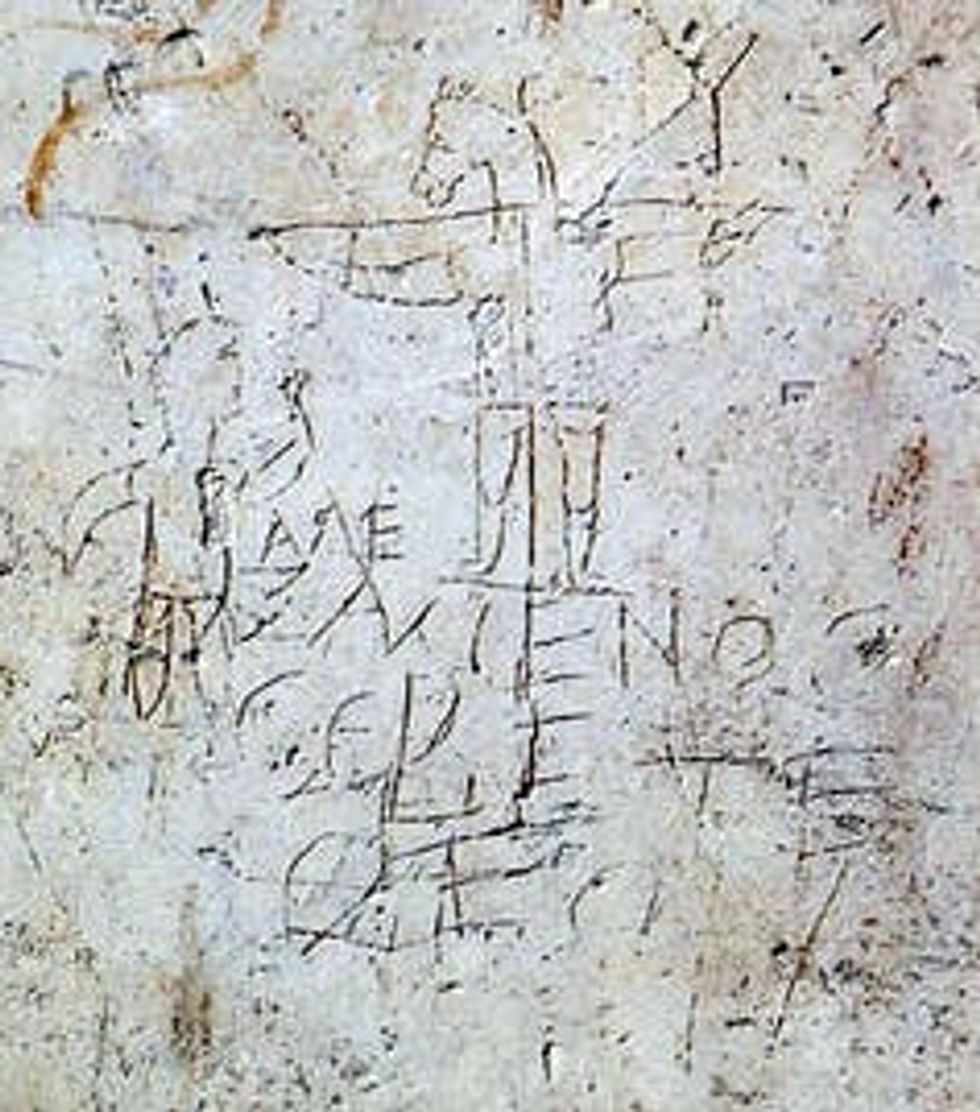
Second century pagan graffito depicting a man worshipping a crucified donkey-headed figure.
A famous piece of early-third century Roman wall art, the “Alexamenos graffito,” depicts two human figures, with the head of a donkey, arms stretched out in a T-shaped cross, with the caption “Alexamenos worships his god.”
Christianity was outlawed at the time in the Roman Empire and criticized by some as a religion for fools. The caricature of “Alexamenos,” offering prayers to this crucified figure was a way of depicting Christ with a donkey’s head and ridiculing his god.
But for Christians, the cross had deep meaning. They understood Christ’s death on the cross to be “completed” by God’s raising him from the dead three days later. This Resurrection was a sign of Christ’s “victory” over sin and death.
Believers could share in this victory by being baptized, forgiven of past sin and “reborn” into a new life in the Christian community, the church. Christians, then, frequently referred to the Christ’s cross both as the “wood of life” and as a “victorious Cross.”
The true cross?
In the early fourth century, Emperor Constantine legalized Christianity. He authorized excavation of some of the holy sites of Christ’s life in what came to be called the “Holy Land.” At the time, it was part of the Roman province of Syria Palestina, bracketed by the Jordan River to the east, the Mediterranean Sea to the west and Syria to the north.
By the fifth century, the legend arose that pieces of crosses were uncovered by Constantine’s mother, Helena, during these excavations. Believers said a miraculous healing took place when a sick woman was touched with one piece, proof that it was a section of the actual cross of Christ.
Constantine built a large church, the Martyrium, over what was assumed to be the location of Jesus’ tomb. The September date of that church’s dedication came to be celebrated as the feast of the “Exaltation of the Cross.”
Helena’s supposed “finding” of the cross itself was given its own feast day in May: the “Invention of the Cross.” Both feasts were celebrated in Rome by the seventh century.
One section of what was believed to be the true cross was kept and venerated on Good Friday in Jerusalem from the mid-fourth century until its conquest by a Muslim caliph in the seventh century.
Later representations
Numerous Christian churches were constructed in the Roman Empire during the fourth and fifth centuries. With imperial financial support, these large buildings were decorated with intricate mosaics depicting figures from the scriptures, especially of Christ and the apostles.
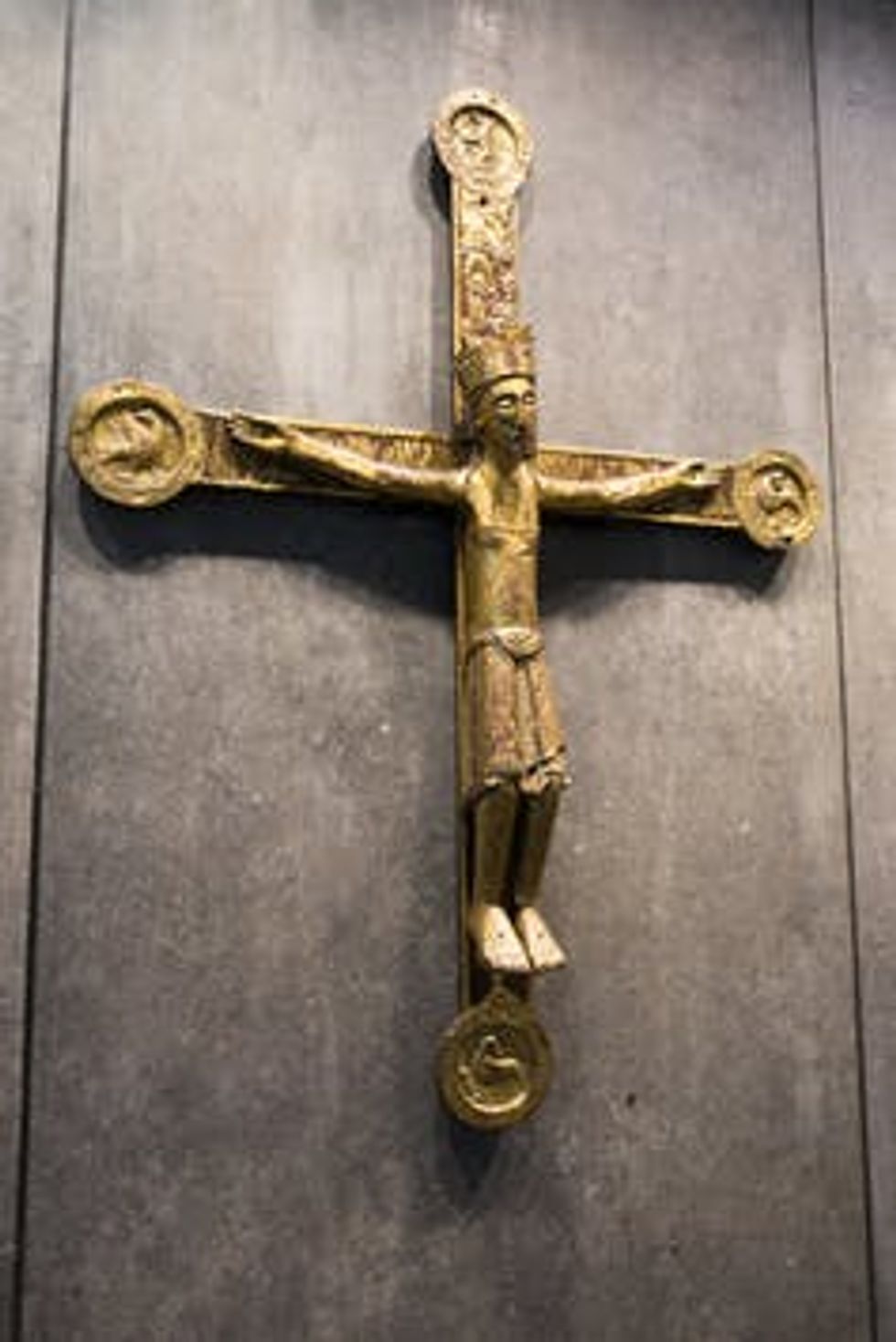
The cross that appears in mosaic is a golden cross adorned with round or square precious gems, a visual representation of the victory over sin and death achieved by Christ’s death. It was called a “crux gemmata,” or “gemmed cross.”
Public veneration of the cross on Good Friday became increasingly common outside of the Holy Land, and this ritual was observed in Rome in the eighth century.
During the medieval period, the crucified Christ was commonly portrayed as a serene figure. The representation tended to change over the centuries, to Christ as a tortured, twisted victim.
Different meanings
During the Reformation, Protestant churches rejected the use of the crucifix. In their view, it was a human “invention,” not in frequent use in the primitive church. They claimed the crucifix had become the object of idolatrous Catholic veneration, and used other versions of a plain cross instead.
Differing depictions of the cross expressed deeper conflicts within Western Christianity.
But even before that, the cross was used in a divisive way. During the High Middle Ages, the cross became connected with a series of religious wars waged from Christian Europe to liberate the Holy Land from the grasp of Muslim rulers.
Those who chose to go and fight would wear a special garment, marked with a cross, over their daily clothes. They had “taken the cross” and came to be called “Crusaders.”
Of all the Crusades, only the first one in the late 11th century really accomplished its objective. These Crusaders conquered Jerusalem in a bloody battle that did not spare women and children in the effort to rid the city of “infidels.” The Crusades also sparked waves of active hostility toward European Jews, resulting in outbreaks of violence against Jewish communities for centuries.
By the 19th century, the term “crusade” came to refer more generally to any kind of struggle for a “righteous” reason, whether religious or secular. In the United States at that time, the term was used to describe a number of religious-social activists. For example, abolitionist newspaper editor William Lloyd Garrison was called a “Crusader” in his political struggle to end the evil of slavery.
Symbol of pro-white agenda
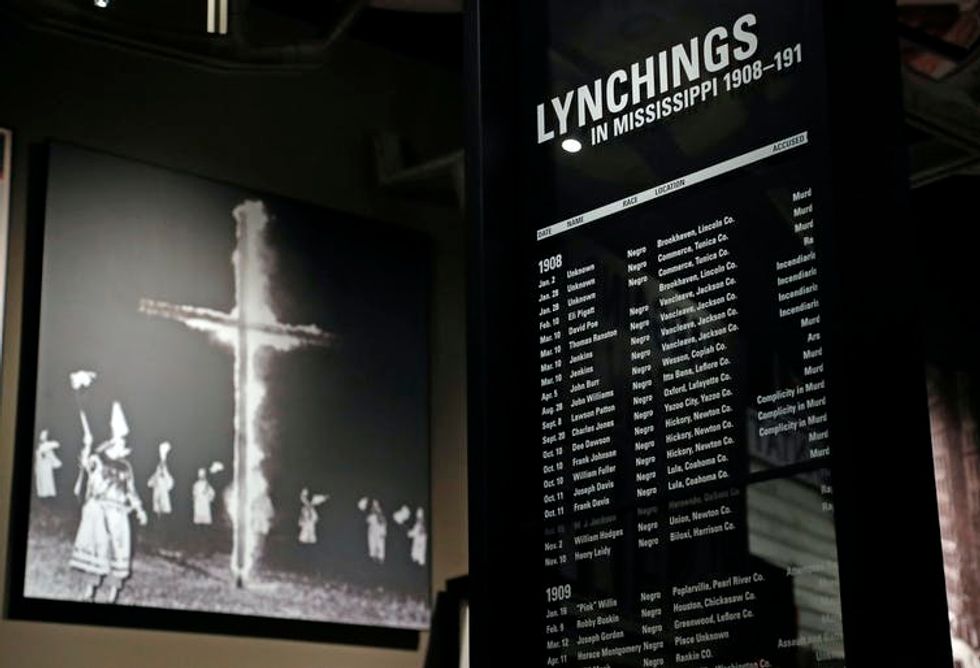
Later the cross was also literally taken up by activists demonstrating against social advances. For example, the Ku Klux Klan, as part of their terror campaign, would often burn plain wooden crosses at meetings or on the lawns of African Americans, Jews or Catholics.
A monolith listing the names, dates and rationale for the lynching of African Americans stands in front of a photograph of a burning Ku Klux Klan cross on display in the Mississippi Civil Rights Museum in Jackson, Miss.
A few decades later, Adolf Hitler’s quest for German expansionism and persecution of Jews, based on his belief in the superiority of the “Aryan race,” came to be crystallized in the sign of the swastika. Originally a religious symbol from India, it had for centuries been used in Christian iconography as one of many artistic expressions of the cross.
Even today, the newspaper of the KKK is entitled The Crusader, and various white supremacy groups use forms of the cross as a symbol of their own pro-white agenda on flags, tattoos and clothing.
The Feast of the Holy Cross focuses on the meaning of the cross as a powerful sign of divine love and salvation for early Christians. It is tragic that the cross has also been twisted into a vivid sign of hatred and intolerance.
The atmosphere of Venus contains traces of phosphine gas -- which on Earth can be attributed to living organisms -- scientists said on Monday, in a fresh insight into conditions on our nearest planetary neighbor.
Conditions on Venus are often described as hellish with daytime temperatures hot enough to melt lead and an atmosphere comprised almost entirely of carbon dioxide.
A team of experts used telescopes in Hawaii and Chile's Atacama Desert to observe Venus' upper cloud deck, around 60 kilometers (45 miles) from the surface.
They detected traces of phosphine, a flammable gas that on Earth often occurs from the breakdown of organic matter.
Writing in Nature Astronomy, the team stressed the presence of phosphine did not prove the presence of life on Venus.
However, as the clouds swirling about its broiling surface are highly acidic and therefore destroy phosphine very quickly, the research did show that something was creating it anew.
The researchers conducted several modeling calculations in a bid to explain the new phosphine production.
They concluded that their research provided evidence "for anomalous and unexplained chemistry" on Venus.
Lead author Jane Greaves, from Cardiff University's School of Physics and Astronomy told AFP that the presence of phosphine alone was not proof of life on Earth's nextdoor neighbor.
"I don't think we can say that -- even if a planet was abundant in phosphorus, it might lack something else important to life -- some other element, or conditions might be too hot, too dry," she said.
Greaves added that it was the first time phosphine had been found on a rocky planet other than Earth.
- 'Exciting' -
Reacting to the study, Alan Duffy, an astronomer from Swinburne University and Lead Scientist of The Royal Institution of Australia, said it while it was tempting to believe that the phosphine was produced by lifeforms, "we have to rule out all possible other non-biological means of producing it".
He called the finding "one of the most exciting signs of the possible presence of life beyond Earth I have ever seen".
Thomas Zurbuchen, associate administrator of NASA's Science Mission Directorate, which has conducted several fly-bys of Venus, called Monday's research "intriguing".
Venus, which rotates in the opposite direction to Earth and where a day lasts 243 times longer, is a subject of intense interest among astronomers.
It is so close and of such similar size to our home planet that some experts believe it serves as a warning of the dangers of runaway climate change.
Previous studies have unearthed tantalizing clues suggesting Venus has active volcanoes, including signs of recent lava flows.
Paul Rusesabagina, whose actions during the genocide inspired the Oscar-nominated film "Hotel Rwanda", was charged Monday with terrorism and other serious crimes in his first court appearance in Kigali.
Appearing drained, Rusesabagina appealed to the court to grant him bail to seek medical attention, however the prosecution argued he was a flight risk and a ruling was pushed to Thursday.
Rusesabagina, who had become a high-profile critic of the government and has been living abroad for years, appeared last month in handcuffs and under arrest in Kigali.
His family say he would never have returned home of his own accord, and believe he was kidnapped while in Dubai. Neither Kigali nor any foreign government have given an account of his arrest.
There was a heavy police presence as Rusesabagina, who is credited with saving more than 1,200 Rwandans during the genocide by sheltering them in a hotel, made his first appearance in court.
He is facing 13 charges including terrorism, financing and founding militant groups, murder and arson and conspiracy to involve children in armed groups.
The stony-faced defendant, wearing a face mask, a beige checkered blazer and khaki trousers, refused to enter a guilty or not-guilty plea, with his lawyers arguing that this will be asked of him when the trial begins in substance.
"Like my lawyers have said, I am sick and in need of constant medical care. In the past two weeks, I have been to hospital three times. I request for bail and I guarantee the court that I will not flee from justice," said Rusesabagina.
The 66-year-old is a cancer survivor and suffers from a heart condition and hypertension, both requiring ongoing medication, his family have said previously.
- A complex hero -
Rusesabagina's heroic tale has grown more complex than the film suggests, with survivors of the slaughter that left 800,000 mostly Tutsis dead accusing him of profiting off their misery.
Supporters of the former manager of the Hotel Mille Collines believe Kigali has worked to tarnish his image due to his strident criticism of the government.
Rusesabagina has lived abroad since 1996 and holds both Belgian citizenship and a US Green Card.
After the genocide, Rusesabagina -- a Hutu -- became increasingly critical of Kagame's Tutsi-dominated government, accusing his ruling party of authoritarianism and anti-Hutu sentiment.
He co-founded an opposition group the Rwandan Movement for Democratic Change (MRCD), which is said to have an armed wing called the National Liberation Front (FLN).
In multiple speeches, Rusesabagina has expressed support for the FLN -- which has carried out armed attacks and is described as a terrorist organization by Rwanda -- but the extent of his involvement in its actions is unclear.
In his address to the court Rusesabagina denied forming the FLN, and said their actions should be blamed on them alone.
He admitted sending some 20,000 euros ($23,000) to FLN commander Callixte Nsabimana -- who is on trial on similar charges -- but denied this was for rebel activities.
"I grew up in the same area as Sankara in Rwanda and my wife was very close to his mother. The money I sent him was meant to provide medication to a child under his care," Rusesabagina said.
Further details of the charges against him will be released during the trial.
Rusesabagina's family has criticised Rwandan authorities for handing him a list of lawyers to choose from, and not giving him access to his own legal team.
"Paul's family reiterates his right to consult with lawyers of his own choosing, particularly given the extraordinary circumstances surrounding his arrest," family spokeswoman Kitty Kurth said in a statement.
Human Rights Watch said last week that Rusesabagina, who was portrayed by American actor Don Cheadle in the 2004 film, was a victim of enforced disappearance.
President Paul Kagame has denied he was kidnapped and suggested he was deceived into returning to the country.
An American woman could be fined after German authorities blamed her for a coronavirus outbreak that sickened dozens.
The 26-year-old woman visited multiple pubs in the Alpine resort of Garmisch despite feeling symptoms from the highly contagious virus, and local officials believe she's responsible for numerous cases, reported The Local.
"The lady had symptoms, came to the test station and was told to stay in quarantine because of the symptoms, said city spokesman Stephan Scharf. "But she did not do so."
The woman, who lives and works in the area, had just returned from a vacation in Greece and was awaiting the results from a coronavirus test.
Health officials said 24 people have tested positive at the hotel where the American woman works, and the city of 26,000 experienced 37 cases on Saturday with a seven-day incidence of 54.
"From a medical point of view, a further significant increase in the number of infections in the district is to be expected", said the District Administrator's Office, which imposed new restrictions after the outbreak. "We want to shut down the nightlife that was the trigger."
Restaurants must now close at 10 p.m., and public gatherings were limited to five people.
Private events are limited to 50 people in closed rooms and 100 people outside.
Bavarian authorities may impose a €2,000 fine for violations of quarantine measures.
President Donald Trump admits in a recording released Monday that he is fond of authoritarian leaders, saying the "tougher and meaner" they are, the better he gets along.
Journalist Bob Woodward played the recording on NBC's Today show ahead of the Tuesday publication of his book "Rage," which is based on 18 taped interviews with Trump.
In the latest snippet of recordings to be released, Trump explains why he is so close to Turkish president Recep Tayyip Erdogan, who has curbed the free media and put tens of thousands of people behind bars in a crackdown in the wake of a failed 2016 coup attempt.
Trump has also drawn attention for his unusually rosy personal assessments of North Korean dictator Kim Jong Un, China's leader Xi Jinping, Russian strongman President Vladimir Putin, Saudi Crown Prince Mohammed bin Salman and other leaders accused of gruesome human rights abuses.
"I get along very well with Erdogan, even though you're not supposed to because everyone says, 'What a horrible guy,'" Trump is heard saying in the interview recorded January 22.
"For me it works out good. I can tell you that the relationships I have, the tougher and meaner they are, the better I get along with them," he said.
The US president, who has expressed "love" for Kim and lavishly praised Xi while squabbling with his traditional democratic allies in NATO, appeared unsure about the reason for his attraction to such leaders.
"You'll explain that to me someday, OK?" he asked Woodward. "The easy ones are the ones I maybe don’t like as much, or don’t get along with as much," he said.
French President Emmanuel Macron on Monday urged his Russian counterpart Vladimir Putin to urgently shed light on the "attempted murder" of opposition figure Alexei Navalny after French tests confirmed the use of the Novichok nerve agent, the Elysée said.
Macron told Putin in telephone talks that it is "imperative that all light be shed, without delay, on the circumstances of this attempted murder and who is responsible", the French presidency said in a statement.
He also informed Putin that France's own analysis had confirmed Germany's conclusion that Navalny was poisoned by Novichok "in contravention of international norms on using chemical weapons".
Putin, for his part, told Macron that it was "inappropriate" to make groundless accusations against Russia over the suspected poisoning of Navalny, the Kremlin said.
The Russian leader said his country wanted Germany to hand over medical test results taken from Navalny, according to a Kremlin readout of the call.
'Independent review'
The German government said Monday that laboratories in France and Sweden have confirmed its own findings that Russian opposition leader Alexei Navalny was poisoned with a Novichok nerve agent.
Chancellor Angela Merkel's spokesman Steffen Seibert said in a statement that Germany had asked France and Sweden "for an independent review of the German evidence (of Novichok poisoning) on the basis of new samples from Mr Navalny", who is receiving treatment in Berlin.
"The results of this review at specialized laboratories in France and Sweden are now available and confirm the German evidence (of Novichok poisoning)," Seibert said.
He said Germany was still waiting for the outcome of a separate evaluation by the OPCW global chemical weapons watchdog.
On the basis of the findings by the three European laboratories, however, Seibert said Germany was "renewing its call for Russia to make a declaration on the events" of the Navalny case.
"We are in close contact with our European partners about further steps," he added.
The 44-year-old Kremlin critic and anti-corruption campaigner fell ill after boarding a plane in Siberia last month and was hospitalised there before being flown to Berlin.
Germany said two weeks ago there was "unequivocal evidence" that he was poisoned with Novichok but Russia has angrily dismissed the findings, saying its doctors found no trace of poison.
'Absurd'
Navalny has now emerged from a medically induced coma and is reacting to speech, Berlin's Charité hospital has said.
The Kremlin has denounced attempts to blame the Russian state for the poisoning as "absurd" and said it wants to know what happened.
Western politicians have said the incident appears likely to have been state-ordered and urged Moscow to prove its lack of involvement.
Navalny's associates believe the use of Novichok shows only the Russian state could be responsible.
The case has prompted international calls for Russia to carry out a transparent investigation or risk sanctions, but the country has not opened a criminal investigation.
Kremlin spokesman Dmitry Peskov said Friday that Russia rejected "when other countries dictate to us what legal procedures we should start and when".
He insisted Russia "de facto" is probing the incident, but cannot open a criminal case "on the basis of tests by the German side, especially when carried out in German military labs".
Russian authorities want to question Navalny at his Berlin hospital, with Siberian transport police, who have been retracing Navalny's movements, saying Friday that Russia would be preparing a request for its officers and an "expert" to shadow German investigators.
While growing up in a high-caste Hindu family near Kathmandu in the 1960s, Ram Bahadur Neupane could see how important cows were to his family. Like other households in Namobuddha, a village on the outskirts of Kathmandu valley, his family depended on cows for milk and oxen to plough land. They would worship cows during Hindu festivals like Gai Tihar, Gaijatra and Govardhan Puja. No ritual would be complete without cows; even the urine and dung of cows was considered sacred and essential for religious rituals.Decades later, Neupane, now 57, says it made him sad to see the animals suffer in the...
Whoever broke into the Bavarian barn was persistent, at least, even if they didn't know their history.The barn, in the village of Pfronten, was broken into several times within a few weeks by people hunting for hidden Nazi gold."They moved all the stuff to the side, tore up the floor and started digging," says Hubert Haf. "They just found rocks though. The barn was only built in 1975."Haf, 82, has spent his whole life in Pfronten, which borders with Austria, and ran a grocery shop there for 30 years. The town gets plenty of tourists keen to visit the ruins of Falkenstein Castle - as well as hu...
Researchers are befuddled by a group of killer whales that are attacking boats off the coasts of Spain and Portugal.The whales appear to have targeted sailboats traveling along the Strait of Gibraltar to Galicia in multiple incidents over the last two months, damaging boats and injuring sailors.Sailor Victoria Morris described an incident to the Guardian that felt “totally orchestrated” after a group of nine whales surrounded a boat and rammed it for an hour.“The noise was really scary. They were ramming the keel, there was this horrible echo, I thought they could capsize the boat,” Morris sai...
Jerusalem (AFP) - Israel said it will reimpose a national lockdown to battle a coronavirus surge, as the number of daily infections around the world reached a record high.Britain, France, Austria and the Czech Republic also reported spikes, as global cases rapidly approached 29 million with more than 921,000 Covid-19 deaths, according to an AFP tally.The Israel lockdown will last three weeks starting Friday, keeping people to within 500 metres (yards) of their homes. It is the first developed economy to take such drastic steps to contain a second wave of infections."I know these measures will ...
Its biggest star is British, and its director is white.
But "Concrete Cowboy," a critically acclaimed new film about at-risk black youths and horse owners in urban Philadelphia, offers a poignant message at a time of mass anti-racism protests in the United States, Idris Elba said Sunday.
The film follows a young black man (Caleb McLaughlin of "Stranger Things") who returns to an impoverished Philadelphia ghetto. He must choose between a life of crime and the close-knit horse-rearing community of his estranged father (Elba.)
"It was incredibly important to us... that we tell this story of the fork in the road that you can take as a young man in this country," Elba told the Toronto film festival, when asked about US anti-black police violence in an online talk.
"America didn't change overnight. These are issues that have been going on for a long time -- even where I'm from in England where there's a huge knife-crime problem," added the London-born star.
Director Ricky Staub stumbled upon the story, adapted from a novel, after spying a black cowboy riding a horse and a bright-red, decked-out buggy down the street outside his Philadelphia office window.
As characters in the film discuss, black cowboys were widespread but have been whitewashed out of history by Hollywood, and black urban riding clubs remain a proud if little-known tradition.
Lee Daniels, best known for directing the Oscar-winning "Precious," admitted he was "shocked" to learn Staub was white, and initially declined to produce the project.
"For a quick minute... you had to really think about it, because I was out," he said. "And then I thought, I prayed, and I was... 'this is ridiculous, I'm in! This cat knows what he's doing.'
"And so then I opened myself up to him."
Reportedly shot for less than $10 million, the movie premiered in Toronto on Sunday.
Reviews praised an "astonishing street-level debut" for shining a light on a unique but fading subculture by using real-life "urban cowboys" as actors.
Elba himself had to overcome a severe horse allergy to film the movie.
"I'm hoping that as a result... people look back at their communities and respect the role that communities play in young men's lives, young people's lives," said Elba, who played a Baltimore slum drug boss to massive acclaim in television's "The Wire."
"Because oftentimes it takes a village."
Another film to use non-actors playing themselves -- "Nomadland," about America's fleet of aging, itinerant van-dwellers, starring Frances McDormand -- screened in Toronto and scooped the Venice festival's top prize earlier this weekend.
Saoirse Ronan ("Lady Bird" and "Little Women") on Sunday discussed another potential Oscar contender that premiered in Toronto -- "Ammonite," in which she stars opposite Academy Award winner Kate Winslet.
The film was inspired by the real life of British fossil-gathering paleontologist Mary Anning (Winslet) and depicts a lesbian relationship with a grieving mother (Ronan) in 19th-century England.
The follow-up to director Francis Lee's "God's Own Country" moves at a gentle pace, but has received a number of rave reviews, with one Hollywood Reporter critic left unable to "think of a single aspect that could be improved upon."
"It takes so much time and care and patience to find the beauty in something and the strength of something -- and that is what these two women sort of do for one another," said Ronan, drawing parallels between searching for ammonite and love.
She added: "It's a very delicate movie."
Toronto, North America's biggest film festival, is taking place mainly online this year due to the coronavirus pandemic. It runs until September 20.