President Vladimir Putin said Tuesday that Russia has passed its peak of coronavirus infections and ordered a World War II victory parade postponed by the pandemic to be held next month.
The postponement of the May 9 Victory Day parade had been a huge blow to Putin, who had hoped to gather world leaders to watch troops march on Red Square to celebrate 75 years since the defeat of Nazi Germany.
But with the number of new coronavirus cases declining steadily in Russia, Putin told Defense Minister Sergei Shoigu to reschedule the parade for June 24.
According to experts, the peak can be considered passed," Putin told Shoigu in a televised video link-up.
"We will do it on June 24, the day the legendary historic victors' parade took place in 1945," Putin said, referring to the first victory parade in Red Square after Germany's surrender to Soviet commanders on May 9.
With leaders including China's Xi Jinping and Emmanuel Macron of France set to attend, this year's parade had been meant as a major showcase of Russia's return to the world stage.
Putin was forced to announce its delay in mid-April as coronavirus infections surged and officials ordered lockdowns across the country.
After peaking in mid-May at more than 11,000 new cases per day, the number of daily infections has dropped below 9,000.
On Tuesday, the country recorded its highest daily death toll of 174 -- a number still far lower than in countries with similar rates of infections -- and said a record 12,000 people had recovered from the coronavirus in the past 24 hours.
Russia has the third-highest number of cases after the United States and Brazil, which officials say is due in large part to a massive testing campaign.
Authorities have been easing lockdowns despite the high number of infections, though tough restrictions remain in place in hard-hit Moscow until at least May 31.
- 'Strict safety measures' -
Putin said "strict safety measures" would need to be put in place for the parade.
"The risks for all participants should be minimized, or even better, eliminated," he said.
Another popular event usually held on May 9 -- the Immortal Regiment processions that see Russians across the country carry portraits of relatives who died in World War II -- will be held on July 26, Putin said.
Russian naval bases will also hold traditional naval parades that day, he said.
Putin has made clear in recent days that he believes Russia has overcome the worst of the pandemic.
On Monday, he made a rare recent appearance for a meeting in the Kremlin, after working remotely from his Novo-Ogaryovo residence outside Moscow for the past few weeks.
The pandemic derailed Putin's plans for a triumphant spring, with not only the parade postponed but also an April vote on constitutional reforms that would have paved the way for the longtime leader to potentially stay in power until 2036.
Officials have said they still hope the vote can be held this year but have yet to announce a date.
The government's handling of the crisis has come under fire, with critics saying Putin initially appeared disinterested in dealing with the pandemic.
One survey by independent pollster Levada showed Putin's approval rating falling to a historic low of 59 percent in April.
In recent weeks he has taken a more direct approach, berating officials for not providing enough protective equipment or promising bonuses to medical workers.
Renowned Italian tenor Andrea Bocelli said Tuesday he had caught the novel coronavirus but was now recovered, describing the experience as "a nightmare".
Bocelli, who has been blind since age 12, raised spirits in Italy during the pandemic, which has killed nearly 33,000 people, by singing alone in Milan's Duomo on April 12.
That was just over a month after the 61-year-old had tested positive for the virus.
"It was a tragedy, my whole family was contaminated," he told journalists at a hospital in Pisa where he had gone with his wife to donate their plasma for COVID-19 research.
The blood plasma will be used by scientists hoping to develop treatments.
"We all had a fever -- though thankfully not high ones -- with sneezing and coughing," Bocelli said.
"I had to cancel many concerts... It was like living a nightmare because I felt like I was no longer in control of things. I was hoping to wake up at any moment," he said.
The singer, who has sold over 90 million records worldwide, said he "thanks God" he was not a politician who had to make decisions but felt there was "too much scaremongering" about COVID-19 in Italy now the crisis appears to have passed its peak.
Montgomery, Alabama Mayor Steven Reed told NPR on Tuesday that his city is experiencing a surge in COVID-19 cases even as the state's government is pushing businesses to reopen.
In his interview, Reed outlined the dire conditions in his city's hospitals and made a plea for people to maintain social distancing and to wear masks outside.
"They're looking for us to sound the alarm and let people know that we're still in the middle of a pandemic," Reed said. "They're running short on PPEs, they're running short, obviously, on beds. The staffs are physically and emotionally spent. So we have to do our part as leaders in the community to make sure we make the public understands that this is not over."
Reed said that he's seen some people in his city acting as though the pandemic has passed even though local hospitals are in crisis mode.
"It's not just themselves at risk when they do that, they put members of the public, their friends, their family at risk, and certainly our first responders and medical professionals," he said.
The report notes that the Paycheck Protection Program, approved by Congress and signed by Donald Trump, was designed to support small companies and assist them with keeping workers employed during the coronavirus pandemic. However, so-called "passive businesses that collect rent and businesses that profit primarily off of price speculation" were excluded as well as companies that primarily develop or lease real estate."
"Because most real-estate firms are private, tracking the number of aid recipients or the total amount of funds the industry has received is next to impossible, say real-estate attorneys and accountants," the Journal reports. "But they are aware of at least dozens of property companies that have received in aggregate tens of millions of dollars or more because of a legal loophole that allows them to apply through related business units, such as management companies or construction companies."
As the report explains, "This means Small Business Administration (SBA) funds could flow to property investors, something that was never intended. Representatives of the real-estate industry have said that even passive real-estate owners employ essential workers and should be eligible for the government funds like any other business."
One such firm, Time Equities Inc, which controls over 30 million square feet of real estate was the recipient of $3.6 million in federal PPP loans, according to Francis Greenburger, the company’s chief executive.
Greenburger claimed that the process to get the money was simple.
"The firm’s PPP lender did minimal due diligence and didn’t check whether the company was eligible for the money, Mr. Greenburger said. “It was really a self-approved process based on the guidelines they set forth, which were so vague as to be basically impossible to understand,” he explained," the Journal reports.
"Critics say that well-financed real-estate companies shouldn’t be eligible for government cash grants. They can raise capital in other ways, by taking out mortgages or selling buildings," the report states. "A company affiliated with Dallas hotelier Monty Bennett, for example, had an agreement to sell a Florida hotel for $120 million, but backed out of the deal after learning it had been approved for millions in PPP loans, according to people familiar with the matter."
According to R.J. Cross with the U.S. Public Interest Research Group. “Unfortunately…the real-estate sector getting money from a program meant for actual small businesses isn’t an anomaly. It’s more evidence that the Treasury and related programs in the Federal Reserve need more oversight.”
One company, Veritas Investments, which manages $3 billion in real estate in San Francisco’s announced they would return the $3.6 million they received back to the government after House Speaker Nancy Pelosi (D-CA) called out the company, saying, “Larger companies like Veritas…which has billions in assets and access to liquidity through other sources, were not the intended beneficiaries of PPP loans.”
"Not every real-estate-loan candidate succeeded. Some property managers said their applications were rejected because the bank didn’t believe they qualified, said Sam Gilboard, manager of public policy at the National Apartment Association," the report added. "Smaller real-estate owners, like family businesses that may own just one building, are less likely to have separate entities for their property-management operations."
The Washington Post spoke with several older Florida voters who said they did not cast ballots for president in 2016 because they didn't like either Trump or Hillary Clinton, but who are now deeply alarmed by what they see as Trump's mishandling of the crisis.
"January and February were totally wasted by Trump," said a 74-year-old Florida resident who wished only to be identified as Tom. "To Trump, in my opinion, the virus is nothing more than an inconvenience to him and his political ambitions. And he doesn’t really care. I don’t believe he cares about the people."
The man said that even though he traditionally leans toward Republicans, he'll be voting for Biden in November.
Julio, another older Florida voter, told the Post that while he's not sure he'll back Biden yet, he cannot imagine himself voting to give Trump a second term.
"He wants to say things, whether they’re true or not, to ingratiate himself," he said. "It’s a problem. There’s a trust factor there. I don’t even listen to him anymore because I can’t believe what he says."
And Allen Lehner, a lifelong GOP voter until the 2016 election, said that he won't be sitting out the 2020 election the same way he sat out in 2016, and will instead vote for Biden.
"Presidents have in the past given leadership or comfort," he said. "But there is nothing coming from our current president."
Appearing on CNN's "New Day" on Tuesday morning, a New Jersey pastor who is defying state orders to stay closed, and plans to sue New Jersey Gov. Phil Murphy (D) if he doesn’t designate places of worship essential, was confronted by Alisyn Camerota for refusing to wear a mask during his Sunday sermon.
With Pastor Charles Clark II of the Solid Rock Baptist Church in Camden County saying the governor is infringing on his 1st Amendment rights by forbidding in-person services during the coronavirus pandemic, Camerota pressed him over whether he wore a mask during this past weekend's sermon.
"It sounds like you're bending over backwards to do all the right things, even things that are beyond what is necessarily officially recommended and I'm sure that's helpful. But it is actually your behavior in front of the congregation that could possibly be the riskiest. I'm sure you heard -- hold on," she began as he attempted to interrupt. "Let me just state the case as is stated by the National Academy of Sciences. You projecting in front of the congregation, it is your sermon. It is the idea that you would take off the mask for that, and the reason that I say that is because there is research that shows that one minute of loud speech, the kind you would do while projecting, produces thousands of droplets that then remain airborne for 12 minutes. And so everybody else, it seems, is doing pretty risk free or as low risk behavior as you can, but yours might be the most dangerous."
"We're up on a platform and we have a distance between us and the first pew that is more than six feet. And so I understand what is being said, the whole idea of the mask or not the mask, including back to things Dr. [Anthony] Fauci has said at times, the mask is very controversial, we are wearing them," he attempted. "I, being on the platform, people that are back away from the first pew, I don't think that's uncommon including in press conferences and where the president and others have spoken, that there is a distance between us and the parishioners, and so every time we come off the platform, we do put our mask on."
"Yeah, I mean, it is the problem with the projecting. I'm heartened to hear about the choir, because it is the singing that gets people sick," Camerota countered. "But it is the projecting of the pastor and there are a couple of instances where we can look to see that parishioners get sick. In Arkansas, a pastor and his wife infected 35 people doing just that kind of preaching, three people then died. In Washington, that was a choir, but there was one person sick in a choir who because of singing infected 71 people, two of them died."
"The reality is in spreading of the virus, there are no guarantees," Clark shot back. "Everyone that I know is trying to be as safe as possible. But this idea that because I'm up on a platform, somehow I'm going to infect a whole entire congregation, that doesn't make sense."
"It is because you're speaking loudly," the CNN host explained. "Not because you're on a platform. because you're speaking loudly."
"I understand that," the pastor exclaimed. "But if I was on the New Jersey boardwalk today or if I were to be in Home Depot today, if I were to be in the grocery store today, and I know some -- I know we're wearing masks in those places -- but we're putting on a mask."
"There is no guarantee of with me wearing that mask or not that it is going to make it perfect being there on the platform," he added.
"I know," Camerota replied. "It is all about cutting down on risk and that's it. What you can do is cut down on risk."
A financial expert on Tuesday gave CNN viewers a crash course in how to handle their personal finances in the middle of the COVID-19 economy.
In an interview with host John Berman, HerMoney.com CEO Jean Chatzky warned that many scammers right now are trying to take advantage of people's dire credit situations caused by the COVID-19 recession.
"Right now we have seen a lot of scam artists in the water," she said. "We want to make sure that we... are taking care of handling your situation well."
She said that the best way to avoid getting into a desperate situation is maintaining a high credit score, and she said that people should make sure to use all their credit cards for at least one purchase a month, as credit card companies are now enacting stricter credit limits on cards that are rarely used.
Chatzky also advised people who are hunkering down and not making any major purchases during the pandemic to freeze their credit.
"It is a great move to protect yourself against identity theft," she said. "We have got a step-by-step guide on how to do it at HerMoney.com, but it is really easy, get in touch with the credit bureaus, say you want to freeze online or on the phone, and you don't have to worry about somebody else taking out credit in your name."
One consequence of the public’s compliance with social distancing and quarantines during the COVID-19 pandemic is a sharp decline in most types of crime. It looks like people staying home made communities less conducive to crime.
Unfortunately, the news isn’t as good as those numbers alone suggest. Other settings are seeing an increase in crime following the stay-at-home orders. One is the household, where domestic violence is likely to have increased in the past two months.
As researchers who study cybercrime, we’re finding that criminal activity seems to be on the rise in the online world, as well. At the same time, many people are relying more heavily than before on online services for work, entertainment and shopping. This makes them more likely to become the targets of different types of online crimes. And the websites and online platforms that these internet users access become more attractive targets to motivated hackers who aim to take them over and deface them.
Wave of website defacing
Website defacement is the online equivalent of graffiti vandalism. It occurs when a hacker infiltrates a server on which a website is hosted and changes the content of the website with images and text of their own choosing.
Unlike more sophisticated forms of hacking, the act of website defacement does not require hackers to have highly sophisticated skills. In fact, several hacker typologies suggest that this form of online crime can be a stepping stone to involvement in more sophisticated hacking, as well as a way to gain a reputation in the hacking community.
A website of a U.K.-based canoe and kayak club was recently defaced.
sreen grab by David Maimon
The harm suffered by victims of this online crime varies from loss of trust in the owner of the website to loss of revenue. When business websites are taken down by hackers, they can’t process transactions. During the coronavirus pandemic, many merchants have been forced to shift from face-to-face trade to e-commerce, which means it’s likely that more businesses will become victims of cybercrime.
Findings from a recent analysis we conducted based on information about website defacement activities reported on the hacker information site Zone-h, suggest that the average daily number of website defacement attacks reported in April 2020 is 50% higher than the average daily number of attacks reported in April 2019. Moreover, the volume of website defacement attacks reported by mid May 2020, has already surpassed the volume of attacks reported in May 2019 for the entire month.
This steady increase in the number of daily website defacement attacks started in late March 2020, while January and February stayed steady. This leads us to believe that the pervasive isolation imposed by governments around the globe has given hackers more time to spend online, which became the driving force behind this trend.
Smaller sites in the crosshairs
Our investigation of the types of websites that are being targeted by hackers reveals that large corporations and government entities are less likely to be the victims. The average daily number of sophisticated defacements against government agency and large private business websites have increased from 17.75 attacks per day in February to 21.6 attacks per day in April.
However, the frequency of those attacks is substantially lower than the overall average daily number of website defacements reported by hackers during that period. It appears that websites of small businesses, social clubs and private individuals are being disproportionately targeted by hackers.
Website defacers prefer to attack extremely vulnerable websites because many of them are inexperienced hackers, often referred to as script kiddies. They lack the skills required to attack high-profile targets, but are motivated to gain status among their online peers.
Findings from our analysis suggest that the number of newbie hackers who experiment with website defacement has grown rapidly during the COVID-19 crisis. The average number of reports of defacements by first-time hackers in February was 3.41 per day. In April the number was 6.31 per day, a 77% increase in the number of first-time hackers.
With more new hackers attempting to establish a reputation by attacking vulnerable websites, it is imperative that small business owners and individuals protect their websites from attacks. Protection strategies should include keeping the software used to maintain websites up to date, using strong passwords to access the servers that host the websites, preventing website users from uploading files, allowing users to connect to websites via the secure internet protocol (HTTPS) and using website security tools. Fortunately, visitors to defaced websites are generally not at risk.
Vicente Arenas moved to the edge of Denver’s Valverde neighborhood, attracted by low housing prices and proximity to his downtown job just three miles away.
The 1-square-mile neighborhood mixes small, ranch-style homes with auto body shops, metal fabricators and industrial supply warehouses, and is hemmed in on its four sides by state highways and interstates. Much of Valverde is devoid of streetlights and wide sidewalks, a fact that Arenas laments. But he immediately felt a strong kinship with the local Hispanic population, which comprises 81% of residents.
“There is a real sense of familia in this area,” Arenas says, “where every house has multiple generations from the grandparents down to the little kids, families are piling into trucks together, and you’ll see five guys crowded around trying to fix an engine. And then there’s the smell of fresh tortillas every night.” The neighborhood is most vibrant in the evenings, he explains, when residents return home after long work days in the construction and food service industries.
But what makes Valverde so attractive to Arenas might also have raised its risks amid the coronavirus pandemic. Its location brings air pollution that can increase the risk of serious respiratory problems, bustling homes makes social distancing nearly impossible, and commuting together increases exposure to potentially infected individuals.
Public health officials and urban planners have long known that one’s ZIP code is an especially reliable indicator of educational attainment, lifetime earnings and even life expectancy. Near Washington, D.C., for example, residents of Chevy Chase can expect to live nearly 33 years longer than those from Barry Farm, a neighborhood just 10 miles away.
ZIP code is also a great indicator of risk for disease transmission. Across the U.S., in cities as diverse as Austin, New York City and San Francisco, lower-income communities of color are experiencing disproportionately high rates of COVID-19 infection, hospitalization and death.
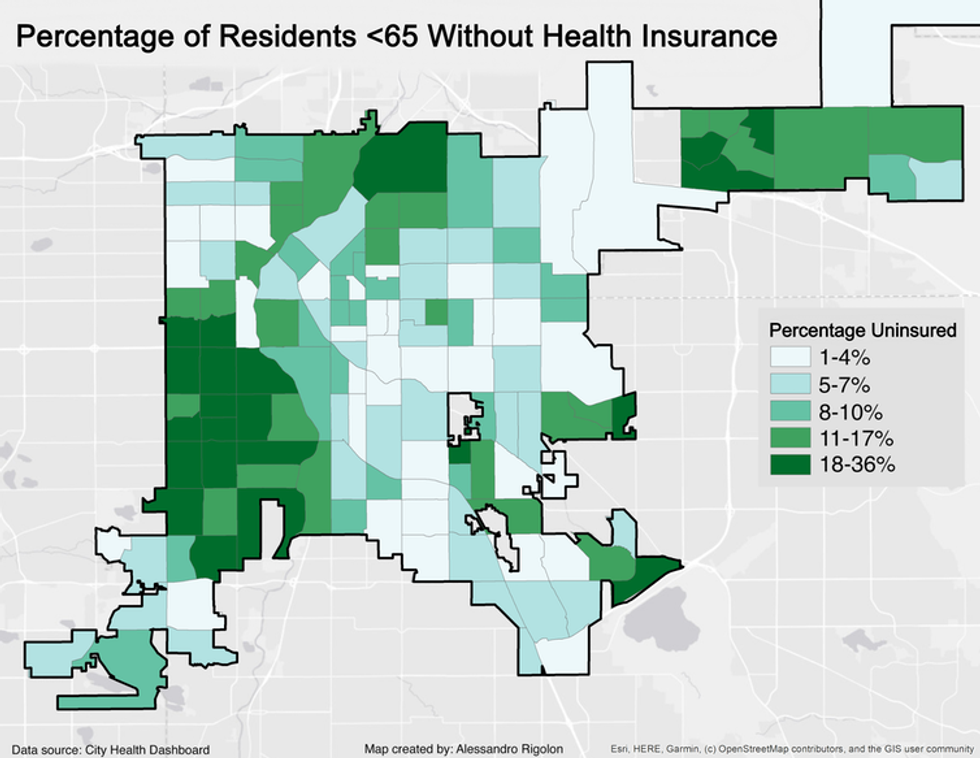
One set of explanations for these geographical disparities focuses on the individual circumstances of neighborhood residents. Indeed, for the 60% of low-wage U.S. workers lucky enough to have kept their jobs through the crisis, those in “essential service” positions like construction, food preparation and retail cannot simply Zoom with colleagues from home. They often rely on family members, who may themselves be in high-risk age groups, for child care and depend on crowded public transit for their commutes before returning home to crowded apartments or houses. And those with limited English fluency often struggle to obtain reliable health information. Lacking health insurance often leads people to delay seeking medical care, sometimes resulting in severe health consequences.
Yet few people have focused on how neighborhood characteristics, or environmental factors, might play a role in virus transmission. Is it possible that neighborhoods themselves are making people sick?
It’s likely. The CDC says that people with asthma are at higher risk for severe illness if they contract COVID-19, and rates of asthma are notoriously elevated near highways like those surrounding Valverde. Diabetes, hypertension and obesity rates are also strong risk factors for virus contraction; these conditions are linked to physical activity and diet, which are themselves directly influenced by access to quality walking and biking infrastructure, parks and healthy food outlets, all features that tend to be lacking in disadvantaged neighborhoods.
The legacy of redlining
Why does this geographical clustering of disadvantage and privilege occur in cities around the U.S.?
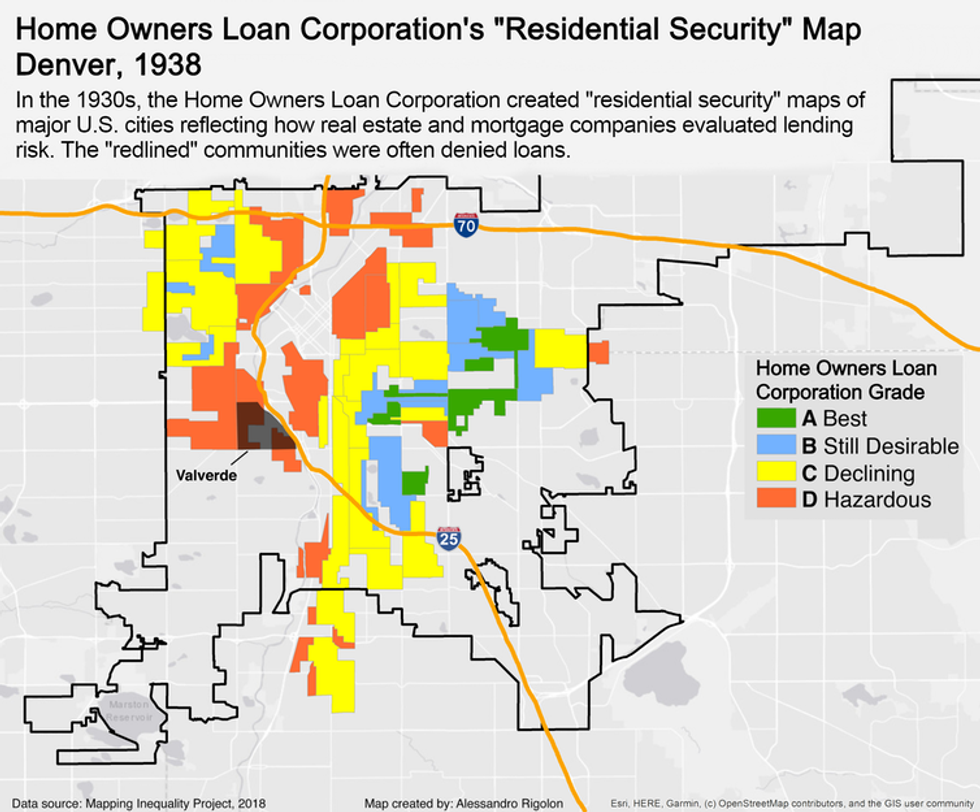
Much of our present-day disparities in health, wealth and social mobility can be traced back to the 1930s, when Valverde and similar neighborhoods were “redlined” by the Home Owner’s Loan Corporation. In this racist practice, banks drew red lines on a map around neighborhoods with populations of color, restricting lending in these places and starving them of investment for generations to come.
In Denver, decades of legally sanctioned disinvestment and segregation made redlined neighborhoods fertile ground for the siting of polluting industrial facilities and two interstate highways, one of which runs directly through Valverde – a familiar story in cities around the U.S..
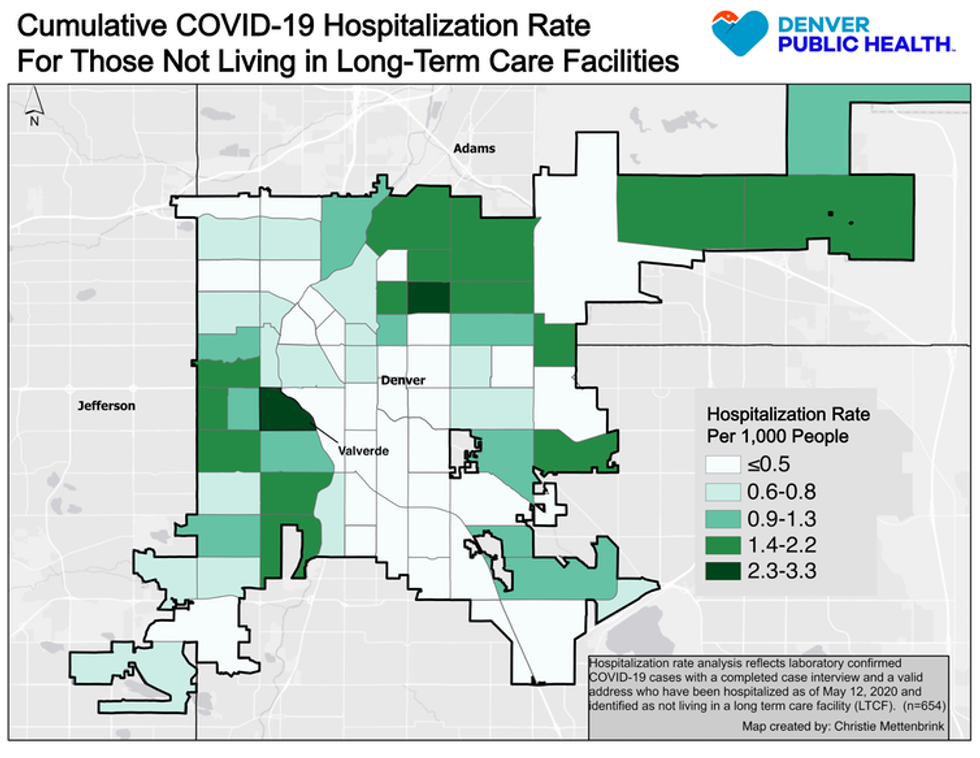
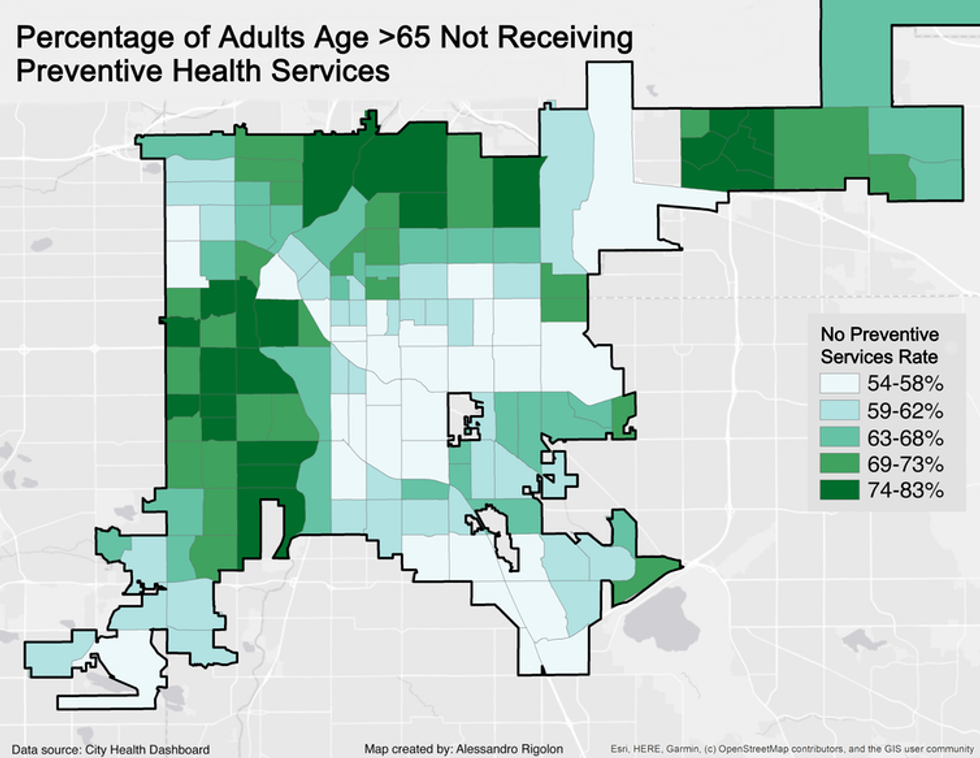
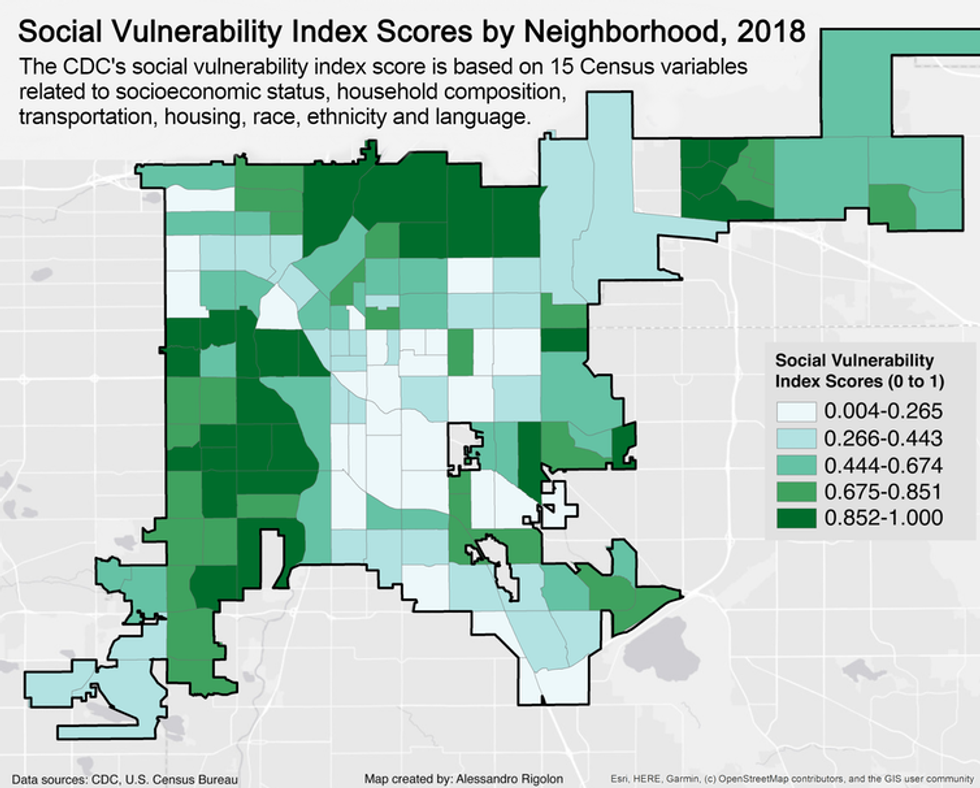
These inequities have contributed to vast differences in levels of social vulnerability – the constellation of individual and environmental circumstances that weaken a community’s ability to prepare for and respond to crises like this pandemic. Mapping scores on the CDC’s Social Vulnerability Index in Denver reveals how these clear patterns of disadvantage coincide with COVID-19 hospitalization rates.
In the short term, critical efforts can include widespread free testing events in vulnerable neighborhoods, along with distribution of free hand sanitizer, cleaning supplies and masks, which also helps ensure that at-risk residents do not have to travel on crowded public transportation to shop for these items. This is also an opportunity to link uninsured residents to health care coverage and primary care providers.
Denver Mayor Michael Hancock recently said the city is committed to “taking the test to the people, particularly where our most vulnerable residents live.” And in April, San Francisco rolled out temporary field care clinics in at-risk neighborhoods. Health care workers in these dispersed clinics are trained to provide culturally and linguistically appropriate medical information about what to do if one feels sick, what testing and treatment options exist and how to prevent further spread of COVID-19.
In the longer term, urban planners have demonstrated how a commitment to building healthy urban environments – those that prioritize walking and cycling, promote recreation, produce more affordable housing, allow residents to access healthy food locally and provide public transportation options – can have long-lasting impacts for all residents.
In addition, locating neighborhood health centers in at-risk neighborhoods has been proven to improve health and build a sense of community trust that can be instrumental in times of crisis.
America is at a crossroads, and cities can embrace this opportunity to address health disparities. Health care officials and urban planning professionals are beginning to work together to help lift communities from the legacy of discriminatory policies. By employing interventions that acknowledge the power of place, the country can mitigate harm from the current epidemic and help create more just, healthy and resilient communities that are better prepared for future challenges.
Reporting on the decision by officials in the state of Alabama to move toward fully re-open despite the rising tide of coronavirus infections, CNN sent cameras down to a beach in the state where crowds packed the sand over the Memorial Day weekend and many beachgoers they interviewed were dismissive of the possibility they could become infected by the deadly virus.
Reporting from the state, CNN's Gary Tuchman noted, "Social distancing is the state's rule, but that effort has often been an exercise in futility at the beaches and bars on Memorial Day week as people come back to party. At this restaurant in Gulf Shores, Alabama, many wonder why it took this long to open."
According to one beachgoer, identified as Bailey Karr, "Everybody's got to go somehow."
"You mean die?" the CNN correspondent asked.
"Yeah, but in a way -- I mean, I don't want to die," the recent college graduate replied. "But if that's what God has in store for my life, then that's okay."
According to another beachgoer, "My family has the same mindset as me, and we kind of just agreed if we get it, we get it. We're going to handle it as a family and just get over it, because that's what a family does."
Yet another beachgoer defended not wearing a mask because Donald Trump doesn't wear one in public.
"I mean, if he's not wearing a mask, I'm not wearing a mask. If he's not worried, I'm not worried," he told Tuchman.
British Prime Minister Boris Johnson's government was hit by its first resignation on Tuesday over the controversy surrounding top aide Dominic Cummings' cross-country trip during the coronavirus lockdown.
Undermining attempts by ministers to try and move on from the crisis which has dominated British politics for days, Douglas Ross, a minister for Scotland, quit in protest.
"I have constituents who didn't get to say goodbye to loved ones; families who could not mourn together; people who didn't visit sick relatives because they followed the guidance of the government," he said in a Twitter statement announcing his departure.
"I cannot in good faith tell them they were all wrong and one senior advisor to the government was right."
He added that Cummings' interpretation of government rules was "not shared by the vast majority of people".
The resignation will pile more pressure on Cummings, who held an extraordinary press conference Monday to justify driving his wife and young son on a 264-mile (425-kilometer) trip from London to Durham in the northeast of England during the height of the coronavirus crisis.
- 'Lack of credibility' -
Not long after Ross quit, Harriet Baldwin joined a growing list of Conservative MPs calling on Cummings to resign.
Tory party grandee Michael Heseltine told Sky News that "the lack of credibility" in Cummings' version of events was "damaging the government".
Some members of the clergy have also called on him to stand down as well as opposition party members, who will meet later today regarding the crisis.
Downing Street said it "regrets" the decision by Ross.
The resignation came after a cabinet heavyweight defended Cummings and said the controversial aide did not break the law.
Michael Gove, Chancellor of the Duchy of Lancaster, said Cummings had acted reasonably in driving from London to Durham and then taking a separate journey to a local beauty spot, Barnard Castle, to -- as he claimed -- test his eyesight.
"What's clear is that he didn't break the law, he didn't break the rules, he sought to protect his family and he also sought to ensure that the risk of anyone in his family infecting anyone else was absolutely minimized," Gove told the BBC on Tuesday.
Cummings drove to his parents' home in Durham after feeling ill because he and his wife, who was also feeling unwell, needed possible back-up childcare for their young son.
Despite calls for him to resign, Cummings has so far resisted and instead defended his actions.
He told reporters he had acted "reasonably and legally".
The prime minister called Cummings' actions "plausible".
Also on Tuesday, the Office for National Statistics said the number of deaths in Britain "involving" the coronavirus had risen above 46,000, far higher than the 36,914 deaths officially confirmed in the government's count.
Italy's world-famous archaeological site Pompeii reopened to the public on Tuesday as the country's coronavirus lockdown lifted -- though there were more guides than tourists.
The exceptionally-preserved remains of an ancient city, covered in volcanic ash nearly 2,000 years ago after the eruption of nearby Mount Vesuvius, are usually the country's second-most visited site after the Colosseum in Rome.
But on Tuesday its most iconic ruins, like the Amphitheater, lay absolutely empty.
With foreign tourists still prohibited from travel to Italy until June, the site that attracted just under 4 million visitors in 2019 is hoping that for now, Italian tourists can make up at least a fraction of the difference.
Visitors will take a mandatory route, but a second itinerary will be added on June 9. Tickets cost five euros, but people will have to reserve ahead and have their temperatures checked by a thermal scanner on entering.
Among the first of the few through the gates Tuesday were an American couple from Detroit who had tried to visit just before the lockdown but found it closed. They have been staying in an Airbnb in Pompeii ever since.
"It's now been almost three months," Marvin Hewson said, adding that they had spent a lot of time looking at the ruins from the outside.
"It's fantastic, well worth the wait to see them up close," said his wife Colleen.
- 'Emptiness, sadness' -
Not all were as chipper. Valentina Raffone, 48, who has been a guide at the site for some 20 years, said there was a "sense of emptiness, of sadness, of post-eruption (post-disaster)."
"It's only us guides, and journalists," she said, pointing to some 35 guides milling aimlessly around the entrance.
The site had just celebrated the culmination of a long $113 million (104 million euros) restoration when the coronavirus crisis hit Italy and museums and cultural sites were closed in March.
The project, which began in 2012, was paid for largely by European Union funding and enlisted large teams of archaeologists, architects, engineers, geologists and anthropologists.
New treasures seen by few tourists before the lockdown included the ancient frescoes and centuries-old tile floors of the "House of Lovers," a two-story home that had been closed to the public since 1980 after an earthquake, and the "House of Orchards," featuring intricately detailed frescoes of fruit trees and birds.
Earlier, in October, archaeologists discovered a vivid fresco of an armour-clad gladiator, his opponent gushing blood beside him, on the walls of what was believed to be a tavern housing the fighters and prostitutes.
ABC News senior national correspondent Terry Moran got more than he bargained for when he questioned whether it was wise for former Vice President Joe Biden to wear a mask during a global pandemic that has killed nearly 100,000 Americans.
In a tweet posted Monday night, Moran posted a photo of Biden wearing a mask to a Memorial Day service and then asked, "Do you think this is a good look for a President of the United States? Or do you think this is a bad look for a President of the United States?"
The response from Moran's followers was that it was a very bad look for a reporter to be making aesthetic judgments about mask wearing during a time of mass death.