An Alabama father is dead after he told his teenage son to clean his room.
The Associated Press reported the teen's 12-year-old brother is still in critical condition after a shooting in their home.
Rick and Linda McNamara told WAFF-TV that their 43-year-old son Chad Wanca was shot and killed this week when a domestic incident erupted after their 16-year-old grandson was told to clean his room.
“I’m going to the hospital. I hope I’ll be able to get in and see my grandson. I’d like to go to the jail as well and see my other grandson. I want to talk to him. I don’t know where his head is at. I love my grandsons. I love them both,” said Linda McNamara.
Deputies received multiple 911 calls and the teen was outside when they arrived. Mrs. McNamera said she wasn't allowed to see her grandson that is in jail at this time, but hopes she can in the future.
“We hope to. I really would and need to talk to my grandson and let him know that we are there for him,” she said.
Reports have not revealed where the 16-year-old obtained his gun.
A top vendor complained it would “not tolerate” further contact between the official and its employees.
The National Rifle Association over the past two years has grappled with two separate sexual harassment allegations against Josh Powell, a senior official, including a case involving an employee.
The employee’s complaint was settled in 2017 using the nonprofit’s funds, according to three sources familiar with the matter. Earlier that year, Wayne LaPierre, the organization’s leader, had promotedPowell to executive director of general operations.
ProPublica could not confirm the settlement amount, which is not noted in the nonprofit’s public filings. In a statement, John Frazer, the NRA’s general counsel and secretary, told ProPublica that Powell denied the allegations.
“The NRA opted to confidentially resolve the matter in the best interest of all involved,” Frazer said.
The disclosure of the settlement comes amid a stream of reports alleging mismanagement and questionable spending by NRA leadership. The organization faces congressional inquiries and investigations into its tax-exempt status by attorneys general in New York and Washington, D.C.
Powell is a top adviser to LaPierre and is among the NRA’s highest-paid officials, with compensation of nearly $800,000 in 2017.
In a separate harassment dispute in 2018, Powell’s behavior toward a woman who works for Ackerman McQueen, then the NRA’s advertising firm, escalated tensions in their decadeslong business relationship and caused Ackerman to bar him from any further contact with its employees.
Ackerman told ProPublica in a written statement that the firm “formally declared to Mr. LaPierre that it would not have any more dealings with Mr. Powell.” Ackerman said there was “clear reason to believe supported by evidence that he sexually harassed one of our employees and we would not tolerate his further involvement with any of our employees in order to protect their right to a safe work environment.”
Ackerman said the NRA “refused to cooperate” in addressing the complaint against Powell. Instead, Ackerman said Powell received “the full support of Mr. LaPierre and the board of directors.”
Over the last four months, Ackerman and the NRA have been locked in litigation in Virginia state court, with the gun group accusing the firm of dubious billing practices and Ackerman countersuing for defamation. Before the legal dispute, the two entities spent four decades working closely together. Ackerman helped shape the NRA’s messaging and public image.
The NRA responded to Ackerman’s statement on behalf of itself and Powell. A spokesperson for the organization called the firm’s claim part of a larger “extortion demand,” in which Ackerman said the NRA “must withdraw” its lawsuit “or face a smear campaign that would include sexual harassment allegations against one of its executives. Ackerman is now delivering on its threat. We are not surprised.”
Ackerman said the NRA’s “false” narrative “grows more ridiculous each day,” and its response to Powell’s actions created what became an irreparable rift in the business relationship, which brought tens of millions of dollars annually to Ackerman. “We believe our decision to take this decisive action to protect our employees contributed to the program of retaliation against Ackerman McQueen, and NRA Board members were not being told about these problems,” Ackerman’s statement says.
But NRA spokesman Andrew Arulanandam said the organization “acted appropriately and swiftly” in response to the harassment allegation involving Ackerman. “The NRA removed Mr. Powell from his position as liaison between the NRA and Ackerman, and Mr. Powell had no further involvement with Ackerman.”
The spokesman called Ackerman’s harassment allegations “cryptic,” adding that they “first surfaced in October 2018, shortly after Mr. Powell participated in an effort to significantly reduce Ackerman’s budget with the NRA. Immediately, remarks allegedly made more than a year before became fodder for a harassment claim — accompanied by a demand that Mr. Powell be excluded from any further budget negotiations with the agency. The NRA committed in good faith to investigate the allegation, but the accuser and Ackerman declined to participate in any interview about the alleged incident.”
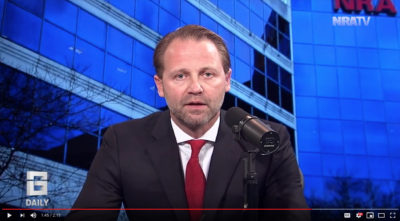
NRA chief of staff Josh Powell appearing on NRATV in 2018. Powell has been accused of sexual harassment in two separate instances over the past two years.
Despite recent negative publicity, the NRA continues to have broad support among Republican members of Congress and with President Donald Trump, who was elected in 2016 after the NRA spent more than $30 million to boost his candidacy. After recent discussions with LaPierre, in the wake of mass shootings in Dayton, Ohio, and El Paso, Texas, Trump has reportedly backed away from favoring more stringent background checks for gun owners.
After receiving a tip, ProPublica asked Ackerman to respond to questions about a harassment complaint involving one of its employees. The woman who filed the complaint did not respond to a request for comment.
Powell has served as LaPierre’s chief of staff since 2016. In December 2018, after the Ackerman dispute occurred, LaPierre announced to staff that Powell would step away from his additional duties as executive director of general operations and join the NRA’s legal team as a “senior strategist” in a high-stakes lawsuit that had been filed that spring against New York Gov. Andrew Cuomo and the New York Department of Financial Services.
Powell has long been a source of contention among NRA staff and even some board members. Before arriving at NRA headquarters in 2016, he ran two upscale clothing catalogs that were intended to appeal to wealthy outdoorsmen. Vendors working with Powell sued him on at least 20 occasions, alleging unpaid invoices totaling more than $400,000.
In 2018, Powell came under scrutiny from NRA accountants. In a document that compiled a list of “top concerns” for the board’s audit committee, which provides the organization with fiscal oversight, arrangements that involved Powell and posed alleged conflicts of interest were repeatedly flagged. The accountants noted payments to Powell’s father, a photographer, and referenced his wife, Colleen Gallagher, who in late 2017 was hired by one of the NRA’s top fundraising vendors, McKenna & Associates. An NRA spokesperson said in May that the audit committee was “aware of the relationship and approved the consulting arrangement with McKenna.”
In June, Robert Brown, an NRA board member, emailed LaPierre and Frazer about Powell. ProPublica obtained a copy of the note, which is addressed to Frazer. “John,” it says, “Since Wayne refuses to respond to my emails, plez pass on to him the message below.”
“Wayne,” the message reads, “At the last NRA BoD meeting, you promised me you were going to terminate that worthless scoundrel, Josh Powell, in 60 days. Well, 60 days have passed. When are you going to fire him?”
Brown declined to provide a comment for this story. “I do not discuss internal NRA politics with the media,” he told ProPublica in an email. “Period.”
When the alleged gunman walked into an El Paso Walmart earlier this month to carry out the worst massacre of Hispanic people in recent American history, he went in with an assault weapon he said he bought from Romania, according to a Texas Department of Public Safety report obtained by The Texas Tribune.
The white 21-year-old suspect in the shooting told El Paso police shortly after his arrest that the Romanian AK-47 was sent to a gun dealer near his home in Allen, a suburb outside of Dallas. He also said he bought a thousand rounds of ammunition from Russia.
El Paso police previously said that the AK-47 used in the shooting that killed 22 people was bought legally, but they did not provide any additional details about its purchase. In a manifesto published just before the shooting, the alleged shooter said the rifle was a WASR-10, a semi-automatic version of a Romanian military AK-47 weapon. The DPS report obtained by the Tribune includes a summary of the suspect's interview with police, providing more details on the weapon and the suspect's actions in the racist slaying where he said he “wanted to shoot as many Mexicans as possible.”
DPS referred questions about the report to the El Paso Police Department, which declined to comment on the investigation. The suspect's lawyer did not respond to request for comment.
Gun experts said it’s common for people to buy imported firearms online and have them delivered through local gun stores, which complete the necessary background check. Although the suspect said he purchased the gun from Romania, they said he likely bought online a Romanian-manufactured gun that had been imported into the United States.
“Primarily the reason that people are attracted to these imports is that they’re less expensive,” said David Chipman, a senior policy adviser at Giffords, a national gun control group, referring to similar U.S. weapons like the AR-15.
The suspected shooter told El Paso detectives shortly after his arrest that the Romanian rifle was delivered to “Gun Masters” in Allen, where he picked it up, according to the report. There is no store with that name in Allen, but there is a Gunmaster gun shop in neighboring Plano.
Gunmaster’s owner couldn’t be reached Tuesday by The Tribune. Brian Park, the store’s gunsmith, said he didn’t know if the El Paso shooter received the AK-47 from his store. When a reporter mentioned the alleged shooter referenced a store called Gun Masters in Allen, Park said, “That would be us.” But, Park added, he thought he would have heard if the shooter received his weapon from his store.
Gun imports are regulated by the U.S. Bureau of Alcohol, Tobacco, Firearms and Explosives, and high-powered semi-automatic weapons must be recognized as being used for "sporting purposes," not military use, to be admitted, according to a bureau guidebook. Last year, Romania exported about 9,000 semi-automatic rifles to the U.S., according to an Arms Trade Treaty report.
“Largely, today these styles of assault weapons are being characterized as sporting weapons,” Chipman said, adding that the interpretation varies in different presidential administrations.
Chipman said the importer for the WASR-10 was likely Florida-based Century Arms, which makes any modifications to ensure they’re legal in the U.S. and then transfers the purchased guns to local dealers. Century Arms did not return calls or emails from the Tribune.
Michael Cargill, owner of Central Texas Gun Works in Austin, said the process is similar to buying a foreign car — but with an added federal background check of the buyer at the local store.
“Think of it like a BMW or a Mercedes,” he said. “You get it through a local dealer here.”
Ammunition bought online, however, can be shipped directly to your door if it’s legal in the receiving state, Cargill said. Only six states and Washington, D.C., have bans on possessing assault weapons, according to the Giffords Law Center to Prevent Violence. Texas is not one of them.
In addition to information about the weapon, the alleged gunman told detectives about his manifesto, seemingly confirming he wrote the hate-filled writings that described the attack as a “response to the Hispanic invasion of Texas.” After the discovery of the manifesto, federal authorities began investigating the shooting as an act of domestic terrorism.
According to the DPS report, the suspect told police he went into the Walmart, went back out to his car to finish and publish the manifesto, and then walked back into the store to kill Hispanic shoppers.
The report also said the suspect, wearing ear protection and carrying an assault weapon, “was surprised no one challenged him or shot him” when he walked into the store. Under Texas law, no license is needed to openly carry a rifle in public. He also said that after the shooting, he left in his car and called 911, but he couldn’t get through to a dispatcher. He told detectives he was returning to the store to surrender when he encountered Texas Rangers.
On Wednesday, WBZ CBS News reported that a Boston teenager attending college at High Point University in North Carolina has been arrested on suspicion of plotting a mass shooting.
Paul Steber, a freshman, was arrested after campus police became aware he had illegally brought guns and ammunition into his dorm, and notified the authorities. Upon being questioned, Steber revealed he had a plan to shoot up the school. One officer said that he had a "plan and timeline to kill people."
According to WBZ reporter Liam Martin, Steber was an avid fan of the National Rifle Association and told his classmates that he "needed guns to protect [himself] from illegal aliens." One student who attended class with him said, "Basically every single day during class, all he did was look up the NRA, look up guns, politicians. He would look up politicians both Democratic and Republican and just stare at them."
Steber is being charged with having weapons on campus and communicating a threat of mass violence on educational property. He is being held on $2 million bond.
This marks the latest in a series of thwarted mass shooting plots in the wake of the devastating massacres in El Paso, Texas and Dayton, Ohio. More than 30 people have been arrested in that time period for allegedly targeting schools, churches, and stores.
The Mormon Church has banned the carrying of firearms in its places of worship, upgrading previous rules that only discouraged bringing guns as "inappropriate."
The Church -- officially called the Church of Jesus Christ of Latter-day Saints -- said the move was not directly linked to the series of deadly mass shootings that have recently plunged the United States into mourning.
Instead, the ban is a response to an imminent change to the law in the state of Texas that removes churches, synagogues and other places of worship from the list of places where carrying a handgun is punishable by one year in prison.
"Churches are dedicated for the worship of God and as havens from the cares and concerns of the world," the new Mormon Church regulations say.
"With the exception of current law enforcement officers, the carrying of lethal weapons on Church property, concealed or otherwise, is prohibited."
Founded in 1830, the Mormon Church, the headquarters of which are located in Salt Lake City, Utah, has 16 million members.
More than half of them live outside the United States, in countries where the culture of firearms is not necessarily as widespread.
Some 350,000 live in Texas.
The Mormon Church says its mission is to restore a true church in preparation for the return of Jesus Christ.
Its informal name refers to the "Book of Mormon" -- named after a prophet -- which followers believe is a restored version of the true word of Jesus, rather than traditional Christian scripture.
A pregnant Colorado woman said that she was abused by police after she had a disagreement with Target employees about a coupon.
Jazzmin Downs told KUSA that the incident occurred when she tried to use a coupon that she had printed out online. After the clerk refused, Downs asked to speak to the manager but she was told to leave the store.
The pregnant shopper demanded to know why she was being denied service, the manager called security and the Aurora Police Department.
Downs, who is black, walked outside to call Target's corporate offices when a police officer showed up. At first she said he joked with her about needing coupons for dog food, but his attitude changed after he spoke with Target employees.
Downs said four more officers showed up while the first officer was inside talking to the manager.
The woman explained to KUSA that one of the officers noticed that her hand was in her pocket. Down said that she had unzipped her jeans because they were uncomfortable due to her pregnancy. Her hand was in her pocket to help hold up her pants, she said.
“I was still explaining to them what was going on and then he yelled at me stating get my hand out of my pocket and I look at him confused," she recalled. "When I took my hand out of my pocket, I took the lining with me to show him there was nothing in my pocket, and I put my hand up. Well that wasn’t obviously good enough for him and he yelled that they had to search for a gun."
In video shared on social media, officers can be seen forcefully searching Downs. She accused them of squeezing her stomach area.
“All I want is an answer as to why they did what they did," she insisted. "They violated me as a human. They violated me as a mother. They violated me as a pregnant woman. They violated me just in general for no reason and they had no explanation but we were in fear of you or you made me nervous.”
One officer told Downs that she had no idea why they were called to the Target in the first place.
"We just came here; we have no idea what had happened," the officer reportedly said.
A Target spokesperson accused Downs of being "angry and aggressive." For their part, the Aurora police have said that they did nothing wrong.
In a moment captured by the Topeka Capital-Journal, Watkins was confronted by Danielle Twemlow, a member of Moms Demand Action about why he refused to support gun safety as well as the Violence Against Women Act. An audience member can be heard gasping upon hearing he refused to reauthorize the 25-year-old law that helps survivors of domestic and sexual violence.
Watkins told her that the bill was filled with "poisoned pills" so he wasn't going to support it. As Twemlow began debating with Watkins, a staffer stepped in to say that they were running short on time and had two questions left.
Americans are running scared as mass shootings erupt all over the United States. The Los Angeles police are responding to a possible shooting that hasn't been verified. Local news reports that it could have been a robbery, but it was enough to send patrons into sheltering in place at the Westfield Topanga Mall. The mall is in a northwestern suburb of Los Angeles and to the east of Thousand Oaks.
ABC7 News reported that it was an organized group of robbers who tried to do a "Smash and grab" at a Neiman Marcus store in Canoga Park.
The suspects were wearing hoods, and two were arrested by mall security without any shots being fired.
"There was a confrontation," Lt. Paul Vernon with the Los Angeles Police Department told the press. "One suspect, who was probably a lookout or a standoff, was recognized and then chased around inside the store. He was finally apprehended."
Another suspect was caught grabbing purses and running from the scene outside. There were at least three or four additional people involved.
You can see some of the tweets from people about the incident below:
According to Wegener, Reinosa did not provide a rational explanation for why he would lie about something so serious.
"Much of his statement was self-serving, didn't make a whole lot of sense," Wegener told reporters.
Although it is unclear how the district attorney's office will proceed in terms of criminal charges, it is unlikely that Reinosa won't face any kind of legal consequence given the seriousness of his false accusation. That said, Los Angeles County Sheriff's Department Assistant Sheriff Robin Limon made it clear that the deputy would be fired and that the department is "incredibly disappointed" in his conduct.
As Wegener pointed out during his press conference, there were serious flaws in the official's story almost from the beginning.
"There were several things that were curious. There was no ballistic evidence in the parking lot at all. No bullet was recovered. ... There were many things that didn't add up," Wegener explained.
On the day of the supposed shooting, Lancaster Mayor R. Rex Parris strongly condemned the alleged act and emotionally told reporters, "The only reason that deputy is alive is because he had his vest on."
While Reinosa's story appears to have been a hoax, there have been several shootings of police officers in the United States over the past month, according to CNN. In Texas Deputy Quinton Goodwill of Harris County was shot multiple times on Wednesday as he approached a vehicle in Houston during a routine traffic stop and was likely saved by the fact that he was wearing a bulletproof vest. In southern Missouri a state trooper and sheriff's deputy were wounded as State Highway Patrol officers helped Carter County Sheriff's Department deputies serve an eviction notice at a local residence. As recently as last week, six Philadelphia police officers were wounded while serving a narcotics warrant, prompting a standoff that lasted for almost eight hours.
In addition earlier this month an Illinois state trooper was shot while serving a search warrant at a home in the town of Wheeling. Also earlier this month a shooting in Odessa, Texas caused at least one officer to be hospitalized with non-life threatening injuries.
Loose gun control laws have long imperiled the lives of police officers, which is why the International Association of Chiefs of Police (IACP), the world's largest professional association for police leaders, has supported measures like stronger regulations on concealing and carrying weapons, banning semi-automatic assault weapons, creating a felony firearm conviction registry and supporting a waiting period for purchasing handguns, closing gun show loopholes and prohibiting the sale of armor-piercing ammunition.
One critic called the proposal, which expands on Trump's claim that mental illnesses, not guns, are to blame for gun violence, "nothing less than chilling."
In keeping with his insistence that people with mental illnesses, and not the wide availability of guns, are to blame for the epidemic of gun violence and mass shootings in the U.S., President Donald Trump is reportedly considering a new project aimed at detecting mental health issues to stop shootings before they happen.
As The Washington Post reported Thursday, the Trump administration has worked with Bob Wright, a close friend of Trump's and his collaborator on the reality show "The Apprentice," to develop a proposal for a new federal agency that would be called the Health Advanced Research Projects Agency (HARPA), within the Health and Human Services Department.
HARPA would be modeled after and led by a top official at the Pentagon's research office, the Defense Advanced Research Projects Agency (DARPA), which has developed drones, artificial intelligence meant to merge with deadly weapons, and technology to help U.S. soldiers detect safety threats during deployments.
Instead of developing military equipment, HARPA would draw information from people—gathered strictly from people who opt in to the program, the administration says—to identify "neurobehavioral signs" of "someone headed toward a violent explosive act."
As Sarah Orem, a postdoctoral fellow who researches disability rights, wrote on social media, HARPA's technology "deeply resembles" the Pentagon's, "which scans for 'possible threats' to soldiers at war."
"Except the 'threat' here is mentally ill Americans," Orem said.
Orem called the proposal "nothing less than chilling."
The Post reported that Wright first proposed the program in June 2017. He approached the administration again last week in the wake of two mass shootings in El Paso, Texas and Dayton, Ohio, in which 31 people were killed this month.
Talks about HARPA were reopened as Trump was assuring the NRA that he would not pursue universal background check legislation to prevent mass shootings, and doubling down on previous claims that people with mental health challenges are the primary cause of shootings—suggesting to reporters last week that the U.S. should institutionalize mentally ill people en masse to prevent violence.
Contrary to the president's claims, studies have shown that mental health issues are not a major risk factor for perpetrating violence.
Trump has reportedly been receptive to the HARPA proposal and the administration is currently considering a potential project within the agency called "Safe Home" (Stopping Aberrant Fatal Events by Helping Overcome Mental Extremes), which would involve a "sensor suite" using AI to identify people who could be prone to violence.
Just as DARPA has partnered with private companies, HARPA would potentially use personal technology devices like Apple Watches, Google Home, and FitBit to identify behavioral or mental health changes.
Although officials insist the information would be gathered from people who volunteer it, some critics raised alarm about the use of products which have already come under scrutiny for violating users' privacy, to gather health information.
"While mental health research is, in and of itself, a worthy and important endeavor, the prospect of a computer culling people's smart home data in the pursuit of red-flagging potential mass shooters feels uniquely dystopian, particularly given America's long, dark history of domestic surveillance," wrote Rafi Schwartz at Splinter News.
Others noted that the details which have been released about HARPA thus far are vague—leading to questions about what the government plans to do after it determines that someone exhibits signs that they could be dangerous to the community.
"This agency isn't being proposed to stem gun violence. It never was," wrote Orem. "Tons of research suggests that gun violence does not correlate or stem from mental illness. This is about policing disability and cognitive difference."
"And remember: because diagnoses of mental illness have been used to police people of color...women, and queer people, policing disability results in policing broader networks of minority groups," she added.
President Donald Trump may not be the best person to focus on mental health in America, a Democratic senator explained on MSNBC.
"All In" host Chris Hayes interviewed Sen. Chris Murphy (D-CT) before a live studio audience.
The two discussed Trump's focus on mental health instead of gun control following the latest mass shootings in America.
"I saw this article about the mental health proposal being floated. I gotta say, the more I hear him talk about mental health, the more freaked out I get, honestly," Hayes explained. "It seems like — like sci-fi dystopia. They want to do something like DARPA, the notorious Pentagon research association called HARPA. It’s going to develop 'breakthrough technologies with high specificity and sensitivity for early diagnosis of neuropsychiatric violence...The document goes on to list a number of widely used technologies it suggests could be used to help collect data, including Apple Watches, Fitbits, Amazon Echo and Google Home."
"This — whatever they’re doing on guns, the mental health stuff strikes me as genuinely scary stuff," Hayes noted.
"And listen, this is a very difficult issue to talk about, because we absolutely do need more research into the intersectionality of the brain and the instincts to violence. But Donald Trump is probably not the guy to thread that needle," Murphy said, to laughter and applause from the audience.
In the aftermath of the shootings in El Paso, Texas, and Dayton, Ohio, public debate once again turned to what Congress should do to reduce gun violence.
One of the challenges that many policymakers face is understanding the views of the general public. Policymakers tend to be most concerned about the magnitude and intensity of the opposition to stricter gun regulation.
We asked respondents whether they remembered nine specific acts or attempted acts of violence targeting large numbers of people in the U.S., from the Sandy Hook Elementary School shootings in 2012 up to the bombings in New York and New Jersey in 2016.
Five of these events occurred before the first survey; four occurred between the first and second surveys.
We had two theories as to how Americans’ opinions on guns might have changed in the intervening six months.
First, as these violent events continue to occur, the general public might become inured to acts of mass violence, including shootings, and to consider them to be the “new normal.” In this scenario, we would expect support for public policies to address gun violence would diminish.
Alternatively, there might be a cumulative effect, where people eventually get to the point of saying that enough is enough. In this scenario, support for gun-control policies should go up.
We asked about levels of support for, or opposition to, a number of policy proposals, including stricter background checks for all gun purchases, sales bans on assault-style weapons, enhanced airport security and expanded high-tech digital surveillance.
Federal law currently requires only commercial purchasers of guns to be cleared through the National Instant Criminal Background Check System. Private sales of guns and sales of guns at gun shows are not covered by the federal law, although 15 states have stricter requirements. Stricter background checks would include requiring the buyers of all guns to be cleared before a purchase could be completed.
In our first survey, a little over 70% of the people said they “strongly supported” or “somewhat supported” stricter checks. In the second survey, six months later, that number rose to nearly 75%.
We saw a remarkable amount of stability in people’s views on background checks. Nearly two-thirds of the people interviewed reported the exact same views at both points in time.
But some people did change their opinions. Between the first and second survey, there was a clear tendency for individual people’s positions to move incrementally toward supporting background checks.
Among those who “strongly opposed” stricter checks, only 46% still strongly opposed them six months later.
Of the 118 people who strongly or somewhat opposed stricter background checks in the first survey, over 20% changed to say they were supportive six months later. Of those who neither supported nor opposed background checks at first, a third shifted to be supportive.
Very few people reported views moving toward being more opposed. Of the 804 people who supported background checks at first, only about 10% shifted to neither support nor oppose, or to oppose, six months later.
Shootings’ cumulative effect
Clearly, support for stricter background checks has increased over the six months we studied, even among many of those who might have been previously uneasy with such checks.
This pattern is reflected in changes toward other policy options, including banning assault-style weapons, although background checks have gained the most support.
Our work offers a glimpse into how individuals in the U.S. have changed their opinions on gun control. Many surveys capture a moment in time, but don’t show who is changing or in what direction.
Based on the information from this study, there would seem to be something of a cumulative effect gradually moving people toward realizing the need for policy intervention.
Strong public support for gun legislation has not been translated into congressional action in the past. Evidence presented here and in national polls suggests that support has never been stronger than it is right now. Of course, whether these changes usher in a new era of efforts in Congress or the states to stem gun violence remains to be seen.
"Created by survivors, so you don't have to be one."
After spending a year and a half traveling the country to register young people to vote and urging high school and college students to participate in the 2020 election, the national organization March For Our Lives released a sweeping gun control proposal Wednesday, calling on the federal government to listen to the demands of young voters.
In its Peace Plan for a Safer America, the group—which was born out of the February 2018 school shooting in Parkland, Florida in which 17 people were killed—calls on the next president to treat the epidemic of gun violence and mass shootings in the U.S. as what it is: "a national public health emergency."
"We have to seismically shift how we respond to gun violence—from inaction to action," said David Hogg, co-founder of the March For Our Lives and a Parkland survivor.
The cover of the plan proclaims it was "created by survivors, so you don't have to be one."
The group released it just weeks after 31 people were killed and more than 50 were injured in mass shootings in Dayton, Ohio and El Paso, Texas.
"We don't have to live like this: in fear for our lives and our families," declares the plan. "The federal government has failed in its responsibility to protect the safety and well-being of the public with regard to the nation's gun violence epidemic. The time for comprehensive and sweeping reform is now."
To curb rampant gun ownership in the U.S., where "there are more guns than people," the six-point peace plan would:
create a national registry of guns and require licenses for all gun owners—just as cars are registered and drivers are required to be licensed—and subject gun purchasers to a 10-day waiting period
ban semi-automatic military-style firearms, commonly called assault weapons, and high-capacity magazines, which have been used in numerous mass shootings including at Parkland and in two mass shootings this month in El Paso, Texas and Dayton, Ohio
implement a mandatory buyback program for assault weapons modeled on Australia's program, which cut gun-related deaths by 57 percent
appoint a National Director of Gun Violence Prevention to lead the federal government's response to the gun violence epidemic, which has killed more than 8,000 people so far this year according to the Gun Violence Archive
The group claims the restrictions proposed in the plan could cut American gun deaths in half over a decade.
The plan will have a greater chance of being implemented by the federal government if the nation prioritizes voter turnout among young people, March For Our Lives says.
"The next administration must use the full force of the federal government to bring the reckless and irresponsible gun lobby and industry to justice for the irreparable harm they have brought to the American people, beginning with the gun lobby's decades-long campaign to change our interpretation of the Second Amendment."
—Peace Plan for a Safer America
To that end, "we must implement automatic voter registration at the moment that young Americans turn 18 years old," the plan reads.
Beyond just preventing mass shootings, the Peace Plan is aimed at making all American communities safer. The program would fully fund "community-based urban violence reduction programs, suicide prevention programs, domestic violence prevention programs, mental and behavioral health service programs, and programs to address police violence in our communities."
"What we are seeking to do is be intersectional," Tyah-Amoy Roberts, a Parkland survivor and member of the group's board of directors, told The Washington Post. "We know and acknowledge every day that gun violence prevention is not just about preventing mass shootings."
To help end the NRA's outsized influence over lawmakers, March For Our Lives also demands thorough investigations into the pro-gun lobbying group's tax-exempt non-profit status and its potential campaign finance violations.
"The next administration must use the full force of the federal government to bring the reckless and irresponsible gun lobby and industry to justice for the irreparable harm they have brought to the American people, beginning with the gun lobby's decades-long campaign to change our interpretation of the Second Amendment," the plan reads.
Under the plan, the next president's attorney general would be directed to examine the District of Columbia vs. Heller decision, which held that the Second Amendment gives any citizen the right to bear arms unconnected with use in a militia.
The group also advocates for a coordinated effort, modeled on those conservatives have used for years to retain power over the legislative and judicial branches of government, to ensure that the nation's courts are controlled by judges who support broadly popular gun control reforms—in hopes that decisions like Heller will become a thing of the past.
"The next generation of federal judges appointed by the president need to be champions of gun violence prevention and a different interpretation of the Second Amendment," the plan reads. "Working with us, other gun violence prevention groups, and legal scholars, the next presidential transition must develop a slate of gun violence prevention champions for federal judicial nominations, modeled off the strategies of the Federalist Society."
The March For Our Lives called on all presidential candidates in the 2020 election to endorse the Peace Plan.
"We started March For Our Lives to say, 'Not One More,' the group wrote. "No more school shooting drills. No more burying loved ones. No more American exceptionalism in all the wrong ways. But we cannot do this alone. We need leaders—in the White House, in Congress, and on the Supreme Court—who care about the future of our children and our nation."