Appearing on MSNBC's "AM Joy" with host Maria Teresa Kumar, Donald Trump biographer and Bloomberg editor Tim O'Brien said the president's latest health issue handed Democratic vice presidential nominee Kamala Harris a powerful weapon to use against Vice President Mike Pence when they debate on Wednesday night.
According to O'Brien, the one thing the Trump campaign doesn't want to talk about is the coronavirus pandemic that has claimed the lives of over 210,000 Americans. Now, with the president hospitalized, the California senator and former prosecutor will be able to put her opponent on trial for the administration's failings.
Following an interview with Sen. Tim Kaine (D-VA) who had some tips for Harris after having debated Pence in 2016 as Hillary Clinton's running mate, O'Brien stated, "I think he's right that she needs to be prepared for who Mike Pence is on a debate stage."
"You know, he is very calm on a debate stage, he knows how to talk soothingly into a microphone because he is a former radio host, and I think they shouldn't underestimate his presence on a debate stage," he elaborated. "I think he was very effective against Senator Kaine in 2016. Having said this -- having said that, he's also completely right that the entire nature of this debate is not only transformed by the fact that Trump and Pence have a record they have to defend and a lot of problems they have to defend; mismanagement, racism, faulty leadership and Trump's own personal lawlessness."
"This all now gets swept up into Trump coming down with COVID, which only makes that an issue that they were trying to avoid and now gets highlighted," he suggested. "I think as long as Harris has done her homework and is in command of the facts she's going to be in a very strong position against him, but she can't take him lightly."
Sen. Tom Cotton (R-AR) on Sunday insisted that Judge Amy Coney Barrett's Supreme Court confirmation will move forward despite the fact that at least three Republican senators are fighting COVID-19 infections.
"Your colleagues have tested positive," Fox News host Maria Bartiromo told Cotton on Sunday. "It looks like it was that Amy Coney Barrett gathering at the White House to introduce her to lawmakers. That really was the place where so many people were exposed."
Cotton revealed that none of his colleagues who are positive for COVID -- Sens. Mike Lee (R-UT), Thom Tillis (R-NC) and Ron Johnson (R-WI) -- had been hospitalized for the disease.
"What I can say is everyone is eager to be at work when they need to be at work," he continued, insisting that the vote on Barrett would happen "this month."
"You think this will not impact the schedule or the agenda?" Bartiromo asked.
"No doubt about it," Cotton remarked. "Several of the senators who are in isolation right now would come out of isolation before those hearings begin."
"And then on the Senate floor later this month," the Arkansas Republican said, "first off, I think every senator who has currently tested positive or is in isolation will be back to work under normal conditions."
He added: "But if that's not the case, Maria, there is a long and venerable tradition of ill or medically infirmed senators being wheeled in to cast critical votes on the Senate floor."
On Sunday morning, CNN "State of the Union" host Jake Tapper put a former Donald Trump campaign official on the spot for giving the Russians internal polling data before the 2016 election and pressed him to explain his actions.
Speaking with Rick Gates, who pleaded guilty to conspiracy against the United States and making false statements about Russian election involvement, Tapper brought up the Russians and how Gates came to be involved with them.
"Obviously, the last few years the Russian investigation and Mueller report and prosecution all of that has been a part of your life," Tapper began. "You deny that there was any conspiracy between the Trump campaign and Russia. Obviously Mueller was not able to find what he thought was prosecutable evidence of conspiracy but you have admitted you repeated shared private Trump internal campaign polling data with your associate Konstantin Kilimnik who we know was a Russian operative -- you've downplayed that."
"I think it's important to make sure we have all of the facts. I know the idea that he has been an operative of the Russian government and gone widely through the media," Gates replied. "I think there another piece to that. Through this investigation and it was very clear through State Department cables, from the U.S. Embassy in Kiev, that he was a high value asset of the United States government and he was providing information to the United States government on a host of information that was coming from Ukraine as well as other countries I'm not aware of."
"That is according to the bipartisan Senate Intelligence Committee -- it's not from Russia," Tapper helpfully added.
"That is correct," Gates replied., "Where is the evidence? There is no evidence to that contrary. Why didn't they include the evidence that does exist which are the State Department cables? U.S. State Department officials recording what they did and didn't do with him."
'Even if he is a double agent, okay? He is a Russian intelligence operative according to the Senate Intelligence Committee," the CNN host shot back. "My question is you provided him with internal campaign data. What do you think he was doing with it? Obviously the Russian government interfered in the election in 2016. They did through disinformation campaign. Is it not possible that they took the internal campaign data that you provided and used it to interfere in the election?"
"First, let me say about the campaign data -- there has been a lot of misinformation over the last three years about that specific data," Gates parried. "Just to be clear -- for the first time hearing it from me -- that campaign data, in most cases was dated and it was called top-line data. That is simply that it has Trump 50% and Clinton 48%. There was no specific detailed data about any of those polls."
"It was a combination of some internal polling on specific states, as well as a lot of public data that was shared and, in most cases, it was sent several days after the fact," he continued. "That information was given to Konstantin to provide information to people in Ukraine and I was never led to believe it was going to any other people than he specified and I took him at his word for that."
Trump campaign spokesperson Jason Miller on Sunday attacked Democratic candidate Joe Biden for wearing a mask "too often" even though President Donald Trump is hospitalized while recovering from COVID-19.
"We've all seen the rallies without the masks," ABC host George Stephanopoulos told Miller during a Sunday interview. "The Rose Garden event without the masks, President Trump's family refused to wear masks at the debate. And the president seemed pretty proud of that at Tuesday's debate."
Miller replied by attacking Biden.
"You know, I would say that with regard to Joe Biden, I think too often he's used the mask as a prop," Miller said. "Americans want to get life back to normal. That is the driving thing in everyone's lives right now. They want to get life back to normal. You can't just stay hidden in your basement the entire time."
Stephanopoulos went on to note that Trump was struggling in the polls even before he admitted having a COVID-19 infection. A recent Wall Street Journal survey found that Biden had a 14-point lead over Trump.
"How can you come back from that kind of a deficit?" the ABC host asked.
"We did it in 2016," Miller replied. "So clearly these national polls are sometimes inaccurate or they're not sampling the right people. They are not getting the right spreads."
"We feel very good about our positioning," he added. "Pennsylvania is going to be tight, Michigan is going to be tight. The whole upper midwest is what this thing could come down to."
According to Miller, an effort called "Operation MAGA" will bolster the Trump campaign until the president has recovered.
Appearing on CNN's "Inside Politics," presidential historian Douglas Brinkley said the White House is hiding details about Donald Trump's health issues and lying about his condition, adding: "We are being gaslit."
Speaking with CNN host John King, Brinkley said the handling of Trump's bout with COVID-19 has been a "debacle" for the White House.
"The lack of transparency about the specifics." host King prompted. "What was the president's fever? How long and for what did the president need oxygen? Is that common or is this unusual?"
"It's unusual for this modern era," Brinkley replied. "In the past presidents would always try to conceal their illnesses, whether it was Eisenhower or Wilson. This one -- we're being gas-lit. The whole world is leaning forward trying to know what's going on now and we can't get any clear information."
"So it's a debacle," he added. "And it's good that President Trump's able to tweet images of himself that are a bit reassuring, but I think full transparency would be the friend of the president and it would be beneficial to the United States and the people of the world."
Fox News host Chris Wallace grilled Trump campaign adviser Steve Cortes on Sunday about the refusal to wear masks by some people close to President Donald Trump.
During an interview on Fox News Sunday, Wallace noted that seven people who attended the White House event with Supreme Court nominee Amy Coney Barrett were not wearing masks and have now tested positive for COVID-19.
"People packed together, the vast majority not wearing masks," Wallace said. "How does that make sense?"
For his part, Cortes insisted that the White House took "tremendous precautions" to protect the president, including testing people in close contact with him.
"The fact that he still got infected shows us that unfortunately this virus has that kind of power," Cortes said. "The president, though, and he's made this clear, he was unwilling to completely sequester himself, to take no risk, because leaders take risks. And he is the servant of the people as well as the commander-in-chief and so he said he must be around the people he serves. He took reasonable risks."
"Let's talk about reasonable risks," Wallace pushed back. "Because there was the debate on Tuesday night that I moderated. The rules from the Cleveland Clinic could not have been more clear. Everyone in the audience was to wear a mask."
"After the first family came in, they all took off their masks," the Fox News host pointed out. "So did the White House chief of staff Mark Meadows. Do they think that the health and safety rules for everybody else do no apply to them?"
"No, that's not the reality," Cortes stuttered. "Everybody was tested before that event as you well know. Those of us who went first were tested by Cleveland Clinic directly."
"Steve, it doesn't matter," Wallace interrupted. "Everybody in that room was tested and the Cleveland Clinic's regulation was, it didn't matter, everybody except for the three of us on the stage was to wear a mask and people from the Cleveland Clinic came over and offered the first family masks, thinking maybe they didn't have them. They were waved away and the Commission on Presidential Debates has issued a statement saying, from now on if you don't wear a mask, you're going to be escorted from the hall."
"So forget this question of being tested beforehand," he added. "Everybody was tested beforehand. No! I'm going to finish my question. Everybody was told to wear a mask. Why did the first family and the chief of staff feel that the rules for everybody else didn't apply to them?"
Cortes replied by calling masks "very useful."
"We also believe in some element of individual choice," he continued. "People were distanced and they had been tested."
"No!" Wallace interrupted. "Steve, they weren't distanced and there were rules and there was no freedom of choice. They broke the rules!"
"I was there like you were and they were distanced!" Cortes exclaimed.
"No, they broke the rules!" Wallace insisted. "Why did they break the rules?"
"Chris, the way you're starting to harangue me now actually reminds me of what you did to the president during that debate on Tuesday night," Cortes shot back. "You were not a neutral moderator then. I don't mind tough questions. I welcome reasonably tough questions. What I don't think is OK is for you to become the effective opposition to the president."
"The president interrupted me and the vice president 145 times," Wallace observed. "So I object to you saying I harangued the president. I know it's the talking point."
Normally unflappable CNN "Inside Politics" host John King hammered Rep. Matt Gaetz (R) on Sunday morning after showing a clip of the Florida lawmaker appearing on Fox News and saying if COVID-19 can infect the president there is no stopping it from infecting average Americans.
"I want you to listen," King began. "This is one of the president's key allies. Republicans have a challenge now: how do we message in the final weeks of the campaign, the final days, with the president in the hospital? This is Matt Gatez's answer."
According to the Florida lawmaker, "This virus can get into the Oval [Office], into the body of the president. There's no place where it could not possibly infect one of our fellow Americans, because there is no lockdown that can be a panacea to save everyone from everything, and this is proof positive that's the case."
"No, it is not proof positive that's the case," a fuming King explained. "It is proof positive that if you behave recklessly, you might get infected."
"I want to show you this, the president's schedule in the days before his diagnosis," he continued. "We could go back weeks and months. The SCOTUS announcement at the White House -- a packed crowd at the White House. People packed into small meeting rooms inside the White House before that. A crowded rally in Pennsylvania. A press conference in the briefing room -- walking out with Pence."
"He had a rally in Duluth," he continued. "He gets on Air Force One headed to a fundraiser after being told one of his aides tested positive within his proximity. The problem is the president's reckless behavior, not that COVID can get anybody."
Appearing on CNN's "New Day" on Sunday morning, a fuming presidential historian told host Victor Blackwell that Vice President Mike Pence was putting the country in danger by going out and campaigning while Donald Trump is hospitalized with COVID-19 which has killed over 210,000 Americans.
According to Tim Naftali, the VP is being "highly irresponsible."
"Mike Pence, the vice president, while the president is in the hospital and will be for days, is going to continue on with campaigning," host Blackwell prompted. "On Thursday he will be in front of a non-socially distant crowd. He is also the chair of the White House Coronavirus Task Force ... what's your view on how the White House is handling their use of the vice president, at least over the next several days?"
"Under the 25th amendment of the Constitution, should -- and we don't want this to happen, of course. -- should the president become disabled, unable to fulfill his duties, it is the vice president to whom the powers of the presidency would pass," Naftali replied. "It is highly irresponsible that at this point, at this moment, with the president in the hospital, with a pandemic swirling around this country and having already attacked the White House for the vice president to take any risks at all."
"I'm not suggesting what he should do, but it seems to me that at the very least, he should not only follow protocols, but he should encourage the protocols that the CDC has set out for this country," he continued. "In addition, I think it is highly irresponsible that the vice presidential debate should have an audience at all. I do not understand why anyone needs to be in the hall other than the two candidates and the moderator. Indeed, at this moment, it would be more responsible for this debate to be virtual. I do not understand why we should be taking any risk at all with the health of the vice president."
According to a report from the Washington Post, White House Chief of Staff Mark Meadows is taking fire from Oval Office insiders for running to the press and delivering the honest truth about Donald Trump's health crisis which -- in turn -- has caused confusion and chaos for the president's re-election campaign.
On Saturday, moments after Trump's doctor gave a rosy update about Trump's condition after becoming infected with COVID-19, Meadows held an off the record conversation with reporters where he told them the president had been through a rough 24 hours and the next 48 hours would be "critical."
This not only infuriated the president but angered officials back at the White House who are doing damage control due to multiple attendees at a Rose Garden event having also tested positive for COVID-19.
As the Post reports, "Trump was angry with Meadows about his Saturday afternoon comments indicating the president was quite sick and has asked aides to reassure the public by offering rosy depictions of his condition, a senior administration official said. Meadows has been the only White House aide with Trump, giving him almost total control of the message."
Following reports of Meadows' comments, the Post reports multiple White House staffers expressed frustration with the chief of staff who should be putting out fires and not starting them.
“It was of zero help to us,” said one Trump aide who wished to remain anonymous, with another adding, "We have not communicated with the public well on this.”
The report goes on to note, "Three different officials said Meadows had not taken the virus seriously enough, not forcing staffers to wear masks and sometimes orchestrating large meetings around the president where officials did not use face coverings."
Adding to their problems is the fact that White House staff is being kept in the dark about the president's health and even how and when he contracted the deadly virus that has claimed the lives of over 210,000 Americans.
“I can tell you what I am hearing, but I honestly have no idea if it’s right,” lamented one senior administration official. “A lot of people aren’t even telling other people in the building the truth.”
Journalists and public health experts on Saturday raised questions over the mixed messages coming out of the White House and President Donald Trump's medical team after Dr. Sean Conley, the president's physician, told reporters Trump was "72 hours into the diagnosis" of Covid-19.
Observers quickly noted that this would mean the president first tested positive for the coronavirus on Wednesday, the day after the first presidential debate.
"Did he attend a rally in Minnesota on Wednesday and then a fundraiser in New Jersey on Thursday AFTER his doctor thought he had coronavirus?" asked MSNBC anchor Ali Velshi.
An anonymous White House official told the Washington Post shortly after Conley's briefing that the doctor "misspoke," but even the White House's attempts to correct Conley regarding whether Trump was diagnosed 72 hours before the Saturday press conference led to more confusion, as NBC News reported:
Another doctor treating the president, Dr. Brian Garibaldi, said [Trump] had been treated "48 hours" ago—Thursday morning—with antibodies.
But a White House official later disputed the timeline, saying Trump had been diagnosed Thursday night and that the doctors meant Trump was on "day 3," not a full 72 hours in on his diagnosis.
The official also said that the antibody treatment was given later Thursday night, not a full 48 hours ago.
On Saturday afternoon, Conley issued a statement through the White House saying Trump had been diagnosed on Thursday night, and given the antibody treatment on Friday.
"I incorrectly used the term 'seventy-two hours' instead of 'day three' and 'forty eight hours' instead of 'day two' with regards to his diagnosis and the administration of the polyclonal antibody therapy," Conley said in a statement.
Conley wasn't the doctor who said Trump had been given antibodies 48 hours ago, though; Garibaldi said that.
"The problem is that we should know, we should have a better idea of what the actual status is of the president," Dr. Craig Spencer, an emergency medicine physician at Columbia University Medical Center in New York, told the Times. "We need more of a scientific update, as opposed to a political one."
The confusion led some Minnesota residents who attended the president's outdoor rally Wednesday night in Duluth to reconsider the gathering in hindsight, the Times reported—"thinking back on how tightly the crowd was spaced, whom they might have spoken to, and whether the coronavirus precautions that organizers had arranged were sufficient."
Other Trump supporters who were in attendance dismissed safety concerns, taking on the attitude the president has publicly displayed for months—despite the fact that he knew as early as February and March that the coronavirus was deadly and highly contagious through airborne transmission.
"We're not mask wearers," one attendee who was standing directly in front of Trump at the rally told the Times.
Kris Ehresmann, director of the Minnesota Department of Health’s Infectious Disease Epidemiology, Prevention, and Control Division, advised anyone who came near the president at the Duluth event to get tested for Covid-19.
"There is a potential risk that transmission occurred at the Duluth rally and other events associated with President Trump's visit," Ehresmann said in a statement.
Trump critics wrote on social media that beyond potentially exposing well-connected Republican members of his circle to the virus by holding a White House event last Saturday in honor of Supreme Court nominee Judge Amy Coney Barrett, in what has been called a "superspreader event," the president and his team apparently this week exposed hundreds in not thousands of other people with far fewer resources to cope with the disease if they become infected.
Regardless of when Trump was diagnosed, some critics said, the president doubtlessly attended a fundraiser in Bedminster, New Jersey on Thursday after being exposed to his advisor Hope Hicks, who tested positive for Covid-19 that day.
"This is a judgment issue, a fitness to lead issue, and Trump failed the test," tweeted former U.S. Attorney Joyce White Vance.
Journalist Rebecca Traister tweeted that Trump's approach to the coronavirus crisis as well as a number of other closely-watched political issues during his presidency—with the Washington Post counting more than 20,000 false or misleading statements since he took office, as of July—has led to an inability among public health experts and journalists to take the White House's claims about Trump's condition and prognosis at face value.
A thing that happens when you lie compulsively for years," tweeted Traister, "is that NO ONE FUCKING BELIEVES YOU."
As more White House staffers and Republican lawmakers test positive for COVID-19, there is speculation that several people may have contracted coronavirus while attending President Donald Trump's Rose Garden event last Saturday announcing the Supreme Court nomination of Judge Amy Coney Barrett.
Now, Twitter users are highlighting Trump and Barrett's recklessness at the event under the hashtag, "SuperSpreader," which appears to describe the nature of the event. In addition to Trump being blamed for his own battle with COVID-19, photos from the Rose Garden event are now being used to argue that Barrett's alleged irresponsibility proves she is not fit to serve on the Supreme Court.
With the latest developments, more Rose Garden photos are circulating and Twitter users are expressing concern about Barrett bringing her seven children to the event without masks.
As the children sat on the front row at the event, they were surrounded by others who also opted not to wear masks despite the ongoing pandemic. Amid concerns about Barrett possibly being exposed to the virus, she admitted that she was diagnosed with coronavirus over the summer later recovered. Her admission has only drawn more criticism. Having contracted the virus herself, many are puzzled by Barrett's presumed lack of regard for the virus as they've described her as an irresponsible parent.
Others have noted that the latest superspreader event could have possibly been avoided if Trump and Senate Majority Leader Mitch McConnell (R-Ky.) hadn't rushed to nominate Barrett almost immediately after the death of the late Supreme Court Justice Ruth Bader Ginsburg, this coronavirus outbreak may not have occurred.
"Ironically, if Trump & McConnell hadn't insisted on fast-tracking their SCOTUS hijacking, Trump, 3 GOP senators (Ron Johnson, Mike Lee, Thom Tillis), Kellyanne Conway, etc., wouldn't have all gotten COVID this week, endangering their lives & the nomination itself," one person tweeted.
The president, First Lady Melania Trump, and several others who attended the event have tested positive for coronavirus. As of Saturday morning, Trump appears to be the only attendee who has been hospitalized due to complications of coronavirus. He is currently being treated at Walter Reed Medical Center.
President Donald Trump is hospitalized after testing positive for coronavirus but his base still refuses to accept that the reality of the situation: coronavirus is real.
Many of Trump's supporters are already circulating conspiracy theories to downplay the spread of the virus. Others are attempting to justify how the president may have contracted the virus insisting someone may have "planted it," according to The Guardian.
A 56-year-old truck driver was briefly interviewed while standing outside of an early voting facility in St Joseph, Missouri. Despite Trump, himself, testing positive for COVID-19 amid his highly criticized response to the pandemic, the trucker still cast his vote for the president.
In fact, he still insists the coronavirus is a hoax and the pandemic is non-existent. As he quoted the president's words, the trucker also attempted to compare the coronavirus to the flu.
"It's a hoax. There's no pandemic. As Trump said, how many millions die of flu?"
He also shared details about a theory that suggests Trump may have become infected with the virus when he was tested.
"If he's sick, then they planted it when they tested him. It's what they did to me when I went to hospital for my heart beating too fast. Two weeks later I got a cold," he said. "It's political. I don't trust the US government at all. Who are they to mandate personal safety? I listen to Trump."
Other Trump supporters are continuing to blindly trust the president while parroting his rhetoric and blatant attacks on Democratic presidential nominee Joe Biden.
"I will vote for him again," said Karen White, a long-time supporter of Trump who voted for him in 2016. "I still think he's better for the country. If Biden becomes president he will be under the control of the socialists."
The latest remarks come just one day after Trump tested positive for coronavirus. The president's diagnosis sparked a media firestorm as multiple developments occurred in a matter of hours. He went from reportedly having "mild symptoms" to being airlifted to Walter Reed Medical Center.
Having a contested election in times of crisis, however, is by no means a guarantee of violence. The front-runners in the 2017 French presidential election, for example, were as politically polarizing as their U.S. 2020 counterparts, with centrist candidate Emmanuel Macron calling right-wing leader Marine Le Pen’s party racist and xenophobic and Le Pen charging that Macron was “the candidate of savage globalisation.”
And the first round of voting in France took place just after a shooting in the heart of Paris sent the country into a state of emergency. Yet, as the votes were counted and Macron was declared the winner, Le Pen conceded defeat, allowing for a peaceful transition.
With the barrage of 24/7 media coverage of the upcoming U.S. election, it can be hard to tell what’s real and what’s not – and that can be frightening. It’s important to step back and ask: What does the research say about the likelihood of election-related violence in November?
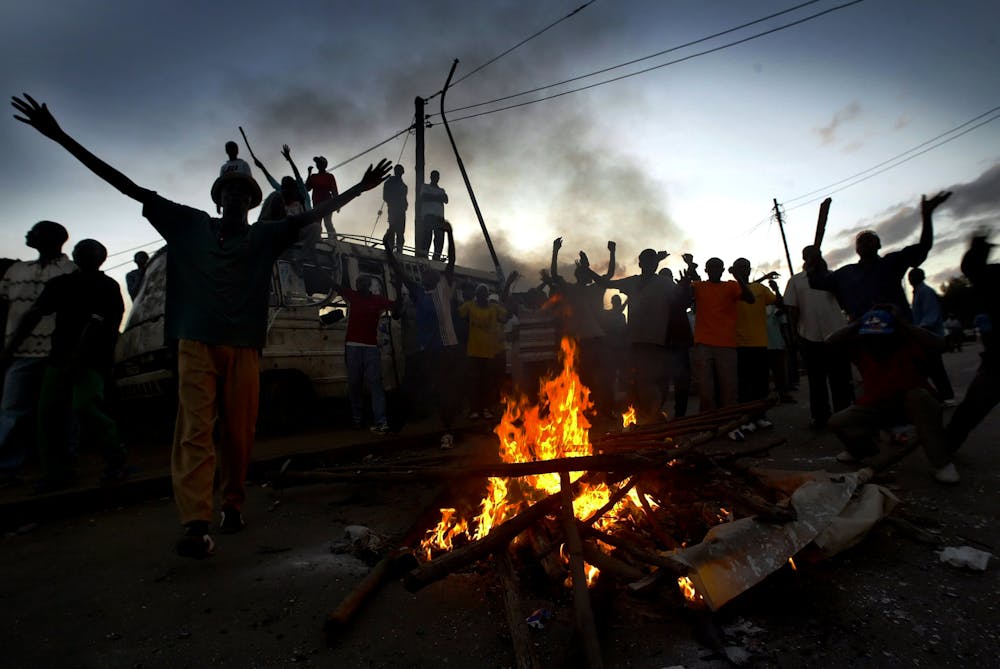
Deadly violence followed the disputed 2007 presidential election in Kenya, including in this Nairobi slum.
When social science researchers like me try to predict political violence, we look at a large number of historical cases across multiple countries, and try to identify which events have resulted in many casualties.
In taking this approach, we can systematically evaluate what explains these extreme events, pinpointing specific issues that were present in most of the situations, and avoiding the inaccuracies that can happen by relying too much on anecdotal stories.
Such studies have highlighted three factors relevant to the upcoming election.
In the U.S., for example, despite allegations to the contrary, electoral fraud is extremely rare. Even if uncertainty and chaos were to ensue in the wake of the election, the authority to decide a winner is vested in an independent institution such as the U.S. Supreme Court or by the House of Representatives. Kenya in 2007 had no comparable institutional anchors to help ensure post-election stability.
Second, research, including my own, finds that mass political violence usually happens in countries that have no capacity to prevent it. In Kenya, for example, most violence was perpetrated by unofficial militias affiliated with ethnic or religious groups, such as the Mungiki, which the government was unable – or unwilling – to curb.
In the U.S., if any political leader calls for vigilantes to mobilize, both the federal government and states have the capacity to expeditiously eliminate this threat. Militias may be armed, but they are no match for a well-trained National Guard or Army regiment. This should help deter the risk of violence by vigilantes.
Some, however, fear that the president will send federal agencies to seize ballots. Although military officers continue to express formal commitment to keeping the military nonpoliticized, such actions, if taken, may result in a violent backlash by left-wing vigilantes. But federal agents acting under orders from the White House will have the tactical upper hand in such clashes, which greatly adds to their deterrent capacity.
Ninety-five percent of the 12,607 political demonstrations in the U.S. between May 24 and Sept. 19, 2020, were peaceful. There were 351 other kinds of incidents, including imposing curfews and perpetrating physical attacks. In 29 of those, there was violence against civilians, where 12 people were killed, nine of them by the police. And in an additional five drive-by shootings, three police officers were killed by the extremist group the Boogaloo Bois.
Considering the number of people involved in the recent Black Lives Matter and COVID-19 protests, and the fact that many were heavily armed, these casualty figures are surprisingly low. According to the data, the majority of deaths were caused by police, not vigilantes or protesters, and all of the perpetrators (with the exception of two drive-by shooters), police and civilians alike, were taken into custody.
Like the U.S., France experienced protests and riots, in addition to multiple terrorist attacks, prior to Election Day. There was even a government plan to handle the potential violence and instability that might ensue if Le Pen were elected. And yet, as the most polarizing elections in decades concluded, there were few riots and no killing.
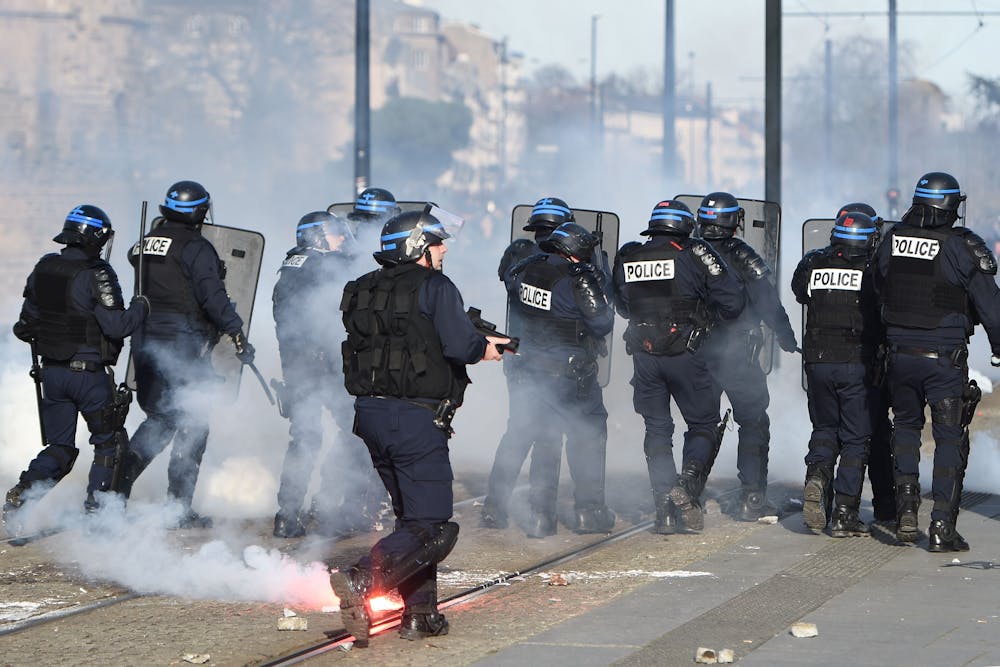
French riot police clash with protesters at a demonstration against the presidential candidate for the far-right Front National party, Feb. 25, 2017 in Nantes.
While I think some concern is valid, it is important to remember that there is a big difference between using a call to arms to mobilize your voters and instill fear in the other party’s supporters, and staging a post-election insurrection, which could subject its instigators to charges of sedition, if not high treason.
Ultimately, the three factors discussed here suggest that fears of widespread violence by vigilantes and activists during and after Election Day should be treated as fears, not as a probable outcome.
Ore Koren, Assistant Professor, Indiana University Bloomington; International Security Fellow, Indiana University