In an announcement made Friday morning, Abbott said he is ordering the closure of bars and is asking restaurants to reduce their capacities back to 50 percent occupancy until the rate of transmission of the disease slows down.
Abbott is also closing down rafting and tubing businesses in the state that have been identified as major sources of infection, and is also placing new restrictions on social gatherings of 100 or more people.
Abbott's order comes as hospitals in Houston, Austin and other major cities in Texas have warned that they are running out of room in their intensive care units to handle the influx of COVID-19 patients.
Despite this, many conservatives voiced angry displeasure at the Texas governor, whom they accused of "caving" to the left by trying to save lives.
During an argument over the words "Black Lives Matter" being drawn in the sand on a beach in South Carolina, a woman decided to expose herself. Now she's being charged with indecent exposure, WBTW reports.
According to the police report, a group of children were writing "Black Lives Matter" and "defund the police" in the sand when a group sitting near them became offended and started to erase the words from the sand.
When an argument between the families broke out, people began recording the incident on their phones. That's when 53-year-old Kimberly Eugenia Allen walked up to the camera and exposed her breasts.
Allen was charged with indecent exposure and released on $1,000 bond.
President Trump traveled to Wisconsin on Thursday to tour a naval shipyard, where he bragged that he had the Navy steer a big contract Wisconsin's way, which can only be construed as an order to boost his electoral chances in the swing state. I suppose it's not surprising that he is so open about such things. After all, he was impeached for trying to extort a foreign ally into produce damaging information on his presumptive opponent, and every Republican senator except Mitt Romney backed him to the hilt. Why would he think interfering in a domestic military contract for his own benefit would be a problem?
Frankly, it probably isn't. Trump's corruption is now the norm and most people just shrug when he openly brags about it. Apparently, they believe everyone does it and it's just the usual partisan fighting. But the way he's dealt with the COVID-19 pandemic is something else again. The latest polling is devastating for his re-election prospects and it's very much tied to the fact that he has so thoroughly mishandled the government response and refuses to change course.
Nearly three-fifths of voters disapprove of Mr. Trump's handling of the coronavirus pandemic, including majorities of white voters and men. Self-described moderate voters disapproved of Mr. Trump on the coronavirus by a margin of more than two to one.
Only the true believers think he's done a good job on the worst crisis of his presidency, and that's largely because they get all their news from suspect sources. The Washington Post published an article about several studies showing that right-wing media has played a major role in misinforming its audience about the virus:
The end result, according to one of the studies, is that infection and mortality rates are higher in places where one pundit who initially downplayed the severity of the pandemic — Fox News's Sean Hannity — reaches the largest audiences.
On Thursday night, Trump appeared with Hannity for a "town hall" and repeated his daft line that if we didn't do so much testing we wouldn't have so many cases. He's said that so often I think we can assume that his followers have been thoroughly indoctrinated in this nonsensical concept.
Joe Biden described the problem perfectly in the speech he gave on Thursday:
He's like a child who can't believe this has happened to him, with all his whining and self-pity. This pandemic didn't happen to him. It happened to all of us. His job isn't to whine about it. His job is to do something about it.
The president wants us to believe there's a choice between the economy and public health. Amazingly, he still hasn't grasped the most basic fact of this crisis: to fix the economy, we have to get control over the virus.
No, he can't grasp this simple fact and I suspect that even if he could, he would be incapable of making the kinds of decisions necessary to make that happen. He trusts no one but his gut, and his gut keeps on telling him that this will all just "go away" and everything will be fine.
He's now taken to bragging that the "mortality rate" in the U.S. is something to be proud of, which is just bizarre. The 126,000-plus dead human beings and their families don't see it as such a great accomplishment, and Trump is signaling clearly that he has no intention of changing course in any way.
Pew Research reported this week that a majority of Republicans and Republican-leaning independents (61%) agree that when it comes to coronavirus, 'the worst is behind us.'" I'm afraid they are in for a rude awakening. Those "embers or flare-ups," as Trump calls them have turned into a wildfire that's now out of control.
Twenty-nine states are currently aflame, with rising caseloads and hospitalizations, as we see the largest national numbers of the pandemic, surpassing the worst weeks of April when cases were concentrated in New York and a few other large cities. His favorite Republican governors — Greg Abbott of Texas, Ron DeSantis of Florida and Doug Ducey of Arizona — are in a particular bind, having followed Trump's lead and opened up their states early, even seizing authority from local officials while arrogantly proclaiming their superior handling of the crisis.
DeSantis was particularly insolent and overbearing. Recall that on May 20, Vice President Mike Pence paid DeSantis a visit and they conspicuously dined in a burger joint without masks or social distancing, after which DeSantis delivered a Trumpian rant to the assembled media.
He spoke much too soon. On Wednesday the state set a new single-day record, with 5,508 new cases of COVID-19. There were another 5,004 on Thursday. In fact, Florida has had more cases in June than in the previous three months combined.
When asked about the surge this week DeSantis said, "We are where we are," and tried to act as though everything was going fine and it's all just as expected. He's now punted all the tough decisions to individual businesses and local officials, so it looks as though he plans to ride the wave wherever it takes him, all while pretending that was the plan the whole time.
In Arizona, Ducey has also loosened his grip and allowed mayors to require masks in public, while in Texas, Abbott has actually begun to slow down the state's reopening and may even roll back toward a partial lockdown. But all these Republican state executives are stuck in the Trump maelstrom in which he continues to insist that the pandemic is "fading away" while they have to face the sickness and death that's crashing all around them. He is an albatross around their necks.
Aside from the massive human carnage, the political ramifications are profound. The Atlantic's Ron Brownstein has been tracking the slow transformation of the Sun Belt from solid GOP to purple to potentially Democratic for a while. He believes the pandemic may be hastening the process and putting Republicans in a bind of their own making:
Until the 2016 election, Republicans had maintained a consistent advantage in the region's big metros — including Atlanta, Houston, Dallas, and Phoenix — even as Democrats took hold of comparable urban centers in other parts of the country. But under Trump, the GOP has lost ground in these diverse and economically thriving communities. And now, a ferocious upsurge of COVID-19 across the Sun Belt's population hubs — including major cities in Florida and North Carolina where Democrats are already more competitive — is adding a new threat to the traditional Republican hold on these places.
Polling shows that Biden is competitive in all those states at the moment ,and the question is whether that will hold up until November. According to the New York Times poll, a majority of voters strongly favor the government prioritizing the pandemic over a hasty reopening of the economy. Unfortunately, Republican voters, no doubt listening to Trump and Hannity, say they believe the opposite. Or at least they did. One has to wonder if those attitudes will hold now that the virus is no longer something that happens to other people far away.
U.S. Senator Lindsey Graham is declaring "war" on Confederate statue activists who are pulling down monuments to slave owners and those who led the Civil War against the United States of America.
In a diatribe on "Fox & Friends" Friday, the Republican from South Carolina who succeeded racist GOP Sen. Strom Thurmond, leveled numerous charges against those who oppose tributes to the men who spent or gave their lives to protect the institution of slavery. Graham called them socialists who hate America and capitalism, disrespect religion, and want to destroy the family.
"The people doing this hate our country," Graham charged. "They hate the way we were founded, they hate capitalism, they have no respect for religion, they have no respect for diversity of thought."
"These people are the most radical people known to America," Sen. Graham said, a stunning allegation against activists who are not known to law enforcement, given he chairs the Judiciary Committee which oversees the Dept. of Justice., including the FBI and Homeland Security.
"We're at war with them politically," Graham declared in another stunning statement, given they are more than likely U.S. citizens.
"They want to destroy America as we know it," said Graham, who is facing a challenging re-election. "They hate America, and every symbol of our country, from our flag to a statue. They hate. They want to turn us into a socialist nation. They want to destroy the family unit as we know it."
"And I tell you what – to the listeners out there: You may not believe you're in a war but you are, politically, and you need to take sides. You need to help this President."
Attorney Lloyd Green, who served as opposition research counsel to George H.W. Bush’s 1988 presidential campaign, thinks that President Donald Trump and his administration are making a colossal political error in their latest attempt to gut the Affordable Care Act.
Writing in The Daily Beast, Green argues that asking the Supreme Court to throw out all of Obamacare during a pandemic that has killed more than 120,000 Americans so far is political malpractice of the highest order.
"Simply put, gutting Obamacare is a political loser," he writes. "More than half of the U.S. favors leaving the ACA alone. Just a quarter want to see it struck down by the courts."
The former GOP campaign operative also writes that throwing out Obamacare entirely will hammer Americans living in swing states.
"If Trump has his way with Obamacare, the ranks of the uninsured would more than double in Michigan and Pennsylvania," he writes. "Florida would probably see a jump in uninsured by two-thirds. As for Wisconsin and Texas, the figure would swell by one-third. In case Trump and the Republicans have not noticed, Obama and Obamacare are now popular. Trump’s presidency burnished their image."
Green notes that this attempt to strip Americans of health insurance during a pandemic follows a string of political miscalculations, including his campaign of "jock-sniffing dead Confederate generals."
A new study found Black people are perceived as more threatening if they wear an improvised mask than a surgical mask.
Black Americans, particularly men, have expressed concerns about racial profiling as state and local governments impose mandatory mask orders during the coronavirus pandemic, and a new study confirms those fears, reported WRAL-TV.
“There’s a lot of prejudice and discrimination out there, and African Americans are more likely, it seems, to face that when wearing a bandana or a cloth mask face covering," said Steve Greene, a political science professor at North Carolina State University.
Greene and researchers at the University of North Carolina surveyed 2,400 non-Black people nationwide and found that a Black model and white model were viewed as 5 percent more untrusthworthy and more threatening while wearing a bandana, as opposed to when wearing a surgical mask.
Researchers then focused on respondents who admitted to holding negative racial views, and they found the white model stayed at 5 percent while the Black model shot to 9 percent more untrusworthy and 12 percent more threatening while wearing a bandana mask.
"By comparing the results to the white model, we were able to show it’s not just, well, people don’t like bandanas and cloth masks," Greene said. "People don’t like bandanas and cloth face coverings on a Black man, in particular.”
The Black model was viewed essentially the same while wearing a surgical mask as when he wore no mask at all.
"Something like a bandana [suggests] bank robbers, criminals – a threat," Greene said. "Something like a surgical mask brings an entirely different set of stereotypes. Honestly, you are thinking about doctors and nurses."
Greene said his team hopes to have their study peer reviewed and then published, but they have already sent their findings to state health officials to recommend distribution of surgical masks in Black communities.
“We would argue that, with the governments making policies saying everybody needs to wear a mask, that to some degree, it is incumbent upon the government – the government's responsibility – to help ensure that everybody, especially the African Americans in our area, can get those surgical masks," Greene said.
Black communities have been hit hard by the pandemic -- nearly one third of Black Americans know someone who died from COVID-19 -- but many Black men feel that wearing a mask is more of a threat than the coronavirus.
“Which death do they choose? Covid-19 or police shooting?” said Vickie Mays, professor of health policy and management at UCLA’s Fielding School of Public Health. “We have African Americans who have been dragged out of stores, who have been ordered by police and store guards to pull their masks down or take their masks off.”
Lincoln County, Oregon, had initially excluded Black people from mandatory mask orders for that reason, but were forced to reverse the decision after a torrent of "horrifically racist commentary" after news reports about their order went viral.
“We passed this last week and didn't hear much, and then all of a sudden, our call center blows up with people just yelling at whoever answers the phone," said Casey Miller, spokesman for the county commission. "We got so many angry emails and calls we’ve been totally overwhelmed. It’s been hard to do day-to-day work, like getting information to people worried about health, or getting a test, or getting a meal while they’re in quarantine.”
The county's Black residents asked them to reverse the exclusion because it ended up making them feel even less safe.
"The county received several calls from leadership from our communities of color asking us to revise the policy — it was not providing them protection, but instead making them possible targets for more hate," the board of commissioners wrote. "We will not continue a directive and policies that were intended to assist but instead are a potential source of harm."
Poll after poll has shown President Donald Trump trailing former Vice President Joe Biden, the presumptive 2020 Democratic presidential nominee — and some of them show Trump losing by double digits. Trump’s response to these polls is not to broaden his appeal, but to double down on his rally-the-base strategy.
Associated Press reporters Aamer Madhani and Jonathan Lemire, in an article published on June 26, outline some of the ways in which Trump is trying to fire up his hardcore MAGA base.
“President Donald Trump is sharpening his focus on his most ardent base of supporters as concern grows inside his campaign that his standing in the battleground states that will decide the 2020 election is slipping,” Madhani and Lemire explain. “Trump turned his attention this week to ‘left wing mobs’ toppling Confederate monuments and visited the nation’s southern border to spotlight progress on his 2016 campaign promise to build a U.S./Mexico border wall.”
In addition to the things Madhani and Lemire mention, Trump is doubling down on his vendetta against the Affordable Care Act of 2010, a.k.a. Obamacare. On June 25, the Trump Administration filed a brief urging the U.S. Supreme Court to strike down the ACA — and he is trying to throw millions of Americans off of health care during a pandemic that, according to researchers at Johns Hopkins University in Baltimore, has killed more than 124,400 people in the U.S. The anti-Obamacare brief was clearly a rally-the-base move, and Democrats are likely to use it against him in attack ads aimed at swing voters.
Trump’s reasoning, obviously, is that if he fires up his MAGA base enough and there is a weak turnout among the Democratic base on Election Day, he might pull off a narrow victory in November.
GOP strategist Dan Schnur, who served as an adviser to former California Gov. Pete Wilson and the late Sen. John McCain, told AP that a rally-the-base strategy might be the Trump campaign’s “only” hope.
“This might be the only path for him at this point,” Schnur asserted. “Most of the center is no longer available to him. Motivating his base is not just his best available strategy — it might be the only one.”
According to Madhani and Lemire, “Trump’s team feels confident that approximately 40% of the electorate supports him and notes his approval rating has remained unusually stable during his term. The president’s campaign advisers believe it comes down to getting a bigger proportion of the smaller group of people who love Trump to turn out than the larger group of voters who express tepid support for Biden.”
Many of the polls released in late June have been encouraging for Biden’s campaign. A New York Times/Siena College poll found Trump trailing Biden by 14% nationally and by 11% in Michigan and Wisconsin, 10% in Pennsylvania, 6% in Florida, 9% in North Carolina and 7% in Arizona. And Fox News polling found Biden leading Trump by 9% in Florida, 2% in Georgia and North Carolina and 1% in Texas.
A Florida man is facing charges after he allegedly shouted racial slurs at two women and spit in one's face. According to WINK News, the incident took place when the man, identified as Donald Mueller, pulled over his car to confront the women as they were picking mangoes.
“When he screamed at me ‘Black lives don’t matter,’ I was beyond myself,” said Leiya R. “And then physically spit in my face.”
According to Mueller's attorney, the women "were there without the permission of the homeowners who are friends with my client, and were stealing mangoes from their tree." The property owner later told police that the women did not have permission to pick the mangoes. But Mueller apparently initially thought the women were picking the mangoes off his property.
Mueller faces charges of burglary and battery as well as a hate crime charge, and has been released on a $2,000 bond.
Watch WINK's report on the story below:
[A previous version of this article stated that the women had permission from the property owner to pick the mangoes. The article has been updated to reflect that the property owner stated that the women did not have permission.]
According to a report from Houston Chronicle, Texas Gov. Greg Abbott (R) thought that expanding his state's COVID-19 tracing program would keep him from having to shut down his state -- but got it wrong and now his state is being overwhelmed with coronavirus patients.
The report notes that Abbott promised in late April that the tracing program would "box in the expansion of COVID-19," but the reality of rushing to set up the program after failing to take necessary methods to halt the spread of the coronavirus pandemic has proven to be a disaster for the Republican governor.
"Local health officials say standing up an army of tracers and the infrastructure to support them has been far more complicated than it may have seemed," the Chronicle reported. "Key components of state and local tracing programs were not in place as Abbott expanded reopenings in May and June, even as cases began to rise and testing for the virus fell short of expectations."
With the report stating, "The rushed debut, compounded by an outdated reporting system and delays in processing tests for the virus, made it difficult for tracers to head off the rise in cases now sweeping across Texas, according to health officials," one Texas A&M University epidemiologist stated, "I think the impression was that it was ready to roll out.”
On Wednesday the Republican governor conceded things have not gone as he planned as he delayed further reopenings while Texas hospitals were overwhelmed with COVID-19 patients, with Abbott telling reporters, “There is a massive outbreak of COVID-19 across the state of Texas.”
According to Dr. Mark Escott, health director at Austin Public Health, “If we look at the efficacy of contact tracing in other countries where that worked, that contact tracing happened when the places were generally shut down, when people were not moving around. That’s not happening here. Things are still open, and we’re trying to contact when we’re getting hundreds, perhaps more than a thousand cases a day being reported in.”
Chris Van Deusen, a spokesman for the Department of State Health Services added that the state could have started earlier and that the governor was late to take the pandemic seriously.
“We will be adding more functionality over time, but that core ability to do contact tracing was there on April 27 with Texas Health Trace,” Van Deusen stated.
A young supporter of President Donald Trumpconfided to USA Today's Nicole Carroll that he decided against wearing a mask at the president's campaign rally in Phoenix earlier this week because no one else in the room was doing so.
During the president's rally at an Arizona megachurch this week, Carroll interviewed 19-year-old Santiago Stewart, who admitted to bringing a mask with him.
Stewart admitted to Carroll that he was "a little" worried about getting sick, but he still didn't put the mask on when he saw a sea of mask-free Trump supporters at the event.
"So was it peer pressure?" asked Carroll.
"Yeah, kind of," he replied.
20-year-old Trump supporter Kaylee Spielman, meanwhile, told Carroll that she didn't bother wearing a mask even though her grandparents were vulnerable to getting very sick from the disease.
Spielman insisted that she was taking other precautions -- but when asked by Carroll to name them, she replied, "Obviously not too many."
Texas keeps setting daily records for new coronavirus cases, and doctors in hard-hit Houston are begging residents to take basic safety precautions.
Two nurses at United Memorial Medical Center are being treated for COVID-19, and doctors aren't sure whether they got sick from treating patients or from community spread, reported KHOU-TV.
"I'm doing everything I can to take care of these very sick people, and then you see people out there without a mask, not having social distance, more gatherings all over the place," said chief medical officer Dr. Joseph Varon. "Our biggest frustration is that people are not listening."
The intensive care unit at the Texas Medical Center, the world's largest medical center, is completely full, but officials there said they can add more.
“We are watching numbers increase," said Methodist Hospital CEO Dr. Marc Bloom. "We are seeing more people in the community with the disease, so we know we will need to take care of more individuals. That obviously cannot go on forever, so we need the community to do the right things to bend this curve right now."
All regular ICU beds in the Texas Medical Center are now being used, according to numbers just released on the TMC website, but officials say they can add more.
Hospitals in Houston's Medical Center will now move some ICU patients to beds not normally used for critical care.
Twenty-eight percent of the ICU patients are being treated for COVID-19.
Despite reaching surge capacity, four hospital CEOs said Thursday there's no cause for "unwarranted alarm."
Those same CEOs signed a letter to Houstonians Wednesday warning, "If this trend continues, our hospital system capacity will become overwhelmed."
Dr. Marc Boom explained in a virtual news conference Thursday that the purpose of the letter was to "urge people to do the right things in the community and do so by talking about capacity, but really ended up unintentionally sounding an alarm bell too loudly about capacity."
Texas Gov. Greg Abbott hit pause on the state's reopening after nearly 6,000 new cases were reported Thursday, and he ordered hospitals in Houston and other big cities to suspend non-elective surgeries for the time being.
"The last thing we want to do as a state is go backwards and close down businesses," Abbott said. "This temporary pause will help our state corral the spread until we can safely enter the next phase of opening our state for business."
Businesses that are already allowed to reopen may continue operations under existing health protocols and operating restrictions, but medical providers urged Texans to stay home as much as possible and take basic precautions when going out in public.
"You can be spreading it when you don't even know you have it, and that's kind of the scariest thing about COVID-19," said Kevin McFarlane, an RN and president of the Houston Emergency Nurses Association. "If you're going to be in crowds of going to be with folks, you know, definitely wear a mask."
As the United States reels from the COVID-19 pandemic and nationwide anti-racism protests, pundits from both sides of the political aisle have speculated that a new New Deal is in the offing.
It could happen. Crises, after all, often produce social policy gains, and the similarities between the 1930s and today are hard to ignore.
The crisis also has to unfold under the watch of a regime opposed to expanded social policies. Herbert Hoover opposed public relief – for the agricultural sector, the unemployed or the welfare state, in general – during the Depression. Instead, he ineffectively relied on mobilizing private efforts.
The public must also blame the crisis on the party in power and reject that party at the polls. The Republicans lost their congressional majority in 1930, and Hoover suffered a crushing defeat in 1932, with Roosevelt carrying many congressional Democrats on his coattails.
But three other things had to happen in the 1930s before New Deal reforms were implemented.
The first was a long-term shift in political control. Congress did not pass the Social Security and National Labor Relations Acts until Roosevelt’s third year in office. And Congress did not approve the Fair Labor Standards Act, which created the minimum wage, until his sixth year in office.
Roosevelt’s first two years were devoted largely to saving banks, encouraging industries to stabilize prices and wages and providing short-term poverty relief. If the Democrats had lost congressional support in 1934, major social reforms would have never seen the light.
Compare Roosevelt’s – and the Democrats’ – hold on power to former President Barack Obama’s, and the prerequisites for extensive reform become clear. Yes, Obama helped pass the Affordable Care Act, but he spent much of his early first term seeking passage of the Recovery Act to counter the Great Recession. He had to abandon potential labor and environmental reforms after losing congressional control for good in 2010.
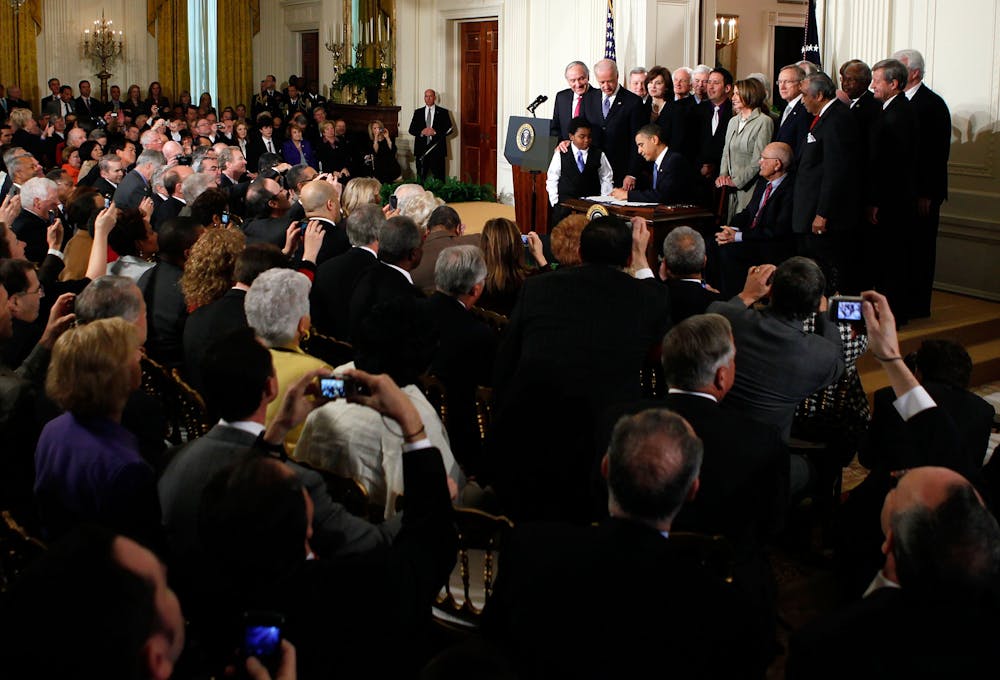
President Barack Obama signs the Affordable Health Care during a ceremony in the East Room of the White House, March 23, 2010 in Washington, D.C.
By contrast, the New Deal reform wave was possible only after congressional elections in 1934 gave Democrats an overwhelming majority, putting legislative control in the hands of liberals. Roosevelt won in a larger landslide in 1936, and congressional Democrats expanded their majority. The Social Security Act was amended twice, and the program we know today was established in 1950, after Democrats had won the presidency for the fifth consecutive time.
Mass mobilization
New Deal reforms also relied on the mobilization of activists. The 2-million-strong Townsend Plan – with 8,000 clubs across the country – placed intense pressure on Congress. This group demanded universal retirement benefits, about $3,700 per month in today’s dollars. Workers struck for the right to bargain collectively. The unemployed organized and demanded benefits, too. Together, these efforts kept major reforms high on the political agenda.
Though unionization has witnessed steady declines for decades, the labor movement has enjoyed a sporadic resurgence of sorts recently, with major work stoppages – by United Auto Workers, United Teachers of Los Angeles and United Food and Commercial Workers – in the last couple of years. To implement major social policy changes, labor would need to remain active. The activists of Black Lives Matter movement would have to build on their nationwide protests and redouble organized efforts to transform police departments. And social policy would benefit from other reform-minded groups mobilizing as well.
Winning lasting social policy reform also required skillful policy crafting. The Social Security Act included taxes on payrolls and over time made its insurance program universal. Benefits for survivors and the disabled were slipped into the program’s coverage in 1939.
However, other programs were mishandled. Roosevelt depleted considerable political capital on the Works Progress Administration, a program to provide temporary work to the unemployed, which was permanently “discharged” after a conservative Congress was elected in 1942. That political capital might have been spent on lasting reform.
Most of programs in Obama’s Recovery Act were funded for only a year or two. Under new Democratic rule, grassroots groups – focused on environmental change, racial justice and gun safety, for example – will need to redouble organizing efforts to keep political leaders’ feet to the fire, lending urgency to public opinion for reform.
The lessons from the old New Deal suggest that a new one is possible. But Democrats will need to control Congress, policymakers will need to look beyond the current crises, and activists will need to keep the pressure on to establish lasting structural change.
Attorney General William Barr recently announced, late on a Friday, that Geoffrey Berman was “stepping down after two-and-a-half years of service as United States Attorney for the Southern District of New York.”
This announcement was news to Berman, who later contradicted Barr by declaring that he had not resigned and indeed had no intention of resigning. Barr then contradicted himself by informing Berman that since he had refused to resign, he had instead been fired.
Was Barr’s ousting of Berman retaliation for his office’s investigations and prosecutions of the president’s friends?
At his confirmation hearings, Barr pledged to act independently from the president. Yet Barr has also argued that the attorney general should vigorously support and defend the president “when the president determines an action is within his authority – even if that conclusion is debatable.”
Can the U.S. attorney general, the top law enforcement official in the country, act independently while also serving as the president’s sword and shield?
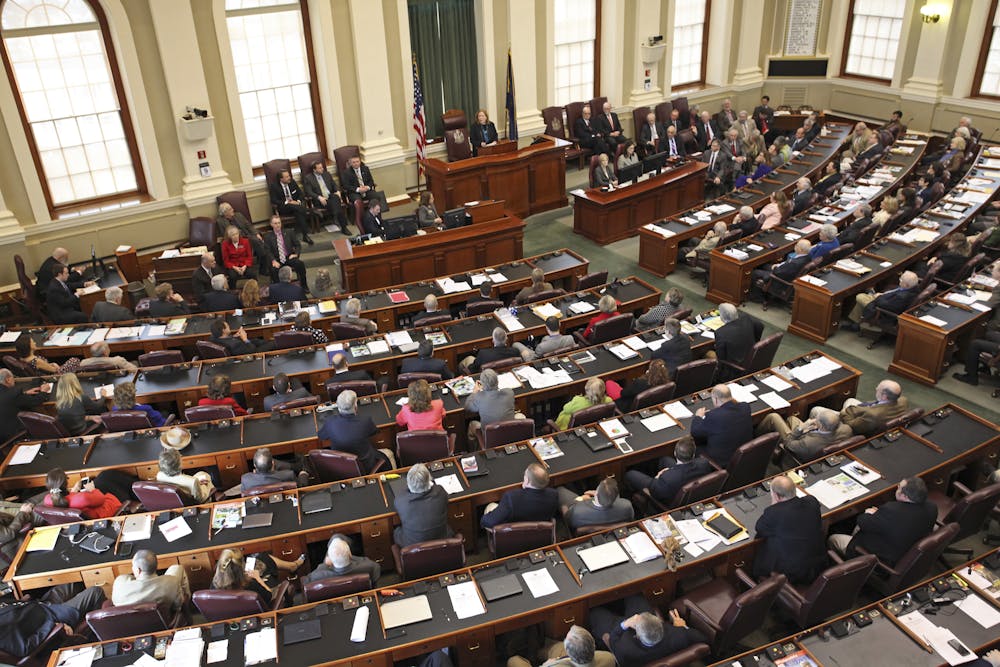
Both houses of the Maine legislature, seen together here, elect the state attorney general by secret ballot.
The U.S. attorney general is appointed by – and answerable to – a partisan president. Consequently, attorneys general are often appointed as a result of loyalty. Barr is not the first attorney general to be viewed as a presidential loyalist; Eric Holder, for instance, publicly proclaimed he was President Barack Obama’s “wingman.”
This can be a problem, however, as attorneys general who serve at the pleasure of the president are more likely to act in pursuit of a particular political agenda, rather than solely in accordance with the rule of law. As a scholar of presidential democracies around the world, I have found that countries where the president and the attorney general are political allies have poor human rights records.
Here’s an example of what that this means in the U.S. In early June, Barr chose to prioritize the president’s photo op at a church close to the White House at the expense of the civil liberties of peaceful protesters, who were cleared from the president’s path by security forces using rubber bullets and a type of tear gas.
Kentucky Attorney General Andy Beshear, the Democratic candidate for governor in 2019, after voting in the 2019 Kentucky election.
In the states, it is unusual for the head of the executive branch – that is, the governor – to have the power to hire and fire the attorney general. Only five states grant the governor the power to appoint the state attorney general: Alaska, Hawaii, New Jersey, New Hampshire and Wyoming.
In Maine, originally the governor appointed the attorney general, but since 1855, the attorney general has been chosen by the state legislature (in what is often largely a party-line vote). In Tennessee, the attorney general is chosen by the state Supreme Court and is considered to be an officer of the judicial branch – not the executive branch.
In the remaining 43 states, the attorney general is elected to the office by popular vote. In such states, attorneys general answer to the electorate, not the governor, and the governor cannot fire or otherwise replace an attorney general that he or she disagrees with.
An elected state attorney general can make politically motivated decisions – particularly if they seek to use the office as a stepping stone to become a governor or senator.
On several occasions, attorneys general have even gone so far as to sue the governor for allegedly overstepping his or her power.
Former Attorney General of Kentucky Andy Beshear won two high-profile court cases against the sitting governor – one related to education cuts and another related to pension reform. Beshear was able to leverage these wins to successfully campaign for governor in 2019.
Part of the judiciary
Many of the founders envisioned that the U.S. attorney general would be appointed by the U.S. Supreme Court. Whereas all other early executive departments – such as Foreign Affairs, Treasury, and War – were established with their own acts, Congress created the position of attorney general with the Judiciary Act of 1789, which is the same act that organized the Supreme Court and lower federal courts.
The founders ultimately decided that the attorney general should be chosen by the president in order to mirror the presidential appointment of federal judges. It was not meant to imply that the attorney general position should be considered similar to the heads of other executive departments.
In line with this thinking, early U.S. attorneys general shared both offices and budgets with the judicial branch. The position’s place within the executive branch wasn’t codified until the creation of the Justice Department in 1870.
The current arrangement allows for the president to replace any attorney general deemed to be insufficiently loyal. For instance, Trump himself has admitted to firing Barr’s predecessor for failing to “end the phony Russia Witch Hunt.”
It appears that Trump’s intent was to find an attorney general more receptive to presidential influence, perhaps because Trump views himself as “the chief law enforcement officer of the country.” Trump also claims: “I have the right to do whatever I want as president.”
When choosing between the people and the president, the incentive for an attorney general who wishes to keep his or her job is to be loyal to the latter over the former. While proposals to change how the U.S. attorney general is selected would face many hurdles, the implementation of any such change might better ensure that future presidents don’t consider themselves above the law.