On Monday morning, MSNBC "Morning Joe" regular Jonathan Lemire claimed that Donald Trump's manic spree of ugly tweets aimed at his critics -- combined with White House attacks on presumptive Democratic presidential nominee Joe Biden -- shows that the president and his campaign are "flailing" because they know the election is likely lost.
With host Joe Scarborough asking, "What is going through the president's mind? What is his state of mind? Why does he seem even more unbalanced and unmoored today than he has over the past three and a half turbulent years?" Lemire stated the combination of the coronavirus pandemic with its mounting death toll and the collapsing economy is more than the president can handle.
"These are the things the president knows are going to very much damage his re-election chances," Lemire reported. "Obviously, he's never been one to show much in the way of empathy. He struggled with previous tragedies. a hurricane or forest fire but he's rarely talked about that in terms of this pandemic. He's rarely offered sympathy to those gone."
Continuing in that vein, while discussing the president's ugly Twitter smears over the weekend, he offered, "What we're seeing here is a frustration from a president who is not overseeing the country that he wanted."
"More than that, [he] is unable to run the campaign he wanted," he added. "He thought, as of a couple months ago, he'd be running a campaign on the back of a robust economy, he'd be able to talk about Obamagate and deep state. He'd be able to dwell on Joe Biden's latest gaffe and none of that is in the cards right now."
"We're seeing him desperate, he and his allies trying to revive that over the weekend with seizing upon the Biden joke.," he continued. "There is this frustration here, this flailing from the White House, from his campaign team, knowing that right now, his own internal polls say if the election were held today, he would lose."
"That has led to, more than anything, a sort of unmoored, unhinged Twitter spree that we saw this weekend, instead of a focus on those who have died in the pandemic," he concluded.
MSNBC's Mike Barnicle hammered President Donald Trump for tweeting out "cruel" attacks against political enemies he would never confront face to face.
The president spent much of Memorial Day weekend tweeting insults and murder accusations at his perceived enemies, including "Morning Joe" host Joe Scarborough, and Barnicle called Trump out for cowardice.
"Is it really shocking that he did this?" Barnicle said. "This is a cruel, damaged human being, who goes out of his way to harm people. He goes out of his way without seeing these people. He would never utter a single negative response to any of the people that he attacked on Twitter over the weekend if it were eye-to-eye contact. He is afraid of that, he is afraid of the repudiation. But he is afraid of the physicality of it, he is afraid of looking at someone in the eye and saying what he says on Twitter to them. He would never, ever do that."
Barnicle said the president's words and actions dishonored the military service members memorialized by this national holiday, and also insulted the nearly 100,000 dead from the coronavirus.
"The front page of the New York Times was a reminder to him and to everyone in this nation that these people listed in the Times, in three full pages, actually, they were your friends, they were your neighbors -- they were us," he said. "We were told as a nation many, many times -- you've gone over it many, many times, Joe -- 'There is no threat here, it is one person from China, it is 15 people from China, we just sent them back to China.'"
"The level of threat has never been addressed, the level or responsibility will never be addressed," Barnicle added. "On Memorial Day 2020, a sacred day, especially where I'm from -- I grew up at a time when Memorial Day was Memorial Day. There were no sales at Home Depots, there were no large-scale picnics. It was to honor the dead. I grew up in a Gold Star household. My Uncle Jerry was killed at Midway. Like all of the people listed yesterday in the Times, and all of the people who will be memorialized at cemeteries around this country today, my Uncle Jerry, 2nd Lt. Gerald J.Barnicle, killed at Midway, June 4, 1942 -- he never died. His memory lived, he lives today through me. As will all those people who are listed in the Times yesterday. That's what Donald Trump fails to grasp."
Texas had the highest uninsured rate of any state before the outbreak. It's also among a minority of states that have declined to expand Medicaid coverage to people with incomes near or below the poverty line.
Laci Crosson’s son doesn’t have pills to manage his attention deficit disorder.
Betty Canales is worried about how she’ll pay for her diabetes medication.
Stevie Smith saw a doctor after she was furloughed — and paid more than double her usual price.
With the U.S. economy flailing as the country contends with the coronavirus pandemic, more than 1 million Texans havelikely suffered the double whammy of losing their jobs and their employer-based health insurance. Some have landed in the state’s patchy health care safety net, where advocates say they could be cut off from physical and mental health services while facing the economic strain of a public health crisis.
Researchers estimate that between 25 million and 43 million people in the U.S. will lose health insurance through their employers in the coming months if the unemployment rate grows to 20%. It’s already near 15%, a record high since the Great Depression.
The situation is particularly dire in Texas, where state officials have restricted access to publicly funded health insurance programs for the poor and have led the charge to toss the Affordable Care Act in court.
Already home to more than 5 million uninsured residents — or about 18% of its population, the highest uninsured rate of any state — Texas is in the minority of states that have declined to expand Medicaid coverage to people with incomes near or below the poverty line.
The result: Of 1.6 million Texans who have likely lost employer-sponsored health insurance during the pandemic, 30,000 would be eligible for Medicaid if the state expanded the program, according to recent estimates from the Kaiser Family Foundation.
Instead, they’re uninsured, and many more are expected to join them.
Texas’ approach stands in contrast to the 36 states that have expanded Medicaid to cover adults who earn less than 138% of the poverty line, about $36,000 a year for a family of four.
More than half of the newly uninsured residents in those states will qualify for Medicaid, leaving less than one quarter of unemployed workers without insurance, according to projections from the Urban Institute.
In Texas and the other states that rejected Medicaid expansion, one-third of the newly jobless are estimated to get Medicaid, with 40% becoming uninsured.
Among the affected is Crosson, 35, a stay-at-home mom whose husband was laid off in March from his job as a heavy equipment mechanic.
Crosson hustled to get her two youngest children enrolled in Medicaid. But for the adults, including her eldest son, who has ADHD and takes Adderall, there was nothing, said Crosson, who moved to Fort Worth last fall.
Her son’s been without his medication.
Crosson herself recently had a medical emergency, coming down with a bad bout of pneumonia just weeks after her husband was laid off. Bedridden for days, and with her husband worried she had the coronavirus, Crosson went to the hospital and was quickly asked, “Do you have health insurance?”
She received a flu test, strep test, chest X-ray, electrocardiogram and a bill she fears she won’t be able to pay. The family’s already lost a storage unit because they couldn’t afford the payments, and they are downsizing to a smaller house.
Her husband seemed depressed at first. “I can't blame him. I was like that for a little while myself,” Crosson said.
A lack of options
There are few choices for adults who lose their job-based health insurance.
They can pay the full premium, an expensive option called COBRA that temporarily extends their coverage. The average annual cost is about $7,200 for a single person or $21,000 for a family of four, according to the Kaiser Family Foundation.
If their annual income is above the poverty line — about $26,000 for a family of four — they can purchase a plan on the Affordable Care Act’s health insurance marketplace, which offers a subsidy to offset some of the cost.
And in limited circumstances in Texas, there’s Medicaid.
Texas has the strictest Medicaid eligibility in the country, and adults are unlikely to qualify for the public insurance program unless they are pregnant or have a disability that keeps them from working. A single parent with two kids could not make more than $300 or so a month.
The restrictive criteria have left a gaping health insurance hole for people who aren’t poor enough to qualify for Medicaid but make too little to get subsidies in the federal marketplace.
Before the pandemic, about 761,000 Texans, many of them working, fell into this coverage gap. Another 382,000 could soon join their ranks because of soaring unemployment, according to estimates from the Kaiser Family Foundation.
The impact may not be felt fully for months, when the unemployment benefits that have buoyed Texans’ incomes — in some cases allowing them to get subsidies in the marketplace — expire this year.
But already, health centers have reported hearing more and more from people asking what to do if they’ve lost their job and benefits.
At People’s Community Clinic, which treats underserved and uninsured Central Texans, there’s been an influx of calls from established patients who say they’ve lost insurance and want to talk to a financial counselor, said Chief Executive Officer Regina Rogoff.
“I think we’re beginning to capture the beginning of this unemployment wave,” said Rhonda Mundhenk, chief executive officer of Lone Star Circle of Care, which has clinics in Central Texas and Houston. “We have always existed to catch folks who fall into the uninsured category. But the scale of what the entire nation is experiencing now is what is radically different and requires different solutions, particularly if the economy doesn’t recover quickly.”
“We have always existed to catch folks who fall into the uninsured category. But the scale of what the entire nation is experiencing now is what is radically different and requires different solutions, particularly if the economy doesn’t recover quickly,” says Rhonda Mundhenk, CEO of Lone Star Circle of Care. Photo credit: Angela Piazza for The Texas Tribune
Lone Star clinics offer financial screenings to see if patients qualify for federal, state or county health programs — including one in Travis County for low-income residents. Not everyone will be eligible.
Among the newly uninsured is Canales, 52, who hasn’t had coverage since she was laid off from her job as a receptionist for a large Dallas-area restaurant company in late April. She and her partner have an 18-year-old daughter who can likely be covered by Medicaid until her 19th birthday, but Canales has not found an affordable source of coverage for herself.
She is diabetic and typically visits the doctor every three months to get bloodwork and prescriptions for the six medications she takes for various conditions: blood pressure, diabetes, cholesterol, neuropathy.
The diabetes medications alone cost more than $1,000 for a 90-day prescription, an out-of-pocket cost Canales said she can’t afford.
Her medicine cabinet is stocked for about a month.
“I worry, because where am I going to get the money to get my medicine?” she said. “People like me, [who] work and lose what they had, we need something to be able to fall back on until we can get back on our feet and regain everything.”
Effect on mental health services
Mental health professionals and advocates worry the loss of insurance will further hurt Texans already grappling with depleted incomes, home schooling and other demands brought on by the pandemic.
The cost to buy treatments and services out of pocket can be prohibitively expensive without insurance — and losing access to that medical care can be devastating, said Greg Hansch, executive director of the National Alliance on Mental Illness Texas.
Hansch spoke with one man who has a schizoaffective disorder, was furloughed and might not be able to afford a medication, Latuda, which can cost upwards of $1,300 for 30 tablets.
He “expressed extreme distress, frustration and worry. The medication that he was receiving through his health insurance plan is fundamental for his recovery,” Hansch said. “All of a sudden, the rug is swept out from under his feet, and he's not just worried about his quality of life. He's worried about his life itself — it’s a matter of life and death for him.”
Hansch is trying to help him find prescription assistance programs.
The man, a Pflugerville resident, said he has enrolled in an insurance plan on the federal marketplace that kicks in next month. In the meantime, he worries he’ll end up in a psychiatric ward. He’s already called several in Austin to see what precautions they’re taking to prevent the spread of COVID-19.
The rising unemployment rate and loss of job-based insurance could also deter Texans from seeking mental health services like therapy or counseling, said Alison Mohr Boleware, government relations director for the Texas chapter of the National Association of Social Workers.
“When people lose jobs or part of their household income, mental health treatment can be seen as a luxury that ‘can wait,’” she said.
There are free counseling services available, including through employers.
Some newly uninsured people have paid out of pocket for medical care they don’t want to postpone.
Smith, for example, spent $73.50 for a telehealth visit to keep a prescription filled, well above the price she paid while insured.
Before the pandemic, she worked in two bars and a coffee shop. When she was furloughed in March, one of her bosses gave her paperwork to help her enroll in a new health plan. But when Smith saw the options would cost between $174 and $250 a month, she thought, “I can’t pay that,” and declined.
Stevie Smith saw a doctor after she was furloughed — and paid more than double her usual price. Photo credit: Ben Torres for The Texas Tribune
She quickly applied for unemployment, food stamps and Medicaid, listing her income as $0. She was rejected for Medicaid.
“The fact that the better plans are only available through work, but then they’re precarious because of that, doesn’t make any sense,” Smith said.
Medicaid expansion
Texans who’ve lost health insurance this year have fewer options than their neighbors in states like Louisiana and New Mexico, said Anne Dunkelberg, a health policy expert for the left-leaning Center for Public Policy Priorities.
“Essentially everyone in the health care world sees [Medicaid expansion] as essential for a million reasons,” she said.
For adults covered by the expanded program authorized under former President Barack Obama’s signature health law, the federal government pays 90% of costs. In Texas, the federal government pays about 60% of the costs of the more limited program, which mainly covers low-income children, pregnant women and adults with disabilities.
Supporters of expanding Medicaid say the state’s share of the program would pay for itself by creating new health care jobs, boosting tax collections and reducing state spending on other safety-net health programs that many uninsured Texans rely on. And many counties in Texas already raise property taxes to fund health programs for the poor and uninsured.
But Medicaid expansion has been a tough sell for Texas Republicans since 2012, when the U.S. Supreme Court ruled that the federal government could not require states to opt into the program. With the pandemic tanking Texas sales tax collections, the state’s conservative leadership may be even less keen to spend new funds to cover 10% of the program’s costs.
Abbott has mostly remained mum on the subject since the virus reached Texas this spring. A spokesman for the governor did not respond to emailed questions for this story.
A porous safety net
Even Texans who should have qualified for Medicaid have struggled to get coverage and are buckling under the added strain of the pandemic.
Deborah Durst, a single mom with two daughters, one with a heart defect, has been out of work since September. Her unemployment benefits ran out in February. Although she was able to get both her children on Medicaid, her application for the same program has been held up for months. In the meantime, she’s struggled to find work, homeschool her kids and navigate the state’s meager safety net.
The stress began to affect her health, Durst feared. She paid out of pocket to see a cardiologist in March after she began convulsing one night, feeling tingling in her extremities and having heart palpitations.
“It’s on top of looking for work, on top of dealing with medical issues or trying to deal with insurance, on top of dealing with unemployment. It’s on top of dealing with this virus — it's so many stress factors, all at once,” Durst said. “That's what I think caused me to have a heart issue … and being a single mom being on my own. There's no partner; there's no break.”
National Suicide Prevention Lifeline: 800-273-8255
Texas COVID-19 Mental Health Support Line: 833-986-1919
This story was produced in part with funding from the Ravitch Fiscal Reporting Program at the Newmark Graduate School of Journalism and is part of a national project on how adequate state safety nets are for the pandemic recession.
Disclosure: The Center for Public Policy Priorities has been a financial supporter of The Texas Tribune, a nonprofit, nonpartisan news organization that is funded in part by donations from members, foundations and corporate sponsors. Financial supporters play no role in the Tribune's journalism. Find a complete list of them here.
However, CNN's John Avlon on Monday warned against believing that Trump's tantrums are part of some grand campaign strategy, and should instead be understood as a series of impulsive outbursts.
"The president is all impulse," Avlon said. "He has no self-control... he's never been about strategy, always about impulse. That has served him well up to a point but it absolutely is a misfit for leading the nation during a pandemic."
Avlon argued that Americans at the moment are craving strong and steady leadership during an uncertain time, and he said that Trump's unhinged tweets are only harming his standing just months before he's up for reelection.
"It doesn't fit anything resembling a commander in chief," he said. "This is the first president who has no impulse or apparent desire to unite the nation. He likes to divide and attack, it makes him seem petty and small."
MSNBC's "Morning Joe" crew kicked off Memorial Day morning slamming Donald Trump for spending the weekend tweeting "disgusting" attacks on his critics, with one panelist saying if Trump was a relative, any family would step in.
After co-host Mika Brzezinski reading off a series of ugly tweets from the president that attacked House Speaker Nancy Pelosi (D-CA), former Secretary of State Hillary Clinton and Georgia Democrat Stacey Abrams, she added, "Why do we read these? Why do we read these? Because everyone is freaking out about what Joe Biden said. They're doing, like, two to three minutes of coverage, extensive coverage."
"This guy [Trump] can't go five minutes without defaming someone, libeling them, saying disgusting, cruel things," she continued. "If we're going to spend as much time on President Trump's disgusting comments as we do on Joe Biden's, we're going to be on the air for a long time -- we'll never get off the air, it is endless."
Host Joe Scarborough added, "I've had calls from the press, 'what should Biden do?' I'm, like, are you kidding me? Since that time, that off-handed remark, Donald Trump has called a black woman, who has dedicated her life to public policy, mocked her for being obese, mocked the appearance of the speaker of the House, the highest-ranked woman in history, called a former secretary of state, former first lady, and the last nominee for the Democratic party a, quote, 'skank.'"
Asked to comment, former George W. Bush State Department official Elise Jordan came down hard on the president.
"Joe, the kind of tweets that Donald Trump was retweeting this weekend, and the trash that was coming off his Twitter account," she began. " If you have a relative tweeting things like that, you step in. If your father or mother is going crazy on the Twitter account, you stop them."
"It just is intolerable and I can't believe that, at the same time, you have Joe Biden's comments -- which were unfortunate, but he apologized immediately and showed humility -- that Trump -- some Trump supporters are trying to say, "Oh, let's keep talking about that." when you look at just the complete trash emitting from Donald Trump's Twitter feed," she added.
Despite having no constitutional authority to do so President Donald Trump on Friday ordered the nation's governors to allow churches and all houses of worship to reopen "right away." He threatened to “override” any governor who did not. To support his actions he declared churches "essential."
On Sunday President Trump headed to the Trump National Golf Club in Sterling, Virginia, according to press pool reports.
About 100,000 people in America have died from the coronavirus.
Sunday's golf outing follows Trump spending several hours on the links on Saturday, the first time he's golfed in 76 days.
Several protesters on Sunday stood outside the entrance to Trump's club resort.
“I care do you, 100,000 dead,” one protestor's sign read.
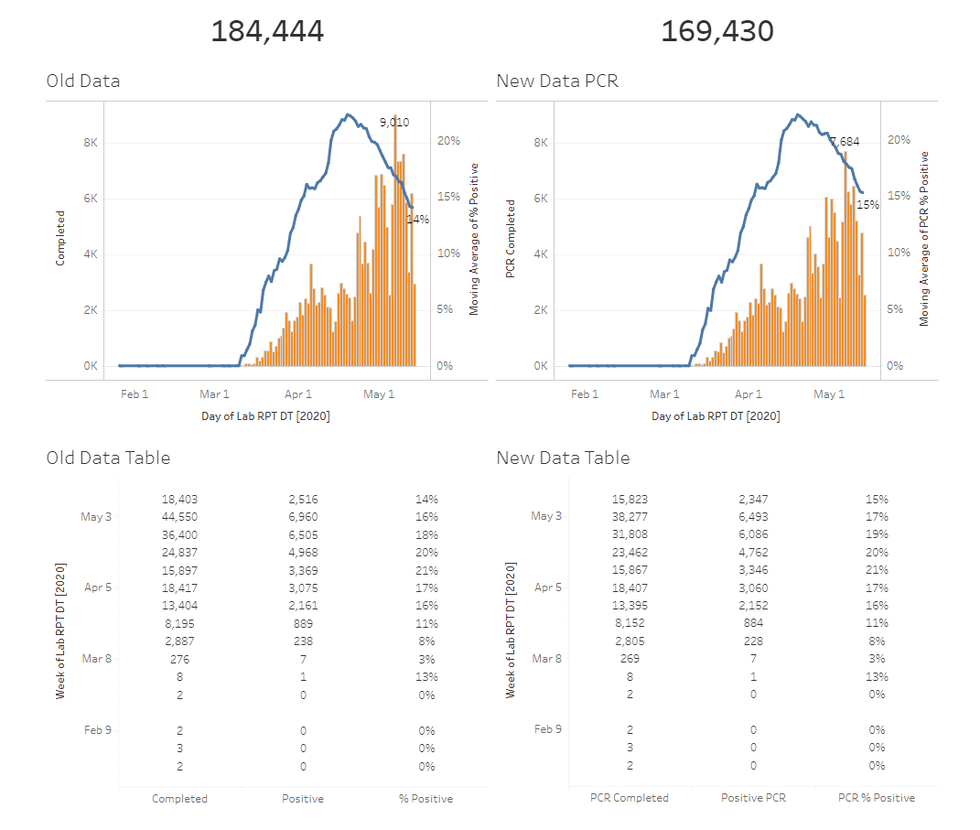
Health officials in Texas, Georgia, Vermont and Virginia acknowledged this week that they have been combining viral and antibody test results. Those results may well have painted an inaccurate picture of how the coronavirus has spread over time, and led to an overestimation of how well officials are tracking the contagion.
The difference is a matter of timing. Viral tests — taken by nasal swabs or saliva samples — help diagnose current COVID-19 infections. Antibody tests analyze a person's blood to see if they have been infected in the past.
"If you put the two tests together, you fool yourself into thinking you've done more testing than you have," said CNN medical correspondent Elizabeth Cohen.
The more testing a state does, the better it can understand the scope of infection. But if viral test numbers include antibody test results, experts say, it might give a state an inflated sense of its ability to test and track current infections.
Some experts believe state officials have been intentionally conflating the two numbers in order to exaggerate or distort the stats. Although unproven, this is plausible, since it's otherwise unclear why health officials would have taken the extra step to combine two clearly distinct datasets.
Moreover, the national testing data published by the Centers for Disease Control and Prevention (CDC) is drawn from the state-submitted data, a CDC spokesperson told Salon.
It's not clear why CDC officials would knowingly combine those two datasets into one viral test dataset. Doing so would create an imperfect picture of the national testing landscape and progress.
It's also unclear whether many states beyond these four have been combining data and how much, or in what way, these flawed reports may have skewed the national data. The Virginia Department of Health, for instance, reports confirmed and probable cases of COVID-19 infection (also listed on its website). We do not know whether CDC knew it was aggregating and publishing skewed data, and if it did, when.
CDC did not respond to questions about those issues.
What seems apparent, however, is that for months CDC has been publishing national data based on imperfect data aggregated from at least some states.
From a public health perspective, it's imperative that health officials and policymakers have an accurate and evolving understanding of how many cases a region has in order to correctly map the contagion. They also need to figure out how many people in the region have already had the virus and now appear healthy, since those people may now be immune to infection, at least in the near term.
Both measures are important, but they measure different things.
Ashish Jha, the K.T. Li Professor of Global Health at Harvard, told The Atlantic last week that such results can represent testing gains that do not exist in reality.
"It is terrible. It messes up everything," Jha said. Combining the test results as these states have done, he says, returns information that is impossible to interpret.
The result might skew the maps of time and space that are increasingly critical as states begin rolling back social distancing restrictions.
Health officials in Texas, Virginia and Vermont say they have been working to deconflict the reports over the last few days. Georgia's state health department, however, said the state was simply adhering to methodology guidelines from the CDC.
In a statement to Salon, a Georgia Department of Public Health (GDPH) spokeswoman doubled down on the claim that the department had followed CDC directives, but promised "greater transparency." The statement also mentioned, in its final sentence, that Georgia officials have decided to change their methodology, and will now separately report antibody and viral (PCR) results:
The GDPH has received antibody tests since early April and, following current CDC methodology, has included the tests received in the 'Total Tests' number currently listed on the DPH COVID-19 Daily Status Report. DPH staff is currently working diligently to provide greater transparency in the molecular and serologic testing data displayed on the Daily Status Report. One of our top priorities is to provide accurate and timely data to the public and we will continue to make every effort to do so.
The number of serology tests reported to DPH is 57,000, and we will continue to get new reports so that number will change daily. Serology tests are useful in determining the prevalence of the disease in the population and have been authorized by the FDA for use in COVID-19. We will update the website to reflect the number of 'Total Tests' that are serology vs PCR.
The statement did not detail the number of viral (PCR) tests.
CDC's online database currently breaks the two tests down by type. When Salon reached out to CDC in search of further clarification on methodology, a spokesperson said that the agency publishes aggregated state data, which we now know included both types of tests, at least in some instances.
It is not clear when CDC learned that some states had been reporting combined test numbers, or whether those states had assumed from CDC's final output format that all other states were combining numbers in the same fashion. How much these mixed methodologies among different states may have the skewed national data seems to be unknown.
"CDC has worked quickly to publicly report COVID-19 laboratory data that we receive in electronic form from state and jurisdictional health departments as part of the pandemic response. CDC began reporting this data on the COVID Data Tracker website to inform the public and guide decision making," the spokesperson wrote in an email.
"Initially, when CDC launched its website and its laboratory test reporting, viral testing (tests for current infection) were far more commonly used nationwide than serology testing (tests for past infection). Now that serology testing is more widely available, CDC is working to differentiate those tests from the viral tests and will report this information, differentiated by test type, publicly on our COVID Data Tracker website in the coming weeks," the spokesperson said.
"This is just one presentation of this data – often states have their own presentation of the data that is driving their decisions," the email said.
The spokesperson pointed to a weekly report called COVIDView, which only counts viral testing. "The advantage to the COVIDView lab data is being able to see the change in percent positivity over time, which has been going down for a few weeks," the spokesperson said.
Further muddying the picture, the CDC website points out that the number of positive tests in a state is not necessarily equal to the number of cases, because an individual may be tested more than once. Negative tests typically take longer to come in; in Virginia, the average lag is three days.
This means that each negative test result does not necessarily represent a distinct individual either. As the number of people tested more than once increases over time — and if the spread of testing outstrips the spread of the virus — it becomes increasingly difficult to draw conclusions at a glance.
A spokesperson for the Virginia Department of Health confirmed that it too will now split test data according to type, but said the differences were "minimal" and did not misrepresent the bigger picture.
"Antibody tests make up less than nine percent of overall tests. When these tests are removed from total results, there is minimal change in the percent positive of tests and no difference in overall trends," the spokesperson said.
The spokesperson provided tables that illustrate heartening trends for the state — the percentage of positive results has declined — but also reveal how the many factors outlined above, such as the three-day lag for full results, might complicate a layperson's understanding of the data.
The Texas and Vermont departments of health did not respond to Salon's requests for comment.
Testing capacity is one of the key pieces required for a successful and phased reopening of the economy. Public health experts, including members of the official White House task force, have repeatedly cautioned against attempting a return to normal before robust testing infrastructure is in place, as well as contact tracing programs and, ultimately, a vaccine.
According to the latest state health department data, Georgia has reported more than 40,400 cases and more than 1,700 deaths. Texas has reported more than 51,300 cases and more than 1,400 deaths, Virginia has reported more than 44,100 cases and 1,099 deaths, and Vermont has reported more than 900 cases and 54 deaths.
Virginia entered its first reopening phase on May 15; Texas, Georgia and Vermont initiated reopening on April 27.
The husband of the woman who leads the Reopen NC movement says people should be willing to kill, if necessary, to resist the “New World Order” and emergency orders imposed by state government to contain the coronavirus pandemic.
Adam Smith posted a string of Facebook Live videos on Facebook on Friday, May 22, 2020 that culminated with a chilling threat.
“But are we willing to kill people? Are we willing to lay down our lives?” he asked. “We have to say, ‘Yes.’ We have to say, ‘Yes.’ Is that violence? Is that terrorism? No, it’s not terrorism. I’m not trying to strike fear in people by saying, ‘I’m going to kill you.’ I’m gonna say, ‘If you bring guns, I’m gonna bring guns. If you’re armed with this, we’re going to be armed with this.’”
A retired Marine who owns a payment-processing company in Burke County, nestled in western North Carolina’s Blue Ridge Mountains, Smith posted four Facebook Live videos over the course of the day while driving his car. Smith said in the videos that he feels called by God and by his understanding of the Constitution to prepare for a violent showdown.
At the outset of the final video, he interrupted his testimonial to accept a bag of fast food from a restaurant worker through a drive-thru window.
“I believe God’s drawing a plumb line,” he said. “And he’s wanting us to choose which side we’ll be on…. Had to grab me a little grub — which of history we’ll be on.”
In another video, captioned “Those who are awake must be ready to fight,” Smith complained about a “bombardment” of media stories and social marketing surrounding the coronavirus pandemic, along with appeals to social solidarity and cooperation, which he contended are “just making it normal for this quarantine level of society that they want us to live in.
“This is a test,” he continued. “This is seeing if we are ready to accept the mark of the beast, if we are ready to accept this New World Order system they want to implement over humanity.”
Ashley Smith, the cofounder of Reopen NC and the movement’s most visible leader, is organizing simultaneous rallies in five cities — Raleigh, Charlotte, Greensboro, Asheville and Wilmington — on Monday to commemorate Memorial Day and protest Gov. Roy Cooper’s handling of the coronavirus response. The rallies have attracted considerable support from Republican politicians, with state Insurance Commissioner Mike Causey and lieutenant gubernatorial candidate Mark Robinson speaking at the Greensboro event.
Adam Smith called on fellow military veterans to attend the rallies in one of the videos, warning that “today is the day the Constitution is under attack and tomorrow might be the day where all our rights are removed.”
Smith has removed the videos from his Facebook page since being contacted by Raw Story.
Reached by phone on Saturday, Smith at first appeared to walk back his statement about being “willing to kill people,” saying it was more of a tribute to the American revolutionaries of 1776 than a comment on the emergency orders issued by Gov. Cooper. But pressed further, he insisted that violence has to be an option.
“I’m trying to make the men of this country stand up,” Smith said. “The last thing we want is bloodshed, but that’s something they should know we’re willing to do.”
He said he can understand how some people would see his statement as an incitement to domestic terrorism, but added, “If you think about terrorism, the whole act is to incite terror in people. We don’t instill terror in people. The point is to instill fear in the government…. It’s to create a check and balance. We know that freedom from time to time has to be renewed by the blood of tyrants. We were founded through rebellion and bloodshed.”
A self-described “constitutionalist,” Smith expounded an argument for American citizens’ right to redress grievances against the government through force of arms that is broadly consistent with the far-right militia movement. An Anti-Defamation League backgrounder on the militia movement for law enforcement states that proponents have “claimed that militia groups were: (a) equivalent to the statutory militia; (b) not, however, controlled by the government; and (c) in fact, designed to oppose the government should it become tyrannical.”
Central to the militia movement that first emerged in the early 1990s is a conspiratorial worldview.
“But the militia movement not only accepted the traditional conspiracy theories, it created a host of new ones; combined, they described a shadowy movement intent on creating a one-world socialist government no matter what the cost,” the backgrounder says. “This ‘New World Order,’ using the United Nations as its primary tool, had already taken over most of the planet. The United States was still a bastion of freedom, but its own government was collaborating with New World Order forces to strip Americans slowly of their freedoms in preparation for the final takeover.”
Adam Smith’s violent rhetoric is seemingly at odds with the stance of Reopen NC, which describes itself as “a peaceful action group.”
But in an interjection during her husband’s interview with Raw Story, Ashley Smith backed his argument that a citizen militia has the right to act as a check on duly elected officials.
“When we have a governor that’s not acting under the constitutional guidelines that we set for his oath of office, then it’s up to the people to check his authority,” she said. “That’s at the heart of the Constitution.”
Ashley Smith said her comments do not represent the official views of Reopen NC.
Adam Smith’s call for violent resistance to the “New World Order” and his involvement with a boogaloo group that has been carrying firearms through downtown Raleigh signals a blurring of the line between the fringe and mainstream wings of the North Carolina reopen movement.
On May 16, Smith showed up clad in a matching camouflage jacket and hat, a black face covering and sunglasses while wielding a high-powered rifle to join a local boogaloo group that has gained national notoriety after photos of armed members ordering food at Subway went viral.
Smith introduced himself to the boogaloo activists on May 16 by saying that he was invited by Stephen Wagner, who is the president of the Johnston County chapter of Reopen NC.
“Do you not know that it’s actually the right and responsibility of the people to be evenly matched with the government armament?” Adam Smith asked a counter-protester during the May 16 boogaloo walk. “Do you not know that constitutional responsibility?”
Ashley Smith told Raw Story that the notion that a citizens militia has the duty to maintain a level of armament equal to the government comes from Federalist Paper No. 46, by James Madison.
The boogaloo gatherings, a weekly occurrence in Raleigh since May 1, have taken place separate but alongside the reopen rallies. The Raleigh police have threaded a needle to avoid making arrests by accepting the boogaloo activists’ assertion that their gatherings are not protests; North Carolina law makes it illegal to carry a dangerous weapon as participant or spectator at a demonstration. In turn, the boogaloo activists have complied in some instances with the officers’ requests to put away signs and flags. While the boogaloo activists use euphemisms like “exercising” to describe their activity, they frequently disparage the state response to the pandemic terms similar to the reopen protesters — as a government overreach and as a public-health threat that is exaggerated for the purpose of scaring people into giving up their rights to assemble and conduct business.
Meanwhile, the reopen rallies, where participants abide by the law against carrying firearms at demonstrations, have provided a more respectable forum for Republican politicians. US Rep. Dan Bishop has addressed the reopen rallies, along with Robinson, and state Rep. Larry Pittman. Meanwhile, Ashley Smith told followers on Facebook that she met with Lt. Gov. Dan Forest and he encouraged their cause.
Smith was arrested by State Capitol Police during the April 28 reopen rally after being warned not to step on the sidewalk in front of the executive mansion.
As the officers placed her under arrest, Smith can be heard in a video posted by the Raleigh News & Observer saying, “My tax dollars paid for this. You’re dishonoring the flag. You’re not an oath-keeper. You’re ashamed of this Constitution.”
Following behind, Adam Smith berated the officers.
“Look at these thugs arresting her over walking on the sidewalk,” he said.
Smith faces charges in Wake County court for misdemeanor resisting an officer and violation of executive orders. On March 14, Gov. Cooper signed an executive order to prohibit mass gatherings in North Carolina. A modification of the order issued on March 27 defined mass gatherings as “any event or convening that brings together more than 10 persons in a single room or single space at the same time.” That provision is the basis of the charge against Smith.
In his livestream on Friday, after saying his “brothers in arms” must be “willing to kill people,” Adam Smith turned his attention to the executive orders.
“See, that is why America has been free, and that’s why we remain free — because we’re willing to step up and fight against the forces of tyranny,” he said. “We’re willing to speak out against these insane edicts and these insane executive orders that were allowed to be passed.”
Then he mentioned a recent protest he had read about in England, in which people protesting lockdown orders had been arrested.
“See, if we’d have had the guns, armed up and lined all around the park, [we could have] said, ‘No, you’re going to let ’em speak,’” he said. “And when they came and said, ‘We’re gonna take this freedom of speech from you,’ someone would have said, ‘No, you’re not. Not unless you want a gunfight on your hands. Unless you want the OK Corral, you better back down.’”
Here are key milestones in the history of crewed US spaceflights, which resume on May 27 with the first transport of US astronauts to the International Space Station for nine years.
- First American in space -
On April 12, 1961, the United States is upstaged by the Soviet Union, when Russian astronaut Yuri Gagarin becomes the first man in space, completing a 108-minute orbit aboard Vostok 1.
Less than a month later, on May 5, American Alan Shepard carries out a 15-minute suborbital flight aboard Mercury, launched in 1958 by the newly-created National Aeronautics and Space Administration (NASA).
Launched from Cape Canaveral, Florida, at 09:34 am local time using a Redstone rocket, his "Freedom-7" capsule reaches an altitude of 186 kilometers (115 miles) and travels less than 500 kilometers before landing in the Atlantic.
Weeks later US President John F. Kennedy launches the Apollo program, which foresees a man on the moon by the end of the decade.
On February 20, 1962, American John Glenn completes the first three orbits of the Earth, a voyage lasting just under five hours
- Man on the moon -
After six unmanned missions and four crewed outings to test equipment and manoeuvres, it is finally Apollo 11 that goes to the moon.
On July 21, 1969, at 0256 GMT, US astronauts Neil Armstrong, followed by crewmate Edwin "Buzz" Aldrin about 20 minutes later become the first men to set foot on the moon. A third astronaut, Michael Collins, remains in orbit.
"That's one small step for man, one giant leap for mankind," says Armstrong in immortal words watched on television by more than half a billion people around the world.
Five other Apollo missions follow, taking 10 other men to the moon before the program is ended in December 1972.
- Challenger and Discovery explode -
In 1972, President Richard Nixon decides to launch the US space shuttle program, with the maiden voyage of the Columbia, the first reusable crewed spacecraft, taking place on April 12, 1981.
It is followed later by Challenger, Discovery, Atlantis and Endeavour. In June 1983 Sally Ride becomes the first American woman to be sent into space, on Challenger.
During the 25th flight on January 28, 1986, the Challenger shuttle explodes 73 seconds after liftoff, killing all seven astronauts, as television viewers around the world look on.
Flights resume in September 1988, with Discovery.
The American shuttles' missions become more important with the deployment in 1990 of the Hubble space telescope and the start of construction of the International Space Station (ISS), in 1998, at a cost of $100 billion, largely financed by the United States.
Shuttle launches become routine, until February 1, 2003, when Columbia disintegrates over Texas upon re-entry, killing all seven crew members.
- US crewed flights halted -
In 2004, President George W. Bush decides to end the shuttle program in 2010, thus giving time to finish construction of the ISS. Discovery, Endeavour and Atlantis are the last orbiters remaining in service.
The last flight takes place in late June 2011, after 30 years in service.
NASA has since depended entirely on Russia's Soyuz to take astronauts to space.
In February 2010, President Barack Obama scraps plans under the Constellation program to return Americans to the moon.
He announces the goal of putting astronauts in orbit of Mars towards 2035 and developing commercial shuttles to transport American astronauts to the ISS.
His successor Donald Trump has ordered NASA to return to the moon by 2024 and to prepare missions to Mars.
On April 28, President Donald Trumpsigned an executive order to ensure that workers at meat processing plants continue working throughout the ongoing coronavirus epidemic despite the crowded conditions that make such workplaces ripe for fresh COVID-19 outbreaks.
Tyson — one of the nation's largest producers and marketers of chicken, beef, and pork — said on Wednesday that 570 of the 2,244 employees at its Wilkesboro, North Carolina complex have contracted confirmed cases of COVID-19, the virus that has killed nearly 96,370 Americans nationwide so far.
Tyson says many of the workers were asymptomatic. "The company has seen similar massive outbreaks, in the hundreds of cases, at its meat processing plants in Pasco, Washington; Madison, Nebraska; and Waterloo, Iowa," VICE News writes.
The company has since closed two of the complex’s three processing plants to conduct a deep cleaning and has also placed the employees on paid leave as they remain in quarantine.
According to the Centers for Disease Control and Prevention (CDC), nearly 5,000 meat plant workers across 19 states have tested positive for COVID-19. Smithfield, the largest pork producer in the United States, has also reported 783 coronavirus cases and two deaths among workers at its Sioux Falls, South Dakota plant.
While these cases and deaths occurred before Trump's executive order, they show just how dangerous meatpacking plants are for employees and their families. Crowded conveyer belt workspaces make it impossible to maintain 6 feet of social distancing and the cold air makes it easier for the coronavirus to stay active on surfaces.
The workers also tend to be low-wage, immigrants who live in crowded homes and take public transit, two factors which can increase a person's likelihood of contracting the virus.
On May 1, Jennifer McQuiston, a top CDC official, said 115 meat and processing facilities in 23 states have reported coronavirus cases. Trump's executive order allows the U.S. Food and Drug Administration to step in and force a meat plant to stay open even if a state government tries to shut it down as a public health hazard.
President Donald Trump's supporters think of him as the ultimate alpha male, but a scathing op-ed in The Atlantic makes the case that he's "the least masculine man" to be elected president in modern history.
Tom Nichols, a conservative professor at the Naval War College in Rhode Island, writes that he is baffled that blue-collar white men continue to support Trump even as the president has whiny tantrums about being treated unfairly in the media.
"Courage, honesty, respect, an economy of words, a bit of modesty, and a willingness to take responsibility are all virtues prized by the self-identified class of hard-working men, the stand-up guys, among whom I was raised," he writes. "And yet, many of these same men expect none of those characteristics from Trump, who is a vain, cowardly, lying, vulgar, jabbering blowhard."
The most damning aspect of Trump, writes Nichols, is his utter refusal to take any responsibility for his actions.
"In this category, he exhibits one of the most unmanly of behaviors: He’s a blamer," Nichols writes. "Nothing is ever his fault. In the midst of disaster, he praises himself while turning on even his most loyal supporters without a moment’s hesitation. Men across America who were socialized by team sports, whose lives are predicated on the principle of showing up and doing the job, continually excuse a man who continually excuses himself."
Space Exploration Technologies Corp. -- commonly known as SpaceX -- is slated to send two astronauts into space on Wednesday. Despite not yet being 20 years old, the company has already developed a creation myth: on September 28, 2008, its first rocket Falcon 1 launched for the fourth time.
"I messed up the first three launches, the first three launches failed. Fortunately the fourth launch -- that was the last money that we had -- the fourth launch worked, or that would have been it for SpaceX. But fate liked us that day," said Elon Musk, the company's founder and chief engineer, in 2017.
"We started with just a few people, who didn't really know how to make rockets. The reason I ended up being the chief engineer... was not because I wanted to, it's because I couldn't hire anyone. Nobody good would join," he added.
Born in South Africa, Musk immigrated to Canada at age 17, then to the US, where he amassed his fortune in Silicon Valley with the startup PayPal.
SpaceX's aim, when it was incorporated on March 14, 2002, was to make low-cost rockets to travel one day to Mars -- and beyond.
The 11th employee hired that year turned out to be someone good: Gwynne Shotwell, who was in charge of business development, soon established herself as Musk's right-hand woman.
AFP/File / Robyn BECK SpaceX founder Elon Musk (pictured with the Dragon capsule in May 2014) said the company started with "just a few people, who didn't really know how to make rockets"
In the space industry, the two are given the rock star privilege of only being referred to by their first names.
"Elon has the vision, but you need someone who can execute on the plan, and that's Gwynne," said Scott Hubbard, a professor at Stanford University and former director of NASA's Ames Research Center.
Hubbard met Musk in 2001, when the thirty-year-old entrepreneur was making his first forays into the space industry.
The 56-year-old Shotwell, who became SpaceX president and chief operating officer in 2008, is a self-described nerd. She graduated from Northwestern University with a degree in mechanical engineering and was elected in February to the National Academy of Engineering.
When Elon talks about colonizing Mars, it's Gwynne who makes commercial presentations and secures contracts.
"I have no creative bones in my body at all," Shotwell told a NASA historian in 2013. "I'm an analyst, but I love that."
- Reusable rockets -
GETTY IMAGES NORTH AMERICA/AFP/File / Michael Kovac Gwynne Shotwell (pictured 2014), who became the SpaceX president and operating chief operating officer, is a self-described "nerd"
The team started to gain credibility in 2006. SpaceX had only 80 employees (compared to 8,000 now) and had yet to achieve orbit. But NASA awarded them a contract to develop a vehicle to refuel the International Space Station (ISS). "The crowd went crazy," Shotwell recalled.
SpaceX succeeded in 2012: its Dragon capsule docked at the ISS, the first private company to do so. Then, in 2015, after multiple crashes and failures (spectacles often webcast live), SpaceX landed the first stage of its Falcon 9 rocket, the successor of Falcon 1, safely back on Earth.
The era of non-disposable rockets had begun.
"Falcon 9 is simpler and lower-cost," said Glenn Lightsey, an engineering professor at Georgia Tech.
The rockets were built completely under one roof, in Hawthorne in the Los Angeles area -- breaking with the long supply chain models of giants such as Boeing and Lockheed Martin.
The SpaceX formula proved seductive to clients: in the past three years, the company has launched more rockets than Arianespace. In 2018, SpaceX launched more rockets than Russia. For an operator, launching a satellite on a Falcon 9 costs half as much as on an Ariane 5, according to Phil Smith, an analyst at Bryce Tech.
Having conquered the private launch market, SpaceX has claimed a bigger piece of the pie for public and military launches. Still funded by NASA, SpaceX is set this week to become the first private company to launch astronauts into space.
GETTY IMAGES NORTH AMERICA/AFP/File / JOE RAEDLE Two of the boosters land at Cape Canaveral Air Force Station after the launch of SpaceX Falcon Heavy rocket on February 6, 2018 in Cape Canaveral, Florida
Despite a few years' delay, its Crew Dragon is ready before Boeing's Starliner. Musk also wants to build NASA's next moon lander.
Industry giants have criticized the company for "arrogance," but "the real reason was that it threatened their way of doing business and their livelihoods," Lori Garver, NASA's former deputy administrator, told AFP.
It's now Shotwell who lectures her competitors: "You have to learn those hard lessons," she said in a NASA briefing at the start of the month, recalling the multitude of problems that plagued SpaceX's start.
"I think sometimes the aerospace industry shied away from failure in the development phase."
Dave Burrier steered his tractor through a field, following a GPS map as he tried to plant as much corn as possible amid the yellow and green rye covering the ground.
Striving to get a massive yield out of his crops in rural Maryland is how Burrier hopes to make it through yet another uncertain year, beset by market disruptions caused by the COVID-19 pandemic and renewed trade tensions between the United States and China.
"We've had so much price erosion that we're basically at below the cost of production. We've got to figure out how to manage and turn a profit," Burrier told AFP.
"That's harder than planting this corn."
American farmers growing corn and soy -- the biggest crops in the world's largest economy -- were hoping for a turnaround this year after Washington and Beijing reached a truce in their months-long trade war, which included a pledge to buy more US agricultural goods.
But the coronavirus hit before the benefits of that deal could be felt, disrupting transportation and operations at slaughterhouses, sapping demand, while the global oil price crash closed the ethanol and biofuel plants that could have picked up the slack.
"It's kind of glum," said Dave's wife Linda Burrier, a soybean farmer who serves on the United Soybean Board, the crop's governing body in the US.
Yet she remains guardedly optimistic.
"Farmers are one of the most faithful people there are," she said. "You put a seed in the ground, you expect to get a crop out of it."
- Unpleasant memories -
Facing a supply glut, the US Department of Agriculture projects the average farm price for corn will to drop to its lowest level in 14 years in the 2020-2021 growing season. Soybean prices also are expected to fall.
And a study from the University of Illinois and Ohio State University earlier this month predicted that even with payments from government safety net programs, corn and soybean farmers are facing total revenue losses of $8.5 billion to $10.2 billion amid the pandemic.
President Donald Trump's administration spent $28 billion in 2018 and 2019 to help farmers hurt by the trade war, and pledged another $16 billion this year to offset the market disruptions.
Dave Burrier said the current conditions are a grim echo of the 1980s -- a decade he would prefer to forget -- when a combination of low commodity prices, heavy debt burdens and a grain embargo against the Soviet Union ruined American farmers.
"It gives me a chill to talk about it," he said.
Plenty has changed in the more than four decades Burrier, 67, has been farming.
Computer monitors in his tractor display detailed metrics to track his planting, replacing the pen and notebook his father relied on.
The Soviet Union is gone, but US farmers once again are partly at the whim of a foreign power.
China retaliated for Washington's unilateral trade actions with crippling tariffs on US soy and pork that drove a steep drop in total US agricultural exports to $9.2 billion in 2018, less than half the 2017 amount, according to government data. Exports recovered to nearly $14 billion last year.
- Delayed retirement -
In the "phase one" deal reached in January, Beijing agreed buy up to $50 billion in US farm products. But with Trump accusing China of covering up the origins of the coronavirus, fears are rising that the deal will fall victim to the acrimony.
"Agriculture in America is very vulnerable right now, but if we have a good growing season we should be able to get through this year," said Arlan Suderman, chief commodities economist at INTL FCStone.
Danielle Bauer, executive director of both the Delaware and Maryland soybean boards, said farmers in her area have stepped up exports to Taiwan and are expecting increased demand for high oleic soybean oil, a variety grown exclusively in the US.
"There is a lot of uncertainty. The farmers are bracing for a really hard year all around," she said.
The Burriers also plant wheat and make good money selling hay to a nearby racetrack, and Dave's corn yield last year was double the county average.
But 60-year-old Linda admits the setbacks of recent years plus the pandemic mean the couple probably will have to delay retirement.
"We're going to have to wait, I don't know, another five or 10 years, if we can, physically," she said. "My husband's worked really hard. I don't know how much longer he's going to want to keep at it."




/https://static.texastribune.org/media/files/0f781dbdffc3c5f48dc5f42e9eec5f2e/Lake%20Aire%20Clinic%20AP%20TT%2004.jpg)
/https://static.texastribune.org/media/files/911722d04663173324145775a2169277/Stevie%20Smith%20BT%20TT%2009.jpg)
 AFP/File / Robyn BECK
  GETTY IMAGES NORTH AMERICA/AFP/File / Michael Kovac
  GETTY IMAGES NORTH AMERICA/AFP/File / JOE RAEDLE