President Donald Trump on Tuesday promised the $181 billion oil and gas industry a federal bailout, after the price of oil suffered historic drops even after Trump last week declared victory when he personally intervened with OPEC. On Monday the price of oil futures for May contracts dropped below zero, for the first time in history. As the photo shows, Trump met with Big Oil executives earlier this month in the White House. In the foreground is Darren Woods, Chief Executive Officer of ExxonMobil.
What's causing the prices of oil and gas to drop is people are staying home because of coronavirus. Demand has dropped dramatically, although the prices at the pump have not dropped equally.
The oil and gas industry is among the wealthiest in the world, so Americans seeing Trump's tweet are now furious. Hospitals and even doctors offices are struggling amid reports some are or will be forced to close permanently as a result of the pandemic – or rather, as a result of the federal government's mismanagement of the pandemic. State and local governments are desperate for funding as they face dramatically reduced revenue while having to spend tremendous amounts to fight against the virus. And the American public didn't get a bailout. Some received one-time payments of $1200 or less.
Some noted the oil and gas industry already gets billions of taxpayer dollars in subsidies, some noted Trump's close relationship with top executives, some noted if it happens there should be strings attached to force them to go green, and some demanded the federal government protect the Postal Service before Big Oil.
Maryland Gov. Larry Hogan (R) on Tuesday said that President Donald Trump recently attacked him because he "got confused" during a press briefing.
During an interview with Hogan on Fox News, host Sandra Smith noted that Trump had lashed out at Hogan at Monday's White House coronavirus task force briefing. The president's attack came just a day after the governor complained about the federal government's failure to ramp up COVID-19 testing.
Hogan said he was "really not sure" what the president was talking about.
"It was a great call we had yesterday with the vice president," Hogan said. "I thanked and praised the vice president and the president's team for all the progress that they had been making. I thanked them for what they were doing with respect to swabs and ramping up testing and PPE. It was a completely positive call."
The governor explained that the White House provided him with at list of testing labs in his state.
"We already knew where the state labs were," Hogan said. "But the list that they gave us was mostly federal labs, which we've been attempting to use for more than a month now. We got a commitment from the vice president that we can now use federal labs, which is terrific."
"But the president was not on the call and somehow, I think, he got confused in the press conference," the governor added. "I'm really not sure what he was upset about. We did what he told us to do, which was go out and get our testing and we had a great call."
A man in Utah has been arrested for vowing to start a "civil war" in Salt Lake City unless its mayor agrees to end lockdown policies that were designed to prevent the spread of COVID-19.
The Salt Lake Tribune reports that a 58-year-old man was arrested last week after he called the office of Salt Lake City Mayor Erin Mendenhall and said that he would work to "forcibly remove" her from office unless she ended the lockdown.
"There's a protest tomorrow and if things don't change, a civil war is coming, and the police can't stop me," he also said in his phone call.
The man also made threats of "civil war" in separate Facebook posts, the Tribune reports.
"Bring your guns, the civil war starts Saturday," he wrote. "Be prepared to defend our God given constitutional right."
Despite being arrested, the man has not yet been charged with a crime, although he is under investigation for making terroristic threats and electronic communication harassment.
He has been released from prison after posting $5,000 bail.
According to an exclusive report by the Daily Mail, the organizer of a Michigan lockdown protest has claimed that nutrition supplements that he takes can beat coronavirus. The Daily Mail also reports that Garrett Soldano is also a national marketing director for Juice+, a controversial supplement company that was once endorsed by O.J. Simpson.
Soldano, who is also a former Western Michigan University linebacker, said that he gives the supplements to his own family so that if they're infected with coronavirus, they'll "get over it" and turn their bodies "into an environment of greatness" that will allow them to "dominate any virus."
Speaking to the Daily Mail, a Juice+ spokesperson said the company makes "no claim and have no data to support that our product prevents or treats COVID-19."
In the 1990s, the parent company for Juice+, National Safety Associates (NSA), was accused of being a giant pyramid scheme in a series of lawsuits.
Soldano started the Michiganders Against Excessive Quarantine Facebook page which has over 360,000 followers. His page's anti-lockdown posts sparked people to storm the State Capitol in Lansing.
Former FDA Commissioner Scott Gottlieb on Tuesday told CNBC that he didn’t understand Georgia’s plan to start re-opening businesses in the state.
Republican Gov. Brian Kemp announced Monday that certain businesses, such as fitness centers, would be allowed reopen this week despite the rise in coronavirus cases.
“Gyms, nail salons, bowling alleys, hair salons, tattoo parlors -- it feels like they collected, you know, a list of the businesses that were most risky and decided to open those first,” Gottlieb remarked.
“I think we should focus on trying to bring people back to work in factories, commercial settings, offices first and open some of those businesses that are providing services -- providing, you know, discretionary services second.”
“Notwithstanding the fact that I understand there are a lot of small businesses behind these professions that are being badly hurt, but if you want to get the economy going and you want to bring back the businesses that contribute to GDP first, if you can,” Gottlieb explained.
The incident took place Friday as part of a series of demonstrations nationwide protesting state orders imposing social distancing measures.
The 36-year-old Costa Mesa man, who appeared to be intoxicated, was still holding the photographer at knifepoint inside the news van when officers arrived, according to police.
Petersen was arrested on kidnapping and exhibiting a deadly weapon charges, and jailed on $100,000 bond.
Neither the photographer and the reporter he was accompanying were harmed, but the station said both were shaken up and would be given time off.
The station did not air a report on the protest that evening because all the raw video was turned over to police as evidence.
This week, Georgia Gov. Brian Kemp announced his plan to cut way back on social distancing in his state and reopen the types of businesses that were previously deemed non-essential — from nail salons to bowling alleys to restaurants. But Kemp’s decision is by no means universally popular in Georgia, and the Daily Beast’s Khushbu Shah explains why so many Atlanta residents are furious with the far-right Republican governor.
Atlanta is a very Democratic city in a red state. Atlanta also has a large African-American community, and blacks have been hit especially hard by the coronavirus pandemic. Keeping all of those things in mind, it isn’t hard to understand why Kemp’s anti-social distancing stand is drawing a lot of angry responses in Atlanta. And as Shah’s article stresses, some of the people slamming Kemp are Atlanta-based businesses owners who plan to voluntarily remain closed.
For example, an Atlanta-based hairstylist told the Daily Beast, “I am mortified and appalled he would open us up in the middle of our coronavirus peak.” And Jacob Franklin, who manages the Atlanta restaurant Bon Ton, told the Beast, “I don’t think we’re ready to open up.”
“Kemp announced Monday that gyms, bowling alleys, hair and nail salons across Georgia would be allowed to reopen so long as they meet some safety thresholds like instituting social distancing policies,” Shah explains. “Shortly after the announcement, the (Georgia) Department of Health announced more than 19,000 residents had tested positive for the virus — though the number of new infections has slowed in recent days.”
One of the Atlanta residents who has been aggressively promoting social distancing is Democratic Mayor Keisha Lance Bottoms — who, Shah notes, “urged residents to stay home” during an interview with ABC News on Monday night.
Atlanta resident Meherwan Irani, who owns the restaurants Chai Pani and Botiwalla and has over 300 employees, has no desire to reopen in a week and told the Beast he would rather rely on medical experts than on Kemp.
“I know small business owners are hurting and desperate — we are too,” Irani asserted. “But if we lose the public’s trust and confidence right now because we reopened even though it wasn’t safe, we’ll risk losing that trust for a long time to come.”
The owner of an Atlanta hair salon stressed to the Beast that social distancing and operating a hair salon are diametrically opposed.
“It’s not social distancing if you’re touching someone,” the salon owner asserted. “We touch people for a living. I would never pick money over putting someone’s life in danger.”
The Washington Post reports that The TrumpWhite House has "explored support for a liability waiver that would clear businesses of legal responsibility from employees who contract the coronavirus on the job."
The White House is now also weighing whether to extend this liability shield to individual employees as well, so that they couldn't be sued for making customers and coworkers sick if they show up to work with the disease.
However, shielding employers who force employees back to work during the coronavirus pandemic from lawsuits would require an act of Congress, and the Post reports that "its fate among Democrats is unclear."
Georgia Gov. Brian Kemp on Monday said that he wanted to see businesses such as bowling alleys and gyms to reopen by the end of the week, but many small business owners are balking at the relaxed guidelines and saying that they don't feel comfortable reopening yet with the pandemic still raging.
Between now and November, President Donald Trump’s reelection campaign will come up with many different ways to attack his Democratic opponent, former Vice President Joe Biden. But how effective the lines of attack will be remains to be seen. And Daniel W. Drezner, a professor of international politics at Tufts University, argued that many are in denial about Trump's standing in the 2020 election.
Some mainstream media coverage of the campaign, Drezner writes in a Washington Post op-ed, is — in an effort to be fair to Trump — downplaying some of the problems his campaign is facing during the coronavirus pandemic.
“My personal favorite is this headline on an Associated Press story: ‘Coronavirus could Complicate Trump’s Path to Reelection,’” Drezner asserts. “I know the AP is as strait-laced as possible in its coverage, and to be fair, the story is straight-forward in describing Trump’s challenges come November. Still, this is equivalent to a headline on December 8, 1941, saying: ‘Japanese Attack on Pearl Harbor Could Complicate America First’s Desire for Isolationism.’”
In other words, Trump is in dire straits, and we shouldn't pretend otherwise.
Mainstream media reports that go out of their way to give Trump’s campaign the benefit of the doubt, according to Drezner, “contain an air of unreality about them.” The Tufts professor explains, “They assume that the Trump campaign’s gambits can somehow alter the trajectory of the general election campaign.”
Drezner notes that over the weekend, the New York Times, the Los Angeles Times and The Washington Post all published articles “covering the Trump campaign’s belief that it can attack Joe Biden, the presumptive Democratic nominee, as being soft on China.” But he goes on to assert that during a deadly pandemic, such attacks miss the mark badly.
“Biden’s tactical response is not the important thing…. The important thing is that campaign tactics are meaningless when the administration has bungled its pandemic response and the economy is cratering,” Drezner explained. “Trump is starting the fourth quarter of the campaign behind and with a lousy field position. Biden is beating him in the polls. Democrats have united behind their candidate. Trump cannot campaign on the economy. Attacking Biden on China is like trying to bail out the Titanic with a toy bucket.”
Drezner noted that even given the dismal conditions Trump is facing for his re-election, victory isn't impossible. It's just much harder for him to pull off than most observers in the press seem to think.
"Trump’s surprise victory in 2016 has caused political analysts to focus on the ways he can survive this debacle. And there is a chance that he can," Drezner writes. "In the past century, only three presidents have run for reelection and lost. But the fact remains that Trump lost the popular vote and barely eked out an electoral college victory in 2016. November’s election will be a referendum on his presidency, and the country will be worse off in every possible way compared with four years ago.:
TALLAHASSEE, Fla. — A Republican Party-dominated task force assembled by Gov. Ron DeSantis began looking Monday at how to reopen Florida’s economy, even as cases of COVID-19, the disease caused by the coronavirus, continue to rise and fears persist about a spike in cases if society returns to normal too quickly.“We need to get the economy back in a safe way,” DeSantis said, and “give people (the) confidence they’re going to be able to participate in the economy.”Coronavirus cases in Florida surpassed 27,000 on Monday, and the death toll topped 800. Social distancing has kept many residents in ...
Older Americans have broken sharply with President Donald Trump on his handling of the coronavirus pandemic.
Morning Consult tracked surveys showing that people older than 65 strongly believe -- by a 6-to-1 margin -- that the government should focus more on addressing the spread of coronavirus than on restarting the economy.
As the president signals that he wants to reopen states before their governors and public health experts recommend as responsible, older Americans are losing their support for him.
Senior citizens approved of Trump's handling of the outbreak in mid-March at a higher rate than any other group, with a net approval of plus-19.
But Morning Consult found that approval had drained away by 20 points over the past month -- and now their support is lower than any age group besides 18- to 29-year olds.
Congressional support on coronavirus has fallen 22 points from a poll taken at the end of March, shortly after a $2 trillion stimulus package was signed into law.
Polls suggest Americans feel a sense of urgency for additional action, with nine in 10 voters saying that an emergency funding bill should be a priority for Congress.
Voters of both parties agree, by at least a 20-point margin, that coronavirus relief should be the top priority for lawmakers, who are reportedly nearing a deal with the Trump administration on a $450 billion relief package.
When President Donald Trump was confronted with the direct and dangerous consequences of his own actions of Monday, he immediately began boasting about his fan base and refused to acknowledge any wrongdoing.
It was a disturbing moment, and it seemed deeply revealing of his character.
The exchange came during Monday’s coronavirus press briefing when PBS reporter Yamiche Alcindor pressed Trump on a family she had come across in her reporting.
“I interviewed someone who said that his family got sick, they went to a funeral in mid-March, and, they said — mainly — because the president wasn’t taking it [the coronavirus] seriously,” she explained. “He said: ‘If the president had had a mask on, if he was saying we should stay home, then I would have stayed home. Instead —'”
“Well, I know, I understand—” Trump said, trying to cut in, but Alcindor continued. Trump impatiently bobbed his head while she continued her question.
“He said his family members were sick because they listened to you,” she said. “Do you feel like you, or are you concerned that downplaying the virus maybe got some people sick?”
Trump seemed barely able to comprehend or process the question, given it put him in such a poor light. Without even actually responding to a word she said, the president awkwardly pivoted back to his fan base.
“And a lot of people love Trump, right?” he said. Of course, from the account Alcindor gave, it seemed the family in question may have been fans of the president themselves — at least until they got sick.
“A lot of people love me,” Trump continued. “You see them all the time, right? I guess I’m here for a reason, you know? To the best of my knowledge, I won. And I think we’re gonna win again. I think we’re going to win in a landslide.”
Trump then moved on to talking about the travel restrictions he placed on travelers from China on Jan. 31, and his subsequent move to restrict travel from Europe.
“So how could you say I wasn’t taking it seriously?” Trump said.
But as I noted when he announced the European travel restrictions, Trump’s messaging about the seriousness of the virus in the United States was entirely muddled. He downplayed the severity of domesticated cases, and his announcement made it seem — wrongly — that the problem was a foreign threat, rather than a domestic one. I explained:
Trump did, correctly, say that elderly people are most at risk, that basic hygiene measures can reduce the spread of the disease, and that “social distancing” measures — avoiding unnecessary contact with others or gatherings — may be necessary. But these remarks were clearly an afterthought to his focus on travel from Europe, and they did not convey the scope of social disruption that the virus is likely to have on American society.
And his record of downplaying the virus for the weeks prior to this is well-documented. So it’s completely plausible that — as Alcindor reported — people who took Trump as a reliable source of information could have been misled into taking dangerous risks in March. It was only March 16 that the White House official announced socially distancing guidelines, but by then it was far too late for many people who were already infected and spreading the disease. And the message that Trump didn’t take the infection very seriously had already been made loud and clear.
Trump has bungled the crisis in ways that go beyond his rhetoric. He had diminished the nation’s pandemic response capacity prior to the outbreak, and he has failed to rally a concerted federal government approach to stopping the virus that the situation demands.
But his choice to downplay the virus for his fans and dismiss the measures that were necessary to stop its spread early on is the clearest case of how the president failed the nation — especially his own supporters. It’s disturbing that, even when confronted with a clear-cut case of a family that blames their trust in Trump for their fate, he can’t take a moment for self-reflection, empathy, or humility. He can’t admit that he’s made any mistakes. Instead, he starts rambling about the people that love him.
It demonstrates exactly the simplistic, sensitive, and self-obsessed mindset that made him downplay the virus in the first place. He psychologically rejects anything that is a threat to his identity and his status as illegitimate, and he tries to replace it with a more comforting narrative. Such a reaction to unpleasant information is flawed, immature, and maladaptive in any human being. But in a nation’s leader, it is unbelievably dangerous.
To date, nearly every state in the U.S. has announced that its incarcerated populations are contributing labor to the pandemic response.
I am a sociologist who studies how emergencies affect correctional institutions. Dependence on incarcerated workers in times of disasters is embedded throughout emergency management policy and practice at the local, state and federal levels.
But that dependence may now be putting these prisoners at risk of illness or even death.
Emergency planning
In the weeks since the coronavirus began to spread across the U.S., every state has declared an emergency, allowing state resources to be directed toward fighting the pandemic.
Incarcerated people in state prisons, representing approximately 1.3 million potential workers, are considered state resources. In my research on state-level emergency operations planning, I’ve found that the majority of states plan to use incarcerated workers to respond to emergencies and disasters.
Federal policy also offers an incentive for using incarcerated workers for emergency-related labor. When President Donald Trump declared a national emergency under the Stafford Act on March 13, the Federal Emergency Management Agency Public Assistance program made money available for states’ COVID response efforts. This program allows local and state government to be reimbursed for costs associated with the management of the emergency or disaster, including the costs of using incarcerated workers.
According to the program guidebook, FEMA pays for prisoner labor costs “based on the rate that the applicant normally pays prisoners,” as well as “prisoner transportation to the worksite and extraordinary costs of security guards, food and lodging.”
Most incarcerated workers are assigned to work within the correctional institution, for local government agencies or for nonprofits. The pay for such work is, on average, between US$0.14 and $0.63 an hour. Certain states, including Alabama, Arkansas, Florida, Georgia and Texas, do not pay wages for such work assignments.
Some states have announced pay increases. In New York, incarcerated workers are reportedly being paid $6 an hour to dig graves, a task assigned to them in the New York City pandemic response plan. In North Dakota, incarcerated workers who clean and disinfect facilities are being offered bonuses for “good work.”
A prisoner transportation bus leaves the Twin Towers Correctional Facility. California is planning to release as many as 3,500 inmates in anticipation of a coronavirus outbreak.
Participation in correctional industries is voluntary and the pay is higher, on average between $0.33 and $1.41. However the conditions under which incarcerated individuals participate can be coercive. The 13th Amendment to the U.S. Constitution was passed to abolish slavery, but an exception was created for persons convicted of a crime.
Incarcerated people do not have the constitutional right to refuse to work. If they don’t volunteer to participate in a certain type of labor, they can be assigned to work in another area that would offer significantly less pay or even no pay, depending upon the state.
Furthermore, they do not have any control over their work conditions, though
incarcerated workers have protested against exploitative labor practices by organizing work strikes in prison systems across the U.S., most recently in 2018.
Work conditions
In February, I began to track how state prison systems are adapting their operations and policies in response to the coronavirus, including the decision to use incarcerated workers for response efforts.
Research shows that decision places the workers in danger.
Correctional and detention facilities are particularly vulnerable to the risks of the coronavirus. Incarcerated populations go about their daily routines within a crowded environment. That poses significant challenges to implementing effective social distancing practices.
The Centers for Disease Control and Prevention suggests canceling assignments that take incarcerated workers outside of the facilities and that administrations plan for the need to “implement alternate work arrangements.” The CDC also suggests – but does not mandate – certain safety precautions for incarcerated workers if infections appear within a facility, including social distancing and the distribution of personal protective equipment.
Evidence is emerging that corrections officials may not practice the recommended social distancing.
In a report from The Marshall Project, one former prisoner says that incarcerated workers within state prison industries do not have access to masks and gloves.
Idaho has shuttered its correctional industries operations out of safety concerns related to the coronavirus.
Meanwhile, in Pennsylvania, as prison manufacturing ramps up, incarcerated people are working longer hours. With the entire state prison system under quarantine, some Pennsylvania prisoners are now working 12 hours a day, six days a week to produce masks, antibacterial soap, medical gowns and disinfectant. (According to the state department of corrections, the standard workday for incarcerated workers is six hours a day, five days a week.)
In Missouri, incarcerated workers are continuing to wash and handle hospital laundry. This arrangement has the potential to introduce the coronavirus to the state’s incarcerated populations.
In early February, the Healthcare Laundry Accreditation Council president issued a statement on the impact of the coronavirus on laundry practices. She described how “all soiled linen should be handled as if it is contaminated.” And the organization states that following their standards only “minimizes” the risks of exposure from contaminated materials.
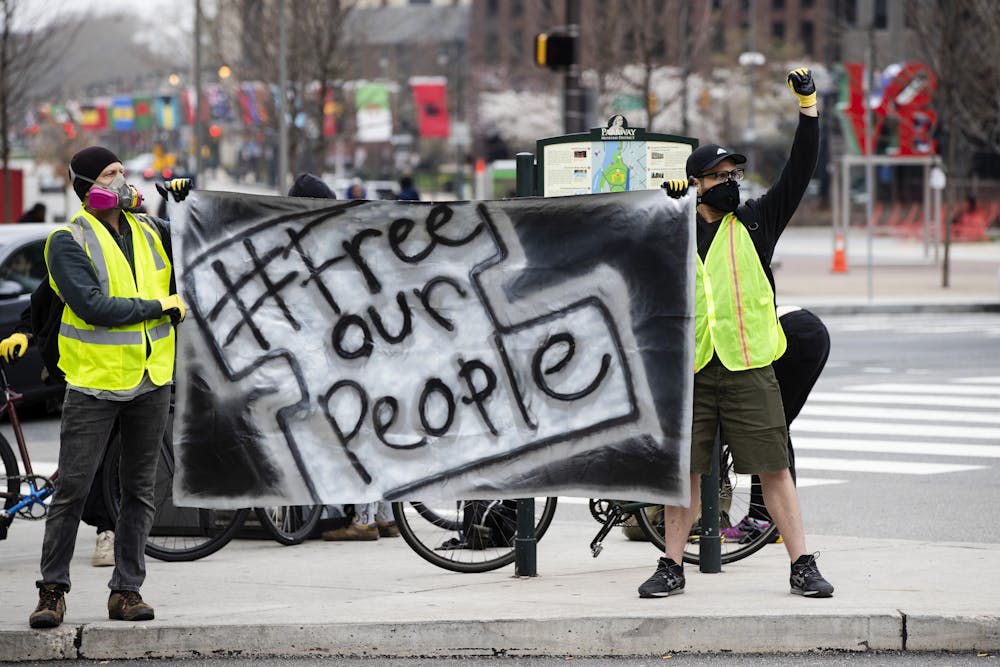
Philadelphia protesters call for officials to release people from jails, prisons and immigration detention centers in response to the coronavirus.
States and the federal government look to incarcerated populations to supply labor at a reduced cost, even as it may subject them to risk of harm and even death.
The most visible example of this are the incarcerated who volunteer to fight fires. These firefighters in California are more likely to experience certain injuries, including fractures and dislocations, as well as inhalation of smoke and particulates, when compared to civilian firefighters.
The decision to continue to use incarcerated workers for hazardous work that could expose them to the coronavirus or facilitate the spread within the facility lies with corrections authorities and emergency management officials.
Every day, the number of incarcerated persons and prison workers who have tested positive for COVID-19 grows. In my view, corrections and emergency officials should be doing everything in their power to reduce the impact of the coronavirus on a vulnerable population by following recommended health guidelines.