The key suspect in the killing of a pro-migrant politician has admitted to the gun murder, Germany's interior minister said Wednesday after a special parliamentary commission hearing.
Stephan Ernst, 45, a far-right militant with previous convictions, is in custody for the assassination-style murder of local politician Walter Luebcke on June 2.
Speaking after the parliamentary hearing, Interior Minister Horst Seehofer said the "suspect has confessed" to the killing and "said he acted alone."
Investigators are now looking into whether others may have known of Ernst's plans or even collaborated with him.
"We will also examine intensively in which circles he moved recently and in the last years," said Seehofer.
"Therefore the clarification of this political murder is not over."
The killing has deeply shaken Germany, and raised questions about whether the country has failed to take seriously a rising threat from neo-Nazis.
"It is now clearly confirmed that there is a far-right background," Greens interior affairs expert Irene Mihalic told AFP after the parliamentary hearing.
The burning question is which network Ernst was linked to, and "whether this was tied to the NSU". If so, "then part of the history of the NSU would need to be rewritten".
The far-right militant group National Socialist Underground (NSU) killed nine Turkish and Greek-born immigrants and a German policewoman from 2000 to 2007, and carried out bomb attacks and bank robberies.
Chancellor Angela Merkel's CDU party has laid partial blame for Luebcke's killing on the far-right party AfD, saying it contributed to inciting extremist hatred.
Luebcke was an outspoken defender of Merkel's decision to welcome refugees and in 2015 drew the wrath of right-wing extremists by telling Germans who objected that they could leave the country.
Railing against migrants, the AfD scooped around 13 percent of the vote in 2017 general elections, becoming the biggest opposition party in parliament.
Global cocaine production reached an all-time high in 2017, breaking the previous year's record by 25 percent, the UN drugs and crime agency said Wednesday in its annual report, as production soars in post-conflict Colombia.
New remote fields and criminal gangs boosted production in the world's top supplier, despite efforts to steer rural communities away from coca cultivation following a peace deal with FARC rebels.
"Of course it's bad news every time. It's bad news for the producing countries... What is happening in Columbia is worrisome," said Angela Me, chief of research of the Vienna-based United Nations Office on Drugs and Crime (UNODC).
The report said the jump in production "was mainly driven by increases in cocaine manufacture in Colombia, which produced an estimated 70 per cent of the world's cocaine".
In the decade to 2017, there was a 50 percent increase in manufacture, reaching a record 1,976 tons two years ago, according to the report, which bases its figures on national monitoring systems.
Over the same 10-year period, the amount of cocaine seized worldwide rose by 74 percent.
AFP / Luis ROBAYO Colombia has also seen more coca bush cultivation
In 2017, authorities across the globe intercepted a record quantity of the drug: in all 1,275 tons were seized, up 13 percent year-on-year.
"This suggests that law enforcement efforts have become more effective and that strengthened international cooperation may be helping to increase interception rates," the report said.
Almost 90 percent of seizures were in the Americas, with Colombia alone intercepting 38 percent of the global total in 2017.
Cocaine production in some central areas of Colombia dropped following the 2016 peace deal with the former Revolutionary Armed Forces of Colombia, or FARC, as farmers were offered alternatives to growing coca bush.
But the report said Colombia has since seen more coca cultivation, with new fields -- often far away from major cities -- being planted and criminal groups moving into areas previously controlled by the rebels.
- Opioid crisis worsening -
The report gave 2018 figures for global opium production, which had soared to a record in 2017.
It said drought in Afghanistan had helped spur a drop in output by 25 percent to some 7,790 tons in 2018, adding that previous years' overproduction had likely also knocked prices.
UNODC also sharply hiked its estimates of how many people suffer from drug use disorders and need treatment, after it ran surveys in populous India and Nigeria.
Globally some 35 million people were affected in 2017, some 4.5 million people more than previously estimated, UNODC said.
"A lot more people need treatment than we previously thought... Six out of seven don't receive the treatment they need," Me said, adding the organisation could revise its numbers again were it given access to data from China.
dpa/AFP / Christian Charisius There was also a record quantity of cocaine seized globally
North America's opioid crisis also reached new heights in 2017 with more than 47,000 opioid overdose deaths in the United States, the report said.
UNODC estimates that there were 53.4 million opioid users worldwide in 2017, up 56 percent from the 2016 estimate due to the surveys from India and Nigeria.
While fentanyl and its analogues remained the key problem in North America, tramadol is besetting West, Central and North Africa.
Global seizures of the synthetic opioid surged from less than 10 kilogrammes in 2010 to almost nine tons in 2013 and a record 125 tons in 2017.
Cannabis remains the most widely used drug worldwide with an estimated 188 million people using it, the report said.
France's Mirazur restaurant -- whose Argentine chef Mauro Colagreco draws inspiration from the sea, the mountains, and his own garden -- was crowned Tuesday the world's best by an influential trade list, beating contenders from Denmark and Spain.
The accolade came just months after Colagreco was handed a third Michelin star, and was the first time a French establishment has triumphed in the World's 50 Best Restaurant list.
"I'm in the sky and I'm waiting to come back here," Colagreco said as he collected his award for his restaurant in the French Riviera town of Menton. "I don't have words to explain," he said.
In second spot in the awards -- which took place in Singapore, their first time in Asia -- was Noma in Copenhagen, and third was Asador Etxebarri in Spain.
Gaggan in Bangkok was fourth, the highest ranked Asian restaurant. Fifth was Geranium in Copenhagen, and sixth was Central in Lima, tagged as Best in South America.
The top restaurant award has gone to Spain seven times, the most of any country. Last year Italy's Osteria Francescana took the number one spot.
Mirazur took the third spot in the awards last year.
- 'Feet on the ground' -
AFP / Theodore LIM The Argentine-born chef-owner of Mirazur, Mauro Colagreco (L) and his wife Julia show their gratitude after winning the top restaurant award
After his victory was announced, Colagreco took to the stage joined by his Brazilian wife carrying a banner representing four flags -- those of Argentina, Brazil, France and Italy.
"Thank you my team. You deserve it, all these years. Thank you friends for supporting us during these last 13 years," he said.
Colagreco is the only foreign chef to have been awarded three Michelin stars. He opened the restaurant in 2006 and was awarded his first star the following year, before getting his second in 2012.
The Argentine-born chef moved to France in 2001 and worked with Bernard Loiseau, Alain Passard and Alain Ducasse before spending a year at Le Grand Vefour.
He said that he ended up in Menton by chance.
"The owner of the place was the perfect stereotype of an Englishman on the Cote d'Azur, a white linen outfit and a Panama hat," he told AFP in a recent interview.
"He saw that I had no money but he wanted to know what an Argentine was doing in Menton... He rented me his restaurant for a ridiculous sum."
This "gave me a lot of freedom" to experiment, he said.
The early days were tough but since being awarded the second star the restaurant has seen its popularity grow.
Mirazur, located in southeast France near the Italian border, offers dishes made with ingredients from Colagreco's own backyard farm, including fresh vegetables and seafood.
Despite his growing fame, Colagreco said that he wants to "keep his feet firmly on the ground."
- First time in Asia -
AFP / Theodore LIM Mirazur chef-owner Mauro Colagreco (C), flanked by his team, said he was "in the sky" after his restaurant was crowned the world's best
For their first foray into Asia, award organizers picked Singapore, which is well-known for its buzzing culinary scene.
But Europe continued to dominate with 25 restaurants named in the best 50, including seven in the top 10. Asia won seven, the United States six, and Latin America six.
The awards are organized by British magazine Restaurant, owned by William Reed Media.
They were launched in 2002 and are now as coveted as Michelin stars, although the methodology used to select the best restaurants has faced criticism, especially from several French chefs who say it remains unclear.
There are no criteria for putting a restaurant on the list, which is based on an anonymous poll of more than 1,000 chefs, restaurant owners, food critics and other industry insiders from around the world.
Each member gets 10 votes and at least four of those votes have to go to restaurants outside their region.
The event has been held before in Spain, London, New York and Melbourne.
President Hassan Rouhani said Iran "never seeks war" with the US, state media reported Wednesday amid a spike in tensions between the two countries.
"Iran has no interest to increase tension in the region and it never seeks war with any country, including (the) US," the president said, quoted by state news agency IRNA.
Rouhani was speaking by phone to his French counterpart Emmanuel Macron, as Tehran and Washington engaged in an escalating war of words following Iran shooting down a US drone last week.
"We have always been committed to regional peace and stability and will make efforts in this respect," the Iranian president told Macron.
US President Donald Trump said he pulled back from retaliatory strikes on Iran at the last minute, rejecting Tehran's claim that the aircraft was in its airspace.
But pressure mounted this week with Trump announcing sanctions on Iran's supreme leader and top officials.
The new measures are the latest against Tehran since Trump pulled out of a landmark nuclear accord between Iran and world powers.
Rouhani blamed the United States for regional tensions Wednesday and said if Washington had stuck to the deal "we would have witnessed positive developments in the region".
Iran announced in May it would suspend two of its pledges under the 2015 deal, giving the agreement's remaining supporters two months to help it circumvent US sanctions.
On Tuesday Tehran's top security official said Iran would "forcefully" reduce further commitments from July 7.
First daughter and senior White House advisor Ivanka Trump was mercilessly ridiculed on Tuesday after praising the so-called "peace plan" for the Middle East created by her husband, Jared Kushner.
The couple, known as Javanka, have been highly criticized for having had no government experience prior to joining the administration and needing presidential intervention after being unable to obtain security clearances.
Ivanka tweeted a quote from her husband at the "Peace to Prosperity workshop today in Bahrain" and urged her Twitter followers to watch his full speech.
Kushner's plan was rejected by the Palestinians before even being released.
Here is some of what people were saying about the Ivanka and Jared:
The Palestinian leadership should sign on to the US economic development plan and worry about their political status later, Hebrew University of Jerusalem Historian Gaudi Taub told FRANCE 24.
Palestinians are wrong to reject the $50 billion US blueprint to rebuild the Palestinian economy, which US Presidential advisor and son-in-law Jared Kushner said is a precondition to peace in the region, Taub said.
“This is five times more than what it took to reconstruct Japan after World War II,” he said. “If they stop sinking money into terror tunnels and corruption, they can have Singapore in Gaza.”
Taub contended that, despite what they say, the Palestinians are not truly interested in statehood. “I think they’re not completely honest about it because in our world of moral kitsch, where victimhood is moral justification for everything, I think the one asset the Palestinians are not willing to give up is their misery,” he said. “They have a leadership that is keeping them at a state of perpetual victimhood.”
In Taub’s view, the Palestinian approach isn’t practical. “If it was Zionism we would have taken the money, built stuff with it, and then tried to move on to other goals, not give it up in advance,” he said. “[Zionist pioneer David] Ben-Gurion would have taken the money and then demanded a state.”
Former Smiths singer Morrissey explained in an interview that he couldn't possibly be a racist because everyone else is racist.
Morrissey came out for the anti-Islam political party in England, and has run into problems about his political claims ever since. As noted by Consequence of Sound, "it doesn’t help that he says thing like Halal certifiers support ISIS, of course."
He made the comments as part of an interview with his own nephew Sam Etsy Rayner, for Moz’s website.
“I think [For England leader] Anne Marie Waters is the only British party leader who can unite the left and right. I don’t know any other party leader who even WANTS to do this,” Morrissey said, before admitting he knows nothing about any other party. “The UK is a dangerously hateful place now, and I think we need someone to put a stop to the lunacy and to speak for everyone. I see Anne Marie Waters as this person.”
But then he proclaimed the opposite, saying he can speak for everyone when it comes to race.
“If you call someone racist in modern Britain you are telling them that you have run out of words. You are shutting the debate down and running off," Morrissey said. "The word is meaningless now. Everyone ultimately prefers their own race ... does this make everyone racist? The people who reduce every conversation down to a matter of race could be said to be the most traditionally ‘racist’ because everything in life is NOT exclusively a question of race, so why make it so? Diversity can’t possibly be a strength if everyone has ideas that will never correspond. If borders are such terrible things then why did they ever exist in the first place? Borders bring order.”
The interview comes just a month after rambling comments about his support for England, while admitting he has "never voted for anyone in my life."
The captain of the Sea-Watch 3 charity rescue vessel threatened Tuesday to enter Italian waters illegally to bring 42 migrants to shore after they spent 13 days in limbo at sea.
Interior Minister Matteo Salvini has banned the Dutch-flagged vessel from approaching under a "closed ports" policy, which has seen migrants repeatedly stranded at sea.
"I will enter Italian waters and bring them to safety on Lampedusa," Carola Rackete said in an interview with La Repubblica daily, in reference to Italy's southernmost island.
The European Court of Human Rights (ECHR) in Strasbourg on Tuesday declined to intervene but called on Italy to "continue to provide all necessary assistance" to vulnerable migrants.
The German NGO Sea-Watch had asked the ECHR to impose "interim measures" on Italy, saying the court could ask Rome to take urgent steps to resolve the standoff in order to "prevent serious and irremediable violations of human rights".
Salvini said Tuesday the charity vessel could "stay there until Christmas and New Year" but would never be allowed in.
Of the 53 migrants initially rescued by the Sea-Watch 3 off Libya on June 12, Italy took in 11 vulnerable people.
"That's enough! Whatever Strasbourg tells us, with great serenity we will maintain our position," Salvini said.
"Imagine if a country like Italy -- the second-largest industrial power in Europe -- let an NGO dictate immigration rules," he said.
On Lampedusa, where Salvini's far-right League won 45 percent in May's European elections, a priest has camped in the street to demand those on board -- including three minors -- be allowed to disembark.
Dozens of German cities have said they are ready to welcome them, and the Bishop of Turin, Cesare Noviglia, said Monday his diocese would be willing to take them in.
"We can't hold on any longer. It's like we're in a prison because we are deprived of everything. Help us, think of us," one migrant from the Ivory Coast said in a video broadcast by Sea-Watch.
In January, 32 migrants rescued by the vessel were stranded on board for 18 days before they were allowed to disembark in Malta thanks to a distribution deal made between several European countries.
Mexico's president said Tuesday the 15,000 troops his government has deployed to the US border do not have orders to stop migrants from crossing, and vowed to investigate a controversial detention last week.
"No such order has been issued, and we are going to review that case, so that it doesn't happen again, because that's not our job," President Andres Manuel Lopez Obrador told a press conference.
He made the comment after an AFP journalist's images of heavily armed National Guardsmen forcibly detaining two women and a young girl at the edge of the Rio Grande river triggered backlash in Mexico, whose government faces pressure from US President Donald Trump to slow a surge of Central American migrants.
The statement contradicts what Lopez Obrador's own defense minister said Monday in a joint press conference with the president.
Asked whether the National Guardsmen and army troops recently deployed to Mexico's northern border were detaining migrants to prevent them from crossing, Defense Minister Luis Cresencio Sandoval replied: "Yes."
"Given that (undocumented) migration is not a crime but rather an administrative violation, we simply detain them and turn them over" to immigration authorities, Sandoval added.
However, Lopez Obrador insisted Mexican forces were not there to detain migrants who try to cross the border.
"Those are not the instructions they have. They are not there to do that job. That is the work of the migration authorities, not the army," he said.
"We are going to deal with this matter so that no abuses are committed."
However, he added: "We have to avoid a confrontation with the government of the United States."
Lopez Obrador, an anti-establishment leftist who came to office in December vowing to protect migrants' rights, has been pushed into a more hardline stance by Trump, who threatened last month to impose tariffs on all Mexican goods if the government did not do more to slow migration.
After a week of tense negotiations in Washington, the two sides announced a deal on June 7 in which Mexico agreed to reinforce its southern border with 6,000 National Guardsmen and expand its policy of taking back migrants while the US processes their asylum claims.
Stars are born when huge clouds of dust and gas collapse in on themselves and ignite. These clouds are made up of raw elements, like oxygen and titanium, and each cloud has a unique composition that imprints on the star. And within the stellar afterbirth – from the material that didn’t find its way into the star – planets are formed.
Finding planets orbiting distant stars, or exoplanets, is difficult. There are tried and true methods that involve using large telescopes to detect these tiny objects. But I’ve developed a faster and more powerful strategy for planet hunting that is based on the chemistry of the star. I am a planetary astrophysicist. Admittedly, this is a title that I made up because I wanted something that actually described what I do. I study the elements within stars, their patterns, and how they are connected to planets.
I created an enormous database of stars and their elemental compositions. Some of those stars have planets orbiting them; others don’t. When a star has an orbiting planet, it could be the smaller rocky type, a large gas one, or both. However, not every star can have a giant Jupiter-sized planets – since these planets require a huge amount of elements and materials to form.
Together with a small team of researchers from Arizona State University, University of California, Riverside, Vanderbilt University and New York University, I used software that searches for complex patterns within stellar data to figure out which stars are likely to have planets orbiting them based only on the star’s chemical composition.
Now, instead of looking through huge all-sky telescope surveys hoping to find a signature of a planet, my team can fast-track the discovery and characterization of planets by analyzing the composition of their host stars. Of the 4,200 stars that we analyzed, we found that approximately 360 stars have a greater than 90% chance of hosting a giant planet. Now we are working to get time on a telescope to test our predictions.
Stars and planets are chemically linked to one another, since they both form within the same molecular cloud. The raw ingredients within the planet ultimately creates an environment that’s ‘alive’ and conducive to life – or not.
The algorithm we developed uses the chemical composition of stars that we know have orbiting giant planets to determine which combination of elements – or chemical fingerprint – is common to stars that host planets. My team then used this algorithm to look at the chemistry of stars not known to have planets to provide a prediction score that a star is likely to host a planet.
This is the logo for the Hypatia Catalog showing an artist depiction of Hypatia. Some of the most important elements in stars are listed along the outside.
Light shines from the interior of a star and is absorbed by atoms in its upper layer, creating a stellar spectra. The absorbed wavelengths reveal what type of elements from the periodic table are present. Using a technique called spectroscopy, scientists are able to measure the light from the star and measure the amount, or abundance, of those elements. I compiled the largest catalog of elements in nearby stars in the Hypatia Catalog. I named it to honor one of the first known female astronomers who was a powerhouse in 400 A.D.
I use the Hypatia Catalog to understand planets from a more chemical or compositional perspective. Each star is made up of different combinations and quantities of elements, which is reflected in the planets orbiting the star. There can be a huge variety in the chemical composition of planets from their interiors to their surfaces.
Physically detecting exoplanets
There are two primary techniques for finding or detecting exoplanets.
The first is the “radial velocity” technique, which detects when a star wobbles in the presence of a planet with a strong gravitational force.
Another strategy is to look for a “blip” in the light a star emits, which happens when a planet moves in front of the star (with respect to the Earth) and actually dims the stellar light. Both of these methods look for ways that the planet influences the star. However, it’s difficult to detect planets because they are so small compared with their star – it would be like trying to observe a person being influenced by a raindrop.
The radial velocity and “blip” methods look at the physical relationship between a star and a planet. These are important because they determine the temperature, orbit and dynamics that exoplanet scientists use to define whether a planet may be habitable. However, none of these detection methods take into account what the star and planet are made of. And yet, understanding the composition of the planet is vital to predicting whether it is habitable.
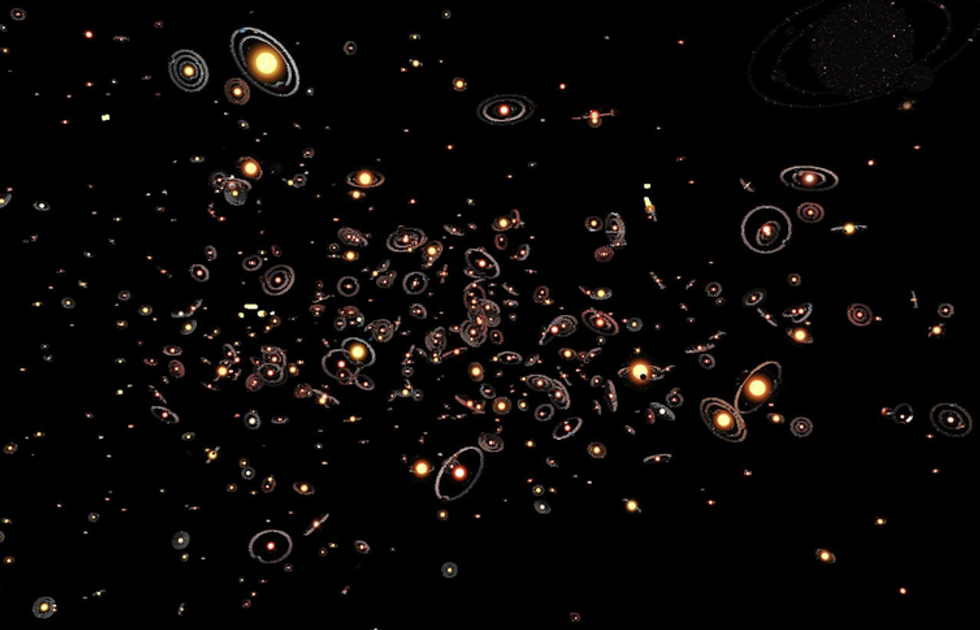
An artist’s impression of how common planets are around the stars in the Milky Way. The planets, their orbits and their host stars are all vastly magnified.
The planet Earth is “alive” – it moves and shifts in a complex way. The surface conditions, like temperature and weather, are maintained by relying on the movement of the continents, for example by plate tectonics. The cycling of different elements or molecules, like the oxygen-carbon dioxide cycle, helps organisms breathe. In order for exoplanets to truly be habitable for life, basic elements must be present within the planet to make sure that these key processes happen.
We exoplanetary scientists don’t currently have the technology to directly observe the surface or interior of a planet outside of our Solar System. This is partially because planets are so small compared to their star, so we’d need high-powered telescopes. It is also because planets don’t shine or emit their own light.
Therefore, my colleagues and I use the stellar composition as a proxy for the planet’s makeup. The algorithm that we developed is a unique one, because it looks at the elemental link between a star and its planet from the very beginning. This makes the approximately 360 likely giant planet host stars we found even more remarkable, because they were identified by the chemical fingerprint.
As part of this research published in The Astrophysical Journal, we studied a variety of different elements, up to 16 at a time. We wanted to see how those elements influenced each other and which were the most important for planet detection and possible formation.
We found that carbon, oxygen, sodium and iron were the most important elements when predicting that a star had a giant planet. Carbon, oxygen and iron are all very important elements when it comes to building rocky and or gas planets. However, we were surprised to discover that sodium also seemed to be a critical ingredient of stars that form giant planets. Sodium is not considered to be a major planet-forming element within the Solar System.
For practical reasons we didn’t use the algorithm to look at Earth-like planets. Rather we focused our study, and trained our algorithm, on big gaseous planets where humans couldn’t survive. Most of the exoplanets that astronomers have discovered to date have sizes similar to Neptune or Jupiter because they are easier to detect.
However, as new missions like TESS and CHEOPS discover smaller, Earth-sized planets, we will have more data with which to train the algorithm to look for rocky planets like Earth.
Natalie Hinkel, Planetary Astrophysicist, Senior Research Scientist at the Southwest Research Institute and Co-Investigator for the Nexus for Exoplanet System Science (NExSS), Arizona State University
Coral reefs are home to so many species that they often are called “the rainforests of the seas.” Today they face a daunting range of threats, including ocean warming and acidification, overfishing and pollution. Worldwide, more than one-third of all coral species are at risk of extinction.
I am one of many scientists who are studying corals to find ways of helping them survive and recover. As a recent report from the National Academies of Science, Engineering and Medicine shows, researchers are exploring many different strategies. Some, such as managed breeding to make corals more tolerant of stresses, are already being developed at small scales. Others, such as moving corals to colonize new areas, have not been tested yet.
My own work examines whether greater diversity of coral species on reefs can help corals survive and thrive. In a study published earlier this year, my colleague Mark Hay and I found evidence that the answer is yes. This finding could help to inform broader strategies for making coral reefs more resilient in altered oceans.
Until recently, no one had applied this test to coral reefs. But we do know that healthy coral reefs are diverse, structurally complex ecosystems dominated by corals. In contrast, reefs that have been damaged by stresses such as coral bleaching events tend to become simplified, less diverse landscapes, often dominated by seaweeds.
For our study we chose a reef area on the southwestern coast of Fiji’s main island, Viti Levu, in the South Pacific. Many reefs along this coast have been heavily degraded by overfishing and other human-related activities, reducing coral cover and allowing seaweeds to dominate.
There are hundreds of coral species across the Pacific, but at smaller scales, we found just five species or fewer during preliminary surveys conducted on the degraded reef at our site. Since these conditions mirror what is happening to many reefs worldwide, we saw it as an ideal place to test whether coral diversity matters for the “new normal” that we expect to see on reefs of the future.
Coral reefs stressed by overfishing can rapidly become dominated by seaweeds. Some types of seaweed produce chemicals that repel coral and fish larvae, which may prevent degraded reefs from recovering.
Underwater gardens
Our team created 48 concrete plots on the seafloor of the degraded reef, which served as the bases for experimental coral gardens. We created single-species gardens that each contained one of three coral species – Pocillopora damicornis, commonly known as cauliflower coral; Porites cylindrica, also known as yellow finger coral; and Acropora millepora, one of a number species known as staghorn corals. We also planted mixed gardens containing all three species.
We chose these corals because they are common to reefs across the Pacific and are representative of different coral families that have shown varying responses to a variety of harmful disturbances. In all, each garden contained 18 coral individuals, for a total of 864 corals.
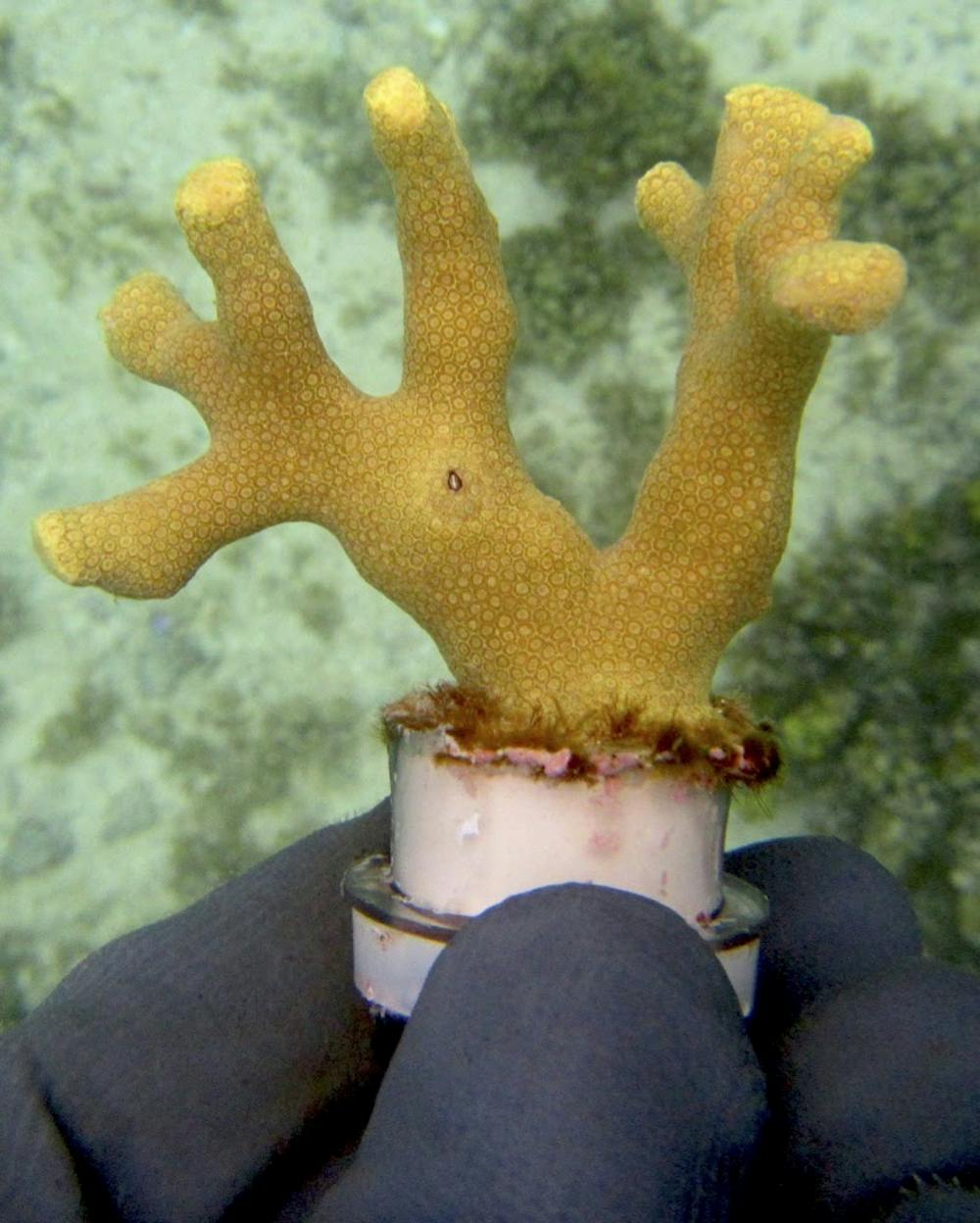
A Porites cylindrica coral planted in our experimental gardens. Each coral was embedded within an upside-down soda bottle neck using epoxy, which allowed us to easily attach or remove them from the garden plots.
To assess each coral’s performance as it grew, we needed to remove them from their plots periodically. So we cut off the tops of hundreds of soda bottles and planted an individual coral in the upside-down neck of each bottle with epoxy putty. We embedded the bottle caps into our concrete slabs so that we could easily unscrew each bottle neck to examine the coral it held, then screw it back into its base. Over 16 months we weighed the corals and tracked other measures of their well-being, including tissue death and colonization of each garden by harmful seaweeds.
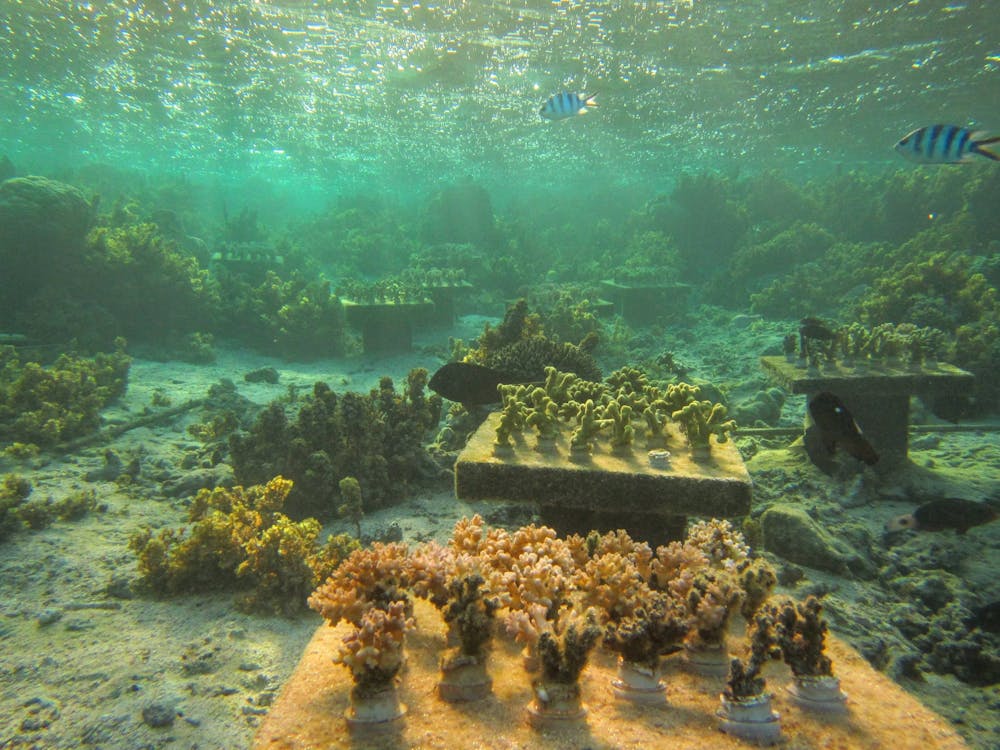
Experimental coral gardens on a degraded reef in Fiji. Gardens with a mix of coral species performed better than gardens containing only one species.
We consistently found that corals grown in mixed-species gardens performed better than those in single-species plots. Within four months, coral growth in the mixed-species gardens was even exceeding the best-performing single-species gardens. This suggests that different species may benefit each other in yet unknown ways, at least during early stages of a coral community’s development.
Examples of single- and mixed-species coral gardens through time during our 16-month experiment. At four months, mixed-species gardens were outperforming single-species gardens in multiple ways – growing faster on average than even the best performing single-species gardens (Acropora millepora). By 16 months, growth was comparable between mixed-species and Acropora gardens, but aggregate performance of single-species gardens continued to lag behind their mix-species counterparts.
Our initial findings offer both concern and hope for the future of coral reefs. If diversity is integral to coral well-being, then continued species loss could dramatically alter these ecosystems in ways that lead to further reef decline. How many parts can be removed from the “ecosystem engine” before it breaks down?
That said, many of the strategies in the National Academies report involve using biodiversity – both at the genetic and species level – to enhance coral reef resilience. Examples include cross-breeding corals between populations; altering coral genes to give them new functions, such as higher heat tolerance; and moving stress-tolerant corals or coral genes to new locations.
Promising advances in technology, such as mapping coral reefs from the air, may also help researchers assess coral health and determine which species they contain. This baseline information may help better inform management and restoration efforts.
Corals are in trouble, but they aren’t down for the count yet. Perhaps harnessing the power of their remaining biodiversity can help give them a fighting chance.
Iran vehemently responded Tuesday to new US sanctions against its leaders, saying they showed Washington was "lying" about an offer of talks and marked the end of diplomacy with the Trump administration, amid an escalating regional standoff.
Washington blacklisted Iran's supreme leader Ayatollah Ali Khamenei and top military chiefs on Monday, saying it would also sanction Foreign Minister Mohammad Javad Zarif later in the week.
"At the same time as you call for negotiations you seek to sanction the foreign minister? It's obvious that you're lying," Rouhani said in a meeting with ministers, broadcast live on TV.
His comments came as US National Security Advisor John Bolton, on a visit to Iran's arch-enemy Israel, said Washington had "held the door open to real negotiations" but that "in response, Iran's silence has been deafening".
Iran and the US broke off diplomatic relations in 1980 over the hostage crisis at the US embassy in Tehran following Iran's Islamic revolution.
Tensions between them have been escalating since US President Donald Trump unilaterally withdrew last year from a landmark 2015 nuclear deal with Iran and reimposed sanctions on the Islamic republic.
US AIR FORCE/AFP/File / HandoutT ehran insists that a US Global Hawk surveillance drone was within its airspace when it was shot down, a claim the US denies
Trump has since moved to choke Iran's economy, blacklisted Iran's Revolutionary Guards as a "terrorist organisation" and nearly launched a military strike in retaliation to Iran downing a US spy drone.
Zarif said the drone had violated Iranian airspace, a claim the US denies. But Russia, a key ally of Tehran, on Tuesday backed Zarif's version of events.
Washington has also blamed Iran for mid-June attacks on two tankers in sensitive Gulf waters, a claim Iran hotly refutes.
Trump has said he is ready to negotiate with Iran "with no preconditions" and that Iran could have a "phenomenal future".
"We do not ask for conflict," he said, adding that depending on Iran's response, sanctions could end tomorrow or "years from now."
But Iran's Foreign Ministry spokesman Abbas Mousavi said Tuesday that the new sanctions meant "permanent closure of the path to diplomacy with Trump's desperate government."
Rouhani also mocked the logic of blacklisting the supreme leader, who has few assets and no plans to visit the US.
"To sanction (the supreme leader) for what? Not to travel to America? That's cute," he said.
- Diplomacy over? -
Rouhani noted that there had been chances for talks between the two sides.
Zarif met former US secretary of state Rex Tillerson several times before Washington unilaterally withdrew from the nuclear deal in May 2018 and reimposed sanctions on Iran.
"You do not seek to negotiate. If you did, we could have," Rouhani said.
Iranian presidency/AFP / HO Iranian President Hassan Rouhani has accused the US of "lying" by claiming it had offered new talks with Iran
Zarif, a political moderate, was a key architect of the deal under which Iran agreed to curb its nuclear programme in exchange for sanctions relief.
But both he and Rouhani have accused Washington of waging an "economic war" on Iran since pulling out of the accord.
Tehran has threatened to scale down some of its commitments under the deal unless the remaining international parties -- the Britain, China, France, Russia and Germany -- help it circumvent US sanctions, particularly through vital oil exports.
But US Secretary of State Mike Pompeo said Monday he was working to build what he called a "global coalition" against the Islamic republic.
AFP / Olivier LEVRAULT Map showing Tehran's and Washington's differing locations of a US drone when it was downed by Iran
Amid a flurry of diplomatic activity, the UN Security Council issued a unanimous call for dialogue to address the standoff between the United States and Iran.
China on Tuesday urged "calm and restraint" as tensions grew.
"We believe that blindly applying maximum pressure will not help solve the problem," said Chinese foreign ministry spokesman Geng Shuang at a press briefing in Beijing.
"Facts have proved that these measures have had the opposite effect and aggravated regional unrest," he added.
French President Emmanuel Macron said he would use a meeting with Trump at the G20 summit in Japan to urge "a constructive solution with the aim of ensuring collective regional security."
NATO will this week decide how to respond to Russia's violation of a key Cold War arms treaty, alliance chief Jens Stoltenberg said Tuesday, insisting any measures would be defensive.
The Intermediate-Range Nuclear Forces (INF) treaty is expected to formally collapse on August 2 after both Russia and the US pulled out, dealing a blow to international arms control efforts.
Stoltenberg said there was "no indication" the Kremlin was prepared to destroy a missile system the West says breaches the INF and so NATO defence ministers will use talks on Wednesday and Thursday to agree countermeasures.
"Our response will be defensive, measured and coordinated. We will not mirror what Russia does," Stoltenberg told reporters, saying NATO did not intend to deploy new land-based nuclear missiles in Europe.
"We do not want a new arms race, but as Russia is deploying new missiles, we must ensure that our deterrence and defence remains credible and effective."
After years of complaining to Russia about the 9M729 ground-launched cruise missile system, the US announced in February it would pull out of the INF in August unless Moscow backed down.
NATO's 29 allies have unanimously backed Washington's assessment that the nuclear-capable missile violates the 1987 treaty, which banned ground launched missiles with a range of 500 to 5,500 kilometres (300 to 3,400 miles).
Diplomats say that rather than simply agreeing with the US, several allies have carried out their own independent investigation and reached the same conclusion themselves.
A meeting of the NATO-Russia Council has been called next week as a last-ditch bid to persuade Moscow to abandon the missiles and save the treaty.
"We call on Russia to take the responsible path," Stoltenberg said.
"But unfortunately, we have seen no indication that Russia intends to do so. In fact, it continues to develop and field the new missiles."
After long denying the existence of the missile system, Russia now insists it complies with the INF and accuses the US in turn of violating the accord.




 AFP / Luis ROBAYO
  dpa/AFP / Christian Charisius
  AFP / Theodore LIM
  AFP / Theodore LIM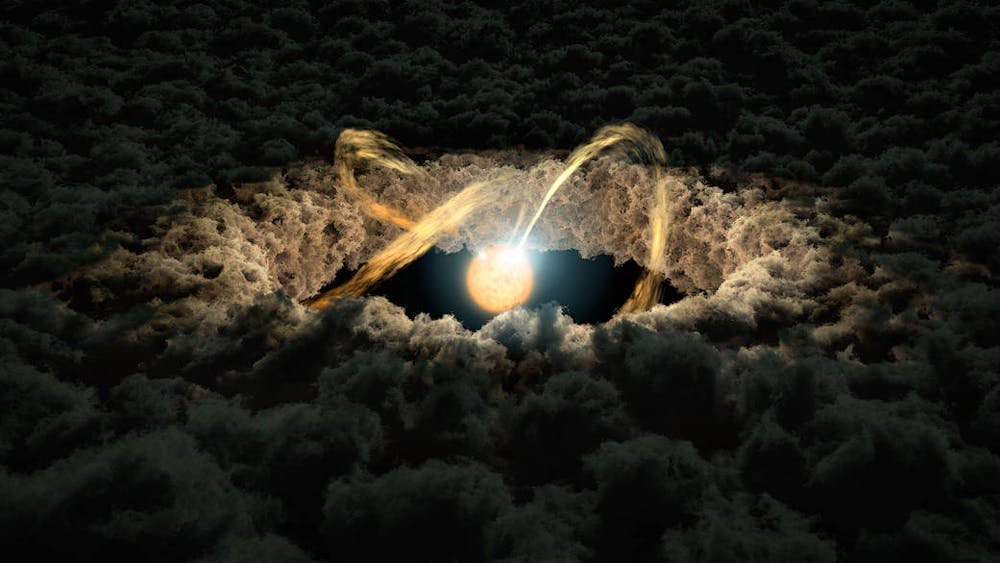




 US AIR FORCE/AFP/File / Handout
 Iranian presidency/AFP / HO
  AFP / Olivier LEVRAULT